







Abstract
This study investigates the impact of advanced explicit phonics and spelling instruction on the oral reading fluency of highly skilled first-grade readers, filling a gap in the literature. While the necessity and enjoyment of phonics instruction for this population are debated, evidence suggests benefits for students with high phonemic awareness and alphabet knowledge. Using a single-case multiple-baseline across-subjects design, six students participated in daily 30-min interventions over an 8-week period. Data-based decision-making was used to group students, identify instructional targets, monitor progress, and determine the need for decoding or spelling review. Results showed gains in oral reading fluency for all students, with greater growth among those with more advanced decoding and spelling skills. Both the instructor and students viewed the intervention favorably. This study offers preliminary evidence that advanced explicit phonics and spelling instruction can be enjoyable and improve student outcomes, with implications for early enrichment and data-based differentiation.
Plain Language Summary
This study explored whether advanced phonics and spelling lessons could help highly skilled first-grade readers become even more fluent. While some question the value of phonics instruction for students who are already strong readers relative to grade-level standards, research suggests that children with robust early literacy skills—like recognizing sounds in words and knowing letter patterns—can still benefit from instruction that is targeted and appropriately challenging. Nevertheless, questions remain about the effectiveness of such instruction. Six first-grade students participated in the study, receiving 30-min daily lessons over 8 weeks. These lessons focused on advanced phonics and spelling concepts that the students had not yet fully mastered. Instructional decisions—such as how to group students, what to teach, and when to review—were guided by ongoing analysis of student data. All students demonstrated improvements in their oral reading fluency, with the most significant growth seen in those who started with stronger decoding and spelling skills. Both the teacher and the students reported enjoying the lessons and finding them valuable. Overall, these findings suggest that advanced phonics and spelling instruction can be both effective and engaging for young, highly skilled primary readers. This approach may offer a promising way to provide early enrichment and targeted support for students who are ready for more challenging literacy instruction but have not yet fully mastered foundational skills.
Introduction
Despite a substantial body of research dedicated to preventing and remediating reading difficulties, comparatively less attention has been directed toward the proactive, data-driven enrichment of students exhibiting advanced early literacy skills. This gap in the literature underscores an urgent need to develop and implement evidence-based models to support the sustained academic growth of highly skilled readers. Incorporating decoding and spelling instruction into enrichment frameworks for highly skilled primary readers represents a critical, yet underexplored, area within the broader discourses of gifted education and early literacy instruction.
Defining Highly Skilled Readers: Theoretical Perspectives
A clear theoretical framework is essential for differentiating instruction for highly skilled readers. Research indicates that advanced linguistic capacities—particularly phonemic awareness and decoding proficiency—are more strongly correlated with precocious reading development than general cognitive abilities (Papadopoulos et al., 2020). Highly skilled readers exhibit exceptional phonemic awareness, coupled with an adeptness at decoding unfamiliar words both in and out of context (Adams, 1990; Byrne & Fielding-Barnsley, 1989; Jackson et al., 1993; Stainthorp & Hughes, 1998; Stanovich, 1981, 1992; Stanovich et al., 1984). In addition, they demonstrate strong oral language capabilities and a robust understanding of the writing system (Nation, 2019). Thus, highly skilled readers are characterized by strong word recognition and language comprehension, resulting in advanced reading comprehension relative to age and grade-level expectations.
This operational definition of highly skilled readers is grounded in the Simple View of Reading (SVR; Gough & Tunmer, 1986), a theoretical framework supported by extensive empirical validation across more than 150 studies (e.g., Hoover & Gough, 1990; Kilpatrick, 2020) in multiple countries and languages. The SVR posits that reading comprehension is the product of two interdependent competencies: word recognition, including accurate decoding and automaticity, and language comprehension, including oral language skills like vocabulary, syntax, and semantics. These competencies apply across reading levels, text types, and expertise (Hoover, 2023), explaining 94%–100% of the variance in reading comprehension (Chiu & Language and Reading Consortium, 2018; Lonigan et al., 2018). The interaction between these essential components is multiplicative (Hoover & Gough, 1990), such that weaknesses in one domain constrain overall reading ability (Petscher et al., 2020). For highly skilled readers who excel in word recognition and language comprehension, continued growth in both competencies optimizes students’ ability to comprehend increasingly complex texts.
The dual-route model of reading further enriches the theoretical foundation for the present study by elucidating the cognitive mechanisms underlying reading acquisition. According to this model, readers process words via two distinct pathways: the lexical route, which facilitates the recognition of familiar words, and the sublexical route, which supports the decoding of novel words through grapheme-phoneme correspondences (Coltheart et al., 2001). Highly skilled readers proficiently utilize both pathways; however, reinforcing the sublexical route through advanced decoding and spelling instruction may improve automatic word recognition, reduce cognitive load, and free cognitive resources for comprehension (Perfetti, 2007). By incorporating insights from the dual-route model, the present study anchors its methodological approach within a robust theoretical framework, emphasizing the crucial role of decoding and word recognition in enhancing reading proficiency.
Challenges of Early Identification and Enrichment
A persistent barrier to supporting highly skilled primary readers is the delayed identification of their advanced abilities. Although some children are identified before or during kindergarten (National Association for Gifted Children, 2008), many gifted screening processes are deferred until the second or third grade. During this interim period, many highly skilled kindergarten and first-grade readers remain in general education classrooms where instructional priorities routinely fail to meet their advanced learning needs (Robertson & Pfeiffer, 2016). This instructional misalignment can contribute to stagnation, impeding these students’ developmental trajectories relative to their same-age peers (Reis & Fogarty, 2020). Moreover, insufficient academic challenge can erode engagement, motivation, and performance, potentially leading to behavioral and social-emotional challenges (Crepeau-Hobson & Bianco, 2013; Rimm et al., 2018). To optimize learning outcomes and mitigate underachievement risks, early identification and targeted, content-based enrichment are essential (Raoof et al., 2024; VanTassel-Baska, 2023).
Frameworks such as Response to Intervention (RtI) and Multi-Tiered System of Supports (MTSS) offer promising solutions for addressing the instructional needs of highly skilled readers (e.g., Berkeley et al., 2020; Brown, 2012; Green et al., 2012; Hughes et al., 2009; Johnsen et al., 2015; McCallum et al., 2013; Rollins et al., 2009). MTSS, in particular, employs a needs-based, asset-oriented approach that facilitates equitable access to tiered enrichment opportunities, enabling educators to deliver differentiated instruction commensurate with students’ strengths and needs (e.g., Dai & Chen, 2013; Lamb et al., 2022; Peters, 2022; Seedorf, 2014). By leveraging data-driven decision-making (e.g., Espinas & Fuchs, 2022) to maximize learning (Dixson et al., 2020), MTSS provides an effective framework for talent development, reducing reliance on traditional gifted services that may be delayed or inaccessible (Nicholas et al., 2024).
Data-Based Decision-Making
Data-based decision-making within MTSS serves as a catalyst for effective literacy instruction, ensuring that teaching remains rigorous, responsive, and targeted to individual learning needs. Through systematic data collection from multiple assessments, educators can identify students’ strengths, target areas for improvement, set measurable goals, and implement empirically supported interventions (Connor et al., 2009, 2011; Deno & Mirkin, 1977). Universal screening, diagnostic, progress monitoring, and outcome assessments provide essential insights that inform instructional decisions (Coyne & Harn, 2006; Morrison et al., 2021). These tools empower educators to make informed decisions tailored to the unique needs of students, thereby maximizing their growth and academic potential (Lindstrom et al., 2019).
Curriculum-based measurement (CBM) is a psychometrically robust assessment methodology that facilitates data-driven decision-making within MTSS by providing objective, reliable indicators of student progress (Deno, 1985, 1989; Fuchs & Fuchs, 2011). Among CBMs, oral reading fluency (ORF) has demonstrated strong predictive validity for reading proficiency (Shinn et al., 1992), prompting researchers to examine its potential for identifying students with advanced early literacy skills. In a large-scale cross-sectional study, McGowan et al. (2016) found that ORF could effectively differentiate gifted students from their typically developing peers. This study, which involved universal screening assessments administered three times annually to students in grades 2 through 5, revealed significant differences in ORF scores between the two groups, reinforcing the utility of CBMs as early indicators of advanced reading development. Notably, although ORF is primarily designed to assess reading accuracy and rate, it correlates strongly with reading comprehension in the early grades (K–3), as fluent readers can allocate more cognitive resources toward constructing meaning from text (Fuchs et al., 2001). Some ORF protocols include retelling components to confirm whether students who read accurately and fluently also understand what they read. Together, these features make an above-benchmark ORF score a useful, though not comprehensive, indicator of overall reading competence.
However, ORF was designed for screening and progress-monitoring, not diagnostic purposes. As such, CBMs like ORF cannot provide detailed information about the specific knowledge and skills a student has mastered or pinpoint their instructional needs. To fully understand the needs of gifted and highly skilled readers—particularly those performing beyond grade-level standards—diagnostic assessments, including above-level measures, are often necessary (LeBeau et al., 2020; Rambo-Hernandez & Warne, 2015; Warne, 2012, 2014). This comprehensive assessment approach enables greater instructional precision, allowing educators to more effectively challenge and support advanced learners.
The Need for Targeted Instruction
Despite their advanced literacy skills, highly skilled readers frequently lack access to targeted instruction that fosters continued growth (Reis et al., 2004; Reis & Fogarty, 2020). Research suggests that general education teachers commonly default to one-size-fits-all instruction, providing the same content for all students (Al Otaiba et al., 2011; Wood, 2008). In primary classrooms, instruction frequently emphasizes basic letter-sound correspondences and decoding simple one-syllable words like “sad” and “dull,” as outlined by the Common Core State Standards (National Governors Association Center for Best Practices & Council of Chief State School Officers, 2010). Although such an approach is effective for many early alphabetic readers (Ehri, 1995, 2014), it fails to address the needs of highly skilled readers who are prepared to engage with more sophisticated phonics concepts—such as vowel teams, complex syllable patterns, and morphological structures—as well as increasingly challenging texts that demand higher levels of decoding and comprehension. Even when provided with scientifically based reading instruction, the performance of advanced students may decline when the instruction is provided via a one-size-fits-all approach (Brighton et al., 2015).
The Case for Advanced Phonics and Spelling Instruction
A preponderance of research substantiates the efficacy of systematic and explicit phonics and spelling instruction for typical and struggling readers (e.g., Brady, 2020; Christensen & Bowey, 2005; de Graaff et al., 2009; Ehri & Flugman, 2018; Foorman & Torgesen, 2001; Johnston & Watson, 2004). The effectiveness of multicomponent interventions, which integrate phonics instruction with other literacy components (e.g., fluency, vocabulary, comprehension), has also been well-documented with older struggling readers (Al Otaiba et al., 2023; Hall et al., 2022). Questions remain about the efficacy of multicomponent interventions for a subset of highly skilled primary readers who have mastered advanced phonics patterns and may benefit more from targeted morphology, vocabulary, and comprehension enrichment. Importantly, preliminary research suggests explicit phonics instruction can benefit students with high phonemic awareness and alphabet knowledge (e.g., Fielding-Barnsley, 1997) and that “explicit phonics instruction can help all children during the early stages of learning to read, but there will be individual differences in the amount of such instruction that is required” (Torgesen, 2002, p. 14). This highlights the need for further exploration into how phonics-based interventions can be refined and adapted to meet the varied needs of highly skilled primary readers.
Although explicit phonics instruction is effective for a wide range of learners, there remains a prevailing counter-narrative within gifted education that questions the necessity of such instruction for highly skilled readers (e.g., Catron & Wingenbach, 1986; Reis & Renzulli, 1989; Wood, 2008; Young, 2024). This viewpoint is predicated on the belief that highly skilled readers will naturally acquire new vocabulary and concepts through extensive reading and self-directed learning. Such a belief echoes the now-debunked whole language theories (e.g., Goodman, 1970; Smith, 1971), which posited that reading could primarily develop through implicit, contextual exposure to language, with minimal need for structured, systematic instruction. Contemporary research has thoroughly refuted this philosophy, emphasizing that foundational reading skills, such as decoding, require explicit, intentional teaching. Despite the weight of this evidence, the misconception that highly skilled readers can thrive through independent activities, such as book reports or silent sustained reading, without teacher-guided instruction, continues to pervade educational practices (Assouline et al., 2015).
In stark contrast to the notion that phonics knowledge can develop solely through exposure, the self-teaching hypothesis (Share, 2025, 2011) posits that explicit instruction in sound-spelling relationships is essential for students to effectively apply these patterns to unfamiliar words. This self-teaching process, while facilitating independent word recognition, depends on the prior mastery of high-prevalence, high-yield phonics concepts through direct instruction. This distinction is critical: while self-teaching fosters the ability to independently decode new words, the foundational acquisition of phonics knowledge through explicit teaching remains an indispensable prerequisite. In light of this, it is essential to reevaluate the role of explicit, advanced decoding instruction, particularly for highly skilled primary readers.
The question of when explicit phonics instruction should give way to more implicit learning, driven by self-teaching (Share, 2011) and statistical learning (Arciuli, 2018; Seidenberg & McClelland, 1989), remains an important area for continued investigation. Research suggests that a fulcrum exists between explicit and implicit learning, where students who have reached a certain level of proficiency can engage in more autonomous, implicit learning through the wide reading of complex texts (Seidenberg, 2017; Snow, 2002); however, the precise threshold of this transition remains indeterminate. Further empirical investigation is needed to clarify the specific conditions under which advanced phonics instruction continues to yield benefits and when independent reading serves as an adequate mechanism for literacy development. Highly skilled readers who neither benefit from grade-level phonics instruction nor receive sufficient support through independent reading likely require a more targeted and adaptive instructional approach.
While the efficacy of differentiated, data-driven instruction has gained widespread recognition, the relative effectiveness of advanced phonics instruction compared to other approaches—such as meaning-focused interventions—remains insufficiently explored. Connor et al. (2004) found that meaning-focused interventions were more effective than grade-level phonics instruction for highly skilled first-grade readers. However, their study did not investigate the potential benefits of advanced phonics instruction or the integration of multicomponent intervention models for this population. This gap in the literature underscores the need for further empirical research to examine the optimal instructional strategies for fostering the continued growth of highly skilled readers at different points in development.
Such research is essential for identifying evidence-based practices for highly skilled readers (Walsh et al., 2012). Fien et al. (2021) assert that “evidence-based practices represent the best option for influencing early learning trajectories that establish who is on track to receive a quality education” (p. 107). Indeed, there is an urgent need for evidence-based practices that demonstrate effectiveness when combined with gifted best practices such as curriculum compacting (e.g., Reis et al., 2004, 2021; Reis & Renzulli, 1992) and acceleration (e.g., Assouline et al., 2013; Bernstein et al., 2021; Colangelo et al., 2004). Effective differentiated instruction is indispensable in optimizing literacy development, as it enables the provision of individualized support that caters to the diverse and dynamic needs of primary readers.
A Rationale for Differentiating Decoding and Spelling Lessons
Given the necessity of identifying evidence-based practices, it is imperative to examine how differentiated decoding and spelling lessons could be used to enrich highly skilled primary readers. Decoding and spelling are interdependent literacy skills that mutually reinforce one another. Orthographic mapping—the process by which readers connect written symbols (graphemes, spelling patterns) to spoken units (phonemes, syllables, morphemes)—is central to this relationship (Ehri, 2014, 2020). While highly skilled readers may excel in one area of literacy, such as decoding, they may still encounter challenges in spelling, which requires distinct cognitive abilities, such as applying orthographic rules (Jackson, 1988; Rayner et al., 2001). These challenges can be compounded by fluency issues that hinder the efficient reading of complex texts and writing (Stainthorp & Hughes, 1999). Such variability in proficiency underscores the inadequacy of a one-size-fits-all instructional approach. As research has shown, effective educational practices for gifted students must be grounded in systematic assessment data that informs individualized, adaptable instruction (Kulik & Kulik, 1992; Rogers, 2007). Evidence further supports the notion that such learners benefit from targeted, small-group instruction (VanTassel-Baska, 1992). Thus, advanced phonics and spelling instruction may be an oft-overlooked yet particularly potent way to foster their continued literacy development.
Once foundational decoding skills are solidified, targeted instruction in complex orthographic patterns and morphological structures may further enhance fluency, deepen comprehension, and equip highly skilled readers to engage with progressively demanding texts (Ehri, 2020). However, it is essential to recognize that the impact of such instruction is not uniform across all highly skilled readers. For twice-exceptional students, particularly those with dyslexia, sustained focus on basic decoding strategies remains essential to facilitating their ongoing literacy development (International Dyslexia Association, 2020). Furthermore, for exceptionally precocious readers, multicomponent enrichment programs that emphasize morphology, vocabulary, and comprehension are likely to yield more substantial benefits, fostering advanced cognitive growth and promoting a more sophisticated understanding of language (James et al., 2021).
Supporting Highly Skilled Readers With UFLI Foundations
Schools need evidence-based structures and resources to differentiate instruction for advanced readers and accelerate their performance. UFLI Foundations, developed by the University of Florida Literacy Institute (H. B. Lane & Contesse, 2022),is a low-cost, easy-to-implement, whole-class phonics and spelling program commonly used in U.S. schools for classroom reading instruction. UFLI Foundations has a high instructional ceiling and utilizes an explicit, systematic, multimodal approach to teaching essential decoding and encoding skills (H. B. Lane & Contesse, 2022).
Preliminary studies, conducted by the authors and collaborators, consistently demonstrate the effectiveness of the UFLI Foundations program in improving early literacy outcomes across various research designs. Contesse et al. (2021) conducted a randomized controlled trial (RCT) with struggling readers aged 6 to 8 years, finding significant improvements in decoding skills. Gage (2023) corroborated these findings, showing that students aged 6 to 7 who completed UFLI Foundations outperformed those in a business-as-usual group in key early literacy measures. Students in classrooms implementing the program with fidelity exhibited marked gains. H. B. Lane et al. (2025) further reinforced these findings, reporting significant gains in phonemic awareness and phonics among kindergarten and first-grade students, with stronger outcomes linked to greater program adherence. To the authors’ knowledge, no independent studies have been published to date.
The present study extends this body of research by conducting the first independent investigation of the effectiveness of UFLI Foundations with highly skilled first-grade readers in a pull-out enrichment setting. By targeting this distinct population, it provides critical insights into the program’s capacity to enhance reading proficiency beyond remediation, demonstrating its potential as a valuable enrichment tool for primary students.
The Present Study
Snow and Juel (2005) assert that the “explicit teaching of alphabetic decoding skills is helpful for all children, harmful for none, and crucial for some” (p. 518); however, questions remain about the potential benefits of explicit and systematic small-group instruction for highly skilled readers. There is a notable paucity of studies investigating its effectiveness and acceptability for this population. Further research is needed to determine the conditions under which such instruction is most effective and to explore its potential to enrich literacy instruction. The present study aims to address this gap by conducting the first known empirical investigation into the effects of advanced explicit phonics and spelling instruction on highly skilled first-grade readers, using a robust multiple-baseline across-subjects design. In addition, this study examines the perceived value and feasibility of the intervention from both the instructor and student perspectives.
The following research questions were examined:
It was hypothesized that participants would exhibit measurable improvements in ORF Words Correct (WC) scores, thereby demonstrating the intervention’s effectiveness. Moreover, it was anticipated that both the interventionist and students would regard the intervention as effective and beneficial, affirming its social validity and feasibility for fostering advanced literacy development.
Method
Setting
The present study involved six highly skilled first-grade readers at a K–5 elementary school located within a small rural district in the Midwestern United States. The school served 266 students, with 45.97% of its student population qualifying for free or reduced lunch based on family income, making the school eligible for additional federal funding through Title I. Institutional authorization was granted by the superintendent, and the study received approval from an Institutional Review Board before initiating data collection.
Participants
All participants were highly skilled first-grade readers. Although some students may later be identified as gifted, they remained unclassified during the study due to the district’s screening schedule, which does not occur until second grade. The researchers employed a multiple-gating procedure to systematically identify highly skilled readers who might benefit from enriched phonics and spelling instruction within an MTSS framework.
Identifying Highly Skilled Readers
As part of the school’s established universal screening protocol, all first-grade students (n = 43) completed the beginning-of-year Acadience Reading K–6 assessment, a curriculum-based measure (CBM) designed to evaluate foundational early literacy skills (Good et al., 2011/2020). This aligns with Olson et al.’s (2006) recommendation to use CBMs to “identify early readers and monitor these skills over time” (p. 231). Research by McGowan et al. (2016) further validates the use of CBMs in distinguishing gifted readers from their peers, supporting their utility in identifying highly skilled readers for targeted, data-driven enrichment. Based on the screening results, nine students who scored above benchmark on Phoneme Segmentation Fluency (PSF ≥ 47) and Nonsense Word Fluency (NWF-correct letter sound [CLS] ≥ 34; NWF-whole words read [WWR] ≥ 4) were identified as potential participants. Parental consent and student assent were duly obtained.
Subsequently, nine students completed the CORE Phonics Survey (Diamond & Thorsnes, 2008), which aimed to (a) identify previously mastered phonics concepts, (b) determine new and developing phonics skills, and (c) inform the formation of small instructional groups. Participation was voluntary, and all students received stickers after completing the assessment. One student was excluded from the study after demonstrating mastery of multisyllabic patterns (≥21), as this exceeded the instructional scope of the intervention.
The remaining eight students were assessed using the Acadience Reading Survey (Powell-Smith et al., 2021) to determine their ORF progress-monitoring level. This step was essential, as they had already surpassed PSF and NWF goals for the beginning of first grade. Although ORF is not typically assessed until mid-first grade for universal screening, it was administered earlier to monitor the progress of these highly skilled readers. Students read progressively more advanced reading passages until the appropriate monitoring level was determined, requiring at least 90% accuracy and a median of 20 words correct per minute (WCPM) or more for first-grade material, 40 for second-grade material, and 50 for third- through sixth-grade material.
Students were grouped with peers possessing similar skills in decoding, fluency, and reading comprehension. Since two of the three groups comprised three students each, two participants from each group were randomly selected for participation. Before sending a follow-up letter, the interventionist contacted the families of those not selected to inform them of their child’s status and to offer an alternative enrichment opportunity. Ultimately, six first-grade students participated in the study, with two students assigned to each of the three groups to mitigate the risk of attrition. Pseudonyms were assigned to maintain anonymity.
Table 1 presents descriptive information about the six participants who completed the study. At the study’s onset, all students were aged between 6 years 3 months to 7 years 2 months. The group consisted of four females and two males, all of whom identified as White, and none were English learners. In addition, two of the students were recipients of free or reduced lunch. All participants scored within the established above-benchmark range on all beginning-of-year first-grade Acadience Reading K–6 measures, indicating strong early literacy skills. Table 2 displays the CORE Phonics Survey data for each participant.
Description of Participants.
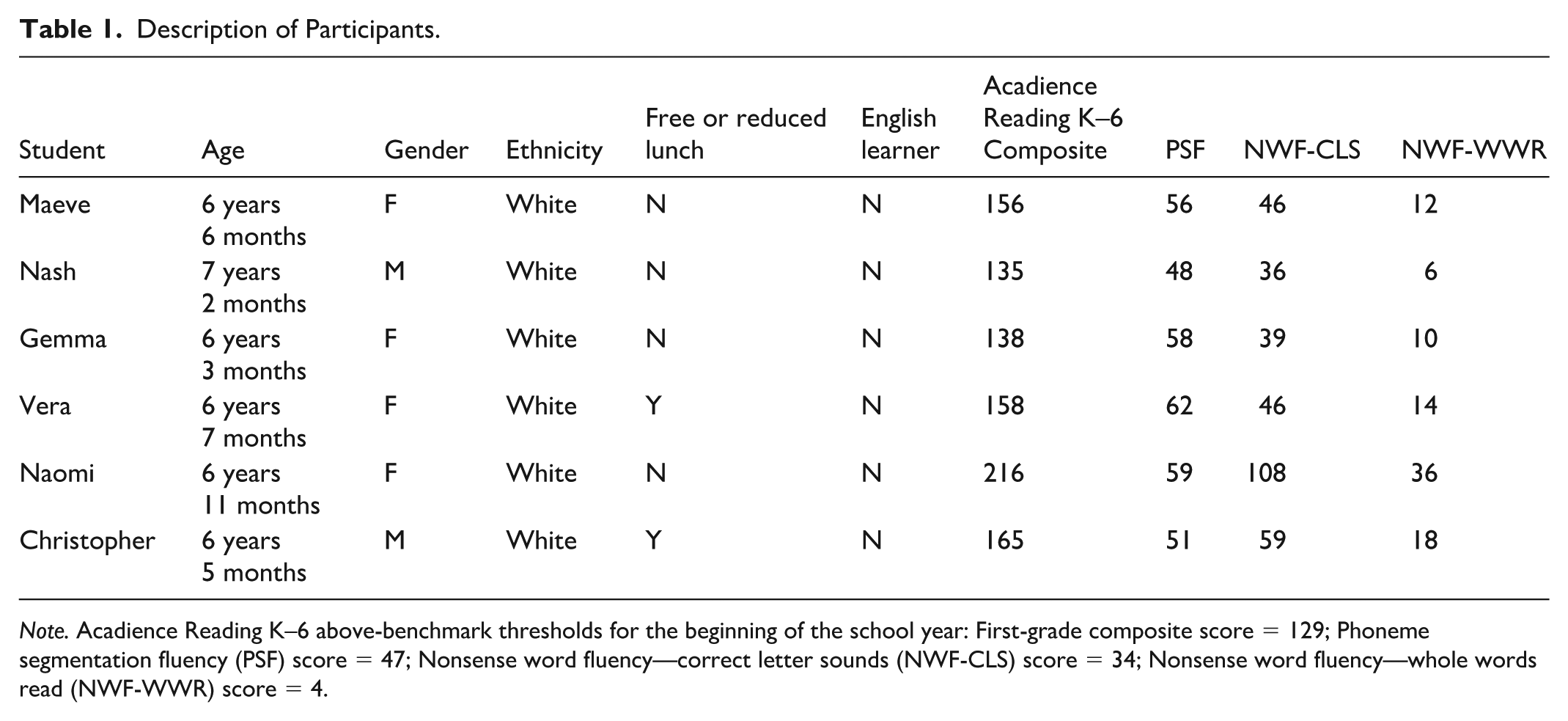
Note. Acadience Reading K–6 above-benchmark thresholds for the beginning of the school year: First-grade composite score = 129; Phoneme segmentation fluency (PSF) score = 47; Nonsense word fluency—correct letter sounds (NWF-CLS) score = 34; Nonsense word fluency—whole words read (NWF-WWR) score = 4.
CORE Phonics Survey Data.
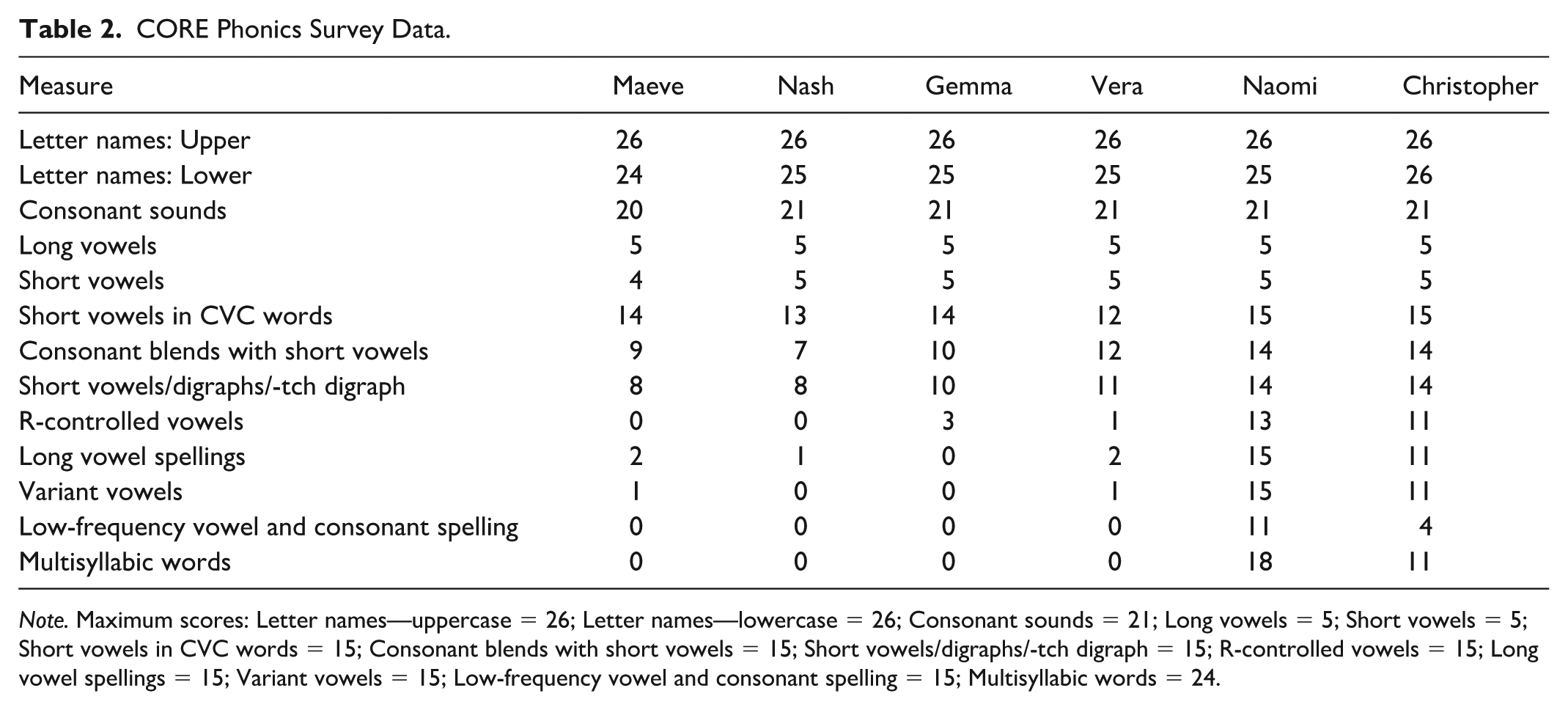
Note. Maximum scores: Letter names—uppercase = 26; Letter names—lowercase = 26; Consonant sounds = 21; Long vowels = 5; Short vowels = 5; Short vowels in CVC words = 15; Consonant blends with short vowels = 15; Short vowels/digraphs/-tch digraph = 15; R-controlled vowels = 15; Long vowel spellings = 15; Variant vowels = 15; Low-frequency vowel and consonant spelling = 15; Multisyllabic words = 24.
Interventionist and Implementation Coach
One interventionist delivered the intervention with support from an experienced implementation coach. The interventionist was employed at the elementary school where the study occurred. She possessed a master’s degree in educational leadership and had 15 years of teaching experience. The implementation coach was an Orton-Gillingham Fellow with a master’s degree in special education. She had 20 years of teaching experience and was employed as a curriculum consultant and practicum supervisor.
Dependent Variables and Measures
Acadience Reading K–6
Acadience Reading K–6 (formerly DIBELS Next; Good et al., 2013/2019) is a universal screening and progress-monitoring assessment with brief and repeatable measures of essential early literacy skills. Acadience Reading K–6 features standardized assessments with alternate forms of similar difficulty, using consistent directions, error corrections, discontinue rules, and scoring rules.
Phoneme Segmentation Fluency
Phoneme Segmentation Fluency (PSF) is a brief, direct measure of phonemic awareness (Good et al., 2013/2019). During administration, the assessor models and practices with the student before using standardized directions to prompt the student to produce the sounds in each word. The total score is the number of correct sound segments produced in 1 min.
The first-grade PSF measure is highly reliable, with an inter-rater reliability of .95 and an alternate-form reliability of .92 (Good et al., 2011/2020). The criterion-related validity of the Group Reading Assessment and Diagnostic Evaluation (GRADE; Williams, 2001) at the beginning of first grade is moderate at .33 (Good et al., 2013/2019).
Nonsense Word Fluency
Nonsense Word Fluency (NWF) is a brief measure of the alphabetic principle and basic phonics, measuring a student’s ability to blend letter sounds into VC (vowel-consonant) and CVC (consonant-vowel-consonant) words (Good et al., 2013/2019). During administration, the assessor models and practices with the student before asking them to read a list of VC and CVC pseudowords using standardized directions. The NWF score includes the number of correct letter sounds (CLS) and whole words read (WWR). For example, a student earns three CLS points for reading the word “mip” by either articulating the individual sounds /m/ /i/ /p/, blending the sounds as /m/ /i/ /p/ “mip,” or simply saying “mip.” A point for WWR is awarded when a student correctly reads a whole word, such as “mip,” without sounding it out.
NWF is highly reliable, with inter-rater reliability of .99 for both CLS and WWR and alternate-form reliability of .84 for CLS and .90 for WWR (Good et al., 2011/2020). At the beginning of first grade, the validity is moderate, with criterion-related validity of .43 for CLS and .39 for WWR with the GRADE (Good et al., 2013/2019; Williams, 2001).
Oral Reading Fluency
Oral Reading Fluency (ORF) measures advanced phonics skills, reading fluency, and comprehension (Good et al., 2013/2019) using standardized, authentic, non-decodable passages with leveled forms of similar difficulty and readability. ORF is an indicator of overall reading proficiency that includes three scores: ORF Accuracy, an indicator of advanced phonics; ORF Words Correct (WC), an indicator of reading fluency and reading comprehension; and ORF Retell, an additional indicator of reading comprehension.
The assessor presents a new passage for a student to read aloud for 1 min, noting errors such as omissions, substitutions, hesitations, or mispronunciations (excluding dialect differences). ORF WC is calculated by counting the number of words read in 1 min, reflecting reading rate and fluency. The ORF Accuracy percentage is then derived from the WC score by dividing the number of correctly read words by the total number of words in the passage, then multiplying by 100. This score indicates the student’s accuracy and comprehension, with higher percentages reflecting better reading skills.
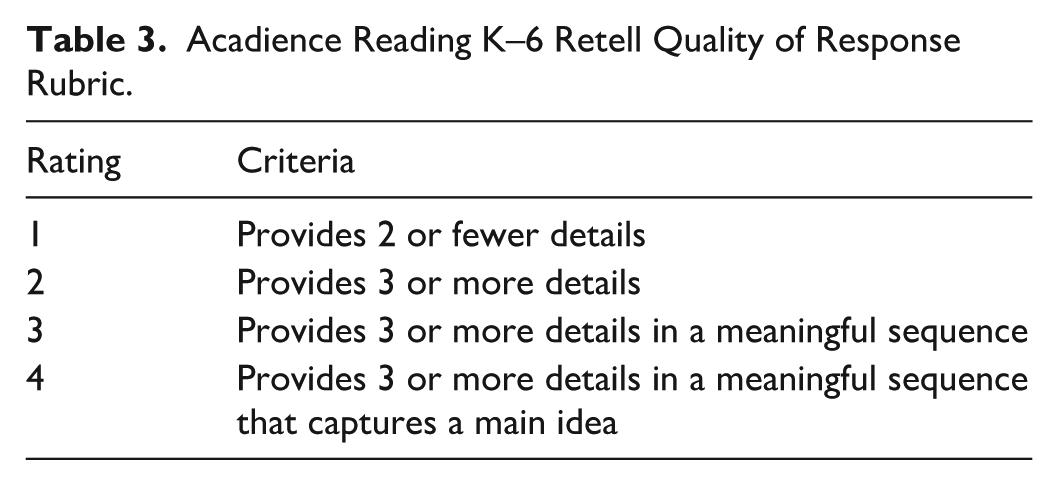
ORF Retell is a 1-min activity that provides an additional indicator of reading comprehension. It is administered if the student reads 40 or more words correctly. If a student reads fewer than 40 words, the assessor exercises professional judgment to decide whether to administer ORF Retell. During this activity, the student provides a retelling of the text, and their response is evaluated using the Retell Quality of Response Rubric (see Table 3), which assesses both accuracy and overall quality. The ORF Retell component provides an efficient means of determining whether students who read fluently and accurately are also comprehending the text. While ORF Retell scores offer insight into a student’s understanding of key ideas and details, they are not designed to yield a comprehensive evaluation of higher-order comprehension or interpretive reasoning.
Acadience Reading K–6 Retell Quality of Response Rubric.
ORF exhibits reliability, validity, and decision-making utility while displaying high predictability for reading comprehension (e.g., Crawford et al., 2001; Fuchs et al., 2001; McGlinchey & Hixson, 2004; Reschly et al., 2009; Sabatini et al., 2019; Silberglitt & Hintze, 2005; Stage & Jacobsen, 2001). The measure demonstrates strong reliability, with an inter-rater reliability of .99 for the first-grade ORF WC score and an alternate-form reliability of .95 (Good et al., 2011/2020).
Acadience Reading Survey
The Acadience Reading Survey (Powell-Smith et al., 2021) was used to (a) validate a need for support, (b) determine appropriate instructional levels and progress-monitoring materials, and (c) set student goals. To identify an appropriate level for progress monitoring, the assessor individually administers the student’s grade-level ORF passage, calculating ORF WC and ORF Accuracy. Progress monitoring occurs at the highest level meeting the standardized criteria. The entire assessment takes 5–20 min per student.
CORE Phonics Survey, Second Edition
The CORE Phonics Survey, second edition (Diamond & Thorsnes, 2008), was used as a diagnostic assessment to assess students’ decoding mastery and facilitate data-driven decisions for precise placement within a phonics scope and sequence. The survey requires 10–15 min per student, with a score derived from the total number of correct responses. Directions specify when each subtest should be administered (i.e., beginning, middle, and end of year) across various grade levels (K–3 and up). In this study, which focused on enrichment, the interventionist administered Parts E–K in the fall, adhering to first-grade winter guidelines. These subtests evaluate decoding skills through progressively more challenging word lists, each containing 10 phonetically regular words and five pseudowords. Mastery of Parts E–K leads to Part L, which assesses multisyllabic word reading. Responses are scored at the item level to inform instructional decisions and the formation of targeted small groups.
Reutzel et al. (2014) found the CORE Phonics Survey to be a reliable measure of phonics skills, with a Pearson test–retest reliability of 0.98 across grade levels and 0.91 in first grade. Cronbach’s alpha coefficients for internal consistency ranged from .64 for alphabetic knowledge (subtests A–D) to .97 for multisyllabic words (subtest L). Overall alphas for each grade ranged from .95 in kindergarten to .98 in second grade, with acceptable face and content validity reported.
Data Collection Process
Oral Reading Fluency
Participants were monitored weekly using Acadience Reading K–6 ORF materials, which are empirically validated tools designed to provide reliable and standardized measures of fluency and comprehension (Good et al., 2011/2020). Since Acadience ORF passages are commercially available, authentic, and non-decodable texts, they are also suitable for evaluating students’ ability to generalize and apply phonics skills acquired during the intervention. Each student completed a weekly ORF assessment during the baseline and intervention phases. Five students did not achieve 90% accuracy on first-grade passages and were consequently monitored using first-grade forms. One student (Naomi) was monitored using third-grade forms.
Acceptability Questionnaire Surveys
Following the conclusion of the study, the interventionist completed an interventionist acceptability questionnaire adapted from Lemons et al. (2012). This questionnaire aimed to evaluate the interventionist’s perceptions regarding the feasibility and effectiveness of the intervention. The interventionist responded to 11 Likert-type questions ranging from 1 (indicating strong disagreement) to 6 (indicating strong agreement).
In addition, students completed a student acceptability questionnaire administered individually by the implementation coach using a scripted procedure. The questionnaire employed predeveloped questions along with a smiley face scale, which was coded into a Likert-type scale ranging from 1 (indicating disagreement) to 3 (indicating strong agreement), with a score of 2 indicating moderate agreement. Students answered two questions about their thoughts and feelings regarding the intervention by circling the face that best represented their perceptions (e.g., smile, neutral, frown).
Fidelity of Implementation and Training
Training on Intervention
The interventionist completed a comprehensive three-phase training process to ensure implementation fidelity. The initial phase consisted of a 6-hr asynchronous UFLI Essential Background Knowledge Course. The second phase involved a 6.5-hr UFLI Foundations Implementation Training, led by the principal investigator, using a facilitation guide and pre-recorded modules developed by the intervention’s authors (H. B. Lane & Contesse, 2022). The interventionist practiced intervention components with corrective feedback, achieving 100% accuracy on the UFLI Foundations Initial Observation form, which surpassed the 95% fidelity criterion. The third phase included a 4-hr training on study procedures and CORE Phonics Survey administration. The interventionist was provided with the UFLI Foundations manual, lesson materials, and assessment tools. She also received intervention plans for each dyad, detailing lessons, timelines, and instructional sequences, along with session notes for planning and progress monitoring.
The coach received training in the use of two UFLI Foundations observation tools to assess procedural fidelity and instructional quality. The UFLI Foundations Initial Observation Form, employed during training and the initial two intervention sessions, was designed to evaluate adherence and dosage. It assessed the interventionist’s proficiency in key components, such as introducing new concepts, articulatory gestures, and word spelling practice. Subsequent observations utilized the more comprehensive UFLI Foundations Quality Observation Form, which evaluated both lesson components and critical aspects of explicit instruction, including student engagement, corrective feedback, scaffolding, and pacing.
Training on Assessment
The interventionist and coach completed a series of assessment workshops. The Acadience Reading K–6 Essential Workshop focused on the administration and scoring of the assessment. The Acadience Reading K–6 Data Interpretation Workshop covered the interpretation and use of assessment data. The Acadience K–6 Mentor Workshop provided in-depth training on data analysis and data-based decision-making techniques. The Acadience Reading Survey Workshop involved identifying an appropriate level for progress monitoring. Feedback on the accuracy and consistency of administration and scoring was provided using the Acadience ORF Assessment Accuracy Checklist (Good et al., 2011/2020).
Procedure
Independent Variable
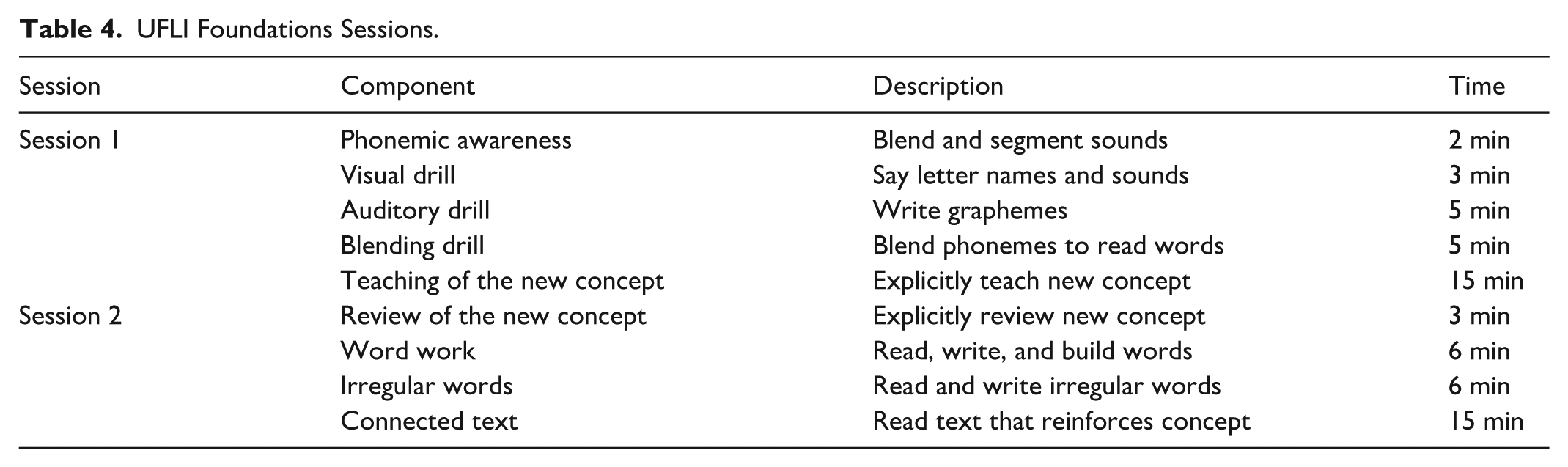
UFLI Foundations (H. B. Lane & Contesse, 2022) is a widely adopted program that adheres to a defined scope and sequence for teaching various grapheme-phoneme correspondences, syllable types, syllable-division patterns, and spelling rules. By integrating spelling as a core instructional component, the program aims to promote the transfer of skills between reading and writing, empowering students to engage with more complex texts and enhance their writing precision. In this study, each group participated in daily, program-adherent lessons for 8 weeks. Each lesson was divided into two 30-min sessions conducted over two consecutive days (see Table 4). Instruction took place in a distraction-free environment, with advanced phonics and spelling lessons delivered at a small table to maximize focus and engagement. One group received instruction during the first-grade walk-to-intervention block, while the other two were taught at alternate times without disrupting classroom instruction.
UFLI Foundations Sessions.
Session 1
Session 1 began with a phonemic awareness warm-up to practice blending and segmenting phonemes, incorporating activities like Elkonin Boxes (Elkonin, 1971), Say It and Move It (Blachman et al., 2000), and sorting games. This was followed by a three-part drill. The visual drill reinforced letter recognition and grapheme-phoneme correspondences by prompting participants to identify phonemes from presented grapheme slides. The auditory drill required students to write the corresponding graphemes for spoken phonemes. The blending drill supported decoding automaticity by guiding students to blend multiple phonemes into words, with corrective feedback and modeling. Finally, the interventionist explicitly introduced a new concept through clear explanations and modeling, followed by guided practice in reading and spelling conceptually related words.
Session 2
During Session 2, students revisited the newly learned concept. In the word work segment, they spelled newly learned and previously taught phonetically regular words. The irregular words segment focused on reading and writing permanently and temporarily irregular words. During the dictation segment, students applied their spelling skills within meaningful contexts. The final lesson segment involved reading decodable text to accelerate the acquisition of text-level automaticity and comprehension strategies.
Data-Based Decision-Making
The interventionist used data-based decision-making to decide when to proceed to the next lesson and when to review content (Espinas & Fuchs, 2022). During the second session of each lesson, the interventionist assessed students’ spelling of target words, including new irregular words, new concept words in isolation, and new concept words within dictated sentences. Target words from the UFLI Foundations Progress Monitoring Spelling Assessment were typed and affixed to each corresponding lesson plan.
The UFLI Foundations manual provides general guidance for small-group lessons, including suggestions for using word chains and word lists. In this study, the interventionist followed a researcher-developed protocol that provided additional recommendations and helped determine whether a review should focus solely on decoding or incorporate both decoding and spelling. If students misspelled more than one target word, a spelling-focused review was conducted the following day, incorporating Elkonin boxes, magnetic letter manipulation, extra word chains, sentence writing, and irregular word spelling. If students also misread words, the review included decoding exercises, blending, reading, and rereading decodable texts as well. The interventionist collaborated with the implementation coach to align instructional strategies with students’ error patterns, ensuring that previous lessons’ words and concepts were effectively reinforced in review sessions.
Research Design and Data Analysis
Experimental Design
The present study utilizes a multiple-baseline across-subjects design to systematically manipulate the independent variable, UFLI Foundations, and examine its causal effect on the dependent variable, ORF. As a form of single-case research design (SCRD), this approach is particularly well-suited for evaluating interventions in small, heterogeneous populations, such as gifted learners. SCRDs, as noted by Peltier et al. (2021), are “flexible and rigorous methods used to investigate the effects of interventions on socially important outcomes” (p. 121). This design ensures high internal validity while accommodating small sample sizes, making it ideal for demonstrating individual-level effects on highly skilled readers (Cresswell & Guetterman, 2019). By focusing on functional relations, the design allows for precise, individualized assessments of intervention effectiveness.
The use of SCRD responds to the increasing demand for more rigorous empirical studies on interventions for gifted learners, as noted by Walsh et al. (2012). Their systematic review revealed a notable gap in studies on early childhood interventions for gifted learners, due to challenges such as small sample sizes, inconsistent definitions of giftedness, and a reliance on case studies and self-reported data. By overcoming many of these limitations, SCRD offers a reliable and valid evaluation of intervention effectiveness in gifted education. Moreover, it offers a practical and applicable model for schools, aligning with the data-based decision-making processes commonly used within MTSS (Riley-Tillman & Burns, 2010).
To ensure methodological rigor, the intervention was implemented based on baseline stability, with the group demonstrating the most stable baseline beginning first. The staggered intervention design allowed for comparisons of ORF data before and during intervention phases, with weekly ORF data collected on a ratio scale, enabling each participant to serve as their own control. Replicating the intervention across three or more students strengthened the evidence for a functional relation and enhanced the generalizability of findings, as consistent outcomes across multiple participants provided robust support for the reliability and applicability of the observed effects (Gast & Ledford, 2014).
Throughout the study, classroom reading instruction was delivered consistently to all participants, while pull-out sessions focused on advanced decoding and spelling. To mitigate potential threats to internal validity, such as history and maturation, the design incorporated phase repetition and effect replication. Intervention fidelity was closely monitored, baseline conditions were maintained, and a minimum of three data points per phase were collected to ensure reliability.
Data Management
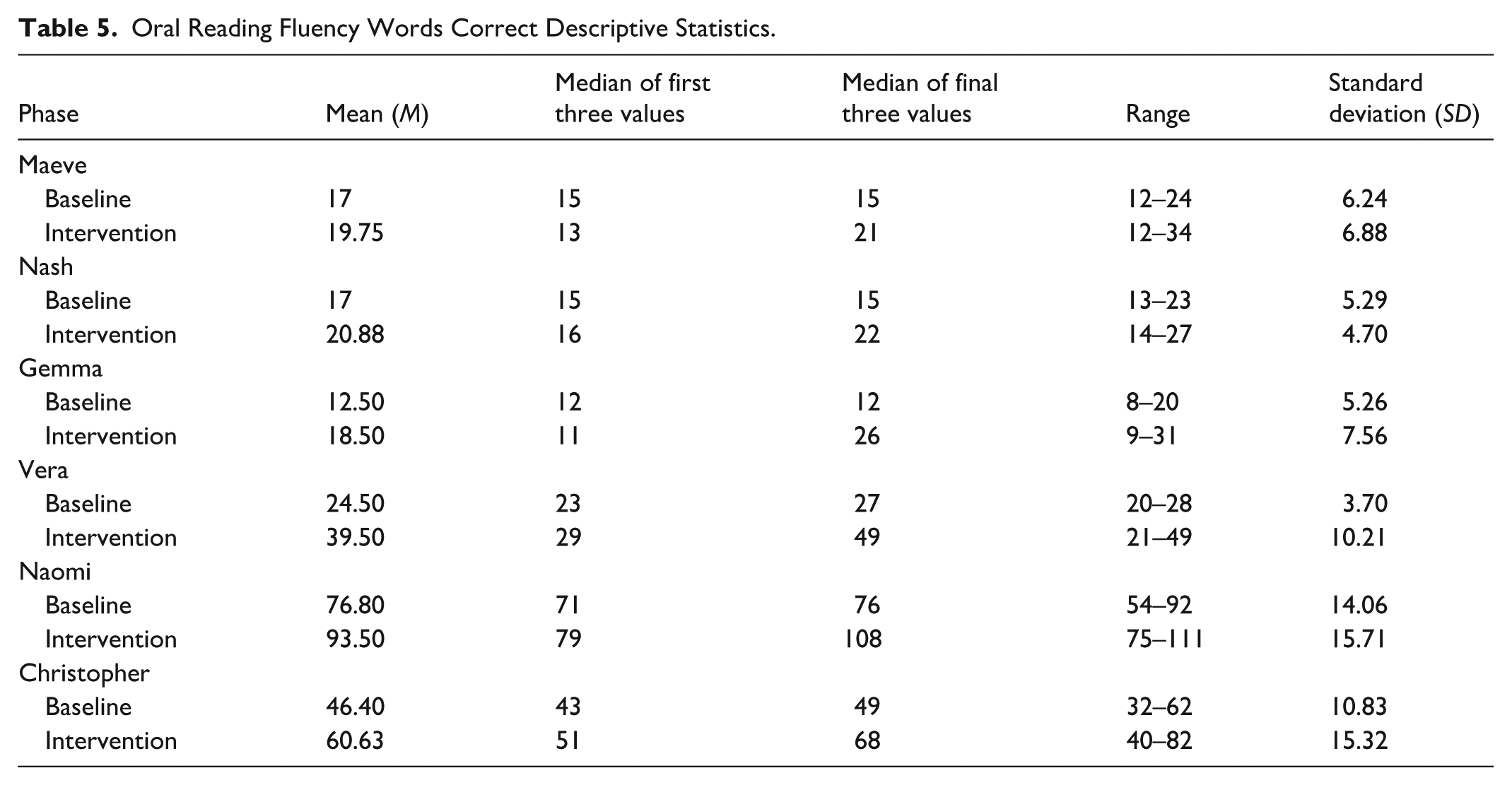
The interventionist administered Acadience Reading K–6 assessments via a Dell touchscreen and stylus within Acadience Learning Online (ALO), which automated scoring and graphed ORF WC trends. Progress was monitored using reports with graphs and ORF metrics (WC, Accuracy, Retell). The interventionist recorded data for each group within an Excel spreadsheet, which was securely shared with the research team and later transferred to a researcher-exclusive repository. The coach checked 20% of the data entry for accuracy. Following verification, the researchers created six line graphs arranged in pairs with staggered baselines to display ORF WC scores. Table 5 summarizes weekly ORF Accuracy, ORF Retell, and ORF Retell Quality of Response scores, including means and standard deviations for each subscore.
Oral Reading Fluency Words Correct Descriptive Statistics.
Visual Analysis
Following guidelines for single-case design (Horner et al., 2012; Kratochwill et al., 2010; J. D. Lane & Gast, 2013; Ledford et al., 2017; Plavnick & Ferreri, 2013; Riley-Tillman & Burns, 2010), visual analysis for ORF WC involved evaluating consistency in level, trend, and variability within and across adjacent phases (e.g., baseline, intervention). Level was assessed by comparing the means of the baseline, intervention, and the last three data points. The medians of the final three data points in each phase were calculated to account for the expected latency of ORF WC growth. Immediacy of effect was examined by comparing the final three data points in baseline with the first three data points in intervention (Manolov & Onghena, 2022). Variability was evaluated by scrutinizing range and standard deviation across phases. In addition, magnitude, latency, and general trends across conditions were compared. Experimental control was assessed by evaluating intervention data patterns in relation to baseline expectations, which requires clear evidence of behavior change and at least three replications across participants (Horner et al., 2005). External factors and anomalies, such as a sudden change within a phase, were also examined and explained. Furthermore, variability in performance was investigated to identify potential sources of differences, such as initial skills, attendance, or spelling assessment results.
Descriptive statistics were calculated to analyze participant performance. For ORF WC, means and medians were used to assess growth and latency effects. For ORF Accuracy, ORF Retell, and ORF Retell Quality scores, medians were used due to their variability and ordinal nature, providing a more representative summary of typical performance than means. Visual analysis aimed to identify patterns of changes in ORF WC exclusively in the presence of the applied independent variable (UFLI Foundations). Research indicates that on-track students typically gain about one word per week in ORF (Schatschneider et al., 2008; Tindal, 2017). For students with higher proficiency, such as those in the present study, ORF growth rates may exceed this typical rate; thus, a gradual upward trend was anticipated.
Effect Size
Effect size measures were selected to ensure a rigorous and comprehensive analysis of intervention outcomes. The Percentage of Data Exceeding the Median (PEM) was used to assess effect size by examining data overlap between baseline and intervention phases. PEM was chosen for its reduced susceptibility to Type 2 errors compared to the Percentage of Nonoverlapping Data (PND) and its ability to detect performance shifts despite baseline variability. Treatment effectiveness using PEM is categorized as ineffective (< 0.7), moderate (0.7–0.9), or high (> 0.9; Alresheed et al., 2013; Ma, 2006; Şen & Şen, 2019). Tau-U was included as an additional effect size measure to account for baseline trends and provide a more robust analysis of intervention effects by addressing data overlap and potential autocorrelation (Fingerhut et al., 2021; Parker et al., 2011). Treatment effectiveness using Tau-U is categorized as small (0.0–0.20), medium (0.20–0.60), or large (0.80–1.0; Parker et al., 2011; Vannest & Ninci, 2015). Together, these statistics provide an index of the impact of the intervention.
Summary Data on Intervention Delivery
Students participated in UFLI Foundations lessons taught by an experienced interventionist for 30 min each day for 8 weeks. Table 6 displays the number of weeks of intervention, the total number of intervention sessions, mean sessions per week, days absent, school closures, attendance rate, and the mean spelling score on the UFLI Foundations Progress Monitoring Spelling Assessment.
Summary Data on Intervention Delivery for Each Participant.
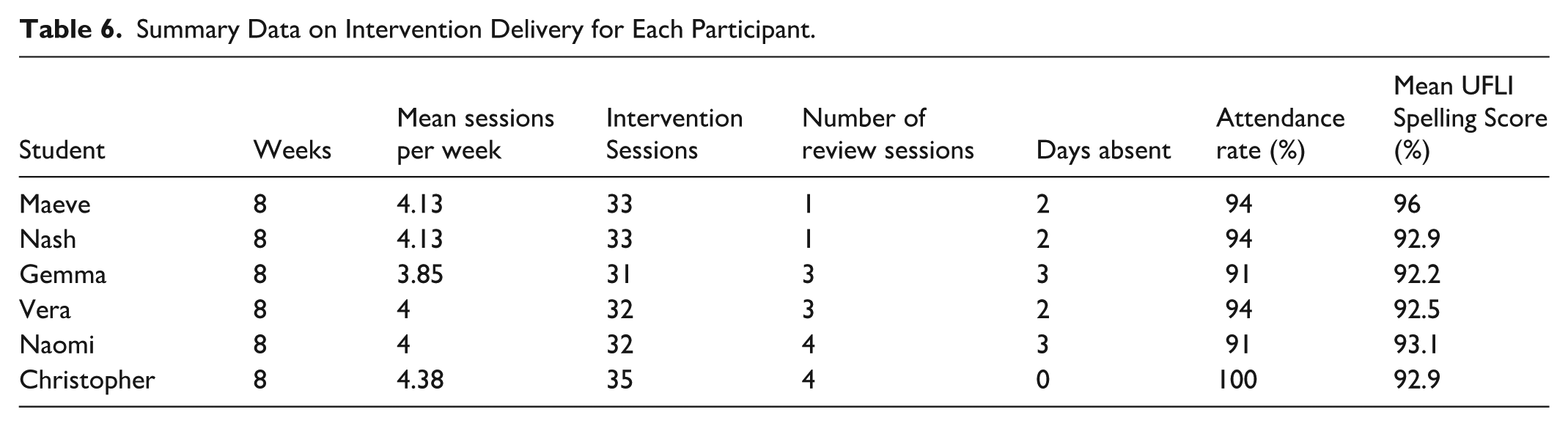
Difficulty with spelling new patterns during the lessons prompted review sessions. Maeve and Nash had one review, Gemma and Vera had three, and Christopher and Naomi had four. Mean spelling scores ranged from 92.2% to 96%, with Maeve scoring the highest at 96%. The number of intervention sessions varied due to absences. Gemma completed 31 sessions (the fewest), Vera and Naomi completed 32, Maeve and Nash completed 33, and Christopher completed 35. Attendance rates ranged from 91% (Gemma and Naomi) to 100% (Christopher).
Results
To investigate the first research question regarding the effect of advanced decoding and spelling lessons on the ORF scores of highly skilled first-grade readers, six participants completed an average of 32.63 UFLI Foundations sessions (range = 31–35) over 8 weeks. Figure 1 presents the ORF WC data for all participants, depicting the staggered baseline and intervention phases, with the x-axis representing weeks and the y-axis representing words correctly read per minute.
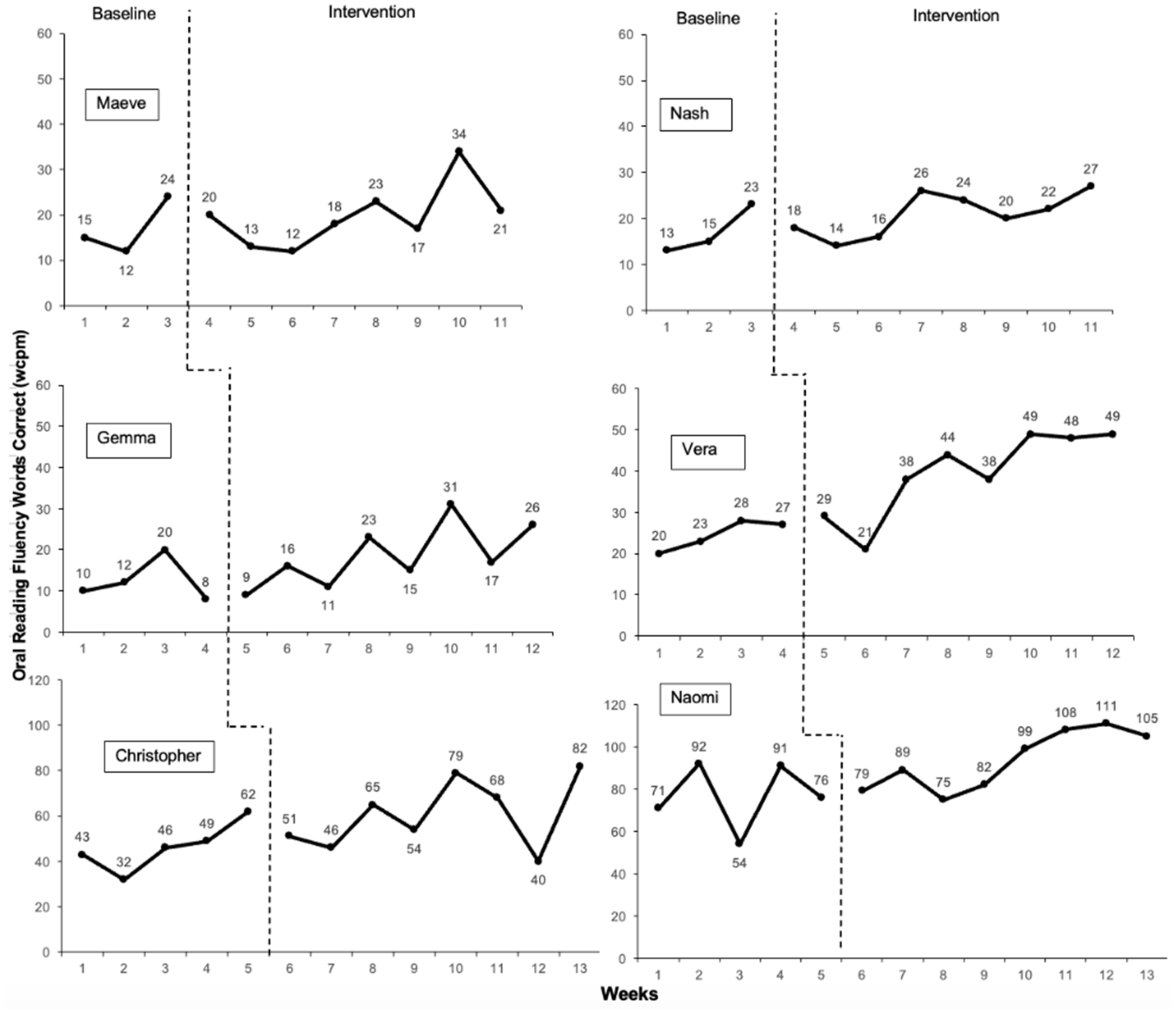
Oral Reading Fluency Words Correct.
The graphs are scaled differently based on the range of ORF WC scores within and across groups. Group 1 and Group 2, with maximum scores of 34 and 49, respectively, are displayed on a 0–60 scale. Group 3, which includes a score of 111 from an outlier (Naomi), is displayed on a 0–120 scale. This nuanced scaling method was selected to depict the distinct characteristics of each group, minimize distortion, and accurately represent their growth (Peltier et al., 2021, 2022).
Although most participants demonstrated a slight upward or fluctuating trend during the baseline condition, this was expected given the typical growth pattern observed in ORF WC data, with an average increase of one word per week (Schatschneider et al., 2008; Tindal, 2017). Therefore, the decision was made to proceed with the intervention as planned without extending the baseline phase. The choice to adhere to the original timeline was influenced by scheduling constraints and the likelihood that adding data points would not have meaningfully altered the presentation of the data pattern due to the participants’ advanced skills. ORF summary data for all students are displayed in Table 7.
Acadience Reading K–6 Oral Reading Fluency Data.
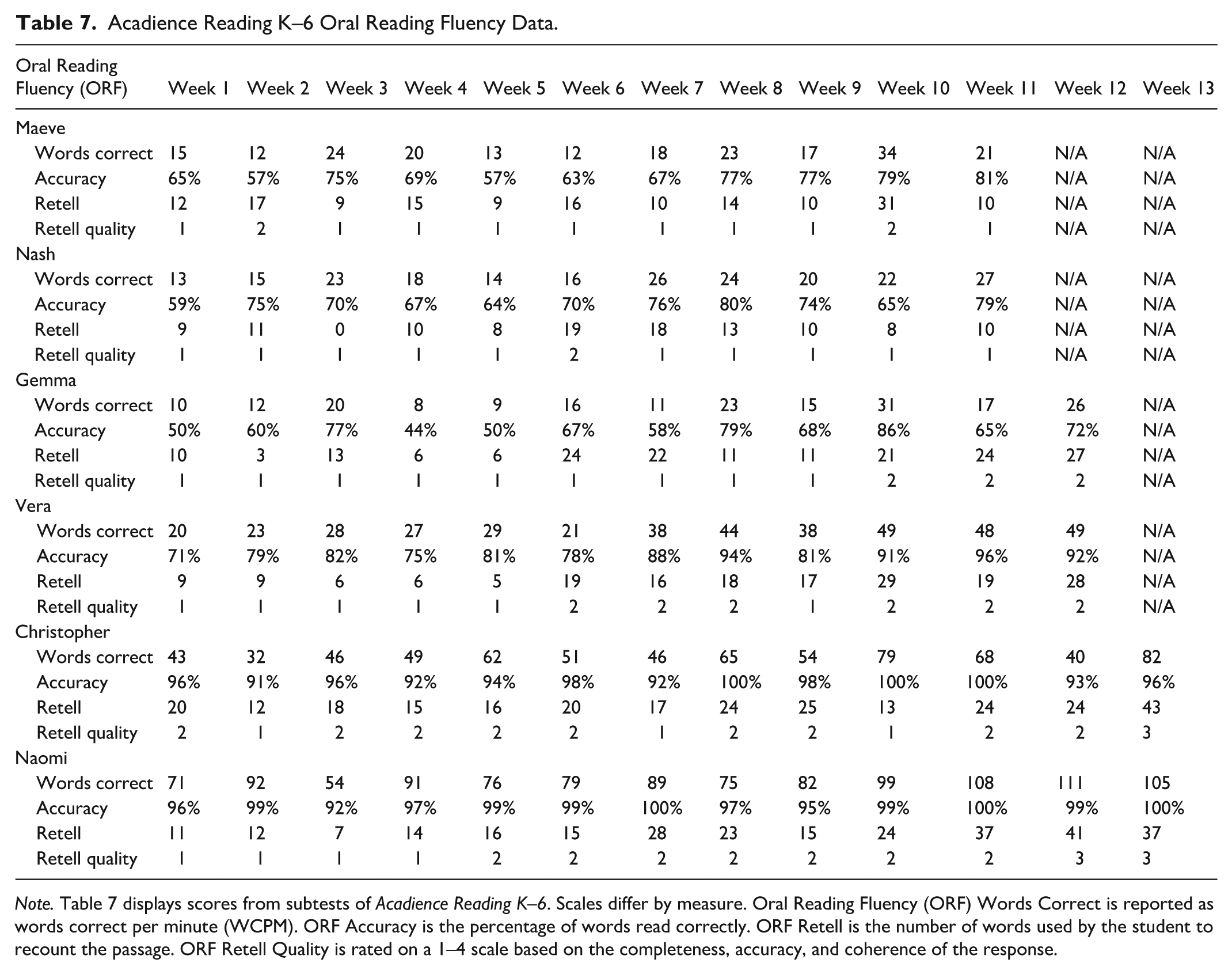
Note. Table 7 displays scores from subtests of Acadience Reading K–6. Scales differ by measure. Oral Reading Fluency (ORF) Words Correct is reported as words correct per minute (WCPM). ORF Accuracy is the percentage of words read correctly. ORF Retell is the number of words used by the student to recount the passage. ORF Retell Quality is rated on a 1–4 scale based on the completeness, accuracy, and coherence of the response.
Effects on ORF
Visual analysis of the data included inspection of level (overall and final three data points), trend, variability, immediacy of effect, and overlap (Kratochwill et al., 2010; J. D. Lane & Gast, 2013; Riley-Tillman & Burns, 2010). To augment visual analysis, effect size calculations were employed to quantify the magnitude of intervention effects (Brossart et al., 2014; Parker et al., 2009).
Maeve
Maeve’s mean ORF WC score increased from 17 WCPM (SD = 6.24) at baseline to 19.75 (SD = 6.88) during intervention, indicating a small level change (+2.75). No immediate intervention effect was observed; the median of the final three baseline scores was 15, compared to 13 for the initial three intervention scores. The median of the final three intervention scores increased to 21, reflecting a delayed but positive response. Baseline data exhibited variability (range = 12–24), while intervention data revealed a more consistent upward trend (range = 12–34). Median ORF Accuracy improved from 65% to 73%. ORF Retell scores remained static (median = 12), while ORF Retell Quality ratings remained consistently low (predominantly 1, with one session rated 2). Although the intervention appears to have improved Maeve’s accuracy and fluency, she may not have reached a level of accuracy or fluency that resulted in better reading comprehension. Given the substantial overlap between phases, it is difficult to isolate the intervention’s impact. Consequently, observed changes may reflect a continuation of the baseline pattern.
Nash
Nash’s mean ORF WC score increased from 17 WCPM (SD = 5.29) at baseline to 20.88 (SD = 4.70) during intervention, reflecting a small level change (+3.88). No immediate intervention effect was discernible; median scores for the final three baseline sessions and first three intervention sessions were 15 and 16, respectively. The median of the final three intervention scores increased to 22, indicating gradual improvement. Trend analysis indicated a slight increase during baseline (range = 13–23), which continued during the intervention with reduced variability (range = 14–27). Median ORF Accuracy scores rose slightly from 64% to 67%, and median ORF Retell scores improved minimally from 9 to 10. ORF Retell Quality ratings remained consistently low (predominantly 1, with one session rated 2). Although small gains in fluency and accuracy were noted, overlap between phases and an increasing baseline trend suggest the observed changes may be a continuation of the baseline pattern.
Gemma
Gemma’s mean ORF WC score increased from 12.5 WCPM (SD = 5.26) at baseline to 18.5 (SD = 7.56) during intervention, reflecting a moderate level change (+6). Change was not immediate, as indicated by the mean of the final three baseline scores (12) and the mean of the first three intervention scores (11). However, the median of the final three intervention scores increased to 26, indicating a delayed but accelerating improvement. Baseline data exhibited a slight upward trend (range = 8–20), whereas intervention data demonstrated a more pronounced increasing trend (range = 9–31). Median ORF Accuracy improved from 55% to 66%, and median ORF Retell scores increased from 8 to 22. ORF Retell Quality ratings improved from 1 to 2. These gains in accuracy, fluency, and comprehension suggest a positive intervention effect, despite some phase overlap.
Vera
Vera’s mean ORF WC score increased from 24.5 WCPM (SD =3.70) at baseline to 39.5 (SD = 10.21) during intervention, reflecting a large level change (+15). No immediate intervention effect was detected; the median of the final three baseline scores was 27, compared to 29 for the first three intervention scores. The median of the final three intervention scores increased substantially to 49, indicative of a latent accelerating trend. Baseline data demonstrated stability, with a narrow range (20–28) and minimal variability, while intervention data revealed an increasing trend and greater variability (range = 21–49). Median ORF Accuracy increased from 83% to 96%, and median ORF Retell scores improved from 25 to 47. ORF Retell Quality ratings rose from 2 to 3. These results suggest that the intervention strengthened Vera’s accuracy, fluency, and comprehension, with growth in her ORF Retell scores reflecting improved detail recall. Thus, the data suggest a clear intervention effect.
Naomi
Naomi’s ORF WC score increased from 76.8 WCPM (SD = 15.71) at baseline to 93.5 (SD = 14.06) during intervention, indicating a large level change (+16.7). No immediate intervention effect was evident; median scores for the final three baseline sessions and first three intervention sessions were 76 and 79, respectively. However, the median of the final three intervention scores rose markedly to 108, indicating a latent accelerating trend. Baseline scores exhibited moderate variability (range = 54–92), whereas intervention scores demonstrated a clearer upward trajectory (range = 75–111). Median ORF Accuracy improved from 96% to 99%, with Naomi achieving 100% accuracy on multiple occasions during intervention, suggesting a potential ceiling effect. Despite this, comprehension measures showed marked improvement: median ORF Retell scores increased from 12 to 35, while ORF Retell Quality ratings improved from 1 to 3. These gains suggest the intervention not only strengthened Naomi’s reading fluency and accuracy but also her ability to recall and convey details from texts. The magnitude and consistency of these improvements indicate a clear intervention effect.
Christopher
Christopher’s mean ORF WC score increased from 46.40 WCPM (SD = 10.83) at baseline to 60.63 (SD = 15.32) during intervention, indicating a large level change (+14.23). An immediate intervention effect was not discernible; median scores for the final three baseline and first three intervention sessions were 49 and 51, respectively. The median of the final three intervention scores increased to 68, indicative of a delayed but meaningful improvement. Baseline data showed an upward trend with moderate variability (range = 32–62), while intervention data revealed an accelerating upward trend with greater variability (range = 40–82). Median ORF Accuracy improved slightly from 94% to 96%, and median ORF Retell scores increased from 16 to 24. ORF Retell Quality ratings remained stable at 2 throughout both phases. A notable decline occurred in Week 7 (40 WCPM), attributed in anecdotal notes to distractibility and rereading behavior. However, Christopher rebounded strongly in Week 8, scoring 82 WCPM, suggesting the Week 7 dip was anomalous. Taken together, the magnitude of level change, consistent gains in fluency and comprehension, and recovery following the discrepant score suggest the presence of a possible intervention effect, although these results should be interpreted with caution.
Effect Sizes
Two effect sizes were calculated to evaluate the impact of the intervention on participants’ ORF performance: the PEM (Ma, 2006) and Tau-U (Fingerhut et al., 2021; Parker et al., 2011). These indices were chosen for their methodological rigor and their capacity to account for baseline variability and autocorrelation. The calculated effect size for PEM was 0.82 (range = 0.75–0.88, SD = 0.071), indicating moderate intervention effects. Similarly, Tau-U yielded an effect size of 0.44 (range = 0.167–0.688, SD = 0.182), which also reflects a medium effect despite some baseline trends. The results of both indices suggest that the intervention had a moderate impact on improving participants’ ORF performance (see Table 8).
Effect Sizes for ORF Outcomes After Advanced Decoding and Spelling Instruction.
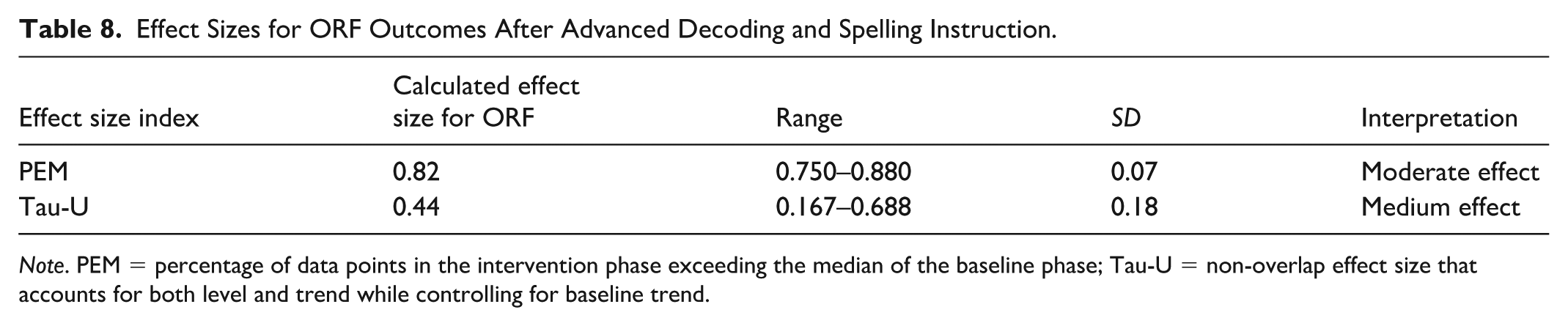
Note. PEM = percentage of data points in the intervention phase exceeding the median of the baseline phase; Tau-U = non-overlap effect size that accounts for both level and trend while controlling for baseline trend.
Implementation Fidelity
The interventionist exceeded the procedural fidelity criterion for UFLI Foundations (≥90%) within the first week, achieving 100% fidelity during the initial lesson. Monthly observations by the implementation coach focused on critical elements, with fidelity checks during the intervention phase averaging 98% (range = 93%–100%). During these observations, the implementation coach also conducted reliability checks to ensure proper adherence to Acadience Reading K–6 procedures during ORF administration. The interventionist consistently exceeded the reliability criterion (> 95%), maintaining an average of 100%.
Social Validity and Feasibility of the Intervention
To evaluate the second and third research questions regarding the perceived value and feasibility of the intervention, acceptability questionnaires were administered to both the interventionist and students. The corresponding means and standard deviations for individual questionnaire items are presented in Tables 9 and 10.
Interventionist Acceptability Questionnaire Results.
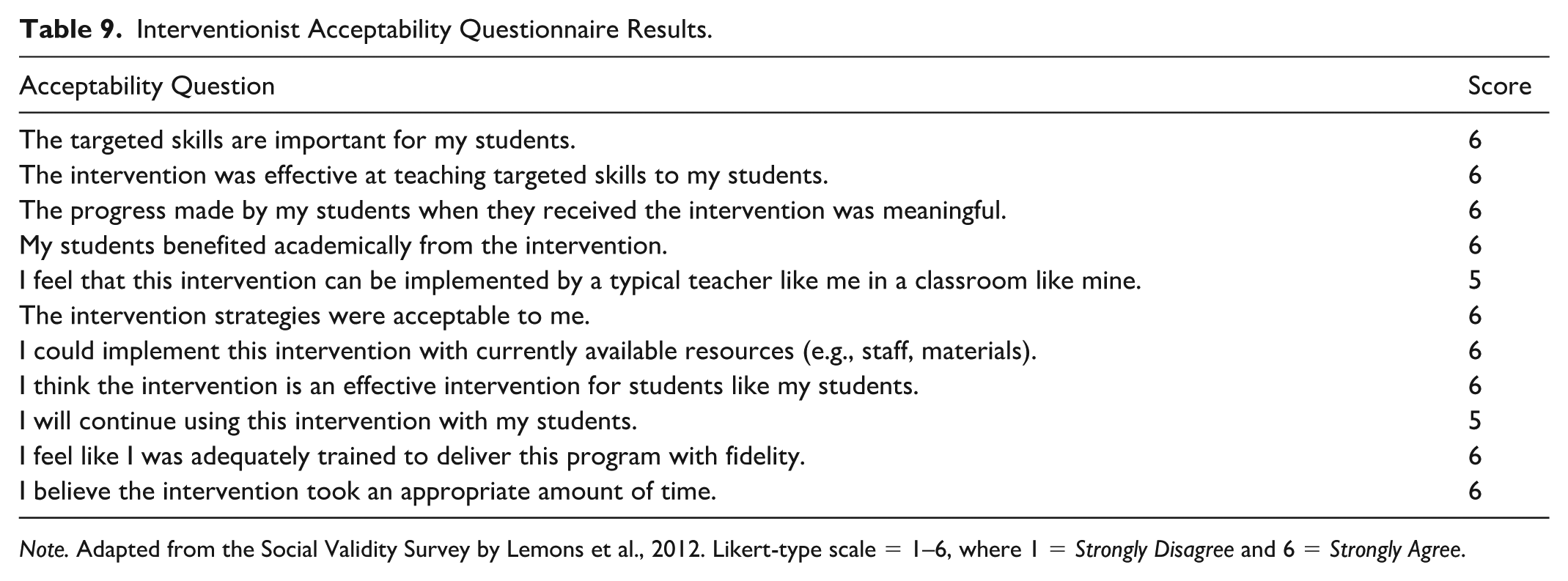
Note. Adapted from the Social Validity Survey by Lemons et al., 2012. Likert-type scale = 1–6, where 1 = Strongly Disagree and 6 = Strongly Agree.
Student Acceptability Questionnaire Results.
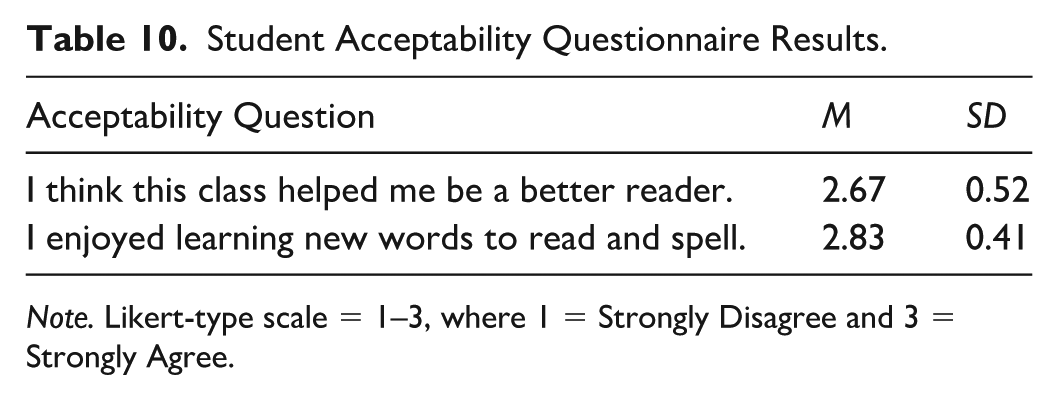
Note. Likert-type scale = 1–3, where 1 = Strongly Disagree and 3 = Strongly Agree.
Table 9 displays the results of the Interventionist Acceptability Questionnaire. The interventionist strongly endorsed 9 of 11 statements, emphasizing the intervention’s effectiveness in fostering essential literacy skills, its efficiency, and its applicability to similar student populations. She expressed strong confidence in her ability to implement the program with fidelity, her belief that a typical teacher could successfully implement the intervention in a similar classroom setting, and her intention to continue using it with her students.
Table 10 presents data from the Student Acceptability Questionnaire, which evaluated students’ perceptions of the intervention. While favorable feedback was anticipated, individual preferences were considered as potential influences on students’ engagement and enjoyment. Using a Likert-type scale from 1 to 3, students reported notable improvements in their reading skills (M = 2.67; SD = 0.52) and found learning to read and spell new words both enjoyable and beneficial (M = 2.83; SD = 0.41). Findings suggest that highly skilled first-grade readers perceive phonics enrichment as both effective and enjoyable.
Discussion
This study provides compelling preliminary evidence for the effectiveness of advanced explicit phonics and spelling instruction for highly skilled first-grade readers, highlighting the benefits of differentiated instruction tailored to students’ individual skill levels (Tomlinson, 2005). Consistent with prior research demonstrating the efficacy of systematic phonics instruction for students with strong phonemic awareness and alphabet knowledge (Fielding-Barnsley, 1997), all participants exhibited marked improvements in ORF WC.
Stronger gains were observed among students with more advanced decoding abilities and more consistent attendance, with clearer improvements noted for Gemma, Vera, Naomi, and Christopher compared to Maeve and Nash, whose data exhibited greater baseline variability and phase overlap. The moderate effects measured by PEM (0.82) and Tau-U (0.44) suggest a positive intervention impact. While four replications of the intervention effect provide compelling evidence of a functional relationship, the mixed effects observed among other participants complicate the interpretation of these findings. Importantly, vertical analysis revealed no observable changes in the non-intervened students during the intervention phases, further strengthening the conclusion that the observed effects are attributable to the intervention.
Differentiated Instruction for Highly Skilled Readers
This study illustrates the value of differentiating advanced decoding and spelling instruction to foster the literacy development of highly skilled primary readers. By strategically grouping students with similar instructional needs, the intervention facilitated tailored lessons that optimized individual growth. Christopher and Naomi, who exhibited the most advanced skills, participated in lessons on the most advanced skills and achieved the most substantial gains in ORF WC. The findings further suggest that when explicit phonics and spelling instruction is customized to meet the specific needs of advanced learners, it leads to growth that far exceeds typical grade-level expectations. For instance, the ORF WC gains of Naomi (+54) and Christopher (+50) substantially surpassed the expected growth of 8 WCPM over 8 weeks (Schatschneider et al., 2008; Tindal, 2017), with other participants, including Vera (+29), Gemma (+23), Maeve (+22), and Nash (+14), also demonstrating meaningful improvement. Furthermore, the robust gains in ORF WC across participants suggest broader improvements in reading competencies, such as vocabulary and comprehension, given the strong correlation between ORF and general reading ability (Reschly et al., 2009; Wayman et al., 2007).
Differences in instructional scope and intensity suggest that the complexity of the targeted skills and the frequency of review likely influenced the rates and patterns of skill acquisition observed across groups. Group 1, which completed Lesson 35a through Lesson 49, needed one review session. Group 2, which completed Lesson 38b through Lesson 54, engaged in three review sessions (one of which was unintentionally omitted). Group 3, which completed Lesson 69 through Lesson 83, required six review sessions. Students with less advanced phonics and spelling skills demonstrated higher accuracy, likely due to their focus on mastering foundational skills. However, their rate of growth was slower compared to more advanced students, who, despite demonstrating faster progress, required more reteaching to consolidate more complex patterns.
The Role of Attendance in Intervention Outcomes
Another important consideration is the role of student attendance in shaping intervention outcomes. Consistent attendance correlated with stronger gains in ORF, as observed in Naomi and Christopher, whose regular participation permitted uninterrupted reinforcement of advanced phonics and spelling skills. Conversely, anecdotal records suggest that inconsistent attendance among other participants, such as Nash and Maeve, may have moderated their progress by disrupting the continuity of instruction and limiting opportunities to consolidate newly introduced skills.
Research consistently highlights attendance as a key factor in optimizing outcomes for evidence-based instructional programs (Epstein & Sheldon, 2002), and the cumulative, sequential nature of UFLI Foundations likely magnified the effects of attendance variability. Missed sessions may have resulted in gaps in skill acquisition, slowing overall progress. Thus, future studies should systematically track attendance and analyze its relationship with intervention efficacy to further clarify its role as a moderating variable. Addressing attendance challenges could involve strategies such as providing targeted review for students with inconsistent participation or offering flexible scheduling to ensure equitable access to instruction.
The Need for Concurrent Decoding and Spelling Instruction
Research has long established the reciprocal relationship between decoding and spelling, yet mastery in one area does not guarantee proficiency in the other (Juel, 1988; National Institute of Child Health & Human Development [NICHD], 2000). Despite students’ robust decoding skills, spelling emerged as a relative area of weakness across all groups. Naomi and Christopher (Group 3), who demonstrated the most advanced decoding abilities, required four additional spelling sessions to address gaps, while Vera and Gemma (Group 2) needed three sessions, and Maeve and Nash (Group 1) completed one. The divergence observed in this study aligns with previous findings, which suggest that while decoding focuses on grapheme-phoneme correspondences for reading, spelling requires additional attention to orthographic patterns, word structure, and morphological awareness (Treiman & Bourassa, 2000). These complexities necessitate deliberate instructional focus to bridge the gap between reading and writing proficiency. These findings reveal that even highly skilled decoders may struggle with spelling, highlighting the necessity of explicit and systematic instruction in both decoding and encoding skills.
Addressing Advanced Instructional Needs Within the MTSS Framework
This study highlights the potential of using an MTSS framework to address the advanced instructional needs of gifted and highly skilled students (e.g., Bianco, 2010; Green et al., 2012; Hughes et al., 2009). The findings suggest that pull-out enrichment opportunities were feasible, acceptable, and effective in promoting robust student growth. Furthermore, the intervention demonstrated how MTSS can address the diverse needs of advanced learners without requiring a formal gifted label. Specifically, by leveraging UFLI Foundations as an enrichment tool, this study showed that MTSS can be adapted to provide early enrichment for highly skilled readers, ensuring instruction remains rigorous and engaging (LeBeau et al., 2020; Rambo-Hernandez & Warne, 2015). Instead of relying solely on independent tasks, educators can utilize flexible grouping during classroom reading lessons or during scheduled walk-to-intervention blocks. Future research should focus on refining the feasibility and effectiveness of a tiered enrichment model within MTSS. Such a model should focus on providing targeted, skill-based classroom instruction with systematically intensified opportunities for enrichment and acceleration.
Implementation Fidelity and Adaptive Instruction
The study emphasizes the importance of maintaining high implementation fidelity to attain meaningful outcomes. Implementation fidelity and social validity data confirmed the intervention’s consistency, feasibility, and perceived value. The interventionist delivered the program with fidelity and accurately assessed ORF. Social validity data showed that the interventionist perceived the intervention as feasible and effective for highly skilled first graders, and students deemed it valuable and enjoyable. The 98% fidelity rate of the intervention delivery and the tailored alignment with students’ skill profiles were likely crucial to the success of the intervention. The structured yet adaptive framework of UFLI Foundations (H. B. Lane & Contesse, 2022) provided a systematic approach while allowing flexibility to meet the needs of individual students. This balance between consistency and adaptability is essential for ensuring the success of differentiated instruction. As instructional programs increasingly align with the science of reading, such adaptive practices ensure that advanced learners receive the rigorous and enriched instruction necessary for continued academic growth and mastery.
Reevaluating Assessment to Inform Early, Equitable Enrichment
Universal screeners and diagnostic tools were designed to identify and support students at risk of reading difficulties; however, this study highlights the potential of these tools to inform instructional decision-making for highly skilled first-grade readers, expanding their utility beyond remedial contexts. By leveraging these assessments innovatively within data-based decision-making frameworks, educators can identify advanced learners, determine appropriate decoding and spelling instruction, and pinpoint precise areas for instruction within the scope and sequence. In this study, forward testing on the CORE Phonics Survey and Acadience Reading Survey facilitated the identification of advanced instructional priorities, offering valuable insights into the needs of highly skilled readers. For example, while ORF is not typically used at the beginning of first grade, employing it as an above-level progress-monitoring tool provided a robust understanding of students’ fluency development. Similarly, testing ahead with the Acadience Reading Survey helped identify students who would benefit from higher-grade-level progress monitoring, such as Naomi, whose progress was tracked using third-grade-level passages.
These findings underscore the critical role of above-level assessments in identifying advanced learners’ unique needs and monitoring their progress with precision. Strategic use of above-level assessments, following grade-level universal screening, may provide a more comprehensive picture of their skills and potential (LeBeau et al., 2020; Rambo-Hernandez & Warne, 2015; Warne, 2012, 2014). By incorporating a variety of instructionally relevant assessments, educators can ensure that highly skilled learners receive appropriately challenging instruction.
Limitations of the Study and Future Research
Methodology
Although this study offers promising evidence regarding the effectiveness of targeted decoding and spelling instruction for highly skilled first-grade readers, its generalizability is constrained by its small sample size. To enhance external validity, future research should employ SCRDs with participants from different geographic locations, socioeconomic backgrounds, languages, and ethnic groups, as well as participants with other exceptionalities. Systematic replication across more diverse settings and participants would enable a more nuanced understanding of individual variation in response to the intervention, allowing for the identification of student characteristics most predictive of success (Gast & Ledford, 2014). Moreover, SCRDs would facilitate detailed analyses of optimal intervention dosage, frequency, and duration, ultimately refining the implementation of advanced phonics instruction for highly skilled readers. To complement these efforts, rigorous group designs, such as RCTs or quasi-experimental studies, should be pursued to compare the efficacy of advanced phonics instruction with multicomponent and meaning-focused interventions at various points of literacy development. The inclusion of larger groups strengthens the statistical power of these studies, enhancing the reliability of the findings. RCTs, in particular, would provide robust evidence on the relative effectiveness of these approaches and clarify how variations in delivery influence outcomes.
Another limitation concerns the study’s relatively brief duration, averaging 32.63 sessions over 8 weeks. Institutional timelines, practical constraints inherent in school-based research, and participant availability influenced the decision not to include a maintenance phase. This limited timeframe likely constrained the assessment of long-term effects, and the absence of a maintenance phase further precluded evaluations of sustained improvements. Preliminary data show latent accelerating trends suggesting that extended intervention or follow-up could reveal continued progress. Given the dearth of studies on effective interventions for gifted and highly skilled learners (Walsh et al., 2012), sustained investigations into such interventions are crucial for elucidating the conditions that yield the most significant and durable benefits (Walsh & Kemp, 2013).
Measurement
Future research should employ more precise and varied measurement tools to capture the diverse growth trajectories of highly skilled primary readers. This study was intentionally designed to isolate the effects of advanced decoding and spelling instruction on ORF; therefore, participants were selected when diagnostic assessment indicated an ongoing need for code-focused support. Assessment measures were chosen not only for their psychometric strength but also for their instructional relevance and feasibility within typical classroom settings. Consistent with the study’s applied focus—supporting students who had not yet mastered multisyllabic word reading and spelling—assessments reflected tools that practitioners could readily use to inform instruction.
ORF passages were the sole texts used for assessment. Although students completed oral retellings, these were scored for instructional purposes and were not analyzed for literal and inferential comprehension. Future research could extend these findings by systematically analyzing student retellings to better understand comprehension development in highly skilled primary readers. Studies of multicomponent enrichment approaches could also include a wider array of comprehension measures—using above-level assessments, complex texts, or qualitative analyses—to more fully capture the multidimensional nature of reading development in this population.
In the present study, the observed gains in ORF WC may reflect students’ differential exposure to more advanced phonics patterns, as some mastered complex patterns (e.g., r-controlled vowels, vowel teams), while others did not. Although ORF is effective for monitoring students with advanced decoding skills, its reliance on authentic, non-decodable passages may disadvantage those with less advanced decoding skills. Thus, more proximal measures, such as decodable curriculum-based assessments, could offer more granular insights. The development and validation of such assessments are critical for enhancing universal screening and providing more sensitive metrics for monitoring the early stages of reading acquisition (Shinn & Ditkowsky, 2024). These assessments could complement ORF measures by better monitoring progress among students with developing decoding skills.
Scope
According to the SVR, effective literacy instruction develops both word recognition and language comprehension capacities (Gough & Tunmer, 1986; Hoover, 2023). This study enriched word recognition skills in highly skilled first-grade readers who had not yet mastered multisyllabic decoding and spelling. However, its narrow focus raises a question: when and how should educators implement targeted, multicomponent interventions for students who have mastered these foundational skills? Such enrichment may require integrated instruction in morphology, vocabulary, and comprehension. Since literacy develops along a predictable continuum (Ehri, 1995, 2020), enrichment effective at one stage may be insufficient at the next. Future research should examine diagnostically informed models integrating code- and meaning-focused components to ensure developmental responsiveness and alignment of assessment and instruction.
Importantly, the study’s exclusive focus on English, an opaque alphabetic orthography, presents a notable limitation that may affect broader applicability. As Share (2025) cautions, findings from highly literate populations in affluent Anglophone contexts may not generalize across linguistic systems. Future research should investigate phonics-based interventions across alphabetic languages with varying orthographic transparency and explore their applicability in non-alphabetic scripts—such as logographies (e.g., Chinese), abjads (e.g., Arabic, Hebrew), syllabaries (e.g., Japanese kana), abugidas (e.g., Ethiopic), and featural scripts (e.g., Korean). Such studies would clarify the extent to which systematic decoding strategies can be adapted to support advanced readers in diverse linguistic contexts.
Conclusion
This study supports the findings of Fielding-Barnsley (1997), indicating that students possessing strong phonemic awareness and alphabet knowledge can benefit from explicit phonics and spelling instruction. It also refutes earlier assertions that gifted and highly skilled students do not benefit from or enjoy phonics. Using a single-case multiple-baseline across-subjects design, six students participated in daily 30-min interventions over 8 weeks. Results indicated improvements in ORF for all students, although the effectiveness varied. Students with more advanced decoding and spelling skills grew more than their less skilled peers. The interventionist and students viewed the intervention positively regarding its acceptability and feasibility. Therefore, this study provides compelling preliminary evidence that advanced explicit phonics and spelling instruction can be enjoyable and has the potential to improve student outcomes.
Footnotes
Authors’ Note
This study is derived from research conducted for the first author’s doctoral dissertation, Utilizing Advanced Decoding and Spelling Lessons to Accelerate Highly Skilled First-Grade Readers, completed at Mount St. Joseph University. This article includes substantive revisions and additional analyses that were not part of the original dissertation.

Ethical Considerations
Ethical approval for this study was obtained from the Institutional Review Board at Mount St. Joseph University (approval no. S423-06) on July 24, 2023.
Funding
The authors received no financial support for the research, authorship, and/or publication of this article.
Declaration of Conflicting Interests
The authors declared no potential conflicts of interest with respect to the research, authorship, and/or publication of this article.
Open Science Disclosure Statement
The data analyzed in this study are not available for the purpose of reproducing the results. The code or protocol used to generate the findings reported in the article is not available for purposes of reproducing the results or replicating the study. There are no other newly created, unique materials used to conduct the research.
Artificial Intelligence Use Declaration Statement
The authors confirm that no generative AI tools were used in the development of this article.