






Abstract
Perfectionism has received a great deal of attention within the field of gifted education. Research in this area spans four decades and a growing number of articles, yet studies directly comparing perfectionism levels in gifted individuals with the general population remain limited. This article reports two studies investigating differences between gifted students and their non-identified peers across two measures of perfectionism. Study 1 examined the extent to which students’ (N = 1,182) perfectionistic cognitions differed by gifted status and school level (middle vs. high school). Gifted high school students reported higher levels of perfectionistic cognitions than their same-age peers, whereas no differences were observed in middle school. Study 2, with a similar sample (N = 646), used Hewitt and Flett’s multidimensional model to compare self-oriented, other-oriented, and socially prescribed perfectionism and to explore their associations with social adjustment and relationships with teachers and peers. The only significant difference was in self-oriented perfectionism, with gifted students scoring higher than their peers. Associations between perfectionism dimensions and students’ social adjustment and school relationships were largely independent of giftedness.
Plain Language Summary
Perfectionism has been studied in the field of gifted education for quite some time and is often considered an important characteristic of gifted students. Comparing the perfectionism levels of gifted students with those of their non-identified peers helps us better understand if perfectionism develops or manifests any differently in their lives. This article shares findings from two studies that explored this comparison. The first study involved 1,182 middle and high school students and focused on their perfectionistic cognitions. We found that gifted middle school students showed similar levels of these thoughts as their non-identified peers, whereas gifted high school students reported higher levels compared to their peers. This suggests that a competitive environment and advanced coursework in high school may activate more demanding expectations and, in turn, higher levels of perfectionistic thinking in gifted students. The second study included 646 students and examined different dimensions of perfectionism: self-oriented, other-oriented, and socially prescribed. Gifted students scored higher only on self-oriented perfectionism compared to their peers. They did not differ in other-oriented or socially prescribed perfectionism. This finding suggests that gifted students’ perfectionistic tendencies are largely internally driven and not externally prescribed. It also highlights the importance of looking at specific dimensions of perfectionism instead of treating it as a single trait directly tied to giftedness.
Keywords
Introduction
Perfectionism is a multidimensional personality disposition characterized by rigid adherence to exceedingly high goals and standards, accompanied by tendencies toward overly harsh self-evaluations (Flett & Hewitt, 2002). For two reasons, perfectionism research in gifted students is particularly important. First, specific individual and environmental factors may influence the development of perfectionism among gifted students from their very early years of schooling experiences (Speirs Neumeister et al., 2007). For example, a gifted student who achieves perfection in their performance easily due to a lack of challenge may view perfection as the expected standard, even when they experience more challenging tasks later in their academic career. These factors may place gifted students in comparably different perfectionistic tendencies from their counterparts. Second, a perfectionism construct has received increasing attention in the field. Practitioners and parents are often concerned about whether being a perfectionist is a virtue or a problem (Franklin-Hall, 2019; Osenk et al., 2020). Is it good for gifted students to be perfectionists, as it may stimulate their pursuit of reaching their high potential? Is it a problem associated with social and emotional maladjustment, or both? Understanding the potential role of perfectionistic tendencies in school experiences is relevant and important. But we need to consider the complex characteristics of perfectionism. It comes in different forms and has various aspects.
In this article, we report findings from two studies in which we examined differences between gifted students and their peers across two measures of perfectionism and explored how these differences are related to their affective engagement, that is, the quality of their connections with peers and teachers. In Study 1, we aimed to extend prior knowledge on the relationship between perfectionism and giftedness by examining and comparing perfectionistic cognitions in gifted students and their peers by focusing on their cognitive responses in concrete situations. Empirical results suggest that even situations that are not very objectively demanding may be perceived as highly stressful by individuals with perfectionistic tendencies, as they can trigger dysfunctional cognitive processes (e.g., Cox & Chen, 2015; Xie et al., 2019; Zureck et al., 2015). These thoughts may be early precursors of perfectionism-related distress in gifted students, specifically in stringent and competitive learning environments, and may precede the development of more stable perfectionism. We found no research whatsoever examining perfectionistic cognitions in gifted students. The contribution of Study 1, therefore, is valuable as it addresses this gap through direct group comparisons and may help stimulate further interest in this area of research. In Study 2, we extended this work using Hewitt and Flett’s (1991) multidimensional model, which conceptualizes perfectionism as having three dimensions: self-oriented perfectionism, other-oriented perfectionism, and socially prescribed perfectionism, and examined how observed differences were associated with students’ social adjustment at school and relationships with teachers and peers.
Literature Review
Perfectionistic Cognitions
Perfectionistic cognitions refer to frequent, involuntary thoughts reflecting excessive striving that stem from a perceived discrepancy between one’s actual self and ideal self (Flett et al., 1998). These thoughts shape an individual’s self-concept and emotional experiences: They may foster self-compassion but more often manifest as harsh internal dialogue, including self-criticism, shame, or self-hatred (Donachie et al., 2018; Flett et al., 2017; Frost & Henderson, 1991). Perfectionistic cognitions have been linked to self-criticism (Casale et al., 2019), self-blame (Rudolph et al., 2007), ruminative and intrusive thoughts following stressful events (Flett et al., 2002), and increased symptoms of depression and anxiety (Tyler et al., 2020). Perfectionism cognitions may also undermine academic performance by diverting cognitive resources (Flett, Nepon, & Hewitt, 2016). Individuals with high rates of perfectionistic cognitions often struggle to focus on other stimuli when they are stuck ruminating (Connolly et al., 2013) and may experience performance difficulties and mind wandering (Flett et al., 1998). Perfectionistic cognitions have largely been treated as a unidimensional construct in the literature, typically represented as a single factor that captures the frequency of negative, intrusive, and ruminative thoughts that pertain to the need for perfection (Flett et al., 1998; Hill & Donachie, 2020).
A Multidimensional Perfectionism Model
Perfectionistic cognitions are considered state-like as they reflect transient and automatic thoughts activated by specific situational demands and contexts. Trait perfectionism reflects a more enduring pattern of thinking, behaving, and perceiving. Hewitt and Flett (1991) conceptualized trait perfectionism as three distinct and stable dimensions: self-oriented perfectionism (i.e., setting high personal standards and being self-critical), other-oriented perfectionism (i.e., imposing high standards on others and expecting them to meet these expectations), and socially prescribed perfectionism (i.e., perceiving that others demand perfection and feeling pressured to meet those external standards). Although being conceptually distinct, these dimensions can coexist in many ways and contribute to variability among individuals (Hewitt et al., 2017).
Perfectionism in Gifted Students
Perfectionism has been widely considered one of the common characteristics of the gifted (Adderholt-Elliott, 1989; Grugan et al., 2025; Parker & Mills, 1996; Rimm, 2007). Yet, results are mixed regarding the relationship between perfectionism and giftedness. For example, some studies have reported gifted students having higher perfectionistic tendencies than their same-age, non-identified counterparts (e.g., Closson & Boutilier, 2017; Mofield & Parker Peters, 2018; Shaunessy et al., 2011; Wimberley & Stasio, 2013), whereas others have found no significant differences (e.g., Parker et al., 2001; Parker & Mills, 1996). These inconsistent results might be due to several reasons, such as the multidimensionality of the perfectionism construct, underpowered studies, differences in measurement, and sample characteristics (e.g., gifted identification criteria).
Two recent meta-analyses attempted to identify sources of heterogeneity and compare gifted students with their non-identified peers (Ogurlu, 2020; Stricker et al., 2020). Ogurlu (2020) reported no significant differences. Stricker et al. (2020), however, found no difference in perfectionistic concerns but reported that gifted students displayed elevated levels of perfectionistic strivings compared to their non-identified peers, g = 0.332, 95% CI (0.092, 0.572), p = .012. This finding aligns with earlier literature suggesting that gifted students tend to hold higher personal standards to achieve excellence (Coleman et al., 2021). But here it is important to note that perfectionism, although correlated, is not conscientiousness (Smith et al., 2022). It differs meaningfully from the self-discipline, organization, and achievement striving that define conscientiousness (Flett & Hewitt, 2006). Therefore, gifted students can channel their perfectionistic strivings in adaptive and healthy ways to succeed, but only when provided with appropriate support.
Perfectionism in the School Context: Social Adjustment and Relationships
Bandura’s (1999) social cognitive theory emphasizes that there is a reciprocal relationship between cognition, behavior, and environment. Within this framework, the school environment plays a key role in how perfectionistic cognition and tendencies are manifested and further developed in students (Schuler, 2000). Perfectionism is an interpersonal phenomenon that involves sets of beliefs about oneself and one’s relation to others (Greenspon, 2000). Studying how perfectionism functions in the lives of students, including gifted adolescents, is important for a better understanding of their school experiences and relationships.
Gifted students with perfectionistic tendencies may perform academically well and experience high levels of achievement, but these accomplishments may come at a cost to their school relationships and social adjustment. Comparing an “ideal self and ideal situation” to the “actual self and actual situation” may create a mismatch in their lives and contribute to social and emotional difficulties. The Perfectionism Social Disconnection Model (PSDM; Hewitt et al., 2006) suggests that perfectionism may increase vulnerability to negative affect through conflict, dissatisfaction, and loneliness. For example, students with perfectionistic concerns may avoid criticism and fear evaluations from others. Hamachek (1978) explained this as perfectionists overvaluing performance and approval from others. If perfect performance is perceived as unattainable, they may avoid evaluative situations. These processes are expressed differently across dimensions of perfectionism. Self-oriented perfectionism has been found to be linked to social anxiety (Frost et al., 2010), and socially prescribed perfectionism is associated with a need for belonging and feelings of shame (Chen et al., 2015).
In academically competitive contexts, gifted students with strong perfectionistic strivings who perform at the top of their classrooms may see similarly high-achieving peers as competitors, which may lead them to act aloof or guarded (see Sherry et al., 2016). However, not all forms of perfectionism are associated with social disconnection. Other-oriented and socially prescribed perfectionism show consistent patterns of unique relationships indicative of social disconnection, whereas self-oriented perfectionism has been associated with social connection (Stoeber et al., 2017).
One important finding on the link between perfectionism and school relations comes from Gilman et al. (2011), in which perfectionism was conceptualized as adaptive (high standards with low discrepancy) and maladaptive (high standards with high discrepancy) using specific cut-scores from the Almost Perfect Scale-Revised. Results from peer reports and self-reported social functioning (N = 984 high school students) were parallel. Adaptive perfectionists reported the most favorable levels of social functioning. Both adaptive and maladaptive perfectionists were perceived by peers as demonstrating significantly more prosocial behaviors and higher academic standards compared to their nonperfectionist peers, while also displaying significantly fewer maladaptive behaviors. Small effect sizes were found between adaptive and maladaptive perfectionists. Much larger differences were observed between the perfectionist group and the nonperfectionists. These findings, however, do not imply that adaptive and maladaptive perfectionists were equally well-liked by their peers. Prior research suggests that maladaptive perfectionists tend to experience lower social acceptance, often due to specific intrapersonal variables such as avoidant personality traits (Sherry et al., 2008; Slaney et al., 2001) or social anxiety (Laurenti et al., 2008). In addition, maladaptive perfectionists often display high self-criticism, avoid participating in activities unless success is guaranteed, and engage in other self-limiting behaviors (Gilman & Ashby, 2006), all of which may compromise their social adjustment and school relations.
Research on Hewitt and Flett’s (1991) perfectionism model is expanding and has great potential to guide us in exploring relations in the school context. Two dimensions—other-oriented perfectionism and socially prescribed perfectionism—are interpersonal in nature. Socially prescribed perfectionism, in particular, plays a unique role in shaping students’ social experiences at school. Even if the perception that others set unrealistic standards and exert pressure for them to be perfect may not be true, it still shapes students’ thoughts, behaviors, and relations (Cross et al., 2018; Mammadov, 2021). Perception is powerful.
A potentially important factor in the associations between socially prescribed perfectionism and peer and teacher relationships may involve how students think about their social experiences at school. Specifically, students’ expectations about social interactions and their perceived social adjustment may play a key role in explaining these experiences. Individuals high on socially prescribed perfectionism typically report more negative expectations about the future (O’Connor et al., 2004; Stoeber & Corr, 2017). Laurenti et al. (2008) examined future thinking about social interactions and found that socially prescribed perfectionism moderated the relation between social anxiety and negative self-statements, such that individuals high in both socially prescribed perfectionism and social anxiety reported more negative statements. Similarly, socially prescribed perfectionism, but not self-oriented perfectionism, has been found to be positively associated with social hopelessness among school-age children and adolescents (Roxborough et al., 2012). Building on this work, Harper et al. (2020) examined whether expectations about future social interactions and social hopelessness explained the relation between perfectionism and loneliness using experience sampling methodology with college students. Negative expectations and social hopelessness accounted for the association between socially prescribed perfectionism and loneliness concurrently and at a subsequent time point. Taken together, if students are high in socially prescribed perfectionism, hold negative expectations about future social interactions and experience greater social hopelessness, these cognitive processes may undermine their feelings of connection to others within the school context.
In a recent systematic review of 36 studies (N = 10,737) on perfectionism in gifted students, Grugan et al. (2021) reported that socially prescribed perfectionism was positively related to depressive symptoms and negatively related to self-esteem, suggesting the potential relevance of this perfectionism dimension for gifted students’ school experiences, including their social adjustment and relationships with teachers and peers. Studies with other student samples reported similar results. Socially prescribed perfectionism has been associated with depressive symptoms in preadolescents (Huggins et al., 2008), high levels of loneliness and shyness, and low levels of social self-esteem in college samples (Flett et al., 1996), and daily interpersonal problems, including social mistreatment and disconnection, in adolescents (Flett, Schmidt, et al., 2016).
Other-oriented perfectionists, unlike socially prescribed and self-oriented perfectionists who tend to be self-critical, are critical of others who fail to meet their expectations (Hewitt & Flett, 2004). Research on the associations between perfectionism and personality traits helps explain how other-oriented perfectionism may be expressed in student behaviors in social contexts such as school. For example, research examining social goals, HEXACO personality traits, and the personality traits of the Dark Triad suggests that other-oriented perfectionism is positively associated with social dominance goals and negatively associated with nurturance goals and social development goals (Ashton & Lee, 2007; Lee & Ashton, 2006; Shim & Fletcher, 2012; Stoeber, 2014, 2015). Students with high other-oriented perfectionism are likely to dominate others and tend to have low interest in helping and supporting their peers or getting along well with others. In addition, other-oriented perfectionism is related to lower HEXACO emotionality and agreeableness, and to higher levels of narcissism and callousness (psychopathy), even after controlling for overlap between the three perfectionism dimensions (Ashton & Lee, 2007; Lee & Ashton, 2006; Paulhus & Williams, 2002). Students high in other-oriented perfectionism may be less tolerant of their peers and more prone to interpersonal difficulties and feelings of isolation. Studies with student samples suggest that other-oriented perfectionism is related to higher levels of assertiveness, social expressiveness, and emotional sensitivity in college samples (Flett et al., 1996) and to externalizing behaviors in adolescents (Fuster et al., 2025). Consequently, other-oriented perfectionism has been characterized as a “dark” form of perfectionism (Stoeber, 2014) that may undermine students’ social experiences, relationships, and adjustment to school.
The association between self-oriented perfectionism and social interactions is less clear. Although several studies have reported that self-oriented perfectionism is positively related to social connection (e.g., Rice et al., 2006), many findings suggest that this dimension is not a direct indicator of aspects of social experiences, such as social adjustment and loneliness (Chang, 2013; Chang et al., 2008). Self-oriented perfectionism is often associated with striving for success and intrinsic motivation (Miquelon et al., 2005; Stoeber et al., 2009), and is therefore viewed as reflecting relatively healthier and more adaptive aspects of perfectionism in achievement-related contexts (Stoeber & Otto, 2006). Evidence on its broader implications is mixed. Grugan et al.’s (2021) review reported a mixed pattern of results on self-oriented perfectionism. They found positive relationships with academic achievement and performance approach goals, and negative relationships with happiness and creativity among gifted students. These results might be related to the type of outcome but could also be explained by two facets of this perfectionism dimension, which have recently been suggested but studied only to a limited extent (Harvey et al., 2017). These facets are self-oriented perfectionism-strivings and self-oriented perfectionism-critical. The former has been highlighted as more positively related to various outcomes, whereas the latter is associated with negative social outcomes such as aggression and hostility among children (Vicent et al., 2019).
Present Research
Conceptualization of Giftedness
There is no single, universally accepted definition of giftedness. The concept is a social construction, and over the years has evolved in response to changing societal values, norms, and educational priorities. Early conceptualizations of giftedness relied heavily on standardized intelligence tests; however, contemporary theories emphasize multifactor models that incorporate relevant individual and environmental variables and acknowledge the developmental nature of giftedness. Accordingly, the use of multiple criteria is often recommended for identification, which requires a body of evidence from multiple types of sources to recognize students’ potential for gifted services.
Recent State of the States data show that 46 of the 50 states have their own definition of “gifted” in law or rule, and the practice of using multiple criteria is common at either the state or local level (Hodges, 2025). State-level definitions typically include components such as general intellectual ability, specific academic aptitude, creative or productive thinking, leadership ability, visual and performing arts ability, and psychomotor ability. In the state from which data were collected for the present study, gifted identification relies on a multi-criteria framework in which students must meet qualification thresholds across multiple domains, including mental ability, achievement, creativity, and motivation.
Operational Definition of Giftedness in the Present Study
For the present study, we adopted the definition of giftedness developed by the task force assembled by the National Association for Gifted Children (NAGC) and approved by the NAGC Board of Directors in March 2010. This definition aligns closely with the state-level definitions under which the participants in this study were identified. According to NAGC, gifted individuals are those who demonstrate outstanding levels of aptitude (defined as an exceptional ability to reason and learn) or competence (documented performance or achievement in the top 10% or rarer) in one or more domains. Domains include any structured area of activity with its own symbol system (e.g., mathematics, music, language) and/or set of sensorimotor skills (e.g., painting, dance, sports).
In practice, students are most often identified for gifted services during kindergarten and the elementary grades. Additional identification services at the middle and high school levels are rare and are offered in only a handful of states (Hodges et al., 2018). We did not ask high school students about their current gifted identification status, as no formal identification procedures were in place at that level. Instead, we asked students whether they had been identified as gifted earlier in their schooling and whether they were currently enrolled in Advanced Placement (AP) or Dual Enrollment courses, including in the analytic sample only those who met both criteria.
This operationalization does not obscure the phenomenon under study nor conflate distinct populations (e.g., students identified solely on the basis of high potential versus those identified solely on the basis of performance or course-taking). Rather, it aligns closely with the NAGC’s (2010) developmental conceptualization of giftedness, which suggests that ability and talent development are lifelong processes. Giftedness may be evident in young children through exceptional performance or rapid rates of learning, whereas during adolescence, achievement and high levels of motivation in the domain become the primary characteristics of their giftedness.
Purpose
The present article reports findings from two studies examining perfectionistic cognitions and perfectionistic tendencies among gifted students and their non-identified peers, using two samples from public school districts in two Southeastern regions of the United States. Study 1 examines perfectionism cognitions to understand the extent to which gifted students differ from their peers in experiencing these automatic, perfectionistic thoughts in academic and social situations. Study 2 performs a similar comparison using three dimensions from Hewitt and Flett’s (1991) multidimensional model and examines how observed differences are associated with students’ social adjustment at school and relationships with teachers and peers. School level (middle vs. high school) and gender were considered important factors and included in our analyses as a primary independent variable and as a covariate, respectively, due to their documented relevance to the development and expression of perfectionism.
We examined the effect of school level and its interaction with gifted status in both studies to better understand if perfectionism varies by school level and whether the relationship between giftedness and perfectionism differs across these contexts. School level itself is meaningful to consider, as prior research suggests that perfectionism changes over time during adolescence (Endleman et al., 2021; Herman et al., 2013). These changes may reflect adolescents’ developmental trajectories (Sand et al., 2021), but they might also be due to contextual differences. High school often presents greater academic demands (Mizelle & Irvin, 2000), as students begin to have more advanced opportunities in their curricular choices, such as AP and International Baccalaureate (IB) classes. Students also have greater exposure to a diverse range of teachers and peers. This transition in both curriculum and social environment often gives rise to “more impersonal, formal, competitive, and evaluative or ability-centered” learning environments (Eccles et al., 1984, p. 302), which in turn may lead students to set different standards for themselves and perhaps for others (Shaunessy et al., 2011).
Gender may be another important factor to consider. We controlled for gender to reduce the confound of gender-specific perfectionistic tendencies, as previous research has identified significant gender differences across specific perfectionism dimensions. For example, Sand et al. (2021) found that female students were more likely to report higher levels of socially prescribed perfectionism, and that students scoring high on measures of socially prescribed perfectionism, self-oriented perfectionism, and overall perfectionism were significantly more likely to be female. Similarly, gifted female students have been shown to report higher rates of self-oriented perfectionism than their male counterparts, whereas gifted male students tend to report higher levels of other-oriented perfectionism (Tsai, 2023). Consistent findings were reported by Park and Kwon (2013): Gifted girls scored higher in both self-oriented perfectionism and socially prescribed perfectionism and lower in other-oriented perfectionism. Gender also plays a role in the development of perfectionism as students age. Boys’ perfectionism tends to fluctuate during adolescence (Siegle & Schuler, 2000), whereas girls’ perfectionism generally increases over the course of their school years (Kline & Short, 1991; Siegle & Schuler, 2000).
Study 1
Research Questions
Methods
Participants
Participants were 1,182 middle and high school students (526 females, 44.8%) from a public school district in a southeastern U.S. state. Eight students did not report their gender. A total of 853 students were in middle school (189 identified as gifted) and 327 in high school (250 meeting the study criteria for giftedness). Two students did not report their grade level. In the district, gifted identification is in place at the middle school level; therefore, students were asked whether they were currently participating in a gifted program. At the high school level, however, where there was no official gifted identification practice, students were asked whether they had been identified as gifted in the past and whether they were currently enrolled in any AP or Dual Enrollment courses. Students who reported prior identification as gifted and enrollment in AP or Dual Enrollment courses were classified as having gifted status. Among participants who reported ethnicity, 59% identified as White, 11% as Black, 8% as Hispanic, 3% as Asian, and 3% as Biracial/Multiracial, which reflects the ethnic composition of the school district.
Measures
Both studies were reviewed and approved by the institutional Internal Review Board (IRB). Passive parental consent (i.e., an opt-out process) was used. Participating students provided assent prior to completing an online survey administered via Qualtrics during class time. The Study 1 survey included a variety of instruments designed to assess students’ school experiences, individual characteristics, and personal preferences, as part of a larger research project. Students also reported basic demographic information, including their gender, grade level, gifted identification, and participation in AP and Dual Enrollment courses. For the current study, we used the measure of perfectionistic cognitions and the demographic variables.
Perfectionistic Cognitions
Students reported how frequently they experienced various perfectionism-related thoughts over the preceding week (e.g., “I have to work hard all the time.”) using 14 items from the Perfectionism Cognitions Inventory (PCI; Flett et al., 1998). Responses were recorded on a 5-point Likert-type scale ranging from “not at all” to “all of the time.” Higher scores indicate greater frequency of perfectionistic cognitions. All items were summed to compute a total score. In its initial development, the internal reliability was found to be 0.95, and the 3-month test–retest reliability was 0.67. In the present sample, Cronbach’s alpha was 0.88, 95% CI [0.87, 0.89].
Data Analysis
The data were screened for missing responses on PCI. Missing responses per item ranged from 77 to 86, with 103 participants missing at least one item. Participants who responded to fewer than 12 of the 14 items were excluded from the analysis (N =80). Among the retained participants, missingness was minimal. Scale scores were calculated using person mean imputation.
We conducted an analysis of covariance (ANCOVA) to address the research questions. Gifted status and school level were entered as fixed factors, gender was entered as a covariate, and perfectionistic cognitions served as the dependent variable. We also included the interaction term Gifted Status x School Level to test the moderating role of school level. For significant interactions, follow-up comparisons of estimated marginal means were conducted within each school level. Partial eta-squared (η2) was used to estimate effect sizes. All analyses were performed using R version 4.2.1.
Results
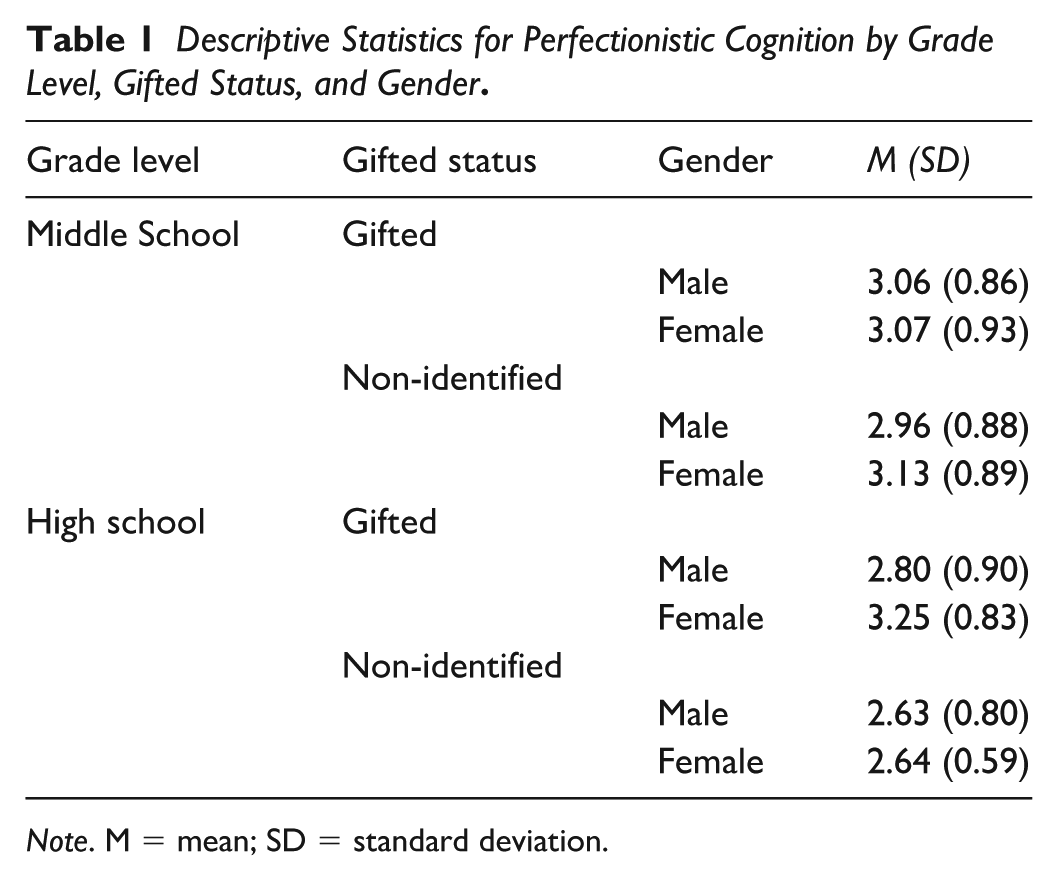
The main research question of Study 1 was whether students’ perfectionistic cognitions differed by gifted status and school level (middle vs. high school) after controlling for gender. Table 1 presents descriptive statistics. ANCOVA results revealed significant main effects of school level, F(1, 1,156) = 8.41, p = .004, Partial η2 = .007, and gender, F(1, 1,156) = 15.28, p < .001, Partial η2 = .01. The main effect of gifted status was not significant, F(1, 1,156) = 0.44, p = .506. However, the interaction between gifted status and school level was significant, F(1, 1156) = 5.68, p = .017, Partial η2 = .005, suggesting that the difference in perfectionistic cognitions between gifted and other students varied by school level. The effect size was meaningful but small.
Descriptive Statistics for Perfectionistic Cognition by Grade Level, Gifted Status, and Gender.
Note. M = mean; SD = standard deviation.
To follow up on this interaction, we compared estimated marginal means within each school level. Among middle school students, perfectionistic cognitions did not differ significantly between gifted (EMM = 3.07, SE = .065, 95% CI [2.95, 3.20]) and other students (EMM = 3.05, SE = .035, 95% CI [2.98, 3.12]) p = 0.72), whereas gifted high school students (EMM = 3.02, SE = .056, 95% CI [2.91, 3.13]) reported significantly higher levels of perfectionistic cognitions than their high school peers (EMM = 2.67, SE = 0.101, 95% CI [2.47, 2.86], p = .002).
Study 2
Research Questions
Methods
Participants
Participants included 646 middle and high school students (332 females, 54%) from a large public school district in a southeastern U.S. state. Of these, 472 were middle school and 171 were high school students. Three students did not report their grade level. Gifted status was classified similarly to Study 1. In middle school, 218 students reported being enrolled in their school’s gifted program and services, and 252 students were not identified as gifted. Students receiving gifted services had been identified in elementary or middle school based on the state’s multiple eligibility criteria, which include assessment of mental ability, academic achievement, creativity, and motivation, using national norms. Among high school students, gifted status was defined by both (a) prior identification as gifted during kindergarten through Grade 8 and (b) current enrollment in AP or Dual Enrollment courses. Based on these criteria, 128 high school students were classified as gifted, and 41 students were not. Non-identified students were those receiving regular education without any special education services or accommodations. The majority of students were White (63%), followed by Black (7%), Hispanic (6%), and Biracial/Multiracial (3%). This distribution reflects the ethnic composition of the school district.
Measures
Perfectionism
The Multidimensional Perfectionism Scale (Hewitt & Flett, 1991) was used to measure self-oriented perfectionism (e.g., “I strive to be as perfect as I can be”; α = .82, 95% CI [.79, .85]), other-oriented perfectionism (e.g., “Everything that others do must be of top-notch quality”; α = .73, 95% CI [.71, .76]), and socially prescribed perfectionism (e.g., “The people around me expect me to succeed at everything I do”; α = .77, 95% CI [.74, .79]). Items were rated on a 5-point Likert-type scale, ranging from strongly disagree (1) to strongly agree (5). Higher scores indicate higher levels of perfectionism in each subscale.
Social Adjustment
To measure students’ social adjustment experiences at school, we used the 8-item social adjustment subscale (e.g., “I join in with the activities that others take part in”; α = .88, 95% CI [.86, .91]) of the Adolescent Multidimensional Social Competence Questionnaire (Gómez-Ortiz et al., 2017). Items were rated on a 5-point Likert-type scale ranging from never (1) to always (5). Higher scores indicate a greater level of social adjustment. The questionnaire has been validated in diverse samples and has demonstrated strong psychometric qualities (e.g., Dinh et al., 2021; Gómez-Ortiz et al., 2017; Zych et al., 2018).
Relationships With Teachers and Peers
Students’ relationships with teachers and peers were assessed using the Student Engagement Instrument (Appleton et al., 2006). The teacher-student relationship subscale includes nine items (α = .92, 95% CI [.90, .95]; e.g., “My teachers are there for me when I need them.”) and the peer support subscale includes six items (α = .90, 95% CI [.87, .92]; e.g., “Other students here like me the way I am.”). Items were rated on a 5-point Likert-type scale, ranging from strongly disagree (1) to strongly agree (5), with higher scores indicating stronger relationships with teachers and peers. The scale was originally developed using a diverse sample (Appleton et al., 2006) and has been further validated in subsequent studies (e.g., Betts et al., 2010; Lovelace et al., 2014; Reschly et al., 2014).
Data Analysis
To address RQ1 and RQ2, initially, we planned a multivariate analysis of covariance (MANCOVA) to examine group differences across multiple perfectionism dimensions simultaneously. But given the relatively low correlations between the perfectionism dimensions (ranging from −.12 to .27; see Table 2), we decided to treat them as distinct variables of interest and use separate ANCOVAs for each dimension to examine group differences independently without assuming shared variance. Assumptions of normality were violated and not corrected by log transformation. We therefore employed nonparametric bootstrapping to obtain more robust estimates of model parameters and confidence intervals. We used the boot package for resampling and confidence interval estimations for bootstrapped ANCOVAs. The number of bootstrap samples was set to 2,000. A False Discovery Rate (FDR) correction using the Benjamini-Hochberg method was applied to adjust for multiple comparisons.
Descriptive Statistics and Correlations for Study 2 Variables.
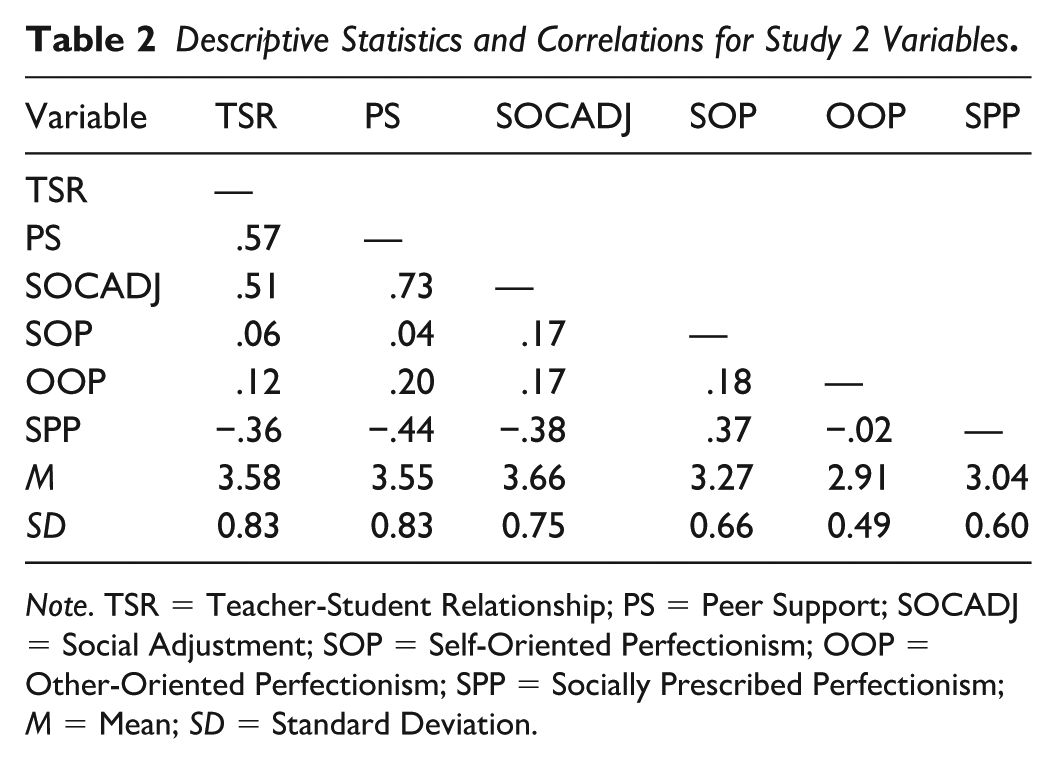
Note. TSR = Teacher-Student Relationship; PS = Peer Support; SOCADJ = Social Adjustment; SOP = Self-Oriented Perfectionism; OOP = Other-Oriented Perfectionism; SPP = Socially Prescribed Perfectionism; M = Mean; SD = Standard Deviation.
To address RQ3, we used multiple regression analyses in which each of the students’ social adjustment, relationship with teachers, and relationship with peers was a dependent variable, the three dimensions of perfectionism were predictors, and gifted status, school level, and gender were covariates. Perfectionism variables were mean-centered. After checking the assumptions of linear regression, we found significant deviations from the normality of residuals (all Shapiro-Wilk test p-values <.01) and evidence of heteroscedasticity (all Breusch-Pagan test p-values <.01). We used robust standard errors with the sandwich package to account for unequal residual variance. All analyses were performed using R version 4.2.1.
Results
Our preliminary analyses suggested violations of parametric assumptions for ANCOVA. Shapiro-Wilk tests revealed significant non-normality in residuals for other-oriented (W = 0.992, p = .003) and socially prescribed perfectionism (W = 0.990, p < .001), despite their Q-Q plots showing only mild deviations. Although Levene’s tests indicated no significant heterogeneity of variance, marginal p-values for self-oriented perfectionism (F = 2.48, p = .060) and socially prescribed perfectionism (F = 2.11, p = .097) suggested potential variance differences that could affect traditional ANCOVA results. Homogeneity of regression slopes was confirmed for all three dimensions (all interaction p-values > .13). We applied a log transformation (log[x+1]) to normalize the distribution of the data and compensate for potential heteroscedasticity. The results did not improve sufficiently. We therefore decided to use robust, bootstrapped ANCOVAs.
Table 3 presents the results of the robust ANCOVA analyses. For self-oriented perfectionism, there was a significant main effect of gifted status F(1, 606) = 7.29, 95% CI [0.60, 21.31], p = .024, Partial η2 = .012, and school level, F(1, 606) = 8.32, 95% CI [0.92, 24.11], p = .024, Partial η2 = .014, with gifted students reporting significantly higher than their non-identified peers, and high school students reporting significantly higher than middle school students. No significant interaction was found between school level and gifted status, F(1, 606) = 1.06, 95% CI [0.45, 21.86], p = .455. There was a significant effect of gender, F(1, 606) = 7.08, 95% CI [0.01, 8.31], p = .024, Partial η2 = .012. Female students report higher levels of self-oriented perfectionism than male students. For other-oriented perfectionism, there were no statistically significant main effects or a significant interaction. For socially prescribed perfectionism, the analyses showed only a significant main effect of school level, F(1, 605) = 14.18, 95% CI [3.33, 33.67], p = .002, Partial η2 = .023. High school students had higher scores than middle school peers. There was no significant main effect of gifted status, F(1, 605) = 0.01, 95% CI [0.01, 5.62], p = .938, or gender, F(1, 605) = 3.01, 95% CI [0.02, 15.82], p = .142. The interaction effect of school level × gifted status was also non-significant, F(1, 605) = 3.47, 95% CI [0.03, 14.00], p = .125.
Robust ANCOVA Results.
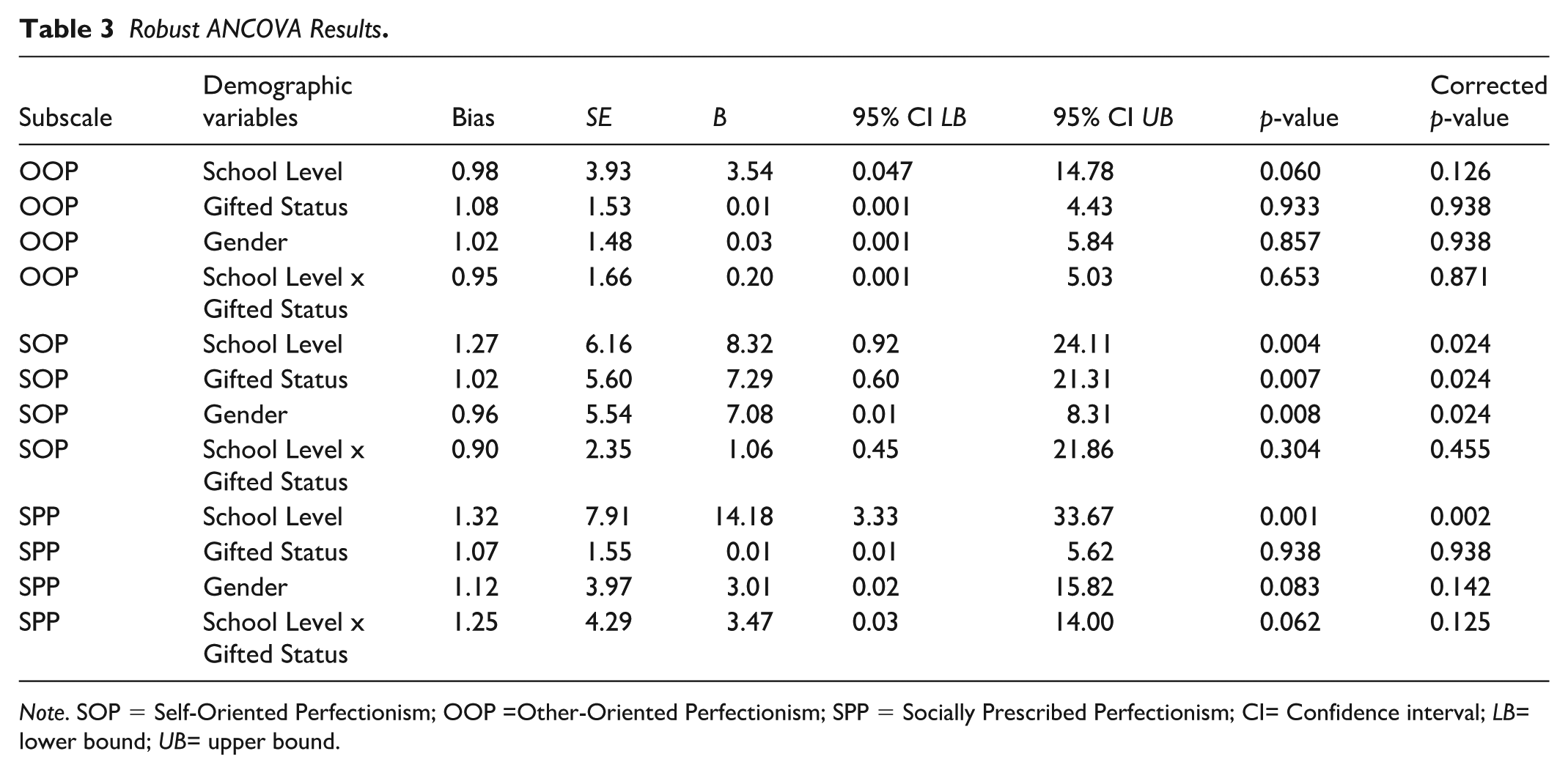
Note. SOP = Self-Oriented Perfectionism; OOP =Other-Oriented Perfectionism; SPP = Socially Prescribed Perfectionism; CI= Confidence interval; LB= lower bound; UB= upper bound.
For the third research question, investigating the relationship between perfectionism dimensions and students’ social adjustment and relationships with teachers and peers, we tested three regression models. The first regression model was statistically significant for relationships with teachers, F(6, 606) = 32.75, p < .001, R2 = .25, R2adjusted = .24. As shown in Table 4, self-oriented perfectionism and socially prescribed perfectionism predicted the quality of teacher-student relationships (B = 0.22, SE = 0.06, p < .001, and B = −0.55, SE =0.05, and p < .001, respectively), with greater self-oriented perfectionism and lower socially prescribed perfectionism associated with stronger teacher-student relationships. Gifted status was also a significant predictor (B = 0.15, SE = 0.07, and p = .04).
Multiple Regression for Teacher-Student Relationships, Peer Relationships, and Social Adjustment.
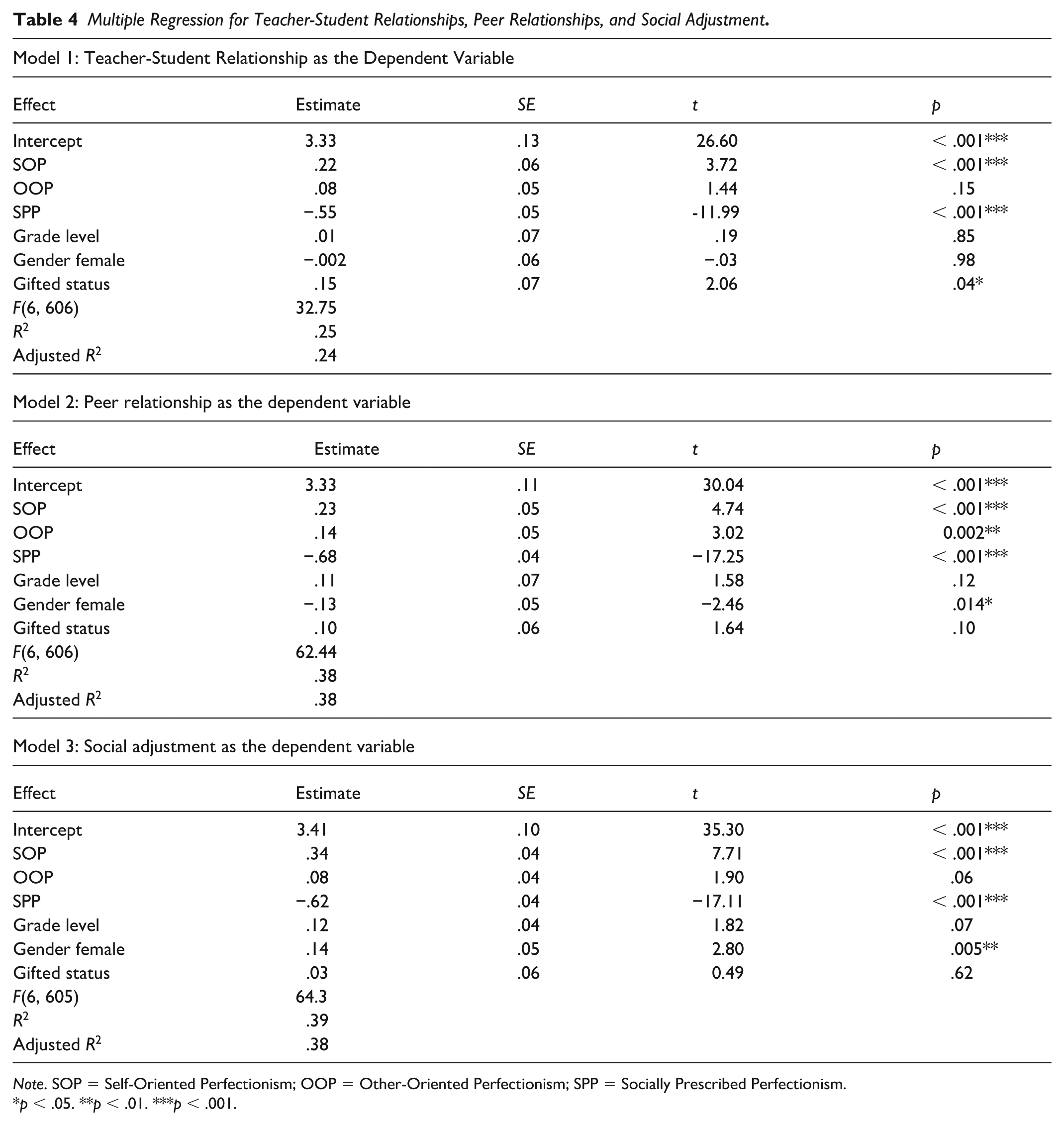
Note. SOP = Self-Oriented Perfectionism; OOP = Other-Oriented Perfectionism; SPP = Socially Prescribed Perfectionism.
*p < .05. **p < .01. ***p < .001.
The regression model for peer relationships was significant, F(6, 606) = 62.44, p < .001, R2 = .38, R2adjusted = .38. All three perfectionism dimensions were significant predictors, self-oriented perfectionism and other oriented perfectionism having positive (B = 0.23, SE = 0.05, p < .001, and B = 0.13, SE = 0.05, and p = .002, respectively), and socially prescribed perfectionism negative (B = −0.67, SE = 0.04, p < .001) associations with peer relationships. Gender was a significant negative predictor (B = −0.13, SE = 0.05, p = .014), with female students reporting significantly lower peer relationship scores than male students, controlling for other variables. Neither gifted status nor school level was a statistically significant predictor of peer relationships (B = 0.10, SE = 0.06, p = .10, and B = 0.11, SE = 0.07, and p = .12, respectively).
The third and final regression model accounted for 38% (p < .001) of the variance in students’ social adjustment. Self-oriented perfectionism was a positive predictor (B = 0.34, SE = 0.04, p < .001), whereas socially prescribed perfectionism was a negative predictor (B = −0.62, SE = 0.04, and p < .001). Other-oriented perfectionism did not predict social adjustment. Gender was a significant positive predictor (B = 0.14, SE = 0.05, p = .005), suggesting that female students experienced better social adjustment compared to male students, controlling for other variables.
General Discussions
The present article reports findings from two studies investigating differences in perfectionism between gifted students and their non-identified peers. Study 1 focused on perfectionistic cognitions, which capture automatic thoughts about the need to be perfect or fear of making mistakes. Study 2 examined trait perfectionism by exploring differences in three dimensions using Hewitt and Flett’s (1991) multidimensional model. Study 2 also investigated whether and to what degree these perfectionism dimensions account for variance in students’ social adjustment and relationships with teachers and peers at school.
Results indicated no main effect of article status on perfectionistic cognitions, but the interaction between gifted status and school level was significant. There was no difference in perfectionistic cognitions between gifted students and their peers in middle school. In high school, however, gifted students reported significantly higher levels of perfectionistic cognitions than their peers. This difference is likely to be due to the specific situational demands of being in high school, such as increased academic demands and perceived performance expectations. Recall that our classification of gifted status in high school was based on students’ enrollment in AP and dual enrollment courses, in addition to their earlier gifted identification in elementary or middle school (as no formal gifted identification was in place at the high school level). It is possible that gifted students, on average, might have a stable cognitive schema that predisposes them to perfectionistic cognitions, but this may not be evident in middle school and may emerge later in high school—perhaps because advanced academic contexts activate it. In addition, academic performance in high school may be perceived as having greater consequences than in middle school, given its perceived relevance for future educational and life opportunities (Gong & Toutkoushian, 2024). Family context may also play a role in students’ motivation and self-expectations, but, given the cross-sectional nature of the study, it is hard to disentangle these alternative explanations.
By looking at our Study 1 findings, we cannot say for sure if gifted students, overall, have high standards for themselves. We did not find any significant differences in middle school. But the observed differences in high school provide some support for the idea that these thoughts are linked to contextual factors, even if they also reflect individual differences. Perfectionistic cognitions have been defined as state-like manifestations of perfectionism that result from the activation of a perfectionistic self-schema (Flett et al., 1998). This activation may not occur when students do not feel a need to be perfect. If learning tasks lack sufficient challenge, a gifted student may not frequently experience such thoughts, especially if their usual level of effort is enough to achieve their goals in that environment. Prior research suggests that gifted students may experience increased levels of perfectionistic thoughts when placed in high-ability environments with more demanding academic expectations (Speirs Neumeister et al., 2007).
One potential risk of striving for high standards arises when a student’s self-esteem is based on these standards despite negative effects, and when the student engages in self-criticism regardless of whether the standards are met. Research suggests that self-worth based on achievement is associated with the onset and maintenance of psychological distress and disorders such as anxiety, depression, and eating disorders (Lunn et al., 2023; Shafran et al., 2023). In clinical perfectionism, cognitive-behavior therapy for perfectionism (CBT-P) is used to target these maladaptive processes and reduce associated symptoms. Randomized controlled trials have shown the efficacy of both self-help and face-to-face CBT-P in reducing perfectionism and anxiety, depression, and eating disorders (for a meta-analysis, see Galloway et al., 2022). Although the distinction between adaptive and maladaptive forms of perfectionism has been widely emphasized in the literature—particularly given positive associations between perfectionism and positive outcomes such as academic performance and well-being (e.g., Hill et al., 2020; Madigan, 2019; Stoeber et al., 2020)—some have argued that the pursuit of excellence (i.e., excellencism) is functionally distinct from the pursuit of perfectionism and that perfectionism itself is either unneeded or harmful (Gaudreau et al., 2022). Of course, it remains an open question whether students are more productive or happier when aiming for and striving toward excellence, and more research is needed. Nevertheless, students may still benefit from interventions designed to help reshape their standards and concerns into the pursuit of excellence.
In Study 2, of the three perfectionism dimensions, we observed a significant difference only in self-oriented perfectionism between gifted students and their peers. Gifted students scored higher on self-oriented perfectionism than non-identified students. No significant differences were observed in other-oriented or socially prescribed perfectionism. These findings offer a great deal of insight into our understanding of the giftedness-perfectionism link. In particular, they challenge the notion that perfectionism is a defining characteristic of gifted students without considering the specific dimension or expression being referenced (Grugan et al., 2021). Perhaps most tellingly, they support the view that perfectionism among the gifted is adaptive (LoCicero & Ashby, 2000; Schuler, 2000). Prior research suggests that self-oriented perfectionism is often associated with intrinsic motivation and mastery goals (Miquelon et al., 2005; Stoeber et al., 2008; Stoeber et al., 2009). Given that gifted students also tend to report high levels in these motivational variables (Mammadov & Hertzog, 2021a, 2021b; Vallerand et al., 1994), it is very likely that their perfectionistic tendencies are largely internally driven. In addition, the absence of significant differences in socially prescribed perfectionism suggests that gifted students are not necessarily more sensitive to perceived external pressures to be perfect.
ANCOVA results for other-oriented perfectionism showed no significant main effects or a significant interaction, suggesting that gifted students were similar to their peers, with no differences by gender or school level. Unlike the other two dimensions of perfectionism, other-oriented perfectionism has received limited attention in studies with children and adolescents. One reason is that widely used multidimensional scales—such as the Child-Adolescent Perfectionism Scale (Flett et al., 2000), the Frost Multidimensional Perfectionism Scale (Frost & Marten, 1990), and the revised Almost Perfect Scale (Slaney et al., 2001)—do not include a subscale specifically designed to measure this dimension. Another reason is that other-oriented perfectionism plays a more central role in dyadic perfectionism in the form of spouse- and partner-oriented perfectionism (Haring et al., 2003; Stoeber, 2012). In contrast, relationships with peers or teachers may not involve the same level of interdependence or expectations, making other-oriented perfectionism less salient in school contexts.
All regression models were significant. Socially prescribed perfectionism appeared to be a strong negative predictor of all three outcome variables, with higher levels associated with weaker teacher and peer relations and lower social adjustment. For every 1-unit increase from the mean of socially prescribed perfectionism, the predicted values of these outcomes decreased by .55, .67, and .62 points, respectively, holding all other variables constant. This suggests that socially prescribed perfectionism may be an important factor in students’ social experiences at school. PSDM (Hewitt et al., 2006) is particularly relevant here. According to the model, socially prescribed perfectionism contributes to social disconnection and isolation, which in turn leads to various mental health problems (Hewitt et al., 2006). Adolescents high in socially prescribed perfectionism may be oversensitive to criticism and rejection (Barnett & Sharp, 2016; Roxborough et al., 2012; Sherry et al., 2016) and may experience feelings of detachment from others (i.e., subjective social disconnection), which can reduce their social contact and result in actual isolation (i.e., objective social disconnection; Magson et al., 2019). Roxborough et al. (2012) reported that socially prescribed perfectionism was associated with suicidal and depressive outcomes, and that this relationship was fully mediated by bullying and social helplessness.
The second and third models were similar in terms of how much variance they accounted for in peer relations and social adjustment. In both models, socially prescribed perfectionism consistently emerged as a strong negative predictor. Perceived external pressure to be perfect, even if not accurate, may undermine students’ social functioning. Prior studies have reported similar results (Flett, Schmidt, et al., 2016; Huggins et al., 2008; Lee et al., 2021). Self-oriented perfectionism showed a positive relationship with both peer relations and social adjustment, suggesting that high personal standards may support more positive social outcomes. Note that self-oriented perfectionism is considered to be an adaptive form of perfectionism (Stoeber & Otto, 2006), which, in previous studies found to be associated with higher levels of teacher relations and peer support (e.g., Fredrick et al., 2016).
The finding that other-oriented perfectionism was positively related to peer relationships was interesting, although the prediction was relatively weak and did not extend to social adjustment. These results contradict previous studies. From the literature, we know that other-oriented perfectionism is associated with other-blame (Flynn, 1996), disagreeableness (Stricker et al., 2019), and conflict (Kleszewski & Otto, 2020). Some studies have also reported negative associations between other-oriented perfectionism and aspects of social adjustment, such as social support and prosocial value orientations (Kleszewski & Otto, 2020; Stoeber, 2014, 2015). However, as noted earlier, this perfectionism dimension has been studied very rarely with children and adolescents. Perhaps in certain aspects of peer relations, holding high standards for others may be helpful for task cooperation or dependability. More research is needed to better understand its role in social relations at school.
Another important finding from the regression models was that gifted status was a significant positive predictor of teacher-student relationship quality. Gifted students reported slightly more positive relationships with their teachers compared to their non-identified peers. Similar findings have been reported in previous studies. For example, Weyns et al. (2021) found that high-ability students reported less conflict with teachers compared to average- ability students. Similarly, gifted students’ teachers reported less conflict with their students than did teachers of regular classrooms (Kesner, 2005). Gifted students might be perceived as requiring less support and as being more engaged and motivated, which could facilitate smoother interactions with teachers. The role of possible teacher bias in favor of gifted students (e.g., Ferrándiz et al., 2025) should also be considered when interpreting this finding.
Conclusion
Perfectionism is the tendency to strive for exceptionally high standards, doing so, and critically evaluating one’s own performance. Context, personal goals, and sources of pressure distinguish one form of perfectionism from another. Perfectionism is especially predictive of achievement and well-being (for meta-analyses, see Limburg et al., 2017; Madigan, 2019), which makes it particularly important to study and understand its implications for both academic experiences and social and emotional lives of students. Perfectionism has gained prominence and popularity in the gifted literature. Findings are promising, but more research is needed.
The current article contributes to this literature by examining both perfectionistic cognitions and multidimensional trait perfectionism in gifted and non-identified adolescents, as well as exploring how different dimensions relate to their social adjustment and relationships at school. Gifted high school students, but not gifted middle school students, reported higher levels of perfectionistic cognitions than their same-age peers. Although we did not examine perfectionistic cognitions in relation to specific school outcomes, this remains a worthwhile area for future research in gifted students alongside trait dimensions of perfectionism.
Regarding perfectionism dimensions, the only significant difference was observed in self-oriented perfectionism, with gifted students scoring higher than their peers. The links between perfectionism dimensions and students’ social adjustment and school relationships were largely independent of giftedness. Socially prescribed perfectionism was negatively related to social adjustment and relationships with teachers and peers for both gifted students and their non-identified peers. With this in mind, students who believe that others expect them to be perfect and will be highly critical if they fail to meet these expectations may struggle with school adjustment and interpersonal and social relationships as long as these beliefs persist. Practitioners should pay close attention to these students and investigate the efficacy of interventions to help them recognize and reshape perfectionistic beliefs about external expectations and evaluations.
Limitations and Directions for Future Research
This brings us to limitations and several directions for future research. Both studies were cross-sectional in design, which precludes any inference on causality, particularly for Study 2, which examined relations with school experiences. The studies also relied on samples limited to the southeastern U.S., albeit from two states, which may constrain the generalizability of the results. Despite bootstrapping and robust methods, results should be interpreted with caution, given assumption violations. Another limitation concerns how the gifted status was determined. Because no formal gifted identification was in place at the high school level, we relied on prior identification and current enrollment in AP or Dual Enrollment courses. Findings should be interpreted cautiously, given this inconsistency.
There are several especially profitable directions for future research on perfectionism in gifted adolescents. Little is known about how students develop different forms of perfectionism. School experiences may shape their developmental trajectories. For example, Flett et al. (2002) suggested that students’ experiences of academic success might contribute to the development of perfectionism. Higher academic performance may predispose students to become more perfectionistic. For gifted students, their unique social and emotional experiences may play a pivotal role. Prospective longitudinal research is needed to better understand how individual tendencies and environmental factors interact to influence the development of perfectionism. Longitudinal designs could also clarify whether, and when, the perfectionistic thoughts of students reflect a stable trait or a contextually activated state. Future research might also examine other-oriented perfectionism in school settings. We observed an unexpected positive association between other-oriented perfectionism and certain aspects of peer relationships. In contrast to the other two dimensions, relatively little is known about what moderates the effect of other-oriented perfectionism in relationships, especially in children and adolescents. For instance, the association between other-oriented perfectionism and peer relationships may vary with peer norms and group expectations.
Footnotes

Ethical Considerations
Ethical approval for this study was obtained from the University of Georgia Institutional Review Board (approval no. PROJECT00009590) on May 01, 2024.
Funding
The authors received no financial support for the research, authorship, and/or publication of this article.
Declaration of Conflicting Interests
The authors declared no potential conflicts of interest with respect to the research, authorship, and/or publication of this article.
Open Practices
The data analyzed in this study are available upon request for purposes of reproducing the results. The code or protocol used to generate the findings reported in the article is available upon request for purposes of reproducing the results or replicating the study. There are no other newly created, unique materials used to conduct the research.
Artificial Intelligence Use
The authors confirm that no generative AI tools were used in the development of this article.