







Abstract
Objective:
This paper reports on the use of child participatory approaches to evaluate the implementation and impact of the Zippy’s Friends emotional wellbeing programme on children in disadvantaged primary schools in Ireland.
Design:
As part of the overall evaluation study, which comprised a clustered randomised controlled trial, qualitative participatory approaches were utilised to explore children’s experiences of the Zippy’s Friends programme.
Setting:
From the overall sample of 44 primary schools (N = 717 pupils) that participated in the evaluation study, a subsample of 9 classes (n = 161 children) from the intervention and control groups was randomly selected to take part in child participatory workshops at pre-intervention, interim and post-intervention.
Method:
A semi-structured child participatory workshop consisting of three activities, including draw and write technique, feelings activity and group brainstorming, was used to explore the children’s experiences of the programme and its impact on their coping strategies and emotional literacy skills.
Results:
The results from the draw and write activity provided evidence of the positive impact of the programme on children’s use of problem-solving and support-seeking strategies in coping with certain problem situations. Findings from the participatory workshop also helped provide insight into how the programme impacted on children’s emotional literacy skills. Children in the intervention group had a broader range of vocabulary and understanding in relation to emotions concerning problem situations. In addition, children identified factors that, from their perspective, supported their engagement with the programme, including the use of narrative through story and the activity-based nature of the programme.
Conclusion:
The use of participatory approaches generated data that enriched our understanding of how children experienced and benefited from the programme from their own perspective, thereby providing insights that were untapped by other research methods in this study.
Keywords
Introduction
Schools play an important role in enhancing students’ social and emotional wellbeing, and their health and civic engagement, in addition to fostering children’s academic development (Durlak et al., 2011). There is growing international evidence that school-based mental health promotion programmes, when implemented effectively, can produce long-term benefits for young people, including improved social emotional functioning and academic performance (Adi et al., 2007; Barry et al., 2013; Payton et al., 2008; Weare and Nind, 2011). Most of the evidence supporting the effectiveness of these programmes has been generated through the use of standardised measures as part of well-controlled research investigations. However, these traditional evaluation approaches have been challenged as being grounded in ‘research on’ rather than ‘research with’ or ‘research for’ children (Darbyshire, 2000; Darbyshire et al., 2005), and as such, they may run the risk of omitting the views of children as active agents and ‘key informants’ in matters pertaining to their health and wellbeing.
Children and young people are increasingly regarded as a group for whom having a ‘voice’ is vitally important (Lloyd-Smith and Tarr, 2000). Simovska and Jensen (2009) state that it is imperative that young people are actively involved in decision-making in the domains that affect their everyday lives. Participatory research with children is recognised as providing a unique view of the world that can positively contribute to child-centred policy and practice developments (Darbyshire et al., 2005; Simovska, 2013; Sixsmith et al., 2007). Participatory approaches are a diverse set of techniques that are bound together by an ethical concern for actively involving research participants in the construction and analysis of data (Nic Gabhainn and Sixsmith, 2006). These approaches provide an opportunity to engage with the social realities that frame even very young children’s lives (Curtis-Tyler, 2011). Kesby (2000) suggests that participatory approaches can ‘access and valorise previously neglected knowledge and provide more nuanced understandings of complex social phenomena’ (p. 423).
Background to this study
This paper reports on the use of child participatory approaches to evaluate the implementation of Zippy’s Friends, an international emotional wellbeing programme for primary school children. Participatory approaches were used as part of the overall study (Clarke, 2011; Clarke and Barry, 2010), which also employed a cluster randomised control trial (RCT) to evaluate the outcomes of the Zippy’s Friends programme for children in disadvantaged primary schools in Ireland. Zippy’s Friends is a universal school-based intervention that aims to promote the mental health and emotional wellbeing of children aged 6–9 years of age. The programme is designed to help all young children to expand their range of effective coping skills by promoting varied and flexible ways of dealing with problems of day-to-day life (Bale and Mishara, 2004). The programme consists of 24 sessions (each 1 hour in duration) which are divided into six modules, each focusing on a particular theme (1) feelings, (2) communication, (3) making and breaking relationships, (4) conflict resolution, (5) dealing with change and loss and (6) general coping skills. Zippy’s Friends is currently running in schools and pre-schools in 27 countries, and more than 712,000 children have enrolled in the programme worldwide. The Zippy’s Friends programme is based upon Lazarus and Folkman’s (1984) theoretical framework of coping. The underlying hypothesis is that if children learn at a young age to expand their repertoire of coping abilities, they will be less likely to develop serious problems in childhood, adolescence and even adult life when they are confronted with the inevitable occurrence of stressful situations (Mishara and Ystgaard, 2006).
Previous evaluations of Zippy’s Friends
To date, the programme has been evaluated in Norway (Holen et al., 2012), Denmark and Lithuania (Mishara and Ystgaard, 2006) and Canada (Dufour et al., 2011). Key findings from these studies highlight the significant positive effects of the programme on children’s coping strategies (Holen et al., 2012; Mishara and Ystgaard, 2006), social skills (Mishara and Ystgaard, 2006), externalising behaviour (Mishara and Ystgaard, 2006), improved autonomy (Dufour et al., 2011) and a significant positive effect on the impact of mental health difficulties in daily life (Holen et al., 2012).
The evaluation of the Zippy’s Friends programme in Ireland employed a clustered randomised controlled design to determine the effectiveness of programme implementation, and the impact and outcomes for primary school children in disadvantaged schools. The Irish study builds on previous evaluations and extends the focus by including children as key informants in the evaluation of the programme. The use of child participatory approaches, in combination with more standardised measures as part of the clustered RCT, was designed to gain additional insights into programme implementation and outcomes. This paper focuses on the use of these child participatory approaches as part of programme evaluation. Findings in relation to other aspects of the evaluation, including investigating the immediate and long-term impact of the programme on children’s emotional and behavioural wellbeing using standardised methods, examining programme implementation and its impact on programme outcomes, have been reported elsewhere (Clarke, 2011; Clarke et al., 2010, 2014).
A range of approaches and methods, including draw and write technique, feelings activity and group brainstorming, were used to capture the breadth and depth of children’s perceptions and experiences that would have been difficult to obtain through the use of any single technique. Draw and write technique has been described as a flexible method that offers children and young people the opportunity to share their views in their own words, not the words chosen by a researcher (Pridmore and Bendelow, 1995). Advocates of draw and write technique contend that its power derives largely from the way in which the act of drawing can help to break down barriers and allow powerful emotions to be expressed (Pridmore and Lansdown, 1997). It is, therefore, suggested that this method can provide data which are richer and more insightful than those which could be obtained through writing alone. The use of drawing also supports a child’s sense of control and mastery (Hanney and Kozlowska, 2002) and reduces power imbalances between the adult and child (O’Kane, 2008), both of which are important ethical considerations in the context of conducting research with young children. On a practical level, the popularity of drawing among children (Thomas and Jolley, 1998) and its typical perception as fun and non-threatening, unlike more testing situations (Rubin, 1984; Merriman and Guerin, 2006), further support the use of this technique with young children. Given the age profile of the children in this study (mean age = 7 years and 2 months), draw and write technique was regarded as a particularly appropriate method to elicit children’s responses regarding the types of coping skills they used at pre- and post-interventions.
The use of vignettes is another popular method used with children (Hazel, 1995). The story-telling nature of the vignette approach is relaxing, interesting and can reduce children’s feeling of being overburdened by the interview process (Barter and Renold, 2000). In addition, the fictitious nature of the vignettes can assist in obtaining information beyond the informants’ current personal situation (Finch, 1987). Furthermore, while vignette activities may be deemed as less threatening for children, the story and questions serve to anchor the choice in a situation and as such reduce the possibility of an unreflective reply (Bryman, 2001; Finch, 1987).
An independent ethical review was undertaken and received from the National University of Ireland Galway Ethics Committee to conduct this research in December 2007.
Method
Design
As part of the overall evaluation study, qualitative participatory approaches were utilised to explore children’s perspectives concerning their participation in the Zippy’s Friends programme.
Sample
The evaluation of Zippy’s Friends was carried out in the context of delivering equality of opportunity in schools (DEIS) 1 (designated disadvantaged) in Ireland. Schools were randomly assigned to intervention and control groups. From the overall sample of 44 designated disadvantaged schools (N = 717 pupils) that participated in the evaluation study, a subsample of 9 classes (n = 161 children) from the intervention and control groups was randomly chosen to take part in the child participatory workshops at pre-intervention, interim (on completion of first half of the programme) and at post-intervention. Six classes were randomly chosen from the intervention group (n = 84) and three classes from the control group (n = 77). Four of the intervention and two of the control classes were located in an urban area. Class sizes ranged from 10 to 25 pupils. The mean age of the children at the baseline (February 2008) was 7 years and 2 months (minimum age = 6 years and 4 months, maximum age = 7 years and 11 months). Independent t-tests revealed that there were no significant differences between children in the control and intervention groups according to their age, t(159) = −1.81, p = .74. A chi squared test for independence indicated that there were no significant differences between the control and intervention groups in terms of gender, χ2(1, N = 159) = 3.56, p = .059, phi = .14, and school size, χ2(1, N = 159) = 0.36, p = .055, phi = .04.
Participatory workshop format
The semi-structured workshop was to explore the children’s coping and emotional literacy skills, which were also examined using standardised quantitative techniques in this study (Clarke, 2011; Clarke et al., 2014) by employing a more child-centred approach. Specifically, the workshop was designed to explore the following in the children:
Personal experiences of how they coped with problem situations;
Ability to identify feelings in response to problem situations;
Views about the Zippy’s Friends programme.
Coping skills: draw and write technique (pre- and post-intervention)
At pre- and post-intervention, draw and write technique (Williams et al., 1989) was used to examine children’s experiences of a problem situation and the types of coping strategies children used to deal with the situation. First, children were asked to draw a picture and write one sentence about a time when they felt sad. Following this, the children were asked to draw a second picture and write one sentence about what they could do to make themselves feel better. Children who requested assistance with writing their sentences were assisted by the class teachers or researcher.
Emotional literacy: feelings activity (interim and post-intervention)
For the feelings activity, the researcher read aloud six short vignettes to the children, each describing something that happened to a child aged 7 years. The following scenarios were read out to the children:
Tom was pushed in the yard Michael was going to Spain for four weeks Gráinne forgot to do her spellings last night Paul’s brother took his PS2 from him and wouldn’t give it back to him Sharon said that nobody would play with her in the yard. Ronan’s sister got a new bike and he didn’t.
The children were asked to respond to each vignette by explaining how the child might have felt. At post-intervention, the scenarios were altered slightly (names and location changed); however, the type of event remained the same.
Programme implementation: group brainstorming (post-intervention)
Children’s views about the Zippy’s Friends programme were ascertained at post-intervention. Following completion of the feelings activity, children in the intervention group were asked a series of questions about the programme using child-centred techniques. Each of the classes was divided into groups of two or three and the children were brainstormed on poster paper (with the researcher acting as scribe): (1) what they liked about the programme, (2) what they disliked about the programme and (3) what kind of things Zippy’s Friends had taught them. On completion of this activity, the children’s responses to ‘What kind of things has Zippy’s Friends taught you?’ were placed on the wall, and the children were asked to individually identify the two most important things that Zippy’s Friends taught them. Each child was given two post-its and voted using these post-its.
The researcher conducted the participatory workshop with each of the intervention and control classes across two school days. The draw and write activity was conducted on the first day, and the feelings activity and group brainstorming were conducted on the second day. For the feelings activity and group brainstorming, children were removed from the classroom structure and sat in a circle. A series of icebreakers were used throughout the participatory workshops to engage the children and ensure the activities were enjoyable. The feelings activity and group brainstorming were recorded with permission from the parents and children.
Data analysis
The results from all three techniques were analysed using the inductive thematic analysis approach as described by Braun and Clarke (2006). With this method, the themes identified emerge from the data, thus providing a rich and detailed account across the entire data set. Using Braun and Clarke’s (2006) six phases of thematic analysis for the draw and write activity, after reading and re-reading the data, the children’s responses to Picture 1 (‘A time when I felt sad’) were coded and collated. Following this, the codes were sorted into potential themes, gathering all data relevant to each potential theme. The themes were checked in relation to the coded extracts (Level 1) and the entire data set (Level 2). Further analysis was carried out to refine the specifics of each theme, and the final step of analysis involved selecting compelling extract examples. Following the analysis of Picture I, the children’s responses to Picture 2 (‘What I could do to feel better’) were analysed within each themed ‘problem situation’. The same six-step process of thematic analysis was repeated for Picture 2. Comparison between children’s responses in the intervention and control groups at pre- and post-interventions was examined.
The recordings from the feelings activity and group brainstorming were transcribed by the researcher and were analysed using the inductive thematic analysis approach (Braun and Clarke, 2006). Similar to the draw and write, transcripts were reviewed and coded. Codes were grouped into potential themes, and themes were reviewed, refined and defined. Coding was subject to cross-checking with a second researcher to determine accuracy and reliability.
Results
Draw and write
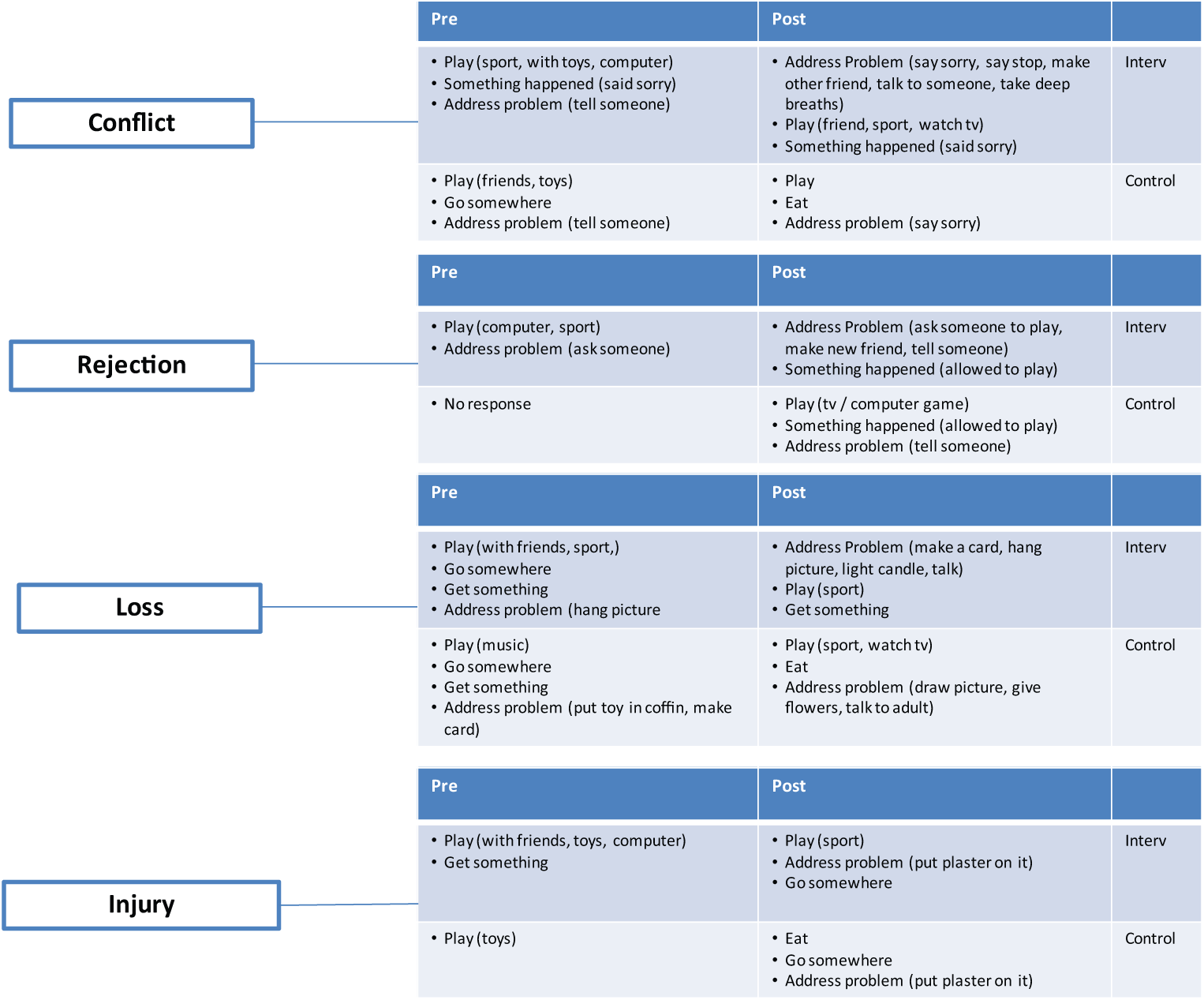
Figure 1 illustrates the key themes that emerged from the draw and write activity, in terms of the main problem situations that resulted in children feeling sad and the types of coping strategies children in the intervention and control groups said they would use at pre- and post-interventions.
Children’s themes: ‘A time when I felt sad’ and pre- and post-intervention coping strategies for each theme.
Picture 1
In relation to Picture 1 (‘A time when I felt sad’), the children’s response were categorised into four themes: conflict, rejection, loss and injury. Each theme was made up of several categories.
The theme of conflict consisted of two categories: (1) dispute and (2) being reprimanded. This was the most frequently reported theme at pre-intervention across the intervention and control groups. Children wrote about times when they were hit/punched/pushed by someone, times when they were teased or called names or shouted at. In relation to being reprimanded, children wrote about being sad when a teacher or parent reprimanded them or when a parent would not let them do what they wanted to do.
The theme of rejection consisted of two categories: (1) not allowed to play and (2) feeling alone. Girls were more likely than boys to draw and write about situations involving rejection. Several children wrote about a time when a friend or a group of people would not let them join in or play. Other children recalled feeling alone/having nobody to play with.
The theme of loss included two categories: (1) death of a loved one and (2) a relative being absent. The majority of children wrote about the death of a grandparent or a pet dying. In relation to the category of a relative being absent, in most cases, the children referred to a parent being absent from home.
Regarding the theme of injury, children referred to falling or being injured. The majority of injuries were related to falling and hurting their leg. Boys referred to feeling sad as a result of an injury more often than girls.
Picture 2
For Picture 2, children were asked to draw a picture and write a sentence about what they could do to feel better. The children’s responses were categorised into five main themes: (1) play – with toys, friends, sport, computer game or watch television; (2) feeling better as a result of something happening, such as the other person saying sorry or someone being reprimanded; (3) feeling better as a result of getting something or going somewhere, such as getting sweets or going to the park; (4) actively addressing the problem situation, such as telling someone about the problem or doing something to actively change the situation and (5) eating to feel better.
At pre-intervention, children in the intervention and control groups used the strategy of play and feeling better as a result of something happening with the most frequency across the four problem situations. There was no apparent difference in the types of strategies used by boys and girls. Examples of children’s pre-intervention responses included the following:
Conflict: (Pic 1): ‘My sister hit me with a toy’. (Pic 2, something happened): ‘My sister said sorry’. (Intervention Group, School 33, Child 06, boy) Rejection (Pic 1): ‘Chloe and Rachel were playing tennis ball but they never let me play’. (Pic 2 something happened): ‘They let me play tennis’. (Intervention Group, S41, C17 girl) Loss: (Pic 1): ‘I was sad when my dog died’. (Pic 2 play): ‘I was happy when I was playing basketball with Sophie’. (Intervention Group, S38, C13, girl) Loss: (Pic 1): ‘Dad left’. (Pic 2 play): ‘I go on my buggy bike’. (Control Group, S36, C09, boy)
Conflict
At post-intervention, the majority of children in the intervention group addressed conflict situations by telling their mother or father or a teacher. Children in the control group used strategies including play, eating and feeling better as a result of going somewhere with the most frequency. Examples of children’s responses included the following:
(Pic 1): ‘I felt sad when my brother hit me’. (Pic 2 Talk): ‘I would feel happy when I tell Mummy’. (Intervention Group, S2 C10, girl) (Pic 1): ‘I was sad when I was grounded’. (Pic 2 address problem): ‘I took deep breaths and said sorry to my Mum’. (Intervention Group, S33, C3, boy) (Pic 1): ‘I was lost and a boy hit me’. (Pic 2 Play): ‘I’m playing my Playstation’. (Control Group, S27, C4, girl)
Rejection
In the case of situations concerning rejection, children in the intervention group used problem-solving strategies such as telling someone about it or making new friends. Children in the control group were most likely to feel better as a result of being allowed to play or playing by themselves or watching television. Examples of children’s post-intervention responses include the following:
(Pic 1): ‘When my cousins came we were playing with the skipping rope. She said I couldn’t play because I was too small’. (Pic 2 address problem): ‘I made friends with a new friend and she brought two skipping ropes. I asked if I could have one’. (Intervention Group, S40, C14, girl) (Pic 1): ‘I was sad when my Mum left me at home’. (Pic 2 Watch TV): ‘When I was sad then I went to watch TV and it made me better’. (Control Group, S21, C14, boy)
Loss: death
At post-intervention, children in the intervention group dealt with situations involving loss by talking to friends, hanging a picture of the loved one on the wall or lighting a candle. Children in the control group were more likely to indicate that playing and having something to eat would help them to feel better. Examples of intervention and control group responses include the following:
(Pic 1): ‘I was sad when my Grandad died’. (Pic 2 address problem): ‘I talk about Grandad’. (Intervention Group, S33, C08, boy) (Pic 1): ‘I was sad when my dog died’. (Pic 2 play): ‘I was happy when I was playing basketball with Sophie’. (Control Group, S36, C3, girl)
Loss: absent relative
At post-intervention, the majority of children in the intervention group attempted to directly address the problem of feeling sad as a result of an absent parent by talking to the person on the phone, making a card, looking at photos and thinking about the person. Children in the control group used play and eating to feel better at post-intervention. Some of the children’s comments included the following:
(Pic 1): ‘I felt sad when my Mum went to Dublin’. (Pic 2 address problem): ‘I rang my Mum, I felt so happy’. (Intervention Group, S31, C4, girl) (Pic 1): ‘I was alone because I over slept and my Mum was gone’. (Pic 2 eat): ‘I made myself some eggs and hot chocolate’. (Control Group, S42, C6, boy)
Figure 2 represents a sample of drawings from children in the intervention group at post-intervention

Sample of drawings from children in the intervention group illustrating their use of active coping strategies at post-intervention.
Feelings activity
For this activity, the researcher read out six different scenarios, and the children were invited to respond to each scenario by describing how the person might have felt. Children in the intervention and control groups identified feelings such as being angry, sad, lonely and worried in relation to different scenarios. At interim-and post-intervention, children in the intervention group were more likely than the control group to use several different feeling words for ‘worried’ and ‘mad’. Examples include the following: worried – ‘scared’, ‘nervous’ and ‘afraid’; mad – ‘angry’, ‘cross’, ‘mad’ and ‘annoyed’. At post-intervention, children in the intervention group also had a more elaborate and wider vocabulary for articulating feelings. The children in the intervention group mentioned feelings such as ‘terrified’, ‘embarrassed’, ‘disappointed’, ‘nervous’, ‘proud’ and ‘shocked’. The children in the control group, on the other hand, were more likely to (1) repeat the same feeling that another child in the group had just said and (2) add the word ‘very’ to exaggerate the point. For example, in response to the question ‘How did Ronan feel when his sister got a new bike and he didn’t?’, one child said, ‘very sad’ and another child said, ‘very, very, very sad’.
Explaining feelings
At post-intervention, children in the intervention group were more likely than children in the control group to give reasons as to why the child was feeling this way. Examples of post-intervention responses from children in the intervention group regarding the scenario of Grainne feeling sad because ‘her teacher gave out to her’ included the following:
‘She might have felt frightened because she didn’t know what to do’. (Intervention Group, S38, girl) ‘She might be really worried because she might be in trouble’. (Intervention Group, S31, boy)
Possible solutions
In addition to providing possible reasons for the children’s feelings, at post-intervention, children in the intervention group also explained what the child could do to make the situation better. Suggestions in relation to Ronan and what he could do to feel better after his sister got a new bike included the following:
He could say ‘I feel upset because you didn’t get me a bike and you got my sister a bike, I’m not ungrateful but it’s just you didn’t get me a bike, could I please have a bike’. (Intervention Group, S2, boy) ‘He could save up for one’. (Intervention Group, S31, girl)
Brainstorming activity
As part of the child participatory workshops conducted at the end of the programme, children in the intervention group were asked a series of questions about the programme. In groups, the children brainstormed (1) what they liked about the programme, (2) what they disliked about the programme and (3) what kind of things the programme had taught them.
What do you like about Zippy’s Friends?
The children’s favourite part of the programme included the stories and activities. Children recalled events in the stories which they particularly liked, all of which were positive solutions to the characters’ problems. One child recalled enjoying ‘When they got Apple to cheer Tig up’ (Intervention Group, S41, girl). The activities that were identified by the children as being particularly enjoyable, included the following: taking part in the role plays, using the mystery box (choosing a role play card from a coloured box), making the puppets, drawing pictures, going to the graveyard 2 and making the celebratory crowns in the final session.
What do you not like about the programme?
Most children disliked two specific events in the stories. The events that the children referred to were problem situations encountered by characters in the stories: (1) ‘When Tommy’s Mom and Dad were fighting’ (Intervention Group, S41, boy) and (2) ‘When Sandy got bullied’ (Intervention Group, S33, girl). Some children referred to Zippy’s death as an aspect of the programme that they did not like. A similar number of children said they did not like talking about death or talking about sad events or feelings: ‘Talking about when people die because it made me sad’ (Intervention Group, S33, girl).
What have you learned from Zippy’s Friends?
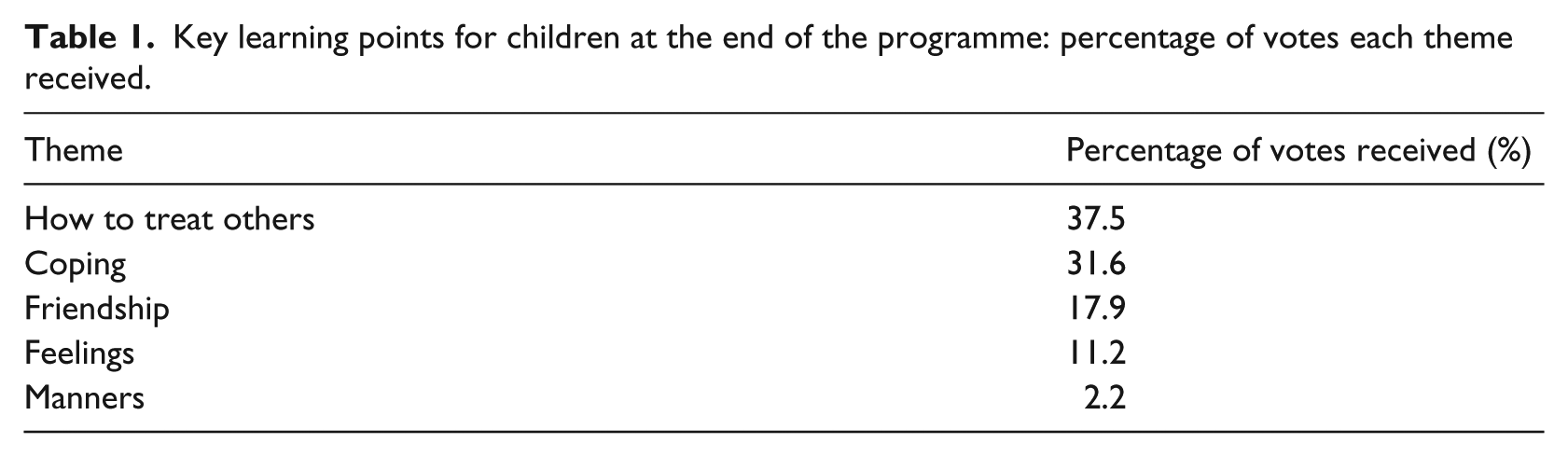
In groups, children brainstormed what the programme had taught them. The children’s responses were placed on the wall, and the children were asked to identify the two most important things that they learned as a result of the Zippy’s Friends programme using two post-its. The children’s responses were grouped into themes. The percentage of votes for each theme is shown in the Table 1.
Key learning points for children at the end of the programme: percentage of votes each theme received.
How to treat others
Five sub categories made up the overarching theme of ‘how to treat others’. Children referred to learning about
being kind to others ‘Think of nice things to say’. (Intervention Group, S2, girl) including others in games ‘Don’t leave anyone out’. (Intervention Group, S33, girl) not fighting/bullying people ‘Don’t be fighting with anyone’. (Intervention Group, S41, boy) listening to others ‘Listening to each other’. (Intervention Group, S31, boy) sharing with others ‘Be nice and share’. (Intervention Group, S40, girl)
Coping
Within this theme, several responses related to talking to someone when experiencing a difficult situation. Examples of children’s responses included the following:
‘Tell teacher or talk to an adult if you are being bullied’. (Intervention Group, S33, boy) ‘If someone makes you sad you have to tell them why you’re feeling sad’. (Intervention Group, S40, girl)
Friendship
Learning how to make friends, how to keep your friends and how to help your friends were regarded by several children as the most important lessons learned during Zippy’s Friends. Some of the children’s responses included the following:
‘You can be friends with anyone if you just try’. (Intervention Group, S2, girl) ‘How to make new friends’. (Intervention Group, S38, boy)
Feelings
Children referred to learning about their feelings and how to express their feelings:
‘Taught us about our feelings’. (Intervention Group, S40 girl) ‘About our feelings, tell your feelings’. (Intervention Group, S2, girl)
Manners
Children spoke about learning ‘good manners’ as a result of Zippy’s Friends.
Discussion
The results from the participatory workshop reveal important findings concerning children’s experiences of the Zippy’s Friends programme and its impact on their coping strategies and emotional literacy skills.
The draw and write activity provided a unique insight into the range of problem situations that concern children aged 7–9 years of age in this study and the types of coping strategies that they use. Both groups reported similar coping strategies at pre-intervention, including distraction techniques such as play or eating and techniques dependent on the behaviour of others such as friend saying sorry or being allowed to play. At post-intervention, children in the intervention group were more likely to identify the use of active coping strategies (problem solving and support seeking) in relation to conflict situations, rejection and loss. These active coping strategies included doing something to change the situation or feel better, relaxation techniques and seeking support. The change in coping strategies among children in the intervention group was in contrast to a lack of evidence of change at post-intervention in the type of coping strategies identified by children in the control group to deal with problem situations. It is likely that increased use of active coping strategies among children in the intervention group was as a result of key strategies taught throughout the 24-week programme, which aims to promote and expand children’s repertoire of problem-solving coping strategies.
The increased use of problem-solving and support-seeking strategies among children in the intervention group mirror the results from a study in Norway, which used standardised measures to examine the impact of the programme on children’s coping skills (Holen et al., 2012). Results from the Norwegian study indicated a significant increase in children’s active and support-seeking coping strategies as measured by their parents. Results from the draw and write activity also support the findings from the standardised measures completed by the teachers in this study as part of the overall evaluation (Clarke, 2011; Clarke et al., 2014). Multilevel analysis revealed that the programme had a significant, immediate and long-term positive effect on children’s emotional literacy skills including self awareness, self regulation, motivation and social skills. Together, these findings confirm the impact of children’s participation in the Zippy’s Friends programme on improvements in their repertoire of active coping skills and emotional literacy skills. These finding are significant in terms of the evidence regarding children and young people’s use of active problem-focused coping and its association with better psychological adjustment, including lower internalising and externalising symptoms (Compas et al., 2001).
The results from the draw and write activity illustrate the high quality and sophisticated nature of data which can be collected from young children, thereby providing additional understanding into children’s coping skills beyond programme efficacy as measured by quantitative findings. The control group’s frequent use of distraction strategies and coping strategies dependent on the behaviour of others is also an important finding which could help inform the development of more child-centred interventions for enhancing how children cope with problem situations. Folkman and Lazarus (1988) contend that if avoidant strategies are called into play prematurely, they can interfere with a realistic appraisal of the options of coping, and in such cases, emotional relief in the short term is purchased at the expense of long-term effective problem-focused coping. The increased use of problem-solving coping strategies among intervention children in this study highlights the potential of school-based programmes to enhance and strengthen children’s repertoire of problem-solving coping strategies.
The results from the children’s feelings activity indicated that children in the intervention group demonstrated a more elaborate vocabulary for articulating their feelings when compared with children in the control group at post-intervention. They were also more likely to explain possible reasons as to why people felt a certain way and to suggest what they could do to make the situation better. The qualitative data thus provided an insight into the types and quality of changes in children’s emotional literacy skills that have been facilitated by the programme. These finds also complemented the positive emotional literacy outcomes obtained using standardised methods in this study (Clarke, 2011; Clarke et al., 2014).
The group brainstorming activity provided important information from the children’s perspectives concerning their experience of the programme and its implementation. The accurate recollection of the programme content by the children suggests that they were engaged and actively learning throughout the programme. Given that children identified the themes ‘How to treat others’, ‘Coping’ and ‘Feelings’ with the most frequency in relation to what Zippy’s Friends had taught them, this suggests that the core objectives of Zippy’s Friends, that is, to enhance children’s social, emotional and coping skills, were achieved. The results from this activity also provided an insight into factors that facilitate and hinder children’s acceptability of the programme, which, as argued by Domitrovich and Greenberg (2000), can assist in our understanding of programme outcomes. The use of narrative through story, the activity-based nature of the programme and the problem-solving approach used throughout the programme were identified by the children as factors that enhanced the programme’s appeal. In contrast to this, discussing difficult problem situations (loss, conflict) was identified as an aspect of the programme that they disliked. These findings support the teachers’ views and observation data concerning programme implementation (Clarke, 2011; Clarke et al., 2014).
The active role that children play in constructing their own developmental story is increasingly recognised and calls for a methodology that assists in assessing and understanding children’s experiential life (Greene and Hill, 2005). The results from this study highlight the benefit of using child participatory approaches in combination with more standardised measures in providing an insight into children’s experiences. McGurk and Glachan (1988) state that too often children are expected to communicate within an adult frame of reference. The participatory approaches used in this study facilitated a shift in power relations, giving children greater control over their involvement in the research. The draw and write technique provided an opportunity for children to reflect upon their own experiences, while the fictitious nature of the vignettes allowed for information to be obtained beyond the children’s personal situations. The use of participatory approaches thus builds capacity for research that honours the voices of children and gives rich meaning to the variety of social encounters in their lives. As argued by Malewski (2004), practices that support children’s active and effective involvement in research ‘have the ability to connect generalisations and particularities in ways that provide investigators with a far more textured understanding of the voice of children and youth’ (p. 220).
Limitations
While the participatory workshops have been shown to be appropriate for eliciting children’s views for the purpose of this research, the limitations of this study must be acknowledged. First, as previously noted, the programme was implemented with children attending disadvantaged schools. This, therefore, needs to be considered when interpreting the findings at a broader level in terms of the use of participatory approaches in exploring children’s experiences and the results generated from this study. However, the findings do show that participatory approaches worked well with the children in this study and that the methods used were appropriate in the context of disadvantaged schools. Second, the researcher (A.C.) analysing the data was not blind to children in the intervention and control groups, which could have been a potential source of bias. The analysis, however, was reviewed by a separate researcher, thus reducing the likelihood of bias. In addition, given the fact that children completed the draw and write activity at their desks in their classroom, it is possible that children viewed this activity as a form of assessment which could have impacted on their responses. Furthermore, the children’s responses could have been influenced by their classmates sitting beside them. Removing children from the formal classroom environment for the draw and write activity could have impacted positively on children’s sense of freedom in completing this activity. In addition, children in the intervention group were more familiar with sitting in a circle and discussing feelings as a result of the Zippy’s Friends programme. This could have impacted on their comfort level and familiarity with discussing feelings in a group situation when completing the feelings activity.
Conclusion
The results from this study highlight the benefit of using child participatory methods in combination with more standardised measures in the evaluation of programme implementation and efficacy. The use of the draw and write technique in combination with the feelings activity and group brainstorming was successful in engaging young research participants (aged 7–9 years) to share their own views in their own words, from their own perspective and not the words chosen by the researcher. The draw and write activity provided an opportunity for children to reflect upon their own experiences, while the fictitious nature of the vignettes allowed for information to be obtained beyond the children’s personal situations. Collectively, the use of participatory approaches has helped to generate additional data untapped by other research methods in this study and provided a more nuanced understanding of how the children experienced their participation in the programme. The findings support the argument for the use of child participatory approaches in combination with more standardised evaluation measures. This approach serves to enrich our understanding of children’s lived experiences from their own perspective which may be otherwise difficult to access.
Footnotes
Acknowledgements
We are grateful to the staff and pupils of all the schools who participated in the study and to the health promotion specialists and members of the National Advisory Board for their support and contribution to the research. The views expressed in this paper are solely those of the authors.
Funding
This work was supported by the Health Service Executive Population Health, Ireland; Health Promotion Directorate, Ireland; National Office for Suicide Prevention, Ireland; and the Irish Research Council for Humanities and Social Services.