







Abstract
Objective:
This study aimed to examine some common problems observed during school recess and translate findings to evidence-based, practical solutions that can be applied within schools on a more systematic level.
Design:
Observational study.
Setting:
Elementary schools in the USA.
Method:
Data were collected from 112 school recess periods at 25 public elementary schools in three distinct geographical regions of the USA (Midwest, Northwest, Southwest). The Great Recess Framework–Observational Tool (GRF-OT) guided observations and field notes. The GRF-OT measures safety and structure, student behaviour, adult supervision and engagement, transitions, and physical activity. Following data collection, inductive and deductive content analysis examined patterns in the data.
Results:
Analyses revealed how poorly designed and inadequately maintained schoolyard spaces contribute to common safety issues. A combination of insufficient play space planning and maintenance, lack of play equipment and game availability, and limited adult involvement in the schoolyard reinforced social hierarchies, leading to exclusionary practices. While recess is often deemed a child-led portion of the school-day, results highlighted the important role that adults play in recess.
Conclusion:
The following evidence-based solutions should be considered by school administrators and policy makers to mitigate problems observed during recess: (1) assess the schoolyard landscape, (2) assess patterns of play, (3) plan an intentional recess and (4) address the social climate. A high-quality recess promotes equitable access to play opportunities.
Introduction
An accumulating body of evidence has shown that school recess provides an important opportunity for child development. That said, the issue of school recess presents a potential paradox. On the one hand, school recess is an enjoyable part of the school-day that provides developmental benefits for children; on the other hand, school recess is a place in which bullying, violence and inequity occur. In terms of the benefits of recess, it is generally the only unstructured time during the school-day in which children can focus on play, fun and social interaction (Massey et al., 2020). Previous research has shown that school recess can contribute to children’s social development (Pellegrini et al., 2002), emotional well-being (McNamara et al., 2015) and classroom behaviour (e.g. Barros et al., 2009). Recess also provides a prime opportunity for physical activity (Erwin et al., 2014), as data have shown recess accounts for roughly 44% of school-day physical activity (Erwin et al., 2012) and can contribute approximately 21.5 minutes (for girls) and 28 minutes (for boys) of daily recommended physical activity. Data collected from child participants also suggest that school recess can be a fun time to make social connections with friends, and an important opportunity for play and activity during the school-day (Massey et al., 2020).
Conversely, researchers have documented problems associated with school recess. For example, conflict is common on the schoolyard. While researchers using time sampling techniques have shown that conflict accounts for a small proportion of recess interactions (Ridgers et al., 2010), other observational studies have revealed as many as two to three verbal and physical altercations per minute occurring during recess (Massey et al., 2017). Research has also documented that children experience bullying, victimisation, conflict and negative social interactions during school recess (McNamara et al., 2015, 2018). Observational data and qualitative studies focusing on child participants have shown that gender stereotypes, social hierarchies and bullying can negatively affect children’s recess experiences, with older and more sport-oriented boys often dominating space and resources (e.g. Pawlowski et al., 2014; Rodriguez-Navarro et al., 2014). Moreover, children have reported a myriad of issues with the quality of the schoolyard and facilities used during recess (Massey et al., 2020). This includes a lack of access to play facilities, poorly maintained facilities, problems with the amount of schoolyard space, and a lack of both fixed equipment (i.e. play structures) and loose equipment (i.e. balls and jump ropes). Studies focusing on adult perceptions have also suggested recess can be a problematic time during the school-day, as school administrators report 90% of discipline-related problems occur during lunch and recess (Robert Wood Johnson Foundation [RWJF], 2010).
In the USA, the paradox of recess is compounded by equity concerns as they relates to for whom recess is accessible. For example, low-quality schoolyard facilities disproportionately impact children attending schools in disadvantaged neighbourhoods (Fernandes and Sturm, 2010). Moreover, there are wide disparities in how much recess time children receive. Students in urban and economically disadvantaged schools receive less recess time when compared to their suburban, rural and higher income counterparts (Barros et al., 2009; Monnat et al., 2017). This may be, in part, due to the cutting of recess time as early as the 1980s to prioritise seated instruction time when international student performance began to be compared with that of children in the USA (London, 2019). School recess was further jeopardised in the USA after the No Child Left Behind Act was passed in 2001, as schools could lose federal government funding as the result of poor student academic performance in Mathematics and English. As a result, urban school districts with diverse populations severely reduced the time spent in recess (Center on Education Policy, 2008). Moreover, the results of a Gallop Poll have shown that approximately three-quarters of school principals in the USA withhold recess as a form of punishment for behavioural or academic reasons (RWJF, 2010); a trend that continues in more updated analyses (London, 2019).
Given both the paradox presented above and data showing inequities in recess, an emerging field of research has focused on improvements in recess as they relate to equitable opportunities for social, emotional, physical and intellectual development (e.g. McNamara et al., 2015; Massey et al., 2018; Rhea and Rivchun, 2018). As this line of evidence expands, researchers espouse the need for contextual understanding of children’s recess experiences (Hayball and Pawlowski, 2018). This is particularly true in the USA given the absence of policies related to recess access and availability, and a wide range of local practices. With few exceptions (e.g. London et al., 2015), the literature lacks detailed qualitative descriptions of what occurs during school recess and corresponding implications. This critical information can help schools address problems associated with recess and improve recess quality. Therefore, the purpose of this study was to examine common problems observed during school recess and translate findings to evidence-based, practical solutions that can be applied by stakeholders on a more systematic level. While the current study focuses on the educational system in the USA, we also sought to examine patterns that may have implications beyond this context.
Methods
Participants
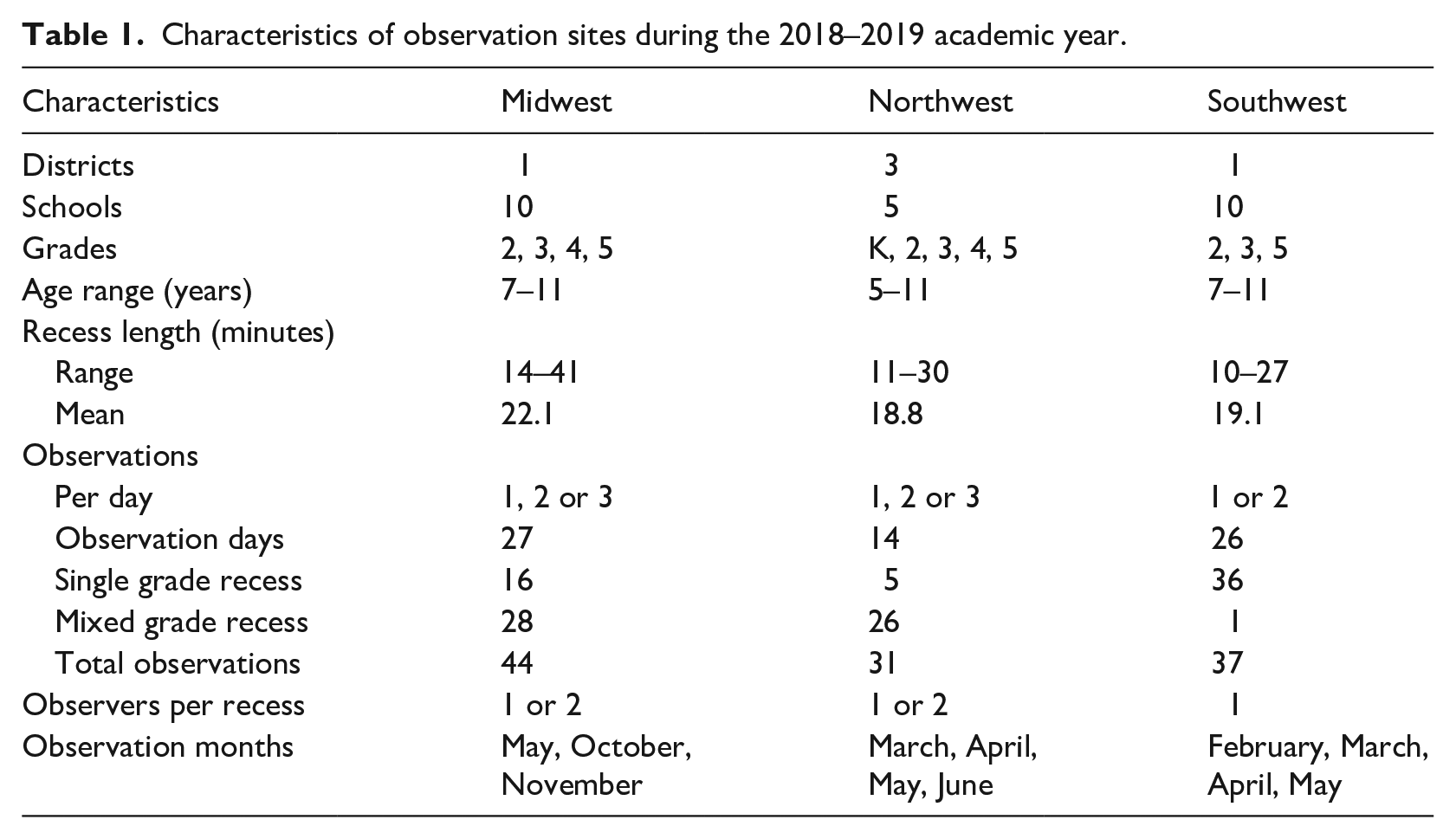
As part of recruitment for a broader study on the relationship between school recess and social-emotional health of children, research requests were sent to 15 school districts across five different states that represented diverse geographical regions in the USA (i.e. East Coast, West Coast, Mountain West, Midwest, Southwest) and encompassed urban, rural and metropolitan demographics. This study focused on structured observations of live, outdoor recess. The sample included 112 recess periods at 25 public elementary schools (i.e. students in grades 1–5). Schools ranged in size from 202 to 917 students; represented three distinct US regions (Northwest, Southwest, Midwest); and were located in large urban communities (n = 10), small rural communities (n = 3) and metropolitan communities (n = 12). More detailed information can be found in Table 1. Publicly available data reported from the Department of Education in each corresponding state show that these schools ranged from 31.6% to 98.2% economically disadvantaged (M = 78.53; SD = 17.95).
Characteristics of observation sites during the 2018–2019 academic year.
Data collection
Recess observations were guided by the Great Recess Framework–Observational Tool (GRF-OT; Massey et al., 2018). The GRF-OT contains 17 items that describe aspects of the recess environment. Items include questions about the safety of the recess environment, number of adult supervisors, access to equipment, availability of play options or games during recess, student initiation of play, levels of physical activity, physical conflicts, communication, conflict resolution, adult support for play, and transitions to and from recess. Seven additional items were observed in the current study, which focused on environmental safety, recess supervision, adult responses to conflict, sustainability of games and inclusive practices during recess.
Data collection was undertaken by trained observers who (1) conducted audits of the recess environment prior to recess, (2) observed live school recess periods and (3) provided an overall score for each scored item. Most relevant to the current study, observers also made field notes that were guided by prompts pertaining to each item. For example, observers were instructed to take notes on ‘specific safety hazards and where they exist’; ‘equipment that is available for use’; ‘games that are being played with consideration for who is playing (gender, age, race, ability)’; ‘barriers to engagement and patterns of inclusion and exclusion’; ‘patterns of physical and verbal altercations (e.g. when altercations happened and who was involved)’; and ‘descriptions of what adults are doing’. Trained observers were also instructed to make notes on their overall observation of recess, including any observed patterns.
Procedure
Data were collected during the 2018–2019 academic year. Observations in the Midwest took place during the autumn; observations in the Southwest took place during the winter and spring months; and observations in the Northwest were conducted in the spring. All procedures were approved by the Human Research Protection Programme at Oregon State University, each school district and individual schools. Because data were collected by observing the broader recess environment, individual informed consent was not obtained.
Prior to data collection, all observers read a training manual developed specifically for recess observations with the GRF-OT. They then completed 2 hours training covering GRF-OT protocols and procedures for scoring and recording field notes, using video and picture examples. Finally, all observers received live training in which they attended school recess periods with the principal investigator (W.V.M.) or a trained recess observer (L.N.).
For each recess period, one or two trained observers arrived at the outdoor schoolyard approximately 15 minutes before the scheduled recess period to complete a walkthrough of the schoolyard and take any notes about the built environment. This included sketching the overall space, identifying any hazards or potential hazards in the environment (e.g. broken glass, broken equipment, hiding spaces, access to busy roads), and identifying available fixed and non-fixed structures and equipment available for play. The entire recess period was then observed, with field notes being recorded.
Trained observers were instructed to move throughout the schoolyard in a discrete manner to observe patterns of interaction and behaviour. In doing so, informal conversations with staff also occurred, and were documented to help provide observers with context or background on school recess procedures. When multiple trained observers were present at recess, one was assigned to focus on taking comprehensive notes of what happened at recess, while the other focused on specific GRF-OT prompts. Furthermore, one observer made a concerted effort to observe recess transitions more closely by positioning himself or herself near the school building entrance. Both observers were outside for the duration of recess. Following recess, notes were compared and aggregated to ensure consistency and thoroughness of documentation.
Data analysis
Data were analysed using both deductive and inductive methods. Observations were guided by the GRF-OT items and categories. Thus, data were already organised in a deductive manner prior to formal analysis. In addition, field notes were organised into three categories of data: the environment, student behaviour and adult behaviour. Trained observers wrote field notes contemporaneously with the recess observation and allowed space for critical self-reflection (Emerson et al., 2011; Phillippi and Lauderdale, 2018). Following this, the research team systematically read through the recorded field notes multiple times to become familiar with the data and better understand the context surrounding children’s school recess experiences (Emerson et al., 2011).
Data were then analysed in four different phases using an inductive content analysis (Hsieh and Shannon, 2005). In the first phase, open coding was used to develop lower and higher order themes within each category (environment, student behaviour, adult behaviour). In phase 1, raw data were treated as independent from school recess periods in order to examine overall patterns within the sample, as opposed to recess-specific or school-specific data. In the second phase, the interactions and relationships across categories (i.e. environment, student behaviour, adult behaviour) were examined, thereby allowing us to explore a broad context for the data. This step was completed to better understand the interactions within the social and physical environment. In the third phase, an analysis of each of the 112 school recess periods was independently conducted. Specifically, the research team examined both the GRF-OT score for each of the 24 items and the field notes for each recess session to better understand data relative to the immediate context. In the final phase, themes were compared and contrasted between regions to account for differences due to geography, weather and demographics.
After each level of analysis, the research team engaged in critical reflections and an iterative consensus process (Tashakkori and Teddlie, 2010). The team reviewed and discussed the data at each step. The dataset was independently and collaboratively analysed. The team used one another as a critical sounding board to discuss and debate differences until consensus was reached (Phoenix and Smith, 2011; Sparkes and Smith, 2009).
Results
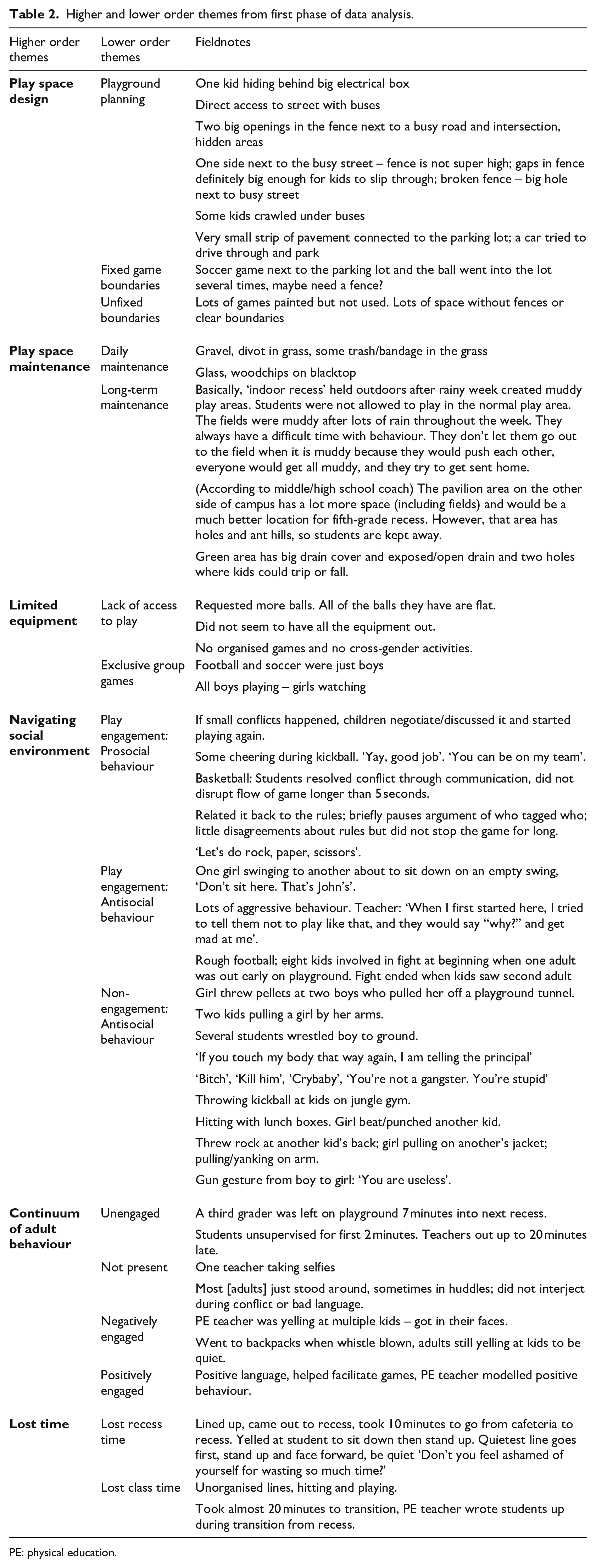
Data from the first phase of analysis can be found in Table 2. Within this analysis, six higher order themes were developed: play space design, play space maintenance, limited equipment, navigating the social environment, continuum of adult behaviours and lost time. Following this, data were analysed across themes and school recess periods to better understand interactions and connections across the dataset. This second analysis led to the development of one overarching theme, inequity of opportunity. These seven higher level themes and relevant lower order themes are discussed below.
Higher and lower order themes from first phase of data analysis.
PE: physical education.
Play space design
One key theme, as it related to problems on the schoolyard, was play space design. Within this theme, three lower order themes were identified: schoolyard planning, fixed boundaries and unfixed boundaries (see Table 2). The schoolyard planning theme is focused on the physical features of the environment, a decision that likely took place when designing the school property. Multiple common problems were noted. Often, schoolyards were too small for the number of students using them or too large for adequate supervision and contained ‘hidden’ areas. Furthermore, children had easy access to hazards, such as open electricity boxes. In addition, schoolyards were often close to busy intersections in urban schools. In the metropolitan schools, it was not uncommon to find schoolyards located directly next to, or sharing space with, school parking lots, at times with no barrier in-between. Finally, many schoolyards in metropolitan and urban districts had very little green space, such as grass or trees. The theme of fixed boundaries was interconnected with schoolyard planning. In the urban and rural areas, there was a lack of fixed boundaries to enclose the schoolyard, such as fencing. Across all regions, schoolyards lacked boundaries to separate various spaces on the schoolyard (e.g. areas in which sports are played, jungle gym, free play). So far as unfixed boundaries were concerned, the use of chalk or paint to separate spaces on the schoolyard was ineffective.
Play space maintenance
Play space maintenance was also identified as a problem on elementary schoolyards. Within this theme, two lower order themes were identified: daily maintenance and long-term maintenance. In terms of daily maintenance, common issues included schoolyards littered with trash. Wood bark chips, or other similar outdoor surface materials, often spread across concrete areas of the schoolyard as opposed to staying in designated areas near the jungle gyms. In urban schools, schoolyards often contained hazardous materials (e.g. glass). Other problems with daily maintenance in the northwestern region included wet, slippery equipment and large standing puddles. Common issues relating to long-term maintenance were deteriorating equipment, eroded surfaces, uneven landscape grading and poor lawn management.
Limited equipment
The limited equipment theme comprised two interconnected lower order themes: lack of access to play opportunities and exclusivity of group games. Notably, limited access to equipment provided limited play opportunities in general. This was especially true for younger children and girls. In the southwest region, students rotated between play spaces; therefore, certain groups of students would have limited access to fixed equipment (e.g. soccer goals, basketball hoops and play structures). Field notes suggested that soccer and basketball were the two most frequently coded activities during recess; however, notes also indicated that these ball games were primarily dominated by older boys. Thus, the current data suggest that limited equipment was problematic, because access to play spaces and materials was only accessible by select groups of children.
Navigating the social environment
The theme navigating the social environment consisted of two sub-themes: play engagement and non-engagement. Children demonstrated both prosocial and antisocial behaviours while engaging in play. Field notes included examples of prosocial behaviours such as negotiation, positive encouragement, cheering for others, conflict resolution and displays of leadership. While engaging in games and play, children’s antisocial behaviours included excluding others from joining and aggressive behaviour while playing games. Field notes include examples of ‘tackle tag’ and ‘fighting over a soccer ball’ during a game. It is possible that these behaviours fell under the guise of competitive game play yet they could also be perceived as combative. Antisocial behaviours during play engagement were coded more often in rural environments. There were also observed instances of poor conflict resolution skills during games. For example, when children were unable to resolve game conflicts, they would run away with the ball, quit the game or argue extensively about rules to the point of ending the whole game. When children were not engaged in play, their social behaviours were often coded as antisocial. Examples of antisocial behaviours when not engaged in play included fighting, teasing, swearing, throwing objects at others, pushing, hair pulling and making threats. In terms of geographical differences, non-play related physical altercations were coded more frequently in urban areas.
Continuum of adult behaviours
The theme of continuum of adult behaviours comprised four lower order themes absent, unengaged, negatively engaged and positively engaged. The lower order theme of absent adults included schoolyards that were not fully supervised. For example, adults could not see the entire schoolyard and/or children were left outside unsupervised. Adults often arrived late to recess in both rural and urban schools. Unengaged adults were preoccupied with their cell phones or seldom interacted with children on the schoolyard. Negative engagement was characterised by adults who only interacted with children by reacting to rule violations. This could involve berating children or placing them in timeout. In one instance, a teacher yelled at a group of students and told them they should feel ‘ashamed’ of themselves for not following school-mandated rules. Yet another time, a teacher got very close to the children and shouted directly at them. Finally, positive engagement was characterised by adults who played alongside children on the schoolyard or promoted play among children in a supportive way.
Lost time
Lost time was a theme documented by problems in transitions to and from recess. The theme included two lower order themes: lost recess time and lost classroom time. In both lower order themes, poor transitions were characterised by running, yelling, pushing and adults shouting at children. As it related to lost recess time, field notes documented that recess often started late across all observation sites. In the Midwest and Northwest, children lost up to half of their recess time due to not being let outside at the time in which recess was scheduled. In the Southwest, children walked outside on time with the teacher, but would often stand in lines for long periods before any play actually began. In terms of lost classroom time, transitions from recess were documented as elongated. Teachers and school staff often waited until students were quiet and in line before allowing them back into the classroom, thereby losing classroom and instructional time during the school-day.
Inequity of opportunity
Following the development of higher and lower order themes, data were coded across themes and across school recess periods to examine patterns among the higher order themes. These analyses resulted in the development of one overarching theme: inequity of opportunity. Field notes suggested that this was both influenced and compounded by the various higher and lower order themes discussed above. As can be seen in Figure 1, adults can influence, both directly and indirectly, inequity in opportunity on the schoolyard. For example, common problems documented related to how schoolyards were designed and maintained, both of which are adult-driven decisions that can affect children’s opportunities. Poorly designed and poorly maintained play spaces contributed to limited access to play environments. In addition, the availability of equipment was also commonly driven by adults at elementary school recess. When equipment was limited, data suggested that older boys tended to dominate the equipment and space with large sport games that were exclusive and difficult to enter. For example, one field note documented a female student who kept attempting to join a soccer game, but she was repeatedly told no by her male peers. Eventually, she participated as a goalie, a role with potentially limited action or interaction in the game as compared to other positions.
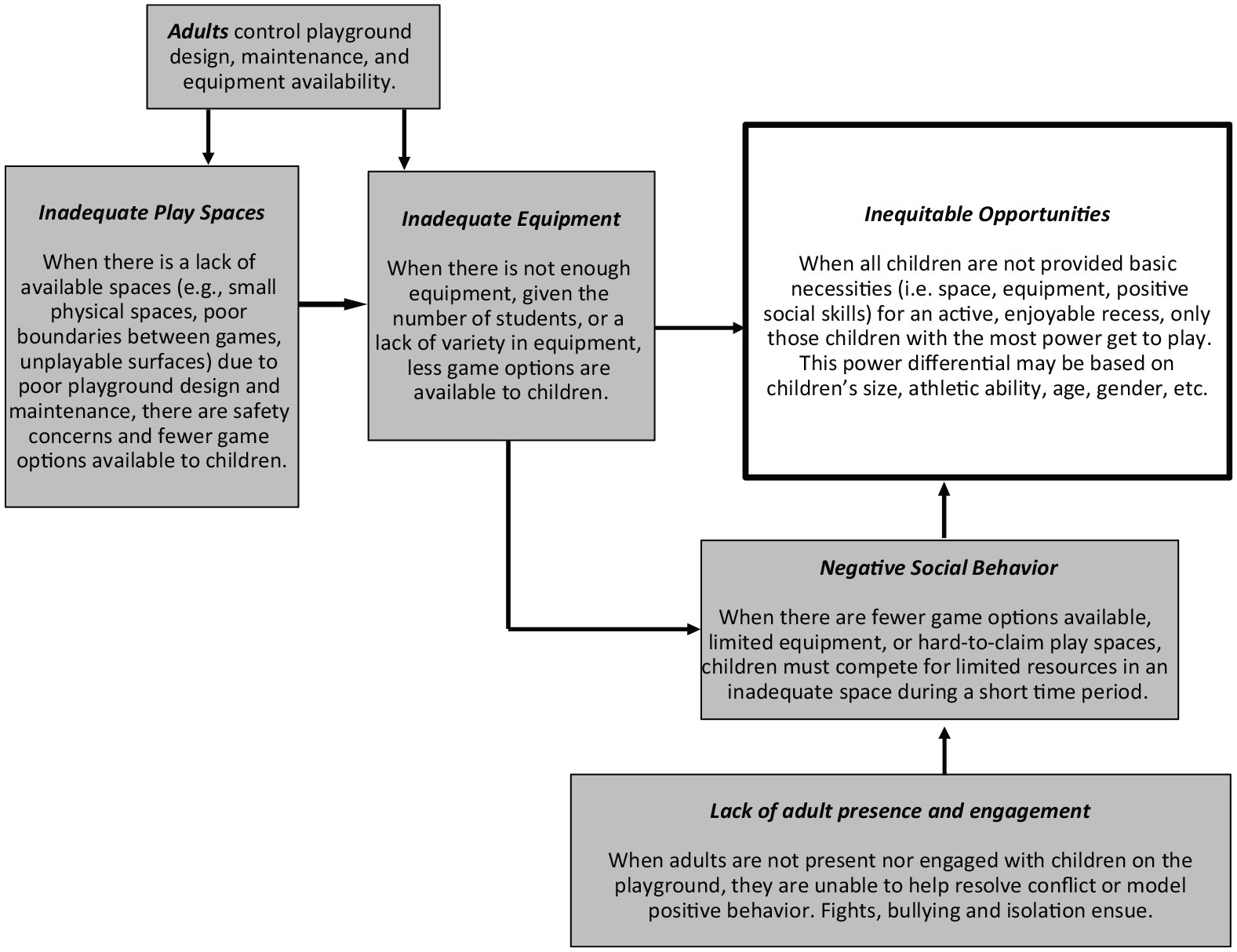
Adults’ influence on inequity among children in recess.
Discussion
This study examined common problems observed during school-based recess and compared these across different geographic regions in the USA. The main finding was that an interconnected series of both distal and proximal decisions, often made without recess’ main stakeholders (i.e. children) contributed to inequity in schoolyard opportunities. Poorly designed and inadequately maintained play spaces limited the availability of viable, safe play environments. The type and amount of available play equipment, a factor commonly driven by adults, further exacerbated inequitable access to games and physical activities. In addition, when adults failed to engage with students during recess, conflict and antisocial behaviours increased; whereas, positive adult engagement helped minimise bullying and exclusion in the schoolyard. Importantly, these findings are contextualised primarily within low-income school settings, thereby highlighting the need for equitable solutions to improve recess. Based on data in the current study and in conjunction with the extant literature on recess, the following evidence-based, practical solutions should be considered: (1) assess the schoolyard landscape, (2) assess patterns of play, (3) plan for recess, and (4) address the social climate.
Assess the schoolyard landscape
Data from this study show a wide range of safety hazards on schoolyards. Given this, school administrators and policy makers should consider regularly assessing the schoolyard landscape throughout the academic year, as well as providing a budget to ensure schoolyards are adequately maintained. Immediate safety hazards should be addressed, which may include blocking off electricity boxes, removing glass and/or debris, placing barriers over open water drains, and removing rusty or mouldy materials. Where funds are not available, schools may consider placing an extra recess monitor near hazardous parts of the schoolyard to limit the use of those spaces.
Assess patterns of play
School staff can work with children to identify popular games at recess, what children want to play at recess, and areas where conflict occurs. For the more popular games, low-cost equipment can be provided to increase opportunities for engagement. School staff can work with student leaders to develop an equitable system for the distribution of equipment, so as to minimise social hierarchies as a determinant of access to play. Adults can focus their attention and engagement towards the more conflict-ridden games. Previous research has shown the importance of directly engaging children through focus groups and surveys to obtain their recommendations on how to improve recess (McNamara et al., 2015; Massey et al., 2020; Pawlowski et al., 2014, 2018). While not directly assessed in the current study, indoor recess periods should also be considered. This may be particularly important for students who view recess as an unsafe space, since providing a range of outdoor and indoor options (e.g. board games, indoor dance groups) can increase opportunities for play and social interaction during school.
Plan for recess
Data support the need for an ongoing assessment of recess in elementary schools. However, the extent of the problems observed in the current study also suggests the need to implement intentional strategies to improve recess. Previous research has shown that when adults provide organisation to recess in the form of available games and play equipment, children report higher levels of similar levels of recess enjoyment and higher levels of physical activity as compare to a completely unstructured recess (Larson et al., 2014). Given issues of access and inclusion in the current study, schools may consider providing children with a continuum of play options at recess (McNamara et al., 2015). This continuum should include age-appropriate games with modified equipment for younger children, a variety of loose equipment (i.e. jump ropes, music speakers, chalk) and games for all genders (Pawlowski et al., 2019). The schoolyard could also have a designated space for imaginative play or a quieter recess experience, thus promoting inclusivity. Aside from equipment, boundaries and expectations may be important to define during recess periods as well. Research has shown that when boundaries clearly delineate play spaces and prevent overlap, children are more engaged and physically active during recess (Ridgers et al., 2007). Moreover, data in the current study suggest physical safety concerns as a result of poor boundaries. This highlights the need to intentionally plan both the recess play space and the functionality of that space during play periods. It is important to note that planning for recess should not be conflated with structuring what children do during this time period. Research has consistently shown the benefits of free and unstructured play during recess (e.g. Bundy et al., 2017), yet providing an environment that facilitates this requires intentionally planning from the school staff.
Address the social climate
Finally, data highlight a need to address the social climate (e.g. interpersonal relationships, interactions, communication and group management; Allodi, 2010) during recess. Student leadership experiences is one way in which children are able to facilitate and influence a positive recess experience (Massey et al., 2017). Moreover, past research suggests the need for a whole school approach to improving positive social interactions during recess, which may include social skills training during the school-day (Rhea and Rivchun, 2018). In addition to student leadership, professional development training should be considered for recess supervisors (London, 2019). In so doing, it is important for adults to understand children’s perspectives on recess. Notably, children reported that teacher support and engagement facilitated recess enjoyment (Hyndman, 2016), so long as teachers do not enforce rules seen as inhibiting play opportunities (Martínez-Andrés et al., 2017). This may be particularly important for younger children who may need higher levels of guided learning during the school-day.
Strengths and limitations
This study has provided valuable information about elementary school recess, yet it is not without limitations. First, observations only provided a snapshot of the recess experience for children. It is unclear how longitudinal follow-up might affect the data. In addition, observers were not able to fully capture all events that occurred during recess, nor the social structures that limit or facilitate recess experiences. It was difficult for observers to circulate the schoolyards and observe as much as possible, while also recording notes and scoring each item.
Guided prompts for field notes were added to the scoring sheets after already completing observations at five schools. Therefore, the notes changed in detail over time and between observers. Moreover, while training was conducted to view recess through a neutral lens, it is impossible to fully account for researcher bias in observations. This means that the data were collected and analysed by adults, which may not represent a child-centred view of recess. The timing of data collection is also a limitation, as fair-weather months were prioritised for outdoor observation and may not accurately depict recess during inclement weather in some parts of the country. Finally, an environment invariably changes due to the presence of observers, despite how inconspicuous they try to be (Emerson et al., 2011), which may have ultimately shaped the results in the current study. It is possible that more adults were in the schoolyard or more games were being offered on the days that schools expected the research team to arrive.
That said, the current study also contained many strengths. Trained observers used the validated GRF-OT as a framework for their fieldnotes. Researchers observed multiple recess periods at each school, often over the course of multiple days, allowing researchers to identify school-wide patterns and informally speak with staff and teachers. Furthermore, observations took place in three distinct geographic regions of the USA (Northwest, Southwest, Midwest) in urban, rural and metropolitan areas, thereby minimising findings that may be specific to issues faced by one local community and allowing for valuable comparisons to be made between the regions.
Conclusion
Recess continues to receive research and policy attention. Recess has been documented to both facilitate child development and potentially cause problems throughout the school-day. Data from the current study highlight common problems observed during recess facilitation (e.g. unsafe spaces, lack of supervision and limited opportunities) and how the interaction of decisions across time may contribute to difficulties seen during recess (e.g. how limited investment can lead to limited opportunities). It should also be noted, however, that many strengths were also observed including, but not limited to, children initiating, directing and leading play on the schoolyard. In considering future research, the experiences of marginalised student groups on the schoolyard should be examined including children with disabilities, as well as children of various cultural, ethnic, religious, geographic, socioeconomic, gender-identity and racial backgrounds. Future research should include longitudinal and mixed methods designs to better understand how the quality of recess shapes children’s development within and beyond the school-day.
