







Abstract
Background:
‘Fat Talk’, or the act of negatively discussing one’s own or another person’s body, is linked to body image constructs, body dissatisfaction, low self-esteem and disordered eating. The spaces in which young women talk about the body are changing, as social media use escalates. Understanding the interplay between social media use, body image and fat talk, in different contexts, is needed.
Method:
Focus group interviews were used to explore how young women (aged 15–19) experience fat talk while using social media and the possible effect on body image constructs. Using purposive convenience sampling, young women who regularly used social media and were living in an inner city of England were recruited. Thematic analysis was used for analysis and six themes were identified, both a priori and inductively, to explore the interplay between them.
Findings:
Over 35 women were successfully recruited into the study, with 18 of these finally participating in focus group interviews. Among participants, social media use was linked to increased self-evaluation of the body, engagement in social comparative behaviour and negative self-talk about the body. Although fat talk was reportedly common and widespread, it was unacceptable in the online space. However, body talk, other than size or shape, was permissible.
Conclusion:
Fat talk can be divisive; however, if it becomes unacceptable in the online space, negative self-talk may increase. If fat talk is replaced by an all-encompassing ‘body talk’, then this too may exacerbate existing pressures on young people and their mental health and well-being. Understanding the relationship between social media, body dissatisfaction and body talk may provide new opportunities for health education to promote a more constructive prevention discourse of the body, including body talk, in or around the online space.
Introduction
In recent years, England has seen a sharp rise in the prevalence of mental health issues associated with body image constructs among young people, including body dissatisfaction, low self-esteem and disordered eating. Young women and adolescent girls experience periods of rapid growth and are acknowledged as especially susceptible to these body image constructs (Carey et al., 2013). It is also widely recognised that women, especially younger women, regularly engage in the process known as fat talk (Corning and Gondoli, 2012). Fat talk is the act of discussing in conversation with others, negative and sometimes derogatory comments about their own body shape or size, or that of others, including discussions of slimming diets, food and eating behaviours (Nichter, 2000; Nichter and Vuckovic, 1994). In addition, engaging in fat talk has consistently been demonstrated to be negatively associated with body image constructs and outcomes, including body dissatisfaction, thin-ideal internalisation, appearance-based comparisons, body checking or body surveillance behaviour, and body shame (e.g. Arroyo, 2014; Arroyo and Brunner 2016; Mills and Fuller-Tyszkiewicz, 2016; Mills et al., 2019). There is strong evidence supporting claims that the burgeoning availability and widespread use of social media is directly related to increasing disturbances in body image constructs and growing rates of body dissatisfaction (Fardouly and Vartanian 2016; Fardouly et al., 2017; Meier and Gray, 2014; Tiggemann and Zaccardo, 2015). The interplay between social media use, fat talk and body image construct among young women is an under-researched area and new insight into this area may highlight future opportunities for health education.
First, studies have demonstrated a strong link between certain types of social media use and body constructs. In their experimental study, Tiggemann and Slater (2013) reported a link between Internet exposure (Facebook use), increased drive for thinness and the desire to achieve socially constructed ‘ideals’ about the ‘perfect’ (body) physique. Fardouly et al. (2015) concurred, reporting that browsing images on Facebook was directly linked with increased likelihood of having negative self-thoughts about appearance, and since an estimated 10 million new photographs were uploaded every hour on Facebook, it highlighted the potential scale for negative impact on body image. Similarly, Meier and Gray (2014) suggested that time spent engaged in ‘image related activity’, that is, posting images and viewing images posted by others on Facebook, was a stronger predictor of body image disturbances, compared with using text-only social media. Since then, researchers (e.g. Franchina and Lo Coco, 2018; Mingoia et al., 2017; Schreiber, 2017) have demonstrated that appearance-based social media applications and networking sites, such as Facebook, Instagram or WhatsApp, are particularly influential in encouraging critical self-evaluation and social comparison behaviour. Much has been written about the power of so-called social media influencers in shaping cultural and behavioural trends. Research, however, also suggests that an individual’s reaction to imagery is stronger when viewing images of attractive others, and is even stronger when attractive others are friends or acquaintances, as they are perceived as more realistic. Since most appearance-based social media sites offer appearance-enhancing tools, there is a greater likelihood that a high proportion of the images posted will be modified, and therefore unreal or fake, including those posted by the so-called ‘normal’ or realistic yet influential friends and acquaintances. While evidence of the impact of social media consumption on body image is clearly strengthening, whether the increased use of social media also influences fat talk is less clear.
It is widely accepted that media has a negative impact on health and body image constructs. The classic example is the role of media in portraying images of thin and progressively thinner women in constructing societal norms of the ‘thin ideal’. Many researchers have criticised the media for its role in encouraging negative or overly critical self-comparison behaviour, whereby constant self-evaluation results in self-internalisation of the thin ideal. Yet, since this ideal is unrealistic and unattainable, failing to achieve the ideal results in negative self-talk (Guertin et al., 2017). This resonates with the process conceptualised by Festinger (1954) in social comparison theory, which ties together the constant self-evaluation, competitive intentions and social influence processes commonly demonstrated by humans. The relevance of social comparison theory in helping to explain the process and consequences of fat talk and to body image research is evident (e.g. Arroyo, 2014; Arroyo and Harwood, 2012; Klein, 2013; Meier and Gray, 2014; Stice et al., 2003; Tiggemann and Zaccardo, 2015). As Carey et al. (2013) discovered, body comparisons among peers significantly mediate the link between a drive for thinness and body image concerns among adolescent girls. Corning and Gondoli (2012) have suggested that the tendency to socially compare is strongly associated with increased engagement in negative self-talk and fat talk. A link has also been established between fat talk and negative body image outcomes (Arroyo, 2014; Corning and Bucchianeri, 2016; Martz et al., 2009; Mills et al., 2019; Salk and Engeln-Maddox, 2012). Cruwys et al. (2016) demonstrated that listening to peers engage in fat talk is a predictor of risk of disordered eating, while Jones et al. (2014) maintained that the act of expressing fat talk dialogue greatly increases body dissatisfaction and disordered eating development. While a correlation between fat talk and problematic eating behaviours is suggested, the evidence remains equivocal (Fardouly and Vartanian, 2016; Mills et al., 2021).
Despite the known consequences of fat talk, research estimates that the majority of women engage in fat talk on a regular, weekly, or sometimes, daily, basis (Corning and Gondoli, 2012). The act of fat talk involves reciprocity; expressing one’s fear of fatness or disappointment in their body shape or size, but then having this challenged, that is, ‘No, you’re not fat . . .’ by one’s peers and significant others, reportedly reduces negative self-talk and body shame. In addition, as Britton et al. (2006) previously explained, women who engage in fat talk do so because they are more likely to be perceived as ‘likeable’, since they portray themselves as imperfect and vulnerable, especially if others, part of the same fat talk, avoid expressing self-deprecating comments. While the motivation for fat talk appears to be self-serving, studies suggest that for some the long-term consequences may outweigh any benefits. Women who engage in fat talk are more likely to experience negative body image. One study examining the relationship between anti-fat attitudes, body shame, self-compassion and fat talk among female college students demonstrated that engagement in critical body shaming (self-talk) is a significant predictor of fat talk (Webb et al., 2016). How fat talk is responded to by others (i.e. challenged, ignored or reciprocated) is also critical in determining how fat talk is experienced by that individual. Studies suggest ‘being ignored’ encourages lower levels of body satisfaction and self-esteem, since this is interpreted as the lack of support from significant others, which can also encourage body shame. For a detailed examination of assurance-seeking behaviour and negative body talk, see Mills et al. (2021); their paper also helpfully reaffirms that the original function served by fat talk, reassurance-seeking behaviour, is still relevant. However, they caution against assuming that fat talk is received in the same way by everyone who engages in fat talk; understanding fat talk in different social and cultural situations is important.
Ironically, in studies where fat talk among high school girls has been studied, it is suggested that girls will only engage in fat talk if they are not fat (e.g. Mills et al., 2019). In an observational study of teenagers in Sweden, Kulick and Meneley (2005) posit that while fat talk may be instrumental in consolidating social relationships, it is also divisive. None of the girls who engaged in fat talk in their study were overweight by normative standards. While being overweight itself did not preclude girls from fat talk friendship circles, they were excluded from talking about their weight, weight-loss efforts and dieting; only the ‘non-overweight’ were ‘deemed’ eligible to participate in fat talk. They used Bourdieu’s concept of symbolic capital – or the qualities required to be acknowledged as someone of worth, or worth talking and socially interacting with – to help explain the divisiveness and power of fat talk in their study. Not being fat appears to entitle a person to engage in fat talk; that is, they acquire what the authors describe as a symbolic fatness, or permission to participate in the assurance-seeking comforts of fat talk. Without symbolic fatness, there is no symbolic capitalor worth.
Fat talk is also acknowledged as divisive; it is associated with exacerbating fat shaming discourses and marginalises individuals according to their body shape or size. Failure to conform to the socially constructed standards of the ideal body size or shape is linked to body and fat shaming (Mills and Fuller-Tyszkiewicz, 2018) which also serves to stigmatise, isolate and marginalise anyone failing to conform as opposed to responsible, productive, healthy citizens who achieve this ideal (La Marre et al., 2017). While extensive research exists about the increasing use of social media or social networking sites (SNS), and their impact on body image dissatisfaction, less is understood about how this may affect fat talk. In recent years, with the burgeoning use of social media, we can assume that much of the interpersonal and offline exchanges between young people have shifted to the digital or social media space (Goodyear et al., 2018). In addition, as the popularity of appearance-based platforms, emphasising imagery, increases, it is imperative to understand how this has displaced fat talk and with what effect. At the time of planning this study, the authors, all public health nutritionists, posed three main questions: first, has social media use influenced fat talk; second, has social media and its imagery influenced or displaced fat talk; and third, what might such a shift imply with respect to future health education efforts?
Methods
A qualitative study using focus groups as the primary data collection was used to explore young (15–19 years) women’s social media use, their understandings of fat talk and the social media and how this impacts body image constructs.
Sample and recruitment
Young women were targeted for recruitment, consistent with literature identifying members of this demographic as frequent participants in fat talk (Fardouly et al., 2015) and significant users of social media. Young women were purposively selected through a large city centre (multicomplex leisure entertainment) organisation known to employ a predominantly young, casual workforce. Women were recruited via the organisation’s staff notice boards (both digital and posters), which invited participants to engage in research to discuss social media use, body image and fat talk. Prior to recruitment, permission was sought from the director of the organisation to approach employees, and all female employees aged 15–19 years were able to access the notices. Those interested in participating were invited to contact the researcher (G.P.) and were screened against the inclusion criteria. They were sent details of the study and invited to attend a focus group, upon the return of signed consent forms. All respondents were advised they could withdraw from the study at any time up to and including data analysis. A minimum of four and maximum of six focus groups, each with five to eight participants, were initially planned in accordance with recommendations for optimising data saturation (Krueger and Casey, 2009). On several occasions, however, insufficient participants attended and so the focus group had to be cancelled; possible reasons for non-attendance included short and unpredictable shift patterns and zero-hour employment contracts. In the end, only three focus groups, involving 18 women, were undertaken. Implications for data saturation are considered in the discussion.
Data collection and analysis
Focus groups were chosen as a means of data collection since they are recognised as an effective means of triggering discussion and generating rich data in a relaxed research setting that allows participants to co-construct meanings and produce multiple narratives on topics under investigation (Krueger and Casey, 2009). For consistency, all focus groups were moderated by the same researcher (G.P.), who had prior experience of facilitation. Interviews began with an explanation of the process, procedures and confidentially. Following the guidelines provided by Krueger and Casey (2009), a schedule (available from the corresponding author on request) was prepared to guide discussion, while also encouraging conversations to flow freely and prompting deeper or broader discussion. Each focus group was scheduled to last 1 hour, recorded and transcribed verbatim by G.P., immediately afterwards; all transcripts were shared with the lead researcher (L.K.) at each iteration, for discussion of the data and the suitability of interview questions. Transcripts were analysed thematically in accordance with procedures described by Braun and Clarke (2006). Deductive and inductive coding was used to reduce transcripts into more manageable chunks of data, to help the sense-making process; concurrence and discord between participants and groups were discussed among the researchers, with data being organised into sub-themes, determined both a priori and inductively, and subsequently overarching themes.
Ethical considerations
Institutional ethical approval was granted by the University of Chester. Given the sensitive nature of the issue, and a potentially vulnerable population, participants were provided with relevant sources of advice on eating disorders and counselling services.
Findings
Overall, three overarching themes were considered sufficiently developed for the purpose of this paper, which draws upon these three themes and seven sub-themes (Table 1). Due to the small sample size recruited into our study, saturation was not achieved on all themes and sub-themes, with the exception of one area of data around the interplay between fat talk and body talk practice and social media use. The data were relatively homogeneous across the three focus groups, and the data have been aggregated for the purpose of analysis and reporting.
Sub-themes and themes.
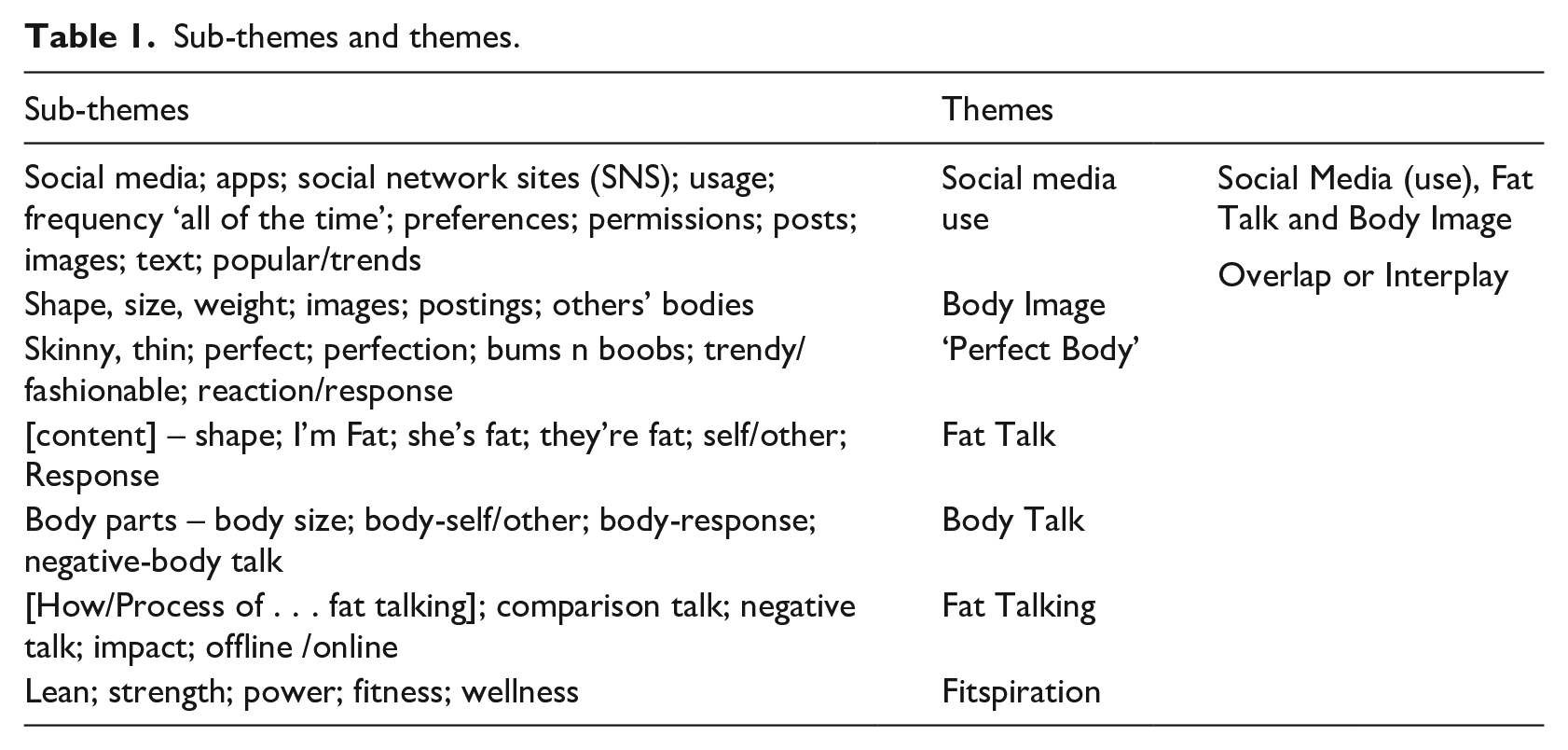
Social media use
For the majority of participants, social media use started early in primary school. As one focus group member put it, ‘I was that child that had to lie about my age to get on there. Think I was about 10’. Many had been facilitated to do so by their parents: ‘Yeah, my Mum set my Facebook up – I was like – about 10 or 12’. Most had started off using basic networking sites such as MSN or Facebook.
By the teenage years, frequency of use, time spent and type of platform or SNS had changed, as new image-focused media such as Snapchat and Instagram became popular. Most participants reported using SNS ‘all the time’ and saw this as normal: ‘[I get online] as soon as I wake up!’. A minority restricted their use, posting images of memorable occasions: ‘Mine’s like on an occasion – so like if I’ve been somewhere or on holiday or like Christmas . . . or family’.
Rather than posting material of themselves, the majority of focus group participants used social media to view the images posted by others, particularly, but not exclusively, the images posted by influential others. One participant said, ‘I don’t even really post that much, I just . . . I just look at everything, at what everyone else is doing’ Another explained, ‘You definitely look at other people’s stuff more than you look at your own’, suggesting interest in the regular surveillance of others. When asked about the images viewed, images of other people’s physical appearance or bodies were most common.
‘Perfect’ body
Participants’ appraisal of the images viewed suggested they were influenced by notions of the ‘ideal’ body shape and size, which triggered self-evaluation of their own body. Some talked about the expectation that young women should have a particular appearance, one of being ‘skinny’, while others referred to the importance of being ‘toned’ with ‘big boobs’ and a ‘big bum’, suggesting a plurality the body ‘ideals’. Other physical attributes discussed were the importance of having ‘really nice healthy hair’ and ‘good make-up’, suggesting the emphasis is not exclusively about body size but the body in general. Moreover, views on what is deemed desirable, i.e. the ‘ideal’ body, appeared to be constantly changing, as ‘fashions’ – and that which is currently considered popular – also changes with time and place. For some focus group participants, this gave rise to anxiety that their body, once admired or desired, might soon be ‘out of fashion’.
Celebrities . . . at the moment its big hips and big bums
Like early 2000 – if you had a bum in the early 2000 you didn’t exist – and if you’ve not got a bum now you don’t exist. It’s the weirdest thing.
I feel like having a bum is the one thing that everyone is bothered about.
I think the worse thing for me is bodies coming in and out of trend as that’s scary to think like, when is my body going to be out of trend?
This fluid nature of social media was a dominant concern in young women’s discussions. Moreover, an affective response to the images viewed was also evident.
So, think of that woman again, how did that make you feel when you saw that [post] on social media? Like how did you feel yourself?
Annoyed!!
Yeah
Chubby! Like I wanted to start the gym, like lose weight.
coz you kinda just concentrate don’t you and think . . .’ what am I doing wrong?’. . .
Like, why do I eat so much food. Why do I enjoy chocolate like?
I think it depends what mood you are in – if you are having a bad day, and you see a picture like that you’re like, oh for god’s sake why am I so fat or whatever, but if you’re in a good mood, you’re like yeah, I’m gonna go to the gym, I’m gonna eat healthy – builds inspiration, like motivates you.
So, it could be 2 different things – it could make you feel worse or feel positive.
Yeah, I think it depends on how you are feeling [that day]
Participants explained how their mood at the time of viewing the images posted by others was important in determining their reaction. A strong consensus was evident about the impact of viewing posts resulting in pressure to take immediate action, to rectify their bodies, and to attain the ideal: ‘. . . because it makes people think they have got to look like that’. While many participants recognised that attaining the ideal was unrealistic, this only exacerbated their frustration.
I would say so just for the fact that people think like if you haven’t got that perfect body then you are not going to like get anywhere in life! I think that’s what a lot of girls our age thinks anyway.
Do you know what I mean – so I feel like they will change their body just to fit in type of thing – not because of them – not because they want to but the fact that they want to fit in with everybody.
Needing to belong was cited as a powerful motivation to conform to society’s ‘ideals’ about the body, despite recognising that the criterion itself is highly subjective, constantly changing and sometimes contradictory.
Fat talk
Interestingly, self-deprecating comments featured highly in all three focus group discussions, particularly when discussing images posted on social media by other reportedly ‘more attractive’ females on social media. As the dialogue below suggests for some of the women, the impact penetrates into the very core or sense of self:
Ok how did it make you feel about your own body when you are looking at those images?
Horrible!
Inferior!
Uncomfortable!
yeah makes you feel uncomfortable
Why?
Cos’ then it’s just like I’m not gonna look like that
Never!
They’re the reason I get insecure sometimes, definitely like why’s he [boyfriend] with me when he could have someone like that . . .
I feel it does affect [my] relationships as well
yeh as you might think he’s [boyfriend] going to see that picture and fall in love with her!
yeah as me and my ex-boyfriend used to fight all the time about social media, as he would say that I was his perfect type and then id scroll through and see that he’d liked girls with blonde hair and big boobs and like 6ft 4 or these girls that look nothing like me. And I’d text him saying why are you liking that and you know that it’s nothing but you still feel that you have to confront it
On seeing images of others, participants internalised strong feelings of self-loathing and criticism.
It’s that thing where if you see someone else that’s pretty you think that takes away from your own beauty
Definitely
Just makes you insecure and knocks your confidence and affects your relationship
Social media wrecks relationships! . . . I just get angry with myself, like how have I let myself get this fat.
Comments such as ‘chubby!’ ‘horrible’ and ‘fat’ were commonly used to refer to themselves, especially when seeing images of others on social media. Some participants talked about having an immediate and strong reaction to these images, alongside the desire to change their own appearance: ‘Like I wanted to start the gym, like lose weight’ and ‘it just makes me think I want to start doing sit ups’. For some, this directly affected their self-esteem and body confidence with others suggesting it also affected interpersonal relationships: ‘[I act] insecure, not happy’, ‘[I] Start to obsess about looking like that’, ‘Yeah and my friends are [also] really insecure because of Instagram’. Viewing images online produced a strong and affective response, which participants appear to be unable to control and prevent. In the absence of fat talk in the social media space, they could only engage in surveillance of others, and this could feel comparatively isolating, encouraging more than usual negative self-talk.
Fat talking
Although none of participants recognised the term fat talk, they were all familiar with the act. They described regularly engaging in negative talk about their own bodies with girlfriends as ‘normal’: ‘I think speaking about like weight and all body image is a common thing for girls, especially like I would speak about it with a lot of my girlfriends but never with like boys’. The majority refrained from posting images of themselves that might become the target of fat talk among peers, with most only posting pictures ‘looking their best’ and going to great lengths to achieve this.
Last thing you want is to post a picture that you feel comfortable with or uncomfortable with and hear that someone has sent it into [another] group chat and be like ‘have you seen the state of her!’ – that’s so much worse than someone commenting directly on the picture.
That’s like going out isn’t it – you take so many photos, you think, I need to find the nicest one where I look so skinny, my make-ups on point and my hair looks so nice.
Yeah and say if you’ve got a friend that say has a different body shape to you, but then gets 10 comments on their picture and you get only 1 you get that feeling that maybe I should look a bit more like them and then maybe I will get more likes. And it’s not as if you are just posting for comments and likes but you do feel validated by their comments and likes
Body talk
External validation was sought through positive responses (‘likes’) to the images participants posted but these were also fraught with risk and therefore caused anxiety.
Yeah and say if you’ve got a friend that say has a different body shape to you, but then gets 10 comments on their picture and you get only 1 [so] you get that feeling that maybe I should look a bit more like them and then maybe I will get more likes. And it’s not as if you are just posting for comments and likes but you do feel validated by their comments and likes.
Edited and enhanced images were discussed in all the focus groups but with divergent perspectives. When asked about ‘digitally altered’ photos, most participants reported this had little effect on their self-comparison behaviour or feelings of body [dis]satisfaction. This, however, was not universal, with enhanced images increasing pressure to conform to unrealistic norms for a few others. Especially when the images were of friends, the impact was stronger since the image was deemed more ‘realistic’.
‘Coz friends are quite similar aren’t they – you must have some similarity to actually be friends – celebrities you think oh my God like I live in . . . and you’ve moved from Manchester to America
no, it’s just unrealistic, most of them don’t get it real do they. A lot of them are photoshopped, it doesn’t make me feel that bad.
no, I think it’s more negative online because in person, you can’t hide any flaws. On social media, you can make yourself look skinnier, filter the photo so you look more tanned and that creates an unrealistic image that people compare themselves to.
Interestingly, despite acknowledging that many of the images on social media have been digitally modified, they remain powerful, encouraging self-comparison behaviour, negative self-talk, overwhelming affective responses such as an urgency to act, to fix their body.
Discussion
This study sought to examine social media use and fat talk among young women, revealing possible links with body image construct and mental health. The focus was on fat talk since it is reported to be a common practice among young women and is arguably linked with negative talk about the self, which links to negative body image constructs.
Our findings align with reports that social media use is widespread among young women in England. We also found that consistent with social comparison theory, using social media encouraged the surveillance of images of other people and their bodies, with this, in turn, triggering self-evaluation and social comparison behaviours. Consistent with the recent meta-analysis (Mingoia et al., 2017), all of the young women in this study described how viewing images of other young women, especially women they knew, greatly encouraged self-evaluation and social comparisons, resulting in negative feelings about their own body and their self. In addition, the real-time nature of social media creates a sense of constant exposure to such images, resulting in a continuous or never-ending process of negative self-evaluation and the endless surveillance of the self and others.
While fat talk in offline spaces may be accepted as part of normal interpersonal exchange between young women, participants were fearful of having their body negatively discussed by others in an online setting. While they all admitted to privately judging another’s body, openly engaging in negative talk about someone else’s body size – in an online space – was unacceptable. While we observed no evidence of fat talk taking place on social media, engaging in online body talk was apparent and recognised as an assurance-seeking behaviour: ‘People make themselves feel better by talking negatively about other people on social media’. Commenting on another person’s hair or facial appearance, or aspects considered modifiable, for example, with make-up, treatments and styling, was acceptable but fat talk was taboo: ‘If you saw a picture of someone on Instagram with dodgy eyebrows and you’d be like oh god look at those but you don’t do it about weight’. In this respect, our research findings align with suggestions of there being a more encompassing ‘body talk’, which relates to more than having an ideal body shape, but appearance more broadly. A recent study conducted in China reports on how body talk is significantly mediated by internalised thin ideal and muscular ideals (Wang et al., 2022), raising the question that if young people shift their primary communication into online and social media spaces, will fat talk eventually be replaced by broader and negative ‘appearance conversation’ or body talk and, if so, what will be the consequences for young people?
In the wider literature, negative self-talk is considered detrimental to health and well-being (Jones et al., 2014; Mills et al., 2019, 2021) especially during adolescence (Rich et al., 2019; Stice et al., 2003), when bodies are changing and the ability to feel in control of our own health still developing. Being able to cope with media imagery and the impact on body image is, therefore, particularly challenging. As participants in this study expressed, discourses concerning the body are also continuously changing and this is exacerbated by imagery posted on social media. Importantly, the plurality of what is perceived or portrayed as being the ideal body must also be managed by the individual. Health education efforts exist to raise awareness about digital enhancement tools used on social media, in an effort to protect against the negative impact of imagery and discourses about the body (e.g. as described by Penny and Kirk (2015), Russell (2020), Tiggerman and Zaccardo (2015)). However, as we found here, participants were already aware of such tools and felt they knew when an image had been filtered or digitally enhanced. However, this did not prevent them from responding with negative self-evaluation and social comparison behaviour.
With the continued rise in social media use, young people face ongoing surveillance of their appearance by others but also by themselves. In addition, the pressure to look a certain way may no longer be restricted to body size and shape. Given the real-time delivery of images, and ongoing change in how acceptable appearance is defined, young people may feel their bodies are under constant scrutiny but are also subject to trends and changes in fashion (cf. Tiggerman and Slater, 2013). To a degree, appearance talk may have displaced or changed the nature of fat talk. This calls for new ways for health education to address body image and mental health concerns. Because motivations for engaging in fat talk and how we respond to fat talk are socially and culturally nuanced (Shannon and Mills, 2015), adopting a single one-size-fits-all approach is unlikely to prove effective (Chua and Chang, 2016).
Overall, more research into the disconnect between the socially constructed narratives portrayed online, through social media, and in the offline space, is warranted. Interventions that encourage young people to critically challenge normative values of appearance have been advocated (Fardouly and Vartanian, 2016) to help address the consequences of social comparison in online or digital spaces (Camacho-Miñano et al., 2019; Rich et al., 2019; Russell, 2020). Lessons can be drawn from the success of positive body image initiatives in helping young people question the cerdibility of bio-pedagogies, for example, Health at Every Size (HAES) (Penney and Kirk, 2015) and critical fat pedagogy (Cameron and Russell, 2021). Initiatives targeting weight discrimination, fat shaming and fat bias, and the ‘body positive movement’, more generally, may offer helpful alternatives to a biomedical weight-centred approach in countering negative self-talk in the online space (Wright and Halse, 2013). Mills et al. (2021) remind us that our reaction to different forms of body talk is socially and culturally nuanced, and that what applies in one country is not necessarily experienced similarly in another. In addition, as Hendry et al. (2021) argue, not all social media, including so-called social influencers, have a negative influence on online representations and discourses of the body. Appreciating the complexity and socially nuanced nature of social media is key to identifying effective responses to fat or body talk in future.
Limitations
Despite novel and illuminating insights, the findings from this study should be interpreted with care. Due to complex work schedules, many participants failed to attend the focus groups as planned, resulting in a small sample of 18 women across three focus groups, which is likely to negatively influence the data and saturation; however, there was richness with respect to some emerging themes. A more detailed inquiry with a larger and more representative group of participants would be helpful in examining the interplay between SNS use and fat talk. Arguably, convenience sampling introduces bias when it comes to discussing a sensitive topic, especially for members of this population. Our sample was likely, therefore, to include a disproportionate number of young women who were comfortable discussing the topic, and likely had limited or low body image concerns. Finally, the sample largely comprised White young women from a city in England. The wider literature suggests that race is a moderator of fat talk, so future research should examine this interplay among young women of different ethnic, gender and geographical backgrounds to better appreciate its socially situated nature.
Conclusion
Despite this being a small-scale study, our data are rich in highlighting the interplay between fat talk and body image constructs in the digital space. As social media use continues to grow, new sites and new contexts emerge, and communications about the body constantly change. Developing an understanding of how this impacts on any form of negative body talk, and body image, is important for future efforts to promote mental health and well-being. This study illuminates how negative fat talk may be shifting from the interpersonal space to online and more ‘invisible’ intra-personal space. Health education, as a preventive approach, has an important role to play in supporting young people to better navigate this new and complex situation.
