







Abstract
Objective:
To investigate the role of specialised content knowledge in instructor training on the teaching and learning of basic life support (BLS) in secondary schools.
Design:
Cluster randomised controlled trial.
Setting:
Data were collected in three Flemish secondary schools during physical education classes.
Method:
Three secondary schools were randomly assigned to a 60-minute BLS instructor training without (one school, three teachers) or with (two schools, five teachers) a focus on recognising and addressing common errors. Knowledge of common errors in the performance of BLS and how to correct these is referred to as specialised content knowledge. Following instructor training, all teachers taught BLS lessons to different students. Teachers’ use of time and interactions were assessed by means of systematic observation. BLS performance was assessed individually and unannounced to students (n = 294) one week following their training using a validated protocol.
Results:
On average, specialised content knowledge teachers interacted more with their students compared to common content knowledge teachers (8 vs 3 teacher interactions per lesson to the class as a whole, 43 vs 31 teacher interactions per lesson to students individually). In addition, students taught by specialised content knowledge teachers achieved significantly higher BLS scores (66% vs 61%; p < .05). Overall, average BLS performance of students correlated positively with the amount of time reserved for hands-on practice, r(21) = .51; p < .05.
Conclusion:
Specialised content knowledge (i.e. recognising and addressing common errors) should be part of BLS instructor training courses.
Introduction
In the case of cardiac arrest, bystanders can play a critical role for survival by performing basic life support (BLS; Gräsner et al., 2020; Hasselqvist-Ax et al., 2015; Nolan et al., 2006; Wissenberg et al., 2013). European guidelines on BLS contain checks for safety, consciousness and breathing, a call for professional help, and the performance of cardiopulmonary resuscitation (CPR; Perkins et al., 2021). There is a consensus that educating all school children about BLS can contribute to increasing the public’s competency and improve the quality and incidence of lay-resuscitation (Greif et al., 2015).
The International Liaison Committee on Resuscitation (Wyckoff et al., 2022), the American Heart Association (Cave et al., 2011; Merchant et al., 2020), the European Resuscitation Council (Greif et al., 2021) and the World Health Organization (Böttiger and Van Aken, 2015) unanimously advocate for mandatory BLS education in secondary school curricula. Although legislation mandating BLS education has been approved in many countries, research shows that additional efforts are necessary to successfully implement BLS training in schools (Malta Hansen et al., 2017). Reported barriers for implementation include curriculum pressure and lack of funds, training materials and teacher training (Zinckernagel et al., 2016).
Research shows that a large proportion of teachers recognise the need for mandatory BLS training at school but do not feel competent to teach this topic or require further training (De Smedt et al., 2019; Dumcke et al., 2019; Malta Hansen et al., 2017; Mpotos et al., 2013). A qualitative study in eight schools in Denmark revealed that teachers’ insecurity in teaching BLS was rooted in a belief that extraordinary skills are required to teach the subject, as it was a matter of life and death (Zinckernagel et al., 2016). There is a pressing need for professional development and appropriate engagement in initial teacher training to make teachers confident and effective in teaching BLS (Brennan, 2014; Dumcke et al., 2019; Zinckernagel et al., 2016). Research shows schoolteachers can be successful in teaching BLS (Iserbyt and Madou, 2021; Iserbyt et al., 2017; Otero-Agra et al., 2022) and achieve similar learning outcomes in children compared to experts such as emergency physicians (Lukas et al., 2016). Current guidelines even suggest schoolteachers are the most appropriate people to teach BLS to children (Greif et al., 2021).
As far back as 1991, Kaye and colleagues identified instructors as the weakest link in BLS training (Kaye et al., 1991). Three decades later, a report on education and implementation of resuscitation by the European Resuscitation Council contains guidelines on instructor training (Greif et al., 2021). The report states, however, that ‘No study has addressed specific formats about how to teach a CPR instructor’ (Greif et al., 2021: 399) and ‘Most of the studies only addressed observed teaching performance and not the effect of the teacher training on the learning achievement of their students’ (Greif et al., 2021: 400). This study aims to contribute to this research gap.
This study
To date, limited research has shown that how BLS instructors are trained affects how they teach and the learning outcomes they achieve (Iserbyt and Madou, 2021; Iserbyt et al., 2017; Ward et al., 2015). This study systematically replicates but extends previous work on the effect of content knowledge on teaching and learning BLS (Iserbyt and Madou, 2021; Iserbyt et al., 2017). Systematic replication serves to validate previous research and is a fundamental element of good science (Cai et al., 2018). It extends previous work on instructor training for schoolteachers by targeting children from a different age group (ages 15–18) and introducing online components. Previously targeted age groups have included children in elementary schools (ages 11–12; Iserbyt et al., 2017) and secondary schools (ages 12–14; Iserbyt and Madou, 2021). Guidelines on education for BLS state that ‘competencies should be adapted to the age of students from preschool to university level due to their differing abilities to perform the skill and understand the underpinning theory’ (Greif et al., 2021: 394) making data collection in all age groups important.
By introducing online components in this study, we aim to exploit previously reported opportunities of combining online and face-to-face learning such as course standardisation, increased learner autonomy and enhanced cost-effectiveness (Thorne et al., 2015). Online learning ensures all participants receive similar content and changes (e.g. updates on guidelines for BLS) can be disseminated promptly (Thorne et al., 2015). This method may help in addressing the reported need (Zinckernagel et al., 2016) for clear guidelines regarding the required proficiency level needed for teachers to train students in BLS. It also facilitates providing them with these skills in a cost-effective manner as the implementation of online learning is reported to reduce face-to-face time (Greif et al., 2021; Thorne et al., 2015).
Previous research with different age groups have shown that learning outcomes are better among teachers trained to detect and correct frequently made errors in learners compared to teachers who were not (Iserbyt et al., 2017). Identifying and correcting common errors requires specialised content knowledge (SCK), whereas the knowledge needed to perform BLS effectively may be referred to as common content knowledge (CCK; Ball et al., 2008; Ward, 2009).
Two instructor training packages for secondary school teachers were developed. We sought to investigate the effect of instructor training containing CCK and SCK versus instructor training exclusively containing CCK on teacher behaviour and students’ learning of BLS. Based on previous research conducted in elementary education, we hypothesised that teachers who were trained to identify and correct common errors (i.e. SCK) would devote higher proportions of learning time to hands-on practice, show higher frequencies of student–teacher interaction and produce better learning results with their students (Iserbyt et al., 2017).
Through this study, we seek to provide evidence of student learning and validate the design of a specific instructor-training package. In addition, correlations between teacher behaviour and student performance were explored aiming to contribute to the evidence base on what effective teaching in BLS looks like.
Methods
Participants and setting
Six Flemish secondary schools were contacted for participation in this study. Schools were considered eligible for participation when they met the following criteria: (1) teachers were willing to participate in a 60-minute blended instructor-training workshop, (2) teachers did not consider themselves experts in BLS as reported in a written questionnaire completed prior to the start of the study, (3) teachers were willing to teach BLS repeatedly while being video- and audio-recorded, (4) participating classes were enrolled in a ‘general secondary education track’ preparing for higher education, (5) BLS had not been part of the school curriculum for at least 2 years, and (6) the school principal approved the study.
Three schools met all the criteria that corresponded to a total of eight teachers, 23 classes and 341 students. Schools were randomly assigned to one of two conditions (see Figure 1 below). The CCK group consisted of one school, three teachers (one woman, two men; age range 34–55), eight classes and a total of 119 students (age range 15–18), and the CCK + SCK group consisted of two schools, five teachers (one woman, four men; age range 25–52), 15 classes and a total of 222 students (age range 15–18). The instructional strategy used to train teachers (i.e. peer learning) required teachers within schools to be assigned to the same research condition. All teachers and students’ parents provided consent for participation in the study, which was approved by the Social and Societal Ethics Committee of the corresponding author’s university (identification number G-201510375).
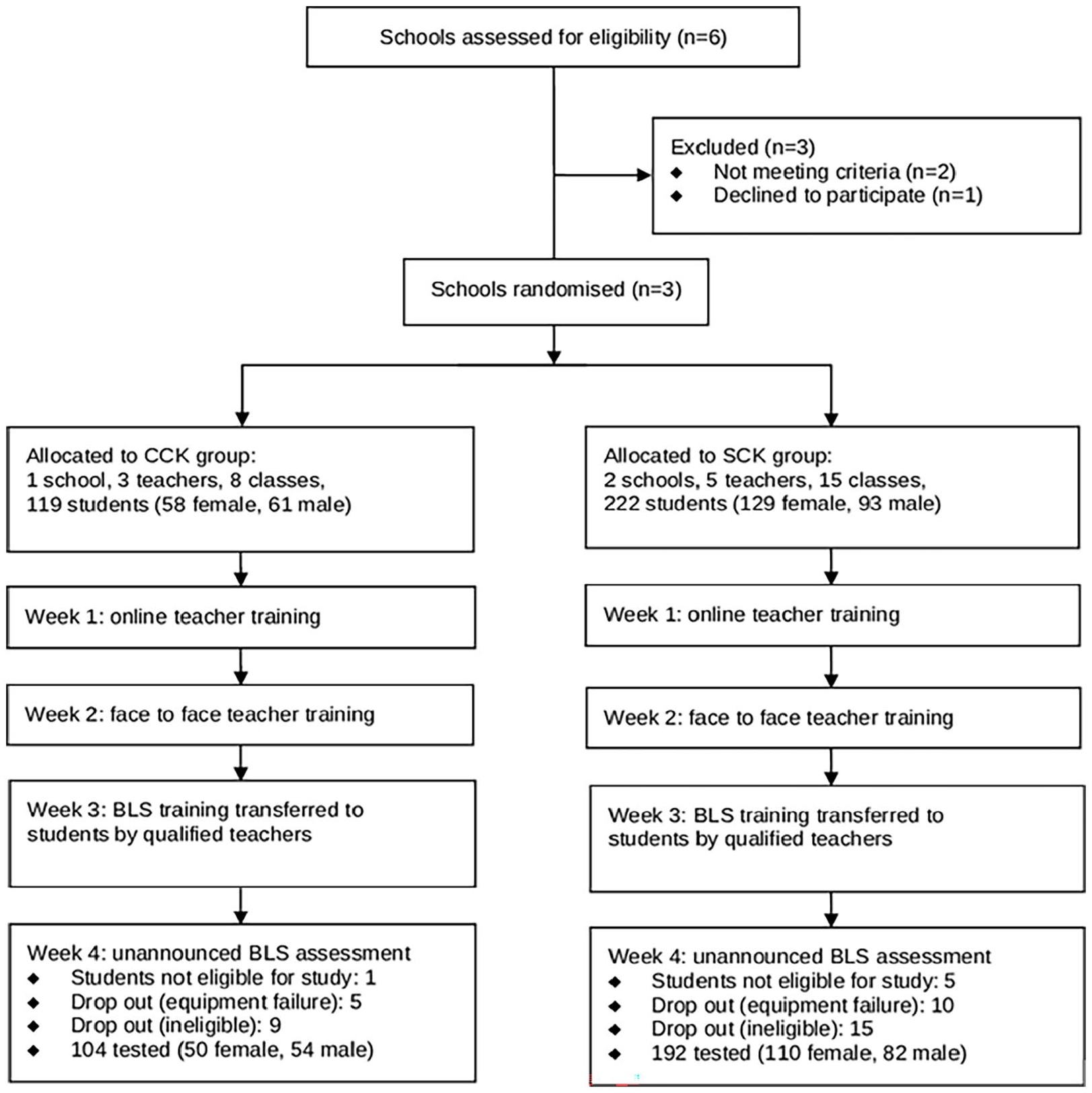
Participants flow through study.
Study design and procedures
This study took the form of a clustered randomised controlled trial. Using an online randomisation tool (www.randomizer.org), one of two instructor training packages was allocated to each school by a research assistant. None of the authors were involved in this process. The structure of both instructor training packages was identical (see below). The content of the instructor training packages was the independent variable of this study and consisted of two conditions: CCK versus CCK + SCK.
Instructor training
All instructor training used blended learning as a teaching strategy. Blended learning may be defined as ‘the thoughtful integration of classroom face-to-face learning experiences with online learning experiences’ (Garrison and Kanuka, 2004: 96). The instructor training packages consisted of three parts: an online learning module, a face-to-face workshop, and a written test.
The online learning modules were designed using Adobe Captivate software (version 11). Based on the educational literature, instructional quality was enhanced by using segmented videoclips (Fiorella and Mayer, 2018) and adding quiz questions (Spanjers et al., 2015). Teachers could freely navigate through all parts of the online module and retake a quiz without limitation. Quizzes provided immediate feedback after each question with clarification when mistakes had been made. The module reported an overall percentage score after completion. Teachers could access their assigned online learning module exactly one week prior to the workshop and were expected to score at least 80% on an online quiz. Based on pilot testing with five teachers and three members of the research team, the online learning modules, including the quiz, took on average 20 minutes to complete and the 80% score was an attainable goal demonstrating participants’ mastery of the online content. Two content experts in BLS certified by the European Resuscitation Council reviewed the online learning module to assess content and face validity for teaching BLS to secondary school children. Following the online assignment, face-to-face workshops were organised at the teachers’ schools in the setting where they would be teaching their students.
Face-to-face workshops followed a standardised protocol (see below). No breaches of this protocol were reported. Workshops had a standardised duration of 60 minutes and were delivered by the lead investigator of the study under the supervision of expert members of the research team.
The CCK instructor training
The focus of the instructor-training package in the CCK condition was learning to perform BLS according to European guidelines (Perkins et al., 2015). In the online module, teachers could consult videoclips of correct BLS performance and test their knowledge using 15 quiz questions (e.g. placing the different steps of BLS in correct order or naming the correct compression depth which is 5 to 6 cm). The face-to-face workshop started with a 10-minute introduction explaining the goals and clarifying the instructional model which took the form of reciprocal peer learning using a mannequin and an iPad as instructional aid. In this model, learners work in pairs to maximise each other’s learning by alternating between assuming a role as ‘doer’ and a role as ‘helper’. All iPads were running an application called ‘StartnHart’, specifically designed to learn BLS using reciprocal peer learning and shown to be effective in previous research (Doucet et al., 2019; Iserbyt et al., 2014; Iserbyt et al., 2017; Madou and Iserbyt, 2020). During the following 20 minutes, learners alternated roles of doer and helper every 5 minutes. Learners assuming the role of doer were asked to kneel beside the mannequin and practise BLS. Learners assuming the role of helper were asked to hold the iPad and help their partner. Next, participants performed a 10-minute peer assessment using a checklist presented in the iPad application and discussed each others’ performance. After the workshop, participants took a written test to assess whether they met the learning outcomes of the instructor training. This test asked them to list all items of the BLS sequence and its technical criteria. All teachers scored 100% on this test. The structure of the face-to-face workshop was based on previous research (Iserbyt et al., 2017).
The CCK + SCK instructor training
The focus of the instructor-training package in the CCK + SCK condition was also learning to teach BLS according to European guidelines (Perkins et al., 2015). In the online module, teachers could consult videoclips of performances of CPR and test their ability to recognise correct and incorrect performances using quiz questions (e.g. recognise compressions with insufficient depth or ventilations with inadequate opening of the airway). Videoclips were recorded for the purpose of this study and showed a student practising CPR (either correct or incorrect). Recordings were made from a similar angle of view a teacher would have when teaching this skill in schools (i.e. the camera was set at eye height). Videos showed one student practising with one mannequin in front of a clear background (see online supplemental material). By completing this online, module teachers were trained to recognise three common errors in chest compression (incorrect compression depth, rate and hand placement) and two common errors in ventilation (incorrect opening of airway and ventilation volume). The common errors were chosen based on expert consultation and previous research (Charlier et al., 2020; Iserbyt et al., 2017). The face-to-face workshop started with a 10-minute introduction explaining the goals and clarifying the instructional model. In this workshop, learners worked in groups of three and rotated between the roles of doer, helper and teacher. While assuming the role of teacher, learners were trained to identify errors in the performance of doers and correct them by addressing the helper. Instructional aids were identical to those in the CCK workshop. Immediately following the workshop, participants took a written test assessing whether they met the learning outcomes of the instructor training. Identical to the CCK instructor training, this test asked them to list all items of the BLS sequence and its technical criteria. In addition, it asked to list the most common errors and how to address them. All teachers scored 100% on this test. The structure of the face-to-face workshop was also based on previous research (Iserbyt et al., 2017).
Student training and assessment
One week following the instructor training, teachers from both research conditions taught BLS to a minimum of two and a maximum of three different classes. One mannequin and one iPad per student pair were provided. All classes were video-recorded over a scheduled lesson time of 50 minutes. One week following the teaching of BLS, performance of all students was assessed individually and unannounced (see Figure 1). Students were found not eligible for this study if they had received BLS training outside school in the past year or if they were absent during class. Using standardised instruction, students were asked to individually perform a BLS procedure on a Laerdal QCPR mannequin connected to a SimPad® PLUS (Laerdal Medical, Vilvoorde). All student performances were video-recorded. Assessments took place in a separate space where students were alone with the mannequin. Students were interrupted by a member of the research team after three compression–ventilation cycles or a maximum of 3 minutes.
Data collection
Dependent variables in this study were teaching behaviours in week 3 and students’ BLS performance in week 4 of the study (see Figure 1).
Teachers’ use of time and the teachers’ interactions with students were coded by two trained observers using systematic observation based on video. The use of time was collected by categorising the length of time all students were engaged. Based on previous research (Iserbyt et al., 2017), the categories were: (1) general context (i.e. the time during which students were not supposed to engage in BLS-related activities such as fetching or storing equipment), (2) subject matter knowledge content (i.e. the time during which students were supposed to focus on BLS-related knowledge, for example, listening to instructions) and (3) subject matter motor content (i.e. the time during which students were supposed to engage in practising BLS).
All teacher–student interactions (e.g. instructions or feedback) were measured by means of event recording and were divided in one of two categories: interactions with the class as a whole, and interactions with individual students.
Students’ individual BLS performance was assessed by combining data collected from the mannequins’ software with data collected by two blinded, independent trained observers from all video-recorded performances in a scoring protocol based on the Cardiff test (Whitfield et al., 2003). Using this protocol, all students were scored on a scale between 17 and 69 points, which was transformed into percentages (for a full description of the scoring protocol, see online supplemental material). Similar protocols have been used in previous research (Charlier et al., 2020; Iserbyt et al., 2014; Iserbyt et al., 2009; Iserbyt et al., 2017; Iserbyt et al., 2016; Whitfield et al., 2003). The following CPR-variables were collected by the mannequins’ software: total number of compressions, percentage of compressions with correct hand placement, average compression depth, average compression rate, total number of ventilations, average ventilation volume. The following variables were collected using video observation: checking for safety; checking consciousness by shaking and shouting; opening airway; look, listen and feel for breathing; call for help; compression–ventilation ratio; continuation of CPR.
Statistical analysis
Teachers’ use of time was reported in minutes and as a proportion of total lesson time. Teacher–student interactions were reported as a total count per lesson. Statistical analysis was undertaken using Statistical Package for the Social Sciences (SPSS) version 22 (SPSS Inc, Chicago, IL). An a priori power analysis was conducted using G*Power version 3.1.9.6 (Faul et al., 2007) for sample size estimation. With a significance criterion of α = .05 and power = .80, the required sample size needed to detect a medium effect (d = .05) would be 64 in each arm of the study. Sample size estimates were multiplied by the design effect [1 + (ρ (m – 1))], with m being the number of participants in a class (cluster size = 15) and ρ being the estimated intra-cluster correlation coefficient based on previous research (Iserbyt et al., 2017). To account for a .03 intracluster correlation between classes, 90 students would be needed in each group. To allow for dropout, we aimed to recruit at least 100 students in each arm. Intraclass correlation (ICC) for schools was .04 and therefore analysis of BLS performance was conducted at the student level in line with previous research (Iserbyt et al., 2017). Shapiro–Wilk testing showed BLS scores were normally distributed and Levene’s testing showed homogeneity of variances, so one-way analysis of variance (ANOVA) was used to detect between-group differences and 95% confidence intervals (CIs) were reported. Measures of effect size were reported using partial eta squared (η2p).
Results
A total of 341 students (186 girls and 155 boys) were recruited for this study. The CCK group consisted of eight classes involving a total of 119 students (58 girls, 61 boys), the CCK + SCK group consisted of 15 classes involving a total of 222 students (129 girls, 93 boys). After checks for eligibility and dropout, a total of 294 students were included in the analysis. The flow of participants is shown in Figure 1. Interrater reliability for teacher behaviour and student performance variables was measured using Cohen’s kappa based on 33% of the total sample as recommended for behavioural research (Cooper et al., 2020) and averaged between .81 and 1. Table 1 shows teachers’ use of time, teacher–student interactions, and average student BLS performance.
Average teacher behaviour and student performance for teachers (T) in the CCK (n = 3) and CCK + SCK (n = 5) condition.
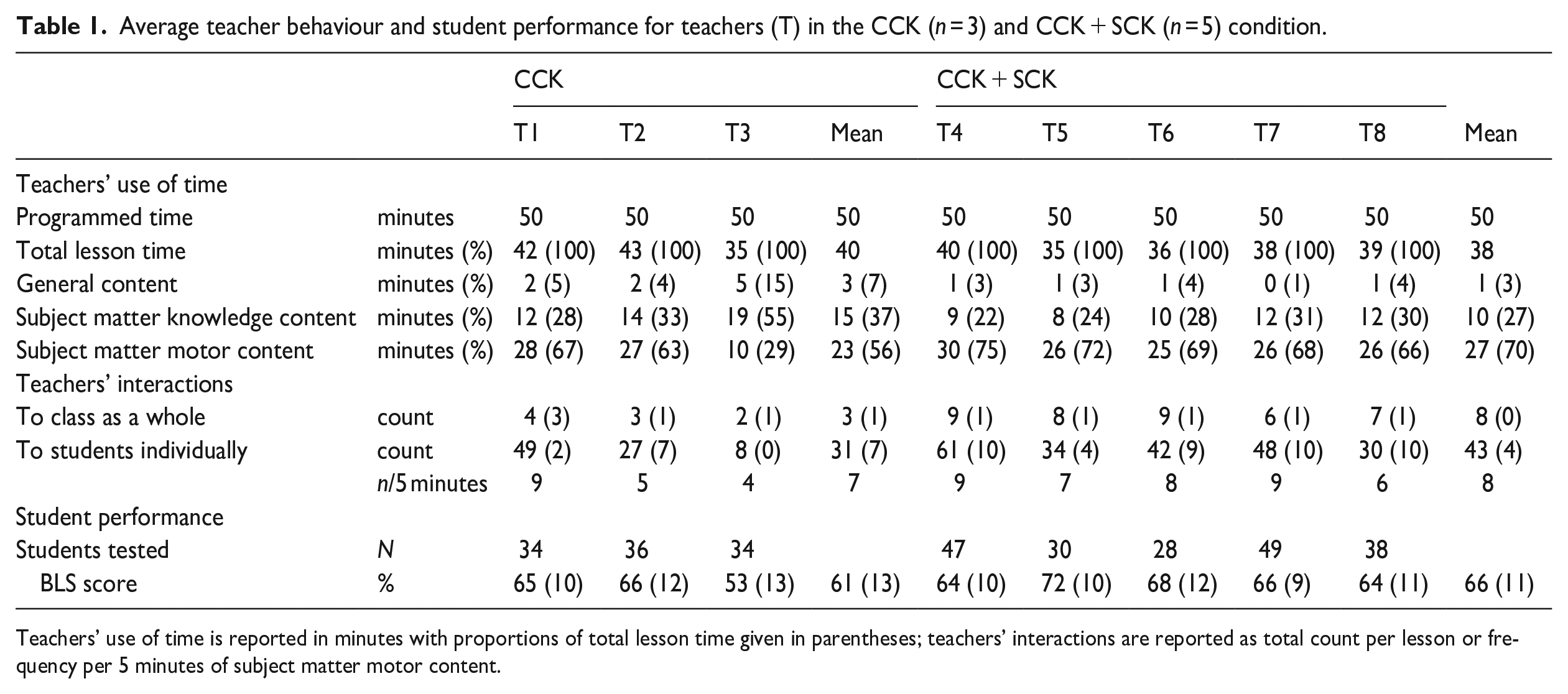
Teachers’ use of time is reported in minutes with proportions of total lesson time given in parentheses; teachers’ interactions are reported as total count per lesson or frequency per 5 minutes of subject matter motor content.
Teacher behaviour
The observed lesson duration ranged between 35 and 43 minutes indicating that none of the teachers were able to fully use the scheduled 50 minutes of lesson time. In the CCK + SCK group, the mean time spent on subject matter motor content was 70% compared to 56% in the CCK group. The mean time spent on subject matter knowledge content in the CCK + SCK group was 27% compared to 37% in the CCK group. On average, CCK + SCK teachers engaged in 8 interactions with the class as a whole and 43 individual interactions compared to 3 and 31 interactions, respectively, for CCK teachers.
Student BLS performance
One-way ANOVA showed a significantly higher BLS performance in the CCK + SCK group compared to the CCK group, F(1, 294) = 11.7, p < .01, η2p = .04. Students taught by teachers from the CCK + SCK group scored an average of 66% (CI: 64.7%–67.9%) compared to students from the CCK condition who scored 61% (CI: 58.6 – 64.0; see Table 1).
The association between teacher behaviour and student performance
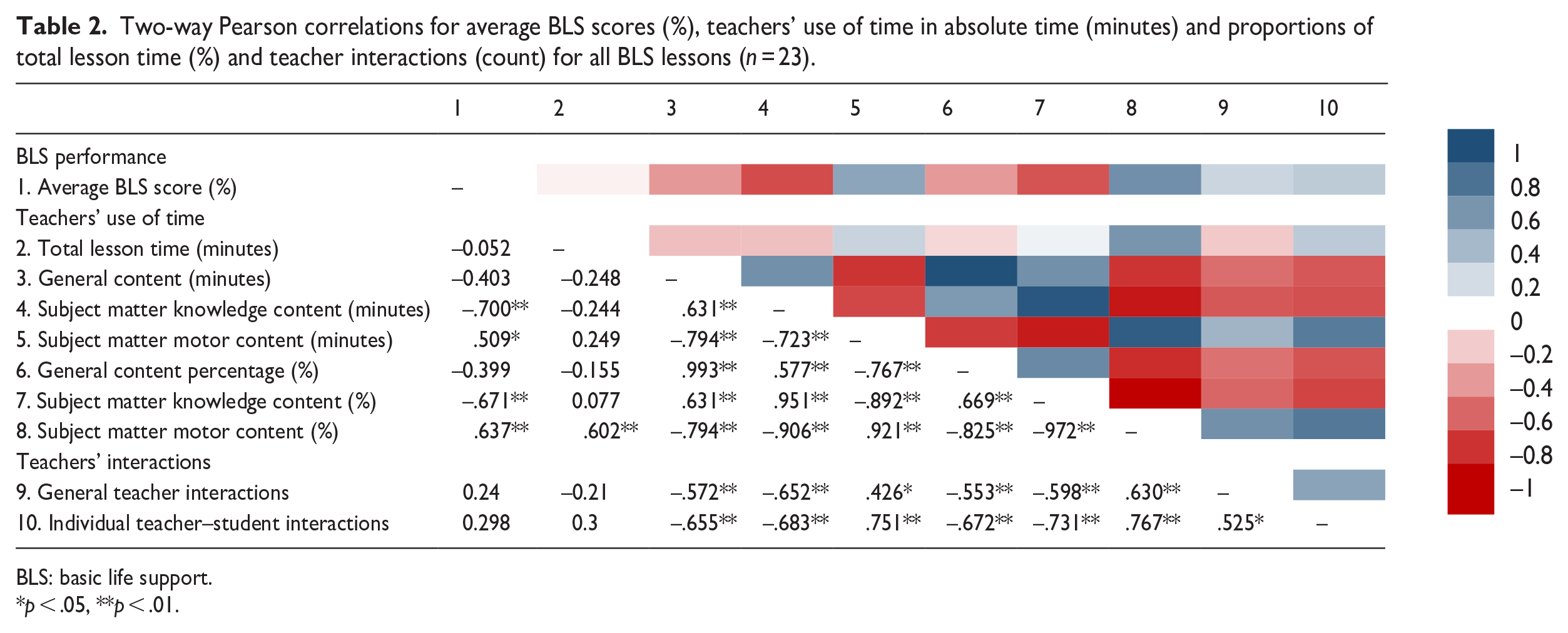
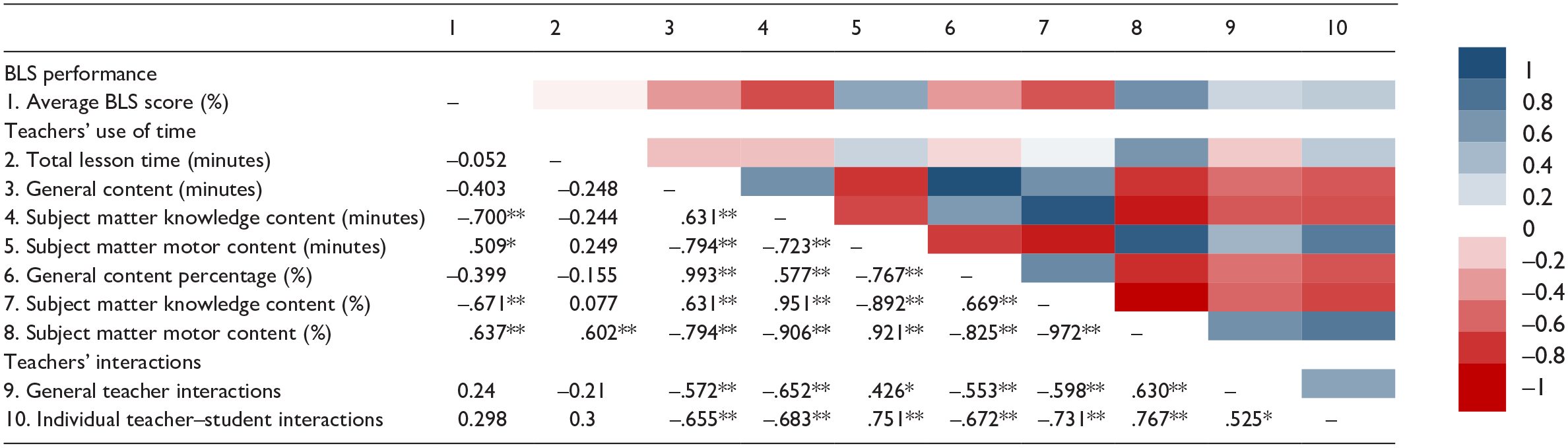
Two-tailed correlations for teacher behaviours over all conditions and average student BLS performance are shown in Table 2. There was a significant positive correlation between subject matter motor content and average BLS performance both in minutes r(21) = .51, p < .05, and in percentage of total lesson time r(21) = .64, p < .01. There was also a significant negative correlation between subject matter knowledge content and average BLS performance both in minutes r(21) = –.70, p < .01 and in the percentage of total lesson time r(21) = –.67, p < .01. No significant correlations were found between student–teacher interactions and average BLS performance.
Two-way Pearson correlations for average BLS scores (%), teachers’ use of time in absolute time (minutes) and proportions of total lesson time (%) and teacher interactions (count) for all BLS lessons (n = 23).
BLS: basic life support.
p < .05, **p < .01.
The number of general teacher interactions correlated positively with subject matter motor content, both in minutes r(21) = .43, p < .05 and in percentage of total lesson time r(21) = .63, p < .01. A negative correlation was found between general teacher interactions and subject matter knowledge content in minutes r(21) = –.65, p < .01 and in percentage of total lesson time r(21) = –.60, p < .01. For individual teacher–student interactions, similar associations were found. The number of individual teacher–student interactions correlated positively with subject matter motor content, both in minutes r(21) = .75, p < .01 and in percentage of total lesson time r(21) = .77, p < .01. A negative correlation was found between the number of individual teacher–student interactions and subject matter knowledge content in minutes r(21) = –.68, p < .01 and in percentage of total lesson time r(21) = –.73, p < .01.
Discussion
This study investigated the effect of instructor training combining CCK and SCK versus instructor training exclusively containing CCK on teacher behaviour and students’ learning of BLS. We hypothesised that teachers who were trained to detect and address common errors would demonstrate superior teaching behaviours in terms of their use of time and their interactions with students, and produce better student learning results. Students who were taught by teachers from the CCK + SCK group outperformed students who were taught by teachers from the CCK group. We believe these findings confirm previous research on BLS education in schools where similar protocols were used targeting younger children (Iserbyt and Madou, 2021; Iserbyt et al., 2017). Our results are also in line with research supporting professional development strategies to advance both CCK and SCK in secondary education teachers (Kim et al., 2018). Training teachers to recognise clinically important errors and how to address them has now repeatedly been associated with stronger student-learning outcomes (Iserbyt and Madou, 2021; Iserbyt et al., 2017). This study confirms that ‘knowing how to perform BLS is not the same as knowing how to teach BLS’ and therefore recommends the implementation of SCK as part of instructor training courses. The BLS performance of students does not depend on the qualifications of their teachers alone. For example, during teaching, an effective BLS instructor should be able to adapt his teaching and feedback to the performance of learners who vary greatly in ability level. Learners making errors should be positively corrected, and learners who perform correctly should be praised and motivated to maintain their level of performance. As such, all the behaviour displayed by the teacher during a lesson is crucial and builds upon that acquired through previous instructor training.
This study also wanted to explore the correlation between teacher behaviour and student performance. The finding that student learning overall was positively associated with the amount of time reserved for hands-on practice, and negatively associated with the amount of time reserved for cognitive learning, is in line with previous research targeting children from different age groups (i.e. 11–12 years old; Iserbyt et al., 2017). The finding that the number of individual and general teacher–student interactions correlated positively with subject motor content indicated that teachers interact with students during practice. We believe that lesson time reserved for subject motor content creates the opportunity for teachers to provide valuable feedback. Interestingly, there was no correlation between the amount of teacher–student interactions and student performance. This could be explained by the means of data collection (i.e. frequency measure), which only shows how much interactions took place but provides no information on their content or quality. In other words, it should be recognised that not all teacher–student interactions are helpful in the process of learning BLS. In addition, verbal feedback may not endure until retention as previous research showed that BLS performance typically drops from intervention to retention (Iserbyt et al., 2009). The finding that the number of general teacher interactions correlates negatively with subject knowledge content should be interpreted with caution as all data on teacher interactions were collected by means of event recording. Consequently, ‘one’ long instruction was recorded as ‘one’ general teacher interaction but might contribute significantly to the proportion of ‘knowledge content’ of a lesson.
Limitations and strengths
The small number of participating schools is a limitation in this study as randomisation needed to be performed at school level due to the instructional model to train teachers. The method of data collection (i.e. systematic observation of teachers in their classes, collecting data over repeated teaching trials and assessment at student level) is time consuming, which puts limits on sample size. Therefore, we recommend replications to increase the external validity of findings concerning the role of SCK. A second limitation in this study is that only CPR-variables that were part of the test protocol (see online supplemental material) were included in the study (e.g. compression rate, depth, hand position). Future work should include inadequate decompression as a common and clinically important error (Nabecker et al., 2021).
A strength of this study is the data collection over repeated teaching trials for all teachers. Research reporting on teacher behaviour and student learning outcomes based on the first teaching session following instructor training may ignore the learning effect of repeated teaching (Ward et al., 2018). A second strength of this study is the detailed reporting on the structure and the scientific underpinning of the instructor training packages (see online supplemental material). Blended learning is currently recommended for BLS training as well as BLS instructor training by major international organisations (i.e. The European Resuscitation Council and The American Heart Association). Although the potential of this teaching strategy is generally recognised in BLS education, its effectiveness remains unclear (Greif et al., 2015) and critiques have been made about a lack of clarity on instructional design and scientific underpinnings (Brennan, 2014; Madou and Iserbyt, 2020).
Informed by the findings of this study, we encourage future research to further explore the role of SCK in professional development in different contexts (e.g. targeting different age groups or professionals such as firefighters and/or lifeguards); and explore the quality of teacher–student interactions as a dependent variable in professional development and as independent variable in relation to student learning. The quality of interactions can be assessed using a functional analysis methodology that codes why a teacher interacts (e.g. incorrect performance), what the teacher says (e.g. ‘You need to push deeper’), and whether the consequence of this interaction leads to better student performance. Beyond this, it is important for future studies to use designs in which data are collected over multiple teaching trials.
Conclusion
This study adds to the literature by investigating the effect of instructor training on the learning outcomes of secondary school children. Results confirm that BLS instructor-training focusing on knowing how to perform BLS technically correct should be complemented by knowledge of the common errors trainees make and how to correct these.
Supplemental Material
sj-docx-1-hej-10.1177_00178969231174685 – Supplemental material for The role of specialised content knowledge in teaching basic life support
Supplemental material, sj-docx-1-hej-10.1177_00178969231174685 for The role of specialised content knowledge in teaching basic life support by Tom Madou, Fien Depaepe, Phillip Ward and Peter Iserbyt in Health Education Journal
Footnotes

References
Supplementary Material
Please find the following supplemental material available below.
For Open Access articles published under a Creative Commons License, all supplemental material carries the same license as the article it is associated with.
For non-Open Access articles published, all supplemental material carries a non-exclusive license, and permission requests for re-use of supplemental material or any part of supplemental material shall be sent directly to the copyright owner as specified in the copyright notice associated with the article.
