







Abstract
Background
Indwelling catheters are necessary in the delivery of lifesaving medical treatments and nutrition for many chronically ill patients. Unfortunately, long-term catheters are frequent sources of infection and present significant challenges when replacement of catheters is not readily feasible.1,2 Antimicrobial lock solutions have been shown to be effective in the management of catheter-related bloodstream infections (CRBSIs) when used in conjunction with systemic antibiotics. 3 Catheter flush or antimicrobial lock solutions are also recommended for prophylaxis in patients with long-term catheters with recurrent CRBSIs.1,2
Catheter lock solutions containing an antimicrobial agent and/or anticoagulant solution may be used to eradicate bacteria from the catheter lumen increasing catheter salvage rates. Empiric antimicrobial agents included in catheter lock solutions should target gram-positive organisms, a common pathogen responsible for the majority of catheter-related infections.1,2 In addition to antimicrobial agents such as vancomycin and gentamicin, ethanol has been used to eradicate various pathogens when combined in catheter lock solutions. Heparin is a commonly used anticoagulant to maintain patency but sodium citrate, an ion chelator, has also been used. A previous study has shown compatibility when cefepime or ethanol is combined with sodium citrate. 4
Currently, most hospitals compound catheter lock solutions based on published in vitro solution compatibility and stability studies and small in vivo studies.5-7 Compatibility and stability study data of the solutions are necessary prior to patient administration. Alternative additives such as ethanol and sodium citrate should be evaluated with traditional antimicrobial agents to minimize toxicity, adverse events, or resistance to traditional agents.8,9
Objective
The purpose of this study was to determine the in vitro physical stability, chemical compatibility, and antimicrobial activity for the combination of gentamicin, vancomycin, ethanol, and sodium citrate over 72 hours.
Materials and Methods
Six different admixtures containing sodium citrate and vancomycin with ethanol or gentamicin were evaluated for compatibility, stability, and efficacy over 72 hours with or without light exposure at room and body temperatures. All solutions were prepared from commercially available products using aseptic technique in a laminar-airflow hood.
Preparation and Storage of Lock Solutions
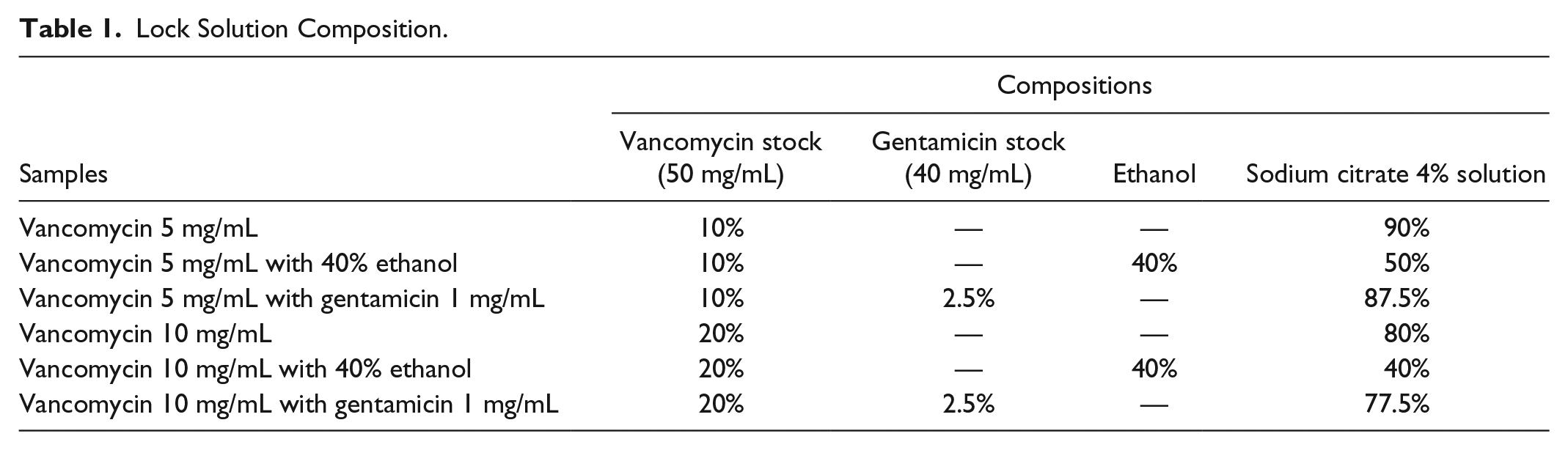
Catheter lock solutions were prepared by mixing vancomycin (final concentration of 5 or 10 mg/mL) with either gentamicin (final concentration of 1 mg/mL) or ethanol 40% in 4% sodium citrate solution (Table 1). Each lock solution was evaluated under the following conditions: room temperature (25°C) with light and without light, and body temperature (37°C) with light and without light. Samples were obtained at 0, 24, 48, and 72 hours and evaluated for physical compatibility, chemical stability, and microbiological susceptibility. Each study was carried out in triplicate. After analyzing the physical compatibility and chemical stability, all samples were passed through a 0.2-µm syringe filter (Thermo Nalgene, Rochester, NY, USA) and stored at −80°C for antimicrobial susceptibility testing.
Lock Solution Composition.
Evaluation of Physical Compatibility
Physical compatibility of each admixture was examined by measuring pH and clarity. The pH was measured using a pH meter (Accumet AB15; Fisher Scientific, Pittsburgh, Pennsylvania), and a change (ΔpH) > 0.1 was considered significant. Clarity was evaluated by visual inspection against black and white backgrounds and graded from 0 to 4 with 0 indicating no precipitation. Clarity was further analyzed using an ultraviolet-light-visible spectrophotometer (Genesys 6; Thermo Scientific, Waltham, MA, USA) at 660 nm. An absorbance value ≥0.010 absorbance units (AU) was considered turbid.
Evaluation of Chemical Stability
A UV spectrophotometric method was developed for simultaneous estimation of vancomycin and gentamicin. 10 This method involved the measurement of absorbance of vancomycin and gentamicin at wavelengths of 280 nm (λmax of vancomycin) and 255 nm (λmax of gentamicin) using a UV-Vis Spectrophotometer (Agilent 8453 UV-Visible Spectroscopy System, Waldbronn, Germany). Unknown concentrations of vancomycin and gentamicin were calculated using the following equations:

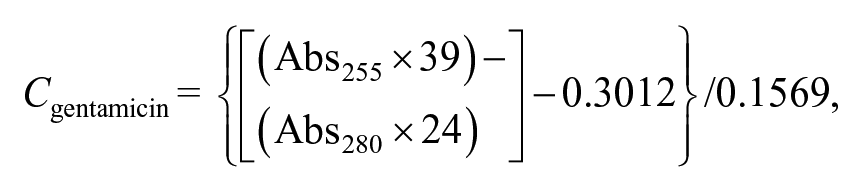
where Cvancomycin and Cgentamicin represented concentrations of vancomycin and gentamicin (µg/mL) in admixtures, respectively; Abs255 and Abs280 represented absorbance of mixture solution at 255 nm and 280 nm, respectively. Accuracy of the analytical method was evaluated by determining the recovery percentage of samples with known drug concentrations. Assay validation demonstrated that the recovery for vancomycin and gentamicin was between 98.6% and 102.8% and 96.9% and 100.5%, respectively. The intraday and interday coefficients of variation of vancomycin and gentamicin were satisfactory because the relative standard deviations of the drug concentrations did not exceed 0.27%. A different set of calibration standards ranging from 15.625 to 250 µg/mL were prepared for analyzing vancomycin from admixtures containing ethanol at 280 nm. A straight line (y = 0.0042x – 0.0031) was obtained with a correlation coefficient (r2) value of 0.9999 (Table 2). Chemical stability of drugs in admixtures was assessed by measuring the drug content at 0, 24, 48, and 72 hours.
Calibration Curves of Vancomycin and Gentamicin at 280 nm and 255 nm.

Antimicrobial Susceptibility Testing
Stability of antimicrobial activity was determined by Kirby-Bauer disk diffusion method according to the guidelines established by the Clinical and Laboratory Standards Institute (CLSI). 11 To determine antibacterial activities of gentamicin and vancomycin, reference strains of Escherichia coli ATCC 25922 and Staphylococcus aureus ATCC 25923 were used, respectively. Because a number of samples contained both vancomycin and gentamicin, a clinical strain of S aureus resistant to gentamicin but susceptible to vancomycin was obtained from the University of Toledo Medical Center and was evaluated in all samples containing vancomycin with and without gentamicin.
The Mueller-Hinton agar (MHA) was prepared according to the manufacturer’s instructions. After autoclaving, the agar was poured into flat bottomed petri dishes to give uniform depths of about 4 mm. The agar was allowed to cool to room temperature and, unless used on the same day, stored in the refrigerator (2°C-8°C). Bacterial colonies from overnight growth were added to normal saline and adjusted turbidity to equal to a 0.5 McFarland standard (1.5 × 10⁸ colony-forming units/mL). The surface of MHA plates was inoculated using a sterile swab that was dipped into the adjusted bacterial suspension and streaked over the surface of the agar plates.
Antimicrobial susceptibility test disks containing gentamicin 10 µg and vancomycin 30 µg (BBL Sensi-Discs; Becton Dickinson Biosciences, Franklin Lakes, NJ, USA) were used. In addition, blank disks were impregnated with required amounts of sample equivalent to the potency of the standard gentamicin and vancomycin disks calculated based on initial concentrations of vancomycin and gentamicin. The standard and the sample disks were applied on the surface of agar plates manually using sterile forceps in such a way that each disk was at least 24 mm away from other disks and from the edge of the petri plate to avoid contamination. The plates were incubated in air at 35°C to 37°C for 24 hours before measuring the zones of inhibition. All the tests were conducted in triplicate.
Antimicrobial activity was calculated by comparing the zones of inhibition at 72 hours to the baseline values and presented as a percentage of the baseline zones of inhibition. These values were then compared using one-way analysis of variance (ANOVA), and when statistically significant results were obtained, Tukey post hoc test was conducted. A P value ≤0.05 was considered statistically significant. All statistical tests were conducted using IBM SPSS Statistics 21 Software (IBM Corp, Armonk, New York).
Results
Physical and Chemical Stability of Lock Solutions
At baseline, 24 hours, and 48 hours, all solution combinations containing vancomycin (5 or 10 mg/mL) with either gentamicin (1 mg/mL) or ethanol (40%) in 4% sodium citrate under 4 different conditions remained visually clear, exhibiting no precipitate or turbidity (all solutions were graded 0 at each time point). Over 72 hours, all solutions except one combination maintained clarity measured by spectrophotometric absorbance. At 48 hours, the admixture containing vancomycin (5 mg/mL) and ethanol (40% v/v) in a 4% sodium citrate solution stored under 4 different conditions did not display any turbidity but at 72 hours; this admixture showed an absorbance value >0.010 AU which indicated turbidity.
The pH of each admixture under 4 conditions maintained pH within the acceptable margins during the 72-hour study period. Chemical stability of gentamicin and vancomycin was assessed and the mean concentrations ranged between 95% and 105% of initial concentrations after 72 hours (Table 3).
Physical and Chemical Compatibility of Sodium Citrate and Vancomycin With Ethanol or Gentamicin Under Different Storage Conditions at 72 Hours.
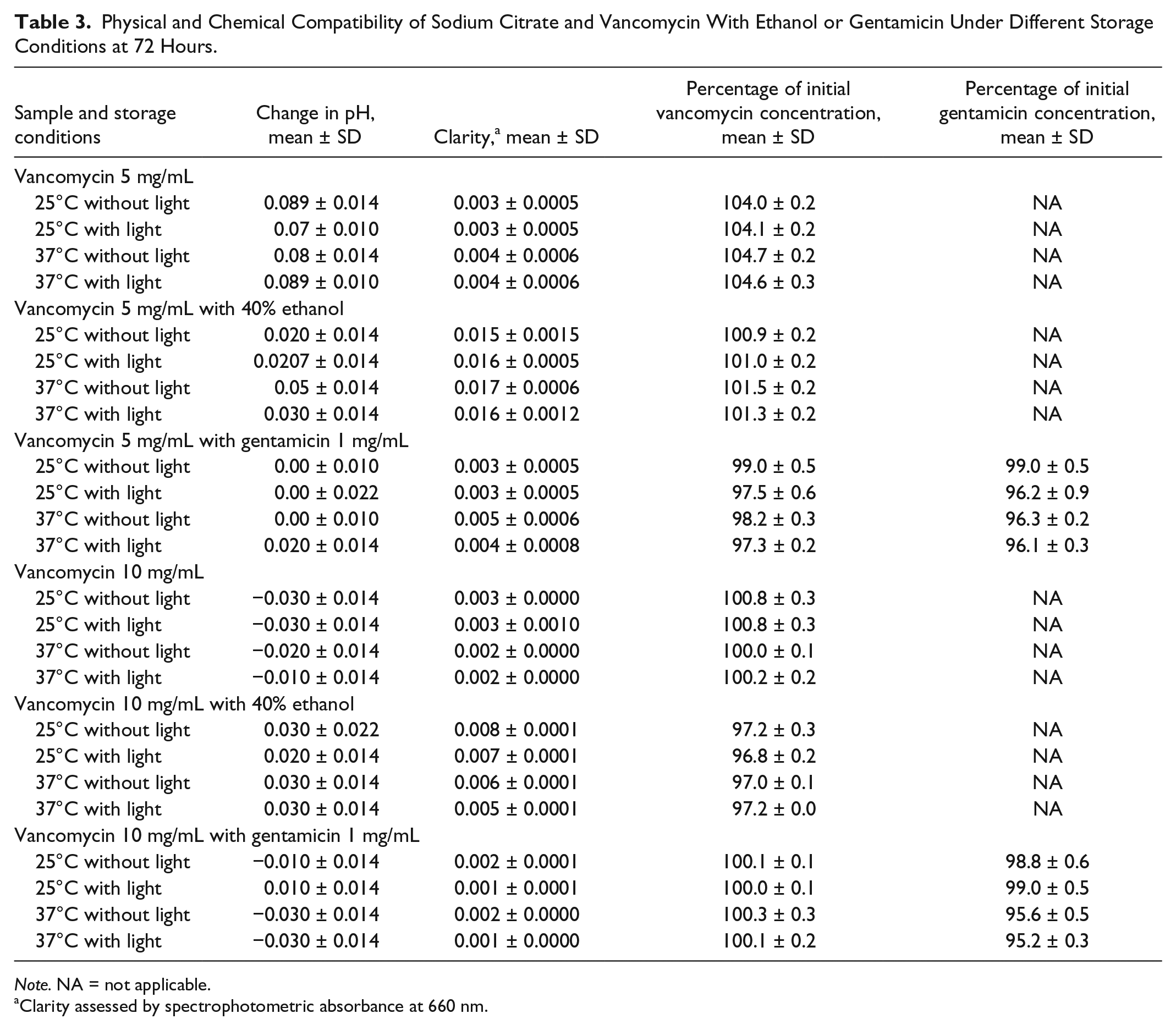
Note. NA = not applicable.
Clarity assessed by spectrophotometric absorbance at 660 nm.
Antimicrobial Susceptibility Testing
The average antimicrobial activity based on zones of inhibition is reported in Table 4. The mean antimicrobial activity of vancomycin against S aureus ranged from 95% to 106% of baseline zones of inhibition after 72 hours. The average activity of gentamicin against E coli was 99% to 104% of the baseline after 72 hours. Overall, no significant change was observed for all 6 combinations of lock solutions under the 4 different storage conditions (P>0.05).
Antimicrobial Disk Diffusion Susceptibility Testing of Catheter Lock Solutions Under Different Storage Conditions at 72 Hours.
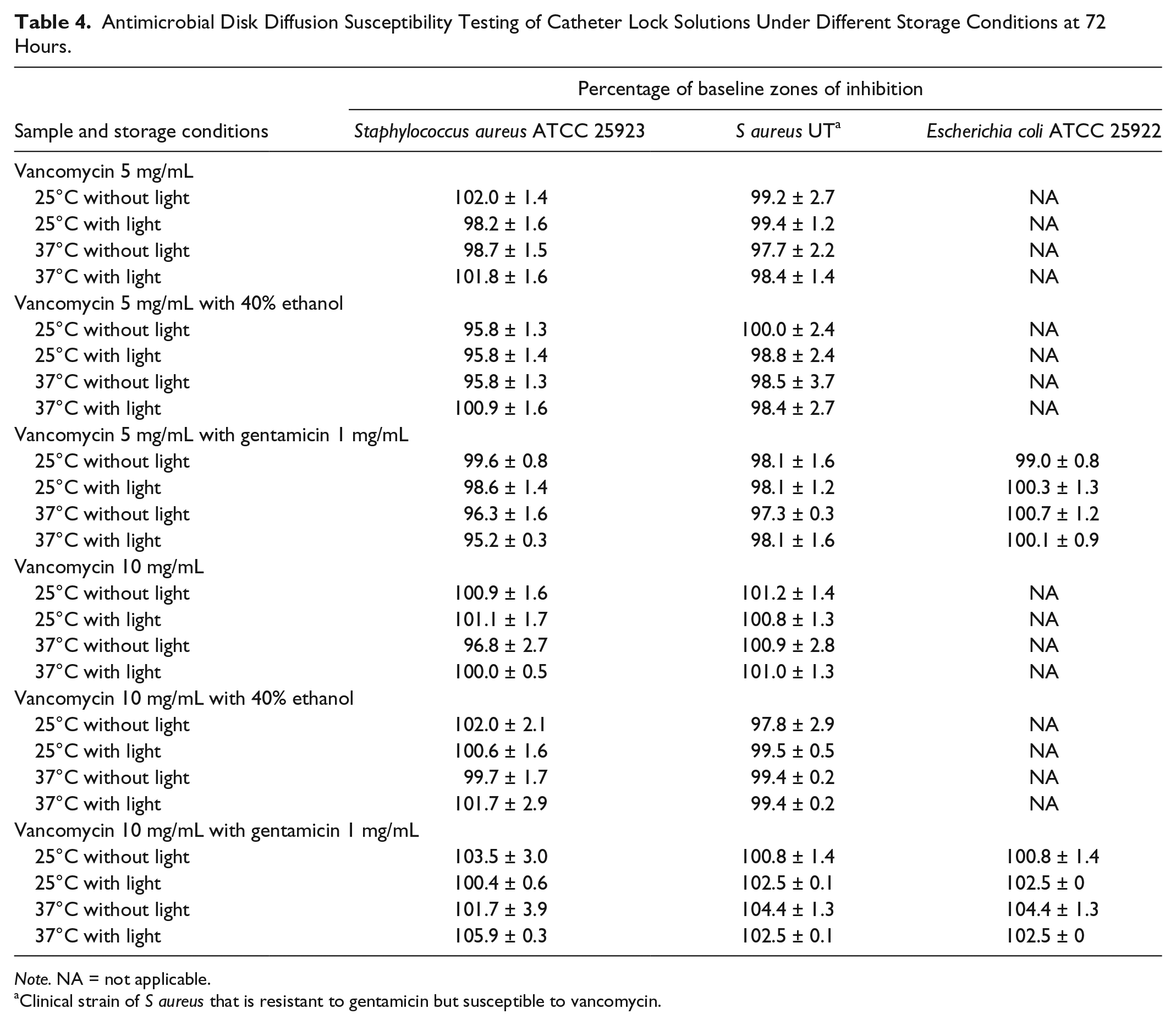
Note. NA = not applicable.
Clinical strain of S aureus that is resistant to gentamicin but susceptible to vancomycin.
Discussion
Catheter lock solutions containing an antimicrobial agent and anticoagulant solution have been used to reduce CRBSIs and maintain patency. Although the most widely used catheter lock solution is unfractionated heparin, there are safety concerns related to its use such as the risk of bleeding due to leakage. Over the years, chelator agents such as sodium citrate have gained favorability as a viable option to unfractionated heparin. Through calcium chelation, sodium citrate at a concentration of 4% suppresses blood coagulation within the catheter lumen. Sodium citrate has also been shown to be safe at this concentration even in the case of lock leakage. 12 We selected 4% sodium citrate for our evaluation because of its safety profile and the availability of a commercial formulation. 7
Even at low concentrations of 4%, sodium citrate may inhibit biofilm formation and bacterial growth but may not be able to eradicate preexisting organisms. Therefore, addition of antimicrobial agents is necessary to prevent or manage CRBSIs. Vancomycin and low-dose gentamicin catheter lock solutions have been reported in the literature.8,13 Although data are limited, ethanol added to a lock solution also appears to be a promising option. Ethanol is bactericidal by protein denaturation and active against a wide variety of organisms and concerns of resistance are limited. An effective ethanol concentration that inhibits bacterial growth has been debated as well as concerns of catheter deterioration with higher ethanol concentrations. 14 In addition to vancomycin and low-dose gentamicin, we evaluated ethanol at 40% since an admixture containing ethanol provides another option to reduce CRBSI.
In our study, the 6 admixture combinations of sodium citrate and vancomycin with ethanol or gentamicin in 4 different conditions were assessed for compatibility, stability, and antibiotic activity. The Infectious Diseases Society of America (IDSA) guidelines recommend changing catheter lock solutions every 48 hours. However, patients receiving thrice weekly hemodialysis may require a longer dwell period to accommodate the extended (68-72 hours) time between dialysis sessions that routinely occurs at the end of each week. 1 Therefore, we decided to evaluate our catheter lock solutions over a 72-hour period.
In our study, all solutions containing 4% sodium citrate combined with vancomycin 5 or 10 mg/mL with ethanol (40% v/v) or gentamicin 1 mg/mL remained stable over 48 hours regardless of storage conditions. However, turbidity was noted at 72 hours in our sample of vancomycin 5 mg/mL and ethanol in 4% sodium citrate when stored at 25°C or 37°C with or without light. All other solutions remained clear over 72 hours.
We conducted preliminary testing of ethanol compatibility with 4% sodium citrate in the absence of the antimicrobial agents (vancomycin and gentamicin) to determine the highest concentration of ethanol we could utilize for this study. Our assessment found compatibility and stability when sodium citrate and ethanol constitute equal parts or an equal percentage of total volume (40% v/v). When sodium citrate exceeded ethanol as a percentage of total volume (50% vs 40%, respectively), we observed turbidity at 72 hours but not at baseline.
This was consistent with the findings of our study. The solution that contained vancomycin 5 mg/mL and ethanol was composed by combining 40% of ethanol with 50% of sodium citrate (4% solution). In contrast, the solution of vancomycin 10 mg/mL and ethanol, where total volume was 40% ethanol, and was combined with 40% sodium citrate (4% solution), remained clear over 72 hours regardless of storage conditions. Turbidity may be attributed to incompatibility between the 40% of ethanol and the 50% of commercially available 4% sodium citrate in the lock solution. Therefore, this evidence suggested that mixing of 40% v/v ethanol with 4% sodium citrate in volumes higher than 40% v/v should be used with caution.
Prior compatibility and stability studies by our group did not assess the antibiotic susceptibility of the catheter lock solutions.4,5 In this study, we evaluated antimicrobial activity of each admixture under 4 different conditions at baseline and at 72 hours. After 72 hours, antimicrobial activity ranged from 95% to 106% of the baseline zones of inhibition. These results support chemical stability testing that produced mean vancomycin and gentamicin concentrations that ranged between 95% and 105% of initial concentrations after 72 hours. Although we studied each admixture under different conditions, a limitation of this study was that we were not able to account for variables that may occur in a patient’s daily activity such as body movement and variations in body temperature. Further evaluation of these admixtures in patients may be necessary to account for these variables.
Conclusion
This study evaluated the in vitro physical stability, chemical compatibility, and antimicrobial susceptibility for the combination of sodium citrate and vancomycin with either ethanol or gentamicin. All solution containing sodium citrate 4% combined with vancomycin 5 or 10 mg/mL with ethanol (40% v/v) or gentamicin 1 mg/mL remained stable over 48 hours when stored in 25°C or 37°C with or without light. At 72 hours, vancomycin (5 mg/mL) and ethanol (40% v/v) in a 4% sodium citrate solution stored at 25°C with and without light, and at 37°C with and without light, became slightly turbid which we defined as incompatible for that time point. All other solution combinations under each of the 4 conditions maintained their compatibility, stability, and efficacy for 72 hours.
Footnotes
Declaration of Conflicting Interests
The author(s) declared no potential conflicts of interest with respect to the research, authorship, and/or publication of this article.
Funding
The author(s) disclosed receipt of the following financial support for research, authorship, and/or publication of this article: The authors are grateful for the support of this research provided by the Department of Pharmacy Practice, University of Toledo College of Pharmacy & Pharmaceutical Sciences.