







Abstract
Objective:
We report two psychoacoustical experiments that assessed the relationship between auditory azimuthal localization performance in water and duration of prior exposure to the milieu.
Background:
The adaptability of spatial hearing abilities has been demonstrated in air for both active and passive exposures to altered localization cues. Adaptability occurred faster and was more complete for elevation perception than for azimuth perception. In water, spatial hearing is believed to solely rely on smaller than normal cues-to-azimuth: interaural time differences. This should produce a medial bias in localization judgments toward the center of the horizontal plane, unless the listeners have adapted to the environment.
Method:
Azimuthal localization performance was measured in seawater for eight azimuthal directions of a low-frequency (<500 Hz) auditory target. Seventeen participants performed a forced-choice task in Experiment 1. Twenty-eight other participants performed a pointing task in Experiment 2.
Results:
In both experiments we observed poor front/back discrimination but accurate left/right discrimination, regardless of prior exposure. A medial bias was found in azimuth perception, whose size decreased as the exposure duration of the participant increased.
Conclusion:
The study resembles earlier results showing that passive exposure to altered azimuth cues elicits the adaptability of internal audio-spatial maps, that is, the behavioral plasticity of spatial hearing abilities.
Application:
Studies of the adaptability of the auditory system to altered spatial information may yield practical implications for scuba divers, hearing-impaired listeners with reduced sensitivity to spatial cues, and various normal-hearing users of virtual auditory displays.
Introduction
This study assessed auditory azimuthal localization performance in water for 45 normal-hearing adults with various durations of prior exposure to water.
Sound localization in humans mainly depends on three cues: interaural time differences (ITDs), interaural level differences (ILDs), and spectral cues (for a review, see Moore, 2003). ILDs and spectral cues are extracted from the high-frequency spectrum of sounds. Binaural cues (i.e., ITDs and ILDs) allow left/right discrimination and azimuth resolution. Spectral cues allow front/back and up/down discriminations and elevation resolution. The set of direction-dependent cues is transformed by the auditory system into spatial coordinates. This complex audio-spatial map depends on anatomical characteristics and develops through experience with visual and vestibular feedback. Spatial hearing capacities of adult animals are substantially malleable by learning (King et al., 2001; Knudsen, Esterly, & Olsen, 1994). In humans, the localization abilities of children are similar to those of adults in spite of the change in morphology during growth (Clifton, Clarkson, Gwiazda, Bauer, & Held, 1988). As detailed further in the following, studies of learning (i.e., of behavioral plasticity) in human adults may yield practical implications for numerous populations (e.g., hearing-impaired listeners with reduced sensitivity to spatial cues, normal-hearing listeners with age-related decline in binaural processing, and normal-hearing users of virtual auditory displays).
The adaptability of the mature auditory system in spatial hearing has been intensively assessed in behavioral studies, under either “active” or “passive” exposure to altered cues. In studies of active exposure, artificial alterations in the relationship between source direction and perceived cue were administered during testing sessions in which the participants were provided with feedback as to the correct target direction (Abel & Paik, 2004; Butler, 1987; Hofman, Vlaming, Termeer, & van Opstal, 2002; Musicant & Butler, 1980; Russel, 1976; Shinn-Cunningham, Durlach, & Held, 1998; Young, 1928; Zahorik, Bangayan, Sundareswaran, Wang, & Tam, 2006). In studies of passive exposure, participants were asked to wear a system distorting the relationship between source direction and perceived cue over several hours or days during waking hours. Localization abilities were measured at regular intervals without any feedback information during measurements or control of auditory inputs during daily activities (Held, 1955; Hofman, van Riswick, & van Opstal, 1998; Javer & Schwarz, 1995; van Wanrooij & van Opstal, 2005). In both sets of studies, localization performance initially diminished compared to normal-listening conditions but started to improve within the first hours of exposure. Improvement was faster and more complete for spectral than for binaural distorted cues.
In water, spectral cues and ILDs are theoretically lost mainly because of the impedance mismatches between water and upper body (i.e., pinna cavities, ear canal, ear cartilage, inner ear, and head bones; for details, see Savel, Drake, & Rabau, 2009). Moreover, the propagation velocity of sound waves in seawater (1,500 m/s) is about 4.5 times greater than in air (343 m/s), so ITDs are considerably reduced. In other words, vertical localization performance should be poor in water and azimuthal performance should solely rely on smaller than normal ITDs. (To our knowledge, no study except Ross, Crickman, Sills, & Owen, 1969, assessed vertical localization or orientation in water. This would be of interest for diver’s both orientation and localization of various sources, e.g., other divers below, boats above. We performed informal measurements of front/back discrimination using broadband noise in 10 experienced divers and observed poor discrimination.) The size of the ITD as a function of target azimuth can be estimated using Equation 1:

where r is the radius of the head (9 cm), θ is the target angle (azimuth, in degrees), and t is the time needed to travel 1 cm. ITDs for target angles ranging from 0° (median axis) to 90° (ears axis) thus vary from 0 µs to 680 µs in air but to 155 µs in seawater. Left/right discrimination should remain possible in water because the ITDs produced for target angles of 10° or beyond are above the ITD at threshold for accurate left/right discrimination (Klumpp & Eady, 1956; McFadden & Pasanen, 1976; Wright & Fitzgerald, 2001; Yost, 1977). In concordance, several past studies reported correct left/right discrimination in water (Feinstein, 1973; Hollien 1973; Norman, Phelps, & Wightman, 1971). However, if listeners associate ITDs in water with their “normal” (air) directions, they should exhibit a directional bias toward the center of the horizontal plane. A small medial bias was reported in experienced scuba divers (Wells & Ross, 1980). The authors suggested that the bias was undersized compared to that predicted by the reduction of ITDs because the participants would have adapted during their prior exposures to water. This would correspond to the previously described passive exposure to altered cues. The hypothesis formulated by Wells and Ross (1980) has not been verified yet: Past studies in water exclusively involved experienced divers, with long prior exposure. If adaptability exists in water, the resulting modification of the audio-spatial map should occur over exposure time in the same way as it has been found to occur in air.
Research Objectives and Hypotheses
The aim of the study was to assess in water the possible dependency of auditory azimuthal localization performance on overall duration of exposure to the environment. A transversal study measuring performance in the same participants over several hours of immersion in water would have been unachievable. Thus, the relationship between performance and exposure was examined in a single session within large cohorts of participants. The cohorts were composed of normal-hearing adults with various durations of prior exposure to water but with no experience in psychoacoustical tasks. Exposure duration was defined as the sum of dives performed prior to and independently of the study.
Performance in water was expected to be exclusively based on smaller than normal but detectable ITDs. The following results were thus awaited regardless of exposure duration: poor capacity of front/back discrimination, high capacity of left/right discrimination, and medial bias in judgments about the target azimuthal direction. Moreover, a negative correlation was expected between medial bias size and prior exposure duration, as a result of adaptation.
We used low-frequency sounds (i.e., frequency <500 Hz) as auditory targets for two reasons. First, both hearing sensitivity (Brandt & Hollien, 1967; Hollien & Feinstein, 1975) and spatial hearing (Feinstein, 1973; Hollien, 1973; Norman et al., 1971) are better in water with low-frequency stimuli. Second, we aimed at excluding the involvement of spectral cues and ILDs (although both cues are theoretically lost in water), available in air at high frequencies. As poor front/back discrimination was awaited but head movements improve front/back discrimination (in air: Thurlow & Runge, 1967; Wightman & Kistler, 1999; in water: Savel et al., 2009), head motion was not allowed.
Method
Localization Tasks
To conduct experiments in water while preserving scuba diving safety rules, methodological choices were made concerning the type and the duration of the localization task.
Experiment 1 involved a forced-choice task (i.e., limited amount of responses possibilities). The task required no procedural training as participants only had to select one of several buttons of a response box. The recording of the responses was fast and automated, which allowed a reasonable amount of responses per target direction to be collected within a limited time. However, localization errors as assessed using forced-choice tasks are possibly increased by “quantization” (Perrett & Noble, 1995).
Experiment 2 involved a pointing task. The loudspeakers were not visible and the participants could point in any direction. Quantization was considerably reduced. The direction of the response was believed to more straightforwardly reflect that of the auditory percept compared to the forced-choice task. However, the time necessary to collect a response was longer, particularly because the use of an automated position-tracking system was impracticable in water. Additionally, the task required time-consuming procedural training prior to data collection. This and constraints in the experimental dive duration considerably restricted the amount of experimental trials.
Participants
Forty-five adults (2 left-handers; 15 females) aged 18 to 45 years (M = 29) participated (17 in Experiment 1 and 28 in Experiment 2). All had hearing thresholds in air of 15 dB HL or lower for octave frequencies from 0.125 to 8 kHz (ANSI, 1996). None had ever done any water sport other than scuba diving nor had any ever participated in any experimental research.
Participants were characterized by various durations of exposure to water, experienced prior to and independently of the study. Exposure duration was computed using their scuba dive log books, which contained detailed information about each personal dive (i.e., number, duration, maximum depth, site, etc.). For example, a participant from Experiment 1 had five dives reported in his dive log book with durations of 15, 24, 27, 35, and 21 minutes, respectively (total = 2 hours). The participants were either scuba diving trainees or instructors but were all regularly practicing scuba diving when recruited for the study.
Apparatus and Stimuli
The localization tests were conducted in open sea (temperature = 19°–23° C) and controlled by a PC on board a boat. The apparatus was located 6,000 feet from the coast, 10 feet under the sea surface, and 50 feet above the seafloor. In Experiment 1 the eight loudspeakers (Aquamusique HP 062) were positioned at different azimuths (see Figure 1) on a cage with acoustic-transparency properties. Participants were seated in the center of the cage, 3.3 feet from each loudspeaker. In Experiment 2 the loudspeaker/head distance was increased to 65.6 feet, which avoided visual cues and proximity effects (Brungart, Durlach, & Rabinowitz, 1999). There was no cage and participants stood erect. The azimuths of the loudspeakers were the same as in Experiment 1.
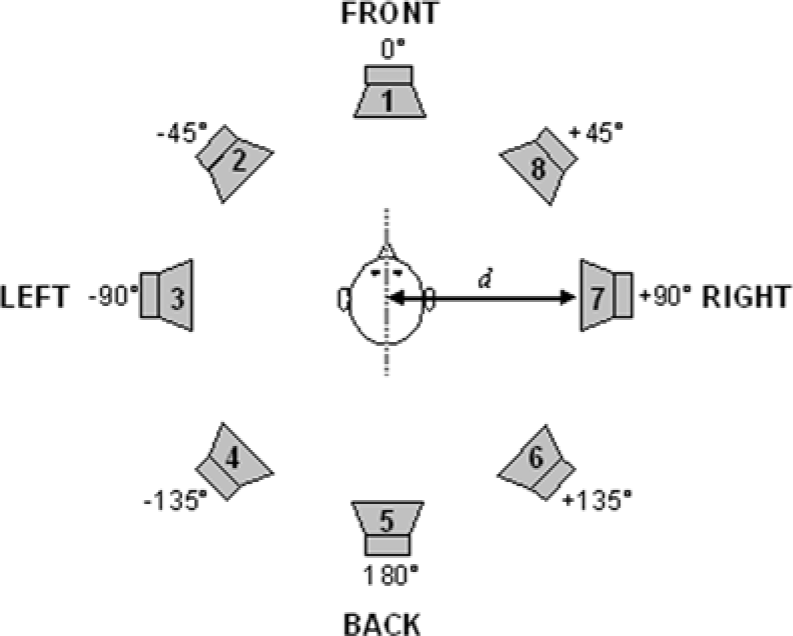
This illustration shows the loudspeakers and participant positions for the localization tests. The head/loudspeaker distance (d) was 3.3 feet in Experiment 1 and 65.6 feet in Experiment 2.
The signals were generated digitally at a 20-kHz sampling rate using a digital array processing card and a digital-to-analog converter (DAC). The output of the DAC was amplified and routed to one of the eight loudspeakers via one of eight channels of a divider. The target was a train of 300 ms bursts, including 25 ms cosine rise/decay times. The repetition rate of the bursts was 2/s and the overall duration of the train was 2.7 seconds. In Experiment 1 the bursts were 400-Hz pure tones. In Experiment 2 the bursts were filtered noise bands (20–400 Hz; center frequency = 210 Hz) whose spectral characteristics were chosen so as to resemble the typical noise produced by a motor boat moving at average speed. The stimulus level at the theoretical center of the head was 100 dB SPL in Experiment 1 and 90 dB SPL in Experiment 2. The lower SPL in Experiment 2 was a consequence of the greater distance. The stimulus SPLs were about 60 to 70 dB above hearing threshold in water for 250 to 500 Hz tones, were thus comfortably audible while being below discomfort and pain thresholds (in water, hearing, discomfort, and pain thresholds are 45–60 dB SPL above those in air; for measurements in water of hearing threshold and aversion to sound and for explanations about how hearing mechanisms in water drastically decrease hearing sensitivity, see, e.g., Brandt & Hollien, 1967; Sims, Fothergill, & Curley, 1999; Wainwright, 1958) and causing no risk of overexposure.
The output levels of the loudspeakers were carefully controlled and matched using the same procedure as that described in Savel and colleagues (2009, see footnote 4). No loudness or timbre differences between loudspeakers were reported by three experienced listeners. The ambient noise was continuous, had maximum energy below 1000 Hz, and had an average overall level of 65 dB SPL. The target-to-noise ratios were well above those at which broadband background noise affects localization accuracy in air (e.g., Jacobsen, 1976; Lorenzi, Gatehouse, & Lever, 1999). The targets were clearly audible for all participants. The tests were interrupted when substantial waves or boat courses caused the noise level to increase by more than 10 dB SPL.
Procedures
Participants, dressed in hoodless neoprene diving suits, were facing loudspeaker 1. Before beginning the tests they pinched their noses and blew out to ensure pressure balance between the ear canals and the Eustachian tube. A visual signal preceded each auditory target to require breath holding and avoid the noise of bubbles produced by the air regulator. The auditory target was presented 2 seconds later to one of the eight loudspeakers at random.
In Experiment 1 participants had to indicate which loudspeaker was the most likely to have generated the target by selecting one of eight buttons of the response box. They were informed that all eight loudspeakers would be used throughout the test.
In Experiment 2 participants had to indicate the apparent location of the auditory target by pointing with the dominant arm. Their hand was connected to a 360° protractor that measured the pointed direction with an accuracy of 1°. Because torso and head motion was not allowed, participants first learned how to point in rear directions without contorting their shoulders. Then they performed a procedural training session with visual targets (i.e., flashlights located at a distance of 65.6 feet and at angles that never coincided with those involved in the auditory task). The training included about 20 to 30 trials with perceptual-motor feedback and stopped once pointing accuracy reached a precision of 5° (i.e., once accuracy approached that measured in air for pointing to a visual target; e.g., Martin, McAnally, & Senova, 2001). The participation of two individuals had to be cancelled because they had not reached the expected accuracy after 30 minutes. Finally, participants performed the pointing task with auditory targets. They had no information concerning the loudspeakers (i.e., position, separation, amount) and were told that the target could be presented anywhere in the horizontal plane.
In both experiments participants were allowed to breathe after the offset of the auditory target. The duration of breath holding was less than 5 seconds, which is close to the natural breath rhythm during dives. The participants were asked to use all response possibilities (i.e., all buttons in Experiment 1, all 360° of azimuth in Experiment 2) indifferently when responding “at random” (i.e., when having no clue about the target direction). The participation of a diver was cancelled in Experiment 1 because he had chosen a particular button as an “I don’t know” response. No headrest was used for safety reasons but one experimenter checked that participants kept their torsos and heads motionless throughout the stimulus duration.
Participants completed about five familiarization trials and then 48 (Experiment 1: 8 loudspeakers × 6 trials in random order) or 8 (Experiment 2: 8 loudspeakers × 1 trial) test trials. No feedback was provided regarding response correctness. All experimental dives lasted 35 to 45 minutes.
Data Analysis
We assessed within-listener variability in Experiment 1. Each response was provided with a button number and variability across 48 responses was quantified using coefficients of variation (CV in % = standard deviation/mean × 100). This allowed verifying whether participants used the available response choices independently of their experience in scuba diving.
In both experiments we assessed individual front/back discrimination ratios (i.e., ratio of “true-hemifield” responses – ratio of “false-hemifield” responses; see Figure 2a) and individual left/right discrimination ratios (i.e., ratio of “true-side” responses – ratio of “false-side” responses; see Figure 2b). In Experiment 1 individual raw amounts of “true” (hemifield or side) responses were compared to amounts of “false” responses using McNemar’s χ2 tests. Discrimination was considered as accurate if both the χ2 test was significant (p < .05) and the discrimination ratio had positive sign (see asterisks in Table 1). In Experiment 2 the amount of trials was too low for the χ2 test to be significant. We thus considered discrimination as accurate for ratios amounting to +0.8 or above (see asterisks in Table 2).
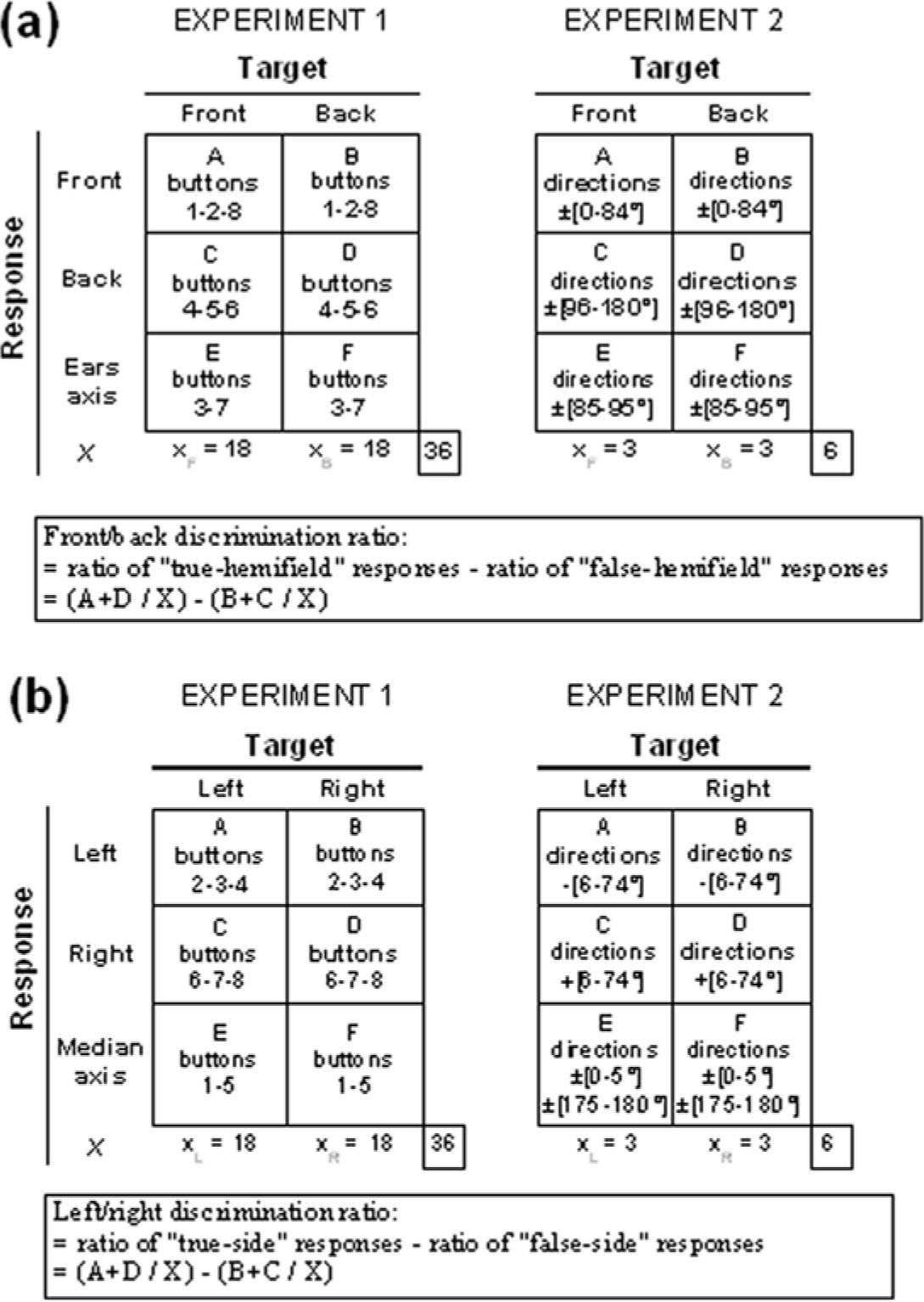
Details on the (a) calculation of front/back discrimination ratios and (b) left/right discrimination ratios.
Individual Data (17 participants) for Each Variable Under Study in Experiment 1
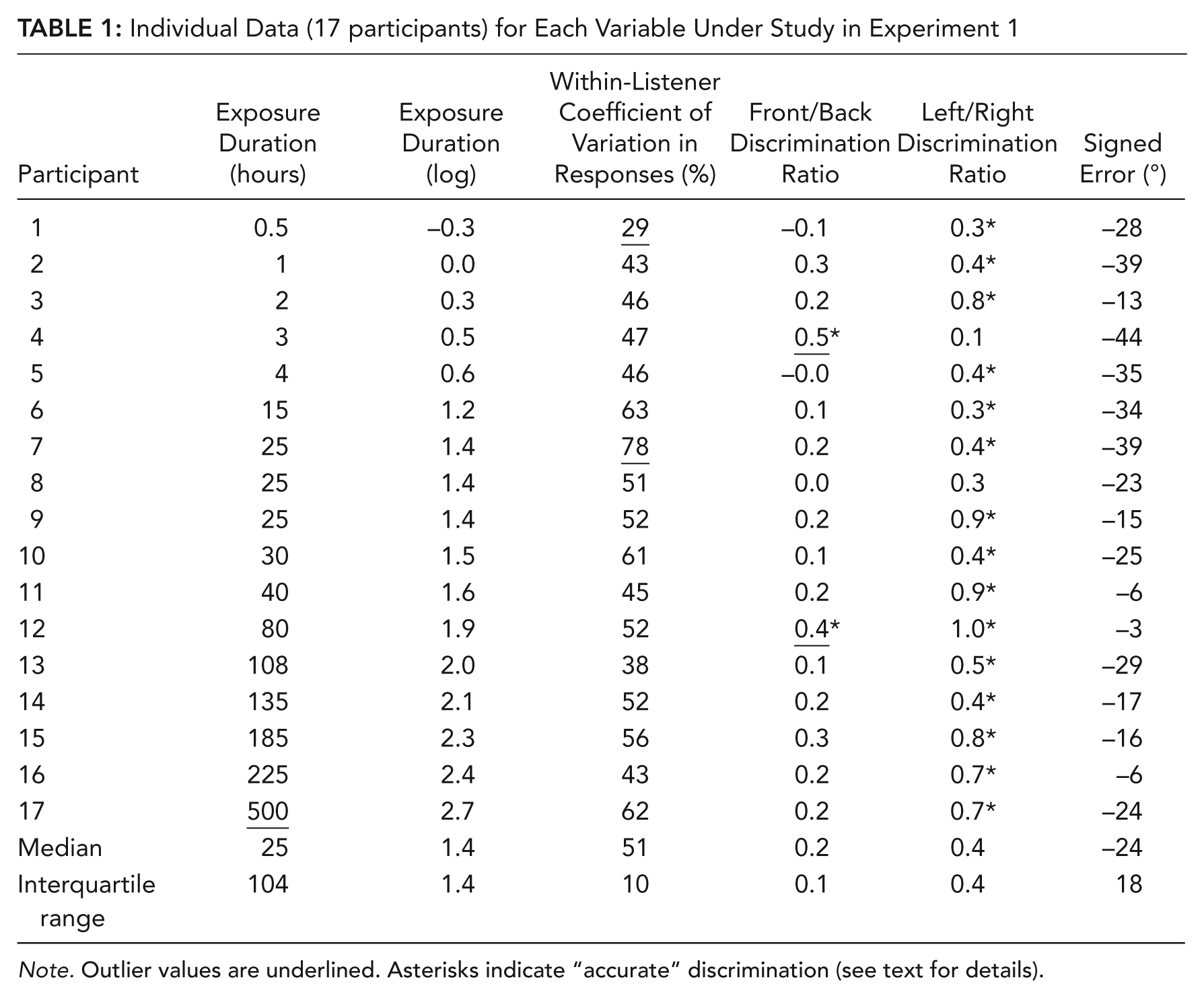
Note. Outlier values are underlined. Asterisks indicate “accurate” discrimination (see text for details).
Individual Data (28 participants) for Each Variable Under Study in Experiment 2
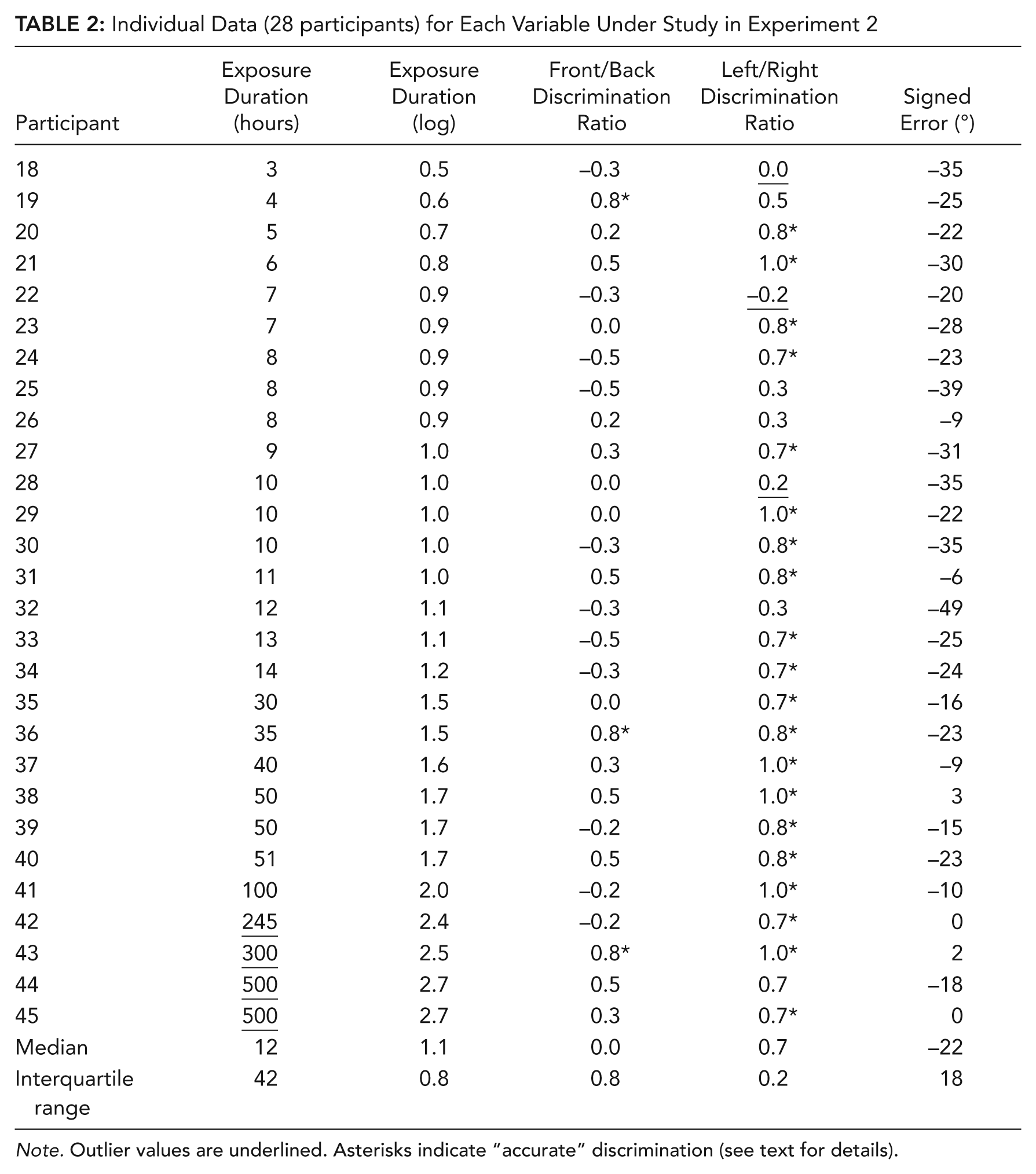
Note. Outlier values are underlined. Asterisks indicate “accurate” discrimination (see text for details).
To quantify directional biases for the six loudspeakers off the median axis (i.e., for all loudspeakers except 1 and 5; see Figure 1), side errors were excluded and hemifield errors were corrected (i.e., response and target angles in the rear transformed into [180 − xi]). Individual signed localization errors were then computed for each trial (i.e., [unsigned response angle − unsigned target angle] in degrees) and averaged across loudspeakers and trials.
Two theoretical signed errors were estimated. The first was the error that should be obtained if the participant exhibited no particular bias, had no idea about the target direction, and responded randomly (= equal use of response possibilities). The second was the systematic medial bias that should be observed in case of no adaptation to the environment (= systematic underestimation of the target angle). This bias was assessed as follows: (θA − θW), where θW is the target angle in water and θA is the angle in air that produces the same ITD as θW according to Equation 1. Averaged across loudspeakers and trials, the random error amounted to −15° (95% confidence interval = 13 in Experiment 1, 27 in Experiment 2) and the medial-bias error amounted to −48° (confidence interval = 6 in Experiment 1, 16 in Experiment 2).
According to Shapiro-Wilk’s tests, several variables (i.e., exposure durations in both experiments, front/back and left/right discrimination ratios in Experiment 2) were not normally distributed (p < .05). Exposure durations were thus log-transformed. The correlations between log exposure duration and each variable were assessed using Spearman’s correlation coefficients (rs) after exclusion of outlier values (i.e., values below [first quartile – (1.5 × Interquartile Range)] and above [third quartile + (1.5 × Interquartile Range)]; see underlined values in Table 1 and 2). Individual results are listed in Table 1 (Experiment 1) and Table 2 (Experiment 2).
Results and Discussion
Within-listener CVs in Experiment 1 ranged from 29% to 78% but were not correlated with exposure (n = 15, rs = 0.25, p = .37).
Front/back discrimination ratios ranged from −0.1 to 0.5 (Experiment 1) and from −0.5 to 0.8 (Experiment 2). Their median values were low (Experiment 1: 0.2; Experiment 2: 0.0). Only two participants in Experiment 1 and three in Experiment 2 showed accurate front/back discrimination. False-hemifield responses represented 35% of the total amount of responses in Experiment 1 and 50% in Experiment 2. We observed no correlation between front/back discrimination and exposure (Experiment 1: n = 15, rs = 0.42, p = .12; Experiment 2: n = 28, rs = 0.26, p = .19).
Left/right discrimination ratios ranged from 0.1 to 1.0 (Experiment 1) and from −0.2 to 1.0 (Experiment 2). Their median values were fairly high (Experiment 1: 0.4; Experiment 2: 0.7). Fifteen participants in Experiment 1 and 20 in Experiment 2 demonstrated accurate left/right discrimination. False-side responses represented only 8% of the responses in Experiment 1 and 13% in Experiment 2. We found no correlation between left/right discrimination and exposure (Experiment 1: n = 17, rs = 0.45, p = .07; Experiment 2: n = 25, rs = 0.19, p = .37).
All 17 participants from Experiment 1 and 24 participants from Experiment 2 showed localization errors with negative signs. The error magnitudes widely varied across participants. The correlation between signed error and exposure was significant in both experiments (Experiment 1: n = 17, rs = 0.54, p = .03; Experiment 2: n = 28, rs = 0.59, p = .001). In Figure 3, the fitting functions (dashed lines) indicate that the errors obtained at about 0 hours exposure were closer to the bias predicted in case of no adaptation (open squares) than to the error predicted in case of random response about the target direction (open circles).
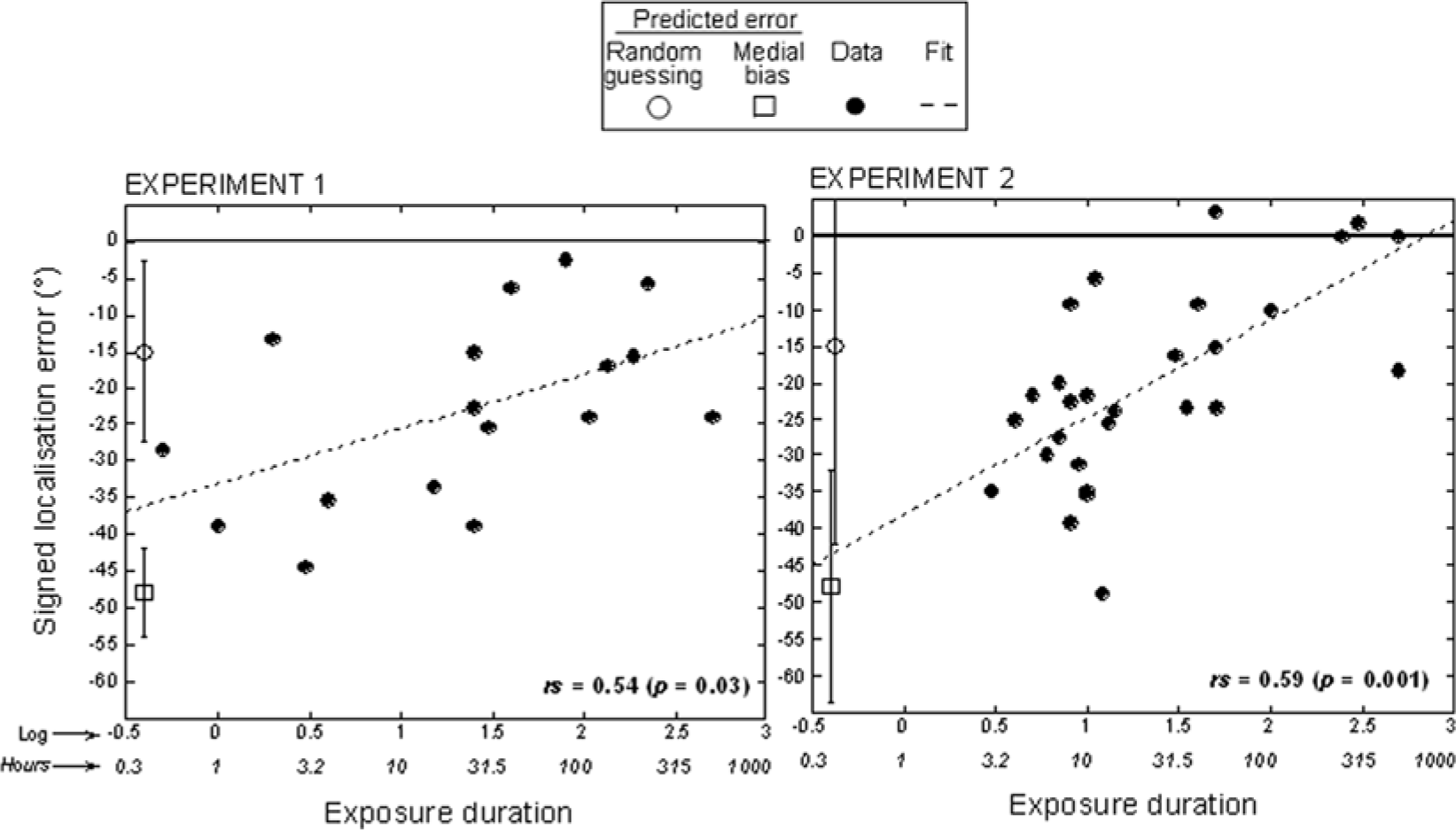
Individual signed errors are plotted as a function of exposure duration for Experiment 1 (left panel) and 2 (right panel). Exposure values are reported in both log transform (plain) and hours (italics). The horizontal lines at the top of the panels indicate the error that would be observed if judgments about the target direction were perfectly accurate (signed error = 0°). The open circles show the error that would be observed if the participants responded randomly. The open squares show the bias that would be observed if no adaptation to the environment had occurred. Bars represent ±95% confidence intervals. The correlations between observed signed error and log-transformed exposure were assessed using Spearman’s correlation coefficients (bottom right corners) and represented using linear fitting functions (dashed lines).
In summary, the ability to discriminate front from back was generally poor, the capacity to discriminate left from right was mostly accurate, and a medial bias was frequently observed in responses about the target direction, regardless of prior immersion in water. This likely indicates that smaller-than-normal but above-threshold binaural cues were used. The size of the bias decreased as exposure duration increased, which may reflect adaptation/plasticity in water resulting from passive exposure.
It could be argued that the participants with low exposure (i.e., with poor experience in diving) exhibited poorer performance mainly because they felt uncomfortable in water. If this were true, these participants would possibly have exhibited three behaviors related to discomfort: greater air consumption throughout the experiment, atypical within-listener variability in Experiment 1, and inability to reach the expected pointing accuracy in the procedural training of Experiment 2. Those behaviors were not observed. Moreover, uncomfortable participants would have demonstrated uniformly poor front/back and left/right discriminations, no particular directional bias, and/or large signed errors. This could possibly be the case for three participants in Experiment 2 (i.e., participants 22, 26, and 28; see Table 2). When they were excluded from the cohort, the patterns of correlation previously described were not altered and were even reinforced (front/back discrimination: n = 25, rs = 0.26, p = .21; left/right discrimination: n = 24, rs = 0.13, p = .54; signed error: n = 25 rs = 0.69, p = .0002). Thus, the relationship between response direction and prior exposure likely reflects the time course of the adaptability to altered binaural cues. The large across-participant variability found at particular values of exposure duration (see Figure 3) could reflect variability in the auditory inputs individually received during passive exposure.
In a past study in air, an artificial ITD of 342 µs was presented to the participants over several days (Javer & Schwarz, 1995). A bias of 42° toward the periphery of the horizontal plane—thus providing the theoretical signed error with opposite sign but similar size compared to that involved here—was predicted. Localization responses to a target presented at 0° were regularly measured in the same six participants from 0 to 130 hours of exposure. The mean signed error amounted to about 0° before exposure (i.e., with normal cues) and varied from 30° (h = 0) to 9° (h = 130) during exposure. We attempted to fit the data from both the present and past studies using the exponential-decay function in Equation 2, where x(d) is the signed error at exposure duration d (in hours), A is the asymptotic error, L is the total decrease in error (i.e., x[0] – A), and k is a constant.

To allow between-study comparison, the error signs in the present study were inverted. Fitting was poor for Experiment 1 but was plausible for both Experiment 2 (25 participants included, 3 “uncomfortable” excluded; r2 = .53) and the study by Javer and Schwartz (mean data; r2 = 0.87). In Figure 4, the fits indicate substantial but incomplete audio-spatial remapping (value of A ± 95% confidence interval = 8–16 in Javer & Schwarz, 1995, –10–18 in Experiment 2). In Javer and Schwarz (1995), the experiment stopped at 130 hours of exposure, where one half of the participants showed errors at/below 0°. Thus, further decrease in error could have been occulted. This would explain why the estimate of A in their study is above that in the present work (see rightmost part of the fits in Figure 4).
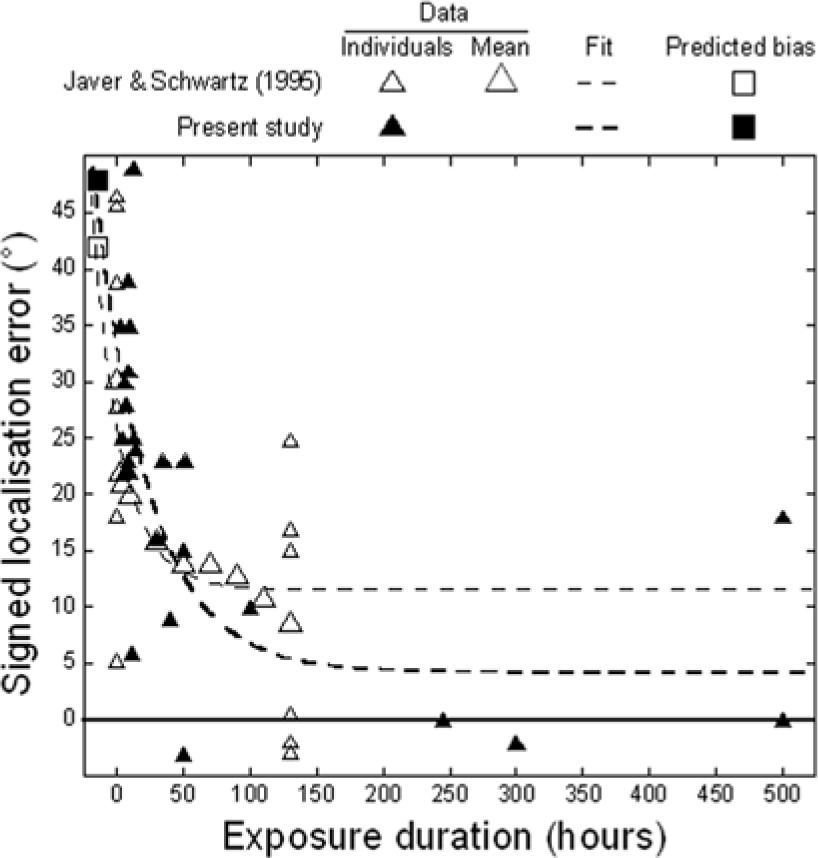
The exponential-decay function (dashed lines) of the form indicated in Equation 2 was applied to both the individual data from Experiment 2 (filled triangles) and the mean data from a past study in air (Javer & Schwartz, 1995; large open triangles). In the present study, the acoustic properties of seawater were expected to produce a bias of 48° toward the center of the horizontal plane (filled square). In the past study, the presentation of a 342-µs artificial interaural time difference (ITD) was expected to produce a bias of 42° toward the periphery (open square). To allow comparison, the error signs in the present study were inverted.
Previous studies of exposure to either spectral (e.g., Hofman et al., 1998) or binaural (e.g., Javer & Schwarz, 1995) altered cues reported little or no aftereffect. Namely, the worsening of localization abilities compared to normal listening conditions disappeared almost immediately once the period of exposure was stopped. As proposed by Hofmann and colleagues (1998), this likely indicates that the new audio-spatial map resulting from exposure does not interfere with the usual representation involved in normal listening. Rather, both maps are simultaneously represented in the auditory system. In concordance, two periods of exposure (i.e., two dives) were generally separated by one day or more for the participants in the present study and periods of exposure during waking hours alternated with short periods of normal listening in Javer and Schwarz (1995). Therefore, both maps would be potentially activated by auditory stimulation. The questions of how and when the auditory system selects one of the two representations remain unclear.
Conclusion
This study showed strong adaptation (plasticity) in water to smaller-than-normal ITDs and mimics past data in air showing similar adaptation to larger-than-normal ITDs. This likely means that the adult human hearing system is substantially malleable to altered ITDs regardless of the type of alteration and milieu.
This finding has direct implications for underwater navigation. We performed an informal experiment in which seven divers (above 50 hours exposure) performed four orientation swims (two based on visual signals, two based on low-frequency auditory signals) in random order. They had to reach a beacon placed at 492 feet from the starting point within 12 minutes, otherwise the swim was considered as missed. Although professional divers are only trained to visual orientation, 43% of the visual swims versus 21% of the auditory swims were missed.
More generally, every study of the effect of exposure on spatial hearing abilities with abnormal cues may have practical implications for a variety of populations. First, hearing-impaired listeners with asymmetrical cochlear loss can have elevated ITD detection thresholds (Kinkel, Kollmeïer, & Holube, 1991) and impoverished azimuthal localization performance (Durlach, Thompson, & Colburn, 1981). Second, recent studies revealed an age-related impoverishment in ITD processing before the middle life in normal-hearing adults (e.g., Moore, Vickers, & Mehta, 2012). A decrease in ITD processing possibly has a deleterious impact on spatial speech discrimination in noise (Neher, Lunner, Hopkins, & Moore, 2012). Third, various populations are concerned with virtual environments providing auditory information (e.g., video games and auditory alarms in aircrafts, medical units, and industrial or military work stations; for reviews, see Guillaume, 2011; Shilling & Shinn-Cunningham, 2002). In virtual environments, it is crucial to provide properly designed auditory information including localization cues, as spatial hearing helps awareness and orientation. One way to synthesize spatialized sounds in virtual environments is the so-called binaural synthesis. It consists in applying to the input sound different acoustic filters that mimic the effect of the head and body occurring in real listening conditions. The “real filter” can be characterized by measuring the acoustic signal at the entrance of the ear canal for a variety of source locations (i.e., by measuring the individual’s head-related transfer function, HRTF). A pair of HRTFs (both ears) contains all localization cues (spectral cues, ITDs, and ILDs). Because HRTFs are strongly listener dependent due to anatomical characteristics, the localization of virtual sources is drastically poorer using non-individual than using individual HRTFs (Wenzel, Arruda, Kistler, & Wightman, 1993). A recent study providing proprioceptive and vestibular feedback to users of a virtual auditory environment showed rapid and substantial adaptation to non-individualized HRTFs, but the authors used “hybrid” HRTFs providing non-individualized spectral cues and individualized ITDs (Parseihian & Katz, 2012). The systematic individualization of HRTFs is unachievable due to time, technical, and cost purposes. Thus, it is important that present and future research identify the mechanisms and situations by which spatial hearing abilities in altered conditions can improve up to normal.
Key Points
We assessed in seawater the relationship between auditory azimuthal localization and duration of prior exposure to the milieu in 45 listeners.
Poor front/back discrimination and accurate left/right discrimination were found, regardless of prior exposure. A medial bias in responses about the target direction was observed, whose size decreased with decreasing exposure duration.
The results resemble those reported in past studies of the plasticity of auditory localization abilities as a result of active or passive exposure to altered binaural localization cues.
Overall, studies of the plasticity of spatial hearing abilities may yield implications for various populations (e.g., hearing-impaired listeners with reduced sensitivity to spatial cues, normal-hearing users of virtual auditory sources).
Footnotes
Acknowledgements
This research was funded in part by a grant from the General Delegation of Arming to the authors (grant number 98-1050/A000). We thank René Germont and Françis Brunner for lending their diving-school boats and equipment during the experiments, Georges Canévet, Olivier Macherey, Doug Gillan, and two anonymous reviewers for their helpful comments on this paper.
Sophie Savel is a researcher at the Acoustics and Mechanics Laboratory in Marseille, France. She received her PhD in cognitive psychology from the University of Paris-Descartes in 2001.
Carolyn Drake is a researcher at the Psychology of Perception Laboratory in Paris, France. She received her PhD in cognitive psychology from the University of Paris-Descartes in 1990.