






Abstract
Objective
The aim of this study was to model the effect of body armor coverage on body core temperature elevation and wet-bulb globe temperature (WBGT) offset.
Background
Heat stress is a critical factor influencing the health and safety of military populations. Work duration limits can be imposed to mitigate the risk of exertional heat illness and are derived based on the environmental conditions (WBGT). Traditionally a 3°C offset to WBGT is recommended when wearing body armor; however, modern body armor systems provide a range of coverage options, which may influence thermal strain imposed on the wearer.
Method
The biophysical properties of four military clothing ensembles of increasing ballistic protection coverage were measured on a heated sweating manikin in accordance with standard international criteria. Body core temperature elevation during light, moderate, and heavy work was modeled in environmental conditions from 16°C to 34°C WBGT using the heat strain decision aid.
Results
Increasing ballistic protection resulted in shorter work durations to reach a critical core temperature limit of 38.5°C. Environmental conditions, armor coverage, and work intensity had a significant influence on WBGT offset.
Conclusion
Contrary to the traditional recommendation, the required WBGT offset was >3°C in temperate conditions (<27°C WBGT), particularly for moderate and heavy work. In contrast, a lower WBGT offset could be applied during light work and moderate work in low levels of coverage.
Application
Correct WBGT offsets are important for enabling adequate risk management strategies for mitigating risks of exertional heat illness.
Introduction
Military training and operational activities often involve physically demanding work while wearing protective clothing systems in various environments. Consequently, body core temperature elevation and the risk of heat-related injury are critical operational concerns for safety and performance (Hunt et al., 2016; Sawka, Latzka, et al., 2001). Ballistic protection is commonly worn by military personnel on the torso and extremities (Larsen et al., 2011). The materials comprising body armor are thick and impermeable, which increases thermal insulation and evaporative resistance (Potter et al., 2015) and impairs heat loss from the body. Numerous studies have shown that heat strain is elevated when wearing military body armor systems (Cadarette et al., 2001; Caldwell et al., 2011; Cheuvront et al., 2008; Goldman, 1969; Haisman & Goldman, 1974, Taylor et al., 2016; Yarger et al., 1968, 1969). A limitation of these studies is that only trials in uncompensable heat stress conditions or time to exhaustion trials have been performed. This approach informs on the physiological strain of specific work intensities and environmental conditions between different body armor systems. Unfortunately, the ability to extrapolate these outcomes to broader conditions is limited. Moreover, inter-study differences in environment, work, body surface area coverage, and population characteristics have not provided a consistent avenue to compare different systems.
Despite these limitations, military personnel are advised to manage the elevated risk of heat-related injury from wearing body armor with a consistent offset to wet-bulb globe temperature (WBGT; U.S. Department of Defence, 2003). Based on the environmental conditions, work intensity, and protective clothing, military Work Tables provide guidance on the duration an activity can be conducted before body core temperature elevations are anticipated to reach 38.5°C for the average combatant (Hunt et al., 2016; Sawka & Pandolf, 2001). Corresponding to this average level of strain, a small proportion of personnel are likely to experience exhaustion or a body core temperature >39.0°C. Ceasing work at this time aims to reduce the risk of heat exhaustion and the elevation of individual body temperatures to dangerously high levels (Hunt, Billing, et al., 2016; Sawka & Pandolf, 2001; U.S. Department of Defence, 2003). When considering the effect of body armor on heat strain, the Work Tables advise the addition of 3°C (5°F) to the measured WBGT (Sawka & Pandolf, 2001; U.S. Department of Defence, 2003). Consequently, the work durations are shorter for the prevailing environmental conditions to account for the increased rate of body core temperature elevation from wearing body armor.
It is recommended that the WBGT offset be applied in humid environments “when sweat is dripping” (Cadarette et al., 2005; U.S. Department of Defence, 2003). The original offset was proposed as required within a WBGT of 27°C–31°C—wherein below 27°C, it was assumed that the environment allowed for sufficient heat loss; and above 31°C, heat loss was assumed to be unachievable with or without body armor (Yarger et al., 1969). In this study, the tolerance criteria were set high at a body core temperature of 39.5°C. As this limit was not reached whether wearing body armor or not in the WBGT 27°C condition, it was concluded that the offset was not required below these conditions. Even though the limits were not attained, average body core temperature rose higher when wearing body armor and surpassed the Work Table limit of 38.5°C (Yarger et al., 1969). Therefore, the time it takes to reach a body core temperature of 38.5°C when wearing body armor, and the WBGT offset, should be re-examined across a wide range of environmental conditions, and particularly below 27°C WBGT.
Body armor systems have also changed significantly since the original limits were proposed. Whereas traditionally body armor was provided in a “one-size-fits-all” approach, recent developments have introduced tiered body armor systems (Potter, Gonzalez, et al., 2015, Potter, Karis, et al., 2015; Taylor et al., 2016). These systems provide a scalable level of coverage with ballistic protection, such that commanders and personnel can select the most appropriate level of coverage for the operational context, enabling them to balance the trade-off between protection and mobility (Billing et al., 2015; Hunt, Tofari, et al., 2016; Taylor et al., 2016). However, the effects of coverage on heat strain also need to be considered in operational planning. Tiers with low body surface area coverage have been found to produce similar levels of heat strain compared with a standard combat uniform, without wearing body armor (Taylor et al., 2016) and security services (Lehmacher et al., 2007; Pyke et al., 2015; Stewart & Hunt, 2011). Heat strain was only observed to be elevated with high levels of coverage, greater than .43 m2 surface area (Taylor et al., 2016). Therefore, the effect of body armor coverage on body core temperature elevation and WBGT offset should be reexamined.
The aim of this study was to model a wide range of environments and work scenarios to determine the effect of body armor coverage on body core temperature elevation and WBGT offset.
Methods
Clothing Ensembles
Four U.S. Army combat ensembles were used in this study. A standard U.S. Army uniform with no body armor was used for the baseline ensemble (BA-0): polypropylene boxer briefs, cotton socks, desert suede combat boots, eye protection (M frame; Oakley, Inc., Foothill Ranch, CA), U.S. Army combat shirt (ACS), flame-resistant Army combat uniform (FRACU) pants, combat gloves (Max Grip; CamelBak Products, LLC, Petaluma, CA), and a U.S. Army combat helmet. The baseline configuration with three variants of increasing levels of ballistic protection was used to create the three additional ensembles (BA 1–3) (Table 1).
Clothing Ensembles
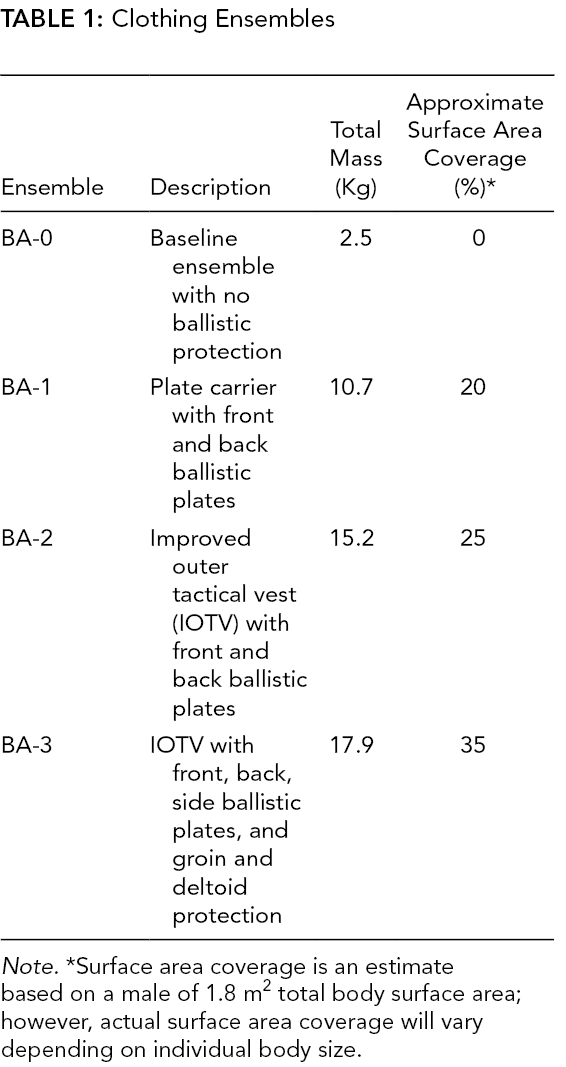
Note. *Surface area coverage is an estimate based on a male of 1.8 m2 total body surface area; however, actual surface area coverage will vary depending on individual body size.
Clothing Biophysical Assessments
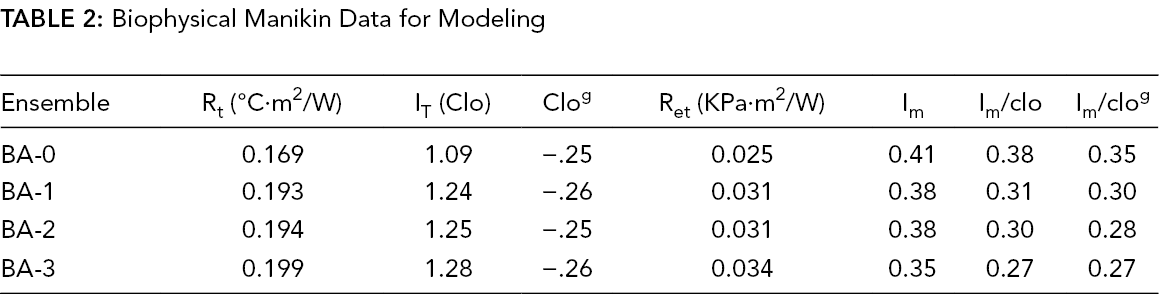
A heated sweating manikin (“Newton” 20 Zone, Thermetrics, Seattle, WA) was used in a controlled climate chamber to conduct biophysical assessments of the clothing ensembles. Thermal (Rt) and evaporative resistance (Ret) measures were obtained on the four combat uniforms based on American Society for Testing and Materials (ASTM) standards (ASTM F1291-16 and F2370-16; American Society for Testing and Materials, 2016a, 2016b). Both Rt and Ret were converted to values of thermal insulation in units of clo and a vapor permeability index (im), respectively. Measures of Rt were converted into clo units, where 1 clo = .155 m2K/W. Measures of Ret were converted into im units (Woodcock, 1962), a nondimensional measure defined as:
Equation 1: Permeability Index
Both clo and im were then combined to establish an evaporative potential ratio (im/clo) to describe the total ensemble’s insulation and evaporative performance potential (Potter, 2016; Woodcock, 1961). Following the standard ASTM assessments conducted at wind velocities of .4 m/s, two additional series of tests were conducted at increased wind velocities of approximately 1.2 and 2.0 m/s, to obtain wind-speed coefficients for both clo and im/clo (clog and im/clog). Wind-speed coefficients were derived from a power regression (equation 2) relating clo and im/clo to changes in wind-speed. Each of the measured biophysical values used for modeling are shown in Table 2.
Equation 2: Power Regression
where y = parameter of interest (either clo or im/clo); a = constant; x = wind-speed; and g = wind-speed coefficient.
Biophysical Manikin Data for Modeling
Modeling
The heat strain decision aid (HSDA) was used to predict body core temperature elevation during work scenarios (Adam Potter et al., 2017, 2019). This model has been used and validated extensively by the U.S. military (Gonzalez et al., 1997; Reardon et al., 1997) and has historically been used as the foundation of the development of U.S. Army heat stress management guidance. A range of environmental conditions (Table 3) and body armor levels (Table 2) were modeled at light (300 W), moderate (450 W), and heavy (600 W) workloads for an average soldier (body mass 82 kg; height 182 cm), where work efficiency is assumed at 80% heat production and 20% work output. These work intensities reflect the midrange of the categories of the Military Work Tables used in managing the risk of heat casualties, where light work is 175–325 W, moderate work is 325–500 W, and heavy work is >500 W (Sawka & Pandolf, 2001; U.S. Department of Defence, 2003). The environmental conditions modeled represent a wide range of conditions to which military personnel may be exposed (Table 3). Wind-speed was consistent at 1 m/s for all scenarios. Mean radiant temperature was assumed to be 20°C greater than air temperature, representing partly cloudy conditions (Potter et al., 2017). Solar radiation was calculated from air temperature and mean radiant temperature (Matthew et al., 2001), and WBGT was estimated from the Liljegren et al. (2008) method as recommended for outdoor WBGT estimates (Lemke & Kjellstrom, 2012).
Commencing at a body core temperature of 37.0°C, the time to reach 38.5°C was predicted for each of the conditions. Further modeling was then conducted to determine the WBGT offset for wearing body armor compared with the BA-0, no armor, reference condition. Air temperature was reduced when wearing BA-1, 2, and 3 until the body core temperature response was identical to what was achieved in the BA-0 condition. WBGT for the matching body core temperature responses was calculated, and the offset from the reference condition was recorded. The maximum duration modeled was 3 hr (180 min); however, if body core temperature failed to reach 38.5°C, no WBGT offset was calculated as task completion would not be limited (i.e., core body temperature would be maintained less than 38.5°C during work).
Environmental Conditions for Modeling
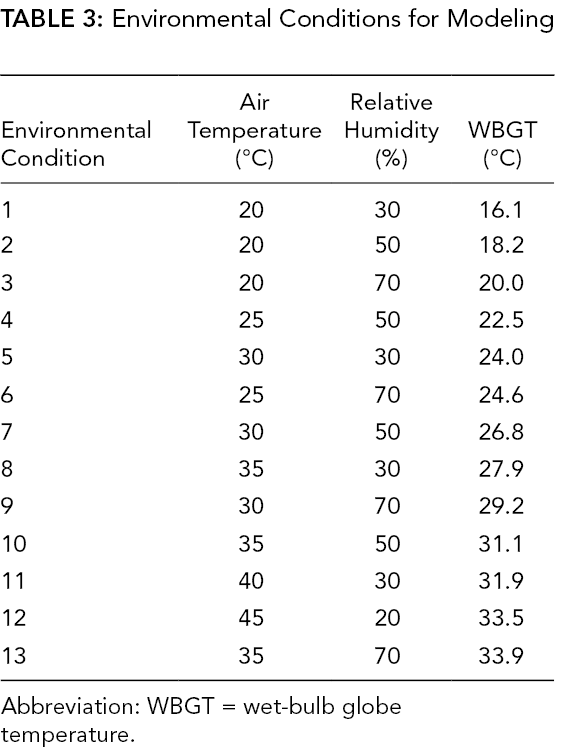
Abbreviation: WBGT = wet-bulb globe temperature.
Data Analysis
Data and statistical analysis were conducted with R version 3.6.1 in R Studio software version 1.215001 (R Core Team, 2019). Packages used in analysis included readxl (Wickham & Bryan, 2019), tidyr (Wickham & Henry, 2020), dplyr (Wickham, François, et al., 2020), ggplot2 (Wickham, 2016), and relaimpo (Grömping, 2006). Multiple linear regression was used to determine the effects of environmental conditions (WBGT), metabolic rate, and clothing evaporative potential (im/clo) on WBGT offset. All predictors were entered into the model simultaneously. The F-statistic was used to determine if the set of predictors significantly influence the outcome. The multiple correlation coefficient of determination (R2) was used to determine how much variance in WBGT offset was accounted for by the predictor variables. T-tests were used to assess the effect of individual predictors. For significant predictors, a one-unit increase in the predictor represents an increase or decrease in the outcome variable equal to its beta coefficient. Residual and Q-Q plots were examined for linearity and homoscedasticity. The relative contribution of each predictor was determined as the relative importance R2 described by Grömping (2006). Statistical significance was accepted at p < .05.
Results
Predicted times to reach a body core temperature of 38.5°C became progressively shorter with increasing WBGT, metabolic rate, and body armor coverage (Figure 1). Relative to the BA-0 condition, work time was reduced by as much as 30% when wearing BA-3 in 22°C WBGT and performing moderate work. In the same conditions, wearing BA-1 and BA-2 reduced work time by ~24% and 26%, respectively. The relative reduction in work time to 38.5°C tended to decrease as WBGT progressed higher, ranging between ~10% reductions across work intensities and BA levels at WBGT over 30°C.
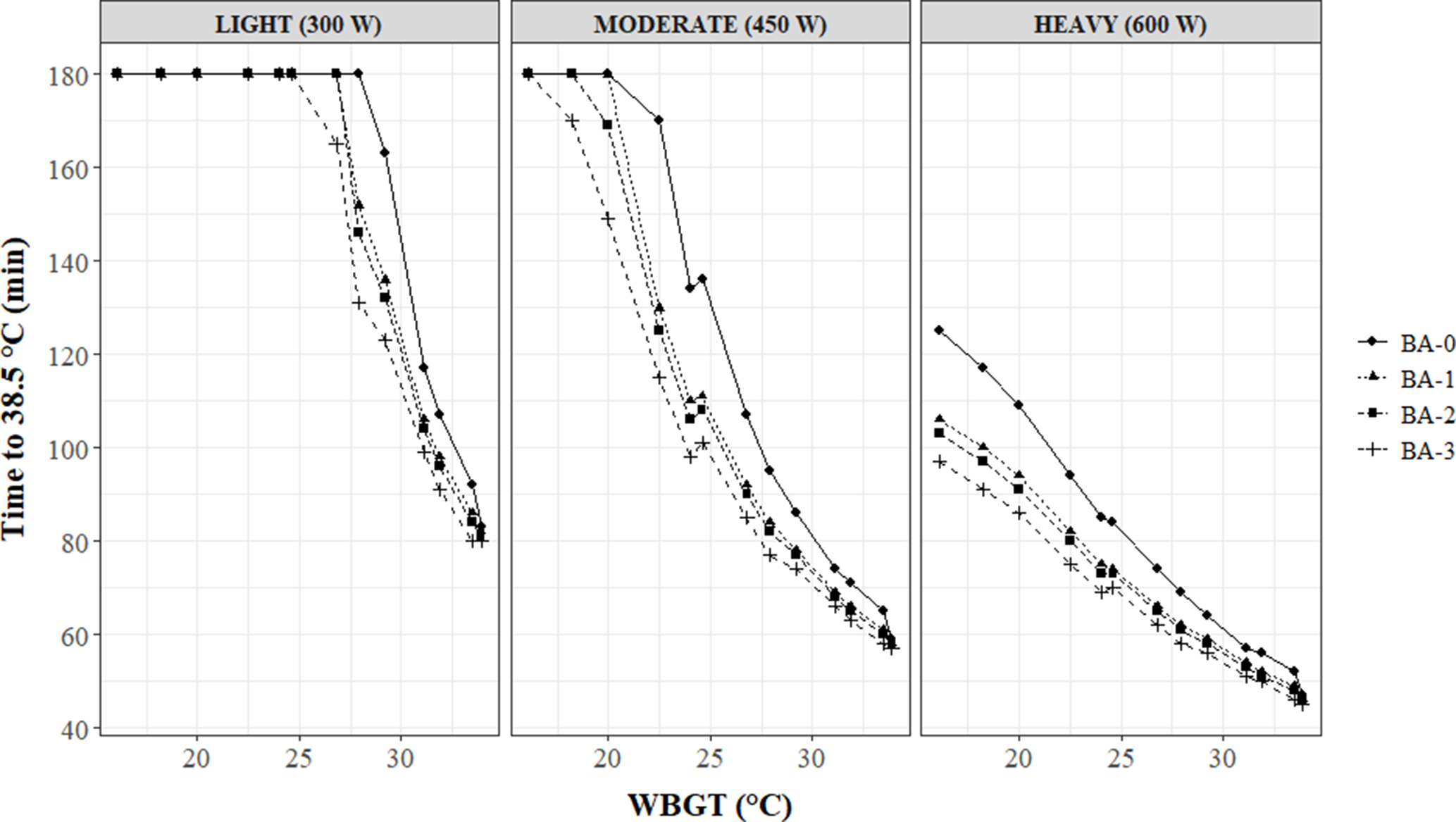
Time to reach a body core temperature of 38.5°C for a range of environmental conditions, work intensities, and body armor conditions (180 min was the maximum modeled duration). Note. WBGT = wet-bulb globe temperature.
The WBGT offset varied with WBGT, metabolic rate, and BA level (Figure 2). Multiple linear regression analysis was conducted to evaluate the prediction of WBGT offset from WBGT, metabolic rate, and im/clo. All factors significantly contributed to the prediction of WBGT offset (Intercept = 14.84, F(3, 87) = 264.9, p < .001; R2 = 0.90, adjusted R2 = 0.90, residual standard error = 0.41°C). Controlling for metabolic rate and im/clo, WBGT had a significant effect on WBGT Offset (β = −0.18, 95% CI [–0.20, –0.17], p < .001) such that a one-unit (1°C) increase in WBGT reduces WBGT offset by −0.18°C. The relative R2 of 0.57 shows that WBGT contributes to explaining 57% of the variance in WBGT offset. Controlling for WBGT and im/clo, metabolic rate had a significant effect on WBGT offset (β = 0.002, 95% CI [0.0014, 0.0031], p < .001) such that a one-unit increase in metabolic rate increases WBGT offset by 0.002°C, or more contextually, a 100-W increase in metabolic rate would increase WBGT offset by 0.2°C. The relative R2 of 0.12 shows that metabolic rate contributes to explaining 12% of the variance in WBGT offset. Controlling for WBGT and metabolic rate, im/clo had a significant effect on WBGT offset (β = −28.95, 95% CI [–33.32, –24.58], p < .001) such that a one-unit increase in im/clo would decrease WBGT offset by 29.0°C, or stated in context, a 0.1-unit increase in im/clo would decrease WBGT offset by 2.9°C. The relative R2 of 0.21 shows that im/clo contributes to explaining 21% of the variance in WBGT offset.
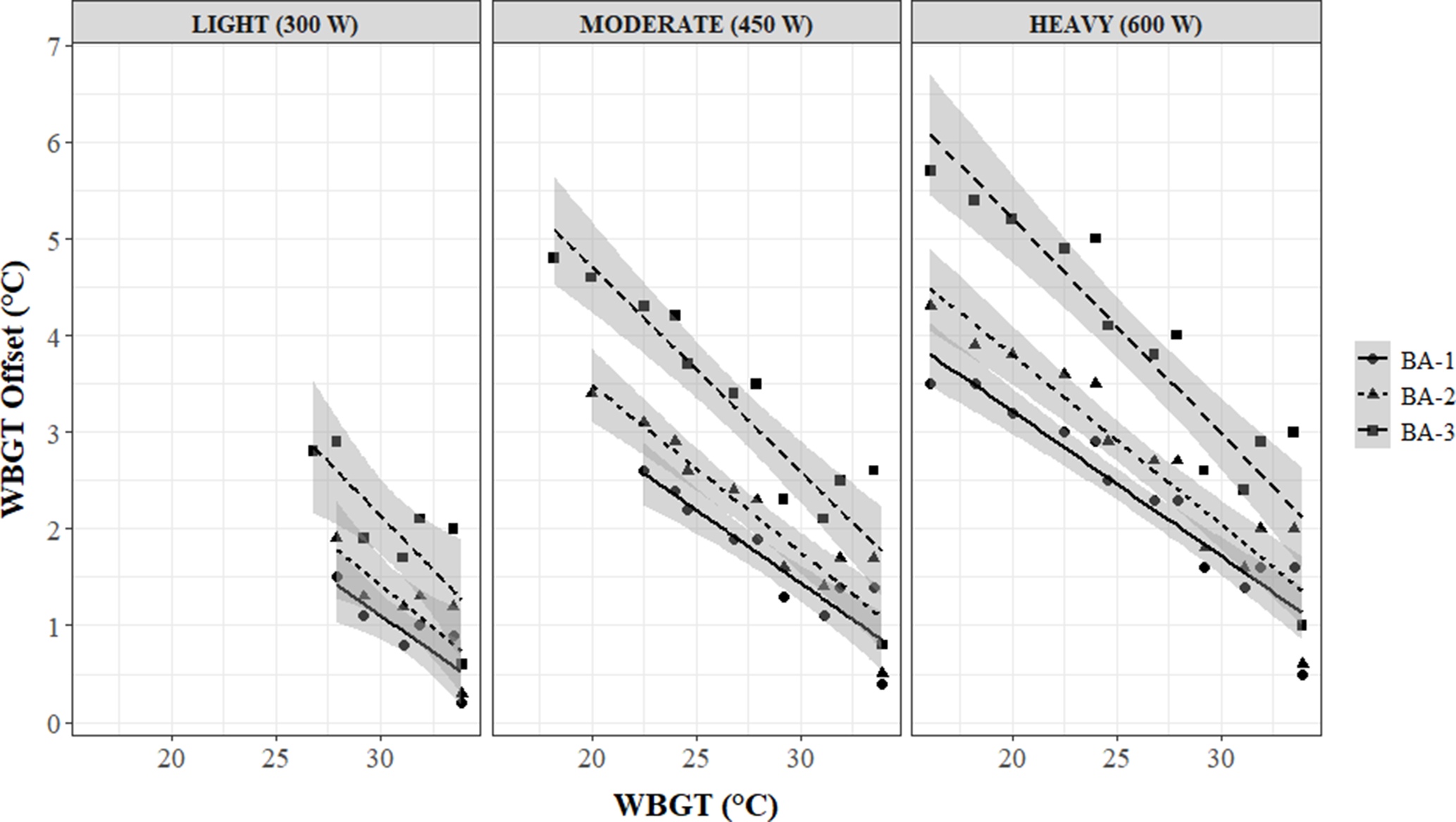
WBGT offset (BA-0 reference condition) for a range of environmental conditions, metabolic rates, and clothing conditions. Plot includes linear trendlines with standard error in gray shading. Maximum model duration was 3 hr; if body core temperature failed to reach 38.5°C, no WBGT offset was calculated as work duration would not be limited. Note. WBGT = wet-bulb globe temperature.
Discussion
The aim of this study was to model a wide range of environments and work scenarios to determine the effect of body armor coverage on body core temperature elevation and WBGT offset. The analysis demonstrated the effect of increasing body armor coverage on reducing work duration to reach a body core temperature of 38.5°C. A novel and important outcome of the present analysis was that WBGT offset—the change in environmental conditions required to achieve the same change in body core temperature as when wearing no armor—was greater than previously recommended in temperate conditions (<27°C WBGT) for high levels of coverage and high work intensities.
The application of WBGT offsets for specific protective clothing systems is a common risk mitigation strategy used by occupational (American Conference of Governmental Industrial Hygienists, 2016; Bernard et al., 2017; International Organisation for Standardardisation, 2017; Occupational Safety and Health Administration, 2017) and military populations (Hunt, Billing, et al., 2016; Sawka & Pandolf, 2001; U.S. Department of Defence, 2003) for conducting work in hot environments. By applying the WBGT offset, the duration of work before reaching a body core temperature of 38.5°C can be determined for a range of protective clothing systems. For example, wearing BA-3 for heavy work in 20°C WBGT can be conducted for 85 min before reaching a body core temperature of 38.5°C (Figure 1). The WBGT offset for wearing BA-3 in these conditions was 5°C (Figure 2). Adding 5°C to the WBGT of the environment (25.0°C WBGT) corresponds to the BA-0 condition of approximately the same permissible work duration (Figure 1). Alternatively, during light work wearing BA-2 in 20°C WBGT, there is no required WBGT offset as body core temperature did not surpass 38.5°C during the 180 min modeled (Figure 1). Instead of creating a Work Table for each clothing condition, a single Work Table with BA-0 duration limits can be provided, along with WBGT offsets for specific ensembles, to inform decision-making and risk management by commanders and personnel.
The Military Work Tables of Australia and the United States advise the addition of 3°C (5°F) to the measured WBGT to account for the effects of body armor (Sawka & Pandolf, 2001; U.S. Department of Defence, 2003). The offset was originally proposed to be required when WBGT was between 27°C and 31°C, below which it was assumed the environment allowed sufficient heat loss to continue from uncovered areas of the body, and above which the environmental conditions were such that sufficient body heat loss through sweat evaporation was unachievable whether or not body armor was worn (Yarger et al., 1969). Compared with the present observations, the 3°C WBGT offset is in reasonable agreement with the present WBGT offset findings, in the range of 27°C–31°C WBGT wearing BA-3 (Figure 2). However, the present analysis also revealed that the “one-size-fits-all” approach did not align with a range of body armor systems with different levels of surface area coverage or a wider range of environments.
The WBGT offsets for the body armor systems with lower surface area coverage (BA-1 and BA-2) were commonly less than 3°C, particularly in light and moderate work (Figure 2). In these scenarios, applying a standard 3°C WBGT offset may restrict work duration more than is required and hinder effective training practices. Alternatively, with heavy and moderate work and high levels of coverage (BA-3), the assumption that an offset was not required in cooler (<27°C WBGT) conditions was not substantiated. Rather, the present analysis suggests that higher WBGT offsets would be required to achieve similar levels of body core temperature elevation when wearing body armor. This is particularly the case for heavy work in all levels of body armor, and moderate work in body armor levels with greater coverage (BA-3; Figure 2). This underestimation of the required WBGT offset in temperate conditions may have important implications for managing the risk of excessive heat strain in military populations.
Exertional heat illness is a recognized problem for the military (Nelson et al., 2018; Stacey et al., 2015). An often-overlooked concern regarding the incidence of exertional heat illness is their occurrence in non-summer months and temperate conditions. Mild and severe exertional heat illness among military enlistees was found to be highest in summer, but also significantly elevated in fall (autumn) and spring compared with winter (Nelson et al., 2018). In the UK Military, two-thirds of exertional heat illness cases occur in temperate conditions compared with only one-third in hot climates (Stacey et al., 2015). Whereas the wearing of occlusive clothing was not identified as a risk factor for severe exertional heat illness requiring hospitalization, which the authors suggested to be related to reduced work intensities when wearing protective clothing, the influence of occlusive clothing such as body armor on exertional heat illness not requiring hospitalization was not assessed. It is plausible that the occurrence of exertional heat illness in temperate conditions may be influenced by underestimating the required WBGT offset for these conditions when wearing body armor. Based on the findings of the present analysis and the evident risks of exertional heat illness, further research should be conducted with human participants to confirm the model predictions.
Whereas the present analysis has isolated the effect of body armor coverage on body core temperature elevation and WBGT offset, the effect of the mass of the body armor systems has not been considered. Metabolic rate increases with load carriage (Drain et al., 2017; Duggan & Haisman, 1992; Pandolf et al., 1977). Consequently, internal heat production would be higher when wearing the heavier BA-3 systems compared with lighter or no armor systems if all other task parameters were consistent. This difference was not considered in the present analysis as all conditions were modeled with the same metabolic rate. The reason for this is that coverage with impermeable materials affects the avenues for body heat loss. In contrast, additional load carried affects body heat gain during physical activity. This is an important distinction because, although coverage and clothing heat transfer properties cannot be changed during a given activity, several other factors can be adapted to adjust metabolic rate. Therefore, the effect of the mass of the body armor is inconsistent and highly variable. For example, military personnel often carry more than just the mass of the body armor system, according to their operational requirements. Relative differences in total load carried are likely much smaller than the differences based on the body armor system mass alone, as personnel can carry more accessory items when wearing lighter body armor systems. This effectively would bring the resulting metabolic rate into closer alignment between the body armor coverage conditions. Second, metabolic rate is also influenced by pace, terrain, slope/incline, and body location on which load is carried (Epstein et al., 1987, 1988; Looney et al., 2018; Pandolf et al., 1977; Schertzer & Riemer, 2014). These parameters can be adapted as risk management strategies in real time to alter metabolic rate and avoid overheating. For example, personnel can be guided to perform tasks at a slower pace when wearing heavier body armor systems. For these reasons, the WBGT offset for body armor have been derived based on the effects of coverage on clothing heat transfer properties, and not also on the mass of the body armor system. In a practical setting, once the required level of protection is chosen, coverage cannot be adjusted, and WBGT needs to be offset to account for this effect. The effect of the system mass on metabolic rate can be adjusted in real time by adjusting task parameters, and hence does not need to be included in the WBGT offset.
A potential limitation of the present analysis is the influence of body armor coverage on heat loss from the body may differ between humans and thermal manikins. Thermal manikin and modeling assessments of tiered body armor systems display a commensurate elevation in predicted heat strain with increasing surface area coverage due to increments in thermal insulation and evaporative resistance (Potter, Gonzalez, et al., 2015). However, the human body may be able to compensate for a certain level of impermeable covering through altered thermoregulatory responses, for example, enhanced sweating in noncovered body regions. In human trials of tiered body armor systems, tiers with low body surface area coverage produced similar levels of heat strain compared with a standard combat uniform without wearing body armor (Taylor et al., 2016) and security services (Lehmacher et al., 2007; Pyke et al., 2015; Stewart & Hunt, 2011). Heat strain was only elevated with high levels of coverage: >.43 m2 surface area (Taylor et al., 2016). Therefore, further human trials are required to confirm the predictions of the present modeling analysis and the levels of body armor coverage that require a WBGT offset.
Two final points should be considered from this study, namely the implications for clothing manufacturers and other nonmilitary occupational groups. First, the study findings showed the influence of body armor coverage on the evaporative potential (im/clo) of the ensemble and resulting implications for thermal strain. Multiple linear regression revealed that im/clo contributes ~21% to the required WBGT offset of wearing the body armor systems. These findings are in similar agreement to those recommended for civilian clothing in occupational settings (Bernard et al., 2017), where the evaporative potential of the clothing ensembles can be used in combination with WBGT to adjust safe exposure times. As such, developers of body armor systems should be cognizant of the implications of increasing or decreasing coverage on the thermal strain of wearers. Second, although military heat stress guidance assumes average body core temperature may reach 38.5°C, general occupational guidance assumes a lower limit of 38.0°C in setting exposure limits. This is an important distinction as the military guidance allows a higher risk of heat-related casualties than other workplace guidance. Thus, further research is required to determine the generalizability of WBGT offsets between occupational and military heat stress guidelines.
Conclusions
The current recommended WBGT offset factor for wearing body armor (3°C) underestimates the required offset to achieve a similar level of strain when not wearing body armor. Underestimations were most prominent during higher intensity work and with greater body armor coverage. In contrast, a standard 3°C WBGT offset may unnecessarily restrict work duration during light work and in moderate work with low levels of body armor coverage. Correct WBGT offsets are important for enabling strategies for mitigating risks of exertional heat illness. Further human trials are required to confirm the predictions of the present modeling analysis and the levels of body armor coverage that require a WBGT offset.
Key Points
Correct WBGT offsets are important for enabling strategies for mitigating risks of exertional heat illness.
WBGT offsets could be adjusted dependent on the amount of body area covered, work intensity, and environmental conditions.
Temperate environments (<27°C WBGT) may require greater WBGT offset (>3°C) than previously recommended, particularly with heavier work intensities and body armor coverage.
Footnotes

Author Biographies
Andrew P. Hunt completed his PhD in occupational physiology at the Queensland University of Technology’s Institute of Heath and Biomedical Innovation in 2011. Andrew is presently a Research Fellow jointly appointed by the Queensland University of Technology and the Defence Science and Technology Group.
Adam W. Potter holds a PhD in biomedical informatics from Rutgers University (2019). He is a Research Physiologist and Deputy Chief of the Biophysics and Biomedical Modeling Division at the U.S. Army Research Institute of Environmental Medicine.
Denise M. Linnane completed her PhD in applied human physiology at Coventry University in 2006. She is presently a human performance physiologist at the Defence Science Technology Group, Australia.
Xiaojiang Xu completed his PhD in mechanical engineering from the Ruhr University Bochum, Germany (1996). He is a scientist in the Biophysics and Biomedical Modeling Division at the U.S. Army Research Institute of Environmental Medicine.
Mark J. Patterson completed his PhD in thermal physiology at the University of Wollongong (1999). He is currently the Head of the Physical Ergonomics Group, Land Human Systems, at the Defence Science and Technology Group.
Ian B. Stewart completed his PhD in exercise physiology at the University of British Columbia in 2002. He is currently a professor at the Queensland University of Technology’s Institute of Health and Biomedical Innovation and School of Exercise and Nutrition Sciences.