







Abstract
Objective
To examine the effect of dual tasking on hand dominance during a bimanual visuomotor task.
Background
Many operators need to perform separate tasks with each hand. Yet, there is no comprehensive study examining whether the right-hand visuomotor advantage found in right handers remains stable, increases or attenuates when another task is performed concurrently with the other hand.
Methods
Twenty-eight right-handed participants (mean age = 22) performed 2D visuomotor tracking under either unimanual (one target, one hand) or bimanual conditions (two targets, one for each hand). Various gaze contingencies and visual displays were tested. Tracking performance of each hand was evaluated through the mean cursor-target distance.
Results
A clear right-hand advantage was found under all unimanual conditions. Under bimanual conditions, tracking accuracy decreased for both hands albeit more extensively for the left hand than the right when gaze was free, thus amplifying the above right-hand advantage. Prioritization of the right hand was associated with a gaze preference toward this hand. However, this increase in manual asymmetry was greatly alleviated when participants were instructed to fixate straight ahead, a benefit obtained at no cost in terms of overall tracking performance.
Conclusions
During bimanual/dual tracking, there is a natural tendency for right handers to prioritize their right hand. However, this effect is strongly reduced by fixating straight ahead.
Application
Performing separate tasks with the right and left hands is common when piloting an aircraft. Fixating straight ahead may be useful for pilots that seek to divide more equally the negative impact of dual/bimanual tasking.
Keywords
Introduction
The ability to continuously match one variable with a reference signal is key for many operators such as those steering an automobile on a winding road, or stabilizing an aircraft on a gusty day (Wickens, 1986). As a result, there is long-lasting interest from ergonomists and engineers to investigate how human factors and task features influence the accuracy of operators during manual tracking (Damos & Lintern, 1981; Moss, 1964; Wickens, 1986; Wightman & Lintern, 1985; Ziegler, 1968). Here, we focus on visuomotor tracking, a version of the task in which the operator has to constantly minimize the distance between a cursor moved by the hand and a visual target that follows an unpredictable trajectory (Damos & Lintern, 1981; Danion & Flanagan, 2018; Miall, 1996). Because operators often need to regulate several processes in parallel, for instance consider a pilot that simultaneously controls the pitch and heading of an airplane (Wickens, 1986; Ziegler, 1968), and because divided attention is central for many jobs (Damos & Lintern, 1981), we propose to investigate a situation in which an operator performs two tracking tasks in parallel. Just as importantly, because performing separate tasks with the right and left hands is common in the aviation, think of the helicopter pilot controlling the collective lever and cyclic stick, the airplane pilot controlling the stick and the throttle, or the drone pilot controlling two joysticks, we concentrate on bimanual tracking, a situation in which each hand is engaged in a separate tracking task. Our interest for bimanual tracking resonates with several studies performed in the field of human factors and ergonomics (Beurskens & Bock, 2012; Damos & Lintern, 1981; Goettl, 1991; Korteling, 1993). Yet, a novel aspect of this study is that we consider the impact of gaze contingencies and manual asymmetry between the dominant and nondominant hands. Because left handers are typically less lateralized and more heterogenous than right handers (Borod et al., 1984; Bryden, 1977; Llaurens et al., 2008; Oldfield, 1971; Przybyla et al., 2012), our study focuses on the latter.
Several studies have shown in right handers a right-hand advantage for visuomotor tracking (Aoki et al., 2016; Coudiere et al., 2024; Mathew et al., 2019, 2020; Simon et al., 1952). On average, pursuit tracking error is found to be 10–15% greater for the left hand. To our knowledge, it remains untested whether this manual asymmetry remains stable, increases or attenuates when both hands are simultaneously engaged in tracking. Although bimanual coordination has been studied in the context in which both hands control a single cursor (Diedrichsen, 2007; Mathew et al., 2020; Neilson & Neilson, 2002; Puttemans et al., 2005; Vangheluwe et al., 2005), to our knowledge, only a handful of studies have investigated the context in which the two hands concurrently track two separate targets (dual tracking, Beurskens & Bock, 2012; Damos & Lintern, 1981; Goettl, 1991; Korteling, 1993). A key objective of the current study is to investigate the extent to which the right-hand advantage described in unimanual tracking extends to bimanual (dual) tracking.
Many studies have shown that pursuit tracking is impaired when another cognitive or motor task is performed concurrently (Braune & Wickens, 1985; Mastroianni & Schopper, 1986; Schmidt et al., 1984; Wickens & Gopher, 1977). For instance, this is the case if, in addition to tracking, participants are required to detect auditory oddball stimuli (Backs, 1997), to report the pitch of a tone (Mastroianni & Schopper, 1986), or to react as fast as possible to an auditory stimulus (Ewolds et al., 2017). In all cases substantial interference effects are observed confirming that attention is mandatory for visuomotor tracking. To our knowledge, only two studies have explored the cost of dual tasking during concurrent bimanual tracking (Damos & Lintern, 1981; Goettl, 1991). Thanks to the separate testing of unimanual and bimanual versions of the task, these studies showed robust interference effects, which in some cases nearly tripled tracking error in the bimanual context (Damos & Lintern, 1981). However, whether dual tasking had a similar detrimental effect on the right and left hands was not addressed by these studies. Moreover, explicit information regarding the handedness of participants was not always provided (Damos & Lintern, 1981).
More recently, to investigate how the useful field of view shrinks with age, Beurskens and Bock (2012) conducted a study in which young and elderly participants were asked to concurrently perform with each hand a 1D compensatory tracking task that required to stabilize the vertical position of cursors in response to external perturbations. Interestingly, the authors reported no obvious difference between the performance of the dominant and nondominant hands, as well as no systematic gaze preference for either hand under gaze free conditions. However, these observations should be taken with caution as this study was conducted with both right and left-handers whose performances were pooled. Moreover, this study did not have any unimanual testing to assess the extent of potential manual asymmetries associated with compensatory tracking. Altogether, it remains unclear how these observations extend to bimanual pursuit tracking, a task in which hand dominance is clearly established. Notably, there is a possibility that in this context, gaze is biased toward the preferred hand. If correct, investigating whether gaze fixation (midway between hands) helps reduce manual asymmetry has practical implications for the design of two-tracking workspaces, such as those commonly employed in the aviation.
Altogether, no study has yet comprehensively investigated how hand dominance operates under bimanual tracking and tested whether it is influenced by gaze contingencies. To fill this gap, we conducted a study with right-handers who completed a conventional 2D pursuit tracking task in which a consistent right-hand advantage was found (Coudiere et al., 2024; Mathew et al., 2019, 2020). Importantly, we assessed hand dominance during both the unimanual and bimanual versions of the task. In line with previous reports showing that visual attention is biased toward the dominant hand during bimanual tasks that require reaching (Buckingham & Carey, 2015; Honda, 1982; Srinivasan & Martin, 2010), circle drawing (Franz, 2004), or swinging pendulums (Amazeen et al., 1997), we hypothesized that our right-hand advantage found under unimanual tracking would extend under bimanual tracking. Next, as in Beurskens and Bock (2012), we included a gaze free and a gaze fixed condition. We reasoned that if gaze, when relaxed, is spontaneously biased toward the right hand, then enforcing central fixation may reduce manual asymmetry. This hypothesis is grounded upon the observation that voluntary redirecting attention toward the nondominant hand can reduce the impact of hand dominance on bimanual coordination (Amazeen et al., 1997; de Poel et al., 2008; Swinnen et al., 1996). Finally, a gaze free condition in which the visual display is inverted (the right-hand target being displayed on the left side and vice versa) was tested to evaluate whether any putative gaze preference was dictated by the hand or the hemifield. Although visual inversion was not expected to alter unimanual tracking, we predicted it would incur a loss of accuracy under bimanual tracking.
More generally, although one hand typically outperforms the other during unimanual tasks, it is key to assess the effect of hand dominance on bimanual/dual tasking. This may prove insightful to ergonomists that seek to maintain comparable levels of performance across hands during bimanual tasks. This issue becomes even more relevant if dual tasking naturally exacerbates manual asymmetry. As will be shown in the current study, this is exactly what happens for bimanual tracking. Fortunately, we also show that this inflation of manual asymmetry is strongly reduced when fixating straight ahead, a benefit that does not come at the cost of overall task performance.
Methods
Participants
Twenty-eight right-handed participants took part in this study (22.0 ± 3.8 years, 18 females). They had no previous experience with our tracking task. Although no formal power analysis was run before the study, on the basis of our previous experience with manual asymmetry in the tracking task, we aimed for a sample size of at least 20 participants (Coudiere et al., 2024; Mathew et al., 2019, 2020). To ensure right-handedness, each participant completed the 10-item version of the Oldfield Handedness Inventory (Oldfield, 1971), and we used a cut-off of 40% (mean laterality score = 85.3 ± 14.2%). None of the participants had neurological or visual disorders. They were naïve as to the experimental conditions and hypotheses and had no previous experience with oculo-manual tracking tasks. The experimental paradigm (2023-04-01) was approved by the Comité d'Ethique de la Recherche Tours-Poitiers (CERTP) and complied with the Declaration of Helsinki. All participants gave written consent prior to participation. Each experimental protocol lasted about 1 hour, and participants received credits course for their participation.
Apparatus
The experimental setup is similar to the one used in our previous studies (Gouirand et al., 2019; Mathew et al., 2018, 2019). Our setup is illustrated in Figure 1(d). Participants were seated comfortably in a dark room facing a screen (ACER Predator, 1920 × 1080, 27” inch, 240 Hz) positioned in the frontal plane 57 cm away from the participant’s eyes. Head movements were restrained by a chin rest and a padded forehead rest. To block direct vision of their hands, a horizontal shield was positioned under the participants’ chin. Participants were required to hold the right/left joystick (Series 812, Megatron, France, with ±25° of inclination along X-Y axes) with the right/left hand positioned horizontally on a table in front of them (with forearms resting on the table). The distance between the right and left joysticks was 10 cm, a distance sufficient to prevent fingertips from the right and left hands to contact each other. Horizontal and vertical eye position was recorded using an infrared video-based eye tracker (Desktop Eyelink 1000 system; SR Research). The output from the eye tracker was calibrated before every block of trials by recording the raw eye position as participants fixated a grid composed of 9 known locations. The output of the joysticks and the eye tracker was fed into a data acquisition system (Keithley ADwin Real Time, Tektronix) and sampled at 1000 Hz. Schematic drawing of the experimental setup and view of the screen depending on the experimental condition. (a) View of the screen during unimanual tracking with the left hand. Although target trajectory is shown here for convenience, it was not actually displayed during the experiment. B, Same as A for bimanual tracking. (c) Same as A for unimanual tracking with the right hand. (d) Top view of the participant sitting in the experimental setup (see Methods for more details).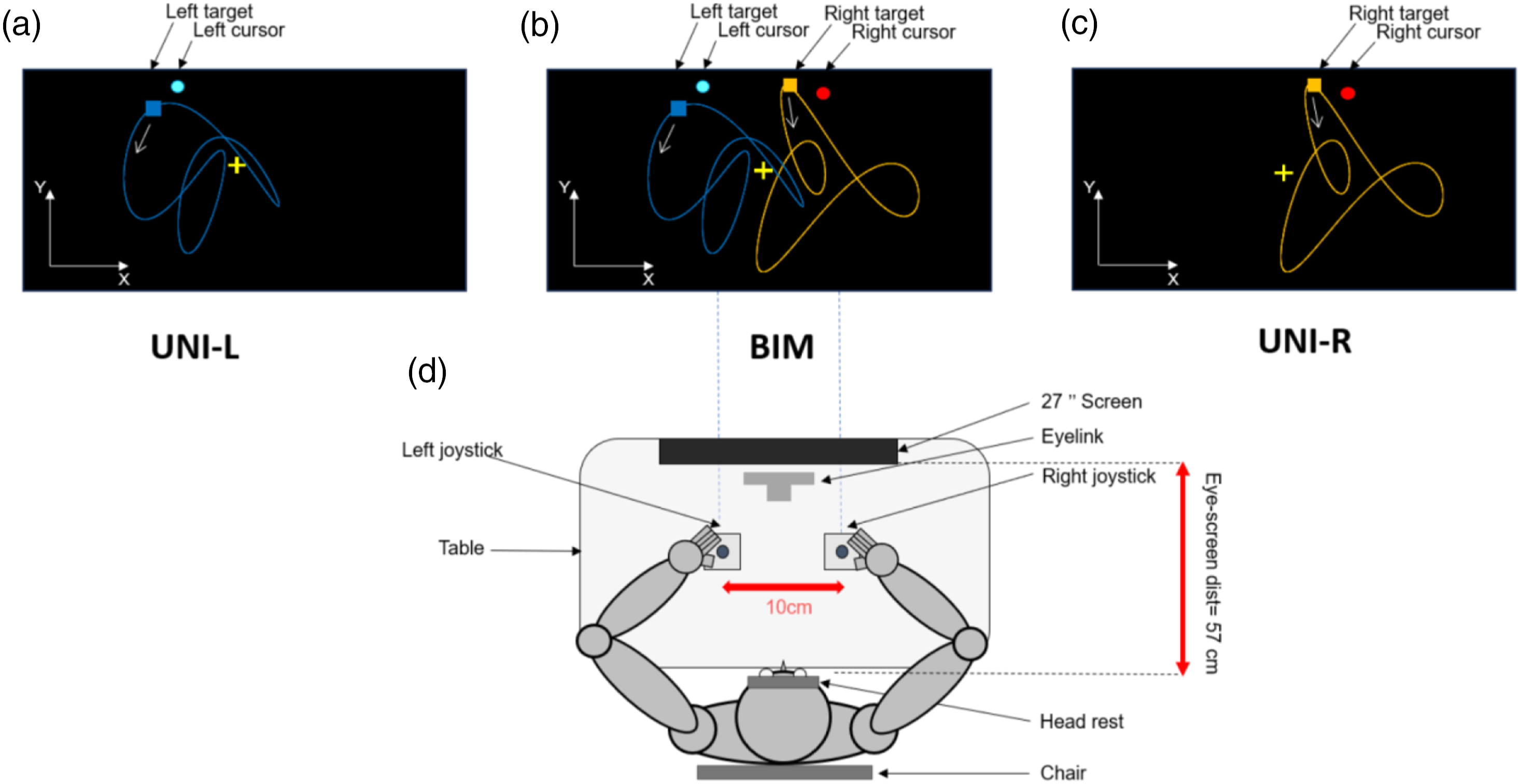
Procedure
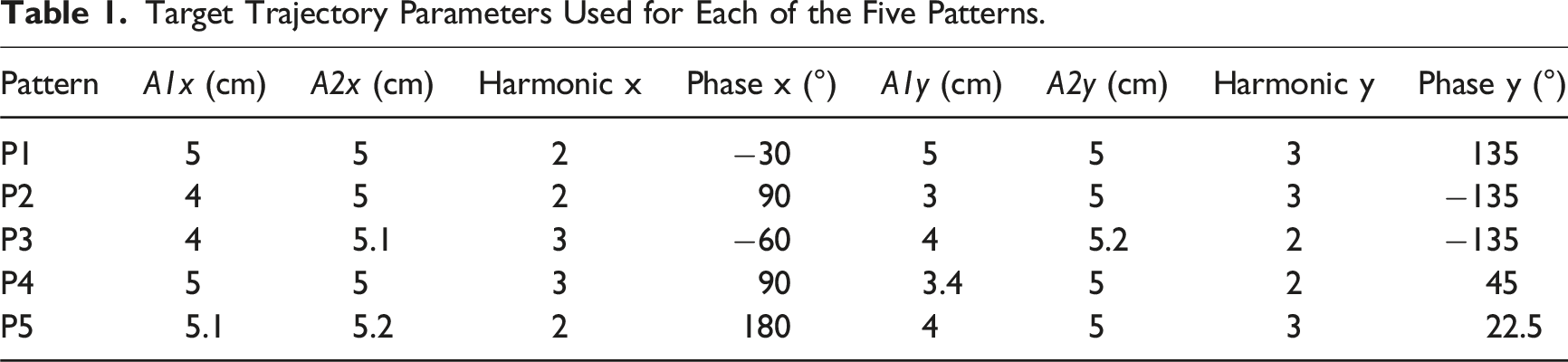
Throughout the experiment, participants had to perform a tracking task that consisted of moving the joystick(s) in order to keep the circular cursor(s) as close as possible to the squared moving target(s) (i.e., pursuit tracking). Whenever participants completed the tracking task, trial duration was set to 10 s. Under its unimanual version, only one cursor and one target were displayed on one side of the screen (Figure 1(a) and (c)). Under its bimanual version, one cursor and one target were simultaneously displayed on each side of the screen (Figure 1(b)). To further facilitate the identification of cursor/target with respect to hand, warm colors were employed for the right hand (red cursor + orange target), and cold colors were employed for the left hand (cyan cursor + dark blue target). The motion of the target resulted from the combination of non-harmonically related sinusoids: two along the X axis (one fundamental and a second or third harmonic) and two along the Y axis (same procedure; see Figure 1(b) for axes). We used the following equations to construct target motion (with ω and φ accounting, respectively, for angular frequency and phase):


Target Trajectory Parameters Used for Each of the Five Patterns.
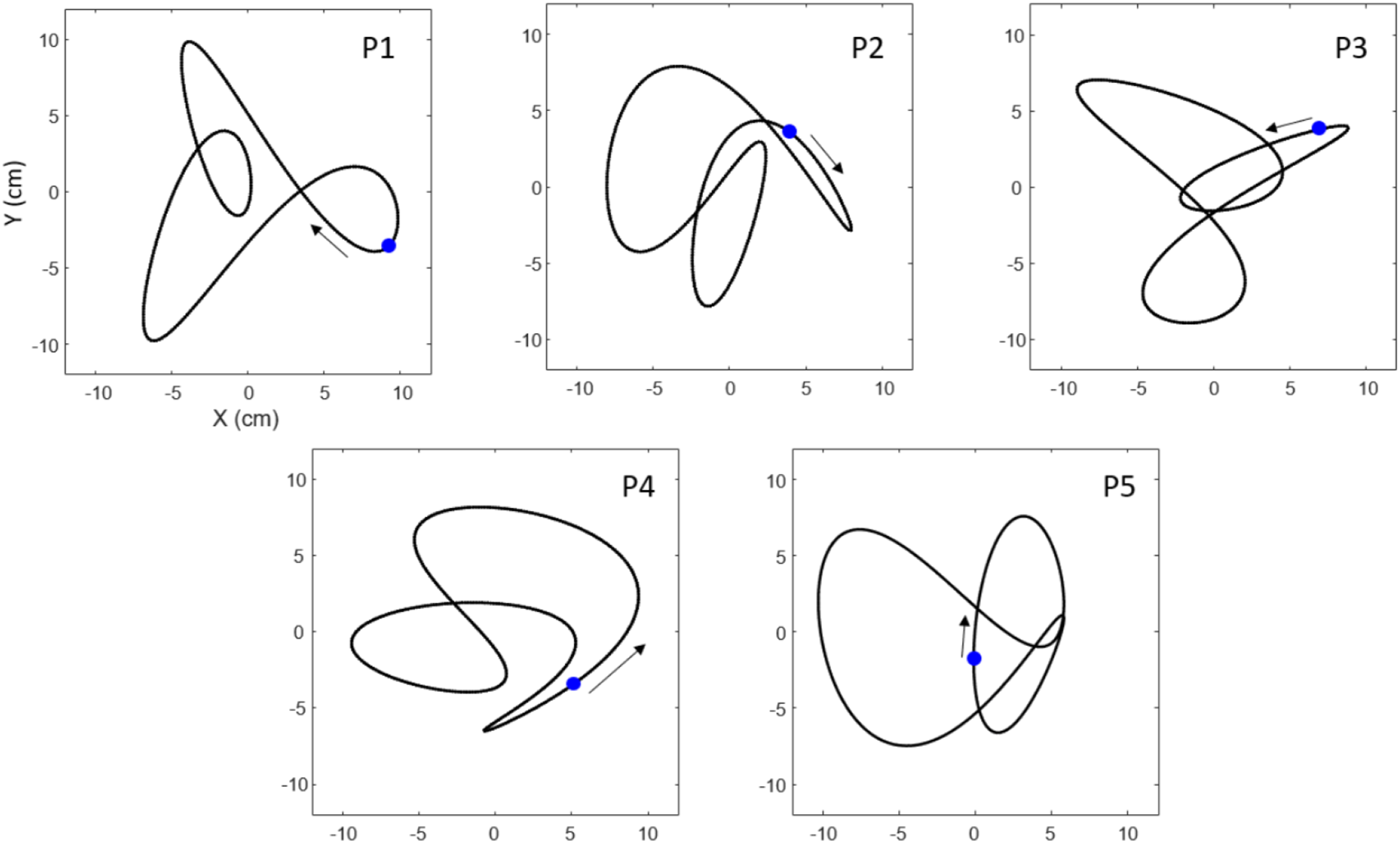
Target trajectory for each of the five patterns. The blue dot shows the initial position of the target, and the arrow shows its initial direction.
The gain of the joystick was such that a 25° tilt of the joystick resulted in a 15 cm displacement of the cursor on the screen. This gain prevented the cursors from moving outside the screen. The angular relationship between the joystick orientation and its visual consequences on the screen was intuitive: if the joystick was tilted to the left, the cursor on the screen also moved to the left.
Each participant first completed three trials of familiarization with each hand separately. Following these warm-up trials, each participant completed 9 blocks of 10 trials (see Figure 3) that were distributed over three phases. During each phase, participants performed three blocks of trials, one with the right hand (UNI-R), one with the left hand (UNI-L), and one with both hands (BIM). In the first phase (FREE condition), participants did not receive any explicit instruction regarding eye movements, so they were free to look at the target(s), the cursor, or anywhere else that felt relevant for the task (Danion & Flanagan, 2018). In the second phase (FIXED condition), participants were instructed to keep their gaze on a yellow fixation cross positioned at the center of the screen. In the last phase (INVERTED condition), participants were free to look at the target(s), but the right and left hand workspaces were inverted on the screen such that the right target was now projected on the left side of the screen (and vice versa for the left target). The ordering of the three conditions was similar for all participants starting with FREE, then FIXED, and INVERTED. We opted for an order that raised task difficulty in a progressive manner, because pilot testing revealed that otherwise, the completion of bimanual tracking was nearly impossible to perform. Regarding the order of blocks within each phase, all 28 participants first performed the unimanual blocks (UNI-R and UNI-L) before the bimanual block (BIM). This order was selected to facilitate dual/bimanual tracking, and is consistent with previous studies (Damos & Lintern, 1981; Goettl, 1991; Mathew et al., 2020). However, half of the participants started each phase with UNI-R, whereas the other half began with UNI-L (see Figure 3). We ensured that both subgroups had similar composition in terms of gender (9 females each), age (22.1 ± 3.6 vs. 21.9 ± 4.1 yrs., F (1, 26) = 0.01, p = 0.92), and laterality quotient (86.3 ± 9.7 vs. 84.2 ± 18.0%, F (1,26) = 0.14, p = 0.71). Overall each participant completed a total of 90 trials, and the total duration of the experiment averaged 45 min. Experimental design for each group of participants (see Materials and Methods for further information).
Data analysis
All signals (cursor and gaze) were first low pass filtered with a fourth order Butterworth filter using a 25 Hz cut-off frequency. For all subsequent analyses, the first second of each trial was excluded to prevent initial transients due to initial cursor positioning (Coudiere et al., 2024; Danion & Flanagan, 2018; Mathew et al., 2018). Because participants were explicitly instructed to always minimize the cursor-target distance, our primary dependent variable to characterize performance across all our tracking conditions perturbations was hand tracking error. To quantify at each instant (t) hand tracking error (E) for each hand, we measured the Euclidian distance in cm (in two dimensions; x and y) between the cursor (C; moved by the hand) and the associated target (T) using the following equation:
Then for each trial, that Euclidean distance was averaged over the whole trial (i.e., last 9 s). To further assess hand tracking error, we also computed the temporal lag between cursor and target using a method that cross-correlates the associated signals along both the vertical and horizontal axes (Danion & Flanagan, 2018). A positive value indicates that the cursor was lagging on the target. Note that this procedure was restricted to unimanual trials, as for about one third of the bimanual trials, the cross correlation between cursor and target did not reach significance (R < 0.2). Indeed, as will be shown later, tracking performance suffered substantially in bimanual trials.
Regarding eye signals, to evaluate the presence of putative gaze preference for the right or left-hand target, we measured mean horizontal gaze position (in cm). More specifically, we averaged the x component of the eye signal for each trial. Given the way eye signals were calibrated, a positive value indicates a bias toward the right side of the screen, and vice versa for a negative value (0 corresponding to the center of the screen where the fixation cross was positioned). To ensure compliance with the fixation requirement in the eye fixed condition, we measured the variability (standard deviation) of gaze along the horizontal and vertical axis within each trial (Gouirand et al., 2019).
A total of 2,520 trials were collected over the 28 participants, and all these trials were kept for analysis (no trial was excluded). For each participant, and each of the nine experimental conditions, the values kept for statistical analyses resulted from the average across the 10 trials performed by this participant in that experimental condition.
Statistical Analyses
All analyses presented in this paper have been performed using Statistica 13. Repeated measure ANOVAs were used as the main statistical tool. Main effects of HAND (RIGHT vs. LEFT), DUAL (UNI vs. BIM), and COND (up to three levels, FREE/FIXED/INVERTED) were tested depending on the question. Instead of a full factorial design that would simultaneously carry all three factors, we favored a step-by-step approach for the sake of clarity. First, we focused on unimanual conditions and assessed the extent of the right-hand advantage. Second, independently of the hand, we investigated the cost of bimanual tracking in terms of overall tracking performance (sum of the right- and left-hand scores). Third, we explored the extent to which bimanual tracking influences the right-left hand asymmetry. Newman-Keuls post-hoc comparisons were used whenever necessary. A conventional significance threshold of 0.05 was taken for all analyses. Eta squared was reported as the estimate effect size (η2) using JASP 0.19.3.0.
Results
Right-Hand Advantage Under all UNIMANUAL Conditions
We first examined whether participants exhibited a right-hand advantage under all three unimanual versions of the tracking tack. In Figure 4, we display three typical unimanual trials performed by the same participant either with the right or left hand (see bottom and top row, respectively). As can be seen, in each case, tracking performance is better with the right hand. This observation is supported by the visual inspection of mean group cursor-target distance presented in Figure 5(a). Moreover, two-way ANOVA (COND by HAND) revealed a main effect of HAND (F (1,27) = 44.11, p < 0.001, η2 = 0.08), COND (F (2,54) = 238.68, p < 0.001, η2 = 0.74), and an interaction between the two (F (2,54) = 4.29, p < 0.05, η2 < 0.01). Post hoc comparisons of the interaction indicated greater cursor-target distance for the left hand under all conditions, but this effect was somewhat greater in FIXED (3.03 vs. 2.65 cm; p < 0.001) compared to FREE (2.06 vs. 1.82 cm; p < 0.001) and INVERTED (2.07 vs. 1.84 cm; p < 0.001). Still, when expressed in percentage of the right hand performance, the left hand disadvantage was comparable across conditions (FREE = +14%; FIXED = +15%, INVERTED = +15%; F (2, 54) = 0.04, p = 0.95). Typical unimanual trials under each experimental condition. The top and bottom row presents data relative to the left and right hand, respectively. Within each graph, we present the cursor, target, and gaze signals. For simplicity, only 5 s of signals are displayed. The number in the top right corner of each graph presents the corresponding mean cursor-target distance during that time window. All these trials were performed by the same participant. Mean cursor-target distance (a) and lag (b) during unimanual tracking as a function of hand and experimental condition. Error bars represent the standard error of the within-subject mean (SEM). Note the higher accuracy of the right hand under all conditions.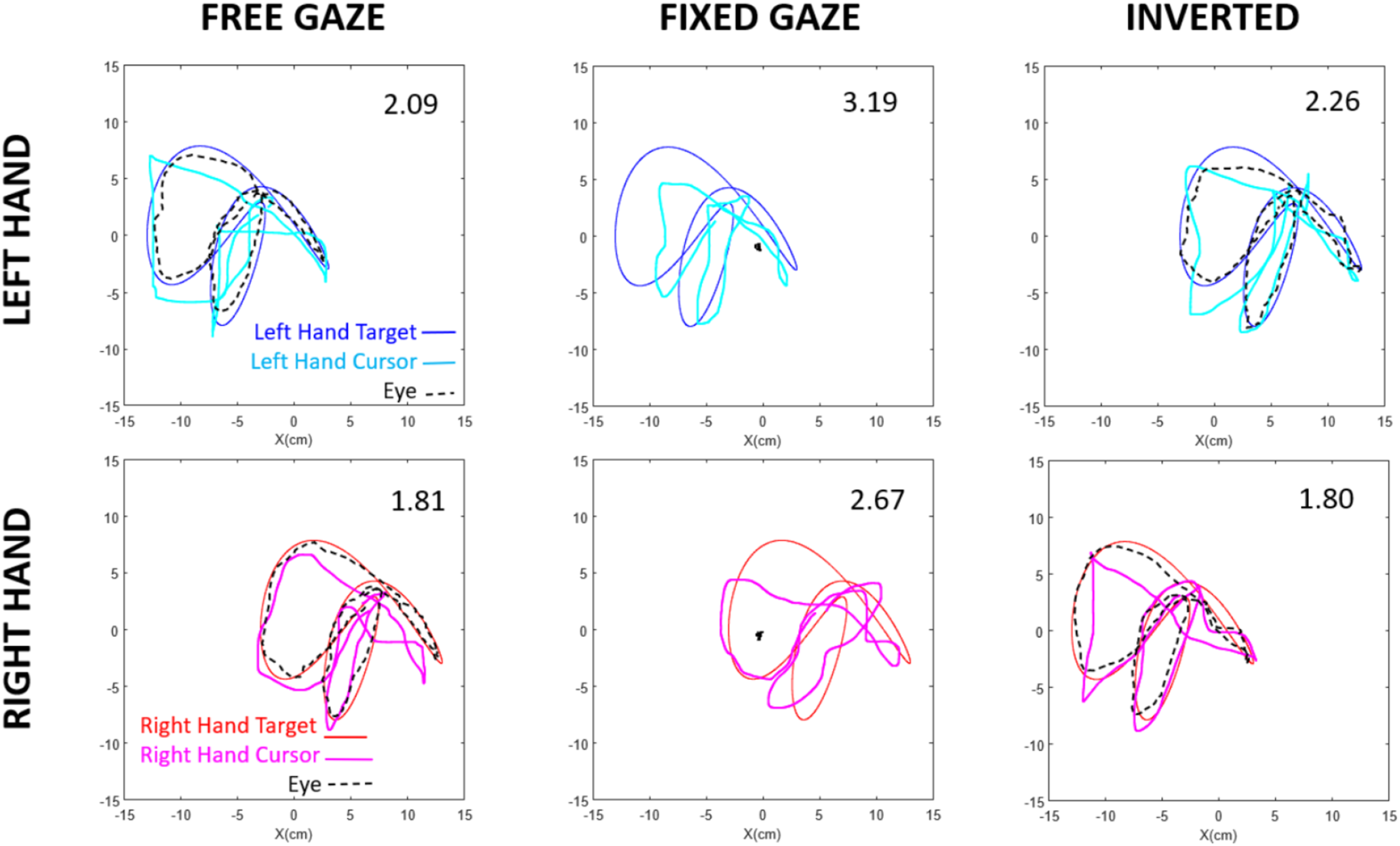
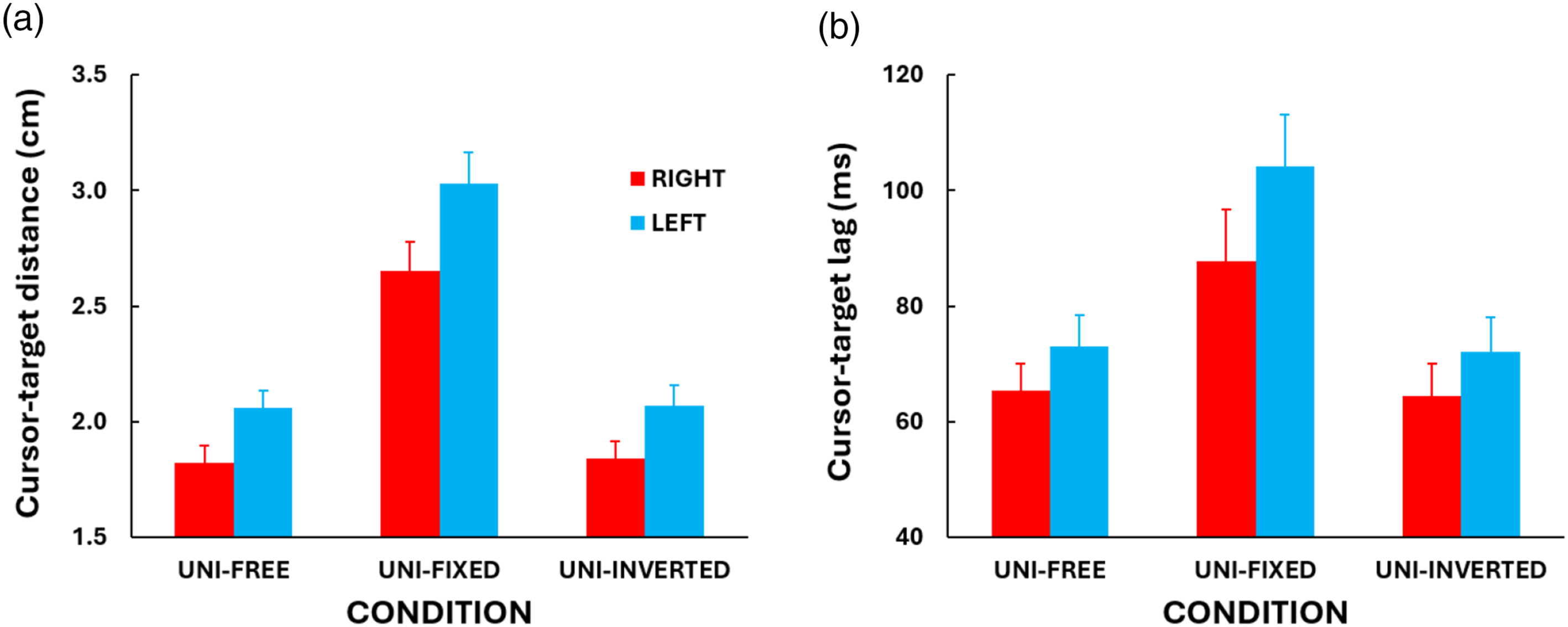
The analysis of the mean group cursor-target lag provided rather similar findings (see Figure 5(b)). Indeed, the two-way ANOVA revealed a main effect of HAND (F (1, 27) = 6.48, p < 0.05, η2 = 0.06) consistent with a right hand advantage (73 vs. 83 ms). We also found a main effect of COND (F (2, 54) = 40.07, p < 0.001, η2 = 0.35) consistent with an increase in cursor-target lag under FIXED compared to FREE and INVERTED (respectively, 96, 69, and 68 ms). The HAND by COND interaction was not significant (F (2, 54) = 2.51, p = 0.09, η2 = 0.01). Altogether, these results corroborate the overall greater efficiency of the right hand for unimanual tracking.
Detrimental and Asymmetrical Effects of BIMANUAL Tracking
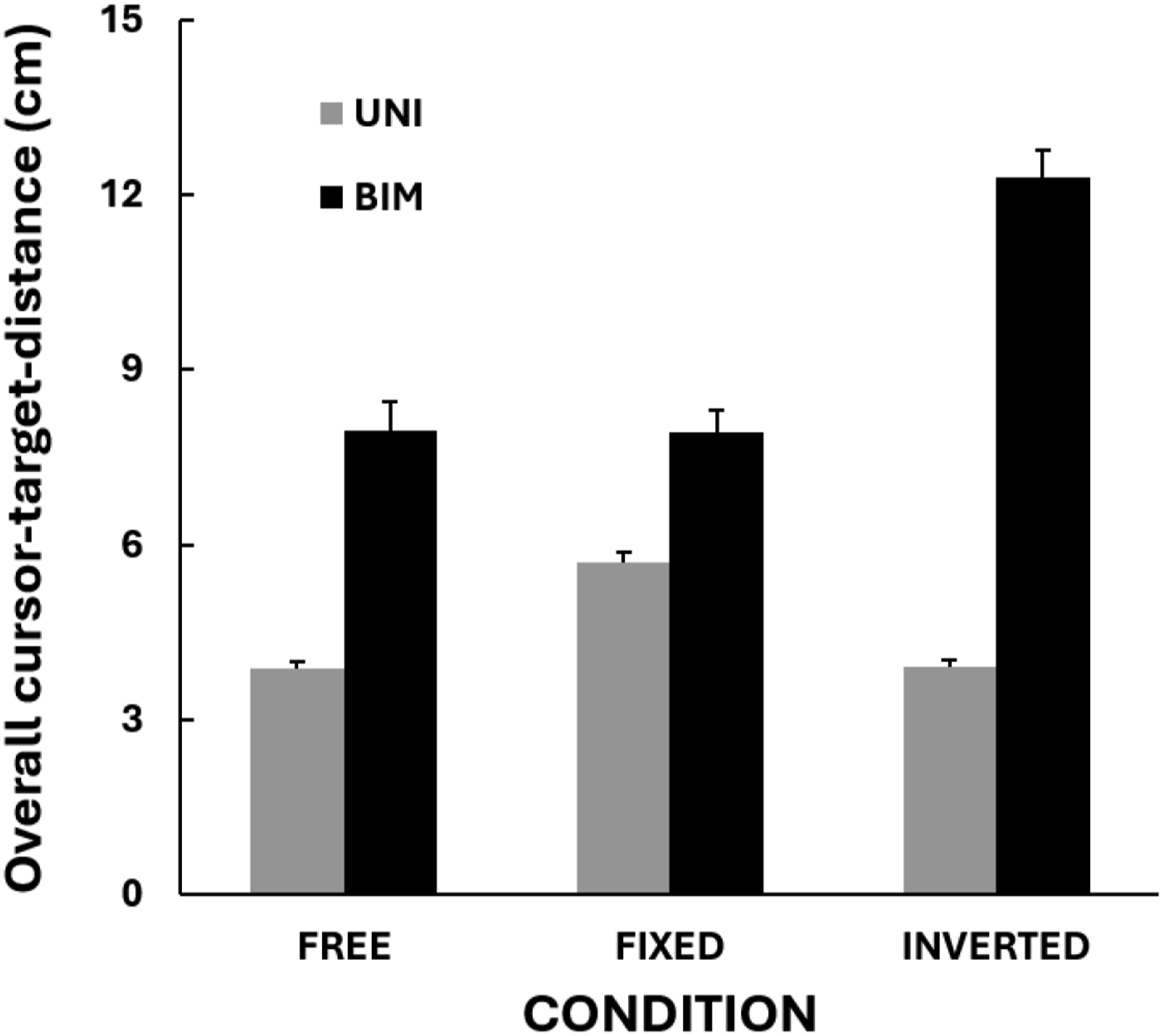
In Figure 6, we display three typical bimanual trials performed by the same participant in each of the three conditions. Visual comparison with unimanual trials displayed in Figure 4 indicates that the accuracy of tracking suffers from dual tasking. Indeed, as shown in Figure 7, when the cursor-target distance associated with the right and left hands are summed, the overall cursor-target distance increased by 39% under FIXED (5.68 vs. 7.91 cm), doubled under FREE (3.88 vs. 7.95 cm; +105%), and tripled under INVERTED (3.91 vs. 12.29 cm; +215%). This view is supported by a two-way ANOVA showing both a main effect of DUAL (F (1, 27) = 403.3, p < 0.001, η2 = 0.62), and a DUAL by COND interaction (F (2, 54) = 109.5, p < 0.001, η2 = 0.17). Post hoc comparisons of the interaction confirmed that overall cursor-target distance was increased by dual tasking for each of the three conditions (p < 0.001). It is also worth noting that there was no significant difference between overall bimanual cursor-target distance under FREE and FIXED (7.95 vs. 7.91 cm; p = 0.901). Typical bimanual trials under each experimental condition. Within each graph, we present the cursor, target, for each hand along with gaze signals. For simplicity, only 5 s of signals are displayed. All these trials were performed by the same participant. Overall cursor-target distance as a function of experimental condition. Error bars represent the within-subject SEM. Note the clear detrimental impact of dual tasking, as overall cursor-target distance was always lower under unimanual compared to bimanual tracking.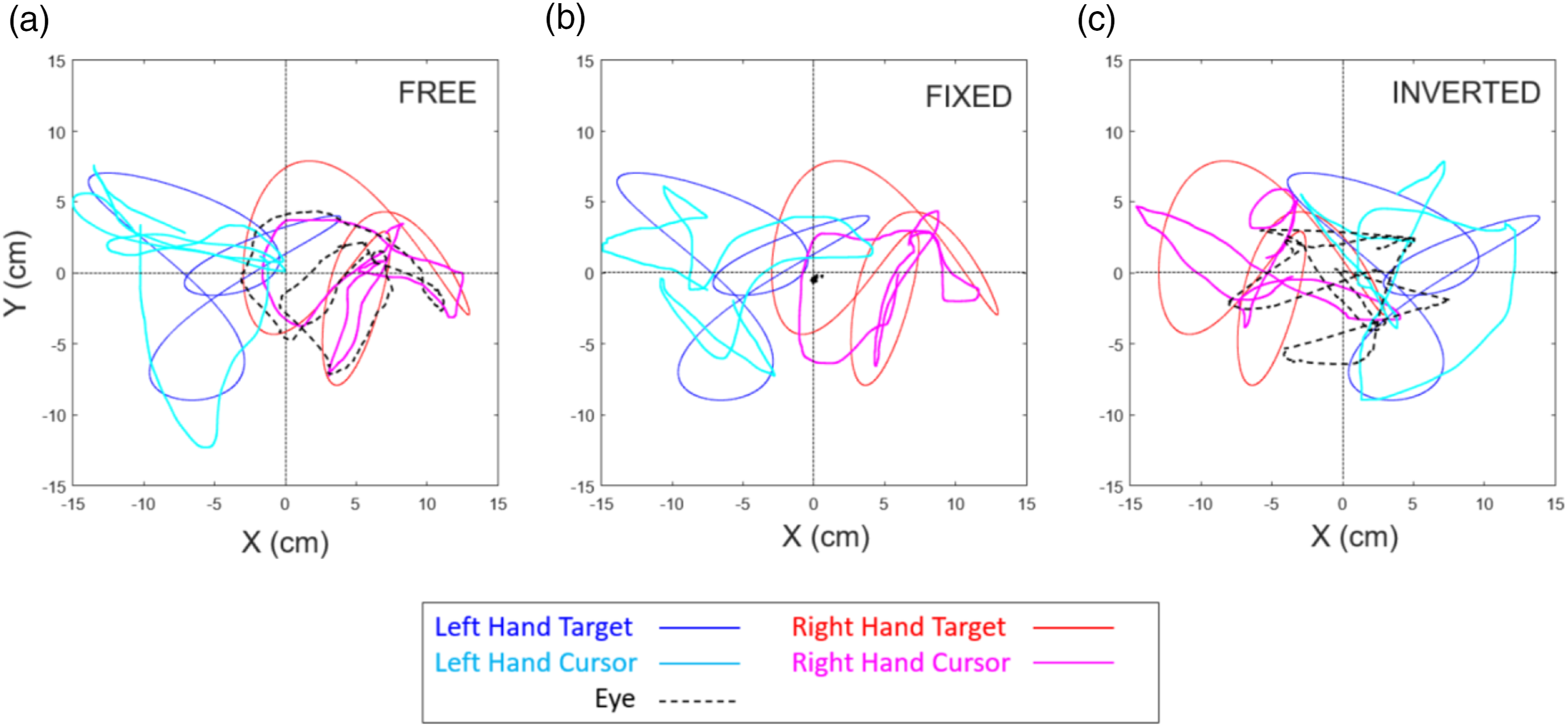
We now propose to examine the issue of whether dual tracking impaired the performance of the right and left hands to a similar degree. This issue was investigated in two different ways. First, we computed separately for each hand the increase in cursor-target distance associated with bimanual tracking. This analysis revealed a greater alteration of tracking for the left hand than the right under FREE (+122 vs. +89%, p < 0.001) and INVERTED (+236 vs. +205%, p < 0.01), but not under FIXED (+42 vs. +36%, p = 0.54). This means that, except when gaze was fixed, participants prioritized the task performed by the right hand when they had to concurrently track two targets. A similar conclusion was reached when we evaluated manual asymmetry through the ratio between the cursor-target distance of the left and the right hand (see Figure 8); the higher this ratio above 1, the greater the right-hand advantage. Using this ratio, two way ANOVAs showed a nearly significant main effect of COND (F (2, 54) = 3.11, p = 0.052, η2 = 0.03), DUAL (F (1, 27) = 17.91; p < 0.001, η2 = 0.15), and an interaction between the two (F (2, 54) = 3.173, p < 0.05, η2 = 0.03). Importantly, post hoc analysis showed that manual asymmetry was invariant across the unimanual conditions, reaching 1.15 on average (p > 0.93), whereas it changed substantially across the bimanual conditions. Indeed, although hand asymmetry more than doubled under FREE and INVERTED (1.15 vs. 1.36, p < 0.001), it remained stable under FIXED gaze (1.15 vs. 1.20, p = 0.55). Mean ratio between the left and right hand cursor-target distances as a function of experimental condition. A value greater than 1 indicates that tracking is more accurate with the right hand than with the left one (i.e., a right-hand advantage). Error bars represent the within-subject SEM. Note the exacerbation of the right-hand advantage under bimanual conditions, except when gaze is fixed.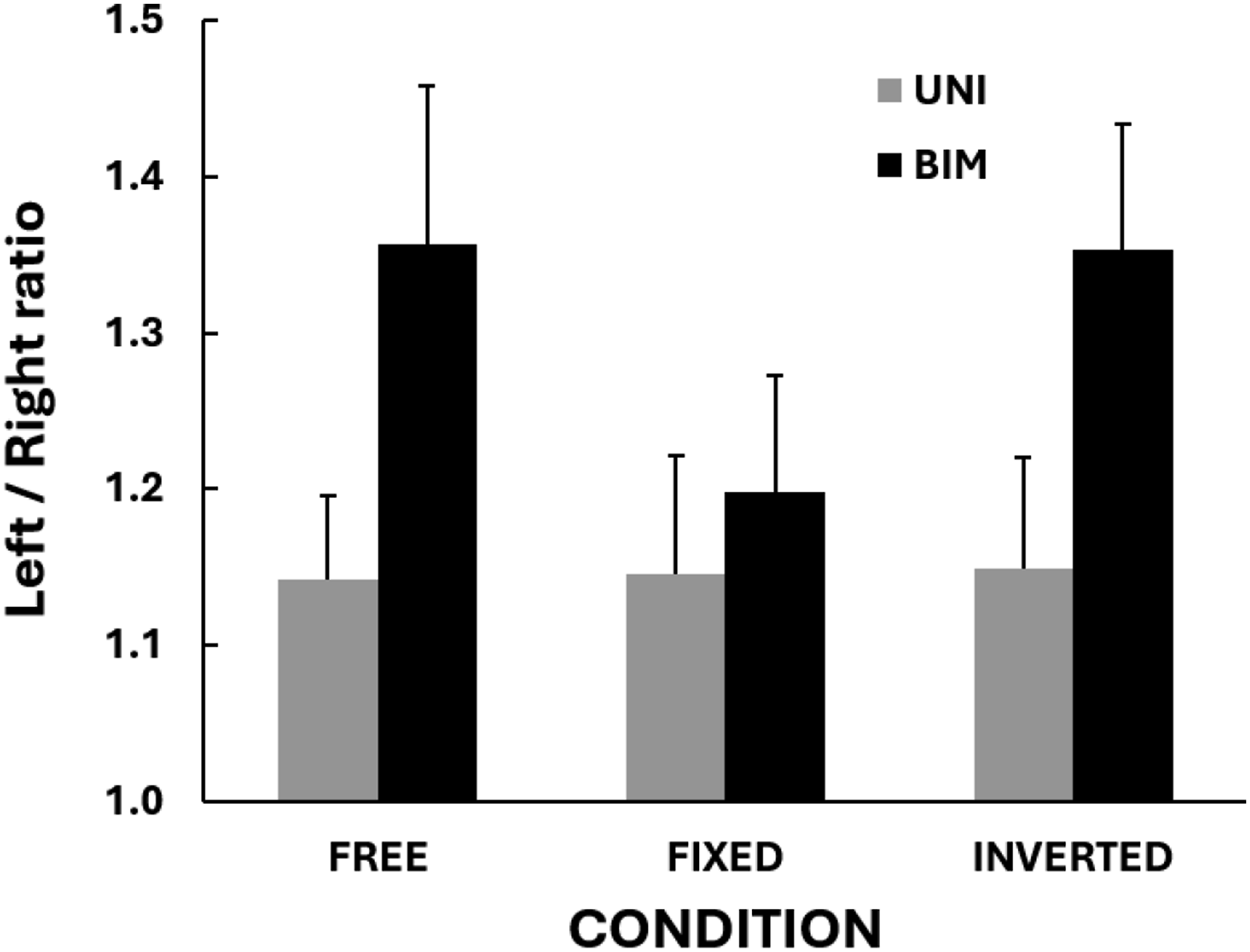
Mean Gaze Position
In Figure 9 we present the mean horizontal position (MHP) of gaze in all nine experimental conditions. In the FREE unimanual conditions, MHP of gaze and target was congruent during both right (4.70 vs. 5 cm) and left-hand tracking (−5.15 vs. −5 cm). However, in the bimanual FREE condition, although MHP of the two targets coincided with the center of the screen (0), MHP of gaze revealed a bias for the right side of the screen as it reached 1.63 ± 1.64 cm, a value significantly different from 0 (t (27) = 5.25, p < 0.001). Note that among our 28 participants, only three had a negative MHP (−0.25; −1.08; −2.09). This right-side bias was further corroborated by a greater percentage of time spent by gaze on the right side of the screen (65 ± 13%; a value significantly different from 50%; p < 0.001). Mean horizontal position of gaze as a function of experimental condition. A positive value indicates that gaze is mostly directed toward the right side of the screen. Error bars represent the within-subject SEM. Note the rightward bias of gaze under bimanual FREE.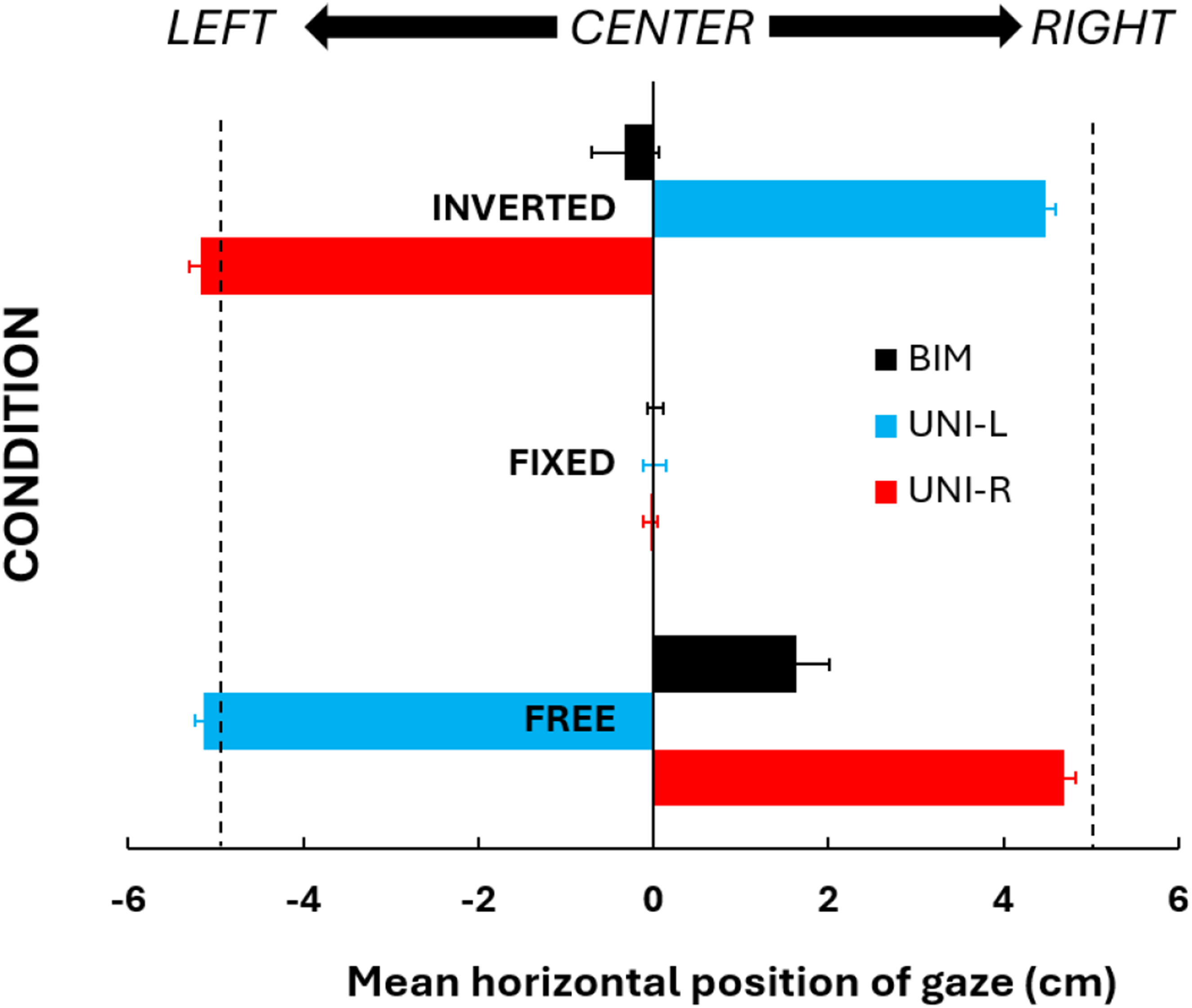
In the FIXED conditions, as required by our task instructions, MHP of gaze was close to the center of the screen (UNI-R = −0.04, UNI-L = 0.02, BIM = 0.02). Yet, to further assess the accuracy of gaze fixation, we computed the SD of gaze position along the horizontal and vertical axes over each trial. Averaged across all trials and axes, the resulting SD was 0.33 cm. Given that the corresponding SD was 4.34 cm during FREE unimanual conditions, this more than 10-fold difference suggests that participants coped well with the instruction to fixate the center of the screen (see exemplary trials in Figures 4 and 6).
Concerning the INVERTED conditions, MHP of gaze in the unimanual tasks was congruent with the fact that the right target was now displayed on the left side (−5.17 cm vs. −5 cm) and vice versa for the left target (4.48 cm vs. 5 cm). However, during bimanual INVERTED, participants did not exhibit a preference for either side of the screen, with an MHP of −0.33 ± 2.60 cm, a value not significantly different from 0 (t (27) = 0.66, p = 0.51). Again, that observation coincided with the fact that gaze spent equal time on the right and left side of the screen (50.5 vs. 49.5%; p = 0.92).
Discussion
The main findings stemming from our study are the following. First, this study confirms a right-hand advantage in right handers that complete a visuomotor task. Second, while further documenting the detrimental effects of dual tasking, our study shows that this right-hand advantage spontaneously amplifies when participants perform bimanual actions under gaze free conditions. Interestingly, we notice that the prioritization of the right hand is associated with a bias of gaze toward this hand. Third, we show that enforcing central fixation alleviates the hand asymmetry, importantly at no cost for overall tracking performance when pooling the right and left hand scores. Fourth, the right-left inversion on the screen severely impaired bimanual tracking and appeared insufficient to alleviate the inflation of manual asymmetry. Below we propose to discuss in more detail all these findings and their implications, especially for ergonomists interested in hand dominance and dual/bimanual tasking.
Right-Hand Advantage During Unimanual Tracking
As anticipated, this study provides further evidence that, in right-handed participants, manual tracking is more accurate with the right hand, no matter whether gaze is free or fixed, or whether the visual display is regular or inverted. Indeed, for all our conditions, the cursor-target distance was on average 15% larger in the left hand. This observation is consistent with previous studies that explored the effect of hand dominance during unimanual tracking (Aoki et al., 2016; Carey et al., 2003; Coudiere et al., 2024; Freeman & Chapman, 1935; Mathew et al., 2019, 2020; Peña-Pérez et al., 2023), but also echoes with some reports obtained in the context of reaching movements (Carey & Liddle, 2013; Carson, 1993; Elliott et al., 1993; Schaffer & Sainburg, 2017). Because this right-hand advantage does not follow from better gaze monitoring of the target (Mathew et al., 2019), the greater dexterity of the right hand is likely to follow from more efficient neuromuscular control (Adam et al., 1998) and/or visuomotor processes (i.e., processes linking visual information to hand motor commands).
Right-Hand Dominance is Increased During Bimanual Tasking
In line with the study of Damos and Lintern (1981), we found that bimanual tracking was much worse than unimanual tracking, an effect consistent with other studies showing the negative impact of dual tasking on manual tracking (Braune & Wickens, 1985; Mastroianni & Schopper, 1986; Schmidt et al., 1984; Wickens & Gopher, 1977). However, the novelty brought by our study is to emphasize that the impact of dual tasking is not the same for the right and the left hand when gaze is free. Specifically, we show that the right hand is less impacted than the left hand, a phenomenon that further amplifies the manual asymmetry exhibited during unimanual tracking. Importantly we noticed that gaze was preferentially directed toward the right-hand task. This observation seems to be at odds with the report of Beurskens and Bock (2012) for bimanual tracking, but as previously exposed in the introduction, one issue is that in contrast to our study, their task did not display any signs of manual asymmetry. However, our finding resonates with other observations made in the context of bimanual reaching (Buckingham & Carey, 2015; Honda, 1982; Srinivasan & Martin, 2010), circle drawing (Franz, 2004), and swinging pendulums (Amazeen et al., 1997). If we reason that gaze is a proxy for overt attention (using foveal vision), it makes sense that the right hand suffers less from dual tasking in our free viewing condition. Interestingly, imposing central fixation significantly alleviated and indeed eliminated that inflation in manual asymmetry. We interpret this finding as evidence that relying on covert attention (using peripheral vision) favors comparable levels of attention to the right and left hands. This conclusion resonates with a recent study showing that attention of allocation is more equally distributed across the visual field when central fixation becomes a task requirement (Hadjipanayi et al., 2022).
Because the rightward bias of overt attention seen in our gaze free condition could reflect a preference for the hand or the hemifield, our protocol included a condition in which we introduced a right-left inversion of the visual display under gaze free. The results stemming from this condition showed no clear gaze preference suggesting that under these circumstances overt attention is neither entirely dictated by the hand, nor by the hemifield. Yet, we found comparable increases in manual asymmetry under gaze free and visual inversion. That latter observation suggests that, under visual inversion, covert attention is drawn toward the right hand rather than the right side of the screen. Altogether, for two of our experimental conditions (free gaze + inverted condition), our results raise the possibility that overt and covert attention exhibit a similar preference for monitoring the right hand.
Limitations
First, we would like to stress that the order of our experimental conditions was not fully counterbalanced. Indeed, the bimanual conditions were always conducted after the unimanual conditions. It is thus likely that bimanual tracking performance measured in our study was better than what would have been obtained with a fully counterbalanced design. This choice of ordering was meant to raise task difficulty in a progressive manner and to minimize transitions in gaze contingencies/visual display. Indeed, prior pilot testing had revealed that starting upfront with bimanual tracking was nearly impossible for most participants, especially under the inverted display. To avoid long familiarization sessions before bimanual conditions that could have induced fatigue and/or a drop in motivation, we opted for an order allowing participants to capitalize on unimanual tracking before they were tested on bimanual tracking (Damos & Lintern, 1981; Mathew et al., 2020). The fact that unimanual tracking at the beginning (FREE) and end (INVERTED) of the experiment was similar in terms of right and left hand cursor-target distance, lag and manual asymmetry (see Figures 5 and 8) indirectly suggests that this procedure was rather efficient in terms of minimizing fatigue. It should also be noted that some statistical tests were very near the 0.05 threshold and should thus be considered with caution. Certainly, replicating our study with greater statistical power would be helpful.
Second, although this study explored various gaze contingencies and visual displays, we agree that many alternatives remain to be tested. With respect to visual display, we think that future studies investigating the influence of intertarget distance would be particularly relevant for bimanual tracking. In the current study, the distance separating the two centers around which the right and left targets oscillated was 10 cm (which is equivalent to 10°). Although we can predict that bimanual tracking performance would decrease for larger intertarget distances (Beurskens & Bock, 2012), it remains to be tested whether larger display separation also impacts manual asymmetry. Finally, regarding our fixed gaze condition, it would be helpful to assess whether moving the point of gaze slightly to the left (instead of a central position) helps reduce manual asymmetry. Obviously, if that procedure works it will be key to assess whether overall tracking performance is still preserved.
Finally, it is worth noting that the current study relied exclusively on right-handed participants. While this ensures good representativeness given the ∼90% of right-handers in the population (Coren & Porac, 1977; Gilbert & Wysocki, 1992; McManus et al., 2010), it remains an open question whether the behavior of left-handed participants would mirror that reported here. Because left handers are typically less lateralized than right handers (Borod et al., 1984; Bryden, 1977; Llaurens et al., 2008; Oldfield, 1971; Przybyla et al., 2012), it could be that the tendency to prioritize the dominant hand during bimanual tracking is less severe than that reported here. Even if this is the case, it would be worthwhile in future studies to assess whether gaze fixation can also help reduce hand dominance effects in left handers.
Implications for Ergonomics and the Design of Bimanual Tasks
How dual tasking influences cognitive and motor performance is key for the field of ergonomics and human factors (Damos & Lintern, 1981; Martin et al., 1984; Mastroianni & Schopper, 1986; Swinnen & Walter, 1991; Tsang & Chan, 2015; Wickens & Gopher, 1977). Here, we focused on a special type of dual tasking in which both hands had to concurrently perform a similar but separate task (i.e., bimanual tracking), which when performed in isolation demonstrates a right-hand advantage (as observed for many other common motor tasks). The fact that this right-hand advantage spontaneously more than doubled under dual tasking (15%→35%) is obviously a concern for ergonomists that seek to maintain comparable levels of performance across hands during bimanual tasks. Yet, the results brought by our gaze fixation condition provide a simple solution to counteract that natural tendency to inflate hand dominance, as this procedure allowed to restore hand dominance slightly above its original level (20% vs. 15%). Importantly, this benefit was obtained at no cost for overall tracking performance as evidenced by the fact that the summed errors of the right and left hands were identical under gaze fixed and gaze free conditions. Still, it should be acknowledged that gaze fixation did not fully eliminate manual asymmetry. Future studies will have to investigate whether imposing gaze fixation a bit closer to the left hand may fully alleviate a right-hand advantage. More generally, our findings are relevant to ergonomists interested in multiaxis control using separated displays (Wickens, 1986), a situation in which the operator has to track multiple variables such as when piloting an aircraft. Indeed, as mentioned in the introduction, this is typically the situation encountered by a helicopter pilot that simultaneously controls with separate hands the collective lever and the cyclic stick (the stick and throttle for an airplane pilot, two joysticks for a drone pilot). Although, to our knowledge there is no study that investigated hand dominance in these contexts, the current results suggest that the task performed by the (right) dominant hand is prioritized. If correct, it is possible that gaze fixation midway between the two displays that pilots need to monitor would alleviate this prioritization effect. In a recent study, we showed that during concurrent stick/rudder pursuit tracking, pilot candidates clearly prioritize the control of the stick at the expense of the rudder controlled by the foot (Danion et al., 2025). We propose that, even when hand dominance is not directly responsible for task prioritization, it is worth exploring this gaze fixation technique. As an aside, we also encourage to examine whether the gain provided by pilot training under fixed gaze conditions transfers to when fixation is subsequently relaxed (as the ability to keep an eye on other displays in the cockpit is crucial). Finally, our study strongly warns ergonomists against the use of right-left inverted displays when operators must concurrently perform two visuomotor tasks. Not only is visual inversion ineffective to reduce manual asymmetry, but it also induces severe decrements in overall motor performance.
Key Points
• During unimanual visuomotor tracking, right handers exhibit a right-hand advantage • During bimanual tracking (one target with each hand), manual asymmetry is nearly tripled, and gaze is biased toward the right hand • Fixating straight ahead greatly alleviates this inflation of manual asymmetry, a benefit obtained at no cost in terms of overall tracking performance • Performing separate tasks with the right and left hands is common when piloting an aircraft, gaze fixation may be useful to pilots that seek to divide more equally the negative impact of dual/bimanual tasking
Footnotes
Acknowledgments
We thank Cedric Goulon and Franck Buloup for technical support and providing, respectively, their ICE and Docometre software (courtesy of Institut des Sciences du Mouvement, Marseille, France). Our experiments were performed using the human behavior analysis facilities of the Maison des Sciences de l’Homme et de la Société (MSHS) of Poitiers (UAR 3565 CNRS—Université de Poitiers).
Author Contributions
FRD, AC, and PMB designed the study. MM and AC collected the data. FRD analyzed data and draw figures. All authors drafted the manuscript.
Declaration of Conflicting Interests
The author(s) declared no potential conflicts of interest with respect to the research, authorship, and/or publication of this article.
Funding
The author(s) received no financial support for the research, authorship, and/or publication of this article.
Ethical Approval
The study protocol received approval from the Comité d’Ethique de la Recherche Tours-Poitiers (CER-TP 2023-04-01) and was performed in line with the principles of the Declaration of Helsinki.
Consent to Participate
Participants included in this study provided informed written consent.
