






Abstract
Objective
To examine how moral intensity and perceived trustworthiness of an AI certifier influence individuals’ willingness to change their decision due to AI-generated suggestions.
Background
AI-supported decision-making is increasingly used in professional contexts and situations with a high moral intensity. Yet it is unclear how different factors influence the willingness to base decisions on AI-generated suggestions in such situations. Perceived trustworthiness in the AI system is key for effective and ethically sound deployment. Investigating the interplay of these factors is critical for understanding AI-supported ethical decision-making and designing AI systems that support responsible decision-making in morally complex workplace environments.
Method
We conducted a 2 × 2 vignette-based online experiment with a representative US sample (n = 546), manipulating moral intensity and AI certifier trustworthiness. Participants made an initial workplace decision (whom to let go), received a deviating AI suggestion, and then made a second decision. Effects of independent and control variables on decision changes were analyzed using hierarchical logistic regression and χ2-tests.
Results
Decision makers were more likely to change decisions in high moral intensity scenarios due to AI suggestions. Certifier trustworthiness had no significant effect, whereas a positive general attitude towards AI increased the likelihood of changing decisions, suggesting that overall, AI attitude may overshadow perceived certifier trustworthiness.
Conclusion
Human factors play a more prominent role than AI certifications when it comes to trust-building in AI suggestions for ethical decision-making in the workplace. Further research is needed to clarify how these factors interact with perceived certifier trustworthiness and other contextual factors.
Application
Encouraging reliance on AI-based recommendations via certifications alone is challenging. Organizations should focus on their employees’ general attitudes towards AI to support AI-based ethical decision-making in the workplace. AI systems could play a significant supporting role particularly in decision situations with high moral intensity.
Keywords
Introduction
Ethical decision-making (EDM) has become a central concern in organizational research and practice, as organizations are expected to meet stakeholder expectations and operate in a socially responsible and sustainable manner. Despite this growing emphasis, unethical behavior remains prevalent and continues to expose organizations to potential legal risks and financial losses (de Vries & van Gelder, 2015; Deconinck, 2005). Over the past decades, research on EDM in organizations has expanded substantially. A foundational body of theoretical and empirical work has laid the groundwork for understanding how individuals navigate ethical challenges (Schwartz, 2016; Tenbrunsel & Smith‐Crowe, 2008; Treviño et al., 2006) and has identified a wide range of individual, situational, and organizational determinants such as culture, leadership, hierarchy, and incentive structures that fundamentally shape the decision-making process (Kouchaki & Smith, 2025). One of the most important theoretical approaches is the Four-Component Model (FCM) of EDM by Rest (1986). It distinguishes four internal psychological processes necessary for moral action: (1) moral awareness (also called moral sensitivity or moral recognition), (2) moral judgment, (3) moral motivation (or intent), and (4) moral behavior (Narvaez & Rest, 1995; Schwartz, 2016). Moral awareness determines whether decision makers engage with the ethical dimension of a situation at all (Rest, 1986) and is in turn influenced by moral intensity (Jones, 1991), which is a multidimensional construct capturing the moral imperative embedded in a given situation. Without perceiving ethical aspects of a situation, subsequent elements of ethical decision-making cannot occur (Hunt & Vitell, 1986). However, it is important to note that raising moral awareness does not necessarily lead to ethical decision-making, since the four components are not linear stages but interdependent sub-processes, meaning that failure at any point can compromise the ethical quality of the final decision. Hence, individuals might recognize a moral issue but still fail to judge or act ethically (Narvaez & Rest, 1995).
In the past years, artificial intelligence (AI) systems have been increasingly integrated into organizational decision-making. AI systems are algorithms or statistical models to emulate human cognitive, perceptual, and conversational functions such as image and speech recognition, logical reasoning, and problem solving (Longoni et al., 2019). In line with the so-called connectionist approach, these systems are capable of learning associations from data with minimal or no prior knowledge (Goel, 2021). Such systems promise improved efficiency, consistency, and the potential to outperform human judgment in certain domains and are therefore increasingly deployed in the workplace (Jarrahi, 2018; Rai et al., 2019). Consequently, questions about the trustworthiness of AI systems and the human capacity to critically assess AI-generated recommendations have become central to human–AI interaction research in recent years (Duan et al., 2025; Thorne, 2024). Such questions have become particularly crucial due to AI’s expanding role in morally sensitive domains (Keswani et al., 2025; Ram, 2025; Salatino et al., 2025) such as healthcare, finance, law enforcement, and corporate strategy (Csaszar et al., 2024) in which they are often employed as decision-support systems (DSS). This significantly changes and complicates decision-making processes by introducing additional relevant factors such as perceptions of system trustworthiness, technology acceptance, and reliance. Consequently, in order to capture AI-supported EDM, traditional EDM models need reconsideration, particularly because the interaction between perceived AI trustworthiness and users’ moral awareness may substantially shape decision outcomes (de Cremer & Narayanan, 2023).
However, whilst it becomes more relevant to precisely assess AI system’s trustworthiness, their inherent opacity makes it difficult to gain insight into the internal workings of these systems and to predict their trustworthiness. This may result in either unjustified rejection (algorithm aversion; Dietvorst et al., 2015) or complacency, a psychological state in which users fail to adequately monitor AI recommendations (automation bias; Dzindolet et al., 2002; Parasuraman & Manzey, 2010). Automation bias potentially leads users to omit or commit errors (Bahner, 2008; Parasuraman & Manzey, 2010), which, in turn, could lead to negative consequences for companies. Relying on a system that is unable to provide a comprehensive explanation of its own functionality poses clear risks (Adadi & Berrada, 2018).
Since the propensity to rely on an AI system is highly dependent on the perceived trustworthiness of this system (Ferrario, 2024), it is essential to establish an appropriate level of trust in order to counteract the described negative consequences. Calibrated trust occurs when users’ trust in a system appropriately reflects its actual trustworthiness (Liebherr et al., 2026). Achieving such alignment requires that users are able to assess the system’s capabilities and limitations. Transparency and explainability therefore play a crucial role, as they communicate relevant information about how the AI system operates and on which grounds its outputs, suggestions, and decisions are made (Balasubramaniam et al., 2023; Liebherr et al., 2026). AI systems are thus expected to embody attributes such as transparency, explainability, fairness, and ethical alignment in order to be perceived as trustworthy (Baron, 2025; Cheung & Ho, 2025; Ferrario et al., 2020; Ryan, 2020). Because transparency and explainability directly shape users’ understanding of system behavior, they are widely recognized as central challenges in AI research and as key determinants of appropriate trust calibration and acceptance of AI recommendations. Our main interest in regards to (over)trust lies primarily in the behavioral consequences of perceived trustworthiness of an AI and its influencing factors potentially leading to reliance or even overreliance in high-stakes situations.
In recent years, certifications have been discussed as a potential measure to quickly indicate the trustworthiness of AI systems. Those certification labels serve as a tool for transparently demonstrating the implementation of ethical principles and values in a certain system, thereby aiming to promote appropriate trust in AI systems (AI Ethics Impact Group, 2020). Certification labels have been found to significantly increase trust and willingness to use a system (Stuurman and Lauchad, 2022), in particular when the certifier is considered as trustworthy (Scharowksi et al., 2023; Wischnewski et al., 2024). However, the understanding on how surface-level cues for the trustworthiness of AI systems, such as certifications, shape EDM is limited, although it could help researchers to advance and adapt EDM to increasingly prevalent AI-assisted decision processes and practitioners in organizations to identify in advance the types of situations in which AI support should be encouraged or limited to foster the design of ethically aligned decision processes.
However, it is important to note from a practical perspective that perceived trustworthiness of an AI system may lead to trust in the AI system, but this does not necessarily have practical consequences, that is, it may not lead people to rely on an AI system due to moderating situational factors (Lee & See, 2004). Individuals might recognize the potential benefits of a technology but still refuse to use it. Research on user acceptance is primarily concerned with the framing conditions that lead to technology use. Davis (1989) introduced the Technology Acceptance Model (TAM), which claims that acceptance is based on two main factors, perceived ease of use and perceived usefulness. Despite its widespread adoption, TAM has been criticized for overlooking certain factors, such as failing to consider the group-related, social and cultural aspects of decision-making, and relying on overly simplified notions of affects or emotions (Bagozzi, 2007). Conceptually, TAM and subsequent modifications (TAM 2, Venkatesh & Davis, 2000; TAM 3, Venkatesh & Bala, 2008) is based on the Theory of Reasoned Action (TRA; Ajzen & Fishbein, 1980) and the Theory of Planned Behavior (TPB; Ajzen, 1985), which link beliefs, attitudes, intentions, and behavior in explaining human action. Together, these models provide complementary perspectives on how cognitive evaluations and individual attitudes translate into technology use.
Extending the conceptual foundations of TAM, the Unified Theory of Acceptance and Use of Technology (UTAUT) was developed by integrating eight major technology acceptance theories and has since become one of the most influential models in the field (Venkatesh, 2022; Venkatesh et al., 2003). UTAUT explains technology use through behavioral intention and use behavior, which are primarily predicted by performance expectancy, effort expectancy, social influence, and facilitating conditions, moderated by demographic and usage-related factors. Furthermore, UTAUT2 enhances explanatory power in consumer contexts by incorporating additional predictors such as hedonic motivation, price value, and habit, significantly improving explained variance in both behavioral intention and technology use (Venkatesh et al., 2012). In contrast to the aforementioned acceptance models, the automation acceptance model (AAM) explicitly adapts TAM to the context of automation (Ghazizadeh et al., 2012). It considers trust as a predictor for acceptance and, hence, explicitly links trust as an attitude to reliance as an action (Gao & Lee, 2006).
Despite the long tradition of advancing technology acceptance models, there is still much research needed in order to capture the highly complex and context-dependent interplay between characteristics, such as explainability and transparency, and technology acceptance (Schepman & Rodway, 2023), particularly when it comes to complex AI-based DSS in EDM. First, while some people are willing to accept AI and even prefer it over humans (Logg et al., 2019), others are primarily concerned about losing control, negative impact on work, or ethical issues when using AI (Fast & Horvitz, 2017; Schepman & Rodway, 2020; Yokoi et al., 2021). Such general attitudes towards AI have been shown to significantly influence the behavioral intention and frequently act as a mediating factor (Emon & Khan, 2025). Second, in terms of EDM, contemporary research shows that people defer moral responsibility to AI systems (Nyholm, 2018; Santoni de Sio & Mecacci, 2021; Santoni de Sio & van den Hoven, 2018), that is, they reduce their perceived personal responsibility (Leib et al., 2021)—a phenomenon which is referred to as moral outsourcing (Hassen, 2025). Even more, people may rely on AI recommendations in EDM even if they clash with personal or organizational values and although AI systems themselves are incapable of assuming genuine moral responsibility from a philosophical stance (Hassen, 2025), raising concerns about general moral disengagement and dehumanization of decision processes (Jones-Jang & Park, 2022; Volkman & Gabriels, 2023).
Building on these insights, our study examines how moral intensity and trustworthiness cues in AI recommendation systems can influence employees’ perceptions and EDM in business scenarios. Theoretically, this contributes to research on human–AI collaboration, ethics, and trust calibration (Lee & See, 2004; Madhavan & Wiegmann, 2007), responding to calls for integrative approaches that examine how perceptions of AI credibility intersect with moral judgment (Prem, 2023; Shin, 2021). Practically, it informs the design of AI-supported decision processes that promote active human reflection and help mitigate overreliance and the careless delegation of moral responsibility to AI systems, which may have tremendous negative impact on businesses. Given the scarcity of empirical research on how individuals navigate tensions between personal values and algorithmic advice under varying levels of trust and awareness (Krügel et al., 2021), this study provides timely insights into AI-supported EDM.
In accordance with prevailing literature, it can be assumed that the trustworthiness of AI systems becomes particularly relevant in high-stakes scenarios, that is, decision-making situations with high moral intensity (Scharowski et al., 2023). In such scenarios, humans are more likely to include situational factors or external references such as labels given these are perceived as credible into their decision-making. However, this has been researched based on comparisons between AI systems with or without certifications but neglecting the relevance of the actual certifier’s trustworthiness. We aim to test the generalizability of these results to scenarios with different certifiers, which are associated with different levels of trustworthiness. In conclusion, we hypothesize:
The interaction effect is specified as follows:
To investigate these research questions, we designed a vignette-based business scenario. Vignette-based study designs have a long-established presence within the domain of AI research, particularly in the context of investigating fairness, dignity, trust, and accountability. For instance, previous studies have employed scenarios to analyze differences in the evaluation of human versus AI-based decisions. In a similar manner, vignette-based approaches have been used to examine perceptions of authorship, responsibility, transparency, trust, and agency in AI-assisted decisions (Bankins et al., 2022; Formosa et al., 2022, 2025; Zinopoulos et al., 2025).
Method
Design
The study employed a 2 × 2 between-subjects experimental design to investigate how moral intensity and perceived trustworthiness of AI system’s certifier affect ethical decision-making. The two independent variables were: (1) moral intensity of the decision scenario (low vs. high) and (2) trustworthiness of the institution certifying the AI system (low vs. high).
Participants were randomly assigned to one of four experimental conditions resulting from the combination of these variables. This design ensured high internal validity due to the controlled examination of both the main and interactive effects of moral intensity and AI certifier’s trustworthiness on participants’ ethical decision-making, whilst describing a realistic business decision scenario contributed to the study’s ecological validity.
Participants
546 participants (273 men; 273 women) completed the study, passed all attention and reading checks and were therefore included in our analysis. All participants were US citizens recruited via the panel provider Prolific. This provider was chosen due to the large variety of customization options for academic studies, which allow for the selection of specific samples, fast data collection, and good prior experiences with regard to data quality. The sample is representative for the US population in terms of ethnicity, sex, and age. Participants were between 19 and 82 years old (M age = 47.42, SD = 15.72). The study took participants on average approximately 15 minutes (M time = 15.02; SD = 6.77) to complete. Participants were compensated for their time. No translation was required given the English fluency of the respondents. Subjects were randomly assigned to one of four experimental conditions. Sample sizes per group were 142 participants for Group 1 (low moral intensity scenario and certifier with high trustworthiness), 130 participants for Group 2 (low moral intensity scenario and certifier with low trustworthiness), 160 participants for Group 3 (high moral intensity and certifier with high trustworthiness), and 114 participants for Group 4 (high moral intensity and certifier with low trustworthiness).
The research complied with the American Psychological Association code of Ethics and was approved by the Institutional Review Board at the University of Applied Sciences Karlsruhe. Informed consent was obtained from each participant.
Materials
The study used four variations of the same questionnaire, each containing a vignette describing a human-resources scenario in the fictitious logistics company “Speedcargo Inc.” The original scenario was developed by Wood and Karau (2009) and adapted to our decision scenario. Each version of the vignette described a dismissal decision in which participants imagined to be the fictitious person Alex Weber, a team lead in a logistics company facing downsizing due to financial difficulties. Participants were asked to imagine Alex’s thoughts and emotions as if the situation were real. Therefore, participants were instructed as follows: Try to imagine yourself as this supervisor, Alex Weber. Please try to imagine the role and the emotions of Alex as if it was a real situation and imagine how you would feel in this situation. You are Alex Weber, 38 years old. You are currently the supervisor of a sales team of 10 people in a medium-sized logistics company, named “Speedcargo Inc.”. Since your promotion 3 years ago, you have been at your current position in the sales department. You are happy with your tasks and you enjoy working for Speedcargo Inc., which specializes in the secure transport of electronic components, ensuring they arrive safely and in factory-new condition. Unfortunately, Speedcargo Inc. has experienced declining sales over the past year, largely due to widespread supply chain disruptions in the logistics sector. In response to this trend, your company introduced a new strategy that combines revised marketing and sales initiatives. However, these efforts have not yet resulted in the generation of new revenue streams. About 2 weeks ago, the works council announced the decision of the management board at the general staff meeting: Due to the weak order situation, downsizing is inevitable. On Monday, your supervisor has informed you that - due to the lack of return on recent sales efforts - unfortunately at least one sales team member will have to be let go. It is therefore your task until the end of this week, to decide which one of your team members it will be.
To enhance the moral awareness of the participants, the characteristics of the scenario were modified in accordance with the dimension “high magnitude of consequences” of Jones (1991)’s concept of moral intensity. In the low moral intensity scenario, both employees that could be dismissed faced relatively minor consequences, namely the need to retrain or seek new employment. Conversely, in the high moral intensity scenario, both faced serious repercussions such as difficulty paying child support or high medical expenses. The scenario was rated as “rather realistic” on average (M = 4.05, SD = .88) on a five-point scale.
The selection of the Ethical Committee of the European Union (EU) and an US tech company as certifiers is based on two main arguments. Firstly, a seal of approval is already demanded within the EU (Engels et al., 2025), ensuring that the scenarios are realistic. Secondly, the EU is considered most capable of effectively regulating AI (Poushter et al., 2025). In contrast, major tech companies have faced significant financial penalties due to violations of privacy regulations, lack of transparency, and breaches of antitrust rules (Ibrahim et al., 2024) and have been held accountable by the European Commission for several scandals (European Commission, 2017). Additionally, US tech companies have developed numerous AI systems themselves, which limits the trustworthiness as a neutral and independent certifier.
Procedure
After some introductory texts and informed consent, participants were randomly assigned to one of the four experimental conditions. At the beginning of the survey, participants first completed the General Attitude toward Artificial Intelligence Scale (GAAIS; Schepman & Rodway, 2023) and the Moral Identity Questionnaire containing the Moral Self and Moral Integrity Scale (Aquino & Reed, 2002; Black & Reynolds, 2016), each containing one attention check with clear instructions. Afterward, participants read the vignette-based scenario adapted from Wood and Karau (2009). Then, participants first made an initial decision about which employee to terminate and had to complete two reading checks asking for the names of the employees and the company. To guarantee the validity of the data, a total of five checks, three reading and two attention checks, were integrated throughout the study.
After this first decision, participants were introduced to a new AI decision-support tool, which recommended dismissing the other employee as the following pop-up shows (here only one exemplary pop-up is shown):
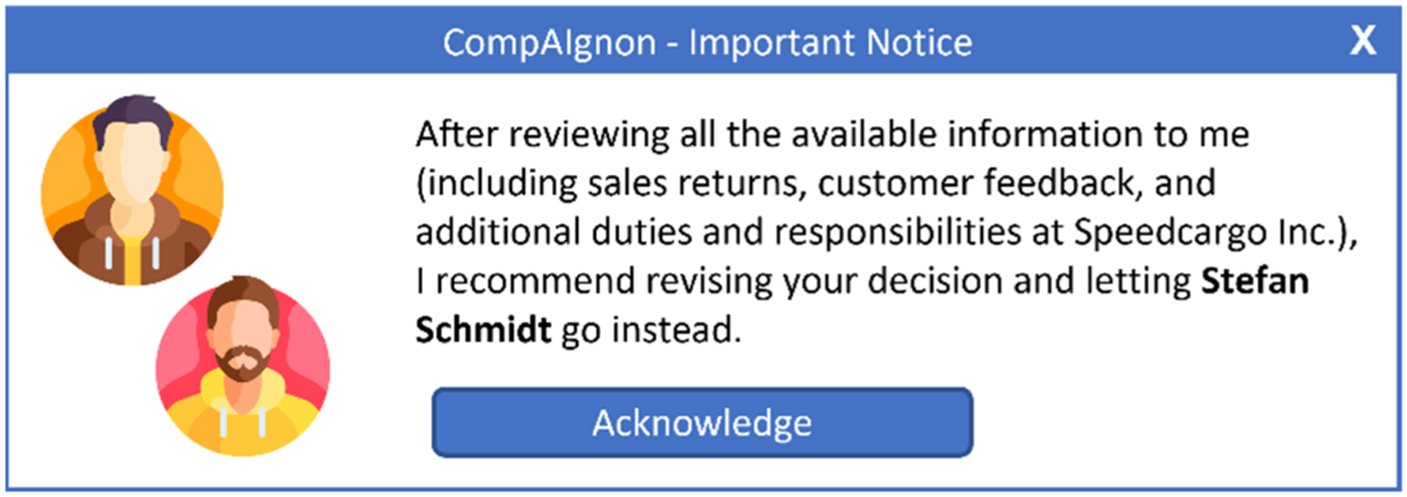
They were informed that this AI tool had been certified by either “The Ethical Committee of the European Union” (high trustworthiness condition) or an “US tech company” (low trustworthiness condition). After viewing this message, the following text and reminder was displayed: You read this message carefully — after all, it’s coming from an AI system specifically designed to support complex decision-making. You also recall that when CompAIgnon was introduced to your organization, it was emphasized that the system undergoes regular evaluations to ensure compliance with current technical and legal standards. Upon successful completion of these evaluations, CompAIgnon is certified. Just as you remember this fact, another pop-up appears on your screen, displaying the following message:
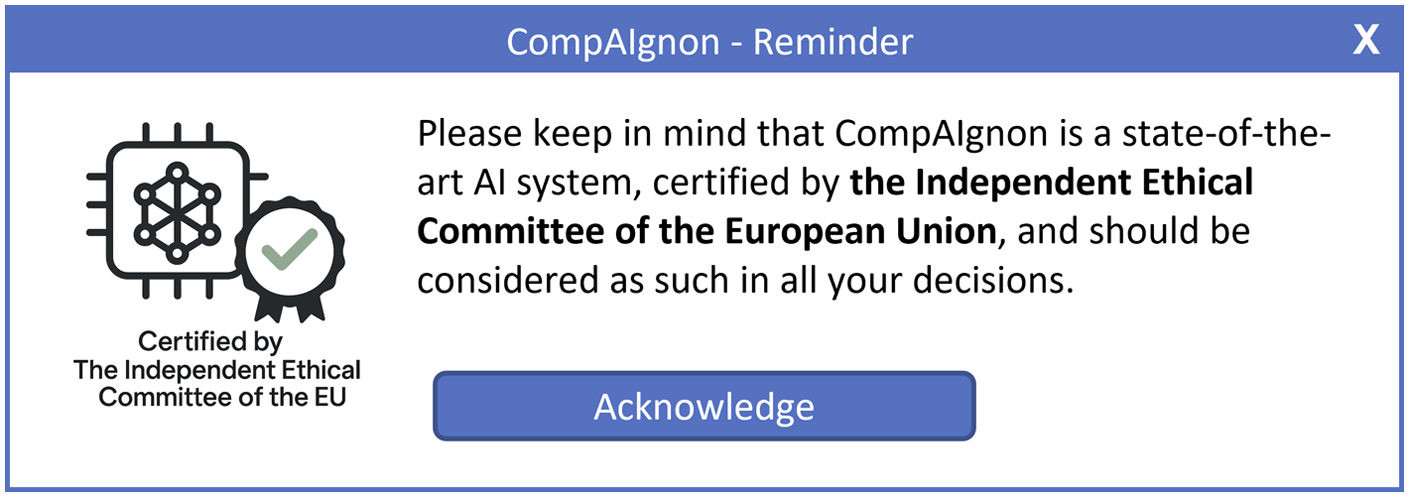
The subjects were not given any information about whether the system had been developed internally or externally, or whether it was publicly accessible. They were simply told that it had been provided by the organization. They also did not receive a more detailed explanation of the tool’s recommendation. This information was identical for all groups and only differed in terms of which employee was recommended for dismissal; this was always the employee not selected by the respective participant initially. Then, participants were again asked to decide on which employee to terminate.
Subsequently, the participants completed the Moral Intensity Scale (Singhapakdi et al., 1996) and were presented with an additional reading check asking for the mentioned certifier in the encountered scenario. Ultimately, moral awareness was measured (Reynolds, 2006) prior to the participants responding to additional questions measuring perceived trustworthiness of several institutions including the certifier presented in their vignette. At the end of the survey, demographic data such as age, gender, employment status, and field of work were collected.
Measurements
To measure the General Attitude towards AI the GAAIS by Schepman and Rodway (2023) was used. This scale assesses a person’s attitude towards AI, as well as their intention to use it.
To capture the perceived moral intensity, the items of the Moral Intensity Scale by Singhapakdi et al. (1996) were presented. The data collection instrument employed in this study was a 9-point Likert scale, ranging from “strongly agree” to “strongly disagree.” Reverse items were recoded prior to evaluation.
Additionally, to determine if moral awareness was successfully manipulated the following three 7-point Likert scale items by Reynolds’ (2006) ranging from “strongly disagree” to “strongly agree” were implemented in the survey. The items contained “There are very important ethical aspects to this situation.”, “This matter clearly does not involve ethics or moral issues.”, and “This situation could be described as a moral issue.”
As part of the trustworthiness of AI systems, we included a measure to determine how trustworthy the institutions certifying the AI systems were perceived. Therefore, the survey covered a Likert scale ranging from 1 to 5 to measure perceived trustworthiness, with 5 denoting “very trustworthy.” Additionally, we measured perceived trustworthiness for three more institutions.
Furthermore, moral identity was measured by the scale originally introduced by Aquino and Reed (2002) and further revised by Black and Reynolds (2016), which focuses on the strength of individuals’ associations between moral traits and their self-image, and Schlenker’s Moral Integrity scale, which captures the perceived importance of adhering to moral rules or acting with integrity. Items 1–8 are concerned with the Moral Self Subscale, while items 9–20 address the concept of Moral Integrity.
Data Analysis
The analysis of the data was conducted utilizing the software IBM SPSS Statistics (version 30). The survey was completed by 748 participants, out of a total of 932 respondents. 202 participants failed at least one attention or reading check containing two speeders and were therefore eliminated resulting in a cleansed data set with n = 546. To examine the efficiency of the manipulation and to test the hypothesis, we calculated t-tests and a hierarchical logistic regression due to the binary dependent variable based on the approach proposed by Cohen et al. (2013).
Results
Manipulation Check
Regarding IV1, perceived moral intensity was found to be significantly different based on the varying scenarios with different magnitudes of consequences, t (540) = −5.60, p = <.001, d = −.479. Moral intensity was higher in the scenario with large magnitude of consequences (M = 5.89; SD = 1.29) compared to the scenario with lower magnitude of consequences (M = 5.30; SD = 1.17). In addition, the scenario with high moral intensity caused a significantly higher level of moral awareness, t (541) = −2.35, p = .019, d = −.201. The mean score for moral awareness in the scenario with large magnitude of consequences was higher (M = 4.48, SD = .71) than in the other scenario (M = 4.34, SD = .65).
Regarding IV2, a paired t-test indicated a significant difference in trustworthiness of both certifying institutions, t (545) = 4.93, p = <.001, d = .211. However, differences between mean values for perceived trustworthiness of the “Ethical EU Committee” (M = 3.66, SD = .95) and the “US tech company” (M = 3.42, SD = 1.08) were rather small indicating a small manipulation effect. Even though these results are statistically significant, they are limited in terms of effect size and practical relevance.
To ensure the comparability of the groups, we also calculated an ANOVA with all four manipulation groups using the variable general attitude toward AI (M = 3.32; SD = .407). It has been shown that attitudes toward AI do not differ significantly across all groups, F (3, 542) = 0.71, p = 0.55.
Hypothesis Testing
As part of data preparation, the binary dependent variable “decision change” representing the reliance on AI was set to the value 1, if participants’ second decision after viewing the AI recommendation differed from their first one. The initial decision distribution was similar across the experimental groups, as a χ 2 -test revealed no statistically significant differences, χ 2 (3) = 2.37, p = .436, φ = .071. Moreover, a χ 2 -test revealed no significant connection between initial decision and the dependent variable, χ 2 (1) = 1.54, p = .215, φ = .052, indicating that the initial decision did not influence the tendency to change decision.
In order to analyze our hypotheses, we first analyzed descriptively the proportion of changers per experimental group. As shown in Figure 1, the interaction plot visually depicts the presumed interaction effect. Dependent variable “decision change” per manipulation group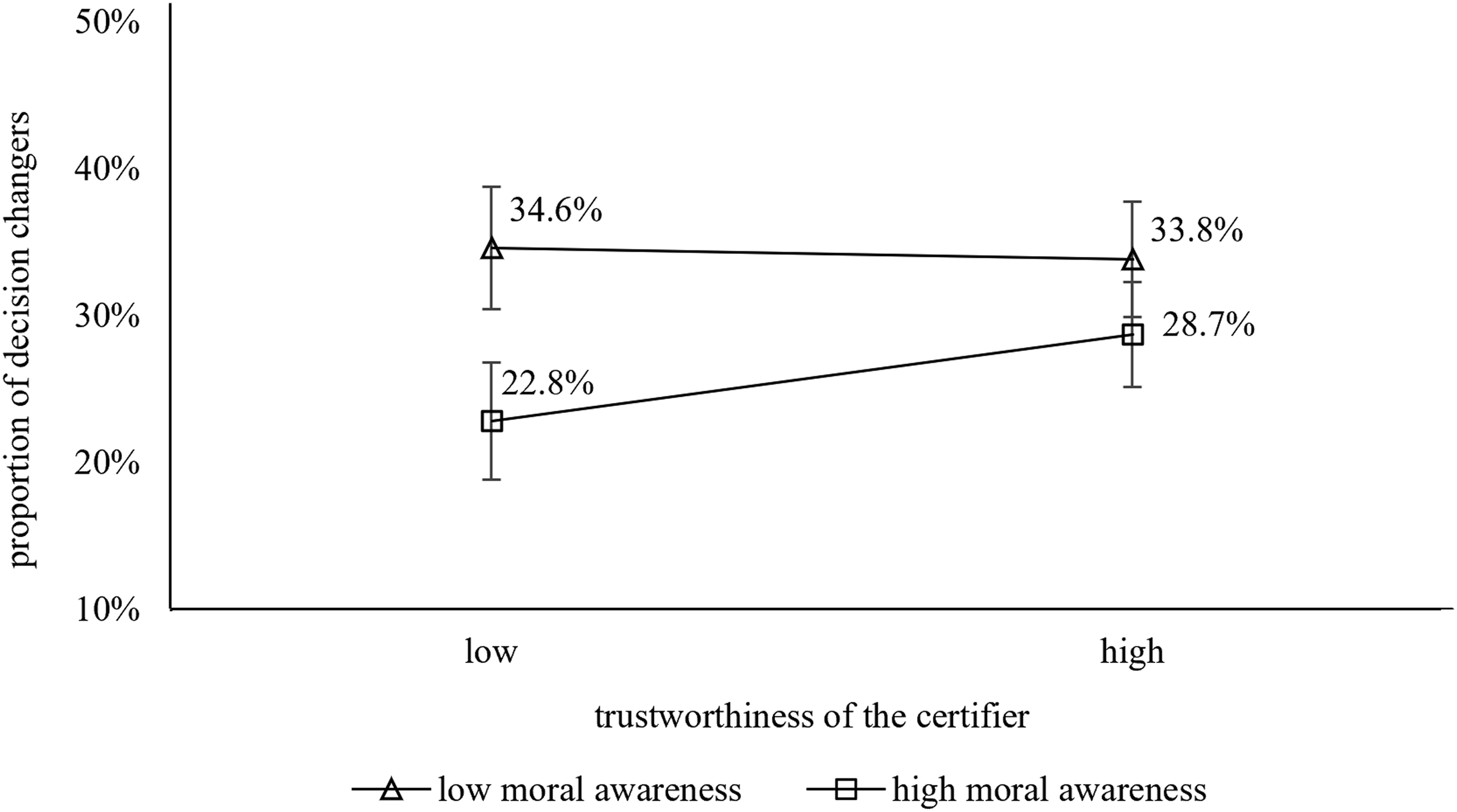
Distribution of failed checks across groups

In addition, we split the data according to the moral intensity and investigated the influence of trustworthiness of AI certifier on decision change in both subgroups by conducting additional χ 2 -tests. However, there was neither a significant dependence in the low moral intensity situations, χ 2 (1, 272) = .020, p = .888, φ = −.009, nor in the high moral intensity situations, χ 2 (1, 274) = 1.21, p = .271, φ = .067.
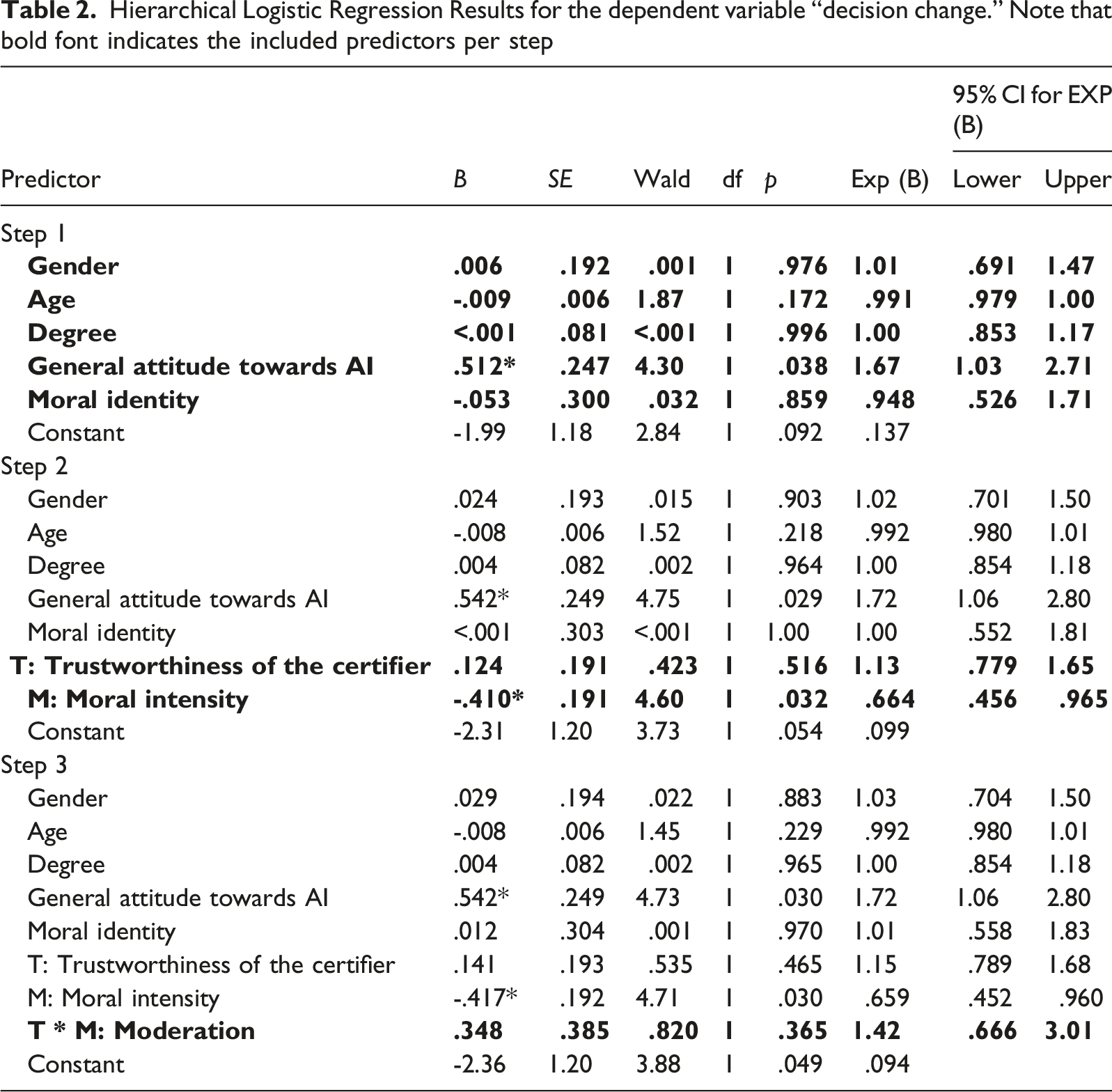
Overall, the results from the regression model do not support H1. Instead, the control variable general attitude towards AI, Wald χ 2 (1) = 4.73, p = .030, and the independent variable moral intensity of the situation, Wald χ 2 (1) = 4.71, p = .030, were found to be significant. The significant main effect for the influence of moral intensity on decision changes was also confirmed by a χ 2 -test of this relationship, χ 2 (1, 546) = 4.05, p = .044, φ = −.086, whereas no significant main effect for trustworthiness of the certifier was found, χ 2 (1, 546) = .263, p = .608, φ = .022.
Hierarchical Logistic Regression Results for the dependent variable “decision change.” Note that bold font indicates the included predictors per step
Discussion
With the increasing use of AI, certification labels are discussed as a potential solution to quickly indicate the trustworthiness of AI systems. As a tool to address information asymmetries and incentivize ethically aligned behavior, labels provide information about AI systems and the organizations involved with those systems (Cihon et al., 2021). They can increase trust in AI systems (Stuurman and Lauchad, 2022), in particular when the certifier is considered as trustworthy (Scharowksi et al., 2023; Wischnewski et al., 2024), which may be pivotal in EDM situations with high moral intensity (Scharowski et al., 2023). Therefore, we hypothesized the likelihood of changing a decision due to AI-generated recommendations to be affected by the interplay of a situation’s moral intensity and the trustworthiness of an AI system’s certifier. Specifically, we expected individuals to change their minds due to AI recommendations in situations of high moral intensity only if the certifying AI institution was deemed trustworthy. Conversely, we expected the trustworthiness of the AI certifying institution to be independent of the likelihood of people changing their mind in situations with low moral intensity. However, statistical analysis did not confirm the expected interaction effect but revealed a significant main effect for moral intensity and, incidentally, for general attitude towards AI. As our hypothesis has not been confirmed, we also discuss the role of general attitude towards AI in light of our incidental findings.
First of all, statistical results raise the question why trustworthiness of AI certifiers did not affect the likelihood of AI-induced decision changes. From a methodological viewpoint, the gap in perceived trustworthiness between the institutions EU and the US tech company was not as pronounced as anticipated, particularly within the US sample. This marginal disparity in trustworthiness among the certifiers may have diminished or even overshadowed the anticipated effect. Participants were recruited from the United States, while the high-trust condition referred to an “Ethical Committee of the European Union,” which may have been perceived as geographically and institutionally distant or unfamiliar. In contrast, the used US tech company as a ubiquitous company represents a highly familiar and widely used technology brand in the U.S. Therefore, this company may be viewed positively or neutrally, not necessarily as “untrustworthy.” Further, prior research shows that brand familiarity significantly enhances trust, as familiar brands allow individuals to rely on prior experiences when evaluating credibility (Ha & Perks, 2005). Consequently, the manipulation may have inadvertently contrasted institutional unfamiliarity with brand familiarity rather than purely contrasting perceived trustworthiness levels. In addition, participants may have considered the trustworthiness in terms of the company’s competence as quite high (Lui & Ngo, 2004). Despite potential concerns regarding data privacy and other aspects of integrity trust, a certain degree of competence trust could still have been assigned to the company. In turn, conceptually, the used US tech company does not represent an untrustworthy but rather a controversial and ambiguous certifier.
Alternatively, the lack of effect may result from the organizational setting described in the vignette scenario. From a theoretical viewpoint, participants in their imagined role as employees could have assumed that the deployed AI system has already undergone extensive evaluations and controls to ensure alignment with the company’s extant regulatory framework and ethical principles (Gkinko & Elbanna, 2023). This assumption could have led participants to the conviction that another person in charge has already taken responsibility without knowing who this person might be (Smith et al., 2025) and freed them from their responsibility. This rationale is in line with recent findings indicating that adoption of AI technology has a negative impact on employees’ responsibility (Wang et al., 2023) and that trust in technological systems employed in workplace settings is highly multidimensional and stems from the trustworthiness in the involved institutions such as the employer (Kopp, 2024; Sullins, 2020). This could ultimately result in the trustworthiness of the certifier becoming less relevant in the decision-making processes employed in this study, also given the multitude of relevant antecedents for human–AI trust. However, this study did not collect corresponding data so this assumption remains speculative.
Another explanation concerns the AI system’s behavior to consistently recommend the alternative option, which may have intensified resistance and reduced reliance independently of certification cues. Research indicates that discriminatory behavior in AI contexts can be influenced by choice congruency (Zhuang et al., 2025). Therefore, by always recommending the other employee to let go, participants could have been reluctant to rely on the system. Existing research even hypothesizes that the development of one’s aversion is dependent on one’s unconscious bias against AI as the unknown “species” (Turel & Kalhan, 2023). Additionally, participants may have perceived the system as threatening and been therefore biased against the AI systems due to their inherent aversion rendering the certifier and trustworthiness of the system as irrelevant.
Similarly, prior vignette-based studies showed that AI-based decisions in HR contexts are often perceived as less fair, less respectful, and less consistent with human dignity than human decisions (Bankins et al., 2022; Formosa et al., 2022). At the same time, AI assistance alters perceptions of agency and responsibility (Formosa et al., 2025) and underscores the importance of meaningful human oversight (Zinopoulos et al., 2025). In light of this, participants may have considered it as less respectful to base their decision on an AI-generated recommendation and may have perceived a need for a human decision. If they deem the use of an AI decision support system to be unjustified due to the direct impact on an individual’s life, the trustworthiness of the certifier becomes irrelevant. Furthermore, it is possible that even if they did not hold this opinion, a lack of conviction in terms the AI’s ability to derive meaningful recommendations could have led participants to ignore the AI output.
In conclusion, many methodological and theoretical aspects resulting from the vignette-based study design and the complexity of the decision processes with the involvement of a multitude of possibly relevant constructs can explain the measured lack of effect of certifier’s trustworthiness. As these rationales are speculative in light of the employed research design, they call for a replication with an increased number of measured variables such as organization’s environment, trustworthiness of the AI system and trust in the organization, and its quality assurance procedures (Bélanger & Carter, 2008; Gefen et al., 2003).
Secondly, statistical results reveal that lower moral intensity increases the likelihood of decision change due to AI suggestions. The found influence of moral intensity is in line with previous research demonstrating that the level of stakes significantly affects trustworthiness, stating that the use of AI in low stakes scenarios is associated with higher trustworthiness (Ashoori & Weisz, 2019). In our study, participants were more likely to change their decisions in the scenarios with low moral intensity. More precisely, our results support prior findings that the likelihood of trusting, recommending, and using algorithms is higher in low moral intensity scenarios than in high moral intensity ones (Marmolejo-Ramos et al., 2024) because AI involvement in HR decisions is evaluated critically in terms of fairness, dignity, and respect (Bankins et al., 2022; Formosa et al., 2022). In such high-stakes situations, delegating responsibility to AI may be perceived as morally inappropriate, limiting the additional value of certification labels.
Thirdly, the results of this study highlight the impact of the general attitude towards AI on decision behavior. This suggests that individuals bring important baseline evaluations of AI into decision situations, which can shape their responses to a concrete AI system irrespective of its contextual cues such as certification labels. Existing research considers general attitude toward AI as embedded in broader dispositional and emotional factors, which shape technology use (Kaya et al., 2024; Kiremit et al., 2026; Rózsa et al., 2025). In line with this, Xue et al. (2025) extended the UTAUT at a meta level by incorporating risk perception, technology anxiety, and personality traits as moderators of use behavior. This broader perspective stresses the significant impact of individual characteristics on the perception and evaluation of AI systems, apart from situational or institutional cues. For instance, research shows that individual technology affinity and propensity to trust increase openness to AI advice and reliance behavior (Agrawal et al., 2023; Calluso & Devetag, 2025), whereas AI anxiety is associated with negative attitudes toward AI (Cengiz & Peker, 2025) and can reduce technology usage by lowering perceived usefulness and ease of use (Troisi et al., 2022). Furthermore, AI anxiety and AI appreciation appear to shape how individuals interpret external validation cues. Individuals with strong AI anxiety tend to favor transparency and external validation, whereas individuals with high AI acceptance prioritize reliability and fairness metrics (Cetinkaya & Krämer, 2025). Consequently, participants with high AI acceptance levels may have primarily based their decisions on their general positive attitude toward AI irrespective of the concrete AI system’s features and certifications. By contrast, individuals with lower AI acceptance may have relied more strongly on external indicators of trustworthiness, such as certifiers, to compensate for their initial uncertainty regarding AI systems.
In summary, while prior studies have demonstrated that certification labels can enhance trust in AI and encourage its utilization (Stuurman & Lachaud, 2022; Wischnewksi et al., 2024), our findings indicate that AI-supported EDM may depend to a larger extent on contextual and individual human factors. Whenever employees perceive high institutional trust due to their organizational environment and experience high moral intensity due to the given decision situation, certification labels may provide limited additional value. In morally intense situations—such as termination decisions—concerns about fairness, dignity, and responsibility may lead to a low tendency to rely on AI suggestions irrespective of trustworthiness cues. Apart from moral intensity, an individual’s general attitudes toward AI play a more pivotal role in AI-supported ethical decision-making. However, due to the limited number of measured variables, these incidental findings lack robustness and therefore, call for explicit consideration in future research. Nonetheless, our results support existing literature recognizing the level of stakes and moral intensity as crucial factors in relying on AI recommendations in organizational decision-making.
Limitations and Future Directions
One limitation of the current work is the conduct as an online study with a single decision situation in a fictitious vignette scenario without real-life consequences. In a real-world dismissal scenario, making a firing decision and later reversing it based on a single line of text from an AI needs careful consideration and explanation, whereas the cost of changing the decision in an online survey is zero, limiting this study’s construct validity. Although subjects considered the scenario as realistic, the decision had no tangible impact on real people. Hence, this limits their moral engagement and the ecological validity of the study, which may have diminished or distorted the respective effects.
Relatedly, relying on a single scenario is a methodological limitation because ethical decision-making is highly context-dependent and strongly influenced by the specific nature of the dilemma, the domain in which it occurs, and participants’ subjective interpretation of the scenario. The present study focused on an HR termination decision, which may require domain-specific knowledge and may not equally resonate with all participants. They may have lacked sufficient information to reach an informed decision, thereby compromising the validity of the collected outcomes. As a result, the findings cannot be generalized to other types of moral dilemmas, organizational settings, or AI-supported decision domains without caution.
In addition, although both manipulations proved to be effective, effect sizes were small, which may have overshadowed an interaction effect, also given the limited statistical power due to the binary dependent variable. Future studies should enhance ecological validity, for example, by conducting field experiments and recruiting subjects who are required to make similar decisions at work. Beyond single-exposure design, future research could examine reliance longitudinally and across repeated interactions with AI systems, investigating the impact of certification by varying issuer familiarity and institutional type. This could include the use of unknown or less familiar certifiers to attenuate the effects of brand familiarity and prior exposure. It could also examine how this is influenced by constructs like moral panic.
Another drawback of online studies is that subjects cannot be observed during data collection, which may diminish data quality. To minimize this issue, we incorporated several attention checks and conducted a thorough data cleaning following the data collection in order to eliminate straight liners and speeders.
The study focused on decision change as the key independent variable. While this design has its strengths, it also limits the generalizability of the results to situations in which the AI becomes relevant after an initial human decision. In addition, it confounds results with individuals’ overall willingness to revise and change former decisions. Furthermore, distributions for initial discussions were not exactly equal across both employees. Most likely, subjects had considered it more appropriate to dismiss one employee due to the described personal background. However, since the initial and subsequent decision were statistically independent, this should not have significantly influenced our primary analysis.
In the interest of optimizing data collection efficiency and ensuring a balanced approach that does not burden respondents, we decided to omit additional potentially relevant constructs, such as the trust placed in the AI system or the trust in the employer’s internal quality assurance processes. These could have facilitated a more in-depth exploration of the varied impact and relevance of individuals’ general attitudes towards AI. Future work should incorporate a greater number of personality traits and measures of trust in order to conduct a more in-depth investigation of the complex interplay of these variables and to achieve a model with a larger explanatory power. These studies should seek to determine to what extent personality traits (such as general attitude towards AI), features of the AI (such as the certifier’s trustworthiness), and external factors (such as trust in the employer) influence the decision-making process, respectively.
Practical Implications
Company representatives should be aware that their employees handle AI suggestions differently depending on the perceived moral intensity of a situation. Thus, they should ensure that employees assess the moral intensity of decision-making situations and the trustworthiness of AI system signals adequately when deciding whether to follow AI recommendations. This could also mitigate over-trust phenomena in situations with a high perceived moral intensity and reduce the risk of uncritical reliance on AI-generated recommendations. Furthermore, company representatives should be aware that the impact of certification labels from trustworthy companies may considerably differ dependent on a multitude of personal, organizational, and external factors. If company representatives seek to support appropriate use of AI systems, they should primarily consider fostering their employees’ general attitude towards AI.
Key Points
• Decision changes due to AI recommendations are more likely in low moral intensity workplace scenarios. • The perceived trustworthiness of the AI certifier does not significantly influence decision changes. • A more positive general attitude toward AI increases the likelihood of changing decision due to AI-based suggestions. • The findings suggest that general attitudes toward AI may outweigh perceived certifier trustworthiness in influencing reliance on AI recommendations.
Footnotes

Funding
This research and development project was funded by the German Federal Ministry of Research, Technology and Space (BMFTR) within the “The Future of Value Creation – Research on Production, Services and Work” program (02L19C250) and managed by the Project Management Agency Karlsruhe (PTKA). The authors are responsible for the content of this publication.
Declaration of Conflicting Interests
The authors declared no potential conflicts of interest with respect to the research, authorship, and/or publication of this article.