






Abstract
Objective
This work analyzes the influence of egocentric versus exocentric viewpoint on the ability of a human supervisor to appropriately takeover or handoff manual control during a spacecraft’s automated rendezvous and docking (ARD) motion.
Background
Previous work showed that automated spacecraft motion factors of initial condition and path curvature influenced supervisor perception of the system and subsequent decision to take over manual control. It was hypothesized that viewpoint may influence the human supervisor’s interpretation of motion trajectories.
Methods
A simulated automated docking procedure was monitored using a Virtual Reality headset by n = 42 participants from three viewpoints (one egocentric and two exocentric perspectives). Monitoring path motion with no prior knowledge of the spacecraft’s targeted dock, participants determined which of two docks the spacecraft was targeting and either asserted manual control or relied on the automation to complete the maneuver. Decision outcomes were analyzed between viewpoints to assess if differences in perspective influence operational decision making on spacecraft paths.
Results
The egocentric viewpoint supported correct takeover and handoff decisions further from the dock. Path characteristics that enabled better or worse decision-making performance differed between egocentric and one exocentric viewpoint but were similar to the other exocentric view.
Conclusion
In addition to existing factors of initial condition and path curvature, supervisor viewpoint significantly influences ARD operational decision making. However, these factors did not account for all differences in outcomes between viewpoints.
Application
Findings inform human-aware motion plan algorithm design for automated spacecraft systems. Locations of cameras used by observers of ARD maneuvers can also be informed.
Keywords
Introduction
As space missions plan for Mars, crews will have increased workload as a result of limited real-time support from mission control. Incorporation of automation into spacecraft systems could mitigate increased crew workload, but could also exacerbate their workload by presenting new tasks requiring additional cognitive resources (Sarter et al., 1997). Adverse outcomes due to inadequate human–systems integration has been identified by NASA as high-risk for future space missions (Buckland et al., 2022), requiring increased knowledge on automation influences. Automated Rendezvous and Docking (ARD) maneuvers facilitate the joining of two spacecraft, which is critical for a multitude of spacecraft mission functions such as crew exchange, resupply and repair, and assembly and retrieval (Fehse, 2003; Polites, 1999; Woffinden & Geller, 2007). While there are efforts to fully automate ARD processes, such as in the SpaceX Crew Dragon spacecraft, current systems still require full supervision from the astronaut, which was critical in the June 2024 Boeing Starliner mission (Garcia, 2024). Despite efforts to fully automate the process, ARD still poses a high-risk of adverse outcomes if not designed to support effective human–automation interaction. The objective of this paper is to assess the effect of supervisor viewpoint perspective on operational decision making in ARD processes.
The influence of viewpoint perspective on a human supervisor’s situation awareness (SA) (M. Endsley, 1995) and decision-making performance has been examined across aerospace systems (Olmos et al., 2000; Wickens & Prevett, 1995). Wickens and Prevett (1995) determined that egocentric perspectives support local guidance and exocentric perspectives support global SA in aircraft navigation. In addition, simultaneous use of multiple perspectives presented challenges in how attention should be distributed between the two display versions (Thomas & Wickens, 2001). When supervisors monitor autonomous systems, they can experience loss in SA that negatively affects their decision making because they are out of the control loop (M. R. Endsley, 2017; M. R. Endsley & Kiris, 1995). Interfaces must support automation transparency to mitigate the loss in SA (M. R. Endsley, 2017) while also managing finite attention resources (Wickens, 2008), which are both influenced by viewpoint. One opportunity to support automation transparency is considering how the supervisor interprets the motion of the observed autonomous agent within the design of the system’s trajectory. Motion compatibility considers how differences between an operator’s control reference frame and the reference frame of the observed environment influence performance (Ellis & Adelstein, 2014). For an example of supervisor viewpoint effect on motion compatibility, a person walking up a steep ramp that is observed from the side of the ramp will have the person’s ascent observable; but if the motion is observed from a top-down perspective, the vertical ascent can be obscured. Similarly, the compatibility of an autonomous agent’s motion with a human supervisor’s viewpoint may influence inferences about the agent’s goals. However, it is unclear how viewpoint influences motion monitoring predictions of future states in an ARD task.
Path legibility is a construct presented in controls and automation literature that describes how accurately an observer of an automated agent’s real-time motion can infer the target of the agent’s motion given no prior knowledge of the target (Dragan et al., 2013). This version of legibility is distinctly different from legibility studied with respect to text, formatting, and print in user-interfaces, which is well-studied in the human factors domain. In a previous study, participants observed automated spacecraft docking motions from an egocentric view (Larson & Stirling, 2025). A manual-takeover distance metric was used to define path legibility, as the metric provided context on when and where in a path the monitor had sufficient confidence in the end-point to make a decision. This metric aligns with participant situation awareness (SA) (M. Endsley, 1995) as it required projecting future states of the system to make a decision, and it was found to be correlated with participants’ expectations of appropriate agent motion (Larson & Stirling, 2024, 2025). Motion plan factors of the spacecraft (initial condition and path curvature) significantly influenced the distance from the targeted dock that supervisors asserted manual takeover, indicating they were projecting the motion of the agent based on the current and previous states of the system. What were defined as the most legible paths in Larson and Stirling (2025) enabled the supervisor to correctly identify that the agent’s docking target was incorrect, leading to a manual takeover at a greater distance from the docks than in less legible paths. When the most and least legible paths from Larson and Stirling (2025) were compared to previous studies by Dragan et al. (2013); Nikolaidis et al. (2016), which analyzed legibility of a robotic arm grasping motion supervised from an exocentric viewpoint, differences in path characteristics were observed. While legible paths in Larson and Stirling (2025) tended to be more direct to the target, Dragan et al. (2013) found less-direct, laterally exaggerated reaching motions better conveyed the robotic arm’s reaching target. It is unclear if the result discrepancies between these studies could be due to the differences in supervisor perspectives—the egocentric viewpoint in Larson and Stirling (2025) and the exocentric viewpoints in Dragan et al. (2013) and Nikolaidis et al. (2016).
In this study, participants monitored automated docking maneuvers from egocentric and exocentric viewpoints. Supervisors were given no prior knowledge of which of two visible docking targets the agent intended to capture and assessed whether the agent needed a corrective action based on their perception of the agent’s docking target. We analyze agent path legibility using distance metrics and examine the conflict in recommendations on path legibility in the literature by incorporating two exocentric viewpoints alongside the original egocentric perspective in the automated docking task. In addition to manual takeover decision tasks in failure scenarios, an automation-handoff decision modality was also incorporated. We hypothesized (1) that the egocentric viewpoint would best support path legibility, as measured by the defined distance metrics, compared to exocentric viewpoints and (2) characteristics of the most and least legible paths would vary between viewpoints.
Methods
This study expands upon the simulation environment and game objectives described in Larson and Stirling (2025). In addition to the existing egocentric viewpoint participants used for agent motion monitoring, two exocentric viewpoints were incorporated.
Participants
Participants (n = 42, 22 male, 17 female, 3 non-binary; mean age 29.6 years, range 20 – 72 years, SD = 10.1), including mostly university students and some staff, provided written informed consent prior to performing the study. Procedures were approved by the University of Michigan Institutional Review Board (HUM00219137). Participants were required to have no self-reported audio, neurovestibular, or corrected visual limitations and no self-reported epilepsy, vestibular disease, screen-induced headaches and/or migraines, dizziness, vertigo, or nausea from an immersive virtual reality environment. Other exclusion criteria included propensity towards motion sickness or complications of the head and neck that may be harmed by wearing a VR headset. Participants were surveyed about their previous experience with video games and VR to contextualize the population’s digital literacy. These survey results are presented in Supplemental Material Figures 1 and 2.
Simulation Environment
Unity software was used to develop and deploy the simulation on a Meta Oculus Quest 2 VR headset. The simulated space environment consisted of an agent using preplanned docking paths to autonomously dock at one of two visible stations, represented as spherical targets, on a mock-up space station (Figure 1). The docking task monitored was simplified from realistic docking so that the participant focus was on motion monitoring and decision making without the added task of docking axis alignment in a six degree-of-freedom space. Unity-based simulation elements and camera placements for monitor viewpoints. Exocentric (Side and Isometric) cameras show the direction of observation with a light-blue field-of-view (FOV) illustration. Figure 2 shows what each camera’s FOV looked like to the viewer.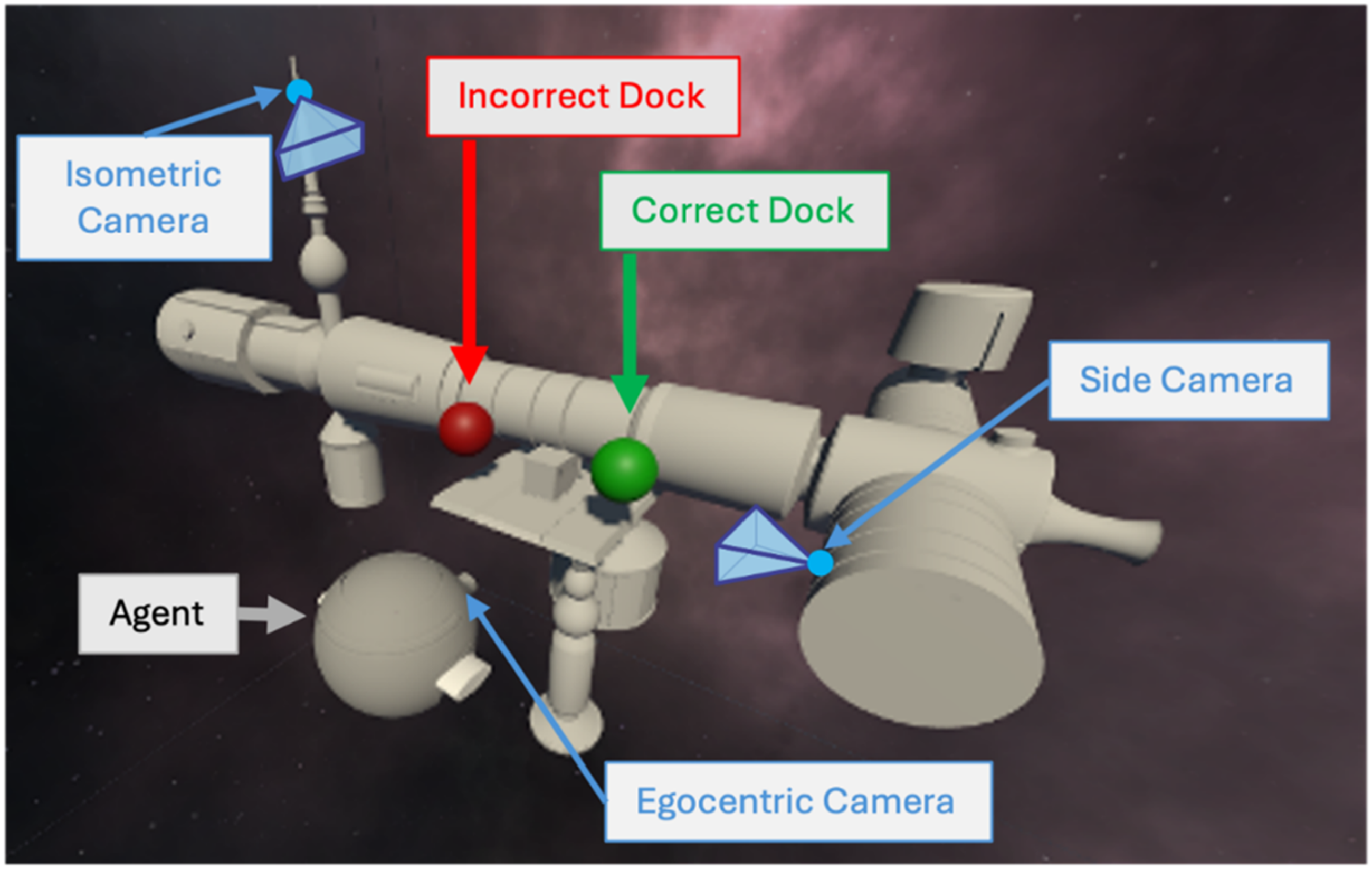
The three selected viewpoints provided different depths and perspectives for monitoring the agent (Figures 1 and 2). The two exocentric viewpoints (side and isometric) were created using camera placements that were anchored to the space station, as current camera systems used for inspection are anchored to the International Space Station (ISS) (Moore, 2014). In the egocentric viewpoint, participants monitored the docking maneuver from a camera perspective on-board the vehicle approaching the station, the same used in Larson and Stirling (2025). The side view provided a lateral perspective with a close-up view of the docking targets. The isometric view was created by positioning the camera at the highest point of the space station, behind the docks, with the camera pointing downward. Snapshots of the three different viewpoints provided by the camera placements in Figure 1 used by the supervisor to observe agent motion. The egocentric view is shown on the far-left. The two exocentric views are the side (middle image) and isometric (far-right image).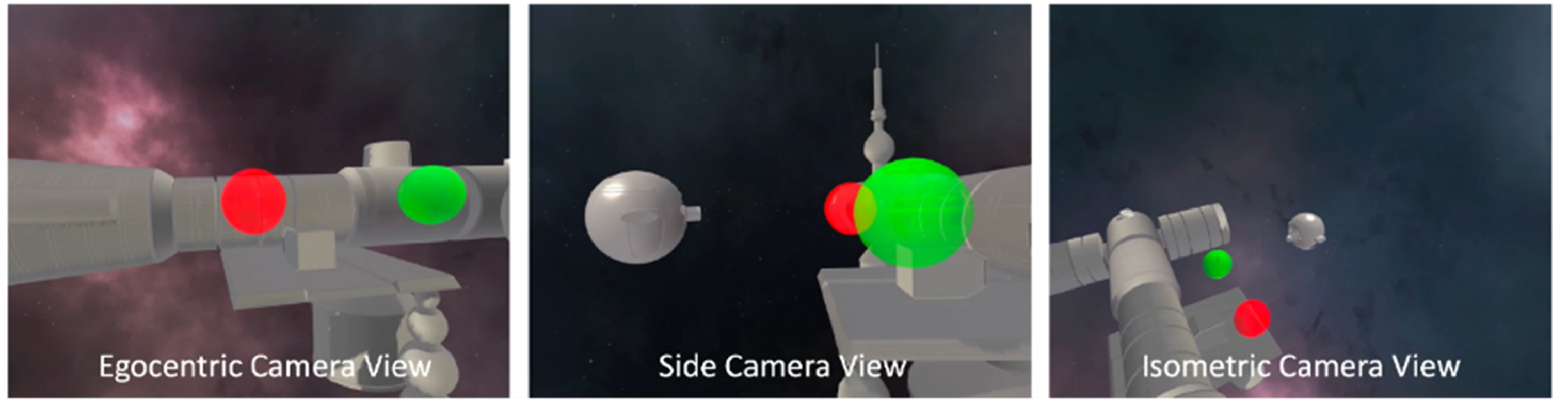
The automated docking paths generated for this study were simplified from multi-phase docking maneuvers in the same way as the previous study (Larson & Stirling, 2025) to examine fundamental path design characteristics as experimental factors. Paths were generated offline using the optimization-based methodology outlined in Larson and Stirling (2025) supplemental material, which was adapted from McNaughton et al. (2011). The maximum deviation from the central path in this study ranged between 0 and 7 units (whereas the previous study was 0−5) to make lateral and medial paths more prominent. Ranges in path deviation scores, a measure of a path’s spatial deviation from the central tendency in the spatiotemporal lattice (Larson & Stirling, 2024), were consistent across initial conditions.
Three initial conditions and three path categories were utilized to characterize the path traversed by the agent (Figure 3). Lateral and medial path categories were defined in relation to the central (middle) path in the library. Lateral paths turned the agent in the counter-clockwise direction in the first portion of path traversal (between 0 and 10 units in the y-axis of Figure 3), while medial paths turned the agent in the clockwise direction. The docking target positions were chosen to foster uncertainty in the target so participants had to rely on their projections of the agent’s motion to make a decision. Additionally, path traversal was sped up compared to realistic docking maneuvers to allow for enough trials in the experiment to draw statistically significant conclusions on the decision data. The agent traversed all paths using the same speed profile, which slowed the agent down upon approaching its target but took between 10 and 15 seconds per trial. In total, 42 paths were created with half targeting each dock. For each initial condition and dock, there were three paths in each lateral and medial group and one central path. Schematic of trial results with selected action shown as T (takeover) or H (handoff). Incorrect and successful docking trials are not illustrated (Table 1). The three path categories (lateral, medial, central) and the three initial conditions are depicted. Takeover Distance and Handoff Distance are illustrated as the 2-norm distance between the takeover or handoff point and the red or green dock. Late takeover and late handoff halos defined the area in which a takeover or handoff decision was considered late.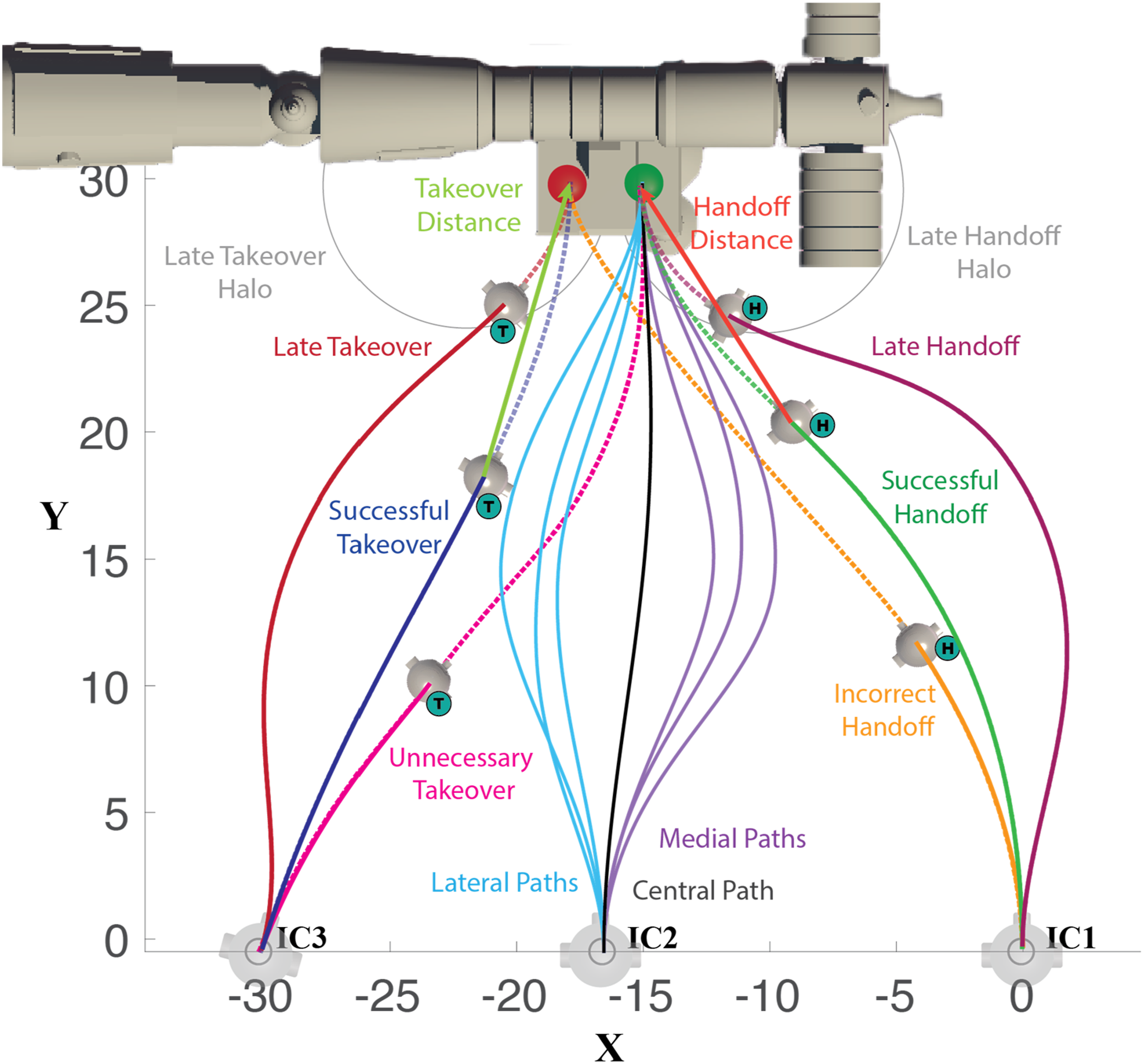
Experimental Task
The participant’s task was to continuously monitor the agent’s docking maneuver and make decisions based on the agent’s projected target. Participants were not made aware of which dock the agent was targeting. If the participant believed the agent was targeting the red dock (which they were instructed to avoid), participants asserted a manual takeover mode which transferred control from the agent to the participant. If the participant inferred the target was the green dock (the desired target), they had a choice to either allow the agent to finish docking at the green target with continued observation or assert an automation handoff mode, ending the trial. In automation handoff mode, the participant gave system control to the agent to finish out the docking maneuver without supervision. Participants engaged both manual takeover and automation handoff maneuvers by pressing the assigned buttons on the VR controllers. The trial ended after a takeover or handoff decision was made or a docking maneuver was completed to the target with no intervention. Because this study analyzed the decision-making process, participants were not required to perform corrective manual docking maneuvers after a manual takeover or observe the rest of the maneuver after automation handoff.
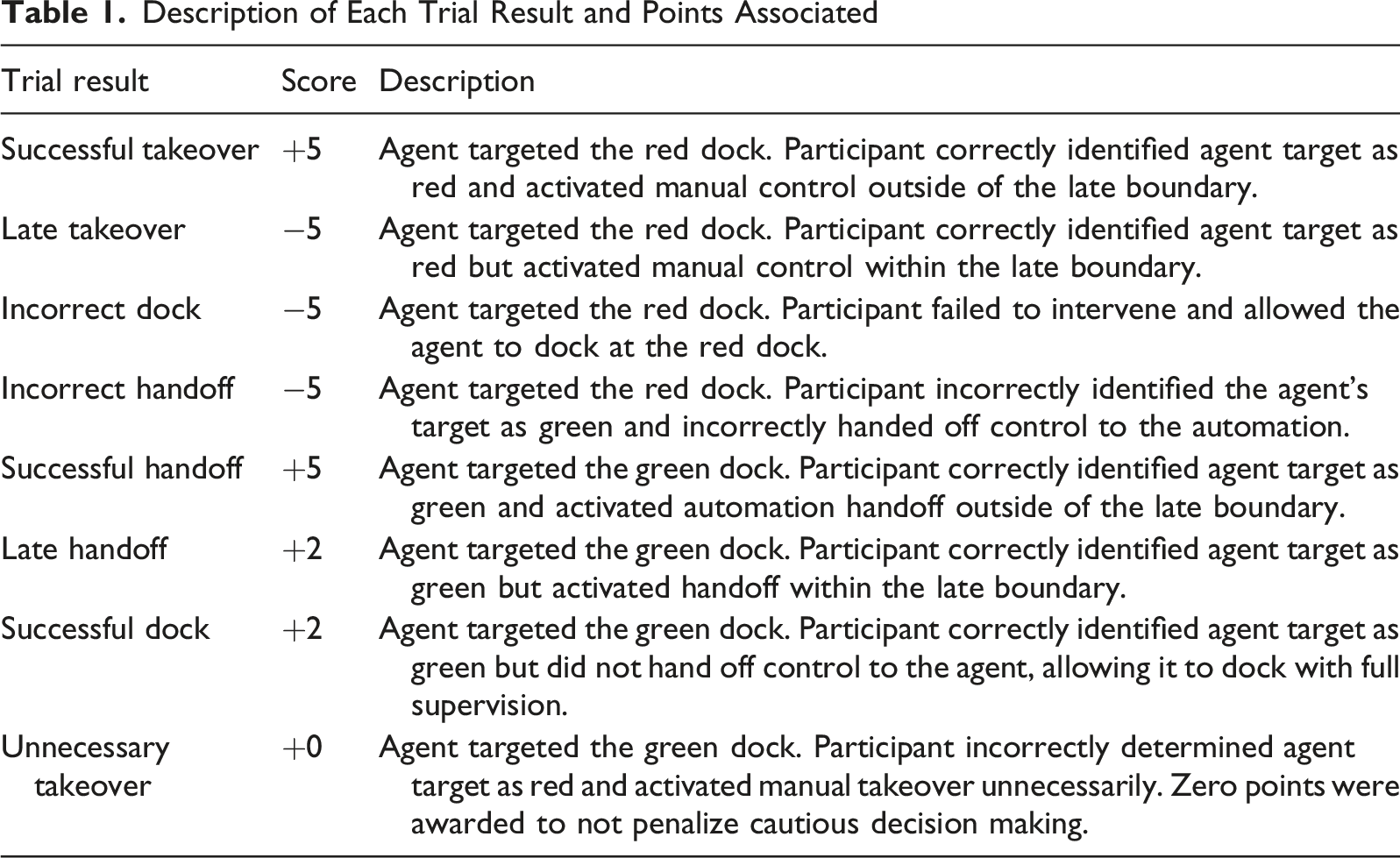
Description of Each Trial Result and Points Associated
Experimental Procedure
Participants were trained on how to use the VR headset, including hand-controller button functionality. An introductory module performed in the headset showed the participant all simulation elements from an exocentric view different from the views utilized in the experimental trials. This module prompted observations of the agent traversing a path targeting each dock, followed by a manual takeover and automation handoff maneuver so that they could gain experience utilizing each button on the controllers. Next, a training module was performed, in which participants were given instructional prompts while monitoring docking maneuvers and performing takeover and handoff decisions from each experimental viewpoint, including learning the scoring system.
To test their training, participants completed a validation phase, which was a shortened version of the experimental trials with no instructional prompts. Participants had to achieve a score of 80% successful trials in each validation viewpoint module to start the experiment. If the score was not achieved, training and validation of the failed viewpoint module was repeated. Only two participants required an additional round of training and validation, while 40 passed on the first try.
The experiment was a within-subjects design. To account for order effects, each distinct order of viewpoint modules was performed by an equal number of participants (seven subjects for six viewpoint orders). Participants monitored 54 docking maneuvers for each viewpoint module, totaling 162 experimental trials per participant, which was determined using a random group sampling analysis of the same dependent variable from previous work (Larson & Stirling, 2025). The order of paths experienced by participants was pseudo-randomized. In each viewpoint module all participants experienced the same order of trajectories. When asked post-experiment, no participants noticed that the path order was the same in each viewpoint module.
Before beginning the experiment, participants completed the Vandenberg Mental Rotation Test (Vandenberg & Kuse, 1978) to assess their spatial reasoning capability and a survey on trust in automation by Merritt et al. (2013). Participants also completed the NASA TLX (Hart & Staveland, 1988) survey after each viewpoint module to assess mental and physical workload. However, these data analyses are left for future work. We also collected self-reported data by asking participants “When you took over/handed off, why did you do so?” after each viewpoint module. These responses are used in the discussion section to contextualize the decision outcomes.
Data Analysis
Legibility Metrics
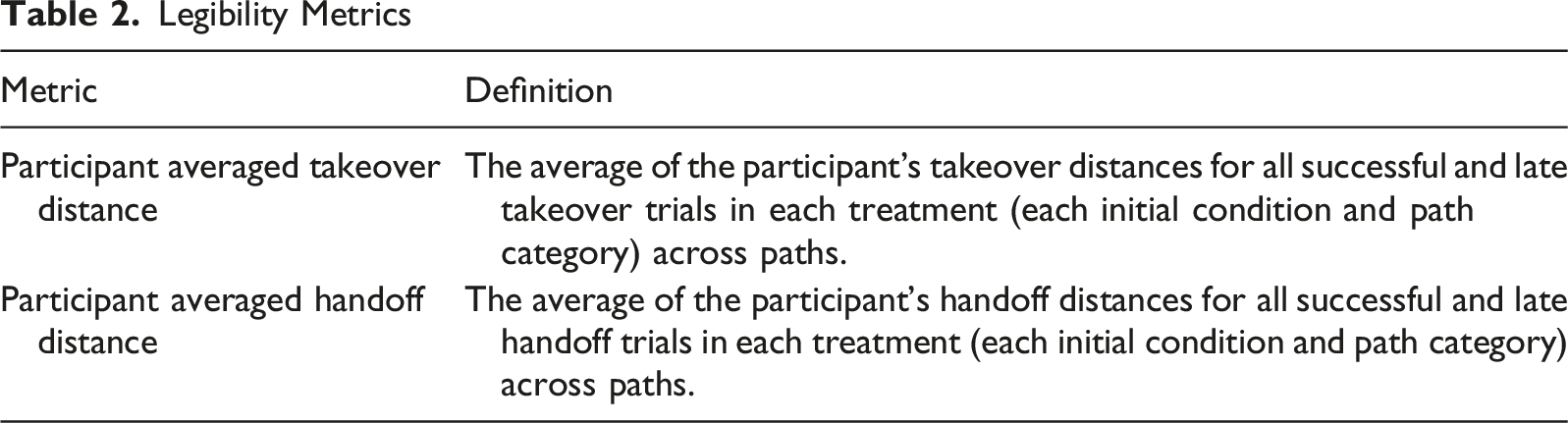
To assess if the three within-subjects factors influenced decisions, repeated measures Analysis of Variance (ANOVA) models were fit to participant-averaged takeover data and participant-averaged handoff data. Both models analyzed factors of initial condition (IC1, IC2, IC3), path category (Lateral, Central, Medial), and viewpoint (Egocentric, Side, Isometric). Sphericity tests were performed, and the Greenhouse–Geisser correction was applied to p-values, ϵ = .22 for takeover data and ϵ = .24 for handoff data. Significance level used for all statistical tests was p = .05. Partial Eta Squared effect sizes were calculated for all factors. The path treatments and viewpoints that best supported overall path legibility for both takeover and handoff cases were determined using post-hoc pairwise comparisons between all groups. All post-hoc comparisons were performed using multiple t-tests with False Discovery Rate corrections (Benjamini & Hochberg, 1995). A corrected significance level of .034 was used.
Results
In all of the total 6,804 trials performed by N = 42 participants, the participant either asserted manual takeover or automation handoff; there were no instances of incorrect docking or successful docking with no handoff. Therefore, while eight trial results were possible (Table 1), we observed only six in the resulting data shown in Figure 4 and Table 4. All experimental data points depicted on each traversed agent path. (Left) All paths that targeted the red dock, requiring manual takeover by the participant. Most trials resulted in successful takeovers (blue), but late takeovers (magenta) and incorrect automation handoffs (orange) were observed. (Right) All paths that targeted the green dock, presenting opportunity for automation handoff. Most trials resulted in successful handoffs (green), but late handoffs (purple) and unnecessary takeovers (pink) were observed.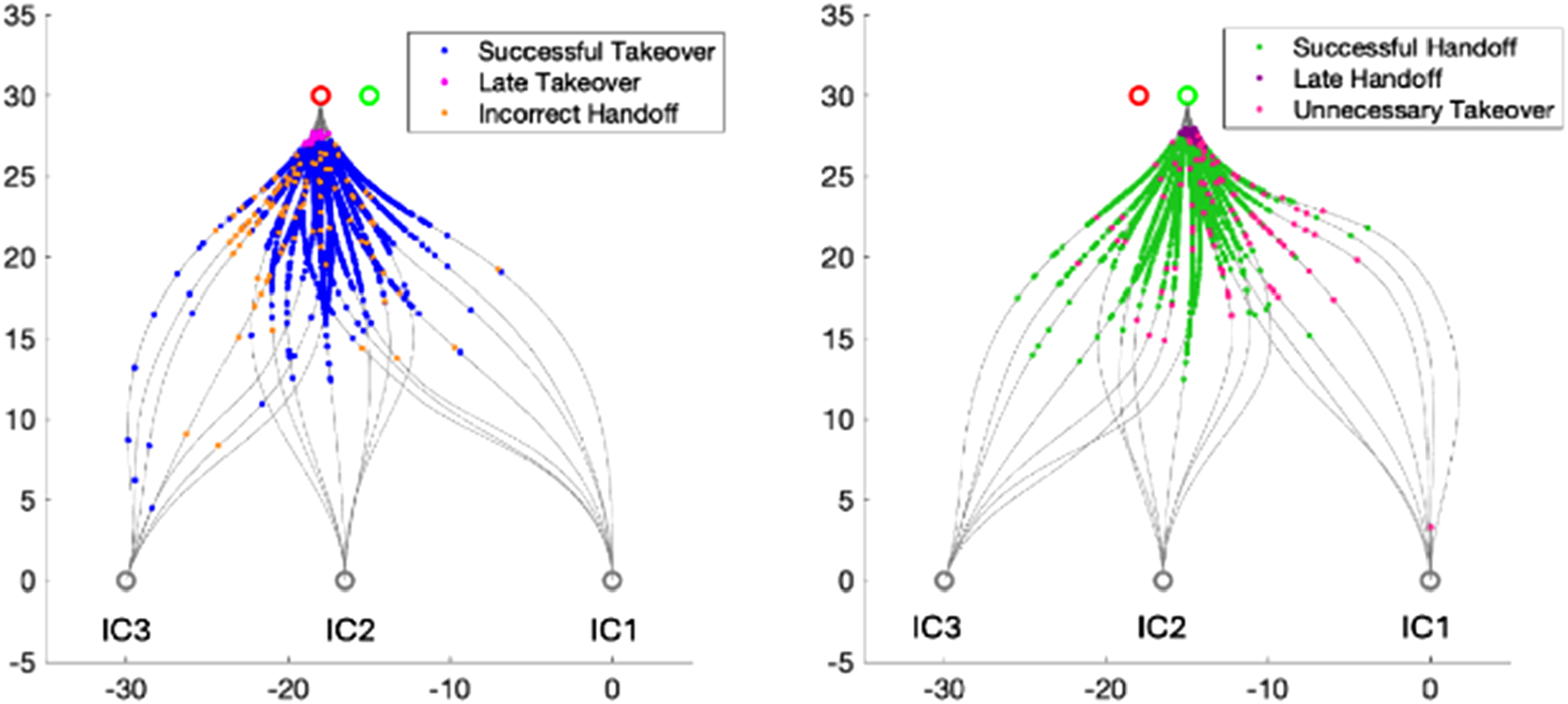
Repeated Measures ANOVA Models for Participant-Averaged Takeover Distance and Handoff Distance
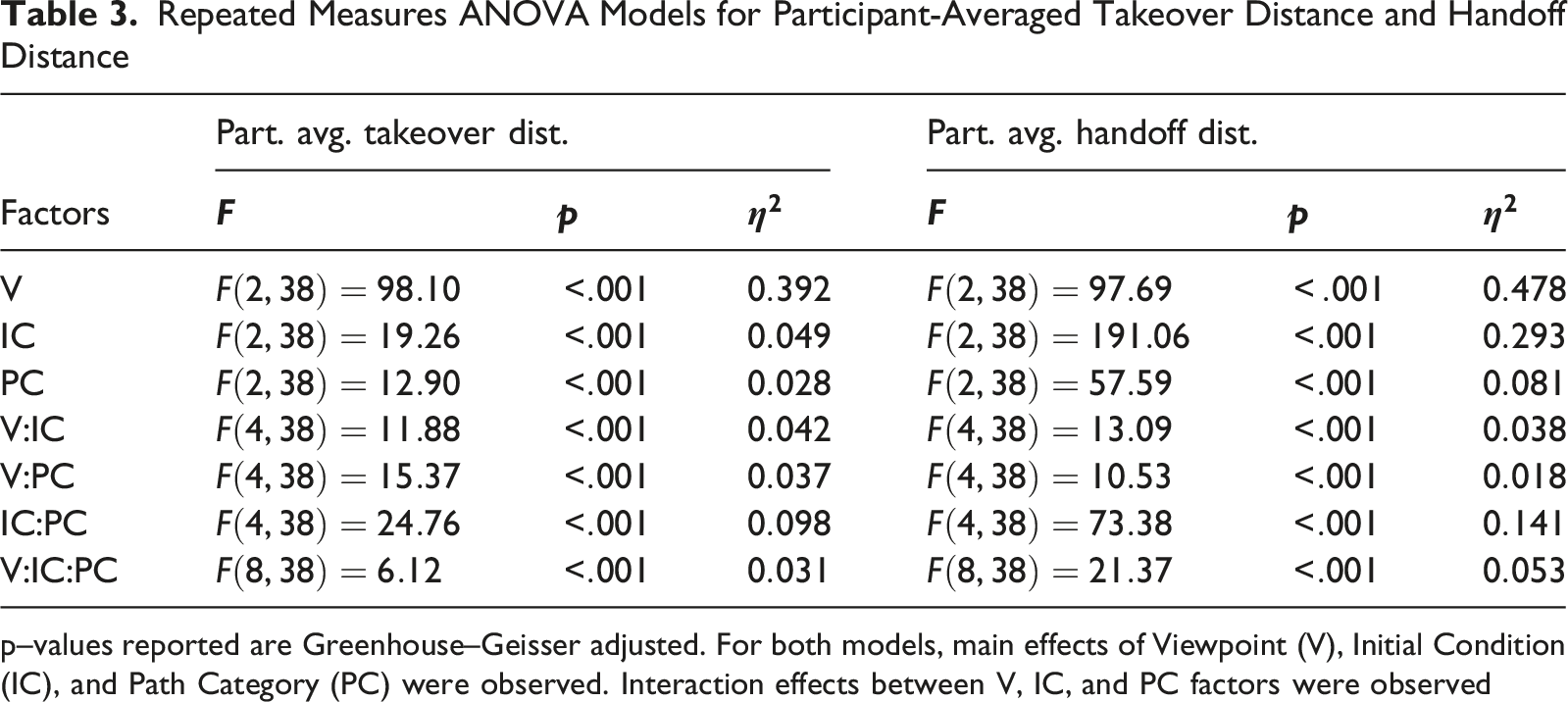
p–values reported are Greenhouse–Geisser adjusted. For both models, main effects of Viewpoint (V), Initial Condition (IC), and Path Category (PC) were observed. Interaction effects between V, IC, and PC factors were observed
Influence of Viewpoint on Legibility
The egocentric view best supported path legibility in the takeover data (Figure 5 (top row)). All groups within the egocentric view had significantly longer participant-averaged takeover distances than the same group observed in the isometric view, illustrated by orange stars in Figure 5 (top row). The IC3 lateral group in the side view also showed longer participant-averaged takeover distance than the same group in the isometric view. Eight of nine groups in the egocentric view showed significantly longer participant-averaged takeover distances than the same group in the side view, illustrated by blue stars in Figure 5 (top row). Comparing the isometric view to the side view, six of the nine groups in the isometric view showed significantly longer participant-averaged takeover distance than in the side view. Participant-averaged takeover (top row) and handoff (bottom row) distances in each viewpoint (column) and path treatment denoted by Initial Condition (horizontal axis) and Path Category (lateral, central, medial). Longer distance value indicates the decision was made farther from the dock, indicating higher legibility. Orange stars indicate the group has significantly longer participant-averaged takeover/handoff distance than the corresponding group in the isometric view. Blue stars indicate the group has significantly longer participant-averaged takeover/handoff distance than corresponding group in side view. Not all statistical differences are shown. All statistical results are provided in Supplemental Material Tables 1 and 2.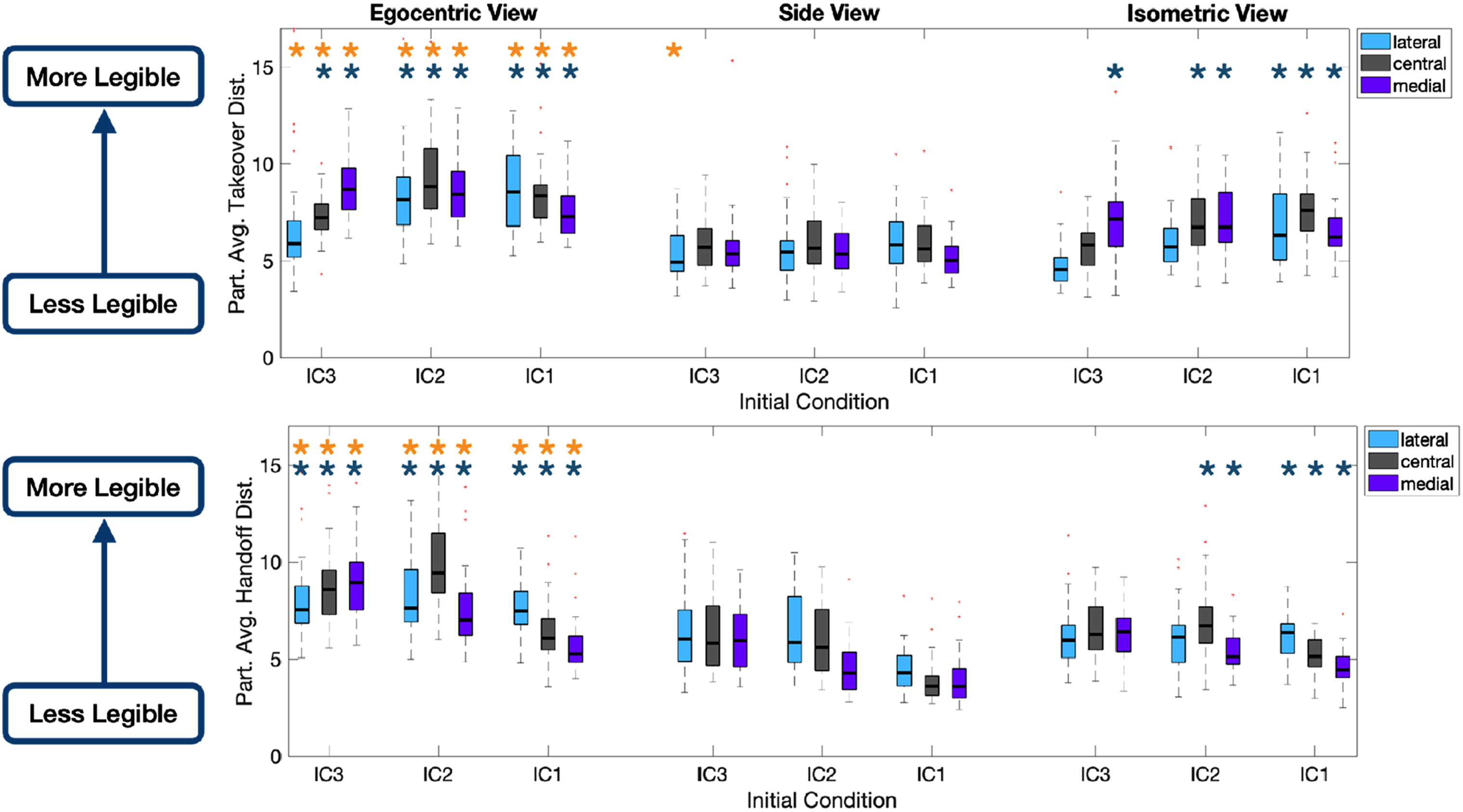
The egocentric view also best supported path legibility in the handoff data (Figure 5 (bottom row)). All groups in the egocentric view had significantly longer participant-averaged handoff distances than the same treatment in both side and isometric views, illustrated by orange and blue stars, respectively, in Figure 5 (bottom row). Five of nine groups in the isometric view showed participant-averaged handoff distances to be significantly longer than in the side view.
Path Legibility Characteristics Between Viewpoints
In the takeover data (Figure 5 (top row)), when comparing the egocentric view to the isometric view, similar relationships between path groups within each view were observed. Within both views, the same five groups were the significantly longest participant-averaged takeover distances—IC3 central and medial, IC2 central and medial, and IC1 lateral and central. There was one exception in the egocentric view where the IC2 lateral group was also one of the significantly longest participant-averaged takeover distances but was not in the isometric view. Both views also had the same group with the significantly shortest participant-averaged takeover distance, IC3 lateral. Within the side view of the takeover data, different relationships between groups were observed compared to egocentric and isometric views; there was not such a distinct difference in most and least legible groups as there was in the other views. The IC3 lateral group was not significantly different from any other group in the side view. IC3 central, IC2 central, and IC1 lateral and central were significantly longer than IC2 medial and IC1 medial.
In the handoff data (Figure 5 (bottom row)), when comparing the egocentric view to the isometric view, similar relationships between path groups within each view were observed. Within both views, the same three groups were the significantly longest participant-averaged handoff distances—IC3 central and medial and IC2 central. Both views also had the same group with the significantly shortest participant-averaged handoff distance, IC1 medial. Similar to the takeover data, within the side view of the handoff data, different relationships between groups were observed compared to egocentric and isometric views; IC3 lateral and IC2 lateral were significantly longest and IC1 central and medial were the significantly shortest.
Unsuccessful Trials
Number and Percentage of Occurrences of Each Takeover or Handoff Action Out of All Trials Allowing for the Associated Takeover/Handoff Opportunity
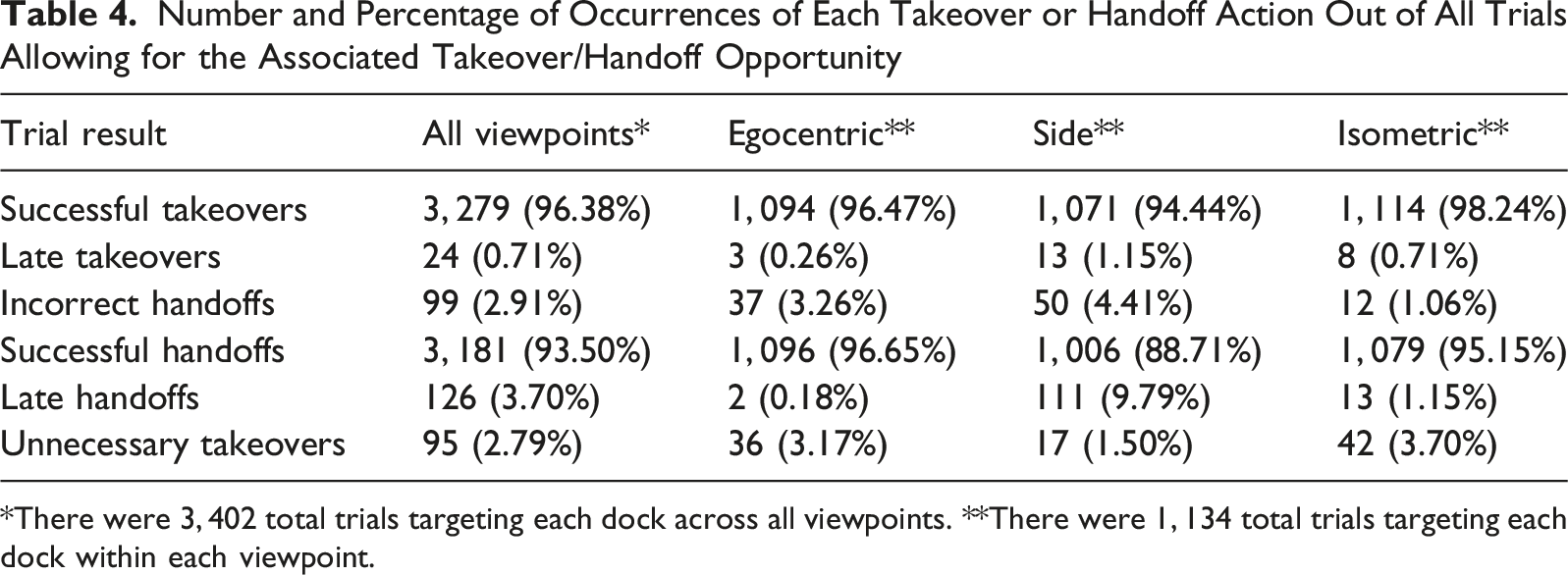
*There were
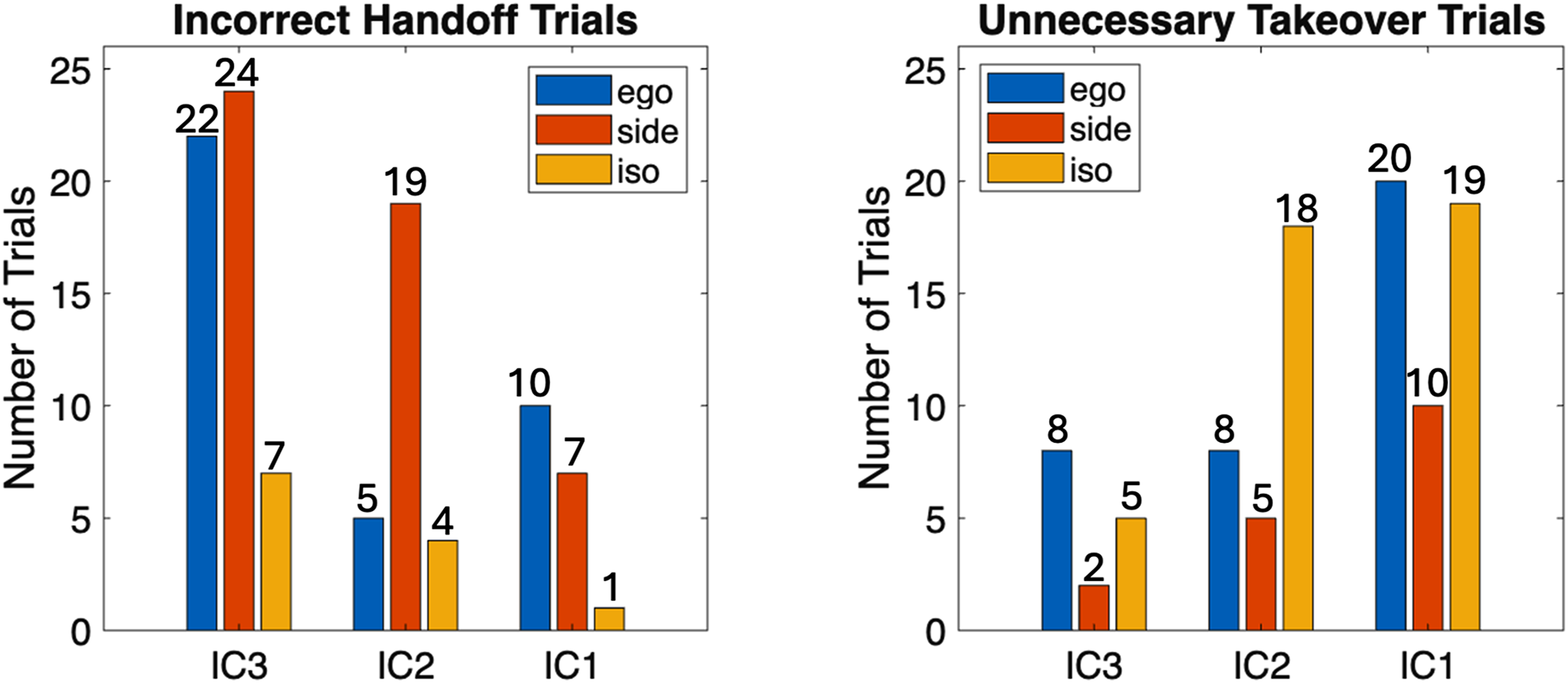
Distribution of incorrect handoff and unnecessary takeover trials between viewpoints and initial conditions. There were
Discussion
This study explored the influence of egocentric versus exocentric supervisor viewpoint on automated spacecraft path legibility in a docking task. Results showed that viewpoint significantly influenced path legibility, as measured by participant-averaged takeover and handoff metrics. Results from this study expand understanding of path legibility in human supervision tasks and can inform agent control algorithm design and camera placement to support human supervisor operational decision making.
Implications of Hypothesis 1
We hypothesized that egocentric view-framing would best support path legibility, as measured by participant-averaged takeover and handoff distances, by enabling supervisors to correctly determine the agent’s target at a greater distance from the dock compared to exocentric (side and isometric) views. Results supported this hypothesis. Participant local guidance of the environment, supported through the egocentric viewpoint, enabled longer participant-averaged takeover and handoff distances (i.e., faster decision making) compared to the two exocentric viewpoints, which have been shown to support global SA (Wickens & Prevett, 1995). The higher performance in the egocentric view may have emerged because the agent was relatively close to the target, so understanding the agent’s position in global space was less useful for the observer in this task. However, the observer may rely more on the exocentric view-framing to support global SA in earlier stages of a docking maneuver when the agent is farther away from the target and its approach is governed by orbital dynamics in an Earth-centered frame. The side view may have resulted in shorter participant-averaged takeover and handoff distances due to the line-of-sight of the participant being parallel with motion of the agent, presenting challenges to participant depth-perception and perceptual resolution in virtual environments (Ellis & Adelstein, 2014). These perceptual challenges should be further investigated to inform optimal camera placement.
Differences in viewpoint recommendations from existing literature suggest that the ideal supervisor viewpoint is task-dependent—Young et al. (2022) suggest an exocentric or mixed perspective for UAV telemanipulation, Weiss et al. (2023) suggest a mixed perspective for spacecraft inspection, and this study suggests an egocentric perspective for spacecraft docking. The methods proposed in this work should be extended to include relevant ARD task factors such as orbital dynamics and significantly longer mission times into path generation to analyze potential benefits of the exocentric viewpoint for global SA in this context.
Implications of Hypothesis 2
It was also hypothesized that the legibility of each path group within each viewpoint, as measured by participant-averaged takeover and handoff distances, would vary across viewpoints. Results showed that the highest and lowest legibility path groups did not vary across all viewpoints—they were similar between egocentric and isometric views but different in the side view. Comparing legibility results between egocentrically monitored ARD motions in Larson and Stirling (2025) and exocentrically monitored robotic reaching motions in Dragan et al. (2013) suggested that egocentric versus exocentric viewpoint perspective could be a factor influencing path legibility. However, this study’s results showed when monitoring ARD motion that the same path groups can be considered most or least legible in both egocentric and isometric (exocentric) views but not in the side (exocentric) view. Nikolaidis et al. (2016) studied legible robotic arm reaching motions from two exocentric views—one from the side and one from top-down, finding paths that were more legible from a side view were less legible from a top-down view and vice versa. However in this study, more legible path groups in the isometric view were not necessarily less legible in the side view. While a subset of path groups were significantly more legible in the isometric view compared to the side, other groups did not show significant differences in legibility between the isometric and side views.
There were other study characteristics between Dragan et al. (2013) and Nikolaidis et al. (2016), and this study which may foster future hypotheses for why differences in results were observed that could expand understanding of motion trajectory influence on decision making. While the robotic arm studies did not have a concept of lateness, participants in this study were required to make decisions under time pressure (i.e., late takeover and late handoff). In Dragan et al. (2013) and this study, participants processed their own uncertainty before making the decision, while Nikolaidis et al. (2016) recorded participant goal inferences and decision uncertainties at discrete pause-points in the motion observation. The difference in how monitor uncertainty is factored into the legibility metric may influence results, and should be investigated in future work. There are also differences in robotic embodiment between the ARD and robotic arm studies. The results of this study contextualized with the literature showed that legible motion for a robotic arm is not necessarily legible for an automated spacecraft docking maneuver. Human factors literature in decision-making theory emphasizes the role of human expectations of a system in decision making (G. Klein, 2008), and it is likely that participant expectations of appropriate motion for an automated spacecraft embodiment are different from a robotic arm. Therefore, legible motion may be influenced by the system embodiment, task, and environment. These potential influences should be considered if the methods in this study are expanded to other systems requiring monitoring automated motion, such as automated assembly systems, rescue operations, and automated medical devices and systems.
Implications of Incorrect-Decision Trials
In the egocentric view, incorrect handoffs occurred more at IC3, and unnecessary takeovers occurred more at IC1. This result is supported by previous work (Larson & Stirling, 2025) that described the importance of target alignment in the field-of-view (FOV). Traveling from these initial conditions resulted in both docks being aligned in the center of the participant’s FOV, which fostered uncertainty in the participant as to which dock was being targeted, leading to more incorrect decisions.
Across all viewpoints, IC1 led to the most unnecessary takeovers and IC3 led to the most incorrect handoffs (Figure 6). These outcomes align with ambiguity in projecting future states of the agent. For IC1, the red dock was the farther target, but maintained a presence in the FOV, which led to instances of unnecessary takeover when the green dock was being targeted. For IC3, the green dock was the farther target, but maintained a presence in the FOV, which led to instances of incorrect handoff when the red dock was being targeted. The ability to project future states based on previous observations and expectations of behavior is central to SA and decision-making theory (M. Endsley, 1995; G. A. Klein et al., 1993). While many participants correctly made determinations, the presence of incorrect decisions highlights how the fundamental motion planning factor of initial condition can be used to either help or hinder a supervisor’s ability to project future states. These findings demonstrate that automated agent motion plan legibility is an important factor in aiding supervisor decision making in the egocentric and exocentric viewpoints and should be considered in motion plan design.
This study supports that robotic motion observed by a human supervisor influences task performance in human–robot interaction systems. Incorporation of a motion legibility metric within the motion planning of a robot may enable improved collaborative human–robot performance. However, our results in combination with the literature indicate that there are additional factors that may significantly characterize a robot’s legible motion, such as task and environment factors (i.e., path dynamics and time horizon), human factors (i.e., uncertainty and risk management), and system factors (i.e., robot embodiment). It is important to perform additional research identifying contributing factors and their interactions that influence human perception and decision making in the presence of robot motion to realize the potential benefits of a legibility factor in motion plan generation.
Future Work and Limitations
The docking task performed in this study was simplified from standard rendezvous and docking maneuvers in space, which require multiple phases of complex maneuvers performed by highly trained astronauts in a six degree-of-freedom space. Participants did not have to balance additional tasks performed by astronauts such as managing fuel resources or tracking orientation. The simplification of the task enabled novice participants to focus on one decision task in each trial, but in reality, astronauts will be making many inter-dependent decisions based on a variety of system factors in docking. Spacecraft maneuvers are performed slowly and begin at greater distances from the target, requiring prolonged vigilance from the astronaut who is dividing attention across tasks. Future work should examine the interactions of motion plan design within this vigilance framework.
Only three potential viewpoints were examined when a multitude of other perspectives exist, including camera views by free-floating drone-like cameras that are not constrained to the space station. Such cameras are proposed for use in automated spacecraft inspection tasks. However, free-floating cameras require additional fuel considerations and also may pose a greater risk for collisions with docking spacecraft. Therefore, any benefits to performance provided by free-floating camera viewpoints should be considered alongside their resource requirements and potential safety risks.
Conclusion
This study analyzed the influence of supervisor viewpoint on operational decision making via the concept of legible spacecraft motion. Participants monitored automated docking maneuvers from egocentric and exocentric viewpoints and were tasked with asserting manual-takeover when they were certain the agent was targeting the wrong dock and automation-handoff in the case of the correct dock. Results of this study showed that autonomous agent path design factors significantly influence supervisor takeover and handoff decision making in both egocentric and exocentric viewpoints. Egocentric viewpoints best support path legibility and supervisor decision making compared to exocentric viewpoints by enabling supervisors to correctly determine the motion target earlier in path traversal. Emergent findings when compared to the literature emphasize the potential influence of embodiment and decision-making structure on legibility.
Key Points
• This paper hypothesized that (1) egocentric view framing would better support operational decision making compared to exocentric view framing for supervisors of automated rendezvous and docking (ARD) maneuvers and (2) characteristics of the paths that best supported operational decision making would vary between viewpoints. • Participants inferred the spacecraft’s final docking target based on real-time observations of the spacecraft’s motion and decided to either take control from the automation (takeover) or allow the automation to complete the maneuver without intervention (handoff). • Takeover and handoff decision data were used to create a path legibility metric, defined by participant-averaged takeover and handoff distances. • The egocentric view frame better supported path legibility, as measured by participant-averaged takeover and handoff distances. Path groups that were most and least legible were similar between egocentric and one type of exocentric viewpoint but not the other. • Viewpoint was a significant factor in overall path legibility and operator decision making. However, other factors, such as robotic embodiment and how supervisor uncertainty and risk management factor into operational decisions, must be further studied as potential influencers of operational decision-making accuracy and performance.
Supplemental Material
Supplemental Material - Effects of Egocentric and Exocentric Supervisor Viewpoint Perspectives on Motion Plan Legibility and Decision Support in Automated Spacecraft Docking Maneuvers
Supplemental Material for Effects of Egocentric and Exocentric Supervisor Viewpoint Perspectives on Motion Plan Legibility and Decision Support in Automated Spacecraft Docking Maneuvers by Hannah Larson and Leia Stirling in Human Factors
Footnotes

Funding
The authors disclosed receipt of the following financial support for the research, authorship, and/or publication of this article: This study was supported in part by the National Aeronautics and Space Administration (NASA) Human Research Program Award 80NSSC20K0409.
Declaration of Conflicting Interests
The authors declared no potential conflicts of interest with respect to the research, authorship, and/or publication of this article.
Supplemental Material
Supplemental material for this article is available online.
Author Biographies
References
Supplementary Material
Please find the following supplemental material available below.
For Open Access articles published under a Creative Commons License, all supplemental material carries the same license as the article it is associated with.
For non-Open Access articles published, all supplemental material carries a non-exclusive license, and permission requests for re-use of supplemental material or any part of supplemental material shall be sent directly to the copyright owner as specified in the copyright notice associated with the article.
