






Abstract
Objective
This study investigates how task priority, task difficulty, and their interaction influence task-switching decisions in a complex multitasking environment, where operators manage multiple supervisory tasks distributed across displays.
Background
The Strategic Task Overload Management (STOM) model posits that task priority and difficulty influence task-switching behavior, but empirical research has yielded inconsistent results.
Method
Participants performed four concurrent supervisory tasks, each shown on a separate display, using a simulated unmanned aerial vehicle monitoring platform. Task priority was manipulated through performance-based rewards, and the difficulty of the target detection task varied across four levels.
Results
Participants were more likely to switch to the target detection task and dwelled longer on it when it was high-priority. Increased task difficulty led to lower overall switching frequency and longer dwell time on the more difficult task. Manipulations of priority and difficulty mutually reinforced perceptions of each other and amplified each other’s impact on task-switching behaviors.
Conclusion
Task priority has a significant impact on task-switching behaviors in complex multitasking scenarios. The impact of task difficulty on switching behaviors is more pronounced at the global level than at the local level, where a threshold effect is observed. The two attributes mutually reinforce each other’s impact.
Application
This study provides implications for refining the STOM model and offers insights into designing interventions that support effective task switching.
Introduction
In digital control rooms of complex systems, operators often manage multiple supervisory tasks distributed across multiple screens. Rather than executing tasks truly concurrently, they typically switch between tasks sequentially (Borst et al., 2010; Salvucci & Taatgen, 2008). Strategic task switching is critical in such dynamic environments (Camblor et al., 2022; Lipovac et al., 2017). Whereas frequent switching incurs substantial cognitive and performance costs (Liefooghe et al., 2008; Strobach et al., 2012; Wu et al., 2023), overly fixating on a single task can cause “attentional tunneling” (Wickens & Alexander, 2009), leading to missing critical environmental changes. Moreover, when tasks are spatially distributed across multiple screens, switching demands additional cognitive and physical effort compared to single-screen setups, amplifying these costs. Therefore, understanding factors influencing operators’ switching behaviors has important implications for the safety and performance of such systems.
Based on a meta-analysis of studies on strategic allocation of attention, Wickens and colleagues proposed the Strategic Task Overload Management (STOM) model (Gutzwiller et al., 2014; Wickens et al., 2013, 2015a, 2015b, 2016) to predict task-switching choices in high-demand environments. STOM predicts whether operators will remain on the ongoing task (OT) or switch to an alternative task (AT), and in the latter case, which AT they will choose, based on four task attributes: priority (relative task importance), difficulty (the anticipated effort demand imposed by the task), interest (the inherent interest in the task), and salience (the feature contrasts between task-related events and their surroundings). Empirical studies have consistently supported the positive effects of interest and salience on task attractiveness (Barg-Walkow et al., 2021; Barg-Walkow & Rogers, 2017; Gilbert & Wickens, 2017; Zabala & Gutzwiller, 2021). In contrast, findings regarding priority and difficulty remain inconsistent, and their effects are not yet fully understood.
The Priority Neglect Mystery and the Issue of Priority Manipulation
Task priority in STOM refers to a task’s relative importance. It is related to the consequence of performing (or failing to perform) a task in a timely manner (Wickens et al., 2003, 2016). In applied domains (e.g., aviation and healthcare), priority is considered important in resolving task conflicts and guiding resource allocation (Barg-Walkow & Rogers, 2017; Brumby et al., 2009; Raby & Wickens, 1994). Intuitively, high-priority tasks should attract more attention, as proposed in the original STOM model. However, empirical validation studies have yielded inconsistent results. Although some studies found that priority affected the likelihood of operators continuing to perform a task, that is, OT stickiness (e.g., Gilbert & Wickens, 2017), most reported a lack of priority influence on the likelihood of switching to a specific task, that is, AT attractiveness (Gutzwiller & Sitzman, 2017; Wickens et al., 2016; Zabala & Gutzwiller, 2021). Such “priority neglect” in task selection has led researchers to question its validity as a predictor of task-switching behavior (Wickens et al., 2016; Zabala & Gutzwiller, 2021).
The Ambivalent Impact of Task Difficulty on AT Attractiveness
Task difficulty in STOM refers to the anticipated effort (e.g., mental and/or physical demand) imposed by a task (Barg-Walkow et al., 2021; Wickens et al., 2016). Empirical evidence has consistently supported the positive effect of difficulty on OT stickiness, that is, more difficult tasks tend to be maintained longer once initiated (Poljac & Yeung, 2014; Wickens et al., 2016; Zabala & Gutzwiller, 2021). However, findings regarding the effect of difficulty on AT attractiveness are mixed. Whereas some studies supported the original STOM prediction (Wickens et al., 2016), that is, individuals switch less frequently to difficult tasks due to an inherent “cognitive-effort-avoidance” tendency (Kahneman, 2011; Kool et al., 2010), other studies reported the opposite pattern, attributing it to the desire to prevent possible worsening situations (Kessler et al., 2009; Zabala & Gutzwiller, 2021).
Gaps in Existing Studies
Based on an in-depth analysis of prior STOM validations and real-world multitasking challenges, we identified several issues requiring further investigation to reconcile mixed findings and extend research to more complex and realistic settings. The first limitation concerns how task switches are tracked and AT attractiveness is measured. Most STOM validations adopted motor actions (e.g., mouse clicks) as indicators of task switching (Gutzwiller & Sitzman, 2017; Wickens et al., 2016; Zabala & Gutzwiller, 2021), which is suitable for simple and discrete tasks (e.g., classifying a digit as odd or even) in basic laboratory paradigms (Kiesel et al., 2010; Monsell, 2003). However, in complex or continuous multitasking settings, for which the STOM model was developed, operators may shift attention multiple times before a motor response is made, making motor actions an imprecise proxy. More accurate measures of fine-grained task switching are therefore needed. Because what individuals see largely determines what they attend to (Hoffman & Subramaniam, 1995; Sun et al., 2008), eye tracking offers a more direct index of overt attention and task switches. Yet it has rarely been used in task-switching research to measure task selection choice (Valéry et al., 2019; Zabala & Gutzwiller, 2021). Furthermore, most prior studies measured AT attractiveness using absolute switch counts (i.e., the total number of switches to a task within a time period), which can be misleading because variations in global switching tendencies across individuals and task conditions can confound AT attractiveness measured by the raw counts (Gutzwiller, 2014; Zabala & Gutzwiller, 2021).
Second, the manipulations of priority and difficulty may contribute to inconsistent findings in prior studies. • Priority manipulation: In most studies finding “priority neglect,” participants were only instructed about relative task importance. Although self-reported ratings showed that the participants remembered the priority order, they seemed not to internalize it—that is, mentally endorse and adopt it as a basis for action (Valéry et al., 2019). We argue that this stems primarily from the lack of explicit and personally relevant consequences of neglecting the priority order. In real-world contexts where such consequences are salient and safety-critical, such as emergency medicine, Barg-Walkow et al. (2021) found that priority was the primary determinant of task scheduling decisions for experts. To establish a laboratory condition where priority matters, Lewis et al. (2024) designed forced-choice “task conflicts” where selecting one task inherently meant forgoing another and observed a significant priority effect on task selection decision. However, it remains unknown whether this priority effect can be generalized beyond such forced-choice task structures to more ecologically valid conditions with multiple supervisory tasks running in parallel, each with events emerging stochastically. • Difficulty manipulation: Most research manipulated task difficulty using only two levels (Gutzwiller, 2014; Janssen & Brumby, 2015; Karpinsky et al., 2018; Zabala & Gutzwiller, 2021), which may be insufficient to reveal potential non-linearity or threshold effects. To resolve the inconsistent findings regarding difficulty’s effect on task attractiveness, more rigorously designed experiments spanning wider difficulty ranges are needed.
Third, the potential interaction between priority and difficulty on task switching remains underexplored. Though many multitasking studies involve both variables, manipulations are often confounded (e.g., Barg-Walkow et al., 2021; Gutzwiller et al., 2019). Among the limited studies manipulating them separately, results are inconsistent. Wickens et al. (2016) and Zabala and Gutzwiller (2021) found no interaction effect, partly due to the ineffective priority manipulations as discussed before. Valéry et al. (2019) found that participants’ attention allocation to two N-back tasks was influenced by either difficulty or priority, depending on the global difficulty. However, the repetitive and discrete nature of N-back tasks differs from that of real tasks in complex environments, and their study examined only dwell time but not task selection choices. How people trade-off between task priority and difficulty when selecting among available tasks in complex, dynamic multitasking environments remains insufficiently understood.
Finally, existing multitasking research has predominantly focused on single-display scenarios, not fully addressing a unique challenge in many real-world control rooms: monitoring tasks across multiple, physically separate displays. Larger visual angles between displays increase gaze-shift effort among tasks and reduce the noticeability of peripheral event arrivals of ATs. These multi-display challenges likely amplify the impact of top-down attentional control, and task priority and difficulty may exert a stronger influence on task-switching behavior in such contexts. To date, this remains under-researched.
Aims of the Current Research
This study aims to examine the effects of task priority and difficulty on task-switching behaviors in a realistic and complex work environment, involving multiple supervisory tasks distributed on multiple screens. The experimental scenario involved controlling multiple simulated unmanned aerial vehicles (UAVs) by performing four tasks across four screens. Priority was manipulated through performance-based rewards to enhance the internalization of task importance. Difficulty was varied across four levels to explore potential non-linear effects. Eye-tracking metrics, instead of input actions, were used to detect switches. Proportions of switches (instead of absolute counts) to specific tasks were used to measure AT attractiveness. We believe that by improving the experimental design and strengthening the ecological validity of multitasking scenarios, this in-depth controlled experimental study will benefit multitasking research and contribute to more robust models of task-switching decisions.
Method
Participants
Forty-four Tsinghua university students were recruited. Four participants were later excluded due to data quality issues (detailed in Data Analysis), yielding a final sample of 40 (20 males and 20 females; mean age = 24.03, SD = 3.25). All participants had normal or corrected-to-normal vision without red–green color vision deficiencies. Upon completing the final session, they received a 135 CNY base payment alongside a performance-based reward (122–166 CNY, M = 135 CNY) tied to the overall task performance, as detailed in Manipulation of Priority and Difficulty.
Experimental Design and Setup
The experimental platform, adapted from Moacdieh et al. (2020), simulated the “Vigilant Spirit Control Station” used by the Air Force to control multiple UAVs. Participants performed four concurrent tasks: target detection, rerouting, maintenance, and communication to control 16 UAVs. Each task was displayed on a separate computer (Figure 1). The two middle screens were coplanar. The angle between the two outermost screens was 120°. Eye-tracking data were recorded via a Tobii Pro Glasses 2 eye tracker at a 100 Hz sampling rate. We manipulated the priority (2 levels) and difficulty (4 levels) of the target detection task within subjects. Thus, each participant underwent 8 experimental scenarios, each lasting for 8 minutes. The workspace layout and screen configuration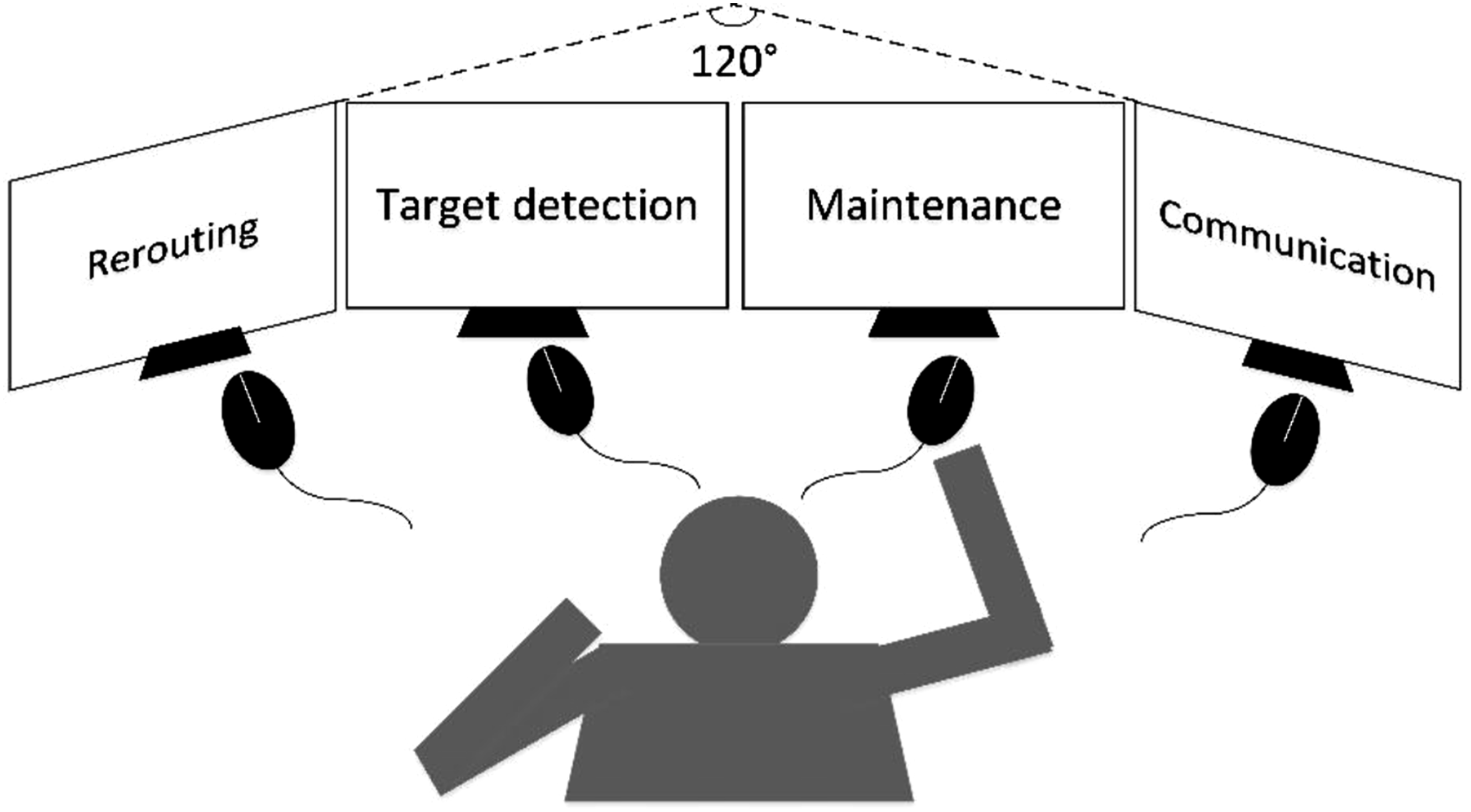
Target Detection Task
As shown in Figure 2(A), the target detection screen presented 16 UAV video feeds. Targets (red squares) only appeared in the highlighted feeds. Each highlight lasted 20 seconds, during which the target could appear at any time within the first 15 seconds. If undetected, the target remained visible until the highlight ended. At most one target could appear in a highlighted feed. Upon detecting a target, participants clicked the target button, and the target would disappear. Altogether, 32 targets appeared per 8-minute scenario. The timing of target appearance was dynamic and adaptive to the participants’ real-time performance to maintain a relatively stable task demand while minimizing temporal predictability. The first target appeared at the 4th second. After a target was detected at time xi, the time interval preceding the next target (i + 1) was randomly sampled from a uniform distribution over the remaining time and remaining targets (i.e., Intervali+1 = U (0, (480−20−xi)/(32−i))). Screenshots of (A) the target detection task (the lowest difficulty level), (B) the rerouting task, (C) the maintenance task, and (D) the communication task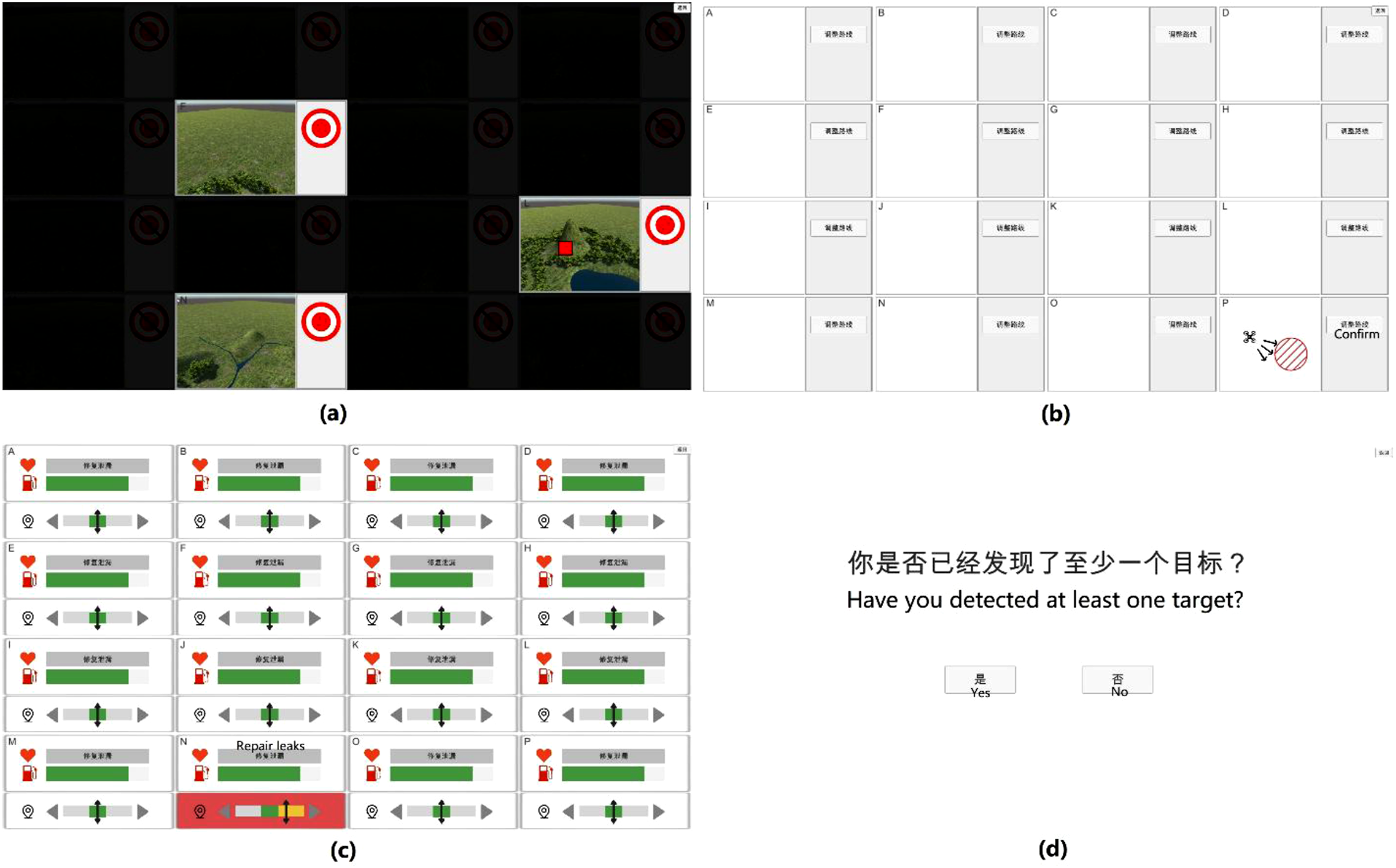
Rerouting Task
Participants needed to reroute UAVs that were approaching no-fly zones. They had 15 seconds to click the arrow indicating the correct route among three alternatives and click “Confirm” (Figure 2(B)). Each scenario included 10 rerouting events.
Maintenance Task
Participants monitored the fuel and navigation systems of each UAV (Figure 2(C)). A fuel leak was indicated when the fuel bar changed from green to yellow, at which point participants were required to click the “Repair leaks” button within 15 seconds. Navigation failures were indicated when the directional arrow deviated from the green safety zone, accompanied by the corresponding side bar changing from gray to yellow. Participants were required to click the adjustment button (triangle) on the opposite side to steer the arrow back into the safety zone within 15 seconds. For both failure types, the background of the affected indicator changed from white to red to signal the presence of a fault. Each scenario included five fuel leak events and five navigation failures.
Communication Task
Each communication task consisted of a visually presented text-based query regarding the status of the other three tasks (e.g., “Has a fuel leak occurred?”; Figure 2(D)), without any accompanying auditory cues. Participants were required to respond by selecting “Yes” or “No” within 15 seconds. A total of 10 communication tasks were presented in each scenario.
Event onset times for the rerouting, maintenance, and communication tasks were pseudo-randomly generated and pre-determined in the platform’s script. Overlap across these three tasks was permitted; however, within each task, at most one event could be active at any given time. Event sequences varied across the eight scenarios but were held constant across participants within each scenario.
Manipulation of Priority and Difficulty
The priority of the target detection task was manipulated by performance-based rewards at two levels: target-priority and others-priority. Participants were informed that their overall task performance would be proportionally converted into a monetary reward. In the target-priority condition, the target detection performance determined 40% of the total reward, and the other three tasks determined 60% collectively. Participants were instructed to prioritize target detection over the other three tasks while still performing them as well as possible. In the others-priority condition, target detection contributed 10% of the total reward, and the other tasks determined 90%. Accordingly, participants were instructed to prioritize the other three tasks over the target detection task while still performing it to the best of their ability. Overall task performance was calculated as a weighted combination of individual task performance according to the corresponding priority condition.
Manipulation of the difficulty of the target detection task
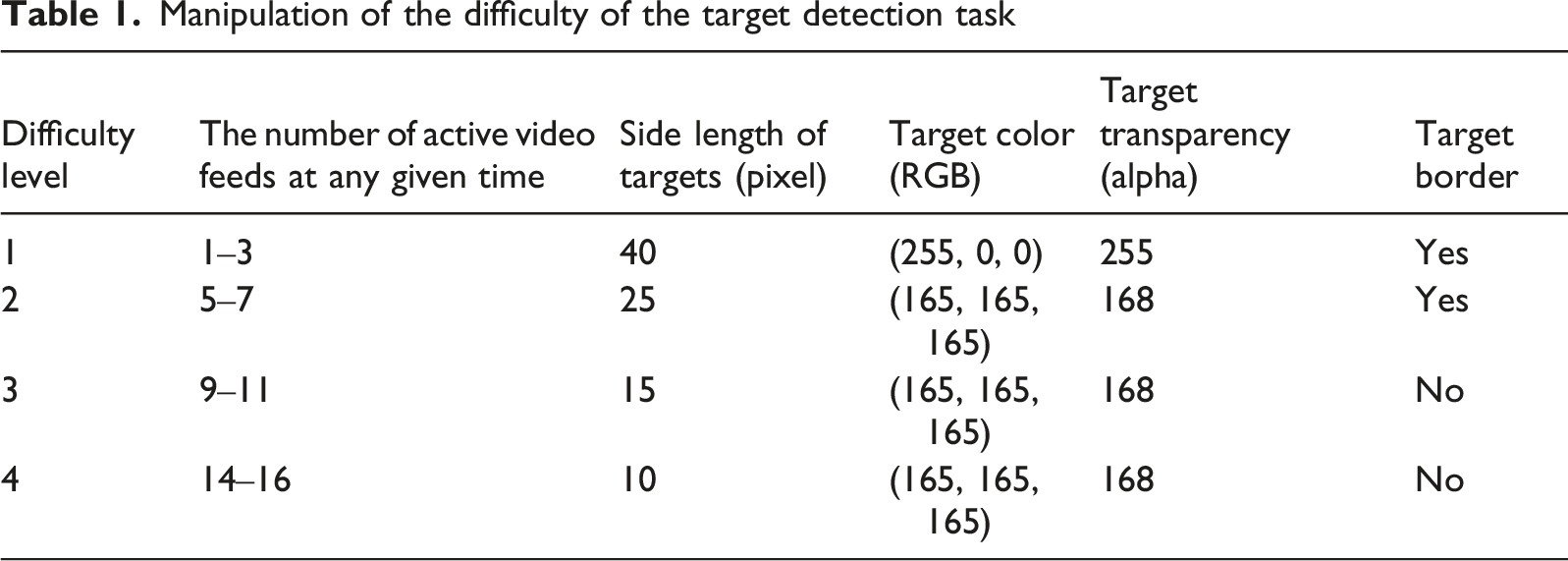
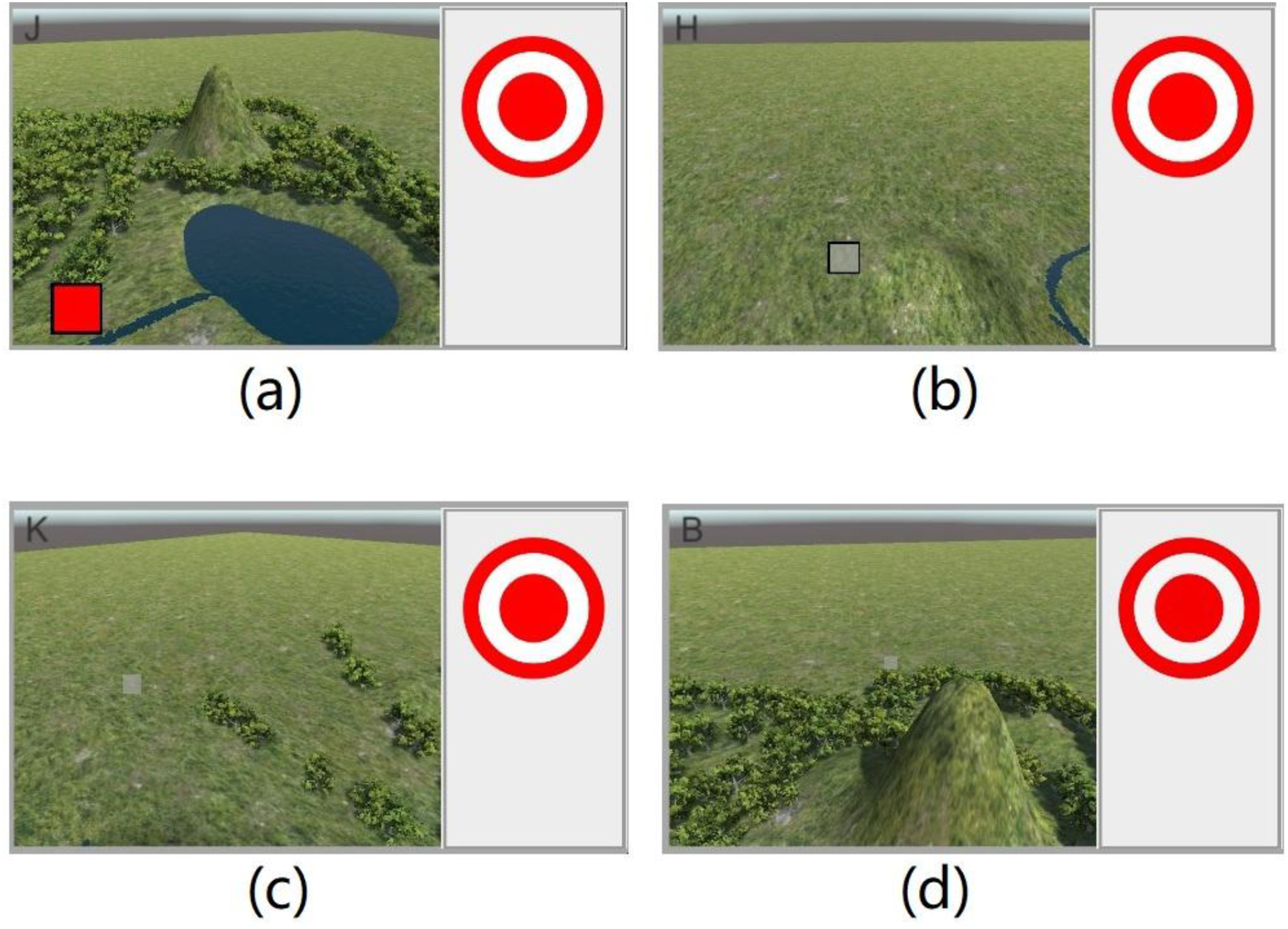
Targets (squares on the video feed panel) in the (A) 1st, (B) 2nd, (C) 3rd, and (D) 4th difficulty levels of the target detection task
Measures
Performance for all tasks was measured by completion time (from event onset to response completion) and accuracy (proportion of timely and correct responses). To verify the effectiveness of priority and difficulty manipulations, after each scenario, participants provided paired-comparison ratings for all unique pairwise combinations of the four tasks (six pairs). We adopted the seven-point bipolar scale (3-2-1-0-1-2-3) from Gutzwiller (2014), where “0” represents equality and the values extending outward indicate increasing relative priority or difficulty for the corresponding task.
Eye-tracking indices analyzed by Tobii Pro Lab (version 1.194) were used to characterize task-switching behaviors. Each task screen was defined as an area of interest (AOI). An AOI visit was defined as the process from the first fixation entry to the last consecutive fixation exit. A task switch was defined as initiating a new AOI visit. Based on these definitions, we derived the following indices: total number of switches, number of switches to a specific task, proportion of switches to a specific task (the number of switches to a specific task divided by the number of total switches), the cumulative dwell time on a specific task, and the average dwell time per visit to a specific task (the cumulative dwell time divided by the number of switches to a specific task).
Procedure
The experiment was conducted in an enclosed, quiet room. Each participant attended three sessions, held once per week over three consecutive weeks: Week 1 for practice (no priority assigned) and Weeks 2 and 3 for completing scenarios at two priority settings, each with four difficulty levels. All sessions for a given participant were scheduled at the same time and day of the week. In Week 1, participants provided informed consent and were introduced to the tasks and procedures. They completed a 5-minute hands-on practice and four 8-minute practice scenarios of varying difficulty, with 5-minute breaks between scenarios. Participants were free to direct their gaze to any screen at scenario onset, and were asked to use only their dominant hand. The procedures in Weeks 2 and 3 were identical to those in Week 1, except that priority manipulations were introduced (one priority condition per week). The order of priority conditions and difficulty levels was counterbalanced across participants. This study complied with the Declaration of Helsinki and was approved by the Institutional Review Board of Tsinghua University.
Data Analysis
Initial gaze data were screened according to ISO/TS 15007-2:2014-09 standards, which define data loss exceeding 15% as indicative of insufficient quality. This resulted in four participants being removed from all analyses. Fixations were identified using the default I-VT attention filter in Tobii Pro Lab, with an upper velocity limit of 100°/s for directional eye shifts. Fixations under 100 ms were removed, as durations below this threshold are generally considered insufficient for information acquisition and processing (Manor & Gordon, 2003; Widdel, 1984).
Two-way repeated-measures ANOVAs (with Greenhouse–Geisser corrections for sphericity violations) were conducted to examine the effects of the manipulated priority and difficulty on perceived priority and difficulty, task performance, and switching behavior. When a significant interaction effect was observed, simple main effects were tested using one-way repeated-measures ANOVAs. Post-hoc tests of ANOVAs were performed with paired t-tests with Bonferroni corrections to control Type I error. Significance levels in all tests were set at 5%.
Results
Impact of Manipulated Priority and Difficulty on Subjective Perceptions and Task Performance
As shown in Figure 4(A) and (B), subjective ratings confirmed the effectiveness of priority and difficulty manipulations. Perceived priority of the target detection task showed significant effects of manipulated priority (F1, 39 = 188.11, p < 0.001, ηp2 = 0.83) and difficulty (F3, 117 = 3.67, p = 0.015, ηp2 = 0.09), as well as their interaction (F3, 117 = 3.76, p = 0.019, ηp2 = 0.09). Simple main effect analyses revealed that perceived priority of the target detection task was significantly higher in the target-priority condition across all difficulty levels (1st–4th) (Fs ≥ 98.83, ps < 0.001, ηp2 ≥ 0.72). In addition, perceived priority tended to increase with difficulty (F3, 117 = 5.85, p = 0.003, ηp2 = 0.13) within the target-priority condition, showing significant differences between the 3rd and lower difficulty levels (ps < 0.05). The results suggest that, for high-priority tasks, increasing task difficulty further elevates perceived importance. Self-reported (A) priority and (B) difficulty of target detection across eight experimental scenarios (group means and standard errors)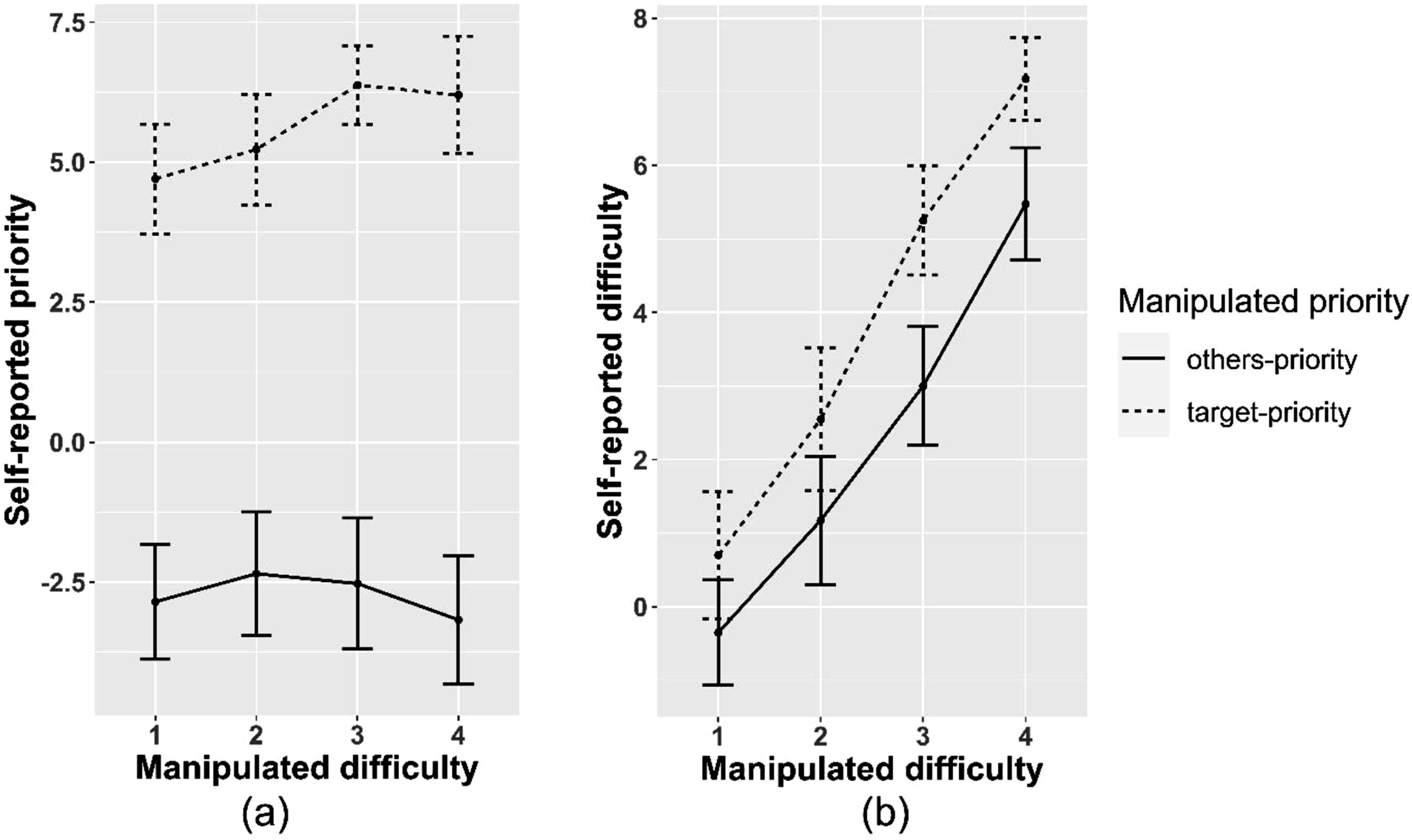
For perceived difficulty of target detection, significant main effects emerged for manipulated priority (F1, 39 = 25.88, p < 0.001, ηp2 = 0.40) and difficulty (F3, 117 = 105.20, p < 0.001, ηp2 = 0.73), with no significant interaction (F3, 117 = 1.97, p = 0.130, ηp2 = 0.05). Self-reported difficulty increased with each increment in manipulated difficulty (ps < 0.05). Furthermore, at each difficulty level, the high-priority task was perceived as more difficult than the low-priority task, suggesting that higher task priority increases perceived difficulty.
The analysis of target detection accuracy (Figure 5(A)) revealed significant main effects of manipulated priority (F1, 39 = 11.61, p = 0.002, ηp2 = 0.23) and difficulty (F3, 117 = 230.34, p < 0.001, ηp2 = 0.86), as well as a significant interaction (F3, 117 = 1.97, p = 0.021, ηp2 = 0.12). Specifically, target detection accuracy was significantly higher in the target-priority condition compared to the others-priority condition at the 2nd–4th difficulty levels (all Fs ≥ 4.52, all ps ≤ 0.040, ηp2s ≥ 0.10). The effect of difficulty was significant in both the target-priority (F1, 39 = 107.71, p < 0.001, ηp2 = 0.73) and others-priority (F1, 39 = 133.59, p < 0.001, ηp2 = 0.77) conditions. In both priority conditions, post-hoc tests showed significant decreases in accuracy from the 2nd to 3rd and 3rd to 4th difficulty levels (ps < 0.05), with no significant difference between the 1st and 2nd levels (ps > 0.05). Accuracy for (A) target detection, (B) rerouting, and (C) communication across eight experimental scenarios (group means and standard errors)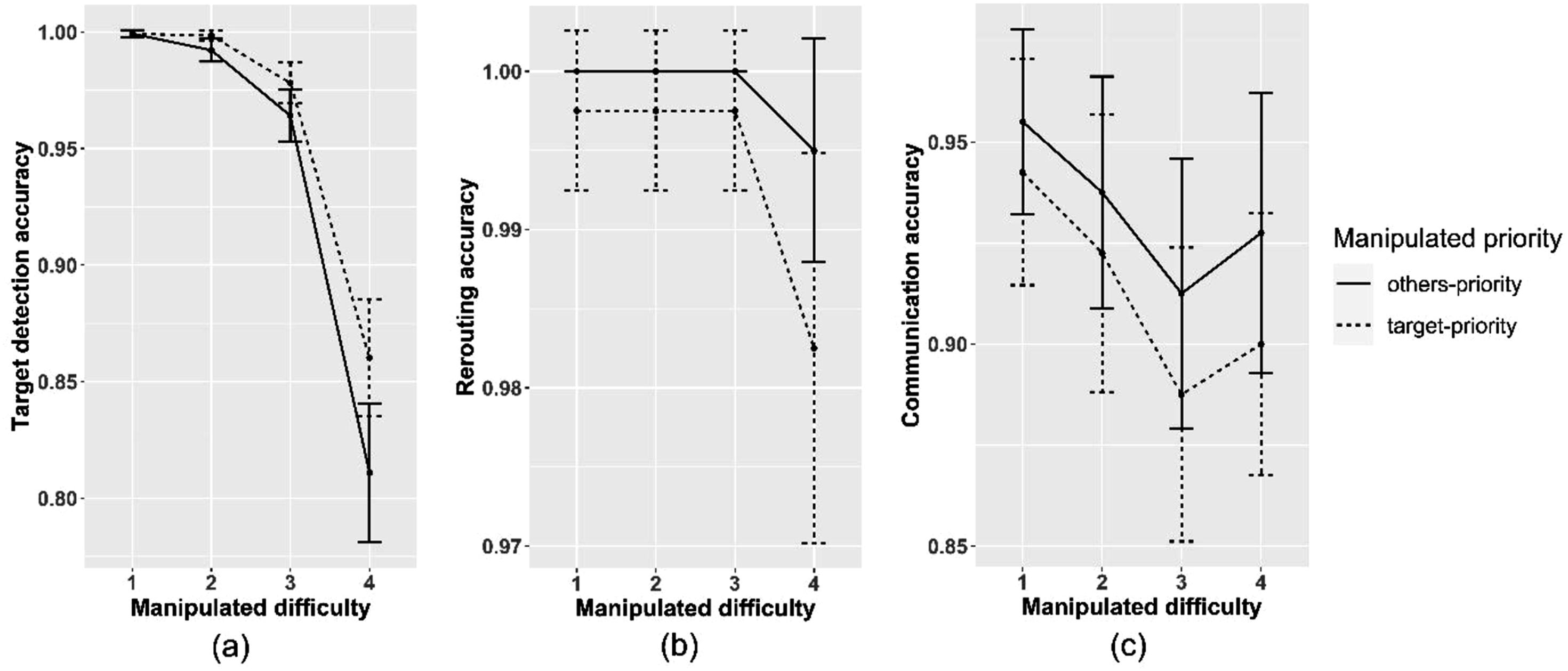
Figures 5(B) and (C) show that manipulations on target detection also affected rerouting and communication accuracy. When target detection was prioritized, the accuracy of these tasks tended to be lower, though this decrease was only significant for the rerouting task (F1, 39 = 6.00, p = 0.019, ηp2 = 0.13). Furthermore, increasing target detection difficulty significantly reduced both rerouting (F3, 117 = 5.32, p = 0.011, ηp2 = 0.12) and communication (F3, 117 = 3.88, p = 0.010, ηp2 = 0.09) accuracy. Rerouting accuracy remained stable across the 1st to 3rd difficulty levels but dropped significantly at the 4th level (ps < 0.05). Communication accuracy tended to decline as target detection difficulty increased; however, only the decrease at the 3rd difficulty level was significant compared to the 1st level (p = 0.002). Maintenance accuracy was not statistically tested because all participants achieved 100% accuracy in all conditions.
Figure 6(A) shows the completion time for target detection. Both manipulated priority (F1, 39 = 41.66, p < 0.001, ηp2 = 0.52) and difficulty (F3, 117 = 553.98, p < 0.001, ηp2 = 0.93) had significant main effects, but their interaction was not significant (F3, 117 = 0.59, p = 0.130, ηp2 = 0.57). Prioritizing target detection significantly shortened its completion time, whereas increasing task difficulty significantly prolonged it (all ps < 0.05 for pairwise comparisons between adjacent levels). Completion time for (A) target detection, (B) rerouting, (C) maintenance, and (D) communication across eight experimental scenarios (group means and standard errors)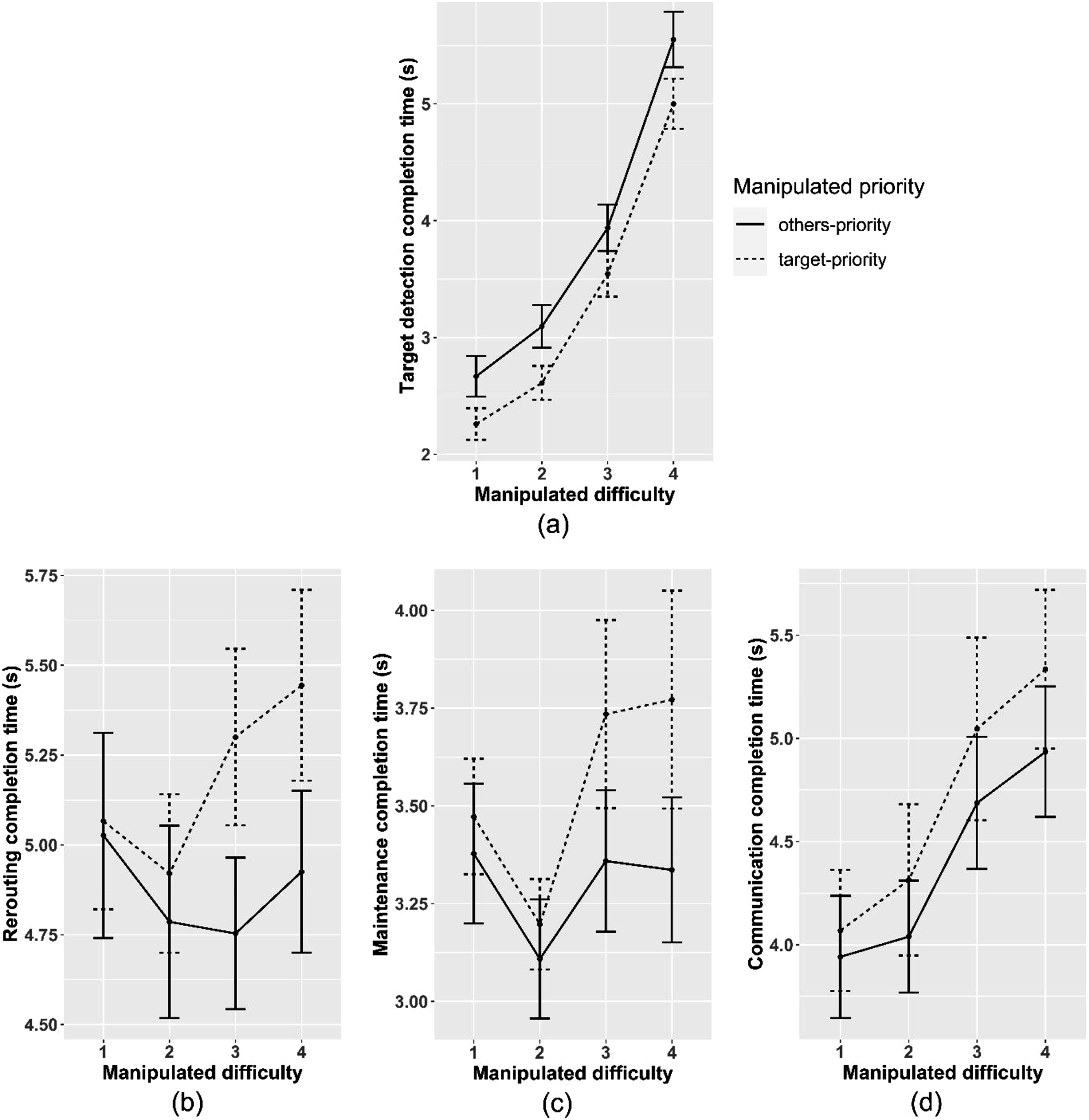
Figure 6(B) and (C) show significant interactions between manipulated priority and difficulty of the target detection task on completion times for rerouting (F3, 117 = 4.51, p = 0.006, ηp2 = 0.10) and maintenance (F3, 117 = 4.56, p = 0.005, ηp2 = 0.10). For rerouting, the simple main effect of difficulty was significant only under the target-priority condition (F3, 117 = 5.96, p = 0.002, ηp2 = 0.13), with longer times at the 3rd and 4th levels than those at the 2nd level (ps < 0.05). For the maintenance task, the simple main effect of difficulty was significant in both target-priority (F3, 117 = 12.59, p < 0.001, ηp2 = 0.24) and others-priority (F3, 117 = 5.01, p = 0.006, ηp2 = 0.11) conditions. The completion time for maintenance at the 2nd difficulty level was significantly shorter than that at the other difficulty levels in the target-priority condition and was significantly shorter than that at the 1st difficulty level in the others-priority condition (ps < 0.05). Furthermore, Figure 6(D) shows that the completion time for communication was significantly longer when target detection was prioritized (F1, 39 = 5.16, p = 0.029, ηp2 = 0.12). The completion times at the 3rd and 4th difficulty levels were significantly longer than those at the 1st and 2nd levels (ps < 0.05), regardless of priority.
Impact of Task Priority and Difficulty on Task Switching
Number of Total Switches
As Figure 7 illustrates, both difficulty (F3, 117 = 165.04, p < 0.001, ηp2 = 0.81) and priority (F1, 39 = 59.02, p < 0.001, ηp2 = 0.60) had a large impact on the total switches, whereas their interaction had a significant but small impact (F3, 117 = 6.77, p < 0.001, ηp2 = 0.15). Simple main effect analyses showed that prioritizing only the target detection task, as compared to prioritizing the other three tasks, resulted in significantly fewer switches across all difficulty levels (all Fs ≥ 10.44, ps ≤ 0.012, ηp2s ≥ 0.21). The simple main effect of difficulty was significant for both target-priority (F3, 117 = 168.57, p < 0.001, ηp2 = 0.81) and others-priority (F3, 117 = 89.90, p < 0.001, ηp2 = 0.70) conditions. Post-hoc tests revealed significant decreases with every difficulty increment (ps < 0.05), except between the 3rd and 4th levels in the others-priority condition (p = 0.116). Overall, increasing the difficulty for a high-priority task caused larger switch reductions than increasing the difficulty for a low-priority task. Number of total switches per 8-minute experimental scenario (group means and standard errors)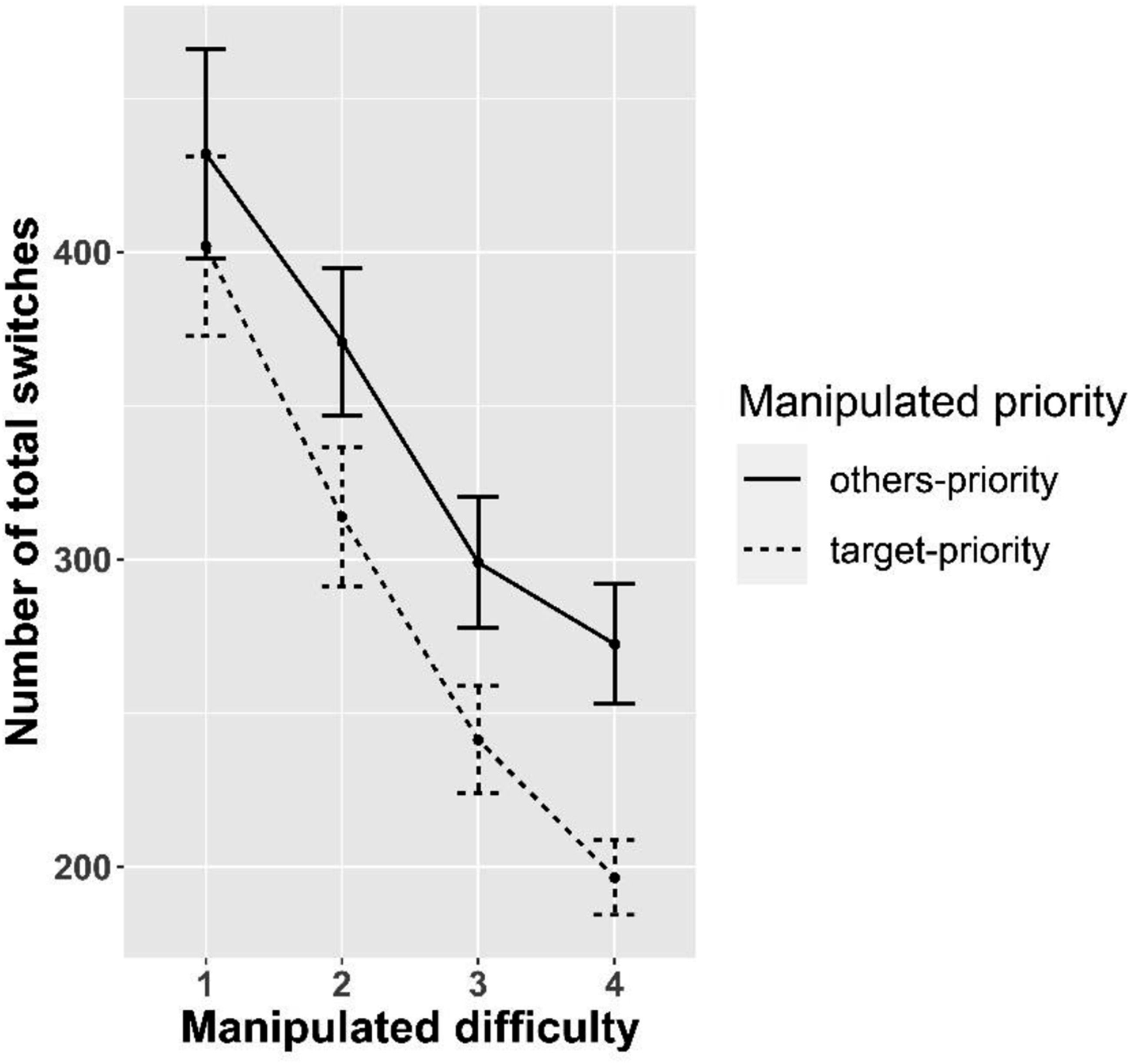
Switches to Each Task
Figure 8 shows that switches to each task decreased generally as target detection became more difficult, mirroring the global switching declines in Figure 7. To examine relative task attractiveness independent of this global switching tendency, we analyzed the proportion of switches to target detection. Figure 9 reveals significant main effects of priority (F
1, 39
= 51.31, p < 0.001, ηp2 = 0.57) and difficulty (F
3, 117
= 9.04, p < 0.001, ηp2 = 0.19) on the proportion of switches to target detection, with no significant interaction (F
3, 117
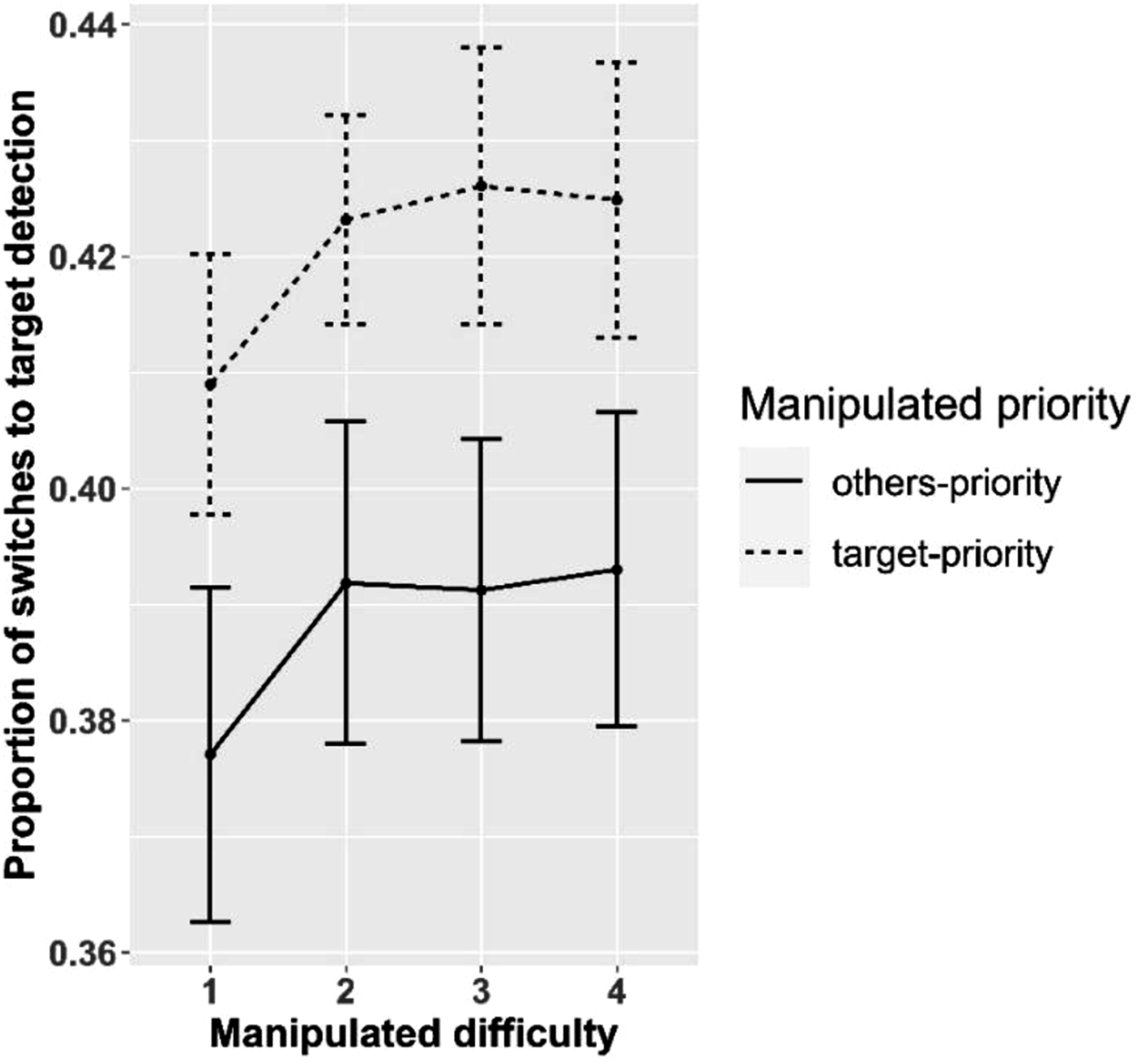
= 0.20, p = 0.893, ηp2 = 0.01). Participants were more likely to switch to target detection when it was high-priority (M = 0.421, SD = 0.043) than low-priority (M = 0.388, SD = 0.043). In addition, they were more likely to switch to the task when its difficulty was beyond the lowest level (all ps < 0.05 in both priority conditions), but there were no significant differences among the three higher difficulty levels. Number of switches to (A) target detection, (B) rerouting, (C) maintenance, and (D) communication per 8-minute experimental scenario (group means and standard errors) Proportion of switches to target detection per 8-minute experimental scenario (group means and standard errors)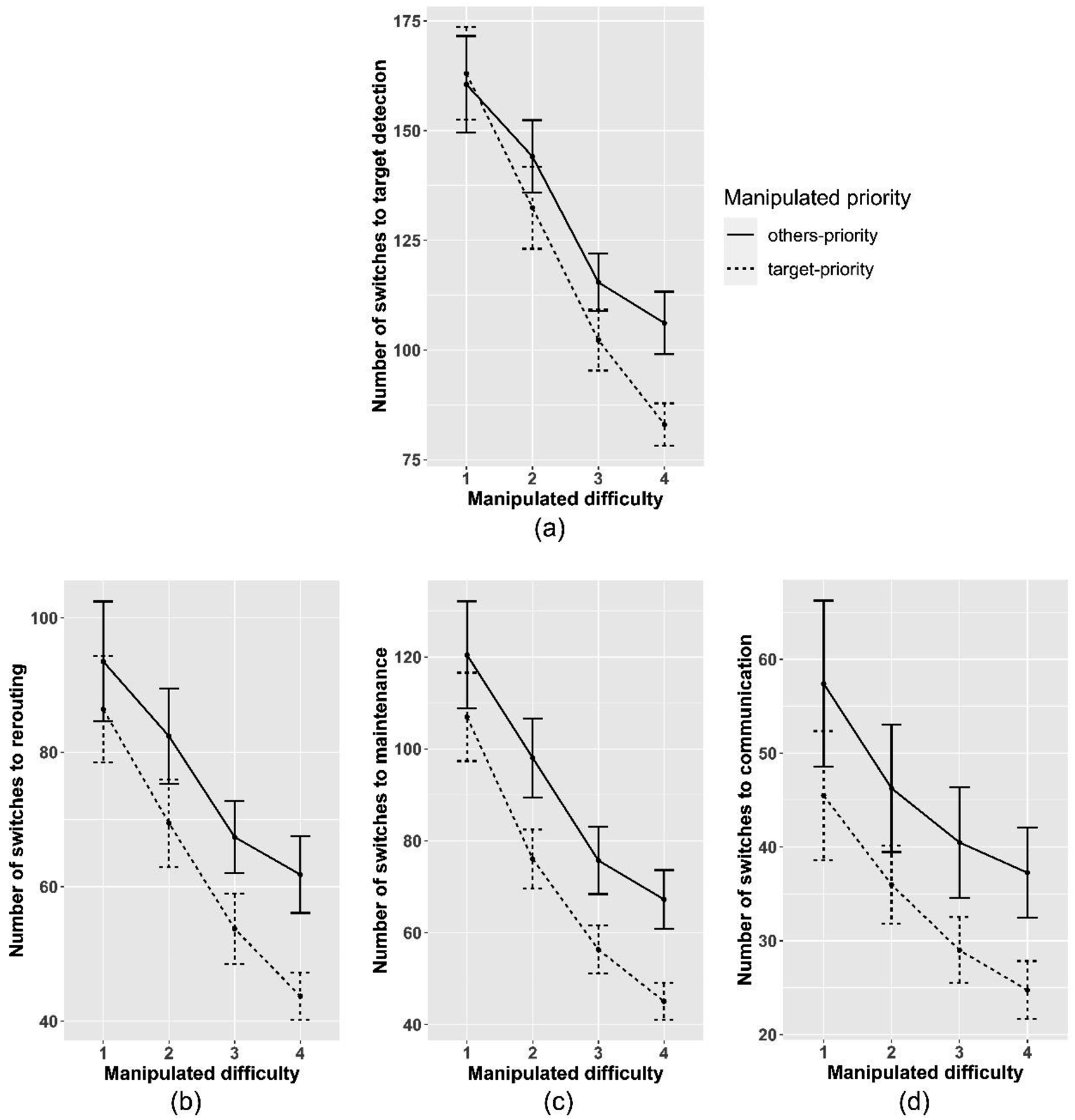
Dwell Time on the Target Detection Task
As shown in Figure 10, cumulative dwell time on target detection was significantly influenced by priority (F1, 39 = 134.66, p < 0.001, ηp2 = 0.78) and difficulty (F3, 117 = 217.45, p < 0.001, ηp2 = 0.85), but not their interaction (F3, 117 = 2.19, p = 0.102, ηp2 = 0.05). Total time spent on the target detection task increased with priority and difficulty (ps < 0.05 for all pairwise comparisons between adjacent difficulty levels). Cumulative dwell time on target detection per 8-minute experimental scenario (group means and standard errors)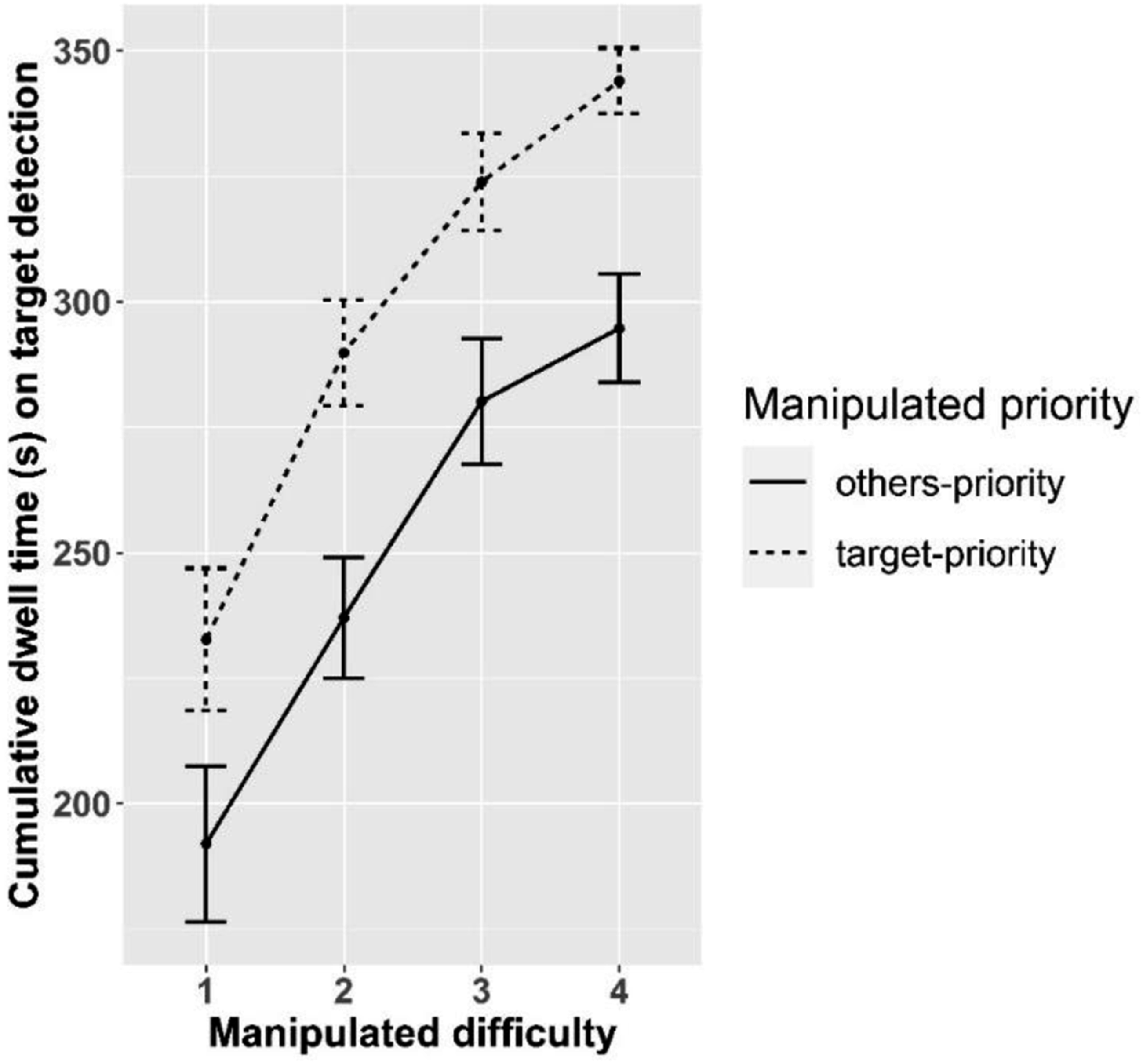
As shown in Figure 11, the average dwell time per visit to target detection was significantly influenced by priority (F1, 39 = 77.56, p < 0.001, ηp2 = 0.67), difficulty (F3, 117 = 260.75, p < 0.001, ηp2 = 0.87), and their interaction (F3, 117 = 22.12, p < 0.001, ηp2 = 0.36). Simple main effect analyses revealed that participants stayed longer on target detection per visit when it was of high priority at each difficulty level (all Fs ≥ 17.77, ps ≤ 0.001, ηp2s ≥ 0.31). Difficulty also increased dwell time per visit under both target-priority (F3, 117 = 206.86, p < 0.001, ηp2 = 0.84) and others-priority (F3, 117 = 102.42, p < 0.001, ηp2 = 0.72) conditions, with significant increases between adjacent levels (ps < 0.05) except for a marginally significant increase from the 3rd to 4th levels in the others-priority condition (p = 0.052). The interaction revealed a reinforcing effect: the effect of priority was strengthened as difficulty increased, and the effect of difficulty was more pronounced for high-priority tasks. Average dwell time per visit to target detection per 8-minute experimental scenario (group means and standard errors)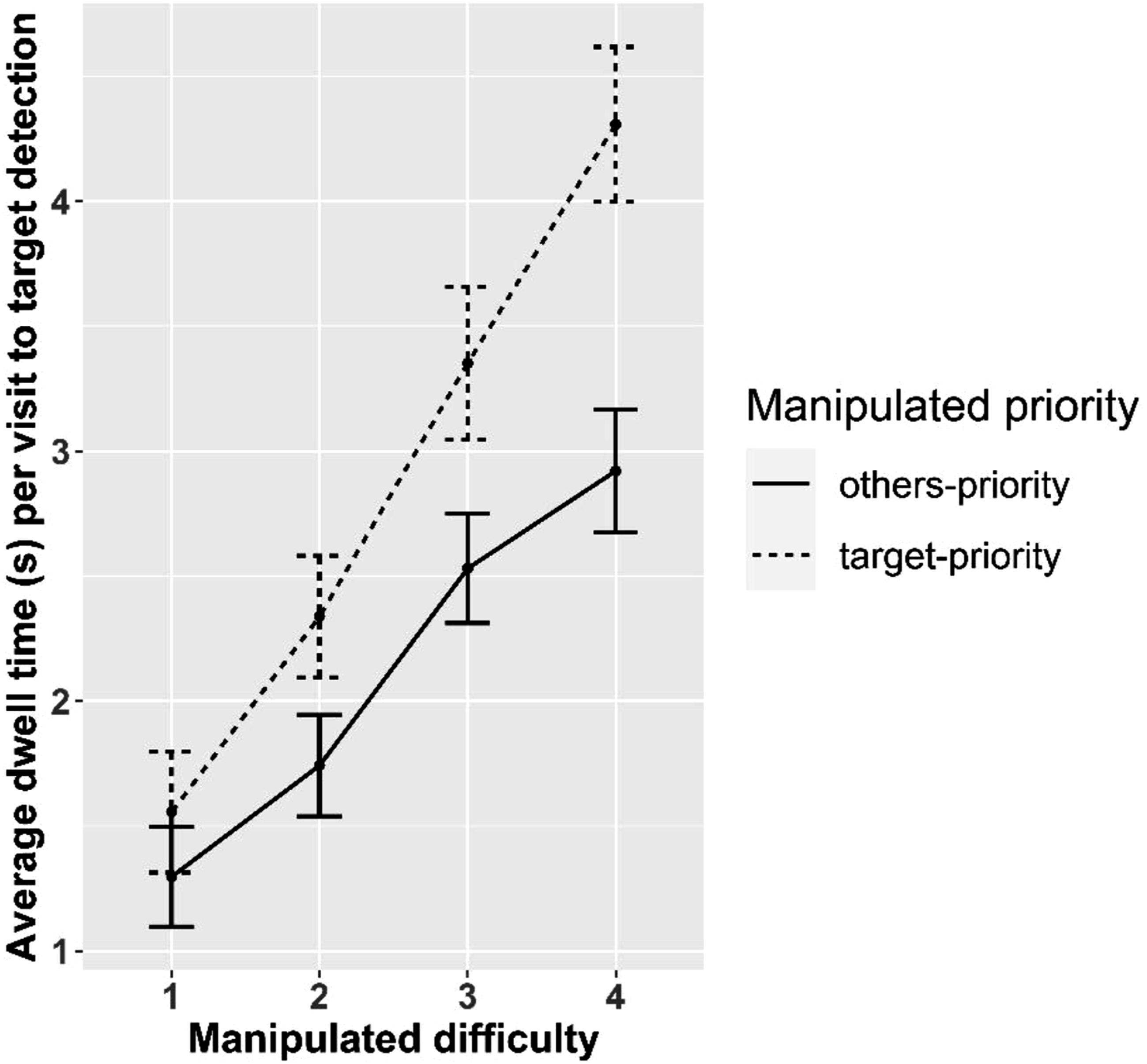
Discussion
Significant Priority Effect on Task-Switching Choice
To address the “priority neglect mystery” in prior STOM validations relying solely on priority instructions, we proposed that priority should be manipulated through explicit, personally relevant consequences tied to task-switching decisions. By implementing this as performance-based task rewards, weighted by individual task priority, the current study showed that priority enhanced both OT “stickiness” (longer dwell time) and AT attractiveness (higher proportions of switches). The findings support the utility of priority in predictive task-switching models, which has been previously questioned due to its lack of effect in laboratory studies (Wickens et al., 2016; Zabala & Gutzwiller, 2021). The results extend the findings of Lewis et al. (2024) by showing that the priority effect on AT attractiveness was not limited to “forced-choice” task conflicts. In multitasking scenarios with stochastic task events, participants demonstrated a clear preference to switch to higher-priority tasks and stayed on such tasks longer.
Task Difficulty Affects Global Switching Tendency More Than Individual Task Selection
Beyond confirming that difficult OTs are “stickier” (Wickens et al., 2016; Wickens & Gutzwiller, 2017; Zabala & Gutzwiller, 2021), our results shed new light on how difficulty affects the tendency to switch to a task, which has been inconsistently reported in prior studies. We found that as target detection difficulty increased, total switches across all tasks declined. This global reduction can be attributed to the fact that task switching itself requires executive control and consumes cognitive resources (Banich, 2009; Kiesel & Dignath, 2017; Langhanns et al., 2021) and that participants may reserve resources for task execution rather than switching. Consequently, absolute switch counts for a given task can misrepresent AT attractiveness due to the confounding effect of overall switching tendencies, and this may account for inconsistent results in prior studies (Wickens et al., 2016; Zabala & Gutzwiller, 2021).
To account for the confounding effect of overall switching tendency, we used the proportion of switches to measure AT attractiveness. The results show that participants were less likely to switch to the target detection task at its lowest difficulty level, as compared to higher levels (Levels 2–4). However, beyond this minimum level, difficulty had no significant effect on proportions of switches. This finding presents a threshold-based account of difficulty’s role in task switching, which diverges from the STOM prediction. The STOM prediction was derived mostly from laboratory experiments using the voluntary task-switching paradigm, in which participants choose between two simple and discrete tasks of equal value on each trial, and the unchosen task is abandoned. Under such conditions, participants favor easier tasks for higher reward-effort efficiency (Braun & Arrington, 2018; Jurczyk et al., 2019; Payne et al., 2007). Our study simulated a more complex and ecologically valid scenario, in which multiple supervisory tasks ran in parallel, and it was possible for operators to monitor and complete all tasks by proper task switching. The results indicate that participants adopted a dual strategy dependent on cognitive demand: when overall demand was low, they strategically attended less to easier tasks to make effective use of available resources; under high-demand conditions, they attempted to maintain the overall demand within cognitive limits as much as possible by reducing global switching, abandoning more nuanced adjustments. Collectively, these findings suggest that task difficulty primarily affects global switching tendency rather than individual task selection.
Priority Effect and Difficulty Effect Mutually Reinforce Each Other
A notable finding of this study is the mutual reinforcement between priority and difficulty at both subjective and behavioral levels. This interaction, while largely overlooked in prior sequential multitasking research, mirrors the resource trade-offs postulated by Navon and Gopher (1979) in their Multiple Resource Theory for concurrent tasks. Viewed through this classic lens, an increase in task “difficulty” can be conceptualized as shrinking the Performance Operating Characteristic curve (i.e., the trace of the bound of joint performance of concurrent tasks), while “priority” acts as the operator’s allocation policy for situating behavior along that curve. The framework suggests that high task difficulty compresses the POC curve, which leads to a stronger effect of priority; conversely, when difficulty is low and resource constraints are relaxed, the POC expands, allowing greater flexibility, that is, priority plays a comparatively weaker role. Our study suggests extending this theoretical framework to sequential multitasking scenarios.
At the subjective level, perceptions of priority and difficulty are intertwined. For high-priority tasks, increased difficulty elevated perceived priority, an effect absent for low-priority tasks. Cognitive dissonance theory provides a possible explanation (Harmon-Jones & Mills, 2019): when performance consequences are high, individuals may invest greater effort to achieve desired outcomes, but increased difficulty also raises the risk of failure. To reduce dissonance between high effort and potentially suboptimal outcomes, individuals may inflate a task’s value to justify the investment. Additionally, tasks with greater performance consequences were perceived as more difficult, likely due to performance pressure and heightened metacognitive awareness.
This psychological reinforcement extended to switching behaviors: the effect of difficulty on total switches and the average dwell time per visit to specific tasks was more pronounced in the high-priority condition. Effect size comparisons revealed that priority had a larger impact on task selection (“which task to switch to”), whereas difficulty more strongly affected global switching frequency (“how frequently to switch”) and dwell time on specific tasks. Our findings align with Valéry et al. (2019), who reported that priority significantly affected cumulative dwell time on a specific task only under high-difficulty conditions. Together, these findings highlight the need for multitasking models like STOM to incorporate the interactive effects of task attributes, particularly in complex, real-world settings.
Practical Implications
This study’s findings inform the design of interventions to support task-switching decisions in complex multitasking environments involving multiple displays. First, designs to mitigate cognitive tunneling must consider priority-difficulty interactions. As difficulty increases, operators sharply reduce switching frequency and tend to tunnel into high-priority difficult tasks. Simply reinforcing task priority alone may exacerbate attentional lock-in on a single task (display). To mitigate this, both system supports and training interventions should help operators maintain broad situational awareness. A possible intervention is to provide a high-level global status zone on all displays, ensuring the “big picture” is always in sight. In addition, proactive system support can be developed to facilitate cross-display task management by monitoring alternative tasks and guiding attentional switches to these tasks when needed. Guiding signals should be carefully designed to avoid unnecessary intrusiveness or disruption to operators’ workflow. For example, ambient awareness designs (e.g., using the border color or “glow” of a secondary task screen to indicate its status) can be adopted to indicate the need for monitoring in a non-intrusive way, whereas auditory or haptic cues can be used to alert operators to critical events that require immediate attention. Furthermore, targeted training should expose operators to varying difficulty and workload conditions to foster adaptive task management skills, and teach multi-display scanning strategies to cope with the challenges of distributed displays.
Second, a critical design challenge lies in ensuring that operators maintain an accurate and up-to-date mental model of task priority. Particular caution is needed when introducing automation or AI assistance for high-priority tasks. Alami et al. (2025) found that participants relied less on AI assistance for high-priority tasks. However, introducing automation assistance can reduce task difficulty for human operators. According to our results, the reduced difficulty may inadvertently lower the operator’s perceived priority and lead to insufficient attention allocation. Furthermore, relying on initial priority assumptions is insufficient when task importance shifts dynamically (e.g., a sudden emergency in a previously low-priority sector). System designers should consider strategies to explicitly visualize dynamic priority levels, preventing operators from ignoring critical information due to outdated priority beliefs or automation-induced complacency.
Limitations and Further Research
Several limitations warrant consideration. First, the participants were students from a top-tier university in China. Chinese people are often considered more polychronic (i.e., general preference for multitasking rather than one thing at a time) than Westerners (Fulmer et al., 2014; Hall, 1976), and high-performance students tend to be more goal-oriented and competitive in general (Baumann & Harvey, 2021). These characteristics may affect individuals’ multitasking strategies and performance, which need to be considered when generalizing our findings. Second, despite receiving training, the participants were novices compared to professional operators. As task-switching is a strategic skill (Gopher, 1993), professional operators likely possess superior mental models of system dynamics, which may help them resist attentional tunneling (Wang et al., 2025; Wickens et al., 2003). For future research, it would be valuable to examine whether experts employ different switching strategies to manage priority-difficulty trade-offs, or whether their plateau in switching proportion occurs at a higher difficulty level. Third, this study did not examine the temporal-spatial patterns of attention allocation, which could offer more nuanced insights into behavioral differences between high- and low-performers.
Conclusion
By addressing previous methodological issues and improving experimental design, this study validates and extends the STOM model by examining how task priority, difficulty, and their interaction affected attention allocation and task switching in a complex multitasking environment involving multiple supervisory tasks distributed on multiple screens. First, by manipulating priority via performance-based consequences, our study resolves the “priority neglect mystery” in prior studies and provides strong support for the impact of priority on task-switching choice. Second, we found that task difficulty affected global switching tendency more than local task selection and revealed a threshold effect in the relationship between task difficulty and attractiveness of ATs. Third, to the best of our knowledge, we provided the first evidence of the priority-difficulty interaction in complex multitasking scenarios. Priority and difficulty mutually reinforce each other’s impact at both subjective and behavioral levels.
Key Points
• This study investigated the main and interaction effects of task priority and difficulty on task-switching behaviors in a complex multitasking scenario. • Participants performed four concurrent supervisory tasks, each shown on a separate display surrounding them. • Participants were more likely to switch to and dwell longer on high-priority tasks. • Increased task difficulty led to fewer overall switching behaviors and longer dwell time on the corresponding task. • Priority and difficulty mutually reinforced each other’s perception and impact.
Footnotes

Funding
The authors disclosed receipt of the following financial support for the research, authorship, and/or publication of this article: This study was supported by the National Natural Science Foundation of China (Project no. T2192932).
Declaration of Conflicting Interests
The authors declared no potential conflicts of interest with respect to the research, authorship, and/or publication of this article.