







Abstract
Affective Events Theory suggests customer interactions elicit event appraisals that, in turn, prompt affective reactions in employees. A qualitative diary study was used to examine the daily events and cognitive appraisals that elicit positive emotions during customer service interactions. Thematic analysis of the diary contents of 276 sales employees from a variety of industries (874 positive events) showed helping customers solve their problem was the event most likely to trigger positive emotions. The data and resulting model revealed that particular configurations of employees’ appraisals predicted particular emotion(s). Within-person differences in cognitive appraisals also helped explain why some initially negative events may ultimately become a positive experience. Emotional contagion was found, where the positive emotions of the sales employees, or those of the customer, influenced the emotion of the other. The implications of the study for employees’ happiness and well-being, and for enhanced customer service relations, are discussed.
Keywords
Introduction
Positive emotions are beneficial for employees’ well-being in organizations (Bakker and Schaufeli, 2008; Frederickson, 2001) and for their success in general (Lyubomirsky et al., 2005). Indeed, Frederickson (2001: 218) argues ‘positive emotions are worth cultivating, not just as end states in themselves but also as a means to achieving psychological growth and improved well-being over time.’ In service industry environments, which make up a significant component of employment in most Western economies (Jorgenson and Timmer, 2011), employees’ positive emotions can also have a positive impact on service quality (Barger and Grandey, 2006; Pugh, 2001) and customers’ willingness to repurchase from the same organization (Tsai, 2001; Tsai and Huang, 2002). According to Affective Events Theory (AET), work-related events are the most proximal cause of employees’ affective reactions (Weiss and Cropanzano, 1996). However, how and why these events trigger emotions is not explained per se by AET. The contribution of this study is in using cognitive appraisal theory within the guiding framework of AET (Weiss and Beal, 2005), to examine the cognitive processes by which customer-related events elicit changes in positive emotional states.
Previous research has investigated affective events in service industry jobs in general (e.g. Basch and Fisher, 2000; Grandey et al., 2002). Few studies, however, have specifically examined positive affective experiences (Langston, 1994). In part, this may be because people find it more difficult to differentiate between positive emotional states (Ellsworth and Smith, 1988). However, as positive affective experiences could involve different underlying processes (Gable et al., 2000), such studies have the potential to enrich our understanding of the reasons why events elicit positive emotions. For example, in a recent study of German auto service workers, Zimmermann et al. (2011) found customers can be a psychological resource for positive affect, and this can lead to positive spirals in mood during the customer interaction. Positive emotional contagion in service encounters has been documented for some time (e.g. Barger and Grandey, 2006; Pugh, 2001). The development of more contextually rich event–appraisal–emotion links, however, will shed additional light on the types of events and appraisals that lead to positive customer service exchanges. Research also needs to consider the dynamic nature of the process by allowing for the possibility that positive affective reactions may also arise from initially negative events (Lindebaum and Fielden, 2011).
Cognitive appraisal theory posits that whether a work event will elicit a positive affective response depends on an employee’s cognitive appraisal of the situation (Ellsworth and Smith, 1988; Lazarus, 1991; Roseman et al., 1990; Scherer, 1997). The key assumption is that it is the interpretation of events that creates the felt emotion rather than the event itself. The person’s appraisal of the event is, therefore, theoretically distinct from the event and the feelings experienced. Agency appraisals, or the sense of responsibility a person feels for the event (rather than someone else), is thought to be a potentially important appraisal determining the pleasantness of felt emotions (Ellsworth and Smith, 1988; Smith and Ellsworth, 1985). Additional appraisals, however, such as perceived effort, are potentially important in differentiating between ‘active’ (e.g. excitement) and ‘quiet’ (e.g. happiness) positive emotions (Ellsworth and Smith, 1988: 306). When combined, these appraisal mechanisms may help to explain why some events elicit high, and others low, activation positive emotions (Russell, 1980). In this article, these appraisals are grouped into primary and secondary appraisals, respectively. It is not intended to imply that one follows the other, but rather that the first is related to pleasantness and the other(s) to the activation level. This distinction is important in building theories that seek to explain how appraisal mechanisms combine to elicit specific positive emotions in response to particular events in organizational settings.
Recent research has shown that appraisal mechanisms can fluctuate within the same individual, as well as between individuals (Goetz et al., 2010; Nezlek et al., 2008). However, there are few within-person studies of fluctuations in positive emotion appraisals in real life (i.e. Goetz et al., 2010; Nezlek et al., 2008) or organizational settings (i.e. Tong et al., 2007). Within-person studies of the appraisal process are an important theoretical contribution because they help explain why people may experience different emotions in response to the same apparent affective event, an explanation currently not provided by the tenets of AET. This information may then be used to help foster positive affective experiences for service employees and their customers.
A qualitative diary study was chosen to examine the positive event–appraisal–emotion process for three reasons. First, it is consistent with Fineman’s (2004) call for context-focused inquiry into dealing with the ‘messy’ truth of emotions. The naturalistic context helps overcome the limitations of previous appraisal research, which has been criticized for using hypothetical vignettes that may not induce the intense or genuine emotions associated with actual events (Nezlek et al., 2008; Tong et al., 2007). Second, the high degree of connectivity in the brain between emotion and cognition (Izard, 2009) can make it difficult for individuals to disentangle the reasons for a particular emotion. The use of a diary has been shown to help elicit the subjective process of event interpretation (Fitness, 2000). Finally, a diary study has the potential to provide insight into the dynamic nature of employees’ day-to-day appraisals and, hence, fluctuations in their emotional state.
The aims of this study were to: (i) identify the events during customer interactions that elicit specific positive emotions (the event–emotion relationship); (ii) examine how employee appraisals are related to those customer service events, including whether similar events can elicit different appraisals within the same individual (the event–appraisal relationship); (iii) determine whether particular configurations of appraisals are associated with particular felt emotions (the appraisal–emotion relationship); (iv) explore why events that are initially appraised negatively may eventually elicit positive emotions (the negative-event–positive-emotion relationship); and (v) investigate the role of employee appraisals in emotional contagion between sales employees and their customers. Each of these aims is discussed in more detail in ensuing sections.
Positive event–appraisal–emotion process
Event–emotion relationship
Positive affective states can have a positive influence on well-being because they expand thought behavior repertoires, as explained by the broaden-and-build theory of emotions (Frederickson, 2001). However, the possible antecedents to positive affective states for individual attitudes and behavior, as well as potential boundary conditions, remain less well understood than those of negative emotions. One notable reason for this is a tendency of prior research to examine positive emotions under the broad umbrella of positive affect, rather than distinguishing between different positive emotions on the basis of their level of activation. Such a distinction is important, because each emotion carries contextually relevant information and meaning for the person experiencing it (Frederickson, 2000). The first aim of this study, therefore, is to identify how particular positive emotions (both high and low in activation) relate to different categories of customer-related affective events. Pleasant high-activation emotions include, for example, excitement and enthusiasm, whereas low-activation emotions might include relaxation and satisfaction (Russell, 1980).
An affective event is ‘an incident that stimulates appraisal of and emotional reaction to a transitory or ongoing job-related agent, object or event’ (Basch and Fisher, 2000: 37). Few studies have investigated job-related events that elicit affective reactions in employees in service industries. Basch and Fisher (2000) found from interviews with hotel employees that happiness and affection were associated with acts of customers, whereas interactions with customers elicited pleasure. The actions of customers however, also elicited negative emotions. Shraga and Shirom (2009) analyzed themes in interview transcripts to identify events associated with increased vigor among employees. The most commonly reported events eliciting vigor were job significance, feedback from supervisors and achieving success. While these studies provide insight into affective events, they do little to further our understanding of the reasons why events cause specific positive emotions.
Event–appraisal relationship
It is important to study the event–appraisal process because ‘how a person construes an event shapes the emotional and behavioral responses’ (Lazarus and Folkman, 1984: 24). Although an appraisal of the pleasantness of an event is consistently associated with positive emotions, Smith and Ellsworth (1985) have shown that, beyond this initial classification, pleasantness is of limited usefulness in discriminating between positive emotions. Additional appraisal dimensions are required. In the present study, the choice of cognitive appraisals to examine was based on a two-step process. First, the literature on cognitive appraisal theory and Pekrun’s (2006) control-value theory of achievement emotions were reviewed to identify relevant studies of appraisals and positive emotions; and second, a comprehensive set of appraisals relevant to the service context were selected to provide a lens to view the various aspects of the employee–customer relationship. Despite the limited prior research into appraisals of positive events, there is considerable overlap in the cognitive appraisals identified by various authors that are potentially relevant (Scherer, 2001).
Twelve appraisal dimensions were selected for inclusion in the study (see the Appendix for a description of each appraisal and example), based on Ellsworth and Smith (1988), Lazarus (1991, 1993), Nezlek et al. (2008), Pekrun (2006), Pekrun et al., (2006), Roseman et al. (1990), Scherer (1997), Smith and Ellsworth (1985) and Tong et al. (2007). Ellsworth and Smith (1988: 305, emphasis in original) in their seminal study of appraisals of positive emotions, specified agency, or the perception of the situation as caused by oneself, someone else, or impersonal circumstances, as a critical appraisal dimension. Agency is a consistent theme in several appraisal models (e.g. Roseman et al. 1990; Scherer, 1997; Smith and Ellsworth, 1985; Tong et al., 2007) and hence, self-agency, other-agency and situational-agency are thought of as primary appraisal dimensions in this study.
Ellsworth and Smith (1988) emphasized that, in combination with agency, additional appraisal dimensions are important in determining whether high- or low-activation positive emotions are elicited (Russell, 1980). They found the person’s perception of the situation as effortful or easy, and as uncertain or certain were important. The extent to which an event is appraised as unexpected or novel in the circumstances is another dimension potentially relevant to positive emotions (Scherer, 1997; Smith and Ellsworth, 1985). In addition to these more general structural dimensions, appraisal dimensions important to the context under study were also included.
Relational appraisal theorists (Lazarus, 1991, 1993; Nezlek et al., 2008; Smith and Kirby, 2009; Smith and Lazarus, 1993) identified the core themes of goal achievement, enhanced ego-identity, positive encounters and improvement in the situation as important mechanisms that elicit specific positive emotions. Pekrun’s (2006) control-value theory of achievement emotions – which suggests that perceived control over achievement activities and outcomes, and the value of achievement activities to employees, will trigger positive emotions – is also of potential relevance to the high achievement context of sales and service. In these environments, mastery of the activity and performance related goal achievements are two appraisal mechanisms potentially of relevance (Pekrun et al., 2006).
Scherer (1997) theorized that events that affirm an employee’s belief about what is right or wrong should lead to positive feelings. Scherer’s ethical dimension (self-concept compatibility) equates to perceptions of fairness (Smith and Ellsworth, 1985; Tong et al., 2007) and to legitimacy (Roseman et al., 1990) in other models. Inclusion of an ethical appraisal category was considered important given the potential for employees to focus on selling rather than on the long-term needs of the customer (Saxe and Weitz, 1982).
Along with the three primary appraisal dimensions of agency, nine possible secondary appraisal dimensions including effort, certainty, novelty, situation improved, positive encounter, ego-identity, goal achievement, personal mastery of the activity and ethical, which were recognized by most researchers as potentially relevant in explaining positive emotional reactions to events in the context under study, were also examined.
Recent research has found evidence for both within- and between-person fluctuations in appraisals (Goetz et al., 2010; Lazarus, 1991; Nezlek et al., 2008; Smith and Kirby, 2009). That is, the same individual can construct different meanings of similar circumstances and of the same circumstances at different times; and two individuals can construct different meanings from the same event. Nezlek et al. (2008) suggested that within-person differences in emotion regulation strategies and emotional reactivity to situational cues may be the reason why individuals may appraise events differently. Therefore, the second aim of the study is to examine how the 12 appraisals relate to specific affective events, and whether similar events elicit different appraisals within the same individual.
Appraisal–emotion relationship
The central premise of appraisal theory is that a specific pattern, or configuration of appraisal, evokes a particular emotion (Ellsworth and Smith, 1988; Lazarus and Folkman, 1984; Roseman et al., 1990; Smith and Ellsworth, 1985). Recent research, however, has found an appraisal is not necessarily invariantly related one-to-one with a specific emotion (Goetz et al., 2010; Nezlek et al., 2008; Tong et al., 2007). Previous studies of appraisals are limited in that they have typically examined the relationship between a single appraisal and a single emotion (Tong et al., 2007). While attributing an event to oneself may elicit pride (Goetz et al., 2010), it does not follow that every time an event is perceived to be caused by the self, that pride will be activated. Rather, Nezlek et al. (2008: 149) reasoned that ‘dominant relationships between certain appraisals and emotions are complemented by weaker but meaningful cross-relationships between other appraisal emotion associations’. Hence, a primary agency appraisal needs to be combined with secondary appraisals in order to discriminate between positive emotions. Emotions may therefore be associated with more than one appraisal, and a configuration of appraisals may elicit more than one emotion.
The few studies of appraisals of positive emotions in naturalistic settings have mixed findings. The pleasantness of the encounter, the importance of the goal, and certainty elicited happiness among Singaporean police officers (Tong et al., 2007). Appraisals of self-agency and goal importance elicited enjoyment, pride, and contentment among university students (Goetz et al., 2010). Goal achievement has been associated with joy; enhanced ego-identity by taking credit for a valued achievement with pride; and an improvement in a situation with relief (Lazarus, 1991, 1993). Crediting oneself with an achievement is thought particularly important in distinguishing pride from happiness (Lazarus, 1991). In another study of university students, goal achievement elicited happiness and joy; and positive encounters evoked joy and love (Nezlek et al., 2008). The third aim of this study, therefore, was to determine whether particular configurations of appraisal mechanisms were predominantly associated with particular emotions.
Negative-event–positive-emotion relationship
Lindebaum and Fielden (2011) have argued that while situations at work may give rise to negative emotions, they do not always lead to negative outcomes. In their study of construction project managers they found that events that elicited anger could result in a positive outcome by helping to ensure the progress of the project. Beal and Ghandour (2011), in their recent study of information technology service workers, found that negative and positive affective events can interact in complex ways to cause affective shifts in employees. In service contexts, employees often experience negative affective events, such as an encounter with a difficult or abusive customer (Grandey et al., 2002). How employees appraise these events may well influence whether they come to view the event as a negative or positive experience. However, little is known about the cognitive appraisal processes that underlie these incidents; including how and why some may eventually be experienced as positive events.
Frederickson (2000) has argued that the ‘end affect’ associated with an outcome can make an experience worthwhile, regardless of the moment-by-moment affect leading up to it. Endings convey some certainty that an event has been completed, particularly when episodes are goal-directed, such as those typically found in service interactions. They also provide valuable information to the person about their personal capacity to manage the experience. Theoretically speaking, although some customers may test the limits of a service employee’s knowledge, skills, and emotion regulation ability (Gross, 1998), the interaction may still be considered a positive experience if there is a positive conclusion. The fourth aim of this study, therefore, is to explore the appraisals associated with negative events, which through dynamic customer-service interactions eventually came to be experienced positively.
Emotional contagion relationship
Prior research has identified that emotions can be transferred from one person to another through primitive emotional contagion (e.g. Hatfield et al., 1994) and through more conscious emotional comparison processes (e.g. Gump and Kulik, 1997; Sullins, 1991). In the former, the contagion occurs through a process of mimicry and feedback. For example, in a study of small food outlets Barger and Grandey (2006) found that smiling employees made customers smile, even though the service encounter was brief. Positive service encounters have also been shown to influence customers’ post-encounter moods (Pugh, 2001). Zimmerman et al. (2011), in a more recent study of car dealerships, found direct and indirect effects of customer positive affect on service employee affect (and vice versa). The second contagion process is more cognitive, in that the person compares their emotional response to others in the situation in order to understand what they should be feeling. The person’s facial expression can convey information which, in turn, influences others’ appraisals of the situation and hence their emotional state (i.e. produces a contagion effect) (Gump and Kulik, 1997). For example, the responsiveness and caring of the service worker may positively influence customers’ moods (Parasuraman et al., 1985). While these studies support the potential for emotional contagion to occur in service settings, the appraisal mechanisms that elicit positive emotions involved in such affective events appear not to have been investigated.
Appraisals that focus on the relational aspect of the service encounter, such as positive encounters, may be more likely to lead to emotional contagion because they elicit interpersonal emotions, such as affiliation and liking (Lazarus, 1991). Nezlek et al. (2008) found events that were appraised as positive encounters were associated with the interpersonal emotion of affection (love) in a sample of university students. How employees appraise events in which the customer’s positive affect initiates the emotional contagion, as found in Zimmerman et al.’s (2011) study, is also of theoretical interest. Employee appraisals that attribute responsibility for the positive encounter to the customer may lead to reciprocated positive emotions in the employee. The final aim of the study is to assess the possibility of a positive affect cycle fuelled by an employee’s appraisal of the situation and hence, the importance of the customer and service worker as potential sources of positive emotional contagion.
Method
A qualitative diary study was chosen because it can provide a deeper understanding of the occurrence of affective events, employees’ appraisal of those events, and of the possible fluctuations in the positive emotions that are generated (Beal and Ghandour, 2011; Brief and Weiss, 2002). Participants were recruited from an on-line panel of full-time employees who had previously indicated their willingness to participate in studies of this kind. The research company sent potential participants an email from the authors that explained the purpose of the study, who was conducting it, what was expected of them, and assurances of confidentiality. Panel members who answered the survey were paid in points that can be used toward online purchases.
The critical incident technique was selected as being appropriate for discovering positive affective events. Participants were asked to recall a specific event and to describe the circumstances surrounding the incident (Flanagan, 1954). The technique is particularly useful when there is little prior information about what kinds of event may be important and the situation is well defined (Buchanan and Bryman, 2007). As the focus of the study was the employee–customer interaction, the diary questions were phrased to ensure participants described only customer-related events. Open-ended questions were purposely used to elicit the full range of affective events, appraisals, and emotions experienced.
Participants completed diary entries on-line for five consecutive days from Monday to Friday in which they described their ‘most emotionally uplifting customer interaction.’ Space was provided for the participant to describe each event. Participants also answered two additional questions (‘how did you feel’ and ‘why was it an emotionally uplifting customer experience’). To minimize recall biases and to elicit ‘peak’ emotional events (Frederickson, 2000), participants were asked to recall the most positive event. To ensure the timely and accurate completion of the diary, participants were given access to the webpage between 1600 and 1800 hours each day. This time period was chosen to accommodate differences in the length of the work day between jobs and industries.
Participants
Participants were full-time employees in sales-oriented roles who spent 50 percent or more of their working day interacting with customers. In total, 276 employees completed an average of 3.17 diary entries yielding a total of 874 descriptions of positive affective events. Of these, 85 employees completed all five days of the diary, representing a response rate of 31 percent of the total participants. There were no significant differences in the demographic characteristics between the 85 participants with complete diaries, and the 191 participants with incomplete diaries, with the exception that the former were slightly better educated. The education level of participants varied, with 33 percent educated to high school, 30 percent completing a diploma or certificate, and 21 percent holding a bachelor’s degree. The employees were aged between 18 and 64, with a mean age of 37. The sample was predominantly female (63%).
The average number of customers that employees interacted with on a daily basis was 30 (range, 1–100), with an interaction lasting, on average, 24 minutes (range, 1–360). The employees worked an average of 41 hours a week and had 10 years’ average sales experience. The average tenure in their current job was five years. Employees worked in a wide range of industries including the retail sector (38%), banking/insurance (11%), travel/tourism (6%), manufacturing (5%), health care/medical (5%), and real estate (4%).
Analyses
The diary responses for each of the questions were imported into NVivo 8 for coding and data analysis. Thematic analysis, a method for identifying patterns (themes) within the data in order to understand the phenomenon in question and to produce mid-level theories (Boyatzis, 1998; Braun and Clarke, 2006), is an accepted technique for analyzing textual data in management research (e.g. Hyde et al., 2009; Shraga and Shirom, 2009). A combination of inductive and deductive thematic analysis was used to code the affective events (Boyatzis, 1998; Fereday and Muir-Cochrane, 2006). To reduce potential bias, the coding of the data was carried out by an independent rater who worked with the first author to develop theoretical nodes based on the literature (Hayes, 1997). A thematic code was developed based on the initial nodes constructed from the raw data. Working with the thematic codes a second rater coded all of the affective events to the categories. The proportion of agreement between the first two coders was 94 percent. To ensure consistency a third rater coded a sample of the data using the thematic code descriptions. An acceptable average inter-rater agreement of 82 percent was achieved.
Deductive thematic analysis was used to code employees’ appraisals of the events using the thematic codes shown in the Appendix (Boyatzis, 1998). The first author and two research assistants coded the events. As each emotion is potentially associated with a particular configuration of appraisals, the events were coded to multiple appraisal categories. Each description was initially coded to the primary appraisal mechanism of agency or perceived responsibility (i.e. self-, other- or situational-agency), and secondary codes were then applied where relevant. Three rounds of coding had an acceptable average inter-rater agreement of 81 percent for the 12 categories of appraisals.
The Circumplex Model of Affect was used as a guide to classify the emotions that were experienced during the affective event (Russell, 1980). A thesaurus was used to code employees’ responses (based on synonyms) that were not clearly discrete emotions, with one exception (Remington et al., 2000). The words ‘good’, ‘great,’ and ‘fantastic’ were used so often by employees that these were coded to one category. An acceptable inter-rater agreement of 95 percent was achieved for the coding of the emotions.
Thematic coding was performed on the critical incidents for all 276 employees to reach theory saturation (Lincoln and Guba, 1985), given the lack of a priori knowledge of aspects of the phenomenon. The prevalence of events, appraisals, and emotions were then summated and the frequency of association between the events and emotions, events and appraisals, and appraisals and emotions obtained from NVivo. Friedman’s chi-square test, a non-parametric test used to analyze repeated measures of categorical data (Diefendorff et al., 2008), was applied to the summated data for the 85 complete diaries to assess the between-day differences. A non-significant finding would show that differences in the frequencies of the affective events, appraisals, and emotions were not related to the day of the week. Finally, the person-level data for the complete diaries were analyzed to determine the extent of within-person differences in events, appraisals, and emotions across the five days.
Results
The Friedman test showed no significant between-day differences in the prevalence of the reported affective events (χ2(4) = .20, p = .98), appraisal dimensions (χ2(4) = .98, p = .91) or emotions experienced (χ2(4) = 1.44, p = .84). Results for each of the five research aims based on the thematic analysis of all event data are discussed in turn. Findings for the within-person analyses, derived from the complete diaries, are presented under the event–appraisal and appraisal–emotion results.
Event–emotion relationship
The first aim of the study was to identify the specific emotions related to different categories of customer-related affective events. Seventeen categories of affective events were initially identified based on the coding including two non-events, where employees answered with ‘N/A’ (2.11%) or ‘none’ (13.52%), and 15 positive events (84.37%). ‘No event’ was the most frequently reported category across the 17 categories. It is difficult to fully interpret the meaning of the ‘no event’ category as only 7 percent of the entries included an explanation as to why the employee responded this way. However, the first quote below refers directly to the lack of a positive affective event and feelings of boredom. The second quotation shows how even when an employee believes no peak affective event has occurred, customers can act as a resource for positive affect:
Absolutely nothing. Not one positive thing happened and that alone made it into a very boring day. (M, insurance, 58 yrs) Didn’t really have any. A few customers smiled and cheered me up. (F, retail, 29 yrs)
The results for the 15 positive events and the most frequent emotions reported are presented in Table 1. Although 17 discrete emotions were reported, nine positive emotions comprised 90 percent of the total responses. The other emotions each had frequency counts of less than 2%. The highest frequencies were feeling happy (304; 27%), good (284; 25%), proud (157; 14%), satisfied (151; 13%), and excited (71; 6%) (final row of Table 1). Employees reported multiple emotions for 18 percent of the affective events, with happiness the most frequently mentioned (79; 35%).
Event–emotion relationship for customer interaction
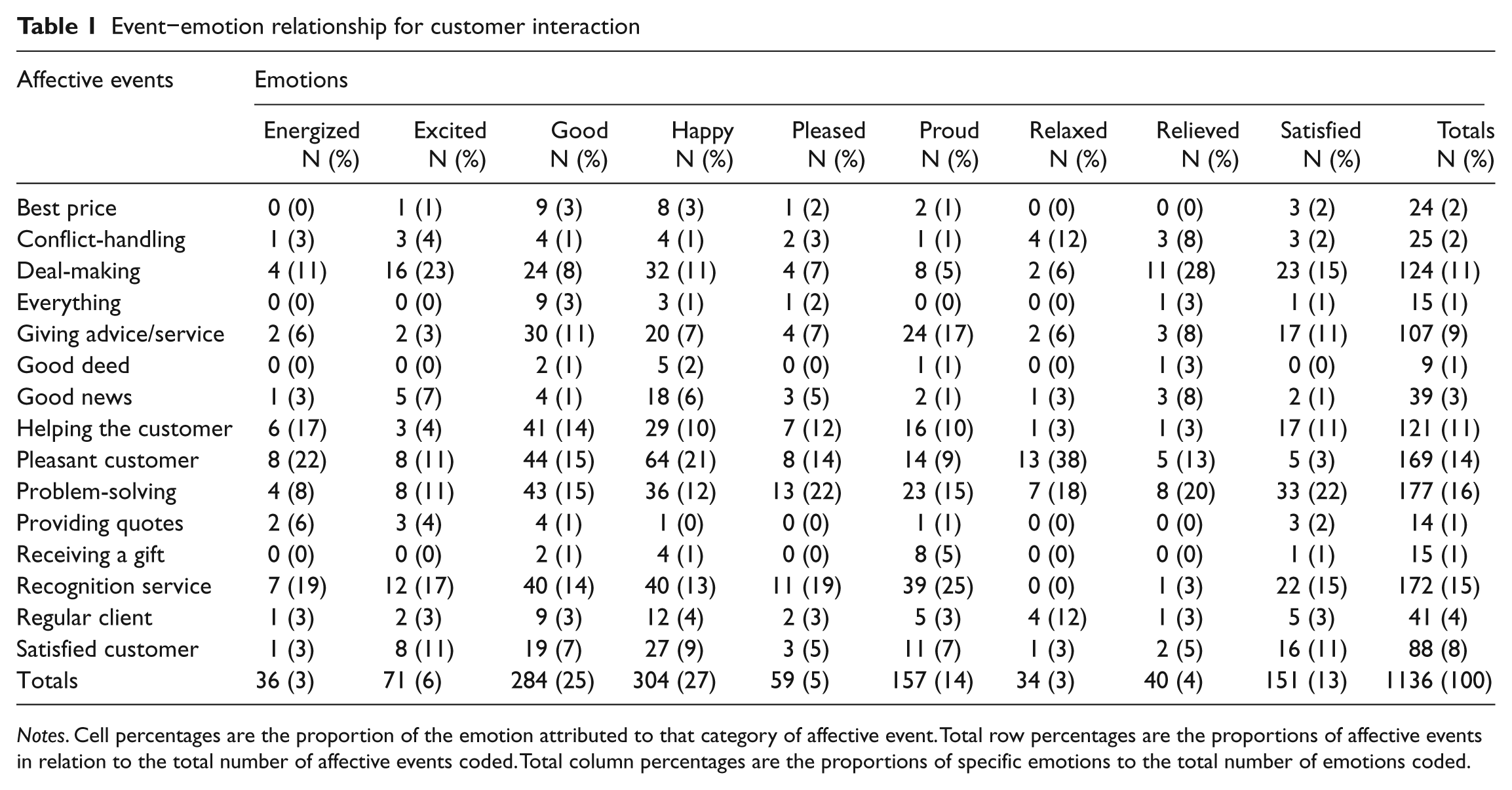
Notes. Cell percentages are the proportion of the emotion attributed to that category of affective event. Total row percentages are the proportions of affective events in relation to the total number of affective events coded. Total column percentages are the proportions of specific emotions to the total number of emotions coded.
Examining the event–emotion matrix shows the four most frequently reported event categories (final column of Table 1) were associated with different emotions (problem-solving with pleased (13; 22%) and satisfied (33; 22%); recognition for service with pride (39; 25%); pleasant customers with relaxed (13; 38%), energized (8; 22%) and happy (64; 21%); and deal-making with excited (16; 23%) and relieved (11; 28%)).
Event–appraisal relationship
The results for the relationship between events and the 12 appraisal categories, relevant to the second study aim, are shown in Table 2. Employees attributed responsibility for affective events primarily to self-agency (677; 32%) and other-agency (i.e. the customer) (257; 13%). The most frequently reported secondary appraisal categories (final row of Table 2) were personal mastery (325; 15%), enhanced ego-identity (270; 13%), goal achievement (207; 10%), and positive encounter (184; 9%). The results for the four most frequent affective events are presented in the following paragraphs.
Event–appraisal relationship for customer interaction
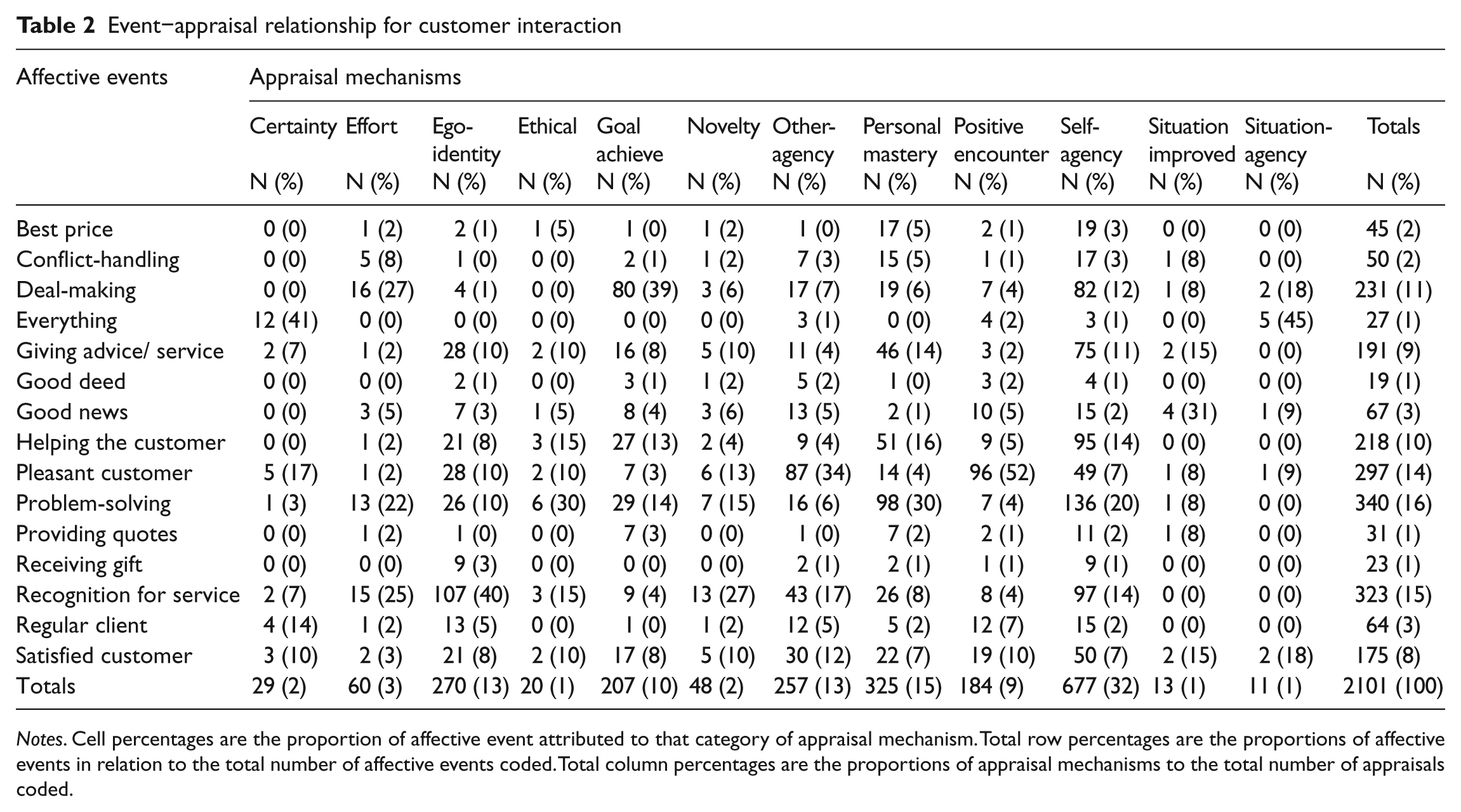
Notes. Cell percentages are the proportion of affective event attributed to that category of appraisal mechanism. Total row percentages are the proportions of affective events in relation to the total number of affective events coded. Total column percentages are the proportions of appraisal mechanisms to the total number of appraisals coded.
Problem-solving
Problem-solving was most strongly associated with self-agency and personal mastery of the activity. Ethical appraisal was also related to problem-solving events. The theme for this event category was employees thinking they had solved the customer’s problem:
Helping out a customer who was struggling to understand what they needed to buy by working out what they were trying to achieve. (M, construction, 34 yrs) I made a suggestion to a customer several days ago about how to fix something of his that was broken and he returned today to thank me for my help and to let me know the problem was now fixed. (F, travel/ tourism, 30 yrs)
Recognition for service
The event category of recognition for good service was associated with self-agency and enhanced ego-identity. Several employees referred to events such as receiving small gifts, chocolates, or flowers for their good service. A number of employees also mentioned instances in which a customer telephoned, emailed, or returned to thank them:
Satisfied customer wanting to speak to my manager to provide good feedback. (F, telecommunications, 36 yrs) A customer asked for me directly and told me that they will continue to do so because I give them good service. (F, manufacturing, 31 yrs)
Pleasant customer
A major affective event category included pleasant or friendly customers, which was associated with positive encounters. Employees primarily attributed responsibility for these positive encounters to the customer (other-agency). These events were not necessarily work-related, but often involved the customer sharing something personal with the employee or simply being friendly. For example, special family occasions such as birthdays, births, or holidays. Employees also made references to the customer smiling, chatting, laughing, or joking with them:
Seeing a really nice customer who has just brought her premature baby out of hospital, so she brought her in for us to see her. (F, health, 31 yrs) The customer told a joke to me and her friends. It was at the end of the day and I was starting to feel a bit flat. Laughter is always an uplifting experience. (F, retail, 46 yrs)
Deal-making
The event category of deal-making was associated with the employee attributing their goal achievement to themselves (self-agency), and this also occasionally involved effort or overcoming an obstacle to close the deal. In these events, employees made references to meeting sales targets and the size of the sale:
Meeting my sales target thanks to a lovely young woman I dealt with. (F, health, 28 yrs) Met my goal today of the week, had to explain it and sell. (M, agriculture, 45 yrs)
Results for the within-person analysis of the extent to which similar events may be related to different appraisals within the same individual shows 12 percent of employees identified, on average, only 1.6 different affective events (SD = .50) across the five days. These same employees, however, described slightly more appraisal dimensions (M = 1.9, SD = .74) than events. These results imply that similar events may elicit different appraisals or interpretations in some people. In contrast, the other 88 percent of employees reported three or more different peak affective events in the diary (M = 4.13, SD = 1.08). These employees described slightly fewer appraisal dimensions on average than events (M = 3.23, SD = 1.03), suggesting that some people may appraise events similarly, even though the events differ.
Appraisal–emotion relationship
The third aim of this study was to identify configurations of appraisal dimensions that elicit particular emotions during the customer interaction; and to examine the extent to which these appraisal configurations, and associated emotion states, vary within individuals. The emotion(s) and the appraisal configurations with which they were associated are discussed next, with particular attention given to the appraisals related to happiness (see Table 3).
Appraisal–emotion relationship for customer interaction
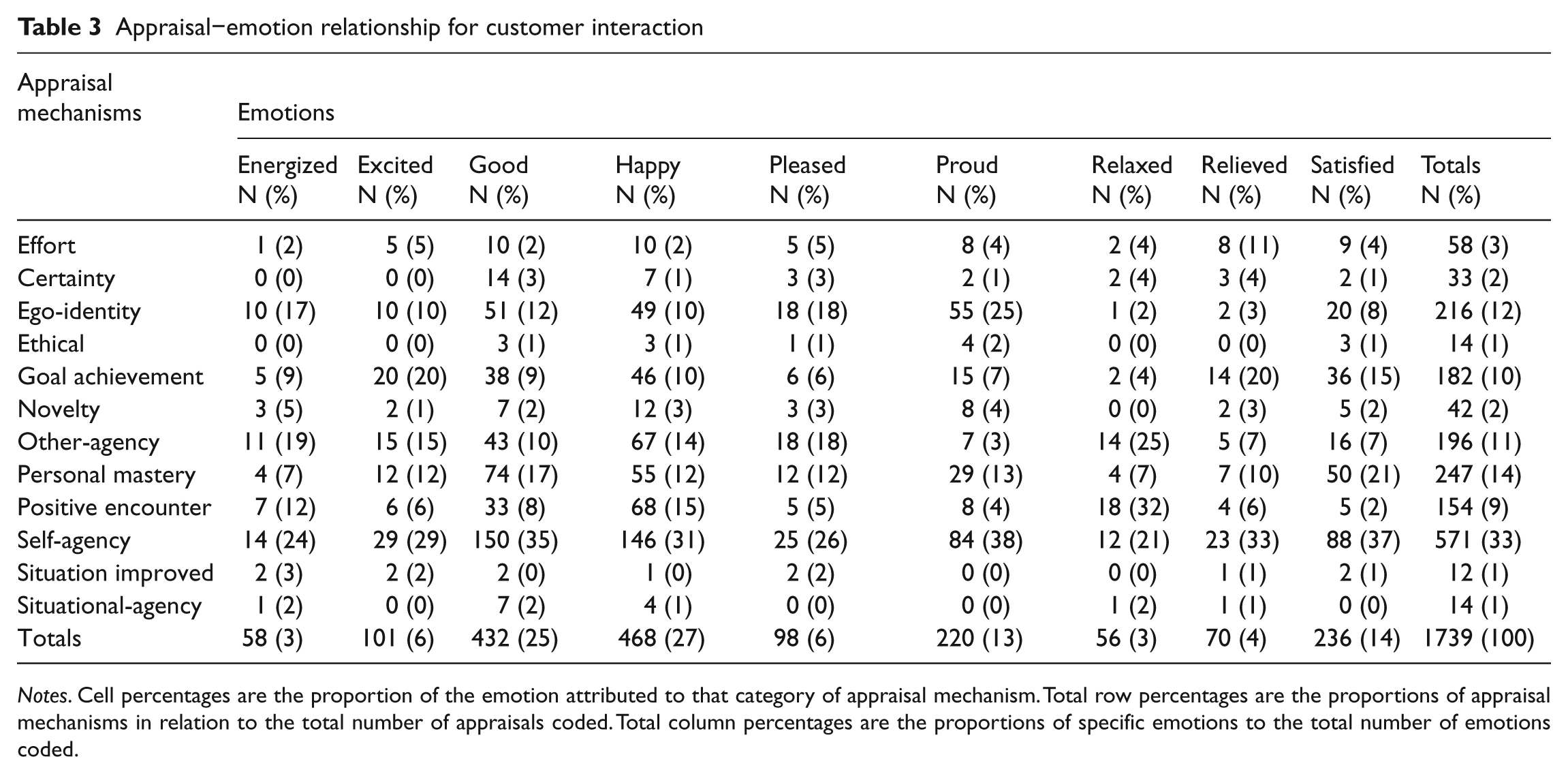
Notes. Cell percentages are the proportion of the emotion attributed to that category of appraisal mechanism. Total row percentages are the proportions of appraisal mechanisms in relation to the total number of appraisals coded. Total column percentages are the proportions of specific emotions to the total number of emotions coded.
Satisfaction
Appraisals of self-agency and personal mastery were most strongly related to satisfaction. Employees felt they had performed their task or service well. This made them feel good about themselves and their ability. Comments such as ‘satisfaction for the well done job’ and ‘because I knew I had done my job well’ highlight employees’ feelings of personal mastery in performing the task, leading to positive emotions:
A sales call where the customer asked ‘my opinion’. A customer asking my opinion of a competitor product shows they value my opinion and also to find out how much I know about what else is available, i.e. my knowledge. Felt respected, satisfied, trusted. (F, medical, 41 yrs) Customer’s surprise of quick response time. I felt as though I was providing a level of customer service not expected by the customer. Satisfied. (M, banking, 30 yrs)
Pride
Appraisals related to self-agency and enhanced ego-identity were uniquely related to pride. Some employees noted they rarely received internal recognition and so it was good to receive it from customers. The comments illustrate that credit for a job well done is an important appraisal in eliciting pride:
It reinforced my feelings of self-worth and made me feel appreciated. I felt as though a straight forward honest answer was not something the customer had received from others. I felt trusted and proud. (F, construction, 48 yrs) Had some chocolates received from a happy client. Made me feel like I was appreciated and felt good about myself for doing such a good job. Proud of my efforts and touched. (F, banking, 33 yrs)
Excitement and relief
The configuration of self-agency and goal achievement appraisals was most strongly associated with excitement and relief. However, it should be noted that the frequency of these emotions was 6 percent and 4 percent, respectively. Comments about meeting sales targets or large sales orders were common:
Being able to sell quite a significant amount of product to the one customer. I felt valued and a success at work. Excited. Very pleased with myself – even though it did take up a large portion of my day completing the sale. (F, healthcare, 28 yrs) Upselling to a client – who bought the best and most expensive products off me. He was a nice person to talk to very friendly – listened to everything I said and was happy dealing with me. Excited made a good sale for the month – more money for me at the end. (F, banking, 30 yrs)
Relaxation and happiness
Configuration appraisals of other-agency and positive encounters were related to relaxation and happiness. The example below illustrates the relation between other-agency and a positive encounter and happiness and relaxation:
Talking to one of my favourite customers. He is one of the nicer customers I have, and it is always nice catching up with him. Quite happy and relaxed, as he is a genuine person, and we always get along extremely well. (F, retail, 40 yrs)
Happiness
Results show a dominant relationship between the appraisal dimension of self-agency and happiness. There are also weaker but meaningful relations between the three secondary appraisals of personal mastery, goal achievement, and ego-identity with happiness. The results support multiple appraisal configurations eliciting happiness, including other-agency and positive encounter as mentioned above, and also self-agency with personal mastery, goal achievement, and ego-identity, as illustrated in these respective examples:
I had an easy call that they already knew what they wanted but I made it better and cheaper for them. I saved them even more money than they expected with a better service. Happy. (M, real estate, 25 yrs) Meeting my sales target thanks to a lovely young woman whom I dealt with. I felt valued and was happy with the sale. Uplifted. She was genuine and I did my best to assess and help fit products to her needs. (F, healthcare, 28 yrs) A customer discovered our brand and was delighted with my service. I love to please my customers – build rapport – they then return as loyal customers. Happy that she was satisfied and excited. (F, retail, 48 yrs)
Results for the within-person analysis show that the individuals who reported slightly more appraisal mechanisms (M = 1.9, SD = .74) than events (M = 1.6, SD = .50) also reported a greater number of positive emotions (M = 2.7, SD = .95). Table 4 provides an example of the fluctuations in appraisals and positive emotions experienced by one employee for similar events across the five-day diary. Although only two affective events were coded (satisfied and pleasant customer), the appraisals differed and hence also the emotions experienced.
Example of intrapersonal fluctuations in appraisals and positive emotions over the week for similar affective events (F, sales clerk, 31 yrs)
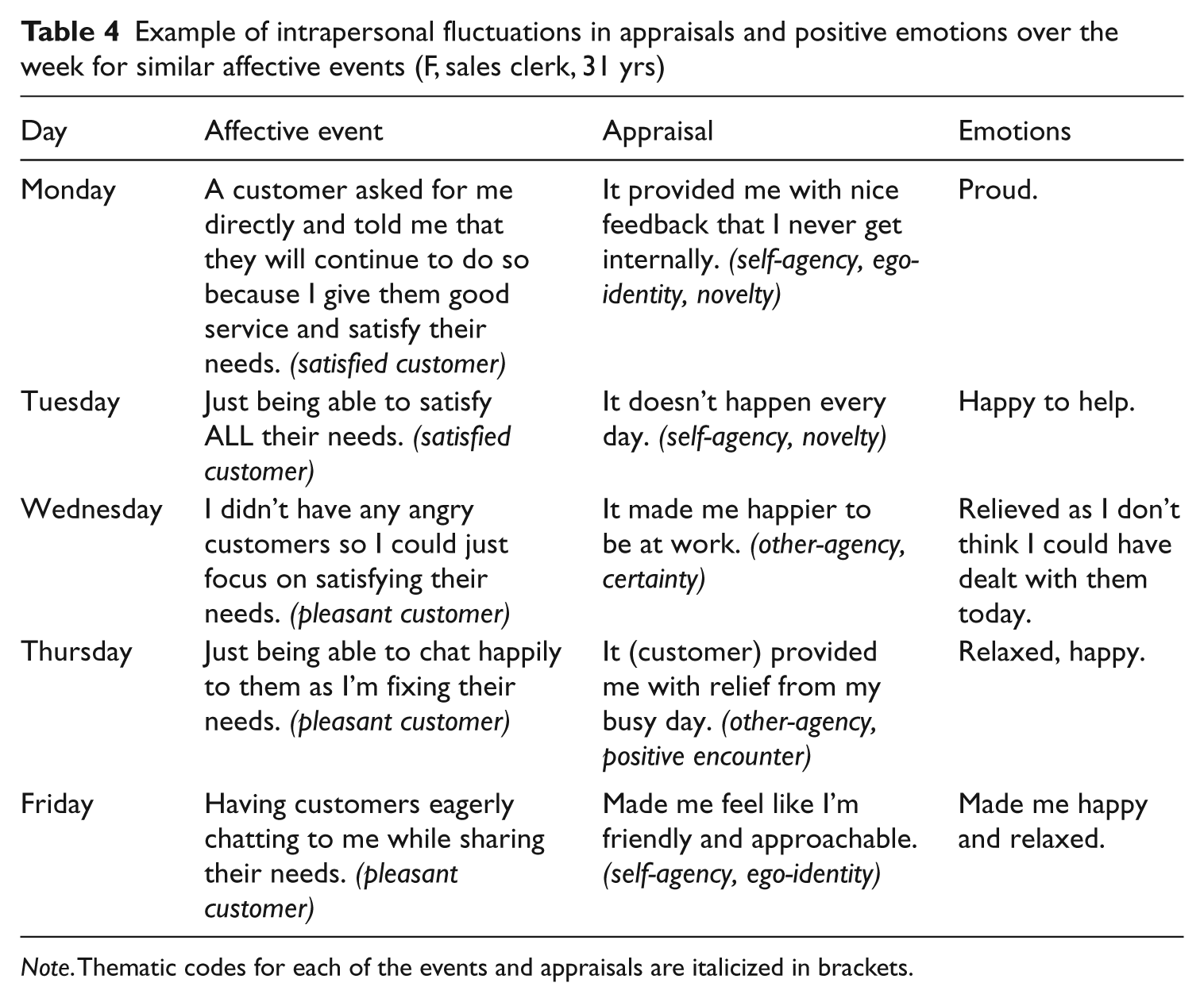
Note. Thematic codes for each of the events and appraisals are italicized in brackets.
The other individuals, who typically described more events (M = 4.13, SD = 1.08) than appraisals, reported equivalent numbers of positive emotions (M = 3.45, SD = 1.30) to appraisals (M = 3.23, SD = 1.03). Fewer appraisals may be important to these individuals, and as a result they experienced fewer different emotions.
Negative-event–positive-emotion relationship
Some evidence was found to support the idea that what appeared initially to be negative affective events can later generate a positive emotional response. Fifteen employees reported 17 (1.5% of total events) critical incidents where this occurred. The increased complexity of the event–appraisal–emotion relationship in these examples is evident:
A person arriving upset, a bit belligerent, and demanding to see someone in higher authority. I felt empathy, tried to find out what was the problem so that I could follow the correct procedure to appease the customer. It took a long time but the customer was finally given the right information and service and went away satisfied. The plus was the genuine thanks and smile from them. (F, education, 64 yrs) A big request. Annoyed at first, but once it was done, it felt satisfying. Because it required tedious work. (F, consulting, 33 yrs)
The dominant appraisal mechanisms involved in these events were self-agency (33%) and personal mastery (25%). To a lesser extent, the appraisal dimensions of anticipated effort (15%) and goal achievement (13%) were also identified. Consistent with the appraisal–emotion configurations identified earlier, self-agency and personal mastery were associated with satisfaction (11%); and self-agency and goal achievement with excitement (11%) and relief (39%) for these events. Effort was also related to relief.
Emotional contagion relationship
Results relating to this fifth research aim included 26 references (2.28% of total events) by 22 employees to events that involved emotional contagion. Comments such as ‘happy customers make me happy’ and ‘it was nice to speak to someone who was feeling so good and happy – it cheered me up’ demonstrated the effect of the customers’ mood on employees’ emotional states. The dominant appraisal mechanisms associated with emotional contagion was a positive encounter (38%) owing to other-agency (35%), and to a lesser extent, self (12%). Consistent with the previous results, this particular appraisal configuration was strongly related to happiness (52%). Feeling good was also mentioned (23%). In the first example the employee attributes responsibility for the change in their emotional state to their encounter with the customer (other-agency), and in the second to themselves (self-agency):
A customer who had a great sense of humour. It was refreshing to talk to someone who enjoyed a good laugh, and it was contagious. Happy. (F, telemarketing, 47 yrs) Got a smile out of a customer, who had just come from having chemotherapy. Because that customer’s long term outlook is not a good one and I made them smile and feel better for just a moment they didn’t feel or think about the illness affecting them. I felt good that I could make them smile and feel better even if only for a short time. (F, retail, 51 yrs)
Discussion
The importance of positive affect for optimal health and well-being is increasingly being accepted among organizational scholars (Bakker and Schaufeli, 2008; Frederickson, 2003). Research has also established the importance of employee positive affect for customer satisfaction and service quality (Barger and Grandey, 2006; Pugh, 2001). The overarching objective of this article was to examine the cognitive processes by which customer-related events elicit changes in positive emotional states. Based on the study’s findings, a model, shown in Figure 1, was developed that describes the nuanced processes by which positive emotions are generated in the relational context of employee–customer interactions.
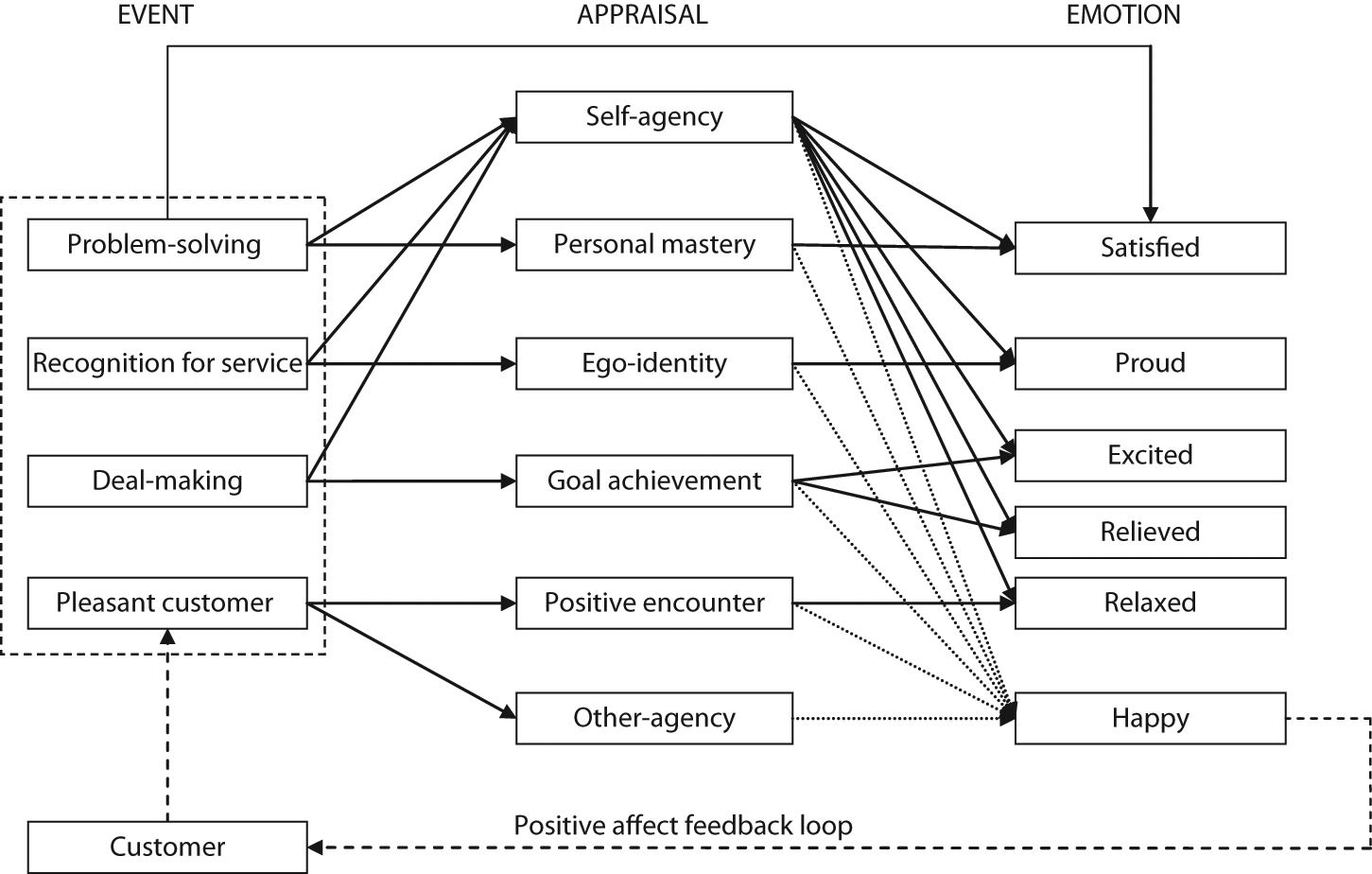
Positive event-appraisal-emotion process during customer interactions.
The findings contribute to a richer understanding of the ‘life of the happy worker’ in three main ways. First, while Ashkanasy (2003) emphasized the importance of AET for understanding within-person fluctuations in emotional states, AET does not explain the mechanisms whereby particular events trigger specific positive emotions. By incorporating cognitive appraisal theory (Ellsworth and Smith, 1988) and the control-value theory of achievement emotions (Pekrun, 2006) within an AET framework (Weiss and Beal, 2005; Weiss and Cropanzano, 1996), the model in Figure 1 explains how particular events can cause changes in positive emotions in service contexts. In particular, the appraisal mechanisms of self-agency, other-agency, personal mastery, ego-identity, goal achievement, and positive encounters were important reasons why events triggered changes in emotions including satisfaction, pride, excitement, relief, happiness, and relaxation.
Second, the findings presented in Figure 1 address the need to develop structural models that specify relations between events, appraisals, and positive emotions (Brief and Weiss, 2002; Smith and Kirby, 2009). Relationships that elicited positive emotions included: (i) problem-solving events with the appraisal configuration of self-agency and personal mastery, which elicited satisfaction; (ii) recognition for service events with the appraisal configuration of self-agency and enhanced ego-identity, which elicited pride; (iii) pleasant customer events with the appraisal configuration of other-agency and positive encounter, which elicited happiness and relaxation; and (iv) deal-making events with the appraisal configuration of self-agency and goal achievement, which elicited excitement and relief. Happiness was found to be associated with multiple appraisal configurations, as has also been found with the emotion of interest (Silvia et al., 2009). It may be that each person has a specific pattern(s) of appraisal that is a subset of these multiple configurations that elicits happiness for them.
Third, the positive event–appraisal–emotion process may be more nuanced than previously considered. Given empirical support for dominant configurations of appraisal–emotion relations, the event–appraisal nexus is critical in understanding how changes in emotional states may occur. For example, if similar events can be interpreted differently by the same person on different days (i.e. differing appraisal mechanisms), as is suggested by the findings, then this helps explain within-person fluctuations in positive emotional states. Why a service employee responds to a pleasant customer with relief on one day (i.e. appraisal of certainty associated with no difficult customers), and with happiness and relaxation on another (i.e. appraisal of other-agency and positive encounter), could be explained by the different needs, goals, and abilities of the individual (Smith and Kirby, 2009) at that moment in time. There is a need, therefore, for experience sampling studies that examine the events that precede the appraisal process and how personal characteristics (e.g. self-efficacy, goal orientation) and task-relevant factors (e.g. task demands, time pressure) (Smith and Kirby, 2009) interact to influence the appraisal of the event and hence positive emotions.
The study findings also contribute to theory development in several minor areas. Customer orientation, or helping to solve the customer’s problem (Saxe and Weitz, 1982), was the most common event identified by employees that elicited satisfaction, or what is often termed an affective ‘uplift’. This study found that a problem-solving orientation can be beneficial for employees’ momentary satisfaction, consistent with Franke and Parke (2006). Recognition for good service was an important source of feedback that was uniquely associated with pride. Customer feedback is integral to employees knowing how well they have provided the service and for gauging customer satisfaction. These results affirm customers as a ‘valid, reliable and trustworthy’ source of performance feedback in sales environments (Grandey and Diamond, 2010: 341).
The findings support the relevance of Pekrun’s (2006) control-value theory of achievement emotions to AET and appraisal theories. Goal achievement has been previously identified as an important appraisal dimension in organizations (Lazarus, 1993; Nezlek et al., 2008; Smith and Lazarus, 1993). However, the findings of this study highlight the importance of mastery of the activity (i.e. utilization of knowledge, skills, and abilities) (Pekrun et al., 2006) in eliciting the satisfaction of employees. For employees in our sample, taking personal responsibility for the customer’s problem and using their skills and abilities allowed them to be more effective problem-solvers. The findings support Dormann and Zapf’s (2004) contention that solving a customer’s problem may be a positive experience because it enhances an employee’s sense of competence and achievement, as well as their self-esteem.
Relational appraisal models contend that specific emotions are related to core themes in one-to-one relationships (Lazarus, 1993; Smith and Lazarus, 1993). However, combining Lazarus’s core relational themes with agency appraisals helped to discriminate more clearly the emotions associated with positive encounters. Other-agency (customer) was an important primary appraisal dimension for differentiating positive encounters owing to pleasant customers from the other types of affective events. The importance of attributing responsibility to self is an implied, but not explicit, appraisal mechanism in Lazarus’s (1993) themes of enhanced ego-identity and goal achievement. Self-agency and enhanced ego-identity were also important in this study in differentiating pride from other positive emotions. A person’s conscious sense of self is an ever-evolving state that may readily incorporate feedback relating to how well they perform, and this can influence an employee’s affective state (Ilies and Judge, 2005).
Consistent with Ellsworth and Smith (1988), attributions of responsibility for the event to self or others did not readily differentiate between positive emotions. The findings provide new insights into the importance of the secondary appraisal dimensions of personal mastery, enhanced ego-identity, goal achievement, and positive encounter for eliciting positive emotions, highlighting the need to employ methods in naturalistic inquiries that allow for multiple appraisals. Feeling good was one emotion not well differentiated within the event–emotion relationship, suggesting it may be a general adjective used by employees to describe positive affect. Employees reported feeling excitement and relief as a result of goal achievement, consistent with the elation of working difficult issues through to a satisfactory conclusion. Our findings also support Nezlek et al. (2008) who suggested that an appraisal dimension may elicit multiple emotions. Pride was the only emotion that was uniquely predicted by self-agency and enhanced ego-identity.
The results support the notion that initially negative affective events can become positive emotional experiences depending on the appraisal mechanisms involved. The keys to this emotional change were the appraisal dimensions of self-agency, personal mastery, anticipated effort/obstacle, and goal achievement. That is, when employees believed they had the ability and authority to solve complex, and sometimes ambiguous, customer service needs, initial negative affect (usually emanating from the customer’s mood, or complexity of the problem), can lead to a positive affective state (i.e. relief, satisfaction, and excitement). These findings suggest a more complicated configuration of appraisals involving moderate changes in appraisals (Tong et al., 2009) is potentially responsible for negative events that generate positive emotions, commensurate with the complexity of the internal cognitive process. Hence, future research is needed to see whether individual differences (e.g. neuroticism, Tong, 2010) might explain why some negative affective events in service settings may have positive outcomes for some service employees.
A further theoretical contribution is the inclusion of the positive feedback loop from happiness to the customer in Figure 1. The findings are consistent with Zimmerman et al. (2011) in providing evidence of the importance of the customer as a potential source of positive emotional contagion and hence, a cause of within-person changes in service employees’ happiness. This study uniquely investigated the role of appraisals in this emotional contagion process. Employees’ appraisals of the customer’s friendliness and positive mood were associated with fluctuations in their own positive emotions. Experience sampling studies that focus on this phenomenon are needed to explore this finding further, as few emotional contagion events were identified. Increased attention on within-person differences and contextual factors, including the frequency and duration of the customer interaction, would provide more detail around the internal processes through which contagion influences emotions.
Practical implications
The results have implications for the potential design of interventions to improve the happiness and well-being of service employees. Events associated with emotional uplifts included solving a customer’s problem, and receiving appropriate positive feedback from the customer for doing so. Appraisals of personal control and mastery in providing a quality service to the customer were evident in employees’ accounts of their experiences. For service employees to experience success and achieve their goals, training in how to identify customers’ needs and the development of skills to provide an appropriate solution are critical. A more customer-oriented approach is likely when sales employees have the expertise and the knowledge to be able to assist customers (Saxe and Weitz, 1982).
Frederickson (2000) has argued a prescription for happiness is for people to put effort into optimizing their peak experiences and work towards creating better endings to affective episodes in organizations. ‘Peak’ events in this study include problem-solving, recognition for service, friendly customers and deal-making, while ‘end affect’ events were observed in the negative-event–positive-emotion critical incidents. Knowing the peak and end affect events could help in the design of work to promote emotional ‘uplifts’ in service contexts. Increasing employees’ awareness of the importance of putting effort into optimizing these processes could help realize more positive emotions, such as happiness.
The findings also highlight the importance of creating a positive service climate that promotes a positive mood among customers. Employees would also benefit from increased awareness that their interpretation of an event is related to the emotions they feel, and hence, changing the way they think about an event can lead to a more consistently positive emotional state. Talking about the event and celebrating its occurrence (through rewards, meetings, or newsletters) may provide additional benefits over and above the original event (Ilies et al., 2011; Langston, 1994).
Limitations and future research
The present study has limitations that future research should address. First, the autobiographical recall method may be prone to biases, because people are more likely to report a salient or prototypical event that evoked the emotion and may ignore less salient events (Nezlek et al., 2008). However, the potential for recall biases was minimized by ensuring the diary entry was made on the day of the event. Retrospective reports do have an advantage because they are based on employees’ descriptions of organizational experiences, allowing more confident generalizations than appraisal studies conducted in a laboratory.
Second, the format of the questions required participants to identify the most emotionally uplifting event (high-intensity) that occurred for them that day. Future research is needed to examine how the frequency of events identified in this study and their intensity influence appraisal and affective states. Experience sampling studies could provide a naturalistic in vivo report of the interpersonal and intrapersonal fluctuations in employees’ emotional states (e.g. see Goetz et al., 2010; Ilies et al., 2011; Nezlek et al., 2008).
Third, it was assumed that an employee’s appraisal, or interpretation of the affective event, influences the emotions experienced. However, emotion researchers have acknowledged there is a complex reciprocal relationship between cognition and emotion, such that an employee’s emotion can also shape appraisals of the event (Izard, 2009). Future studies are needed to examine the reciprocal nature of this relationship using longitudinal data (e.g. Fugate et al., 2011) that tracks changes in events, appraisals, and emotions over time.
Fourth, the study did not directly account for the influence of situational factors on the incidence of positive daily events reported. Autonomy has been found to be an important influence on the extent to which a service employee may appraise an event as stressful or satisfying (Grandey et al., 2004). Increased autonomy provides sales employees with greater latitude in regulating their emotions. Future studies of the potential moderators of the event–appraisal–emotion linkages would be useful.
Finally, there are some limitations in relation to the sampling. Although the sample size was large for a qualitative study, further research is needed to determine the applicability of the findings for service jobs beyond sales. Further, the day of the week was not significant in the frequencies of the events, appraisals, and emotions reported, based on employees’ peak daily experiences. Future experience sampling studies could use a qualitative diary method to sample more frequently the daily event–appraisal–emotion process.
Conclusion
This study helps to fill important gaps in the literature in five critical areas. First, the event categories were related to the experience of different positive emotions, making the context of the customer service interaction a salient characteristic. Second, secondary appraisals of events were uncovered, beyond previous appraisals of self- and other-agency. Third, the findings point strongly to the notion that specific appraisal configurations result in different experienced emotions. Employees’ self-reported emotions also showed that appraisals often lead to multiple felt emotions highlighting the ‘messy truth’ of how emotions may ‘play out’ in customer service settings. Fourth, self- and tasked-focused appraisals helped the employee reframe negative event obstacles into customer service opportunities. Finally, although emotional contagion was found in both directions, customers were appraised as a more frequent source of the positive encounter, with happiness more commonly reported than other positive emotions. The article lends credence to a problem-solving, customer orientation in the design of work for service employees. The customer interaction may need to be recast in the context of a dynamic interplay between salespersons and customers, where the affective state of each may influence the other.
Footnotes
Appendix
Twelve appraisal mechanisms used in thematic coding
| Primary appraisal mechanisms and examples |
| - e.g. ‘I had an easy call that they already knew what they wanted but I made it better and cheaper for them. I saved them even more money than they expected with better service.’ |
| - e.g. ‘A customer on the phone made small talk conversation, they were happy. It was good to receive a call that the customer was satisfied.’ |
| - e.g. ‘The positivity that the market is changing. Signs that better times are to come.’ |
| Secondary appraisal mechanisms and examples |
| - e.g. ‘Got a big dollar value order. Good achievement.’ |
| - e.g. ‘Selling a customer on our service rather than the price and winning an order. Because it was another example of being a salesperson rather than an order taker and I was able demonstrate the problem-solving skills that make the job interesting.’ |
| - e.g. ‘It reinforced my feelings of self-worth and made me feel appreciated. I felt as though a straightforward honest answer was not something the customer had received from others.’ |
| - e.g. ‘Customer was very friendly and made general conversation. The customer was very friendly easy to talk to.’ |
| - e.g. ‘Customer that has previously been difficult to deal with becoming increasingly easy to deal with. I feel like I’m finally building a relationship with this customer.’ |
| - e.g. ‘I can’t say what was the most really because overall it was great. Cause everything went to plan and no hiccups all day. Had an excellent day.’ |
| - e.g. ‘Having good feedback for the work done. Because I put a great deal of time and effort into it.’ |
| - e.g. ‘Satisfied customer wanting to speak to my manager to provide good feedback. It doesn’t happen often that a customer will go the extra step and praise you.’ |
| - e.g. ‘Finding out what the customer really could afford and dealing with it. They were very receptive to my product. Felt that I gave an honest opinion about the product.’ |

Note: These appraisal mechanisms from Ellsworth and Smith (1988), Lazarus (1991, 1993), Nezlek et al. (2008), Pekrun (2006), Pekrun et al. (2006), Roseman et al. (1990), Scherer (1997), Smith and Ellsworth (1985) and Tong et al. (2007).
Acknowledgements
The authors would like to acknowledge the invaluable assistance of Despoina Xanthopoulou, a guest editor of this special issue, for her insightful and constructive comments throughout the review process. We are also grateful to Simone Pettigrew and Melanie Pescud, who gave advice and assistance with NVivo on this project. We also thank the three anonymous Human Relations reviewers for their constructive feedback on earlier drafts of the manuscript.
Funding
This research was supported by an internal Research Development Grant from the University of Western Australia.