






Abstract
This article examines the three-way interaction effect of breaches of past promises, current job alternatives, and promises of future idiosyncratic deals on affective organizational commitment. Specifically, we posit that the negative relationship between breaches of past promises and affective organizational commitment is strongest when employees are promised idiosyncratic deals in the future and when they perceive that few job alternatives are currently available elsewhere. Data collected from 196 managers at two points in time over a one-year period support the proposed three-way interaction effect. This article highlights the importance of differentiating fulfillment of past contract obligations from promises of future idiosyncratic deals in further research on psychological contract breaches.
Keywords
Psychological contracts, or the promissory expectations employees have about what they owe their employers and what their employers owe them in return, help define employment relationships (Rousseau, 1995). Prior research has consistently shown that when such expectations are unfulfilled, employees’ job attitudes and job behaviors are both likely to deteriorate (Morrison and Robinson, 1997; Zhao et al., 2007). Many researchers have tried to understand how firms can repair these breaches in the employment relationship after they have occurred (Child and Rodrigues, 2004; Gillespie and Dietz, 2009).
One strategy for repairing these breaches is to promise employees better idiosyncratic deals (or i-deals) in the future to compensate for violating their expectations in the past (Hornung et al., 2009). These i-deals might include special pay packages, for example, or tailor-made career development programs. The rationale underlying this strategy is that employees’ adverse reactions to past breaches can be muted by promising disappointed workers additional resources in the future.
Do promises of better deals in the future succeed in repairing the bonds between employees and employers? Surprisingly, the extant literature has focused largely on how employees react to the fulfillment of past i-deals, but not on how employees react to promises of i-deals in the future. While i-deals have been linked positively to job attitudes and work behaviors in previous research (Anand et al., 2010; Hornung et al., 2008), there is no literature that addresses whether promises of future i-deals repair or adequately compensate for contract breaches in the past.
The fact that employees react positively when their psychological contracts have been fulfilled does not necessarily mean that employees will respond positively to as-yet-unfilled promises of future deals. Indeed, this article argues that promising future i-deals to employees as a way of repairing past breaches might actually backfire, as employees who have already experienced breaches might be especially skeptical about the organization’s ability and willingness to fulfill its promises in the future (Lo and Aryee, 2003; Rigotti, 2009). In fact, employees who have experienced breaches in the past may view promises of future deals as just another way for the organization to stall or delay honoring its commitments even further. Thus, the first goal of this study is to examine whether promises of future i-deals moderate the relationship between breaches of past promises and organizational commitment.
In the present article, we consider organizational commitment as our main outcome variable of interest for two key reasons. First, psychological contracts capture workers’ perceptions of their employment relationships (Rousseau, 1995), whereas organizational commitment captures workers’ reactions to those employment relationships (Meyer and Herscovitch, 2001). Second, organizational commitment has been found to be an influential predictor of many job attitudes and behaviors (Mathieu and Zajac, 1990; Meyer et al., 2002) and thus has the potential to explain why and how contract breaches relate to a wide range of workplace outcomes.
The second goal of the article is to examine the role which perceived job alternatives play in moderating the relationship between breaches of past promises and organizational commitment. Perceived job alternatives refer to individuals’ estimates of being able to obtain comparable jobs outside the firm (Van Dam, 2005). To date, there has been only one study which has examined the moderating effects of perceived job alternatives in the breach–outcome relationship (Deery et al., 2006), and that study did not yield significant results.
Most of the previous research on psychological contracts has explored how factors within the organization (such as organizational trust) affect employees’ responses to psychological contract breaches (Restubog et al., 2010; Robinson, 1996; Turnley et al., 2003). However, here we suggest that this approach is incomplete because it ignores the influence of factors outside the organization, such as current availability of job alternatives, which influence employees’ perceptions of how likely organizations will be to honor their promises in the future. Our thesis here is that current job alternatives influence employees’ assessments of their bargaining power in getting promises of future i-deals actually fulfilled. In essence, we predict that promises of future i-deals and current job alternatives jointly moderate the relationship between breaches of past promises and organizational commitment.
Theory
Organizational commitment
Organizational commitment is generally conceptualized as a stabilizing force that binds individuals to organizations (Bentein et al., 2005; Meyer and Herscovitch, 2001). Organizational commitment is one of the most commonly examined job attitudes in the organizational sciences literature (Meyer et al., 2002). In particular, we focus on affective organizational commitment, which refers to employees’ emotional attachment to, involvement in, and identification with, their employers (Allen and Meyer, 1990; O’Reilly and Chatman, 1986). We focus on it here not only because it has been more frequently examined in the psychological contracts literature (Zhao et al., 2007) but also because the most direct and immediate outcomes of psychological contract breaches are negative emotions (Morrison and Robinson, 1997; Zhao et al., 2007).
Psychological contract breaches
Psychological contracts refer to employees’ beliefs regarding the mutual obligations between themselves and their employers (Rousseau, 1989, 1995; Shore and Barksdale, 1998). Employers provide inducements (e.g. pay raises or promotions) to encourage employees to contribute extra work effort and stronger attachment to the firm (Lambert et al., 2003). In turn, these promises and reciprocal obligations form the basis of employment relationships between the two parties over time (Janssens et al., 2003).
Psychological contract breaches occur when employees perceive that their employers have failed to fulfill the obligations or promises implied by their employment relationships (Turnley et al., 2003). It is important to note here that we are studying psychological contract breaches rather than psychological contract violations. A breach refers to a cognitive assessment of the discrepancy between what is promised and what is delivered, whereas a violation refers to the emotional response to such a breach (Morrison and Robinson, 1997). We focus on breaches here rather than on violations for both theoretical and empirical reasons. Theoretically, we are interested in how cognitive assessments of breaches, along with cognitive comparisons of current jobs to jobs elsewhere, prompt employees to distance themselves psychologically from their employment relationships. Empirically, previous researchers have observed that breaches and violations are often quite strongly correlated (e.g. Robinson and Morrison, 2000; Suazo and Stone-Romero, 2011). Consequently, following similar studies of psychological contracts, we frame the present study in terms of breaches as well (Bordia et al., 2010; Ng et al., 2010).
Psychological contract breaches elicit negative reactions from employees, partly because employees do not get the resources they are promised by their employers. Indeed, breaches of psychological contracts have been found to be negatively related to job satisfaction, trust, in-role performance, and extra-role performance, while being positively related to employee cynicism, absenteeism, and turnover (Andersson, 1996; Conway and Briner, 2002; Pugh et al., 2003; Restubog et al., 2006; Sutton and Griffin, 2004). These previous research findings lead us to predict that breaches of past promises will be negatively related to affective commitment to the organization as well.
Hypothesis 1: Breaches of past promises are negatively related to affective organizational commitment.
Idiosyncratic deals and contract idiosyncrasy
Rousseau et al. (2006) suggest that individuals sometimes negotiate with organizations to obtain special employment arrangements for themselves that are not made available to other workers. These personalized, non-standard arrangements are called idiosyncratic deals (or i-deals) and might include special promotion tracks, telecommuting arrangements, flexible work schedules, or tuition support for further education (Rousseau, 2005).
Building upon Rousseau et al.’s (2006) work on i-deals, Ng and Feldman (2010) proposed the construct of contract idiosyncrasy. Contract idiosyncrasy refers to the extent to that individuals believe they have been promised unique employment arrangements that are unavailable to most of their colleagues. While both these constructs refer to employment arrangements that are personalized and non-standard in nature, there is one important respect in which the research on these two constructs differs. The research on i-deals has examined how employees react to i-deals after they have been honored (or not). In contrast, contract idiosyncrasy research has focused on how employees react to promises of future i-deals before they have been honored.
Promises of future i-deals send positive signals to employees about the benevolent intentions of employers. When organizations breach psychological contracts, firms might try to repair those breaches by promising employees attractive i-deals in the future. In doing so, organizations hope to dissipate the employee’s frustration and/or compensate the employee for failure to fulfill their commitments. On one hand, then, it is reasonable to expect that promises of future i-deals might soften the negative relationship between breaches of past promises and affective organizational commitment.
However, we argue here that this strategy may not only fail to ameliorate reactions to breaches of past promises but may even exacerbate those negative reactions. That is, we hypothesize that promises of future i-deals will moderate the negative relationship between breaches of past promises and affective organizational commitment such that the relationship will be even more strongly negative when promises of future i-deals are made.
Our rationale is based on the observation that breaches of psychological contracts significantly lower employees’ trust in the organization (Lo and Aryee, 2003; Restubog et al., 2008; Robinson, 1996). Even material rewards (such as pay raises and promotions) subsequently given to employees to ‘make up’ for those breaches often fail to counterbalance the negative effects of breaches on organizational trust in the future (Robinson, 1996). In fact, in some cases, employees carry over the distrust created by a contract breach in one organization into their future employment relationships (Kim and Choi, 2010). Thus, a decline in organizational trust as a result of a past contract breach is not easily repaired and may well affect employees’ expectations regarding the likelihood of experiencing a contract breach in the future (Lo and Aryee, 2003).
Employees who have experienced breaches in the past but are promised i-deals in the future may be particularly suspicious that their employers are using these future promises as an excuse not to fulfill existing agreements. In addition, employees who experience breaches may view promises of future i-deals as a way of delaying honoring time-sensitive requests until they are no longer valuable. For example, employees may negotiate to telecommute one or two days a week so that they can spend more time with their children when they are out of school. Putting off honoring this obligation until September vitiates, in effect, the value of the contract altogether. Moreover, having to continually negotiate to get promises of i-deals fulfilled – and anticipating all the tactics the organization might use to get out of its commitments – can itself be very frustrating to employees. Last here, employees who have had contract breaches in the past but are promised future i-deals will be especially disappointed if those promises are breached once again, particularly if they entail rare or valuable resources that swayed employees to join the firm in the first place. For all these reasons, then, we predict:
Hypothesis 2: Promises of future i-deals moderate the relationship between breaches of past promises and affective organizational commitment, such that the negative relationship is stronger to the extent employees are promised future i-deals.
Perceived job alternatives
Perceived job alternatives refer to the beliefs individuals hold about whether they can find comparable jobs elsewhere (Farrell and Rusbult, 1992). While previous research on psychological contracts has focused largely on factors within the organization’s control, perceived job alternatives refer to employees’ estimates of labor market opportunities outside the organization. We propose that, in evaluating the quality of their employment relationships, employees consider not only what they are promised by their current employers but also whether there are better deals available elsewhere. This latter comparison process has been largely ignored in previous psychological contract research. As noted above, there has been only one study that examined the moderating impact of perceived job alternatives in breach–outcome relationships (Deery et al., 2006), and that study yielded non-significant results. Our thesis here is that the moderating effect of perceived job alternatives in the relationship between breaches of past promises and affective organizational commitment is more likely to be observable when those alternatives are jointly considered with promises of future i-deals.
Specifically, perceived job alternatives reflect an employee’s assessment of his/her own marketability and employability (Nyberg, 2010; Wittekind et al., 2010). When perceived job alternatives are high, employees see themselves as highly marketable and employable elsewhere. Under these conditions, employees will be more confident that their employers will deliver on promised i-deals, despite past contract breaches, because failure to do so would lead to the employee exiting the firm when few replacement employees are available. In contrast, when perceived job alternatives are few and far between, employees’ bargaining power is weaker (Gerhart, 1990). Under these conditions, employees have less leverage with their current employers to make them honor their promises and fewer opportunities to obtain comparable deals elsewhere. In effect, the employees will be stuck in the firm whether or not the firm fulfills its promises. Thus, in anticipation of even further breaches of promises of future i-deals, those employees who perceive few job alternatives will experience even greater declines in affective organizational commitment after breaches of past promises have occurred.
Indeed, previous research has shown that employees without acceptable job alternatives respond to dissatisfying job conditions by physically staying with their firm but psychologically withdrawing from it (Farrell and Rusbult, 1992; Rusbult et al., 1988). The perceived deprivation of valued resources in the future (signaled by breaches of past promises), when coupled with lack of opportunities to acquire similar, valuable resources elsewhere (as signaled by low perceived job alternatives), will jointly lower affective organizational commitment. Thus, we predict:
Hypothesis 3: There is a three-way interaction effect of breaches of past promises, promises of future i-deals, and perceived job alternatives on affective organizational commitment, such that the negative relationship between breaches of past promises and affective organizational commitment is strongest when employees are promised future i-deals and when perceived job alternatives are low.
Method
Research design
We hired Zoomerang.com to collect online survey data (rather than using more traditional methods, such as sending surveys to university alumni), for several reasons. First, we hoped to alleviate respondents’ potential reservations about the confidentiality of their data, which might have concerned respondents had we made entry through senior management. Second, the use of Zoomerang.com allowed us to follow up with employees easily with multiple waves of data collection over time. Third, the use of Zoomerang.com allowed us to broaden the diversity of industries sampled, thereby increasing the variance in the sample on our four key constructs. Fourth, Zoomerang.com allowed us to focus on managers as our sample, as they are a group who are most likely to negotiate and receive i-deals on their own behalf (Bao et al., 2011; Si et al., 2008). Fifth, we had ex ante expectations that this strategy would prove effective in the present case as other researchers had also successfully sampled online respondents through Zoomerang.com (Arora and Henderson, 2007; Autry et al., 2008; Gronlund et al., 2009; Kwun and Alshare, 2007) or through other similar recruiting websites (Montes and Zweig, 2009; Piccolo and Colquitt, 2006). Lastly, previous research has shown that employees react more positively to online surveys than to paper surveys and, at the same time, there are no differences in the quality of the data obtained from them (Boyer et al., 2002; Croteau et al., 2010).
We constructed the surveys, which Zoomerang.com then distributed (online) to participants who were currently employed at the time of the survey. An invitation letter stating the purpose of the study was sent along with the survey. Participation was voluntary, and potential subjects were promised small monetary incentives (approximately US$5) by Zoomerang.com in return for their participation.
One of the key concerns with using online surveys is whether online panelists are primarily motivated by any extrinsic rewards that might be offered. However, in their research, Bruggen et al. (2011) found that the proportion of online survey takers who were intrinsically motivated to participate was much larger than the proportion who participated simply for extrinsic rewards. Also, in experimental settings, Goritz (2004) found that the different types and amounts of tangible incentives had no effect on the quality of online participants’ responses. Thus, these authors, too, concluded that incentives do not represent a key response motive in online research.
Data were collected from respondents in the United States at two points in time over a one-year period. Our study was conducted during a period of economic recession (2009–2010). Because these data were collected during a significant downturn in the US economy, experiences of psychological contract breaches might have been more prevalent than when the economy was thriving.
On the Time 1 survey, we measured the three independent variables: breaches of past promises, promises of future i-deals, and perceived job alternatives. Time 2 data were collected one year later, at which point we measured affective organizational commitment. This design allowed us to examine employees’ long-term affective responses to breaches of past promises. Such a longitudinal design could also help reduce the influence of common method bias (Podsakoff et al., 2003).
Research sample
Within the pool of employees in the research company’s database, 2500 subjects were chosen randomly. As noted above, a wide variety of industries were sampled, but all potential respondents had some supervisory responsibility. Five hundred and forty usable surveys were returned, representing a response rate of 22 percent at Time 1.
One year later (at Time 2), we received 220 usable surveys back. After deleting cases with missing values and respondents who had changed employers over the previous one-year period, the final sample size was 196. The response rate over the one-year period, then, was 36%. We compared the responses of individuals who participated in both surveys with those of individuals who dropped out without completing both surveys. There were no differences on any key study variables or demographic variables.
In addition, following the procedures recommended by Aguinis (1995) and Cohen (1992), we found that the required sample size for a moderated multiple regression like ours was at least 76 for a statistical power of .80 at α = .05. Our final sample size (196) thus has sufficient power to detect the proposed three-way interaction effects.
The average age of the participants in the study was 40 years (SD = 11). Thirty-eight percent (38%) of respondents were female. Average organizational tenure was 8.7 years; average job tenure was 6.9 years. Sixty-six percent (66%) of the sample had at least some college education. All the participants resided in the United States. A wide range of industries and functions were included, such as accounting, finance, and consulting (11%); customer service, sales, and marketing (17%); research, education, and social work (8%); law, architecture, and engineering (8%); human resource management (7%); real estate (5%); physicians and health care professionals (5%); IT (4%); and civil service employees (4%); among others.
Measures
Except where noted, survey items were measured on five-point Likert-format scales. Response scales ranged from 1 (strongly disagree) to 5 (strongly agree).
Breaches of past promises were measured at Time 1 with five items adapted from Robinson and Morrison’s (2000) scale of contract fulfillment (α = .97). These items tap respondents’ perceptions of whether the promises made by their employers were met. Sample items include: ‘My employer has not broken its promises to me’ and ‘So far, my employer has done an excellent job of fulfilling its promises to me.’ Higher scores indicate larger breaches of past promises (or lower levels of promise fulfillment) at the time of measurement. It should be noted that all items tapping breaches of past promises (operationalized in the present study in terms of fulfillment of past promises) were reverse scored.
Promises of future i-deals were measured at Time 1 with the scale developed by Ng and Feldman (2010) (α = .94). This scale assesses the extent to which employees perceive that they have been promised future employment conditions (i.e., pay, advancement, training, career development, job security, and support with personal problems) that are idiosyncratic compared to what coworkers have. Sample items include: ‘This organization promises me a level of pay that most employees in my team/unit do not get’ and ‘This organization promises me career development opportunities that most employees in my team/unit do not get.’ High scores reflect perceptions of high levels of promises of future i-deals.
Perceived job alternatives were measured at Time 1 with a three-item scale created by Van Dam (2005) (α = .82). Sample items are: ‘I can get another job easily if I want to’ and ‘There are enough other jobs for me in the labor market that I can do’.
Affective organizational commitment was measured at Time 2 with Meyer et al.’s (1993) six-item scale (α = .96). Sample items are: ‘I feel a strong sense of belonging to my organization’ and ‘I feel emotionally attached to this organization.’
Control variables
We included several socio-demographic variables as control variables: gender, age, education level, job level, job tenure, and organizational tenure. Gender (coded as a binary variable) and age (coded as a continuous variable) were included because previous meta-analyses suggest that men and older workers have stronger affective organizational commitment than women and younger workers (Meyer et al., 2002; Ng and Feldman, 2010).
The amount of formal education has also been found to be inversely related to organizational commitment (Benson et al., 2004), while hierarchical level has been found to be positively related to organizational commitment (Mathieu and Zajac, 1990). We used six categories to code education, ranging from 1 (some high school) to 6 (postgraduate degree). We used three categories to code job level (1 = frontline supervisor, 2 = middle manager, 3 = senior manager).
In addition, we controlled for both job and organizational tenure (measured in years) because workers with greater tenure might have more favorable perceptions of their employers. As highlighted by research in the attraction–selection–attrition paradigm (Schneider et al., 1995), individuals without strong positive affect toward their jobs and organizations are more likely to leave their positions relatively early.
Confirmatory factor analysis
We employed confirmatory factor analysis (CFA) and evaluated the fit of our measurement model with four fit indices recommended by Hu and Bentler (1998), including Tucker-Lewis Index (TLI), Bollen’s Fit Index (BL89), the Comparative Fit Index (CFI), and Standardized Root Mean Squared Residual (SRMR). Hu and Bentler (1998) recommend these fit indices in maximum likelihood-based applications of covariance structure modeling because they are sensitive to model misspecification (especially SRMR). To conclude that a model fits the data well, Hu and Bentler (1999) suggest that TLI, BL89, and CFI should be close to .95, and SRMR should be close to .08.
We specified a model including the four core variables of interest (breaches of past promises, promises of future i-deals, perceived job alternatives, and affective organizational commitment). This model demonstrated acceptable fit (χ2/d.f. = 665.80/164). The TLI is .93, BL89 is .94, CFI is .94, and SRMR is .06, all of which meet (or marginally meet) the criteria proposed by Hu and Bentler (1999).
In addition, we alternately constrained each pair-wise factor correlation to a value of 1.0 and examined whether model fit would significantly worsen in each case (as assessed by the traditional test of change in χ2) (James et al., 1982). This procedure was used to determine the empirical distinctiveness of the four constructs (Edwards, 2001; Mallard and Lance, 1998). In each case, we found that constraining the factor correlations significantly worsened model fit (Δχ2/Δd.f. ranged from 237.22/1 to 1293.11/1), suggesting that our four study constructs were empirically distinct from one another.
Because all measurement scales were self-reported (although at different points in time), we took extra steps to examine the influence of common method variance (CMV) in the study. Podsakoff et al. (2003) observed that, among many ways to detect CMV, the inclusion and specification of a latent CMV factor is one of the most frequently adopted approaches. In that procedure, each measurement item is allowed to load on its underlying theoretical construct and on a latent CMV factor. Next, the significance of the factor loadings and factor correlations observed in the model with the CMV factor are compared with those observed in the model without the CMV factor. Changes in patterns of significant (vs non-significant) findings suggest that CMV may play a role in the interpretation of a study’s results.
Therefore, we added a CMV factor to the CFA model described above. We found that specifying a CMV factor underlying all measurement items did improve the model fit (Δχ2/Δd.f. = 174.54/20, p < .01). Next, we examined whether the measurement items loaded significantly on the CMV factor. Only a handful of items had significant factor loadings on the CMV factor: zero from the breaches of past promises scale, one item from the promises of future i-deals scale, one item from the perceived job alternatives scale, and two items from the affective organizational commitment scale.
Thus, while we cannot totally eliminate the threat of CMV in this study, its influence does not appear to be a major threat to the interpretation to our results. Some improvement in model fit from the non-CMV to the CMV model is almost inevitable because the CMV model specifies more parameters and has fewer degrees of freedom than does the non-CMV model. In addition, there were few changes in factor loadings – and no clear pattern to those changes – which would suggest that CMV is a plausible alternative explanation for our results. Most importantly, when we constrained the factor correlations between the independent variables and the dependent variable to their initial values before adding the CMV factor, the constraints did not significantly increase the chi-squared value of the CMV model in any case.
Results
Means, standard deviations, and correlations are provided in Table 1. Regression results for testing our interaction hypotheses are shown in Table 2. Following Aiken and West’s (1991) recommendation, variables were centered before the interaction terms were created in order to reduce non-essential multicollinearity.
Means, standard deviations, and correlations among study variables (N = 196)

Internal consistency estimates (coefficient alphas) are provided in parentheses.
1 = male, 2 = female.
1 = some high school, 2 = high school graduate, 3 = some college, 4 = associate degree, 5 = bachelors degree, 6 = postgraduate degree.
1 = frontline supervisor, 2 = middle manager, 3 = senior manager.
p <.01; *p <.05.
Regression results (dependent variable = affective organizational commitment)

N = 196. Regression coefficients represent standardized parameters (Betas).
1 = male, 2 = female.
1 = some high school, 2 = high school graduate, 3 = some college, 4 = associate degree, 5 = bachelors degree, 6 = postgraduate degree.
1 = frontline supervisor, 2 = middle manager, 3 = senior manager.
p <.01; *p <.05.
Hypothesis 1 predicted that breaches of past promises would be related negatively to affective organizational commitment. As seen in Table 2 (Step 1), we found that breaches of past promises have a significant main effect on affective organizational commitment (β = –.19, p < .05). That is, individuals who perceived greater breaches of past promises at Time 1 reported less affective organizational commitment one year later. Therefore, Hypothesis 1 was supported.
Regarding the other two variables for which we did not predict direct effects on affective organizational commitment, we observed differing patterns of results. Promises of future i-deals were related significantly to affective organizational commitment at Time 2 (β = .25, p < .05); individuals who were promised future i-deals at Time 1 reported a higher affective organizational commitment one year later. Therefore, consistent with previous research showing that the receipt of i-deals is associated with positive job attitudes like organizational commitment (e.g. Hornung et al., 2008), here we show that promises of future i-deals also have positive effects. On the other hand, perceived job alternatives at Time 1 were not significantly related to affective organizational commitment at Time 2.
Hypothesis 2 predicted that promises of future i-deals moderate the relationship between breaches of past promises and affective organizational commitment, such that the negative relationship will be stronger when employees are promised future i-deals. To test this hypothesis, we entered the three possible two-way interaction effects in Step 2 in Table 2. We did not find any significant two-way interaction effects. In some sense, these results are not surprising because, as we posit in Hypothesis 3, we expected the two-way interaction effect to be moderated by perceived job alternatives.
Hypothesis 3 predicted a three-way interaction effect of breaches of past promises, promises of future i-deals, and perceived job alternatives on affective organizational commitment. In Step 3 in Table 2, we found that this three-way interaction was statistically significant (β = .31, p < .01). The incremental variance explained by the three-way interaction effect was 4 percent.
Supplemental analyses
To determine the direction of the significant three-way interaction effect, we performed two additional analyses. First, we performed sub-group analyses where four subgroups were created based on whether they were one standard deviation above or below the mean on the moderator variables (promises of future i-deals, perceived job alternatives). This analysis indicates the relative distribution of respondents on the moderator variables as well as the effect sizes of the relationship for the four subgroups. Second, we used Dawson and Richter’s (2006) method for plotting the three-way interaction effects and statistically testing for differences in their slopes. This approach provides a visual aid for interpreting the three-way interaction effect and allows us to examine all possible pair-wise differences across slopes. Taken together, these two approaches help us understand the nature of the three-way interaction effect better than if we focused on one analysis alone because, given our relatively small sample size, some findings might have been masked.
Sub-group analyses
Among managers who perceived low levels of promises of future i-deals, whether breaches of past promises had an effect on affective organizational commitment depended upon the level of perceived job alternatives. For individuals who perceived low levels of job alternatives, breaches of past promises did not influence affective organizational commitment significantly (N = 94, r = –.16, ns). On the other hand, for managers who perceived high levels of job alternatives, breaches of past promises had a significantly negative effect on affective organizational commitment (N = 32, r = –.39, p < .05).
Whether breaches of past promises influenced affective organizational commitment also depended upon the level of perceived job alternatives when promises of future i-deals were high. However, here a very different pattern of moderating effects emerges. Specifically, for individuals who perceived high levels of job alternatives, the relationship between breaches of past promises and affective organizational commitment was not statistically significant (N = 48, r = –.18, ns). On the other hand, individuals who perceived low levels of job alternatives reported a significant negative relationship between breaches of past promises and affective organizational commitment (N = 22, r = –.60, p < .01). In fact, this negative relationship was statistically the strongest among the four groups.
Overall, then, the sub-group analyses provide support for Hypothesis 3. That is, negative reactions to breaches of past promises are strongest when employees are promised future i-deals but there are few job alternatives available in the open market. On the contrary, employees do not react as negatively to breaches of past promises: (i) when they have few promises of future i-deals and perceive few job alternatives, or (ii) when they have high level of promises of future i-deals and perceive numerous job alternatives.
Interaction plot
Following Dawson and Richter’s (2006) recommendations for comparing slopes across groups, we also plotted the three-way interaction effects in Figure 1. Consistent with the subgroup analyses reported above, we found once again that the strongest negative slope for the effect of breaches of past promises on affective organizational commitment was observed when the level of promises of future i-deals was high and the level of perceived job alternatives was low.
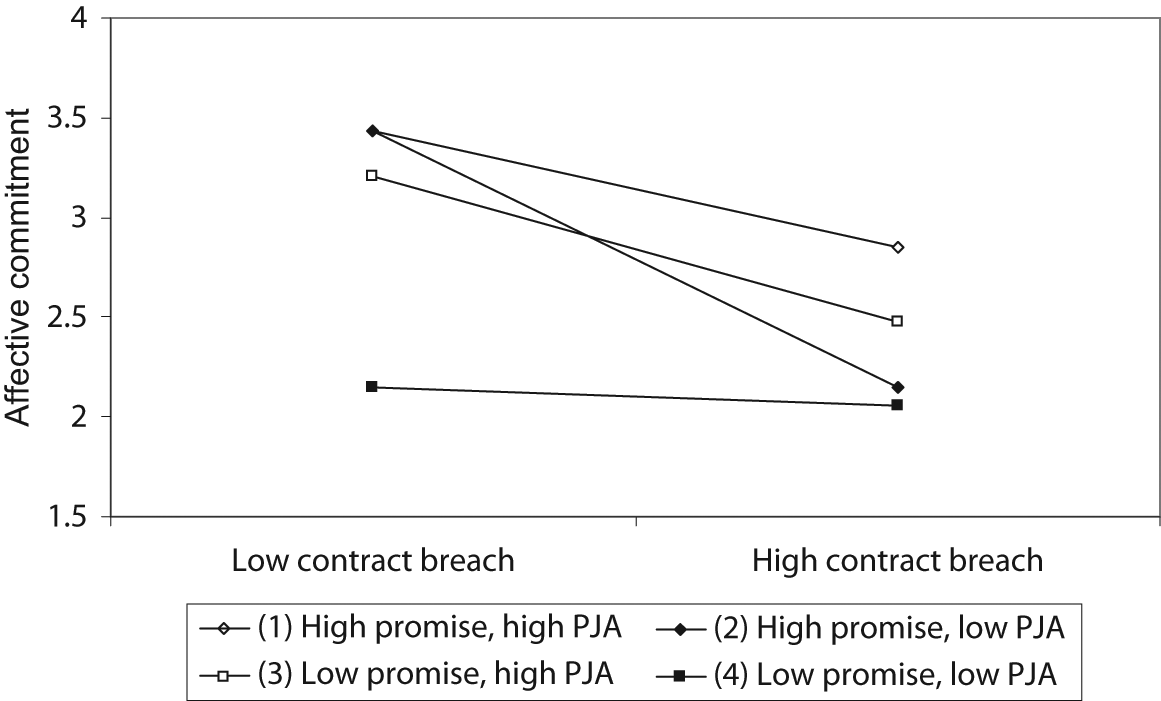
Graphical plot of the three-way interaction effect among breaches of past promises, promises of future i-deals, and perceived job alternatives on employees’ affective organizational commitment.
Further, Dawson and Richter’s (2006) procedures revealed that a marginally significant difference was found between the high promise–low alternatives scenario and the low promise–low alternatives scenario (p < .10). In addition, a marginally significant difference was also found between the high promise–low alternative scenario and the high promise–high alternative scenario (p < .10). Thus, the interaction plots provide support for Hypothesis 3, too. That is, the relationship between breaches of past promises and affective organizational commitment was the strongest in the high promise–low alternative scenario, though the magnitudes of slope differences were not strong.
Post-hoc analyses
Components of i-deals
To further understand which components of i-deals drove the above interaction effects, we performed item-level analyses as well. Specifically, we repeated the above moderated multiple regression six times; in each case, we used only one of the six items in the promises of future i-deals scale (level of pay, advancement opportunities, training, career development, job security, and support with personal problems) rather than the entire scale. The results are presented in Table 3.
Significance of two-way and three-way interaction effects at item level (dependent variable = affective organizational commitment)

N = 196. Regression coefficients represent standardized parameters (Betas). Socio-demographic variables were included in the regression models but are not shown here.
Item 1 = Idiosyncratic deals related to level of pay.
Item 2 = Idiosyncratic deals related to advancement opportunities.
Item 3 = Idiosyncratic deals related to skill training.
Item 4 = Idiosyncratic deals related to career development opportunities.
Item 5 = Idiosyncratic deals related to job security.
Item 6 = Idiosyncratic deals related to support for personal problems.
p <.01; * p <.05.
We found very different results across the six items. Specifically, the effect size for the three-way interaction effect among breaches of past promises, promises of future i-deals, and perceived job alternatives was the strongest when the idiosyncratic element was related to support for personal problems (β = .47, p < .01, ΔR2 = 9%). The next three largest effect sizes were for job security (β = .42, p < .01, ΔR2 = 7%), level of pay (β = .30, p < .01, ΔR2 = 4%), and skill training (β = .27, p < .01, ΔR2 = 3%). The weakest three-way interaction effect among breaches of past promises, promises of future i-deals, and perceived job alternatives occurred when career development and advancement opportunities were the idiosyncratic elements. Further, the direction of the interaction effects for each separate element of a future i-deal was consistent with what we have observed when we used the composite scale as a whole.
Non-linear effects
Researchers caution that the results of moderated regressions might be affected by non-linear effects of predictors on criterion variables. Specifically, moderated relationships might be spurious if the predictors also have non-linear effects on criterion variables (Shepperd, 1991). In order to examine this possibility, we repeated the above moderated regression procedures, except that this time we included the squared terms of the three predictors (breaches of past promises, promises of future i-deals, and perceived job alternatives) as an additional set of control variables. We observed that, even after we had controlled for the non-linear effects of the three predictors, the three-way interaction effect among them was still statistically significant, although the effect size on affective organizational commitment was weakened (β = .26, p < .01, ΔR2 = 2%). These results suggest that the observed three-way interaction effect was not spurious.
Discussion
The results here suggest that the negative effect of breaches of past promises on employees’ affective organizational commitment is greatest when: (a) employees are promised future i-deals, and (b) employees perceive there are few comparable job alternatives available elsewhere. We propose that employees tend to view past breaches as signals that the organization is not trustworthy and therefore that promises of future i-deals cannot be relied upon either. In addition, lack of external job alternatives decreases employees’ bargaining power within the firm and therefore further decreases employees’ confidence that promises of future i-deals will be honored by the current employer. In this final section, we consider the pattern of results in greater detail and highlight directions for future theoretical and empirical research on psychological contract breaches.
Contributions to theory development
Our findings contribute to the psychological contracts literature in four key ways. First, the results from the present study highlight that promises of future i-deals are an important moderator to be considered in psychological contract research. While previous research on psychological contracts has examined reactions to breaches of past promises (e.g. Turnley and Feldman, 1998), scholars have seldom considered how negative reactions to these breaches can be alleviated or exacerbated by promises of future i-deals. The results here suggest that promising employees future i-deals is a double-edged sword. On one hand, this strategy may help firms strengthen affective bonds with employees who have experienced past breaches. On the other hand, though, the negative effects of breaches of past promises on affective organizational commitment will be greater when employees view breaches of past promises as precursors of future breaches as well.
Second, the extant literature on i-deals has generally focused on how employees respond after they have received i-deals, but rarely on how employees respond to promises of future i-deals (e.g. Anand et al., 2010; Hornung et al., 2008). As the literature on psychological contracts suggests, though, it is often the nature of the promises (Rousseau, 2001: 525) and the act of breaching a promise that draw the most intense negative reactions from employees (Morrison and Robinson, 1997; Shanteau and Harrison, 1991). Thus, we urge scholars to make the distinction between delivery on past promises and promises of future deals clearer in future research and to incorporate both constructs into that research.
Third, the results of this study suggest that perceived job alternatives outside the firm, when considered alone, do not moderate employees’ reactions to psychological contract breaches. While much of the research on psychological contracts has focused on how employees compare promised inducements with delivered inducements, here we propose that employees also compare their current deals with what they could potentially get in the external labor market. Like Deery et al. (2006), we did not find significant results for this two-way interaction.
It is hard to pinpoint what the reason for this non-significant result might be, but it is possible that simply experiencing a breach – especially if it is minor or can be rationalized or justified in some way – may not be powerful enough to lead employees to search for jobs elsewhere (Griffeth et al., 2000; Turnley and Feldman, 1998). Another possibility is that, in the preliminary stages of job hunting, individuals think about job alternatives in rather abstract terms without having access to specific data regarding comparable employment packages. Lack of details about potential external offers might therefore limit the size of the moderating effect of perceived job alternatives in the breach–commitment relationship.
On the other hand, the results suggest that perceived job alternatives, when considered jointly with promises of future i-deals, do moderate the relationship between breaches of past promises and affective organizational commitment. When an organization promises future i-deals as a way of remediating past breaches, the firm is effectively raising the stakes in the relationship. At that point, employees start paying more attention not only to the details of the current employer’s promises but also to the specifics of deals available outside the firm. The results here suggest that perhaps only when the promised future i-deal is likely to be met (e.g. because the employee has market power to get a comparable deal outside the firm) does the individual respond less negatively to past contract breaches.
Finally, contrary to what previous meta-analyses have found about the negative effects of breaches of past promises on organizational commitment (Zhao et al., 2007), the sub-group analyses revealed that there are two scenarios where breaches of past promises do not necessarily draw negative reactions from employees.
First, individuals who do not anticipate receiving future i-deals (or attractive future i-deals) and who do not have external job opportunities did not experience drops in affective organizational commitment after breaches. This scenario is likely explained by employees’ lack of options. Having no better job alternatives at hand and no hope of getting more resources from current employers, such employees are ‘locked in’ and cannot afford to lessen their commitment or performance in their current organizations.
Second, for individuals who are promised future i-deals and also perceive numerous external job possibilities, breaches of past promises also do not appear to lead to drops in affective organizational commitment. While the scenario described above captures the experience of being ‘locked in,’ the second scenario here captures the experience of preferring ‘flight to fight.’ As such, they are not strongly bothered by breaches. In part, individuals who are promised attractive future i-deals are also more likely to view themselves as highly valuable in the marketplace; the correlation between promises of future i-deals and perceived job alternatives at Time 1 is .42 (p < .01) and lends some credence to this possibility. In part, individuals who perceive they have many alternative job options available to them may not develop strong affective organizational commitment to any employer. For example, the correlation between perceived job alternatives at Time 1 to affective organizational commitment at Time 2 is only .18 (p < .05).
Implications for empirical research
There are multiple ways for future empirical work to extend the findings of the present research. First, the current study examines affective organizational commitment as an outcome variable, but future research could also address behavioral outcomes like citizenship behavior and counterproductive work behavior. It would be interesting, for example, to explore whether employees who have experienced contract breaches in the past are more likely to engage in counterproductive work behavior when they are promised future i-deals but no comparable job alternatives are available elsewhere. One could argue that lower affective commitment may result in more withdrawal behavior (Meyer et al., 2002), but employees who perceive no better alternatives elsewhere might be reluctant to aggress against their current employers (Turnley and Feldman, 1998). Moreover, employees promised future i-deals might engage in more citizenship behavior and less counterproductive behavior to increase their chances of actually getting those future promises fulfilled.
It would be equally interesting to examine how employees change their perceptions about i-deals and about their marketability after past deals have been breached. That is, instead of treating breaches of past promises, promises of future i-deals, and perceived job alternatives as relatively independent predictors, future theory might investigate the inter-relationships among these three constructs in greater depth. For instance, how do prior breaches of promises affect the negotiation of i-deals? Do employees (and/or employers) try to redefine the idiosyncratic nature of contracts more narrowly after employees feel their contracts have been breached? How do breaches of past promises directly affect employees’ perceptions of their own marketability, and how do perceptions of marketability influence the likelihood of experiencing breaches in the future? Longitudinal studies that track changes in employees’ perceptions of past breaches, future i-deals, and marketability simultaneously would be particularly useful for addressing such research questions.
In addition, future research should explore in more detail what leads employees to view their contracts as idiosyncratic. For instance, in assessing whether one’s deal is unique compared with what coworkers have, employees may consider both the distinctiveness and level of the inducements that have been offered. That is, individuals may evaluate whether there are extraordinary elements of their psychological contracts that are unlikely to be offered elsewhere (distinctiveness) and/or whether their current employers are promising unusually high levels of commonly offered resources (level of inducement). In this early stage of research on the topic, the present study examined the overall differences between what is promised to an employee compared with what is promised to others, but future research examining the separate effects of distinctiveness and level of inducement is clearly needed.
At the same time, our item-level analyses revealed that some components of i-deals (e.g. personal support for problems, job security, and pay level) are more critical to employees than others (e.g. advancement and career development opportunities). In contrast, Hornung et al. (2008) found that i-deals involving career development opportunities had a particularly positive effect on organizational commitment. Thus, further empirical research is needed to determine which kinds of promises and inducements are most likely to generate positive reactions from employees and under which conditions they are likely to do so.
Lastly, future empirical research would benefit from measures of employees’ sensitivity to breaches, perhaps akin to the constructs of ‘equity sensitivity’ or ‘procedural justice.’ As the literature on psychological contracts has demonstrated, how an employment deal is perceived lies largely in the eye of beholder (Rousseau, 1995). As such, how an employee responds to a breach depends not only on his/her overall perspective on the nature of the exchange relationship, but also on his/her sensitivity to what constitutes a breach in the first place (Morrison and Robinson, 1997). The present results provide support for the notion that employees are more likely to take previous breaches as credible signals of future breaches and therefore will react particularly negatively should they occur. In addition, we recommend that researchers explicitly measure the extent to which employees perceive that their psychological contracts are likely to be breached in the future. This perceived likelihood may be a key explanatory mechanism for understanding why experiences of psychological contracts and their breaches continue to change over time (Ng et al., 2010) and why it is difficult for organizations to repair fully the trust lost in a breached employment relationship (Robinson, 1996).
Limitations of the present research
The current study has some methodological constraints that should be addressed in future research. First, we followed the prevailing research stream in this area by focusing on what employees feel employers owe them, not on what employees perceive they owe employers. However, this imbalance needs to be addressed in further research if scholars genuinely believe that psychological contracts represent mutual understandings of inducements and contributions (Lambert et al., 2003). Second, although the response rate was consistent with previous research studies using online surveys (Baruch and Holtom, 2008), larger datasets that sampled more managers would strengthen the generalizability of the results. Third, even though we collected two waves of data over a 12-month period, we did not have repeated measures and thus our research design did not allow for definite causal inferences. Future research that examines how changes in the predictors interact to affect changes in organizational commitment would provide stronger causal evidence (Ployhart and Vandenberg, 2010). Nonetheless, previous research suggests that interaction effects in regression models are less susceptible to the influence of common method variance (Siemsen et al., 2010), so we believe that the three-way interaction effect that was the main focus of this study is rather robust.
Fourth, the effect sizes for the interaction effects observed, although significant, are rather small (ΔR2 = .02 – .04). The difficulty of detecting moderation effects with small and medium sample sizes has been well established (Aguinis et al., 2005; McClelland and Judd, 1993), and our effect sizes are within the typical range (ΔR2 = .01 – .03) for moderation effects found in non-experimental research (Champoux and Peters, 1987; Chaplin, 1991). Furthermore, our item-level analyses revealed much stronger effect sizes for some of the proposed interaction effects (ΔR2 up to .09). Nonetheless, future research with larger samples will be needed to draw firmer conclusions about the interaction effects observed here.
Finally, some of our scales have very high reliabilities (that is, larger than .90) and might raise questions about the interpretation of our results. However, high scale reliabilities are still preferable to low scale reliabilities, as the biases that imperfect measurement error can create in the latter are very problematic in correlational analyses (Ree and Carretta, 2006). Further, some researchers see reliabilities larger than .90 as acceptable and commendable, especially in applied behavioral research studies like ours (Kaplan and Saccuzzo, 1982; Nunnally, 1978). In addition, meta-analytical evidence collected across multiple studies indicates that the magnitude of reliabilities does not vary substantially across numerous research design characteristics (Peterson, 1994). Thus, there is no compelling evidence that the survey methodology that we used here resulted in the high reliabilities observed.
Conclusion
Managing employee expectations is a major challenge for many organizations (Inkson and King, 2011; Turnley and Feldman, 1999). In some cases, organizations compete for the services of desirable employees with promises of future i-deals that are special and are therefore too good to turn down. In other cases, individuals consider whether their deals are special enough to stay for and/or whether there are better deals available elsewhere. This article illustrates that both promises of future i-deals and perceived job alternatives are important constructs to be considered, both singly and together, in understanding employees’ reactions to past contract breaches, their trust that a firm will honor its commitments in the future, and their emotional attachment to the firm. We hope that this article stimulates further research on the comparison processes employees use in deciding how to respond to psychological contract breaches.
Footnotes
Funding
This research received no specific grant from any funding agency in the public, commercial, or not-for-profit sectors.