







Abstract
Adopting a relational perspective, this article investigates whether organizational relationship-building routines and relational coordination influence organizational knowledge management capability and ultimately innovation in professional service firms (PSFs). Using data collected from 120 accounting firms in Ireland, support is found for an inter-mediation model where both relational coordination and knowledge management capability intervene in the relationship between relational routines and innovation. Thus, a linkage model is supported whereby relational routines facilitate relational coordination, which enhances knowledge management capability, leading to innovation. This article provides evidence of the importance of relational routines and relational coordination in promoting a firm’s knowledge management capability and in fostering innovation. Results highlight the value of relational resources in PSFs and suggest a novel and easy-to-implement approach for knowledge and innovation management.
Keywords
Introduction
Since social capital was proposed as a resource embedded in the relationships among individuals (Bourdieu, 1986; Burt, 1992; Coleman, 1988; Lin, 2001; Nahapiet and Ghoshal, 1998; Putnam, 1993), many scholars have investigated its antecedents and applications from a variety of relational perspectives. These perspectives include relational job design (Grant, 2007), relational leadership (Uhl-Bien, 2006), relational coordination (Gittell, 2002a, 2002b; Gittell et al., 2000, 2010) and relational wealth in organizations (Leana and Rousseau, 2000). The rationale underlying the relational perspective is that the relationships, links and associations among people are becoming increasingly important in intra- and inter-firm functioning (Chung et al., 2000; Subramaniam and Youndt, 2005). Relational perspectives are especially relevant to firms where work is conducted through teams, as is the case in professional service firms (PSFs) (von Nordenflycht, 2010).
PSFs employ a highly educated and professionalized workforce in order to provide clients with customized knowledge (Greenwood et al., 2005; Maister, 1993; von Nordenflycht, 2010). Firms providing professional services include accounting, engineering consulting, management consulting and law firms. PSFs are important in the global knowledge economy, as reflected in their increased growth and significance (DeLong and Nanda, 2003). In the past 25 years, the professional services sector has grown by more than 10 percent per annum and currently generates more than US$ 1,000 bn in revenues globally (Empson, 2007). As an illustration, one of the world’s largest PSFs and the largest of the Big 4 auditing firms, PricewaterhouseCoopers, attained worldwide revenues of US$32.1 bn for the fiscal year 2013, and employed over 184,000 people in 159 countries (PricewaterhouseCoopers, 2014, www.pwc.com).
Knowledge management is critical for PSFs’ success. PSFs are knowledge-intensive and their primary input takes the form of knowledge embedded in their professional staff, producing outputs in the form of customized client services (Maister, 1993). Knowledge management is regarded as a key source of competitive advantage (Barney, 1991; Grant, 1996), particularly in the context of PSFs (e.g. Anand et al., 2007). It has attracted considerable scholarly interest, including the special issue on knowledge management in PSFs published in Human Relations in 2001 (Issue 7) and numerous recent studies (e.g. Anand et al., 2007; Gardner et al., 2008; Gardner et al., 2012; Haas and Hansen, 2007; Swart and Kinnie, 2010; Turner et al., 2013).
Effective knowledge management within PSFs leads to innovation by generating new ideas to meet clients’ requests. It has been evidenced in existing research (e.g. Chen and Huang, 2009; Gardner et al., 2012; Scarbrough, 2003), which shows that firms with a higher level of knowledge management capability perform better in developing new ideas and innovation. The present study adopts Janssen’s (2001) definition of innovation as the generation, promotion and implementation of new ideas among staff. It is consistent with existing research that treats process innovation as an indicator of an organization’s innovative performance (e.g. Anand et al., 2007; Chen and Huang, 2009).
Owing to the important role of knowledge in PSFs, the particular factors associated with knowledge management capability, which in turn leads to innovation in PSFs, have received considerable attention. Research has identified several key individual and organizational factors in PSFs’ knowledge management capability. These include the inhibiting effects of ‘fear’ of sharing knowledge with colleagues (Empson, 2001) and the facilitating effects of firm-level knowledge management practices (e.g. through codification and personalization) (Hansen et al., 1999), along with the strategic uses to which this knowledge can be put (i.e. exploration and exploitation) (Swart and Kinnie, 2010; Turner et al., 2013). Despite this attention to knowledge management inhibitors, practices and uses, less is known about how firms might build knowledge management capability which leads to innovation in the first place, that is, what resources will contribute to building such knowledge management capability and how these resources can be used to improve knowledge management capability and ultimately innovation in PSFs. Before organizing and using knowledge, a firm must build the capability to develop and accumulate it so as to enable employees to acquire, share and create new knowledge. Knowledge management, including knowledge acquisition, sharing and application (Chen and Huang, 2009), occurs among staff where they share, combine and leverage their knowledge together, leading to innovation (Anand et al., 2007). Thus, a key aspect of knowledge management is relational, that is, where relationships between employees are important to enable knowledge exchange and combination.
The primary objective of the present study is to identify two types of relational resources, that is, relational routines and relational coordination, and to investigate whether they are antecedents of knowledge management capability and ultimately innovation in PSFs. Understanding how PSFs build their capability to develop and accumulate knowledge leading to innovation is vital, for two reasons. First, it helps identify key (relational) resources that can help the firm gain competitive advantage (e.g. Barney, 1991) by building up its knowledge management capability. Second, it provide insights into effective ways to overcome the knowledge management problems identified in past research (Empson, 2001) by encouraging employees to share, combine and leverage their knowledge together, leading to innovation, rather than restricting or protecting it. In addition, identifying such relational resources extends our understanding of the key factors that encourage and enable knowledge-based innovation in PSFs. Existing research on innovation in PSFs employs mainly two perspectives. One focuses on the knowledge side of innovation, that is, how knowledge flows to enable innovation (see, for example, Anand et al., 2007). The other highlights the importance of organizational elements, for example, the creation of organizational policies that enable PSFs to attract, recruit, develop and retain highly talented people (Fu et al., 2013; Starbuck, 1992); and organizational systems such as knowledge codification practices that enable individuals to share and reuse innovative types of expertise (Morris, 2001; Morris and Empson, 1998). The present study lies in the realm of the second research theme in proposing the key role of two easy-to-implement relational practices in enabling innovation in PSFs.
The present study is rooted in the resources-based view (RBV) of the firm (Barney, 1991) and is informed by a relational perspective that recognizes the value achievable through connections and interactions among people. It focuses on two relationship-based resources: (i) relational routines and (ii) relational coordination. To address the issue of knowledge management capability-building described above, this article investigates how relational routines and relational coordination can foster both knowledge management capability and organizational innovation. Relational routines refer to organizational role relationship routines that enable employees to know each other and to learn about their organization. Previous research on routines in organizations has focused on the activities that comprise them and the complexity of their operations (e.g. Cohen, 2007; Parmigiani and Howard-Grenville, 2011). In contrast, the present study focuses on the specific construct of relational routines – that is, recurring practices that enable employees to get to know each other and what each other does in the organization as well as how the organization operates from the perspective of different organization members. Based on the work of Feldman (2000) and Gittell (2001), relational routines refer to any practice that brings organization members together, from informal gatherings over coffee, to company celebrations, and cultural norms encouraging informal social exchanges that facilitate member familiarity and cooperation. The present study seeks to establish the extent to which these relational routines exist in PSFs and their contribution to knowledge management capability. Relational coordination, the second relationship-based resource, refers to the coordination of work through timely, accurate, frequent and problem-solving-based communication based on shared goals, shared knowledge and mutual respect (Gittell, 2001). It arises from members having relationships based on their organizational roles, including the tasks individuals are responsible for – that is, the kinds of relationships derived from the aforementioned relational routines.
This study tests a multi-mediator or multi-step mediation model (Hayes et al., 2011; Mathieu et al., 2008) to explore the relationships between relational routines, relational coordination, knowledge management capability and innovation in the context of PSFs. Four mediation hypotheses are proposed:
Hypothesis 1: The relational routines and innovation link via relational coordination;
Hypothesis 2: The relational routines and innovation link via knowledge management capability;
Hypothesis 3: The relational coordination and innovation link via knowledge management capability; and
Hypothesis 4: The relational routines and knowledge management capability link via relational coordination.
Together, these hypotheses address the linkages whereby firms’ relational routines facilitate relational coordination, which in turn builds knowledge management capability, leading to new idea generation and implementation in the workplace, that is, innovation.
This article advances our understanding of the resources that firms may need to create or enhance their capability for managing knowledge to support organizational innovation in creating, promoting and implementing new ideas in the workplace. Based on RBV (Barney, 1991), this article adopts a relational perspective to the antecedents of knowledge management capability in PSFs, and identifies two relational resources that can impact this capability and its resultant of innovation as generating, promoting and implementing new ideas within PSFs. By investigating relational resources, that is, role-relationship-oriented routines and relational coordination, this article complements previous PSF research exploring knowledge flow at the individual level (e.g. Morris, 2001) and knowledge management strategies at the strategic level (e.g. Hansen et al., 1999; Swart and Kinnie, 2010). The goal of this article is to inform theory and practice by integrating relational resources and their management into existing understandings of how knowledge management capability is built.
In addition, this article extends our theoretical understanding of the indirect impact of relational coordination on organizational performance that occurs through the mediating role of knowledge management capability. Organizational performance is represented by organizational innovation, for example, generating, promoting and implementing new ideas in the context of PSFs. Existing studies on relational coordination mainly adopt a direct perspective linking relational coordination and organizational outcomes without accounting for the mechanisms whereby this effect might be achieved (e.g. Gittell, 2001; Gittell et al., 2010). As Hayes (2013) points out, knowing whether there is a relationship is not sufficient; understanding how the relationship happens is more important. This is consistent with the arguments made by Goodman (2000), Mathieu et al. (2008) and Shapira (2011) that specifying and testing intervening mechanisms/linkages is important in promoting a cumulative organizational science and moving organizational research toward a true science. Identification of knowledge management capability as a mediator provides better understanding of the processes through which relational coordination functions to promote organizational performance and therefore contributes to answering the how question (Hayes, 2013).
Finally, existing studies have found that organizational factors such as job design (Gittell et al., 2008) and high-performance work systems (HPWS: Gittell et al., 2010) positively affect relational coordination. HPWS are also found to have an impact on knowledge management capability (Chen and Huang, 2009). However, the adoption of sophisticated practices associated with HPWS might not be feasible for many firms, particularly during difficult economic times. This article proposes that a more adoptable managerial practice, referred to here as relational routines, can increase relational coordination by promoting social interaction among members, thereby enabling the familiarity and shared knowledge that interactions promote. Identifying relatively easy-to-implement approaches for firms addresses the utility dimension of theory-building valued in organizational research (Corley and Gioia, 2011).
Research context: Professional service firms (PSFs)
PSFs employ a highly educated and professionalized workforce and provide clients with customized knowledge (Empson, 2007; Greenwood et al., 2005; Maister, 1993, Morris, 2001), as evident in accounting, engineering consulting, management consulting and law firms. Knowledge management capability and innovation within PSFs is critical for their success. PSFs are knowledge-intensive, distinguishing them from traditional manufacturing firms (Løwendahl, 2000; Morris, 2001; von Nordenflycht, 2007, 2010). Their inputs derive mainly from the expert knowledge provided by a professional workforce (Starbuck, 1992), and their outputs are customized client solutions based on that knowledge (Empson, 2007; Hitt et al., 2006; Løwendahl, 2000; Morris and Empson, 1998). PSFs gain competitive advantage primarily by exploring and exploiting their often intangible knowledge assets. Owing to the nature of teamwork, professional staff need to acquire, exchange, share, combine and apply knowledge between each other. As previously noted, PSFs provide clients with customized services, and they need to generate, promote and implement new ideas. These innovative work behaviours constitute innovation (Janssen, 2001), which is treated as a key indicator of organizational performance (Anand et al., 2007; Chen and Huang, 2009). As such, innovation is substantively relevant in PSFs and essential to their survival and effectiveness in creating value for both clients and themselves.
PSFs are relatively flat organizations (Greenwood et al., 1990; Stumpf et al., 2002), and this facilitates the flow of knowledge laterally and between senior and junior staff members. The organizational processes within PSFs focus on developing and retaining the firm’s knowledge base given its central role in the services provided to clients (Freidson, 1986; Greenwood et al., 1990; Robertson et al., 2003). These processes include organizational routines formed by professionals collaborating on tasks. Such routines represent the ‘informal work understandings and practices built up by colleagues as they collaborate over time, like an accumulated shorthand of work’ (Morris, 2001: 822). They constitute important resources for PSFs in facilitating knowledge creation, sharing, combination and exchange and application (Morris and Snell, 2008).
In PSFs, most work is project- or programme-oriented with the aim of serving the needs of the external client organization or customer (Stumpf et al., 2002). The project team is the primary means by which work gets done in PSFs (Gardner et al., 2012; Werr and Stjernberg, 2003). Professionals work together in acquiring, exchanging and sharing knowledge with each other. For example, to help a client to devise a redundancy plan, a cross-functional team is required, comprising people with diverse specialist skills in human capital, employment tax and pensions, and investments. For other services, a different team composition might be needed. This diversity in skills requirements necessitates high levels of communication and coordination to ensure successful team formation and development, optimal skill utilization and, ultimately, successful completion of tasks.
In summary, the talents of professional staff and the positive working relationships which exist among them are important contributors to the creation of organizational knowledge. Effective communication and coordination among professional staff is central to this process.
Theory and hypotheses
Relational routines and innovation link in PSFs
Routines are repeated patterns of activity performed by people who ‘think and feel and care’ (Feldman, 2000: 614). Organizational routines are well established, practised rigorously and reinforced over time until they become stable and are not easy to change (Nelson and Winter, 1982). Organizational routines are potential sources of an organization’s competitive advantage as they codify best organizational practices, transform individual knowledge into organizational knowledge (Nelson and Winter, 1982), enable employees to capture and learn from previous experiences, and help them avoid repeated mistakes and prevent errors before they occur (Levitt and March, 1988). Building on Feldman’s (2000) definition of routines, this article adds the relational perspective to organizational routines and defines them as follows: relational routines refer to the structuring of opportunities for people to get to know each other, mainly through their roles, and to know how the organization they work in operates. At its core, the concept captures the process of building role relationships. It is noted that this article focuses on the role relationships (i.e. organizational level of social capital) rather than the personal relationships between employees (i.e. individual level of social capital). It does not, however, assume that personal relationships are not important. In this article, relational routines are examined in the professional service context where work relationships are important in project and cross-functional team-based work.
The RBV posits that the valuable, rare, imperfectly imitable and non-substitutable resources that the firm already possesses are a source of competitive advantage (Barney, 1991). Relational routines are a valuable and important organizational resource for firms in gaining competitive advantage. Such routines help organizations codify the best practices in building role relationships among professionals. They are created by previous and current employees, utilized by the current employees and transmitted to future employees entering the organization. During this process, individual knowledge is transformed into organizational knowledge embedded in practices and shared by multiple members. Consequently, people establish, practise, maintain, reinforce and reuse organizational knowledge through relational routines and may use them to explore and generate new knowledge.
The innovation in PSFs is knowledge-based and, owing to the ambiguous nature of knowledge, such innovation is particularly challenging (Anand et al., 2007). There are mainly two research perspectives addressing the issue of innovation in PSFs. One focuses on the knowledge side of innovation, that is, how knowledge flows to enable innovation. For example, based on two-phase and multiple case studies, Anand et al. (2007) find three pathways for knowledge-based innovation. The first pathway is expertise-based where emergent knowledge is developed by a group of professionals. The second pathway is labelled as turf-based, where new knowledge is developed from the experience of the external client marketplace. The third pathway is support-based, where new knowledge is generated from firms’ top-level goals and plans. The other perspective highlights the importance of organizational elements, e.g. organizational policies to attract, recruit, develop and retain highly talented people (Fu et al., 2013; Starbuck, 1992), and organizational systems such as knowledge codification practices that enable individuals to share and reuse innovative types of expertise (Morris, 2001; Morris and Empson, 1998). This article lies in the second research theme and focuses on the role of two relational resources in enabling innovation in PSFs.
In the professional service context, relational routines help professional staff to become familiar with each other and their roles as well as helping them to learn how other parts of the organization operate. Relational routines are important for PSFs because of their reliance on team-work and knowledge to provide services to clients. When such routines are in place, professional staff can more effectively interact, communicate, coordinate work and exchange knowledge within and among teams. Doing so facilitates organizational innovation in terms of generating, promoting and implementing new ideas for solving clients’ problems (Janssen, 2001; Subramaniam and Youndt, 2005; Van de Ven, 1986). PSFs provide customized solutions to clients and thus such innovation is critical for PSFs’ success.
Empirically, Subramaniam and Youndt (2005) find that organizational capital, including organizational routines, can foster organizational innovation. Similarly, Morris (2001) reports that organizational routines generally help PSF workforces obtain new ideas for products and services. For example, when a project is completed, relevant information is stored in the data centre and the knowledge becomes codified. When new cases arise, this data centre provides relevant information that will help exploit the existing solution and explore new ones. In this process, individual knowledge is first embedded in the organization via organizational routines and is subsequently used by the wider workforce to improve efficiency. In relation to relational routines, they function for employees and organizations in the same way as other routines do. In particular, relational routines enable people to know each other and the organization. They facilitate and foster the process of new idea generation and implementation. Based on the above analysis, a positive relationship between relational routines and innovation is expected.
The mediating role of relational coordination in PSFs
Relational coordination is a theory advanced by Jody Hoffer Gittell (2001, 2002a, 2002b) based on Mary Parker Follett (1949) and James D Thompson’s (1967) work on the relational theory of coordination. Gittell defines relational coordination as ‘a mutually reinforcing process of interaction between communication and relationships carried out for the purpose of task integration’ (Gittell, 2002a: 301). Relational coordination theory focuses on task-based relationships rather than personal relationships and explores how relational coordination impacts on performance. Two components of relational coordination include the quality of communication and role relationships. In its operationalization, relational coordination includes the timely, accurate, frequent and problem-solving nature of communication, shared goals, shared knowledge and mutual respect.
Relational coordination theory argues that relational coordination is particularly useful to achieve desired performance outcomes when work involves high interdependence among workers, uncertainty and time constraints (Gittell, 2006). When the work requires more interdependence among workers, relational coordination is important for enabling workers to create feedback loops among them (e.g. via accurate communication) and to mutually adjust their actions in response to each other’s work outcomes. When task uncertainty is high, relational coordination is important for enabling workers to adjust their activities with each other more rapidly (e.g. via timely communication). When time constraints increase, relational coordination becomes more important for enabling workers to communicate effectively on the status of their work, to adjust their actions quickly and to work efficiently on the solution. Relational coordination has been explored in contexts with these characteristics such as air travel (Gittell, 2001), surgical care (Gittell et al., 2000), long-term care (Gittell et al., 2008) and general hospitals (Gittell et al., 2010). High task interdependence and uncertainty as well as increased time constraints also characterize the PSF context, in the sense that work is knowledge-intensive and requires very frequent interpersonal interactions and high levels of task integration. It is, therefore, surprising that relational coordination has not been investigated in the PSF context. This article applies relational coordination theory to the PSF context and investigates its antecedents and consequences.
Gittell (2002b) finds support for the mediating effect of relational coordination in the relationship between routines and organizational performance. The results indicate two main relationships: (i) the organizational routines and relational coordination link; and (ii) the relational coordination and organizational performance link. Gittell (2002b) suggests that routines in general facilitate the coordination reaction by strengthening interactions among people. As a typical example of a routine, relational routines facilitate the interactions within and among teams by developing role relationships. In the present article, relational routines are defined as those that allow professional staff to know each other and to know about the organization. Some research suggests that such routines represent a valuable organizational resource for innovation within PSFs (Morris, 2001; Subramaniam and Youndt, 2005). As previously stated, project-based teams represent the primary vehicles for conducting work in PSFs, where teams are fluid and reconfigured after projects are completed (Gardner et al., 2012). When organizations have role-relationship-oriented routines in place, professionals are more likely to have direct contact with each other. Relational routines form a basis for high-quality communication and work relationships. When professional staff know about each other and about their organization through role relationships, they can talk and contact each other via timely, accurate, frequent and problem-solving-based communication, shared goals, shared knowledge and mutual respect, that is, relational coordination. Therefore, a positive relationship is expected to exist between relational routines and relational coordination.
Relational coordination has a large impact on organizational performance through the promotion of good work relationships between people (shared goals, shared knowledge, mutual respect) and high communication quality (timely, accurate, frequent and problem-solving-based communication) (Gittell, 2006). Shared goals ensure that staff from different functions understand and accept the shared goals in their work. Shared knowledge enables staff to see how their specific tasks interrelate with the whole project. Mutual respect enables staff to overcome status barriers and encourages them to see and take account of each other’s work. Timely, accurate, frequent and problem-solving-based communication enables staff to communicate with each other on the project status in order to solve the problem. Compared with the traditional bureaucratic form of coordination where the managers tell subordinates how to do their job, relational coordination focuses more on work relationships among workers and the motivational processes of workers. As front-line staff are best placed to know about their work, with relational coordination in place they can manage their work more directly and freely, with fewer errors and delays, and therefore experience higher performance levels.
In the context of PSFs, relational coordination facilitates organizational innovation in terms of generating, promoting and implementing new ideas in the form of customized services (Janssen, 2001). Work in PSFs is project-oriented and team-based. When a partner (equivalent to senior management team member in other organizations) receives a client’s request, he/she needs to choose several professionals to form a team in order to meet a client’s needs. Teams are the basic units of work, and team management is vital for the successful completion of projects and in providing innovative solutions to clients (Gardner, 2012a, 2012b; Gardner et al., 2012). PSFs need to deploy teams and coordinate tasks efficiently. Relational coordination focuses on developing high-quality communication and work relationships. It is a valuable and important relational resource that facilitates the team formation and utilization process. Relational coordination includes timely, accurate, frequent, problem-solving-based communication, goals and knowledge sharing, and mutual-respect-based work relationships. It builds role relationships among professional staff during their interactions and fosters the knowledge exchange and combination as well as the promotion, generation and implementation of new ideas for innovation. Relational coordination becomes more important in the current dynamic global economic environment where in PSFs the speed of work is accelerating, the uncertainty is increasing and changes are rapidly taking place (Anand et al., 2007; Teece, 2003). For example, customers’ assignments are much more compressed, resulting in PSFs having to meet their demands in a relatively short timeframe (Morris et al., 2007). They quote a partner from a consulting firm who said, ‘… we need to compress six months work into a three week assignment’ (Morris et al., 2007: 20). This requires PSFs to have high levels of relational coordination within and between teams, enabling all staff to effectively communicate on the status of their work, to quickly adjust their actions, and to work efficiently on the customized solution.
Empirically, Gittell (2002b) and Gittell et al. (2010) provide consistent support for a positive link between relational coordination and organizational outcomes in terms of efficiency and quality of care in the healthcare context. Gittell (2001) finds a positive link between relational coordination and flight departure performance in airlines. Similarly, Katherine Kellogg and her colleagues (2006) find that cross-boundary coordination between different communities facilitates individual adaptability, speed and learning. Such studies provide support for the importance of relational coordination in achieving desired organizational outcomes.
Based on the above analysis of the links between relational routines and innovation, between relational routines and relational coordination, as well as the link between relational coordination and innovation, the mediating effect of relational coordination in the relational-routines–innovation link in PSFs is proposed:
Hypothesis 1: Relational coordination mediates the relationship between relational routines and innovation in PSFs.
The mediating role of knowledge management capability in PSFs
Based on the knowledge-based theory of the firm, knowledge embedded in the professional workforce has been regarded as the most valuable resource for PSFs (Anand et al., 2007; Grant, 1996). However, resources alone cannot guarantee the development of competitive advantage or the creation of value (Barney and Arikan, 2001; Fu, 2013; Priem and Butler, 2001; Sirmon et al., 2007). It is only when these knowledge resources are effectively managed and leveraged that PSFs can create value and enhance organizational effectiveness. Dynamic capability theory supports this proposition by arguing that an organization’s competitive advantage relies on its ability to integrate, develop and reconfigure its internal and external resources (Eisenhardt and Martin, 2000; Teece et al., 1997). Knowledge management capability, including knowledge acquisition, sharing and application capabilities (Chen and Huang, 2009), is a key to exploring and exploiting knowledge resources in PSFs and is the dynamic capability of PSFs.
The relationship-oriented resources such as relational routines and relational coordination help build PSFs’ knowledge management capability. Relational routines enable professional staff to get to know each other’s roles and better understand how their organization operates. With such relational resources in place, professionals reuse their organization’s knowledge. Relational coordination constitutes high quality of communication around tasks and client services, making it easier for professionals to exchange, combine and generate new knowledge.
Empirical evidence indicates that firms need to provide employees with opportunities to exchange and combine knowledge and motivate them to do so in order to develop firm-level knowledge management capability (Currie and Kerrin, 2003; Mueller and Dyerson, 1999; Nahapiet and Ghoshal, 1998). Relationships within and among teams are critical to this process. In PSFs, Gardner et al. (2012) find that relational resources help project teams to develop their knowledge integration capability. Empson (2001) finds that during the merger of two organizations, professional workers only engage in knowledge transfer after their fear of knowledge exploitation and contamination is reduced. Willman et al. (2001) report that traders in investment banking resist attempts to codify and disseminate their knowledge unless it ceases to have personal value or until it becomes widely recognized as legitimate to do so. Such studies highlight the importance of relational resources in organizations to encourage staff to share and combine knowledge with each other (Leana and Rousseau, 2000). Both relational routines and relational coordination focus on developing high-quality role relationships in organizations. Relational routines permit members to become more interdependent and promote high-quality communication and work relationships so that staff coordinate their efforts on their organization’s behalf. Such relational resources are important for knowledge transfer, sharing and combination among team members because they give rise to a shared language and understanding (e.g. Cramton, 2001), encourage risk-taking (e.g. Lewis et al., 2005) and enable members to integrate each other’s expertise (e.g. Gardner et al., 2012). Knowledge acquisition, sharing and application are the three main elements of knowledge management capability (Chen and Huang, 2009). As such, relational routines and relational coordination are expected to create and enhance knowledge management capability in PSFs.
Previous research has demonstrated that firms with a higher level of knowledge management capability can improve their ability to develop creative ideas and to innovate (e.g. Chen and Huang, 2009; Scarbrough, 2003). The rationale behind this is that effective knowledge management facilitates the knowledge acquisition, exchange, combination and application required in the innovation process (Nonaka and Takeuchi, 1995). Knowledge acquisition, sharing and application among workers facilitate the generation, promotion and implementation of new ideas for meeting clients’ needs in PSFs. In PSFs, where work is carried out primarily through teams, knowledge is acquired from members, shared between members and applied by members during the process of seeking the best solution for clients’ needs. New ideas generated via this knowledge acquisition, sharing and application process thus play a vital role in supporting and fostering innovation (Chen and Huang, 2009).
Based on the above theorizing, it is hypothesized that relational routines and relational coordination increase innovation through knowledge management capability in PSFs:
Hypothesis 2: Knowledge management capability mediates the relationship of relational routines (2a) and relational coordination (2b) with innovation in PSFs.
As argued above, links exist between relational routines, relational coordination knowledge management capability. Therefore, another mediation model linking relational routines and knowledge management capability via relational coordination is hypothesized. It indicates that relational routines that enable employees to know each other and know about the organization are expected to facilitate relational coordination, which in turn increases knowledge management capability in PSFs:
Hypothesis 3: Relational coordination mediates the relationship between relational routines and knowledge management capability in PSFs.
Together these hypotheses and their corresponding mediation models give rise to the inter-mediation model presented in Figure 1.
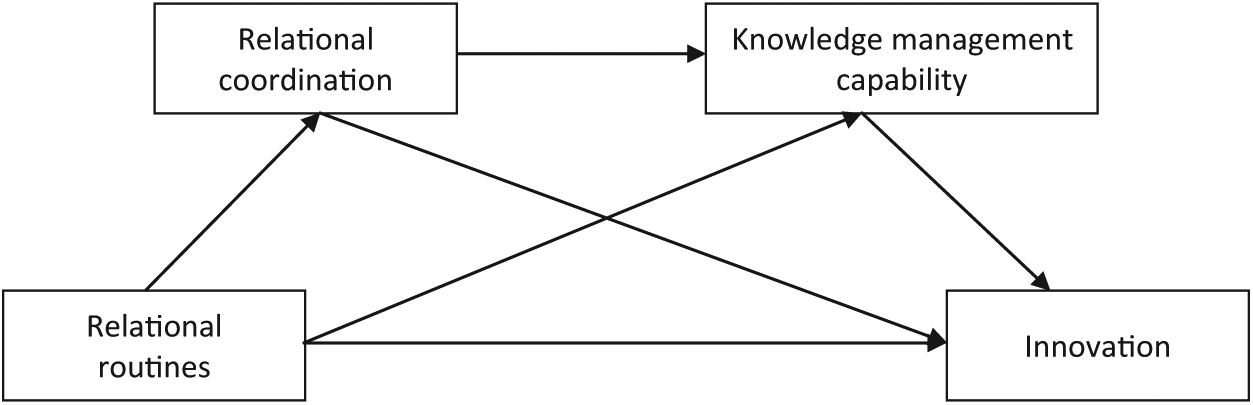
Theoretical model.
Research methods
Data collection procedure
This study focused on accounting firms in Ireland, which operate in a professionalized and regulated sector. Accounting firms with a minimum of three partners were sampled to avoid firms either with too few employees or without established or formalized management practices. To create the initial sampling frame, several databases were combined including the Business World Top 1000 Professional Firms, Chartered Accountants Regulatory Board, Chartered Accountants Ireland, Forecasting Analysis and Modeling Environment (FAME), Kompass Directory and IndexIreland. To avoid single-rater bias (Gerhart et al., 2000), two senior executives in each firm were invited to participate. Dillman’s (2007) Tailored Design Method was employed to collect data, including an invitation letter, cover letter with survey, reminder/thank you postcard and reissue of questionnaires, as necessary.
Sample
Surveys were mailed to 548 initial respondents in 274 firms. This included 10 firms that no longer existed (returned as undeliverable) and three firms that did not qualify because of size (<5 employees), reducing the population to 522 respondents in 261 firms representing managing partners, HR managers and senior partners if no HR manager was available. After a reminder, postcards and letters with replacement surveys were sent; a total of 196 questionnaire surveys were returned, including four incomplete ones – a total of 157 paper and 39 online surveys. The response rate was 37 percent representing 120 firms (46%). Of this sample, 72 were matched pairs from the same firm. Among the respondents, 84 percent were managing partners or senior partners, 10 percent were HR manager/directors, and 6 percent were other experienced professional staff with such titles as Director, Financial Director and Manager. In total, 80 percent were males, with an average age of 49 years (SD = 10) and working tenure of 26 years (SD = 11). In terms of firm size, there are 10 out of 120 firms with fewer than 10 employees (8%).
The researcher checked for possible non-response bias using a ‘time trend extrapolation test’ in which ‘late’ versus ‘early’ respondents were compared along key study variables (Armstrong and Overton, 1977). The assumption behind this test is that ‘late’ respondents (those responses received after the first round of mailing) are very similar to non-respondents, given that they would have fallen into that category without follow-up efforts (Armstrong and Overton, 1977). A one-way analysis of variance (ANOVA) showed no significant difference between the early and late responses in terms of firm characteristics (e.g. size, age, partnership structure and international network membership), and individual respondent characteristics (e.g. age, education, tenure in present organization or in accounting, and full time work experience).
Data from all 120 firms were used to test the proposed theoretical model. This required aggregating the 72 matched pair data to the organizational level and including these with the remaining single respondent data. Support for this approach was provided by the ANOVA results, showing no significant difference between matched paired respondents and single respondents on either individual demographics or between their firms on firm characteristics. Previous studies have combined respondents in this way (e.g. Datta et al., 2005) to maximize the reliability of their measures.
Measures
To develop a reliable and valid survey, three exploratory interviews were conducted with the managing partner, communication partner and HR manager of a Big 4 accounting firm as well as a university accounting faculty who had worked in practices. The interviews focused on human resource and knowledge management issues and lasted for approximately one hour. The survey was developed based on existing instruments designed to measure relational coordination, knowledge management capability and innovation. The measures of relational routines were developed based on both theory and these interviews. The final survey was reviewed by the learning and development officer of the chartered accounting professional body in Ireland and a statistician. It was then refined, modified and pilot-tested using partners and practising accountants in non-participating firms. The feedback from them was positive, suggesting good face validity.
Relational routines
Two items were used to measure relational routines. Participants were asked to what extent they agreed with the following statements (1 = strongly disagree, 7 = strongly agree): ‘The routines in my organization encourage employees to know each other’ and ‘The routines in my organization encourage employees to know about the whole organization’. Reliability was assessed by Cronbach’s alpha. The internal consistency reliability for the measure of relational routines was α = .91.
Relational coordination
The construct of relational coordination was originally developed by Gittell (2002b) as a single factor and was operationalized at the organizational level. For example, Gittell et al. (2010) asked care providers to answer questions in relation to other groups, for example, if people in other groups communicate with the respondent in a timely way. Then they aggregated it to organizational level. The present study also treats relational coordination as a firm-level construct in relation to PSF management. Three items referring to timely and accurate communication and shared organizational goals were adopted from Gittell et al. (2010). The questions were: ‘On average, how often do employees engage in communicating with management in a timely way about the status of the project?’; ‘How often do employees engage in communicating with management accurately about the status of the project?’; and ‘How often do employees engage in sharing organizational goals about the quality of service?’. Respondents answered on a seven-point Likert scale ranging from 1 = never to 7 = always. These three dimensions (frequency, accuracy of communication and shared goals) represent the two main components of relational coordination – namely, the quality of communication and work relationships (Gittell, 2002b). These questions were reworded to reflect relational coordination at the organizational level without losing its meaning between team members. In accounting firms, where work is often allocated in short time blocks, regular communication between managers and staff carrying out the task is a key element in achieving key performance indicators. As PSFs have few hierarchical levels, management in this context refers to the partners and other team members who take charge of projects and act as team leaders. Respondents – that is, partners – are clear about the quality of communication and role relationships through their frequent interactions within and among teams. Therefore, this measure reflects the communication between team members and among teams in general, which is consistent with Gittell et al. (2010). The alpha coefficient for relational coordination was .81, which is comparable to the coefficient of .86 in Gittell et al. (2010).
Knowledge management capability
Measures of knowledge acquisition, sharing and application capabilities were adapted from Chen and Huang (2009). Respondents indicated to what extent they agreed (1 = strongly disagree, 7 = strongly agree) with each of three knowledge acquisition capability items. A sample item is ‘Knowledge is obtained from partners to solve clients’ problems’. Two additional items measured knowledge-sharing capability. A sample item is ‘Knowledge is shared between colleagues’. Another three items measured knowledge application capability. A sample item is ‘Most teams can efficiently use knowledge to develop new ideas’. In the initial data analysis, high correlations were found among the three elements of knowledge management capability (e.g. ranging from .44 to .58). A second-order confirmatory factor analysis 2 (CFA) showed support for the overall construct of knowledge management capability. Thus, knowledge management capability was operationalized by averaging all eight items (Cronbach’s α = .85).
Innovation
To measure innovation, nine items were adopted from Janssen (2001). The respondents were asked, ‘On average, how often do employees engage in the behaviours listed below, e.g. creating new ideas for difficult issues’ and responses were based on a scale ranging from 1 = never to 7 = always. A principal axis factor analysis using oblique rotation of the items was conducted to evaluate the factor structure. All nine items had factor loadings of .72 or above on a single factor explaining 75.99 percent of variance, with an eigenvalue of 6.84. This scale has high reliability (Cronbach’s α = .96).
Control variables
Firm size and age may influence organizational innovation performance by affecting how firms deploy resources. Larger firms may be able to offer more resources for building role relationships, as also may be the case with older more established firms. Alternatively, newer firms may be more aware of the types of resources that are valuable in a knowledge economy. Moreover, previous studies on firm performance have also controlled for size and age (e.g. Chen and Huang, 2009; Delaney and Huselid, 1996). Other context-based variables such as partnership structure and international network membership were controlled because of their potential impact on whether firms adopt relational routines and how they manage knowledge. With the exception of firm size, control variables were collected directly from respondents. Size – the number of professional staff – was derived from public databases such as IndexIreland, Chartered Accountants Regulatory Board, Kompass, Top 20 Irish Accountancy Firms and company websites. The natural log algorithm was used to operationalize firm age and firm size. For partnership, ‘1’ represented a firm that was structured as a partnership and ‘0’ represented one that was not. For international, ‘1’ indicated that the firm belonged to an international network and ‘0’ indicated that it did not.
Aggregation
In the final sample, there were 72 matched pair responses representing 72 firms. To aggregate matched pairs data, the inter-rater agreement and inter-rater reliability were examined. Inter-rater agreement was assessed using rWG (James et al., 1984, 1993) for each variable (see Table 1). The rule of thumb value for rWG is .60 (James, 1982) but the more commonly acceptable value is .70. In this study, the mean rWG was .84 for relational routines and .89 for relational coordination. For knowledge management capability, the mean rWG was .95 for knowledge acquisition capability, .93 for knowledge sharing capability and .92 for knowledge application capability. For innovation, the mean rWG was .99. The high rWGs indicate that the two respondents from each firm were in strong agreement.
Descriptive statistics.
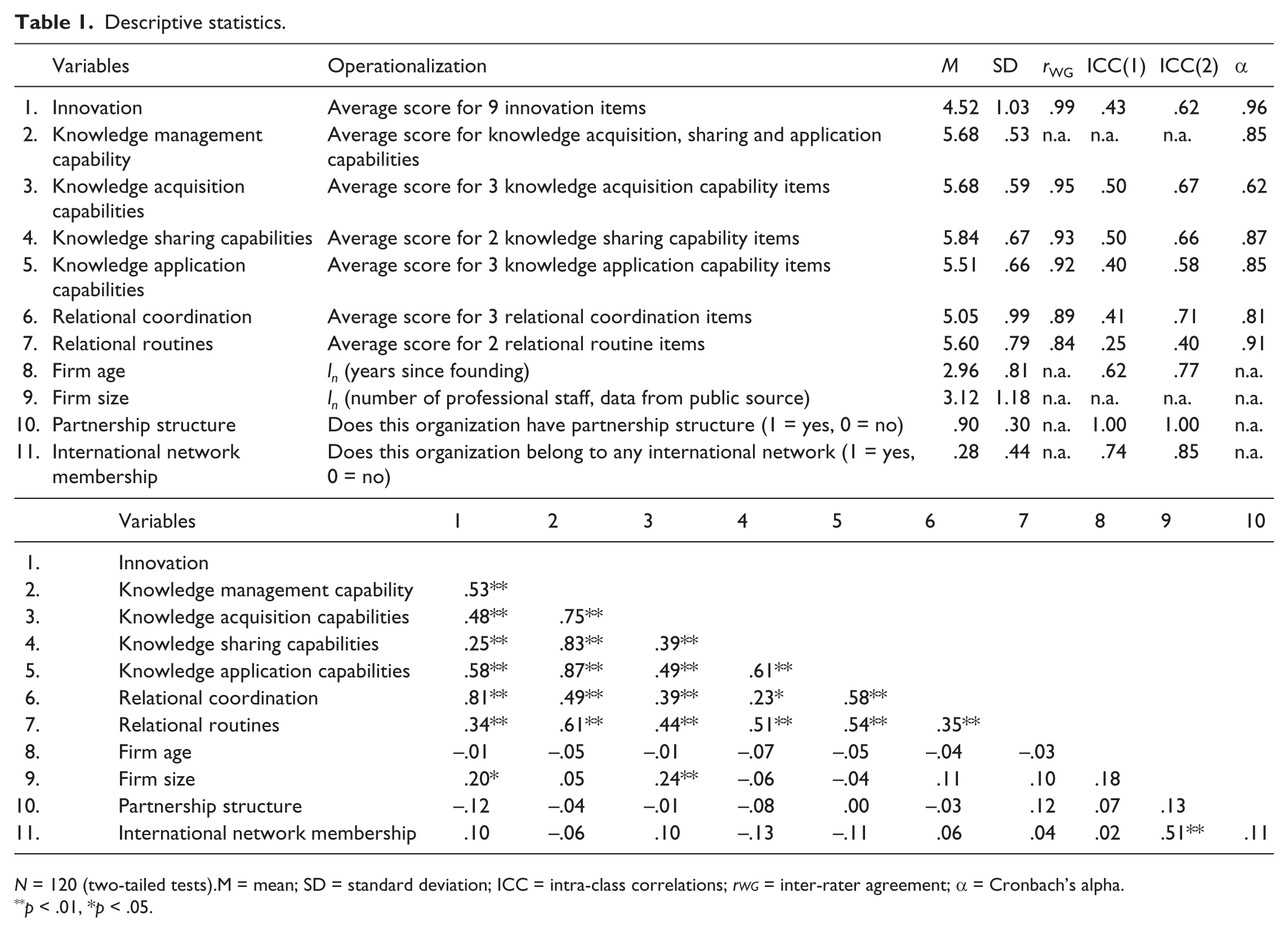
N = 120 (two-tailed tests). M = mean; SD = standard deviation; ICC = intra-class correlations; rwg = inter-rater agreement; α = Cronbach’s alpha.
p < .01, *p < .05.
Both inter-rater agreement and inter-rater reliability were assessed using intra-class correlations. ICC(1)s and ICC(2)s were calculated using McGraw and Wong’s (1996) formula with a one-way random-effects analysis of variance (see Table 1). High values of ICCs occur only when there is both absolute consensus and relative consistency in judges’ ratings (LeBreton and Senter, 2008). Gittell et al. (2010: 498) state, ‘the ICC(1) provides an estimate of the reliability of a single respondent’s assessment of the unit mean’ and ‘ICC(2) provides an overall estimate of the reliability of unit means’. In this study, the ICC(1) values for all of the variables ranged from .25 to 1.00 – higher than the median value of .12 reported by James (1982). This indicates that the two respondents in each unit/firm had high agreement and that answers from single respondents were reliable. The ICC(2) values for all of the variables ranged from .62 to 1.00 – higher than the .60 cut-off point recommended by Glick (1985), except for a .40 score for relational routines. The relatively low ICC(2) value for relational routines is a direct result of only two participants from each firm as well as the small number of items. However, it is comparable to those coefficients shown in Liao et al. (2009), which ranged from .28 to .38. Therefore, it is concluded that the firms can be reliably differentiated in terms of all variables in the model. The matched-pair responses data were aggregated so that the final score for each firm represents the average unit-level perception.
Analyses
To address concerns regarding potential common method bias, this study followed Podsakoff et al. (2003) and Podsakoff et al. (2012) in assessing the risk of common method bias in three ways: (i) by obtaining some data from public database sources, that is, firm size; (ii) by allowing the respondents’ answers to be confidential in order to avoid desirability bias; and (iii) by testing common method variance using both Harman one-factor analysis and the CFA marker technique. In complying with (ii) above regarding confidentiality, the cover letter informed respondents that ‘this is a strictly confidential survey and your participation is entirely voluntary … under no circumstances will your individual responses be made available to anyone’. To comply with (iii), all variables were first entered into an unrotated exploratory factor analysis with a forced one-factor solution. If the majority of the variance is not determined by one general factor, there is less concern regarding common method bias. The CFA marker technique requires that an unrelated ‘marker variable’ is partialled out as a surrogate for common method variance. ‘Unrelated’ indicates that the selected marker variable should be theoretically unrelated to the constructs of interest included in this article. The structural parameters are examined both with and without this measure to determine the potential effects on the observed relationships. If adding this marker variable does not increase the variance to a large extent, there is less concern regarding common method bias.
To test these hypotheses, hierarchical multiple regression analysis (Hofmann et al., 2000) was used to test four separate models. Model 1 tested the mediation effects of relational coordination on the relational routines and firm innovation link (H1). Models 2 and 3 tested the mediation effect of knowledge management capability on the relational routines (H2a) and relational coordination (H2b) with firm innovation relationships, respectively. Model 4 tested the effects of relational coordination on the relational routines and knowledge management capability relationship (H4).
Mediation tests were conducted following the four conditions that Baron and Kenny (1986) specify: (i) the independent variable should be directly related to the dependent variable (X → Y); (ii) the independent variable should be related to the mediator (X → M); (iii) the mediator should be related to the dependent variable while controlling for the independent variable (M → Y); and (iv) the direct relationship between the independent variable and dependent variable should become non-significant (full mediation) or weaker (partial mediation) when accounting for the effect of the mediator (X + M → Y). The effects in both steps 3 and 4 are estimated in the same equation. Two methods were used to test the significance of each meditation model, i.e. the Sobel and bootstrapping tests (Preacher and Hayes, 2004; Sobel, 1982). The bootstrapping confidence intervals are preferred over the Sobel test because of the unrealistic assumption that the Sobel test makes regarding a normal sampling distribution for the indirect effect (Hayes, 2009; Preacher and Hayes 2008). In this study, both methods were used to provide more comprehensive analysis.
Finally, Hayes et al.’s (2011) SPSS macro MED3C was also used to compare the proposed model of relational-routines–relational-coordination–knowledge-management-capability–innovation to a series of alternative models such as the knowledge-management-capability–relational-routines–relational-coordination–innovation linkage model.
Results
Descriptive statistics
Table 1 shows descriptive statistics, including the operation methods, means, standard deviations, rWGs, ICC(1)s, ICC(2)s, correlations and inter-item reliabilities.
Confirmatory factor analysis and common method variance
First, CFA was conducted to confirm that the variables were distinct. The CFA results supported a four-factor structure of relational routines, relational coordination, knowledge management capabilities and innovation (χ2/d.f. = 451.71/193 = 2.34, p < .001, comparative fit index [CFI] = .93, root-mean-square error of approximation [RMSEA] = .08, the standardized root mean square residual [SRMR] = .08). The low p-value obtained may be owing to the somewhat small sample size (191) relative to the large number of items (22).
Second, common method variance was assessed. The unrotated one-factor principal axis analysis revealed four factors with eigenvalues greater than 1, with the first factor accounting for 47 percent of variance. Additionally, the CFA indicated poor fit for the single-factor model (χ2/d.f. = 1138.13/199 = 5.72, p < .001, CFI = .75, RMSEA = .16 and SRMR = .12). Squared regression estimates indicated that common variance was about 21 percent. Furthermore, using CFA marker techniques, an additional unrelated marker variable (monitoring in this study) was added to the CFA analysis. Following this analysis, common variance remained similar at 22 percent. In all, these results suggest that common method variance is not a concern.
Test of the hypothesized model
Table 2 shows the hierarchical multiple regression analysis. The variance inflation factors (VIFs) and the Durbin–Watson test (Durbin and Watson, 1950) were used to detect effects of multicollinearity and the autocorrelation of residuals. The values of the average VIF associated with the predictors ranged from 1.02 to 1.90 – less than the threshold of 5 provided by Haan (2002) – thus ruling out multicollinearity as a concern. Durbin–Watson values associated with the predictors had a range of 1.04 to 1.64, within the acceptable limits between 1 and 3 (Field, 2009), ruling out concern regarding the autocorrelation of residuals.
Impact of relational routines, relational coordination and knowledge management on innovation.
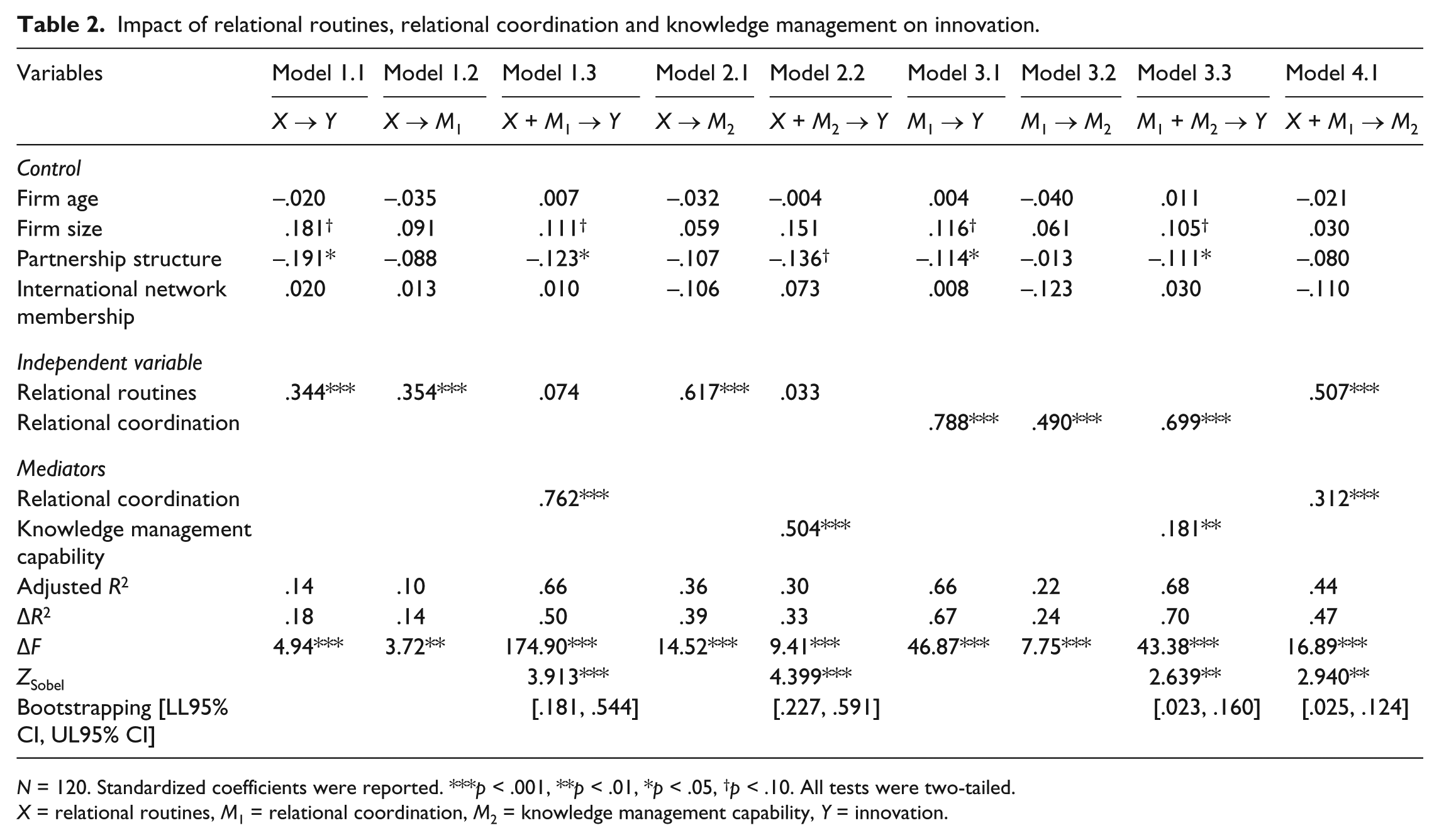
N = 120. Standardized coefficients were reported. ***p < .001, **p < .01, *p < .05, †p < .10. All tests were two-tailed.
X = relational routines, M1 = relational coordination, M2 = knowledge management capability, Y = innovation.
Table 2 presents the regression results for Models 1 to 4. To streamline the results presentation, one detailed example was provided on the findings regarding the mediating effect of relational coordination between relational routines and innovation (Model 1). Results for Models 2 to 4 will be reported more briefly.
Model 1 results: Relational routines and innovation link via relational coordination
Hypothesis 1 proposed the mediation effect of relational coordination on the relationship between relational routines and innovation. Following the procedure outlined by Baron and Kenny (1986), after controls were entered, innovation was regressed on relational routines. Relational coordination also was regressed on relational routines. Finally, innovation was regressed on both relational routines and relational coordination.
After entering controls, the beta coefficient for relational routines on innovation was significant and positive (β = .34, p < .001; see Model 1.1). The first condition (X → Y) was satisfied. The second condition (X → M) was also satisfied because the beta coefficient for relational routines on relational coordination was significant and positive (β = .35, p < .001) (see Model 1.2). Regarding the third condition, (M → Y), the beta coefficient for relational coordination on innovation was also positive (β = .76, p < .001) (see Model 1.3). The fourth condition requires that the direct relationship between the independent variable and dependent variable should become non-significant (full mediation) or weaker (partial mediation) when accounting for the effect of the mediator (X + M → Y). The beta coefficients for relational routines on innovation became non-significant when relational coordination was included (from β = .34, p < .001 to β = .07, n.s.) (see Models 1.1 and 1.3), thus satisfying the fourth condition. Finally, the Sobel and bootstrapping tests were conducted using Preacher and Hayes’ (2004) procedure for simple mediation. The results provided support for relational coordination acting as the mediator between relational routines and innovation (ZSobel = 3.913, p < .001; the 95 percent confidence interval of bootstrapping was between .181 and .544, which does not include 0). Thus, Hypothesis 1 was supported.
Model 2 results: Relational routines and innovation link via knowledge management capability
Hypothesis 2a proposed that knowledge management capability mediates the relationship between relational routines and innovation. The results of Models 1.1, 2.1 and 2.2 presented in Table 2 indicate that knowledge management capability fully mediated the relationship between relational routines and innovation as the beta coefficient for relational routines on innovation became smaller and non-significant when knowledge management capability was included (from β = .34, p < .001 to β = .03, n.s.; see Models 1.1 and 2.2). The Sobel and bootstrapping tests further showed that knowledge management capability mediated the relationship between relational coordination and innovation (ZSobel = 4.399, p < .001; the 95 percent confidence interval of bootstrapping was between .227 and .591, which are both above 0). Hypothesis 2a was thus supported.
Model 3 results: Relational coordination and innovation link via knowledge management capability
Hypothesis 2b proposed that knowledge management capability mediates the relationship between relational coordination and innovation. The results of Models 3.1 to 3.3 in Table 2 indicate that knowledge management capability partially mediated the relationship between relational coordination and innovation, as the direct path between relational coordination and innovation remained significant (from β = .79, p < .001 to β = .70, p < .001) (see Models 3.1 and 3.3). The Sobel and bootstrapping tests showed that knowledge management capability mediated the relationship between relational coordination and innovation (ZSobel = 2.639, p < .01; the 95% confidence interval of bootstrapping was between .023 and .160, which are both above 0). Thus, Hypothesis 2b was supported.
Model 4 results: Relational routines and knowledge management capability link via relational coordination
Hypothesis 3 proposed that relational coordination mediates the relationship between relational routines and knowledge management capability. The results of Models 1.2, 2.1 and 4.1 shown in Table 2 indicate that relational coordination partially mediated the relationship between relational routines and knowledge management capability as beta coefficients for relational routines on knowledge management capability became smaller when knowledge management capability was included (from β = .62, p < .001 to β = .51, p < .001; see Models 2.1 and 4.1). According to the Sobel and bootstrapping tests, relational coordination mediated the relationship between relational routines and knowledge management capability (ZSobel = 2.940, p < .01; the 95% confidence interval of bootstrapping was between .025 and .124, which are both above 0). Thus, Hypothesis 3 was supported.
Full model results: Relational routines – relational coordination – knowledge management capability – innovation
The full model linking relational routines, relational coordination, knowledge management capability and innovation was tested using Hayes et al. (2011)’s SPSS macro MED3C (refer to the model in Figure 2). Table 3 presents the results of the total effect, the effects from the first mediator (M1), the second mediator (M2) and the sum of both mediators (M1 + M2). If the bootstrapping intervals do not include 0 for all three effects, the effect is deemed significant. As shown in Table 3, all effects for the hypothesized model exceeded 0.
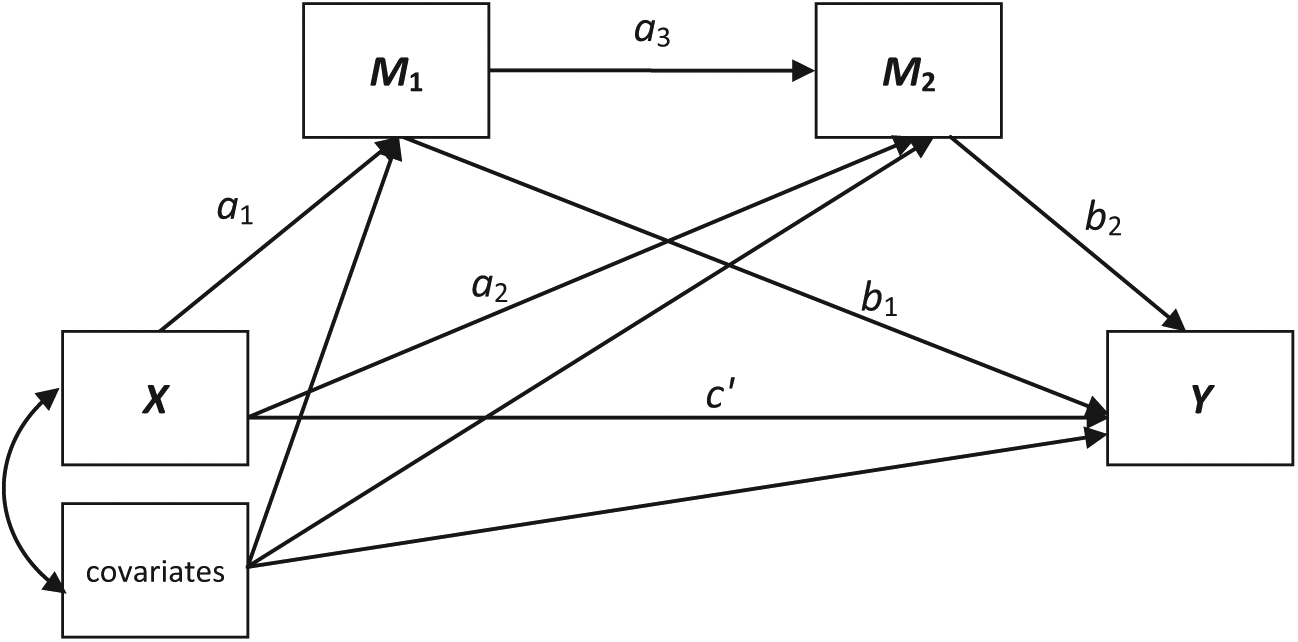
Model to be tested using the SPSS macro MED3C of Hayes et al. (2011).
Results of full model – indirect effect comparisons.
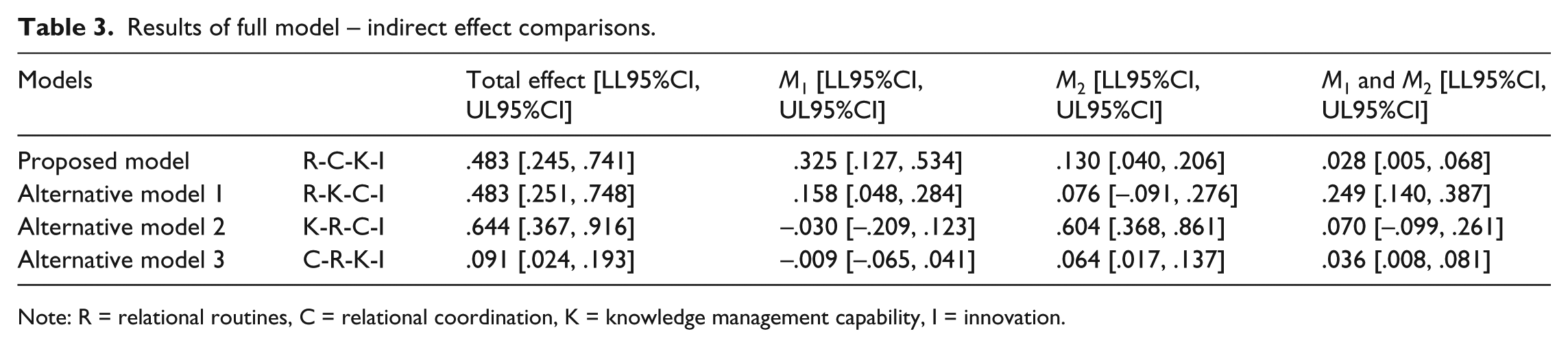
Note: R = relational routines, C = relational coordination, K = knowledge management capability, I = innovation.
Three plausible alternative models were tested to ascertain whether there is evidence for alternative directionality. Alternative Model 1 presents the model of ‘relational routines (R), knowledge management capability (K), relational coordination (C) and innovation (I)’. Alternative Model 2 presents the model of ‘K, R, C and I’. Alternative Model 3 presents the model of ‘C, R, K and I’. All three failed because of the non-significant effect of M1 (Alternative Models 2 and 3), M2 (Alternative Model 2) or the sum of M1 and M2 (Alternative Model 2). Thus, the hypothesized model was supported.
Discussion
The primary objective of this study was to investigate two types of relational resources, that is, relational routines and relational coordination, as potential antecedents of knowledge management capability and ultimately innovation in PSFs. Using data collected from 120 accounting firms, full support was found for all four mediation hypotheses. Overall, the study found that relational routines facilitate effective relational coordination among PSF project teams. Together these two valuable relational resources appear to enable PSFs to improve their capability to manage organizational knowledge by acquiring, sharing and applying it in project work. As a result, these relational resources facilitate the knowledge management capability that helps PSFs to promote, generate and implement innovative ideas to deliver solutions to their clients’ problems. The study reveals insights with important theoretical and managerial implications.
Theoretical implications
This article advances our understanding of the antecedents of firms’ capability in managing knowledge and innovation. Existing studies on knowledge management in PSFs focus on the individual and organizational strategic factors affecting knowledge flow and knowledge management. The present study takes a step back and asks what factors might promote a professional firm’s knowledge management capability in the first place. Results in this study suggest that the role of relational resources has been overlooked in research on knowledge management and innovation in PSFs. This indicates that relationships within firms can give rise to valuable resources that bring PSFs competitive advantage by promoting knowledge sharing, generation and application.
Further, this article contributes to relational coordination theory in three ways. First, the findings on the relational-routines–relational-coordination link extend our understanding of the conditions promoting relational coordination. Existing relevant studies find that the utilization of high-performance work systems (HPWS: Gittell et al., 2010) and specialization-based job design (Gittell et al., 2008) are positively linked to relational coordination. HPWS are systems of human resource management practices used to improve employee commitment and productivity. HPWS include selective recruitment, extensive training, effective performance management, competitive compensation schemes, information sharing and participation. Job design covers a range of factors such as job autonomy, task identity, job feedback, task significance and task variety (Hackman and Oldham, 1975). Compared with these factors, relational routines draw on the relational perspective within which relational coordination is rooted. They call attention to the potential strategic value offered by creating familiarity among organization members, knowledge of each other’s roles, and shared perspectives regarding the larger organization. Relational routines, by definition, are enduring ways of building ties and shared information among organization members, and constitute a dimension of what Leana and Rousseau (2000) referred to as relational wealth – the strategic advantage embedded in stable workplace relationships. Valued relational resources call attention to the potential benefits attained by retention strategies that maintain the membership not just of individuals in the organization but of a critical mass of members who can work together well for common goals.
Second, this article provides evidence for the generalizability of the performance impact of relational coordination and knowledge management capability into the professional service context. The findings on the positive impact of relational coordination and knowledge management capability on organizational innovation in the PSFs are consistent with previous research in other contexts. For example, Gittell and her colleagues found that relational coordination is positively related to quality of care and efficiency in hospitals (Gittell et al., 2010) and flight departure performance in airlines (Gittell, 2001). The present study investigated the research context of professional service firms based in Ireland, extending US-dominant research to a European country, and examined a contextualized organizational outcome – that of organizational innovation in PSFs. In terms of the knowledge management capability and innovation link, evidence has been found in a high-technology context (e.g. Chen and Huang, 2009). This article reports consistent findings on the efficiency of the same link in the professional service context. Thus, this study provides sample legitimacy with regard to the positive links between relational coordination, knowledge management and organizational outcomes. In addition, by identifying the key role of two relational organizational resources, that is, relational routines and coordination, in enabling innovation in PSFs, this article extends our understanding of the organizational elements in creating innovation in PSFs. Existing research has identified organizational elements such as human resource management in recruiting, developing and retaining highly talented people (e.g. Starbuck, 1992) and knowledge codification practices in reusing different types of innovative expertise (e.g. Morris and Empson, 1998) leading to innovation. Two novel and easy-to-implement organizational practices are proposed and found to be significantly associated with organizational innovation in PSFs, therefore shedding new insights on the key factors driving successful innovation in PSFs.
Finally, this article advances our understanding of the underlying mechanism between relational coordination and organizational outcomes by finding support for the mediating role of knowledge management capability in the relational coordination and organizational innovation link. It indicates that relational coordination actually impacts on organizational outcomes, not only directly but also indirectly. Existing studies on relational coordination largely focus on the direct link between relational coordination and firm performance (e.g. Gittell, 2001; Gittell et al., 2010). As Mathieu et al. (2008) and Shapira (2011) point out, specifying and testing intervening mechanisms is important in promoting a cumulative organizational science and moving organizational research toward a true science. Consistently, Hayes (2013) argues that knowing whether there is a direct relationship between two constructs is not sufficient and that investigating how, that is, the process and mechanisms through which the relationships exist, is more important for a better understanding of our world. This reduces the problem of ‘missing organizational linkages’ (Goodman, 2000), where researchers have failed to specify a clear logic for the intervening effects expected (or required) to occur in order to influence organizational performance. Identification of knowledge management capability as a mediator provides better understanding of the processes through which relational coordination functions to promote organizational performance.
Implications for managers
This article highlights the value of two overlooked relational resources in organizations in building a firm’s knowledge management capability and its innovation. Relational routines refer to any activities that bring people together to learn about each other, share information and build mutual respect. Social activities like having coffee together, all-hands meetings or social celebrations, if carried out regularly, constitute relational routines. Relational coordination refers to timely, accurate and frequent communication practices that promote problem-solving. Relational routines that build ties and familiarity between organization members directly aid relational coordination, facilitating communication between members and developing their ability to deal with problems that arise. These two relational resources can be important for all types of firms but perhaps particularly for small and medium-sized firms that may not have large resources to invest in building their knowledge management capability and support for innovation.
Relational resources offer a practical novel and easy-to-implement approach to improve firms’ knowledge management capability. Previous research has advocated more complex interventions in the form of strategic human resource management (SHRM) practices to promote knowledge management capability (Chen and Huang, 2009). These SHRM practices include practices such as selective recruitment, extensive training, effective performance management, competitive compensation schemes, information sharing and participation (e.g. Guthrie, 2001; Huselid, 1995). Such practices are costly and complicated to implement, and might not be feasible for many firms. The organizational routines focusing on building relationships between organization members, particularly those in interdependent roles, may realize a more easily attainable benefit, particularly during difficult economic times. Relational routines and the relational coordination they enable offer a relatively uncomplicated way to build and accumulate organizational knowledge and deploy it in innovative ways – through the stable constructive relationships fostered among organization members.
Overall, the findings reported in this article bring valuable practical implications for managers within professional service firms. It may also offer broader insights relevant in service sectors where interactions among members often take place and interdependence is important for carrying out work.
Limitations and future research
This study has a number of limitations that provide direction for future research. It examined relational routines as an antecedent of relational coordination. However, other social exchange constructs may exist influencing relational coordination, including intra-team trust, and personal networks, both of which can encourage sharing goals and knowledge. This organizational-level study did not capture the experiences and attitudes of individual professional employees. One direction for future research would be to explore the factors contributing to relational coordination at the individual level so as to better understand the psychological processes underlying relational coordination.
The sample in this study is limited to a single industry and is relatively small. By investigating a single industry – accounting firms – this study has the advantage of industry focus but makes generalizability difficult. Therefore, future research needs to test the proposed model in a broader range of professional service firms such as law practices or architectural firms as well as more general contexts, to establish the external validity of this study’s findings. Regarding its sample size, this study was unable to employ the preferred structural equation modelling approach for testing measurement errors. Although sufficient power existed to find significant effects using an alternative advanced regression method by Hayes et al. (2011), future research should seek to gather a larger sample to more fully test for measurement error.
Although support was found for the proposed model and not for other possible models, causality cannot be confirmed because of the cross-sectional research design. Thus, longitudinal research is required in future to substantiate this by tracking the sample firms and better detecting causal relationships. The present study relied on accounts from more than a single respondent in most firms, helping to reduce concern over common method bias. However, future research might incorporate data collection from a broader range of sources, and over time capture other important perspectives on organizational resource use and performance, for example, collecting performance data from the perspective of customers.
Finally, in terms of measurement, this study is limited in adopting only three out of seven items in measuring relational coordination. Relational coordination focuses on the quality of communication and work relationships, and is represented by the frequency, timeliness, accuracy and problem-solving nature of communication, shared goals, shared knowledge and mutual respect (Gittell, 2001). This study only adopted timely and accurate communication and shared goals, representing the two main components of relational coordination owing to practical concerns on the survey length. In addition, this study used these items, which were strategically selected based on factor analysis of previous studies – for example, the items’ factor loadings were .10 higher than other items’ factor loadings on average in Gittell et al. (2010). They also have high face validity and relevance to the context. However, using a partial scale limits our understanding of other dimensions of relational coordination and their performance impact. Therefore, future research should use the full scale in order to capture the entire construct that is relational coordination.
Conclusion
The article offers a theory-based explication of the mechanisms through which relational resources in organizations influence innovation. It presents evidence regarding the benefits of relational resources that managers in PSFs can apply with relative ease of implementation to enhance their firm’s knowledge management capability and innovation. It highlights the value of two relational resources, that is, relational routines and relational coordination – often overlooked in studies of knowledge and innovation management. It specifies a pathway based on organizational theory that can account for the emergence of knowledge management capabilities in professional service firms wherein quality relationships among staff are cultivated. Scholars and managers are now positioned to more carefully reflect on what can be done to develop relational resources for the benefit of the firm, its members and clients.
Footnotes
Acknowledgements
I thank Associate Editor Samuel Aryee and the two anonymous reviewers for their insightful comments, constructive suggestions and great support throughout the reviewing process. Sincere thanks are given to Denise Rousseau at Carnegie Mellon University, Patrick Flood, Kathy Monks, Edel Conway, Brian Harney, Yseult Freeney, Lisa van der Werff and Steven Kilroy at Dublin City University for their very helpful feedback and comments on drafts. I acknowledge the DCU Business School Research Committee and Irish Research Council for their financial support for this study. Thanks are also due to Marann Byrne, Barbara Flood, Ruth Mattimoe, Mary Canning and Orla Feeney at DCU Business School Accounting Group for their valuable advice in developing the survey. I also thank the audience in the Management Consulting Division, Academy of Management Annual Meeting 2012 for their valuable feedback. Finally, I thank Mr Diarmuid Breathnach at Chartered Accountants Ireland for his great support in conducting this research project, and the many HR Managers and Managing Partners who completed the surveys.
Funding
The author of this article is funded by an Irish Research Council for the Humanities and Social Sciences Postdoctoral Research Fellowship.
1
Presented at the Academy of Management Conference 2012 and nominated for the William H Newman Award.