







Abstract
This research extends our understanding of organizational sensemaking through storytelling to highlight complex processes of organizational change in space, time and strategic context. We focus on the concept of antenarratives, how managers’ and other stakeholders’ fragmented speculations regarding futures may legitimate or resist organizational change. Antenarratives are not yet fully-formed narratives, but rather pieces of organizational discourse that help to construct identities and interests. We explain the theoretical relevance of Russian socio-linguist Mikhail Bakhtin’s space and time conceptualizations (chronotopes) for strategic narratives of change, and illustrate how antenarratives play important roles in narrative chronotopes. We relate German philosopher Martin Heidegger’s reasons for being in relation to others (existential ontology) to stakeholders’ and organizational identities, and to antenarrative glimpses in Bakhtin’s chronotopes. Through these theorizations, we contribute to conversations surrounding managerial discourses of organizational change, and discussions on how researchers may analyze antenarratives in relation to stabilized narratives. We use microstoria, or little-story analysis, and the case of Burger King Corporation’s international strategizing, to highlight emergent conflicts and their resolution for sensemaking that includes diverse organizational stakeholders and affects organizational effectiveness.
Introduction
How do organizational stories, which we define as spoken or written accounts of connected events, form and justify strategic change? We focus on the concept of anternarratives (Boje, 2001; Vaara and Tienari, 2011), diverse stakeholders’ fragmented, mediating, prenarrative speculations. Without understanding the role of time, we cannot fully comprehend how antenarratives and fully-formed narratives constrain strategic sensemaking (Vaara and Pedersen, 2014). We argue that Bakhtin’s (1982) concept of space-time, or chronotopes, captures critical, mediating processes in organizational sensemaking. We extend through archival analysis of Burger King Corporation (BKC) the concept of antenarratives as stakeholders’ retrospective and prospective sensemaking of future strategic possibilities (Rosile et al., 2013) before narratives become fully coherent (Barry and Elmes, 1997). Identifying organizational antenarratives allows us to differentiate efforts at reconciling compatibilities and incompatibilities as narratives form in strategic context. Thereby, we seek to account for strategic storytelling’s richness and complexity, but also its propensity to lead to myopia, inertia and dominance. Some stakeholders engage in retrospective sensemaking (Weick, 1995), reviewing how past events will repeat to project future actions. Others engage in prospective sensemaking (Boje, 2014), betting through antenarrative processes on preferred futures not tied to clock time.
Fenton and Langley (2011) highlighted narratives’ central roles in practical strategy. Brown and Thompson (2013: 1148) argued that narrative approaches make more visible the polyphony of organizational strategizing. Lyotard (1984) introduced competing social, historical and economic grand (or meta) narratives of sensemaking (such as the term ‘global competition’) that legitimize ideologies, but also include growing incredulity to them. We build theory through highlighting sensemaking that linked multiple space–time frames with stakeholders’ antenarratives of their activities in relation to others in the world (ontology) that underpinned BKC’s strategic change. Thereby, antenarratives provide glimpses into negotiated, emergent sensemaking that could change BKC’s coherent grand narratives of global strategy.
Specifically, we theorize on four antenarrative processes. First, antenarratives emerge before grand narratives cohere into form. Second, antenarratives constitute the deeper structure beneath grand narratives. Third, antenarratives recur in the cyclic bets on the way events unfold in the future. Finally, antenarratives serve as the between of participants’ localized living stories and organizations’ more long-lived grand narratives (or what Czarniawska [2004] termed as petrified narratives). As Weick (2012: 144) elaborated, antenarratives constitute fragmented, non-linear, incoherent, collective, unplotted and pre-narrative speculations where people experience a narrative’s middle, but only vague beginnings or ends, resorting to sensemaking, and to establishing subjective time. We contribute to understandings on how stakeholders’ fragmented sensemaking situated in subjective space and time correspond to BKC’s organized patterns of global strategy and may contribute to change.
Other researchers have analysed the social and cultural construction of organizations including sensemaking narratives by which people give meaning to experience (Weick, 1995); frames or schemata of interpretation that organize experiences, guide actions and provide coherence to ideas (Fiss and Hirsch, 2005); and genre repertoires or sets of shared communication that become templates for social action (Orlikowski and Yates, 1994). Scholars studying sociotechnical systems also identified the importance of spotlighting diverse, competing voices underlying organizational change (Humphreys et al., 2012). Vaara and Tienari (2011) explained multinational corporations’ merging through distinguishing competing globalist, nationalist and regionalist antenarratives. They noted a lack of conceptual frameworks for narrative analysis of conflicting sensemakings of time within organizations; however, they did not explain how antenarratives arose and did not situate them in time or space. Vaara and Pedersen (2014) proposed that through shedding light on differing strategic ideas, antenarratives may capture conflict underlying institutional changes; they called for theory and data to understand intra-organizational sensemaking. We contribute to these discussions.
We use stakeholders’ fragmented stories as underlying constructs in organizational narratives (Pentland, 1999); we frame these fragments in the context of Bakhtin’s (1982, 1984) epistemology on how space-time influences how we know and Heidegger’s ontology on how we exist in and relate to the world. At any point of time, alternative and competing antenarratives exist, sometimes in dialogical relationships, explaining and propelling strategic change (Czarniawska, 2004). Stakeholders’ fragmented stories, our units of analysis, derive their meaning, significance and identity from the changing functional roles they play within organizational grand narratives that we view as dynamic, unfolding processes (see Guillaume, 2010). Brown and Humphreys (2003) noted that senior managers explained events as epic-change narratives, while employees explained the same events as tragic narratives. Epic-change narratives can focus on key events, missing important, more subtle antenarrative processes. Küpers et al. (2013) examined narratives’ ambiguity and effects on discursive struggles, de-sacralization and recurring rituals. We propose that for more effective strategizing, managers routinely connect competing antenarratives to link living stories grounded in particulars with grand narratives of general trends. Bakhtin’s and Heidegger’s recurring organizational frames and themes give stability to understand living-story experiences; and, antenarratives capture dynamic processes of negotiating inter-relationships.
We view organizational change as ‘becoming’ (Carlsen, 2006), occurring in tandem with authoring individual and collective identities, and emphasizing movement, flux and emergence. Organizational change also stems from reweaving stakeholders’ webs of beliefs and habitual actions through new experiences and interactions (Tsoukas and Chia, 2002). Change and identity become on-going engagement with lived experience, continually enacted sequences of unique presents (Carlsen, 2006), or Bakhtin’s (1993) ‘once-occurrent and unfinished event of being’.
We argue that antenarratives involve bets on the future (Boje, 2001) that interact with recurring grand narratives (Haley, 1991) and living stories’ individuating aspects but not only for conjoined sensemaking. Antenarratives justify strategies and visions in which managers want stakeholders to believe, but that presently have no justification. Simultaneously, stakeholders’ reception augments and amends managerial antenarratives that may eventually become institutionalized in organizational grand narratives (Boje, 1991, 1995). Antenarratives may also conjoin prospective and retrospective sensemaking, connecting grander, universal, abstract narratives to living stories’ grounded webs. Yet, researchers have largely excluded micro processes of change in grander strategy narratives. Using Bakhtin’s and Heidegger’s theories, we capture rich storytelling dynamics from multiple perspectives in space, time and being to shift from monological, objective texts, to dialogical, performative texts.
As our contributions, first, we see antenarratives as central to back-and-forth storytelling to shape organizational identity that managers and other stakeholders derive from lived experiences (Weick, 2012). We build on previous research on Bakhtin’s and Heidegger’s concepts to understand strategic changes, including polyphony (Belova et al., 2008), multiple logics that organizations repress for storytelling dominance (Boje et al., 1999), politics of multicultural communications (Evans, 1998), everyday phenomenology (Hirschkop, 1999) and process theories of language (Chia and Holt, 2006). Second, we relate Bakhtin’s chronotopes to Heidegger’s writings on process in the emerging practice-oriented paradigms of strategy (Langley et al., 2013). Our contribution centers on understanding strategic change and vision by connecting fragmented, individual antenarratives to grand, abstract narratives through recurring organizational themes. We assume logical discourse and that the storytelling fragments will eventually have made sense (Weick, 2012). First, for Heidegger (1962), by questioning their being, people desire to find reasons for being. Second, for Bakhtin (1982), people draw purposefulness and rationality from interactive communications, leading to preeminence of context over text. Both theorists distinguished between physical-real stories of what actually happened, and history from which managers may draw monological narratives. Texts in space–time, or chronotopes, provide contextual preeminence to understand purposefulness (Pedersen, 2009) and being, thereby shedding light on conversations that shape organizational futures (Cornelissen et al., 2011).
For the remainder of this article, first, we explain the theoretical relevance of Bakhtin’s space–time frames for grand narratives and stories of change. In the ensuing section, we relate Heidegger’s deep structure to organizational identity and stakeholders’ sensemaking. Next, we describe our data collection and methodology of microstoria analysis. We follow by using BKC to present space–time frames that highlight antenarratives as the before-beneath-cyclic bets-between stories and organizational strategy and vision. Finally, we link antenarratives to discussions on changes in grand narratives with implications for theory and practice.
Stories of change in space–time
Not homogenous or uniform, and more than polyphony (Bakhtin, 1984) or turbulence (Emery and Trist, 1965), market space captures diverse contexts, institutions, political, cultural and social spaces for economic activities. Importantly, managers basing strategies only on linear, objective time and information may discard strategic possibilities for choosing from diverse futures (Vaara and Pedersen, 2014). We propose concepts of market turbulence that encompass more than other organizations’ actions for understandings of organizational ‘attunement’ and of ‘being-in-[a-turbulent-world]’ to analyze ‘movement’ (Bakhtin, 1984: 179).
Antenarratives draw on Bakhtin’s (1982) literary presentations of chronotopes or nine slices of storied space and time that permeate grand narratives. Not mutually exclusive, each chronotope interacts with and builds on others to elaborate on nonlinear strategic change. Chronotopes make explicit multiple space–time frames for antenarrative sensemaking (Boje, 2014). Through situating antenarratives in subjective space and time, we show how diverse voices interconnect, embed and entangle in organizational strategies.
Boudes and Laroche (2009) highlighted how actors enacted environments during crises through narrative sensemaking in subjective time. Vaara and Pedersen (2014) discussed how antenarratives link retrospective and prospective sensemaking: they classified strategy narratives as chronotopes enveloped in literary genres of time and place. 1 Antenarratives of the past, present and future derive from resources that enable but also constrain these constructions. Some antenarratives become institutionalized parts of organizational strategy, while others wither. Through observing antenarratives, we understand how constructions of organizational objectives become taken-for-granted parts of organizational strategy.
Haley and Boje (2014) analyzed how Bakhtin’s chronotopes capture stakeholders’ accounts of McDonald’s Corporation’s internationalization for a fuller story of organizational expansion in space and across time. They identified stakeholders’ voices in dynamic networks of production, distribution and consumption, including managers, farmers, consumers, media, governments, labor, local and global competitors, authors, advertising agencies and marketing departments. As with other narrative inquiry (Weick, 2012), voices did not speak for themselves: Haley and Boje (2014) chose stories and quotes according to their criteria of importance, which included strategic changes in managerial narratives and visible internationalization processes, as well as public justifications of existing narratives. Through their choices of storytellers and stories, they emphasized certain structures and meanings in stories. Their multimodal data distinguished internal and external actors but focused on fully-formed stories that shape organizational narratives. Unlike Haley and Boje (2014), we employ a methodology to capture fragmented, pre-narrative speculations, which we analyze in strategic context. Thereby, we provide a framework to highlight divergent internal voices that may never emerge in organizational narratives of strategy, but which nevertheless exist. For clarity, we present separately each chronotope’s definition and description in strategic context.
Romance Adventure
Here, organizations battle environmental foes, yet remain unscathed. Battles uncover organizations’ intrinsic traits of indomitable life energy, not cultivated over time but always existing. Organizations develop through core strengths that mature in time outside time. Despite an ongoing set of quests, ‘suddenlys’ (Bakhtin, 1982: 92) or unusual processes abruptly change worlds built entirely on chance, into romantic worlds where adventure uncovers purpose. ‘One and the same’ time becomes inseparable from ‘one and the same’ place (Bakhtin, 1982: 97): distinctions dissolve between the presently apparent and history. Space expands when mechanistic meetings between environments and adventuring organizations create ‘suddenlys’. Managers appear as overcoming adversity by focusing on organizational purpose. The linear Strengths–Weaknesses-Opportunities–Threats (SWOT) strategy model enshrines this chronotope (Barry and Elmes, 1997): it romanticizes organizations’ overcoming weaknesses and threats from external environments, while developing strengths vis-a-vis opportunities. Similarly, through related diversification (Rumelt, 1974), organizations grow, but intrinsically stay the same while conforming to environments.
Everyday Adventure
Here, everyday life confronts suddenly emergent interruptions, as in Romance Adventure, but ‘suddenlys’ contribute to organizational identity. Identity changes over time as time changes traits; adventure time of ‘suddenlys’ integrates with everyday time for metamorphosis (Bakhtin, 1982: 111). Organizational transformation approximates identity change, leading to new characteristics. Story arches develop through sequential paths as in Campbell’s (2003) conceptualization of the hero’s journey. While historical processes including natural cycles remain unchanged, unseen forces transform managers and key individuals into heroes. Idealized, linear narrative paths emerge as sequences of everyday, historically-situated occurrences. The stories’ heroes understand their transformation and misplacement.
Chivalric Adventure
These stories appeal to abstract ideologies that structure organizational adventures, traversing history and initiating noble quests. Heroic deeds balance personal opportunities and perfection of action, in response to ideological power, but may become stuck in patterns. Managers encounter challenges that include chivalric codes (Bakhtin, 1982). Mixtures of ‘suddenlys’ build on Everyday Adventure, incorporating systematic quests drawn from Romance Adventure, but not the self-oriented Biographical, but rather one of ‘heroic deeds’ (Bakhtin, 1982: 153). Organic and internally consistent, Chivalric originates from symbolic concepts of being blessed and bewitched; ‘suddenlys’ occur not randomly, but because abstract ideologies either help or hinder the adventuring organizations.
Biographical and Autobiographical
These stories reveal managers’ underlying life energies and unchanging character traits to the public. The heroes’ paths involve public accounts of self (Bakhtin, 1982), where character traits acquire social salience. The ‘time-space of their representative life’ (Bakhtin, 1982: 131) lies bare, such as to draw in stakeholders. But, people accessing internal knowledge may subvert Autobiographies. If stakeholders question in the public arena identity that they assumed as authentic, stories may move managers’ and therefore organizational identities. Stakeholders may withdraw support if trusted managers appear untrue to grand narrative.
Historic Inversion
Historic Inversion challenges past experiences to posit alternative futures and therefore new strategic actions. As the future comes under the influence of past expectations, an inversion occurs of the historical becoming the only possible future: to ‘say that a thing could, and in fact must, be realized in the future is portrayed as part of the past’ (Bakhtin, 1982: 147). Stories emphasize the fleshed-out past instead of the ephemeral future; fixed historical structures justify future decisions, integrating the character arches of Everyday Adventure in time and space, moving the heroes toward ‘a growth process without any inauthentic debasing’ (Bakhtin, 1982: 150). Research on rhetorical history as strategy (Suddaby et al., 2010) shows Historic Inversion, where the past solidifies as what will happen in the future. Stories predicate organizational future on what has worked in the past, thereby reducing stakeholders’ dissonance (Boyce, 1995). Managers justify future obligations through retrospective sensemaking.
Rogue–clown–fool
Rogue, Clown and Fool masks from medieval folklore expose narrative frames’ falseness in situations of power and control (Bakhtin, 1982). Life becomes metamorphosis where the private sphere lays bare hypocrisy in public, theatrical space. The three masks present theatrical connection to the public square, which becomes public spectacle. External stakeholders’ tacit assumptions demarcate what the masks’ wearers aim to overturn and hypocrisy becomes readily apparent. The masks grant rights not to understand, to confuse, to hyperbolize life, to parody others and not to be taken literally, not to be one’s-self. Stakeholders express theatrical, farcical responses to strategies appropriating Everyday growth to show the Biography as hypocritical.
Rabelaisian Purge
A radical-change approach, the Purge uses grotesque humor to reframe and to renew worldviews. Purging of illusory frames interacts with previous chronotopes, discarding Chivalric falseness or laying bare hypocritical masks. Renewal can come after purging that which the Rogue, Clown and Fool revealed (Bakhtin, 1982). The Purge centers on authentic, unidealized nature, as false hierarchical relationships between things, ideas and monstrous ideological unions fall apart through material, worldly contact. Physical licentiousness caricatures contact between the body and worldly actions such as drinking, eating, sleeping and digestion. Satirical ideologies reveal deep meanings behind the grotesque.
Collective Life and Idyllic
Here, the social whole stresses the cyclical as in harvest time. Time is tied to the future, but metaphorical. For Bakhtin (1982), preceding chronotopes fell short of the answerable, ethical, positive, authentic potential found in Collective Life. Agricultural-labor cycles give rise to new cycles of space and time. Labor processes connect to concrete notions of space, human nature and life, which become shared, interactive experiences that flow from nature. Collective laboring links the environmental, sustainable and authentic to reconnect life to the social whole. Idyllic matrices include family space in the collective people’s agricultural and craft-labor time. Life links to nature and cycles that separate from progress myths, offering rebirth from modern development. Love, labor, family, organizations, relate in common understandings of nostalgia and a unified place in the world.
Sensemaking reasons for being
Heidegger (1962) posited two modes of being in the world: transparent and apparent. Focusing on existence, the ontological deals with being in time and place and employs transparent logic. For example, organizations may move towards goals through ready-to-hand or freely available means. Apparent logic displays the Cartesian split of the ontic or apparent empirical facts, and the epistemic or sensemaking. These concepts permeate modern culture, philosophy and literature on strategy (Tsoukas and Shepherd, 2004) and provide narrative structures for antenarratives, living stories and grand narratives.
Heidegger (1962: #153) elaborated on the importance of structure to understand sensemaking of change:
Our constant task is never to allow our fore-having, fore-sight, and fore-conception to be presented to us as fancies or popular conceptions, but rather to make the scientific theme secure by working out these fore-structures in terms of the things themselves.
For Heidegger (1962: #31) ontological inquiry concentrated on Being, with ends providing means that allow for being-in-the world and the emerging of structures. Ontological inquiry incorporates apparent facts that lead towards potential outcomes; ready-to-hand data provide justification for means.
The epistemic holds relations that we learn or absorb as socially factual. For Heidegger (1962), the epistemic dealt with sensemaking, emphasizing scientific theory, a portion of scientific rationality. Here, we observe how structures solidify in the mind. Experience leads to segment rationally new information into theory, assumptions and observables. Examples include using grounded theory to build generalizable knowledge, testing a hypothesis derived from a theory, and, observing antenarratives that use past events to create present stories.
For Heidegger (1962), the ontic dealt with observable empirical facts that provide physical-material justifications and examples of structure. Things present-at-hand make up the physically present. Ontical inquiry concentrates on entities and the facts about them. Figure 1 provides a representation of Heidegger’s structure of sensemaking.
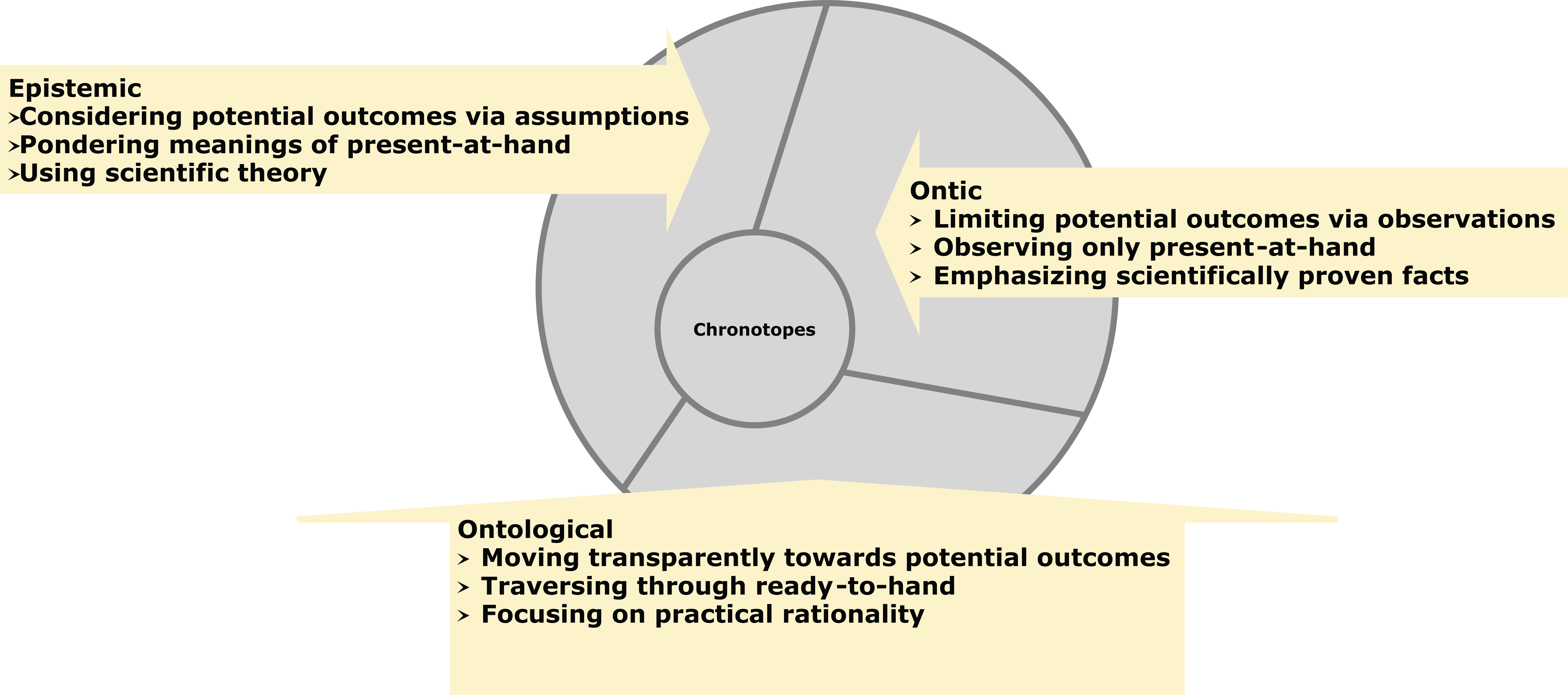
Sensemaking in space–time.
Heidegger (1962) proposed narration as key to understand Being-in-the-world: ‘whenever something is interpreted as something, the interpretation will be founded essentially upon fore-having, fore-sight, [fore-structuring] and fore-conception’ (Heidegger, 1962: #152). We propose that Bakhtin’s chronotopes provide useful frames to understand strategic change as interactive, antenarrative processes. Figure 2 proposes how antenarratives may relate to organizational strategy and managerial vision, both changing and being changed.
Before grand narratives cohere into rigid structures and roles, processes work ‘to bring into the scope of our fore-having, with which all subsequent steps of . . . analysis are to conform’ (Heidegger, 1962: #232);
Beneath grander narratives that frame general concepts, and living stories of daily working and living, ‘something is arrived at in a resoluteness of fore-conceptions that lies in temporality’ (Heidegger,1962: #327);
Anticipated cyclical bets on possible futures fore-tell new potentialities for being where the ground ‘betrays itself’ as it moves forward (Heidegger, 1962: #257);
Between individuating living stories and general, universal grand narratives, fore-structure from ‘the ground up’ ‘[amplifies] understanding’ (Heidegger, 1962: #153).
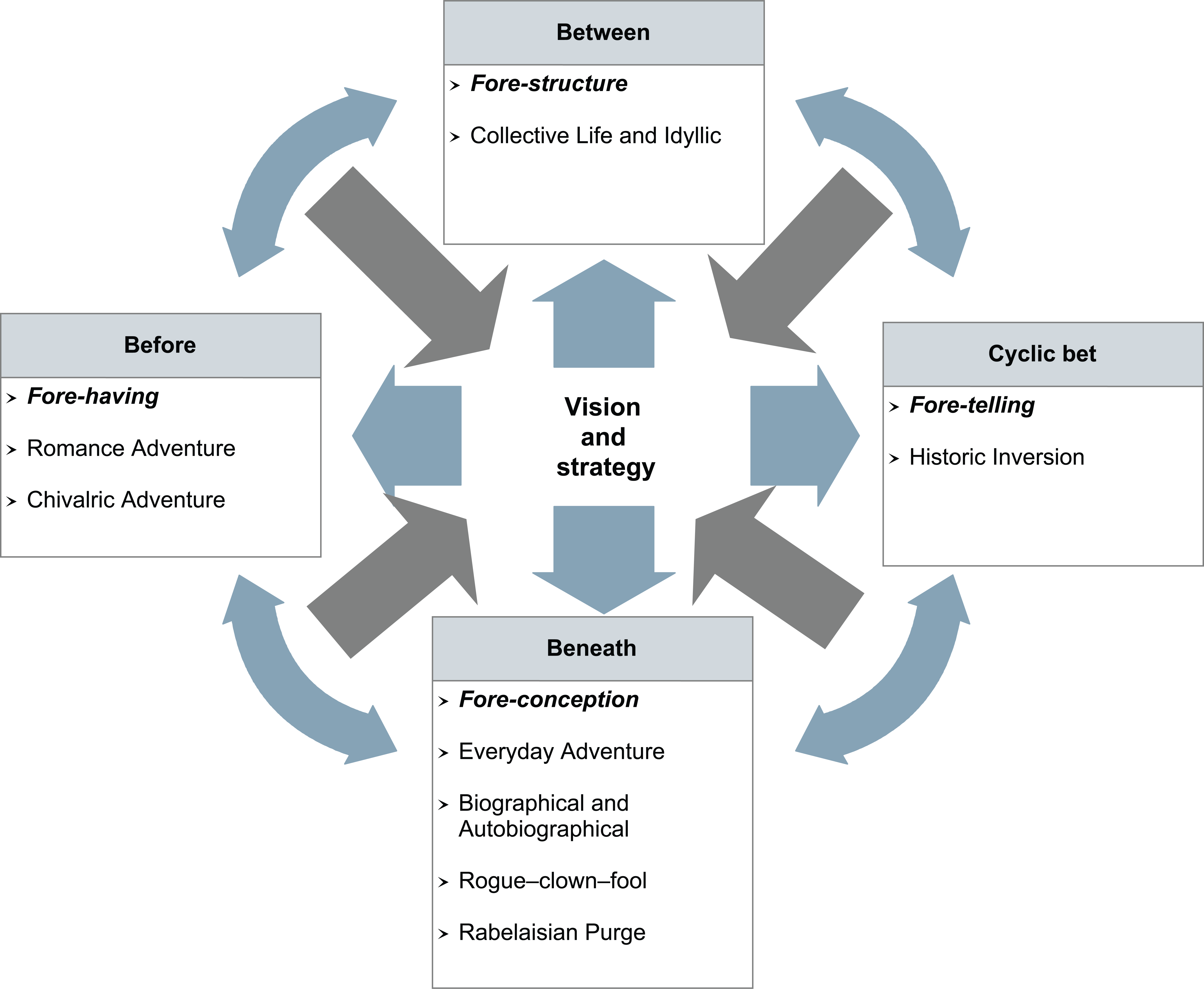
Antenarrative processes in organizational change.
Grounding and embedding strategic change in multiple space–times highlights the struggles between and beneath grand narratives with living stories of life and work in relation to the before of enacting strategic steps and the cyclical bets on anticipated actions.
Data and analysis
Operating in the fast-food restaurant industry, and historically the second-largest fast-food hamburger restaurant chain (after McDonald’s Corporation), BKC was overtaken by Wendy’s in 2013. Headquartered in Miami, Florida, BKC employed 34,248 people in 2011 and operated in about 81 countries. The company recorded revenues of $1146m during the 2013 financial year, down from $1971m in 2012 and $2340m in 2011. Analysts estimated that the industry’s revenues experienced modest growth in 2014 of 1.4 percent, as the broader economy recovered. Over the past five years, demand had increased for healthy alternatives, while decreasing for traditional, greasy fast-food options. Major competitors, such as McDonald’s, expanded menus to include healthier options such as salads, fruit and smoothies, and invested internationally in emerging economies. Managers have viewed China especially as offering strong growth and long-term profit potential, though most have experienced food-safety problems. Competitors such as McDonald’s and Yum! Brands earned about 60 percent of their sales overseas, as compared with about 40 percent for BKC. Analysts estimated that fast-food restaurants would experience slow growth domestically as industry segments reached saturation (Marketline). The grand narrative of competitive global strategy emphasized that successful companies in this industry will adapt to consumers’ changing preferences, new international markets and stakeholders’ opposition as traditional fast food evolves.
Method
We use an interpretivist paradigm to communicate theoretical ideas that lay in between the fully-formed stories that Haley and Boje (2014) described. For this exploratory research, we used microstoria analysis (Boje, 2001) to pinpoint fragmented, terse stories that form antenarratives. Microstoria advances fine-grained understandings of multiple voices for subjective interpretation of hidden meanings. Consequently, research using microstoria does not aim for objectivity and generalizability; rather, subjective coding of multiple voices and hidden meanings becomes central to interpret interrelationships between chronotopes and antenarratives.
Unlike other narrative methods (e.g. Czarniawska, 2004; Glaser and Strauss, 2009), microstoria allows focus on diverse space and time frames between the epistemic and ontologic. Our approach aligns with Vaara and Tienari’s (2011) critical-discourse and antenarrative analysis, by privileging ‘little’ stories alongside CEOs’ narratives (Boje, 2001: 55). Through microstoria, we interpret terse, fragmented stories that either bolster or speak against organizational power in situated context and as polyphonic histories.
Official stories often obscure other realities (Imas et al., 2012). Terse-story unit of analysis reveals that dominant or petrified narratives do not form abstractions but that stakeholders use discursive devices to justify actions and to develop antenarratives (Weick, 2012: 144). By using three sources of voice: the media, workers and manager’s official statements, we attend to untold story that we connect to fully-formed narratives through the in-between flux of antenarrative practices (Izak et al., 2015).
BKC’s dynamic history and changing ownership provided numerous contexts to observe antenarratives coded as terse stories: novel organizational routines sometimes failed to replace those in place (Colville et al., 2013). Our focus on one case also reduced exogenous influences (Yin, 2003). Microstoria analysis of BKC provided forthrightness, rigor, consistency and the ability to share ideas that constitute the key virtues of this qualitative-research style (Golden-Biddle and Locke, 2007).
Data collection
In line with microstoria research requirements, we used multiple archival sources from 1978–2015. First, we used Lexis Nexis Academic and Factiva to find news reports related to BKC’s international strategizing. We chose the newspapers and web-based publication subcategories, leading to 939 documents; because of limited theoretical relevance, we removed 421 documents dealing with idiosyncratic experiences at BKC’s outlets, native advertising and duplicates. Second, we compiled a database of BKC’s texts for stakeholders, including letters to shareholders, statements of mission, vision and values, Securities and Exchange Commission (SEC) filings, press releases and codes of conduct (Legacy Filings, 2015). Third, we collected reviews and reports from Glass Door (2015). A search for ‘Burger King’ returned 5680 workers’ reports, of which 4459 lacked qualitative information. We sorted the remaining 1221 responses in to those at the Miami Headquarters (66) and the Management Trainee program (19), which we classified as managers, and those at all other locations (1136), which we classified as labor.
We engaged in three phases of analysis of these archival data. First, we defined parameters for the data we analyzed through creating word lists for the antenarrative contexts of before, beneath, bet and between: for example, we associated ‘beneath’ with under, underneath, foundation, basis, bedrock, bottom, cornerstone, footing, ground, groundwork, keystone, root and underpinning. Table 1 identifies these lists of words. Next, we read the documents individually and in accordance with qualitative coding procedures (Strauss and Corbin, 1990) that involved sorting and noting important phrases and concepts. We confirmed for very high (over .8) intercoder reliability. Third, we identified collections of antenarratives for each chronotope and chose examples we felt best illustrated different stakeholders’ voices. We discussed how to articulate, and to interpret, antenarratives in organizational context using an iterative approach (Eisenhardt, 1989), alternating between theory and data.
Coding parameters for antenarratives.
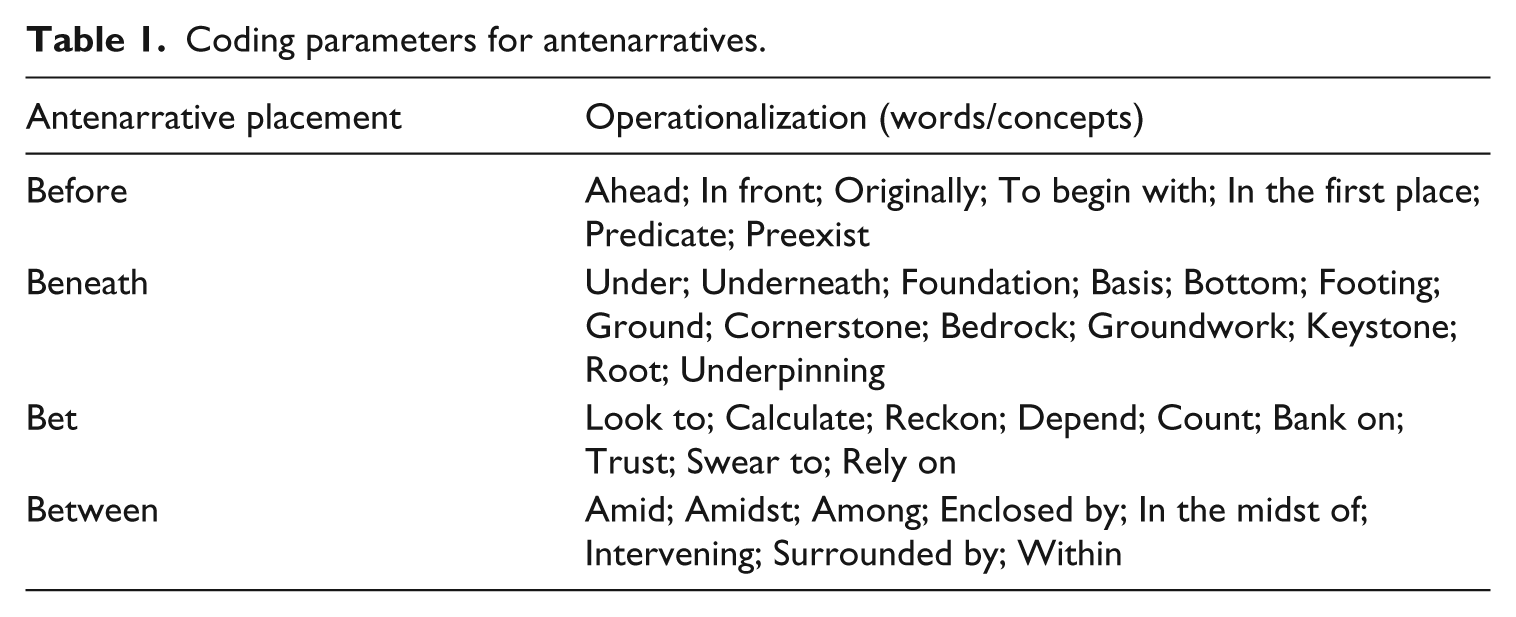
Table 2 illustrates how the microstoria of labor, managers and the media either supported or detracted from BKC’s grand narratives of global competitiveness. We acknowledge that other interpretations of BKC’s stories exist. However, in this preliminary research we responded to a call for empirical studies on antenarratives (see Vaara and Pedersen, 2014) through offering a framework to share ideas and examples (Gephart, 2004); our research also provides a foundation for further systematic research and tests for predictive validity.
Microstoria illustration of anternarratives underpinning Burger King Corporation’s global strategy.

Notes: EBITDA = earnings before interest, taxes, depreciation and amortization; CapEx = capital expenditures.
Source: Burger King Corporation Corporate Responsibility Statement (2015); Burger King Corporation (2012, 2013); Burger King Worldwide (2014); Tim Hortons (2014); Patton (2011); Politifact.com (2014); Ramirez (1990); Randall (1991); Reuters (2014); Ro (2014); Sheehan and O’Brien (2013); Stanley (2002); Tiam (1992); and Glassdoor reviews of Burger King Corporation by labor: www.glassdoor.com/Reviews/Employee-Review-Burger-King-RVW5809752.htm; www.glassdoor.com/Reviews/Employee-Review-Burger-King-RVW5621856.htm; www.glassdoor.com/Reviews/Employee-Review-Burger-King-RVW5621856.htm; www.glassdoor.com/Reviews/Employee-Review-Burger-King-RVW4661542.htm.
Antenarratives in organizational context
We contend that microstoria identifies meaning and multiple stories within BKC (Eriksson and Kovalainen, 2008) – whilst, Bakhtin’s chronotopes and Heidegger’s existential ontology provide structure or how diverse stakeholders told their stories; interactional context or how stakeholders told their stories to others in specific contexts; and, performance measures or how stakeholders told their stories for specific outcomes. We present an antenarrative exposition of Heidegger’s (1962) fore-having, fore-conception, fore-telling and fore-structure in relation to antenarrative before-beneath-cyclic bets-between. Bakhtin’s chronotopes provide sensemaking genres to situate fragmented stories in time and in relation to other stories (Holt and Mueller, 2011). Table 3 provides an overview of possible antenarrative processes in space and time with epistemic, ontic and ontological elements.
Integrative outcomes of antenarrative processes.

The before: Romance Adventure
Statements from annual reports highlighted BKC’s enduring strengths from before. For example, the 2012 annual-report section, ‘Special note regarding forward-looking statements’, elaborated on ‘our belief and expectations regarding the strength of our menu and our ability to optimize our menu by focusing on core products while delivering compelling value to drive sales and traffic and rolling out fewer, more impactful products’. Managerial pronouncements also aimed to increase external and internal stakeholders’ beliefs in BKC’s leadership. Rational fears regarding exploitable weaknesses transformed strategies of flight from sectors and countries, through transparent antenarratives, to become strategies of fight through other transparent, practical, rational, assumptions of strength such as brand image.
Many stakeholders found worth in which they wanted to believe, emanating from before, and accepted stories of BKC’s past strategic investments. This most out-of-time and out-of-place chronotope heavily sways facts of being in the world. With little change or diversity of antenarratives, stories drawing on before may ignore active exchanges with environments, thereby blocking possibilities beyond present facts (Barry and Elmes, 1997).
The beneath: Everyday Adventure
‘Suddenlys’, including past strategies’ unanticipated consequences, may become organizational threats. For example, on 26 August 2014, after many years of cost-cutting, BKC spent a large amount of cash to merge with Canadian multinational fast-food restaurant chain, Tim Hortons, to create the world’s third largest quick service restaurant (QSR) company. With combined sales of $23b, the new company had over 18,000 restaurants in 100 countries, and headquarters in Canada with lower corporate tax rates than the United States. The new company will be listed on the Toronto and New York Stock Exchanges. A stakeholder backlash resulted in both countries: some Canadian customers said Tim Hortons was now a US company and they would not eat there; US advocates and regulators said BKC was moving to avoid paying US taxes that it owed US communities; some Canadian stockholders and analysts feared that the US company’s focus on costs over quality would destroy their iconic brand; and, some US customers saw BKC’s actions as opportunistic and unpatriotic and boycotted its products (Lum, 2014). US Senator Sherrod Brown released a competing beneath antenarrative on 26 August: ‘Burger King’s decision to abandon the United States means consumers should turn to Wendy’s Old Fashioned Hamburgers or White Castle sliders . . . Burger King has always said “Have it Your Way”; well my way is to support two Ohio companies that haven’t abandoned their country or customers’ (Brown, 2014).
The acquisition exposed the underside of BKC’s official narratives. Responding to stakeholders’ concerns, managers quickly adjusted living stories for meanings that differed from just competitive strategy. BKC’s investor relations released a public statement on 26 August regarding the deal’s structure: ‘Commitment to Canada’ assured stakeholders that the acquisition uncovered the organization’s continued commitment to ‘community, sustainability and [charitability]’. Everyday surprise, however, led to antenarrative repairs revealed in BKC’s new commitment to ‘not change . . . [make] no changes . . . [but to retain a] meaningful number of Canada-based executives’. Despite limiting facts, BKC’s managers induced different meanings of the present, proposing numerous antenarratives to respond to publics’ and regulators’ concerns: BKC’s attempts to increase net profits by evading US taxes became BKC’s commitment to sustainable operations. Managers representing stockholders worked change linearly, through ready-to-hand antenarratives that folded into grand narratives. Internal adjustments may occur to regain environmental fit. For example, BKC may hire more Canadians than it previously planned.
The before: Chivalric Adventure
Before antenarratives link the present to past traditions, norms, standards and rules. In medieval times, the Knights of the Round Table conformed to chivalric codes of honor and nobility. Corporations claim their standards from founders’ traditions and codes of conduct and service. Before antenarratives appear in BKC’s presentations of quality standards and also in the chivalric dedication ‘Burger King: Where taste is king’. While managers dedicated BKC to the storied pursuit of flavor, in the 2013 annual report ‘delivering compelling value to drive sales and traffic’ appeared as driver. Managers made internal sense of the focus on flavor, while undertaking contradictory healthy-eating pilot initiatives. By drawing upon storied meanings from the past, managers showed customers, investors, and employees that tradition guides corporate operations.
Before antenarratives may turn problematic. For example, BKC’s spokesperson said the company, is ‘committed to providing menu options’ to meet individual nutritional needs around the world. BKC had:
. . . successfully reduced the sodium content in many products around the world . . . As part of its global, menu-innovation process, BKC develops standards for its menu items . . . BKC’s approach ensures that all Burger King restaurants have items that meet our stringent food quality standards in each region. (Parry, 2014)
Yet, nutritionists revealed that the global salt content of BKC’s burgers varied widely, corresponding to taste: the Bacon Double Cheeseburger contained 2.85g of salt/burger in Canada and 1.92g in New Zealand. Despite public calls, the UK Cheeseburger’s salt had risen by 20 percent from 2006–2014, from 2.2g to 2.64g. The World Health Organization recommended daily salt intake of less than 6g (Parry, 2014).
The beneath: Biographical and Autobiographical
Antenarratives beneath stakeholders’ biographies and autobiographies, may counter grand narratives, suggest opportunities and allow for disagreement. Pursuing competitive goals, BKC’s managers have spoken positively, but not forthrightly of the company and employees. For example, BKC’s 2014 announcement after acquiring Tim Hortons stated, ‘Our combined size, international footprint and industry-leading growth trajectory will deliver superb value and opportunity for . . . our dedicated employees, strong franchisees, and partners’. This antenarrative references debatable stakeholders’ values and goals and belies BKC’s cost-cutting strategies.
BKC’s biographical commercial featured controversial professional National Basketball Association player, Chris Webber: A federal grand jury indicted Webber and stripped him of his college titles for his involvement in a money-laundering scheme of payments to college athletes. In BKC’s (officially released) accompanying video entitled ‘Chris Webber behind the scenes’, Webber referenced his crew as ‘preserving our identity’ and made nostalgic reference to a ‘pregame Whopper’, the ‘fun’ he had advertising the company, and how BKC had partaken in his life’s ups and downs. Beneath antenarratives became facts, revealing valuable, unchanging traits poignant and salient in the now. BKC’s managers have used similar antenarratives to allow stakeholders to notice, and even to change goals.
Without alternative facts, stakeholders’ sensemaking may correspond with grand narratives. Placed in the public square, living stories can influence other antenarratives through retroactive temporality. However, as the story presents no path forward, managers cannot show potential future outcomes, despite present circumstances.
The cyclic bet: Historic Inversion
Managers engage in retrospective sensemaking where past successes or failures predict optimal future strategic moves: the past becomes the basis for a future that repeats the past. For example, in 2010, holding firm 3G Capital acquired BKC with the stated aim of undertaking future strategic moves that leverage core-competencies, including BKC’s brand (3G Press Release, 2010). BKC’s restructuring included divesting corporate stores, which had been turning around since 2004. Nevertheless, divestment resulted in higher profits. Alex Behring (3G’s co-founder and BKC’s chairman) assured stakeholders that his bet on acquiring Tim Hortons, and future successes for the combined company, stemmed from past knowledge of successful acquisitions. For retrospective sensemaking, BKC released a document entitled ‘World’s third largest [QSR] company launched with two iconic and independent brands: Tim Hortons and Burger King’. This past repeated as cyclic bet in an official statement released later in 2014: ‘Over the past four years, we have transformed Burger King into one of the fastest-growing and most profitable QSR businesses in the world, through successful international growth’. Yet, facts do not support that statement: BKC had geographically concentrated operations with 60 percent of restaurants in the US and Canada; in 2011, the US generated 67 percent of BKC’s total revenues. In contrast, McDonald’s generated only 32 percent of total revenues from the US (Marketline). BKC’s managers projected plans for future international expansion as successful past strategy.
When employees and investors believe organizational versions of the past, narratives of the past may become organizational futures. History in particular time may move into future time. Thereby, antenarratives of an organizational past, affecting stakeholders in the present, may also drive them into a future that repeats past lessons. However, these cyclical antenarratives fail to convey novel possible future actions.
The beneath: Rogue–clown–fool
The Rogue reveals corrupt practices beneath officialdom. As in the Renaissance, the carnivalesque Clown sees beneath power and pokes fun at it. Out of step with modern times, and befuddled by modern inventions, the Fool displays irony. BKC’s advertising mascot embodies a Clown who became a Rogue and then an out-of-time Fool. The mascot has undergone several iterations over the course of BKC’s history (Stevenson, 2004). In the early 1970s, the company used a small, animated, clownish version of the King called Kurger Bing in its children’s advertising. By the late 1970s, the animated King became the Marvelous Magical Burger King, a red-bearded, Tudor-era king who ruled the Burger King Kingdom, performing magic tricks with his Magic Ring that could summon copious amounts of food. Since the 1990s, and responding to rising competition in the fast-food industry, followed by steeply falling international profits and sales, BKC portrayed the King as a rogue that openly stole McDonald’s food stories worldwide. In one television commercial, the King breaks into McDonald’s headquarters late at night and steals the recipe for McDonald’s breakfast sandwich. ‘It’s not that original, but it’s super affordable’, the King states (Haley and Boje, 2014). In 2004, a rogue King, that managers called ‘the creepy King’, began appearing in commercials: the King appeared unexpectedly in places, such as in bed with people or behind doors and walls, only to offer a BKC product. Stakeholders responded with their own internet antenarratives. The King became an internet meme with jokes about his huge head, a fiend with monstrous intents, often accompanied with the catchphrase ‘Where is your God now?’. Blaming sluggish sales and customer aversion, BKC retired the rogue for food-centric marketing. Chief Financial Officer, Josh Kobza, said, ‘We got rid of the creepy King character that tended to scare away women and children’ (Wong, 2014).
By taking antenarratives outside the present-at-hand, the chronotope reveals managerial sensemaking as living story leading to stakeholders’ present stances. Stakeholders can comprehend beneath managerial antenarratives a factually observable farce. Managerial antenarratives then make concrete the narratives that stakeholders formerly ignored, allowing critical insight into other potential stories such as the internet memes. For BKC’s managers, as stakeholders realized through farce the fallacy of previous beliefs, they more willingly accepted new fast-food stories. Strategic storytelling as expressive movement surfaced as farcical mask, opening up BKC to self-criticism, and potentially self-assessment.
The beneath: Rabelaisian Purge
The Rabelaisian Purge uses grotesque body parts to uncover the ridiculous beneath grand narratives. Parodies emerge of the human body, larger than life, in eating, bodily functions, and so on. For example, in one commercial, BKC revealed problems of obesity beneath its official managerial stories of healthy food. In a music-video parody of the hip-hop Sir Mix-ALot song ‘Baby’s got back’. The original began ‘I like big butts and I cannot lie’, but in BKC’s version it’s ‘square butts’ that Mix-ALot wasn’t going to lie about. The commercial featured gyrating women in outfits that gave them ‘a butt with sharp right angles’ and ‘spongey’ (Glover, 2009). The grotesque misshapen derrieres provided a Rabelaisian antenarrative to general western conceptions of attractiveness, just as the original song did; it also provided a beneath justification to consume BKC’s Sponge Bob Square Butt related food-merchandise.
For stakeholders such as consumers and publics, antenarratives reveal beneath the official, even sacred, in ways that through irony may create greater self-awareness. For example, hip-hop artists started questioning their lyrics in the face of BKC’s commercial exploitation. As managerial antenarratives revealed new facts, some stakeholders experienced a new sense of being, and a new set of goals. For instance, children’s advocates such as Campaign for a Commercial Free Childhood (CCCF) opposed BKC’s Sponge Bob Square Butt commercials as depicting children in a derogatory and potentially exploitable fashion (CCFC, 2009).
The between: Collective Life and Idyllic
The Collective Life and Idyllic combine antenarratives that occur between previous space–time frames. Here, antenarratives link particularizing living stories with grander narratives. Human connections to earth and fertile soil link to seasonal and cyclic changes, environmental sustainability links to sustainable profitability. Without the living story of a safe and clean everyday life, BKC’s grand narrative falls apart. For example, in July 2014, when BKC and its competitors encountered troubles in China with tainted meat from its Chinese food supplier Shanghai Husi Food (Yan, 2014), managerial antenarratives flagged. While competitor McDonald’s moved quickly to apologize and to explain away using rotten meat, BKC wavered in its response (Jourdan, 2014). While McDonald’s announced severance of all relations with the Chinese contaminated-food supplier, BKC, hamstrung by weak supply chains, stated it would temporarily ‘suspend’ its connection to the supplier.
For managers, the Collective Life and Idyllic afford opportunity for antenarratives to deliver stakeholders’ acceptance of perpetual change. Repeated organizational storytelling through the Collective Life allows managers to weave changed facts into living stories that incorporate diverse goals. Storytelling emerges not as words and symbols but as living beings’ expressive movements. Inverting systems, the higher order influences the lower, blurring distinctions between developed wants and primordial needs. After a scandal in 2008, food safety has become the top issues for Chinese consumers. Other food scandals have hit China’s fast-food industry, and many Chinese look to foreign brands as offering higher safety standards. The scare stirred Chinese consumers and became one of the most discussed topics online among the country’s influential netizens: some users spread long lists of firms, including BKC, which the scandal tarnished. BKC’s restrained anternarrative announced on Chinese weblog Weibo indicated it had removed the contaminated product from shelves and launched an investigation. BKC’s antenarrative crisis may have failed to maintain Idyllic senses of ignorance that form the core of modern food production and connections to grand narratives of progress (Schlosser, 2012), thereby affecting future profits.
Conclusions
Critical challenges in organizational theory involve moving from surface to deep structure for cohesive interpretations from multiple, partial, subjective, even conflicting accounts (Pentland, 1999), a gap we propose our research and others may fill. Such research may provide insights on narrative strategies’ limited success: we posit BKC’s relative lack of stories of Collective Life affected performance vis-a-vis competitor, McDonald’s (Haley and Boje, 2014).
We provided an account of organizing around antenarratives for understanding BKC’s strategic change as emanating from Bakhtin’s space-time and Heidegger’s sensemaking of being. We presented a plurality of contexts in which BKC operated that interconnected, embedded, and entangled with narrative ecologies. Grounding and embedding systems in multiple contexts allowed us to see struggles between and beneath grand narratives with living story webs, and the before and cyclical bets of antenarrative relationships. We analyzed and compared antenarratives and grand narratives in specific contexts to show how BKC’s stories linked to overarching power structures and ideological representations to describe managers’ strategic actions. Thus, we have shown how being changed to becoming in time and through organizational structure. We have argued that antenarratives linked living stories to grand narratives to construct identities and interests in time and space for unique discursive constructions of BKC’s change. Through building on Bakhtin’s and Heidegger’s works, the antenarrative approach allowed for focus on fragmented pieces of discourse from workers, managers and the media as cohesive aspects of storytelling for strategic change.
Our case study by its nature has limited generalizability. Future research can extend our approach to other contexts and across industries for predictive validity and further insights into the context of strategic actions. Systematic studies of antenarratives may provide fuller explanations of how grand narratives change, how purposeful managerial antenarratives may elicit and mimic grand narratives, and how these processes feed into organizational change and managerial vision. Dialogical views of organizational change such as ours, across different strategic contexts, can thereby complement linear theories of organizations by incorporating increasingly complex and contradictory voices to understand strategizing (Van de Ven and Poole, 1995).
Footnotes
Acknowledgements
We thank Associate Editor Mathew Sheep for his excellent suggestions, insights and guidance, which helped to improve this article; we also thank the reviewers (one in particular shaped our approach) for their timely and in-depth feedback.
Funding
This research received no specific grant from any funding agency in the public, commercial, or not-for-profit sectors.