







Abstract
Organizational changes are costly ventures that too often fail to deliver the expected outcomes. Psychological empowerment and affective commitment to change are proposed as especially important in turbulent contexts characterized by multiple and ongoing changes requiring employees’ continuing contributions. In such a context, employees’ beliefs that the changes are necessary, legitimate and will be supported, are presumed to increase psychological empowerment and affective commitment to change. In a three-wave longitudinal panel study of 819 employees, we examined autoregressive and cross-lagged relations among latent constructs reflecting change-related beliefs (necessity, legitimacy, support) and psychological reactions (psychological empowerment, affective commitment to change). Our findings suggest that psychological empowerment and affective commitment to change represent largely orthogonal reactions, that psychological empowerment is influenced more by beliefs regarding support, whereas affective commitment to change is shaped more by beliefs concerning necessity and legitimacy.
The need for organizational change is not new, but the pressures for change are arguably more complex today than in the past. They come in different forms (e.g. technological, economic or social) and from multiple sources (competitors, clients, employees, government), often at the same time. Consequently, organizations increasingly need to tackle multiple issues simultaneously and in a continuous manner in order to maintain optimal functioning (Kang and Snell, 2009; Van Looy et al., 2005). It is now well recognized that employees’ reactions can be crucial to the success of organizational change, and various theories and researchers have attempted to account for the nature, antecedents and consequences of these reactions (e.g. Anders and Cassidy, 2014; Armenakis and Bedeian, 1999; Armenakis and Harris, 2009; Bazzoli et al., 2004; Kotter, 1996; Rafferty et al., 2013; Stevens, 2013). However, managing complex and continuous changes introduces some unique considerations. For example, the concept of organizational ‘ambidexterity’ (e.g. Kang and Snell, 2009; Van Looy et al., 2005) was recently introduced to recognize the need for organizations to combine orthogonal strategies (e.g. exploitation/exploration; top-down/bottom-up) as a way to sustain adaptation to turbulent environments while ensuring continuous improvement and competitiveness. For complex and continuous change initiatives, it may thus be critical for management to build employees’ approval for the whole transformation process, rather than focusing on each specific change. Similarly, because complex ongoing changes make it unrealistic for management to anticipate all possible adaptive challenges for years to come, it might be particularly important to encourage employees to engage in active self-determined contributions (Hobfoll, 2002). Therefore, organizations exposed to complex continuous change might need to combine a top-down communication approach aiming to build employees’ approval for the change initiative with a bottom-up approach aiming to build change capabilities among employees (e.g. Argyris, 1999; Brown and Eisenhardt, 2002).
Consistent with these recommendations, we argue that organizations involved in complex and continuous changes need to build and maintain commitment to the change as well as strive to empower their employees to enact the change in ways that are best suited to the challenges they encounter (e.g. Argyris, 1999; Armenakis and Harris, 2009; Brown and Eisenhardt, 2002; Hultman, 1998; Kotter and Cohen, 2002). Accordingly, this study focuses on the development of two complementary yet distinct psychological reactions: affective commitment to change (ACC) (Herscovitch and Meyer, 2002) and psychological empowerment (PE) (Spreitzer, 1995, 2008). For present purposes, we embed these two important reaction variables within Armenakis’ (Armenakis and Bedeian, 1999; Armenakis and Harris, 2009; Armenakis et al., 1993) well-established theory of change readiness. More specifically, we use change-readiness theory to identify potential proximal determinants of ACC and PE (i.e. change necessity, legitimacy and support). Consequently, our findings contribute to change readiness, ACC and PE theories by (a) combining facets of the three theories in a single study, (b) investigating relations among these facets within and across time and (c) doing so under conditions of complex continuous change.
The study was conducted in a Canadian public health-care organization undergoing a series of changes aimed at maintaining and continuously improving the quality and efficiency of patient-care services in a context of evolving demands (e.g. regulations, scarcity of resources, evolving needs; see Laschinger et al., 2004). Importantly, as changes become more complex and continuous, it becomes increasingly important to use multi-wave longitudinal designs with appropriate statistical controls to clarify the finer grained processes by which employees’ reactions evolve over time (e.g. Kim et al., 2011). Ultimately, clarifying the directionality of associations and the stability of employees’ reactions will help develop more effective theories and interventions based on data characterizing the process of human adaptation to changing realities (Marks, 2007). This was our objective in the present research. For this reason, we used a multi-wave panel design to allow for a better identification of the directionality of relations between the constructs than has been possible in previous research. That is, as we test for relations between perceptions of the change and subsequent ACC and PE, we can control for stability in each of these variables as well as potential reciprocal relations whereby ACC and/or PE might also predict more positive beliefs about the change. In the following sections, we explain why ACC and PE are important in this context, introduce the theoretical framework used to guide our study, elaborate on the nature, development and consequences of ACC and PE, and present our hypotheses.
Managing employee reactions to organizational change
As organizations undergo extensive and prolonged changes, empowered and committed workers are necessary to ‘give life’ to the changes, to take initiatives, to refine them and to proactively address new problems as they continually arise (e.g. Argyris, 1999; Brown and Eisenhardt, 2002). It is for this reason that we selected ACC and PE as the focal outcome variables in our investigation. ACC reflects recognition of the importance and value of the change, and has been linked to the willingness to do what it takes to make the change work (e.g. Herscovitch and Meyer, 2002). Likewise, PE (Spreitzer, 1995, 2008) is crucial because, to remain engaged in the change implementation process, employees must feel that they have control over their work and are capable of having an impact on the way changes are implemented. At the same time, they need to have sufficient freedom in deciding how to juggle the requirements of the changes and along with their other work responsibilities.
Many factors are likely to contribute to ACC and PE under conditions of ongoing change. At this early stage of research, we chose to focus on three of the previously identified and investigated precursors to change readiness (Armenakis and Harris, 2009; Caldwell et al., 2004; Fugate et al., 2002; Rafferty et al., 2013). According to Armenakis and his colleagues (Armenakis and Bedeian, 1999; Armenakis and Harris, 2009; Armenakis et al., 1993), there are five key beliefs that change agents should seek to develop in employees: (a) the changes are necessary for the continued success of the organization, (b) the changes being implemented are a legitimate approach to achieving the organization’s objectives, (c) the employees will receive the support (e.g. training) they need to cope effectively with the demands for change, (d) the changes have value for the employees personally and (e) the employees have the capacity to implement change. The last two of these beliefs (d, e) are conceptually similar to our focal constructs of ACC and PE. Indeed, belief that the change has value for employees is a key component of ACC (Herscovitch and Meyer, 2002), and perceived competencies are a key dimension of PE (Spreitzer, 1995). Although a somewhat broader construct, ACC encapsulates the belief that change has value for the employee (Herscovitch and Meyer, 2002). Similarly, the PE construct refers to a generic assessment of one’s capability to perform effectively at work (Spreitzer, 1995, 2008), and thus incorporates the capacity to deal effectively with changes, especially when these become an ongoing part of one’s job reality.
Interestingly, the first three beliefs (a, b, c) are intimately related to change management practices and are highly similar to antecedents of ACC and PE identified in previous research under conditions of change (see below). Therefore, we selected the first three beliefs as our primary antecedent variables. It is important to note that change readiness theory in its current form does not address sequential ordering of the five beliefs implied in our investigation (i.e. that necessity, legitimacy and change will contribute to the development of value [ACC] and capacity [PE]). Therefore, our findings have the potential to enrich change readiness theory by proposing and testing a dynamic sequence through which the first three beliefs may give rise to two distinct and complementary psychological reactions (ACC and PE) argued to be critical for the success of a continuous organizational change.
We turned to self-determination theory (SDT: Deci and Ryan, 1985; Gagné and Deci, 2005; Ryan and Deci, 2000) as an overarching framework to support the proposed dynamic process model. SDT proposes that employees seek to satisfy three basic psychological needs at work: autonomy, competence and relatedness. The satisfaction of these needs appears particularly important in a change context (Gagné et al., 2000) where both the tasks and context tend to be ill-defined or unstable (Gagné and Deci, 2005). When these needs are satisfied, employees experience autonomous rather than controlled regulation of their behavior, giving rise to higher levels of performance and well-being (Gagné and Deci, 2005). Our reason for focusing on SDT is that it has previously been linked to both commitment (Gagné et al., 2008; Meyer, 2014; Meyer and Gagné, 2008; Meyer et al., 2004) and PE (Gagné et al., 1997; Spreitzer, 2008), and shown to be relevant to many work contexts (Gagné and Deci, 2005), including organizational changes (Gagné et al., 2000). SDT provides theoretical grounds for predictions regarding the effects of change-related beliefs (necessity, legitimacy and support) on ACC and PE.
Affective commitment to organizational change
Adapting Meyer and Allen’s (1991) tripartite model of commitment, Herscovitch and Meyer (2002) defined commitment to change as a force that binds individuals to a course of action deemed necessary for successful implementation of the change, and noted that it can be characterized by three distinct mindsets: a desire to support the change based on its inherent benefits (affective commitment), a sense of obligation to support the change (normative commitment) and a need to support the change to avoid the cost of failing to do so (continuance commitment). Here, we focus on ACC because it has been shown to have the strongest and most consistent positive relations with behavioral support for specific change initiatives (Herscovitch and Meyer, 2002; Meyer et al., 2007; Neves, 2009; Parish et al., 2008). Employees with strong ACC see the value in a change initiative and are therefore willing to do what is requested of them as well as engage in more discretionary activities intended to ensure the success of the change (e.g. work extra hours; promote the change).
To date, investigation of factors contributing to the development of ACC is limited and has been largely unsystematic. Among the factors found to be positively associated with ACC in cross-sectional studies are trust in management and supervisor (Michaelis et al., 2009; Neves and Caetano, 2006), participation in decision making with regard to the change (Cook et al., 2008; Sverke et al. 2008), just treatment and fairness of the change process (Bernerth et al., 2007; Foster, 2010), perceived favorableness of the change for the employee (Fedor et al., 2006) and satisfaction with communication (Conway and Monks, 2008; Rafferty and Restubog, 2010). Conditions contributing to uncertainty (e.g. job insecurity, role ambiguity, role conflict) were found to relate negatively to ACC (Bernerth et al., 2007; Foster, 2010), as was a history of negative change experiences (Rafferty and Restubog, 2010).
Although these findings offer some guidance to change managers, they are limited in several ways. With a few exceptions (Amiot et al., 2006; Axtell et al., 2002; Bommer et al., 2005; Fugate et al., 2002), most research on ACC has been cross-sectional, which severely limits causal inference. Moreover, even the few longitudinal studies of commitment within a change context (Coyle-Shapiro et al., 2002; Fugate et al., 2002; Rafferty and Restubog, 2010) generally fail to consider the possibility of reverse or reciprocal causality whereby ACC might also contribute to later change-related beliefs. In addition, a majority of studies have focused on ACC with regard to a specific change initiative. Interestingly, the amount of change that employees experience has been found to negatively relate to their willingness to continue supporting the change (Fedor et al., 2006; Herold et al., 2007). Importantly, in adapting the ACC measure (Herscovitch and Meyer, 2002) for this study to focus on ongoing change, we continue to direct attention to actual changes rather than to change in general.
This study was designed to provide a more systematic investigation of the development of ACC over time during large-scale organizational change. As noted previously, we focus on beliefs about the necessity, legitimacy and managerial support for the changes. Although these specific beliefs have not been addressed in previous research concerning ACC, they are logically connected to several of the factors identified earlier that have been found to have positive (trust in management, justice, communication) or negative (uncertainty, negative change history) relations with ACC. For example, clear and open communication combined with past experience of effective change management is likely to be associated with greater confidence that the changes are necessary and legitimate for continuing organizational success (e.g. Kotter and Cohen, 2002). Similarly, trust in management and perceptions of justice are likely to be associated with the belief that management will continue to provide employees with the support they need to adapt to changing conditions (e.g. Rafferty et al., 2013).
The implications of change-related beliefs of necessity, legitimacy and support for ACC can also be explained from a SDT perspective. It has been shown that employees with a strong affective commitment tend to feel more autonomous than those with more controlled forms of motivation as they perform their job (Gagné et al., 2008, 2010; Meyer et al., 2012). Moreover, both affective commitment and autonomous motivation have been linked to greater need satisfaction (Gagné and Deci, 2005; Meyer and Maltin, 2010). Indeed, within SDT, need satisfaction is viewed as a key mediator in the relations between work conditions and autonomous forms of regulation – such as ACC. Therefore, we reasoned that employees who view the ongoing changes as necessary and legitimate are more likely to endorse them than are those who question the necessity and legitimacy but nevertheless feel forced to comply (need for autonomy). Similarly, employees who perceive management as supportive are more likely than those who do not to believe they will receive the resources needed to meet the challenges they encounter (need for competence and relatedness). Therefore, based on their intuitive links with (a) established antecedents of ACC and (b) theoretical mechanisms underlying the development of affective commitment, we tested the following hypothesis regarding the time-lagged effects of beliefs of necessity, legitimacy and support on ACC:
Hypothesis 1: Beliefs at Time t that the changes are (a) necessary, (b) legitimate and (c) supported by management, relate positively to ACC at Time t + 1 (see Figure 1).
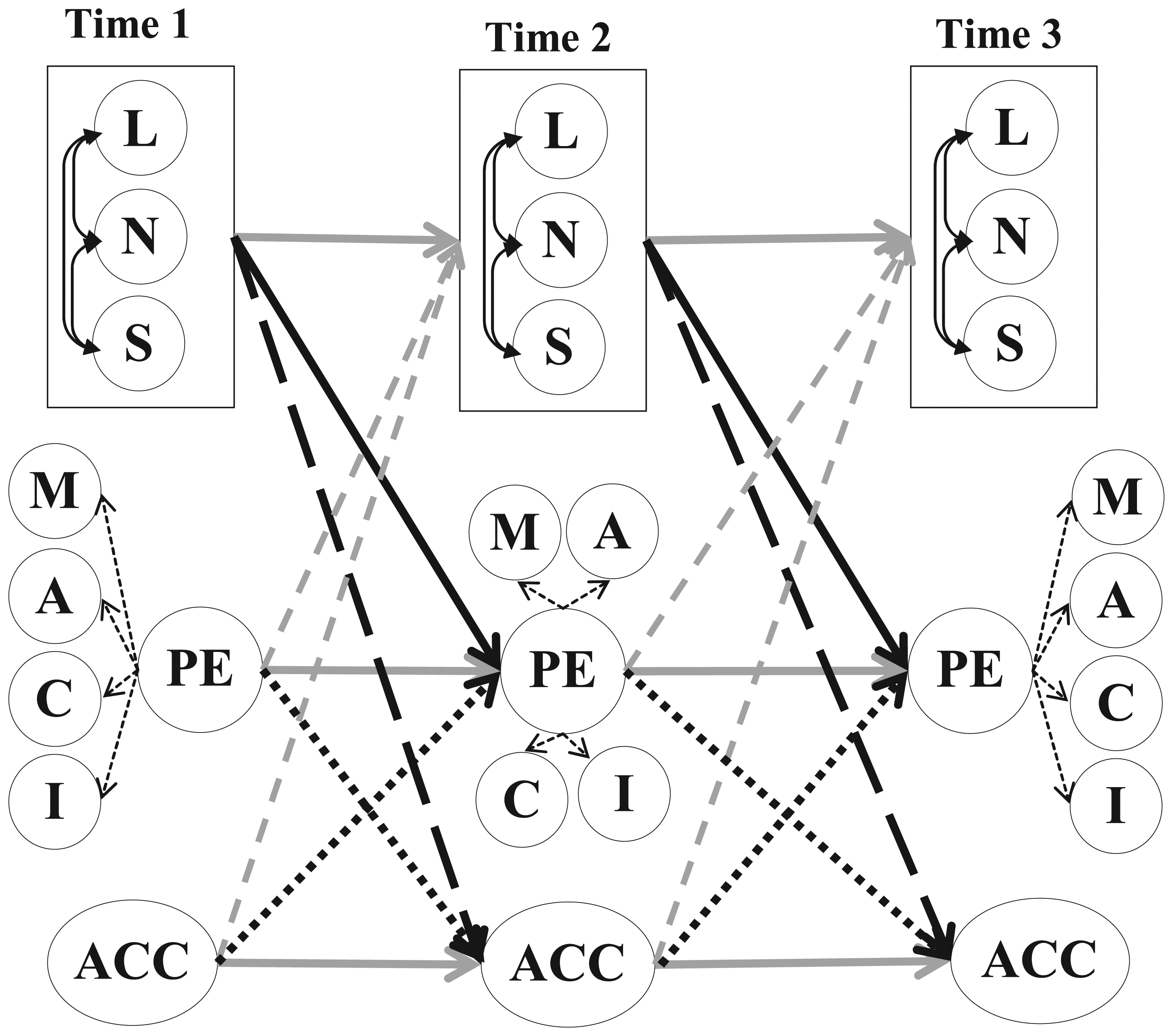
Alternative predictive models.
Psychological empowerment
Spreitzer (2008: 56) defined PE as a ‘set of psychological states that are necessary for an individual to feel a sense of control in relation to their work’. Specifically, PE reflects an integration of four job-related cognitions (Spreitzer, 1995, 2008): meaning, competence, self-determination and impact. Meaning refers to the degree of fit between job requirements and one’s values, beliefs and standards. Competence is the self-evaluated belief that one possesses the abilities to perform one’s job effectively and is closely related to self-efficacy. Self-determination involves having a sense of control in the initiation and regulation of one’s actions. Finally, impact is the belief that one can have significant influence on administrative, strategic and operational outcomes. Seibert et al. (2011) demonstrated that these cognitions reflect a unitary higher-order PE construct.
PE has been linked to a variety of positive behavioral outcomes across situations, including job performance, organizational citizenship behaviors and change support behaviors (Choi, 2007; Seibert et al., 2011; Spreitzer, 2008). Unlike ACC, PE per se has not been studied extensively as a factor contributing to support for organizational change. However, employees’ support for change has been linked positively to constructs related to PE, or specific dimensions of PE, such as self-efficacy (e.g. Cunningham et al., 2002; Herold et al., 2007) or perceived control (e.g. Fugate et al., 2002). Furthermore, PE becomes even more relevant under conditions of continuous change, where dealing with changes becomes an integral part of one’s job that must be balanced with regular job responsibilities. In these circumstances, PE should have effects similar to those obtained in previous research under stable conditions (e.g. Seibert et al., 2011). Furthermore, this focus on a more generic tendency to function in a self-determined empowered manner across situations is in line with recommendations made within the change management literature (e.g. Argyris, 1999; Brown and Eisenhardt, 2002) that organizations create a more general capacity for change that goes well beyond the ability to implement a single change initiative. In the context of ongoing changes, employees are often in the best position to determine how to enact changes within their specific jobs. That is, changes might be implemented more effectively with employees empowered to do what is required on a moment-to-moment basis.
In the absence of previous research, our expectations regarding the implications of beliefs about change necessity, legitimacy and support are shaped in part by PE theory and research regarding its structural determinants. Theoretically, PE is instilled and sustained by ensuring a good match between individual competencies and job requirements (Laschinger et al., 2006), and providing individuals with control in their work roles (Lawler, 1992). For example, one of the factors found to contribute to PE is participation in decision making (Spreitzer, 2008). Such participation is likely to contribute to beliefs about change necessity and legitimacy. Similarly, the adequacy of training and quality of leadership contribute to the development of PE (Seibert et al., 2011) and are likely to be reflected in beliefs regarding the support received from management. This is important as ongoing changes can directly affect employees’ PE by forcing them to learn new procedures and develop new competencies over and above usual work requirements – thus limiting the amount of control they can really exert on their work. For this reason, ongoing support will be necessary if organizations want employees to feel empowered to handle change as effectively as possible within their domain of influence (Boudrias et al., 2009, 2012; Lawler, 1992; Spreitzer, 1995).
As was the case for ACC, we can also draw on links between PE theory and SDT as a rationale for our study hypotheses. According to SDT, employees are more likely to experience autonomous regulation when their basic psychological needs for competence, autonomy and relatedness are met by the organization (e.g. Gagné, 2014; Gagné and Deci, 2005). These needs are conceptually similar to the four factors underlying PE (i.e. meaning, competence, self-determination and impact). Moreover, PE has been conceptualized in previous research as an indicator of the fit between personal needs and job characteristics (Laschinger et al., 2006; Spreitzer, 2008), and shown to be intimately related to autonomous motivation (Gagné et al., 1997). Thus, just as we explained how beliefs regarding necessity, legitimacy and support can satisfy basic needs, and in doing so contribute to strong ACC, we expect that employees will more readily find meaning in their role in the implementation of changes that are necessary and legitimate, and will feel more competent in enacting this role when they are supported. Therefore, on the basis of both previous research and basic principles from SDT, we predict that beliefs concerning necessity, legitimacy and support will all contribute positively to PE within and across time:
Hypothesis 2: Beliefs at Time t that the changes are (a) necessary and (b) legitimate, and (c) will be supported, relate positively to PE at Time t + 1 (see Figure 1).
Relations between affective commitment to change and psychological empowerment
To this point, we have treated ACC and PE in isolation, but proposed that both could be predicted by a similar set of beliefs (necessity, legitimacy and support). This implies that there might be some overlap between ACC and PE, but we are unaware of any studies that have examined the relationship between these constructs. Previous studies have reported a positive correlation between PE and affective commitment to the organization (ACO) (Seibert et al., 2011), as well as between ACO and ACC (Herscovitch and Meyer, 2002; Meyer et al., 2007), which suggests that ACC and PE should relate positively. However, in the absence of clear evidence, we address the ACC–PE associations as a research question rather than a specific hypothesis.
Research question
Are ACC and PE interrelated within and across time during ongoing organizational changes and, if so, what is the nature of the time-lagged relation?
Including both ACC and PE in the same analyses has another important advantage; it helps to address concerns over the influence of unmeasured variables on parameter estimation (see Meade et al., 2009). By including PE and ACC in the same model to examine time-lagged relations with change-related beliefs, we control for at least one other variable in our focal analyses. To the extent that ACC and PE relate to other unmeasured variables, each also serves as at least a partial control for these other variables. Moreover, by allowing PE and ACC to influence one another, we can also determine whether any observed relation between them influences their time-lagged relations with change-related beliefs (see Figure 1).
Method
Participants
Participants were recruited in a closely-linked (i.e. sharing buildings, services, employees, etc.) consortium of health-care organizations (specializing in long-term care and rehabilitation) affiliated with a Canadian University located in the province of Québec. This study relied on a three-wave panel design, which started in 2007. All measures were collected at approximately the same time period for three consecutive years. A total of 409 employees (response rate = 50%) completed questionnaires at Time 1, 485 (50%) at Time 2 and 423 (43%) at Time 3. Response rates are based on the total number of employees on the consortium’s payroll at the time of data collection. Employees not active on the payroll at that time (e.g. unpaid leave, maternity leave) were considered unavailable. Given the nature of the ongoing changes occurring in this consortium, employees’ listing underwent drastic changes over the course of the study (including a notable intake of employees between Times 1 and 2). A total of 819 employees completed at least one time point, 371 completed at least two time points and 127 completed three time points (a more extensive discussion of missing data is provided in section S2 of the online supplements † ). Among the 819 participants: (a) 81 percent were women; (b) 21 percent were less than 30 years old, 51 percent were are between 30 and 50, and 27 percent were more than 50 years old; (c) 39 percent had less than five years of organizational tenure, 42 percent had between five and 20 years, and 19 percent had more than 20 years; (d) 43 percent had a high school diploma or less, 24 percent completed college and 33 percent had a university diploma; (e) 90.2 percent provided direct health care services to patients (nurses, nurses assistants, etc.; doctors were not included in this study), 6.6 percent were support employees and 3.2 percent were managers.
Procedures
Procedures were explained to unit managers and employees via internal communications and meetings with researchers. Then, the research team distributed paper questionnaires to all employees present during sessions scheduled by the organization. Absent employees received the study information and questionnaire by internal mail. Participants were informed that their confidentiality would be preserved and that they could withdraw from the study at any time. Written consent was obtained from all participants at each wave. Completed questionnaires were returned to the research team in a sealed envelope.
Study context
The Canadian context leading to the changes implemented in this organization is well-described in Laschinger et al. (2004) and includes over a decade of hospital restructuring initiatives, downsizing initiatives, lay-offs and attempts to reduce the length of patient stays, all ultimately aiming to deliver more efficient patient-care in a context of limited resources, population aging and a lack of qualified personnel. In the current organization, a five-year plan guided by the same set of objectives was implemented starting in 2005 (and ongoing for the full duration of the study). The initial component of this plan was a merger of various institutions providing community and health care services in the same geographic area. This merger occurred in 2005 so that the organization could be considered as a single entity at the start of the data collection in 2007. This overarching change management plan involved a complete revision of the policies and practices used in the initial organizations, relocations of employees into new buildings and work groups, and a complete restructuration of services, health care practices and work roles. Officially, the change process was completed in 2011, and therefore implementation of the required changes and their repercussions were still very much visible at the time that the last wave of data was collected for this study.
Employees were asked to complete the measures of change-related beliefs and ACC as they pertained to the ongoing and overarching change process occurring in their organization. Interviews and focus groups conducted over the course of the study with employees, managers and human resources professionals confirmed that it was clear for the employees that the referent was this overarching change context, rather than any specific change initiative composing it. These processes were already underway at the beginning of this study, and still ongoing at the end of the study.
Measures
Beliefs about the quality of the change management process
The Change Management Questionnaire, available in French (Desjardins, 2005), was used to assess beliefs regarding change necessity (four items, e.g. Our former methods appeared to have reached their limits), change legitimacy (six items, e.g. I understand fully what has motivated the organization to introduce certain changes) and of the adequacy of the support provided by management (five items, e.g. There were sufficient training opportunities available for me to adapt to the changes introduced in the organization). Employees rated each item on a five-point Likert scale (1 = strongly disagree; 5 = strongly agree). Desjardins (2005), using a sample of 581 employees from two organizations undergoing important changes to their information technology systems, reported acceptable scale score reliability (necessity α = .76; legitimacy α = .75; support α = .89) and factorial validity (using confirmatory factor analysis [CFA]) for these subscales. Desjardins’ (2005) results also supported the convergent validity of the scales in relation to measures of employees’ self-efficacy regarding the implementation of the changes and behavioral involvement in the implementation of the changes.
Affective commitment to change
Employees’ affective commitment to the changes was assessed with five items developed in French by Morin et al. (2013) based on Herscovitch and Meyer’s (2002) affective commitment to change scale. These items (α = .93; e.g. ‘I endorse the values underlying these changes’) were rated on a five-point Likert scale (1= strongly disagree; 5 = strongly agree).
Psychological empowerment
PE was assessed using the French version of Spreitzer’s (1995) multi-dimensional measure, developed and validated by Boudrias et al. (2010). The measure includes three items for each of four dimensions: meaning (e.g. The work I do is meaningful to me), competence (e.g. I am self-assured about my capabilities to perform my work activities), self-determination (e.g. I can decide on my own how to go about doing my work) and impact (e.g. My impact on what happens in my work group is large). Employees rated each item on a four-point Likert scale (1 = strongly disagree; 4 = strongly agree). Boudrias et al. reported that this scale presents good psychometric properties, similar to those of the original version (Spreitzer, 1995), and showed that the instrument measured the four dimensions of PE with adequate reliability (α = .85−90 for meaning, .73−.87 for competence, 80−.84 for autonomy, .87−.90 for impact), and factor validity based on exploratory factor analyses and CFA. CFA confirmed the fit of a higher-order model including a global PE factor based on four first-order dimensions in two samples (also see Seibert et al., 2011).
Analyses
Our objective was to test our study hypotheses regarding the time-lagged relations between employees’ change-related beliefs and their levels of ACC and PE. To this end, we took advantage of a number of advanced data analytic procedures that allowed us to fully utilize all available data, control for autoregressive and reciprocal effects that can influence the effects of focal interest, and test for the invariance of the measurement models and equilibrium of the relations over two time periods. Although important, details regarding some of these procedures may be of less interest to more substantively-oriented readers. Therefore, we describe our basic analytic strategy in enough detail to allow those readers to proceed to the Results section. However, given that we rely on state-of-the-art statistical procedures that have yet to be integrated into mainstream organizational research, we also provide a more detailed description of key analytical issues in the online supplements. †
Model estimation
All models were estimated using the robust weighted least square estimator (WLSMV) available in Mplus 7.0 (Muthén and Muthén, 2012), which has been found to outperform Maximum Likelihood estimation with ordered-categorical Likert-type items involving five or fewer categories such as those used in the present study (e.g. Finney and DiStephano, 2013). To account for the fact that only 371 employees answered at least two measurement points, all models were estimated based on the full information that was available, based on algorithms implemented in Mplus for WLSMV estimation. Extensive discussions of missing data, WLSMV and shared-method variance are provided in online supplements S1, S2 and S3. †
Preliminary analyses
Among the assumptions underlying fully latent longitudinal models, like those tested in the present study, are the expectations that the constructs measured by the different indicators remain the same across time (i.e. measurement invariance: e.g. Millsap, 2011), and that the overall longitudinal system has reached equilibrium. Equilibrium means that the pattern of associations between constructs remains the same across time periods, showing that the observed results can generalize/replicate across time periods (Cole and Maxwell, 2003). To test these assumptions, we conducted a series of preliminary CFA. The results, which are reported in the online supplements (sections S4, S5 and S6 † ), supported the appropriateness of the measurement models, their invariance across time, and the equilibrium of the longitudinal system. From these models (Table 1), scale score reliability was calculated with McDonald’s (1970) ω, which is similar to alpha, but takes into account the strength of association between items and constructs as well as item-specific measurement errors. These coefficients were all relatively high and satisfactory (0.719 to 0.984; M = 0.884).
Latent factor correlations and reliabilities for the longitudinal higher-order confirmatory factor analytic model (N = 819).
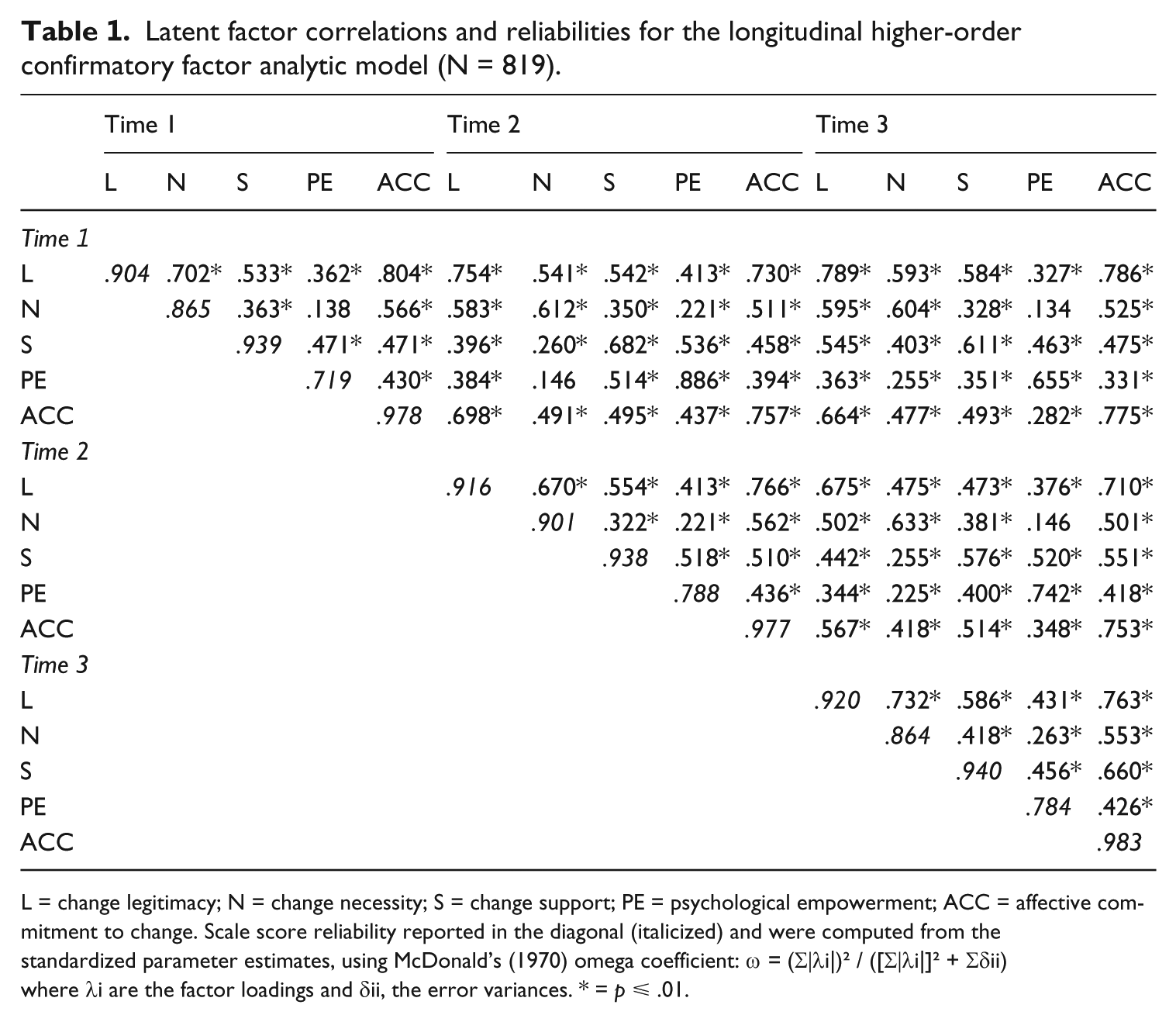
L = change legitimacy; N = change necessity; S = change support; PE = psychological empowerment; ACC = affective commitment to change. Scale score reliability reported in the diagonal (italicized) and were computed from the standardized parameter estimates, using McDonald’s (1970) omega coefficient: ω = (Σ|λi|)² / ([Σ|λi|]² + Σδii) where λi are the factor loadings and δii, the error variances. * = p ⩽ .01.
Main model specification
Following these preliminary CFA, we moved to predictive models. The measurement components of these predictive models were specified as invariant across time-waves on the basis of the CFA described above. This ensured stable and comparable measurement of the constructs over time and greater stability in the estimation of the predictive paths. These predictive models are illustrated in Figure 1. For clarity, the measurement part of the models relating items and latent constructs are not included in the figure, and the three change-related beliefs are treated together as the paths linking them to the other constructs are fully parallel. The thin dotted arrows reflect the measurement model relating the first-order Meaning, Autonomy, Competence and Impact factors to the higher-order PE factor.
We started with a baseline autoregressive model in which each latent construct measured at Time t predicted itself at Time t + 1 (grayscale arrows). All other longitudinal relations were constrained to be zero, but correlations between constructs were freely estimated within time-waves (but not represented in the figure to avoid cluttering). Then, we estimated a model in which change-related beliefs at Time t also predicted PE and ACC at Time t + 1 (the full and dashed black arrows), while including the reverse cross-lagged paths controlling for effects of PE and ACC on later change-related beliefs (grayscale dashed arrows). Finally, we estimated a model also including the cross-lagged paths whereby PE predicted later levels of ACC, and ACC predicted later levels of PE (dotted back arrows).
Even with longitudinal data, it is possible to observe large cross-sectional associations between constructs, showing that individuals high on one construct also tend to be high on another construct, even though the longitudinal associations between these constructs turn out to be non-significant (e.g. Morin et al., 2011). The models used in this study allow for the verification that changes in levels of PE and ACC can be predicted over and above their longitudinal stability and potential reciprocal effects of ACC and PE on change-related beliefs – providing a clear disaggregation of the cross-sectional and longitudinal associations between the constructs (Morin et al., 2011). These models provide direct tests of the directionality of the associations between constructs (Morin et al., 2011).
At each step, we started with a model in which all predictive paths were freely estimated, and contrasted it with a model in which Time 1−Time 2 paths were constrained to be equal to the matching Time 2−Time 3 paths. This tested the predictive equilibrium of the system (Cole and Maxwell, 2003), evaluating whether Time 1−Time 2 relations could be replicated across Time 2−Time 3, which is important given missing data (see online supplements). †
Model fit
The fit of all models was evaluated based on: the Chi-square test of exact fit (χ²), the Comparative Fit Index (CFI), the Tucker-Lewis Index (TLI), the Root Mean Square Error of Approximation (RMSEA) and its 90% confidence interval. Values greater than .90 and .95 for both the CFI and TLI were considered to indicate adequate and excellent fit to the data, respectively, while values smaller than .08 or .06 for the RMSEA reflects acceptable and excellent model fit (Hu and Bentler, 1999; Yu, 2002). WLSMV chi-square values are not exact, but ‘estimated’ as the closest integer necessary to obtain a correct p
Results
Preliminary analyses
Latent correlations from the CFA models are reported in Table 1. These show significant relations between constructs, and no apparent problem of multicollinearity, which was confirmed by a detailed examination of the parameter estimates and model-implied correlations in later predictive models (online supplements S4 and S5 † provide further evidence of the distinctiveness of the constructs). The highest correlations are between the constructs and themselves at later time points (mean [M] = .700, standard deviation [SD] = .088; versus M = .503, SD = .164 for within-time correlations between different constructs and M = .444, SD = .142 for longitudinal correlations between different constructs), showing substantial longitudinal stability. This high longitudinal stability reinforces the need to rely on models taking into account these autoregressive relations when the objective is to investigate the directionality of the association between constructs. Examination of these correlations shows some preliminary support for the study hypotheses, showing mostly significant positive relations between change-related beliefs and both PE and ACC. Furthermore, correlations between change-related beliefs at Time t and PE and ACC at Time t + 1 (M = .466, SD = .181) were slightly higher than the reciprocal relations between PE and ACC at Time t and change-related beliefs and Time t + 1 (M = .433, SD = .143). However, these reciprocal relations remained high enough to reinforce the importance of controlling for them in the main predictive models. Finally, within-time correlations between PE and ACC were moderate (M = .430, SD = .005), and higher than the longitudinal relations between them (M = .368, SD = .058).
Predictive models
We first estimated an autoregressive model in which each construct predicted itself over time (Model P2), and then constrained the autoregressive paths to invariance over time (Model P3). The results (see Table 2), reveal that Model P3 fits the data well, supporting the invariance of the autoregressive paths over time. The autoregressive paths are all substantial and significant, showing the longitudinal stability of the constructs. Model P3 fitted the data almost as well as the fully saturated CFA where all possible relations between constructs were freely estimated (Model P1), suggesting that most of the longitudinal associations can be reflected through the autoregressive paths. However, the MDΔχ² associated with this comparison remained large and suggested that a better representation of the data was possible.
Results from the predictive models (N = 819).
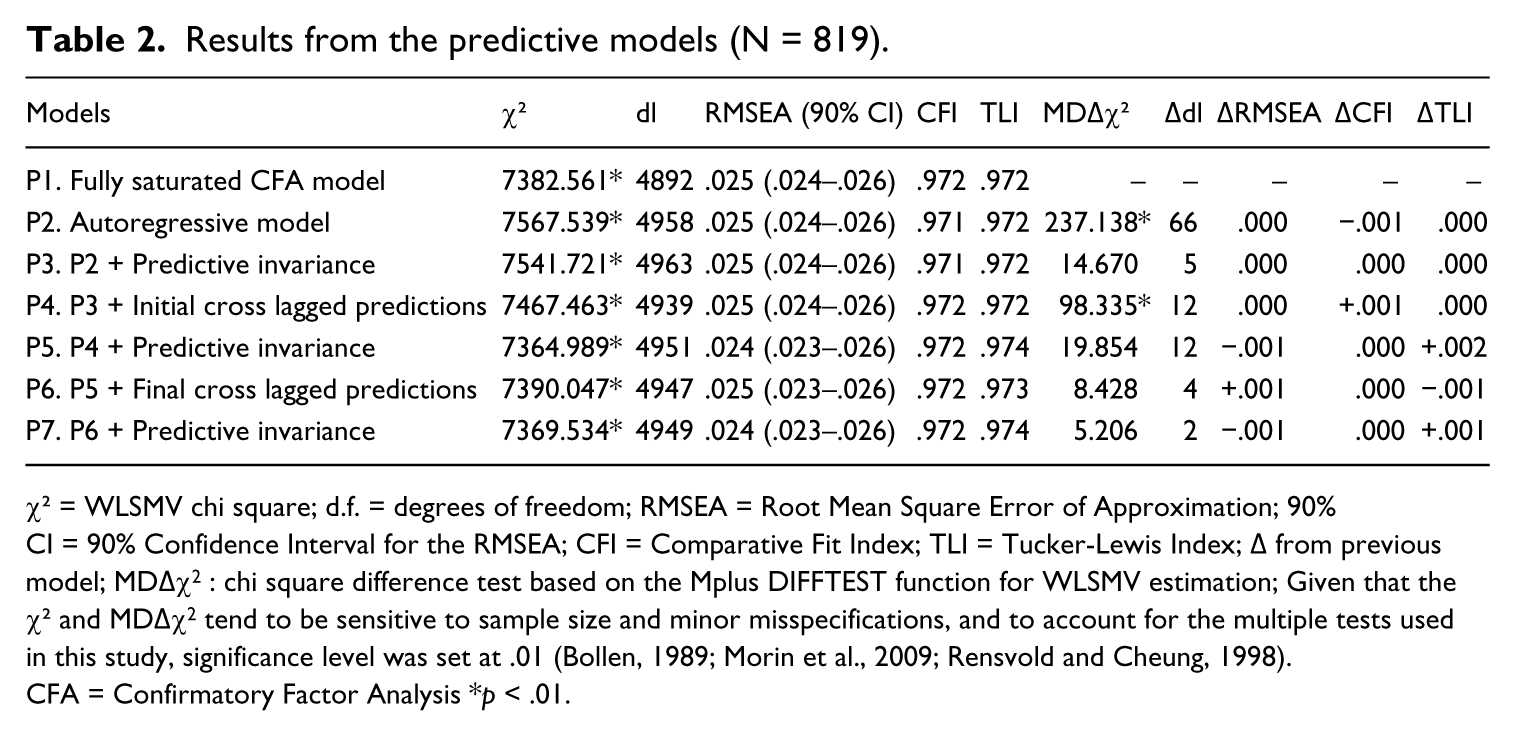
χ² = WLSMV chi square; d.f. = degrees of freedom; RMSEA = Root Mean Square Error of Approximation; 90% CI = 90% Confidence Interval for the RMSEA; CFI = Comparative Fit Index; TLI = Tucker-Lewis Index; Δ from previous model; MDΔχ2 : chi square difference test based on the Mplus DIFFTEST function for WLSMV estimation; Given that the χ² and MDΔχ2 tend to be sensitive to sample size and minor misspecifications, and to account for the multiple tests used in this study, significance level was set at .01 (Bollen, 1989; Morin et al., 2009; Rensvold and Cheung, 1998). CFA = Confirmatory Factor Analysis *p < .01.
Next, to verify Hypotheses 1 and 2, we tested a second model allowing change-related beliefs to predict later levels of PE and ACC while controlling for the reciprocal effects of PE and ACC on change-related beliefs (Model P4). These additional paths again proved to be fully invariant over time (Model P5), confirming the equilibrium of the predictive system over time periods. Models P4−P5 fitted the data slightly better than Model P3 according to a small improvement in fit indices and a substantial improvement in MDΔχ². When reciprocal effects between PE and ACC were added to model P5 in order to test our Research Question (i.e. Model P6), and constrained to invariance (Model P7), the results showed no improvement in the fit to the data. There was no increase in the MDΔχ² and the CFI, and even a slight decrease in fit indices controlling for parsimony (i.e. RMSEA and TLI). Moreover, there was no change in the estimated reciprocal relations between change-related beliefs and ACC and PE. The results from these models revealed non-significant reciprocal paths between PE and ACC, failing to support longitudinal associations between PE and ACC (providing a null answer to our Research Question). Similarly, although the within-time correlations between PE and ACC were significant in the CFA (r = .426 to .436; see Table 1), this changed in the predictive models when the longitudinal stability of the constructs was controlled through autoregressive paths. Indeed, the correlation between PE and ACC was significant at Time 1 (r = .396, p < .01), potentially owing to unmodelled common antecedents, whereas correlations between PE and ACC residuals were non-significant at Time 2 (r = .285, p >.05) and 3 (r = .175, p >.05) once construct stability was controlled for.
Model P5 was thus retained as the final model. Parameter estimates from this model are reported in Table 3. These results showed clear autoregressive relations, whereby each construct measured at Time t was moderately to strongly related to itself at Time t + 1(ß = .378 for ACC to .864 for PE), attesting to the presence of dispositional or otherwise stable determinants, especially for PE. Once these were controlled, some effects of PE on later beliefs about necessity and support, and of ACC levels on beliefs concerning support, were also evident, supporting the need to account for these reciprocal relations in the models.
Parameter estimates from the final predictive model (Model P5) (N = 819).
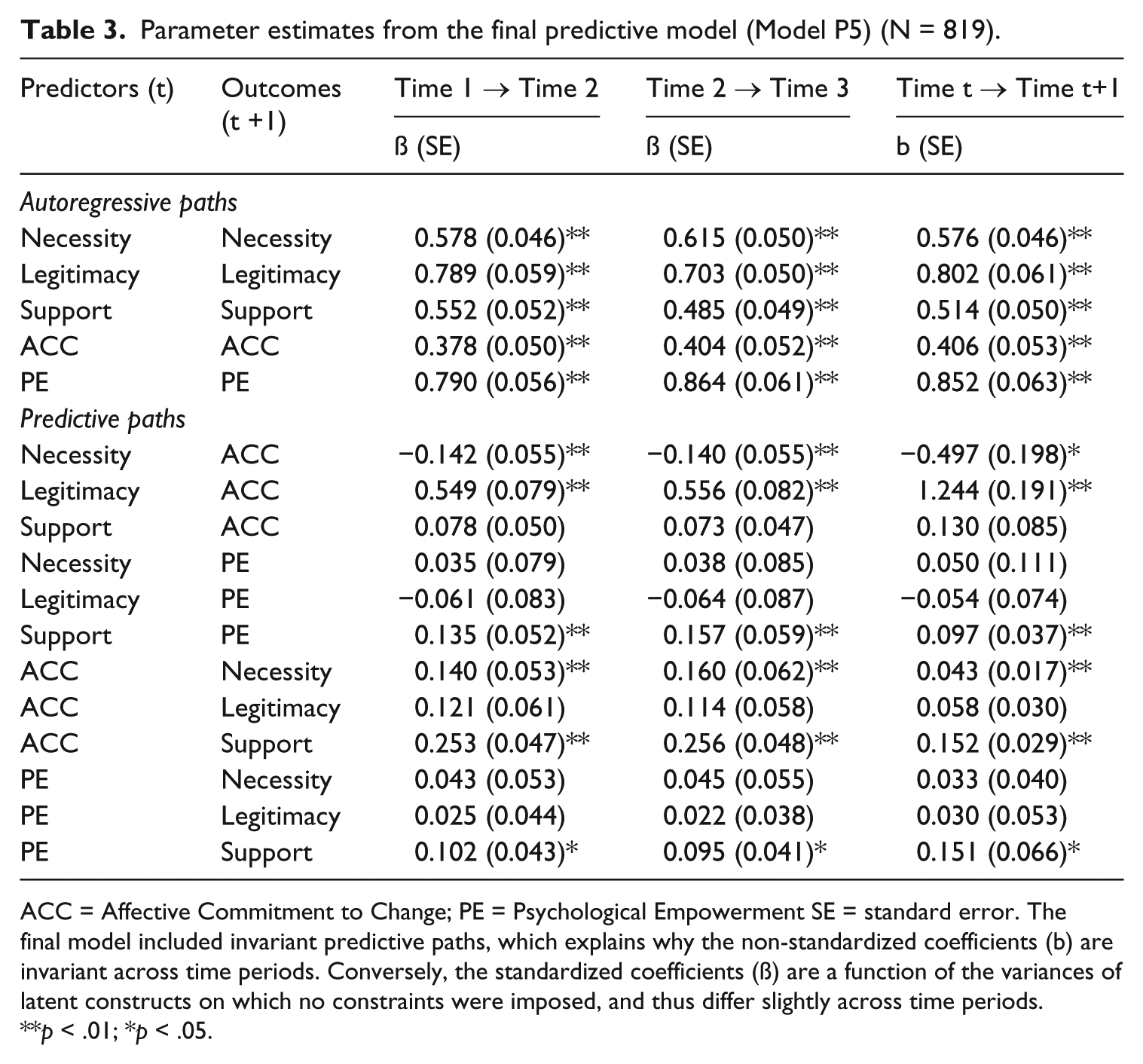
ACC = Affective Commitment to Change; PE = Psychological Empowerment SE = standard error. The final model included invariant predictive paths, which explains why the non-standardized coefficients (b) are invariant across time periods. Conversely, the standardized coefficients (ß) are a function of the variances of latent constructs on which no constraints were imposed, and thus differ slightly across time periods. **p < .01; *p < .05.
Turning to the findings of direct relevance to our hypotheses, beliefs regarding necessity and legitimacy (but not support) at Time t related significantly to ACC levels at Time t + 1. Although the relation was positive for beliefs about legitimacy as predicted, the relation was negative for beliefs concerning necessity. These findings partially supported Hypothesis 1. Similarly, beliefs about support (but not necessity and legitimacy) at Time t related significantly and positively with PE levels at Time t + 1, partially supporting Hypothesis 2.
The results revealed a relatively small but significant negative cross-lagged relation between beliefs about necessity and ACC (ß = –.140 to –.142), compared with a much stronger positive relation between beliefs concerning legitimacy and ACC (ß = .549−.556). This result was surprising, particularly in light of the fact that the latent correlations between beliefs regarding necessity and ACC remained positive within each time-wave (r = .293−.557), as well as across time-waves in the longitudinal CFA (r = .501−.525, see Table 2). However, as can also be seen in Table 2, employees’ beliefs about necessity and legitimacy also share a substantial amount of variance (within-time r = .670−.732). Thus, when both are included as predictors, multivariate analyses estimate the unique effect of each predictor on the outcome (i.e. on changes in the outcomes over and above the autoregressive effects) controlling for the variance it shares with the other predictor. We note here that a detailed examination of parameter estimates from the predictive models, as well as of the model-implied correlations among constructs, confirm that this result is not owing to any problem of multicollinearity. Furthermore, although the high autoregressive paths estimated for some of the constructs may cast doubts on this conclusion, we emphasize here that multicollinearity problems, when present, occur when variables specified as predictors (i.e. constructs measured at the same time points in the models estimated here) share elevated correlations among them (resulting in redundancy), not when the relations between some predictors and some outcomes are elevated. Thus, this negative relation suggests that beliefs that changes are necessary (i.e. the previous ways of doing things are no longer effective), but not legitimate (i.e. the new practices proposed are not adequate to solve the problem), will tend to predict lower levels of future ACC. This interpretation was confirmed in additional models where both predictors where considered separately. In these alternative models including only necessity or legitimacy as predictors, the effects of beliefs regarding necessity on ACC were positive (ß = .105−.107; p < .01), and lower than the effects of beliefs concerning legitimacy (ß = .414−.417; p < .01). Other results remained unchanged.
Discussion
In this study, we demonstrated that employees’ change-related beliefs contribute, within and across time, to the prediction of ACC and PE under conditions of continuous change. This is an important finding given existing evidence for the positive links between ACC and behavioral support for specific changes (Herscovitch and Meyer, 2002; Meyer et al., 2007), and between PE and effective performance more generally (Seibert et al., 2011; Spreitzer, 2008). It is noteworthy that the longitudinal cross-lagged relations between employees’ change-related beliefs and subsequent ACC and PE were obtained after controlling for construct stability, reciprocal effects of ACC and PE on change-related beliefs, and within-time relations between ACC and PE. Including these controls allowed us to have greater confidence in the directionality of these relations over time than has been the case in the past. Indeed, the bivariate correlations reported in Table 1 appear to support previous cross-sectional studies, showing that most of the relations among constructs are positive and significant, both within and across time. However, when proper controls for the longitudinal stability of the constructs, and reciprocal effects among them, are properly estimated, a completely different pattern of results emerge. According to this model, ACC and PE appear to be relatively independent of one another as they change over time, and to be predicted by different beliefs. More precisely, our results showed PE to be particularly responsive to beliefs about management support for the changes, whereas ACC was impacted more by the perceived legitimacy and necessity of the changes, although the effects of necessity controlling for legitimacy turned out to be negative. It is important to note that, although we can be more confident in the nature and direction of the relations we observed, some findings were contrary to our predictions. At this point, any explanation we can offer remains speculative, but might serve to guide future hypothesis development.
Although unexpected, it was particularly interesting to find that, controlling for construct stability and reciprocal relations, employees’ beliefs regarding change necessity were negatively related to ACC over time. We were able to rule out multicollinearity as an explanation for this unexpected result. Instead, we propose that this negative relation may reflect the fact that, when employees perceive that changes are necessary (i.e. that something needs to be done) but are not convinced of their legitimacy (i.e. they doubt the potential effectiveness of the proposed change to address the problem), they may be less willing to commit to supporting them. SDT (e.g. Gagné et al., 2000) proposes that people are more likely to embrace change when they are provided with an attractive reason for it (e.g. a direction and a rationale) rather than feeling pressured to change or fear the negative consequences of not changing. From an experiential standpoint, situations where a change appears necessary without also being seen as legitimate could undermine intrinsic motivation to change and result in more controlled forms of motivation. Furthermore, employees who realize that the organization is not currently functioning effectively (i.e. change is necessary), but is not on a legitimate path to correct the problem, may become less committed to the organization itself. Based on previous research, we would expect this reduction in ACO to be accompanied by weaker commitment to the changes (Herscovitch and Meyer, 2002; Meyer et al., 2007). This can create a downward spiral in which reduced ACC leads to less positive change-related beliefs, which leads to further reduction and ACC, as reflected in our findings of reciprocal time-lagged relations.
Another unexpected finding was that ACC did not relate positively to beliefs about managerial support as predicted. Again, it must be kept in mind that beliefs concerning support and ACC did correlate positively in the within-time analyses, and that the lack of a relationship in the time-lagged analyses involves residualized variables. That is, the time-lagged relation between beliefs regarding support and ACC at a later time was examined with prior ACC, PE and the other beliefs controlled. Thus, it is possible that any positive influence of support on subsequent ACC was indirect through one of these other variables. Also contrary to our predictions, management support was the only belief to predict PE in the time-lagged analyses. One possible explanation for this finding is that managerial support is relevant to employees’ sense of PE in general, even under conditions when the changes are not particularly salient (i.e. during the periods of stability in the ebb and flow of change). Thus, once this salient predictor is controlled, belief about the necessity and legitimacy of change become relatively unimportant. Of course, these findings require replication but, if found to hold, will necessitate refinement to the framework that guided the present research.
Contributions to theory
In this study, we used change readiness theory and SDT to develop a theoretical framework integrating ACC and PE, two important psychological reactions (ACC and PE) to organizational change. Consequently, even though our hypotheses were not fully supported and the framework may require some modification, our findings have important implications for ACC and PE theories and their integration.
Affective commitment to change theory
Our study contributes to the theory of commitment to organizational change in several important ways. First, it examines how ACC develops under conditions of continuous change. Second, it addresses one of the biggest gaps in existing theory and research on ACC, namely the relative lack of attention to antecedents relative to consequences (e.g. Coyle-Shapiro et al., 2002; Rafferty and Restubog, 2010). By drawing predictors from an established theory of change readiness (Armenakis and Bedeian, 1999; Armenakis and Harris, 2009; Rafferty et al., 2013), bolstered by SDT (Deci and Ryan, 1985; Gagné and Deci, 2005; Ryan and Deci, 2000), we were able to provide more structure to the antecedent side of ACC theory than has been available to date. Third, by utilizing sophisticated longitudinal analytic procedures, our study provides clear evidence that the relations identified in our study are directional and likely to reflect causal effects. Through the use of these sophisticated procedures we were able to demonstrate not only that change-related beliefs related to subsequent levels of ACC, but also that ACC related positively to subsequent change-related beliefs (i.e. the time-lagged relations are reciprocal). We also discovered that there is considerable stability over time in both change-related beliefs and ACC. This sets the stage for future research examining forces for stability and change in the way employees perceive and react to ongoing changes.
Psychological empowerment theory
As noted previously, PE was not originally conceptualized as a change-related variable. Nevertheless, PE has obvious implications for continued effectiveness in the context of complex and continuous change when dealing with change becomes a part of employees’ regular routine. Therefore, our inclusion of PE within an established theoretical framework addressing the key determinants of employees’ change readiness (Armenakis and Bedeian, 1999; Armenakis and Harris, 2009; Rafferty et al., 2013) helps to expand PE theory as well as its breadth of relevance. Although we expected that PE would be positively influenced by beliefs concerning change necessity, legitimacy and support (Hypothesis 2), we found that only beliefs about being supported had unique positive effects on PE. This suggests that providing support to help employees face new challenges and demands is more critical to maintenance and improvement of employees’ sense of control, motivation and competence to meet work demands (including those resulting from change) than nurturing beliefs about the necessity or legitimacy of the changes themselves.
Integration of affective commitment to change, psychological empowerment and change readiness theories
Our study brought together two theories, ACC and PE, that have to date been investigated in isolation, and used them in conjunction with change readiness theory and SDT to propose an overarching theoretical framework pertaining to employees’ reactions to complex and continuous change. Although we suspected that ACC and PE would relate positively, we did not have solid grounds for predicting how they would relate over time in the context of ongoing changes. Overall, our findings suggest that, although ACC and PE did relate positively within time, they developed somewhat independently over time, and were influenced by different change-related beliefs.
Although used primarily as a framework to guide our investigation of ACC and PE, our findings might also have relevance for change readiness theory. Armenakis and colleagues (e.g. Armenakis and Bedeian, 1999; Armenakis and Harris, 2009) proposed that five key beliefs (necessity, legitimacy, support, value and capacity) should be nurtured among employees to further their readiness for change. These five beliefs have always been conceptualized as complementary, and never been sequentially-ordered. In the present study, based on the nature of the constructs, SDT and previous research, we argued that two of these beliefs, value and capacity, are subsumed by ACC and PE, respectively, and that the remaining beliefs would serve as antecedents to these more general ‘reaction’ variables. Although we initially hypothesized that ACC and PE would each be predicted by necessity, legitimacy and support, our findings suggested that, as they evolve over time, ACC and PE are relatively independent and predicted by different beliefs. This modified theoretical framework must be verified in subsequent research, but provides preliminary evidence suggesting that the five beliefs identified by Armenakis and his colleagues may indeed have a sequential ordering. More precisely, our results suggest two distinct, complementary and orthogonal, pathways in line with organizational ‘ambidexterity’ conceptions of organizational change (e.g. Kang and Snell, 2009; Van Looy et al., 2005).
The first pathway is likely to emerge from top-down communication approaches aiming to build employees’ approval for the change initiative. Through this pathway, belief that change is necessary, when coupled with beliefs that it is also legitimate, contributes to building the perceived value of the change among employees, leading to higher levels of ACC. The second pathway emerges from efforts to build change capability among employees in a more ongoing manner (e.g. Argyris, 1999). Through this pathway, beliefs that change will be supported by management contribute to building employees’ capacity for change, in turn leading to PE. The orthogonality of these pathways makes perfect sense. The fact that one is drawn to a change does not necessarily mean that one also perceives having the required ability to implement the change. Similarly, having the ability to embark on a specific course of action does not necessarily mean that this course of action has value.
Previous research further supports the idea that these two orthogonal pathways may lead to distinct behavioral outcomes. Although there are no studies available to compare the effects of PE and ACC on outcomes in the same dataset, available results suggest that, while ACC is key to building support for the change itself, PE is critical to the ability to maintain satisfactory performance levels when facing challenging situations and for proactive or innovative behaviors (e.g. Voigt and Hirst, 2015). Indeed, the first pathway, going through ACC, is more likely to lead to behavioral support for the change itself (e.g. Herscovitch and Meyer, 2002; Meyer et al., 2007). In contrast, the second pathway, going through PE, is more likely to lead to the preservation of stable levels of performance in a context of change and to efforts to improve change implementation (e.g. Boudrias et al., 2014; Maynard et al., 2014; Seibert et al., 2011). These complementary pathways should be further investigated in future studies, and tested in models including both objective indicators of change management practices and behavioral outcomes on the part of employees.
Practical implications
In practice, the fact that ACC and PE were largely orthogonal reactions suggests that change agents should monitor both reactions, as they could indicate how well the organization is doing in communicating a top-down overarching vision of the change while preserving and nurturing capabilities in employees to support bottom-up initiatives to improve change implementation and maintain their performance levels. As the concept of organizational ambidexterity suggests, both processes can occur simultaneously. Therefore, there is added value in studying both reactions, rather than relying on a single overarching measure of change readiness. As noted previously, employees are more likely to develop ACC when they perceive the changes to be legitimate. Although demonstrating that the changes are necessary may be a precursor to making a case for legitimacy, our findings suggest that necessity in the absence of legitimacy can actually have negative effects on ACC over time. An organization that needs to change but has not identified an approach that will address the presenting problem(s) is unlikely to garner the kind of support needed to be successful. Change agents therefore need to provide a convincing case for why a particular course of action was chosen for the change and why they believe it will be successful in achieving the desired outcomes. This might be achieved by providing evidence of the success of similar changes in the past, bolstered by continuous feedback on how well the change is working. This may prove more difficult when change is continuous than when it is highly circumscribed, but evidence of early successes, what Kotter and Cohen (2002) refer to as ‘small wins,’ might help to reinforce perceptions of both the necessity and legitimacy of the chosen path to change. Similarly, for long-term change initiatives, proposing a coherent vision of the future emerging from a legitimate set of actions may also represent a key lever to develop and sustaining ACC over time. Whether, as we proposed, these mechanisms really play a more critical role in the context of complex ongoing changes, where ACC needs to be maintained over a longer time period, than in the context of more circumscribed change initiatives, remains an open question for future research exploring similar issues in a longitudinal manner across various types of changes initiatives.
In contrast to ACC, the most important belief for the development of PE seems to be support from management. This is not surprising because, regardless of the necessity or legitimacy of the change, employees cannot feel empowered unless they have sufficient training and resources to cope with the demands created by the changes. Interestingly, developing the employees’ capability to take initiatives does not appear to depend on providing an overall direction, or rationale, for the change itself. This suggests that the initiatives needed to promote and maintain PE, providing managerial support for change initiatives in particular, may be independent of those required for ACC. In line with models of organizational learning (e.g. Argyris, 1999; Kang and Snell, 2009), we argued that PE becomes particularly relevant under conditions of continuous change, where dealing with changes is an integral part of one’s job that must be balanced with regular job responsibilities. Therefore, change agents might think of developing PE among employees through ongoing training and development opportunities as a way to cultivate a fertile ground for proactive actions aimed at improving both organizational functioning and change implementation. The observed high levels of stability in PE (as documented by the high autoregressive paths) suggest that successfully influencing PE might generate benefits that are enduring in terms of change capacity. This property could be especially interesting in large-scale ongoing changes, in comparison to short-term specific changes, requiring that employees contributions and adjustment efforts be maintained over a long period.
Another important finding of our study is the fact that change-related beliefs, ACC, and PE were all relatively stable over a three-year period, despite the broad range of changes taking place. We did not specifically address the source of that stability in the present study, but it is likely that it reflects dispositional differences as well as situational consistency (or at least perceived consistency; e.g. Morin et al., 2011). Organizations that anticipate undergoing continuous change may need to ensure that they hire employees who are adept at coping, or even thriving, under conditions of change. Moreover, they must realize that changing ACC or PE is not something that can be done overnight. Indeed, our findings suggest that employees who have weak ACC and PE may be inclined to have more negative change-related beliefs over time, whereas those with strong ACC and PE will tend to have more positive beliefs. Therefore, it is important for organizations and change managers to establish a reputation for effectiveness in managing changes because these perceptions are likely to be long-lasting.
Limitations and directions for future research
Some limitations of the current research need to be acknowledged, including our focus on a limited set of perception variables (necessity, legitimacy and support) and psychological reactions to organizational changes (ACC and PE). In particular, although SDT assumes that the relations between work conditions (or perceptions of work conditions) and autonomous forms of regulation (such as ACC or PE) are mediated by need satisfaction, this specific mediational mechanism was not directly assessed in the present study. Of course, the generalizability of our findings is also limited by our focus on a single organization from the healthcare industry and the implementation of a broad, albeit somewhat specialized, set of ongoing changes. Although we see no reason to assume that the results would differ if assessed in a different context, their generalizability still remains an open research question. Like many, if not all, longitudinal studies, we were forced to deal with the issue of missing data. As noted previously (see online supplement S2 † ), we addressed this issue using state-of-the art procedures allowing us to utilize all available data to their fullest potential in testing our theoretical models (Enders, 2010; Graham, 2009; Newman, 2009).
The one-year time lag used in this study needs to be considered carefully. We found evidence that most constructs were quite stable over a one (r = .576−.886), or two (r = .604−.789) year period, which is in line with estimates reported in previous studies of similar constructs (e.g. Bommer et al., 2005; Fugate et al., 2002; Laschinger et al., 2004) and supports the idea that studying change in these constructs requires relatively long time lags. Still, longitudinal research always needs to be interpreted in relation to a specific time frame (Cole and Maxwell, 2003). A shorter time frame may have allowed us to detect finer associations occurring at the state level, while a longer time frame might have revealed relations occurring at a more fundamental trait level. Ultimately, longitudinal evidence needs to be built incrementally from an accumulation of studies exploring alternative time frames.
Our study also focused on the affective mindset of commitment to change. In addition to ACC, Herscovitch and Meyer (2002) proposed that employees can also experience normative (NCC) and continuance (CCC) commitment to change, and present profiles characterized by varying combinations of ACC, NCC and CCC. Expanding the theoretical framework to include these other commitment mindsets would allow for the detection of conditions that could thwart the long-term success of change. For example, when change is believed to be necessary but not legitimate, it might undermine ACC, while also leading to the development of CCC. Meyer et al. (2007) found that CCC was positively related to ‘mere compliance’ (i.e. doing what is asked but nothing more). Indeed, they may do what is asked, even if they believe that it is contrary to the objectives of the change.
All variables were assessed using self-reports, a legitimate approach when dealing with psychological variables. However, although our results are unlikely to be biased by this characteristic (see online supplement S3 † ), we encourage future researchers to expand this investigation beyond the psychological variables examined here while including more objective measures of the conditions likely to influence these beliefs, as well as the consequences of these reactions.
Finally, our study relies on the assumption that there are ways for management (e.g. communication, involvement, planning, etc.) to impact change-related beliefs of legitimacy, necessity and support, and that increased levels of ACC and PE will be translated into more positive outcomes for change programs. As noted above, previous cross-sectional and longitudinal research provides compelling evidence of the benefits of both ACC and PE for organizations (e.g. Herscovitch and Meyer, 2002; Meyer et al., 2007; Seibert et al., 2011; Spreitzer, 2008), generally supporting the idea that ACC and PE represent valuable outcomes in their own right. Ultimately, our results should lead to studies going beyond investigations of the impact of change-related beliefs on psychological states in order to predict actual changes in behaviors. This would provide a more complete picture of the mechanisms at play as organizations try to implement broad and continuous changes.
Conclusion
This study sought to integrate change readiness theory with SDT as guides to understanding how ACC and PE develop and evolve during the course of complex and ongoing organizational changes. We studied these two psychological reactions using longitudinal analyses introducing appropriate controls for the stability of each construct over time and for time-lagged relations among them, allowing us to obtain a cleaner picture of the directionality of the associations between ACC, PE and employees’ change-related beliefs. In line with the organizational ‘ambidexterity’ approach to change management (e.g. Kang and Snell, 2009; Van Looy et al., 2005), our results suggest that ACC and PE represent orthogonal reactions corresponding to two complementary change management pathways. The first pathway stems from top-down communication approaches aiming to legitimize the change process and contributing to ACC, a known antecedent of behavioral support for change initiatives. The second pathway reflects a bottom-up approach involving managerial efforts to empower their employees to implement the change in ways that are best suited to the challenges they encounter. Through the provision of managerial support, managers contribute to sustained PE, a psychological state likely to influence employees’ ability to take initiatives and to maintain satisfactory performance levels when facing challenging situations. Our findings contribute to change readiness theory by suggesting a sequential ordering of the five key beliefs identified by Armenakis and Bedeian (1999) and Amrenakis and Harris (2009) as well as the existence of orthogonal pathways reflecting top-down and bottom-up change management processes.
Footnotes
Funding
This study was made possible through a grant from the Fond Quebecois de Recherche Société et Culture (FQRSC) awarded to the first author. This article was also made possible by a grant from the Australian Research Council (LP140100100) awarded to the first and last authors.
Notes
 ). He defines himself as a lifespan developmental psychologist with broad research interests anchored in the exploration of the social and organizational determinants of psychological well-being, self-concept and commitments at various life stages. His research interests are centered on substantive methodological synergies aimed at illustrating the usefulness of powerful new statistical methods (including exploratory structural equation models, mixture models, longitudinal models, latent curve models and multilevel models). Alexandre has published over 100 publications, some of which appear in leading journals such as Journal of Management, Organizational Research Methods, Structural Equation Modeling, Annual Review of Clinical Psychology, Child Development, Journal of Educational Psychology, Developmental Psychology and Addiction. [Email:
References
Supplementary Material
Please find the following supplemental material available below.
For Open Access articles published under a Creative Commons License, all supplemental material carries the same license as the article it is associated with.
For non-Open Access articles published, all supplemental material carries a non-exclusive license, and permission requests for re-use of supplemental material or any part of supplemental material shall be sent directly to the copyright owner as specified in the copyright notice associated with the article.
