







Abstract
Issues relating to litigation and other forms of employee legal claiming are at the forefront of the practice of human resource management. However, organizational scholars have paid scant attention to this important aspect of organizational life. Underrepresented in this collective research have been investigations into how social influence variables impact the legal claiming process. We add to the understanding of legal claiming by evaluating how perceived levels of accountability, reputation and political skill affect individuals’ willingness to engage in contentious and non-contentious legal claiming. We also investigate the impact that social influence has on individuals’ advice to other potential claimants. This study employed a longitudinal design utilizing both scenarios and survey data collection. Results from our study partially support the conclusion that individuals are more risk-averse in their own legal claiming considerations than they are in the advice they offer to similarly-situated others. Furthermore, accountability, reputation and interpersonal influence (one aspect of political skill) were found to significantly influence the likelihood of legal claiming. The pattern of results indicates that social influence variables play a role in determining whether legal claiming will be pursued and what type of claiming will be chosen.
To what extent do social influence variables shape the nature and extent to which individuals are inclined to engage in legal claiming (Goldman, 2003)? When employees assert their legal rights in the workplace, they potentially face undesirable consequences. An employee may be labeled a troublemaker, a complainer, or slacker for engaging in legal claiming (Baldridge and Swift, 2013). The socio-legal (Felstiner et al., 1981) and legal studies literatures (Felstiner, 1975) both suggest that individuals assess contextual concerns and rely on advice from others before they engage in legal claiming. However, to date, organizational scholars have paid relatively little research attention to the antecedents to legal claiming (Goldman et al., 2004). This lack of research is surprising, given that many of the human resource management activities performed within organizations are related – either directly or indirectly – to both compliance measures and to the avoidance of litigation or other legal claiming by employees.
Researchers have suggested that individual differences are an important, yet under-investigated, antecedent to legal claiming by employees (Lind et al., 2000; Munyon and Kane-Frieder, 2015). To date, scholars have examined the influence of demographic variables such as race (Lind et al., 2000), gender (Lind et al., 2000) and age (Baldridge and Veiga, 2001) on an employee’s assertion of rights. Yet other individual differences, such as degree of social effectiveness, have been largely ignored (Munyon and Kane-Frieder, 2015).
In order to fill the void in the literature, we investigated social influence as an antecedent to legal claiming. Specifically, we examined the role of social influence as an individual difference (in the form of accountability, reputation and political skill), and its possible effects on the nature and extent of legal claiming. In addition to the possible role of social influence, past research suggests that other factors may play a role with respect to whether someone asserts her rights. Specifically, researchers have found that individuals typically consult with others such as friends or family members before they engage in claiming (Goldman et al., 2004; Groth et al., 2002). But research has yet to fully examine the type of advice that is given to potential legal claimants. For example, the organizational literature has not addressed whether the legal claiming advice given to others is similar to what they may consider for themselves. Thus, we also examine that issue in this article. Finally, we know of no research that has examined a range of claiming behaviors within the same study. Because specific claiming behaviors may be associated with differing levels of risk, it is important for scholars to understand factors influencing decisions to claim. We address that issue in this study, as well.
Legal claiming
Despite anecdotal claims to the contrary (Munyon and Kane-Frieder, 2015), empirical research (Miller and Sarat, 1980; Podlas, 2005) suggests that individuals may not claim as much as they may be entitled to claim. Nevertheless, perceptions still exist that employees in the United States and other western countries are overly litigious (MacGillivray et al., 2010; Podlas, 2005). These persisting perceptions, coupled with the actual costs and disruptions associated with legal action (Goldman et al., 2004), often result in employees being treated as potential litigants by their employers. Although the idea of legal claiming has been examined by scholars in other disciplines such as socio-legal studies (Miller and Sarat, 1980) for several decades, organizational scholars have just begun seriously examining claiming behavior during the past 15 years or so (e.g. Lind et al., 2000). Thus, there are still many questions that remain to be answered in order for researchers to more fully understand when and why employees choose to exercise their legal rights. One key issue that must be addressed in the literature is the definition of legal claiming, which has evolved over time.
In their foundational work on legal claiming, Miller and Sarat (1980) defined a legal ‘claim’ to occur whenever an individual communicates ‘a sense of entitlement.’ In a related foundational article, Felstiner et al. (1981: 635) defined claiming as occurring when ‘someone with a grievance voices it to the person or entity believed to be responsible and asks for some remedy.’ Goldman defined a legal claim as ‘a complaint by an aggrieved employee to a governmental entity for the purpose of seeking a remedy provided by the law’ (Goldman, 2003: 417). More recently, Gardner et al. (2000) used claiming to describe when employees exercise their rights under workers’ compensation and family and medical leave laws.
As illustrated in the preceding definitions, claiming has been used to describe a wide range of behaviors. As suggested by Miller and Sarat (1980) and Felstiner et al. (1981), legal claiming is a transformational process in which a request or grievance may be disputed within or outside the organization. However, empirical studies have typically investigated only one form of claiming such as filing a discrimination complaint with an external governmental agency (Goldman et al., 2004). Citing the foundational works of Miller and Sarat (1980) and Felstiner et al. (1981), Fuller et al. (2000: 201) used the term ‘legal mobilization’ to describe ‘the process by which employees pursue their legal rights through either internal organizational forums or external formal legal forums’. They also described mobilizing the law as ‘pursuing formal legal action’ (Fuller et al., 2000: 200). In order to further advance the stream of research on employees’ assertion of legal rights vis-a-vis their employers, we offer the following definition of legal claiming that incorporates a broader legal mobilization perspective of legal claiming. Specifically, we define legal claiming to occur when employees invoke their legal rights with respect to a workplace issue. Our conceptualization of legal claiming involves asserting rights via internal mechanisms such as making a formal request for legally authorized family and medical leave or filing a grievance alleging discrimination with an organization’s internal grievance system. Legal claiming could also involve making claims outside the organization such as filing a discrimination complaint with an external governmental agency (e.g. the Equal Employment Opportunity Commission in the U.S. or the Employment Tribunal in the UK).
To date, legal claiming research has focused primarily on litigation and other adversarial proceedings against employers such as actual complaints or intentions to file complaints with governmental entities or other legal tribunals (Goldman et al., 2006). This type of legal claiming can be categorized as external contentious legal claiming because it is adversarial and involves parties outside the organization (e.g. lawsuits filed in civil court or complaints filed with governmental agencies that adjudicate discrimination claims).
However, employees can invoke their legal rights in a number of ways that do not involve pursuing legal action outside of organizations. For example, employees may engage in internal contentious legal claiming such as filing a grievance within their organizations pursuant to company policy or collective bargaining agreements. Grievance claims are less expensive than litigation, and they may actually have positive organizational and employee outcomes such as decreased turnover and higher organizational commitment (Fiorito et al., 2007).
Another way an employee may invoke his or her legal rights is to make a legally authorized or protected request for workplace accommodation or leave. For example, in the U.S. federal law allows individuals to request up to 12 weeks of unpaid leave under the Family and Medical Leave Act of 1993 for the birth or adoption of a child or for the employee’s own illness or that of an immediate family member. In this article, we refer to requests to invoke legally protected or mandated employee rights as non-contentious legal claiming. These claims do not involve any allegation of wrongdoing on the part of the employer and/or supervisor. In these cases, an employee is simply asserting a legal right vis-a-vis the employer.
The above three types of legal claiming refer to the nature of the employee claim relative to the employer. These three categories can also be related to three dispute resolution categories that refer to the major approaches to resolving disputes (Ury et al., 1988a). The three categories of dispute resolution include: (i) reconciling underlying interests, (ii) determining who is right, and (iii) determining who has more power, such as through a fight (e.g. a labor strike). The dispute resolution framework of interests, rights and power has also been used in the study of negotiations (Lytle et al., 1999). The three dispute resolution options become increasingly adversarial and costly, moving from interests to rights and then to power (Brett et al., 1990; Ury et al., l988b). Non-contentious legal claiming is consistent with an attempt to reconcile underlying interests. For example, filing a request for a contractually agreed upon leave reasserts and enacts the mutual agreement among the parties. An internal contentious legal claim is consistent with the dispute resolution category of determining who is right. Filing a grievance over a work schedule dispute, for instance, is an action that seeks a determination of who is right. External contentious legal claiming is also within the dispute resolution category of determining who is right. However, an external contentious claim is portrayed as being discernibly more adversarial and closer to the dispute resolution category of determining who has more power.
Engaging in any form of legal claiming involves potential costs and risks on the part of an employee as well. Employees may face not only unlawful retaliation after filing complaints against their employers with governmental agencies, but they may also face ostracism from co-workers (Zimmerle, 2004). Although research has found positive outcomes such as decreased turnover associated with grievance claims (Fiorito et al., 2007), a ‘punishment effect’ has been found to occur for certain employees who have won grievances against their supervisors (Boswell and Olson-Buchanan, 2004; Klaas and DeNisi, 1989). Filing a request that alleges no wrongdoing such as a request for family and medical leave or request for workplace accommodation for disability should potentially be the least risky form of legal claiming in many circumstances. However, employees may face a backlash from making such requests, and may be labeled as poor organizational citizens and be more likely to receive penalties such as demotions or discharge (Rudman and Mescher, 2013).
Proposed model of legal claiming
We propose a model of legal claiming that is presented in Figure 1. This model centers on social influence variables as antecedents to the three legal claiming responses that we outlined above (internal non-contentious, internal contentious and external contentious). We also propose that whether the claim involves oneself or another will impact the nature and extent of the claiming response. Finally, we propose that the social influence variables (accountability, political skill and reputation) affect how, or even whether, individuals exercise their rights.
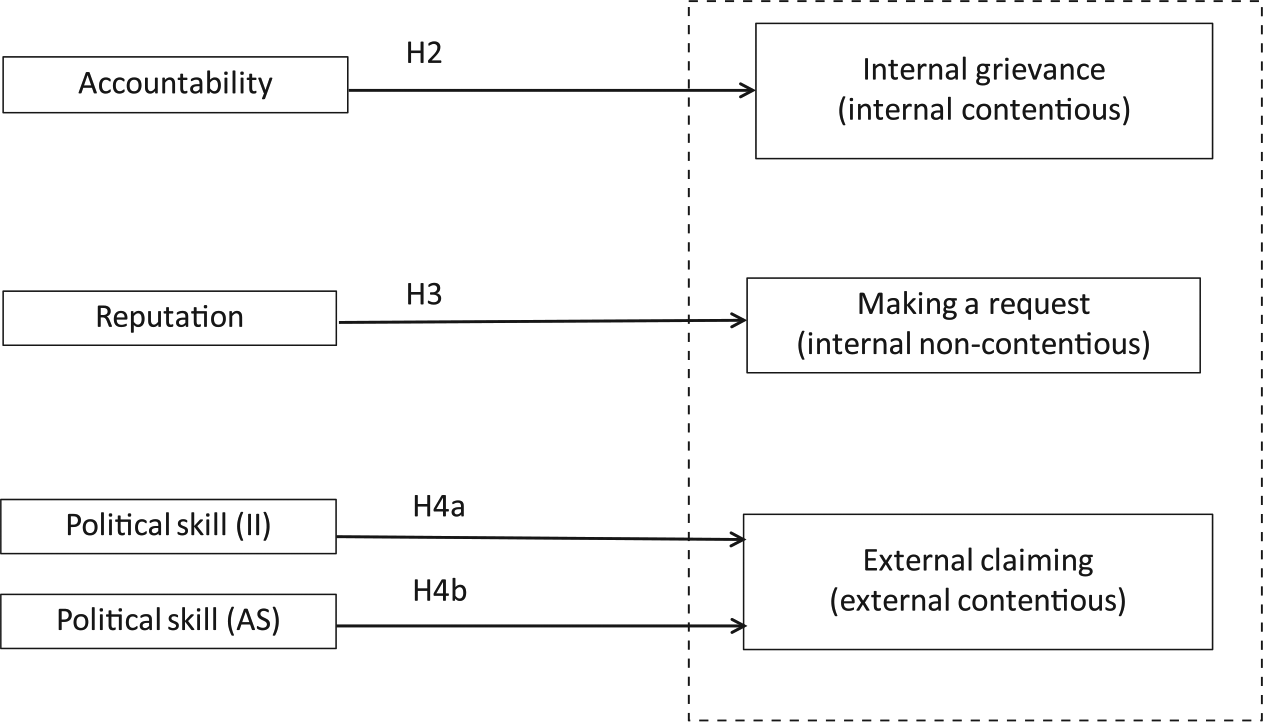
Model of social influence and legal claiming.
Advice to others
Scholars have used social information processing (SIP) theory as a framework to examine the relationships between the social environment and claiming behavior (Goldman, 2001). SIP emphasizes the importance of how the individual perceives the social environment, the actions of others and the actions of self. This perspective is also consistent with the idea that disputes are social constructs that transform over time. As individuals proceed through the dispute stages, they are required to evaluate and reevaluate the situation, people and social context of the event. Based on their evaluations, they form attitudes which influence their behaviors (i.e. likelihood to claim). Goldman (2001) found that perceived injustice and social guidance to claim were both significantly correlated with the filing of discrimination claims.
Providing additional support for the role of SIP in legal claiming, Groth et al. (2002) used a sample of 435 unemployed individuals to empirically assess how organizational tenure, social guidance and supervisor attribution related to employee commitment to claim. This study revealed that employees received information (advice) from relevant others and that this information was then included in processing efforts used to arrive at a decision to claim and the relative commitment to claiming. Although the study by Groth et al. (2002) attempted to examine the impact of social guidance on legal claiming in the workplace, research has yet to examine the factors that influence the content of the claiming advice individuals provide to potential claimants.
Most of the research related to advice taking and advice giving has concentrated on the former (Bonaccio and Dalal, 2006; Jonas and Frey, 2003). However, there are a small number of studies that have focused on recommendations that individuals provide to others (i.e. advice-giving). In general, advisors tend to anticipate their recipients’ preferences when making their recommendations, whereas advisors use their own preferences when making decisions for themselves (Bonaccio and Dalal, 2006; Kray, 2000).
Following workplace injustices or stressors, or the threat thereof, individuals must mobilize available coping mechanisms to deal with the loss, or potential loss, of physical or emotional resources. This coping process may take the form of seeking social support. Individuals’ advisors in such situations are likely to recognize this implicit need for social support and conform to salient role expectations. Furthermore, in most circumstances advice-givers have fewer resources committed to, and lower risk associated with, their own responses to these workplace issues. Based on the foregoing, individuals’ advice to other potential litigants should be more pro-confrontational and pro-claiming than individuals’ own willingness to take similar courses of action.
Hypothesis 1: Individuals are more risk-averse in their own legal claiming (internal non-contentious, internal contentious and external contentious) when compared with the advice they offer to similarly-situated others.
Social influence as individual difference
Social influence is a broad construct that encompasses many sub-processes within organizations. It includes such phenomena as impression management, self-presentation, intraorganizational influence, influence tactics, power, reputation, accountability, organizational politics and political skill (Ferris et al., 2002). Social influence processes in organizations involve behavioral tactics and strategies used by individuals to shape decision outcomes controlled by others in ways that maximize positive outcomes and minimize negative outcomes for the influencer (Ferris et al., 2002). In this article, we concentrate on three social influence variables: accountability, reputation and political skill. We expect that individual differences with respect to social influence variables will result in differing approaches involving legal claiming choices.
Accountability and legal claiming
Accountability has been defined as ‘an implicit or explicit expectation that one’s decisions or actions will be subject to evaluation by some salient audience(s) with the belief that there exists the potential for one to receive either rewards or sanctions based on this expected evaluation’ (Hall and Ferris, 2011: 24). Both the management and the psychology literatures consider accountability to be a social influence variable that is directly related to a variety of workplace outcomes (Frink and Klimoski, 1998). Specifically, accountability has been found to influence performance appraisals, organizational citizenship behaviors, job tension, influence/political behaviors and creativity (Frink and Klimoski, 1998). Using a role-taking/role-making perspective (Katz and Kahn, 1978), Frink et al. (2008) suggested that individuals have the power to shape and create the accountabilities that others have for them. Indeed, individuals may actually seek out accountabilities, such as when a senior employee volunteers to mentor a junior colleague (Frink et al., 2008). Thus, accountability can be used by both management and employees to shape behavior in organizations, influencing actors to specific actions deemed appropriate or desirable. Individuals weigh and prioritize their accountabilities (Hall et al., 2007). In the workplace, employees face multiple, often competing accountabilities (Hall et al., 2007). Although accountability may be a motivator, it has also been found to be a source of stress with attendant strain reactions (Hochwarter et al., 2005).
Tetlock (1985) identified coping strategies people use to make decisions when faced with varying accountability conditions. Based on this social contingency model, Tetlock proposed strategies that individuals use to cope with accountability demands. One of these strategies is the acceptability heuristic, which is theorized to occur when individuals know both (i) that they will be held accountable and (ii) the preferences of their relevant audience. The acceptability heuristic refers to a strategy in which agents act in a manner they believe is most likely to be acceptable to the relevant audience (e.g. manager, supervisor). Thus, when preferences are known, the individual tends to reduce his or her cognitive effort and employ behaviors that are designed to comply with the desires of the evaluator.
Feelings of accountability may encourage an employee to engage in more acceptable forms of legal claiming (i.e. less contentious forms) in order to resolve issues in the workplace. Multiple and competing accountabilities may lead to disputes in the workplace (Hall et al., 2007). Resolving such disputes may even be necessary for the individual to accomplish his or her accountability demands. The preceding discussion leads to the following hypothesis:
Hypothesis 2: Accountability will have a significant, positive relationship with internal contentious legal claiming (internal grievances).
Reputation
In organizations, possessing a positive reputation has been shown to provide rewards such as career success, power, resources and autonomy (Ferris et al., 2008). As a result, individuals in the workplace actively attempt to create and maintain positive reputations. Even when positive reputations exist, an event that is seen as a strong enough deviation from the day-to-day norms may still severely damage a reputation (Ferris et al., 2008). Those with positive reputations, however, are often granted idiosyncrasy credits (Greenberg, 1990) in which they are given the ‘benefit of the doubt’ (marginal latitude) when their actions are being evaluated by salient audiences (Hall et al., 2004; Hollander, 1958).
Although non-contentious legal claiming is the least risky form of claiming behavior, as it does not involve an allegation of employer malfeasance, engaging in such claiming is not without risks. Colella (2001), Stone and Colella (1996) and, more recently, Baldridge and Swift (2013) discussed the potential negative outcomes such as stigma and co-worker and supervisor reprisals for employees who make requests for workplace accommodations under the Americans with Disabilities Act (1990). Similar negative outcomes may exist for individuals who make requests for legally entitled family and medical leave, as they may be viewed as lazy and less committed to the organization (Rudman and Mescher, 2013).
Because individuals will often take steps to protect their positive reputations (Ferris et al. 2008), they would be expected to assess the social consequences associated with engaging in claiming behaviors (Baldridge and Swift, 2013). However, those employees who perceive themselves to have positive reputations may be more likely to make non-contentious requests, as the potential damage to their reputations will be lower owing to the non-confrontational nature of their assertion of rights and the idiosyncrasy credits they have banked with their supervisors and other important audiences such as co-workers. Based on the foregoing, we propose the following:
Hypothesis 3: There will be a significant positive relationship between reputation and non-contentious legal claiming (i.e. making a request).
Political skill
Political skill is ‘the ability to effectively understand others at work, and to use such knowledge to influence others to act in ways that enhance one’s personal and organizational objectives’ (Ferris et al., 2005: 127). Highly politically skilled individuals are more likely to be successful in social situations through their ability to influence others. Those high in political skill typically receive benefits such as higher performance appraisals and better job assignments (Ferris et al., 2005).
Recent research has demonstrated that the degree of political skill, as assessed by external observers, is related to job performance (Blickle et al., 2011). In other words, independent judgment of the degree of political skill correlates with performance effectiveness. This finding supports the importance and validity of the construct of political skill. However, self-perception regarding the degree of political skill can also be an important measure of the construct. Self- and other-assessments of political skill have been found to be significantly correlated (Liu et al., 2007; Semadar, 2004), but the level of correlation has been judged to be modest (Blickle et al., 2011). Although there is some slippage between self-perceptions and judgments made by others, it is the self-perception that should determine the choice of a course of action. Individual perception of reality most directly drives individual behavior, rather than an external and objective reality (Lewin, 1936). In terms of legal claiming, it is the self-perception of political skill that should be a determinant of the choice of that course of action. Thus, our focus in this study is on the self-perception of the degree of political skill.
In defining the political skill construct, four critical dimensions are recognized: social astuteness, interpersonal influence, networking ability and apparent sincerity (Ferris et al., 2002). Although political skill has been conceptualized as a multi-dimensional construct, to date almost all empirical research has operationalized political skill unidimensionally (see Blickle et al., 2009). Indeed, in a recent review of the political skill literature, Ferris et al. (2012: 35) asserted that ‘future research desperately needs to examine the individual dimensions of political skill (i.e. social astuteness, interpersonal influence, networking ability and apparent sincerity), and how they might represent differential relationships on work outcomes’. Two of these dimensions – interpersonal influence and apparent sincerity – are addressed in this study. These two facets of political skill are discussed next.
Interpersonal influence
Politically skilled individuals have the ability to adapt their behaviors to different contextual settings in order to achieve their goals. These individuals are able to adjust their behaviors in a manner that is unassuming and convincing, thus allowing them to relate to others and appear trustworthy (Ferris et al., 2005). Owing to this ability to influence others, those high in interpersonal influence may be able to prevent situations from escalating into adversarial conflicts by using more subtle means (i.e. influence) to achieve desired outcomes. Influence tactics have been found to be an effective technique to both manage and prevent conflicts and disputes (Tjosvold and Sun, 2001). By utilizing influence as a mechanism to resolve workplace controversies, those who perceive themselves to be high in interpersonal influence will avoid the potentially negative outcomes of external contentious legal claiming while potentially improving their working conditions. Thus, we expect that those who perceive that they are effective in the interpersonal influence dimension of political skill would be less likely to engage in external contentious legal claiming – the riskiest form of legal claiming.
Apparent sincerity
Politically skilled individuals appear to others to have high levels of integrity. They are also perceived to be authentic, sincere and genuine (Ferris et al., 2005). This dimension of political skill aids in the ability to influence others, because people are more likely to agree when they believe the other person has no ulterior motive (Jones, 1990). Individuals high in apparent sincerity do not appear manipulative or coercive (Ferris et al., 2005), and as such may be more effective at gaining positive outcomes in workplace situations. We expect that individuals who perceive themselves to be high on this dimension of political skill will be more willing to engage in external contentious legal claiming, as they believe that their actions will be viewed as honest and sincere (e.g. that their discrimination claims are valid), thus decreasing their exposure to negative work-related outcomes such as retaliation and co-worker ostracism that are often associated with this riskiest form of claiming behavior.
Based on the foregoing we propose:
Hypothesis 4a: There will be a significant negative relationship between the interpersonal influence dimension of political skill and external contentious legal claiming.
Hypothesis 4b: There will be a significant positive relationship between the apparent sincerity dimension of political skill and external contentious legal claiming.
Methods
Sample
Data were collected in two waves, approximately one month apart. A survey and then a scenario were sent to 204 US MBA students (at two different universities) who had at least one year of full-time work experience. A total of 185 participants responded to both surveys (response rate 91%). 1 Ninety-two respondents answered the ‘self’ condition, whereas 93 answered the ‘other’ condition. For the internal grievance scenario, the ‘other’ and ‘self’ groups consisted of 31 and 30 persons, respectively; for the external claiming scenario, 36 respondents answered the ‘other’ condition and 32 respondents answered the ‘self’ condition; and for the request-making scenario, the sample sizes were 26 respondents (‘self’ condition) and 30 (‘other’ condition). We tested if the respondents from the two universities differed in their answers on the three legal claiming strategies. Three independent sample t-tests were performed, and the results indicated that there were no differences between the two groups. Therefore, the sample was treated as one group.
The average age of respondents was 27 years, with 49% being white, 33% Hispanic, with other ethnicities (Black, Asian, Native American and other) making up 18% of the respondents. About one-quarter (22%) were professional employees, 28% were non-supervisor/staff, and 20% middle management, and 27% were at the entry level. The majority of the respondents were males (61%), half worked on a full-time basis, and only 6% worked for a government organization. More than half (58%) did not supervise any other employees. The respondents had on average 5.6 years of work experience and four years of organizational tenure.
Procedure
In Time 1, data were gathered on demographic information, accountability, reputation, political skill and control variables. Individuals in Time 1 were randomly assigned into one of 12 groups. In Time 2, evaluations of the scenarios were collected. Each group received one of 12 different scenarios. Each scenario involved manipulations based on a 3 × 2 × 2 design (three different legal claiming strategies, advice to self/others and perception of employer as fair/unfair). Sample scenarios may be found in Appendix A. 2 In total, 204 answered survey 1 (Time 1), out of which 185 answered survey 2 (Time 2). The factors manipulated in the design are described below.
External filing/internal grievance/request for leave
Participants who received the external filing manipulation scenario were asked to rate how likely they would file a complaint with the US Department of Labor for perceived retaliatory employer behavior for the employee taking leave under the Family and Medical Leave Act (FMLA, 1993). Participants who received the internal grievance scenario were asked to rate how likely they would be to file an internal grievance for perceived retaliatory employer behavior. Participants who received the request for leave manipulation were asked to rate how likely they would be to make a request for leave pursuant to the FMLA. Participants used a likelihood scale anchored from ‘1’ (very unlikely) to ‘7’ (very likely).
Self or other
Participants were asked to read the scenario while imagining that they were the employee described within or they were asked to imagine that the scenario involved a friend.
Fair or unfair
For participants who received the fair manipulation, their scenario read: ‘You (He) believe(s) that your company is fair, and in the past you (he) have (has) always been treated fairly in the workplace.’ Respondents who received the unfair condition had a sentence in the scenario that read: ‘You (he) believe(s) that your (his) company is unfair, and in the past you (he) have (has) always been treated unfairly in the workplace.’
Measures
Accountability
Accountability was measured with six items developed by Hochwarter et al. (2003) (α =.75). The scale utilized a seven-point response format with strongly disagree (1) and strongly agree (7) as endpoints. The scale consisted of items such as ‘I often have to explain why I do certain things at work.’
Personal reputation
Personal reputation (α = .93) was measured using the seven items developed by Hochwarter et al. (2007). This scale consisted of items such as ‘I am regarded highly by others.’ This scale was rated from ‘1’ (strongly disagree) to ‘7’ (strongly agree).
Political skill
Political skill (apparent sincerity: α = .81; interpersonal influence: α = .88) was measured using seven items from the Political Skill Inventory developed by Ferris et al. (2005). ‘When communicating with others, I try to be genuine in what I say and do’ and ‘It is easy for me to develop good rapport with most people’ are representative items. Like accountability and reputation, this scale was also rated from ‘1’ (strongly disagree) to ‘7’ (strongly agree).
Controls
Past research has suggested that demographic variables may affect legal claiming (Lind et al., 2000). As such, we controlled for age and organizational tenure. Additionally, we believe that those who are high in the personality trait of extroversion will be more likely to engage in legal claiming. Extroversion refers to the tendency to be social, talkative and energetic (Perrewé and Spector, 2002). Zellars and Perrewé (2001) contended that extroverts are more likely to engage in interpersonal activities that cause them to derive greater social support from their co-workers. As such, extroversion should affect the nature and extent of legal claiming exercised by individuals. We measured extroversion (α = .83) using nine items developed by Goldberg (1999).
We also controlled for fairness in our analyses. Past research has found that the notions of justice and fairness weigh heavily in legal claiming decisions such as external contentious claiming (Goldman, 2001) and request-making (Colella, 2001). The notion of fairness is also important in discussions of legal claiming (Lind et al., 2000) in the context of accountability. Folger and Cropanzano (2001) introduced fairness theory. Under this accountability theory, it is argued that individuals use information and judgments about fairness to conclude whether authorities are to blame for unfavorable outcomes.
Data analysis and results
Confirmatory factor analysis for all study variables
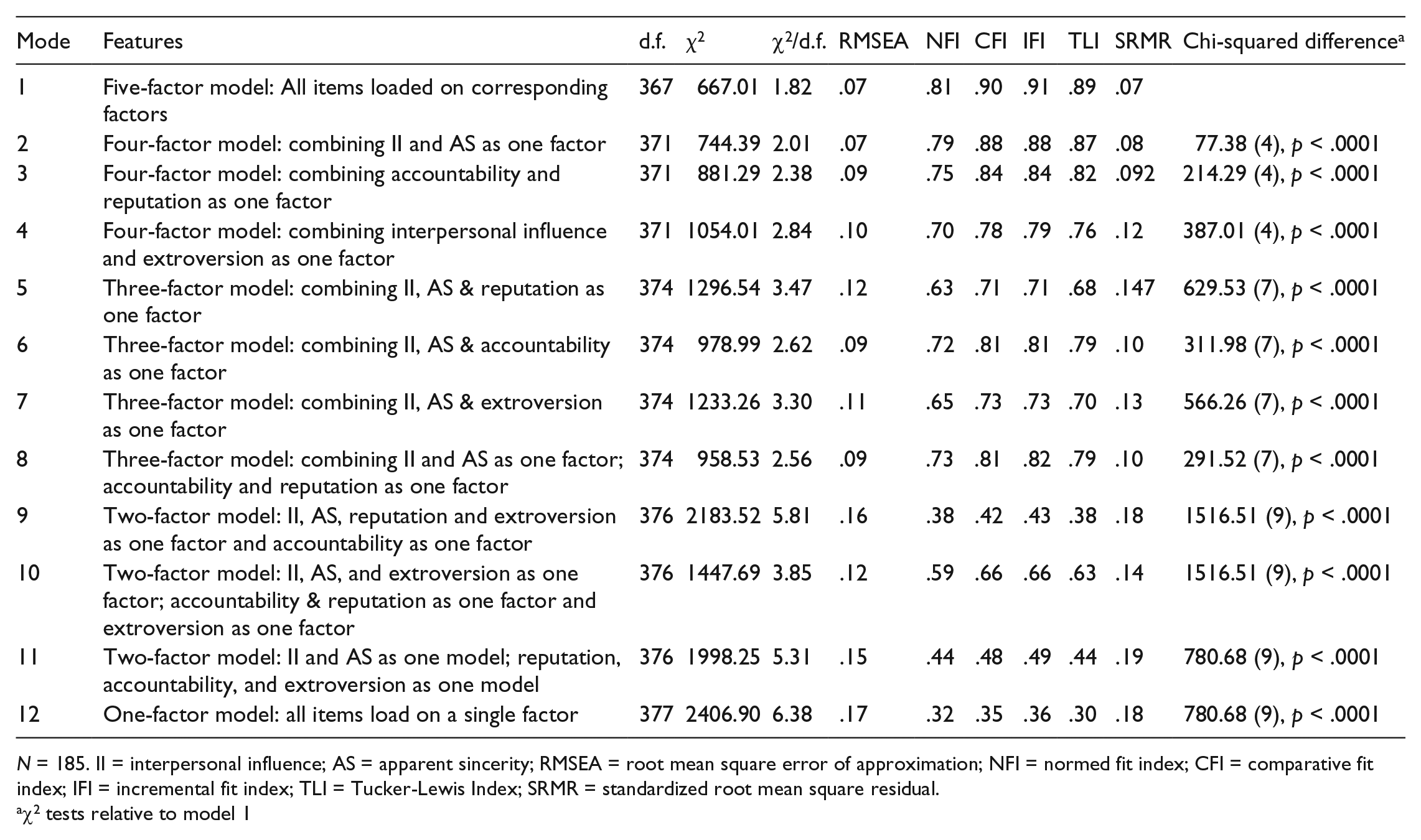
A confirmatory factor analysis was conducted using AMOS software to investigate the convergent and discriminant validity of the measures. Multiple measurement models were constructed and compared (see Appendix B). The models represent different combinations of our five multi-item measures. The models were compared based on the reported fit indices and chi-squared difference test. Our analysis shows the model having all items loading on their corresponding factors has the best fit among the 12 models.
Analysis
Three separate hierarchical regression analyses were used to test the hypotheses. In the first step we inserted the control variables. To test Hypothesis 1, we inserted in the three separate analyses the condition ‘self/other’ in the second step. In the third step of these three separate analyses, we added ‘accountability’ (Hypothesis 2), ‘reputation’ (Hypothesis 3) and ‘interpersonal influence’ and ‘apparent sincerity’ (Hypothesis 4a and 4b). We inspected the magnitude and significance of change in R2 after step 2 and step 3 to determine whether our hypotheses were supported.
Descriptive statistics and correlations
Descriptive statistics are presented in Table 1.
Descriptive statistics.
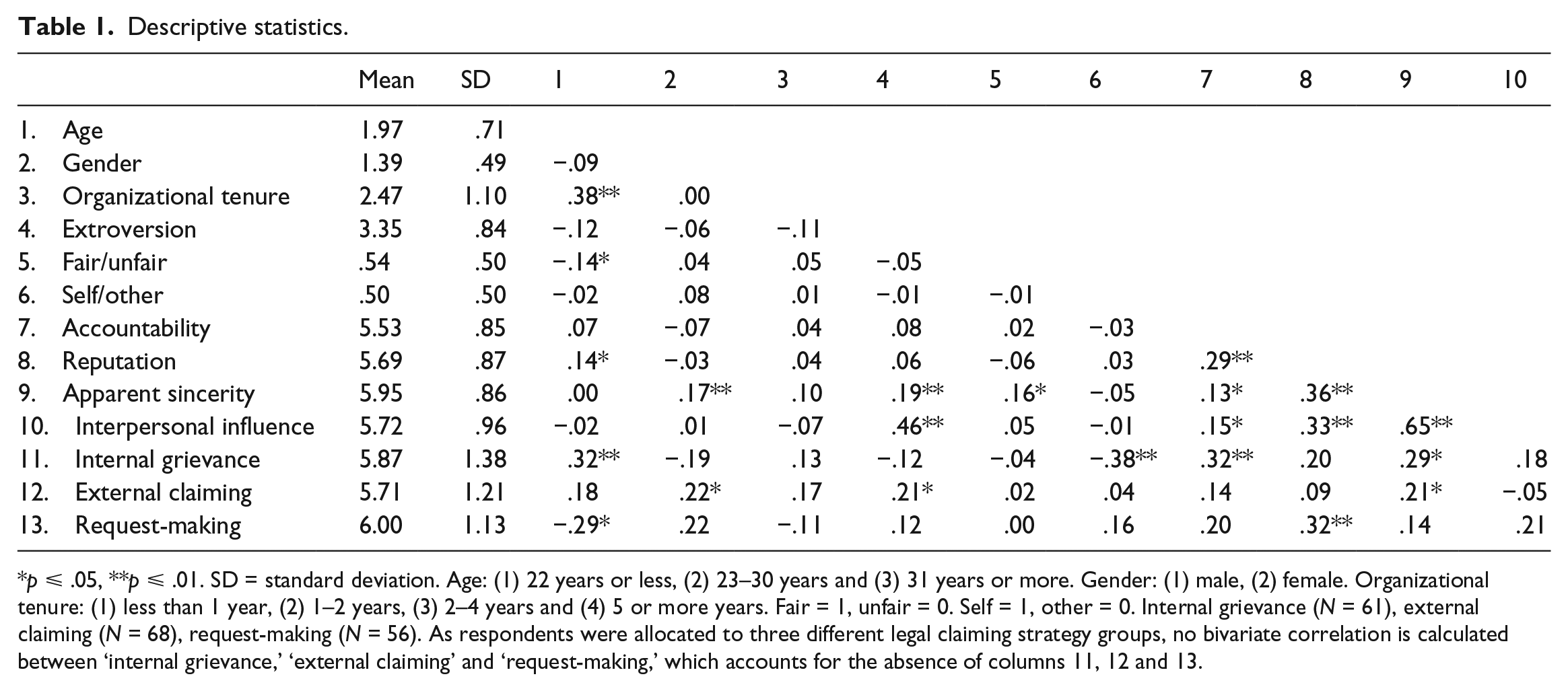
*p ⩽ .05, **p ⩽ .01. SD = standard deviation. Age: (1) 22 years or less, (2) 23–30 years and (3) 31 years or more. Gender: (1) male, (2) female. Organizational tenure: (1) less than 1 year, (2) 1–2 years, (3) 2–4 years and (4) 5 or more years. Fair = 1, unfair = 0. Self = 1, other = 0. Internal grievance (N = 61), external claiming (N = 68), request-making (N = 56). As respondents were allocated to three different legal claiming strategy groups, no bivariate correlation is calculated between ‘internal grievance,’ ‘external claiming’ and ‘request-making,’ which accounts for the absence of columns 11, 12 and 13.
To test Hypothesis 1, we used hierarchical regression to investigate if respondents are more risk-averse in their own legal claiming when compared with the advice they offer to similarly-situated others. The results (Table 2, step 2) indicate that subjects are more likely to suggest an internal grievance to others than to choose that action themselves. When it comes to external claiming and making a request, subjects seemed not to differentiate their recommendations (other or self). Thus, Hypothesis 1 is only partially supported.
Predictors of legal claiming strategies.
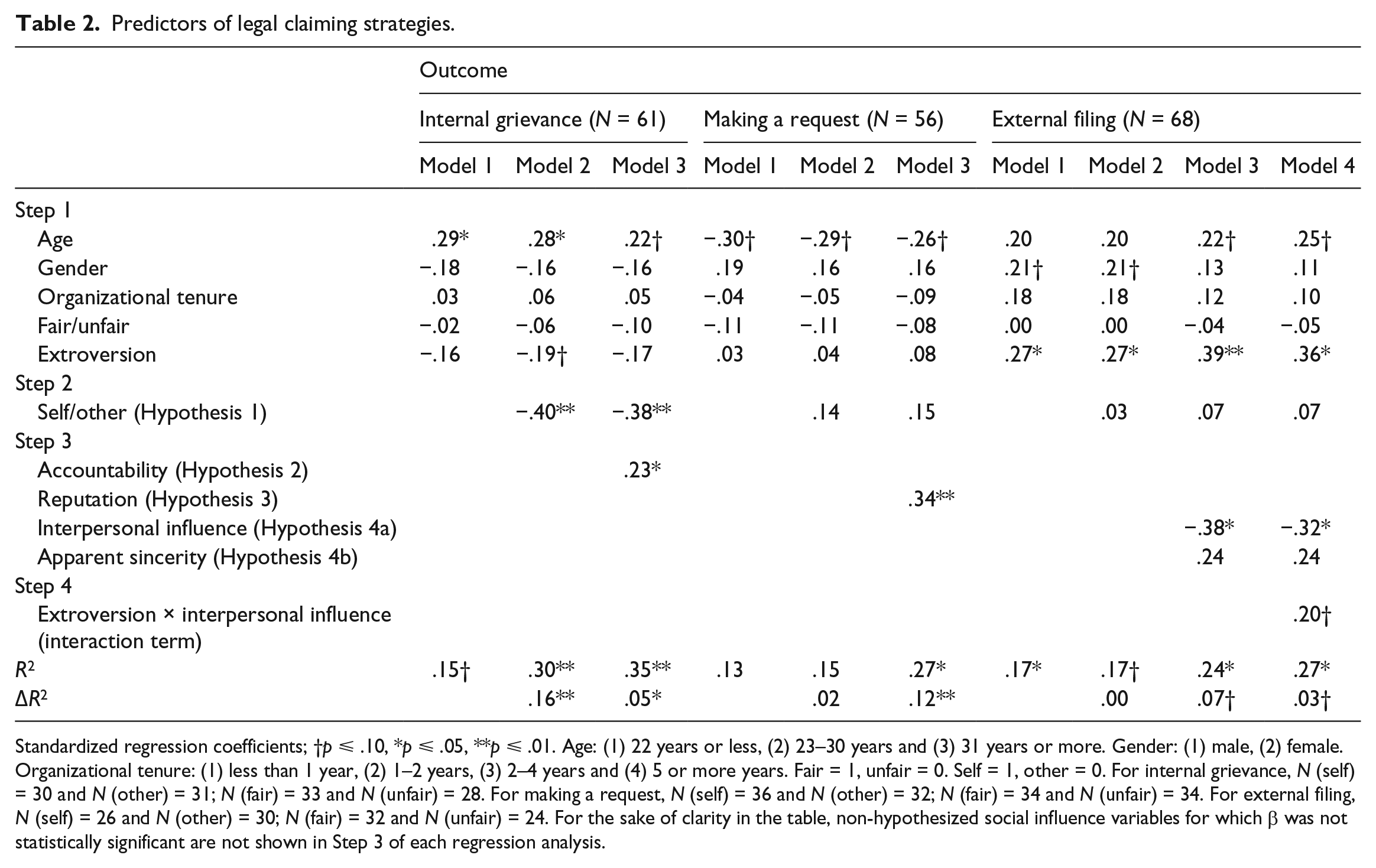
Standardized regression coefficients; †p ⩽ .10, *p ⩽ .05, **p ⩽ .01. Age: (1) 22 years or less, (2) 23–30 years and (3) 31 years or more. Gender: (1) male, (2) female. Organizational tenure: (1) less than 1 year, (2) 1–2 years, (3) 2–4 years and (4) 5 or more years. Fair = 1, unfair = 0. Self = 1, other = 0. For internal grievance, N (self) = 30 and N (other) = 31; N (fair) = 33 and N (unfair) = 28. For making a request, N (self) = 36 and N (other) = 32; N (fair) = 34 and N (unfair) = 34. For external filing, N (self) = 26 and N (other) = 30; N (fair) = 32 and N (unfair) = 24. For the sake of clarity in the table, non-hypothesized social influence variables for which β was not statistically significant are not shown in Step 3 of each regression analysis.
The next set of hypotheses (Hypotheses 2 to 4b) dealt with relationships between social influence variables and legal claiming. The results regarding these hypotheses can be found in Table 2. The results indicate that accountability (β = .23, p < .05) was found to have a significant positive relationship with internal grievances (internal contentious), supporting Hypothesis 2. Supporting Hypotheses 3, reputation was found to have a significant positive relationship with making a request (non-contentious) (β = .34, p < .05). Political skill (II: interpersonal influence) had a significant negative relationship with external claiming (external contentious) (β = –.38, p < .01). Thus, Hypothesis 4a was supported. Political skill (AS: apparent sincerity) had a positive, but non-significant, relationship with external claiming (external contentious) (β = .24, p > .05), not supporting Hypothesis 4b.
Notably, extroversion had a positive relationship with external claiming, whereas interpersonal influence had a negative relationship with external claiming. However, extroversion and interpersonal influence are positively correlated. 3 In line with previous calls (e.g. Leslie and Gelfand, 2008), we tested if extroversion moderates the political skill–external claiming relationship. We centered the independent variables before creating the interaction term as described by Cohen et al. (2003). The interaction term was inserted as a fourth step in the hierarchical multiple regression analysis (β = .20, ΔR2 = .03, p < .10). The results (Figure 2) show that highly extroverted employees with high interpersonal influence are more likely to turn to external claiming than their colleagues who have equal interpersonal influence but are less extroverted. Employees who have low interpersonal influence do not vary in their likelihood to turn to external claiming, regardless of their level of extroversion.
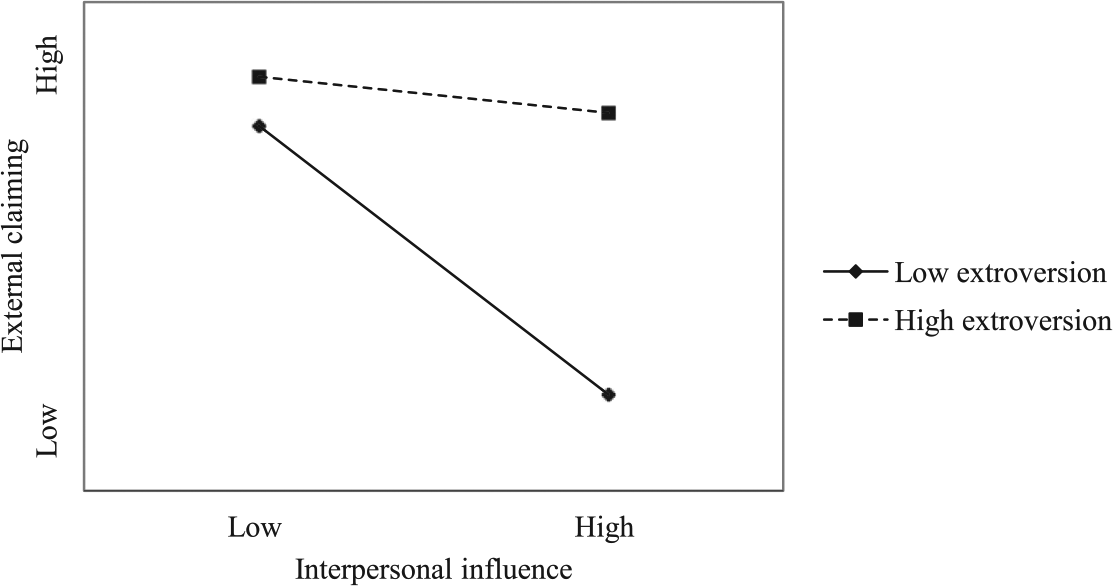
Extroversion as a moderator.
We performed three additional, and separate, analyses predicting the three legal claiming strategies. In these additional analyses, accountability, reputation and the two forms of political skill were inserted at the same time in step 3. The aim was to test our hypotheses after controlling for the other social influence variables in each analysis. Only the hypothesized social influence variable showed a statistically significant relationship with the investigated legal claiming strategy. These findings support the conclusions from our hypothesis testing: specific social influence variables predict different legal claiming strategies.
Discussion
This article provides a contribution to the field by being the first study to look at individual differences in social influence variables as antecedents of legal claiming. The study also investigated whether individuals were more likely to suggest that another pursue legal claiming over recommending that option for themselves. The difference in patterns of effects supports the importance of examining the various types of legal claiming and suggests that different social influence variables are more closely associated with certain legal claiming tactics.
The results regarding Hypothesis 1 indicated that advice givers are likely to err toward recommending legal claiming, at least in terms of filing an internal grievance (internal contentious). Our findings, however, did not support that individuals were more likely to recommend legal claiming when it came to making a request (internal non-contentious) or external legal claiming (external contentious). These results suggest that the form of claiming considered impacts the type of advice others give. However, more research is needed on this topic.
The remaining hypotheses involved social influence variables – accountability, political skill and reputation. All three were found to have an impact on legal claiming.
In support of Hypothesis 2, accountability was found to have a significant impact on legal claiming. Specifically, accountability was found to be positively related to internal contentious legal claiming (internal grievance). This finding suggests that accountable individuals balance the need to resolve disputes with the level of contentiousness of the dispute resolution tactic. These findings are in line with established accountability theory (Tetlock, 1985), which suggests that individuals employ coping strategies that are best-suited to address their accountability demands.
Reputation was found to be positively related to making a request – the least contentious form of claiming behavior – supporting Hypothesis 3. This suggests that those high in reputation are likely to take a path to resolve workplace issues that involves the least risk. It may also suggest that they are not afraid to request assistance from their employers as they have banked ‘idiosyncrasy credit’ (Greenberg, 1990), which occurs when individuals are given the benefit of the doubt or they are ‘cut some slack’ because of their positive reputations. Thus, those individuals with positive reputations may have more latitude to express vulnerability without having negative consequences associated with doing so.
Hypotheses 4a and 4b examined political skill and legal claiming. Consistent with the hypothesis, our results included a significant negative relationship between the interpersonal influence dimension of political skill and external legal claiming (external contentious). This negative relationship supports the notion that those individuals high in interpersonal influence will use other means, most likely in the form of informal influence techniques, to resolve disputes, as opposed to taking the politically risky approach of external legal claiming. Our results also include a positive (albeit not statistically significant) relationship between the apparent sincerity dimension of political skill and external contentious claiming. This relationship suggests that those who appear sincere and honest may feel that they can take the risk of making an external legal claim because they believe that others will believe the merit of their claims.
This study tested hypotheses that reflect a broader perspective of legal claiming. Past conceptualizations of legal claiming have been built upon socio-legal (Felstiner et al., 1981) and justice theories (e.g. Lind et al., 2000). Some studies have considered demographic variables as they relate to legal claiming (e.g. Lind et al., 2000), but these studies have been scarce. Moreover, to date, studies in the management field have concentrated mainly on either contentious or non-contentious legal claims. Our study offers a contribution to the management literature by including an examination of three different forms of legal claiming within one theoretical model. A broader conceptualization of legal claiming is important because denied requests may eventually escalate to internal contentious or external contentious legal claiming. The results of our empirical study suggest that, although justice/fairness considerations are important, factors such as reputation, accountability and political skill affect the nature and extent of legal claiming and also the advice given to others.
Limitations
All studies have limitations, and this article is no exception. The main limitation of this study is that all the data were single-source self-report. However, to eliminate potential bias, we utilized both an experimental design to obtain some of the data in addition to surveys, and we gathered the data in two separate waves, approximately one month apart. The study also did not include measures of all facets of political skill. Specifically, although measures of interpersonal influence and apparent sincerity were included, the facets of social astuteness and networking ability were not examined in this study. We encourage future researchers to include these additional facets in empirical assessments of the role of political skill in legal claiming. Regarding the design, although we targeted an equal number of individuals in each scenario, our final 12 groups varied slightly in size.
Additionally, this study has a US sample and the scenarios are based on US laws. Nevertheless, the notions of individual differences and voice have implications for other industrialized countries, particularly as western countries are both becoming more diverse and continuing to enforce laws that protect the civil rights of their workers (Albiston, 2005).
Practical considerations
Employers should do their best to avoid certain types of legal claiming, such as discrimination lawsuits in court. By adopting and implementing fair human resource management practices, employers should be able to limit (although not completely eliminate) many of these claims. However, an employer should encourage some forms of legal claiming. For example, granting a request for workplace accommodation by an employee with disabilities should not only allow that employee to work to her fullest potential, but it may also engender a sense of loyalty and commitment on the part of that employee (Baldridge and Veiga, 2001; Stone and Colella, 1996). Legal claiming is an important voice mechanism, which, if managed properly, may help to empower employees who use this tool as a form of personal advocacy (Baldridge and Veiga, 2001).
Employers may create an environment that fosters beneficial (or at least less disruptive forms of) legal claiming. For example, adopting an internal grievance system has been found to decrease external contentious legal claiming, which is almost always a more costly alternative to both employee and employer (Klaas et al., 2012). Also, employers who foster an environment where leave and accommodation requests are encouraged may lower litigation costs, reduce turnover and decrease employee stressors and accompanying strain-related outcomes (Baldridge and Veiga; Stone and Colella, 1996).
Over the past decade, increasingly more attention has been paid to the concept of political skill (Ferris et al., 2005). Despite findings that indicate that political skill may be influenced by less mutable traits like personality (Ferris et al., 2005), the argument has been made that political skill may be taught and honed (Ferris et al., 1993). Although it is a controversial hypothesis, it has been suggested that women and minorities may often have a ‘political skill deficiency’, as they are not taught insider tips by senior white males in the organization (Ferris et al., 1993). In our study, a dimension of political skill was found to be negatively related to contentious legal claiming. Formal mentoring programs may provide one means of increasing the political skill of out-group members. Such programs would allow women and minorities, who historically have not had the benefits of informal mentoring of senior management, to be on a more equal footing. By adopting a positive multiculturism perspective (Triandis et al., 1994), members of these groups could gain these skills while maintaining their self-identities. Among a myriad of potential positive outcomes from such an approach may be a decrease in contentious legal claiming, as certain groups use more informal and social means to resolve disputes.
Conclusion
Potential employee legal claims are a reality of organizational life. As such, this issue warrants more attention than it has previously received from organizational scholars. In this article, we offered a conceptualization of legal claiming that has incorporated claims that are both contentious and non-contentious. By incorporating various forms of legal claiming into a broader conceptualization, we may better understand the nature of this complex phenomenon. Social influence considerations have been virtually ignored by previous legal claiming researchers, particularly within the context of external contentious legal claiming. However, existing theory and empirical research strongly suggest that employees do consider the social ramifications of legal claiming. Our findings suggest that social influence is an important consideration in legal claiming. Future research should examine other individual differences, such as personality, when considering claiming-related behaviors. For example, in this article we controlled for extroversion, which was significantly related to one form of legal claiming.
By being able to understand antecedents to legal claiming, organizational scholars will be able to ascertain ways in which organizations may reduce unnecessary contentious legal claiming, while fostering legal claiming that may benefit both employer and employee (e.g. requests for workplace accommodation). Only by examining social context considerations and individual differences, including social influence, will researchers be able to advance our knowledge regarding the conditions under which employees invoke their legal rights.
Footnotes
Appendix A
Appendix B. Confirmatory factor analysis.
| Mode | Features | d.f. | χ2 | χ2/d.f. | RMSEA | NFI | CFI | IFI | TLI | SRMR | Chi-squared difference a |
|---|---|---|---|---|---|---|---|---|---|---|---|
| 1 | Five-factor model: All items loaded on corresponding factors | 367 | 667.01 | 1.82 | .07 | .81 | .90 | .91 | .89 | .07 | |
| 2 | Four-factor model: combining II and AS as one factor | 371 | 744.39 | 2.01 | .07 | .79 | .88 | .88 | .87 | .08 | 77.38 (4), p < .0001 |
| 3 | Four-factor model: combining accountability and reputation as one factor | 371 | 881.29 | 2.38 | .09 | .75 | .84 | .84 | .82 | .092 | 214.29 (4), p < .0001 |
| 4 | Four-factor model: combining interpersonal influence and extroversion as one factor | 371 | 1054.01 | 2.84 | .10 | .70 | .78 | .79 | .76 | .12 | 387.01 (4), p < .0001 |
| 5 | Three-factor model: combining II, AS & reputation as one factor | 374 | 1296.54 | 3.47 | .12 | .63 | .71 | .71 | .68 | .147 | 629.53 (7), p < .0001 |
| 6 | Three-factor model: combining II, AS & accountability as one factor | 374 | 978.99 | 2.62 | .09 | .72 | .81 | .81 | .79 | .10 | 311.98 (7), p < .0001 |
| 7 | Three-factor model: combining II, AS & extroversion as one factor | 374 | 1233.26 | 3.30 | .11 | .65 | .73 | .73 | .70 | .13 | 566.26 (7), p < .0001 |
| 8 | Three-factor model: combining II and AS as one factor; accountability and reputation as one factor | 374 | 958.53 | 2.56 | .09 | .73 | .81 | .82 | .79 | .10 | 291.52 (7), p < .0001 |
| 9 | Two-factor model: II, AS, reputation and extroversion as one factor and accountability as one factor | 376 | 2183.52 | 5.81 | .16 | .38 | .42 | .43 | .38 | .18 | 1516.51 (9), p < .0001 |
| 10 | Two-factor model: II, AS, and extroversion as one factor; accountability & reputation as one factor and extroversion as one factor | 376 | 1447.69 | 3.85 | .12 | .59 | .66 | .66 | .63 | .14 | 1516.51 (9), p < .0001 |
| 11 | Two-factor model: II and AS as one model; reputation, accountability, and extroversion as one model | 376 | 1998.25 | 5.31 | .15 | .44 | .48 | .49 | .44 | .19 | 780.68 (9), p < .0001 |
| 12 | One-factor model: all items load on a single factor | 377 | 2406.90 | 6.38 | .17 | .32 | .35 | .36 | .30 | .18 | 780.68 (9), p < .0001 |
N = 185. II = interpersonal influence; AS = apparent sincerity; RMSEA = root mean square error of approximation; NFI = normed fit index; CFI = comparative fit index; IFI = incremental fit index; TLI = Tucker-Lewis Index; SRMR = standardized root mean square residual.
χ2 tests relative to model 1
Acknowledgements
The authors would like to thank Teri Elkins Longacre, Mark Roehling and the anonymous reviewers for their suggestions and guidance on earlier drafts of this article.
Funding
This research received no specific grant from any funding agency in the public, commercial, or not-for-profit sectors.