






Abstract
This article considers the customary choice of silence over voice of two groups of UK workers – women clergy and women actors – who routinely tolerate poor quality conditions rather than express dissatisfaction. We argue that a key mediating factor is an expanded version of Hirschman’s (1970) concept of loyalty. The article considers how occupational ideologies facilitate loyalty as adaptation to disadvantage in ways that discourage voice, in framing silence as positive. Consequently, we also identify this type of loyalty as potentially salient in understanding silence in other occupations. A descriptive model comparing strength of occupational ideology and voicing of dissatisfaction is outlined, and through discussion of findings the article offers conceptual refinements of loyalty in accounting for worker silence.
Introduction
In this article, we consider the routine choice of silence over voice of two groups of seldom-researched UK workers – women clergy and women actors. Both these occupational groups are more likely to tolerate systemically poor quality working conditions than express dissatisfaction to management or trade unions. They also simultaneously indicate satisfaction and engagement with their work. We posit occupational ideology as a key mediating factor in this silence, and the article explores the connection between these positions through Hirschman’s (1970) ideas on exit, voice and, in particular, loyalty.
Hirschman’s concepts, originally conceived of in relation to customers and members of institutions, have been developed to incorporate workers and their employment (see Wilkinson et al., 2014), and we focus on his original ideas around quality and loyalty. Quality is assumed as a desirable characteristic – as good quality. Voice is an expression of dissatisfaction to management, a higher authority or general protest. Exit is when members leave an organization/institution because of discontent with quality. Loyalty is ‘special attachment to an organization’ incorporating an internalized ‘penalty for exit’ (Hirschman, 1970: 77, 98). Attachment stimulates the use of voice mechanisms to improve lapses in quality of environment, as it changes the character and costs of exit. For someone with no special attachment, exit costs may involve material change with no specific emotional dimensions. In contrast, Hirschman argues that sometimes the worse the conditions the less likelihood there is of exit and thus loyalty will increase the likelihood of articulating dissatisfaction with poor quality.
Both occupations considered in this article exhibit types of special attachment – vocational jobs where a fundamental assumption is widely accepted as a legitimate frame of reference; that is, as occupational ideology. For clergy it is ‘God’, for actors it is ‘Art’. In exploring the purchase of these frames of reference, we find that attachment can facilitate a type of loyalty that leads to tolerance of poor conditions. Therefore, and in contrast to Hirschman, voice is discouraged rather than encouraged. We suggest this interpretation has force in relation to occupations other than those considered here and propose a descriptive model that relates strength of occupational ideology to voicing of dissatisfaction with quality of conditions.
The article begins by considering the role of ideology in relation to voice and loyalty and sets out our model that helps map responses to poor quality conditions. The research projects from which our ideas developed are then described. This is followed by discussion of poor conditions, lack of voice, and satisfaction in the work of clergy and actors. Findings on silence as loyalty are considered, and the significance of our arguments for other occupations and for analysis of worker interests more generally is discussed.
Ideology and connections to loyalty
Rosso et al. (2010: 98) observe that most people see their work in one of three ways: as job, career or calling, with calling taking two different forms, which share the perspective that the work is an end in itself and usually done in the conviction that it is contributing in some positive way to wider society. The forms differ, in that the first is seen as developing post entry to the job, in parallel with doing it: examples could be high job satisfaction exhibited by the low-paid domiciliary and residential care workers in Hebson et al. (2015) and Hoffmann (2009). The second form applies more clearly to actors and clergy, and involves a religious or secular pre-entry vocation to do the specific job. Such conceptualization has implications for worker responses, given arguments that it is essential to identify the ways in which ideas have causal effects in the workplace (Hauptmeier and Heery, 2014: 2472). Recognizing the existence of occupational ideology enables identification of interests/power conflicts which are fundamental to a particular social arrangement (Eagleton, 1991). For example, Styhre’s (2014: 310) study of Swedish clergy as professionals considers the importance of ideas in shaping action and, drawing on Geertz (1973), defines the ideology that he found regulated clergy as: ‘the everyday construction of meaningful images that guide practices and behavior (ideology as a “cognitive construct” or a “collective conscience”)’. In our empirical contexts, the occupationally normalized cognitive construct for clergy is ‘God’, explained by Peyton and Gatrell (2013: 52) as the ‘sacrificial embrace’ whereby clergy believe that their physical, intellectual and emotional selves are permanently claimed for the service of God. They argue that clergy accept that expectations of usual work and career rewards are sacrificed in the pursuance and living out of their ordination commitment to God (Peyton and Gatrell, 2013: 118). For actors, the occupationally normalized cognitive construct is ‘Art’, to which we attribute two dimensions: artistic vision and art-for-art’s-sake. Artistic vision implies creative freedom in the combination of the individual’s right to free speech informed by ancient ideas of art as sacred (Dean, 2015). Art-for-art’s-sake captures the idea of human creativity as an end in itself (Jussim, 1978; Menger, 1999), and Eikhof and Haunschild (2007) explore tensions between artistic and business logics of practice in the German repertory theatre, system and characterize ‘l’art pour l’art’ as a motivating driver for actors.
Building on this work, we broaden Hirschman’s application of his concept of loyalty beyond that formed with the organization or institution, to the occupation. This approach resonates with Allen’s (2014) understanding of loyalty as a more deep-seated attachment than job satisfaction, with which loyalty has sometimes been equated, as well as with Hoffmann’s (2006: 2328) query, ‘From where does “loyalty” come?’, in reference to her study’s coal mining families. Hoffmann found that ideologically tempered loyalty affected voice and exit in ways not anticipated by Hirschman’s model. Miners’ gendered ties to occupational culture meant that exit was not included in dispute resolution strategies, as to leave these jobs would be to remove a part of themselves. In addition, they would often use coping or toleration strategies rather than voice discontent. Hoffmann asks whether Hirschman’s model needs to be reformulated to take account of more finely differentiated types of exit costs, linked to a version of loyalty that exists prior to the worker joining the organization and transmitted through mechanisms such as cultural expectations. Hoffmann (2009) went on to study homecare workers and found they were willing to work unpaid from a sense of self-sacrificial loyalty and to realize self-worth. Hoffmann notes these dimensions as affecting willingness to resist poor terms and conditions, returning us again to the importance of identifying causal effects of ideas in the workplace (Hauptmeier and Heery, 2014). This is implicit in a question posed by Donaghey et al. (2011) in relation to one aspect of their dialectical interpretation of employee silence. They observe that where employees have inadequate openings to convey concerns to management, silence has been largely interpreted as negative for employees but that this is often without gaining a deeper understanding of the ways in which it may actually affect them. They ask whether employees might acquiesce ‘depending upon the particular aspirations they bring to the employment relationship’ (Donaghey et al., 2011: 62, emphasis added).
This article responds to a broad understanding of Donaghey et al. (2011)’s query. We outline a descriptive model of customary worker responses in relation to silence/tolerance of disadvantage, to approximate how a refined conceptualization of Hirschman’s ‘loyalty’ mediates such responses (see Figure 1). The implication of our research on women actors and clergy, explored in detail later, is that occupational ideology shapes loyalty which affects expression of worker voice: the stronger this type of loyalty, the weaker use of voice/greater the tolerance.
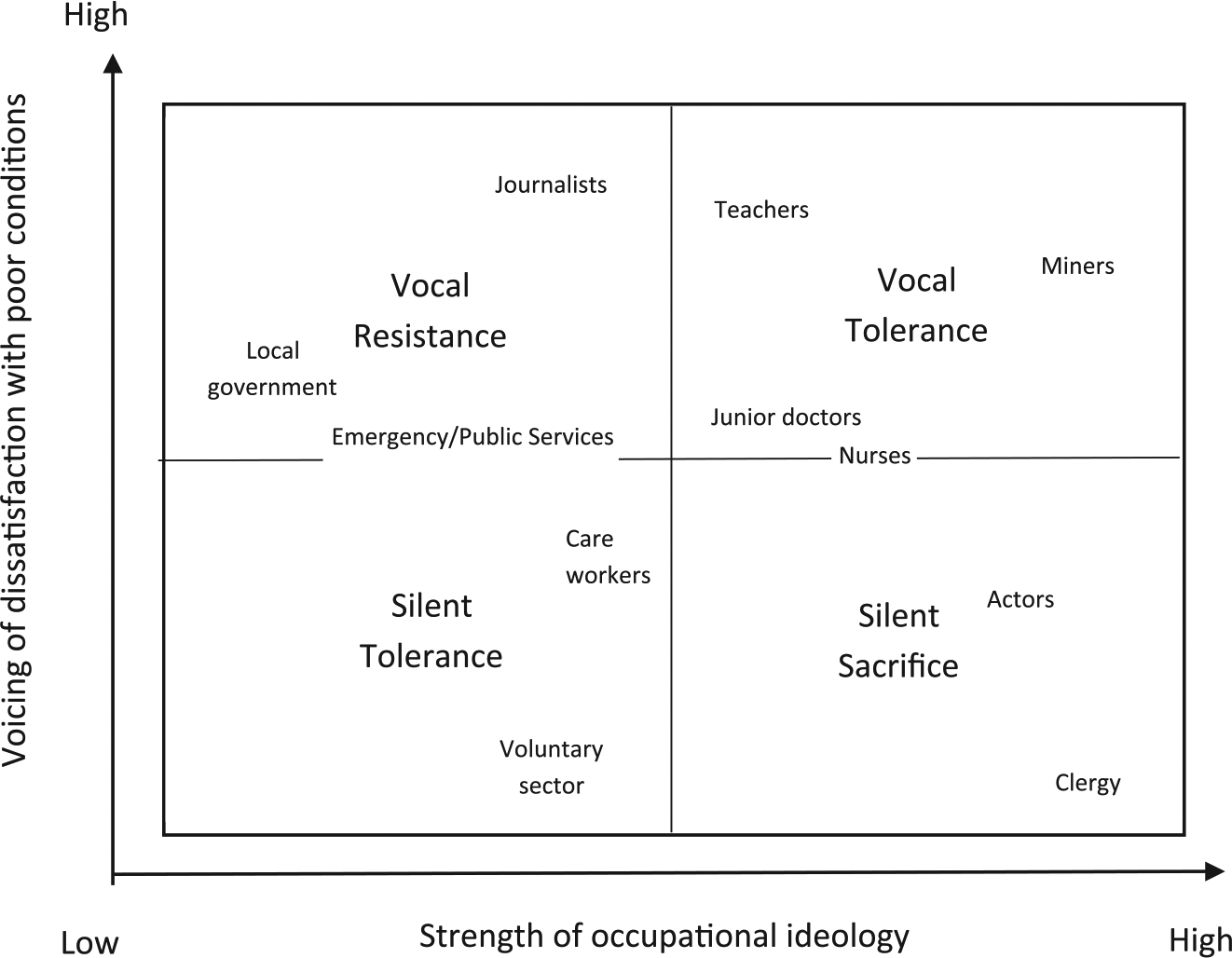
The mediating effect of occupational ideology on voice.
The model labels four broad, descriptive categories in which different occupational groups could be located: ‘Vocal Resistance’, where mediation of occupational ideology does not typically preclude workers from identifying and voicing dissatisfaction with poor quality conditions; ‘Vocal Tolerance’, where mediation of occupational ideology restrains routinely overt action while allowing for overt recognition and expression of dissatisfaction; ‘Silent Tolerance’, where mediation of (commonly, post-job calling) occupational ideology influences simultaneous recognition and tolerance of poor quality conditions; and ‘Silent Sacrifice’, where mediation of occupational ideology encourages the routine lack of expression of dissatisfaction in the re-framing and toleration of poor quality conditions.
To populate our exploratory model, we have deliberately selected occupations that arguably have pre-or post-job calling with some reputation for poor conditions such as insecurity, relatively low pay and long hours (not necessarily all of these for each occupation). Systematic analysis of these occupations is outside the remit of the article; our aim here is to frame an argument that can inform future research. Where an occupational group is located on this model is an empirical question relating to the specific occupational conditions, actions of individual workers and voice institutions. For example, the Silent Tolerance section of the model includes voluntary sector workers. These were identified by the Chartered Institute of Personnel and Development (2013) as most likely of all employees to experience and expect redundancies, whilst also being the most satisfied and engaged, which the report concluded was because these workers understand clearly what the purpose of the organization is and are motivated by this core purpose. In the ‘Emergency/Public Services’ category of the Vocal Resistance/Silent Tolerance border of our model we include police, firefighters and paramedics, local government employees and civil servants. Again, we note that our aim here is a preliminary sketch drawing on previous research, such as Van Maanen (2010), who explores effects of prior orientation and occupational community in shaping police officers’ decisions to join and leave the job. The potential for broader consideration can also be seen in Van Maanen and Barley’s (1984: 24) grouping of identification and involvement with a line of work in such varied occupations as air traffic controller and garbage collector.
What is proposed is that it is relevant to ask questions of the existence of pre- and post-job occupational ideology, in formation of employee preferences in relation to voice, loyalty and exit. One would expect a range of nuanced responses from all relevant parties, such as ideology leading not to joyous acceptance in the ‘Silent Sacrifice’ quadrant (many clergy), but to acceptance as compromise in ‘Vocal Tolerance’ (many nurses: Briskin, 2012; Heyes, 2005), or as an element of occupational identity in ‘Silent Tolerance’ (many police officers: Van Maanen, 2010). As Figure 1 shows, we locate clergy and actors in the ‘Silent Sacrifice’ quadrant, through analysis of two qualitative research projects exploring work experiences of women actors and clergy, which we now discuss.
The research projects
The article’s discussion is based on empirical fieldwork from studies conducted independently of each other. However, these studies shared certain characteristics in their primary subject sample, namely women as a sub-group of atypical occupations, both of which have been seldom-researched and possess highly distinct occupational ideologies that feature a calling dimension. In addition, both studies shared research aims: first, to map occupational realities through respondents’ perceptions of gendered employment disadvantage already established by existing research; second, to consider the effects on these realities of informal individual voice and formal legal and social voice mechanisms.
The two studies also shared key principles of methodology. The clergy project was undertaken by the second author between 2010 and 2015 and involved semi-structured interviews with 38 stipendiary (paid) women ministers in the UK (21 parish priests in the Church of England (CofE) and 17 presbyters in the Methodist Church), plus the national officer and a lay representative of the Faith Workers Branch of the trade union Unite. Some interviewees were contacted by an initial email approach from the union and snowballing on from that, and others by random selection from lists of ministers. The eventual sample included a spread over both rural and urban parishes and also geographically across the UK. The actor research involved projects undertaken by the first author between 2000 and 2010. The data drawn on for this article come from semi-structured interviews with 30 women performers drawn via snowball sampling from the informal industrial status categories of lower-range, middle-range and leading performers, four national and regional officials of the entertainment industry union Equity, and 10 industry gatekeepers, including casting directors, producers and agents. Interviews in both studies explored the same issues, including: recruitment, selection, training and pay; vocational drive; job satisfaction; relationships with trade unions and those in managerial roles; gender discrimination; and willingness and ability to challenge poor treatment.
Thematic analysis of interviews in both studies was conducted manually, with general categories developed initially from the interview agendas themselves, which were then expanded upon and subdivided. Although exceptions were highlighted, analysis in both studies looked primarily for the existence of shared meanings or ‘interpretive repertoires’ (Potter, 1996). We draw on interviews in all occupational categories, indicating the relevance of issues across each sector (interviewees quoted are identified by occupation and source notation). In particular, we also look at those traditionally viewed as ‘voice agents’ (union officials, union activists) to establish a wider context for our primary interviewees’ responses.
Utilizing independently conducted case studies has a precedent within comparative case study design, where understanding of a phenomenon is developed by expanding the scope of analysis afforded by each of the studies alone. Ability to undertake such integration relies on there being some element of ‘replication logic’ (Eisenhardt, 1989), which the similarities between the two studies discussed above facilitates. The compared studies do not have to be part of a pre-designed research strategy, and the comparison emerges from an ex post facto realization by independent researchers that the insights derived from their studies can be enriched by comparative analyses (Teram, 2010: 475). In direct relation to the analysis within this article, dimensions of ideology and loyalty did not form part of either project’s original research questions or analytical frameworks. These were distinguished in subsequent analysis and identified as central in discussion of findings between the authors, resulting in the integrated comparison described above by Teram. Recognizing the explanatory force of ideology and loyalty in separate but similar occupations thus produces greater theoretical insights.
The comparison between these two occupations is also appropriate as actors and clergy share significant similarities as nonstandard workers. Both have atypical occupational legal status and formally permit sex discrimination, as explained further later. Neither occupation is thought of as conventionally ‘real’ work by society or, largely, by its workers (see Dean, 2012, on actors; and discussions about clergy in Jarvis, 1975 and Musgrove, 1975). Both men and women workers in these vocational occupations regularly experience poor terms and conditions (Christopherson, 2008; McDuff, 2001; Menger, 1999). However, existing qualitative and quantitative research establishes that, as a category, women clergy and actors experience systemically poorer working conditions than their male peers (Bagilhole, 2003, 2006; Dean, 2008a; Greene and Robbins, 2015; Thomas, 1995). Therefore, in analytical terms, these women workers are usefully extreme examples in considering toleration of poor conditions within occupations that are also usefully extreme examples, having strong and distinct occupational ideologies where calling is a key feature. The primary respondents of both studies – clergy and actors – were all women, which enables our explanatory concepts to be explored in sharpest relief. Although their gender is relevant to their experiences in that, as existing research shows, women are usually further along a continuum of poor occupational conditions, we are not positing their gender as causally related to their responses. We come back to this issue later in the Discussion section.
The empirical findings are now considered, organized into four sections. This starts with establishing the landscape of poor/er quality terms, conditions and environments. Next, the customary absence of individual voice is examined, followed by the related picture of effective tolerance in relation to external avenues of the law and trade unions. The findings on internalized penalty for occupational exit are then presented. The final discussion reflects on these issues in relation to the descriptive model set out above and considers implications for future research.
Occupational contexts and patterns of disadvantage
Long hours and relatively low pay are common experiences for most workers across these occupations. In addition, similarities in unequal access to work, vertical segregation, lower pay and active sex discrimination are predominant occupational contexts for women actors and women clergy. The CofE and the Methodist Church are two of the most prominent Christian denominations in the UK. Women were admitted as ordained Methodist clergy in 1974 and in the CofE as late as 1994. Progression has changed very recently in the CofE and, as with Methodists, women are now eligible to apply or be recommended for senior roles, the consecration and appointment of the first woman bishop in January 2015 ending a long battle for formal gender equality. However, women account for only 23% of those ordained as full time stipendiary (paid) CofE clergy and 11% of senior positions; that is, archdeacons, cathedral canons and bishops (Archbishops’ Council, 2013), whereas they hold more than half of unpaid (self-supporting) posts. Methodist women’s progression is better-established institutionally, although this context is also male-dominated: women account for 39% of presbyters, and in senior positions for 30% of district chairs and 25% of superintendents. 1 Remuneration in both church contexts includes provision of a house while in post and payment of a centrally set average ‘stipend’ of between £22,600 (Methodists) and £24,000 (CofE) per annum. Although this is not technically low pay, it is low for a graduate-level job and, importantly, the stipends do not increase beyond cost of living rises unless through appointment to more senior posts that, as noted, significantly fewer women hold. Overall, women continue to be disproportionately represented in unpaid, part-time and low-status jobs in both Churches.
The occupational access route for actors varies as there are no formal career paths in this generally low-paid occupation, which is permanently oversupplied (unlike clergy) and in which progression to larger roles is effectively random. Despite the fact that – again in contrast to clergy – acting has been a gender-integrated occupation for several hundred years, career progression to regular work or leading roles and so greater income is shaped by gender. There are fewer roles and fewer leading roles written or cast as women and, of those, greater concentration in younger age groups (Dean, 2008b; Higgins, 2012). Further, although women and men are assessed on the same grounds, including employer perception of physical suitability for the role, the criteria used for these decisions are explicitly narrower for women than for men. The most recent findings on performer pay indicate that more than half of all actors (and notably nearly two-thirds of women actors) are chronically low-paid, earning between nothing and approximately £12,000; the next two highest income categories have almost identical proportions of women and men, and the next five highest show men earning more. Women were also underrepresented in the top income category: 0.1% of women earned more than £60,000, compared with 4% of men (Dean, 2008b; Skillset, 2005; Thomas, 1995).
Exacerbating these structural disadvantages, many women in both occupations experience sex discrimination. What emerged from clergy interviews was its ubiquity as a key feature of their work (Greene and Robbins, 2015). Without exception, all interviewees had personally experienced or been witness to disadvantageous treatment, hostility and opposition to them as clergywomen, from both clergymen and members of the congregation. Despite their longer presence within the church, Methodist clergywomen said many lay members still see them as unusual and there is resistance to them over such central functions as conducting services. Personal witness accounts from CofE clergywomen (for example, Furlong, 1998; Green, 2011) have detailed passive tolerance to the discrimination that is often felt to be their predominant experience (explored further in our own empirical material). This tolerance can also be seen intersecting with management (in)action in producing silence: a monitoring report by the Gender Justice Committee in 2004 found that the Methodist Church was ‘suffering from and perpetuating institutional sexism’; however, there were no formal action recommendations until another report in 2008, with an interim equality and diversity structure only recommended to Conference in 2010 and to date still not initiated.
Women actors’ disadvantage lies predominantly in that they are employed to portray women, so have fewer available jobs (particularly from middle age) and that throughout their careers occupational requirements which are shared with men, such as a desired appearance to convey meaning, are more closely defined (Dean, 2005). However, widespread sexist practices constrain the quality of working conditions for women even further. Gatekeepers such as casting directors acknowledged that male directors and producers often made irrelevantly sexualized recruitment demands: as a woman television producer put it, ‘casting fantasies’. A casting director was clear that selection of performers regularly involved inappropriately personal judgements: ‘You have to be quite careful. And I often say [to directors] I am not here for the delectation of your loins actually’. Thus, in both occupations the quality of generally challenging working conditions is lessened further by gendered frameworks and one might expect dissatisfaction to be voiced: worker to employer, worker through the law, or worker through the union. In the next three sections we consider: first, individual tolerance of disadvantage; second, lack of use of external routes to challenge disadvantage; and third, loyalty as penalty for exit.
Individual tolerance of poor quality conditions
In this section, we present tolerance of, rather than voicing dissatisfaction with, poor quality conditions in the form of low pay, long hours and sex discrimination. Clergy and actors accepted or accommodated their low pay in the context of occupational ideology. The underlying purpose of the clerical stipend is to be merely ‘adequate for clergy to discharge their duties without undue financial anxiety’ (Central Stipends Authority, 2013: 1; see similar understandings in the Methodist Church, Connexional Allowance Committee, 2014). The majority of clergy shared this view, although financial anxiety was certainly a reality for many, with four interviewees indicating they had needed to apply for Church hardship funds. Although the provision of tied housing was seen as compensation for lower pay, there was little choice and housing was often unsuitable and expensive to run, bringing difficulties in terms of the real value of pay, particularly in the case of this single mother: ‘I remember being in floods of tears when I got my first heating bill, it was like the entire month’s salary went on one heating bill’ (CofE A1). For all clergy interviewed, the stipend was regarded as facilitating rather than rewarding the long hours worked. All accepted the connection of their pay with the ideology of God, as this quote captures: ‘to pay you to be God’s person in a particular place’ (CofE, M). While recognizing that the pay could be difficult to live on, another interviewee related this directly to acceptance of disadvantage: ‘I guess I feel part of my calling is actually about living simply that others may simply live’ (Methodist, F). Despite the inadequacy of remuneration, ideology reframes disadvantage: remuneration is simply enough ‘to keep you up and running so you’re free to minister’ (CofE, J). Silence is a consequence of conditions not perceived as legitimate to challenge because of the ideological constructs brought to the job.
The parallel analysis for actors has been conceptualized as ‘psychic income’, where pay can be substituted partially or completely for perceptions of self-fulfilment in artistic practice (Eikhof and Haunschild, 2007; Menger, 1999; Towse, 1996). The art-for-art’s-sake element of calculating whether or not a job is affordable to take was noted by both performers and gatekeepers. An agent said, ‘It’s like they’d almost pay to do it … There are whole film companies set up on the basis of actors working for nothing’. An Equity official’s description of theatre wages as members ‘subsidising their own art form’ was repeated by most performer respondents, summarized by one as ‘we are subsidising the arts … nine times out of 10 it’s the actors who are subsidising by taking ridiculously low salaries that no dustman would accept’ (Performer, S).
This effectively sacrificial position can also be translated to ‘subsidising the church’, as although clergy and actors are not legally employees (see later discussion), it seems their effective employers nevertheless benefit from workers’ acquiescence in relation to long hours for low pay. It is difficult to separate clergy work from the rest of life (Jarvis, 1975) and the majority of clergy interviewees did not feel they could take their weekly day off or full holiday entitlement and still perform their service to their congregations. For example:
I had a week off two weeks ago and I ended up working most of it … an imminent death in one of my churches where we were having to do a quick wedding for her daughter before she died and things like that … Because it isn’t just a job, it’s about who I am. (Methodist, D)
Another compared her previous experience as a social worker with being a minister:
I thought I worked hard as a social worker but that was nothing to this … you don’t want to offer anything other than the very best to God … and the expectations of the churches they’re hard to meet … my diary gets incredibly full. I get ridiculously tired. And I’m nowhere near meeting their expectations. (Methodist, V)
Performers’ reflections on attitudes to working time also supported this assessment and the general attitude of respondents that acting as artistic endeavour was distinct from real work (Dean, 2012):
Acting’s not really a job, it’s a love. That’s why I feel that directors, whoever, in the profession take advantage of that. Sometimes you’ll be in a rehearsal and if they want to go over time … I will stay and let them get away with stuff and I think that’s why they will push you because most people will just see it in that sense – that you have to give up your life for it, kind of thing. (Performer, M1)
Another pointed example of underpinning (and for employers, enabling) ideology is this quote from an experienced performer: ‘And certainly the most enjoyable jobs I’ve ever done really [were] for no money whatsoever … Because the job of acting is an artistic endeavour when you’re doing it purely … and money shouldn’t be involved’ (Performer, E3).
Variations on this ‘pure’ example of silent sacrifice were repeated by other performers and also echoed in the tenor of clergy interviews. Findings around the occupational ideology of art connect directly to clergy in their view of themselves as ‘saviours of souls’:
We’ve got a calling, a vocation, that the Almighty has asked us to do something in particular which … is joining … in God’s mission for the world … It includes the renewal of creation and the salvation of every bit of creation including human souls. (CofE, M)
Similarly, many actors also saw a civic dimension to their jobs in terms of artistic work publicly raising important issues. Despite their different occupational objectives, similar concepts were sometimes used by actors talking about their work: ‘people’s souls, for want of a better word, need to be … encouraged’ (Performer, S). This implicitly renders expression of dissatisfaction inappropriate as it would be contradicting art-for-art’s-sake. Many interviewees talked about low-paid theatre touring jobs with very basic conditions in terms of the art rather than the conditions, such as the experienced performer just quoted:
We took our portable auditorium to all sorts of places … that don’t normally have theatre. I mean we became ambassadors really … If you take theatre and you present it in the right way it can transform people … We were taking it to people’s sports halls and swimming pools and school halls and prisons … I still meet some of the actors [names] and they go, oh god it was hard work I mean it nearly killed us … we’d pack up the auditorium, on to the next one … but … everybody united watching something amazing or beautiful or frightening, cruel. (Performer, S)
Despite the knowledge that actors subsidise their own work/art form, as discussed above, the calling and parameters of the occupational ideology meant difficult conditions were accepted rather than challenged.
There was also general acceptance in both occupations of frequent discriminatory behaviour. Most clergywomen felt that this was just part of their job, with even directly abusive behaviour going largely unchallenged and unreported. Most worked in lone ministry with infrequent interaction with other clergy. Feelings of isolation also reflect the lack of support they felt they could draw on from senior clergy (see discussion in Greene and Robbins, 2015), again indicating the salience of managerial influence in shaping silence. Most interviewees felt that the only choice they had was to personally resolve or ignore issues, or to resign. In this regard, Peyton and Gatrell’s (2013) metaphor of the sacrificial embrace is important in explaining how clergy can endure and accept difficulties. Peyton and Gatrell (2013: 96–97, in line with Styhre, 2014, noted earlier) argue that a ‘personal vocational professionalism’ effectively self-regulates clergy behaviour in accordance with notions of appropriate priestly conduct. Thus, a direct challenge to those opposed to them might conflict with their calling and the ways in which they are supposed to conduct themselves. Certainly, this ideology is embedded in management systems; for example, official guidance on grievance procedure stresses effective consensus as a formal part of the process: ‘It is central to the teaching of Jesus that those who are reconciled to God must be open to being reconciled to those who have offended them or those they have offended. Reconciliation should be the desired outcome’ (Church of England, 2009). This clarifies the lack of space for challenge in the sacrificial embrace and illustrates the part of Donaghey et al.’s (2011) framework where employee silence ‘acts for’ management concerns, here through the vehicle of shared occupational ideology. Although interviewees were saddened and annoyed by their difficulties, the ideology of God enabled them to make sense of and thus redirect these elements of dissatisfaction. Christian conviction mitigates negative experiences by producing a desire to accommodate and accept working conditions:
a lot of my work … is … making allowances for people … my calling in a sense … we’re there to show an alternative way … if people are going to see the love of God, they need to see it demonstrated in how we try and live. (CofE, K) So God is very much there in my work … it’s like in a state of grace … a bit tiring really but it’s not a bad thing because I think that’s part of Christianity really, to sort of go out of one’s way to be friendly to people really regardless. (Methodist, F) I have to do what I do as graciously as humanly possible in a set-up that isn’t necessarily congenial to me. (CofE, M)
Similarly, the Art ideology informed responses to the unanimously acknowledged recruitment criterion of individual gatekeeper preference, even when unrelated to experience or skill. This criterion was agreed by all to have a further dimension for women, summarized by one interviewee as: ‘If [the people casting are] male, you’re kind of aware that they’re always going to — part of it’s going to be to do with your attractiveness’ (Performer, M2). However, when discussing recruitment and selection, all but a handful of performer interviewees used normative language in saying that directors, writers and other gatekeepers to employment should not be forced to make different decisions. They cited artistic vision and distaste for the idea of external influence on individual artistic choices. Performer members of Equity’s Women’s Committee (interviewed individually) said most members would categorize recruitment and selection as an individual artistic process. A longstanding Committee member, an experienced performer and co-founder of a feminist theatre company, typified the common perception that addressing disadvantage might involve infringing artistic vision. She bracketed her activist comments about lack of jobs for women with the caveat that, ‘If you are commissioning a writer, you want the writer to be inspired about their subject, you don’t want to actually say to them well I want three men and three women in this’. Another Equity member talked about financial imperatives in casting but emphasized, ‘also artistic reasons … the director obviously wants to put their own stamp on it … they are the ones that decide what vision they have for this piece’. Again, silence necessitating sacrifice is facilitated by taken-for-granted occupational ideology.
Having established that occupational ideology can stimulate silence in the form of individual tolerance of disadvantage, we now consider routine lack of engagement with external routes for voicing dissatisfaction.
External avenues and responses to poor quality conditions
Clergy and actors both have formally marginalized status as workers. Even though classed as an ‘employed earner’ for income tax and national insurance purposes, clergy are not legally classified as employees in the UK unless they work in other organizations such as hospitals, prisons, schools and universities. Fundamentally, the appointment of clergy is held as a spiritual matter of ‘office holding for God’ with no intention to create legal relations (Cranmer, 2012), and this has been upheld by successive court decisions. Therefore, clergywomen do not have access to the protections offered by the Equality Act 2010. For CofE clergy, this is more starkly implicated because of the history of the ‘Theology of the two integrities’, which formally allowed direct sex discrimination in order to accommodate those opposed to women’s ordination on theological grounds. Under this, a woman could be banned from ordinary duties, and appointment of an ordained woman to a post could be prohibited on grounds of her sex (see Greene and Robbins, 2015). However, although the new Church legislation allowing women bishops moves away from formal provisions to accommodate opponents, it still offers ‘safeguards’, risking continued institutional discrimination (Greene and Robbins, 2015) and poor quality of working environment. Nevertheless, the majority of clergywomen did not feel that they should be legally classed as employees. This quote represents a common view:
I don’t know whether it terribly much worries me … in a way this is not like many other sorts of employment … and I’m not sure that over-protectiveness of it helps your ministry … you aren’t going to be able to have the fruitful ministry that you perhaps want. (CofE, A2)
Although actors are almost always economically reliant on employing organizations (‘dependent self-employed’, Heery et al., 2004: 21), they pay tax and, since 2014, National Insurance as self-employed workers. In contrast to clergy, performers are potentially protected by the Equality Act. However, acting is accepted as falling within the Act’s occupational requirement exemption, enabling employment on the specific basis of gender and ethnicity. This permits recruitment of, for example, only middle-aged white males for the role of ‘Archbishop of Canterbury’. Previous research has shown that this potential exemption (and its predecessor in the Sex Discrimination Act 1975) is actually an effective exemption, in that individual selection decisions are never legally challenged. Here, artistic vision as ideological restraint combines with pragmatic re-employment concerns (Dean, 2015), such as in relation to equal pay: ‘It’s hard to prove; don’t want to draw attention to yourself in case you never work again’ (Performer and union activist, M3). However, echoing some clergy responses, there was also a widely expressed view that legislation was an inappropriate tool to change the content of performing work (indirectly improving pay through improving access) and certainly not to manipulate casting. A longstanding performer member of Equity’s Women’s Committee confirmed the majority membership view: ‘it’s an area that people want artistic freedom and claim artistic freedom’, a frame of reference that encourages tolerance of structural disadvantage.
Clergy’s unusual employment status also has implications for a trade union as potential voice mechanism. UK Clergy are organized by the trade union Unite, within its Faith Organisations subsector. 2015 data from the union branch office indicate there are 1180 active members of the subsector, split between 18 religious denominations, of which 51% are CofE clergy. The union provides support for individual cases, a regional organization of around 60 lay representatives and a 24-hour help telephone line, but it has no collective bargaining agreements or rights of collective representation for its members. Notwithstanding this managerial restriction of union voice, occupational ideology produced ambivalent attitudes towards the trade union. Attitudes expressed did not exclude awareness of potential injustice. However, there was a strong normative view that the Church should be morally superior to conventional organizations and therefore union as voice mechanism should not be needed, signifying ideology’s constraining role as cognitive construct noted above (Styhre, 2014). The Unite national officer indicated that the union concentrates more on providing an individual servicing function, which few use, and she summed up the ideas that inhibited use of this voice channel: ‘If I’d had a fiver for every time somebody said, “never thought I’d join a union because I thought the Church was something else”’. Clergy respondents made the causal relevance of their occupational ideology in shaping ‘Silent Sacrifice’ clear:
Having a union cuts across the idea of a covenant. (Methodist, C) There are certain elements [of unions] that don’t sit comfortably with the sort of role we have … A professional association open to all clergy … that would feel to me to be a much more comfortable fit. (CofE, R)
This echoes tension in the relationship of many performers with their union, viewing it more as a professional association (Dean, 2015). But unlike most clergy, actors did not see a contradiction between their occupational ideology and union membership. Nevertheless, most performers objected to intervention in artistic expression or constraints on art-for-art’s-sake and some specifically in relation to union regulations on working time:
I’m used to just working ‘til we all fall down and then the second we wake up get back on the set. So they [the union] are looking out for my best interests … but … I chose to work on whatever project because I love it, and whatever needs to be done to get it done I was willing to do. (Performer, E3)
The union acknowledges that it works within the constraints of this occupational ideology and therefore contributes to lack of voice. One senior official regarded the union’s regulatory room for manoeuvre as directly limited by this frame of reference: ‘Our members will often do things against their better judgement because “the show must go on” or because they trust the director’. Another senior official expressed, rather than commented on, the Art ideology, in talking about women actors’ access and pay disadvantage: ‘I mean, is Gertrude’s contribution to Hamlet or Ophelia’s contribution to Hamlet, equal or not equal to Laertes or Horatio? I think the problem with that is that they are not industrial questions solely. They’re artistic questions’.
The Equity’s Women’s Committee member quoted above reinforced the message implicit in both officials’ views, at the end of her remarks on members’ prioritizing of artistic freedom: ‘And I think that the union feels they can’t interfere’. This opinion was indirectly supported by an employer association official: ‘And in terms of influencing those decision-making processes, I mean you run into all of the arguments from writers and producers and directors about their artistic creativity and the right to make the appropriate decisions in the interests of the story’. Thus, ideology informs the mutually reinforcing dynamics that constrain voice (Dean, 2015: 50). Therefore, although the barriers to indirect voice differ in kind for women performers than for women clergy, engagement with the union is also inhibited by an occupational frame of reference which promotes tolerance to disadvantage. Such tolerance is developed within a context which exacts, in Hirschman’s (1970) deceptively minimal phrase, ‘penalty for exit’.
Loyalty as penalty for exit in response to poor quality conditions
All except one clergy interviewee were adamant that they found their work satisfying (see similar findings in Bagilhole, 2003 and McDuff, 2001), directly related to the ideological context of their occupation. The concepts of service, duty and cure of souls enabled both tolerance and satisfaction, and commonly overrode or reframed dissatisfaction, silencing potential voice. If God had ‘called’ the person to serve, challenging conditions must be seen as part of that call. Acceptance of a Christian conviction requiring accommodation meant the majority of interviewees did not feel able, or want, to challenge the discrimination they experienced. Within these tensions can also be seen the high cost of disloyalty-through-exit: ‘There have been times … when I really wanted to walk away … yet because I’ve known it was a commission from God, I’ve not been able to do that’ (Methodist, A). They cannot exit because to do so would deny their very essence, recalling, if in more elemental terms, Hoffmann’s (2009) study of miners noted earlier. The majority of interviewees had felt the first calling to be ordained very early on in their lives, for all but one before the age of 21. Thus, there was a very strong sense that they were now doing what they were supposed to do with their lives:
It’s my life, much more than a career. (Methodist, V) What I am is a priest … I don’t take for granted that I will be in stipendiary ministry forever. But what will never change is the fact that I’m a priest. (CofE, JM) Well I love ministry … I find it very life giving. It can be very costly and hard sometimes, and incredibly frustrating. But you just have to keep stepping back and seeing the bigger picture and just seeing God and just being faithful to your calling … So I wouldn’t do anything else. (CofE, E)
The potential penalties for exit were as clear for performers as for clergywomen: ‘I get that ache, otherwise I’d have given it up really, the business. I need it, I need to act’. (Performer, J). The following quotes capture other common art-for-art’s-sake attitudes:
I’m being paid £250 a week but I don’t care … didn’t feel like I was doing something that was bringing home bacon I felt like I was just doing what I really loved and wanted to do … It’s a process of, kind of, enlarging your soul. (Performer, K) I love the job … I have never been motivated by money … I’ve been living hand to mouth and I’ve gotten very used to that … I took a job because it’s interesting to me and challenges me, or working with people I’m inspired by … I just wanted to work only at this. (Performer, E3) When I’m not working I miss it desperately … if you are lucky enough to be born with something innate in you … it has to be satisfied. Because if you don’t, that way madness lies, or frustration. (Performer, E2)
This is the wider context in which interviewees frame their work experiences and that, we argue, affects their willingness to challenge poor conditions, resulting in the common default state of ‘Silent Sacrifice’.
Discussion
This article has explored worker silence as tolerance of poor quality working conditions among women clergy and women actors, who also simultaneously indicate both recognition of poor conditions and satisfaction with aspects of their work. The original studies focused on women’s working realities in two particular occupations, and we cannot say for certain that men would not respond differently in terms of occupational ideology and make more use of voice in response to poor quality conditions; this would require specific comparative research. What we can say is that existing literature points to the explanatory purchase of occupational ideology in relation to disadvantage across all genders in both occupations. For example, Peyton and Gatrell’s (2013) research on the sacrificial embrace had a mixed sample, with women in the minority; and mobilization strategy by Equity was aligned with the occupational ideology of its whole actor membership (Dean, 2012).
These workers have a pre-entry calling orientation to their occupation, and the ideologies associated with each calling, respectively ‘God’ and ‘Art’, were shown to be mediating factors in encouraging this type of silence. This responds to Donaghey et al.’s (2011) query as to whether employees might acquiesce through silence depending upon the particular aspirations they bring to the employment relationship. Our response is (a complicated) ‘yes’. In considering occupational ideology, we have refined Hirschman’s (1970) concept of loyalty as special attachment thus penalty for exit, in developing Hoffmann’s (2006) identification of a culturally transmitted loyalty. Importantly, this is ideological attachment to the occupation rather than employing organization and, in contrast to Hirschman, we find this type of loyalty adapts to poor quality conditions in ways that generally discourage rather than encourage voice. It is loyalty in terms of penalty for exit and as reward for remaining. However, although not usually utilized in this way, it can be argued that Hirschman effectively allows for the finer differentiation we argue for:
If organizations can be ranked along a single scale in order of quality, prestige, or some other desirable characteristic, then those at the densely occupied lower end of the scale will need loyalty and cohesive ideology to a greater extent than those at the top. (Hirschman, 1970: 82, emphasis added)
This recognition of the importance of ideas in his framework supports the exploration in this article of a wider-ranging theoretical account of loyalty and worker responses to poor quality conditions. This has been proposed in our descriptive model above and the elaboration of one of its dimensions, ‘Silent Sacrifice’, for women actors and clergy. Here, occupational ideology mediates routine lack of expression of dissatisfaction, in re-framing and toleration of poor quality conditions.
We do not argue all-encompassing orientations or that workers in these occupations never voice dissatisfaction; inevitably, the strength of frame of reference varies not only between occupations but between individuals. Some women actors do publicly resist employment disadvantage (e.g. Hemley, 2009; Rogers, 2006; Walter, 2014). Some women clergy do try to change institutional discrimination: CofE campaign groups have existed around women’s equality, and two of our interviewees had been active in the original Movement for the Ordination of Women. However, our empirical findings indicate these are minority activities.
More generally, taking ideological positions may also encourage resistance/voice rather than toleration/silence. For example, along the ‘Vocal Tolerance’/‘Silent Sacrifice’ border, nursing’s ideology of care has been mobilized to justify industrial action over pay because the outcome would be better for patients (Briskin, 2012). Brook et al. (2016) consider junior doctors’ industrial action through the lens of good practice built on personal occupational commitment combined with ideological commitment to NHS values of state-provided universal healthcare. Similarly, as noted, the Art ideology has been drawn on by Equity to mobilize actor workers for industrial action in what was essentially a pay campaign, framed as resisting market and managerial priorities over artistic priorities (Dean, 2012). The God ideology was drawn on in campaigns for women’s ordination, with alternative theological perspectives to opponents on the necessary inclusion of women (Bagilhole, 2006). Although we found occupational ideologies central to both jobs, they are not always centrally implicated in silence – for example, in worker attitudes to unions. Clergy seem to be more directly restrained from accessing the union because of the God ideology. This is, as we would expect, close to the post-job calling care workers (discussed earlier), whom we would locate in the ‘Vocal Tolerance’ category, in their rationales for accommodating poor conditions. In contrast, the Art ideology does not preclude accessing the union. However, it does affect voice in expanding the tolerance boundary and reframing what is appropriate to take to the union. Examples above included actors not objecting to working unpaid, or for longer hours than contractually specified, because of artistic considerations (also noted by Haunschild and Eikhof, 2009). A possible area of interest to emerge from our research, therefore, is the extent to which voice institutions like trade unions make use of, or are aligned to, occupational ideologies in mobilizing and representing members.
It is important not to elide material factors. The occupational ideologies we have considered here might have such purchase because they are embedded in arcane, patriarchal and informal career structures that effectively privilege managerial authority in lack of formal voice mechanisms. That both occupations can be excluded from legal regulation (formally or in effect) might encourage underpinning awareness of individual vulnerability, or for actors, the ‘psychic income’ element of art-for-art’s sake might be stimulated by having to maintain a career in a permanently oversupplied labour market. As discussed above, Hebson et al. (2015) found that social care workers’ simultaneous job satisfaction and acceptance of low pay hinged on capacity to balance the pressures of economic necessity and intrinsic reward. Again, similar arguments are made in relation to employees in the residential aged care sector (Kaine, 2012), nurses (Heyes, 2005) and teachers (Mahony et al., 2004). Yet it must also be noted that the mediating effects of occupational ideologies we observed had purchase in two labour markets that were, respectively, chronically over- and under-supplied. That is, that our argument holds in two sectors that differ on a factor we might expect to influence exit and loyalty.
The point is that occupational ideologies are implicated. In relation to clergy, the direction of causation seems clear: the ideology of God leads to acceptance of a poor quality environment and to satisfaction. With actors, it is less clear whether the ideology leads to acceptance, or helps individuals live with the acquiescence or lack of articulation that an oversupplied labour market encourages. The broader structural contexts of the two occupations are also relevant, indicating that where silence acts for employees it is not always necessarily because, as Donaghey et al.’s model suggests, ‘employees disengage due to cynicism or lack of trust’ (Donaghey et al., 2011: 61). Both empirical contexts here involve institutions (churches, entertainment outlets) commonly struggling or in competition for income. In the words of one senior Equity member, most publicly subsidized sector theatre managers ‘are not there to make profits, they’re actually just there to make sure they don’t lose the building over to the bank’. Clergy are also working to prevent the closure of churches and merging of congregations and parishes in the face of declining attendance. Although we have seen examples of institutional constraints (such as safeguards to accommodate opponents of women bishops), there is little need for employers to overtly obstruct voice avenues – even if there were desire, on which we have no data. Managerial interests such as control over recruitment, selection and costs are served by loyalty constructed from calling, occupational ideologies, labour market factors and organizational realities. Silence is constructed relationally here in shared, occupational ideologies of art-for-art’s-sake and the necessary sacrifice to cure souls. This is not to make unitary assumptions, but to highlight the multifaceted and sometimes conflicting nature of employee interests.
Considering these particular atypical workers, where occupational ideology is so strong, has indicated that there are further dimensions to explore in understanding worker silence and a broader concept of loyalty more generally. Specifically, in some cases occupational ideology appears to cause particular responses (seen most often with clergy but also at times with actors), whereas in other cases occupational ideology appears to be drawn on, in both accommodating to the working environment and generating satisfaction. Therefore, such questions can be asked of other workers where some occupational ideology is required or is ‘called up’, and locates our work within the same supposition as Hauptmeier and Heery (2014), that ideas can cause tangible workplace outcomes. As they emphasize, it is important to specify under which conditions ideas matter. Further research is necessary to establish whether our model can be developed into a useful analytical framework in considering other occupations. Here we have started the process using two particular groups to establish the relevance of occupational ideology in worker definition of poor conditions and in constraining use of individual, legal and social channels for worker voice.
Footnotes
Acknowledgements
We would like to thank Trevor Colling for starting us thinking about these issues and seminar audiences at De Montfort University and Queen Mary, University of London for their helpful comments on earlier drafts of this article. We also wish to thank John Cordery (Associate Editor) and the three anonymous reviewers for their valuable insights and guidance.
Funding
This research was supported by funds from: Leicester Business School, De Montfort University; Susanna Wesley Foundation, Roehampton University; and Warwick Business School, University of Warwick.