







Abstract
How might political ideology help to shape an organizational field? We explore the discursive construction of the multinational hotel industry through analysis of one of its leading actors, Hilton International (HI), conceived by Conrad Hilton as a means of combatting communism by facilitating world peace through international trade and travel. While the politicized rhetoric employed at hotel openings reflected institutional diversity, it resonated in parallel with a strong anti-communist discourse. We show that through astute political sensemaking and sensegiving, macro-political discourse that is ideological and universalizing may be allied to micro-political practices in strategic action fields. Our study illuminates the processes of early-stage post-war globalization and its accompanying discourses, demonstrating that the foundation of a global industry may be ideologically inspired. Our primary contribution to theory is specific acknowledgement of the importance of political ideology as a particular ‘social skill’, helping to determine how international business has been ‘won’.
Introduction
Recognition by mainstream scholars of organization studies and international business that multinational corporations (MNCs) are fundamentally politicized organizational forms has been slow to develop (Morgan and Kristensen, 2006). Recently, however, a new understanding has begun to emerge that politics and power have played a significant role in the construction, evolution and social existence of MNCs (Dörrenbächer and Geppert, 2009; Geppert et al., 2016; Hollinshead and Maclean, 2007; Maclean and Hollinshead, 2011). This has contributed to a heightened awareness that political action by key social actors is informed by their institutional backgrounds, identities, interests and ideologies (Geppert and Dörrenbächer, 2011).
To reach a more complete understanding of MNCs as politicized entities, however, more research is needed on the discourse and interaction of power-holders in pursuing internationalization (Hillman, 2003; Hillman and Hitt, 1999). MNCs are politicized according to the discursive positioning of their leading actors. Power is expressed through discourse, which moulds dominant ideologies in institutional fields (Suddaby and Greenwood, 2005). Ideological discourses serve as vehicles for political strategizing through which actors strive to extend their reach, frame issues, motivate constituencies and create order (Clark and Geppert, 2006; Clegg, 1989). Yet in the field of international business, ideology is often so taken for granted and subsumed in the apparent ‘natural’ order of things that it fails to attract the attention it merits. The historical case we consider here benefits from an ideological discourse that is explicit and fully articulated.
This article examines the role of political ideology in shaping an organizational field by exploring the discursive construction of the multinational hotel industry through analysis of one of its leading actors, Hilton International (HI) (Contractor and Kundu, 1998; Davé, 1984; Dunning and McQueen, 1981). We examine the purposeful use of ideological rhetoric at Hilton Hotels Corporation (HHC) in pursuing international growth between 1947 and 1967 through its subsidiary, HI, formed in 1948 and spun out in 1964 as a separate company registered on the New York Stock Exchange. Over a period of 20 years, HI expanded from a standing start in 1947 to 41 landmark hotels with 14,556 rooms in 1967 when it merged with Trans World Airlines. HI was conceived by its founder Conrad Hilton (1887–1979) as a vehicle for combatting communism by constructing international hotels to boost capitalist economic development through business travel and tourism (HIA, 1956a). The immediate post-war era was a time of reconstruction, but also of rising tensions when the West and the freedoms it embraced appeared under threat from communism and the political and military expansionism of the Soviet Union. With the world seemingly split between adherents of western-style capitalism and countries sympathetic to Soviet-style communism, a third group emerged consisting of nations that saw themselves as belonging to neither ‘camp’. The politicized speeches given by Hilton often targeted this non-aligned group, dubbed the ‘uncommitted third’, whom he sought to convince of the merits of the American business model as a route to freedom and prosperity. In this way, our study sheds light on the politicized processes of early stage globalization and the ideological discourses that accompanied it. We follow Morgan (2011) in underscoring the political diversity of MNCs and corresponding ‘need to contextualize any particular MNC … within a “map” of [its] diversity’. Hence, we accord particular attention to macro- as well as micro-political challenges within what has become known as the ‘transnational social space’ (Morgan, 2011).
We address two guiding research questions. First, what are the political processes in which key actors engaged in the discursive construction and enactment of the multinational hotel industry? Second, how was meaning-making tailored to suit the variegated political contexts within which HI came to operate globally? Our article unfolds as follows. The next section reviews the literature on politics, power and ideological discourse in international business, focusing on meaning-creation within a politicized organizational field. We then provide details of the research on which our study is founded, explaining our methodology, data sources and analytical methods. In our empirical section, we draw on rich archival material to explore the types of political activity engaged in by leading actors at HI. In doing so, we explore the processes of rhetorically intense argumentation, elite political networking, coalition-building and cultivating officialdom germane to setting up hotels in disparate locations, and consider the meaning-making behind the political messages delivered at international hotel openings. In our concluding section, we discuss our findings, reflect on the implications of our research for the study of political ideology in informing international business, and consider its limitations and avenues for future research.
Politics, power and discourse in international business
Politics, power and ideology in multinational corporations
We follow Harzing and Sorge (2003: 190) in defining MNCs as organizations that ‘operate across borders and societies’. According to Munir (2014: 91), MNCs have served to sustain hegemonic propensities in international business, such that the rise of the MNC can be seen as a critical means through which ‘belief systems become hegemonic’, whereby ideology is converted into taken-for-granted logic. The tendency of MNCs to promote a particular worldview and thus define new courses of social action, however, is regularly overlooked. Yet the dynamic political systems within which markets are constructed ‘resemble contested organizational fields in which actors struggle over the construction of economic relationships, governance structures, institutional rules and norms, and discursive frames’ (Levy, 2008: 944). The most dominant actors among them employ political and discursive strategies that determine the socio-political contexts within which they operate and compete (Clegg et al., 2006). This has been particularly apparent in the recent rise of a neo-liberal ideology that accentuates inequalities by privileging the interests of global MNCs over those of nation states and societies (Kaplinsky, 2004).
As Hardy and Phillips (1998: 218) remark, the resulting inter-organizational domain becomes a contested arena in which organizational fields are socially constituted and meanings are forged in a ‘dynamic process of contestation and accommodation’ (Levy, 2008: 945). Hence, market positioning is inherently political, organizational boundaries and market construction being bound up with the setting of ideological boundaries (Levy, 2008; Santos and Eisenhardt, 2009). Considered thus, the expansion of organizational boundaries by core actors into new, uncharted territory may be seen first and foremost as a political project (Fligstein, 1997). Connecting such projects to the interests of other actors in the field is critical to their success (Hollinshead and Maclean, 2013).
The power relations that ensue between actors in contested inter-organizational fields are therefore not entirely one-way. While power in the contested transnational social space is ‘structurally weighted in favour of the MNC’ (Clark and Geppert, 2006: 340), conventional dominant actors must take account of other actors in the field who have a bearing on the success of their projects, inter alia through their power to block them by mobilizing resistance (Fleming and Spicer, 2007; Vaara et al., 2005). In this sense, the firm-specific advantages of MNCs are counterbalanced by the location-specific advantages of players anchored within local networks who may otherwise be misrecognized as relatively low-power actors. As Bouquet and Birkinshaw (2008) stress, such views may be erroneous, especially when (semi)autonomous actors inhabiting their own socio-political contexts and endowed with vital resources pertaining to the locality can exercise power and influence in their own right.
From the work of Bourdieu (1993, 1996), we deduce that the political contests that determine the outcomes of inter-organizational change projects are played out in the field of power – the integrative social arena that brings together dominant actors from varying backgrounds. The ability to access prized resources is associated with network centrality and active agency (Bouquet and Birkinshaw, 2008; Geppert et al., 2016; Harvey and Maclean, 2008). Despite the emphasis placed upon relationship asymmetry (e.g. Inkpen and Beamish, 1997), local actors may be able to leverage critical resources strategically, including through their status and positioning in the topography of social relations which comprise local fields of power, providing access to valuable relationships and resources and alerting them to local opportunities (Anheier et al., 1995; Dörrenbächer and Geppert, 2009; Suddaby et al., 2016). It is this situatedness within the host country’s unique institutional configuration that determines the scope and strength of their bargaining power, suggesting that highly networked actors in the host country are likely to be relatively empowered and in demand (Ferner et al., 2005).
The varieties of capitalism and comparative institutionalism literatures elaborate the manifold ways in which different countries and localities are subject to varying governance regimes, rationalities and jurisdictions (Hall and Soskice, 2001; Maclean et al., 2006; Morgan and Kristensen, 2006; Whitley, 1999). Individual governments can have notable impact on the competitive environments within which MNCs compete (Hillman and Hitt, 1999). Elected and appointed government officials are important players in fashioning business activity in contextualized domains ‘internally shot through … with social, socio-political, sociocultural and socioeconomic specificity’ (Harzing and Sorge, 2003: 207).
Here, we reason that the establishment of foreign-based subsidiaries must take account not of a unitary field of power as commonly depicted but rather of individualized, variegated fields of power, subject to local cultural and political logics, and populated by indigenous elites and dignitaries. A macro-level perspective on MNCs is insufficient on its own to understand the differentiated contexts within which political struggles play out. To appreciate the extent of institutional diversity experienced in MNCs demands a fine-grained analysis that complements a broader macro-regional perspective by taking account of local micro-political specificities and idiosyncrasies (Morgan, 2011). This shifts the emphasis from power asymmetry to contextually situated interaction (Becker-Ritterspach and Dörrenbächer, 2011; Geppert et al., 2003b), influence being ‘primarily the result of who interacts with whom’ (Bouquet and Birkinshaw, 2008: 487). As Fligstein (2001: 108) writes: Institution building moments occur when groups of social actors confront one another in some set of social interactions that is contentious. These moments are inherently political and concern struggles over scarce resources by groups with differing amount of power.
This underscores the role of interrelationships, dynamic, evolving and innately political, on the part of skilled social actors who engage in meaning-making, networking and coalition-building within local fields of power, seeking to build trust and reputation with gatekeepers and resource-holders and resolve ambiguities (Morgan and Kristensen, 2006; Rindova et al., 2006). It is within and between these strategic action fields that political contests shaping organizational fields are played out (Fligstein, 2001).
Ideological discourse in international business
The power to shape social reality is primarily textual, power being ‘a matter of the successful deployment of meaning’ (Berger and Luckmann, 1966; Brown, 1998: 49). Hence, power and discourse are closely related to ideology (Clegg et al., 2006). Ideology refers to the science of ideas, and, when formulated in discourse, ideas have a potent political force (Eagleton, 2013). Organizational fields are not preordained but emerge from processes of discursive construction, meaning-making and sensemaking (Geppert and Dörrenbächer, 2016; Hardy and Phillips, 1998), often ideological in orientation (Maclean et al., 2014; Simons and Ingram, 1997). In international business, these processes are led by institutional entrepreneurs who engage in persuasive communication aimed at target constituencies at home and abroad to claim legitimacy for their political projects (Erkama and Vaara, 2010; Lawrence and Phillips, 2004; Suchman, 1995). Rhetoric has a strong legitimating capacity (Suddaby and Greenwood, 2005), through which actors seek to enhance their credibility and reputation (Rindova et al., 2007). Legitimacy-claiming is likely to entail contestation, which requires discursive skills to succeed (Vaara et al., 2005). Drawing on Eagleton (2013) and Fligstein (2001), we define ‘ideology’ as a set of values and principles informed by a given worldview whose discursive promotion by skilled social actors underpins and legitimises their activity in strategic action fields.
In constructing meaning for stakeholders, skilled social actors simultaneously create meaning for themselves (Fligstein, 2001). Such discursive activity is fundamentally political because it provides a means for actors to frame accounts intended to garner approval from relevant constituencies by chiming with their concerns and identities. This type of political sensemaking enables actors to (re)fashion dominant ideologies to suit their own interests, which in turn influences allocative outcomes by determining access to markets and resources (Suddaby and Greenwood, 2005). Political sensemaking and sensegiving propel discursive enactment through the generation and acceptance of a ‘shared interpretive frame’ (Brown, 1994: 873; Gioia and Chittipeddi, 1991; Hong et al., 2016). Rhetoric is a powerful vehicle for crafting political meaning because it represents the primary means of communication that orders social agency (Sillince and Suddaby, 2008). The political messages it produces can be used to mobilize opinion against opponents (Fligstein, 2001). Hence, the use of language that is inherently persuasive may be seen to have ‘productive effects’ which are also effects of power by enabling skilled actors to engender a preferred version of the ‘truth’ (Clegg et al., 2006; Golant et al., 2015; Riad, 2005: 1548). Communication is therefore not ‘a passive vessel or conduit for logics’ but galvanizes action (Suddaby, 2011: 185).
The use of rhetoric by powerholders may also enable target audiences to cope better with ambiguity. As Blazejewski and Becker-Ritterspach (2016) argue, in ambivalent situations those actors who can reduce insecurity may find their power enhanced. Politicized discourse by leading actors can lessen institutional distance, and hence tensions, between home and host communities. Shaping collective cognitions in this way can allow actors to connect with hearts and minds (Eagleton, 2013). By drawing on discursive resources through speech-making, for example, powerholders may generate positive emotional responses, encouraging stakeholder audiences in home and host countries to buy into their political messages while enhancing their social influence and perceived standing (Rindova et al., 2007). Emphasizing collective interests is legitimating because it affords a type of ‘political cover’ (Hillman, 2003: 472). In this regard, legitimacy may be considered a primary means of regulating power distributions across the wide-ranging geographies in which MNCs operate (Bouquet and Birkinshaw, 2008), the most effective legitimacy strategies being multilevel, embracing both macro- and micro-levels (Bitektine and Haack, 2015).
Methods
Analysis of archival and oral history data can cast fresh light on everyday realities within MNCs as well as the political processes pertinent to their founding and life-course. We determined to locate archival data on a first-mover MNC instrumental in laying the foundations of a global industry in the aftermath of the Second World War. We were attracted to HI by the pre-existing research interests of one research team member familiar with its longstanding hegemonic position within the hotel business. Although Intercontinental Hotels was the first mover as a hotel MNC (Quek, 2012), it was HI that led the way, its adoption and dissemination of numerous business innovations shaping policies and practices within the hospitality industry we know today. Our case selection was vindicated on gaining access to Conrad Hilton’s substantial personal and business records.
The Hilton papers housed at the Hotel Industry Archive (HIA) at the University of Houston are extensive, representing printed series of presidents’ letters, annual reports and accounts, photographs and other assorted items, an oral history series, and 345 boxes of business and personal papers comprising around 4500 folders, the majority of which contain multiple documents. 1 The archive remains to be fully catalogued. Wide-ranging searches are required to assemble documents relevant to specific themes. Our own search strategy, implemented in the course of two lengthy visits by three researchers, focused on collecting data relating to the development of HHC and its subsidiaries from its inception in 1946 to the founder’s standing down from executive responsibilities in 1969.
Following our return from Houston, we categorized all material assembled based on its purpose and topic. We decided to investigate the construction of the global hotel industry through a political and discursive lens. Our interest was aroused by the boldness with which Hilton sought to expand the boundaries of the organization into uncharted waters and politically ‘contested terrain’ (Edwards and Bélanger, 2009; Santos and Eisenhardt, 2009). As we reviewed the material, it became clear that a corollary of each launch was ideological sensemaking, locating the geopolitical significance of each hotel in a world Hilton deemed imperilled by communism. Bound up with political sensemaking was an explicit impetus to action, designed to spur uncommitted actors across politically disparate nations to subscribe to free enterprise solutions as a means of raising living standards (Djelic, 1998). It is important to state as a caveat that, as may happen with business archives, there is a danger that material casting the company in an unfavourable light may not have been retained, potentially leading to systematic bias in historical interpretation, which might be compounded further by author bias in data selection (Anteby and Molnár, 2012). We endeavoured to combat the latter by comprehensive data extraction, and believe the former unlikely because of retention of so much personally sensitive material in the archive.
From our material, we constructed three datasets, each deriving from multiple documents, as a foundation for further analysis. First, by obtaining data from HHC and HI annual reports, we were able to study closely the domestic and international development and expansion of the Hilton businesses. Second, we decided to undertake an in-depth examination of Hilton hotel projects globally, according particular attention to countries in which political tensions were rife. This enabled us to extract data pertaining inter alia to protagonists from home and host localities, the political activities in which they engaged, their access to resources, and activities in fields of power. Third, we independently analysed, categorized and coded some 62 public speeches delivered by Conrad Hilton from 1950 to 1965. Our analysis entailed specifying the primary target audience of each speech, identifying its main arguments, and calculating the word count devoted to each. Differences in coding were debated and resolved. We did not ascribe names to different speeches, as this had already been done, with titles such as ‘The Battle for Freedom’ or ‘People do not choose Communism’ assigned. Ideology featured prominently as a theme across the range of speeches consulted. The following extract from ‘We are the Early Americans’ delivered by Hilton in 1953 is typical: If communism is a system of revolutionary ideas we must match it with another system of ideas. That we are doing. In fact, our system begins where theirs ends. The communist revolutionary says he wants enough world power to set all men free; the American revolutionary sets men free to build their own power. (HIA, 1953a: 6)
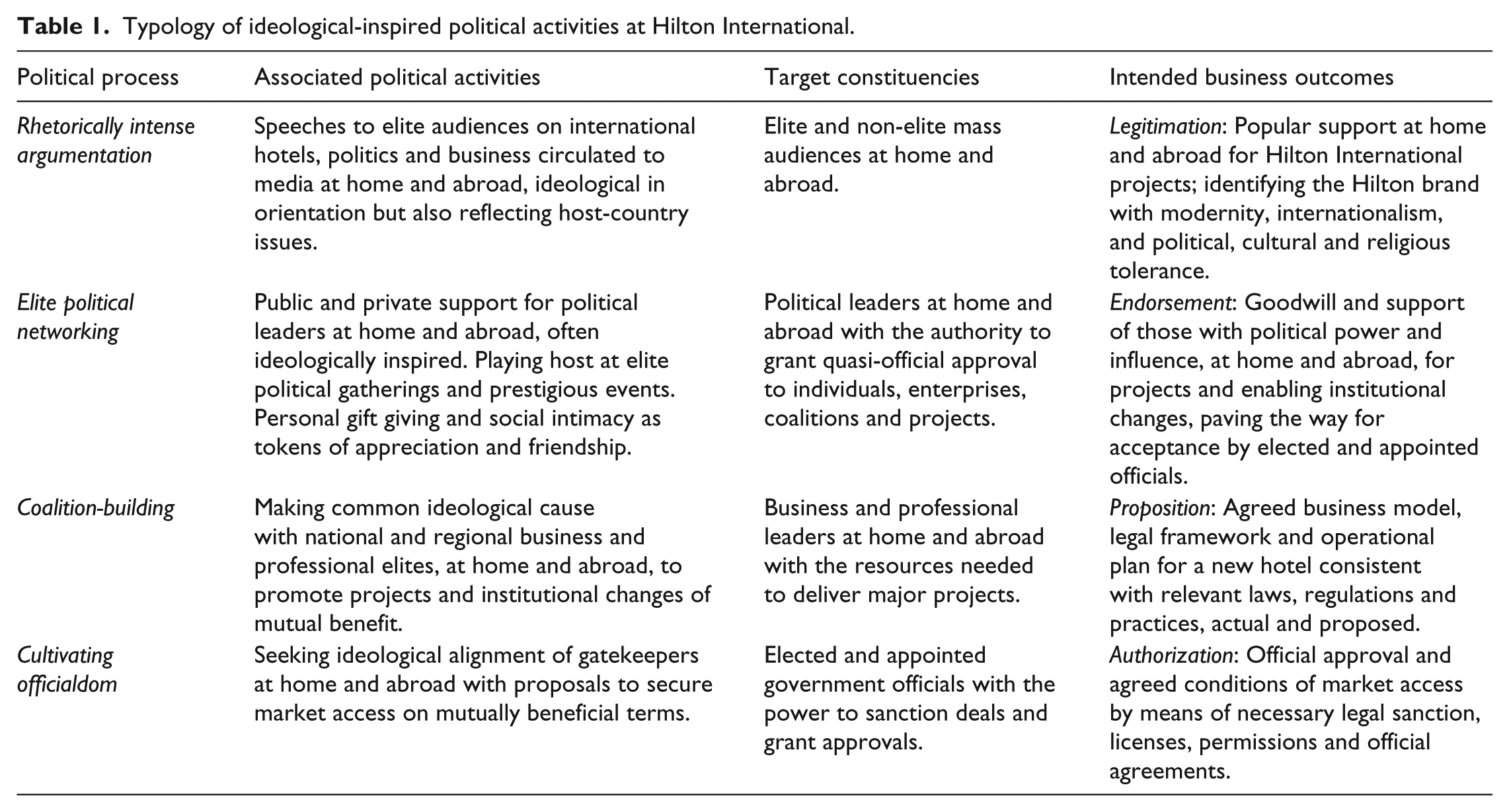
These three analyses enabled us to identify recurring thematic ideas across the body of material consulted, and to differentiate between genres of politicized activity undertaken at HI. As we became more absorbed in our data, additional readings and deliberation led to our discerning four key political processes practiced at HI, on the basis of which we coded our data (Berg, 2009). These processes are: rhetorically intense argumentation, elite political networking, coalition-building and cultivating officialdom, as summarized in Table 1. This table synthesizes our thematic interrogation of a large volume of documentary and oral history evidence relating to the emergence of HI as a global force, which we reflect upon below.
Typology of ideological-inspired political activities at Hilton International.
Political ideology and discursive construction at Hilton International
There is considerable variation within and between industries in the business models and practices of MNCs (Geppert et al., 2003a). In the hotel industry, the business model first propagated by HI and its rival Intercontinental Hotels remains the global industry standard (Dunning and McQueen, 1981; Quek, 2012). It is characterized by having multiple independently owned hotels managed under various types of contract by brand-owning MNCs, separating hotel ownership from management. This was a novel departure from the own-and-operate model pursued by HHC in the US (HIA, 1958a). For HI, the advantage lay in minimizing risks and capital requirements. For owners, it promised higher returns through prestigious branding, network access and the application of superior operational and marketing skills. Owners provided the capital needed to develop and build hotels to HI specifications, working closely with US and local architects and designers to retain the symbols of national cultural identity (Vaara et al., 2005). HI organized training for host-country staff and arranged well publicized launch events, financed by owners and attended by American celebrities and local elites. Having met pre-opening costs, owners leased their properties to HI, typically for 20 years, and as rent received two-thirds of operating profits, HI retaining the remaining one-third. HI accepted limited risk in providing working capital by securing loans from host-country banks. The leasehold contract predominated in the early years, but in time, under pressure from owners seeking a better deal, it ceded to a new form of management contract (DeRoos, 2010). Under this, owning companies recompensed Hilton by some combination of a smaller share of operating profits (say 10%) plus a fixed percentage of turnover (for example, 10% of room revenues and 5% of food, beverage and other revenues).
Political processes at HI
The contemporary world economic order regulated by international rules and managed by international organizations is the product of a long process of institution-building that began in earnest following the Second World War (North, 1990). National governments progressively have yielded sovereignty in favour of international rules governing trade, capital flows, property rights and business conduct (Kaplinsky, 2004). Widespread agreement that multilateralism reduces transaction costs and stimulates economic growth has been fundamental to globalization and the emergence of global corporations.
It would be a mistake, however, to assume that the relative ease with which MNCs operate nowadays in multiple national jurisdictions is the preordained outcome of anonymous economic forces. The political consensus that exists emerged fitfully, differentially, through a socially constructed process of argumentation and alliance-building in a world of competing ideologies and political turbulence (Behrman, 1971). When Conrad Hilton set course in the late 1940s to build a chain of hotels in major global cities, little could be taken for granted. There were few norms or expectations. The argument for multilateralism and international economic integration had yet to be fully articulated, let alone won. The evident need in country after country where he sought to establish a hotel was to find common ground, emphasize collective interests, adapt to the local environment, and overcome barriers to market entry (Hillman, 2003). In this endeavour, rhetorically intense argumentation, elite political networking, coalition-building and cultivating officialdom were complementary processes bound together by a unifying vision of HI as facilitator of world peace through international trade and travel. Hilton outlined this vision as follows: The time is not too distant when a traveller, circling the globe, will be able to stop at a Hilton hotel in almost any world city he may visit … These hotels express our ideal that any hotel anywhere should be more than just the center of the community. From an international aspect, the hotel can become the focal point for the exchange of knowledge between millions of people, citizens and visitors alike, who have gathered there because they desire to know each other better, trade with each other and live with each other in peace. (HIA, 1955: 4)
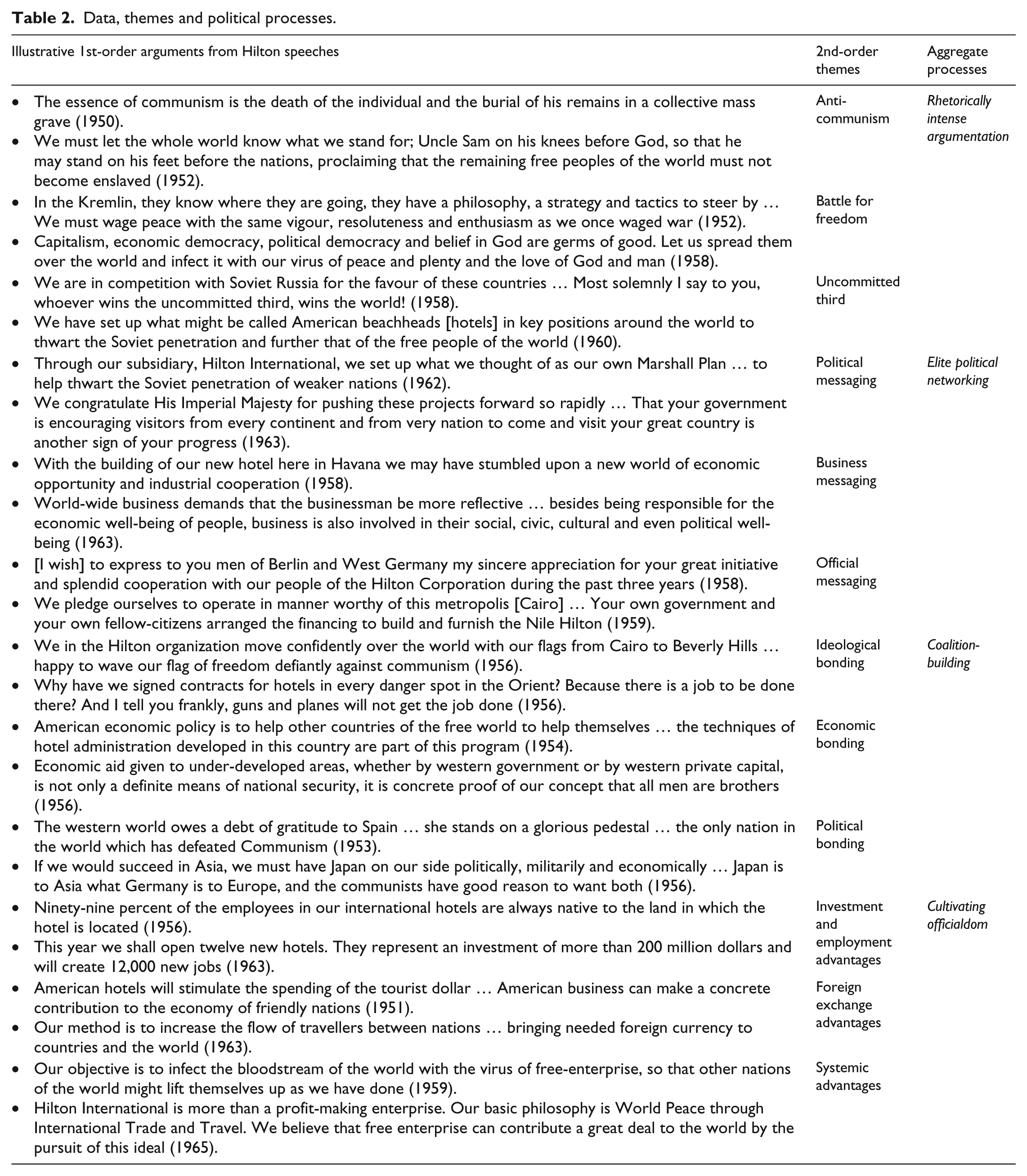
Hilton was an accomplished speechmaker who recognized the power of discourse in helping shape the thoughts and actions of influential actors on whom realization of his global vision depended. From the 62 speeches we analysed, we used the first-order arguments we discerned to distinguish 12 second-order themes, which map in turn to the four aggregate political processes identified above, as can be seen from Table 2 (Corley and Gioia, 2004). Rhetorically intense argumentation went beyond the anti-communist platitudes of the day to identify ideologically uncommitted nations at risk of becoming communist as the prime target for US intervention. Elite political networking was facilitated by persuading political, business and government elites at home and overseas that international hotels were an important weapon in the fight against communism, which Hilton saw as an ideological rather than a military struggle. In building the coalitions needed to deliver hotel projects, Hilton used his speeches to forge ideological, economic and political bonds of affiliation between host countries and the US government and business. These ideals were reinforced by spelling out to host officials, assiduously cultivated through sustained interaction by his managers, the practical advantages of investing in hotels for national economic development.
Data, themes and political processes.
Rhetorically intense argumentation
When interviewed in 1993, Curt Strand, former President of HI, characterized Conrad Hilton as primarily ‘a deal maker, an entrepreneur, a showman’ (HIA, 1993: 10). Strand observed Hilton closely for over two decades and considered him ‘a genius in knowing what would be good in the future’ with a genuine ‘sense of the dramatic, very much at home in show business … doing exciting things’ (HIA, 1993: 9). HI ‘was really his baby’, born of his imagining how modern American hotels might help the ‘free world’ vanquish communism (HIA, 1992: 3). Hilton, Strand maintained, was a man of political vision whose personal contribution to HI’s success was to attune its political strategy to the global forces driving economic and social change. Strand commented that by means of political nous, Hilton regularly ‘dominated the room, and then he dominated the deal’ (HIA, 1993: 9). On this reading, supported by a wealth of evidence, Hilton had the political and rhetorical skills required not only to respond to events but to shape outcomes to the benefit of HI. The pursuit of power is linked to sensemaking and sensegiving, and Hilton may be seen in this regard to position his ideologically inspired, rhetorically intense argumentation within transnational political discourses with which they were designed to resonate (Riad, 2005).
A mainstream Republican, who had served for a year as a representative in the New Mexico Legislature, Hilton believed in free enterprise, property rights, democracy, low taxes and non-intrusive government. He pragmatically courted influential politicians of all hues, including Richard Nixon, John F Kennedy and Lyndon Johnson (HIA, 1960a, 1962a, 1962b). He was a close friend of President Dwight Eisenhower (1953–1961) and ally in the fight against communism (Hilton, 1957). Rhetoric provides an effective vehicle for legitimacy-claiming, in this case setting a value-infused path designed to appeal to target constituencies in a period of political uncertainty (Suchman, 1995; Suddaby and Greenwood, 2005). In a series of 62 rhetorically intense political speeches delivered during the 1950s and early 1960s, he constructed a coherent, rationalizing argument that denounced communism as ‘the death of the individual and the burial of his remains in a collective mass grave’ and the Soviet Union as ‘a great spider – the evil men of the Kremlin feeling around the perimeter of their vast empire, probing incessantly for military or political soft spots to enmesh the world in their web of tyranny’ (HIA, 1950: 4). The US government was therefore correct, he claimed, to take the lead in resisting the threat posed by communism to the free world by economic and military means, particularly in Europe, where the battle was ‘to win the peace’ (HIA, 1952a: 3). The solution he proposed, widely reported in the media, was for private enterprise to join the US government in delivering the capital, expertise and organizational skills needed to bring prosperity to war-fatigued nations, eliminating the communist threat by demonstrating the superiority of free enterprise in generating growth and rising living standards (HIA, 1956a: 9).
Strategically, Hilton followed General Marshall, architect of the European Recovery Programme (ERP, commonly known as Marshall Aid), and Presidents Truman and Eisenhower in opposing the installation of new communist regimes in Europe, Latin America and Asia (Merrill, 2006; Stanford, 1982). He became nationally prominent as one of the small minority of business leaders actively to support US interventionism and the ERP (Djelic, 1998). As a rhetorically intense speechmaker, he added two personal elements to the anti-communist argument. First, he dissociated ‘the battle for freedom’ from the ideal of democracy. Communism, he believed, was evil at core because it was ‘faithless’, and as such was oppressive to the human spirit. It was wise, therefore, he reasoned, to recognize that any political system that defended faith communities was preferable to communism, which should be vigorously opposed by all religions (HIA, 1956a: 11–14). His own faith was Catholicism, and in General Franco, for example, he did not see a dictator to be sanctioned but a hero who delivered Spain from communism (HIA, 1953b: 3–4). Second, he positioned the international hotel industry as pivotal to any political strategy designed to divert countries from communism toward capitalism and identification with US interests. What was at stake was not simply ensuring that traditional allies remained true to capitalism, but also that the ‘uncommitted third’ of non-aligned countries, torn between socialism and capitalism, should ultimately side with capitalism (HIA, 1957). International hotels that embraced American tastes, technologies and values were crucial to this venture because they represented safe havens where locals might interact with business people, politicians and travellers from the US and allied countries. They thus had both practical value and politically symbolic significance in expressing hope for a brighter economic future (HIA, 1956a).
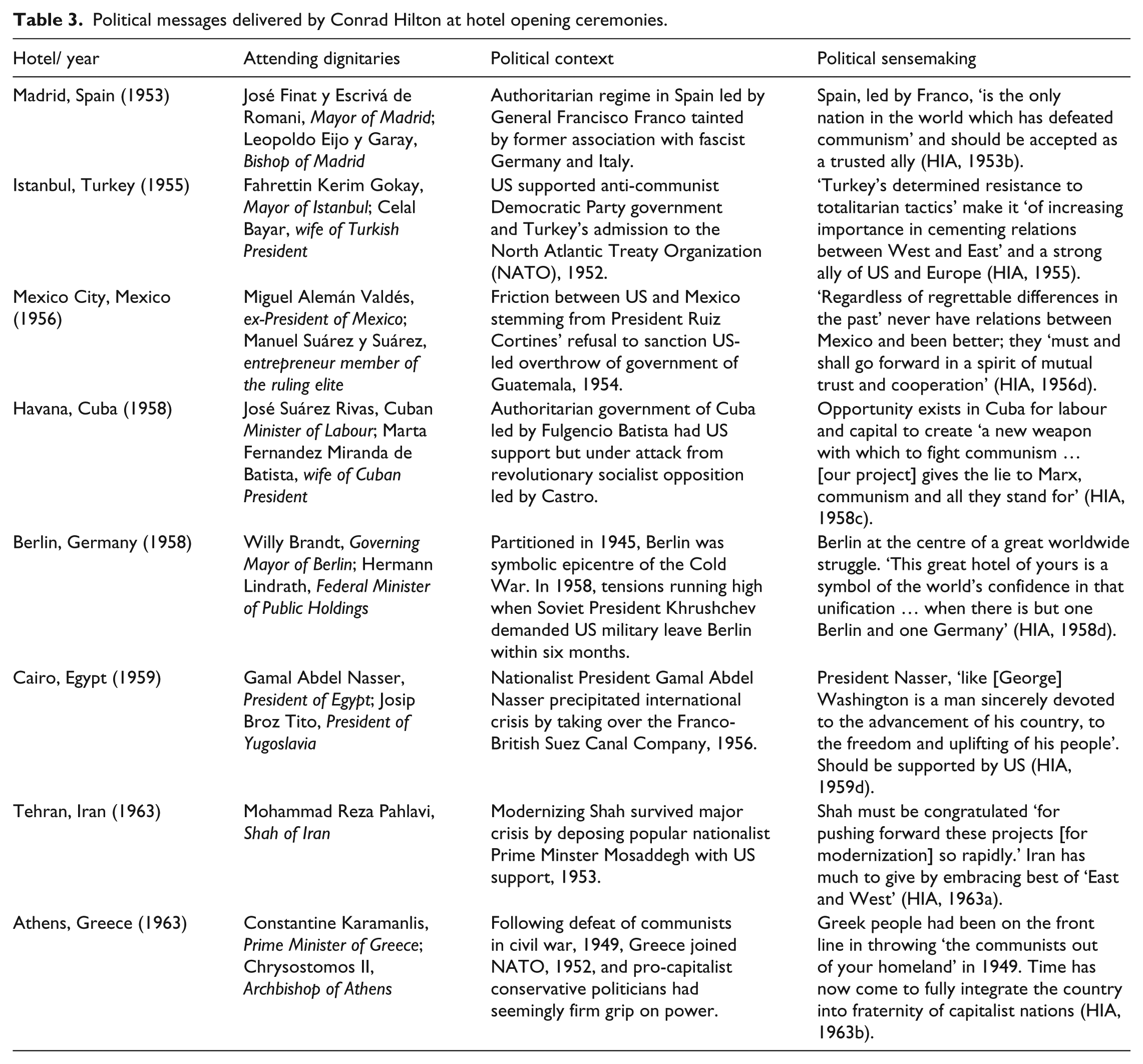
The ideologically imbued speeches given by Hilton at hotel openings were particularly important in communicating these messages. Launch events were symbolic events that often extended over three days (Brown, 1994), uniting national political, administrative and business elites with US cultural icons and officials flown in from the US (HIA, 1959a). The presence of stars of stage and screen added to the lustre of the openings and ensured they were reported in the local media (Rindova et al., 2007). The HI publicity department routinely supplied newspapers and magazines with Hilton’s speech, a 15-page corporate biography, a guest list, photographs, and interesting facts about the design and specifications of the new hotel (HIA, 1959b). These materials formed the basis of countless press reports and features, underlining that HI had a mission: to bring people together in pursuit of mutual understanding, peace and prosperity. Each speech, as Table 3 attests, was carefully attuned to the local, micro-level political context while chiming with transnational, macro-level political issues. Each sought to lessen institutional distance between home and host actors by emphasizing the broader ideological ‘battleground’ in which both were presumed to be engaged, suppressing national differences to emphasize macro-political commonalities (Contu and Willmott, 2003). After welcoming guests, there typically followed a long eulogistic section demonstrating knowledge and respect for the history and culture of the host nation before delivering incisively a macro-level, yet contextually sensitive political message. Ideology entails a ‘call to action … in a world-referencing discourse’ (Gouldner, 2013: 208–209). As self-appointed statesman, Hilton urged elite guests and everyday readers to consider the political choices facing them, inviting them to join the US in fashioning a new, economically integrated community of free-world nations. In this, business and ideological considerations went hand-in-hand. He succeeded at the same time in amplifying the HI brand, identifying it with modernity, internationalism, and religious tolerance, and enhancing its visibility and reputational benefit (Rindova et al., 2007).
Political messages delivered by Conrad Hilton at hotel opening ceremonies.
Elite political networking
Contemporary celebrity is a by-product of processes of mass communication (Gamson, 1994; Rindova et al., 2006). Hilton’s speeches and attendant publicity spearheaded his emergence as a celebrity and public figure during the 1950s, easing access to influential political figures in the US and globally. His mindset in courting top politicians was not narrowly instrumental. Rather, he knew that befriending Eisenhower, Nixon and Earl Warren, Chief Justice of the US, or meeting with heads of state like Franco (Spain), Nasser (Egypt) and Tito (Yugoslavia), or being photographed with esteemed figures like the British monarch, Elizabeth II, and Pope Paul VI, by symbolic association raised his personal stock and the value of the Hilton brand (Guthey et al., 2009; Holt, 2004). Those at the apex of society might extend goodwill by endorsing him, his company or a particular project, and others lower down the social hierarchy might assume he warranted support because of the authority conferred by high-level connections. These he cultivated assiduously through pledges of allegiance, personal gift giving, and hosting elite gatherings. Party political affiliation mattered little. Before Democrat John F Kennedy succeeded Eisenhower as President in 1961, for example, Hilton wrote to Kennedy’s father confirming that, although ‘from a strong Republican family’ he was ‘impressed … and completely happy that [his son John] was going to make good’ (HIA, 1960b). Likewise, when in 1963 he gifted copies of his book Inspirations of an Innkeeper to his ‘friends’, power trumped all else in the choice of recipients (HIA, 1967). The same rule applied when hosting elite events like the annual Presidential Prayer Breakfast, inaugurated in 1953, at which he sought to build consensus around shared faith-based values (HIA, 1954a).
The non-judgemental, inclusive approach to governing elites outside the communist bloc became fundamental to the credo of HI, handed down from founder to senior managers throughout the organization. HI’s enhanced visibility as it expanded across the globe accentuated ‘the need to be perceived as cooperating with like interests rather than acting individually’ (Hillman, 2003: 472). Paradoxically, therefore, although HI was an instrument of anti-communism, in all other matters its political stance was neutral. The imperative was to engage in elite political networking with core actors in their respective environments in order to build hotels and reach institutional settlements that benefited all parties – on the basis that, united against communism, they had much more in common than divided them. Engaging in local fields of power even-handedly addressed issues of institutional duality by reducing the apparent distance between home and host groups (Morgan and Kristensen, 2006). In Berlin, for example, Curt Strand was ‘greeted like a visiting statesman from the Western world’, receiving invitations to socialize ‘from all the city’s leaders and … military commanders’ (HIA, 1993: 2). Legislation was needed in the Berlin Senate to approve the hotel and establish the ground rules for its operation. Funding arrangements had to be agreed requiring sanction from the US ERP authorities and national political leaders, including Willy Brandt, Governing Mayor of Berlin and future Chancellor of the Federal Republic of Germany (HIA, 1964a). Here, as elsewhere, success depended upon collaboration and sensitivity to micro- as well as macro-politics (Ferner et al., 2012; Morgan, 2011). As Strand explained, Berlin was ‘a political problem more than an economic problem … a military situation, it was a hotbed of intrigue’ (HIA, 1993: 6). In the 1950s, in countries wracked by war, political complexity was commonplace. When, in 1961, HI entered an agreement to operate in Tel Aviv, Israel, for example, several Arab governments threatened to terminate operating contracts in their own countries. The argument in defence, eventually accepted by all, was premised on political neutrality. In a personal letter signed by Hilton, it was stated that HI did not favour any country, but without prejudice offered ‘a management service to the benefit of the country concerned’, taking ‘no part in politics’, its interests confined to travel and tourism (HIA, 1992: 17).
The combination of anti-communism with context-sensitive elite political networking worked to the competitive advantage of HI. First, it invested the enterprise with a magnetic quality such that it was inundated with joint venture propositions from around the world. The route to profitable growth lay in selecting the best on offer and avoiding costly mistakes (HIA, 1961). Second, as partner of choice in most cases, as in Iran where the Shah gifted a prime site and invested directly in the hotel, or Berlin and Istanbul where the US government provided ERP funding, HI was able to negotiate advantageous terms and conditions (HIA, 1959c). Third, the leverage secured through possession of abundant political capital legitimized HI activities and paved the way for success in country after country. The US ambassadorial service and other agencies of state frequently lent support when the going got tough, as in Athens and Rome (HIA, 1951; HIA, 1954b). Likewise, within the host country field of power, when obstacles had to be overcome, such as securing planning permission or relaxing currency controls, the intervention of well-connected local politicians often afforded the legitimizing ‘political cover’ indispensable to moving projects forwards (Hillman, 2003).
Coalition-building
Realization of Hilton’s vision of a chain of Hilton branded hotels across the world, without significant foreign direct investment (FDI), depended crucially on locating prime sites in major cities and access to host-country capital. This involved coalition-building with other ‘field dominants’ – home country elites who discerned financial advantage in working with HI to pursue shared objectives and jointly advantageous futures (McAdam and Scott, 2005: 17). The basic proposition was that by leveraging the HI brand and operational expertise, a new hotel within an international network could yield a far higher rate of return than if managed domestically. The premium earned could be divided to mutual advantage between the owner and HI. Many ventures were initiated by HI, but others were initiated directly by host-country nationals, as in Puerto Rico, Madrid, Havana and Tehran (HIA, 1960c). It was critical to the success of HI that it had the expertise needed to select and work closely with in-country partners. For 10 years, this was the job of executive vice-president John Houser, whose reports provide a graphic account of what was involved (HIA, 1958b).
The process was not narrowly calculative. The costs of constructing, equipping and launching a new hotel were detailed and return on capital estimated. This information, however, was not crucial in partner selection: subjective judgements gleaned from relational interaction mattered more. Of particular importance were reputational and social capital (Kostova and Roth, 2003; Kotha et al., 2001). Houser gathered intelligence from local lawyers, bankers, officials, politicians and businessmen to assess whether individuals and organizations had the capacities needed to deliver a major capital project when confronted with opposing forces (HIA, 1951, 1954b). Only those of high standing and dense social networks made the grade (Ghoshal and Bartlett, 1990). In Mexico, for example, the moving spirit behind the Continental Hilton in Mexico City was business tycoon Manuel Suárez, highly placed within the country’s political-economic ruling elite (HIA, 1952b). Similarly, in Greece, the Athens Hilton project was entrusted to the politically influential banker, Stratis Andreadis (HIA, 1963c). Once a contract was signed between HI and the future owner, Houser reported on routine business issues and less tractable political and bureaucratic problems. Often, as in Rome, London and Paris, where host-country powerholders dragged their feet in protracted non-decision-making, it took years to overcome entrenched political and regulatory issues (Bachrach and Baratz, 1963). HI could count on support from US diplomats, but in numerous cases lobbying and political interventions fell to host-country partners. It is unsurprising, therefore, that HI was keen to develop hotels with government agencies and non-profits with ready access to decision-makers, as in Istanbul (government pension fund), Havana (catering union), Tehran (Pahlavi Foundation) and Berlin (municipal government) (HIA, 1960c). In these cases, political opposition and bureaucratic resistance were more easily overcome and projects delivered relatively quickly. As Table 4 confirms, the degree of resistance encountered was typically higher in Europe, the Middle East and Africa (EMEA), leading to much longer project development times.
Mean project delivery times by ownership and location, 1949–1967*.
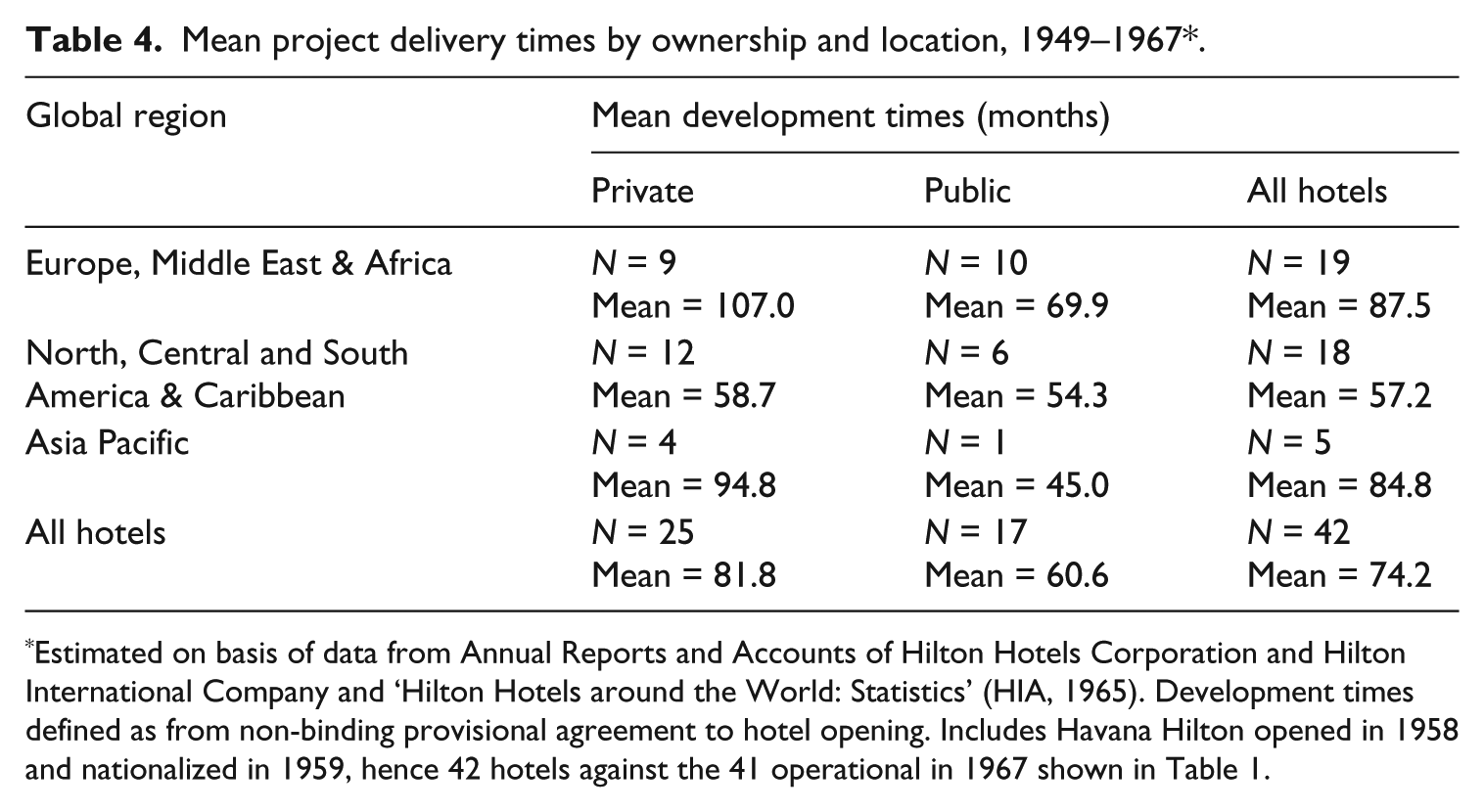
Estimated on basis of data from Annual Reports and Accounts of Hilton Hotels Corporation and Hilton International Company and ‘Hilton Hotels around the World: Statistics’ (HIA, 1965). Development times defined as from non-binding provisional agreement to hotel opening. Includes Havana Hilton opened in 1958 and nationalized in 1959, hence 42 hotels against the 41 operational in 1967 shown in Table 1.
Cultivating officialdom
The problems encountered by HI in getting projects off the ground in EMEA were severe in the 1950s because of nationally variant combinations of economic privation, political instability and resistance to US corporate encroachment in domestic economies. National governments faced severe resourcing constraints, and especially the US dollars needed for vital imports (Findlay and O’Rourke, 2007). The ERP eased the situation in beneficiary countries, but currency controls, import licensing and other centrally imposed restrictions remained the norm down to the 1960s. Hotel-building was not a priority, and in only two countries – Turkey and Germany – was HI successful in securing ERP funds to finance its projects. These countries were in the front line in the fight against communism, and building a Hilton hotel gave symbolic expression to the Truman doctrine of US resistance against Soviet territorial encroachment (Wharton, 2001). Elsewhere, where there were higher priorities, as in Britain, France and Italy, there was evidence of recipient reluctance (Clark and Geppert, 2006). Here, political opponents and government officials conspired to create delays in planning approvals, operating agreements and licenses (Bachrach and Baratz, 1963). In Italy and France, there was deep-seated resistance to collaborating with US firms in new hotel construction. In such cases systematically cultivating officialdom was vital to circumventing obstructionism (Stern and Westphal, 2010).
The HI business model was beneficial in negating the worst effects of economic nationalism, as ‘rather than assume the role of invaders intent on siphoning off all the profits to the United States, Hilton join[ed] forces in business fellowship with foreign entrepreneurs’ (HIA, 1956b: 14). Its ‘unique philosophy’ was to hasten the interpenetration of capitalist elites to create a bulwark against communism and the social and political capital needed to realize its corporate vision. This meant forming alliances with entrepreneurs and industrialists who had ready access to government officials responsible for making and enforcing institutional settlements (Hillman and Hitt, 1999). In Rome, for example, the principal ally was Aldo Samaritani, Director General of the Società Generale Immobialare, the leading Italian property company. As early as July 1951, Houser reported to Hilton he had visited government officials with Samaritani, transported plans by truck and put on displays. There had been meetings with cabinet ministers, and they were ‘targeting’ Prime Minister Alcide De Gasperi. US officials responsible for administering the ERP were reputedly coming to future meetings ‘to bump their heads if there is any more sissy stuff,’ as Houser bluntly put it (HIA, 1951). Yet, as in many other countries, negotiations dragged on for years, delaying the opening of the Rome Hilton until June 1963.
How profit is distributed is pivotal to the smooth running of cross-border business (Morgan, 2011). A major stumbling block in EMEA in the 1950s was HI’s insistence that profits might freely be remitted to the US in dollars, which often required a special decree to be issued by the financial authorities, as in Spain (HIA, 1956c); or an innovative solution found, as in Egypt, where the Minister of Finance agreed that HI could ‘withhold at source’ by depositing in New York dollar payments made by customers using American Express or similar means of payment (HIA, 1992: 16). In time, as financial pressure eased and the international economy expanded, dollar convertibility became a lesser problem. As tourism and business travel boomed, dollars flowed and international hotel-building moved sharply up the priority order of governments. There was a powerful demonstration effect as early movers in the tourism industry, like Spain and Puerto Rico, reaped the benefits. Other countries began to compete, and by the early 1960s sweeteners such as ‘tax exemptions, guaranteed return to investors, donation of site, waiver of import duties, guaranteed dollar conversion and other incentives’ became commonplace (HIA, 1964b: 6). International norming brought institutional convergence, making negotiations simpler, cutting the time needed to bring projects to fruition. It was at this point that HI, as a chief first mover with a powerful brand, really began to reap the benefits of earlier political endeavours.
Discussion
At the outset of this article, we posed two research questions pertaining to the political processes in which core actors engaged in the discursive construction of the global hotel industry, and to the adaptation of meaning within the varying political settings within which HI operated. The business model initiated by HI was innovative and novel. Hence, in answering the first question, it is important to stress that we are not dealing with a single process. The construction of a global industry necessarily involved multiple processes. We propose that the astute adoption by skilled social actors of rhetorically intense argumentation, elite political networking, coalition-building and cultivating officialdom enabled them to interact to good effect in selected localities while demonstrating that they had the interests of indigenous elites, governments and communities at heart. According due recognition to local actors empowered the former while casting HI in an altruistic light, affording political cover and legitimacy (Fligstein, 1997; Hillman, 2003; Maclean and Harvey, 2016). In history, emphasis is often laid on the role of charismatic individuals, to the detriment of the teams of individuals they had at their disposal who are often overlooked. Hilton may have ‘dominated the room, and then … the deal’ (HIA, 1993: 9), as Strand put it, yet it is important to recognize the influence of social interaction within strategic action fields, and hence the vital role played by core teams of home- and host-country actors whose manifold contributions were vital to founding the global hotel industry as it emerged and exists today. Hilton could not have achieved this alone. He was in this sense primus inter pares, joined in the task by numerous field dominants at home and abroad, underlining Fligstein’s point that: … actors (decision makers, managers, leaders, or elites) have many constituencies to balance off and they must continuously be aware that they have to produce arrangements that induce cooperation with both their allies and opponents … Rational actor models … miss the creativity and skill of individuals, as representatives of collectivities, to operate vis-à-vis other actors to produce, reproduce, and transform institutional arrangements. (Fligstein, 2001: 111, emphasis added)
In addressing the second question, we suggest that the local was recognized at HI as a vital, and specific, domain. Ideology is often experienced as universalizing, presenting ‘partisan, controversial, historically specific values as true of all times and all places’ (Eagleton, 2013: 9). The broad ideological sweep of the rhetoric employed at differing hotel openings, emphasizing common point and purpose at the macro-level, was therefore nuanced to suit the specific micro-level institutional contexts in which hotels were situated, using different accounts as vocabularies of motive in different situations while expressing due respect for the political context and cultural heritage of the host community. Thus, although the discourse was modulated to encompass political diversity and institutional pluralism, the basic ideological template remained constant. It resonated with a broader macro-political discourse informed by a pronounced anti-communist critique, highlighting perceived common ground between different political rationalities which, in the case of the ‘uncommitted third’, it sought to augment. In this way, ‘microlevel communication and action [were designed to] yield macrolevel outcomes’ (Bitektine and Haack, 2015: 69).
Our study adds to the literature on the role of power and political discourse in MNCs (Clegg et al., 2006; Geppert and Dörrenbächer, 2016; Geppert et al., 2016; Hardy and Phillips, 1998; Levy, 2008; Morgan and Kristensen, 2006) and particularly to the literature on political strategizing by MNCs by exploring the role of ideology in shaping an organizational field (Fligstein, 2001; Hillman, 2003; Hillman and Hitt, 1999; Hillman et al., 2004; Maclean et al., 2014; Simons and Ingram, 1997). Our case analysis shows how the boundary-shaping of an MNC ‘depends on the discursive justification used to rationalize it’ (Green, 2004: 653). Organizational fields are not predetermined but emerge from the intentional deployment of meaning by principal actors. We shed light on the nature of MNCs as combinations of micro-political systems located in interactive fields of power, where power is distributed across home and host actors engaged in skilful political manoeuvring to increase their stock and further their interests. We contribute to this literature by revealing how, through astute political sensemaking and sensegiving, macro-political discourse which is ideological and hence likely to be experienced as universalizing may be allied to micro-political practices in the transnational social space, in this way addressing the unique situatedness of each locality in question (Bitektine and Haack, 2015; Morgan, 2011).
In this regard, our main contribution to the literature on the role of politics and discourse in MNCs is to demonstrate how the very foundation of a global industry may be politically and ideologically inspired. Our research reveals that overseas expansion can have a dual motivation – business and ideological – with Hilton acting as statesman on behalf of the US with the backing of government. This is an important and hitherto unexplored aspect of the literature, providing an overtly ideological context for FDI. Fligstein (1997, 2001) emphasizes the importance of ‘social skill’ in fields in general. Our contribution to the theory here is much more specific acknowledgement of the importance of political ideology as a particular ‘social skill’. The growth of the global hotel industry was bound up with Hilton’s vision of expanding the boundaries of the pro-western ‘free world’, achievable through discursive dissemination and enactment (Santos and Eisenhardt, 2009). Ideology connects belief with action (Simons and Ingram, 1997). The extraordinary development of HI, often in politically contested terrain, where constituency-building might seem initially unpromising, attests to the agential power of ideological sensemaking that reaches beyond objectives of persuasion and co-option to ‘create entire new systems of meaning’ by promoting a new order (Fligstein, 2001: 106; Morgan and Kristensen, 2006). Thus, a global hotel industry imbued with the aim of fostering world peace by bringing together dignitaries, business travellers and tourists may be seen to be discursively constructed and ‘talked into existence’ (Weick, 2009).
What detailed scrutiny of this discursive political activity demonstrates, above all, is the degree to which transnational institution-building and the global industrial order, far from emerging spontaneously, have been shaped by communication and contests (Behrman, 1981; Clark and Geppert, 2006). Politics, Clegg (2017) asserts, is the very business of MNCs, and ideas the primary form of weaponry (Eagleton, 2013). Political struggles are part-and-parcel of the global diffusion of rationalized management templates by principal social actors, which have helped to determine how international business has been ‘won’. The thrust of our argument is that one cannot fully understand the contemporary scene and rules of the game as currently operating without reference to the formative historical period in the quarter-century after the Second World War (Maclean et al., 2016). Our analysis shifts the emphasis away from the overly reductive notion that contemporary global capitalism emerged from the endeavours of American corporate leaders bent on exporting the American model (Djelic, 1998). What we reveal here is rather the development of a new model responsive to local circumstances. In doing so, we advocate a bigger picture according to which the institutional convergence vital to the full flowering of MNCs like HI was necessarily wider than exporting a pre-existing model, involving multiple actors across varying geographies whose contributions are often unsung. While led by the US, and in HI’s case by a talented, charismatic leader, he enlisted and inspired elite actors within home and host nations. Initially slow and politically fractious, the combined effect of rhetorically intense argumentation, elite political networking, coalition-building and cultivating officialdom was progressively to reduce barriers to market access. In the process, the conditions were created for the emergence of an interconnected transnational business elite insistent on free markets yet supportive of national differences in governance and culture (Carroll, 2010).
Conclusion
This article shows the creation of a global MNC in a nascent industry to be a dynamic, politically infused project entailing discourse, struggle and negotiation (Levy, 2008). We concur with Geppert and Dörrenbächer (2014: 237) that ‘power is the result of continuously socially constructed dynamic relationships among key actors, who make use of existing power resources and, in so doing, stabilize and destabilize established power structures’. Actor centrality changes over time, and must be regularly renegotiated. Hotel propositions were received differently depending on local political contexts, host-actor receptivity spanning a broad spectrum from enthusiasm to obstructionism. All negotiations required discursive and relational skills to achieve the desired result, especially when host-country actors sought to block agreements by leveraging their own sources of power (Bachrach and Baratz, 1963). This highlights the importance of social interaction within strategic action fields, directing attention to the need to consider how legitimacy is accrued (or eroded) by the manner in which MNCs approach their non-market environments (Bouquet and Birkinshaw, 2008). Aligning the interests and ideologies of local field dominants with those of core powerholders in the MNC is a political meaning-making endeavour that involves producing shared meaning for home and host stakeholders alike.
The limitations of this article include its reliance on a single case example. This raises the question of whether it is possible to generalize with regard to the development of a global industry on the basis of a single case. We suggest that HI represents a unique case worthy of consideration in its own right (Eisenhardt, 1989). Our study embraces hotel construction in far-flung, politically variegated corners of the globe, including EMEA, the Asia Pacific region and the Americas, in assorted cities like Berlin, Istanbul, Tehran, Mexico City and Havana, which Hilton sought to unite through a common perspective. It shows how a genuinely multinational industry unfolded and came into being in the years following the Second World War (see Tables 2 and 3). Generalization is permissible, we argue, because the rationalized management template initiated by HI proved formative to the global industry and survives, in essence, to this day (see Clegg, 2017). Where HI led, others followed, its innovations laying the foundations for the industry as presently constituted, planting seeds that have grown into large and healthy plants.
Avenues for future research might include focusing on the use of ideological rhetoric in managing ambiguity in MNCs (Dörrenbächer and Geppert, 2009). The authoritative discourse employed at HI in disparate contexts took seriously the battle for hearts and minds in an unpredictable world, striving to reduce ambivalence through the use of ‘great themes’ that set a clear political direction while accommodating local diversity (Riad, 2005: 1549). At a time when the geo-political uncertainties confronting MNCs are rising and political commitment to globalization is vacillating, further research might probe the role of discursive ideological sensemaking in MNCs in addressing this uncertainty.
Footnotes
Acknowledgements
The authors wish to express their gratitude to Dr Mike Young, archivist at the Hotel Industry Archive at the University of Houston, Texas, USA, and Dr Andrew MacLaren, for research assistance. We are also grateful to the Special Issue Guest Editors, Stewart Clegg, Mike Geppert and Graham Hollinshead, and the three anonymous Human Relations reviewers for their thoughtful and perceptive comments throughout the review process.
Funding
This research received no specific grant from any funding agency in the public, commercial or not-for-profit sectors.