






Abstract
The notion of job quality has been at the forefront of academic and policy-debates, best crystallized in the pursuit to create more but also better jobs as a route to economic prosperity. Motivated by the need to better understand how occupational-level structures shape job quality, we derive predictions from the occupational closure literature to explore how occupational licensing – the strongest and fastest growing form of closure – shapes job quality in Britain. Using nationally-representative data over several decades, we find that the effects of licensing tend to be confined to jobs in the most stringently-licensed occupations, with such jobs having higher pay, lower job insecurity, greater opportunities for skill-use, and higher continuous learning requirements – relative to jobs in similarly-skilled unlicensed occupations. Of particular concern, however, is the finding that jobs in stringently-licensed occupations are also characterized by significantly lower task discretion and significantly higher job demands. Overall, our study adds a new dimension to job quality debates by highlighting the role of emergent occupational-level institutional structures in shaping job quality, and further, that despite the overall positive effects closure strategies have, they may come at a cost to certain critical intrinsic dimensions of job quality.
Introduction
Public interest in job quality has intensified in recent years. While employment in Britain is at record levels, there is widespread concern that many jobs are not of sufficient quality to maintain a productive and thriving society, culminating in the government commissioning a review into the issue (DBEIS, 2017). The centrality of job quality to worker and societal wellbeing is underpinned by a stream of academic studies that have shown it to be an important determinant of labour market participation and transition rates, productivity, turnover, absenteeism, job satisfaction, and happiness (Dolan et al., 2008; Kalleberg and Vaisey, 2005).
As the issue of job quality rises higher up the policy agenda, there has been a renewed interest in understanding how it is shaped by the wider social and institutional structures in which jobs are located – with an often explicit aim of deriving policy interventions. The focus has largely been on macro-level structures relating to product markets, financial systems, and employment regimes (Doellgast et al., 2009; Esser and Olsen, 2011; Gallie, 2007; Holman, 2013) and organizational-level structures such as ‘high road’ versus ‘cost minimization’ business models, HRM practices, and the role of unions in the workplace (Findlay et al., 2017; Hoque et al., 2017; Simms, 2017). At the same time, research on national and international trends routinely demonstrates that there are persistent and growing divisions in job quality (especially pay) across occupational categories (Felstead et al., 2015; Gallie, 2015; Holman and Rafferty, 2018; Vidal, 2013; Williams, 2017). However, all these strands in the job quality literature have curiously overlooked structures pertaining to the occupational-level that may reinforce or ameliorate the well-known occupational differences in job quality. This is the research gap we seek to address.
Drawing on occupational closure theory (Johnson, 1972; MacDonald, 1985; Weeden, 2002), we argue that job quality is also shaped by institutional structures pertaining to the wider occupational environment in which jobs are embedded. Through the collective upgrading of an occupation’s position in the stratification system, incumbents can exercise some agency in job quality outcomes. Since occupational closure strategies (strategies associated with institutional and legal barriers to enter occupations) have repeatedly been shown to be successful in creating and capturing ‘economic rents’ for occupational members (additional pay on top of what ‘would have’ prevailed in the counterfactual occupational labour market without such barriers), it is possible that gains might also be extended to non-pay aspects of job quality.
We empirically examine this thesis by exploring how occupational licensing – the enactment of legal barriers that govern entry to occupations and subsequent conduct within them (Kleiner, 2006) – affects the following dimensions of job quality: pay, job insecurity, opportunities for skill-use, continuous learning requirements, task discretion, and job demands. Licensing now represents a sizeable and rapidly growing segment of the labour force across countries, with the latest estimates showing that occupational licensing covers nearly one-quarter of all workers in the EU28 (Koumenta and Pagliero, 2018) and almost one-third of all workers in the United States (Gittleman and Kleiner, 2016). While the generally positive effect of licensing on pay is well-documented, little is known about its potential to shape job quality more broadly.
Defining job quality
Job quality by definition is rather nebulous. Orthodox economics approaches commonly treat pay and benefits as synonymous with job quality (Goos and Manning, 2007; Nickell, 1982), while dual and segmented labour market theories developed by institutional economists highlight contractual status, job stability, and development opportunities offered by the job as equally important (Doeringer and Piore, 1985; Kalleberg et al., 2000). Sociological approaches, with their intellectual roots in theories of the labour process and occupational class, have focused on prospects and security, skill development, and control over work processes (Braverman, 1974; Gallie, 2007; Goldthorpe and McKnight, 2006; Vidal, 2013). Organizational psychologists’ emphasis has been on the quality of working life in terms of more intrinsic aspects and have shown how specific aspects of work organization (e.g. autonomy and job demands) are important determinants of job-related wellbeing and physical health (Hackman and Oldham 1980; Warr, 1987).
Job quality is now widely recognized as a multidimensional concept, reflecting aspects of these three disciplines (Gallie, 2007; Green et al., 2013; Muñoz de Bustillo et al., 2011). The multidimensional notion of job quality is also widely reflected in current policy definitions (Burchell et al., 2014), most notably in the European Union’s labour market strategy and the ILO’s and the OECD’s policy invocations (Cazes et al., 2015; Eurofound, 2002; ILO, 2012). From a UK perspective, concerns about job quality culminated in the commissioning of the Taylor Review of Modern Working Practices (DBEIS, 2017), which also recommended taking a multidimensional approach, emphasizing the following six aspects (DBEIS, 2017: 12): wages, employment quality, learning and development, working conditions, work–life balance, and consultative and collective representation.
Accordingly, we also adopt a multidimensional definition of job quality. We delimit our focus to the first four of these facets to ensure a certain degree of theoretical parsimony in deriving expectations about occupational licensing. In doing so, we follow Grote and Guest (2017: 157), who in their typology of job quality, refer to these four facets as the ‘individual and the job’ domains of job quality. As the latter two facets to a greater extent fall into the ‘life outside work’ and the ‘context in which work occurs’ (i.e. the organization) domains respectively, we exclude them on the basis that their relationship to an occupation-specific phenomenon is likely to be weak. This further enables us to stay true to the focus of this study on job quality rather than organizational aspects of job quality. In total, we examine six indicators covering these four dimensions, namely pay, job insecurity, opportunities for skill-use, continuous learning requirements, task discretion, and job demands. In what follows, we next explore the ways in which a job being covered by an occupational license might shape its quality along these dimensions.
Theoretical expectations
Sociological theories of the professions provide a useful starting point to understanding how occupational licensing might relate to job quality. The functionalist perspective envisions professionals as selfless experts who possess a defined body of specialist knowledge, preserve professional values, and carefully screen new entrants, barring those whose skills or character will compromise quality (Freidson, 2001). The assumption of ‘unbiased gatekeepers’, however, was questioned as early as 1776 in Adam Smith’s the Wealth of Nations, and later most influentially by Max Weber in the 1920s, both of whom depicted the professions as groups of self-interested actors engaged in the advancement of their economic and social interests.
Occupational closure theory best captures these arguments. At its heart is the notion that the enactment of institutional barriers to enter occupations will affect the labour market position of incumbents (Larson, 1977; Sørensen, 2000). The drive to achieve occupational closure begins with the realization that an occupation’s working conditions can improve via collective action. According to Weeden (2002), closure is achieved through three processes, namely restricting the supply of labour into an occupation, creating and solidifying demand for the occupation’s output, and securing the occupation’s territory through task demarcation. Supply-side restrictions are usually but not exclusively on the basis of educational credentials and rest on the premise that alternative ways to guarantee quality are costly or onerous. From the demand side, occupations need not only ensure a steady demand for their work, but also claim a monopoly of this demand over alternative suppliers. This is achieved via the enactment of firm occupational boundaries such that substitutes for the work produced by the occupation are eliminated. Weeden (2002) draws parallels between such activities and unions’ attempts to channel consumer demand to products or services produced by unionized labour.
Occupational licensing is one of the most powerful mechanisms in achieving closure, not least owing to the active role that the state plays in granting and enforcing licensing status. 1 While other forms of closure such as certification and educational credentialing are voluntary in nature, only licensed occupations have a legal underpinning such that only those that meet the criteria can practice (or undertake certain occupational tasks). To achieve the supply-side restrictions described by the theory, occupations engage in boundary-setting activities over occupational tasks and commit considerable resources in their attempt to persuade the public, the state, and legislators that licensing is in the public interest. In the early 1990s, for example, the British Medical Association was successful in convincing the state to regulate osteopathy and chiropractors by positioning these occupations close to conventional medicine (Shackleton, 2017), while intense lobbying efforts and jurisdictional claims over topographical knowledge have ensured London’s licensed taxi drivers preserve their monopoly of ‘ply for hire’ over ‘private hire’ taxis (Niemietz and Zuluaga, 2016). From the perspective of employers, attitudes toward licensing are likely to be more favourable than toward unions, since it creates perceptions of higher quality output among consumers without the risks commonly associated with unionization (e.g. industrial action).
Drawing on the insights from closure theory, we can form some propositions with regards to the relationship between licensing and job quality. With regard to wages, the tighter barriers to occupational entry are expected to reduce the supply of practitioners in the occupation and drive wages up. Empirically, the increase in the wages of incumbents has been repeatedly shown to be a direct outcome of the closure and rent-seeking processes associated with licensure, albeit with considerable heterogeneity depending on the occupation and the characteristics of the licensing regime (Kleiner and Krueger, 2013; Koumenta and Pagliero, 2018; Koumenta et al., 2014). Therefore, we also expect to find a wage premium associated with licensing:
Hypothesis 1: Occupational licensing will be positively associated with higher wages.
While the overwhelming focus of the closure literature has been on its effect on wages, as Weeden (2002: 57) suggests, ‘much of the same logic could be applied to nonmaterial rewards’, alluding to the possibility some of the ‘pay-off’ from closure might also be in the form of non-wage compensation. Specifically, if closure theorists are correct, then it is possible that licensing enables occupations to advance other aspects of job quality. Such an effect is not uncommon in studies of non-licensing types of closure, for example unionization (Bryson and Green, 2015; Hoque et al., 2017). It is also not uncommon for professional associations of licensed occupations to take an active role in dictating skill requirements and exercising control over the nature of work activities such as learning and development, task discretion, and job demands – either directly or through their representative functions in state-appointed regulatory bodies. The British Dental Association, for example, recently launched a study into stress and burnout in dentistry that results from increased job demands, with the intention of submitting policy recommendations to the state regulator (British Dental Association, 2018).
Starting with job security, we expect a positive association since entry to the occupation is controlled. In this respect, occupational licensing can be viewed as a form of career insurance in that, by prohibiting aspiring practitioners from entry, it shields incumbents from competition. Empirical research largely confirms the negative effect of licensing on labour supply. Carroll and Gaston (1981) show that licensing lowers the total stock of electricians, dentists, plumbers, real estate agents, optometrists, sanitarians, and veterinarians in the USA, while Kleiner (2006) finds a 20% faster growth rate in employment in states in which librarians, respiratory therapists, dieticians, and nutritionists are not licensed compared to states where they are:
Hypothesis 2: Occupational licensing is associated with higher levels of job security.
The key impetus for licensing occupations rests on the assumption that the resulting higher investments in training will affect the skill stock of practitioners within an occupation. Empirically, this has been shown to be the case in various studies (Bryson et al., 2011; Gospel and Thompson, 2003; Koumenta and Pagliero, 2018). It is also expected that legislators set the skill requirements such that there is a direct link between the skills that practitioners acquire and how these are applied to their job. Therefore, we would expect licensing to have a positive effect on opportunities for skill-use – even relative to similarly-skilled unlicensed occupations. Similarly, the effect of licensing on continuous learning is expected to be positive since it provides a de facto incentive for (or even compels) incumbents to engage in human capital acquisition. For instance, the General Pharmaceutical Council requires that pharmacists and pharmacologists are subject to an annual ‘licensing’ process that includes the completion of a continuous professional development portfolio, while social workers and those working with children are subject to a three-year ‘licensing’ cycle that entails mandatory post-licensing training and learning:
Hypothesis 3: Occupational licensing is positively associated with opportunities for skill-use.
Hypothesis 4: Occupational licensing is positively associated with continuous learning requirements.
Turning to task discretion and job demands, since the impetus for licensing is to address information asymmetries associated with the production of goods and services for which quality is hard to observe (Law and Kim, 2005; Spence, 1973), we would expect its incidence to be associated with high autonomy work. Occupational insiders – as the gatekeepers of occupational knowledge and expertise – are likely to be able to exercise more agency in their choice of work methods, work routines, and pace of work compared to their non-licensed counterparts. From a closure perspective, licensing confers professional associations the authority to control the nature and scope of work. Sociologists have consistently shown that workers in professional occupations have the power to demarcate their job tasks and are well-placed to resist work intensification associated with technological change (Abbott, 1988; Larson, 1977). Since licensing reinforces the professional status of occupations and their monopoly over knowledge (even if they are not traditional ‘professions’), the expectation would be that it is also associated with higher levels of discretion than comparable unlicensed professions:
Hypothesis 5: Occupational licensing is positively associated with task discretion.
Hypothesis 6: Occupational licensing is negatively associated with high job demands.
However, licensing is a dynamic process in that its intensity varies across occupations, so in modelling its consequences for job quality it is important to account for such variability. According to closure theory, occupations are likely to differ in their capacity to establish barriers restrictive enough to preclude entry (Larson, 1977; Weeden, 2002). Licensing is only likely to have a strong ‘closure’ effect on job quality if the skill and education requirements to practice are set at a high level, both in terms of the number of entry hurdles but also in relation to the substantive nature of these hurdles. Fernie (2011), for example, in her study of the introduction of licensing within the UK private security industry, finds that the licensing criteria were so low that they did not have a profound entry effect other than barring individuals with a criminal record. Humphris and Koumenta (2015) conclude that the different magnitude of the licensing effect on wages and employment they observe when examining licensed nursery workers and security guards can be explained by the stringent licensing regime for the former but not for the latter. The magnitude of the closure effect is likely to be even stronger where, in addition to educational credentials, licensing regulations make stipulations regarding formal continuous professional training and regular re-testing as a condition to maintain one’s license to practice (Kleiner, 2015; Koumenta and Pagliero, 2018). As such, we expect the effect of licensing on job quality dimensions to be stronger in more stringently-licensed occupations:
Hypothesis 7: The effect of licensing on job quality dimensions is stronger in more stringently-licensed the occupations.
Data and analytical strategy
The Skills and Employment Surveys
To test our hypotheses, we draw on the Skills and Employment Surveys (SES) (Felstead et al., 2014). It is the most authoritative and commonly-used survey on job quality research in Britain. SES has been providing nationally-representative cross-sections of the British labour market (i.e. England, Scotland, and Wales) since 1986, with comparable cross-sections for the years 1992, 2001, 2006, and 2012. Occupational regulation information comes from the UK Database of Regulated Occupations (DRO). The compilation of the DRO was commissioned by the UK Commission for Employment and Skills (see Bryson et al., 2011) and later updated by Koumenta et al. (2014) for the UK Department for Business, Innovation and Skills. The DRO is a hand-collected database put together through desk research on the regulatory status of the 353 4-digit occupation unit groups defined by the Office for National Statistics’ Standard Occupational Classification system (SOC 2000). For each occupation unit group, the database contains information such as the type of regulation by which it is covered (four dummy variables including unregulated licensing, accreditation, certification, and registration 2 ), the stringency of the regulation (described in more detail below), and the date when the regulation covering that occupation was enacted, among other detailed characteristics for each occupation. The DRO assigns the ‘licensing’ status to occupations when these are subject to legal requirements postulating that the worker must meet prescribed standards of competence. 3 Given that the SES also classifies occupations to 4-digit SOC 2000, we map information from the DRO into the SES at this occupational-level. We further define an occupation as being licensed if the DRO deems all job titles in the unit group were covered by licensing legislation at the time of an SES survey year, resulting in 53 out of the total 353 4-digit occupational codes being classified as licensed by the final SES survey year. We examine all workers in the SES aged 20 to 60. Once excluding cases with missing data on the variables of interest, our final sample sizes from the pooled cross-sections in the multivariate analyses vary depending on the dependent variable of interest (as not all are asked in every wave), ranging from around 13,000 to 18,000. 4
Measures
We examine a total of six job quality indicators that cover the four dimensions of job quality in which we are interested, namely wages, job insecurity, opportunities for skill-use, learning requirements, task discretion, and job demands. Taking each indicator in turn: (1) Wages are hourly wage rates obtained by dividing usual pay (including overtime) by usual hours (including overtime). Wages are deflated to the 2012 CPI and the natural logarithm is taken. This variable was collected in all survey years. (2) Job insecurity is obtained from an item asking ‘Do you think there is any chance at all of you losing your job and becoming unemployed in the next twelve months?’ with the possible responses being either ‘yes’ or ‘no’. 5 Respondents selecting ‘yes’ were further asked to rate the likelihood of this happening (‘very unlikely’, ‘quite unlikely’, ‘evens’, ‘quite likely’, and ‘very likely’). We use these two items to create a six-point scale ranging from ‘no’ to ‘very likely’. This variable was collected in five of the six survey years (1986, 1997, 2001, 2006, and 2012). (3) Opportunities for skill-use is a four-point scale obtained from an item asking ‘How much do you agree or disagree with the following statement: “In my current job I have enough opportunity to use the knowledge and skills that I have”’, with the possible responses ranging from ‘strongly disagree’ to ‘strongly agree’. This variable was collected in three survey years (2001, 2006, and 2012). (4) Learning requirements is also a four-point scale ranging from ‘strongly disagree’ to ‘strongly agree’ but with the statement ‘My job requires that I keep learning new things.’ This variable was collected in four survey years (1992, 2001, 2006, and 2012). (5) Task discretion is obtained from summing responses to four items asking ‘How much influence do you personally have on…’: ‘how hard you work’; ‘deciding what tasks you are to do’; ‘deciding how you are to do the task’; and ‘deciding the quality standards to which you work’. The possible responses for each (coded from 0 to 3) are ‘none at all’, ‘not much’, ‘a fair amount’, and ‘a great deal’ (Cronbach’s alpha = 0.78), resulting in a scale ranging from 0 to 12. The underlying variables were collected in five survey years (1992, 1997, 2001, 2006, and 2012). (6) Job demands is a four-point scale obtained from an item asking for level of agreement to the statement ‘My job requires that I work very hard’ with the possible responses ranging from ‘strongly disagree’ to ‘strongly agree’. This variable was collected in five survey years (1992, 1997, 2001, 2006, and 2012).
Turning to the measure of stringency, in the DRO stringency is defined on a scale ranging from 0 (unlicensed) to 3 (most stringent) obtained by the following criteria: qualification level (postgraduate, graduate, vocational, etc.), years of work experience for entry, other entry requirements (e.g. CRB checks, professional references, whether assessment interviews or tests are required, and the level of continuous professional development), whether entry confers grandfathering rights (that is, once passing the requirements, whether the incumbent can practice for their entire career with minimal reassessments or training). Occupations were classified to one of the four categories by the expert team behind the DRO based upon desktop research. Occupations rated as having level 1 or level 2 of stringency are collapsed to increase the number of cases resulting in a three-fold classification of occupations: unlicensed, licensed with low to moderate stringency (level 1 and 2), and licensed with high stringency (level 3). A total of 52% of jobs in licensed occupations are in the most stringently-licensed category. The largest five occupations in this category are nurses, secondary school teachers, primary school teachers, medical practitioners, and lawyers and judges. The largest five in the moderate stringency category are van drivers, police officers (sergeant and below), heavy goods vehicle drivers, bus and coach drivers, and taxi drivers and chauffeurs. Descriptive statistics on all variables are reported in Table 1.
Descriptive statistics.
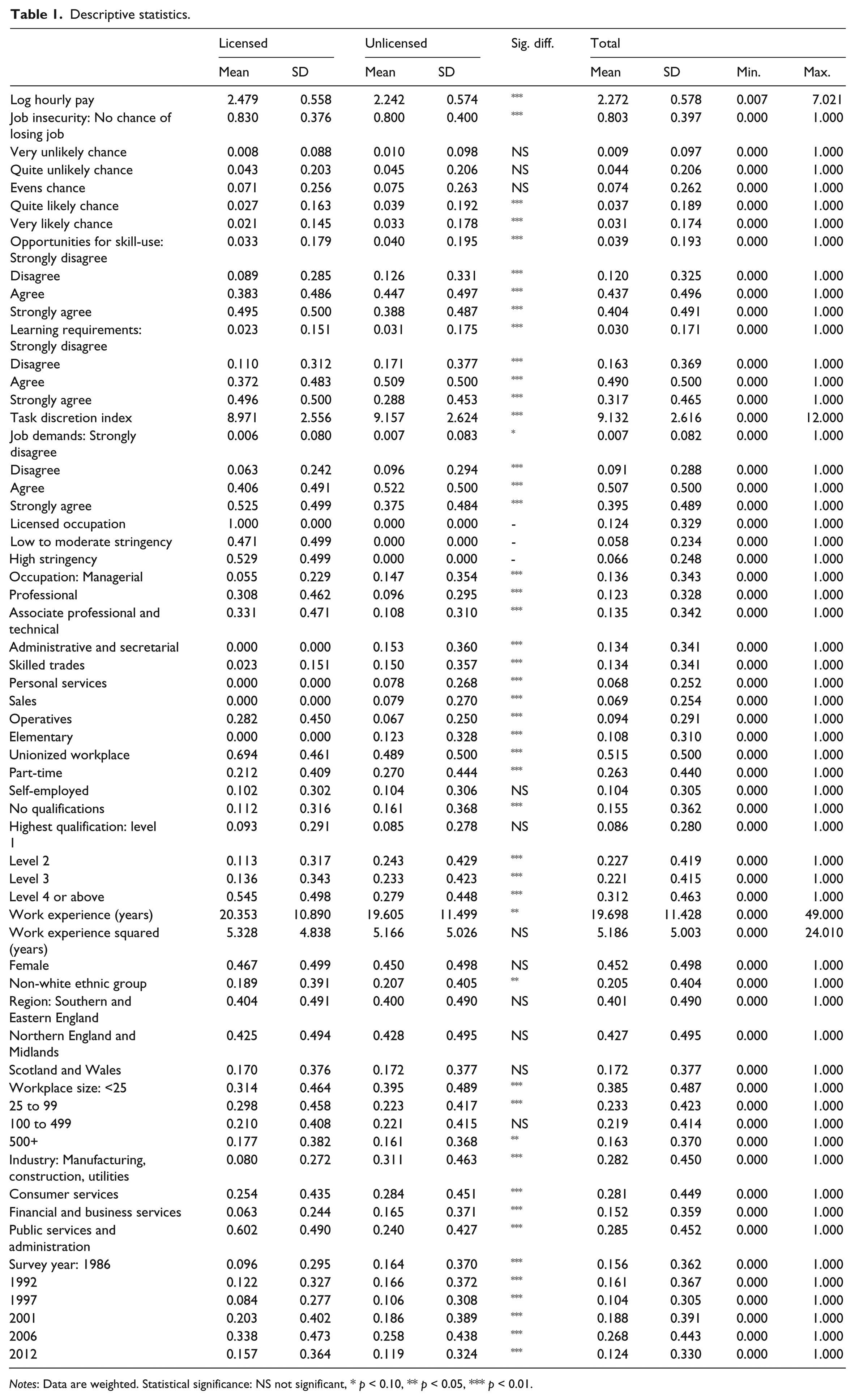
Notes: Data are weighted. Statistical significance: NS not significant, * p < 0.10, ** p < 0.05, *** p < 0.01.
Analytical strategy
The analysis proceeds in three main steps. First, we explore the descriptive patterns in the data. Second, we switch to a multivariate approach, probing the robustness of associations between whether a respondent’s job is in a licensed occupation as the independent variable of interest and the six job quality aspects as dependent variables, testing Hypotheses 1 through 6. Given our theoretical expectations in Hypothesis 7, in the third step of the analysis, we repeat this second step, but this time exploring a finer-grained measure of occupational licensing relating to the level of stringency.
For each dependent variable, we estimate four specifications. First, a specification with whether the respondent’s job is in a licensed occupation or not and survey year dummies with no other covariates. This reveals the unadjusted relationship between occupational licensing and the job quality dimensions. This specification is then extended to include the following standard set of control variables: union at current workplace, part-time, self-employed, educational qualifications, work experience, work experience squared, gender, whether non-white, region, workplace size, and industry (see Table 1 for descriptions of categories and descriptive statistics).
This specification is then further extended to include a control for 1-digit occupation fixed-effect (nine 1-digit SOC occupational categories). This then adjusts the patterns uncovered for the uneven distribution of licensing across broad classes of occupations. These findings can be interpreted as the effect of licensing on job quality net of 1-digit occupational categories (i.e. the effect of licensing on job quality net of an occupation belonging to the associate professional category). In the fourth specification, 1-digit SOC codes are replaced with 2-digit SOC codes (25 categories). These specifications test the sensitivity of the results to more fine-grained occupation fixed-effects. This results in more robust estimates of the association between licensing and job quality given the uneven diffusion of licensing across occupational categories at the 1-digit and 2-digit levels. 6
For wages and task discretion, we fit ordinary least squares (OLS) regression models since these are continuous dependent variables. For job insecurity, opportunities for skill-use, learning requirements, and job demands, we fit ordered logistic regression models, since these are ordered categories. For each, Brant tests revealed the proportional odds assumption was met. To facilitate interpretation, we report average partial effects of achieving the highest category instead of log odds (see Table 1 for highest categories). 7 In all analyses, we apply survey weights to take into account the sampling design and so our estimates pertain to the population of interest. We also cluster standard errors on 4-digit SOC codes by survey year given the measurement level of our main independent variable.
Results
Descriptive overview
The analysis begins with a descriptive overview of patterns of occupational licensing trends to provide some context. As a labour market institution regulating the employment relationship, comparisons are often drawn between licensing and trade unions (e.g. Humphris et al., 2011). Figure 1 estimates the proportion of the labour force (employed and self-employed) that are working in a licensed occupation and/or are members of a trade union using the SES 1986 to 2012. As is well-known, union membership declined substantially over this period, but what is less well-known is that the proportion of jobs in licensed occupations grew over the same period to one-in-six jobs by the end of it. In 1986, for every worker in a licensed occupation, there were six union members. By 2012, the figure had narrowed to 1.6 union members for every job in a licensed occupation. Figure 2 estimates that share of workers in licensed occupations that were licensed at the time of the relevant SES survey year, as well as the proportion working in an occupation that was licensed prior to 1986. As can be seen, if no new occupations had become licensed, there would have been some growth in the proportion of workers in licensed occupations (the light grey bars). However, the difference between the two colours of bars demonstrates that most of the growth in licensing over the period was owing to more occupations becoming licensed. These figures underline one of the main motivations of this study: that occupational licensing is an emergent and increasingly prevalent institution whose influence on job quality (other than pay) is largely unknown.
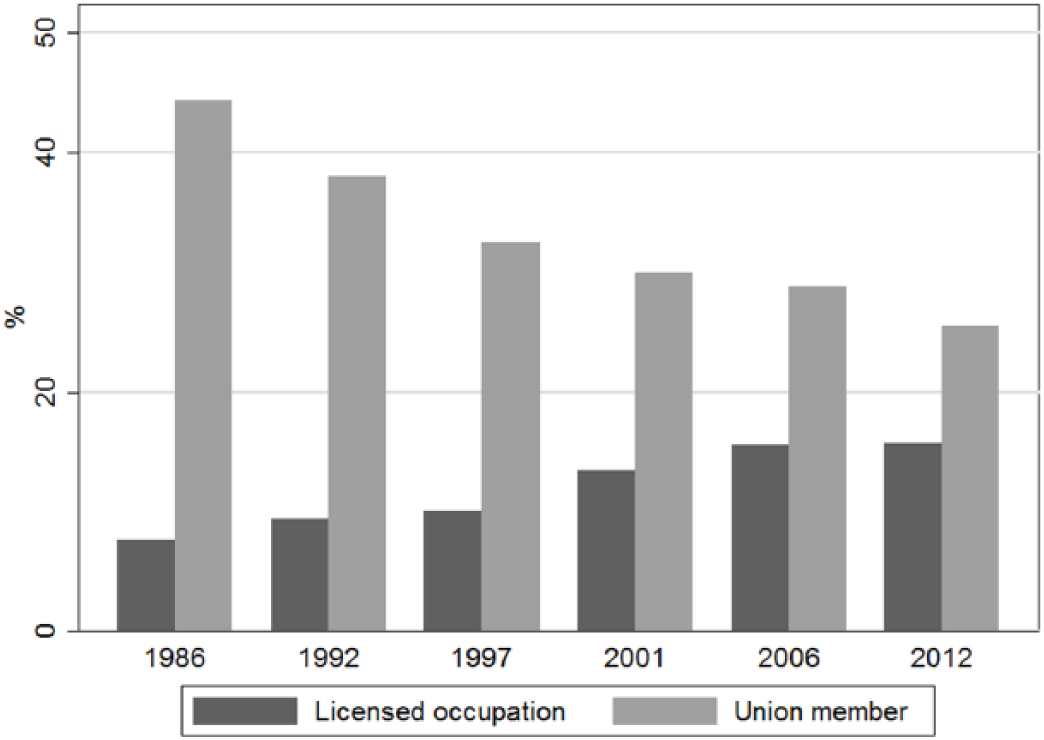
Occupational licensing and unionization over time.
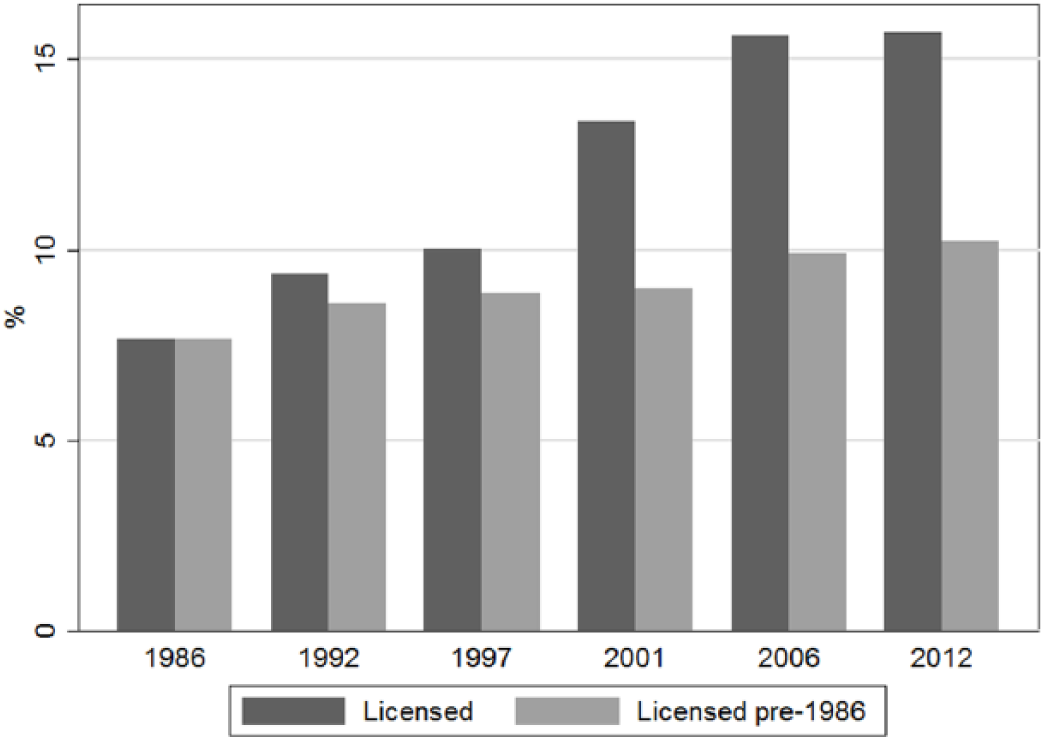
The growth in occupational licensing.
Multivariate results
Table 2 reports the difference between jobs in licensed versus unlicensed occupations for wages and the five non-pay aspects of job quality, adjusting for other factors. For each aspect, the sensitivity of its relationship with occupational licensing is tested across the five different specifications detailed previously. Taking wages first, we find that jobs in licensed occupations pay more on average than jobs in unlicensed occupations – about 19% more (e0.178). However, once factors such as education and work experience are taken into account in the second specification, as well as the many other standard controls, the wage advantage is halved and fails to reach conventional levels of statistical significance. Introducing the different versions of occupation fixed-effects only brings the premium closer to zero. At face value, this result suggests licensing is not associated with any identifiable pay premium in the UK. We will show later this result (and others) is sensitive to the stringency of licensing.
Multivariate analysis of differences in job quality between licensed and unlicensed occupations.
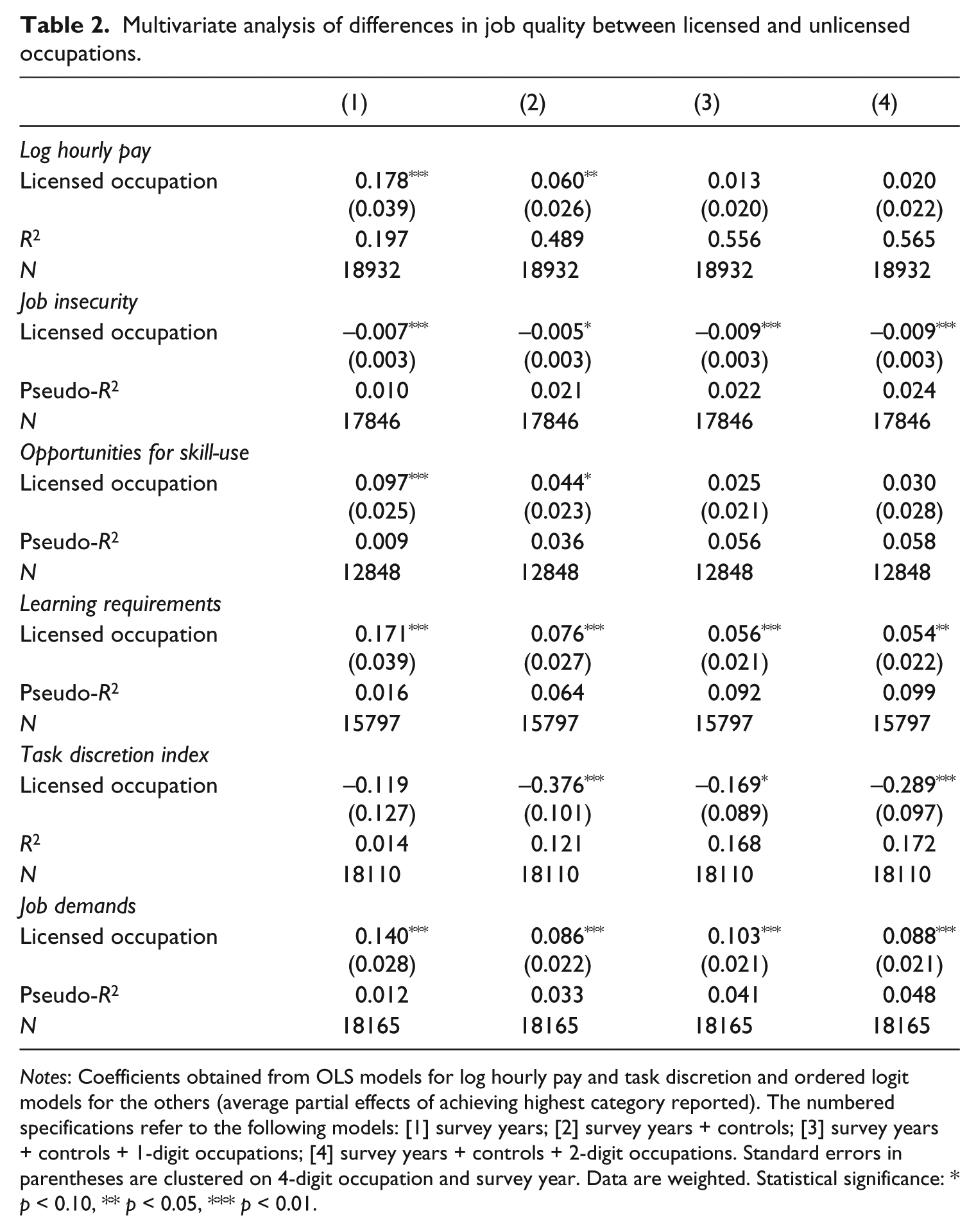
Notes: Coefficients obtained from OLS models for log hourly pay and task discretion and ordered logit models for the others (average partial effects of achieving highest category reported). The numbered specifications refer to the following models: [1] survey years; [2] survey years + controls; [3] survey years + controls + 1-digit occupations; [4] survey years + controls + 2-digit occupations. Standard errors in parentheses are clustered on 4-digit occupation and survey year. Data are weighted. Statistical significance: * p < 0.10, ** p < 0.05, *** p < 0.01.
With respect to job insecurity (Hypothesis 2), we find evidence that workers in licensed occupations have a lower probability of reporting a ‘very high’ chance of losing their job in the next 12 months in specifications 1 to 4. The average partial effects may appear quite small (less than a 1 percentage point difference between jobs in licensed and unlicensed occupations), but this largely because only a few respondents report their job security being in this category (approximately 3%; see Table 1). Taking this into consideration, we find support for Hypothesis 2. Turning to opportunities for skill-use (Hypothesis 3), although the probability of respondents strongly agreeing that their job provides opportunities to learn new things is higher in licensed relative to unlicensed occupations (specification 1), once controls and detailed occupation categories are introduced (specifications 3 and 4), the effect converges to zero, not supporting Hypothesis 3. By contrast, the difference in probabilities of respondents strongly agreeing their job requires continuously learning new things in licensed occupations relative to unlicensed occupations holds even when controls are added for detailed occupational groups (specifications 3 and 4), supporting Hypothesis 4.
Turning to the index of task discretion (Hypothesis 5), the results in the first specification reveal that there are no detectable differences in task discretion between jobs in licensed occupations and unlicensed occupations on average. However, once controls are added (specification 2), we find that task discretion is in fact lower in licensed occupations (about 0.376 lower on the 12-point scale, equivalent to 4.5 standard deviations). Once taking into account that occupational licensing is unevenly spread across different kinds of occupations (specifications 3 and 4), the association remains strongly negative and statistically significant, but reduces in magnitude to about 3 standard deviations lower. In other words, task discretion is lower in licensed occupations even within relatively similar fields of work. Thus, we find no support for Hypothesis 5. With respect to job demands (Hypothesis 6), we find that there is about a 14 percentage point higher chance of respondents strongly agreeing that their job requires them to work very hard in specification 1. While this effect is attenuated somewhat when controls are included and finer occupation distinctions are made across specifications, Hypothesis 6 is also not supported.
Overall, these findings suggest that jobs in licensed occupations are associated with lower job insecurity and higher continuous learning requirements, but not necessarily higher pay or greater opportunities for skill-use once other factors are controlled for. We do find that jobs in licensed occupations are associated with worse working conditions in two respects, having both lower task discretion and higher job demands.
Occupational licensing stringency
Next we move to examine the level of stringency of occupational licensing in Table 3. This repeats the analysis in Table 2, but divides licensed occupations into two categories according to the level of stringency, thus enabling us to test Hypothesis 7. It appears that the main findings from Table 2 of (i) lower job insecurity, (ii) higher continuous learning requirements, (iii) lower task discretion, and (iv) higher job demands, largely only apply to jobs in occupations characterized by the highest level of stringency. Jobs in less stringently-licensed occupations tend to be statistically indistinguishable from unlicensed ones across the specifications, with some exceptions. For instance, respondents in less stringently-licensed occupations have a lower probability of agreeing their job offers opportunities for skill-use and requires continuously learning new things, implying worse job quality on these dimensions relative to unlicensed occupations. When splitting licensed occupations this way, we also observe a more consistent wage premium across specifications, but again, only for stringently-licensed occupations. We also now observe greater opportunities for skill-use across specifications – for jobs in the most stringently-licensed occupations. Overall, then, we only find the clearest evidence for systematic differences in job quality for jobs in the most stringently-licensed occupations, supporting Hypothesis 7.
Multivariate analysis of differences in job quality between licensed and unlicensed occupations by level of stringency.
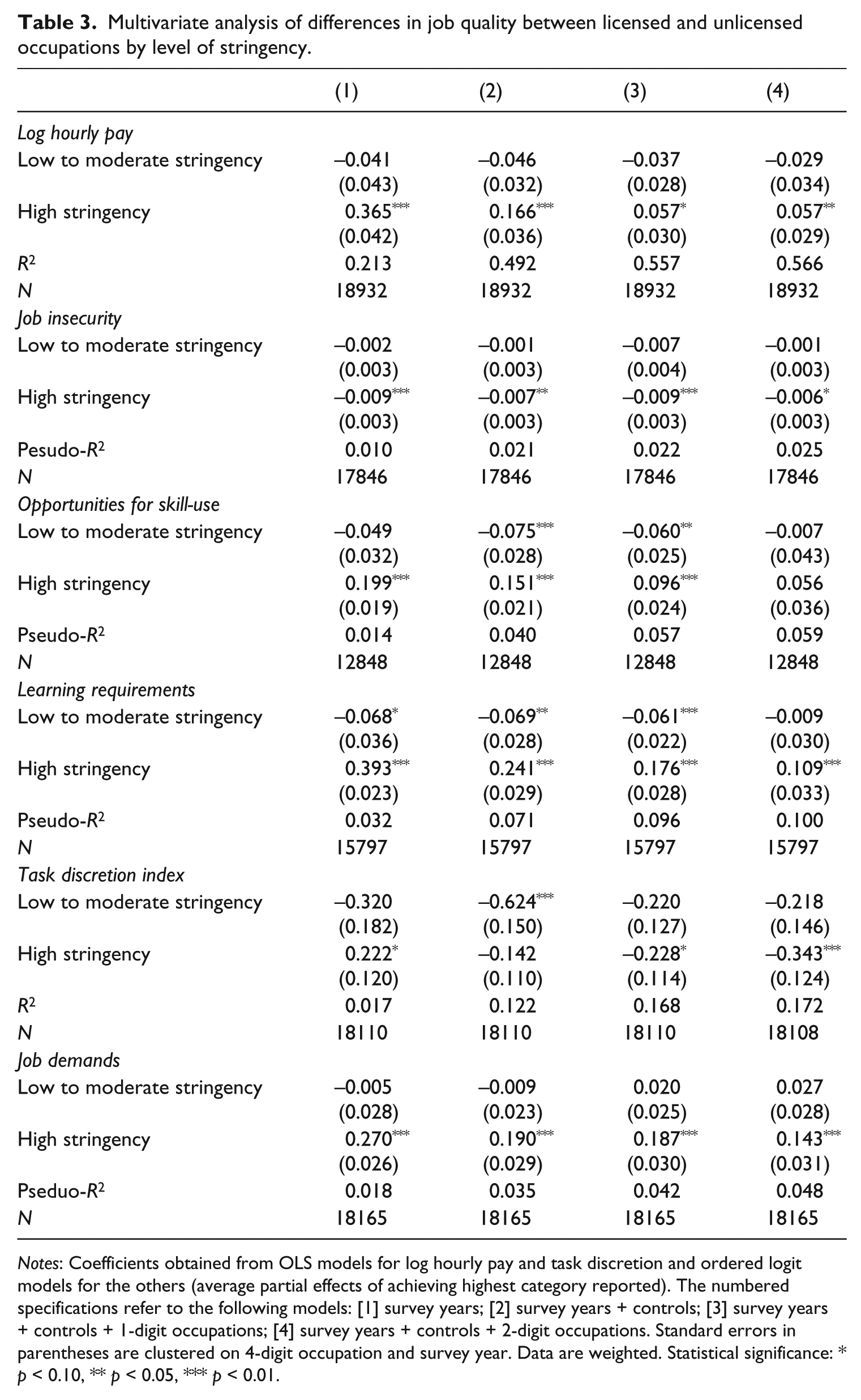
Notes: Coefficients obtained from OLS models for log hourly pay and task discretion and ordered logit models for the others (average partial effects of achieving highest category reported). The numbered specifications refer to the following models: [1] survey years; [2] survey years + controls; [3] survey years + controls + 1-digit occupations; [4] survey years + controls + 2-digit occupations. Standard errors in parentheses are clustered on 4-digit occupation and survey year. Data are weighted. Statistical significance: * p < 0.10, ** p < 0.05, *** p < 0.01.
Discussion and conclusions
Motivated by the notable absence of theory and evidence on how occupational-level structures shape job quality, the aim of this article was to understand how the dominant and growing institution of occupational licensing has the potential to shape job quality. While the previous literature on occupational closure had a narrow conception of job quality based on pay, taking a more contemporary multidimensional approach, we find differences in the more intrinsic aspects of job quality between jobs in licensed and unlicensed occupations – but these effects are largely confined to jobs in the most stringently-licensed occupations. In particular, jobs that have achieved higher levels of closure (i.e. more stringently-licensed ones) have lower job insecurity, greater opportunities for skill-use, and higher continuous learning requirements. Therefore, from a theoretical perspective, our findings indicate that closure theory can account for occupation-based variations in the distribution of job quality outcomes.
On the negative side, however, for incumbents in licensed occupations, our results indicate that task discretion is quite clearly reduced in the most stringently-licensed occupations and that job demands are significantly higher. A possible explanation is that the professional autonomy conferred by licensing to the individual is exaggerated, and instead authority over one’s work is transferred to professional associations and regulators who in their efforts to homogenize quality standards also standardize production methods. It could also be the effect of conduct postulations (i.e. what tasks to perform, the order in which they are performed, how to perform them) common within many licensed professional occupations such as architects, engineers, and the medical profession, but also seen in certain licensed non-professional occupations such as crane operators and train drivers. It is also a defining feature of regulation when licensing applies to performing some specific occupational tasks (rather than the occupation as a whole), such as in the case of ophthalmic opticians who fit contact lenses, or plumbers responsible for gas installations.
With respect to higher task demands, it is possible that licensing alters the behaviour of firms who – faced with higher wage costs as a result of the licensing wage premium – respond with management practices that aim to offset the loss of what ‘would have’ otherwise been normal returns to capital. Such an offset is likely to be sought (among other things) in productivity enhancements driven by higher performance expectations and intensified pressures to meet performance standards, all resulting in the work effort being subject to higher intensification. Indeed, research on unionization has shown the union wage premium often results in employers being more demanding of hard work (Bryson and Green, 2015; Metcalf, 1990). Overall, these findings echo the effect of unionization on task discretion and task demands (e.g. Bryson and Green, 2015) and raise doubts as to the extent to which forms of closure can enable occupations to achieve positive outcomes with regards to the more intrinsic aspects of job quality associated with autonomy and workload.
Finally, while we fail to detect a universal wage premium for licensed occupations in the same manner as the US literature (e.g. Gittleman and Kleiner, 2016; Kleiner and Krueger, 2013), our findings are in line with UK and EU studies that show considerable heterogeneity in the incidence and size of the wage premium associated with licensing (e.g. Koumenta and Pagliero, 2018; Koumenta et al., 2014). Within this latter literature it is argued that such variations might result from the occupation-specific characteristics of the licensing regime, a point that our current empirical contribution substantiates in relation to stringency. With respect to the wider research on job quality, our findings reinforce the conclusions reached in the extant literature that aspects of job quality do not necessarily co-vary (see Findlay et al., 2017; Green et al., 2013; Muñoz de Bustillo et al., 2011), and, as such, depictions of a polarized labour market and crude ‘good’ and ‘bad’ jobs typologies (see Kalleberg, 2011; Kalleberg et al., 2000) fail to capture more complex sets of patterns and processes – some of which might be owing to the moderating force of hitherto overlooked occupational-level institutions such as licensing.
Reflecting on our findings more widely, as discretion over one’s work and job demands are two of the most central aspects of job quality for job-related wellbeing (Gallie, 2013), the lower task discretion in jobs in stringently-licensed occupations implies that such jobs have lower chances of achieving high levels of job-related wellbeing. Often referred to as ‘high strain’ jobs in job demand-control models, low autonomy and high demands have long been shown to be the worst possible combination for wellbeing and physical health, and, as such, this combination of lower discretion and higher demands we identify in stringently-licensed occupations is a cause for concern. There are also other growing closure mechanisms that tend to be more voluntary in nature such as accreditation and certification – both of which may have quite different effects to licensing – about which we know very little. The findings reported here suggest their capacity to shape job quality may be weaker given they would not be classed as very stringent forms of closure, but given their prevalence in the labour market, they certainly deserve further examination. Although our results suggest that the implications of occupational licensing (for strangely licensed occupations) entail higher wages, greater employment security, and better learning and development opportunities, the positive picture is partially offset by certain inferior intrinsic dimensions.
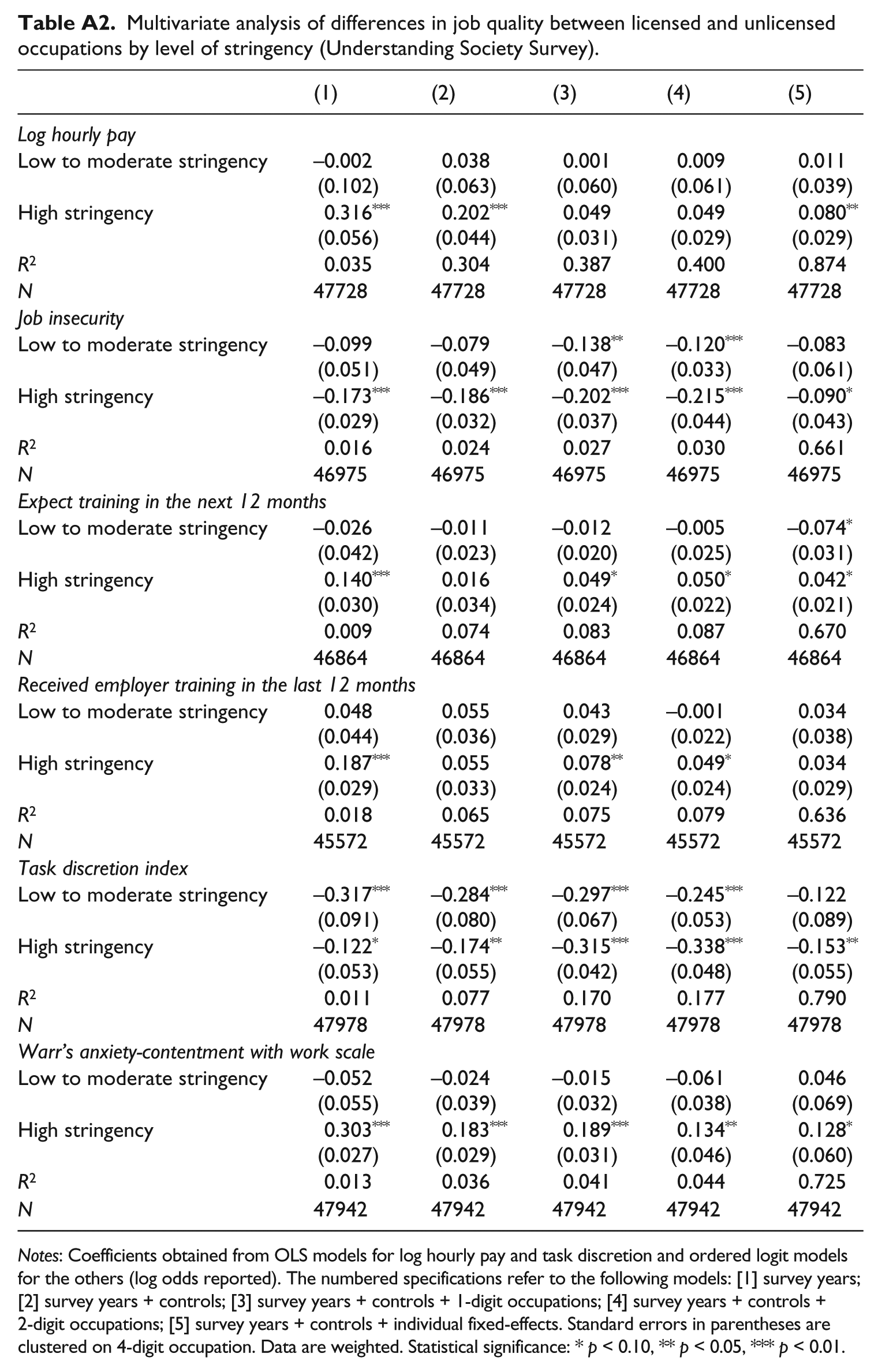
Nevertheless, there are limitations to our findings. In particular, the cross-sectional nature of our research means that selection bias on unobservables may contaminate our results. To address this, we conduct a supplementary three-wave panel analysis of the Understanding Society Survey, whereby we replicate our main analyses but also add individual-specific fixed-effects. 8 The rationale for this additional analysis is to aid our prior interpretation that the regulation of the occupation itself is what explains differences in job quality rather than certain types of individuals selecting or being admitted into certain occupations. Although we cannot rule it out completely, individual fixed-effect approaches to panel analysis go some way to alleviating such self-selection concerns. The findings support our main results of lower job insecurity, more skill development, lower task discretion, more intense work, and a wage premium – all of which tend to be restricted to the most stringently-licensed occupations (Tables 1 and 2 in the Appendix). Although our central findings appear to be consistent in the additional three-wave panel analyses, future research should seek ways to tackle such limitations, as well as document how other institutional contextual factors, such as unionization, may moderate the effects of licensing on job quality. 9
Overall, therefore, our findings add to an established body of literature that seeks to understand how the wider structures in which jobs are embedded shape their quality. While studies have emphasized the role of macro-level institutions and organizational-level structures, our contribution centres on how institutional configurations at the occupational-level can (and do) shape job quality. The occupational-level is particularly interesting since it cuts across the more conventional organizational, sectoral, and national levels of analysis. Moreover, occupational structures such as licensing may help explain certain puzzles in wider job quality trends. For instance, previous research in Britain has shown that professional occupations have not been protected from the general declining task discretion despite stronger than average earnings growth (Gallie, 2015). Changes in the regulatory environment, affecting mainly the professions, may explain such patterns. In light of these findings, a research agenda that explores how and why job quality varies across the occupational structure – including uncovering the role occupational-level institutional structures in which jobs are embedded – is an underexplored but fruitful avenue for future research.
Footnotes
Appendix
Multivariate analysis of differences in job quality between licensed and unlicensed occupations by level of stringency (Understanding Society Survey).
| (1) | (2) | (3) | (4) | (5) | |
|---|---|---|---|---|---|
| Log hourly pay | |||||
| Low to moderate stringency | −0.002 |
0.038 |
0.001 |
0.009 |
0.011 |
| High stringency | 0.316
***
|
0.202
***
|
0.049 |
0.049 |
0.080
**
|
| R 2 | 0.035 | 0.304 | 0.387 | 0.400 | 0.874 |
| N | 47728 | 47728 | 47728 | 47728 | 47728 |
| Job insecurity | |||||
| Low to moderate stringency | −0.099 |
−0.079 |
−0.138
**
|
−0.120
***
|
−0.083 |
| High stringency | −0.173
***
|
−0.186
***
|
−0.202
***
|
−0.215
***
|
−0.090
*
|
| R 2 | 0.016 | 0.024 | 0.027 | 0.030 | 0.661 |
| N | 46975 | 46975 | 46975 | 46975 | 46975 |
| Expect training in the next 12 months | |||||
| Low to moderate stringency | −0.026 |
−0.011 |
−0.012 |
−0.005 |
−0.074
*
|
| High stringency | 0.140
***
|
0.016 |
0.049
*
|
0.050
*
|
0.042
*
|
| R 2 | 0.009 | 0.074 | 0.083 | 0.087 | 0.670 |
| N | 46864 | 46864 | 46864 | 46864 | 46864 |
| Received employer training in the last 12 months | |||||
| Low to moderate stringency | 0.048 |
0.055 |
0.043 |
−0.001 |
0.034 |
| High stringency | 0.187
***
|
0.055 |
0.078
**
|
0.049
*
|
0.034 |
| R 2 | 0.018 | 0.065 | 0.075 | 0.079 | 0.636 |
| N | 45572 | 45572 | 45572 | 45572 | 45572 |
| Task discretion index | |||||
| Low to moderate stringency | −0.317
***
|
−0.284
***
|
−0.297
***
|
−0.245
***
|
−0.122 |
| High stringency | −0.122
*
|
−0.174
**
|
−0.315
***
|
−0.338
***
|
−0.153
**
|
| R 2 | 0.011 | 0.077 | 0.170 | 0.177 | 0.790 |
| N | 47978 | 47978 | 47978 | 47978 | 47978 |
| Warr’s anxiety-contentment with work scale | |||||
| Low to moderate stringency | −0.052 |
−0.024 |
−0.015 |
−0.061 |
0.046 |
| High stringency | 0.303
***
|
0.183
***
|
0.189
***
|
0.134
**
|
0.128
*
|
| R 2 | 0.013 | 0.036 | 0.041 | 0.044 | 0.725 |
| N | 47942 | 47942 | 47942 | 47942 | 47942 |
Notes: Coefficients obtained from OLS models for log hourly pay and task discretion and ordered logit models for the others (log odds reported). The numbered specifications refer to the following models: [1] survey years; [2] survey years + controls; [3] survey years + controls + 1-digit occupations; [4] survey years + controls + 2-digit occupations; [5] survey years + controls + individual fixed-effects. Standard errors in parentheses are clustered on 4-digit occupation. Data are weighted. Statistical significance: * p < 0.10, ** p < 0.05, *** p < 0.01.
Acknowledgements
Datasets for this study were provided by the UK Data Service. The Editor and three anonymous referees made very helpful comments on earlier drafts of this article. The usual disclaimers apply.
Funding
This research received no specific grant from any funding agency in the public, commercial, or not-for-profit sectors.
