






Abstract
Communities of practice (CoPs) represent a broad range of work situations characterized by shared knowledge and situated knowledge use. Although CoPs have been studied rather extensively, discussions of control in CoPs are rarer. This is peculiar because CoPs are characterized by a common tension in contemporary work: on the one hand, CoPs are expected to autonomously “think together,” but on the other they are expected to be responsive to various managerial control attempts. We interrogate this tension in an ethnographic study of engineering work, where we found that in response to management control the engineering communities engaged in constructive disobedience – that is, subversion and displacement of rules and orders to construct a dynamic of control where work can be executed autonomously. By associating constructive disobedience with control in CoPs, our study contributes with insight into and theorization of how management control is dealt with and how control operates in work characterized by CoPs. The study also provides deepened insight into the limits of management control and how professionalism may be maintained despite increased management. These insights may support development of a more knowledgeable and nuanced approach to attempts at managing communities of practice.
Keywords
Communities of practice (CoPs) are broadly understood as groups of people with a sense of joint enterprise, who share knowledge about this enterprise that enables them to competently contribute to it (Wenger, 2000). In a work setting, this may be a community of police officers investigating a murder, doctors investigating a patient, or, as in this article, engineers engaged in the enterprise of developing technology for telecommunication. CoPs thus represent a broad range of situations where shared knowledge and situated knowledge use characterize the work.
Although CoPs have been studied rather extensively, discussions of control in CoPs are rarer. Most research focuses on the learning aspects (e.g. Lave and Wenger, 1991; Pyrko et al., 2017). Some studies (e.g. Orr, 1996) imply aspects of power but do not articulate these aspects in terms of organizational control, broadly understood as organizational processes in which it is decided what to do and how to do it (Johnson and Gill, 1993: x). They instead emphasize the socialization aspects associated with becoming a member of a CoP (e.g. Lave and Wenger, 1991), or the disciplinary effects of learning in CoPs (Contu and Willmott, 2003). Though these studies highlight identity shaping and disciplinary power in CoPs, they do not articulate how CoPs are exposed to managerial control 1 attempts or how they respond to these attempts. The latter is the focus of this article, where we spotlight the interface between managerial control and the work in communities of practice.
We suggest that control in CoPs needs to be further theorized, for two main reasons. First, CoPs represent a common condition in contemporary work organizations. Many organizations today are “knowledge-intensive” (Alvesson, 2004), complex, contested social systems (Kuhn, 2008) with distributed leadership (Fairhurst, 2008), intent on creating worker participation (Stohl and Cheney, 2001) and empowerment (Styhre, 2001). Put differently, organizations’ productivity relies heavily on the competent performance of fairly autonomous employees who have a sense of joint enterprise, share knowledge and skills, and understand how to use these to contribute to the joint enterprise (Cordery et al., 2014). In short, many contemporary organizations rely heavily on the performance in CoPs.
This leads into the second and related reason, namely that CoPs are often exposed to control attempts by managers who have limited knowledge of the communities’ work. The members of CoPs often share both contextual and formal knowledge and develop methods and processes that are best understood by the members themselves (Barley, 1996). This produces challenges for management control. Traditional methods of management control, such as direct control and bureaucracy, are insufficient because they rest on the assumption that formally appointed managers are the conceivers and employees the executors of work, and that control flows from top to bottom. However, CoPs are not merely executors of managers’ thoughts; they are both conceivers and executors, and their need for managers’ conceptions is limited. Recent studies have even suggested that CoPs cannot be managed instrumentally because they rest on the idea of “thinking together” – a collective process that cannot be imposed by managers (Pyrko et al., 2017; see also McDermott, 1999).
Yet, these characteristics of CoPs do not mean that management does not attempt to control them. Even in knowledge-intensive work, which often characterizes CoPs, traditional managerial control has by no means disappeared. Dynamics of collective learning and knowing may very well co-exist with performance management structures (Alvesson and Kärreman, 2007), managerial goal setting (Covaleski et al., 1998), knowledge management (Waring and Currie, 2009), audit and top-down processes of quality control (Craig et al., 2014; Power, 1997). Similarly, even professional work – which largely rests on the dynamics of CoPs – that used to be characterized by protection from managerial control (Freidson, 2001) is increasingly influenced by hierarchy (Adler and Chen, 2011; Adler et al., 2008). This puts members of CoPs in a situation where they, on the one hand, are expected to autonomously “think together” (Pyrko et al., 2017), but on the other respond to various managerial control attempts. Because of this dual pressure to be both autonomous and responsive to control, members of CoPs need to deal with, align and make sense of control attempts directed toward their community. This tension leads into our research questions – namely, how do communities of practice respond to managerial control attempts, and how can their responses be theorized? Answering these questions furthers the understanding of dynamics of control in settings where those who are formally in control have a limited understanding of the practice of those who are to execute it.
We respond to these questions by drawing on an ethnographic study of engineering work, where particular attention is paid to the practices of the organization’s “operative core” – engineering communities that shared knowledge, a sense of joint enterprise and mutual engagement – and how they deal with managerial control attempts directed toward their work. The study shows that the organization utilizes quite extensive management control systems in the shape of project management tools and quality control systems, but also that the engineering community responds to the managerial control attempts by what we label constructive disobedience, thereby creating an autonomous space where they could work undisturbed. In creating this space, however, they simultaneously align their autonomy with organizational tasks.
Based on this general finding, we contribute with insight into how formal management control attempts are dealt with and how control operates in CoPs. We introduce constructive disobedience as a specific type of response to management control that subverts and displaces rules and orders to construct a dynamic of control where work can be executed autonomously within the community of practice. 2 Constructive disobedience is theorized as a knowledge-intensive process involving three actions, which we label critical apprehension, translation and peer reviewing. Critical apprehension signifies grasping something, while also taking hold of it and detaching it from its original source for critical investigation. In our case, this refers to detachment from management, but not detachment in the sense of complete disregard: a rule or order needs to be detached to a certain degree so that it can be translated and then peer reviewed. Translation involves the use of knowledge to convert formal control into content that is workable within the community of practice. And peer reviewing takes place when members of the community review – that is, scrutinize, evaluate, discuss and suggests alterations – each other’s work.
The article is structured as follows. First, we review the literature on organizational control and communities of practice, and account for our method of data collection and analysis. The method section is followed by the empirical section, where we ground the notion of constructive disobedience in our data. We then expand on the meaning of constructive disobedience and relate it to relevant literature on control and responses to control, in CoPs and beyond. Finally, we conclude by situating our study in a broader context of organizational control and outlining some implications for managerial practice.
Organizational control and communities of practice
As noted in the introduction, CoPs are characteristic of work contexts where the boundary between the conception and execution of work is blurred, and where organizations rely heavily for their productivity on the interactions taking place in non-managerial communities. Relatively little has been written explicitly about organizational control in communities of practice, but some general trends can be discerned.
First, the main body of literature understands CoPs mainly in terms of sites of social learning and knowledge development (e.g. Brown and Duguid, 1991, 2001; Lave and Wenger, 1991; Pyrko et al., 2017). We do not mean to invalidate this important research, but only note that it does not focus on articulating how CoPs are exposed to or respond to organizational control.
Second, scholars have discussed organizational control in CoPs by analyzing how much structure is optimal for cultivating effective CoPs (e.g. Thompson, 2005). It is suggested that CoPs are delicate constructs that, in order for their creative and problem-solving capacity to be unleashed, should not be controlled too tightly. Instead, organizations need to find a balance between cultivating CoPs and constraining their activities so that they do not depart from organizational interests. This perspective largely restates and develops Wenger’s (1998: 229) statement that CoPs “can be recognized, supported, encouraged, and nurtured, but they are not reified, designable units.” Though a discussion of CoPs’ responses to control is lacking, this perspective suggests that control in the shape of both support and more constraining structures may be directed toward CoPs.
Third, some scholars are dissatisfied with how the original works on CoPs (notably Lave and Wenger, 1991) have been picked up without including an analysis of the power dynamics surrounding CoPs. One aspect of this regards the position of the CoP in the corporate hierarchy. Contu and Willmott (2003) suggest that the insights around CoPs have been selectively adopted to support managerialist interests to harness the innovative and knowledge-developing dynamics in CoPs, while neglecting the power dynamics of capitalist organizations and failing to see power as a relational and practical accomplishment (Contu, 2014). This point produces a basis for our study because Contu and Willmott suggest that CoPs are entangled in various forms of control, including managerial control. However, they do not study how CoPs respond to managerial control attempts but focus on the worthwhile but more abstract argument that learning in CoPs is both “enabled and constrained by their embeddedness in relations of power” (Contu and Willmott, 2003: 283).
Fourth, and partly as a response to Contu and Willmott’s concerns, there is a literature on the relationships between CoPs that touches on the question of responses to management control. For instance, Mørk et al. (2010) found that the master–apprentice relationship in CoPs may be altered when new practices associated with other CoPs are introduced (they studied how the introduction of laparoscopy changed the master–apprentice relationships in, for instance, urologist CoPs). And Hong and O (2009) identified that the lack of a common identity and power inequalities between communities (in their case, between in-house communities and communities in an organization to which the IT-function was outsourced) undermined the potential of creating a learning community. Although this literature does not deal explicitly with the relationship between management control and operative communities, it highlights that conflicts tend to arise when communities meet.
More concrete empirical investigations of control in CoPs are rare. But there are reasons to expect that CoPs are exposed to various forms of control. Indeed, a recent literature review suggests that the tendency to view the CoP as a managerial tool implies that CoPs are often exposed to bureaucracy, but adds that empirical studies are lacking (Thomas, 2017). It is also the case that emphasis on CoP-related dynamics such as knowledge sharing, creativity and complex problem solving hardly excludes exposure to management control. It is well known that knowledge work is subject to not only normative control (e.g. Kunda, 1992) but also to various other control forms. For example, Adler et al. (2008) suggest that hierarchical structures have become more salient in the work of doctors, Covaleski et al. (1998) found that output control permeated the work in accounting firms, and Alvesson and Kärreman (2007) pointed at the extensive reliance on formal performance measures in a management consultancy firm.
Thus, formal control attempts of CoPs abound, but we know relatively little about how it is responded to by the community members. However, some insight can be gained by leaving the specific CoP context and turning to more general conceptualizations of responses to managerial control. Employees have been observed to respond to control attempts through cynicism (Fleming and Spicer, 2003), “Svejkism” (Fleming and Sewell, 2002), compliance (Kärreman and Alvesson, 2009), “making out” (Burawoy, 1979), “functional stupidity” (Alvesson and Spicer, 2012), or outright resistance such as strikes and sabotage (Jermier et al., 1994). While possible and relevant, these responses tend to exaggerate the adversarial relationship between management and workers, and present workers as either compliant, or lured into relatively toothless types of resistance that may reproduce managerial power (cynicism, making out), or resistant by refusing to do their job (through striking or sabotage). These responses may exist in CoPs and are worthwhile to consider, but they only provide a narrow and selective account for what is arguably often the case in CoPs, namely that, in Brown and Duguid’s (1991) terms, the organization’s “canonical” structure and control systems meet with the “noncanonical” practices (harbored by the CoPs), and knowledgeable workers in CoPs deal and struggle with managerial control attempts on an ongoing basis in their everyday work. In other words, studies are needed that capture the interaction between the canonical and the non-canonical, and specifically how the non-canonical dynamic of the CoP becomes present and is mobilized within canonical structures produced by managerial practice.
To understand these non-canonical dynamics of control from within CoPs, support is found in the relatively recent wave of “practice-based studies” (PBS), which in many ways resembles CoP scholarship (Brown and Duguid, 1991; Gherardi, 2000; Nicolini, 2010, 2011; Orr, 1996). In PBS, there is a strong focus on the workers’ core productive activities, and social order is understood as a collective accomplishment (Orlikowski, 2002; Schatzki et al., 2001). Put differently, order is primarily created as the work gets done, while managerially instilled norms and rules are only given prominence insofar as they are practically relevant (rather than assuming that they control the work).
PBS have provided important insight that nuances the image of organizations as necessarily controlled by management. For instance, the knowledge-accomplishing activities observed by Kuhn and Jackson (2008) and the storytelling that Orr (1996) found also involved decisions about what to do and how to do it, and thereby have controlling effects. These insights suggest that organizational control is a collective accomplishment, acknowledging that the relationship between management and communities of practice is characterized by negotiation and “struggle” (Fleming and Spicer, 2008).
Furthermore, PBS have theorized this “struggle” through the notion of “translation.” Although knowledge and knowing rather than control remain the main focus, controlling effects are implied and sometimes brought up. Importantly, translation is an interpretive activity that changes its object (e.g. Czarniawska and Sevón 1996; Latour, 1986; Nicolini, 2010, 2011). It retains some of the original referent but also adds new meaning by placing it in a new context. With regard to control, translation is a mediating activity between communities, such as managerial and operative communities. This implies that workers are translators of vertical control; they are not compliant recipients but actors who pick up managerial control, convert it and produce new meanings and possibilities.
To sum up, insights from PBS suggest that CoPs are not passive recipients of management control, nor in stark opposition to it. Negotiation and struggle are emphasized instead. This is an important backdrop when considering the community members’ responses to control attempts in our study, where we found that the engineers dealt with managerial control in their everyday practice by critically apprehending formal rules and guidelines, translating them to construct a peer review based dynamic of control where they could execute their work more autonomously. Taken as a whole, we understand this response as “constructive disobedience.”
Method
To analyze control in CoPs, we draw on an ethnographic study at one of the Swedish sites of GlobalTech, 3 an international developer of telecom technology for mobile phones (at the time of the study, corporate GlobalTech had more than 50,000 employees; the site where the fieldwork took place had about 800).
The majority of the employees at GlobalTech, including the managers, are highly educated engineers who develop technology to be used in mobile phones. This technology is developing fast, and the work is characterized by innovation and uncertainty of how long it will take to finish projects because many things are done for the first time. One result of this is that the work is characterized by non-routine problem solving in groups of engineers that fit well with the criteria of CoPs: 4 the engineers share both theoretical (from their education, all have engineering degrees) and contextual (from their work on the same products) knowledge as well as a sense of joint enterprise (where competence implies understanding the enterprise well enough to contribute to it) and mutual engagement (where competence implies being able to engage with and be trusted by the community), and the organization depends to a large extent on these communities’ knowledge and knowing for its productivity (Wenger, 2000: 229; for a similar description of engineering work see also Wenger and Snyder, 2000; and Barley, 1996).
In addition to this, we observed early on that although a formal hierarchy existed (like in most organizations), the engineers’ work was not really led by managers, and their interactions were not confined to their formal groups. For instance, during the extensive participant observation, we noted that the engineers rarely interacted with managers but instead with their peers to figure out what to do. This is illustrated in the empirical section where the largely insignificant role of the manager is expressed. In addition, these interactions transcended the formal work groups and were rather organized around the objects that the engineers worked on. This is demonstrated in the episode where the engineers work on an ASIC (a circuit), which brings people from “Radio design” and “ASIC design” together, as well as in the last section on peer reviewing where there is no formal manager and the community emerges based on an idea of a new version of their product.
It is in particular the central place of shared knowledge and knowledge use to solve problems in creative ways that makes the engineering groups different from “mere” work groups: “communities of practice are emerging in companies that thrive on knowledge,” whereas work groups are held together mainly by shared deadlines and dissolve when a project is ended (Wenger and Snyder, 2000: 145). This makes GlobalTech a relevant site for studying the dynamics of control in CoPs.
Data collection
The fieldwork was conducted by the first author, who was granted ample access to GlobalTech, initially gained through a middle manager who used to be a student at our university. The whole study lasted for 27 months, with a more intensive period of 6 months. Access was very good. The first author was allowed to observe and record all meetings, interview anyone he liked, and for a 6-month period, he had his own temporary ID card, which granted unlimited access to the engineers’ workplace. GlobalTech accepted his role as an independent observer. Thus, he did not participate actively in any work and did not function as a consultant.
In line with our ethnographic approach and interest in operative practice, observations played a central role in the fieldwork, and were favored both analytically and in terms of data presentation over secondary sources such as interviews or documents (Carlile, 2002; Kuhn and Jackson, 2008). In total, the first author did 45 observations of various meetings, such as all-employee information meetings, culture change workshops, larger project meetings and work meetings.
During the introductory phase of the study, we realized that the engineers often worked in smaller projects that were characterized by the qualities of CoPs (e.g. Wenger, 2000). We decided to focus on these groups, observing their work meetings as well as following their work between the meetings. Three project groups that the first author knew from the early phase of the study were chosen. Twenty work meetings were observed: 5–7 consecutive meetings in each group, lasting between 1 and 2 hours each. Most meeting observations, and all used in this article, were recorded and transcribed by the first author (length of transcripts between 3000 and 7000 words). All participants in the meetings were also interviewed.
Our attention was directed towards their weekly work meetings because they made up a situation where managerial control met operative practice. The meetings were situations where project managers were expected to follow up on the work of the engineers and where the engineers responded.
The first author also did extensive general observations of the work beyond the formal meetings. He “shadowed” an engineer for a full work week, that is, followed him in all his activities. Shadowing is a way to get a closer and more coherent view of everyday work by moving with the person who does the work, and a good way of pursuing the ethnographic aims of empirical openness and proximity (Czarniawska, 2007). Another and more specific purpose of the shadowing was to get a more contextualized understanding of activities that were referred to at work meetings. In addition to the shadowing, the first author also spent 29 full workdays at GlobalTech, interviewing people or observing meetings, but also just “hanging out” (Dingwall, 1997) with them, that is, sitting in their laboratory observing their work, chatting, going for coffee breaks and having lunch with them. The field notes from the shadowing and “hanging out” comprised about 35,000 words.
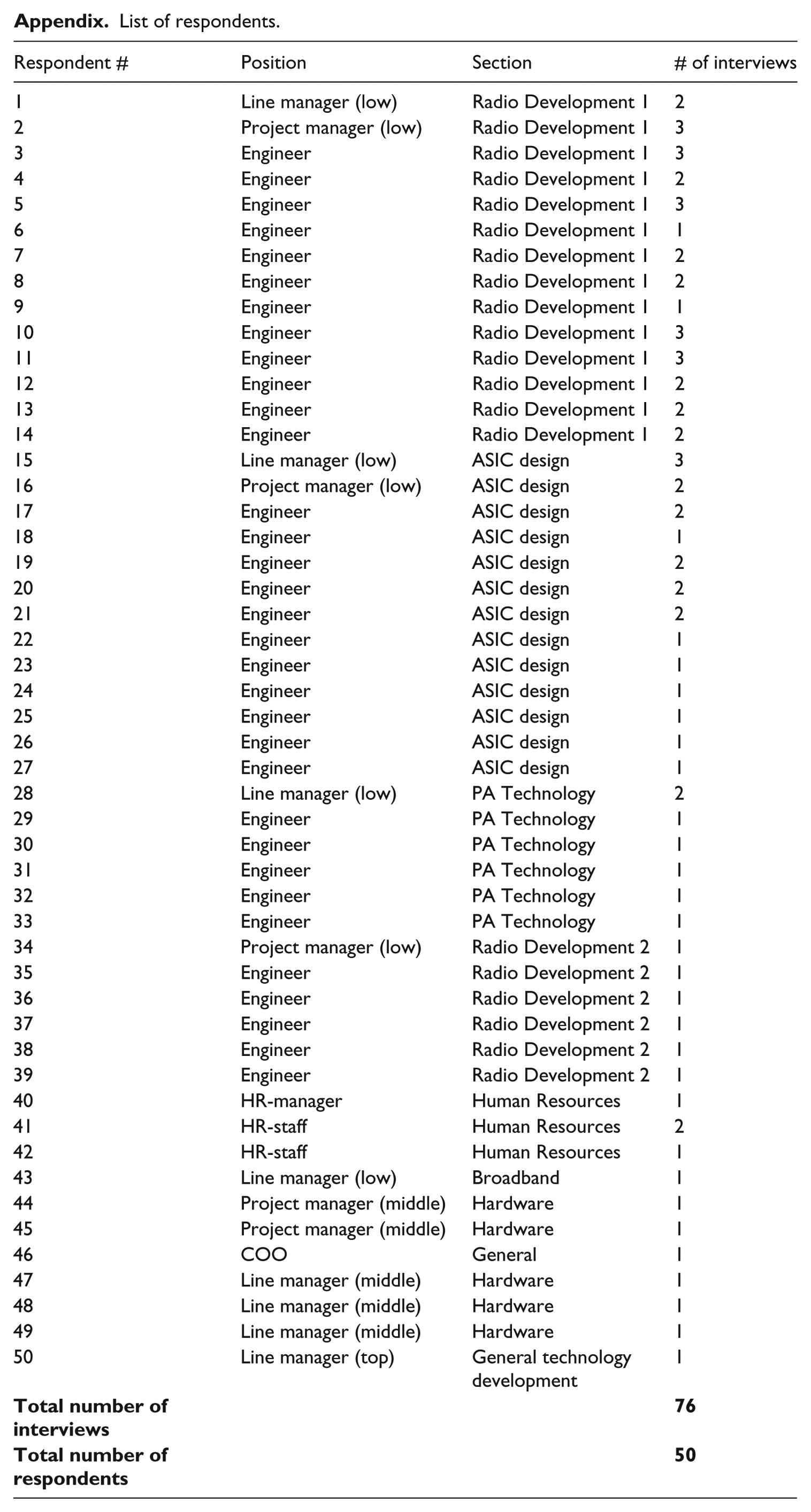
In addition to the observations, 76 interviews with 50 managers and engineers were conducted (see Appendix), of which 46 interviews were with the members of the focused engineering groups and their work meetings. The interviews lasted 1–2 hours and were audio-recorded and fully transcribed. Sixty-one interviews were transcribed by the first author, and 15 by a professional secretary. The interviews were of a semi-structured kind and discussion oriented, meaning that the interviewer had an agenda, but the direction of the interview partly depended on the response of the respondent. Questions were asked such as: How would you describe your work? How are you doing it? How would you describe your work with others? What do you do when you encounter problems? Later interviews were more specific and organized around phenomena that had been observed by the researcher, such as how they deal with managerial orders and directives, and the role of deadlines and the quality control system reported further down in this article.
Data analysis and presentation
Our study draws on interpretivist ethnographic methodology which, because of its emphasis on observation, is particularly well suited to make sense of how work gets done (Prasad, 2005; Schwartzman, 1993). We followed the ethnographic ideals of being close to the object of study (the engineers’ work), and open to what the field has to offer in terms of new insights (for studies employing a similar approach, see, for example, Ashcraft, 2001; Orr, 1996). This is not the same as induction, and the idea of being “non-theoretical” and blank as one enters the field, as suggested by some views of grounded theory (e.g. Glaser and Strauss, 1967). Rather, the analysis emerged interactively in a dialogue between the empirical material and the theoretical repertoire of the researchers (see Blumer, 1969; Schwandt, 2000).
Acknowledging the theory-laden nature of our analysis, we were nevertheless influenced by aspects of grounded theory in our classification and analysis of the data (e.g. Charmaz, 2006). In particular, we drew on the method of starting broad, engaging in initial categorization (coding) of the material, which allowed for many preliminary insights into the control environment surrounding the engineering community. Some categories were found to make a more interesting contribution to the extant understanding of control in CoPs. The content of these categories was then theorized through the development of concepts – in our case, constructive disobedience, critical apprehension, translation and peer reviewing – that are thought to be more general representations of insights drawn from the data (Becker, 1998; Charmaz, 2006). The concepts, in turn, are intended to say something of relevance about the case at hand, but also about the world outside of the case (Becker, 1998: 128).
In concrete terms, we proceeded as follows in our analysis. Throughout the field study, sets of observations and interviews were categorized with the general aim to map the control around and in the CoPs. The first author did the categorization and the second author functioned as a reader and sounding board. Initially, we created the following categories: (1) management-initiated culture control, (2) employee-initiated culture control, (3) customer control, (4) formal hierarchical control, (5) control through follow-up at work meetings and (6) horizontal control.
All these said something about the control environment of the engineers, but we focused particularly on 4, 5 and 6. The reason for omitting 1, 2 and 3 was that there is already so much written about managing culture (1), and our observations and interviews indicated that the engineers did not care very much about “culture management.” When it comes to employee-initiated culture control (2), there was little evidence of consequential versions of this. “The customers” (3) were mainly an issue for those who formally worked with customer relations and top-managers.
The formal hierarchy (4), on the other hand, was often present in the shape of deadlines and quality control systems intended to control the engineers’ work. In order to analyze the role of the formal hierarchy and its relation to the actual work of the engineers, we focused on categories 5 and 6. Although the other categories are by no means irrelevant, 5 and 6 were chosen because they provided insight into both how control appears as work gets done and the dynamic between canonical and non-canonical (Brown and Duguid, 1991) control practices.
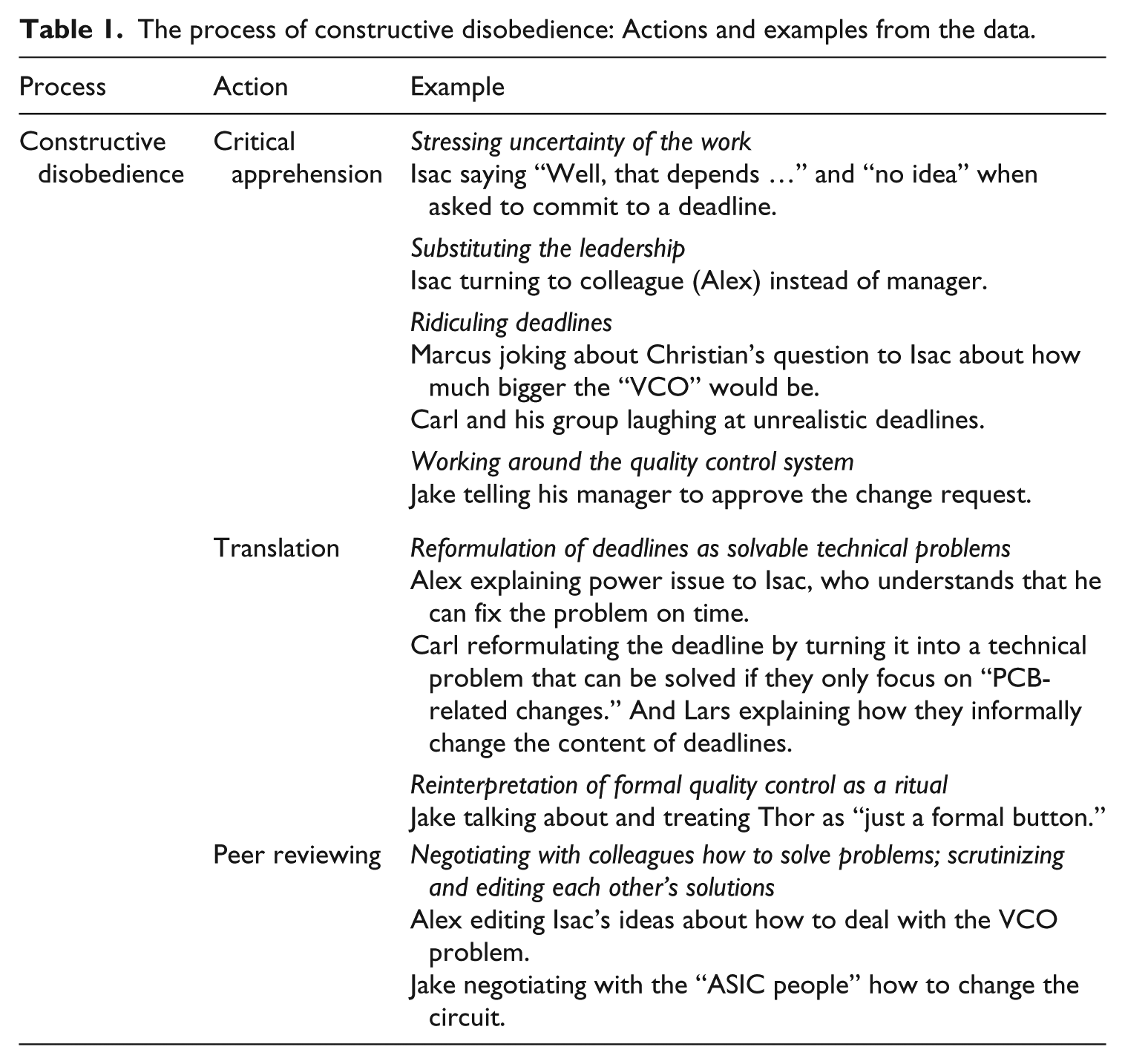
After this choice to reduce our focus, work meetings as well as their everyday work were studied more in depth (see data collection section for details). Upon analyzing the data, we developed more generalizable categories to make sense of the control in the CoPs. To give one example (also see Table 1 in the Discussion section), we observed that the engineers tended to stress the uncertain nature of their work when asked by their managers if they could commit to a deadline. We initially called this “uncertainty infusion.” We also found that the engineers often turned to a colleague rather than their formal manager to solve problems and figure out when they could be finished – as you would expect in a community of practice. We called this “substitution of leadership.” Both are examples of the general category of “critical apprehension” and constitute important steps toward translation and peer reviewing, which are our main categories for making sense of constructive disobedience in this context.
The process of constructive disobedience: Actions and examples from the data.
In the presentation of our data below, we rely mainly on “episodes” or “vignettes” based on observations of operative work, while lesser space is given to interviews. We thereby maintain our commitment to the ethnographic tradition, which favors the presentation of excerpts that illustrate analytical points (e.g. Emerson et al., 1995; see also Contu, 2014, for a defense of the use of “vignettes”). In addition, we present data mainly from the study of the project groups, while the initial part of the study – where more strategic initiatives (such as a culture change initiative) were observed – is left out. The initial part of the study helped us gain general knowledge about the organization, and it was necessary to contextualize the episodes presented, but it is less efficient as data for responding directly to our research questions. We therefore present contextualized episodes that illustrate operative work, and particularly how the engineers in the CoPs respond to attempts of managerial control.
Constructive disobedience at GlobalTech
As previously mentioned, GlobalTech is a developer of technology for mobile phones. In terms of formal management control of the technology development work, they have a project management system in place. It is the task of the higher echelons of the project organization to formulate requirements for the new products. The requirements are quite general, such as whether the technology should support a camera, a USB port or that it should have a certain memory size. These must be broken down into various sub-projects. The process of breaking down requirements is thus intended to trickle down through the project hierarchy to the low-level managers, who are the ones who interact with the engineering communities and follow up their work.
In other words, the formal managerial control of the product development resembles well-known project management techniques where the definition and follow-up of goals is emphasized (e.g. Maylor, 2003). In Brown and Duguid’s (1991: 49) terms, this is the “canonical” part of the organization’s control practices, while the CoPs make up the “noncanonical” part, which is “more fluid and interpenetrative than bounded, often crossing the restrictive boundaries of the organization” and “emergent.” It is the interaction between the canonical management control practices and the non-canonical CoPs that we focus on.
To gain this focus, we present four episodes that represent central work activities where managerial control attempts meet the work in the CoPs. The episodes follow a similar pattern: the canonical management practices are deployed, but are responded to by the engineers in a process that can be described as a sequence of three actions: (1) critical apprehension of the management control attempt, (2) translation of the control attempt into workable problems and (3) peer reviewing, i.e. scrutiny and feedback between colleagues on the same hierarchical level. We call this process constructive disobedience. In this process, the CoP is mobilized and asserts itself against the management control.
In the episodes, all three actions are in different degrees present, but the managerial form of control and the way the CoP emerges vary. In the first episode, managerial control appears as a quality control system and the CoP emerges as members of different formal groups get together to constructively disobey the canonical practices. In the second, the managerial control appears as deadlines formulated by managers, and the CoP emerges as the engineers develop their own practices for dealing with the deadlines. In the third episode, the managerial control is a follow-up attempt in a group, while the CoP emerges as the engineers use their shared knowledge to develop their own dynamic of control at the meeting. In the last episode, we illustrate how the canonical system was downplayed in everyday work, and the CoP emerges as the engineers engage in peer reviewing based on the situated decisions of who will be the most relevant colleagues to interact with. Taken together, the episodes show how, in various central situations, the engineering community asserts itself against management control attempts by engaging in constructive disobedience.
Dealing with quality control
Quality control is a key activity in GlobalTech’s product development work. The products have to live up to both external (such as international standards for telecommunication) and internal requirements. GlobalTech’s quality control system is called “Guido,” which is a database to which errors are to be reported and through which changes are to be managed. For example, a project specification stated: “All error-reports inside [the project] shall be reported in the Guido. It is the responsibility of all project members to act on assigned error-reports.”
In brief, Guido was intended to function as follows. If somebody finds an error or a problem, s/he is expected to, via the database, write a “change request” (CR) to the “change control board” (CCB), whose members are managers and experts in various fields. The CCB will then analyze and approve or disapprove the CR. If the CR is approved, it will be forwarded to the engineer who wrote it via Guido. The engineer will work on the change and then report it back to Guido. The change is then analyzed by the CCB and, if approved, it can be formally documented in Guido that a change has been made.
According to the description above, the management of changes seems to follow a hierarchical route where the CCB takes on the role of an “expert board.” In practice, however, the engineers tended to treat the route via the CCB more as a management ritual than actual quality control. Jake, one of the engineers in the radio group, provided insight into this phenomenon when he, in an interview, explained what happened when he found out that a circuit did not fulfill the requirements and things needed to be changed:
Well, the [circuit] did not fulfill the specified requirements and what you can do then is to change either the circuit or the specification. And this time the ASIC people [the people who design the circuit] asked if we could change the specification instead of the circuit because that’s a smoother solution. So, what I did was an investigation to see if we could loosen up the specification in terms of the systems aspect, which I am good at. And I saw that we could. So I told them that they could change their specification, but I did that by saying that they have to make a change request on the specification.
To the CCB?
Yes, to the CCB. And that’s where Thor [a second-level project manager] enters the picture. Because he’s the one who makes the approval in the CCB. And after he has approved the request, which I asked the ASIC people to write, then we can update the specification. […] And then everything will look fine.
So you ask ASIC to make a change request, and then it’s approved.
Well, it’s not approved until I say, “we can approve this.”
Ok, so you are supposed to say that it can be approved.
Yes.
But what about Thor?
He’s not … he’s just a formal … button.
Yeah. So he’s just supposed to sign?
Yes. I say, “write approved,” to him.
There seems to be quite much of this “sign here” thing.
Yes [laugh]. Oh yes. Sometimes they don’t even sign. There’s a lot of … that they don’t even get in contact with the document. I think they get some sort of mail where they can check what they have approved [laughs].
This sort of dynamic between managerial control systems and the engineering community was also noticed during our informal observations and, as Jake indicates, quite common. The existence of a CCB gave the (first) impression that quality was controlled through a managerial quality control system, but its actual impact on the work appeared to be limited. But what happened in the example above was that Jake discussed the issue with some people in the ASIC department instead, who asked if it would be possible to change the specification and still fulfill the general requirements. Jake investigated the issue and found that it would be possible. Instead of just changing his own and the ASIC group’s specification, however, Jake – in line with the Guido-requirements – asked the ASIC group to write a change request (CR) to the CCB so that the board could approve the change. The board gave its approval, an approval that was formally given by Thor, but in practice it was given by Jake, who told Thor to sign the document – to “write approved.”
The engineers thus – drawing on their shared knowledge about their work, interacting beyond the formal work groups – responded to the formal quality control system by apprehending it critically, translating it by interpreting it as a superficial management ritual rather than a requirement, thereby turning it into something that they could “peer review” in the community rather than with managers. Or in terms of constructive disobedience, the formal intention of the CCB was disobeyed, while the CoP was mobilized and a different dynamic of control emerged, in which work could be executed more autonomously.
Dealing with deadlines
The second episode pays particular attention to the functioning and treatment of deadlines at GlobalTech. Deadlines are a key part of the formal project management system that controls by formulating, breaking down and following up goals. However, the deadline’s effects as a managerial instrument for controlling the content of the engineers’ work was limited. The engineers often found the requirements in the time plans unrealistic and in need of change. As one engineer pointed out regarding the deadlines, “it seems like the leaders just won’t listen when someone comes up with a realistic time plan.”
Carl, a first-level project manager, also expressed this, stating that, “some things that they want us to do require a totally different time plan you know.”
The unrealistic character of the time plans was also expressed at the work meetings, such as the one presented below. We enter the meeting, which was held on a Tuesday, when the engineers are talking about a deadline on Friday the same week, and Carl, the project manager, explains the situation to the group: Ok, we are talking a lot about RF5 [a version of a prototype], and everything should be finished this week [this had been decided by higher management]. Actually, it’s a very tough job to do all that we should do this week, but I have tried to … I made a plan for RF5. I will just briefly go through this and I think the status you have presented now … [the engineers have just presented their work status, i.e. how far they have proceeded in their respective areas of responsibility] well … it doesn’t fit too well into this really tight schedule [Carl laughs a bit]. If we focus on PCB-related changes, then I think we can do it … I’m sure we can do it. So actually, according to the present plan, we must have some kind of a small design review already tomorrow [some laughter]. That’s tough [smiling, and then everybody laughs]. It’s really tough [some people are whispering, smiling]. But this gives you feedback … It must fit into some deliveries in the end.
What Carl is saying here is that it is basically impossible to fulfill the requirements. “It’s a very tough job to do all that we should do,” he says. Their laughter indicates that they found the requirements unrealistic – ridiculous, even. Their shared knowledge about the work enables them to see what is ridiculous, but to an outside observer, they may seem to face an impossible situation: they cannot do everything that they should do until the deadline on Friday, but they are still going to keep the deadline on Friday. How?
The resolution to this mystery lies in the way that the deadlines were subject to constructive disobedience. They were treated as a point in time when something needs to be completed, but not so much as a description of what shall be delivered. As Carl noted, “… it’s better to deliver something than nothing.”And similarly,“if it’s a real deadline, then we modify its content in order to keep it […] that’s often the only way.”
The dynamic above was also communicated in interviews with the engineers. For example, in an interview with Lars, an experienced engineer with a background as project manager, the first author asked what the laughter was all about in the work meeting presented above, and Lars responded as follows:
When people laugh a bit at it like that, it can be either … sometimes you make sure that you finish it on time, as good as you can. I mean … a deadline, it’s something that is to be done, and it is to be done before that deadline. And they are often very sacred, you can’t move those deadlines. And if you can’t move the point in time, then you can change what’s to be done. So you give it your best shot and redefine the content in order to keep the deadline. And this is often a very informal process, you do what you manage to do or … people can sort of make decisions under the table regarding what they find appropriate to do, or you so to speak interpret it as constructively as possible and do what you think should be done, although it’s not really what you said you would do.
So you change the content a little sometimes …
Yeeeah, not all that little. Quite much. Just in order to keep that deadline.
Keeping deadlines thus seemed to be a matter of a quite flexible interpretation of the situation, where the CoP was mobilized to engage in “a very informal process” where the canonical content of the deadline was changed and new priorities were made on an ad hoc basis among the members of the CoP. The data thus illustrate that a deadline was not something that controlled the work in any direct sense. Rather, it was something that needed to be managed and constructively disobeyed. It needed to be critically apprehended because it was unrealistic and translated into the horizontal dimension so that it made sense in the engineering community’s practice of technical problem solving. Once translated, the work could be controlled through peer reviewing.
Dealing with follow-up attempts
As noted above, follow-up at work meetings run by a project manager was a central way to deploy “canonical” control practices. The purpose of the meetings was to communicate the overall goals of the project to the operative core, the time plan that needed to be followed and the objectives that needed to be met. In other words, the project manager was expected to find out if the engineers were on time, and if not, exert influence to make sure that they were.
At a typical work meeting, the project manager began by informing of decisions that had been made at higher levels. Then he (there were no women in the group) highlighted the time-plan on a PowerPoint and started the follow-up, which was sometimes a rather mechanical activity where he said the names of the engineers and the processes they worked on, whereby the engineers gave a report that tended to be very brief and technical. However, there were often problems of some kind, whereby the encounter between the canonical and non-canonical was played out. In this encounter, the engineers often responded to the managerial control attempt through critical apprehension, as in the following example where this is done by stressing the inherent uncertainty of the work and collectively ridiculing the manager’s request for information about things that, from the point of view of the community, cannot be known: Christian (project manager) asks Isac (engineer) how much time it would take to design a more advanced version of a component called “VCO.” “Well, that depends how different it is,” says Isac, mumbling. Christian asks if he can estimate: “I mean if you take a guess?” “Well … a month,” Isac replies. “Is it gonna get bigger, or …?” Christian asks. Isac says that it will get bigger. Christian then asks cautiously: “How much is it size-wise … you don’t know … yet …?” “No idea,” says Isac. Marcus (engineer) chimes in with a joke. “Don’t you know that?” he says, sarcastically pointing out the difficulty of knowing such a thing. Christian tries to get an approximate answer, asking if they are talking 50% bigger or more, but Isac says that he doesn’t “have the slightest clue.” “No …” says Christian, a bit resigned.
The observation highlights the tension between the canonical and non-canonical, and how the CoP dynamics are mobilized. The latter is particularly expressed as Marcus jokes about Christian’s request: the joke communicates that the community hosts an understanding of the work that is beyond Christian’s comprehension, and thereby underlines that Christian does not belong to the CoP. Differently put, the engineers draw on community-specific knowledge to critically apprehend the expression of the canonical system.
After the critical apprehension of managerial control attempts, other control dynamics took over. One common phenomenon that brings forth the mobilization of the CoP as well as the “translation” activity was that the engineers substituted the canonical system by turning to colleagues instead of the project manager during the follow-up. In interaction among the colleagues, the managerial control attempt was translated from a rather blunt requirement about time into a technical problem, which enabled the engineers to discuss what to do, how to do it, and when it could be finished, as in the excerpt below: Christian follows up on Isac’s work. Isac says he is “not done.” Christian asks about his status and receives a very technical report. After a short discussion in which Alex (an experienced engineer) is also involved, Christian asks: “When do you think … [you could finish]?” Isac replies a bit evasively, looking at Alex: “Well, I mean … I can do it on the blocks we have today, but now we added some extra stuff so …” Christian is about to say something when Alex chimes in: “I guess it’s rather little, at least it’s still the same interface.” Isac asks Alex a question about the power supply. Alex explains and they have a discussion. The discussion is very technical and only Isac and Alex seem to understand. Then Isac says: “Well, sure, I guess I’ll have to add those things.” Christian then asks again when this will happen. “Next week in that case,” says Isac. Alex chimes in again, suggesting a way of taking care of the issue so that Isac will be able to send off the document on Monday morning. Isac seems to think that sounds ok: “I’ll try to do it tomorrow then” he says. “Good,” says Alex.
This observation shows how the CoP members substituted Christian’s leadership and instead ascribed authority to knowledgeable colleagues and turned to them instead for guidance, which we understand as an instance of critical apprehension, enabling the CoP to “take over” the initiative. Then they translated the managerial order into technical problems and engaged in a discussion that can be understood as peer reviewing in order to solve these problems.
Peer reviewing permeates work after critical apprehension and translation
We have illustrated how the CoP was mobilized when the engineers were confronted with three key forms of managerial control: quality control, formulation of deadlines and follow-up. In response to the control attempts, the control forms were critically apprehended and translated in order to enable peer reviewing. While critical apprehension and translation come forth in the episodes, the action of peer reviewing is worth some further explication.
It is of note that we have constructed our three actions in a sequence where peer reviewing comes last. This may not always be the case. For instance, critical apprehension and translation may be undertaken through peer reviewing (thus, peers scrutinizing a management control attempt and translating it into a workable technical problem). But there is an analytical point in viewing peer reviewing as the last action in constructive disobedience because critical apprehension and translation lay the groundwork for peer reviewing. Put differently, formal management control was often perceived as pointless (Guido-episode), unrealistic (deadline-episode) or obtrusive (follow-up episode), and therefore needed to be critically apprehended and translated in order to enable peer reviewing.
Once management control had been critically apprehended and translated, peer reviewing permeated much of the work at GlobalTech beyond the formalized work meetings, deadlines, or quality control systems. This further emphasizes the centrality of the CoP dynamics in this workplace. In addition to what has been presented in the episodes, the fieldwork showed that the engineers organized meetings where they scrutinized and gave feedback on each other’s work. The participants at the meetings were rarely there to supervise, but they were people who were knowledgeable enough to give “valuable feedback,” as one engineer put it, or who would be affected by the results of the work. Put differently, they shared knowledge, a joint enterprise and mutual understanding. These people were typically not managers but other engineers.
Peer reviewing characterized the many ad hoc meetings held by the engineers. Typically, the engineers who were working on a problem – it could, for example, be the introduction of a new component to minimize power consumption – met to discuss and find out a solution. In the process, they gave each other feedback, and they decided what to do and how to do it.
For example, at one such meeting, observed by the first author during the week of “shadowing,” three engineers (Lars, Jake and Andy) worked on a future version of their product. They decided that Jake and Lars would work out possible solutions until the following day when they would have a new meeting. Jake worked in the afternoon on his solutions, often walking over to Andy to ask for advice. On the following day, they met again, and Jake and Lars presented their solutions. They had intense discussions for about an hour. Then Andy got an idea, which he presented. After about another hour of discussion, the other engineers decided that his idea was the best one, and asked Andy if he could be responsible for developing it more properly. When the engineers left the meeting, the first author asked Jake who was the manager in the process, whereby Jake responded, “Yeah, I’d wonder that too,” and smiled. There was no project manager, according to Jake. This emergent work by the engineers then turned out to make up the ground for a new solution that was less power consuming and smaller than the previous one.
The observation that work was very much controlled through peer reviewing was also articulated in interview statements. Lars, for example, said, “That we’re working on things like this from below, that’s definitely common, because there’s no leadership from above regarding issues like this.”
Thus, this final empirical section illustrates the central role of the CoPs and the prevalence of peer reviewing. In addition, it underlines how a sequential understanding of constructive disobedience brings forth how critical apprehension and translation construct an autonomous space in which qualitative technical problem solving based on peer reviewing can take place.
Discussion
The engineering communities at GlobalTech frequently faced managerial control. Our study shows that they responded to this through constructive disobedience, a way of responding to managerial control by subverting and displacing rules and orders to construct a dynamic of control where work can be executed autonomously within the community of practice. In the following, we shall expand on the meaning of this finding, both in relation to the CoP phenomenon and other types of responses to managerial control.
Characteristics of constructive disobedience and its relation to CoPs
As pointed out in the analysis section, constructive disobedience includes three distinctive actions: critical apprehension, translation and peer reviewing (see Table 1 for a summary).
The engineers exhibit critical apprehension by stressing the uncertainty of the work and substituting canonical practices, by working around the quality control system telling the manager what to do rather than the other way around (episode 1), by mocking deadlines (episode 2) and by turning to a colleague instead of the manager (episode 3). As indicated by the data, the engineers often perceived managerial control as “unrealistic.” They dealt with this by translating the perceived intent of the control – such as naïve expectations of time estimation, unrealistic deadlines and dysfunctional formal quality control via managers – into workable technical problems or operating procedures.
Once management control attempts had been critically apprehended and translated, control largely took place among peers. Peers, as understood here, are people who belong to the same community, who share knowledge about a joint enterprise (e.g. Lave and Wenger, 1991; Wenger, 2000). In our study, this is exemplified by engineers who organized themselves around their shared knowledge about certain objects – the circuit/ASIC, the “RF5,” “the VCO” and the “future version” of the platform – and associated technical problems to be solved, rather than around their formal position. These community members were knowledgeable enough to make insightful comments about the operative work.
To say that constructive disobedience requires community membership is also to say that it requires in-depth knowledge of the community’s practices. While any workgroup could disobey orders and guidelines, it takes a community of practice for the group to be constructively disobedient. Our findings show that whether the engineering community constructively disobeyed follow-up attempts, deadlines or quality-control systems, this was enabled by their shared knowledge (enabling them to contribute competently) and mutual understanding (enabling them to engage with and be trusted by the community) around a joint enterprise. In more abstract terms, translating managerial control into something doable and working on this with colleagues in a peer review process requires engagement in “knowledge accomplishing” activities such as engaging in non-routine problem solving (Knorr-Cetina, 2001) and interacting with the community’s epistemic objects (Rennstam, 2012). This aligns our findings with “practice-based studies” that discuss the role of knowledge-accomplishing activities in the creation of order in organizations (e.g. Hargadon and Bechky, 2006; Kuhn and Jackson, 2008). The concept of constructive disobedience articulates that these activities are not only about knowledge accomplishment but also a response to and transformation of management control. Constructive disobedience thereby contributes by conceptualizing the complex control dynamics inherent in the “knowledge accomplishments” of CoPs.
Constructive disobedience thus communicates that in addition to being a site of learning and knowledge development (e.g. Brown and Duguid, 1991; Pyrko et al., 2017), CoPs are also a site in which struggles over the control of work takes place in relationship with the managerial community. We thereby further the scholarship that recognizes that CoPs are entangled in various forms of control – both the ones who contemplate how much constraining structures are optimal for encouraging productive CoPs (e.g. Thompson, 2005), and the ones who regret that CoPs’ entanglement in relations of power is undertheorized (Contu and Willmott, 2003). Constructive disobedience offers a vocabulary for making sense of control in CoPs that adds specificity and precision to the theoretically important but more abstract insight that both enabling and constraining structures surround CoPs (Contu and Willmott, 2003).
Constructive disobedience and other responses to managerial control
The characteristics outlined above are important for understanding constructive disobedience in relation to other types of responses to management control. Responses to control are often collected under the label “resistance.” While this may be adequate sometimes and has offered valuable insights, the control-resistance route has rightly been criticized for conceptualizing workers as either compliant or resistant, leading to a depiction of employees as either unconsciously co-opted by managers, or a romanticized image of employees’ efforts to resist management control (Fleming and Spicer, 2008; Mumby, 2005). Arguably, “resistance” also fails to communicate a nuanced image of the struggle and negotiation characteristic of many interactions between controllers and controlled, and particularly so in CoPs. Constructive disobedience, inspired by the insights from practice-based studies that control and power are practical accomplishments (e.g. Contu, 2014), attempts to add nuance to this discussion.
Constructive disobedience is obviously quite different to outright resistance in the form of strikes or sabotage. It is also distinct from different types of unwillingness to use one’s knowledge and skills to execute work tasks productively, such as work-to-rule (e.g. Gottfried, 1994) and/or “functional stupidity” (Alvesson and Spicer, 2012). In fact, constructive disobedience may be understood as the inversion of these types of responses because it involves precisely the willingness to use one’s knowledge to subvert and displace rules and orders to create a situation where work can be done more autonomously within the CoP. Constructive disobedience also differs from cynicism and “Svejkism,” which refer to distancing from and ridiculing management control attempts rather than critically apprehending and translating them (Fleming and Spicer, 2002).
The dynamics in our case study bear more resemblance to Burawoy’s (1979) notion of “making out” in so far as “making out” emphasizes how workers collectively re-interpret managerial control to create a sort of autonomy. However, the central role of knowledge of the practice at hand, which is related to its association with the characteristics of CoPs, makes the dynamic of constructive disobedience different from making out. Constructive disobedience implies that key parts of the control system – such as problems, deadlines and quality control – are critically apprehended and translated. This implies that the constructively disobedient workers need to conceive and take charge of a larger part of their own work practice than do workers who engage in games of “making out.”
Another aspect that resembles Burawoy’s study of “making out” – and other studies where workers to varying degrees control their own work (e.g. Barker, 1993) – concerns the simultaneous creation of an autonomous space and support of the managerial objective of increased productivity. This prompts questions about the extent to which constructively disobedient workers are in control of their work practice. When workers knowledgeably take over the control of their work, they may very well become more productive, which suggests that this may be yet another path to compliance with managerial interests (Kärreman and Alvesson, 2009). Although we do not want to rule this possibility out, it also makes sense to be skeptical of the assumption that workers in CoPs, such as engineers, are compliant and exploited. The knowledge requirement of constructive disobedience implies that the workers’ conception of their own work reaches relatively far, which suggests that if they contribute to their own exploitation, this happens only at a systemic level.
Thus, at a (capitalist) systemic level, workers in CoPs are neither in control of decisions about work arrangements (mergers, acquisitions, re-organizations, layoffs etc.) nor the product of their labor (Friedman, 1977; Knights and Willmott, 2002). One possible consequence of this is deskilling – that is, that the professionals are increasingly controlled by others in a labor process (Adler, 2007; Knights and Willmott, 2007; Thompson, 2007). However, skills are not necessarily downgraded, but rather re-honed and refined as suggested by Adler and colleagues (Adler, 2007; Adler and Chen 2011; Adler et al., 2008).
This is where the orientation toward knowledge and practice in the notion of CoPs becomes relevant for nuancing the control–resistance relationship: constructively disobedient community members know and are still in control of their practice. If we with many practice-based scholars accept that the social order of practice (such as engineering) is not a priori controlled externally but constantly re-negotiated in practice (Gherardi, 2000; Nicolini, 2011; Orr, 1996; Schatzki et al., 2001), then we must also accept that the members of CoPs are not only subjects to the organization but also active participants in the constitution of its social order (authority and division of labor). Our observation that the engineers were not given autonomy but, instead, often took charge of their practice to affect the conditions of their own work indicates that they, at the minimum, resisted deskilling. Constructive disobedience therefore adds value by reformulating in practice-terms the relationship between the managerial and the operative communities, which opens up other responses to management control than compliance or resistance.
In sum, our findings thus support those who lament that many studies of control tend to depict managerial power over workers as omnipotent and a priori relevant rather than relevant when practiced (Adler, 2007; Contu, 2014; Nicolini, 2011), which tends to overemphasize how managerial control shapes social life at the expense of analyzing how this social life (e.g. individuals and groups) responds when faced with managerial control (see Newton, 1998). Our study suggests that constructive disobedience is a process that takes place in what Foucault (1980: 39) might have called the “capillaries” of organizational power exertion, but this does not imply that the members of CoPs are helpless subjects of broader structures of managerial control. Rather, they are active translators of it. This theorizes managerial control as less omnipotent, CoPs as an actor in the production of organizational control, and opens up for further discussion of how managerial control is dealt with and made sense of when it reaches the practice that it intends to regulate.
Concluding remarks
We have theorized constructive disobedience based on one group of practitioners: engineers. However, it is not the practitioners but their practices that define the context (Rennstam and Ashcraft, 2014). Thus, constructive disobedience may be an important element in any line of work that is characterized by the dynamics of CoPs. The data presented in this article may represent a common dynamic of contemporary work where employees need to constructively disobey managerial activities as they struggle to execute their own, operative, practice. Particularly, constructive disobedience is relevant for understanding control in communities that face the dual demands of complex problem solving and increased control, not only through project management systems but also through the market and hierarchical forms of regulation (Adler et al., 2008). Lawyers, accountants, doctors, nurses and engineers increasingly work in environments where managerial, client, customers and other external stakeholders’ interests and agendas need to be catered for but cannot reasonably be obeyed.
The conceptual framework around constructive disobedience thereby contributes to those seeking to understand the limits of management control and how professionalism may be maintained despite increased management (e.g. Waring and Currie, 2009). Professional autonomy is typically understood as “protected” from management control by institutional circumstances such as professional associations and norms and formal education (Freidson, 2001). A functioning process of constructive disobedience is likely to construct similar protection but on a local and operative rather than institutional level. Under the shield of a community of practice, the practitioners are likely to remain in control of their knowledge, difficult to reach by both knowledge-management attempts to make their tacit knowledge explicit (Waring and Currie, 2009) and various attempts at commodification (Thompson, 2007). This makes our framework relevant for future studies both of how professionals maintain control over their practice and how they simultaneously control each other.
We have theorized constructive disobedience as a process that requires in-depth knowledge of the community’s practice and, relatedly, legitimate membership in the CoP. The dynamics that we found between management control and the engineering communities relied deeply on the shared knowledge among the engineers, which limits our scope to CoPs but also adds precision. This limitation, however, makes up a good ground for future studies. Different versions of constructive disobedience may be found where the collective dimension is less pronounced. Although never isolated from their context, knowledgeable workers may engage in constructive disobedience more or less on their own. Future analyses and applications may, through modified versions, make the scope of constructive disobedience broader.
Constructive disobedience also has implications for managerial practice. Other scholars, with a more explicit address to managers, have argued that acknowledgment of politics is instrumental for releasing the productive and innovative potential of CoPs (Coopey and Burgoyne, 2000). As an extension of this, we believe that a proper understanding of constructive disobedience can help managers make sense of their organizations in ways that prevent them from instinctively thinking of disobedience as unproductive “workarounds” and “rule-bending” and stimulate them to consider the advantages of developing control systems that grant CoPs more autonomy. In fact, constructive disobedience may, using Orlikowski and Iacono’s (2001: 132) words, very well be the type of informal work that “enable[s] people to make dynamically complex systems work in practice.” We also believe that our study can assist in preventing simplified and naïve treatment of CoPs. CoPs are emergent phenomena that unfold as employees begin to develop shared knowledge and use it to define and contribute to shared enterprises, and the practice of constructive disobedience underlines that CoPs exist in a tension-ridden relationship to management. For this reason, CoPs can possibly be cultivated (Thompson, 2005), but neither managed so that they strictly obey managerial control systems (for this would kill their dynamic potential of knowing) nor “set up” without consideration of their complex nature (for that will probably just produce a group of people, not a CoP). Thus, we believe that our study can help managers deepen their insight about CoPs and develop a more knowledgeable and nuanced approach to their attempts at managing them.
Footnotes
Appendix
List of respondents.
| Respondent # | Position | Section | # of interviews |
|---|---|---|---|
| 1 | Line manager (low) | Radio Development 1 | 2 |
| 2 | Project manager (low) | Radio Development 1 | 3 |
| 3 | Engineer | Radio Development 1 | 3 |
| 4 | Engineer | Radio Development 1 | 2 |
| 5 | Engineer | Radio Development 1 | 3 |
| 6 | Engineer | Radio Development 1 | 1 |
| 7 | Engineer | Radio Development 1 | 2 |
| 8 | Engineer | Radio Development 1 | 2 |
| 9 | Engineer | Radio Development 1 | 1 |
| 10 | Engineer | Radio Development 1 | 3 |
| 11 | Engineer | Radio Development 1 | 3 |
| 12 | Engineer | Radio Development 1 | 2 |
| 13 | Engineer | Radio Development 1 | 2 |
| 14 | Engineer | Radio Development 1 | 2 |
| 15 | Line manager (low) | ASIC design | 3 |
| 16 | Project manager (low) | ASIC design | 2 |
| 17 | Engineer | ASIC design | 2 |
| 18 | Engineer | ASIC design | 1 |
| 19 | Engineer | ASIC design | 2 |
| 20 | Engineer | ASIC design | 2 |
| 21 | Engineer | ASIC design | 2 |
| 22 | Engineer | ASIC design | 1 |
| 23 | Engineer | ASIC design | 1 |
| 24 | Engineer | ASIC design | 1 |
| 25 | Engineer | ASIC design | 1 |
| 26 | Engineer | ASIC design | 1 |
| 27 | Engineer | ASIC design | 1 |
| 28 | Line manager (low) | PA Technology | 2 |
| 29 | Engineer | PA Technology | 1 |
| 30 | Engineer | PA Technology | 1 |
| 31 | Engineer | PA Technology | 1 |
| 32 | Engineer | PA Technology | 1 |
| 33 | Engineer | PA Technology | 1 |
| 34 | Project manager (low) | Radio Development 2 | 1 |
| 35 | Engineer | Radio Development 2 | 1 |
| 36 | Engineer | Radio Development 2 | 1 |
| 37 | Engineer | Radio Development 2 | 1 |
| 38 | Engineer | Radio Development 2 | 1 |
| 39 | Engineer | Radio Development 2 | 1 |
| 40 | HR-manager | Human Resources | 1 |
| 41 | HR-staff | Human Resources | 2 |
| 42 | HR-staff | Human Resources | 1 |
| 43 | Line manager (low) | Broadband | 1 |
| 44 | Project manager (middle) | Hardware | 1 |
| 45 | Project manager (middle) | Hardware | 1 |
| 46 | COO | General | 1 |
| 47 | Line manager (middle) | Hardware | 1 |
| 48 | Line manager (middle) | Hardware | 1 |
| 49 | Line manager (middle) | Hardware | 1 |
| 50 | Line manager (top) | General technology development | 1 |
|
|
|
||
|
|
|
Acknowledgements
The authors would like to thank Karen Ashcraft, Tim Kuhn, the COG-collective at CBS, the three anonymous reviewers and associate editor Mathew Sheep for their helpful comments on this manuscript.
Funding
This research received no specific grant from any funding agency in the public, commercial, or not-for-profit sectors.