







Abstract
How does diversity of social ties influence creativity? Moving beyond the information argument, we theorize creative self-efficacy as a motivational explanation for the relationship between diversity of social ties and creativity. We further posit tie strength as a boundary condition for this mechanism. We collected social ties data from 309 employees and creativity data from 98 direct supervisors. Results showed that diversity of social ties had a direct positive relationship with creative self-efficacy and an indirect positive relationship with employee creativity via creative self-efficacy. These direct and indirect relationships were fortified when tie strength was reinforced. We contribute to and advance theory development by identifying and testing creative self-efficacy as a motivational mechanism for diversity of social ties. We show the importance of diversity of social ties and tie strength and their synergistic role in the motivational process linking social ties to creativity.
Keywords
Scholars have paid much attention to the role of social ties – interpersonal connections that provide access to resources (Granovetter, 1973; Perry-Smith, 2006) – in creativity (i.e. the generation of new and useful ideas; Amabile, 1996) (Anderson et al., 2014; Li et al., 2018). This social-ties perspective on creativity has largely taken an informational angle. For instance, it has been argued that weak ties (i.e. ties of low duration, infrequent interactions and low emotional closeness) provide access to distinct social circles and, thus, to diverse information, whereas strong ties (i.e. ties of long duration, frequent interactions and high emotional closeness) provide access to similar individuals and, thus, to redundant information (Granovetter, 1973; Perry-Smith and Shalley, 2003). Access to diverse information then facilitates creativity through cognitive recombination and unusual connection (Perry-Smith, 2006; Rodan and Galunic, 2004; Sosa, 2011).
However, as some scholars have pointed out, weak ties are conducive to information diversity under certain conditions, but not always (Aral and Van Alstyne, 2011). Similarly, others have suggested that weak ties do not necessarily provide access to distinct social circles and, thus, to diverse information, whereas strong ties do not necessarily connect the same social circles and, thus, provide redundant information (Anderson, 2008; Baer, 2010). To address these contradictions, scholars have called for a focus on diversity of social ties or variety of social circles that one is connected to (Baer, 2010; Hirst et al., 2015; Rogan and Mors, 2014; Singh et al., 2015; Sosa, 2011). Separating diversity of social ties from tie strength is a clear-cut approach, conceptually speaking (Baer, 2010). Focusing on diversity of social ties also gets closer to non-redundant information.
Although the concept of diversity of social ties is appealing, scholars have yet to theorize and examine any mechanism through which it may promote employee creativity (i.e. the ‘how’ question) and the boundary condition for the mechanism (i.e. the ‘when’ question), leaving a major void in theory building and testing. To fill this void, we move beyond the informational argument and develop and test creative self-efficacy (i.e. the belief or estimate that one has the capacity for creativity; Tierney and Farmer, 2002, 2011) as a motivational mechanism. According to social cognitive theory and research (Bandura, 1986, 2001; Liu et al., 2016; Tierney and Farmer, 2004), individuals will not put effort into creative activities unless they believe that they can produce creative outcomes. Diversity of social ties can boost creative efficacy belief owing to increased resource estimation based on potential information available for generating creative ideas as well as the actual acquisition of information from social ties (Bandura, 1997; Gist and Mitchell, 1992). Creative self-efficacy is motivational in that it propels individuals to engage in creative activities (e.g. combining diverse information into creative solutions) and persist in such activities (Bandura, 2001; Liu et al., 2016), leading to high creativity (Gong et al., 2009; Grosser et al., 2017; Tierney and Farmer, 2002, 2011). Therefore, our first goal is to theorize and examine whether diversity of social ties has an indirect positive relationship with employee creativity via enhancing creative self-efficacy.
In addition, the social ties perspective and associated research highlight the importance and benefits of tie strength (e.g. trust, support and positive affect; De Stobbeleir et al., 2011; Hansen, 1999; Ma et al., 2011; Sosa, 2011). Tie strength has been examined as an antecedent of creativity (Sosa, 2011). Theoretically, it should also synergize with diversity of social ties. When social ties are strong, diversity of these ties fires up the ‘creative efficacy belief’ even more. This is because reinforced tie strength not only enhances trust in and exposure to diverse social ties that boost resource estimation (Gist and Mitchell, 1992) but also increases the effective acquisition of actual resources from diverse social ties (Aime and Van Dyne, 2010). The enhanced efficacy belief in turn motivates excellent employee creativity. Our second goal is to examine the idea that tie strength moderates (amplifies) the effect of diversity of social ties on creative self-efficacy and subsequently employee creativity, making creative self-efficacy an effective mechanism under reinforced tie strength. Figure 1 depicts the overall research model.
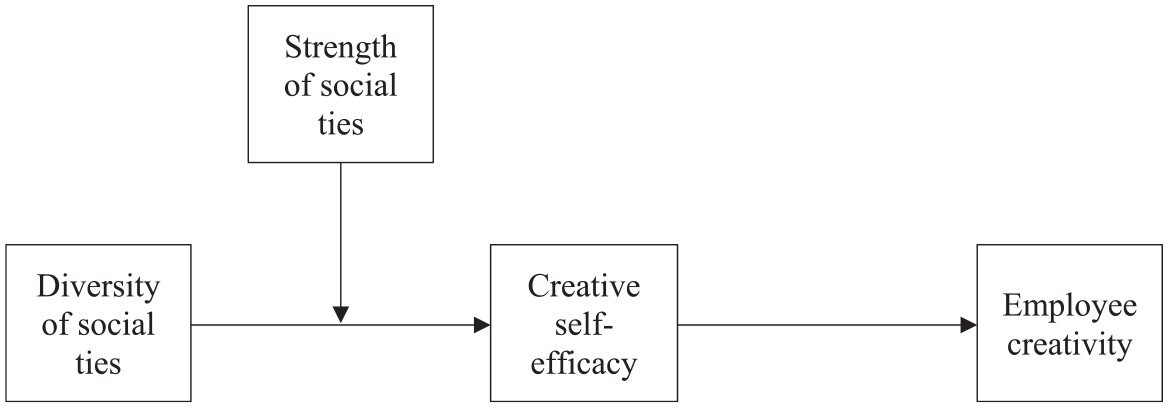
Overall research model.
We focus on diversity of social ties in terms of functional areas which represent salient social circles and capture the range of expertise in real organizations. In general, we move beyond the informational argument only, and contribute to theory development and testing by showing creative self-efficacy as a motivational mechanism linking diversity of social ties and employee creativity. In addition, building on the distinction between diversity and strength with regard to social ties, we show that the two jointly shape creative self-efficacy and subsequently employee creativity, thereby extending research on the independent effect of tie strength on employee creativity (Sosa, 2011). The insight is that social ties must be diverse and strong to best enhance employee creative self-efficacy and consequently creativity.
Theory and hypotheses
Diversity of social ties, creative self-efficacy and creativity
From diversity of social ties to creative self-efficacy
According to social cognitive theory and self-efficacy theory (Bandura, 1997, 2001; Gist and Mitchell, 1992), diversity of social ties can increase one’s estimate of potential resources for generating creative ideas and the actual acquisition of diverse information, thus boosting creative self-efficacy. Specifically, an individual’s efficacy estimate can be influenced by his or her judgment of the task and interpersonal environment ‘by which the individual assesses the availability of specific resources [emphasis added] and constraints for performing the task at various levels’ (Gist and Mitchell, 1992: 190). Examples of interpersonal environmental factors include availability of models and feedback information (resources), and examples of task environmental factors include distractions (e.g. noise) and physical setting (Bandura, 1997; Gist and Mitchell, 1992). In the current study, we focus on social ties for work-related issues. These ties are found in a focal employee’s immediate social environment (e.g. peers and supervisors in the same team or unit) and beyond (e.g. individuals in other teams, units or even organizations). In creative problem solving, such social ties constitute those in the interpersonal and task environment because they are the individuals from whom the focal employee will seek advice on work-related issues.
According to social learning theory and self-efficacy theory (Bandura, 1997; Gist and Mitchell, 1992; Tierney and Farmer, 2002), diversity of social ties can generate an environmental cue that is favourable to an employee’s creative efficacy estimate. Specifically, diverse social ties provide opportunities to tap into ‘alternatives available for producing something new, for developing a new combination of ideas’ (Amabile, 1996: 85). Such diversity creates an environment that makes an employee believe that he or she has potential resources available for generating creative solutions when needed (Gist and Mitchell, 1992). Having diverse social ties can cue the focal employee towards an increased creative self-efficacy estimate based on the employee’s estimate or perception of the availability of potential resources. However, when diversity of social ties is low, an employee will have a decreased estimate of the availability of potential resources for generating creative solutions because the resources will be similar and unlikely to be novel.
Indicative evidence exists for this argument. Shin et al. (2012) examined how perceived cognitive diversity can benefit individual creativity. In their study, participants rated the extent to which members’ ways of thinking differ. Given their different research focus, they did not directly examine the relationship between the individual perception of cognitive diversity in a team and the individual creative self-efficacy. However, a reanalysis of their data supports such a relationship. 1 Individual perception reflects a personal estimate or belief rather than objective differences in and actual availability of information, knowledge and perspectives. We therefore infer that the estimate of available resources (via diverse social ties) boosts one’s creative self-efficacy.
Diverse social ties boost one’s creative efficacy estimate through exposure to and awareness of different worlds. Exposure to diverse social ties and their thought worlds broadens an employee’s horizons by revealing that different ways of thinking and behaving are possible (Csikszentmihalyi, 1999; Leung and Chiu, 2010). For instance, such an exposure makes an employee realize that a practice or idea in one area can create value in another (Burt, 2004). Moreover, the same object, action, or method may hold different meanings or functions in various areas and, therefore, unfreeze the existing cognitive structure and reduce functional fixedness (Leung and Chiu, 2010; Maddux and Galinsky, 2009). The employee also becomes aware of the different types of creativity and analogies between seemingly irrelevant areas or ideas (Burt, 2004). Such awareness propels the employee to believe that creativity is possible, boosting his or her creative self-efficacy. Indicative evidence supporting this theory is available. For instance, Maddux et al. (2010) showed that exposure to foreign cultures through foreign living experiences enhanced the awareness of different assumptions, meaning, functions and ways of doing things in different cultures. By extension, we expect that exposure to diverse social ties from different functional areas promotes similar awareness and, hence, an increased belief that creativity is possible.
Finally, consistent with the information argument, diversity of social ties can increase creative self-efficacy by boosting actual job resources, such as knowledge and information acquired from social ties. Some types of knowledge (e.g. rooted in personal experience) may be difficult to acquire, but others can be readily accessed, transferred and assimilated (Perry-Smith and Shalley, 2003). The concept of vicarious learning (Bandura, 1986, 1997) suggests that individuals acquire information and knowledge from others, which serves as the foundation for one’s creative efficacy estimate. Individuals learn from their diverse social ties through observation and modelling (Bandura, 1986), and this learning enhances their knowledge (Perry-Smith, 2006) and, hence, their creative self-efficacy estimate. We note that creative self-efficacy is partially based on the information and knowledge acquired, but it refers to the estimate of one’s capacity for creativity rather than the actual information and knowledge themselves. This observation further distinguishes the creative self-efficacy mechanism from the information argument.
From creative self-efficacy to creativity
Creative self-efficacy enhances employee creativity (Bandura, 1997, 2001; Gong et al., 2009; Tierney and Farmer, 2002). Creative endeavours are risky and challenging, and they require individuals to engage in trial and error and continuous learning (Tierney and Farmer, 2011), making strong internal sustaining forces important for achieving creative outcomes. Creative self-efficacy reflects the can-do aspect of creative motivation and provides the internal driving force for creativity (Liu et al., 2016).
Drawing upon social cognitive theory (Bandura, 1997, 2001), Liu et al. argued, ‘. . . unless people believe they can produce desired results and forestall detrimental ones by their actions, they will not invest ample time and resources in their work’ (Liu et al., 2016: 238). With high creative self-efficacy, an employee believes that he or she can produce creative outcomes, which motivates him or her through the expectancy process. When an employee believes that he or she is capable of achieving a creative outcome, he or she sees a positive link between effort and creative outcome and is thus willing to exert effort and persist. As such, the employee is more likely to challenge the status quo, demonstrate high creative effort and persist rather than withdraw from creative endeavours (Bandura, 2001; Grosser et al., 2017; Tierney and Farmer, 2002). Furthermore, the employee is less likely to prematurely settle with a less creative idea or reject a good idea (Grosser et al., 2017). With high creative self-efficacy, an employee also feels comfortable with and hence has greater motivation to utilize new information and knowledge to ‘brainstorm greater and more varied ideas’ (Grosser et al., 2017: 1362). By contrast, an employee who does not believe that he or she is capable of producing a creative outcome will not challenge the routine, explore new knowledge or brainstorm creative solutions. The same employee will withdraw from creative activities when faced with obstacles and setbacks, leading to decreased creative performance. To sum up, we hypothesize and test the following:
Hypothesis 1: The diversity of an employee’s social ties in terms of functional areas has an indirect positive relationship with the employee’s creative performance via the employee’s creative self-efficacy.
Tie strength as boundary condition
So far, we have explicated how diversity of social ties increases employee creativity via enhanced creative self-efficacy. Next, we discuss an important boundary condition (i.e. the ‘when’ question) for the indirect relationship in Hypothesis 1. For several reasons, we propose that tie strength amplifies the relationship between diversity of social ties and creative self-efficacy and, thus, the indirect relationship between diversity of social ties and creativity via enhanced creative self-efficacy.
Firstly, when his or her social ties are strong, a focal employee enjoys cohesive relationships with social ties, characterized by high trust and exposure (Aral and Van Alstyne, 2011; Hansen, 1999). In this situation, the environmental cue for creative self-efficacy estimation is strong because the focal employee is likely to believe that he or she can marshal resources easily and effectively through diverse social ties. Secondly, strong relationships enable increased and improved interactions with diverse social ties (Aral and Van Alstyne, 2011; Sosa, 2011) and, thus, wide exposure to different social circles and ways of thinking and effective unfreezing of existing cognitive structures, boosting the estimate that one can achieve creativity. Thirdly, when tie strength with diverse social ties is great, the focal employee is likely to trust the accuracy of the information and knowledge he or she receives from social ties, leading to increased confidence in information and knowledge and thus high efficacy estimate.
In addition, tie strength enhances the effective transfer and assimilation of actual information and knowledge from diverse social ties (Aime and Van Dyne, 2010; Hansen, 1999) and, therefore, amplifies the relationship between diversity of social ties and creative self-efficacy. To explicate this amplifying effect, we first elaborate on the types of non-redundant information and knowledge provided by diverse social ties. Perry-Smith (2014) distinguished between non-redundant information (i.e. facts, data and readily available solutions) and frames (i.e. thought worlds or perspectives through which individuals make sense of a problem or situation). Information tends to be objective and explicit and thus easy to transfer (by social ties) and absorb (by the focal employee). Strong relationships are not needed for the transfer and acquisition of information across distinct domains. By contrast, frames are subjective and often tacit and, thus, difficult to transfer and absorb. Strong relationships characterized by trust, support and frequent interactions (Granovetter, 1973; Ma et al., 2011; Perry-Smith, 2006) are necessary for the transfer and absorption of such knowledge. While not focusing on tie strength, some studies (Baas et al., 2008; Chua et al., 2012; Gong et al., 2012; Sosa, 2011) suggest that trust and positive affect, which often characterize strong social relationships, facilitate knowledge exchange and/or creativity.
The information–frame categorization of Perry-Smith (2014) is consistent with the explicit–tacit distinction in the knowledge management literature (Nonaka, 1994). Explicit knowledge, also called codified knowledge, is objective and presented in formal and systematic language (e.g. reports; Edmondson et al., 2003; Nonaka, 1994). Tacit knowledge is more subjective and difficult to formalize, articulate and communicate than explicit knowledge because the former is grounded in personal experiences, insights and know-how (Alavi and Leidner, 2001; Nonaka et al., 2000). Tacit knowledge includes (a) the mental models, beliefs and paradigms through which individuals perceive and understand the world, and (b) technical knowledge covering concrete, context-specific know-how and skills (Alavi and Leidner, 2001; Nonaka, 1994). Whilst explicit knowledge is important for creativity, tacit knowledge, such as frames from social ties, is critical because it influences how an employee makes sense of a situation or problem (e.g. reinterpretation of a root cause and reframing of a problem), increases cognitive flexibility and expands cognitive categories, leading to creative solutions (Hargadon and Bechky, 2006; Perry-Smith, 2014). For example, Hargadon and Bechky (2006) found that others’ perspectives help reframe a problem, leading to a creative solution.
The information–frame distinction helps us explain why tie strength amplifies the relationship between diversity of social ties and creativity. Diverse social ties from different knowledge domains provide not only easily obtainable information or explicit knowledge but also difficult-to-transfer frames or tacit knowledge. Access to and transfer of information or explicit knowledge is relatively easy because this information or knowledge is often in a publicly accessible, self-explanatory and easily understandable format (Perry-Smith, 2006; Perry-Smith and Shalley, 2003). Thus, accessing and transferring such information or knowledge does not require strong relationships. This means that developing creative self-efficacy based on access to and acquisition of information or explicit knowledge can be achieved regardless of tie strength (Perry-Smith, 2006; Perry-Smith and Shalley, 2003).
However, the situation is different for developing creative self-efficacy on the basis of enhanced access to and acquisition of frames or tacit knowledge for creativity. We expect that frames or tacit knowledge can be effectively transferred and assimilated when social ties are strong (Aral and Van Alstyne, 2011; Hansen, 1999; Reagans and McEvily, 2003), leading to high creative self-efficacy. As previously pointed out, frames or tacit knowledge are critical for creativity but difficult to transfer and assimilate (Nonaka, 1994). Acquiring such knowledge requires trust, time and interaction, which are the aspects that often characterize strong relationships. Granovetter (1982: 113) acknowledged that strong ties provide ‘greater motivation to be of assistance and are typically more easily available’. The availability and assistance of social ties make frames or tacit knowledge accessible and understandable to the focal employee, thus enhancing the assimilation of frames or tacit knowledge (Hansen, 1999). For instance, when the employee cannot assimilate and apply frames or tacit knowledge during an interaction, strong relationships with multiple interactions will enable him or her eventually to do so.
A strong supportive relationship increases the likelihood that ‘a relationship is charged with positive affect’ (Sosa, 2011: 5) and that the focal employee experiences positive affect (Madjar et al., 2002). As a result, the employee becomes open-minded (or less rigid, for example, less likely to distort or ignore that which does not fit their preconceptions) and thoroughly processes what he or she receives and readily integrates it (Isen, 2000). This effect should facilitate the recognition and assimilation of frames or tacit knowledge from diverse social ties. A strong relationship also means increased motivation to engage in the relationship, and such a motivation provides the employee with the energy to acquire and process frames or tacit knowledge from their diverse social ties (Sosa, 2011). When the relationship is strong, the employee is also likely to consider and utilize alternative viewpoints from their diverse social ties because a strong relationship means trust, support and a feeling of psychological safety (Li et al., 2018). The effective recognition, assimilation and utilization of frames or tacit knowledge from diverse social ties boosts the efficacy estimate because knowledge forms the basis for such an estimate, strengthening the benefit of diverse social ties for creative self-efficacy.
Overall, the above discussion suggests that the relationship between diversity of social ties and creative self-efficacy is amplified in the case of strong social ties. Although no study has directly tested this expectation, indirect evidence exists. For example, in a study of interunit ties, Hansen (1999) found that weak ties are advantageous when seeking new knowledge, but strong ties are excellent at transferring difficult-to-transmit tacit knowledge. Reagans and McEvily (2003) found that strong relationships enhance knowledge transfer and that this advantage is even stronger for tacit knowledge. Effective transference and assimilation of such knowledge enhances creative self-efficacy. To sum up, we hypothesize and test the following:
Hypothesis 2: An employee’s tie strength moderates the positive relationship between the diversity of the employee’s social ties and creative self-efficacy such that the relationship is amplified when the employee’s social ties are strong.
Next, we put forward a moderated indirect relationship hypothesis by integrating Hypotheses 1 and 2. That is, the positive indirect relationship between diversity of social ties and employee creativity via creative self-efficacy is strong when tie strength is increased. In essence, tie strength enhances the indirect relationship between diversity of social ties and employee creativity (via creative self-efficacy) because it amplifies the relationship between diversity of social ties and creative self-efficacy. Specifically, when social ties are strong, a given level of diversity of social ties leads to a high creative efficacy estimate because the focal employee has: (a) a favourable estimate of resources available for generating creative solutions owing to increased effective access to resources from social ties; (b) an increased awareness of different ways of thinking and behaving owing to deep exposure to social ties; and (c) effective transference and assimilation of frames or tacit knowledge (beyond information or explicit knowledge) owing to increased trust and support. These three forces (which drive one’s creative efficacy estimate) combined build up the employee’s creative self-efficacy when the employee’s social ties are strong. The enhanced creative efficacy estimate subsequently strengthens creativity further. To sum up, we hypothesize and test the following:
Hypothesis 3: An employee’s tie strength moderates the positive indirect relationship between the diversity of the employee’s social ties and employee’s creativity via the employee’s creative self-efficacy such that the relationship is amplified when the employee’s social ties are strong.
Method
Participants and procedure
The third author contacted the top management of 33 firms operating in central China. These firms had cooperative relationships with the third author’s university. They operated in technology, manufacturing and service industries, and their sizes (total number of employees) ranged from 50 to 200. The human resource managers at these firms compiled lists of randomly selected employees and the direct supervisors of those employees. These lists provided 463 employee–supervisor pairs. The third author invited all of them to participate. He informed them that their participation was voluntary and that the data would be accessed and used by the researchers only. The participants received pre-coded questionnaires to facilitate matching of employee and supervisor surveys.
The questionnaires were distributed and completed during work hours. The employees responded to a name generator question about their social ties (contacts) for work-related matters, including each tie’s functional category and position level, the duration of the relationship with each contact, the degree of affinity with each contact and the frequency of communication with each contact. Consistent with prior research (Baer, 2010; Perry-Smith, 2006; Venkataramani et al., 2014), the name generator question read as follows: For work-related issues, whom have you communicated with or consulted in the past two years? Please include people with whom you did not interact frequently and with whom you interacted informally. Please write down their names in the table below and then answer questions (e.g. the functional category of and your interaction frequency with the person) regarding each person you listed.
The employees also rated their creative self-efficacy. The supervisors assessed their subordinate employees’ creative performance. Employees and supervisors completed and returned their surveys separately.
Of the 463 pairs of surveys distributed, 309 complete (employee–supervisor) pairs were returned, with a response rate of 67.0%. A total of 64.0% of the employees were male. Their average age and organizational tenure were 30.0 years (SD = 5.4) and 4.5 years (SD = 3.7), respectively. Of the 98 supervisors, 80.0% were male, with an average age of 37.6 years (SD = 6.1) and an average organizational tenure of 7.5 years (SD = 4.9).
Measures
We initially developed the surveys in English, but translated them into Chinese following Brislin’s (1986) recommendation. Specifically, two bilingual individuals independently translated the surveys from English into Chinese and reconciled any disagreement regarding word choice and expression. A third bilingual person then translated the surveys back into English. During this process, a few words or phrases in the Chinese version that did not exactly match with those in the English version were back-translated into English based on the agreement between the third translator and the previous two translators.
Diversity of social ties
We asked each respondent (employee) to list individuals with whom they had communicated on work-related issues over the past 2 years. We had 10 numbered rows in the table and provided additional rows so that participants could include additional social contacts. We reminded respondents to include those with whom they had interacted infrequently or informally. The respondents then reported the functional category of each social tie. We adopted the functional categories from Bunderson and Sutcliffe (2003). We combined a few administration and general management-related functions into one category and generated the following functional categories: 1 = Production or manufacturing, 2 = Business department (sales/marketing and business planning), 3 = Engineering and technology (R&D and quality assurance), 4 = General management (HR/personnel and office administration), 5 = Logistics (purchasing, distribution and warehousing) and 6 = Others (finance and accounting). The index of Blau (1977), 1 − ∑Pi2, was then used to calculate the functional diversity of an employee’s social ties based on the six categories, where Pi represents the proportion of an employee’s social ties in the ith functional category.
Tie strength
We measured tie strength by the duration, closeness and frequency of the interaction (Granovetter, 1973; Perry-Smith, 2006). Following previous studies (Hansen, 1999; Perry-Smith, 2006; Wegener, 1991), we asked the respondents to report the duration of the relationship (1 = less than 1 year, 2 = 1–2 years, 3 = 2–5 years, 4 = 5–10 years and 5 = above 10 years), the degree of closeness of the relationship (1 = general acquaintance, 2 = general colleague, 3 = close colleague, 4 = good friend and 5 = close personal friend), and the frequency of the interaction with each social tie (1 = once a year, 2 = once a month, 3 = several times a month, 4 = several times a week and 5 = every day). We rescaled respondents’ assessments into standardized scores, which allowed a comparison of the duration, closeness and frequency scores. Following prior research (Morrison, 2002), we averaged the standardized scores for the three dimensions to form a composite score of tie strength. We then took the average of the strength of all social ties for each employee. A high score indicates the employee’s strong social ties.
Creative self-efficacy
We used Tierney and Farmer’s (2002) 3-item scale to assess an employee’s creative self-efficacy (see also Gong et al., 2009; Tierney and Farmer, 2011). Participants reported the extent to which they agreed that the items accurately described themselves in their current jobs. A sample item was ‘I have confidence in my ability to solve problems creatively’ (1 = strongly disagree, 7 = strongly agree).
Employee creativity
The supervisors rated each subordinate employee’s creativity in their current job using Zhou and George’s (2001) 13-item scale (1 = not at all characteristic, 5 = very characteristic). A sample item was ‘Comes up with new and practical ideas to improve performance’.
Control variables
Following prior research (Amabile et al., 2005; Gong et al., 2009; Madjar et al., 2002), we controlled for employee age, gender, education and organizational tenure. In addition, we controlled for several characteristics of an employee’s social ties that might have influenced the relationship between diversity of social ties and employee’s creativity. Specifically, we controlled for an employee’s outside ties by calculating the percentage of the social ties that were not in the same organization out of the total number of social ties (i.e. proportion of outside social ties). Outside social ties may provide more diverse information and knowledge than inside ties, and thus influence creativity more. We controlled for the average job level of the social ties of each employee (1 = first-year employee, 2 = experienced employee, 3 = supervisor of a unit/team, 4 = middle manager and 5 = senior manager) because hierarchy or status in an organization may qualify the utility of social ties as a source of information. We also controlled for the number of social ties of an employee because, on average, an employee with a larger number of social ties may be able to build up a larger pool of information and knowledge compared with one with a smaller number of social ties. We also controlled for the square of number of social ties. As the number of social ties increases beyond an optimal level, the focal employee could no longer engage in meaningful interactions with these ties nor devote necessary time to assimilating information and knowledge and developing creative ideas (Baer, 2010; Zhou et al., 2009). Finally, to partial out the potential impact of jobs and their requirements, we assessed job requirements for creativity using Gilson and Shalley’s (2004) 4-item scale and controlled for it. A sample item included ‘My job requires that I come up with novel means of doing things’ (1 = strongly disagree to 7 = strongly agree). The average job requirement for creativity was moderately high (M = 4.89, SD = 1.08).
Analytical strategies
We had a nested data structure (i.e. subordinate employees nested within supervisors and organizations). Following prior creativity research (Amabile et al., 2005), we conducted multilevel path modelling to control for unique variances from the high levels. Specifically, we used Mplus 7.3 (Muthén and Muthén, 2012) to control for any potential confounding effects of supervisor- and organization-level factors on the relationships. We used three-level models with individual employees at Level 1, supervisors at Level 2 and organizations at Level 3, and ran a random intercept-only model for the supervisor and organizational levels. To test the indirect and moderated indirect relationships, we used Monte Carlo simulation to generate asymmetric confidence intervals (CIs) (20,000 replications) following the guidelines of Preacher et al. (2010).
Results
Descriptive statistics
Table 1 reports the descriptive statistics, reliability estimates and correlations for the study variables (all reliability estimates were above .70). Diversity of social ties was positively related to creative self-efficacy (r = .21, p < .01) and employee creativity (r = .18, p < .01). Creative self-efficacy was positively related to employee creativity (r = .25, p < .01). The strength and diversity of social ties were not significantly related to each other (r = –.11, ns), suggesting that they are independent.
Means, standard deviations and correlations among variables.
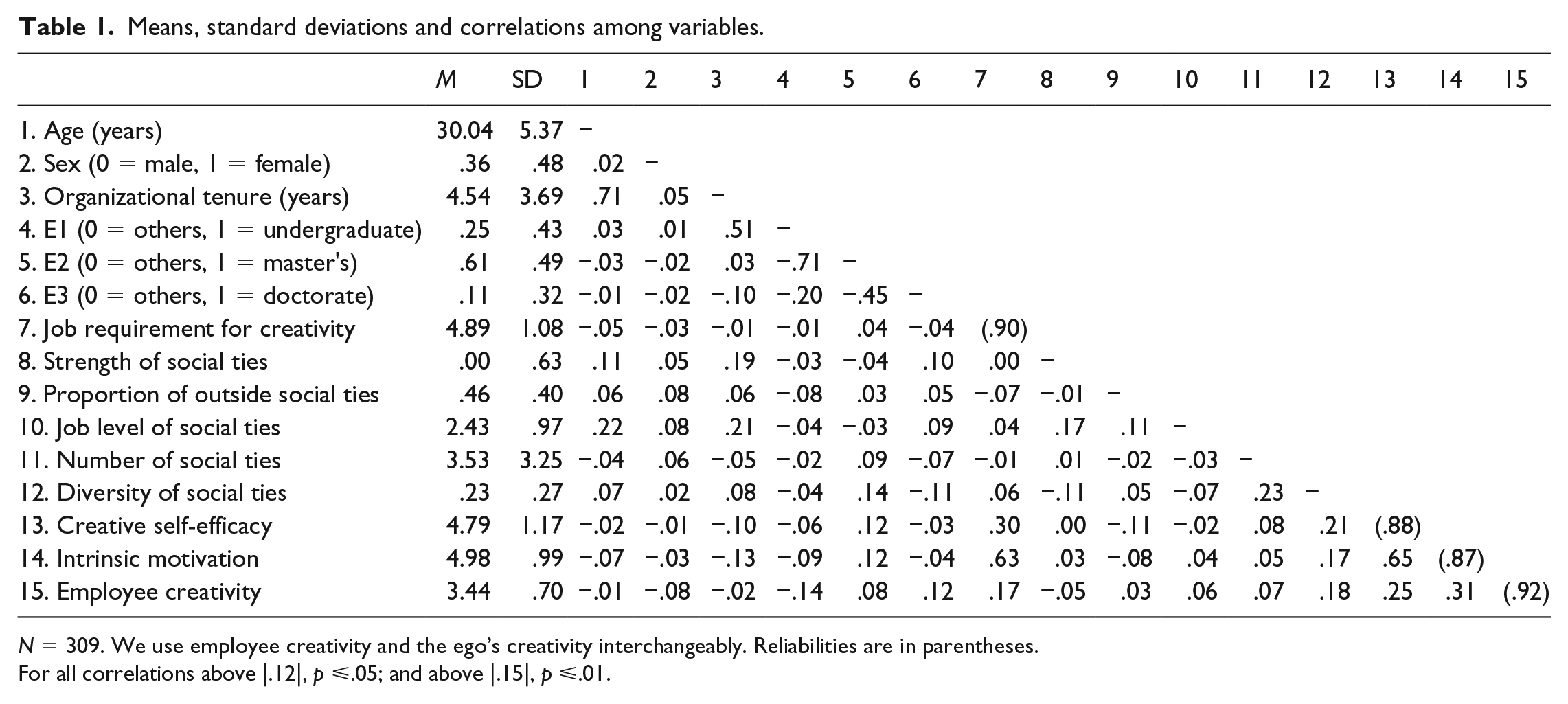
N = 309. We use employee creativity and the ego’s creativity interchangeably. Reliabilities are in parentheses.
For all correlations above |.12|, p ⩽.05; and above |.15|, p ⩽.01.
Hypothesis testing
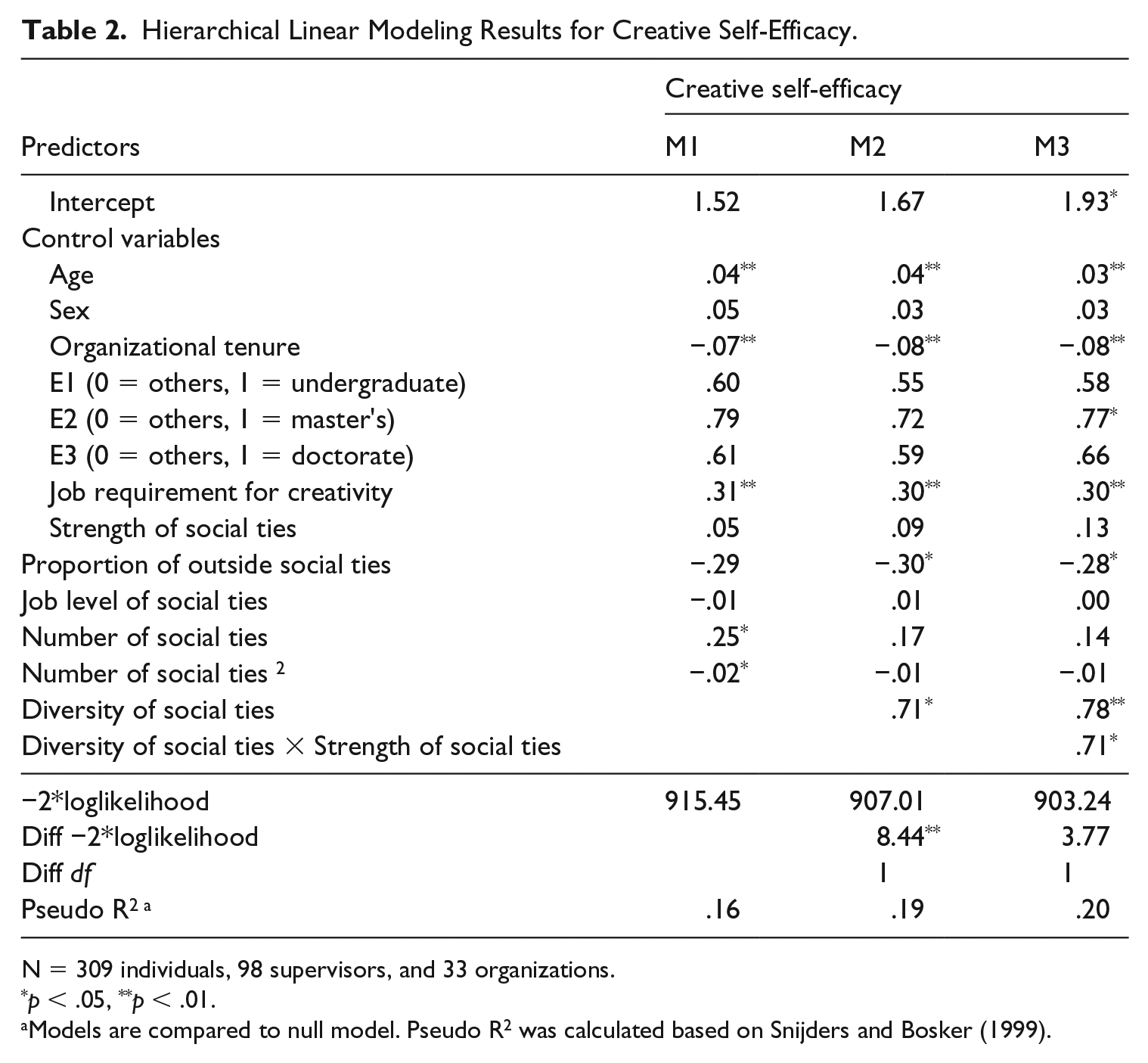
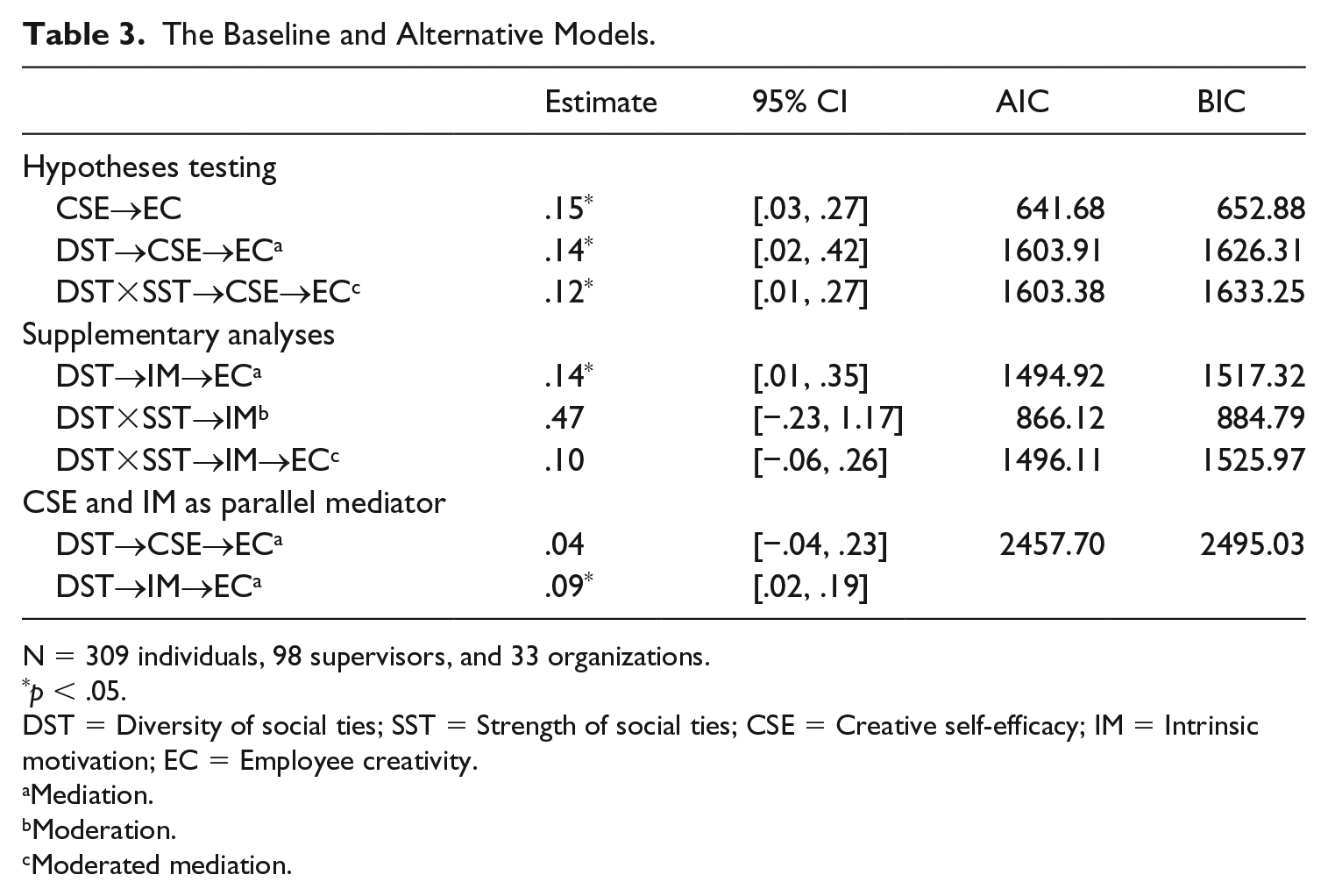
Hypothesis 1 states that the diversity of an employee’s social ties has an indirect positive relationship with the employee’s creative performance via the employee’s creative self-efficacy. As expected, diversity of social ties was significantly related to creative self-efficacy (γ = .71, p < .05), as shown in Table 2, and creative self-efficacy was significantly associated with employee creativity (γ = .15, p < .05), as shown in Table 3. We further conducted Monte Carlo simulation to examine the significance of the indirect relationship via creative self-efficacy. The results in Table 3 suggested that the indirect relationship that diversity of social ties had with employee creativity via creative self-efficacy was significant (indirect effect = .14, 95% CI = [.02, .42], supporting Hypothesis 1.
Hierarchical Linear Modeling Results for Creative Self-Efficacy.
N = 309 individuals, 98 supervisors, and 33 organizations.
p < .05, **p < .01.
Models are compared to null model. Pseudo R2 was calculated based on Snijders and Bosker (1999).
The Baseline and Alternative Models.
N = 309 individuals, 98 supervisors, and 33 organizations.
p < .05.
DST = Diversity of social ties; SST = Strength of social ties; CSE = Creative self-efficacy; IM = Intrinsic motivation; EC = Employee creativity.
Mediation.
Moderation.
Moderated mediation.
Hypothesis 2 proposes that tie strength moderates the positive relationship between diversity of social ties and creative self-efficacy such that the relationship is amplified when social ties are strong. The results in Table 2 revealed a positive sign for the interaction term (γ = .71, p < .05). Specifically, simple slope tests demonstrated that the relationship between diversity of social ties and creative self-efficacy was non-significant when tie strength was low (1 SD below mean) (slope = .33, ns) but significant when tie strength was high (1 SD above mean) (slope = 1.22, p < .01). These simple slopes were also significantly different from each other (t = 2.29, p < .05), supporting Hypothesis 2. These simple slopes are portrayed in Figure 2.
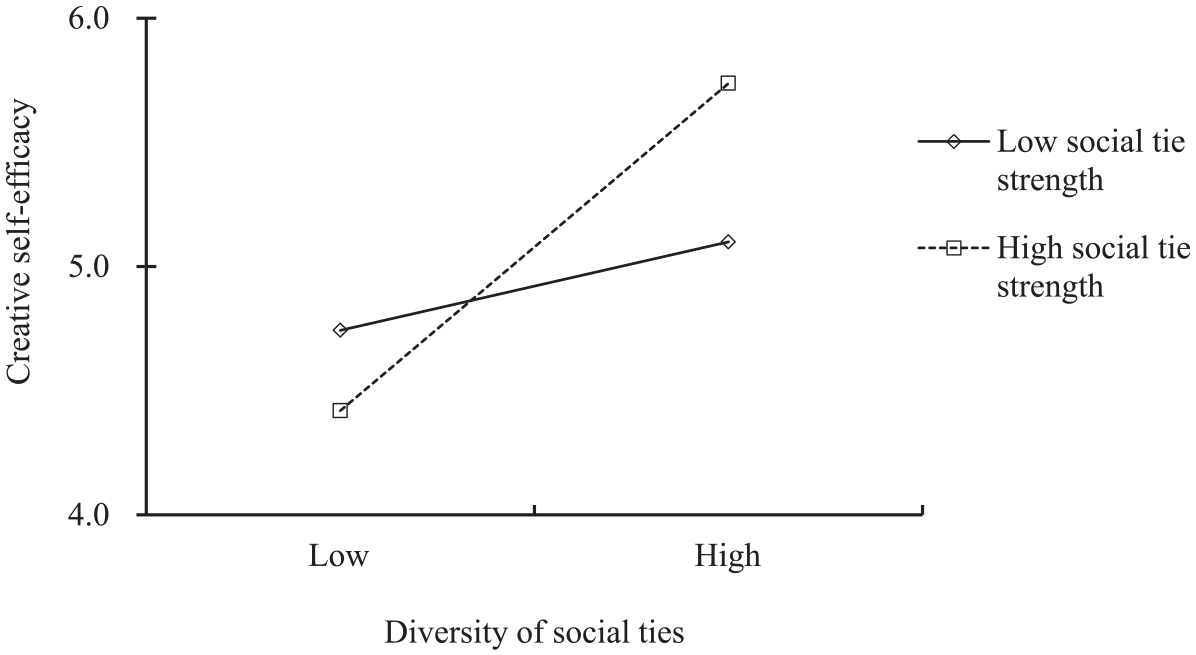
Simple slopes for the effects of diversity of social ties on creative self-efficacy at low and high levels of strength of social ties.
As supplementary analyses, we tested the interactive effect using the three dimensions of tie strength (i.e. the degree of closeness, frequency of interaction and duration of the relationship) separately. The results showed that the interactive effect of diversity of social ties was significant for the dimensions of closeness and interaction (γ = .58, p < .05; γ = .41, p < .05), and the interaction patterns were similar to those shown in Figure 2. However, the interactive effect of diversity of social ties and duration of the relationship on creative self-efficacy was non-significant (γ = –.03, ns).
Hypothesis 3 assumes that tie strength moderates the positive indirect relationship between diversity of social ties and creativity via creative self-efficacy such that it is amplified when social ties are strong. The moderated path analytic results based on Monte Carlo simulation showed that the indirect path linking diversity of social ties and employee creativity via creative self-efficacy varied significantly as a function of tie strength (i.e. moderated mediation effect = .12, 95% CI = [.01, .27]), as shown in Table 3. Specifically, the indirect relationship was non-significant when tie strength was low (i.e. indirect effect = .03, 95% CI = [–.03, .27]) but significant when tie strength was high (i.e. indirect effect = .21, 95% CI = [.03, .49]). Figure 3 depicts the indirect effect slopes, and the results support Hypothesis 3.
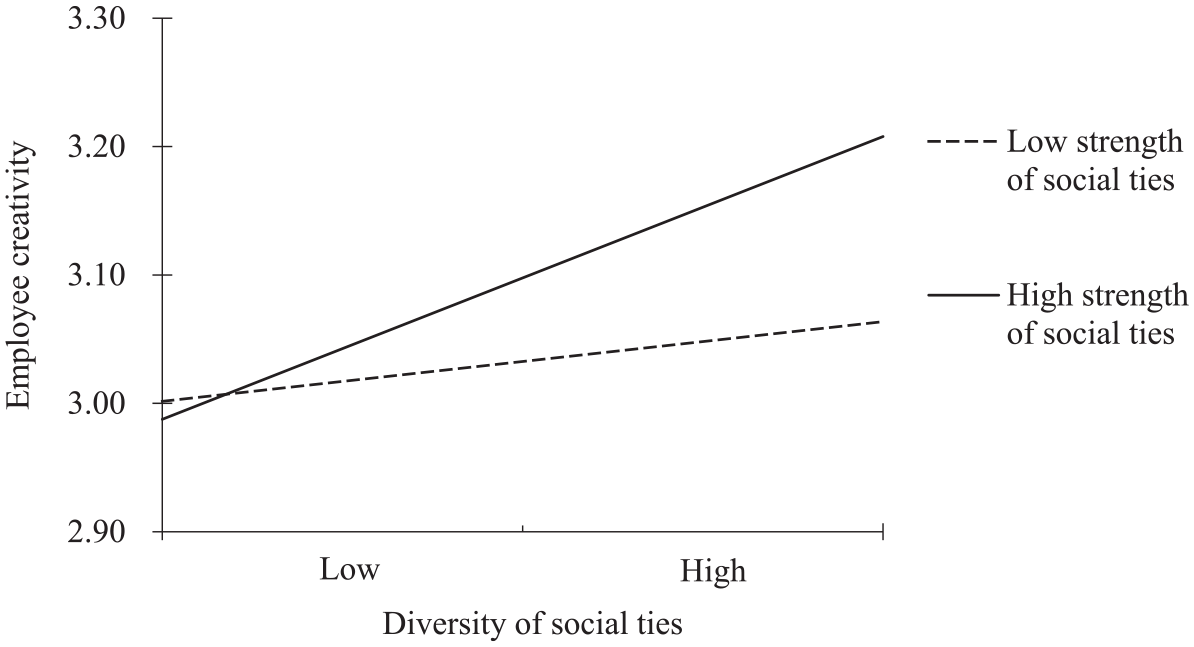
The indirect effects of diversity of social ties on employee creativity via creative self-efficacy at low and high levels of strength of social ties.
Supplementary analyses
We conducted a sensitivity analysis to examine the robustness of our results. We ran our models excluding non-significant control variables, and all significant results remained the same. We likewise tested alternative models. For example, diversity of social ties can be linked to intrinsic motivation, which in turn relates to employee creativity. Diversity of social ties and tie strength may interactively affect intrinsic motivation. Specifically, we assessed employee intrinsic motivation using Tierney et al.’s (1999) 5-item scale. Similar to Shin and Zhou (2003), each employee in the current study reported the extent to which he or she was currently interested and engaged in creativity-related activities. A sample item was ‘I enjoy finding solutions to complex problems’ (1 = strongly disagree, 7 = strongly agree). Cronbach’s alpha was .87 for the scale. We ran a two-factor model for intrinsic motivation and creative self-efficacy, both of which were employee-reported. This two-factor model had an acceptable fit with the data (χ2[311, 19] = 62.42, p < .01; RMSEA = .08; CFI = .97; TLI = .95). We then proceeded to model testing.
We first tested intrinsic motivation as a mediator separately. The indirect relationship that diversity of social ties has with employee creativity via intrinsic motivation was significant (indirect effect = .14, 95% CI = [.01, .35]), as shown in Table 3. When we tested creative self-efficacy and intrinsic motivation simultaneously, diversity of social ties was significantly and indirectly related to employee creativity via intrinsic motivation (indirect effect = .09, 95% CI = [.02, .19]) but not creative self-efficacy (indirect effect = .04, 95% CI = [–.04, .23]). However, a clear and conclusive estimate of the effects of creative self-efficacy and intrinsic motivation on employee creativity is difficult to reach when testing them as parallel predictors because they were highly correlated (r = .65, p < .01). In addition, whether diversity of social ties influences creative self-efficacy and intrinsic motivation is more crucial to our model. The results showed that diversity of social ties had a stronger relationship with creative self-efficacy than with intrinsic motivation (r = .21, p < .01; r = .17, p < .01, respectively). Furthermore, tie strength did not significantly moderate the relationship between diversity of social ties and intrinsic motivation (moderation coefficient = .47, 95% CI = [–.23, 1.17]). As a result, tie strength did not significantly moderate the indirect relationship that diversity of social ties has with employee creativity via intrinsic motivation (moderated indirect effect = .10, 95% CI = [–.06, .26]), as shown in Table 3.
Discussion
Our objective was to examine how and when diversity of social ties influences creativity. We found that diversity of social ties has a positive indirect relationship with employee creativity via creative self-efficacy. Moreover, tie strength amplifies the direct relationship that diversity of social ties has with creative self-efficacy and its indirect relationship with employee creativity (via creative self-efficacy). These findings offer implications for theory and research.
Implications for creativity theory and research
Implications for the social ties perspective on creativity
In this study, we theorize and empirically show that diversity of social ties increases employee creativity via employee creative self-efficacy. When an employee has social ties with individuals from diverse domains, he or she develops high creative self-efficacy. This finding supports the move towards focusing on diversity of social ties rather than relying on the distinction between weak and strong social ties (Baer, 2010). More importantly, this finding extends the social ties perspective on creativity. The information argument has often been raised but has not been directly measured and tested. Moving beyond the information argument, we show creative self-efficacy as a motivational mechanism. The creative self-efficacy mechanism is in line with the information argument because one’s creative efficacy belief is partly based on acquired information and knowledge from his or her social ties. Creative self-efficacy, however, is largely motivational because it refers to one’s belief about capacity for creativity rather than actual knowledge and information, and such a belief propels an individual to work hard and persist in creative endeavours. Moreover, an employee’s creative self-efficacy is influenced by the estimate of potential resources available for generating creative solutions when circumstances require. It can be also boosted by an individual’s exposure to diverse social ties as such an exposure develops awareness that different ways of thinking and behaving are possible. Both sources of efficacy belief do not rely on the actual knowledge and information acquired from social ties.
Secondly, we show that the diversity of ties and tie strength are important and that they jointly strengthen employees’ creative self-efficacy and consequently their creativity. Theoretically and empirically, tie strength in itself does not have clear-cut implications for creativity. Strong relationships enjoy the advantages of trust and support, which are conducive to creativity, but may involve at least some connections (ties) between similar individuals and generate conformity pressure. The two forces cancel each other out, generating a non-significant relationship with creativity. However, tie strength synergizes with diversity of social ties in the motivational process leading to creativity. Although having diverse social ties helps obtain diverse information and knowledge, it does not generate the most benefit unless these social ties are also strong, thus enabling increased resource estimation, deep exposure to different ways of thinking, and effective transference and assimilation of complex and difficult-to-transmit frames or tacit knowledge. The implication is that diversity and strength should be separated as various concepts of social ties. This separation reveals the new insight that creative self-efficacy is an effective mechanism for diversity of social ties when tie strength is strong.
Prior research has tested the main effects of strong and weak ties on creativity using the specific facets of tie strength separately (i.e. closeness, frequency, and duration; Perry-Smith, 2006). Inspired by prior research, we conducted additional analyses on the moderating role of tie strength by separating the three facets as well. Results suggested that closeness and frequency of communication (interaction), but not duration, strengthen the relationship between diversity of social ties and creative self-efficacy. Conceptually, closeness and frequency of communication may more accurately reflect tie strength than duration. In addition, frequent communication (interaction) creates and enhances intimacy and trust, strengthening relationships. Interaction enables deep exposure, increased resource estimation and effective acquisition of information and knowledge and, thus, unleashes the potential of diversity of social ties for creative self-efficacy to a great extent. Duration of relationship, on the contrary, captures how long a relationship has existed but may not accurately reflect a close relationship and its associated frequent interaction (communication). Future research may ascertain whether the three dimensions of tie strength play different independent roles or work differently with others in shaping creativity.
In this study, we did not formally include intrinsic motivation in the research model. We noted that Sosa (2011) proposed (but did not test) that dyadic tie strength is associated with strong intrinsic motivation to engage in a relationship and, therefore, much energy to acquire knowledge on the employee side and increased support for creativity on the source side. In this study, we examined diversity of social ties at the focal employee level rather than tie strength at the dyadic level. Intrinsic motivation is the desire to engage in a task because it is enjoyable and challenging and, hence, reflects the want-to-do motivation for creativity (Amabile, 1996; Deci, 1980; Liu et al., 2016; Shin and Zhou, 2003). Creative self-efficacy refers to the belief that one is capable of achieving creative outcomes and, thus, reflects the can-do motivation for creativity (Bandura, 1997, 2001; Liu et al., 2016; Tierney and Farmer, 2002). According to self-determination theory (Deci and Ryan, 1985, 2012; Ryan and Deci, 2000), satisfying the need for autonomy (e.g. through job autonomy) most effectively boosts intrinsic motivation. Conceptually, exposure to diverse social ties has no strong, direct relevance to the satisfaction of autonomy need and, hence, intrinsic motivation. To sum up, we reason that diversity of social ties has no strong, direct relevance to intrinsic motivation. Contrary to expectation, our supplementary analysis suggests that diversity of social ties enhances intrinsic motivation. Acquisition of information and knowledge from diverse social ties possibly makes the focal employee feel competent, and this feeling of competence enhances intrinsic motivation. However, as expected, diversity of social ties is more strongly related to creative self-efficacy than to intrinsic motivation. Tie strength significantly moderates the relationship between diversity of social ties and creative self-efficacy but not that between diversity of social ties and intrinsic motivation.
Implications for the creative self-efficacy perspective
In this study, we identify a critical antecedent to creative self-efficacy and an associated boundary condition. Prior research focuses on antecedents such as job tenure and education (Tierney and Farmer, 2002, 2011). We demonstrate diversity of social ties as an environmental antecedent. Moreover, diversity of social ties benefits creative self-efficacy more when such social ties are strong rather than weak. Prior theory and research on creative self-efficacy has not clearly theorized the characteristics of knowledge or its role in creative self-efficacy. If anything, scholars have leaned towards job-relevant knowledge or experience that develops job-specific knowledge. Our study points to the role of knowledge breadth (associated with diverse social ties) in promoting creative self-efficacy, and therefore complements prior focus on job-specific knowledge in the development of creative self-efficacy.
Limitations and future research directions
This study has several limitations. Firstly, although the supervisors rated creativity, employees reported both their social ties and creative self-efficacy, raising a potential common method bias concern. However, diversity of social ties is based on objective data (i.e. the functional areas of one’s social ties) and further reconstructed using Blau’s (1977) index. This also means that diversity of social ties has a response format different from that for creative self-efficacy (Likert scales), reducing the common method bias concern (Podsakoff et al., 2003).
Secondly, we conducted a cross-sectional field study. We could not establish causality among the variables despite the theory-driven nature of the proposed relationships. Nevertheless, we tested an alternative model in which diversity of social ties leads to employee creativity and, thus, to creative self-efficacy. The indirect relationship model was non-significant (indirect effect = .19, 95% CI = [–.17, .55]). This result suggests that the model with creative self-efficacy driving employee creativity fits the data better than does the one testing the opposite relationship. The proposed relationship from creative self-efficacy to employee creativity is firmly grounded in social cognitive theory and self-efficacy theory. It is also consistent with prior research showing the effect of creative self-efficacy on creativity. However, we acknowledge that high creativity may increase the efficacy of an employee. Self-efficacy theory and research has shown reciprocal causation between self-efficacy and task performance (Bandura, 1997). Simply put, the causality between creative self-efficacy and employee creativity is mutual: the existence of one causal direction does not invalidate the other.
A highly creative employee may also seek out and form diverse social ties. Thus, we tested a model in which employee creativity leads to diversity of social ties without the mediating mechanisms. After taking into account the potential confounding effects of supervisor- and organization-level factors and control variables, we found that the model on employee creativity to diverse social ties fits the data better than the reverse model does (γ = .06, p < .01; γ = .40, p < .05, respectively). We did not formally hypothesize and test the effect of diversity of social ties on creativity. Nevertheless, the existence of the opposite relationship could bias the estimate if we were to hypothesize and test this effect. Empirically, diversity of social ties was calculated on the basis of social contacts with whom the focal employee communicated over the past 2 years. Creativity was assessed at the time of the survey. Although they were reported at the same time, the timeframe for diversity of social ties, the independent variable, was actually earlier. Given that we could not assume a particular temporal ordering between diversity of social ties and employee creativity, we caution against any causal interpretation. We encourage future research to use a longitudinal or experimental design to ascertain the causal directionality.
Thirdly, we could not fully disentangle the effects of creative self-efficacy and intrinsic motivation and their interrelationships in shaping creativity. Although we did not hypothesize and report it, our additional analysis reveals the possibility that creative self-efficacy may boost creativity partially through intrinsic motivation. The relationship between creative self-efficacy and intrinsic motivation is complex and remains unresolved. Future research should focus on this relationship specifically and provide a (much needed) nuanced and extensive treatment.
Fourthly, we did not include openness. This omission is potentially more serious than simply a lack of control because individuals with high openness may maintain more diverse social ties and be more creative than those with low openness. The relationship between diversity of social ties and employee creativity can be a spurious correlation (i.e. two or more variables are not causally related to each other, yet it may be wrongly inferred that they are owing to the presence of a certain third, unseen factor; Ward, 2013). Without data regarding openness, we were unable to check this possibility directly. Creativity research in organizational settings alleviates this concern. We examined social ties for work-related matters or simply instrumental ties. Fang et al.’s (2015) meta-analysis showed that openness was significant for expressive, but not instrumental, network ties. Furthermore, although openness is positively related to artistic and scientific creativity (Feist, 1998), it is not necessarily so for employee creativity in business organizations for reasons such as situational constraints (George and Zhou, 2001). George and Zhou (2001) also found that openness has no significant effect on employee creativity and that it exerts a positive effect only under certain conditions (e.g. when an employee receives positive feedback from his or her supervisor and there are unclear means at work). Nevertheless, it would be valuable to include openness as a control in order to rigorously test the relationship between diversity of social ties and creativity.
Fifthly, social ties in this study refer to individuals from typical functional areas in business organizations. Such functional information and knowledge should have relevance to employees because modern organizational work activities are often interdependent, and cross-functional interactions are often necessary and expected. However, in some instances, information and knowledge from other functions are too different to be relevant and, thus, do not boost a focal employee’s creativity. Future research should directly examine such a possibility.
Sixthly, we conceptually distinguished between information and frames because the former is more easily transferred than the latter. It follows that tie strength should be less necessary and, thus, a less powerful moderator when it comes to the transfer of information (compared with that of frames) from diverse social ties that influences creative self-efficacy. We encourage future research to test these ideas directly.
Finally, we conducted the study in China, which has a more collectivistic culture than many western societies. To the extent that collectivism reduces individual autonomy and produces conformity in a group or unit, knowledge from diverse social contacts should have a weaker effect on creative self-efficacy and, thus, on creativity. This suggests that the positive role of diversity of social ties should be stronger in individualistic cultures. Future research may examine this possibility directly.
Managerial implications
This study offers a few managerial implications for enhancing creativity in organizations. Firstly, instead of encouraging employees to form weak ties, managers should encourage and help employees to establish strong social ties with individuals from diverse functional areas. Such diverse social ties foster employees’ creative self-efficacy because of favourable estimation of resources available for creative idea generation, deep exposure to and, thus, awareness of different thought worlds and the effective transfer and assimilation of knowledge from those ties. One approach is providing a platform (e.g. a forum) for individuals from diverse functional areas to contact one other and, thus, establish relationships. Managers and organizations can also develop HR policies and practices that promote the formation of social ties (e.g. train people in and evaluate people regarding establishing beneficial social ties). Indeed, strategic human resource management research suggests that a firm’s network-building human resource practices (i.e. a bundle of internally consistent human resource practices that motivate and support employees in building social ties) enhance social capital (e.g. resources) and firm performance (Collins and Clark, 2003).
Secondly, managers should encourage employees not only to establish diverse social ties but also to strengthen them if possible because the combination of both leads to the greatest creative self-efficacy and subsequently creativity. Managers can provide many opportunities for individuals from different functional areas to interact with one another to improve the strength of their relationships. After-work interactions among people from different functional areas can be helpful as well. Furthermore, managers can rotate employees in and out of different functional areas. Doing so can provide an opportunity for employees to work closely together for a few months or years and, thus, strengthen their relationships. In terms of office allocation, one possibility is to mix people from different areas on the same floor to facilitate cross-area interaction and exchange.
Conclusion
To conclude, we provide initial evidence for creative self-efficacy as a motivational mechanism linking diversity of social ties and employee creativity and tie strength as a boundary condition for this mechanism. We add a motivational explanation to complement the information argument. The insight is that social ties should be diverse and strong to most effectively fuel creative self-efficacy, which subsequently motivates excellent employee creativity. We hope this study stimulates further research on how and when diversity of social ties benefits creativity.
Footnotes
Acknowledgements
We thank Yonghoon Lee for his comments on an earlier version of the paper. Zhiqiang Liu and Tae-Yeol Kim mainly contributed to data collection and analyses, respectively.
Funding
The authors disclosed receipt of the following financial support for the research, authorship, and/or publication of this article: National Natural Science Foundation of China (Grant number: 71832004 and 71672070), Research Grants Council, University Grants Committee of Hong Kong (Grant numbers: 16501418 and 16514016).
