







Abstract
This study examined the identity work processes of severely disabled soldiers who faced discontinuous and involuntary career transitions. As these individuals engaged in rehabilitation and vocational training at a military-affiliated facility, their identity transitions were not marked by deletions of past identity elements or reference groups. Instead, their transitions involved collectively and contextually edited imaginations of the future that allowed for continuity of their foundational self-narratives. The findings extend past research by identifying why the forging of continuity is generative during certain identity transitions. The findings also show that when similar others contribute to the script of one’s identity narrative within a familiar liminal context, maintaining a semblance of the status quo is construed as change.
Introduction
Involuntary termination of a valued career entails considerable identity adjustments, especially when the trigger is a traumatic life event (e.g. a disabling injury) that shatters an individual’s closely held assumptions about the self (Haynie and Shepherd, 2011; Maitlis, 2009). Trauma impacts individuals’ beliefs about who they are and who they can become, and it necessitates identity work as they move toward new careers. That is, individuals question and build stories of the self through social interactions (Maitlis, 2009) to repair or revise their identities (Sveningsson and Alvesson, 2003). Identity work in such liminal periods when an individual is in between social identities (Ibarra and Obodaru, 2016) is especially prominent in cases when an individual’s identity and career are inextricably linked, that is, when his or her sense of self is strongly informed by his or her career, such as for armed forces personnel (Godfrey, 2016; Godfrey et al., 2012; Haynie and Shepherd, 2011; Thornborrow and Brown, 2009).
In this study, I ask how individuals’ identity work processes unfold when they are faced with discontinuous and involuntary career transitions. I focus on an extreme case: soldiers who had been severely disabled during military operations and were consequently engaged in rehabilitation and vocational training at a military-affiliated facility. At this stage, they were neither soldiers serving in the armed forces nor in civilian jobs.
Past research on discontinuous and involuntary career transitions has focused on situations in which individuals have the possibility of returning to their employers (see Fraher and Gabriel, 2014) or have an aspirational identity standard; that is, they are engaged in training for a desired professional role and the associated behaviors (Haynie and Shepherd, 2011) and can sense a degree of certainty in their prospects of building bridges between identities (Maitlis, 2009). We know less about identity work processes when individuals espouse an unattainable desire to continue working with their past employer and do not have a clear work identity narrative. Further, when the social context has been considered during such transitions, individuals have been found to engage in identity work more or less on their own, even when they are part of a liminal training program within a context detached from their former employers and professions (Haynie and Shepherd, 2011). There are no studies of identity work processes within a context that includes similar fellow ‘liminars’ or that is seen not only as an appendage of the past employer but also as a setting that is focused on divesting individuals from their past employer and profession.
Theoretical background
Identity work
I draw upon the discursive approach to the study of identity, which contends that identities are organized through situated practices of language use (Brown, 2017, 2019). Identity is understood as the meanings that individuals attach to themselves as they comprehend how they relate to others, who they are, and who they will become or wish to become (Brown, 2015) based on their membership within social groups, such as organizations (Brown and Toyoki, 2013), and within existing discourses (Sveningsson and Alvesson, 2003; Watson, 2009; Ybema et al., 2009). These identities assume the form of self-narratives that develop based on internal conversations and social interactions (Beech, 2008; Brown and Toyoki, 2013), including conversations with phantom others (Athens, 1994).
Identities particularly reflect self-policing in alignment with the organizational discursive context (Brown and Toyoki, 2013; Gabriel, 1999). For example, ‘master status’ professions (see Hughes, 1945), such as the armed forces, influence the identity of individuals through powerful socialization and continued social validation (Godfrey, 2016; Godfrey et al., 2012; Haynie and Shepherd, 2011; Thornborrow and Brown, 2009). When such central and socially validated identities are threatened, individuals engage in deliberate identity work. That is, they engage in creating, mending, sustaining, or revising a sense of coherence and distinctiveness with reference to available discourses (Brown and Toyoki, 2013; Sveningsson and Alvesson, 2003; Watson, 2008).
Discontinuous and involuntary career transitions are especially disruptive to one’s narrative of ‘who I am’ because the ability to continue with one’s profession, immediate social groups, and employer is shattered (Baldridge and Kulkarni, 2017; Haynie and Shepherd, 2011; Maitlis, 2009). During such transitions, the individual is in a liminal period. Liminality is a transitory and transformational state wherein an individual is suspended between past and future identities and does not belong to either identity but rather is a ‘liminar’ (Ibarra and Obodaru, 2016; Van Gennep, 1960 [1908]).
In liminal periods, identity work typically occurs through narratives and is referred to as narrative identity work (Ibarra and Barbulescu, 2010). Telling stories about themselves helps people create meaning (Gergen, 1994), and such self-narratives simultaneously express and establish identity (Gergen, 1994; Ibarra and Barbulescu, 2010). Narratives help individuals make a point about themselves, establish continuity between who they were and who they are becoming, obtain social validation (Ibarra and Barbulescu, 2010), make sense of job loss and associated identity changes (Fraher and Gabriel, 2014), and transition toward a new identity (Baldridge and Kulkarni, 2017; Haynie and Shepherd, 2011; Maitlis, 2009). Identity work during transitions can be confusing, marked by self-doubt (Brown, 2015; Maitlis, 2009), and nonlinear as individuals oscillate between possible identities (Baldridge and Kulkarni, 2017) and even create contradictory identities (Sveningsson and Alvesson, 2003).
Identity work during career transitions
Past research offers insights about identity work during discontinuous career transitions. For example, self-narratives that generate feelings of authenticity are likely to be maintained and elaborated for future use (Ibarra and Barbulescu, 2010). Authenticity could imply continuity in terms of maintaining one’s childhood dream, an occupational fantasy, or a calling. In a study of pilots furloughed twice by their employer, Fraher and Gabriel (2014) found that individuals either held onto their occupational fantasies even after moving to related jobs or saw their new jobs as stopgaps before they returned to their dream.
Identity work is also aimed at reconstructing foundational assumptions about the world, humanity, and oneself when moving toward a new identity standard (Haynie and Shepherd, 2011). An identity standard—a new professional role and the associated behaviors—is helpful, as it allows for targeted identity experiments that can be evaluated using internal standards and external feedback (Ibarra, 1999). In a case involving soldiers disabled in combat, Haynie and Shepherd (2011) found that establishing a new career as an entrepreneur was possible for soldiers who could orient themselves away from the past and toward a new career—an aspired identity standard—as these soldiers considered past competences at an abstract level and to be applicable in a variety of contexts.
Attempting synergy between identities is another response to discontinuous career transitions. Maitlis (2009) found that musicians who could no longer play professionally because of disabling conditions authored self-narratives that allowed them to build bridges between identities so that they could create a new identity that was a close version of the past identity (e.g. from playing an instrument to conducting music). Baldridge and Kulkarni (2017) found that adults who experienced disabling hearing loss that necessitated a career change initially distanced themselves from the new and feared disability identity. Over time, with the help of new reference groups, some transitioned to allied identities (e.g. from being a partner in a law firm to being a solo practitioner).
Identity work occurs at the intersection of agency and structure (Beech, 2011), highlighting the importance of the liminal context. Such a context serves as a workspace or a holding environment wherein individuals acquire or experiment with new identities or consolidate an existing identity. The liminal context can assist in sensemaking, gaining formal or informal feedback, acquiring targets for comparison, and receiving social support (Petriglieri and Petriglieri, 2010). Such contexts can also offer access to institutionalized scripts (Ibarra and Barbulescu, 2010) or transition scripts (Ashforth et al., 2000) that specify thoughts and behaviors, which can facilitate the authorship of a new self-narrative (Greil and Rudy, 1983, 1984). Rehabilitation contexts particularly offer an overarching worldview with which to reinterpret experience and aid identity transition because new reference groups provide new language and realities (Greil and Rudy, 1983, 1984).
Overall, discontinuous and involuntary career transitions can be difficult in any context. Such career transitions are particularly difficult when the terminated career is highly valued and when one’s self-narrative is strongly informed by the career. In this study, I examine the identity work processes of severely disabled soldiers who, because of involuntary career transitions, were engaged in rehabilitation and vocational training at a military-affiliated facility. Through this study, I hope to outline the agency–structure interplay within an unconventional context as it informs identity work.
Methods
Research setting
The Indian Armed Forces comprise the Indian Army, Navy, and Air Force and are supported by the Coast Guard and paramilitary forces. Training in the armed forces can last up to 3 years, and the value of sacrifice is instilled during this period. For example, according to the Ethos of Indian Army (Government of India, 2017), soldiers are expected to have ‘an unbridled ability to give their lives for others; confident that in return the nation will look after them and their families.’ Brotherhood (‘one for all and all for one’), an unquestioning willingness to do or die for naam (the name of the unit, army, and nation), namak (i.e. salt; signifying loyalty to the nation), and nishan (the insignia of the unit, army, and nation), honesty, discipline, fidelity, and the choice of death over dishonor are instilled as key values.
Individuals can join the armed forces at various levels. Those in junior ranks or with general soldier duties typically join when they are 17.5 years old. In general, these individuals have low levels of education, approximately 8 to 10 years post-kindergarten (Join Indian Army, 2019). Thousands of people apply for a few hundred slots (Rupera, 2017), and many applicants are rustic, poor, and semiliterate (Sahgal, 2003; Sharma, 2015). The armed forces acknowledge the difficulty for soldiers to move from an army work environment to a civilian work environment (Sharma, 2015), a task that is particularly daunting for those who are ‘boarded out’ or released from duty after they suffer disabling injuries. Soldiers who are rendered unfit for service owing to disability are given an opportunity to join Queen Mary’s Technical Institute in Khadki, Pune (referred to as ‘the Institute’ going forward). The Institute was established in 1917 by Lady Marie Willingdon, the wife of the then Governor of Bombay Province.
Given the low literacy level of these soldiers, their disabilities, and the assumed burden on their families, the Institute tries to restore their initiative and will to survive, as well as provide vocational training (Bindra, 2017). The Institute conducts courses such as Diploma in Industrial Administration and Services Management (Management), Computer Operator cum Programming Assistant and Diploma in Web Creation (Computers, Programming), Mechanic Computer Hardware (Computers, Hardware), Mechanic Diesel, Welder, Electrician, Mechanic Motor Vehicle, and Fitter. Course duration ranges from 1 to 2 years, and course content is designed and delivered in partnership with regional schools. Admission is initiated by an individual or his commanding officer, and the costs can be paid for by the soldier’s unit, after obtaining the required military authorizations.
Sample
Soldiers who had sustained disabling injuries and who were in the process of being boarded out by the Indian Armed Forces constituted the sample for this study. This sample is a useful theoretical example, for the following reasons. First, through its extreme socialization, the military produces individuals whose own identity attributes mirror the organizational identity attributes. Moreover, the military not only offers an opportunity to earn respect but also involves a certain lifestyle and person–profession merger. Therefore, unexpected career terminations can be threatening to soldiers’ identities (Haynie and Shepherd, 2011; Thornborrow and Brown, 2009). Each interviewee was a frontline soldier who had suffered a severe injury that necessitated a career transition from a soldier to a civilian job. Each went from being extraordinarily able-bodied to being severely disabled.
Second, each interviewee was undertaking vocational training and rehabilitation at the Institute. They were thus ‘liminars,’ that is, they were suspended between two identities and were among a community of fellow liminars (Ibarra and Obodaru, 2016; Van Gennep, 1960 [1908]). The transition was ongoing during the period of the study (e.g. Haynie and Shepherd, 2011). This transitional or liminal period allowed for an understanding of the identity work of individuals engaged in making sense of who they were and who they were becoming. The role of the Institute as a transition context helped examine whether and how fellow liminars (e.g. fellow soldiers with a disability) and liminal caretakers (fellow soldiers and Institute personnel) informed the identity transition process. For example, I focused on the interviewees’ talk about the role of social support and other interactional elements that underpinned liminal identity work (Beech, 2011; Watson, 2009).
Data collection
At the initial information-gathering stage, I visited the Institute and interacted with the Chief Executive Officer, the Chief Administrative Officer, the Dean, the Chief Corporate Liaison Officer, a few teachers, and some soldiers and their families. This stage did not include formal interview conversations. I focused only on observations and procuring relevant secondary data. For example, I was given information about the Institute’s programs (e.g. a centenary function), vocational training (e.g. the courses listed earlier), and rehabilitation arrangements (e.g. connections with the Armed Forces Medical College, which houses the Artificial Limb Centre that is utilized by the soldiers as needed). I obtained brochures and a centenary coffee-table book (Bindra, 2017), and I was invited to watch two videos about the Institute’s history. I was able to visit classrooms, to observe sessions in progress, and to informally speak with teachers and soldiers. I was also shown around the adjacent Paraplegic Rehabilitation Center and the residential quarters attached to the training campus.
During my study, 204 military and paramilitary soldiers were being trained at the Institute. Of these, 36 were certified as having more than 40% disability, and 30 were certified as having more than 60% or severe disability. Given my focus on identity work, the Chief Administrative Officer of the Institute directed me to speak with these 30 individuals. In true military fashion, none of the 30 declined the interview opportunity that was presented to them by an officer. Interviewee details are described in Table 1.
Interviewee detail.
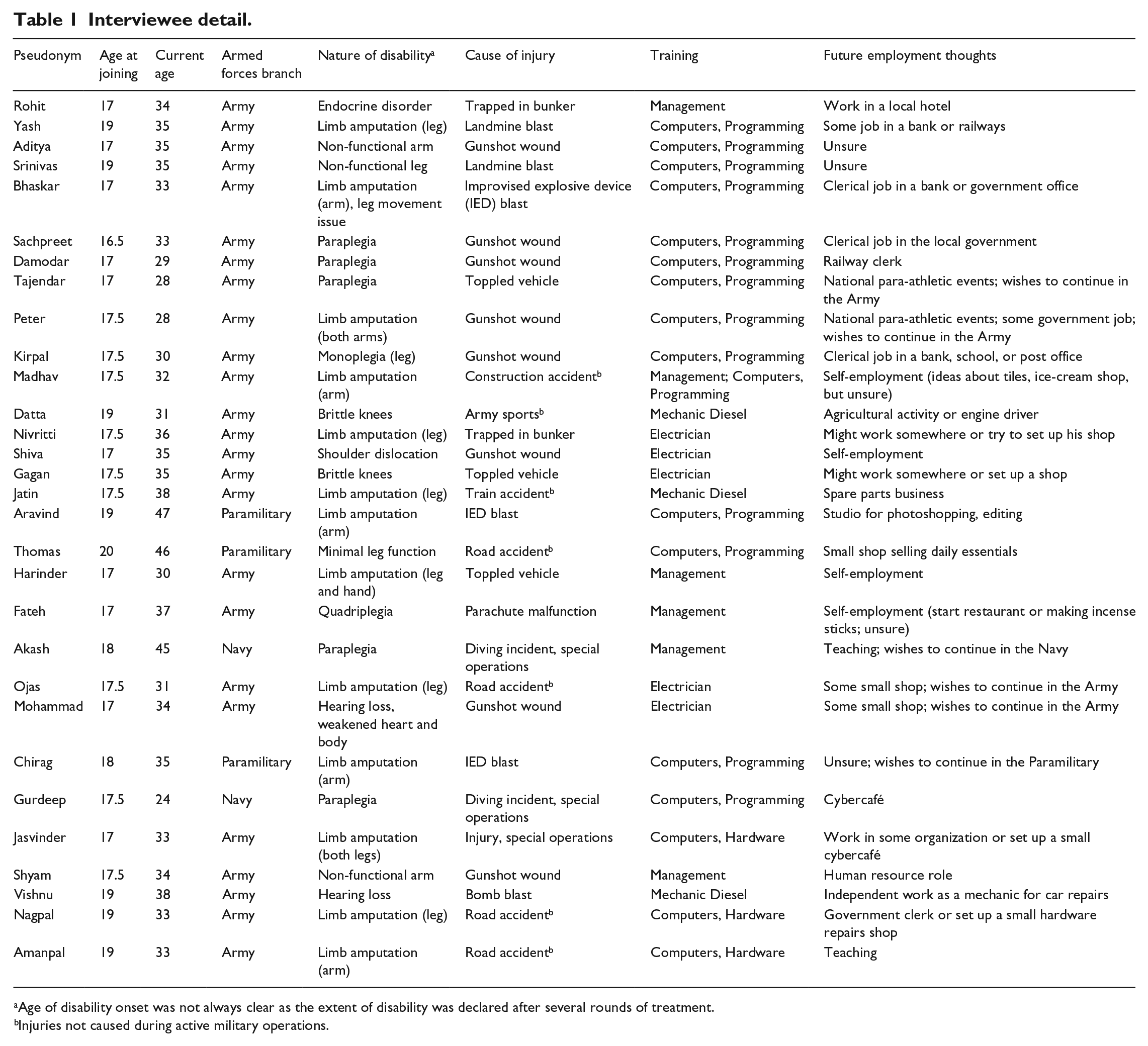
Age of disability onset was not always clear as the extent of disability was declared after several rounds of treatment.
Injuries not caused during active military operations.
During this initial stage, I attended the Institute’s centenary function. The function was held in the Armed Forces Medical College auditorium and was attended by hundreds of family members of soldiers, army officers, and local dignitaries. While potential interviewees had likely seen me visit classrooms and speak with Institute officers, I tried to reduce, at least to some extent, perceived social distance during this function. Specifically, the seating arrangements were such that the most senior officers sat in the front of the auditorium, followed by the next level of officers (along with their spouses) and local dignitaries, and finally, the soldiers and their families. Though I was offered a seat with the officers and their spouses, I sat with the soldiers and their families.
My observations at this stage helped me understand and explain the interview data. For example, the crest or the symbol of the Institute is an apple tree that has a broken bough. This bough is held up with a bipod, and underneath is an inscription of the Institute motto: ‘Though hurt, I grow.’ The insignia includes colors representing the armed forces branches. The interviewees talked about the symbol, motto, and flag. Furthermore, I was told about the Institute song that refers to survival despite enemy bullets, how a soldier’s suffering is rewarded by the motherland’s honor, and how—akin to some foliage—pruning encourages growth.
During the next stage of the study, the 30 soldiers were interviewed. The interviews ranged in duration from 20 minutes to 68 minutes. As almost all interviewees preferred to converse in Hindi or Marathi, I used back-translation to establish semantic equivalence (Schaffer and Riordan, 2003; Shepherd et al., 2011). Two research assistants helped me to ensure the accuracy of the interview guide and of the transcription of the interview conversations. One of the research assistants also helped with the semi-structured interviews (Shepherd et al., 2011), as she was from the state where the research took place (Schaffer and Riordan, 2003). Following past research (Brown and Toyoki, 2013; Shepherd et al., 2011), English questions were translated into Hindi and Marathi. Later, the conversations were translated back into English. Retaining meaning across the translations was possible as I am fluent in Hindi and Marathi and because the research assistants and the Institute’s Chief Executive Officer and the Chief Administrative Officer also helped check the accuracy at various stages.
The interview conversations were aimed at understanding the interviewees’ life courses and career progressions prior to their injuries, their disabling events, the career and psychological implications of their traumatic events, and their transitions (e.g. Haynie and Shepherd, 2011; Watson, 2009). Open-ended questions were aimed at understanding each individual’s meaning from his point of view (Fraher and Gabriel, 2014). For example, questions covered interviewees’ work in the armed forces, their decisions to become soldiers, whether they ever had mixed feelings about their career choices, their injuries, the key highlights of their lives, and their future plans. The interviews were digitally recorded with the Institute’s permission and were professionally transcribed.
Data analysis
The empirical approach was not entirely inductive because I had starting points for coding the data (e.g. Beech, 2011). For example, past research on identity work in traumatic career transitions served as an initial foundation while coding the data (e.g. Haynie and Shepherd, 2011). Despite the rigor that I attempted through the phases listed below, I recognize that my attempts to be systematic were inevitably informed by what appeared to me as interesting initial codes from which to build a theoretical storyline (Brown and Toyoki, 2013).
Following past research (Bardon et al., 2017), I began by identifying both explicit identity talk (e.g. ‘I am a gun operator’) and other talk wherein identity-relevant material was mentioned by interviewees (e.g. ‘As a soldier, your life is different from that of a civilian’). I started with open coding to identify initial codes in each interviewee’s narrative. I also constructed memos based on a list of broad codes (e.g. the presence and forms of identity work). Memos included interview data, codes assigned to the data, and my thoughts about these codes. At this stage, I noticed that the interviewees’ identity work included not only working toward a new identity (e.g. a computer professional) but also holding on to the past identity (e.g. a soldier) and creating artificial identity boundaries (e.g. ‘I will be better than other civilians’). Given such observations, I re-coded the data and added codes and what they meant into an emergent dictionary.
Next, I worked iteratively with the data and the literature to understand what the interview conversations meant. Following Fraher and Gabriel (2014), at this stage, I moved between the data of the present study and the findings of other studies, as well as between the data and theoretical formulations. For example, the interviewees were keen to refer to who they were not (e.g. they were ‘not like the civilians’). They drew an arbitrary line between their new possible identity as a ‘better civilian’ and ‘those other civilians.’ The literature refers to such identifications as the anti-identity or the ‘not-me’ positions that are important as individuals work on their identity presentations and struggles while integrating their self-definitions with emergent or current situations (Sveningsson and Alvesson, 2003). Furthermore, I noted that the interviewees’ identity work was not linear; instead, it was messy, with the interviewees holding on to their past identities (e.g. a gunner) while trying to adopt new identities (e.g. a budding entrepreneur). Their identity work also involved counterfactual or ‘what if’ talk (e.g. ‘I could have died’ or ‘what if I had experienced worse trauma?’) and was underpinned by contextual elements (e.g. the collective building of ontological expectations).
At each stage, as I better understood the data and what it implied theoretically, I tried to understand my own values, assumptions, and any stake I might have in teasing out the findings and their interpretations (Gabriel, 2018), and remained open to ambiguities and surprises in the data. For example, I made efforts not to discount the interviewees’ seemingly arbitrary boundaries among identities or their nonlinear identity work. I also reminded myself not to be overly influenced by their narrations. Thus, I did not treat the narratives as ‘true’ versions of any ‘reality,’ but as the interviewees’ statements about their interpretations of their situations (Courpasson and Monties, 2017).
Though asking identity-related questions is a prevalent methodological approach, interviewee identity is not an absolute, tangible, or unchanging property that can be discovered during conversations (Alvesson et al., 2008; Gabriel, 2018). Indeed, identity is co-constructed during interview conversations. Individuals become research subjects based on the researcher’s espoused theoretical frame (Hardy et al., 2001), and the findings reflect the researcher’s tacit metaphors regarding identity-related phenomena (Alvesson, 2010). Further, the interviewees’ impression management and sensemaking can influence answers (Brown and Coupland, 2015), and the very conversation can spur interviewees’ identity work (Alvesson et al., 2008; Brown and Coupland, 2015).
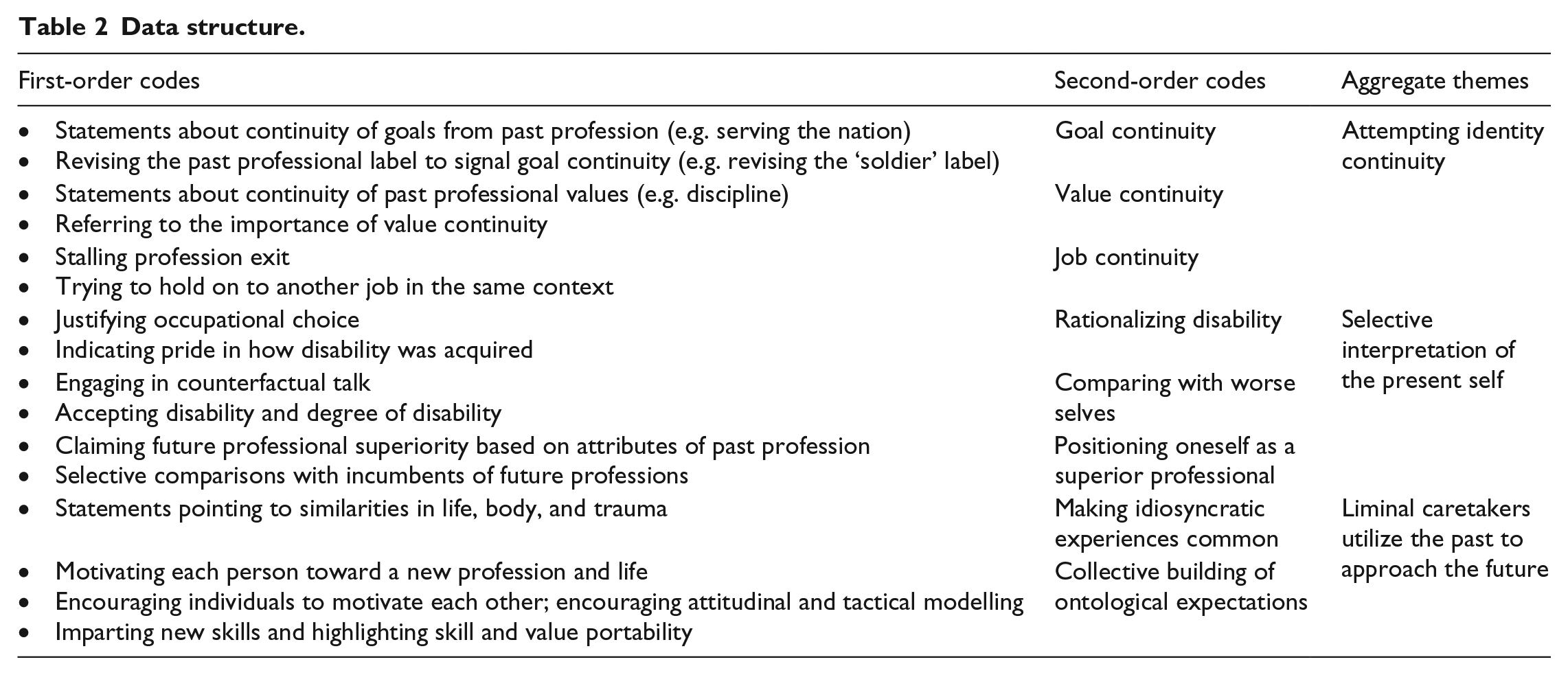
However, as Fraher and Gabriel (2014) explain, narrations from many interviewees can be mutually reinforcing and can pool together to form a coherent story akin to those that lawyers create based on the testimonies of different witnesses. The interviewees had very similar career trajectories, shared an employer and setbacks, belonged to a cohesive professional community, and subscribed to a shared narrative. Furthermore, when experiences are relatively common, whether or not they involve a tragedy, there are core constants despite differing narrations (Gabriel, 1991). Thus, when I re-read the transcripts and as the common broader story emerged, I noted the definitions of all concepts and categories, which a research assistant then used to comb through the interviews. Subsequently, we addressed differences. For example, the interviewees referred to accepting their disability or their degree of disability. We decided that such statements should be grouped under ‘comparing with worse selves’ when the focus of the conversation was within-person. If the focus of the conversation was on how the community provided the interviewees a frame of reference, we decided such statements should be grouped under ‘making idiosyncratic experiences common.’ While the results are grouped in relatively bounded categories, the interviewees’ narrations did not correspond to distinct categories, but rather spanned categories.
Findings
As summarized in Table 2, the interviewees stated that they attempted to hold on to their narratives of being a soldier through the continuity of their goals, values, and jobs. They also stated that they held on to select elements of their past selves that would help them eventually become superior civilian professionals. Finally, the interviewees stated that the liminal caretakers helped them compose a narrative that allowed them to hold on to their discourses regarding what it means to be a soldier and utilize those discourses to move forward.
Data structure.
Attempting identity continuity
The interviewees noted that the institution of the armed forces had offered them a way out of financial hardship, a way to fulfill their dream, and recognition in their communities. Vishnu’s narrative was representative: Since the time I was a student, I had a great desire to serve and protect the nation . . . My home condition was not good; I didn’t have many resources or support . . . I need to earn and support my family, [so] I thought if I joined the army and worked in service of my country, my family and my village would earn respect. That’s why I joined the army . . . I was meant to do this.
The interviewees spoke of who they were—able-bodied, disciplined, and respected nation-serving soldiers—and they buried the uncertainties of a once-poor boy from a rural farming family or a school dropout with an uncertain future. Specifically, the interviewees stated that the intense occupational socialization as well as their dreams of joining the army meant that the values of the armed forces had percolated into all aspects of their lives. As Nivritti explained, this pervasive influence of the armed forces occurred because their ‘life revolved around the job.’ Their disabling injuries had deeply shaken their held truths about who they were and their associated sense of security. As the armed forces had nourished their sense of self, as elaborated below, the interviewees expressed the need for continued significance.
Goal continuity
The interviewees envisaged the enactment of continuity in the form of primary goal continuity, army value continuity, and army job continuity. They noted ‘serving the nation’ as a primary goal, and they also expanded or revised the ‘soldier’ label to maintain continuity, as Shyam stated: In my opinion, there cannot be any greater service in the world than patriotism. I was injured during defense service, but I say that I would choose to go to defense service in every birth . . . sometimes in life, certain changes happen . . . at such times, rather than getting upset, I think that service towards one’s nation can be done in different ways. Every citizen who is thinking about the development of his country or the good of his country or is working for the welfare of the people of his country is a soldier! . . . Someone is contributing as an engineer, someone else is contributing as a teacher . . . if I cannot do physical work, then I will do official work or mental work as a soldier in a different way.
Peter noted that he was ‘somewhere in the middle . . . not back in the army [and] not in civil life,’ but his goal of serving the nation would continue. Damodar also referred to continuity: The primary goal for any rank is serving the nation. The way you do it may differ, but the purpose is the same . . . I am doing this course now . . . I want to take up a booking clerk’s job in the railways . . . I wanted to serve my nation. I got an opportunity to do that and will do so in the future also. If not in the army then somewhere else, but I will serve my nation. My aim is the same.
Value continuity
Corporeal proficiency, a key ingredient of the soldier identity, was no longer a reality for the interviewees. Bereft of their physical proficiency, the interviewees said that they held on to relatively abstract identity elements. Specifically, they found the self-defining values of discipline, endurance, loyalty, and honesty to be helpful in their new professional lives. They also found that these values helped them maintain a sense of continuity in terms of who they had been, who they were currently, and who they were becoming. Fateh voiced a common sentiment: To be a good soldier, first, you need to have punctuality. Second, your discipline should be good from the way you dress, walk, and talk. Third, you need to have the tolerance or will to withstand hardships. Whatever the hardships, you shouldn’t back off . . . This spirit comes from the army. Fourth, you don’t get flustered by anything that happens to you or around you, unlike the common man. The army has taught us how to face and get out of a difficult situation . . . no matter what happens, never lose heart. Be disciplined and fight till the last bullet and the last enemy. That value will help me most in my next job. That is who I am and will be.
The interviewees appropriated organizational values as being self-defining while noting the possible benefits of these values, such as their disciplined workdays, organizational loyalty, and capacity for hard work, in future professions. Jasvinder explained that although he could not apply his ‘weapon training’ going forward, his army values would continue: [Training] cultivates a spirit of endurance and tolerance. Whatever the situation, not to lose our willpower. Concentrate and move forward. Tolerate all hardships. Tolerance and endurance are a very big thing. That’s all the training is about . . . that applies in any professional life that we can take from the army.
Job continuity
The interviewees noted that they had delayed exiting the army by hiding their injuries. For example, Bhaskar explained that he had hidden his knee pain and tried to fool his doctor until he was sternly advised to leave and ‘go for knee replacement surgery,’ as his bones had ‘become as brittle as an old man’s bones.’ Bhaskar spoke in the present tense about being a gunner (‘Actually, I am a gunner. I am a gun operator’), and sought continuity because he enjoyed his work and commanded respect. Others held on to the hope that they could continue in some army job. Mohammad explained this sentiment as follows: Within the army premises, there are places of worship like the temple, church, gurudwara, and mosque. Since I am a Muslim, my Commanding Officer told me that I should be in the mosque as a caretaker. There was another physically fit soldier deputed along with me so that he could take care of the cleaning . . . Since I was disabled and couldn’t do much work anyway, it made sense for me to be there rather than anyone else. In some way, I would like to continue.
One of the other reasons for wanting to maintain job continuity was the interviewees’ childhood dream of serving the nation. Another reason was that the army had been a source of emotional and tangible support. Chirag explained as follows: Even now, I would like to continue if they let me. But they don’t usually keep disabled persons in service, so they will board me out, [but] if they let me, I would like to continue because so far, I have been able to support my family due to my service. I have been able to get my siblings married. I lived my life through the Force, so I have a sense of belonging. So, if I get a chance, I will definitely continue.
The interviewees thus attempted to hold on to their narratives of being soldiers through the continuity of goals, values, and jobs. They did not completely abjure notions regarding what it means to be a soldier, and attempted continuity in their identity work.
Selective interpretation of the present self
Alongside their attempts at continuity, the interviewees interpreted who they were after the trauma. They indicated pride in their career choices and disability, and they saw themselves as fortunate when they compared their present selves with a possible worse self. The interviewees also held on to select identity elements from their past profession and stated how these would make them superior professionals in the future.
Rationalizing disability
The interviewees rationalized—that is, they justified their career decisions and disabilities. For example, their disabilities notwithstanding, the interviewees reiterated their dreams of joining the army. As a rebellious teenager, Peter had run away from a Christian retreat to enroll in the army. He stated that, disability or otherwise, joining the army was one of his ‘best’ decisions, as it had shaped his life positively. Bhaskar rationalized that anyone could be injured and explained that his father was bitten by a snake in his village. He expressed gratitude to his commanding officer and fellow soldiers for helping him from the moment of his injury through his hospitalization, and for helping him gain admission to the Institute. Mohammad also credited the army for extending him the required support: The army is still taking care of me . . . the army gave me a livelihood and took care of me such that I never realized the impact of the injury. There is still a large splinter from the grenade attack lodged near my heart even today. You tell me what would I have done if I was a civilian? The army has done a lot for me . . . they have also sent me for this training course based on which I will carry out the rest of my life.
Jasvinder explained that despite the amputation of both his legs, the army was taking care of him through pension, free medical facilities, and access to the military store for his household provisions. He stated that a civilian job would have given him a one-time disability payment and then he would have been forgotten. He downplayed military accidents and instead highlighted civilian deaths from junk food consumption. Jasvinder said that his disability was worthy of respect. Sachpreet displayed pride at being part of an elite unit and downplayed his disability: . . . when I was posted at [location], I suffered a gunshot. I was injured while I was doing the job that I was supposed to do. I am proud of that . . . Our unit had importance. We had a platoon called [name]. There are 19 of us . . . People would look at our platoon with envy . . . that was my job. I got injured while I was doing my job . . . I’m proud of it!
Thus, a physically compromised body competed poorly with the interviewees’ pride in their disabilities that were sustained while pursuing a key goal within a valued occupational context. By rationalizing their career decisions and disabilities, the interviewees distanced themselves from their bodily struggles while holding on to their self-narratives based on their profession. Notably, even when their disabilities were not acquired during military operations, as was the case with seven interviewees, they were a matter of pride. Jatin noted that he was helping a lady when he was accidentally pushed by a surging crowd on to the railway tracks. The Central Reserve Police Force personnel at the train station had saved his life, and his military brothers had taken over his care.
Comparing with worse selves
The interviewees engaged in counterfactual or ‘what if’ talk, and saw their current disabilities as being better than death or better than an even more serious injury. The interviewees stated that they were still ‘able’ as professionals. Vishnu noted that his hearing loss was better than the loss of all his limbs. Sachpreet expressed gratitude for being alive so he could support his children. Srinivas explained that he could have been worse off and how that thought caused him to be less upset: I was very upset when I got injured . . . I remember when I was in the hospital. I saw people who were much more grievously injured than I was. There were soldiers whose legs were amputated . . . I thought that what happened to me was a small sacrifice for my country . . . after I recovered, I was thankful to God that I could walk a little at least. I thought, ‘I have got an opportunity again to work.’ I was not as upset as before. I was able to overcome it.
Kirpal explained that he was grateful to ‘focus on my family’s needs.’ He hoped to obtain a clerical job in a bank, school, or a post office near his home, and added the following description of his recovery process: My initial weeks after the surgery were very tough . . . Over time, I got better, and there was some improvement in my condition. I had a tough time for around 45 days. It was a great struggle for me to get out of bed . . . a lot of problems in sitting and standing . . . I was so weak that I could barely lift a glass of water. My movement in the upper part of my body has improved faster than the lower part of my body. What if that had not happened?
Although the interviewees engaged in such talk to construct new professional identities, their identity positions were still grounded in their soldier narratives. The interviewees said that they accepted the fact that they were not serving soldiers, but they indicated that they were still army men. It was common to hear them say, ‘mentally, I am the same.’
Positioning oneself as a superior professional
Though they were working toward civilian jobs, the interviewees communicated the dichotomy of what they saw as two competing identities: civilian and soldier. Civilians were condemned for being lazy and dishonest. Soldiers were portrayed as the opposite, and the identity position they expressed was, ‘I will be a better civilian professional because I was a soldier.’ Thus, the interviewees played up the differences between these identities, and they distinguished themselves from the negative civilian identity by maintaining a continuity of self in some form. Referring to superiority in his professional life, Srinivas explained that he would be more disciplined, would follow instructions, and would not slack: In the army, the way you conduct yourself is very different from civil life . . . you have to adhere to discipline . . . You have to follow orders . . . You learn to live honestly and with a certain amount of discipline . . . If a task is assigned to a soldier, he will always try his best to do it. In civil life, people take it easy. If they can’t do something, they will just leave it . . . Even after some solider leaves the army and starts civilian life, that aspect will not change.
Rohit recommended mandatory year-long armed forces training for all civilians so that they would become more helpful, relationship-oriented, and honest: Someone is fighting, and if he needs your help, he will not ask for help. You will automatically go and help him out . . . that is unsaid trust . . . we care about our relationships . . . they don’t care much . . . I went there to get my number plate. The person was expecting a bribe, and he had already served time in a jail . . . corruption has become acceptable. I am not always trying to compare defense and civil life but . . . ‘honesty is the best policy’ is something only limited to books in civilian life . . . I feel that one year of service in the defense should be a must for everybody.
Thus, as the interviewees worked through ‘who am I now,’ they justified and took pride in both their choices of a profession and their disabilities. Based on counterfactual or ‘what if’ talk about a possible worse bodily self, the interviewees saw themselves as proud and able individuals. They also held on to select elements of their previous identities to claim that they would be a superior civilian professional in the future.
Liminal caretakers utilize the past to approach the future
The interviewees noted that both fellow soldiers and Institute personnel enabled and made available a narrative of possibility. The interviewees were able to move forward as they saw their trauma as common and surmountable and as they collectively spun webs of motivation.
Making idiosyncratic experiences common
The interviewees noted how the social context of the Institute helped them to perceive their idiosyncratic experiences as a common experience and gave them a fresh lease on life. For example, Fateh described the Institute’s environment as follows: The environment at the Institute is a positive environment. And a positive environment can take you really far . . . No matter how depressed you are, it will uplift you. When we look at each other we think, ‘My problem is not as bad as his. My spinal cord is broken but my hands and legs are okay. And if this person can walk, why can’t I try?’ This feeling motivates you . . . The very motto at the Institute is disability to ability.
Nivritti noted that he had been ‘struggling a lot since that injury,’ having lost interest in life, let alone a new career after the armed forces. However, because of his teachers and fellow soldiers, he wanted to work again and provide for his family. He explained as follows: After my injury, I lost my will to live. I was very depressed. It was such a struggle for me . . . But after I came here, I was motivated by the Institute to keep going . . . Now, I try my best to keep my spirits high . . . After coming here, I felt that I got a reason to live. We get a lot of motivation from the staff here . . . I got inspired to look ahead and move on in my life . . . You get a fresh lease on life after coming here. It gives you positivity and hope. It’s like a steppingstone in the transition to civilian life and civilian work.
Akash explained that the Institute’s social context and allied facilities such as the Paraplegic Rehabilitation Center provided continuity of the armed forces fraternity and helped him ‘move forward.’ He remarked that the other soldiers in similar situations and the Institute personnel understood ‘our limitations as well as our positive things, as they are one of us.’ He characterized the relationships at the Institute as ‘very thick,’ such that even if one did not fully articulate his needs, they were understood and met.
Collective building of ontological expectations
Interviewees noted that the Institute invited alumni to share their experiences to motivate current students. Furthermore, the teachers and other soldiers at the Institute motivated each newcomer, who in turn motivated others. Thus, the Institute’s inhabitants helped to spin webs of motivation. Peter, for example, had to have both his arms amputated. He said that his initial disheartenment gave way to hope because of the social context. Peter said that he now served as a motivator for others, and explained his journey as follows: I had a nursing assistant who was my constant motivator. I had lost my arms. I had no hope. He wanted me to start writing again. He would keep telling me, ‘You can do it!’ …. He tied a cloth over my shoulder. He got a notebook and made me write alphabets . . . When [Dean] or [the CEO] tell others that despite having lost both my arms, I can write, probably no one believes them . . . I have made a video . . . people who come to the Institute are initially disheartened . . . Many are immobile waist-down. But I tell them that their hands are functional, so they can try computer training . . . Focus on what you have rather than what you don’t. I operate the mouse with my feet. I never imagined I could do that.
The interviewees quoted the Institute’s motto, ‘Though hurt, I grow,’ and referred to the ‘one family’ atmosphere symbolized by the Institute’s flag. They also stated that they perceived the social context as a crucible that served to endorse and uphold values that undergirded their soldier identities. For example, brotherhood—an armed forces value—was upheld. The interviewees referred to one another during interviews and explained that they motivated one another and newcomers toward rehabilitation, skill learning, and a positive spirit toward a new profession and life. Two interviewees said that they had ‘begged’ doctors to end their lives. However, as they received inspiration from fellow soldiers, they worked toward a new outlook and careers. Aditya explained that he had gained a ‘positive spirit,’ and Damodar explained that he modeled a lifestyle and learned how to approach coursework. Thomas noted the power of multiple sources of motivation: ‘We can ignore one or two people. When we hear the same message from different people, after some time, it does register, and it helps.’
The interviewees also credited the army for instilling skills that could be applied in many contexts. Rohit spoke of a time when he had arranged the logistics for a large-scale religious event, and he credited the ‘defense culture’ for teaching him how to manage large crowds.
Overall, the interviewees constructed their identities using socially available discourses regarding what it means to be a soldier. Selective self-interpretations further allowed them to hold on to their narratives of being a soldier. Coupled with continuity in terms of being surrounded by military personnel, facilities, and emblems, maintaining a semblance of the status quo was construed as change—the interviewees’ talk conveyed their holding on to and consolidating of the narrative of being a soldier, as they referred to change in terms of moving toward new professions and lives. Indeed, transitions were anchored in narrative continuity.
Discussion
I began this study by asking how individuals’ identity work processes unfold when they are faced with a discontinuous and involuntary career transition. My focus was on an extreme case: soldiers who had been severely disabled during military service. The interviewees were in the process of being boarded out by the military and were undertaking training at a military-affiliated institute to enter civilian careers. At this stage, the interviewees were neither active duty soldiers nor were they in civilian jobs.
The findings of this study show that the interviewees had constructed their identities using socially available discourses regarding what it means to be a soldier. They attempted to maintain the continuity of these foundational self-narratives through the continuity of the goals inculcated in their prior careers (e.g. serving the nation) and continuity of values (e.g. endurance). Some spoke in the present tense about being a soldier, while others revised the ‘soldier’ label to maintain their self-narratives. Simultaneously, the interviewees rationalized their career choices, validated their disabilities, and selectively interpreted their present self in a manner that allowed them to distance themselves from their bodily struggles caused by their profession while holding on to their self-narratives based on their profession. The liminal context that provided reference group continuity (e.g. fellow soldiers) and support (e.g. military rehabilitation facilities) simultaneously helped the interviewees to continue their narratives of being a soldier and guided them toward new professional identities. The context also made idiosyncratic experiences of trauma seem common, and helped the interviewees develop new identity narratives.
Taken together, the findings show that when identity possibilities are perceived to be diminished following the loss of a highly valued and self-defining career, identity work involves forging continuity in foundational self-narratives. This is generative as it helps cement an assumed ontological status and significance provided by social membership and allows for collectively crafted reimaginations of the future.
Theoretical contributions
The findings of this study affirm existing views on identity work regarding the maintenance of a childhood dream manifested in a career (Fraher and Gabriel, 2014) and of foundational self-assumptions (Haynie and Shepherd, 2011; Maitlis, 2009). The findings also present novel perspectives and extend our understanding in the following ways. First, research indicates the importance of moving away from past identities and reference groups during identity transitions (Fraher and Gabriel, 2014; Haynie and Shepherd, 2011). My findings show that when self-defining careers are terminated, continued fidelity to the past identity and reference groups is generative in the move toward a new identity. Second, and concomitantly, research indicates the importance of settings unaffiliated with the prior identity during identity transitions (Greil and Rudy, 1983, 1984; Haynie and Shepherd, 2011). In comparison, my findings offer a different view by showing that gearing for emergent selves can be accomplished in a familiar and homogeneous social context that allows for narrative continuity.
The findings show that when past careers exemplify an aspirational and socially endorsed identity or are self-defining (Haynie and Shepherd, 2011; Thornborrow and Brown, 2009), identity work involves fidelity to a steady set of overarching self-meanings (Fraher and Gabriel, 2014). Forging continuity in such cases may allow for a sense of biographical continuity (being the same person over time), ecological consistency (behaving in the same manner over time), and locus of control (controlling one’s behavior over time) (see Grote and Raeder, 2009). Indeed, working toward a new identity standard during trauma-induced transitions (Haynie and Shepherd, 2011) in cases such as the present one might prove to be a difficult or ineffectual exercise.
Holding on to let go during transitions—in the form of selective self-interpretations or ‘not-me’ or ‘anti-identity’ positions (Alvesson et al., 2008; Sveningsson and Alvesson, 2003) that manifest in ‘self-other’ talk (Ybema et al., 2009)—can also be generative, as artificial social fencing helps defend ideological boundaries and reinforces one’s in-group against identity-threatening out-groups (Zerubavel, 1991). Holding on allowed for the cementing of an assumed status and significance provided by membership in a coveted institution. Transitions in such cases might not hinge on the utilization of a well-established prior identity as a temporary splint until the present or future fragile identity solidifies (Pratt et al., 2006). ‘Master status’ identities (Hughes, 1945) under certain circumstances can serve as more than splints (Pratt et al., 2006). Instead, they can act as implants that forever merge with one’s identity narratives and help one to forge ahead. In cases of strongly held self-narratives, identity transformation is never absolute, and disengagement and becoming are inseparable in identity work (see Simi et al., 2017). What individuals are ‘changing from’ assumes importance alongside what individuals are ‘changing into’ (Louis, 1980).
Finally, a familiar and homogeneous social context that manages to unproblematically bind past and emergent identities can also aid transition by offering palatable, co-created, and efficacious scripts to accomplish identity claims. Institutionalized scripts are important because identities are claimed and granted in transition-related social interactions (Ibarra and Barbulescu, 2010; Petriglieri and Petriglieri, 2010). However, these scripts need not be afforded by totally new reference groups (e.g. Greil and Rudy, 1983, 1984); they can also originate from a source that is considered a limb of the profession that has bestowed a set of self-meanings. Transitions in the present study were not marked by deletions of past identity elements; rather, they involved collectively and contextually edited imaginations of the future that allowed for the continuity of foundational self-narratives.
The findings extend the broader literature on identity work within liminal environments that reinforce the role of socially disciplined memory in identity-making. Specifically, the overall agency–structure interplay that upheld the almost transcendental role of the desired soldier identity spotlights the role of ‘remembrance environments’ that convey what and how to remember. In such environments, socially disciplined memories fuse individual biographies with the history of the groups to which the individual belongs (Zerubavel, 1996). In the present study, remembrances were realized in meaning-laden spaces that allowed the interviewees to reaffirm a sense of community and continuity. The impossibility of retaining a coveted identity did not diminish commitment to it in the present meaning-laden space where maintaining narrative continuity helped with the transition. In cases where others (Watson, 2008)—including phantom communities (Athens, 1994)—inform us about who we are, identity consolidation can assume significance.
Limitations and future research directions
Readers are a source of meaning-making regarding what is (un)said (Fletcher, 2007), and there are many ways to interpret findings. Reading gender into the findings might have led to an interpretation that holding on was about the desire to maintain symbolic masculinity. This interpretation rests on the fact that the physical male body made fit for military purposes no longer had purpose (Godfrey et al., 2012) and the military-cultivated bodily hegemony (Morgan, 1994) could not be upheld. Disability, of course, concerns more than the physical body, and the interviewees may have desired to hold on to sociocultural expectations of masculinity—strength, autonomy, and the ability to provide for others (Shakespeare, 1999).
Further, a reading of the Institute as an ‘identity workspace’ wherein formal and informal social structures offered feedback and support during identity transitions (Petriglieri and Petriglieri, 2010) could yield another interpretation. The holding on might have reflected the interviewees’ desires to retain their military-provided formal and informal social structures in which are implicated relations of power. Indeed, identity as an interactional achievement (Cerulo, 1997) is arguably an exercise in power (Humphreys and Brown, 2002), and individuals in situations of perceived vulnerability may work toward maintaining relations of power that protect one’s sense of self (see Knights and Willmott, 1989). Ultimately, such holding on while letting go might be a strategy that leads to negative identity outcomes such as despair, embarrassment, or nostalgia. Overall, the diverse ways in which interviewee narrations can be read mean that the interpretations offered here are always incomplete (Gabriel, 2018).
Conclusion
In conclusion, I have examined the identity work processes of severely disabled soldiers who faced discontinuous and involuntary career transitions, and who were engaged in rehabilitation and vocational training at a military-affiliated facility designed to move them toward civilian careers. The interviewees had constructed their identities using socially available discourses regarding what it means to be a soldier. They engaged in selective self-interpretations that allowed them to hold on to their narratives of being a soldier while attempting transitions. Coupled with continuity in terms of being surrounded by military personnel, facilities, and emblems, maintaining a semblance of status quo was construed as change. This unique case—in which transitions were anchored in narrative continuity—presents further opportunities for examining the agency–structure interplay in other professional contexts during career transitions.
Footnotes
Acknowledgements
I would like to thank Professor Andrew D Brown for his editorial direction and the three anonymous reviewers for their many helpful suggestions. I would also like to acknowledge Alpana Sawant and Priya Ayoor for their research assistance, and the support of Queen Mary’s Technical Institute and the Indian Institute of Management Bangalore.
Funding
The author received no financial support for the research, authorship, and/or publication of this article.
