







Abstract
Cigarette and electronic-cigarette users (i.e. vapers) are increasingly stigmatized in both society and the workplace. We examine effects of this stigmatization in the selection process by testing whether interviewers’ negative initial impressions of smokers and vapers extend throughout the interview. We used a dual-process framework of interviewer bias against stigmatized applicants, comprised of Type I-automatic and Type II-systematic processes, and conducted two experiments where US and Canadian participants enacted the role of an interviewer in video-based job interview simulations. Consistent with Type I processes, results show that cigarette smokers, and to lesser extent vapers, were initially rated as less qualified than non-smokers. These initial impressions were not subjected to justification/rationalization during the interview via harder questions asked. However, they served as anchors, also consistent with Type I processes, and impacted final assessments alongside Type II adjustments based on applicants’ response quality. Additionally, using attentional eye tracking data, we found that raters with worse attitudes toward smoking, but not vaping, glanced at stigma cues more frequently, which went on to influence first impressions. These findings provide valuable tests of key components of the dual-process model of interviewer bias, and raise concerns around the devaluation of smokers and vapers in hiring decisions.
Organizations frequently use personnel selection methods that rely on managers’ subjective judgments and interpretations (Highhouse, 2008). These judgments can unfortunately be biased due to numerous reasons. For instance, biases may be triggered by the presence of stigmatized features like candidate gender, age, race, ethnicity, religion, sexual orientation, disabilities, and depression (e.g. Baert, 2016; Baert et al., 2016; Derous et al., 2017; Finkelstein et al., 1995; Ghumman and Ryan, 2013; Hebl et al., 2002). In numerous parts of the world, many of these features are legally prohibited grounds for hiring discrimination (e.g. through the United States’ Civil Rights Act (1964), the Canadian Human Rights Act (1985), and the European Union’s Charter of Fundamental Rights (2000)). Researchers, however, continue to identify candidate features such as body piercings (McElroy et al., 2014), body art and tattoos (Burgess and Clark, 2010; Timming, 2017), and cigarette smoking (Roulin and Bhatnagar, 2018) that trigger biases but do not receive legal protection.
The instance of cigarette smoking, and negative connotations engendered on a wide range of unassociated traits, is particularly troublesome for organizations. Smokers, once socially accepted, are now devalued (Bayer and Stuber, 2006; Seiter et al., 2010). This manifests in workplaces through outcomes such as unfair performance evaluations on work-related attributes like professionalism and team work (Gilbert et al., 1998), and the emergence of smoke-free and smoker-free organizational policies (Houle and Siegel, 2009; Lecker, 2009). Notwithstanding numerous negative labor market outcomes, national and regional level legislations designed to protect employees generally circumvent smokers (Schmidt et al., 2013). The emergence of alternative forms of smoking such as “vaping” electronic-cigarettes also complicates a full understanding of the organizational and job market effects of smoking. Concerns around vaping are exacerbated given its popularity with younger users (Keane et al., 2017), and perceptions that it is a less harmful alternative to cigarettes and therefore an effective smoking cessation tool. Recent evidence, however, is troubling, and links vaping with risks such as developing respiratory illnesses over time (Howard, 2019). Both researchers (e.g. Palazzolo, 2013) and governmental agencies (e.g. US Centers for Disease Control and Prevention, 2019) have called for greater investigations into the long-term health effects of vaping. The effects of vaping in the personnel selection domain too remain unexamined. In fact, only one study to date has examined the presence of cigarette smoker stigmatization in hiring (Roulin and Bhatnagar, 2018). This study, however, used written scenarios and limited its examinations to initial impressions of cigarette smokers. Very little is thus known about the impact of more realistic depictions of applicant smoking as well as vaping habits on interviewer judgments and decisions throughout the interview.
This research employs two studies built on key components of the recent dual-process model of interviewer bias against stigmatized applicants proposed by Derous et al. (2016) to examine the roles of smoking and vaping status within the full job interview. It contributes to the personnel selection and employment discrimination literatures in several ways. First, it empirically tests key propositions outlined in Derous et al.’s (2016) model. Second, it presents a novel research methodology that uses a video-based interview simulation paired with eye tracking technology that examines participants’ (i.e. interviewers’) attention to stigma cues. Third, it replicates the initial findings of Roulin and Bhatnagar (2018) that are limited to first impressions, and extends them by examining the entire interview process. Fourth, it explores whether the “smokerism” bias seen against cigarette smokers (Gilbert et al., 1998) also extends to vapers. Finally, it investigates whether smoking status interacts with ethnicity to create a “double jeopardy” whereby interviewer reactions become even more negative when smokers and vapers are ethnic minority as compared to majority applicants. This research has important practical and societal implications given the significant segment of the population that continues to smoke cigarettes, and the rise in popularity of alternative forms of smoking such as vaping. According to the latest (2015) statistics provided by the World Health Organization, among people 15 years of age and older, daily tobacco smoking rates stand at 15.9% in the USA, 10.7% in Canada, 18% in the UK, and 27.4% in France (http://www.who.int/countries/en/). This demonstrates the pervasiveness of smoking, and the concomitant scope of the problem.
The dual-process model of interviewer bias
Derous et al. (2016) recently proposed a dual-process model of the cognitive processes underlying biased assessments of stigmatized applicants in job interviews. The framework, described here, is built on existing dual-process models of biases within social interactions and decision making (Kahneman, 2003; Pryor et al., 2004). Derous et al. (2016) focused on interviewer judgments and incorporated the social and organizational aspects of the interview to argue that these judgments result from two parallel types of processes. Specifically, Type I processes that are largely automatic and driven by cognitive scripts and heuristics, and Type II processes that are conscious, thoughtful, and drawn from working memory. While Type I processes are immediately activated, resulting in faster intuitive decisions and uncontrollable impulses, Type II processes require slower information processing, leading to controlled judgments and behaviors. While some Type II processes may be deliberate attempts at justifying Type I intuitive responses, others aim to correct and override these biased responses.
These Type I and Type II processes, together with situational and interviewer factors that serve as facilitators or impediments, influence interviewers’ reactions, judgments, and behaviors in the three pre-interview, interview, and post-interview stages. In the pre-interview stage, interviewers’ initial impressions are proposed as primarily outcomes of Type I processes. Indeed, interviewers initially judge candidates based on access to two types of information. First, limited ancillary information obtained prior to the interview such as the candidate’s resume (Levashina et al., 2014); and second, salient visual cues like applicant appearance or stigmatizing features (Finkelstein et al., 2007; Madera and Hebl, 2012) and behaviors such as handshake quality (Stewart et al., 2008) observed at the start of the interview. Derous et al. (2016) suggested that stigmatizing features play an important role in initial impression formation, especially if the interviewer relies on stereotypes, is prejudiced, or has negative attitudes toward stigmatized applicants. Initial judgments of stigmatized applicants are thus proposed as more intuitive, automatic, and fast compared to judgments of non-stigmatized applicants who are assessed based on less salient information.
The interview stage comprises of a social exchange of information between interviewers and applicants, and includes a rapport building followed by a questioning phase. Unless the interview is highly structured, interviewers can choose the types of questions asked and gather information in order to update their initial impressions. For stigmatized applicants, Derous et al. (2016) suggested that interviewers engage in Type I confirmatory information processing aligned with biased initial impressions. That is, interviewers focus on information, such as verbal and non-verbal behaviors, that helps confirm initial biased impressions rather than information that updates these impressions. Interviewers also use Type II processes to rationalize and justify their initial impressions whereby they selectively seek out and accept new information that aligns with initial impressions, while scrutinizing and discarding evidence that is unaligned with them. As a result, post-interview judgments of stigmatized applicants remain anchored by Type I initial impressions via self-fulfilling prophecies wherein final evaluations are strongly influenced by initial impressions (Dipboye, 1982; Stewart et al., 2008).
In contrast, for non-stigmatized applicants, Derous et al. (2016) argued that interviewers consciously and actively gather new information via Type II processes in order to update initial impressions that were associated with less confidence. This involves developing varying hypotheses surrounding applicant qualifications, testing them via questioning, and interpreting both confirming and disconfirming information while updating applicant representations. As such, post-interview final evaluations of non-stigmatized applicants are based on initial impressions adjusted by new information based on quality of the interaction and applicant responses.
Societal, organizational, and interviewer biases toward cigarette smokers and vapers
The first US Surgeon General’s report advised of the health consequences for cigarette smokers (US Department of Health Education and Welfare, 1964) and marked the beginning of a societal rejection of smoking. Subsequent reports that highlighted the second-hand health risks for non-smokers significantly contributed to perceptual and legislative shifts against cigarette consumption. As tobacco de-marketing campaigns adopted stigmatizing tactics, and the higher social classes distanced themselves from smoking, smokers began to be viewed as abhorrent deviants that hurt others rather than their earlier characterization as glamorous independent individuals (Bayer and Stuber, 2006). The subversion of cigarette smoking from socially normative to stigmatized is now complete (Kim et al., 2017).
Goffman (1963) proposed that a stigma is an attribute, such as smoking, that leads to negative stereotypes about the person, such as unrelated characterizations made about smokers. Stigmatization often results in spoiled social identities, status devaluation, and discrimination (Link and Phelan, 2001). Stigmatization at a societal level, where smokers are seen as less credible, likeable, considerate, clean, and so forth (Schmidt et al., 2013), also transpires in the workplace where smokers are disadvantaged in a variety of ways. In economic terms, organizations view smokers as expensive based on higher perceived healthcare costs/claims (Schmidt et al., 2013) coupled with lower perceived attendance and productivity (Greenberg, 1994). Smokers are viewed as less productive and more absent despite no real supporting evidence (Morrow and Leedle, 2002). They receive worse evaluations on job-related attributes such as dependability and professionalism (Gilbert et al., 1998) and take on riskier jobs while receiving lower bonuses for hazardous conditions (Viscusi and Hersch, 2001). These inferior outcomes are exacerbated as many organizations institute not just odor-free and smoke-free environments (Malouff et al., 1993), but also smoker-free hiring policies (Houle and Siegel, 2009). While such discriminatory practices are legal in many states in the USA and supported by tobacco control proponents, they have also been deemed as unethical given that smoking is a leisure time activity and is addictive (Houle and Siegel, 2009; Schmidt et al., 2013).
In personnel selection, numerous stigmatized job applicant characteristics such as disabilities, depression, ethnicity, age, gender, and religion are found to impact managers’ subjective assessments (e.g. Derous et al., 2017; Finkelstein et al., 1995; Ghumman and Ryan, 2013; Hebl et al., 2002). For instance, disclosing a disability such as blindness or deafness unrelated to productivity results in fewer call backs even when disability-based wage subsidies are made salient (Baert, 2016). Similarly, disclosing a year of unemployment due to depression results in fewer interview invitations (Baert et al., 2016). Smoking may be categorized as a visible, controllable, and unprotected stigma; three characteristics likely to impact hiring decisions (Summers et al., 2018). Recent research found that initial impressions of job applicants identified as smokers were less favorable compared to non-smokers partly because the former were deemed as more likely to participate in counterproductive work behaviors (Roulin and Bhatnagar, 2018). These lowered evaluations were exacerbated for raters that held less favorable attitudes toward smoking. Although this research provides preliminary evidence of smoker stigmatization during selection, the interviewer judgments were based on written descriptive scenarios, restricted to initial impressions without addressing the remainder of the interview, and associated with cigarette but not alternative forms of smoking such as vaping.
Electronic-cigarettes or vaping devices are battery-operated and produce a vapor created by heating e-liquid cartridges that contain different levels of nicotine or are nicotine-free (Booth et al., 2017). These come in a variety of shapes including those that look like standard cigarettes, larger tank-based systems, or memory sticks and pens. Over the last few years, vaping has emerged as an alternative to traditional cigarette smoking (Keane et al., 2017). Although its long-term health effects are under investigation, vaping is generally perceived as less harmful and addictive relative to traditional smoking, and therefore an aid to cigarette smoking cessation (Dawkins et al., 2013; Palazzolo, 2013; US Centers for Disease Control and Prevention, 2019). Vaping is also popular with the younger demographic (Emery et al., 2014) partly because it helps circumvent bans on cigarette smoking in public spaces and the various appealing flavors such as candy, dessert, and sweet fruit that are available (Harrell et al., 2017). Initial research indicates that social attitudes and reactions toward vaping are more favorable than toward smoking, with vaping in public being perceived as more acceptable and less harmful (Booth et al., 2017). However, other results also show that vaping is viewed as relatively unsafe and unhealthy, suggesting slow shifts in social attitudes (Hart, 2017). Moreover, we still know very little about reactions toward vaping in hiring decisions. Next, we use the dual-process model of interviewer bias to understand interviewer reactions to job applicants that are smokers or vapers within the various stages of the interview.
Pre-interview stage
According to Derous et al. (2016), interviewers’ initial impressions in the pre-interview stage are largely outcomes of Type I processes. Visible stigmas are processed through interviewers’ automatic heuristics, leading to more negative initial impressions of stigmatized applicants. Candidates can give their smoking or vaping habits away in a number of ways. For example, candidates might smoke outside the building to manage stress before an interview, smell like cigarettes during the interview, involuntarily display the cigarette pack or vaping device (e.g. in a bag or pocket), or reveal their habits through social media posts (if interviewers engage in cyber-vetting; Berkelaar, 2017; Roulin and Bangerter, 2013). Thus, both cigarette smoking and vaping are visible stigmas that can be associated with stronger reactions (Derous et al., 2016). Given the current societal view on cigarette smoking (Bayer and Stuber, 2006; Kim et al., 2017), research on biases toward smokers in the workplace (Schmidt et al., 2013), and recent findings in selection (Roulin and Bhatnagar, 2018), we expect applicants who smoke to be stigmatized, and thus receive more negative initial assessments than non-smokers. Vaping is a more recent trend. While initial evidence is concerning, its long-term effects on health are still unclear (Palazzolo, 2013; US Centers for Disease Control and Prevention, 2019). Public perceptions of vaping, albeit likely not as negative as for cigarette use (Booth et al., 2017), are undergoing deterioration (Hart, 2017). We thus also expect worse initial impressions of applicants who are vapers rather than non-smokers.
Hypothesis 1: Initial impressions are more negative for applicants who are (a) cigarette smokers and (b) vapers than non-smokers.
Intersectional theory posits that people can be socially categorized in multiple ways (e.g. based on gender, social class, and ethnicity), with multiple identities serving as a source of discrimination that come together to form a complex network of disadvantages (Ruiz Castro and Holvino, 2016). Applicants can be stigmatized for different reasons, and research has highlighted how individuals belonging to two stigmatized groups may be twice as disadvantaged in the form of a “double jeopardy”. For instance, minority women are particularly vulnerable to pay discrimination (Barnum et al., 1995) and hiring discrimination (Derous et al., 2012). In selection, race and ethnicity are central sources of discrimination (e.g. Derous et al., 2009). We thus expect smokers and vapers who also belong to an ethnic minority group to be especially vulnerable and to be doubly punished.
Hypothesis 2: Initial impressions are more negative for applicants who are both from an ethnic minority group and (a) smokers or (b) vapers.
The process of interviewers’ initial impression formation primarily draws on pre-existing heuristics, and therefore Type I processes (Derous et al., 2016). In other words, interviewers automatically react to applicants’ visible stigmas, which trigger emotional and behavioral reactions such as staring at the stigma. In contrast, Type II processes would be activated to override such impulses, because they violate professional norms, and initiate more controlled behaviors (e.g. avoid staring at the stigma; Derous et al., 2016). Although it is relatively easy to measure the outcome of reactions in a job interview, for instance via initial impression ratings, it is more difficult to measure actual automatic reactions (and thus directly examine Type I processes). One way to capture such reactions is to measure the extent to which attention is paid to the stigma. Self-reported attentional data are not reliable indicators of a process that can occur below conscious levels of awareness. Although physiological assessments of attention, such as via eye tracking, are imperfect approaches and their use in assessing cognitive processes debated, such approaches have also been encouraged (Beach and McConnel, 2019; Glöckner and Herbold, 2011). In selection research, Madera and Hebl (2012) used eye tracking technology in a study where participants listened to an audio-recorded interview while viewing a static picture of an applicant. They showed that participants who spent more time looking at the facial stigma recalled fewer interview facts and rated the applicant more negatively. As proposed by the dual-process model (Derous et al., 2016), the presence of a stigma should initially activate Type I processes, such as staring at the stigma. And, these automatic processes should lead to more negative initial judgments of the applicant. Thus, we expect that interviewers who pay greater attention to both obvious cues of smoking status (e.g. the person smoking/vaping outside before the interview) or subtler ones (e.g. a cigarette pack/vaping device visible upon first meeting the applicant) would form worse initial impressions of the applicant.
Hypothesis 3: The more interviewers pay attention to cues of (a) smoking or (b) vaping prior to the interview, the more negative are their initial impressions of applicants.
Interview and post-interview stages
The dual-process model predicts that interviewers’ information gathering during the interview depends on their initial classification of applicants (Derous et al., 2016). When candidates have been easily classified in the initial impression stage, with stigmatized applicants being initially evaluated more negatively, interviewers engage in both Type I processes by automatically ignoring information that does not confirm initial impressions and Type II processes by consciously collecting information to justify or rationalize their initial judgment. When the initial classification is unclear, such as with non-stigmatized applicants being initially evaluated more positively, interviewers are more likely to actively search for new information to update impressions (Type II processes). Interviewers can adapt their information gathering approach in unstructured or semi-structured interviews, where they can choose the questions asked (Levashina et al., 2014). Justification and rationalization processes can involve interviewers asking different questions of applicants depending on their initial impressions. For instance, applicants initially rated more negatively (likely smokers and vapers) may be asked more difficult questions, which limits their opportunity to provide responses that would impress the interviewer. This creates a self-fulfilling prophecy (Dipboye, 1982; Dougherty et al., 1994) whereby interviewers affirm initial impressions and justify worse final evaluations. We thus expect:
Hypothesis 4a: The more negative interviewers’ initial impressions are, the more they ask difficult questions of applicants.
Hypothesis 4b: The more interviewers ask difficult questions of applicants, the more negative are their final evaluations of applicants.
Another prediction of the dual-process model is that interviewers use their initial impressions of candidates as anchors when making post-interview decisions (i.e. a Type I process; Derous et al., 2016). In other words, the more positive the initial impressions are, the more positive the final decisions will be (Barrick et al., 2010; Dougherty et al., 1994; Stewart et al., 2008). At the same time, interviewers can also incorporate new information collected from the applicant at the time of the interview and use it to update their initial assessments through Type II processes (Derous et al., 2016). Importantly, applicants respond to interviewer questions and provide job-relevant information about their work experience and qualifications during the interview. Interviewers should adjust their initial impressions depending on these responses, for instance, by rating the applicant more positively when high-quality responses are received. On the other hand, if stigmatizing attributes remain visible and salient during the interview, Type I processes can continue to produce undesirable behavioral impulses (where interviewers automatically pay attention to the stigma cue at the same time as listening to applicant responses), while Type II processes are activated to suppress and overrule these impulses. Type I processes, which again may be captured via eye tracking (e.g. Madera and Hebl, 2012), may hinder interviewers’ ability to effectively adjust their impressions. We thus anticipate that interviewers who pay greater attention to cues of smoking status such as a visible cigarette pack/vaping device during the question-and-answer phase would evaluate the applicant more negatively at the end of the interview.
Hypothesis 5: Interviewers’ final evaluations are positively related to (a) initial impressions, and (b) the quality of applicants’ responses.
Hypothesis 6: The more interviewers pay attention to cues of (a) smoking or (b) vaping during the interview, the more negative are their final evaluations of applicants.
Study 1
We developed an innovative video-based job interview simulation to test Hypotheses 1, 2, 4, and 5 in Study 1. This methodology is similar to digital interviews where interviewers assess video recordings of applicant responses (e.g. Langer et al., 2017). Participants played the role of an interviewer tasked with assessing a candidate for a social media manager position at a bank.
Method
Sample
Participants were 609 US residents recruited through the online Mechanical Turk (MTurk) panel, and were paid US$2. Research suggests that MTurk respondents are generally more attentive (Hauser and Schwarz, 2016) and diverse (Landers and Behrend, 2015) than student samples, and typically provide good quality information (Buhrmester et al., 2011). We used the TurkPrime portal (Litman et al., 2017) to ensure that all respondents were from the USA, had a minimum 70% MTurk approval rating, and had not participated in any of our previous pre-tests (see below). The mean age was 34.1 (SD = 10.4). The sample was 56% male and 44% female; 74.5% Caucasian, 9.1% Asian, 8.8% Black, 4.3% Hispanic, and 3.3% from other ethnicities; 61% college educated; and 68.9% employed. Importantly for this study, 38.3% of respondents had prior experience in a hiring role, 24.9% were smokers, and 16.8% were vapers.
Design
We used a 3x2x2 between-subjects design where the job applicant was portrayed as a smoker, vaper, or in a control condition, was from an ethnic majority (Caucasian) or minority (East Indian) group, and provided high- or average-quality interview responses. Participants were randomly assigned to one of the 12 conditions. The smoker was shown smoking a cigarette prior to the interview, and displayed a pack of cigarettes during the interview. The vaper was shown using and displaying a vaping device. The control candidate used/displayed a cellphone (similar to Roulin and Bhatnagar, 2018). 1
Material creation and pre-tests
Before developing the video material, we first created 16 interview questions designed to vary in difficulty and pre-tested them using an independent sample of N = 61 respondents also recruited through MTurk. Each question was rated on a seven-point scale (“extremely easy” to “extremely difficult”). We retained eight questions that significantly differed in perceived difficulty (four “easy”, four “difficult”). We then created and pre-tested 16 written applicant response scripts (i.e. good and average responses for each of the eight questions). Another MTurk sample of N = 78 respondents assessed the quality of response scripts (i.e. four per person) using a three-item, seven-point scale measure (e.g. “the candidate provided a strong answer”). We ensured that response quality was in line with our manipulation, and made edits to the scripts where differences in quality required enhancement.
We created our video material by hiring two male actors to play the part of the job applicant: one Caucasian to represent the majority ethnicity group, and one East Indian to represent the minority ethnicity group. We first interviewed several actors, and chose two actors that were both in their late thirties, and similar on attributes such as size, perceived age, and language skills. We also checked that both actors were perceived similarly on warmth (using two items: friendly and approachable) and competence (using two items: professional and competent) by showing their picture to a sample of N = 55 undergraduate business students, with half viewing and assessing the minority candidate and half the majority candidate. ANOVA results showed no significant differences on any of the items, and the means suggested average levels of warmth and competence for both candidates (i.e. 3.07 to 3.56 on 1–5 Likert scales). In the videos, the actors were dressed professionally and strictly followed the scripts in response to interview questions. We also provided instructions on non-verbal behaviors, and created materials with both actors on the same day so that they could observe each other and align their behaviors. We recorded several versions of each video clip, and selected the ones that looked realistic, and were of similar duration and quality across actors and experimental conditions.
Interview simulation
Participants completed the informed consent form and started the interview simulation by reading a description of their role as assistant human resources (HR) manager at a local bank. They were then asked to imagine arriving at work in the morning, and watched a video shot in first-person that simulated the experience of walking toward and ultimately entering an office building. On their way, participants simulated crossing paths with an individual, played by the majority or minority actor, who was shown waiting outside while smoking a cigarette, vaping, or checking his cellphone. Following this, participants received a job description and were informed that the first task of the day involved interviewing a pre-selected candidate for a social media manager position. Participants then watched another video clip in first-person perspective where the job applicant, who turned out to be the same individual seen outside, knocked on the door, entered the office, said “hello”, shook their hand, sat down, and put a black leather folder along with either a cigarette pack, vaping device, or cell phone on the desk. At this point, participants provided their initial impressions. Then, they had the opportunity to “ask” the applicant four questions. For each of the four questions, participants could choose either an easy question such as: “Tell me about a project that you managed from start to finish”, or a difficult one such as: “Tell me about a work project for which you did not respect the deadline that was set”. Once a question was chosen, participants watched the applicant response clip. The approximately two-minute long clips featured our response quality manipulation. As such, participants watched either all four good- or all four average-quality responses. Applicant responses across each pair of questions were based on the same work experience, with content adapted to fit the easy versus difficult question chosen and the strong- versus average-response quality manipulation. Participants provided their final candidate assessments after watching the fourth response clip. Finally, participants responded to questions related to their demographics, attitudes toward smoking and vaping, and the manipulation checks. We provide sample screenshots to illustrate what our simulation looked like in Online Appendix A.
Measures
We measured initial impressions with a five-item (α = .90) scale adapted from past interview research (e.g. Roulin et al., 2014). We used items such as: “Based on a first impression, I would evaluate this candidate positively”, and assessed responses on 1–5 Likert scales. We measured final applicant evaluations with a similar five-item (α = .96) scale (e.g. “Overall, based on the interview, I would evaluate this candidate positively”). We assessed question difficulty by the number of difficult questions, between 0 and 4, asked by participants during the interview. Finally, we measured participants’ attitudes toward smoking and vaping using four-item (α = .97 and .98) seven-point semantic differential scales from Roulin and Bhatnagar (2018), with items anchored by unfavorable/favorable, negative/positive, dislike/like, and bad/good in order to control for any effects of these stable attitudes on candidate evaluations (see Online Appendix D for a list of items used in the study).
Manipulation checks
To ensure that respondents paid attention to the video content and manipulation, we asked them: “What was the person that you encountered on your way in to the office doing?”, with four possible responses (i.e. the three conditions: using a cellphone, smoking a cigarette, smoking an electronic-cigarette; and a foil: waiting for the bus). Overall, 82% of participants responded correctly, although more so in the control (93%) and smoker (86%) conditions than in the vaper condition (67%), F(2, 606) = 27.83, p < .01. We also asked whether the person encountered outside was the same as the applicant. Eighty-six percent of participants responded correctly, with no significant difference across conditions, F(2, 603) = 1.04, p = .35.
Results
We present descriptive statistics and correlations among main variables in Table 1. We tested our hypotheses using path analysis, with maximum likelihood estimations in STATA 14, and built a model aligned with our interview simulation (Figure 1). Specifically, we constructed paths from two of our manipulated variables (i.e. the candidate’s smoker, vaper, or control status, and majority or minority ethnic group), attitudes toward smoking and vaping, and relevant interaction terms to initial impressions. This was followed by a path from initial impressions to the number of difficult questions asked, as well as from initial impressions, number of difficult questions, and (manipulated) response quality to final evaluations. Our model demonstrated a good fit to the data, and clearly exceeded the cut-off rules-of-thumb that are generally referenced (e.g. Hu and Bentler, 1999: CFI > .90, RMSEA < .08), with Χ2 = 28.65, p = .10, Χ2/d.f. = 1.43, RMSEA = .03; CFI = .98; TLI = .96, SRMR = .02.
Descriptive statistics and correlations among main variables (Study 1).
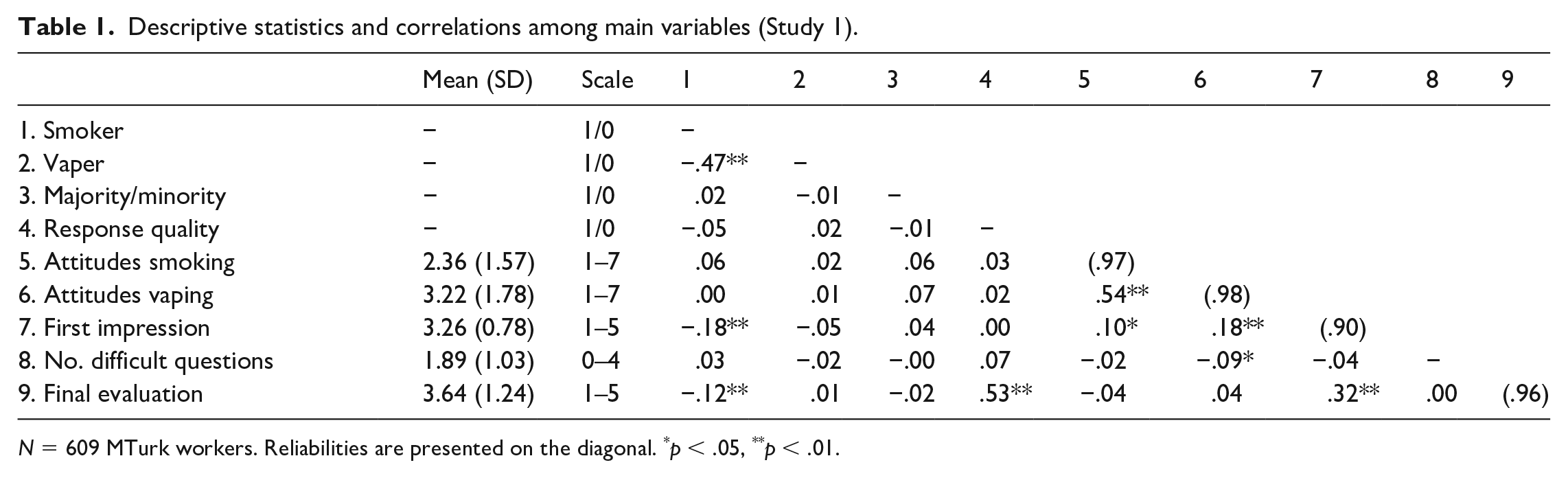
N = 609 MTurk workers. Reliabilities are presented on the diagonal. *p < .05, **p < .01.
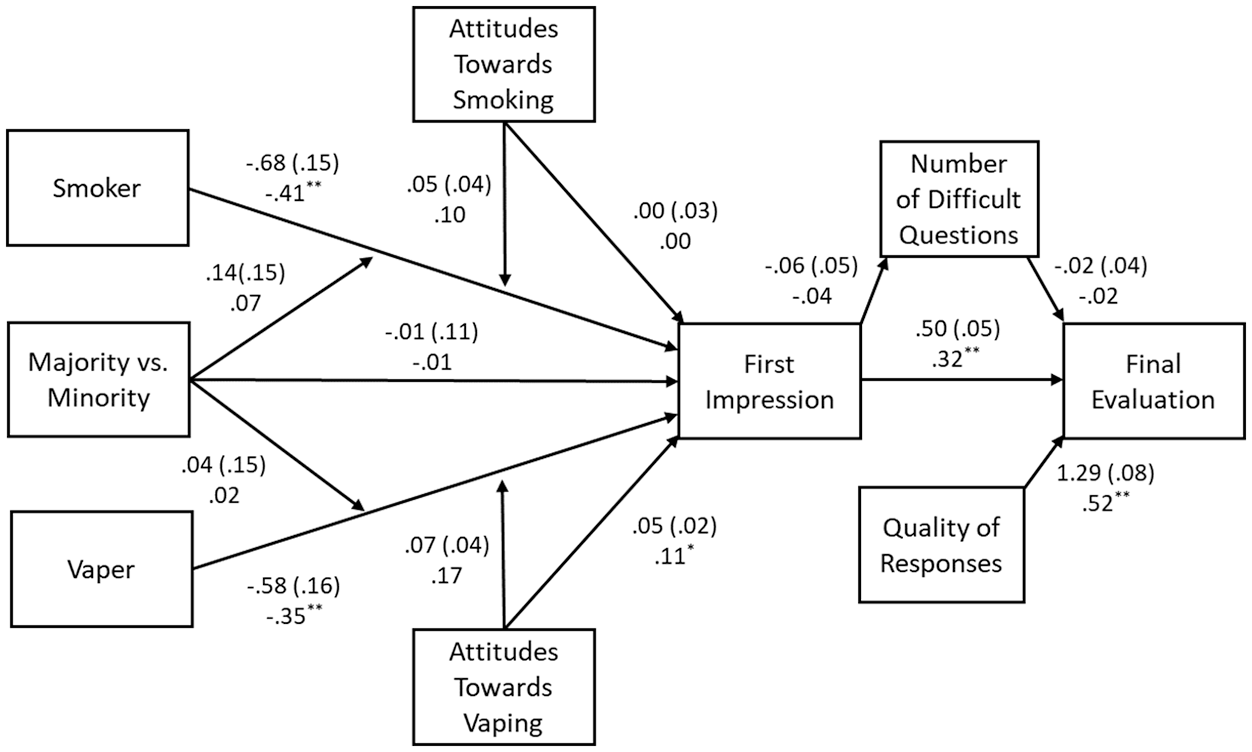
Path model for Study 1.
We found support for Hypotheses 1a and 1b, with more negative initial impressions of applicants that were smokers or vapers than non-smokers. We observed significant and negative paths from both smoker (b = −.68, SE = .15, p < .01) and vaper (b = −.58, SE = .16, p < .01) to initial impressions. Interestingly, the effect of smoking status on initial impressions was a main effect, and was not moderated by interviewers’ attitudes toward smoking or vaping. Results from an ANOVA further illustrate the difference in initial impressions between our three conditions, F(2, 605) = 19.14, p < .01, with smokers receiving the lowest evaluation (M = 3.06, SD = .75), followed by vapers (M = 3.21, SD = .79), and the control condition (M = 3.52, SD = .73). Post-hoc tests confirmed that the differences between smoker and control (p < .01, d = .62) and between vaper and control (p < .01, d = .41) were both significant and of medium size, while the difference between smoker and vaper was small and non-significant (p = .14, d = .20).
We found no support for Hypotheses 2a and 2b, that initial impressions would be particularly negative for applicants that are both from an ethnic minority group and smokers or vapers. Indeed, we did not find any interaction between majority status and being a smoker (b = .14, SE = .15, p = .33) or majority status and being a vaper (b = .04, SE = .15, p = .78). We also did not find a main effect of majority status (b = −.01, SE = .11, p = .92), suggesting that minority and majority applicants received similar initial impressions. 2 Our data also did not support Hypotheses 4a and 4b. Indeed, interviewers’ initial impressions were not associated with asking more difficult questions (b = −.06, SE = .05, p = .30), and the number of difficult questions was not associated with interviewers’ final evaluations of the candidate (b = −.02, SE = .04, p = .56). And, correlational data showed that question difficulty was unrelated to the applicant being a smoker (r = −.02, p = .41) or vaper (r = −.02, p = .68).
Finally, we found support for Hypotheses 5a and 5b, with interviewers’ final evaluations being positively related to both initial impressions (b = .50, SE = .05, p < .01) and applicant response quality (b = 1.29, SE = .08, p < .01). Importantly, our model confirms that first impressions (that are more negative for smokers and vapers) were significantly associated with final evaluations, even when response quality was included in the analysis. Although not related to our hypotheses, we examined whether initial impressions and response quality interacted to predict final evaluations using PROCESS (model 1). We found a significant interaction, b = −.32, SE = .10, p < .01, suggesting that the effect of initial impression on final evaluation is stronger when applicants provide average (vs. strong) responses. 3 We also conducted an ANOVA to examine differences in final evaluations across the three conditions, F(2, 604) = 6.15, p < .01, and found that smokers received the lowest evaluation (M = 3.43, SD = 1.24), followed by vapers (M = 3.64, SD = 1.22), and the control condition (M = 3.85, SD = 1.22). Post-hoc tests confirmed that the difference between the smoker and control was significant but small-to-medium in size (p < .01, d = .34), whereas differences between vaper and control (p = .20, d = .17) and smoker and vaper (p = .19, d = .17) were smaller and non-significant. 4
Discussion
Results from our interview simulation in Study 1 replicated recent scenario-based findings suggesting that applicants identified as cigarette smokers are devalued in the hiring process (Roulin and Bhatnagar, 2018). We found that interviewers’ initial impressions were more negative for smokers compared to non-smokers. Lowered initial impressions were also found for vapers compared to non-smokers, but not to the same extent as for smokers. Thus, Study 1 findings provide initial evidence for reactions to vaping in the selection context and suggest that this too is a stigmatized behavior, although not (yet) to the same extent as smoking traditional cigarettes (e.g. Hart, 2017; Keane et al., 2017). These results are mostly in line with Type I processes and their impact on interviewers’ initial impressions (Derous et al., 2016). Interestingly, the impact of smoking status on first impressions was independent of interviewers’ attitudes toward smoking or vaping despite generally unfavorable attitudes within our sample (i.e. M = 2.36 and 3.22 on a 1–7 scale). Moreover, the minority applicant did not receive harsher evaluations. In other words, we did not find support for a “double jeopardy” effect (Barnum et al., 1995; Berdahl and Moore, 2006) for ethnic minority candidates that were also smokers or vapers.
Study 1 went beyond initial impressions by examining interviewers’ questioning strategies during the (simulated) interview and evaluations at the end of it. This allowed us to empirically examine additional important parts of the dual-process model of interviewer bias (Derous et al., 2016). We did not find support for interviewer engagement in Type II justification or rationalization processes in that no relationships between initial impressions or smoking status and the difficulty of questions asked emerged. However, we did find Type II updating based on response quality. Further, results also confirmed that interviewers’ initial impressions serve as Type I anchors for final interview judgments (Derous et al., 2016; Dougherty et al., 1994). Even as interviewers incorporated new information and adapted their assessments based on response quality, initial impressions continued to impact final evaluations, likely due to Type I confirmation. In this fashion, interviewers gave worse evaluations to smokers and (to a lesser extent) vapers than non-smokers at interview-end even when response content stayed the same. The significant interaction effect of initial impressions and response quality on final evaluations further suggested that the anchoring effect was weaker when applicants provided stronger, non-confirmatory, responses, thereby indicating engagement in Type II updating. Overall, Study 1 results suggest that reactions toward smokers and vapers are not just limited to first impressions. They also impact overall evaluations, and thus the opportunity to obtain employment.
Study 2
Study 2 was a simplified version of the prior video-based job interview simulation, and incorporated only the ethnic majority candidate. Business students completed the study in an office using a computer equipped with eye tracking technology. This second study retested Hypotheses 1, 4, and 5, while additionally testing Hypotheses 3 and 6.
Method
Sample
Respondents were 154 business students from a large university in Western Canada who participated in exchange for bonus course credit. The mean age was 21.6 (SD = 4.1). The sample was 52% male and 48% female; 36.4% Caucasian, 45.5% Asian, 9.1% Black, 9.1% from other ethnicities, and 61.7% employed (mostly part-time). Although only 25.2% of respondents had previous experience in a hiring role, 71.2% had completed at least one human resource management course. Moreover, 24.5% were smokers and 12.5% were vapers.
Design
We used a truncated 3x2 between-subjects design. We manipulated smoking status and response quality as in Study 1, but removed the majority/minority condition (i.e. we used only the majority applicant). Participants were randomly assigned to one of the six conditions.
Materials and interview simulation
We relied on the same video material and interview simulation as in Study 1, with two major differences in addition to the design difference discussed above. First, participants completed the study in an office, one participant at a time, under the supervision of a trained research assistant. The in-office portions of the videos were shot within the same office in order to maximize realism of the simulation for study participants. Second, an eye tracker (Tobii Pro X2-60) was used to capture exactly where participants were looking while watching the videos (e.g. by capturing how much/often they looked at the pack of cigarettes), with a sampling rate of 60 Hz. 5 This type of eye tracker is unobtrusive and was attached to the bottom frame of a 24″ computer monitor. We included a cover story to minimize the possibility of participants acting differently, such as by not looking at key items, due to the presence of the eye tracker. Before the actual study, we told participants that the eye tracker was there to capture their reactions to print ads that the school was pre-testing for its MBA program. We showed two ads for a few seconds each, followed by a fake “stop” icon that participants had to click on in order to move on to the main study. This was done to make participants believe that the eye tracker was not intended for measurement during the interview simulation. We debriefed participants as to the actual purpose of the eye tracker at the end of the experiment.
Measures
We used the same measures as in Study 1, and obtained similar reliability levels (see Table 2). In addition, we analyzed eye tracker data using the Tobii Pro Studio software. The Tobii Pro X2-60 eye tracker continually records where participant gaze is directed on screen during the study. We thus designed “areas of interest” for each video by drawing rectangular frames around key stigmatizing objects such as the cigarette smoked by the candidate outside the building and the cigarette pack on the interview table. The three objects (cigarette/pack, vaping device, cellphone) and the areas of interest around them were of similar size and color in order to minimize strong bottom–up attentional effects. We used the Tobii Pro Studio software to compute the number of visits participants made within the areas of interest (i.e. the eye tracker data) during two key stages of the interview: (1) prior to making initial impression ratings (with the stigmatizing object visible for a total of about 12 seconds); and (2) during the interview (with the object visible for a total of about 518 seconds). 6
Descriptive statistics and correlations among main variables (Study 2).
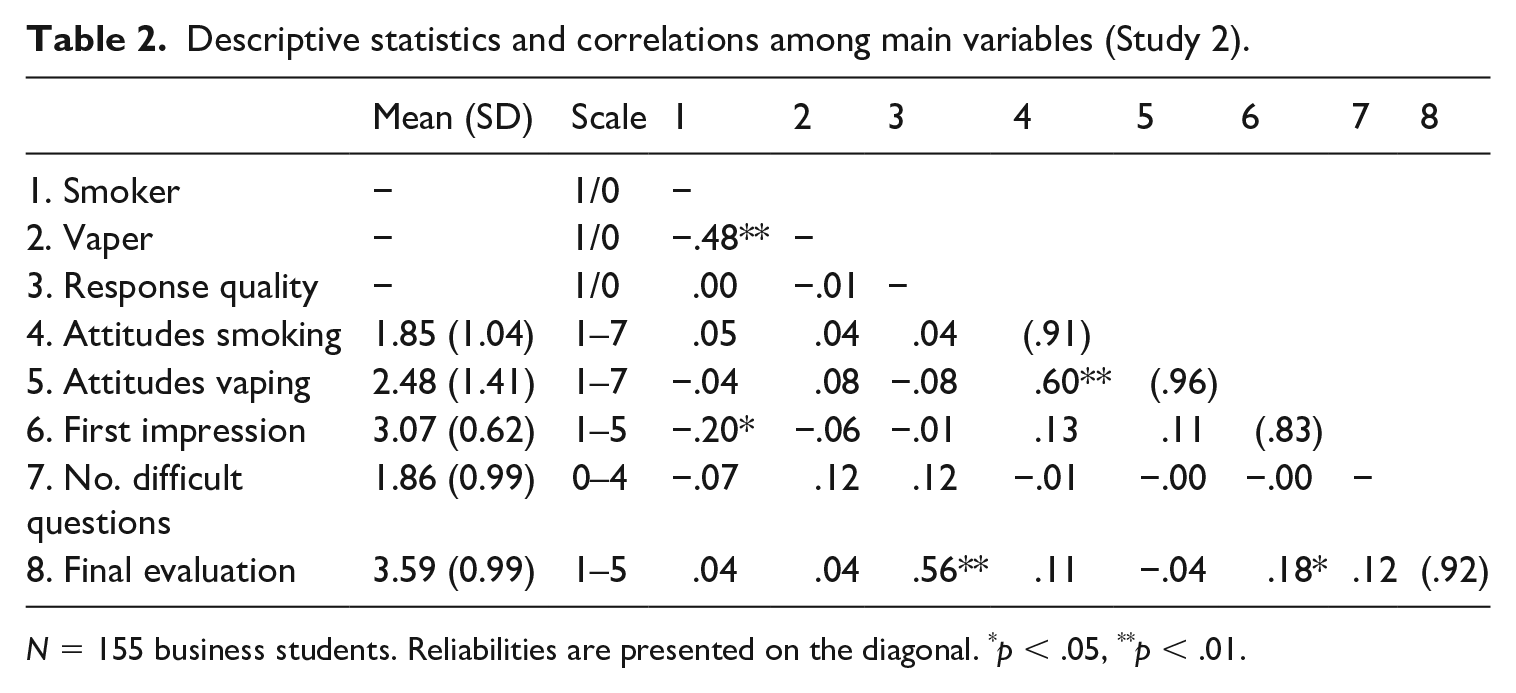
N = 155 business students. Reliabilities are presented on the diagonal. *p < .05, **p < .01.
Manipulation checks
We used the same manipulation check items previously adopted in Study 1. Overall, 76.8% of participants responded correctly to the “What was the person doing?” item (with 70% correct responses in the control, 94% in the smoker, and 67% in the vaper conditions respectively), F(2, 152) = 6.65, p < .01. Additionally, 87.7% responded correctly to the “Was it the same person?” item, with no difference between conditions, F(2, 152) = 0.31, p = .74.
Results
Table 2 presents descriptive statistics and correlations among key variables for Study 2. As in Study 1, we tested our hypotheses using path analysis, with maximum likelihood estimations in STATA 14. We built one model that included the full sample (similar to the one used in Study 1) to test Hypotheses 1, 4, and 5 (see Figure 2). Our model showed a good fit to the data and surpassed commonly cited cut-offs, with Χ2 = 9.50, p = .79, Χ2/d.f. = .68, RMSEA = .00; CFI = 1.00; TLI = 1.00, SRMR = .04. To avoid making inappropriate comparisons due to the different stimuli used (Orquin and Holmqvist, 2018), we did not directly compare eye tracking data across conditions. Instead, we built separate models for the smoker (N = 50) and vaper (N = 49) conditions that included eye tracking data to test Hypotheses 3 and 6 (see Figure 3). Both models fit the data well, with Χ2 = 8.29/7.92, p = .31/.34, Χ2/d.f. = 1.18/1.13, RMSEA = .06/.05, CFI = .96/.96, TLI = .92/.92, SRMR = .09/.08 for the smoker and vaper conditions respectively.
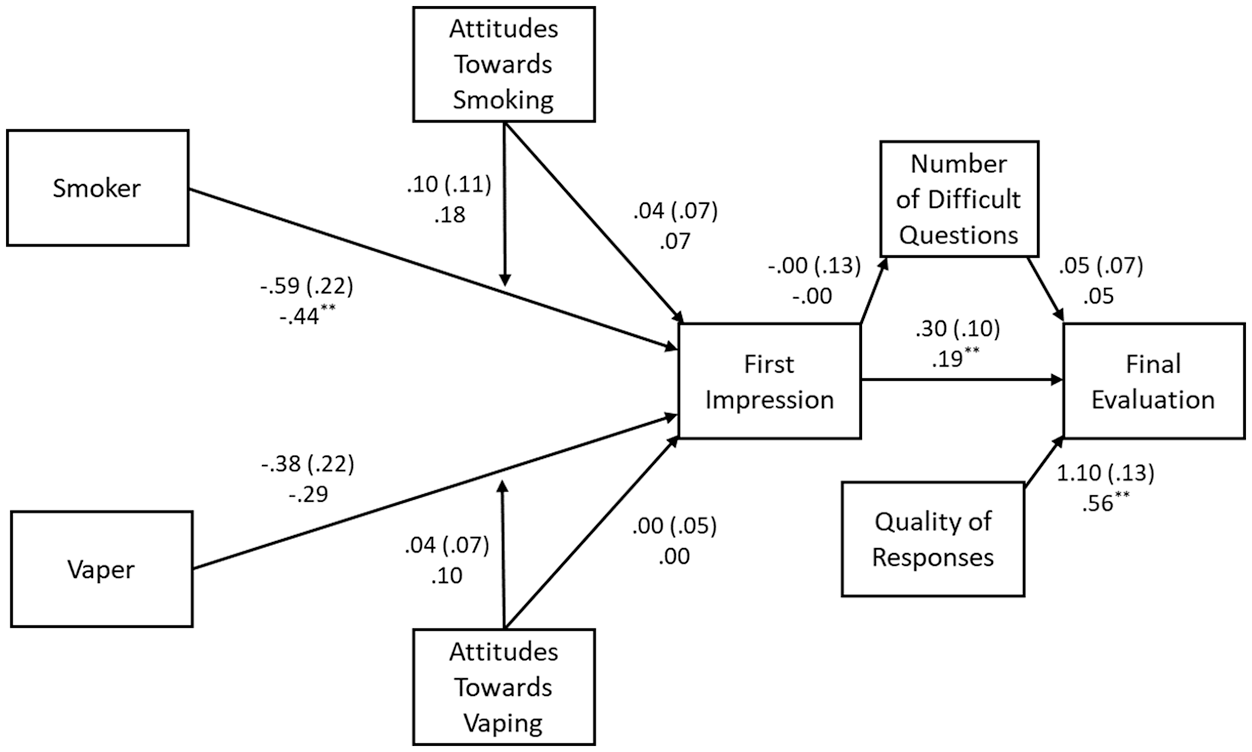
Path model for Study 2 (without eye tracker data).
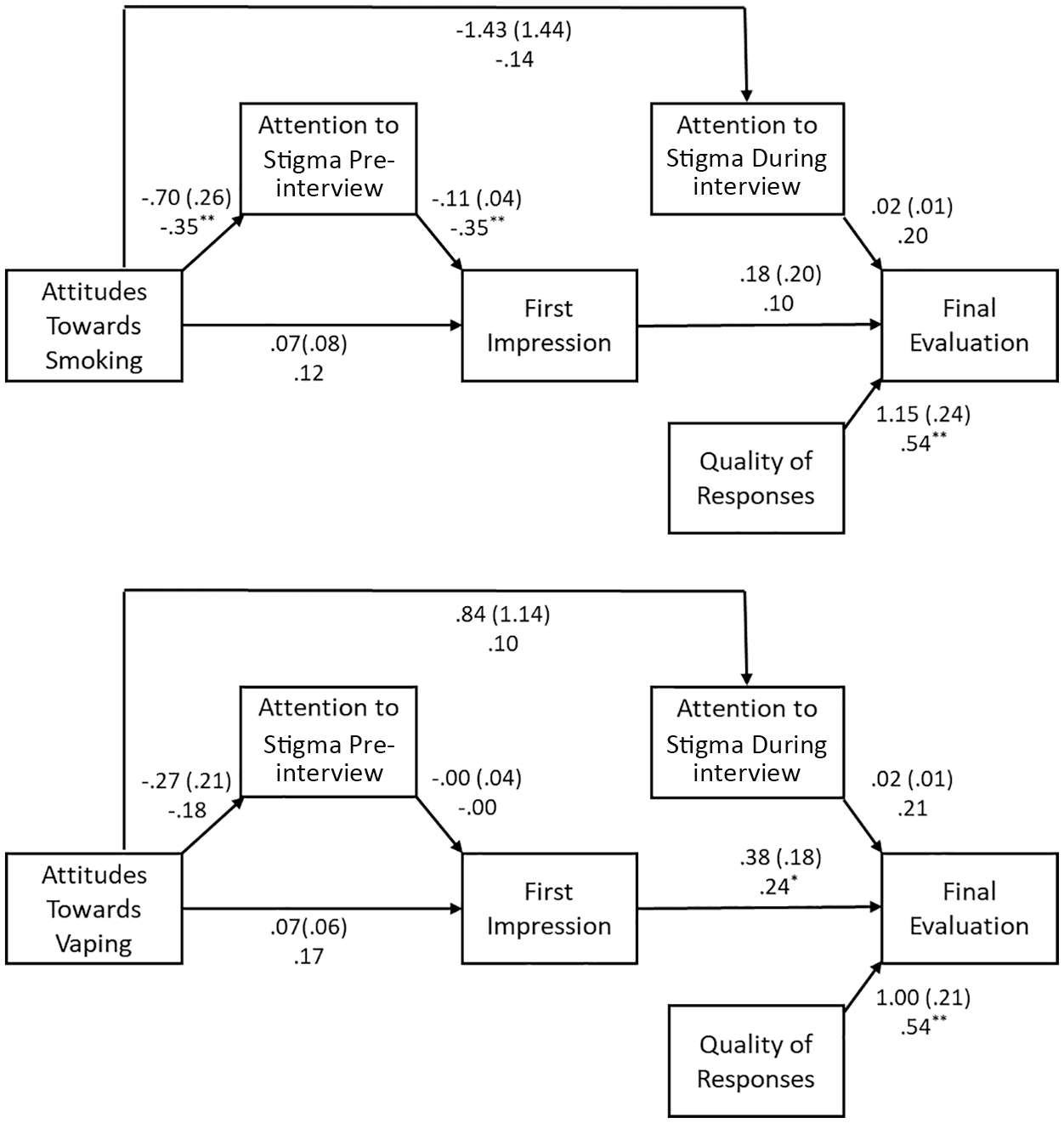
Path model for Study 2 with eye tracker data for the smoker (top) and vaper (bottom) conditions.
We found additional support for Hypothesis 1a, but support was more limited for Hypothesis 1b. We observed a significant negative path from smoker to initial impressions (b = −.59, SE = .22, p < .01). The relationship was in the expected direction for the path from vaper to initial impressions, but remained marginally significant (b = −.38, SE = .22, p = .08). As in Study 1, there was a main effect of smoking status on initial impressions that was not moderated by interviewers’ attitudes toward smoking or vaping. Results from an ANOVA further illustrate the difference in initial impressions across our three conditions, F(2, 152) = 5.54, p < .01, with smokers receiving the lowest evaluation (M = 2.90, SD = .60), followed by vapers (M = 3.02, SD = .63), and the control condition (M = 3.29, SD = .58). Post-hoc tests confirmed a medium-to-large and significant difference between smoker and control (p < .01, d = .66) and a medium and significant difference between vaper and control (p < .05, d = .45). The difference for smoker and vaper was small and not significant (p = .31, d = .20).
We found support for Hypothesis 3a, with a significant negative path between the attention paid to the stigma (i.e. number of visits in the area of interest) prior to the interview and initial impressions in the smoker condition (b = −.11, SE = .04, p < .01). Interestingly, we also found a significant path between interviewers’ attitudes toward smoking and attention paid to the stigma prior to the interview (b = −.70, SE = .26, p < .01). Interviewers with more negative attitudes toward smoking looked more at the applicant smoking or the cigarette pack prior to the interview, resulting in more negative initial impressions. In contrast, we found no support for Hypothesis 3b, with no relationship between the attention paid to the stigma prior to the interview and initial impressions for vapers (b = −.00, SE = .04, p = .99).
As in Study 1, our main path analysis for Study 2 did not provide support for Hypotheses 4a and 4b. Indeed, interviewers’ initial impressions were not associated with asking more difficult questions during the interview (b = −.00, SE = .13, p = .99), and the number of difficult questions was not associated with interviewers’ final evaluations of the candidate (b = .05, SE = .07, p = .41). Moreover, correlational data suggest that question difficulty was unrelated to the applicant being a smoker (r = −.07, p = .37) or vaper (r = .12, p = .12). Our main model supported Hypotheses 5a and 5b, with interviewers’ final evaluations being positively related to both their initial impressions (b = .30, SE = .10, p < .01) and the quality of applicants’ responses (b = 1.10, SE = .13, p < .01). Similar to Study 1, results from supplementary analyses using PROCESS (model 1) showed a significant interaction, b = −.45, SE = .21, p < .05, again suggesting that the effect of initial impressions on final evaluations is stronger when applicants provide average versus strong responses. 7 We also conducted an ANOVA to examine final evaluations in our three conditions, but found no significant difference, F(2, 152) = 0.15, p = .85, with d values ranging from .04 to .11. Finally, we found no support for Hypothesis 6. Interviewers that looked more at the cigarette pack (b = .02, SE = .01, p = .09) or vaping device (b = .02, SE = .01, p = .08) during the interview did not evaluate the applicant more negatively at the end of the interview. Interestingly, interviewers’ attitudes toward smoking or vaping were also not associated with the number of times they looked at the pack or device during the interview. 8
Discussion
Overall, results of Study 2 largely replicated those of Study 1. As in Study 1, we found that interviewers formed less favorable initial impressions of smokers and, to a lesser extent, vapers (at a significant level in Study 1, and marginally significant level in Study 2). In addition, eye tracking data uncovered a potential attentional mechanism that triggers initial impressions of smokers (but not vapers), thus providing additional evidence for the role played by Type I processes within the pre-interview phase (Derous et al., 2016). More precisely, our findings highlighted that the more interviewers looked at visible cues of the smoking stigma (i.e. the cigarette pack) before the interview, the more negative their first impressions were. However, we did not find similar effects for vapers. This may be because our students were less familiar with the vaping device than a cigarette pack, although a subsequent question posed to half the sample showed that over 80% were able to correctly identify the device based on an explicit standalone picture. Another explanation may be that students were less attentive to the experimentally manipulated stigmatizing features than the MTurk sample, as has been observed in past research (Hauser and Schwarz, 2016). In addition, final evaluations were not associated with eye tracking data collected during the interview. This suggests that interviewers were more focused on listening to applicant responses and less on the stigmatized features at this stage of the interview.
Results of Study 2 further confirmed that the difficulty of questions asked by interviewers was unrelated to initial impressions or final evaluations. However, as in Study 1, final evaluations were influenced by both initial impressions and response quality, in line with both anchoring (Type I) and updating (Type II) processes respectively (Derous et al., 2016). Also, as found in Study 1, the Type I anchoring effect was weaker when applicants provided stronger responses. This was further indicative of Type II updating. Further, comparing our findings across both studies suggests that smokers are indirectly evaluated more negatively because of worsened initial impressions and anchoring effects. Yet, the indirect effect for vapers was smaller and marginally significant in Study 2. These effects were smaller overall in Study 2 than in Study 1. Moreover, we did not find any difference when directly comparing final evaluations across the three conditions (contrary to Study 1 where the sample size was larger). Overall, such results and discrepancies may be attributable to the sample used here. For instance, a large majority of the students (71%) had completed at least one HR course as part of their curriculum, and 37% had completed 2+ courses. Such classes feature topics like employment discrimination, biases, and risks associated with inaccurate first impressions in selection, thereby making these students more likely to update their initial judgments instead of engaging in confirmatory or rationalization processes. Besides, these results may also be due to a smaller sample size, lesser attention paid by students as opposed to MTurk participants, or lower familiarity with the vaping device as compared to the cigarette pack.
General discussion
Key findings and contributions
Our examination of interviewer judgments of job applicants identified as smokers or vapers makes theoretical and methodological contributions to the personnel selection, tobacco control, and stigmatization literatures in important ways. Cigarette smoking is widely stigmatized, including within the workplace, today (Kim et al., 2017; Schmidt et al., 2013). This stigmatization suggests greater risks of discrimination for the high proportion of the population that still smokes. While numerous job applicant features such as age, weight, and race or ethnicity are considered as stigma inducing in the personnel selection literature (Derous et al., 2009; Finkelstein et al., 1995, 2007), the treatment of smokers has largely been ignored. In this research we selected key propositions from Derous et al.’s recent (2016) dual-process framework to empirically test for biases toward smokers and vapers, that are a growing demographic, within job interviews. 9
Within this framework, interviewers’ initial impressions of stigmatized applicants are largely the result of intuitive and automatic Type I characterizations triggered by the sight of visible stigma cues such as unintentionally exposed cigarette packs or vaping devices, or behaviors like smoking or vaping near the interview venue. Weaker first impressions of traditional smokers across both studies, and to a smaller degree vapers, with significant effects for a broader US sample (Study 1) and marginally significant ones for a younger Canadian sample (Study 2), relative to non-smokers largely provide empirical support for pre-interview components of the Derous et al. (2016) framework (specifically, Propositions 1a and b, and 4a). These findings also reiterate and extend results from emergent personnel selection research (Roulin and Bhatnagar, 2018). Our results are likely reflective of broader public attitudes toward smoking and vaping, with vaping being generally considered as less harmful and therefore more acceptable than cigarette smoking (Booth et al., 2017). However, while vapers are not as stigmatized as smokers are today, these perceptual differences may dissipate as the health consequences of vaping become clearer and social attitudes around vaping undergo subversion (Hart, 2017). In fact, the latest US Surgeon General’s report advises of the rise in vaping and associated health dangers for youth and young adults (US Department of Health and Human Services, 2016). We also found smaller effects for the Canadian student sample than for the US general sample especially with respect to vapers. The smaller effects could be attributed to a smaller sample size or more limited attention paid by the student sample. And, contrary to research highlighting the greater popularity of vaping among younger people (Emery et al., 2014), our student sample (Mage = 21.6 years) reported slightly more negative attitudes toward vaping than the older general sample (Mage = 34.1 years).
Further, we tested for and did not find evidence of harsher interviewer judgments of smokers and vapers that also belonged to a minority ethnic group within our general US sample. The issue of double jeopardy, where job applicants pay a price for smoking and vaping behaviors as well as ethnic affiliation, was not found in our study. However, rather than indicating a lack of intersectional double jeopardy, this result may instead be an artifact of the specific ethnic minority portrayed, and attributes of the actor who possessed strong English language and professional skills. Further, the actor was also selected for general equivalence with the majority group candidate in terms of physical presentation and attributes related to warmth and competence. Another possibility is that the general downward shift in the socioeconomic composition of smokers (Bayer and Stuber, 2006) makes even ethnic majority smokers a doubly stigmatized group: both for their smoking behaviors as well as their lower actual or perceived social status. In that sense, both minority and majority smokers and vapers may equally fall victim to a double jeopardy.
In line with the dual-process framework (Propositions 9–10 in Derous et al., 2016), initial impressions anchored interviewer judgments and continued to drive final evaluations (Type I), even after adjusting for more deliberate and thoughtful Type II assessments based on the quality of interview responses. While this demonstrates how insidious these biases are, we also found that the anchoring effect was diluted for strong- versus average-quality responses. We thus demonstrate that the societal stigma surrounding smoking, and to some degree vaping, found in interpersonal settings (Seiter et al., 2010) or in the workplace (Greenberg, 1994) also makes its way within the hiring process. Importantly, in both studies the effect of response quality on final evaluations was stronger than the effect of first impressions (and thus indirectly smoking status). As such, Type II processes might play a larger role than Type I processes in interviewers’ final judgments, which is positive both for organizations in terms of the validity/quality of hiring decisions and applicants in terms of fairness. However, worryingly for smokers and, to a smaller degree, vapers, exemplary performance on the interview itself can still be insufficient for fully overcoming automatic biases and ultimately receiving a job offer.
In addition, participants across both samples did not engage in conscious (Type II) justification or rationalization processes during the interview stage in the form of asking more difficult questions of the smoker or vaper as was expected based on the dual-process framework (Proposition 6 in Derous et al., 2016). It could be that participants did not evaluate the proposed questions differently in terms of difficulty, felt constrained by the two options presented and had a preference for asking different questions, or that other rationalization processes were at play. For instance, participants may have focused on elements of applicants’ responses that matched their initial assessment. It is also possible that interviewers’ conscious rationalization processes are less impacted by applicants’ stigmas than envisioned by Derous et al. (2016).
Moreover, in line with Type I processes (Proposition 2), eye tracking results in the Canadian sample showed that interviewers with lower attitudes toward smoking, but not vaping, paid greater attention to the stigmatizing cue for smokers, which in turn lowered initial impressions. However, attention to smoking cues during the interview did not influence final assessments. This may be due to potential habituation over the longer period of cue exposure during the interview (about 518 seconds) versus prior to initial assessments (12 seconds). Indeed, eye tracking research suggests that initial gaze direction is more relevant than subsequent eye movement for assessing Type I processes (Innocenti et al., 2010). In addition, in past eye tracking selection research (Madera and Hebl, 2012), the stigmatizing feature was present on the job applicant’s face. The “area of interest” where attention was assessed was thus in the vicinity where respondents likely focused (i.e. the face) as they viewed a static picture of a hypothetical candidate. In our study, the stigma inducing pack of cigarettes/vaping device was placed on the desk, and thus away from the respondents’ focus (i.e. likely on the actor’s face as interview questions were addressed). As such, our research suggests that the location of applicants’ stigma can represent a potential boundary condition to the dual-process framework (Derous et al., 2016), which is consistent with the importance of stigma visibility (Summers et al., 2018). And, the greater acceptance of vaping than smoking cigarettes (Booth et al., 2017) may help explain the non-significant indirect effect of attitudes toward vaping on first impressions via greater attention paid to the potentially stigmatized cue (i.e. the vaping device).
This research also offers novel methodological contributions to the selection literature. We developed a video-based interview simulation approach, allowing us to precisely capture multiple judgments and decisions in the pre-interview, interview, and post-interview phases, and thus test several portions of the dual-process model of interviewer bias. This approach arguably possesses external validity given the rising popularity of asynchronous video interviews in practice (Langer et al., 2017). It is also in line with recent calls for the use of video-based experiments to better simulate interactions in organizational settings (Heath and Luff, 2018), and capture psychological phenomena that are indicative of subtler forms of biases that might otherwise go unnoticed such as body movement (Congdon et al., 2018). In addition, we relied on eye tracking technology to potentially capture subtle and quick Type I processes (i.e. through fast gaze movement). To our knowledge, this is only the second time that this technology has been used for examining stigmatization within selection. And, unlike Madera and Hebl (2012) who used a static picture of a candidate and an audio recording of the interview, we used dynamic content in the form of video responses for enhancing realism and better replicating real interviews.
Practical implications
Our findings have practical implications for both hiring organizations and job applicants. Interviewer biases against smokers and vapers leave organizations vulnerable not just to losing out on qualified employees, but also hiring discrimination based on leisure activities that are unrelated to job performance (Morrow and Leedle, 2002). There is recognition that organizations need to be just in their hiring decisions (Arvey and Renz, 1992), and some legislative protections designed to ban discrimination against smokers have emerged (Schmidt et al., 2013). This is particularly important given that smoking rates are often higher in groups that are already marginalized, such as the less educated, certain ethnic minorities, or people low on the socioeconomic scale, and thus most in need of protection (Bayer and Stuber, 2006). We find stronger biases toward smokers and vapers within initial rather than final evaluations. We also demonstrate that initial impressions are used as anchors for final evaluations that albeit undergo some adjustment when interview performance is of high quality. As such, organizations could institute interventions for hiring personnel such as bias-sensitivity training that provides techniques for correcting biased initial impressions.
For smokers and, to a lesser extent, vapers, persistent stigmatization lowers access to valuable employment opportunities regardless of how well they perform during the interview. The negative health consequences of cigarette smoking are incontrovertible today, and smokers are well advised to break the habit. Other than smoking cessation, smokers (as well as vapers) would help themselves by making such behaviors less visible in physical as well as virtual spaces (e.g. within social media postings that are frequently reviewed by hiring managers; Berkelaar, 2017; Roulin and Bangerter, 2013). The fear of being found out, however, is a heavy burden to carry. Ultimately, applicants should receive training that makes them aware of public reactions to smoking and vaping, and the negative consequences for employability.
Limitations and future research directions
The controlled nature of our experiments, fictional scenarios used, and the online and student samples confer freedom from extraneous noise and confounding factors, allow tests for causality, and are commonly employed in stigmatization research in selection (e.g. McElroy et al., 2014; Madera and Hebl, 2012). At the same time, these also introduce artificiality that limits the external validity and generalizability of our findings. The novel video-based interview simulation, patterned on widely used asynchronous video interview assessments, was developed here to mitigate these issues. While our video stimuli simulate reality better than written scenarios in past research (e.g. Roulin and Bhatnagar, 2018) and students and professional hiring managers are often similarly biased (e.g. Luxen and Van De Vijver, 2006), ultimately field investigations with hiring managers and professional recruiters (along the lines of the audit method; Derous et al., 2012) are needed.
Our stimuli, such as the pack of cigarettes on the interview table, were also very visible, which likely limits the realism of the study and prevents us from clearly disentangling the effects of applicant smoking status from (voluntary or inadvertent) displays of the stigmatized stimuli. In other words, interviewers might not penalize all smokers, but just those that make this aspect of their identity transparent either at the time of the interview or even in other venues such as social media posts uncovered during the cyber-vetting process. As such, future research could also examine the effects of subtler or indirect signs of smoking status. For instance, eye tracking research could examine physical stigmatized attributes like skin discoloration, damaged teeth, or lines around the lips. This was not possible in our studies as our actors were non-smokers in their personal lives. Alternatively, researchers could examine the revealing role of cigarette smells in line with recent examinations of odor in the workplace (Riach and Warren, 2015). Studies could also explore applicant awareness of the damage caused by displays of smoking status, and the actual strategies employed for hiding this status.
In Study 2, we use participants’ visits in areas of interest as indicators of automatic Type I processes. This is consistent with our theoretical framework (Derous et al., 2016). The fact that visits during the pre-interview stage were associated with initial impressions, while visits during the interview stage were not associated with final evaluations, is also consistent with other eye tracking research suggesting that initial gaze direction is a relevant indicator of Type I processes (e.g. Beach and McConnel, 2019; Innocenti et al., 2010). That being said, the literature continues to debate the use of eye tracking data for measuring cognitive processes (Orquin and Holmqvist, 2018), and distinguishing between automatic versus deliberate information processing. Given this, we cannot completely rule out the alternative explanation that the visits, instead, indicate conscious Type II processes.
Our studies were designed to empirically test several key propositions from Derous et al. (2016). However, further research is needed for examining additional propositions (e.g. the role of contextual factors like the presence versus absence of organizational anti-discrimination policies). Moreover, we did not find support for several propositions, including some related to Type II processes during the interview. For instance, we found no evidence for Type II information gathering via more difficult questions posed to smokers. However, our interview questions were designed to be easier versus more difficult, and not to probe the kinds of negative associations people have about smokers in the workplace (such as taking more breaks or other counterproductive behaviors; Roulin and Bhatnagar, 2018). Future research could allow interviewers to choose questions that address these concerns in order to better approximate rationalization processes as proposed by Derous et al. (2016), or find other ways to more directly examine the specific psychological processes at play.
Further, future researchers can also examine differences in smoker and vaper stigmatization in different national labor markets. Societal attitudes toward smokers in the USA and Canada are markedly poor today, but this may not be the case in other countries where anti-smoking legislations are relatively lax and smoking prevalence and attitudes are higher. Further, longitudinal tracking of biases against vaping is also warranted as health implications of vaping emerge and public attitudes associated with it potentially deteriorate. Future research could also examine interviewers’ reactions to smokers and vapers as compared to (or in combination with) other stigmatized features. Although we found no interaction with ethnicity, we merely compared Caucasian versus East Asian applicants. Future studies could examine other ethnicities (e.g. African-American, Hispanics, East Asians) or explore other stigmas (e.g. age, gender, tattoos, etc.). Finally, the very small and non-significant effect of ethnicity (and lack of a double-jeopardy) in Study 1 is somewhat inconsistent with existing research, and may have arisen based on socially desirable responding. Replication and further investigations would thus be warranted.
Conclusion
Negative public sentiments around cigarette smoking have deepened over the past five decades, resulting in the creation of a stigmatized social class of smokers. The extensive societal discrimination faced by smokers is also found in organizations. And, although vaping is increasingly popular, perceptions surrounding it are also in flux. This research builds on, and empirically tests key principles of Derous et al.’s (2016) dual-process model of interviewer bias. Results show that interviewers form more negative first impressions of smokers and, to a lesser extent, vapers (a Type I automatic reaction). These effects carry on through the interview, with interviewers giving worse final evaluations to smokers and vapers (illustrative of Type I processes) despite adjustments for interview performance quality and diluted biased assessments where performance quality is strong (illustrative of Type II processes). We thus demonstrate the persistence of “smokerism” and, to a lesser degree, “vaperism” biases that originate at the start of the interview and persist till the end. These findings are critical given the importance of interviewers’ final judgments in personnel selection.
Supplemental Material
912320_supp_mat – Supplemental material for Examining the impact of applicant smoking and vaping habits in job interviews
Supplemental material, 912320_supp_mat for Examining the impact of applicant smoking and vaping habits in job interviews by Nicolas Roulin and Namita Bhatnagar in Human Relations
Footnotes
Acknowledgements
The authors thank Keya Gaglani and Trang Anh Tran for their help with the data collection and coding, Sean Buchanan for his feedback on the manuscript, as well as the two actors who participated in the material creation.
Funding
The authors disclosed receipt of the following financial support for the research, authorship, and/or publication of this article: Part of this research was supported by internal funding from the Asper School of Business, University of Manitoba.

Supplemental material
Supplemental material for this article is available online.
Notes
References
Supplementary Material
Please find the following supplemental material available below.
For Open Access articles published under a Creative Commons License, all supplemental material carries the same license as the article it is associated with.
For non-Open Access articles published, all supplemental material carries a non-exclusive license, and permission requests for re-use of supplemental material or any part of supplemental material shall be sent directly to the copyright owner as specified in the copyright notice associated with the article.
