







Abstract
In equality, diversity and inclusion studies, there is often an underlying assumption that research will advance equality and inclusion. Yet scholars increasingly point to a gap between theory and practice to achieve change. While paradigmatic differences in how change is framed may in part account for this gap, we argue that ‘action knowledges’ drawn from different paradigms are both important and ‘commensurable’ once a change agenda is adopted. Placing these in tension, we develop an interplay requiring scholars to engage differences in both ontology and ideology to ‘see’ the change knowledge in other paradigms. A ‘fifth knowledge’ for research to combat inequality and contribute to more equitable organizations can result from engaging with the dynamic tensions identified in our analysis.
Keywords
Introduction
Sharing an overarching goal to address inequality and discrimination in organizations, scholarship in equality, diversity and inclusion (EDI) has also produced divisions and sometimes intractable debates. Researchers have argued that the tensions hinder theoretical development and limit the impact of research on change in practice and policy (Cukier et al., 2014; Harrison and Klein, 2007; Malin et al., 2013; Van Dijk et al., 2017). EDI literature has generated important knowledge about organizational impacts of a diverse workforce, experiences of oppression of minority identity groups and individuals, the role of context and power relations in defining diversity and constraining equal opportunity, and the structures and practices that impede, or may advance, greater social and labour market equity among groups in society. However, research that integrates these issues and questions is relatively rare, and scholars have noted inconclusive findings of this large body of knowledge (Harrison and Klein, 2007; Roberson et al., 2017). As inequalities based on race, sex, ethnicity, gender identity, disabilities and their intersections remain a stark reality in contemporary organizations (Cukier et al., 2020; Mor Barak, 2017: 2), EDI scholars across traditions increasingly assert that the literature does not go far enough to generate theory on how progress towards more equitable organizations can be achieved (Ahonen et al., 2014; Pullen et al., 2017; Roberson et al., 2017).
Research on diversity and equality has been widely conducted in paradigms isolated from one another, with ‘inter-paradigm’ critique appearing regularly in the literature. Arguments that functionalist research devalues people’s diversity by using difference as a tool to achieve organizational economic goals sits beside work claiming that critical diversity scholarship is overly theoretical or aspirational. Some scholars have pointed to shortcomings in work in their own paradigm, finding that it does not bring significant change to build greater equality (see Malin et al., 2013), or has fallen short in terms of developing practical knowledge needed to manage diversity in a way that reduces inequality (Joshi et al., 2015).
We consider the fragmentation of approaches and theory-practice gap through the lens of Burrell and Morgan’s (1979) seminal sociological paradigms categorizing theoretical foundations underlying social sciences research. Paradigm analysis helps us to see the fragmentation that exists and to draw out important divisions in the EDI literature. The fact that research within these distinct paradigms rarely ‘speaks to’ or co-informs the others (Czarniawska, 1998) presents barriers for change-oriented research. The paradigms framework asks first, from an ontological perspective, whether reality is viewed as externally given (objective) or as a product of individual consciousness (subjective). The second dimension asks whether society is understood as reinforcing underlying unity and cohesiveness (regulation or status quo), or as the basis of structural conflict, modes of domination and contradiction (radical change). The two dimensions result in the four distinct approaches to research each with its own underlying assumptions and consequential findings. Functionalist research aims to understand the world as it is – an ordered and regulated state of affairs – and sees reality as knowable and objective. Interpretivist research focuses on the phenomenological reality of individuals, viewing reality as constructed through subjective and inter-subjective experience and aiming to understand the individual’s position in a unified and ordered system. Radical humanist research similarly views reality from a subjectivist perspective but emphasizes resisting or overcoming the limitations of current existing social arrangements through individual and/or collective agency. For radical structuralists, reality can be known and measured through research; however, power relations in society are understood as the dominating social force pointing to a requirement for radical change to counter oppression.
Building on these distinctions, we use the concept of paradigm interplay (Romani and Primecz, 2019; Romani et al., 2011; Schultz and Hatch, 1996) as a generative tool to analyse literature in EDI studies. Paradigm interplay is a ‘respectful interaction between analyses performed in different paradigms’ that recognizes the contribution of each (Romani et al., 2011: 433). The outcome of a paradigm interplay can be characterized as a meta-paradigmatic conceptual framework that builds on the theories of each paradigm (Monaci and Hassard, 2019). Applied to EDI studies, we first identify areas of knowledge within each paradigm that have the potential to inform change in this domain, and label these ‘action knowledges’ to denote this potential capacity. We then develop a framework to show similarities as well as tensions in the literature among and between these types of action knowledge, and argue that this interplay has the potential to support future research that effects change.
EDI research: Approaches to change to date
While calls for tangible impact have become louder in the EDI literature, work from different traditions subsumes distinct, and possibly conflicting, conceptualizations of ‘change’. For example, functionalist research tends to focus on measuring demographic diversity and representation, and its impact on organizational outcomes (e.g. Roberson et al., 2017), often centered on understanding what is, with a change agenda only implied. For example, Roberson et al. (2017) develop a ‘dynamic capabilities’ approach to understand the relationship between workforce diversity and performance at firm level. Firms can gain important benefits from workforce diversity (as well as losses); the authors argue that their process-based perspective is important for understanding value creation as it pertains to diversity. Still, demonstrating that diversity itself can be a dynamic capability suggests that wise firms will strive for this and benefit from it, instilling a shift away from workforce homogeneity. While their data may be critical to informing efforts to drive change, most functionalists pride themselves on objectivity.
Scholarship in the interpretivist tradition centres on the lived experience as an important focus for knowledge generation, grounded in subjectivity and individuals’ social constructions (e.g. Gherardi, 1995; Kamenou and Fearfull, 2006; Ostendorp and Steyaert, 2009). Interpretivist studies’ aim is to understand the very basis and experience of social reality as this is perceived and constructed by individual actors, rather than transforming that reality. Interpretivist work adopts a view of the world as cohesive, ordered and integrated (Burrell and Morgan, 1979: 31). In EDI, interpretivist studies often examine how individuals understand experiences of being different or confronted with inequality, with identities as key to understanding the complex dynamics between self, work and organization (Alvesson et al., 2008; Lewis and Grimes, 1999). Unlike much functionalist work that draws on demographic categories, interpretivist research may address intersectionality, recognizing that individual identities are often multiple, shaped by more than one demographic variable, for example gender, race or class (Acker, 2006), and socially constructed in nature (Atewologun et al., 2016; Rodriguez et al., 2016).
In contrast, radical humanist and radical structuralist scholarship is oriented explicitly towards change as fundamental within society and social research. On the subjectivist side of the radical dimension, humanist research examines learning, human development, agency (individual and collective) and micro-emancipation as means of driving change (e.g. Anthias, 2011; Zanoni and Janssens, 2007). The ways in which social actors construct identities for themselves and others in the face of broader forces of unequal power constitute an important focus for change. Radical structuralist research, on the other hand, works to expose the role and material reality of systems of oppression and inequality, viewing power relations from an objectivist stance (e.g. Nkomo and Ariss, 2014; Tilly, 1998). Scholars from both radical paradigms have begun to call for increased attention to performative outcomes from research on diversity and equality (e.g. Calas et al., 2009; Lorbiecki and Jack, 2000; Pullen et al., 2017; Zanoni et al., 2010). A performative as opposed to performance-oriented stance sees the actions of managers as embedded in larger systems, with those systems understood ultimately to be the targets for change towards more equitable organizations. Others have highlighted interaction between individual and organizational levels of analysis to better understand why and how inequality is manifest in different settings (e.g. Prasad et al. 2006; Syed and Ozbilgin, 2009). The ‘critical ecological model’ developed by Cukier et al. (2014) takes the inter-level approach further, drawing on previous studies in health and social sciences to show that ‘change’ is a function of concerted actions at different levels, and their interactions, including macro structures.
Paradigm interplay
Czarniawska (1998) argued that contention and debate – a discussion between paradigms fuelled by translating the views from one into another – adds vibrancy to a field. While it may be easiest for scholars to ignore research in other paradigms, and as researchers we are often socialized and trained within a particular paradigm, tensions and conflicts are a catalyst for generating knowledge (Czarniawska, 2001). Although it might be impossible to have one unique meaningful language between paradigms, as there cannot be a neutral language for scholars who have been socialized in different generalizations, tools and assumptions, communication and learning can take place through learning different languages (Westwood and Clegg, 2003). Thus, the task of interplay is to create a vocabulary that can allow the paradigms to ‘talk’ to one another, assisting to understand the others (see also Romani et al., 2011). This might involve learning some of the language of the other, or indeed a new language. The process may then contribute to a meta-paradigmatic form of knowledge that is novel and distinct in itself (Lewis and Grimes, 1999; Monaci and Hassard, 2019). Meta-paradigmatic approaches have the potential to develop theories and frameworks by encompassing the intellectual developments of a field (Hassard and Wolfram-Cox, 2013).
‘Paradigm interplay’ builds on these ideas to generate knowledge through simultaneous consideration of how analyses from separate lenses are differentiated on one hand, and what connects them on the other (Monaci and Hassard, 2019; Schultz and Hatch, 1996). Romani and colleagues (2011) propose that interplay consists of, first, analysing knowledge separately within each paradigm; second, contrasting these analyses to identify distinctions and associations between them; and third, applying the analysis to the field of interest to open ground for new contributions, ‘reaching a third insight’ (Romani and Primecz, 2019: 36). The interaction between analyses performed in different paradigms recognizing the contribution of each, challenges longstanding (in)commensurability arguments. Burrell and Morgan (1979) claimed the paradigms to be incommensurable. A significant proportion of subsequent paradigms literature has focused on debates about the (in)commensurability of the different systems of orientation expressed in the paradigms (Scherer and Steinmann, 1999). Some find no common ground to judge the relative empirical validity of each paradigm and their competing claims (McKinley and Mone, 1998). Opponents of the incommensurability argument point out that some research streams have more in common with traditions in other paradigms than sometimes claimed (e.g. interactionism with functionalist or hermeneutics as interpretivist), arguing for permeable boundaries among paradigms (Hassard, 1988).
The term interplay is used both as a verb to describe this analytical process and as a noun to define the result – the interplay is a novel, meta-paradigmatic form of knowledge not possible within any paradigm operating in isolation (Lewis and Grimes, 1999). It is geared to building more comprehensive understandings of social phenomena based on dialogue, enabling recognition of ‘transition zones’ between paradigms rather than a hard barrier, with multi-paradigmatic inquiry producing creativity and enriched insights (e.g. Hassard, 1991; Schultz and Hatch, 1996; Ybema, 1996). By this view, conflicting paradigmatic discourses are normal and the task of the theorist should be to build a bridge between them (Kaghan and Phillips, 1998), bringing peace to the ‘paradigm war’ in service of greater knowledge. We thus position our work within the (in)commensurability debate and argue for the possible fruitful interaction between paradigms in the EDI field (Hassard and Wolfram-Cox, 2013; Romani and Primecz, 2019).
Drawing on paradigm interplay, we ask, what can an interplay lens bring to create better understanding of the sources of fragmentation and connection in the EDI field as these relate to knowledge directed at change? How can a meta-paradigmatic analysis help to unlock the current situation of limited impact of research for change?
Interplay Stage 1: Action knowledge in exemplar articles
In this section, we analyse EDI scholarship in each paradigm separately, drawing on four exemplar articles, one that ‘fits’ within each paradigm. We chose these four articles because they are well-cited in the literature and each is illustrative of work in a particular paradigm. Clearly not every study or article can be neatly assigned to one paradigm; nor do we suggest that all scholarship in EDI lends itself directly to paradigmatic analysis. Rather, the paradigms help articulate important, sometimes fundamental divisions in the EDI field. The articles offer a heuristic basis on which we can compare and contrast along the key paradigmatic dimensions in the subsequent stage of paradigm interplay. We also understand that other observers may choose different pieces to exemplify paradigmatic work and that some studies may go some way to spanning adjacent paradigmatic boundaries. Our goal is to understand in more detail how action and change may be approached and assisted, whether implicitly or explicitly, through scholarship representing the different paradigms. What knowledge for building change, which we label ‘action knowledge’, might be embedded in the research, or not? Through this first stage of interplay, we find and label four forms of knowledge, each connected to one of the paradigms, that can contribute to a change agenda.
Functionalist – Knowledge for demonstrating a problem exists through measurement
Richard’s (2000) quantitative study ‘Racial diversity, business strategy, and firm performance: A resource-based view’ is an example of a functionalist approach for EDI. According to Burrell and Morgan (1979), functionalist research aims to understand the role of human beings in society by measuring and analysing behaviour without influencing it. It adopts a realist and nomothetic orientation to social questions, treating organization ‘as an aspect of a wider societal system that serves the interests of its members’ (Morgan, 1990: 15). Richard’s article examines the relationships between diversity, strategy and performance in the banking industry, measuring firm performance as productivity, return on equity and market performance. The study demonstrates that workforce cultural diversity adds value to a firm in certain conditions. The positive impact of cultural diversity is contingent on context, with context here defined as the business strategy of the firm, namely growth, no-growth or downsizing strategies. Firms following a growth strategy benefit from diversity, whereas those with a no-growth or downsizing strategy do not. The author highlights that firms should be aware of negative performance implications that potentially higher coordination costs owing to increased diversity might bring. While the study makes recommendations for human resources managers aimed at improving firm performance, the stance of the article is to present the objective results, to observe and analyse the status quo.
Richard’s definition of diversity based on observable attributes locates the approach on the objective side of Burrell and Morgan’s typology. ‘Cultural diversity is taken to mean the representation, in one social system, of people with different group affiliations of cultural significance . . . identified by particular surface level characteristics or observable attributes’ (2000: 164); here ‘cultural diversity’ refers to racial diversity. In other words, it is both meaningful and possible to observe and ‘measure’ diversity through visible characteristics, reflecting an objectivist approach. Yet, while change is ultimately something that the organization should and can pursue to increase performance, greater equity and inclusion are factors for observation rather than advocacy in this type of work. The study’s implications do not refer to any systemic or structural changes, rather, they allow for organizations to leverage their resources within their status quo.
The action knowledge gained through this functionalist approach is what we call knowledge to ‘measure’, to inform decision-making. Results provide information that show objectively that there is a ‘problem’ – for organizations in a growth period, lower levels of diversity are a disadvantage. Functionalist approaches tend to state implications for practice around effectively working with existing conditions to demonstrate organizationally valued outcomes, likely a product of policy change (Gilbert and Stead, 1999). Research in this vein attempts to assess levels of representation of minority groups in organizations, levels of engagement associated with different demographic groups, perceptions of diversity and equality measured through defined, uniform constructs, and the impact of various workplace strategies and interventions (Mor Barak, 2017). Identity groups are assumed to be identifiable based on objective criteria that can be measured and are useful for performance, and the organization has power to advance diversity and equity in representation, or not. Such work may recognize the imperfection of reductionist demographic categories as a limitation in the work, yet focuses on defining patterns that are common to certain demographic groups. Inequality in representation is something that can be defined and measured.
It is also instructive to examine EDI work specifically focused on change that adopts a positivist stance. As above, while the orientation is typically to observe, measure and assess, positivist research often attempts to evaluate ‘what works’. For instance, Mor Barak et al. (2001) are among researchers attempting to evaluate the impact of different interventions on advancing inclusion as a phenomenon of change. They test hypotheses regarding different perceptions of diversity using survey methods, defining diversity based on a person’s diversity characteristics, in Californian and Israeli companies with the intention of examining the ways in which employees experience inclusion and the relationship between inclusion and (organizational) commitment across cultures. Their research, they maintain, can serve companies as they develop interventions to improve retention among their diverse employees.
Interpretivist – Knowledge to understand lived experiences of inequality
Kamenou and Fearfull (2006) take an explicit interpretivist approach in their paper ‘Ethnic minority women: A lost voice in HRM’. Research in this paradigm strives to offer readings of a phenomenon on the part of those experiencing it without assuming its objective existence – reality is not ‘objective’ but nominalist, and must be understood through ideographic methods that focus on individuals’ lived experiences. In a qualitative interview study, the authors gain insight into the lived experience of ethnic minority women at their workplace, reflecting the subjective side of Burrell and Morgan’s subjective-objective dimension. The authors explicitly take the view that reality is socially constructed and that individuals play a role in this construction. Their interest lies in participants’ subjective perceptions in order to increase an understanding of the individuals concerned, those who are considered a part of the non-majority. Intersecting identities are important and may shape experiences, for example along gender, race, ethnicity, religion and sexuality, reflecting a more fluid, varied and socially constructed ontology of diversity than that offered in functionalist work.
The participants in the study struggle to become an integral part of their organization and advance in their careers given that they do not fit into the male-dominated western organizational culture. The struggle becomes apparent owing to the negative effects of stereotyping and to tensions between the organizational and social group structures in which the individuals have a position. Experiencing cultural and gendered stereotyping and having a physical appearance different from the organizational norm (i.e. white, male, western), the participants report a lack of acceptance by their coworkers, subordinates and managers. Ultimately, the women face the dilemma to either remain true to their minority identities, for example through wearing religious symbols or feminine dresses, or to ‘westernize’ including through dress, in order to fit in. The authors highlight how the women’s struggle takes place in a positionality within a given social structure; the women’s cultural and ethnic structure versus the organizational structure.
Thus, while the study’s research approach is located on the status quo side of Burrell and Morgan’s regulation-radical change dimension, the authors draw conclusions that change is needed to address the inequities experienced by their participants. Such change should happen through better organizational equality policies that sanction discriminatory practices and promote equal opportunities and treatment for all. Change is discussed although not explicitly researched; the organization and its managers are responsible and accountable for its achievement, while seeking input from members of minority groups.
The interpretivist approach creates knowledge for understanding experiences of diversity and inequality. Through phenomenological research, we can deeply understand individuals’ own narrations and experiences of difference. This knowledge can illuminate the important issue of intersectionality – how individuals experience it here and now – and thus its impact in different contexts (Gherardi, 1995). The research can bring light to the experienced importance of within-group, as well as between-group, differences. Finally, through studying individuals’ constructions, an interpretivist lens can reveal otherwise ‘invisible’ or taken-for-granted assumptions including the impact of experienced stereotyping, bias or exclusion, for individuals featured in the work.
Interpretivist analyses in EDI specifically focused on change typically highlight ways in which new realities can be co-constructed by imagining new possibilities or narratives. For example, Showunmi et al. (2016) undertook a qualitative study they position as constructivist-interpretivist, applying an intersectional framework to explore identity ‘in order to challenge universalist, gender and ethnic-neutral assumptions of leadership’ (2016: 917). They concluded that while white women focused on gender and class barriers to leadership, minority ethnic women described barriers linked to their ethnic and religious identities. The authors draw inferences about the implications for developing leadership training for women.
Radical humanist – Knowledge to know agency and micro-emancipation
In ‘Minority employees engaging with (diversity) management: An analysis of control, agency, and micro-emancipation’, Zanoni and Janssens (2007) show how diversity management itself can be experienced as a form of control affecting minority employees, but that, as agents, individuals can create space for their own micro-emancipation. Radical humanist research is concerned primarily with finding ‘emancipatory ways in which humans can exercise control over their own constructions’, allowing them to express and use human agency (Morgan, 1990: 21). Human beings become alienated from their agentic potential through socially created realities that constrain the mind and behaviour. This paradigm thus focuses on individual emancipation, often through education or other means to liberate human agency (Deetz, 1996). The authors suggest that minority employees’ engagement with identity regulatory discourses does not operate solely as control; individuals are able to maintain and repair their sense of who they are through their emancipatory identity work.
The study is based on the assumption that difference and diversity are not given, but socially constructed, clearly sharing the subjective side of the Burrell and Morgan matrix with work from interpretivist perspectives. Discourses that define minority employees in terms of fixed, essential group characteristics, and their negative connotations and impact, are surfaced by the researchers. Yet individuals also draw on such managerially inspired discourses, self-selecting among them, insofar as such discourses allow them to construct a positive identity. Diversity management and constructions of difference take place in a context of identity-regulating discourses and bureaucratic controls that are deployed to reach institutional goals. As such, while the authors focus on individual agency, their stance is that social relations are embedded in the structural reality of an employment relationship, where power is asymmetrically distributed among dominant and minority groups. Agency is viewed as reflexivity or the capacity to reflect and act, distinct from a view of agency as voluntarism or free will, but not fully determined by structure.
Thus, unlike interpretivist work, this orientation points to social relations as grounded in the requirement for change, as opposed to the status quo on the Burrell and Morgan matrix. The article reflects a clear orientation toward change highlighting a need for more inclusive workplaces and encouraging organizations to embrace change. Individuals have the agency to make choices, to resist or comply with unequal relations, and this opens the door for micro-emancipation in the form of influence on organizational processes and thus on society. The authors draw on their findings of individual narratives of micro-level change to suggest two ways in which organizations can foster equality. First, organizational practices should broaden prevailing norms concerning both competences and identities. They can counter institutionalized perceptions of ethnic minority groups and build their own, local understandings, such that they limit the broader reproduction of social inequalities. Second, organizations should approach those with ethnic identities as ‘full subjects’, that is, address individuals as employees rather than as members of minority groups, in order to help overcome hierarchically ordered categories. Together, these practices can constitute ‘alternative diversity management’ (Zanoni and Janssens, 2007).
We label the action knowledge created in such radical humanist research ‘knowing agency’. The approach sheds light on the agency of individuals who engage directly in identity work that challenges barriers. Actors are constrained by asymmetrical power relations, but have the capacity to make choices and reorient their own practices in a way that can bring them freedom from the organization. While much research in this vein examines individual change through identity work (Watson, 2008), there are also studies of how actors develop strategies in order to be heard by key stakeholders, resisting unequal relations and advancing a broader equality agenda (Ahmed, 2007a, 2007b; Gagnon and Collinson, 2017; Litvin, 2002). Consequently, we learn about how difference and diversity can be shaped through individuals’ reflexivity and reflexive agency and, further, how these actions may ultimately influence organizational and societal as well as individual practice. The knowledge provided in the radical humanist paradigm is specifically knowledge to inform human action and agency and can be a starting point to shift power relations (Gagnon and Collinson, 2017). Other work in this category may take a less power-oriented perspective, focusing on learning and education, training and development for individuals as routes to building agency and change (e.g. Joshi et al. 2015).
EDI research explicitly focused on change from this paradigm, empowering individuals is often a strong focus. For example, Coleman and Rippin (2000) highlight the importance of action and agency, on the part of both organizational actors and the research collaborators, in advocating for a feminist change agenda in a manufacturing context. Their action research project established a self-managing team on the shop floor with an eye to shifting gendered patterns of work while enhancing performance. The paper offered conclusions on the specific intervention but also on the processes that individuals and groups can use that build empowerment to drive change.
Radical structuralist – Knowledge to show structures of inequality and domination
In their paper ‘The historical origins of ethnic (white) privilege in US organizations’, Nkomo and Ariss (2014) shed light on the link between European global expansion and colonization, industrialization and racializing of American organizations in the 19th and 20th centuries. For radical structuralists, power relations in society are the dominating social force; social relations should be understood in terms of structures and their intrinsic tensions as sources of oppression. The authors’ method here relies on a historical analysis of the literature on work, culture and society to demonstrate underlying structures of white privilege in organizations, and how these have created advantage and inequality. In considering mechanisms that lead to white privilege, the authors draw a holistic picture of the roots of inequality in organizations in the American context.
The definition of diversity and equality in this work stresses the importance of understanding the objective realities of demographic characteristics that stratify groups. In this sense, identities are objective and not subjective in this work. The authors argue that ‘whiteness is not just a matter of phenotype or skin colour’ but also the power and privilege that have accrued there-to over the history of organizations (Nkomo and Ariss, 2014: 390). For example, whites are assumed to be raceless so that white employees are seen as individuals, while non-whites are defined by otherness but otherwise undifferentiated. Nkomo and Ariss find that ‘whiteness as an ideology has naturalized the status quo in the workplace – the legitimatization of everyday practices as natural, not racialized’ (2014: 397). Their work exemplifies the objective-radical change quadrant of the Burrell and Morgan matrix. By examining the historical context of whiteness, they focus attention on deep structural forces that embed identities, ‘an inexorable link between European global expansion and colonization, industrialization and the racialization’ of the 19th and emergence of 20th century US organizations (2014: 390).
Like other research in the radical frame, the work has an overt focus on the imperative for change, but the authors’ conclusion is that, in order to achieve this, historical developments that have structured white privilege in society and dominance in organizational life, have to be fully understood (in this context, and in other societal contexts). The authors argue that it is not enough to study how minority groups can be ‘included’; research must reveal and understand mechanisms of whiteness that have fostered the inclusion of dominant groups. Moreover, managerial influences on sustaining white privilege and how these are resistant to change require study. Such aspects are key to addressing the challenge of inequality; their disruption is required to drive change.
We label the action knowledge produced in work such as Nkomo and Ariss’ ‘showing unequal structures’. Studying how (in)equality has developed historically, we learn of the origins of what scholars and practitioners label difference and diversity, and how these are reproduced within structures that support the power of some groups and subordination of others. Thus, we see the impact of structure on existing identity groups and the power asymmetries that define the structures, which are necessary to shift if lasting change is to occur. Radical structuralist approaches to change in EDI research typically at the macro level often through policies or campaigns aimed at advancing minority groups in the organization or society. For example, Schmidt and Cacace (2018: 321) are explicit in their goal, research that helps meet ‘the need to redress persistent gender inequality in senior decision-making positions in science through structural measures’ in the Danish university system.
Interplay Stage 2: Paradigmatic contributions – Towards language for change
Taking our analysis to the next stage, paradigm interplay requires more than the juxtaposition of distinctive perspectives. Following Lewis and Grimes (1999), the goal is to recognize both the complementarity and disparity of research from different paradigm lenses. Crucially, the paradigms must ‘talk’ to one another on some level that brings their commonality into view and into play (Czarniawska, 2001). In EDI research, commonality can be seen in the commitment to greater understanding of diversity and difference and its impact, to reducing injustice and discrimination based on minority identity, and overall, to greater equality and more equitable organizations. Thus, in the second step of paradigm interplay, we contrast the analyses conducted in the first stage to consider how they can be connected (as well as distinguished), co-informing a change agenda. While there are undoubtedly different starting points for research following a change agenda, our argument is that regardless of the paradigm, whether theoretically grounded in the status quo and existing system or oriented to agency or critique to change those systems, the research that they produce and the methods that they use are important for impact for change. Moving from a focus on each paradigm in isolation, here we explore their strengths as well as limitations in light of this objective.
Knowledge to ‘measure’ inequality
First, the knowledge to measure inequality from the functionalist paradigm helps to raise awareness of an issue, an important antecedent for a matter to get on to a policy or organizational agenda in the first place (Baumgartner, 2015). Statistics about the representation of certain identity groups and links to measured outcomes help provide an overview of the status quo, and thus a benchmark for future studies on how interventions affect representation. This data also substantiates the depth of systemic issues – it does not provide explanations but it is a clear indication of differential outcomes for demographic groups.
Such findings or ‘hard facts’ can heighten managers’ and policy makers’ attention and willingness to take action on an EDI agenda, whether organizationally or at the level of government or institutional policy. For example, data about the underrepresentation of women in leadership positions, including taking account of intersecting identities for example between gender and race, are necessary for policy makers on various levels including governmental to acknowledge the fact of underrepresentation and start conversations around the question. Such quantifiable information tends to be highly valued in organizational and institutional decision-making systems. This is illustrated in the following excerpt from functionalist work by Richard (2000), discussed earlier: How does diversity affect the bottom line? The results of this study suggest that (neither interest group) is likely to see a direct, positive relationship between cultural diversity and firm performance. Instead, the effects are likely to be determined by the strategies a firm pursues and by how organization leaders and managers respond to and manage diversity. (Richard, 2000: 174)
Further, although rooted in a ‘status quo’ paradigm, the links between representation and corporate performance found by organizations such as Catalyst support an explicit change agenda (e.g. ‘The benefit of gender balance on boards’, Catalyst, 2019). This type of research provides information for stock-taking and a quantitative benchmark of effects of corresponding policy change over time. There is also evidence that organizations who are required to report on the demographic diversity of their employees become more diverse (Diversity Leads, 2019), suggesting a further ability of this type of research to assist change.
Knowledge to understand experiences
Such data are not sufficient to gain an understanding of how underrepresentation is experienced, however, nor for solutions that address the issue. Particular cases can be instructive and impactful for change in different ways, yet these are entirely missing in aggregated statistical and other outcome-oriented data. At an organizational level, measurement-based systems of tracking diversity and equality will provide important information for decision-makers but do little to explain experiences of discrimination or tokenism. Knowledge that shows lived experiences of those outside of the dominant group is provided by research largely in the interpretivist paradigm. This work has the potential to afford a deep understanding of the effects of the issues at hand, whether prejudice, discrimination or harassment, for individuals. In the context of advancing gender equality, we see considerable emphasis on storytelling and individual case studies in the research. For example, the narrative of a woman of colour in her struggles with sexism can make the effects of inequality more tangible and assist others – policy makers, the public, organizational leaders and peers – to get a much better sense of the reality of the issue. In Kamenou and Fearfull’s (2006) article discussed above, the quotes from their qualitative interviews are used to tell individuals’ stories. For example, they quote one of their participants relaying her experience of being sexualized as a black woman by her male colleagues: In the work scenario, there have been some white men who I found intolerable because of the way they treat you. . . I also had the very caring white male who all the time is ‘oh my God, you’ll be alright?’ or ‘don’t worry’ [mimicking a worried tone], you know. . . and I think that’s probably to do with being black and a woman. (Jane, Afro-Caribbean, Solicitor). (Kamenou and Fearfull, 2006: 161)
Such real-life stories may be used by women’s advocacy organizations to augment data on the underrepresentation of women in leadership roles as one of the drivers of the pay gap in many societies. For example, Catalyst documents ‘real life stories of unequal pay’ in a recent study: [M]y manager handed me a letter with some information about my annual bonus. The bonus was much higher than I was expecting, so I was pretty excited – until I took a closer look and noticed the letter was intended not for me, but for a male colleague. . . The annual bonus specified in Ryan’s letter was significantly higher than my own, despite the fact that we had started the same job at the same time and had the same degrees and comparable levels of experience –Beth*, Former banker, Brooklyn, NY. (Catalyst, 2015)
However, in terms of uses of the research, lived experiences may be viewed as idiosyncratic and thus not a solid basis from which to generate change. Without more patterned or contextualized analysis, they can be dismissed as anecdotal. Such studies may be limited in their ability to drive a change agenda given that analysis of the issues remains individualized.
Knowledge to know agency
Sharing the subjective dimension of experience and perception-based knowledge described above, research examining agency, micro-emancipation and learning provides knowledge of how individuals and groups can themselves pursue change. Research knowledge from the radical humanist paradigm shows agentic practices that can contribute to transformation. For example, it helps to understand how an advocacy group in an organization can generate strategies to combat discriminatory practices, through an amplified voice to which the formal leadership may be compelled to listen. This work is distinguished from interpretivist research in its focus on change through micro-emancipation, a term emphasizing that minority individuals operate in broad systems of control from which such emancipation is required for equality to be achieved. In the radical humanist exemplar article above, Zanoni and Janssens (2007) depict the micro-emancipation of an employee with a disability, for whom a new learning opportunity is a source of agency: In spite of all difficulties, employment tout court might represent for Robert one of the few available sources of self-esteem and possibly micro-emancipation in Belgian society, where the disabled have long been cast as patients in need of assistance rather than as competent individuals. It is through his antagonistic identity and behaviour that Robert is able to conciliate his need to make a difference in his life (and possibly micro-emancipate himself). (Zanoni and Janssens, 2007: 1387)
The authors also stress the importance of organizational support for such micro-emancipation, pointing to the impact of structural constraints and ways to cope with those: ‘He expresses his gratitude towards his boss, who has given him a chance and the freedom to organize his work as he wishes, revealing that he might not be completely in control after all’ (Zanoni and Janssens, 2007: 1384).
However, again such individual cases may not be sufficient to counter claims of patterned discrimination, nor provide concerted evidence of systemic injustice to convince policy makers. Further, although individuals and advocacy groups through their actions gain a sense of movement and liberation from unequal structures that regulate behaviour, these are unlikely to be wide-ranging enough to spur systemic change. Thus, informing agency by shining a light on agentic struggles and gains, action knowledge in this frame may not inform institutional decision-making.
Knowledge to show structures of inequality
Lastly, knowledge to reveal structures of inequality provides necessary historical and systemic analysis of the issues to understand deep patterns and the barriers they pose to greater equity and inclusion. In radical structuralist accounts, these often refer to embedded systems of capitalism, subjugation of particular groups or colonial assimilation, and attendant oppressive effects that constitute socio-economic and political contexts for organizations and individuals alike. As Nkomo and Ariss (2014) summarize in their article analysed earlier, such scholarship aims to reveal deeply rooted structures that perpetuate inequalities and discrimination, but that have become invisible through institutional normalization: To the extent organizations were constructed from the early days of industrialization for the interests and privileging of one racial group, what is actually positioned as normal is racialized. Those behaviors and characteristics most shared by groups on the dominant side of the power line institutionalize organizational norms and standards. This ends up sustaining the present status of racial and ethnic minorities in the U.S. workplace and rendering efforts to address inequality as only marginally effective. (Nkomo and Ariss, 2014: 14)
Change is explicitly desired within the radical structuralist paradigm yet highly difficult to achieve given the structural bases of inequality. Yet the research reveals these structures and power relations that require disruption. For change to occur, it must alter longstanding structural barriers, the current reality of which can be shown in part through the statistics and ‘hard measures’ of functionalist work. Historical perspectives shine light on change or its absence over time. At the same time, this form of action knowledge produced tends not to focus on the ‘how’ of change including situated actions ‘on the ground’ that can build social and public interest, and spur further change agency. It may also designate too distant an objective for some interested in pursuing change, diminishing interim evidence of progress that falls short of disrupting structures. Nonetheless, those structures are revealed as a critical target of systemic transformation. Table 1 summarizes each of these forms of action knowledge relating to each paradigm, the embedded approaches to change in each, and their potential impact within a research for change agenda.
Action knowledge, change approaches and usefulness for a change agenda.

Interplay Stage 3: Placing the differences in tension
In a third stage we ask, what knowledge may result when overlaying these contributions of each form of ‘action knowledge’ with a change agenda that addresses fragmentation in EDI research? This exercise suggests that work in the different paradigms is arguably both necessary and to an extent, commensurable. Identifying how each contributes to change provides some access to the vocabulary of each paradigm, in order for researchers to understand, and ultimately be able to use the knowledge, of other paradigms (Monaci and Hassard, 2019; Romani et al., 2011). However, beyond this juxtaposition strategy, interplay involves a third stage through which we aim to offer a novel strategy for change research that respects but also cuts across and transcends the four action knowledges for EDI. It requires scholars to accept certain weaknesses or limitations in their paradigm of choice and most fundamentally, returning to our paradigm analysis, involves holding both ontological and ideological differences in tension. The pay-off for embracing and working with these tensions, however, may be a research agenda and outcomes more closely geared to changing inequality.
First, ontological differences subsume but go beyond distinctions in levels of analysis, highlighted in previous reviews (e.g. Syed and Ozbilgin, 2009), or considerations around mixed methods that do not touch ontology per se. The differences in theories of reality within EDI research call for holding in tension: (a) knowledge that is objectivist, informing change through examining structures, stability and embeddedness of action within institutional frameworks, on one hand; and (b) knowledge that sees reality as fundamentally socially constructed, supporting change through examining these constructions, their processual character and how they create power relationships, on the other. In other words, individual understanding, agency and learning (subjectivist ontology) sits in dynamic tension with structure, stability and embeddedness in a framework (objectivist). In brief, an interplay strategy requires simultaneous consideration of individual experience and structural reality, of agency and embeddedness. How can this be reached? Our analysis is strongly suggestive of a relational ontology, as shown in Figure 1 below. A range of approaches might fall under the relational ontology umbrella, starting with the seminal work of sociologists whose fundamental contribution is to argue for the ontological ‘locatedness’ of actors within actual situations contexts (Emirbayer, 1997; Mische, 2011); in Emirbayer’s terms, ‘the classification of an actor divorced from analytic relationality is neither ontologically intelligible nor meaningful’ (1997: 287). Individual experience and action are always embedded within structures and material or substantialist reality (Mutch et al., 2006). In EDI scholarship, authors have begun to consider possibilities in this domain for example through process approaches (Gagnon et al., 2014) drawing on Langley and Tsoukas (2017), and explorations of practice or praxis that show promise in integrating action and structure to understand diversity complexity (Janssens and Steyaert, 2019).
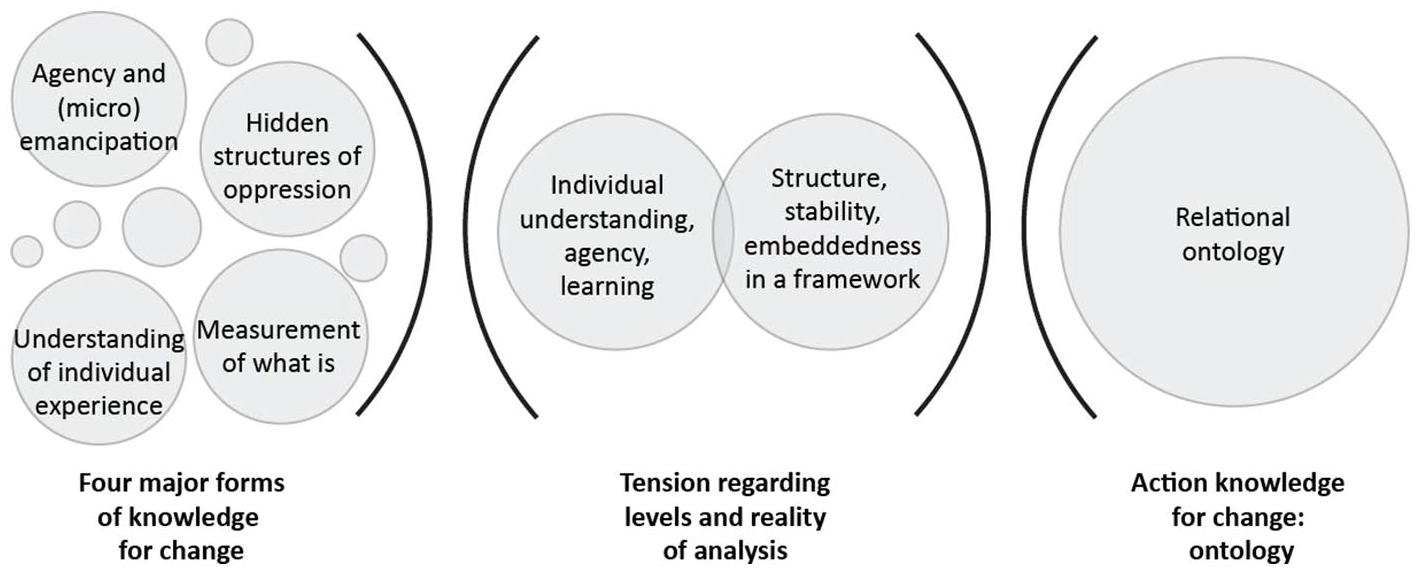
Tensions: Ontologies.
Second, the action knowledges embed important differences of ideology. Burrell and Morgan’s framework provides us with a useful heuristic here in drawing attention to paradigmatic differences in the purpose of social research and theory (1979). EDI research that aims to show the agency of individuals or groups in pursuit of equality, and how structures create, reproduce and indeed, preclude this agency, embodies a questioning and contesting of the status quo as an important purpose of EDI research. Questioning, critique and resistance to how things are is an important aim grounding work in the radical traditions. This is in ideological tension with research whose aim is to understand and report on the status quo, whether through objectivist, orientations or a focus on individual experiences. In Figure 2, a concern to understand and report how things are sits in dynamic tension with critiquing and resisting how things are. An ideology for interplay involves a simultaneous need to consider the status quo and the need for reform
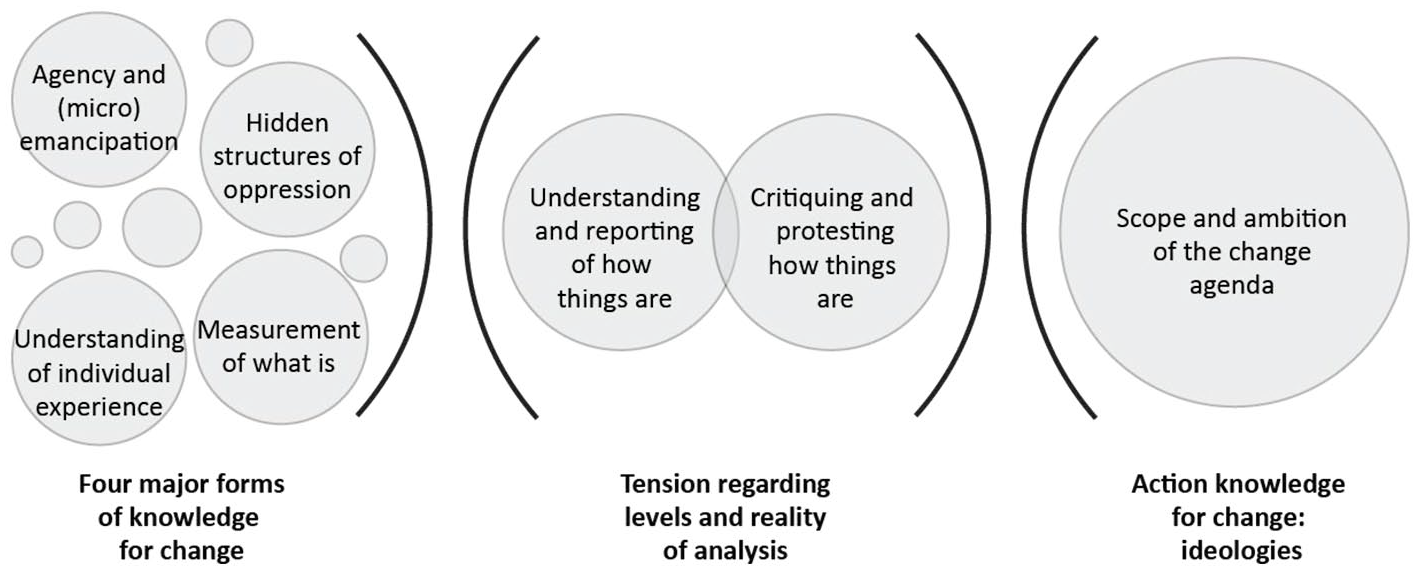
Tensions: Ideology.
Resolving this tension, we argue, centers mainly in considering the scope and ambition of a change agenda. Whether grounded in a ‘regulation’ tradition or one of the radical paradigms, work from an interplay perspective would embody a change agenda of some scope, be this change in individual behaviour, organizations or broader systems/societies. Together with consideration of scope, interplay requires an ambition for change in unequal systems – the research agenda pursues change at least to some degree. Thus, researchers from the ‘regulation’ paradigms bring change to inequality into their agendas, adopting a change ideology. Research from the radical traditions, and in particular radical structuralist, may set more immediate aims in terms of change: movement towards social justice still ‘counts’ so that producing and giving credence to findings that show such movement can bolster overall knowledge for change.
Completing the interplay, Figure 3 brings together relational ontology with ambition and scope oriented to change, to define a research agenda grounded in the will and conditions for changing inequality. Drawing on the previous stage of interplay, EDI researchers working from different paradigms can be guided by a research agenda embodying the will to change inequality (scope/ambition of the change agenda) and an interest in conditions for changing inequality (relational ontology). This ‘fifth knowledge’ or interplay can guide future research regardless of the paradigm or tradition in which it originates.
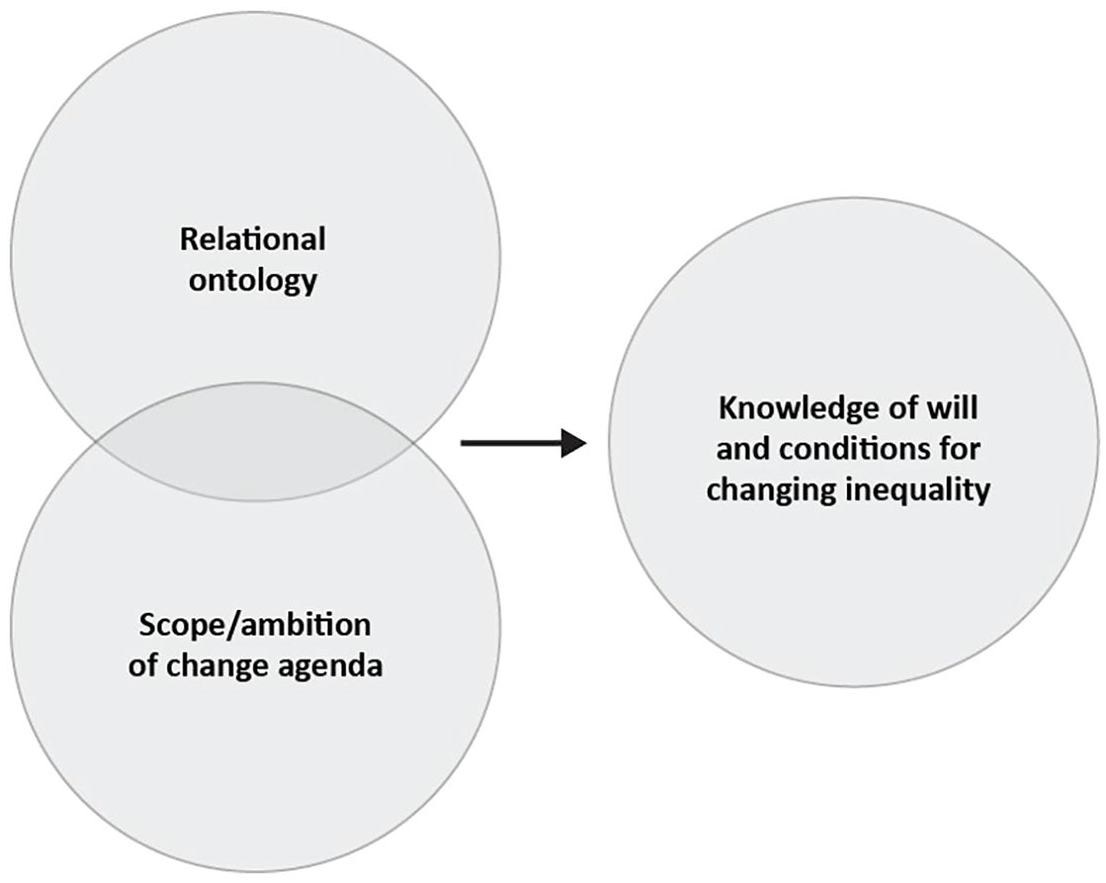
Change knowledge through interplay.
Regarding will, we would expect researchers to ask, how can my research embody a change agenda of some scope? How might I draw on this interplay and the knowledge of other paradigms to actualize my interest in changing inequality through my research?
Regarding conditions, the researcher might ask, what are the conditions relevant to inequality that I might not naturally see, but that I can recognize in my work when I look at the other paradigms? Given what we know about the requirements of meaningful change from work across paradigms, theory and research that utilizes this ‘fifth knowledge’ will strive for a systemic framing – knowing conditions that foster change – that captures, at least to an extent, the importance of unequal structures and power relations – systems of inequality – which must be understood to inform change. A systemic lens is equally suggested in the ‘measurements of patterned inequality’ offered by functionalist research, the quantitative outcomes over time that demonstrate an embedded problem beyond any individual experience. At the same time, a ‘fifth knowledge’ embraces the phenomenological and agentic side of change. Without understanding how inequity and inequality are experienced, objectivist frameworks may elide the experiences of individuals whose lives are deeply affected and whose actions can contribute to change. Coupled with the systemic lens, however, such actions take on a deeper meaning linked also to structures of exclusion and inequality in a given context.
As scholars adopt an interplay with their work, committing to engaging with the tensions that exist, they adopt this ‘fifth knowledge’ around the will and conditions for change. We provide several examples. For functionalist EDI researchers, this knowledge or research agenda might be used in a decision to compare cases, retaining a focus on ‘measuring’ inequality through representation or causal mechanisms of performance, but with a view to situated contexts and comparisons there-of, as well as measures that do not essentialize individuals on one identity marker. For interpretivists, adopting the fifth knowledge (the will, the tensions in ideology as well as attention to conditions) would help to consider a broader context in which (inter)subjective experiences of discrimination or difference or perhaps empowerment take place, locating them in systems and considering the possibility of potential to change those systems; they are not static. For radical humanist researchers, using interplay could mean embedding minority actors’ agency and learning into structures of domination, and pulling from the hard facts of functionalist work to argue for and demonstrate the presence of inequality and why there is need for change. For radical structuralists, the knowledge of interplay could help find ways to tackle systemic change toward greater equality through agency and learning, and to bring ‘life’ into the systems of domination through lived experiences. We summarize these in Table 2 below, together with key limitations of their own paradigms that scholars would need to take on board to enact interplay.
Action knowledge, limitations and contributions to knowledge for interplay.

Discussion and conclusions
This paper has identified action knowledge centered in EDI scholarship in different paradigms, and using interplay, has asked whether and how that knowledge might be brought together to better inform a change agenda. Two problems led us to this inquiry: the literature has been characterized by significant fragmentation, which itself may limit its impact, and calls for greater attention to research in the service of combatting inequality have increasingly been made by EDI scholars themselves.
Through an analytical process of paradigm interplay, we arrive at a ‘fifth knowledge’ for change or action through EDI research, drawing from and supplementing the ‘action knowledges’ that we identify from work in each paradigm or tradition. These knowledges subsume important tensions that we pull out in the mid-stage of the interplay analysis. In short, the interplay ultimately embodies will, combining and transcending ideological tensions arising from differences about the role and purpose of research in EDI, and attention to conditions, embracing ontological tensions pointing to the nature of reality as fundamentally objectivist and structural, or as subjectivist or constructed resting in human action and experience. It implies that those working from objectivist ontologies, functionalist and radical structuralist paradigms, come to accept that change involves understanding diverse actors’ interpretations, constructions and also their agency (subjective conditions), and that subjectivists accept structural and systemic conditions. A relational ontology allows this.
Focusing first on ontology, how might scholars from different traditions embrace these ontological tensions? Working with a relational ontology, functionalist research can recognize the limitations of essentializing or reifying identities, including through better consideration of intersectionality. That is, when discussing categories drawing on identity groups, ‘measurement’ can strive to recognize how categories such as race, gender and others intersect in important ways, and take care to show the implications for outcomes. For example, if using representational data to discuss the proportion of women in leadership roles, ensure that a further analysis is conducted to examine the proportion of women of colour. Meanwhile more subjectivist and constructionist orientations can recognize that statistical and representational research has value at an aggregate level, notwithstanding its limitations, as an indication of the prevalence of inequities, of systemic inequality. For more objectivist scholars, we suggest that research using a change interplay draws on a consideration of identities as shaped by context and history, that is as gendered and racialized, rather than as static and uniform ‘entities’. From work from the radical humanist orientation, we understand that identities are shaped by social practice in context, over time, and from the radical structuralist, that such timeframes are often the product of deep histories. For example, the language of racialization and gendering as processes, and similar formulations for additional groups who have been subject to inequity and may be the focus of our research, can be adopted in work using the ‘fifth knowledge’ or interplay. This does not preclude the importance of structural realities that reproduce these constructions, rendering them deeply entrenched and truly a product of systems of inequality. Nonetheless, agency and collective action can shift such systems, creating the potential for greater equality and inclusion. In other words, research to inform knowledge for change can in this way grapple with the dynamic tension between identities as socially constructed and as structurally manifest.
Some EDI scholarship has begun to suggest routes for work in this vein. For example, arguing for greater understanding of the complexity of diversity in organizations, Janssens and Steyaert (2019) question prevailing ‘dualism’ in EDI studies between individualism and societism. The authors use case study research to examine how situated practice accomplishes (in)equality, in which diversity-related phenomena are themselves ‘social order producing practices’, akin to structural changes but drawing on relational ontology to argue that such structures develop through practice. Thus, in our terms, the authors combine attention to the objectivist paradigms and material presence of inequality, with a subjectivist or actor-based approach situated in particular contexts. More work from such practice-oriented perspectives might better inform change through (a) recognizing specific, located processes in organizations that foster or hinder inequality – the situatedness of inequality, and (b) thus pointing to actions that might reverse such processes. The authors argue that recognizing the interconnection of agency and structure, subject and object, individual and society, in their case through a practice ontology, will lead to better theory and thus, greater applicability in how inequality may be tackled.
Further, practice-oriented research constitutes only one relational ontology among others than might be adopted within EDI (and indeed there are different varieties within practice theory, e.g. see Nicolini, 2017). For example, EDI scholars more grounded in radical structuralism might adopt social realist approaches (Archer, 1995), as an important step towards ontological relationalism. Here, the starting point is objectivist in that material inequality exists and requires acute attention, with the assumption that change will not be possible without such attention. Applied to inequality, its structural, historical embeddedness would suggest that more localized, situational approaches may be insufficient to understand change. Yet the researcher works to ‘know agency’ there-in; agency is not the primary focus for analysis but only understood in direct relationship with pre-existing structures which over time, may indeed be eroded through agentic action. A final example points to poststructuralist research emerging within EDI studies, perhaps most closely related to the radical humanist work we profile above. As a further example of what may be labelled relational ontology broadly defined, here structures do not ‘exist’ outside of the discursive regimes in which they are constructed, and discourse itself is a critical focus for the scholar’s analysis. However, this may be seen as relational in the sense that it subsumes subject-object tensions through understanding actors’ discourses within broader orders of discourse (Foucault, 1977). In this case, change might be supported through research focused on first, the recognition, and second, the possible deconstruction of discourses of oppression or inequality. In sum, embracing of ontological tensions is becoming evident in EDI scholarship, and we would call on scholars from different traditions to work in this frame, perhaps drawing on the ideas above.
Moving to engagement with ideological tensions, also central in our interplay analysis, this may pose a more difficult problem for EDI scholars. Researchers’ belief systems and ambitions may not specifically address change, and indeed having a strongly objectivist view of the purpose of research may militate against this aim. How then might scholars take on the challenge of embracing tensions in ideology, through what we are calling attention to scope and ambition for change through research? The tension between reporting on what is, and resisting, denouncing or critiquing what is, may often require researchers to reach beyond the socialization they have received in their own paradigms. Paradigmatic lenses often reinforce worldviews and notions of ‘truth’ and knowledge that can prevent seeing value in other approaches (Morgan, 1980). However, an awareness of the interplay of action knowledge across paradigms may better inform change. For example, the vocabulary of action – measuring inequality, understanding experiences of diversity, knowing agency, and showing unequal structures may provide a framework to conduct meta-analyses of the extensive body of research on diversity and inequality in organizations.
Overall, the issue of ‘will’ within our last stage of interplay calls on scholars to embrace change itself as a bridging ideology within EDI studies. In EDI scholarship, ideological tensions have contributed to fragmentation to a perhaps a greater extent than many other areas of study. Interplay does not resolve such tensions or elide them. Indeed, a strength of using paradigm analysis arising from Burrell and Morgan’s seminal work is its power to recognize and engage ideological, as well as ontological, differences.
We have suggested that there is value in each of the paradigms in terms of action for change. Pursuing the initial stages of interplay, we provide a vocabulary that recognizes and expresses that it is important to ‘measure’ inequality, an action knowledge provided in functionalist scholarship, but also to understand experiences of discrimination and difference, recognizing fluidity and intersectionality of identities. In turn, research can ‘see’ context beyond the individual’s own perceptions and the interactional setting, the situational status quo knowledge offered in interpretivist research. That is, power relations among groups, and understanding how these influence which identity becomes salient, when, and with what impact, are central to a deepened understanding. Radical humanist research demonstrates the importance of understanding the types of agency, individual and collective, that can produce change. Yet as it recognizes, power relations and institutional structures may produce profound constraints on agency for some groups in some settings, potentially translating ‘agency’ into struggle and resistance. Radical structuralist EDI scholarship reveals that inequalities are sustained by historically embedded structures, which themselves require deconstruction and dismantling for change to materialize. Such ‘action knowledges’ provide a vocabulary for change. Taking our analysis through stages of interplay, we suggest here that ‘change’ itself can become a new ideology for EDI studies. By adopting the framework above, scholars may reach greater clarity and impact.
With respect to practice, scholars have argued that findings from EDI research are sometimes difficult for practitioners to use and apply (e.g. Harrison and Klein, 2007; Roberson et al., 2017). We would argue that the interplay frame has the potential to guide practice. Measuring inequality offers a useful foundation providing evidence of what forms of inequality exist among identity groups, while knowledge for revealing structures can encourage organizations to pay attention to how their own institutional and structural realities have sustained or created these disparities. ‘Understanding experiences of inequality’ helps practitioners to learn via lived experience how perceptions of the very categories of race, gender and difference are socially constructed (even if the impact of these social constructions is, according to the work of the functionalists and radical structuralists, ‘real’ and ‘measurable’). Individual stories or narratives are often critical for motivating and mobilizing change. For example, individual cases of harassment and discrimination can have significant impact on developing strategies to address them. ‘Knowing agency’ can provide powerful examples of initiative for driving change. Individual and collective actions in specific organizations can create change at the local level and serve as examples for others. Knowledge showing structures further serves as a reminder that unequal structures have evolved over time, and may provide methods for dismantling barriers; in turn, functionalist work can help to understand whether the methods have been effective. For example, new policy establishing quotas or targets for diversity or preferential procurement strategies for underrepresented groups are examples of interventions informed by an analysis of the systems through which structures exclude some and privilege others. Ultimately, an ability to ‘speak’ across traditions may augment both will and attention to conditions to increase the performative impact of EDI studies – greater equality on the basis of race, gender, and other critical sources of inequality in organizations and in society.
Footnotes
Acknowledgements
We acknowledge the valuable guidance of our Associate Editor Helena Liu as well as the three anonymous reviewers. Special thanks to one of our reviewers for suggestions relating to the figures in this article.
Funding
The author(s) disclosed receipt of the following financial support for the research, authorship, and/or publication of this article: This work was supported by the Social Sciences and Humanities Research Council of Canada, Insight Grant 435-2016-1038 (2016–2020)
