







Abstract
Employees who experience psychological contract violation may quit the organization and join a new organization. However, how past psychological contract violation influences employees’ behavior in the new organization is less understood. Drawing on the social-cognitive model of transference, we hypothesize that past psychological contract violation is associated with lower psychological ownership and higher job insecurity in the new organization. These adverse transference effects can be buffered by institutionalized socialization tactics in the new organization. Furthermore, past psychological contract violation influences employees’ present deviant behaviors through psychological ownership and job insecurity in the new organization. These indirect effects are weaker when the new organization uses more (vs. less) institutionalized socialization tactics. The results across two field studies provide consistent and robust support for our hypothesized model. We discuss how our findings shed light on the transference effects of psychological contract violation and how to attenuate these harmful effects.
Keywords
Introduction
Psychological contracts consist of employees’ schemas or mental models about the reciprocal obligations between them and their employers (Rousseau, 1995, 2001). Employees perceive psychological contracts as being mutually agreed on and promised (Rousseau, 2001). Violation of psychological contracts leads to a range of detrimental outcomes (Zhao et al., 2007). One critical negative consequence is workplace deviance (Bordia et al., 2008; Restubog et al., 2007), that is, behavior that violates significant organizational norms and threatens the well-being of the organization and its members (Robinson and Bennett, 1995). Deviance is destructive to organizations; just a few deviant employees in the work unit can hamper unit performance and diminish morale (Dunlop and Lee, 2004). The literature has examined how victims of violation engage in deviant behaviors that target the organization (i.e., organizational deviance) as direct revenge and spill over to other organizational members, such as coworkers (i.e., interpersonal deviance) (Bordia et al., 2008; Chiu and Peng, 2008; Deng et al., 2018).
Despite the significant progress made, the literature has examined the negative effects of psychological contract violation/breach primarily by looking within organizational boundaries based on social exchange theory (e.g., Bordia et al., 2008; Chiu and Peng, 2008; Conway et al., 2014). Employees who experience violation will negatively reciprocate or revenge the organization and its members with deviance. However, many victims of violation choose to change their jobs (Clinton and Guest, 2014), yet we do not have theories and empirical support regarding whether the effects of psychological contract violation transfer across organizational boundaries. Exploring whether and how victims of violation continue their deviant behaviors at the new workplace after changing jobs is critical in addressing this void and provides an opportunity to bring in new theoretical perspectives that lead to important theoretical extensions in a cross-organizational context. This knowledge is critical for organizations that hire experienced newcomers—a common practice to leverage their experience and skillsets developed in the previous organization (Carr et al., 2006)—regarding how to reduce the impact of newcomers’ possible past negative work experiences to avoid their present deviant behaviors.
To examine this issue, we bring in the social-cognitive model of transference (Andersen and Chen, 2002; Ritter and Lord, 2007) to develop a model that explains the cross-organizational effects of psychological contract violation. When employees quit their jobs and enter a new organization as veteran newcomers (i.e., newcomers with past work experience; Carr et al., 2006), their expectation of new employment experiences is affected by pre-employment schemas that build on previous employment experiences (Rousseau, 2001). This process can be explained by the transference effect (Andersen and Chen, 2002), which argues that people use schemas developed in their interaction with a significant other to guide their expectation of and interaction with a newly encountered other. Notably, the transference effects can occur automatically, “even when the new other does not concretely resemble the significant other” (Andersen et al., 1995: 53). We follow this theorizing to propose that victims of violations who develop a violation schema of their previous employer will transfer this schema to their new employer during organizational entry, and they would expect violation treatments by the new employer.
We examine how the violation expectation that arises from transference affects veteran newcomers’ psychological processes in the new organization through which past violation affects present deviance, as well as the contingent factors that can attenuate them. Research on transference (Andersen and Chen, 2002; Ritter and Lord, 2007) suggests that expectations of adverse treatments owing to transference lead to coping and self-protection. People would take a self-protective, cautious approach to monitor the exchanges with the new other to protect themselves from being exploited (Ritter et al., 2005; Ritter and Lord, 2007). As psychological contracts shape employees’ perceptions of the reciprocal obligations between them and their employers (Robinson et al., 1994; Rousseau, 1995), veteran newcomers with a violation expectation of the new organization would have lower obligations toward the new organization and expect the new employer to have lower obligations toward them for balancing exchanges and self-protection. Specifically, we examine the newcomer and employer obligations as captured by psychological ownership (i.e., feelings of possession or ownership for the organization “accompanied by a felt responsibility and a sense of burden-sharing for the organization”; Pierce et al., 2001: 303) and job insecurity (i.e., perceived potential threat to one’s continuity in the job; Sverke et al., 2002). Furthermore, the strength of transference depends on the (dis)similarity between the previous and new relationships (Andersen and Chen, 2002; Ritter and Lord, 2007; Song et al., 2015). We examine how the new organization’s institutionalized socialization tactics provide veteran newcomers who suffer violation in the previous organization with information on the new organization regarding its dissimilarity from the old organization, thereby weakening the transference effects. Figure 1 depicts the theoretical model of this study.
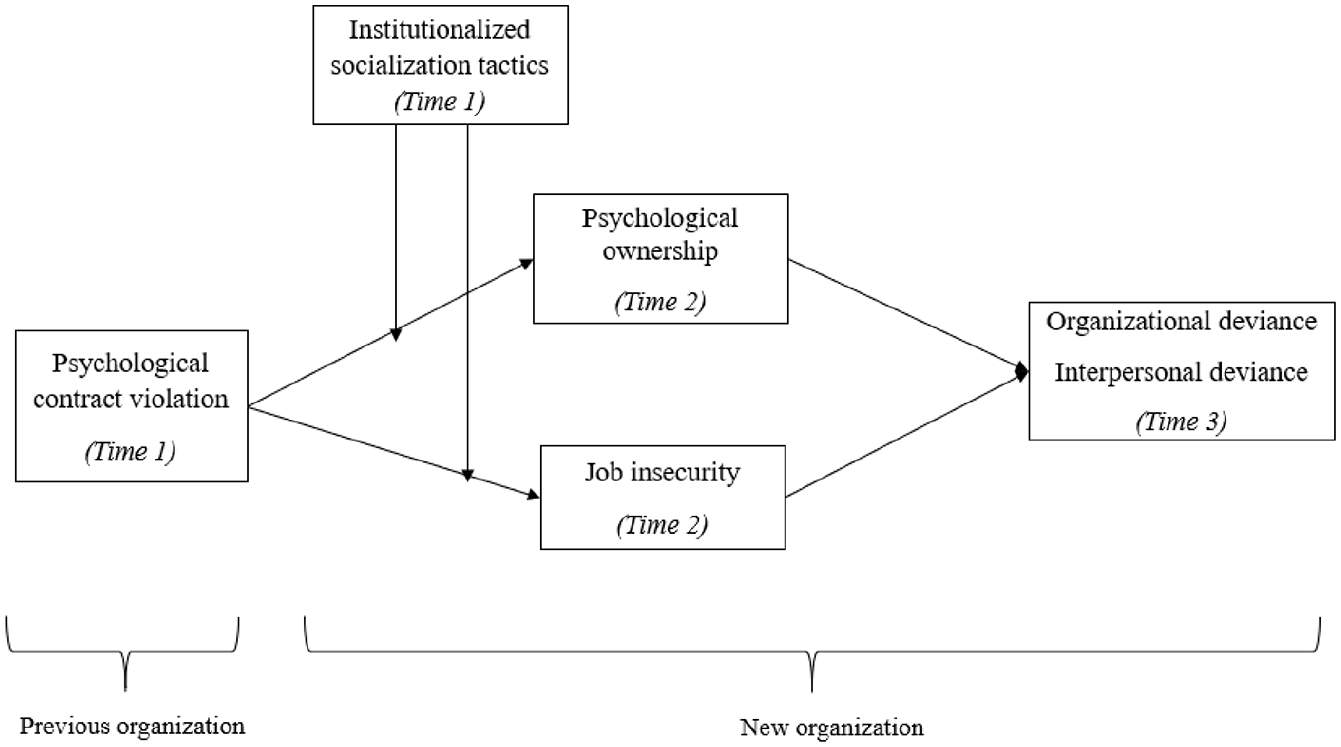
The hypothesized model.
This study makes three significant contributions. First, by introducing the social-cognitive model of transference to the psychological contract violation literature, we extend prior research on the violation–deviance relationship within organizational boundaries based on social exchange theory. We provide a novel theoretical lens based on transference to understand the consequences of negative work experiences across organizational boundaries. Second, we extend the transference literature by examining the downstream effects of treatment expectations owing to transference (Andersen and Chen, 2002; Ritter and Lord, 2007). Psychological ownership and job insecurity depict the pathways that explain how the transference of the violation expectation affects deviance. Third, we examine the role of institutionalized socialization tactics in new organizations in buffering the transference effect of past violations. Doing this adds to the transference research by investigating an organizational factor that provides the dissimilarity signal and serves as a crucial contingency for the deactivation of transference (Ritter and Lord, 2007; Song et al., 2015).
Theoretical background and hypotheses development
Transference of psychological contract violation
The social-cognitive model of transference (Andersen and Chen, 2002) examines how people use schemas or mental representations developed in a previous relationship with a significant other (i.e., significant-other representations) to guide how they feel, think, and act toward a newly encountered other. Earlier research argued that transference is activated when the new other is similar to the significant other (e.g., Andersen et al., 1995). However, research has evolved to find that significant-other representations are activated even when such similarity is minimal or absent, even though similarity can heighten the activation (Andersen et al., 1995; Chen et al., 1999). Researchers propose and find empirical support for the chronic and transient sources of accessibility of significant-other representation activation (Andersen and Chen, 2002). Significant-other representations are chronically accessible, meaning that they “have a special readiness to be activated regardless of contextual cues” (Andersen and Chen, 2002: 620, see also Andersen et al., 1995). In addition, the presence of transient cues, especially the similarity between the new and old significant others (termed as applicability, Higgins, 1996), can heighten chronic readiness for activation, thus strengthening transference (Andersen et al., 1995; Andersen and Chen, 2002). As empirical support in the work context, Ritter and colleagues (Ritter et al., 2005; Ritter and Lord, 2007) found that leaders’ harmful treatments such as abuse resulted in an abuse schema. The transference of the abuse aspect of significant-other representations was preservative and affected employees’ expectations on all new leaders; the similarity between the old and new leaders heightened transference.
Transference research traditionally focuses on examining interpersonal relationships. However, the transference effect can also apply to employee–employer relationships, with employees viewing employers as “significant others” because they spend considerable time and are emotionally invested at work (Adkins and Premeaux, 2012). Psychological contracts capture employees’ perception of employee–employer relationships and are developed through frequent interactions. During job transition and organizational entry, veteran newcomers have relatively incomplete information about the new organization. They tend to draw on past psychological contracts to interpret the new employee–employer relationship (Buch et al., 2014; Carr et al., 2006; Rousseau, 2001; Tomprou and Nikolaou, 2011), suggesting that psychological contracts can be transferred across organizational boundaries (Rousseau, 2001). Employees who suffer psychological contract violation are likely to develop a violation schema (Buch et al., 2014; Davis et al., 2015; Tomprou and Nikolaou, 2011). We follow the chronic accessibility and applicability arguments to theorize that victims of violation, during job transition, tend to transfer the violation schema and expect violation treatments of the new employer, and that such transference can be attenuated by dissimilarity between the old and new organizations.
Past psychological contract violation and present psychological ownership/job insecurity
Psychological contracts capture employees’ overall perception of the reciprocal obligations between them and their employers (Rousseau, 1995, 2001). Such schemas of employee–employer relationships guide employees’ exchange with the employer in terms of the investment of efforts and loyalty in exchange for security and other material and socioemotional benefits offered by the employer (De Cuyper and De Witte, 2006). When experiencing psychological contract violation, employees form an overall evaluation and strong negative feeling that the employer has failed to carry through its responsibilities (Robinson, 1996; Robinson and Morrison, 2000).
The social-cognitive model of transference suggests that the violation schema can be transferred to the new employer during job transition, such that employees will expect violation treatments from the new employer. The transference research further proposes that expected negative treatments that arise in transference evoke coping strategies to “protect oneself from unfair and exploitative exchanges” (Ritter and Lord, 2007: 1687, see also Andersen and Chen, 2002). To cope with the anticipated exploitative exchanges, employees would minimize their obligations to the new organization to avoid being exploited and have low expectations of the new organization’s obligations toward them. In other words, they will reduce their obligations specified in their psychological contacts (i.e., lower their contributions to and investments in the organization) and expect reduced employer’s obligations toward them (e.g., expected security and other inducements from the organization) (Robinson, 1996). We theorize that psychological ownership and job insecurity respectively capture the reduced obligatory mechanisms of the exchanges resulting from transference of the violation expectation.
Psychological ownership is a crucial variable that captures employees’ obligation in terms of the sense of responsibility to invest oneself, including energy, effort, and attention in the organization (Avey et al., 2009; Pierce et al., 2001). It is based on feelings of mine-ness or being responsible for the organization (Pierce et al., 2001; Zhang et al., 2021), thus heightening employees’ responsibility in making personal contributions to and investing their efforts and energies in the organization (Pierce et al., 2001; Wang et al., 2019). Employees with psychological ownership believe that they should protect, care, and commit to the organization (Pierce et al., 2001).
Veteran newcomers who are victims of violation will transfer their violation schemas across organizational boundaries during job transition and have the violation expectation of the new organization because of the transference effect. Such employees tend to have negative expectations of the new employment relationship and believe that the new employer is not likely to keep its part of the bargain (Buch et al., 2014; Pugh et al., 2003). To cope with such a threatening situation and protect themselves from being exploited, they are likely to balance the exchange by reducing their obligations (Buch et al., 2014; Davis et al., 2015; Pugh et al., 2003). They tend to reduce their investment of themselves in the new organization, leading to low psychological ownership of the new organization:
Hypothesis 1: Psychological contract violation of the previous organization is negatively related to psychological ownership of the new organization.
Job security captures employees’ perception of the extent to which they will be retained if qualified (Keim et al., 2014), and it is derived from employees’ need or expectation of job continuity from their employer (De Witte, 1999). On the other hand, insecurity of job pertains to “an overall concern” of continuity of job (Sverke et al., 2002: 243; see also Cheng and Chan, 2008; De Witte, 1999). Job security is an integral part of the employee–employer exchange and a significant inducement such that employees feel obligated to take from their employer (Keim et al., 2014). It is noteworthy that employment relationships have substantially changed in recent decades. Employees increasingly seek to enhance their employability for high mobility in the workforce (Direnzo and Greenhaus, 2011; Sullivan and Arthur, 2006), which may replace their commitment and need for long-term employment (Silla et al., 2009). Nevertheless, “job insecurity remains a crucial piece of any psychological contract” (Keim et al., 2014: 270). Job insecurity is stressful and harms employees’ well-being (Hellgren and Sverke, 2003; Huang et al., 2013; Roskies and Louis-Guerin, 1990; Sverke et al., 2002). Employability may only reduce, but not eliminate, the concern of job insecurity (Silla et al., 2009).
Violation captures employees’ overall and global negative feeling that the employers break their promise and fail to follow through with their obligations (Robinson, 1996; Robinson and Morrison, 2000). When the victims of violation quit the previous job and join the new organization, they continue to use the violation schema developed during the previous employment and view the new employment relationship as a threat to self. To cope with such a threatening situation, employees are likely to decrease their expectations of inducements offered by the new employers (Davis et al., 2015). They would view the new employment relationship as transactional and short-term (Buch et al., 2014; Pugh et al., 2003; Tomprou and Nikolaou, 2011). For example, they would feel they have an economic relationship with the new organization, which does not imply long-term obligations (Buch et al., 2014). This argument suggests their low expectation of security and job continuity provided by the new organization:
Hypothesis 2: Psychological contract violation of the previous organization is positively related to job insecurity in the new organization.
The moderating roles of institutionalized socialization tactics
The previous reasoning suggests that employees with violation experiences in the previous organization tend to transfer their negative attitudes and behaviors to the new organization because of the transference effects. Therefore, examining the factors that can help the new organization break the transference effects is vital. The social-cognitive model of transference (Andersen and Chen, 2002; Ritter and Lord, 2007) suggests that people are more likely to transfer the schemas of their relationship with a former significant other to a relationship with a new significant other when these two significant others are similar.
We propose that institutionalized socialization tactics are critical in helping the new organization reduce the adverse transference effects of violation by providing information on the uniqueness and distinctiveness of the new organization from the former organization. Institutionalized socialization tactics refer to the methods organizations use to help newcomers understand and adapt to their new environment and acquire knowledge, attitudes, and behaviors required in the new organization (Allen et al., 2017; Cable and Parsons, 2001; Jones, 1986). Such tactics suggest that the new organization is caring and supportive and is different from the previous organization that violated psychological contracts. Van Maanen and Schein (1979) propose six dimensions of socialization tactics (i.e., collective vs. individual, formal vs. informal, sequential vs. random, fixed vs. variable, serial vs. disjunctive, and investiture vs. divestiture), and Jones (1986) groups these six tactics into three factors (i.e., context, content, and social aspects) on a single continuum of institutionalized organizational tactics (Kim et al., 2005).
Highly institutionalized socialization tactics use collective and formal (context), sequential and fixed (content), and serial and investiture (social aspects) approaches, which are systematic in providing newcomers with explicit and precise information about the new organization. Such practices provide newcomers with the necessary information to learn about the new environment (Ashforth et al., 2007; Ostroff and Kozlowski, 1992), which helps them develop the new schema of the new employment relationship instead of relying on the old schema (De Vos and Freese, 2011; Woodrow and Guest, 2017). Moreover, the new organization with highly institutionalized socialization tactics accommodates the employees in reducing uncertainty and stress and providing support and guidance (Ashforth and Saks, 1996). These practices make the new organization dissimilar to the previous organization that has violated its employees’ psychological contracts. Therefore, we expect that highly institutionalized socialization tactics will weaken the transference of the violation schema to the new organization, thus attenuating the transference effects of psychological contract violation of the previous organization on the perception of the reciprocal obligations in the new employment relationship. As indirect support, Buch et al. (2014) found that with high support in the new organization, the relationship between violation in the previous organization and perceived economic exchange relationship in the new organization is weakened.
Because newcomers in the new organization with highly institutionalized socialization tactics will develop new schemas about the organization and are not likely to believe that all employers treat employees in bad faith, they will not judge the extent to which the new organization deserves their investment of time, effort, and care based on the old violation schema. Therefore, we expect that psychological ownership of the new organization is less affected by psychological contract violation in the previous organization. Likewise, employees will not evaluate how much the new employer will break its promise and fail to fulfill its obligations based on their past violation experiences. The extent to which they feel their current job is secure is less influenced by the previous employer’s psychological contract violation.
By contrast, organizations using low institutionalized socialization tactics employ individual and informal (context), random and variable (content), and disjunctive and divestiture (social aspects) approaches. These tactics provide inconsistent and ambiguous information to newcomers and increase situational uncertainty, leaving newcomers to “sink or swim” and creating an unfriendly and unsupportive environment (Cable and Parsons, 2001). The new organization does not provide newcomers with the necessary information to develop new schemas about it and suggests that the old and new organizations are similar in mistreating employees. Victims of violation will continue their violation schema in the new organization and view the obligatory responsibilities in the new employment relationship through the lens of the old violation schema. Accordingly, we expect strong relationships between psychological contract violation of the previous organization and psychological ownership and job insecurity in the new organization. In summary, we propose the following moderation hypotheses:
Hypothesis 3a: Institutionalized socialization tactics of the new organization moderate the negative relationship between psychological contract violation of the previous organization and psychological ownership of the new organization, such that the relationship is weaker when institutionalized socialization tactics are higher rather than lower.
Hypothesis 3b: Institutionalized socialization tactics of the new organization moderate the positive relationship between psychological contract violation of the previous organization and job insecurity at the new organization, such that the relationship is weaker when institutionalized socialization tactics are higher rather than lower.
Mediation and conditional indirect effects
Low psychological ownership and high job insecurity in the new organization resulting from transference, in turn, are likely to be related to high deviance toward the new organization and its members. For psychological ownership, employees who feel that the new organization is theirs are concerned with organizational outcomes, assume a caretaker role, and strive to protect its wealth and enhance its performance (Zhu et al., 2013). Deviant behaviors, both organizational and interpersonal, are destructive to organizational outcomes (Dunlop and Lee, 2004). The sense of responsibility and role of caretaker involved in psychological ownership make employees refrain from engaging in deviant behaviors in the new organization that harm the organization and its members, such as coming late to work and taking excessive breaks, taking property from work, and acting rudely toward colleagues (Avey et al., 2009; Kim and Beehr, 2017). However, low ownership takes away employees’ sense of burden-sharing, accountability, and responsibilities (Avey et al., 2009). Employees may not assume their responsibilities and engage in negative behaviors such as littering the work environment and making fun of colleagues (Kim and Beehr, 2017). Additionally, those with low ownership do not see their organizations as an extended part of self (Zhang et al., 2021). Such employees do not feel that deviant acts against the organization or its members would negatively affect them. Thus, they are less likely to exercise self-control to avoid such behaviors.
Job insecurity is also subsequently related to deviance toward the new organization and its members. Employees with job insecurity concerns perceive their new employment experiences as dissatisfying and stressful (Ashford et al., 1989), and they will engage in deviant behaviors to retaliate “against dissatisfying conditions and unjust workplaces” (Dalal, 2005: 1243). Supporting this argument, Huang et al. (2017) theorized and found that job insecurity makes employees attribute this dissatisfying and stressful working experience to others in the workplace, including their employers (e.g., unfair policies) and colleagues (e.g., political behaviors). Insecure employees then are “likely to view deviance as a justifiable means of ‘getting back at’ the organization and those in it for contributing to their job insecurity” (p. 28). Job insecurity may also strain work relationships as it creates a feeling of suspicion, rivalry, and frustration (De Cuyper et al., 2009; Van den Broeck et al., 2014). Employees with high job insecurity thus are likely to be mean to their colleagues. Taken together, we expect that job insecurity is related to both organizational and interpersonal deviance (De Cuyper et al., 2009; Huang et al., 2017; Van den Broeck et al., 2014). Given that we expect the previous organization’s psychological contract violation to affect psychological ownership and job insecurity in the new organization, which in turn influence organizational and interpersonal deviance, we propose the following mediation effects:
Hypothesis 4a: Psychological ownership of the new organization mediates the positive relationships between the previous organization’s psychological contract violation and organizational and interpersonal deviance in the new organization.
Hypothesis 4b: Job insecurity in the new organization mediates the positive relationships between the previous organization’s psychological contract violation and organizational and interpersonal deviance in the new organization.
Connecting the moderating and mediating effects, we proposed the following conditional indirect effects:
Hypothesis 5a: Institutionalized socialization tactics of the new organization moderate the positive mediated relationships between psychological contract violation of the previous organization and organizational and interpersonal deviance in the new organization through psychological ownership of the new organization, such that these relationships are weaker when institutionalized socialization tactics are higher rather than lower.
Hypothesis 5b: Institutionalized socialization tactics of the new organization moderate the positive mediated relationships between psychological contract violation of the previous organization and organizational and interpersonal deviance in the new organization through job insecurity in the new organization, such that these relationships are weaker when institutionalized socialization tactics are higher rather than lower.
We conducted two field studies to test our hypotheses. In Study 1, conducted in Ghana, we tested the main and mediation effects in a sample of layoff victims who subsequently secured reemployment. Ghana’s government announced a cleanup of its financial services sector in 2017, resulting in the merger and consolidation of seven weak universal banks and the revocation of licenses of several financial institutions, as well as a loss of 4000 jobs (Ghanaweb, 2020). We recruited 268 participants who suffered job loss as a result of this cleanup exercise and subsequently obtained reemployment. The timing of data collection was precious, and the cultural background was unique. Nevertheless, to capture this opportunity, we did not fully develop our theoretical framework by considering the boundary conditions of the mediation effects. In Study 2, in addition to constructively replicating the findings obtained in Study 1, we tested the moderation role of institutionalized socialization with a general sample of 221 newcomers with diverse backgrounds and reasons for turnover in China. 1 The second study supplemented the first one and made our empirical examination more complete.
Study 1
Method
Sample and procedures
We collected data in the context of Ghana government’s cleanup exercise of the financial service sector. Using the records from the banks that took over the failed banks and announced layoffs, we obtained a list of 866 layoff victims. We then contacted each of them and identified 411 people suitable for our study, that is, the layoff victims who entered new organizations within 13 months (Bauer et al., 2007). There is no consensus in the literature regarding the time frame for studying newcomers (Nifadkar et al., 2012). In Bauer et al.’s (2007) meta-analytical study on newcomers, they regarded employees who have spent less than 13 months in their new organizations as newcomers, as this period captures adjustment, including task and social transitions, following organizational entry. We followed Bauer et al. (2007) to use a 13-month time frame in Study 1 to ensure a sizable sample in this unique context and to capture this adjustment period in which transference plays a role. We invited their participation and informed them that their participation was voluntary and confidential, and their responses would be used only for research. They were also allowed to withdraw at any time from the studies. Among them, 398 gave consent to participate in the survey. The majority of the respondents were re-employed in diverse industries outside the finance industry (95.90%), including education, manufacturing, and telecommunication.
To reduce the common method bias concern (Podsakoff et al., 2012), we collected data in three waves with approximately a one-month time interval. At Time 1, respondents reported demographics and psychological contract violation at the previous organization. At Time 2, the 343 respondents who completed the Time 1 survey were asked to rate psychological ownership and job insecurity in the current organization. At Time 3, the 301 respondents who completed the Time 2 survey were asked to rate their deviant behaviors in the current organization; we received 284 responses. The final sample included 268 matched and complete responses (overall response rate: 67.34%). Respondents’ average age was 35.13 years (SD = 3.91), and the average tenure in the new organization was 6.23 months (SD = 1.93). Of this sample, 70.15% were males, and 78.36% had college-level education or higher.
Measures
We administrated the survey in English. Unless otherwise indicated, respondents rated the items on a seven-point scale (1 = strongly disagree, 7 = strongly agree).
Psychological contract violation
We measured psychological contract violation at the previous organization using a four-item measure developed by Robinson and Morrison (2000) (α = .95). A sample item is “I feel that my former organization violated the contract between us.”
Psychological ownership
We measured psychological ownership of the new organization with a seven-item measure developed by Van Dyne and Pierce (2004) (α = .80). A sample item is “I feel a very high degree of personal ownership for the current organization.”
Job insecurity
We used a four-item global measure (Mauno et al., 2001) to capture job insecurity in the new organization (α = .95). A sample item is “I am worried about the possibility of being fired from the current job.”
Organizational deviance
We used a 12-item scale (Bennett and Robinson, 2000) to measure organizational deviance in the new organization (α = .94; 1 = never, 7 = always). A sample item is “I come in late to work without permission in the current organization.”
Interpersonal deviance
We used a seven-item scale (Bennett and Robinson, 2000) to measure interpersonal deviance in the new organization (α = .85; 1 = never, 7 = always). A sample item is “I acted rudely toward someone at work in the current organization.”
Control variables
Following previous research (Berry et al., 2007; Lee and Allen, 2002), we controlled for age, gender, education, and organizational tenure because they are related to deviance.
Results
Confirmatory factor analyses
We conducted confirmatory factor analyses (CFAs) by using Mplus 8 (Muthén and Muthén, 2017). Following previous studies (e.g., Wang et al., 2021), we used an item-to-construct-balance method (Little et al., 2002) by creating three item parcels for each variable by sequentially averaging items with the highest and lowest loadings (Landis et al., 2000). This method adequately assesses the model with an appropriate parameter-to-sample size ratio (Landis et al., 2000). The hypothesized five-factor model (i.e., psychological contract violation, psychological ownership, job insecurity, organizational deviance, and interpersonal deviance) had a satisfactory fit (χ2(80) = 137.13, Root Mean Square Error of Approximation (RMSEA) = .05, Comparative Fit Index (CFI) = .98, Tucker Lewis Index (TLI) = .98, Standardized Root Mean Square Residual (SRMR) = .03). This model is better than (1) a four-factor model that combines psychological contract violation and job insecurity (χ2(84) = 678.28, RMSEA = .16, CFI = .84, TLI = .80, SRMR = .08); (2) a three-factor model that combines psychological contract violation, psychological ownership, and job insecurity (χ2(87) = 1042.13, RMSEA = .20, CFI = .71, TLI = .65, SRMR = .13); and (3) a single-factor model (χ2(90) = 1925.22, RMSEA = .28, CFI = .50, TLI = .42, SRMR = .14). These results support the distinctiveness of the studied variables. Table 1 presents the means, standard deviations, reliabilities, and correlations of the variables.
Study 1 descriptive statistics and correlations.
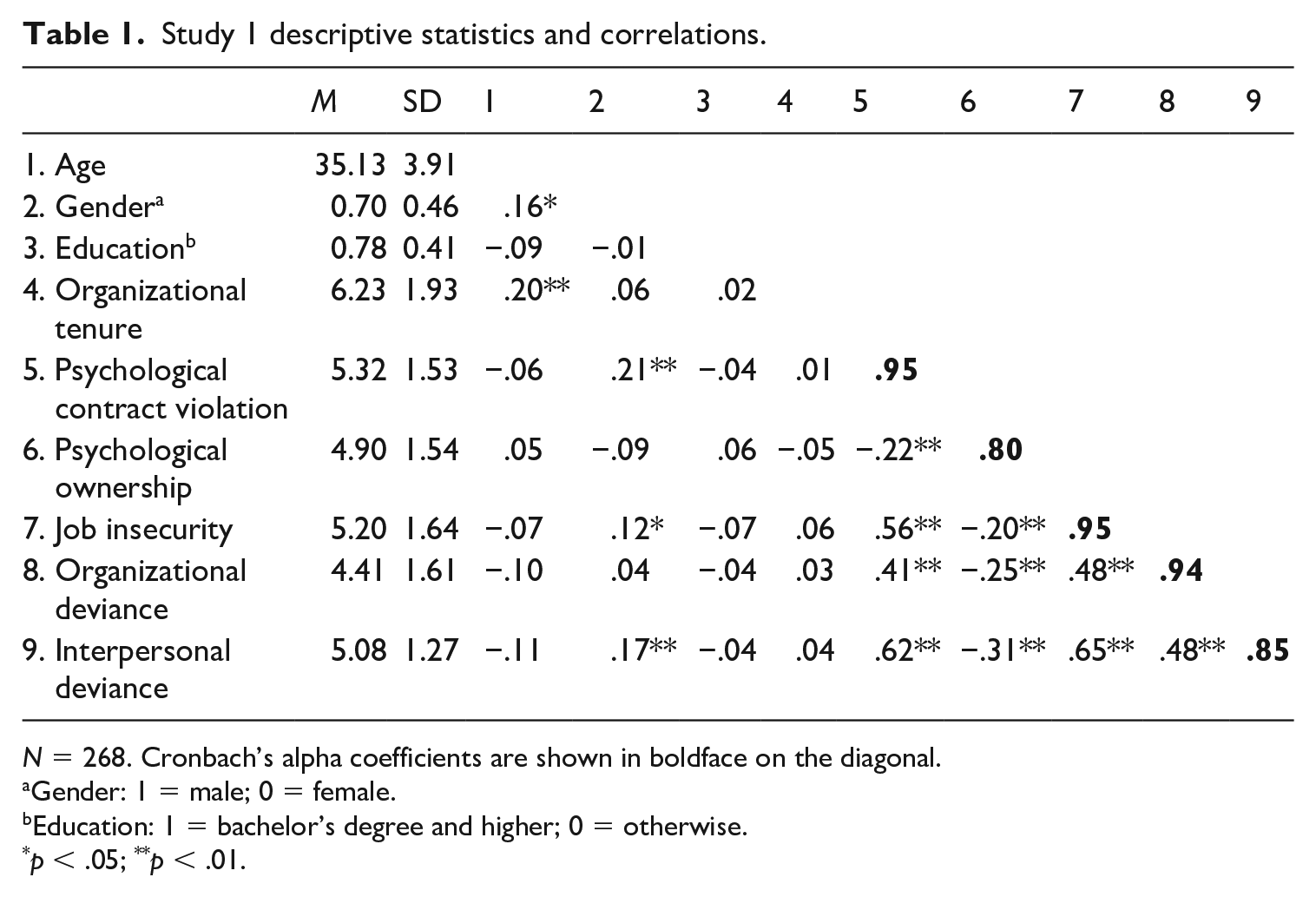
N = 268. Cronbach’s alpha coefficients are shown in boldface on the diagonal.
Gender: 1 = male; 0 = female.
Education: 1 = bachelor’s degree and higher; 0 = otherwise.
p < .05; **p < .01.
Hypotheses testing
We estimated a mediation path model with the composite scores of our studied variables by using Mplus 8 (Muthén and Muthén, 2017). In estimating the mediation path model, we specified both the direct and indirect effects of psychological contract violation on organizational and interpersonal deviance through the mediating effects of psychological ownership and job insecurity. The mediation path model was a saturated model with a perfect fit. As Table 2 shows, psychological contract violation was negatively related to psychological ownership (B = −.20, p < .01) and positively related to job insecurity (B = .59, p < .01), supporting Hypotheses 1 and 2, respectively. In addition, psychological ownership was negatively related to (1) organizational deviance (B = −.15, p < .01) and (2) interpersonal deviance (B = −.12, p < .01), while job insecurity was positively related to (1) organizational deviance (B = .34, p < .01) and (2) interpersonal deviance (B = .32, p < .01).
Mediation path model (Study 1).
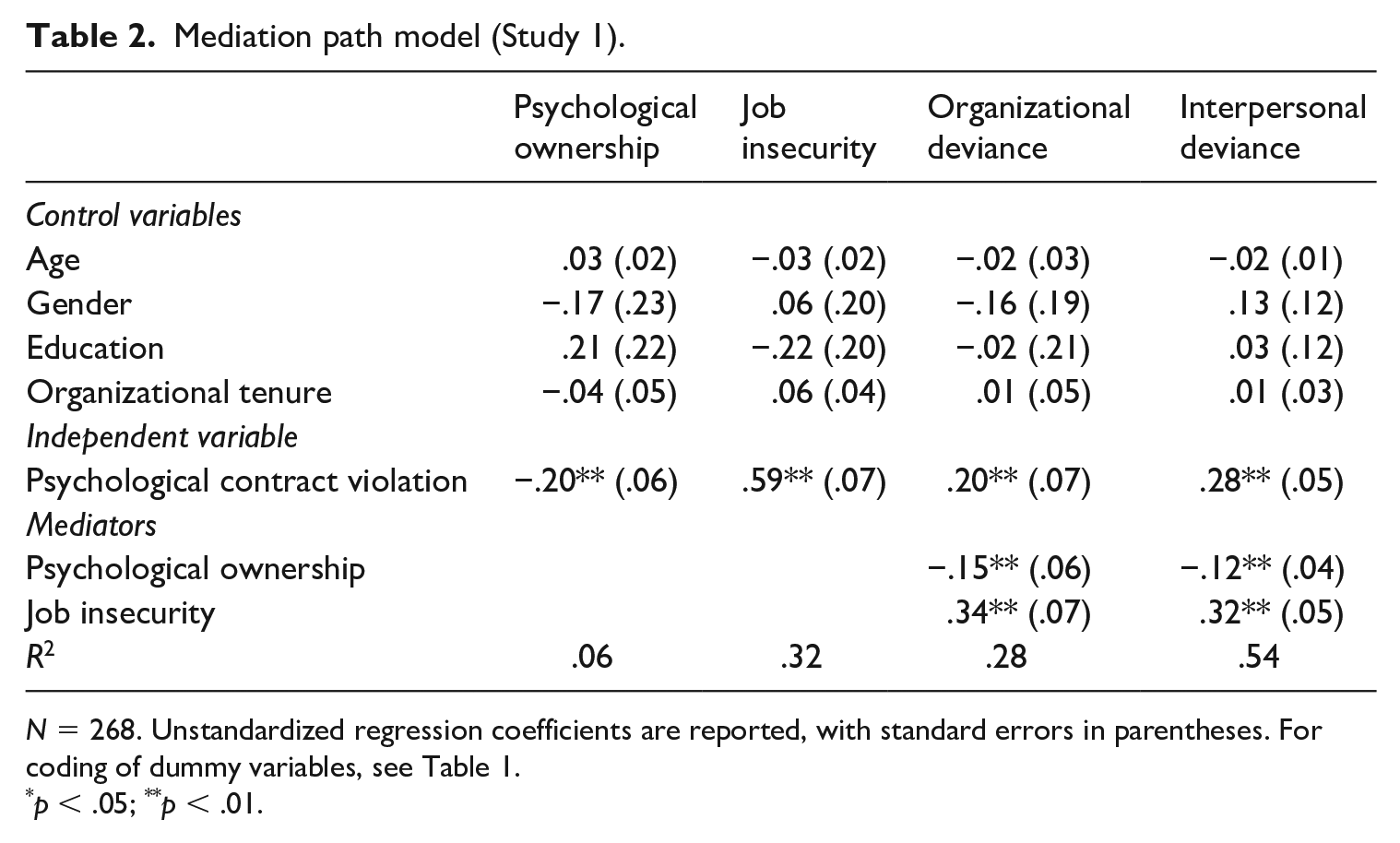
N = 268. Unstandardized regression coefficients are reported, with standard errors in parentheses. For coding of dummy variables, see Table 1.
p < .05; **p < .01.
We proceeded to test the significance of the hypothesized indirect effects by using bias-corrected confidence intervals (BC CI) with 10,000 bootstrap samples. As Table 3 shows, psychological ownership mediated the positive relationship between psychological contract violation and (1) organizational deviance (indirect effect = .03, 95% BC CI = [.01, .07]) and (2) interpersonal deviance (indirect effect = .02, 95% BC CI = [.01, .05]), in support of Hypothesis 4a. Likewise, job insecurity mediated the positive relationship between psychological contract violation and (1) organizational deviance (indirect effect = .20, 95% BC CI = [.12, .30]) and (2) interpersonal deviance (indirect effect = .19, 95% BC CI = [.13, .27]), in support of Hypothesis 4b. In supplementary analyses, we repeated these analyses without controlling for age, gender, education, and organizational tenure, and the statistical conclusions remained unchanged.
Mediation effects (Study 1).
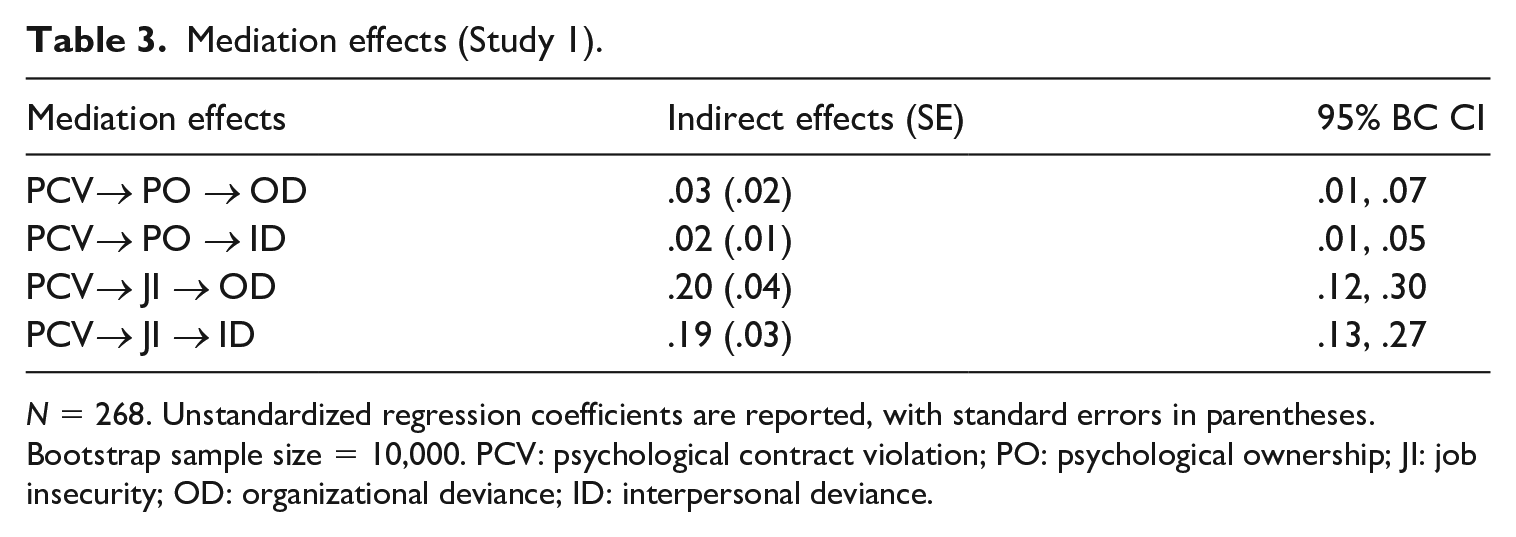
N = 268. Unstandardized regression coefficients are reported, with standard errors in parentheses. Bootstrap sample size = 10,000. PCV: psychological contract violation; PO: psychological ownership; JI: job insecurity; OD: organizational deviance; ID: interpersonal deviance.
Discussion
The results of Study 1 provide full support for our mediation model. Despite these encouraging findings, Study 1 used a restrictive sample; all respondents experienced involuntary turnover owing to the banking sector cleanup. This might limit the generalizability of the findings to newcomers who experienced voluntary turnover. Thus, we conducted a second study designed to overcome this potential limitation. First, we constructively replicated the findings of Study 1 based on a broader sample of respondents who were from a different country and had diverse backgrounds and reasons for turnover. Second, we examined the moderating effects of the new employer’s institutionalized socialization tactics in breaking the transference effects.
Study 2
Method
Sample and procedures
In Study 2, we examined a general sample of newcomers located in cities in Southern China across job types and job levels from diverse industries, including health care, e-commerce, transportation, and telecommunication. We conducted Study 2 in July and August of 2020. To be consistent with Study 1, we focused on employees who entered the new organizations within 13 months (Bauer et al., 2007). With the assistance of the participating organizations’ human resource management departments, we obtained lists of all newcomers who joined the organizations within 13 months and distributed the online questionnaire surveys. We created unique codes for each of the participants and built them in the online questionnaires for matching the responses of the three waves of questionnaires. The final data file did not include any personal identifiers. Participants were assured that their responses were confidential and anonymous and would be used only for research.
Using a multi-wave approach, we conducted the surveys at three time points with an approximately two-week time interval. The final sample included 221 matched cases (overall response rate: 77.82%). Respondents’ average age was 27.98 years (SD = 5.42), 51.60% were men, 78.70% had a college-level degree or higher, and the average tenure in the new organization was 6.81 months (SD = 3.15).
Measures
We measured psychological contract violation (α = .92), psychological ownership (α = .86), job insecurity (α = .87), organizational deviance (α = .96), and interpersonal deviance (α = .96) with the same scales as in Study 1. We used a 12-item scale (Cable and Parsons, 2001) to measure institutionalized socialization tactics of the new organization (α = .92; 1 = strongly disagree, 7 = strongly agree). A sample item is “I have received a great deal of guidance from experienced organizational members as to how I should perform my job in the current organization.” Regarding control variables, we included turnover reason and crisis disruptiveness in addition to age, gender, education, and organizational tenure included in Study 1. Turnover reason is a dichotomous variable that distinguishes voluntary from involuntary turnover (1= voluntary turnover; 0 = involuntary turnover). To control for the impact of the COVID-19 pandemic on respondents, we measured crisis disruptiveness with a five-item scale adapted from Morgeson (2005). A sample item for crisis disruptiveness is “To what extent has the COVID-19 pandemic disrupted your ability to get work done?” (α = .83; 1 = none, 7 = a great deal).
Results
Analytical strategy
In Study 2, we estimated two path models with the composite scores of the variables using Mplus 8 (Muthén and Muthén, 2017). We first estimated a mediation path model and then estimated an integrated moderated mediation path model by including the moderating effects of institutionalized socialization tactics of the new organization.
CFAs
Following the same approach as in Study 1, we conducted CFAs to assess the measurement model. The hypothesized six-factor model (i.e., psychological contract violation, institutionalized socialization tactics, psychological ownership, job insecurity, organizational deviance, and interpersonal deviance) had a good fit (χ2(120) = 214.33, RMSEA = .06, CFI = .97, TLI = .97, SRMR = .05). This six-factor model is better than (1) a five-factor model that combines psychological contract violation and institutionalized socialization tactics (χ2(125) = 515.21, RMSEA = .12, CFI = .89, TLI = .86, SRMR = .11); (2) a three-factor model that combines psychological contract violation, institutionalized socialization tactics, job insecurity, and psychological ownership (χ2(132) = 1069.82, RMSEA = .18, CFI = .72, TLI = .68, SRMR = .16); and (3) a single-factor model (χ2(135) = 1915.17, RMSEA = .24, CFI = .48, TLI = .41, SRMR = .17). These results support the distinctiveness of the studied variables. Table 4 presents the means, standard deviations, reliabilities, and correlations of the variables.
Study 2 descriptive statistics and correlations.
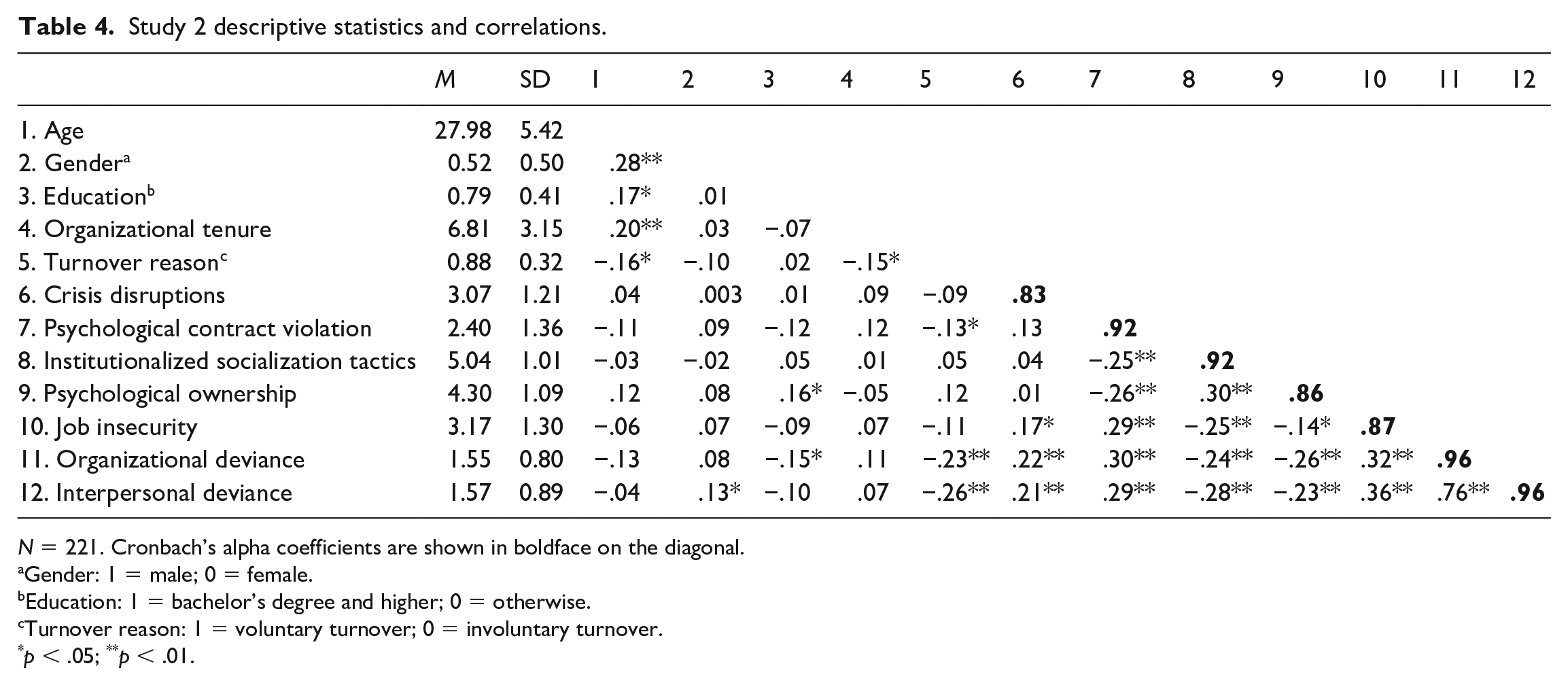
N = 221. Cronbach’s alpha coefficients are shown in boldface on the diagonal.
Gender: 1 = male; 0 = female.
Education: 1 = bachelor’s degree and higher; 0 = otherwise.
Turnover reason: 1 = voluntary turnover; 0 = involuntary turnover.
p < .05; **p < .01.
Test of the mediation path model
The mediation model was a saturated model with a perfect fit. As the results in Table 5 show, psychological contract violation was negatively related to psychological ownership (B = −.19, p < .01) and positively related to job insecurity (B = .23, p < .01), supporting Hypotheses 1 and 2, respectively. In addition, psychological ownership was negatively related to (1) organizational deviance (B = −.12, p < .05) and (2) interpersonal deviance (B = −.12, p < .05), while job insecurity was positively related to (1) organizational deviance (B = .12, p < .05) and (2) interpersonal deviance (B = .17, p < .01). As Table 6 shows, psychological ownership mediated the positive relationship between psychological contract violation and (1) organizational deviance (indirect effect = .02, 95% BC CI = [.004, .06]) and (2) interpersonal deviance (indirect effect = .02, 95% BC CI = [.004, .06]), supporting Hypothesis 4a. Job insecurity also mediated the positive relationship between psychological contract violation and (1) organizational deviance (indirect effect = .03, 95% BC CI = [.01, .07]) and (2) interpersonal deviance (indirect effect = .04, 95% BC CI = [.01, .09]), supporting Hypothesis 4b.
Mediation path model (Study 2).
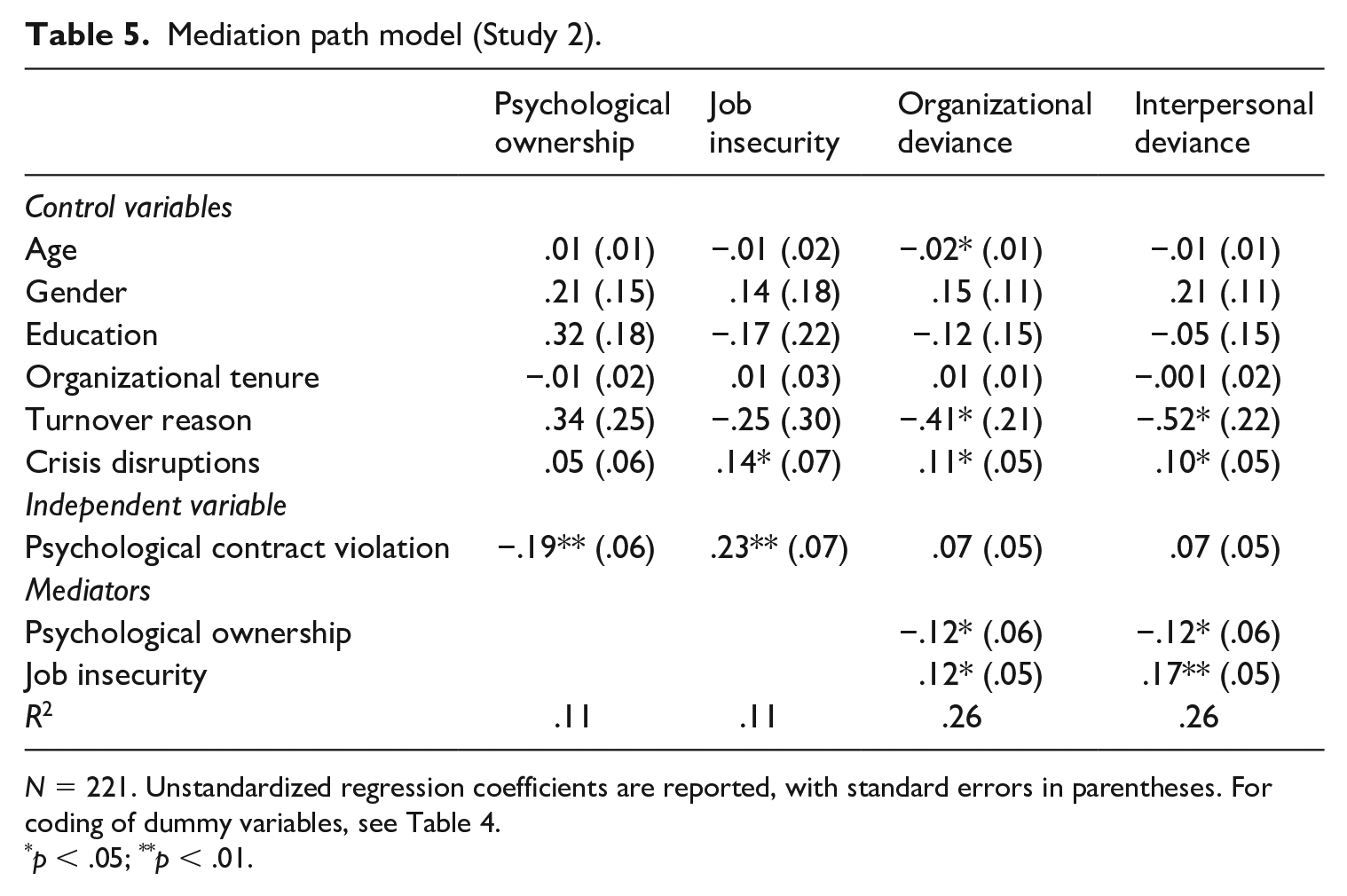
N = 221. Unstandardized regression coefficients are reported, with standard errors in parentheses. For coding of dummy variables, see Table 4.
p < .05; **p < .01.
Mediation and moderated mediation effects (Study 2).
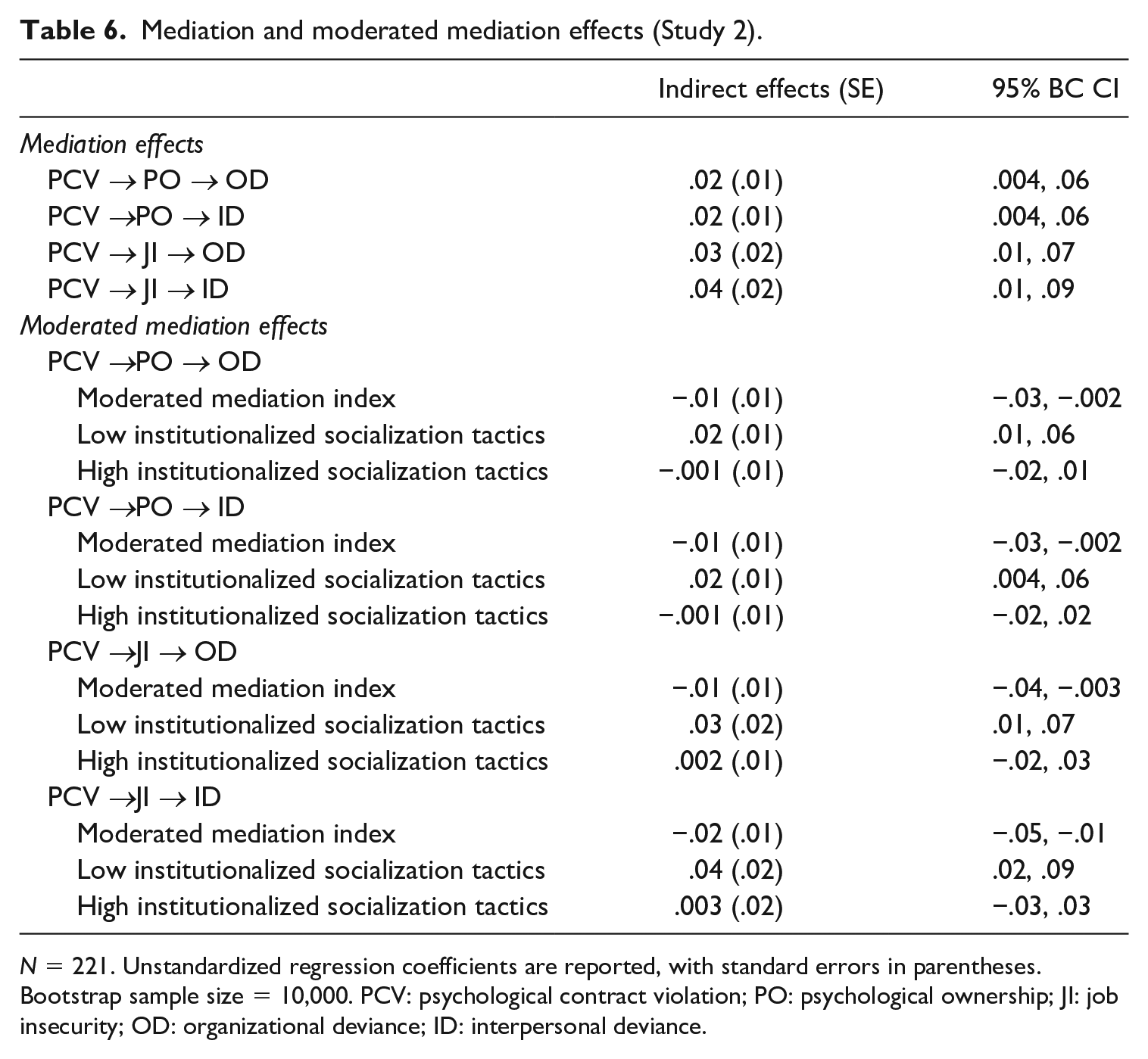
N = 221. Unstandardized regression coefficients are reported, with standard errors in parentheses. Bootstrap sample size = 10,000. PCV: psychological contract violation; PO: psychological ownership; JI: job insecurity; OD: organizational deviance; ID: interpersonal deviance.
Tests of the moderated mediation path model
We proceeded to test the moderated mediation effects by adding the effects of institutionalized socialization tactics and an interaction term between psychological contract violation of the previous organization and institutionalized socialization tactics on the two mediators to the mediation path model (Table 7). The rest of the model’s specification was the same as in the mediation path model. This model demonstrated a good fit (χ2(4) = 8.26, RMSEA = .07, CFI = .99, TLI = .87, SRMR = .02). To examine whether adding the two interaction effects was better than without them, we compared our baseline moderated mediation path model with an alternative model that constrained the two interaction effects to zero (χ2(6) = 25.50, RMSEA = .12, CFI = .94, TLI = .59, SRMR = .03). A chi-square difference test of the nested models was significant (Δχ2 = 17.24, Δd.f. = 2, p < .01), suggesting that the model with the interaction effects was better than without them.
Moderated mediation model (Study 2).
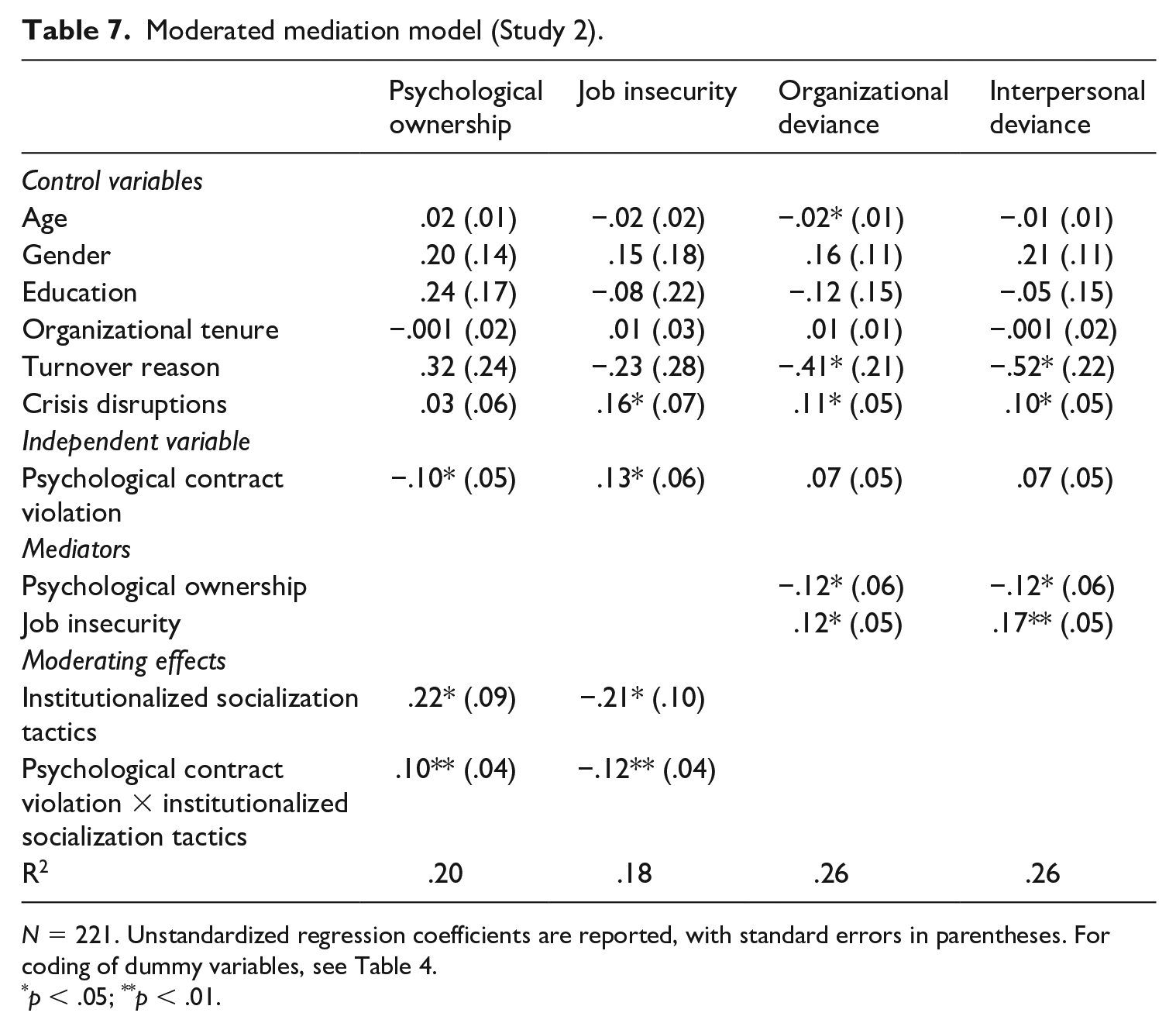
N = 221. Unstandardized regression coefficients are reported, with standard errors in parentheses. For coding of dummy variables, see Table 4.
p < .05; **p < .01.
The interaction effects of psychological contract violation and institutionalized socialization tactics on (1) psychological ownership (B = .10, p < .01) and (2) job insecurity (B = −.12, p < .01) were significant. We plotted the moderating pattern, as illustrated in Figures 2 and 3, respectively. Simple slope tests show that the relationship between psychological contract violation and psychological ownership was negative and significant when institutionalized socialization tactics were lower (simple slope = −.20, p < .01) but was not significant when institutionalized socialization tactics were higher (simple slope = .01, p = .92). In addition, the relationship between psychological contract violation and job insecurity was positive and significant when institutionalized socialization tactics were lower (simple slope = .25, p < .01) but was not significant when institutionalized socialization tactics were higher (simple slope = −.02, p = .85). Taken together, these results provide strong support for Hypotheses 3a and 3b.
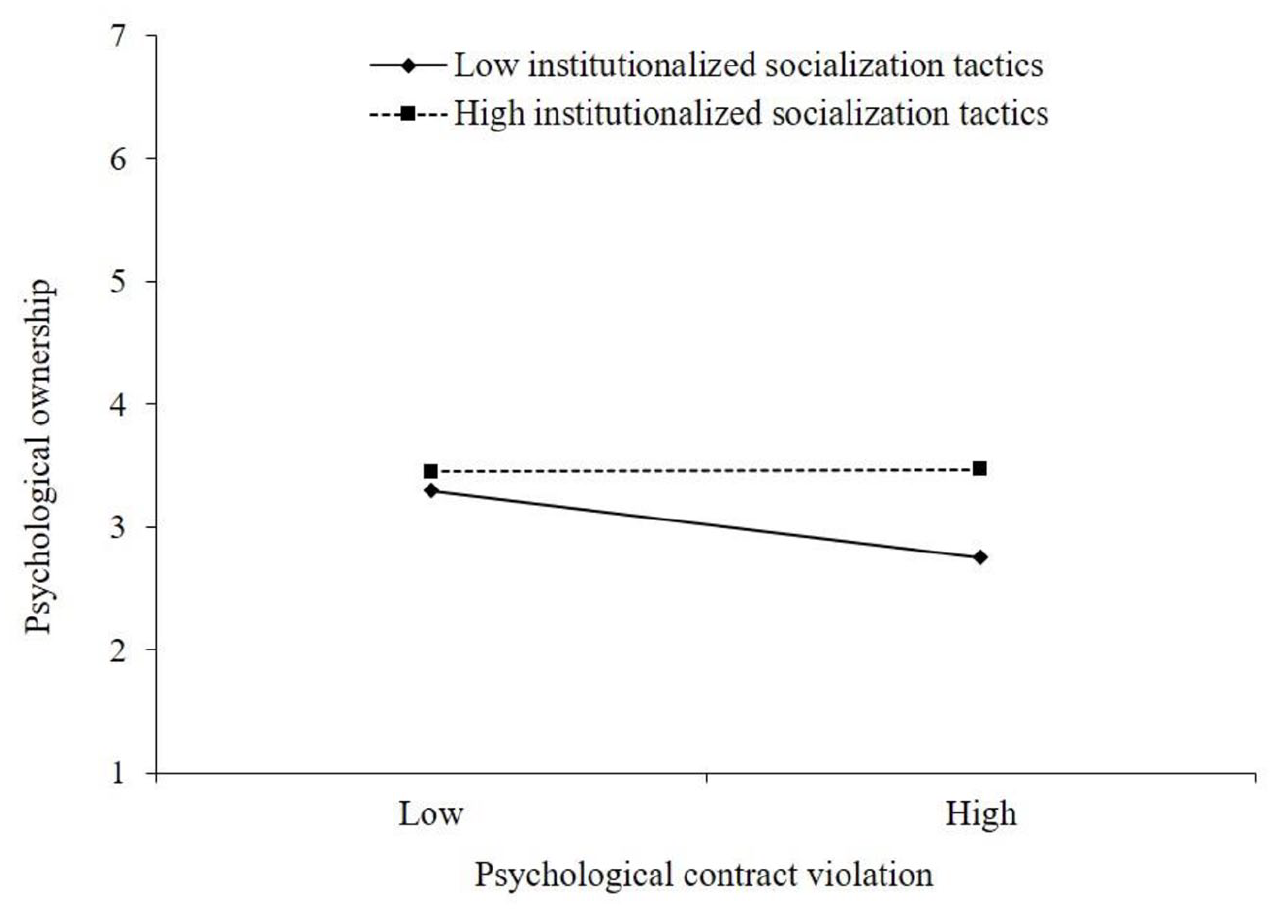
The interaction effects of psychological contract violation and institutionalized socialization tactics on psychological ownership.
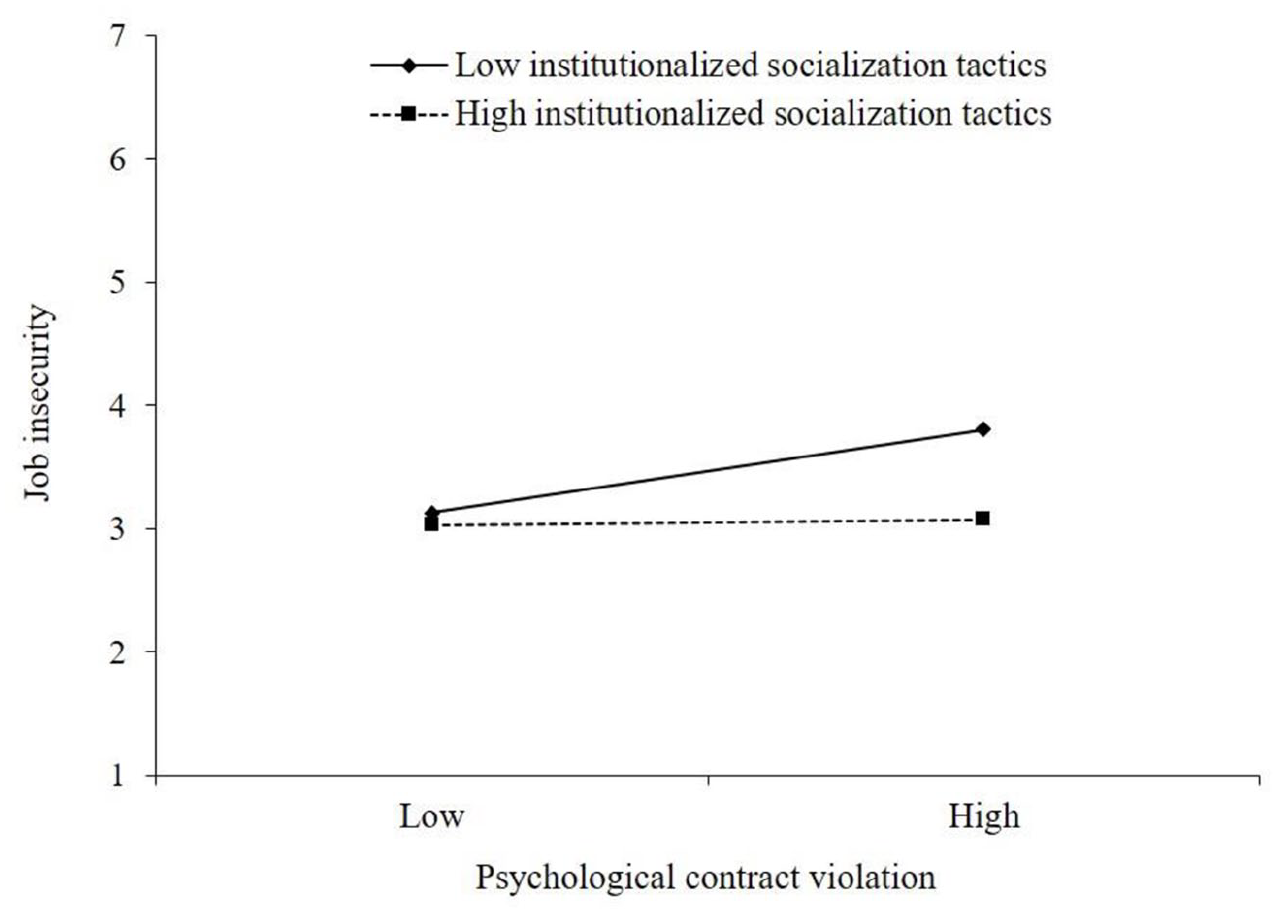
The interaction effects of psychological contract violation and institutionalized socialization tactics on job insecurity.
We proceeded to test the moderated mediation effects (Table 6). For the moderation effect of institutionalized socialization tactics on the indirect relationship between psychological contract violation and the two types of deviance through psychological ownership, the indices of the moderated mediation were significant and negative for the dependent variables of (1) organizational deviance (index = −.01, 95% BC CI = [−.03, −.002]) and (2) interpersonal deviance (index = −.01, 95% BC CI = [−.03, −.002]). In particular, the moderated indirect relationship was positive when institutionalized socialization tactics were lower for (1) organizational deviance (indirect effect = .02, 95% BC CI = [.01, .06]) and (2) interpersonal deviance (indirect effect = .02, 95% BC CI = [.004, .06]) but became non-significant when institutionalized socialization tactics were higher for (1) organizational deviance (indirect effect = −.001, 95% BC CI = [−.02, .01]) and (2) interpersonal deviance (indirect effect = −.001, 95% BC CI = [−.02, .02]). These results provide support for Hypothesis 5a.
For the moderating effects of institutionalized socialization tactics on the indirect relationship between psychological contract violation and the two types of deviance through job insecurity, as shown in Table 6, the indices of moderated mediation were significant and negative for the dependent variables of (1) organizational deviance (index = −.01, 95% BC CI = [−.04, −.003]) and (2) interpersonal deviance (index = −.02, 95% BC CI = [−.05, −.01]). The indirect relationships were positive when institutionalized socialization tactics were lower for (1) organizational deviance (indirect effect = .03, 95% BC CI = [.01, .07]) and (2) interpersonal deviance (indirect effect = .04, 95% BC CI = [.02, .09]) but became non-significant when institutionalized socialization tactics were higher for (1) organizational deviance (indirect effect = .002, 95% BC CI = [−.02, .03]) and (2) interpersonal deviance (indirect effect = .003, 95% BC CI = [−.03, .03]). These results provide support for Hypothesis 5b.
We conducted supplementary analyses to test the robustness of our results. Statistical conclusions remained unchanged by excluding all control variables, or controlling for age, gender, education, and organizational tenure but not turnover reason and crisis disruptiveness.
Comparison of effects between Studies 1 and 2
We had different respondents in Studies 1 and 2, and thus we tested whether the cross-organizational effects of psychological contract violation on psychological ownership and job insecurity were different between the two studies using the multiple group analysis in Mplus. Results show that compared with the baseline model that freely estimated the effects across the two studies, the model fit of the first alternative model that constrained the effects of psychological contract violation on psychological ownership across the two studies to be equal was not significantly different (Δχ2 = .02, Δd.f. = 1, NS). This result suggested that the effects of psychological contract violation on psychological ownership across the two studies were not significantly different. However, the model fit of the second alternative model that constrained the effects of psychological contract violation on job insecurity across the two studies to be equal was significantly worse (Δχ2 = 15.47, Δd.f. = 1, p < .01), suggesting that the effect of psychological contract violation on job insecurity in Study 1 (a sample of layoff victims) was significantly stronger than that in Study 2 (a general sample of newcomers).
Discussion
Study 2 replicated the findings obtained in Study 1. In addition, Study 2 extended the findings of Study 1 by examining the moderating role of institutionalized socialization tactics in breaking the transference effects. The current sample also provides more generalizable findings, given that it included individuals with more diverse backgrounds and reasons for turnover.
Comparing the results across Studies 1 and 2, the effect of psychological contract violation in the previous organization on job insecurity in the new organization was stronger in Study 1 (a sample of layoff victims) than in Study 2 (a general newcomer sample). This result suggests that layoff victims are more likely to carry over their job insecurity feeling (Davis et al., 2015). In addition, this result suggests examining the different effects of job insecurity in different contexts. For instance, employees today understand that jobs are often precarious and embrace the idea of boundaryless careers. They seek career security through investing in their broad employability instead of expecting job security from their employer (Feldman and Ng, 2007). The mediating pathway captured by job security may be less salient in certain conditions.
General discussion
Findings from the two field studies provide consistent and robust support for our hypothesized model of transference. These findings have important theoretical and practical implications.
Theoretical implications
First, we found that psychological contract violation in the previous organization was related to low psychological ownership and high job insecurity in the new organization, which mediated the effect of past violation on present deviance. This finding extends research on the negative consequences of psychological contract violation from within organizational boundaries (Bordia et al., 2008; Restubog et al., 2007; Zhao et al., 2007) to across organizational boundaries. Prior research focusing on within organizational boundaries has drawn on social exchange theory to argue that victims of violation take direct and indirect revenge by engaging in organizational and interpersonal deviance. We extend this research stream by introducing a new theoretical perspective to investigate how such harmful effects can carry over to other organizations through job transitions. The social-cognitive model of transference (Andersen and Chen, 2002; Ritter and Lord, 2007) provides an overarching theoretical framework to understand the possible lasting carryover effects of harmful organizational practices (Buch et al., 2014; Davis et al., 2015; Kim and Choi, 2010; Pugh et al., 2003). Although the social exchange perspective has proved important in studying the impacts of psychological contract violation (Bordia et al., 2008; Restubog et al., 2007), it focuses on only exchanges between employees who are violated and offending employers and their members. The development of a transference perspective (Andersen and Chen, 2002; Ritter and Lord, 2007) provides a compelling theoretical framework capable of explaining the negative carryover effects of psychological contract violation across organizational boundaries with employers not initially associated with the psychological contract or its violations. Although we focus on psychological contract violation, our model can be extended to transference of other negative experiences and positive experiences. In a broader sense, our research suggests that organizations are not independent units but can be interconnected by individual employees. Through job transitions, employees’ experiences in one organization can transfer to another organization and affect the new organization and its members. This issue should become increasingly salient and deserves more research attention, given the notions of boundaryless careers and employability for high mobility in the workforce (Direnzo and Greenhaus, 2011; Sullivan and Arthur, 2006).
Second, by finding the mediating roles of psychological ownership and job insecurity, our model extends the transference research. The mainstream transference research has examined how characteristics of significant-other representations influence the transference effect (Andersen et al., 1995; Andersen and Chen, 2002; Andersen and Cole, 1990; Chen et al., 1999; Ritter and Lord, 2007). Research also suggests that the consequences of transference of the expectations of adverse treatments may be severe (Andersen and Chen, 2002; Ritter et al., 2005; Ritter and Lord, 2007). We test low psychological ownership and high job insecurity as two immediate outcomes of transference of the expectation of violation treatments. They depict the reciprocal obligations that constitute the essence of the psychological contract concept (Robinson et al., 1994) and capture how veteran newcomers with violation experience monitor the exchanges with the new organization for self-protection (Andersen and Chen, 2002; Ritter and Lord, 2007). From a reciprocity perspective, scholars have argued that psychological contract violation triggers revenge cognitions among employees and leads to their negative reactions (Bordia et al., 2008; Deng et al., 2018). While the revenge cognitions argument has been supported in prior studies (Bordia et al., 2008), it falls short in explaining the impact of past psychological contract violation on third parties (Deng et al., 2018). By examining psychological ownership and job insecurity as downstream variables of transference, we show that employees’ evaluations of the reciprocal obligation between them and their new employers can also lead to detrimental effects on new employers. This finding also echoes research of anticipated adverse treatments such as injustice, which found such anticipations lead to defensive and self-defeating behaviors (Shapiro and Kirkman, 2001).
Third, the finding of institutionalized socialization tactics as a moderator sheds light on how to attenuate the harmful transference effects. Scholars have called for research to examine when the negative effects of psychological contract breach/violation are more or less likely to occur (Conway et al., 2014). Responding to this call and extending the investigation of moderators to a cross-organization context, we find that institutionalized socialization tactics in the new organization weaken the transference effects of violations. This moderator captures an organizational factor signaling that the new organization is caring and supportive and is dissimilar to the previous organization violating psychological contracts. Our findings extend prior violation studies, which investigated several variables that might mitigate the negative effects of psychological contract violation, including procedural justice (Restubog et al., 2009) and professional identification (Deng et al., 2018). Again, by examining institutionalized socialization tactics as a moderator in a job transition, cross-boundary context, we extend the transference research by suggesting a new direction of investigating (dis)similarity cues. Research on newcomers has established the critical role of institutionalized socialization tactics for newcomers (Bauer et al., 2007; Saks et al., 2007). However, meta-analytical studies provide mixed findings regarding institutionalized socialization tactics’ relative effectiveness on the adjustment of veteran versus neophyte newcomers (newcomers with no work experience) (Bauer et al., 2007; Carr et al., 2006; Saks et al., 2007). Our research provides a new angle for investigating this issue. Institutionalized socialization tactics are critical for the adjustment of veteran newcomers who have experienced violations by attenuating the transference effects.
Practical implications
This study offers useful practical implications for organizations and managers. First, our findings suggest that organizations should be careful when recruiting talents who had psychological contract violation experiences, especially those who experienced major adverse incidents such as the case in Study 1. Employers are also advised to attend to the obligatory mechanisms underlying the transference effects of psychological contract violation. Human resources managers are suggested to help improve newcomers’ psychological ownership and reduce their job insecurity, especially for those who experienced job loss before (Davis et al., 2015).
In light of the findings that institutionalized socialization tactics weaken the transference effects, firms should capitalize on their socialization processes to help new employees acquire knowledge and attitudes that fit their new context. Socialization allows firms to refine any attitudinal baggage that newcomers carry into the new organization. It also provides opportunities and information for employees to learn about their new employers’ uniqueness and differences, thereby changing their negative perceptions of employers in general.
Limitations and directions for future research
This study has several limitations. First, not all forms of deviant behaviors can be observed by others (Bennett and Robinson, 2000; Berry et al., 2007), we thus asked employees to report these dependent variables. Self-reported deviance may bias the study’s results owing to the possible concern of common method variance (CMV). To reduce this concern, we follow Podsakoff et al. (2012) to adopt temporal separations in both studies. In addition, following Williams et al. (2010), we adopted the CFA marker technique and found that CMV did not pose a serious threat to, nor biased the validity of the results of both studies. Nevertheless, it would be useful to adopt other-rated deviance to replicate our findings. Another future direction to address this limitation is to include other-reported outcomes, such as job performance and citizenship behaviors.
Second, our measure for psychological contract violation was retrospective. That is, we did not measure this variable at the time respondents worked for their former employers; instead, we asked them to “recall” their perceptions when they were re-employed. To address this limitation, future research can consider using a design with a longer time frame. At Time 1, researchers ask participants to rate psychological contract violation at their present organizations. At Time 2, which is about one year later, researchers send a short questionnaire, asking the participants’ employment status. Those who have changed their jobs in the past year are contacted again immediately to complete a questionnaire about psychological ownership and job insecurity at their new workplace. At Time 3, which is about one month after the Time-2 survey, those who completed the Time-2 survey are contacted to complete a survey on their deviant behaviors at the new organization. To ensure a sizable sample and have enough participants who change their jobs within one year, researchers can conduct the research in industries with high turnover rates such as call centers (Tuten and Neidermeyer, 2004).
Third, we conducted Study 1 in a unique context of the financial reform in Ghana in which all participants experienced a layoff. As such, all likely experienced high psychological contract violations and job insecurity (Davis et al., 2015). To address potential problems caused by this unique sample and context, we conducted Study 2 among a general sample of newcomers in China. The convergence of results across the two studies provides strong empirical support for our hypothesized model. Nevertheless, we encourage future studies to examine this model in other cultural contexts to further test our findings’ generalizability.
Fourth, there are some directions on how to extend our theoretical model. Future studies are encouraged to explore other mechanisms in addition to psychological ownership and job insecurity, such as organizational commitment (Zhao et al., 2007) and organizational support. Although we focus on the transference of harmful effects of psychological contract violation, victims of violation may also be more cautious and engage in reflection at the new organization (Liao et al., 2021). Moreover, during job transition, there may be contrasting or honeymoon effects (Boswell et al., 2005, 2009; Van den Bos et al., 2005). Employees may experience short-term favorable affective and psychological processes and thus less deviance immediately after changing their jobs. Transference and contrasting effects may coexist, and future studies can employ longitudinal designs to account for lagged effects owing to the honeymoon period and investigate both transference and contrasting effects and their contextual conditions to build a more comprehensive and nuanced understanding of the cross-organizational effects.
We examined socialization tactics as a moderator by following previous research (e.g., Kim et al., 2005) to use a single dimension that combines organizational practices and social support (Jones, 1986). It may be beneficial to investigate socialization from localized context (i.e., leaders and incumbent colleagues such as leadership and social supports) and that from the organization (e.g., practices and policies) (Ashforth et al., 2007; Bauer et al., 2007) separately, which provides a nuanced understanding of its moderating role. Finally, exploring how the relationships between employees’ psychological processes and outcomes in the new organization during post-job transition are moderated is an interesting future research direction.
In conclusion, this study explores the notion that past psychological contract violations can cross-organizational boundaries and influence present deviant behaviors. We also find that psychological ownership and job insecurity in the new organization are underlying mechanisms for transference effects, and the new organization’s institutionalized socialization tactics can attenuate these adverse transference effects. This research offers a novel angle for understanding and managing the harmful effects of psychological contract violation.
Footnotes
Acknowledgements
For his valuable feedback on an earlier version of this article, we thank J. Michael Crant, as well as three anonymous reviewers and the journal Associate Editor, Zhijun Chen.
Funding
The author(s) disclosed receipt of the following financial support for the research, authorship, and/or publication of this article: This research was supported by Guangdong Basic and Applied Basic Research Foundation, China (grant number: 2019A1515010698), Guangdong Planning Office of Philosophy and Social Science, China (grant number: GD19CGL33), and National Natural Science Foundation of China (grant numbers: 71772076 and 71701054).
