






Abstract
How do women’s business networks help to advance women’s freedom? Drawing on Zerilli’s freedom-centred feminism, our study sets out to answer this question at the intersection of freedom, feminism and work. Critics argue that women’s business networks promote a postfeminist view of freedom focusing on individual self-realisation and thus participate in rolling back collective, feminist efforts to dismantle structural inequalities. We reconceptualise women’s business networks as political arenas and argue that making claims about shared interests and concerns in such an arena constitutes a feminist practice of freedom. With an original, inductive and qualitative research design combining topic modeling and dialectical analysis, we examine the claims made in 1529 posts across four women’s business network blogs. We identify postfeminist claims and new forms of change and transformation that can help to advance women’s freedom across three ‘dialectics of freedom’: conformity and imagination; performative care and relational care; sameness and openness. Our findings show that uncertain and contradictory ways of defining and engaging with women’s freedom can emerge through claim-making in such arenas. The fragility of the process and its outcomes are, then, what can move feminism forward at work and beyond.
Introduction
Women’s business networks (WBNs) are independent, bottom-up initiatives that organise women’s voices and experiences to address the status quo in the gendered world of work (Dennissen et al., 2020; Villesèche and Josserand, 2017). Their bottom-up character differentiates them from employee resource groups (also known as diversity networks) within corporations where the control over initiatives and aims depends heavily on top-down decision-making (Donnellon and Langowitz, 2009). WBNs provide women with the opportunity to join a public group and share their views on work-related issues that matter to them. They may also constitute platforms for advocacy work (Avdelidou-Fischer and Kirton, 2016; Villesèche and Josserand, 2017). In that sense, WBNs display what Aronson calls ‘feminist consciousness’, that is, an ‘awareness and critique of gender inequalities’ (2017: 335) that can lay the foundations for collective action.
However, research critical of WBNs argues that, while such groups develop support strategies that address their members’ needs at the individual level, they fail to address organisational and structural inequalities (Petrucci, 2020). Scholars in gender and organisation studies often use the notion of postfeminism (Gill, 2007; Lewis, 2014) to characterise how, in the neoliberal world of work, there is a distancing from the critique of structural inequalities (Petrucci, 2020). From a postfeminist perspective, women’s freedom from gendered constraints is the result of purposeful agency detached from a concern for the social conditions of its realisation (Hirschmann, 1996). Consequently, critics argue, the promotion of individualised, performance-driven processes of self-realisation and freedom of choice undermine the feminist movement’s collective action, thus resulting in an ‘undoing of feminism’ (McRobbie, 2009; Sullivan and Delaney, 2017).
Given that backdrop of scholarly debate on WBNs as they gain popularity around the globe, we draw in this article on Zerilli’s (2005) work on freedom-centred feminism to elucidate how we might (re)think how WBNs help to advance women’s freedom. Theoretically, we conceptualise WBNs as public sites of encounter for women, that is, political arenas, in which claims made about shared interests and concerns can be rejoined, contested and transformed. Making claims in such a political arena constitutes a feminist practice of freedom that provides the possibility of ‘world-building’ (Zerilli, 2005): a collective attempt to make sense of the world we share and imagine how the world could be transformed, that is, creating forms or figures that are not already taken for granted.
We empirically examine the claims made in a corpus of 1529 blogposts from four WBNs. The selected WBNs were founded in the United Kingdom or the United States and have international chapters extending across four continents. Their social media following ranges from a few thousand to almost a million followers, and they have had active blogs for the last seven to 15 years. Members include entrepreneurs, managers and corporate leaders, as well as women interested in (re)starting or changing their careers. Through a qualitative analysis of blog posts, we identify three dialectics of freedom: conformity and imagination, performative care and relational care, and sameness and openness. The dialectics reveal how women’s freedom is understood in WBNs and delineate the ways in which changing and transforming our shared world is envisioned. We contribute to the literature on freedom and feminism in the workplace and to scholarship on WBNs in gender and organisation studies by reconceptualising how WBNs can help to advance women’s freedom and by demonstrating the political plurality of claims made in WBN blogs. The empirical investigation of WBN blogs further extends our understanding of the practical possibilities of Zerilli’s freedom-centred feminism and enables us to make an ancillary methodological contribution through an inductive and qualitative research design combining topic modelling and dialectical analysis.
In the remainder of the article, we first discuss the literature on postfeminism, freedom and WBN. To extend the existing understanding of how WBNs help to advance women’s freedom, we present our freedom-centred feminist perspective chiefly grounded in Zerilli’s work. We then explain how we conducted our empirical study and present our analysis. Finally, we discuss our findings, contributions to the literature and future research avenues.
Theoretical framework
Postfeminism, freedom and equality in women’s business networks
Feminist scholars in gender and organisation studies have employed the notion of postfeminism (Gill, 2007; Lewis, 2014) to describe the increasing emphasis on women’s agency and choice in exercising their freedom at work and beyond (Lewis et al., 2019). Postfeminism is not a historical or theoretical break from feminist movements but ‘an attitude, a reaction formation, an always available hegemonic response to feminism not entirely linked to any particular [feminist] historical moment’ (Projansky, 2001: 88). The idea of unforced choice – the legal right to do that which social conditions make practically impossible (Bowring, 2015) – is central to the description of postfeminism and an important tenet of the classic conceptualisation of freedom as ‘negative liberty’ (Berlin, 1958). From that perspective, freedom (from patriarchy and other external constraints) is the result of purposeful agency (Hirschmann, 1996) detached from a concern for the social conditions of its realisation. In a postfeminist world of work, it is thus assumed that women have an equal chance of success to men in the workplace if sufficient energy and enthusiasm are invested (Lewis, 2014). That view delineates a particular type of agency for the ‘free subject’ that favours notions of self-realisation devoid of painful choices located with and attributed to the individual woman (Rottenberg, 2019). For instance, Sheryl Sandberg’s 1 popular book Lean in epitomises postfeminism by promoting individualistic strategies that women can deploy to enhance their careers without a need to first undo gendered organisational structures. Bowring (2015) argues that this emphasis on free will and individual agency ultimately removes women from the realm of politics and thus estranges them from feminism.
Although not questioning that postfeminist takes on freedom may indeed be observed in WBNs, other research disputes that postfeminism is apolitical (Genz, 2006) and studies how postfeminist politics unfold (Genz, 2006; Petrucci, 2020). In her study of gender-inclusive meetup groups in the United States, Petrucci defines postfeminist communities as ‘groups of individuals and non-profit organisations and/or corporations who politically organise around gendered issues marked by postfeminist assumptions, goals and strategies’ (2020: 550). Countering critical perceptions of postfeminism as apolitical, Petrucci argues that communities such as WBNs constitute a form of political organisation that promotes postfeminist ideals. Those communities’ shared beliefs and agenda lead them to reconfigure feminist practices in individualistic, market-oriented ways, thus depriving themselves of the possibility to transform workplaces and power relations, not least because their ‘desire for a postfeminist future in which gender-neutral competition is fully realised, and thus oppression is resolved’ (2020: 549) is misguided. In sum, promotion of the individual empowerment and self-realisation discourse in such groups is seen to undermine the feminist movement’s gains and may result in an ‘undoing of feminism’ (McRobbie, 2009; Sullivan and Delaney, 2017). Postfeminism scholars thus challenge the idea that WBNs can contribute to the realisation of feminist goals, which require collective action oriented towards collective gains (Lewis et al., 2019; O’Neil et al., 2011).
In contrast to the postfeminist stance and a view of freedom as negative liberty, positive liberty supposes the recognition that (internalised) social forces limit our freedom and, as a result, demands that we define a content for our choices, a shared governance (Bowring, 2015), that requires collective action (Gill et al., 2017; Lewis, 2018). Critical feminist work in organisation studies documents the ways in which women internalise external discourses that shape how choices are produced, constructed and limited in the neoliberal world of work, enhanced by and through the power relations that exist in our social contexts (see e.g. Adamson and Kelan, 2019; Baker and Kelan, 2019; Scharff, 2015). Rectifying the power imbalance is thus considered necessary to effect change, reach equality and free women. Such a view entails that feminist collectives that can transform the world and gender power relations act to rectify unjust and freedom-limiting structural inequalities with the goal of attaining equality and thus freeing women. From that perspective, despite constituting political communities, WBNs cannot achieve that goal because the means (support strategies for individuals) and end (gender-neutral competition under neoliberalism) are judged as inadequate for realising women’s freedom (Petrucci, 2020).
However, defining a ‘content’ for freedom, that is, a collective aim for action such as gender equality, presupposes conformity to the agreed content and inevitably means excluding competing notions of ways in which to be and act (Bowring, 2015: 157). In that sense, favouring a view of political action as a means of enabling us to reach a pre-defined end – such as equality – for particular subjects – ‘women’ – based on a normative understanding of what the problem is and how it can be solved to free women still aligns with the idea that we are free once we have full control over our actions, that is, a view of freedom as sovereignty. Instead, as we will now argue, a freedom-centred feminism (Zerilli, 2005) perspective enables us to consider uncertain and contradictory ways in which to define and engage with women’s freedom.
Freedom-centred feminism and women’s business networks
In her freedom-centred feminist political theory, developed most notably in her book Feminism and the Abyss of Freedom (2005), Zerilli proposes plurality as the irreducible condition of politics and a view of feminism as a conflict-ridden, world-building practice of freedom. Grounding her analysis in Arendt’s work, Zerilli adopts a non-sovereign approach to freedom, viewing it not as only the result of will, of individual agency deployed to overcome causes of unfreedom. She is thus critical of freedom as negative liberty as expressed in postfeminism but also points to the limitations of how subjectivity and the path to freedom are understood in preceding feminist movements. For Zerilli, notwithstanding differences in their social, radical and liberal orientations, the focus of feminist movements from the 1960s onward on social justice and equal rights (so-called second wave feminism) and the identification with an ‘all-powerful sisterhood’ (2005: 10) struggling against the workings of power, obliterates particularity and, with it, plurality. This is the case even if for example black feminism and other breaches in the movement have contested this unity and highlighted the differences among women. Indeed, albeit the means may take other forms, Zerilli argues that such perspectives displace the political and promote a view of feminism as being merely a means to an end. In turn, although subsequent theories (so-called third wave feminism) have acknowledged gender as performative (Butler, 1990) and notably created new space for intersectional and queer identities (Showden, 2009), the political solutions remain limited beyond attempts to reveal and deconstruct (the power of) norms or advocating work on the self for desubjectivation. Zerilli thus argues that the focus of such work is still on the ‘subject question’, placing the individual and identity, rather than plurality and action, at their core. Moreover, in both cases freedom is still articulated as a sovereignty gained by countering power ‘from above’ or by undoing the power that constitutes the subject.
Basing her argument on Arendt’s notion of politics as a struggle among people who choose the aims that they represent, Zerilli challenges both subjective and objective notions of identity as grounds for politics and as a way of defining a political actor, whether individual or collective. In the argument that Zerilli weaves, a conceptualisation of feminism through the lens of the subject is wholly contingent on the subject’s capacity for agency and, as a result, risks limiting politics to an instrumental activity (2005: 12–13). Zerilli’s stated aim is to ‘return’ to feminism’s concern for freedom and to examine how women’s freedom is realised by engaging in ongoing and incessant public interaction to (re)build a shared world.
From a freedom-centred feminist perspective, freedom is a predicate of action. Referring to Arendt’s formulation, Zerilli argues that freedom cannot be achieved based only on what one wants – ‘I will’; it also requires an ‘I can’ reflecting the worldly conditions that enable the subject to do what they will. Creating such conditions requires action in a political community, thus necessitating that women act as a political collective that ‘involves speaking for others, being spoken for and speaking back’ (Zerilli, 2005: 180). Women’s struggles to express themselves and achieve recognition of their claims is where Zerilli locates the political in feminism. Thus, making claims and the political decision to affirm or refuse community and affiliation are at the heart of feminism and are the ultimate meaning of freedom. Abandoning a means-end logic entails, as a result, acknowledging that we cannot act according to a plan (social goals of politics) nor control or predict the outcome of our actions. This means that ‘the predicative moment of politics involves not the exchange of proofs but the ability to claim commonality’ (2005: 171, emphasis in original) in a public space with a plurality of participants.
Drawing from Arendt, Zerilli defines plurality as acting in an ‘already existing web of human relationships, with its innumerable, conflicting wills and intentions’ (2005: 13). Reducing freedom to a means-end, instrumental conception of politics denies plurality, the very condition of democratic and feminist politics. Such relations in plurality represent what Arendt calls the ‘common world’ (2005: 19) and engaging in such a space constitutes a practice and experience of freedom. It is in this space of the common world that differences become meaningful and the newly thinkable can appear (2005: 181). In that space, either affirmation or refusal is possible: ‘we have the world in common because we view it from different perspectives. . . . Rather than threaten our shared sense of worldly reality, in other words, plurality generates it’ (2005: 140). As a result, world-building takes the form of incessant public interaction, the aim of which is not to reach a consensus or decide on the validity of particular claims, but rather to enable us to better understand our common world and further shape it.
In sum, the freedom for women to be political actors, Zerilli argues, is one that belongs just as much to self-asserting individuals as to self-asserting collectives. In both cases, that freedom rests on no firmer foundation than the claim and its recognition by others. It is by making political claims in public arenas that we may be able to recover feminism’s ‘lost treasure’ (2005: 25): the radical demand for women’s political freedom, to see women able to exercise their political freedom collectively and thus see feminism as a world-building practice. Using the example of a manifesto produced by the Milan Women’s Bookstore Collective in the 1980s, Zerilli illustrates the ability of collectives to imagine women under the figure of freedom: ‘the desire for “something more” rather than equality’ (2005: 102) and for something different from investing the feminine with ‘some positive social quality’ (2005: 113). To be clear, Zerilli specifies that ‘claiming one’s right’ and the need for equality can indeed be a practice of freedom, albeit not one where the validity of the claim in relation to a particular object and social setting is determined in advance (2005: 98). There is thus no opposition, but a relationship between the exercising of freedom and long-standing objects of feminism such as rights and equality. Zerilli thus helps us to think about feminist practices that are not exhaustively determined in advance, that is, based on truth claims about particular subjects and social ends.
On that basis, instead of assuming WBNs’ participation in the ‘slow and devastating erosion of feminism’s emancipatory impetus’ (Rottenberg, 2017: 340), we take up the project of ‘affirming feminism anew’ (Zerilli, 2005: 31) in WBNs. In this article, we pursue such ideas further in seeking to understand, through our empirical exploration, how plurality manifests and how world-building unfolds in WBNs. We do so by examining the claims made about common objects of interest in WBNs as political arenas.
Methodology
Research context and data collection
To assess the claims made in WBNs about how women may realise their freedom, we empirically examine a particular mediated form of WBN interaction: online blogs. Besides interactions such as face-to-face meetings, blogs are a contemporary way for WBN members to engage with each other on issues that matter to them in relation to work. Blogs are popular online spaces enabling the participation of multiple authors and easy publication of content for a vast audience (Swan, 2017). They are contemporary extensions to diary-based research that help us to understand social actors and their day-to-day experiences and reflections (Hookway, 2008). Previous research has explored women-dominated online spaces such as Mumsnet (see e.g. Mackenzie, 2018; Pedersen, 2020). Blogs represent a significant format in popular culture providing users with distinct written social interaction and meaning-making possibilities (Graves, 2007).
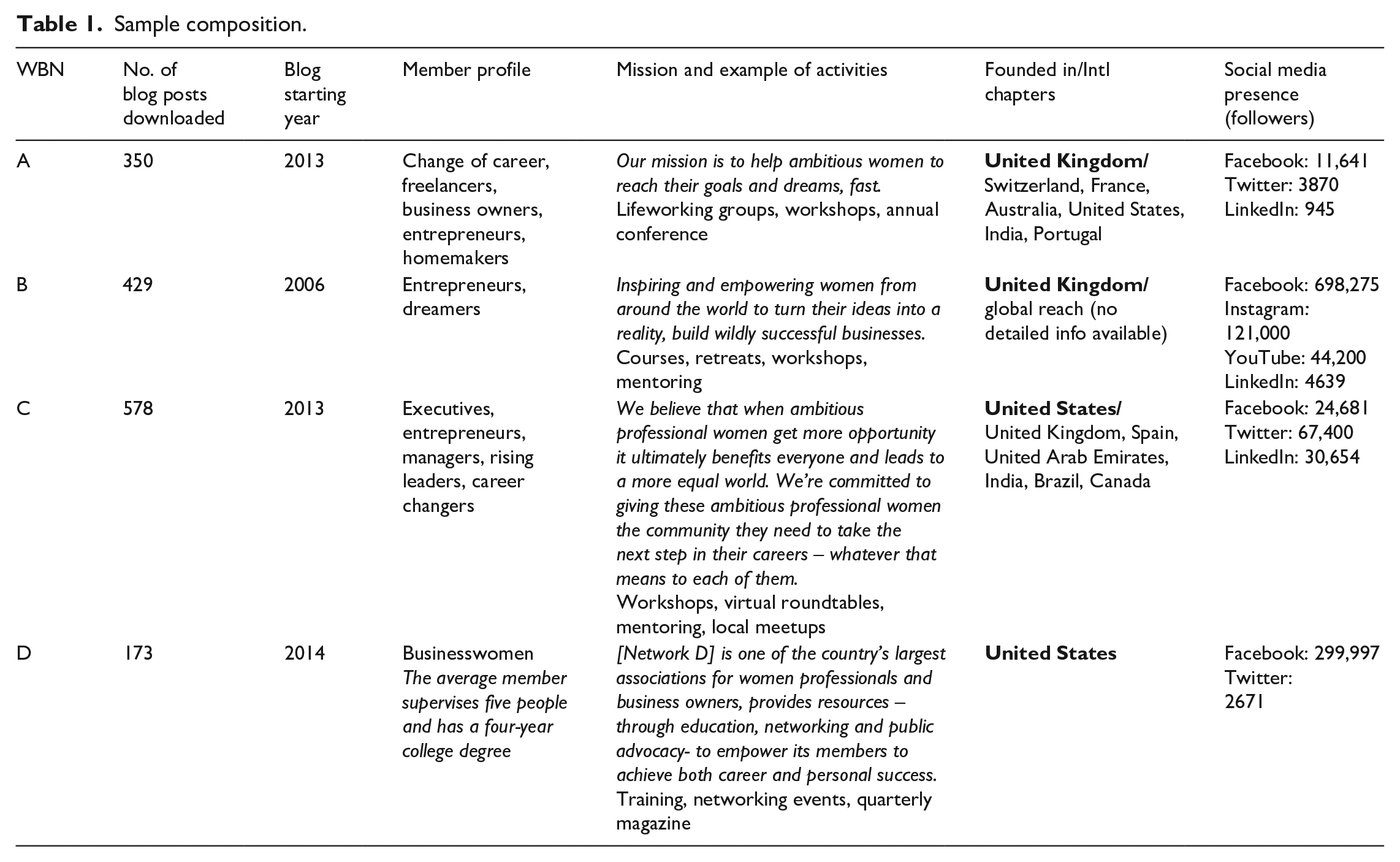
In this study, we want to examine the claims made in WBNs from a freedom-centred perspective to better understand how WBNs help to advance women’s freedom. The aim is thus not to compare different WBNs and their blogs, but to examine a corpus of a sufficient scope and size to be able to address our research question. We selected the four WBN blogs used in this study based on appropriateness rather than statistical representativeness. In particular, the selection criteria are as follows: (1) We selected WBNs that have both online and offline activities, so that the blog would be part of the offer rather than solely being a blogging site for women in business. (2) We looked for WBNs with regular blogging activity over several years to collect a large volume of posts and capture a wide range of themes that were not related to a particular contextual event (such as the financial crisis or the current health crisis). (3) We aimed for blogs that have attracted practitioner and media attention as particularly worthy of interest (e.g. the Forbes.com list ‘15 great websites for business owners’) as well as federate readership and membership internationally, including large social media followership, albeit in English language only. (4) Finally, we selected blogs where posts are written by different network members, rather than by a single author, to capture a diversity of voices. The selected WBNs were founded in the United Kingdom or the United States and have international chapters extending across four continents. More information on our sample can be found in Table 1, including information about the type of members and social media followership. We downloaded the full websites for each network using the SiteSucker software for macOS, extracted the blog pages from the earliest year available and converted them into .txt files. We collected 1529 blog posts ranging from a couple of paragraphs to two pages.
Sample composition.
Data analysis
To interpret our corpus, we followed a two-step inductive and qualitative approach. The first step is based on topic modeling allowing us to identify the key objects of discussion, or what is discussed across the blog posts in our corpus. While the use of pure machine learning approaches to textual data analysis has been criticised for limiting researchers’ interpretations, the inductive design we adopted in line with recent recommendations (Aranda et al., 2021; Brookes and McEnery, 2019; Hannigan et al., 2019) mitigates such downsides. In the second step, we focus on identifying claims made in relation to the topics uncovered through topic modeling in step one and aggregated them into ‘dialectics of freedom’. The specifics of the process are as follows:
Step 1. In the first step of the analysis, the objective was to identify the most prevalent discussion topics across our data corpus of 1529 blog posts. This is important because understanding WBNs as political arenas in which claims can be rejoined, contested and transformed requires that we ‘recognise common objects as candidates for judgement, objects on which our considered opinions might very well diverge’ (Zerilli, 2016: 267). In other words, we need to identify the objects about which views are formed before we can decide for ourselves which perspectives we want to rejoin and carry forward.
Following the ‘linguistic turn’ in management research (Alvesson and Kärreman, 2000), computer-based language processing techniques have become increasingly prominent, especially for analysing large sets of textual data to understand actors’ cognition and meaning-making (Hannigan et al., 2019). We used Latent Dirichlet Allocation (LDA) (Blei, 2012; Blei et al., 2003), an unsupervised machine learning tool of topic modeling. We used MALLET software (McCallum, 2002) to run the LDA algorithm, with individual blog post text files as input, and computed several topic models (10, 20, 30, 40, 50, 60 and 70 topics). Topic modeling returns a solution in the form of a pre-specified set of ‘topics’, that is, groups of words that tend to co-occur more frequently across documents (DiMaggio et al., 2013; Mohr and Bogdanov, 2013). Running the algorithm is only the first step in the exploration of meaning structures underlying any large data corpus, and researchers need to interpret the outputs of the algorithm (Bail, 2014; Jha and Beckman, 2017; Mohr et al., 2013).
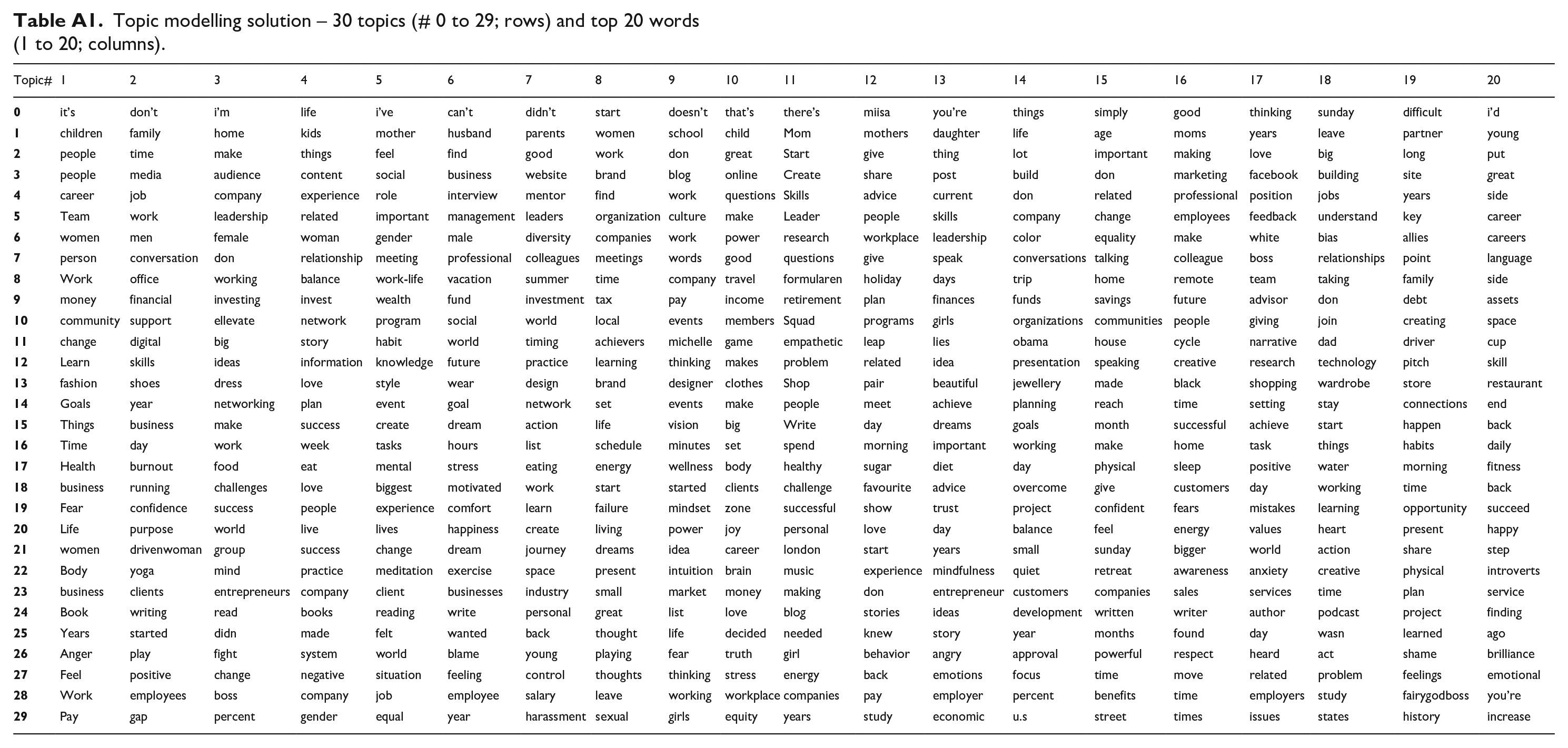
Each author independently examined the different models to find the solution with the most interpretable sets of topics. We agreed that the 30-topic solution was the most appropriate (see Appendix Table A1 for the full solution), individually proposed a summary title for each topic and dismissed non-interpretable topics (i.e. topics that we judged to be non-interpretable). That process led us to identify 26 interpretable topics, that is, key objects of discussion in the WBN blog posts, and we dismissed four (topics #0, 11, 23 and 25). We then imported into the NVivo software the top ten most relevant blog posts in terms of meaning concentration for each of the 26 topics, giving 260 posts in total, identified through their Dirichlet parameters. A close reading of the posts, comments and discussions among the authors allowed us to further refine our understanding of the topics. See Table 2 for the list of topic titles reached by team consensus at the end of this process.
Summary titles for the discussion topics. 1
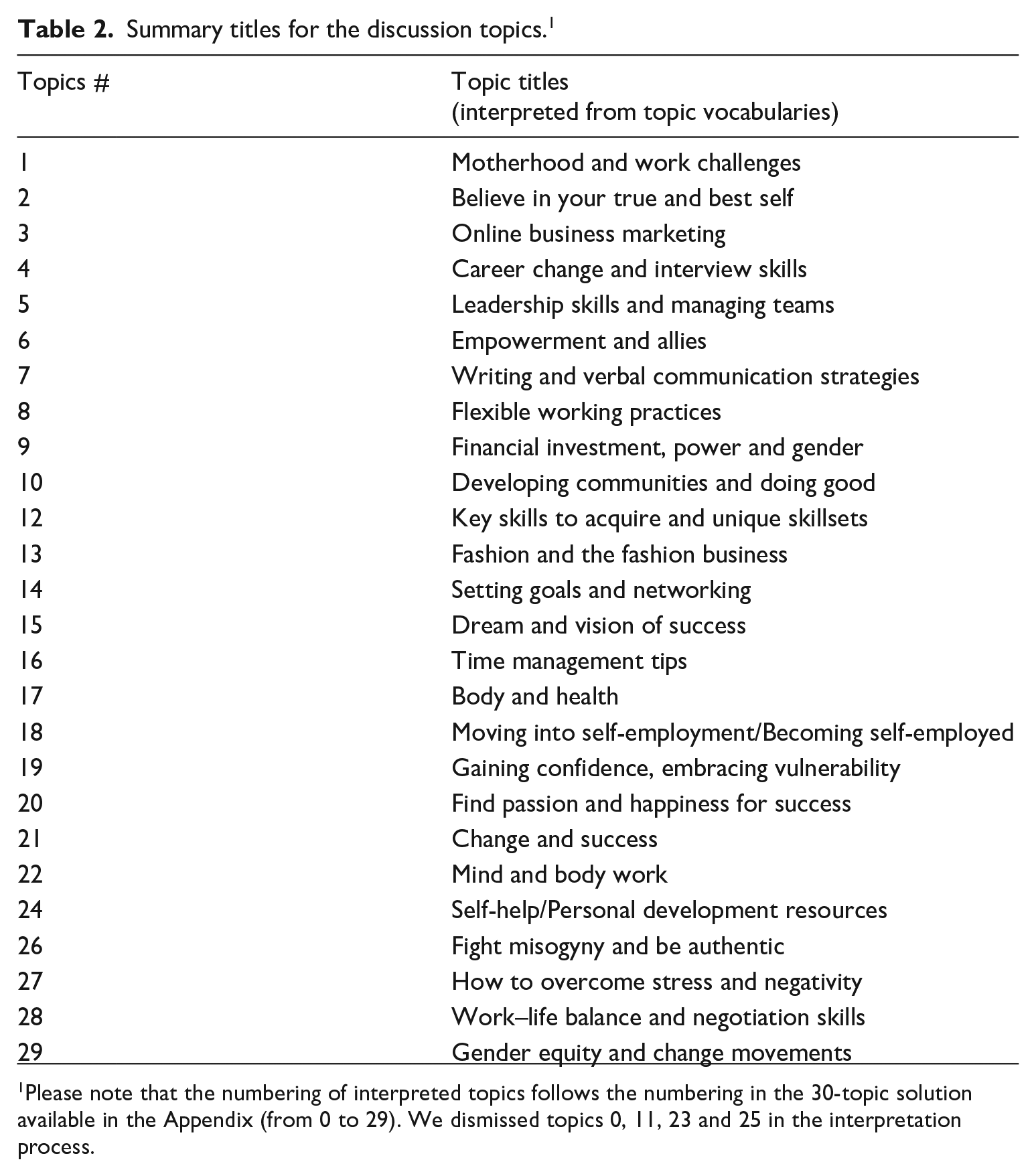
Please note that the numbering of interpreted topics follows the numbering in the 30-topic solution available in the Appendix (from 0 to 29). We dismissed topics 0, 11, 23 and 25 in the interpretation process.
Step 2. Akin to the methodological approach of Elliott and Stead (2018) and Hellgren et al. (2002) to examining argumentation practices in printed media, we explored the claims made in the blog posts. We read the 260 most relevant blog posts again, this time with the aim of distinguishing the different claims made in relation to the discussion topics. Based on our freedom-centred theoretical framework, we conducted an interpretive reading of our corpus to assess and then aggregate those claims. This interpretive reading let us identify claims that reflect postfeminist ideas, as emphasised by previous research, as well as claims that imagine other avenues for change and transformation to advance women’s freedom.
For example, blog posts related to Career change and interview skills (topic 4) include claims such as ‘we need to copy the men’, versus ‘women have to teach each other’; blog posts related to Mind and body work (topic 22) include claims such as ‘we need positivity and self-control for success’, versus ‘we need to display vulnerability and support each other’. The claims on each side of our theoretical framework were then aggregated across topics based on commonalities. This process led us to delineate three dialectics, that is, sets of tensions across ‘verbal ideological tendencies’ (Bakhtin, 1981) between which ‘systems of meaning’ (Edwards et al., 2019) are debated and redefined. The following section presents our findings in detail.
Findings: Dialectics of freedom
Through our analysis of claims across topics, we identified three dialectics of freedom: conformity and imagination, performative care and relational care, and sameness and openness. With the support of excerpts from our data set, we present below an analytical interpretation of those dialectics.
Dialectic 1: Conformity and imagination
The first dialectic emphasises the relationship between ‘conformity’ and ‘imagination’. ‘Conformity’ is expressed in the (re)production of a feminine identity in the neoliberal world of work, aligned with the gendered status quo and with conceptions of freedom as sovereignty. Imagination, on the other hand, is defined by Zerilli as ‘the faculty that enables a feminist critical practice that does not seek to occupy the external standpoint or entangle us in forms of reflection for which the strange is inevitably the exception that puts the rule into radical doubt’ (2005: 59). Imagination can give rise to new forms and figures for transformative action. That is exhibited here through a redefinition of normative boundaries between work and life relying on practices of making judgements in a web of relations and as a feminist community (Zerilli, 2005).
On the one hand, we observe in various blog posts that much of the advice offered assumes the reproduction of traditional gender roles as inevitable: women can realise their freedom through work only if they always/already realise themselves as women – and mothers. That need to accommodate the existing social world is grounded in a commitment to the binary gender/sex divide as the condition of their freedom, thus highlighting the postfeminist sensibility of femininity as a bodily property (Gill, 2007):
Until we become sensual sexual beings, the shame, hurts, wrongs and the pain of our female predecessors are not important, and we are free to grow and explore who we are. As soon as we develop into women our genetic imprint reminds us of how important it is to procreate and find the ‘perfect’ partner, the one who will protect and provide for us.
Many blogposts invoke ‘values embodied in female behaviour’ (Zerilli, 2005: 97-98), as women should make space for work yet simultaneously take full responsibility for motherhood and childcaring. This cost-care calculus (Rottenberg, 2018) is evident in the following excerpt:
[You need] to ignore things that are not critical and simply ‘walk over Lego’. If you work from home, there is a great temptation to keep picking up toys and cleaning the house every day. But to work on your full potential, it’s time to let other standards fall, dramatically.
Such advice is meant to help other women to realise their freedom to work; however, they still must feel the pain of not fulfilling their feminine duties.
Moreover, women are expected to embody specific versions of ‘desirable femininity’ (Lewis, 2014). Maintaining that image requires a constant critical gaze on the self to ensure the subject reflects such norms and indeed embraces the female identity of a successful woman in the neoliberal context (Hirschmann, 2013; Lewis et al., 2019). The blog post Dress Codes Redefined suggests that:
Work dress codes are extremely confusing for women . . . . Here are the four main dress codes I see today and the rules I have to follow. If you develop your professional style within these rules, you should be in the clear.
Construed in a rule-following manner (Zerilli, 2005) around the narrative of a feminine identity, conformity requires the application of these rules, and work by the subject to accommodate the social world in order to be free to perform their work (see e.g. Mavin and Grandy, 2016; Pullen and Simpson, 2009).
On the other hand, ‘imagination’ recasts how women may realise their freedom beyond a normative understanding of work-life balance. Imagination aligns with Zerilli’s argument that women’s freedom should not depend on an ethical nature; making judgements means being reflective about our experiences without accepting pre-given conclusions. For example, on motherhood: ‘We should proudly define our own style of motherhood!’ Freedom is also claimed to be something different from the struggle for equality:
For many years I was playing directly into the patriarchal game without ever noticing. . . . Equality is not a fight. You are not small. Ladies, we have to prove nothing to nobody. . . . So next time when you feel small, overwhelmed and confused, please remember this: it is not who you are. There’s an enormous deposit of energy and drive inside of you. There’s eternal brilliance wanting to burst out.
In a sense, it is claimed that freedom from patriarchy can be reached by not getting entangled in struggles against that patriarchy; one’s energy can instead be used elsewhere.
Freeing oneself from normative expectations also means not accepting pre-given conclusions about what roles women are to play in the neoliberal economy, perhaps even to transform it:
If we women were to collectively choose to invest into women just a fraction of the money that we now have defaulted into investing in men, well, that could be hundreds of billions of dollars of investments, supporting other women. Game. Changed.
Such claims are, in turn, backed by the need to follow women’s desires in relation to objects that are not related to their love or family life:
The new way [of investing]: Built for women, by women with hundreds of hours of research, design and conversations with women about what they actually want. Brought to you by a company populated by people more representative of what our country actually looks like (since we’re not 90% men).
Finally, making a judgement about the world leads to reversing norms that are prevalent in the workplace such as those concerning the masculine ideal of the leader (Meriläinen et al., 2015): ‘While the term “alpha” is most commonly associated with “male”, it’s really a gender-neutral designation for “leader” in the animal world. In fact, with horses the alpha is almost always female’.
This rejoins Zerilli’s argument that sex difference is not to be destroyed or transcended but resymbolised – transformed from a social cause of unfreedom to a cause of women’s freedom (2005: 98). Women can thus free themselves from the heavy gender norms by adjudicating themselves a ‘natural’ right to be an alpha; a leader.
Dialectic 2: Performative care and relational care
The second dialectic draws attention to the notion of care through which women may realise their freedom. At one end, care manifests as a concern for the performance of the self through the promotion of personal development and self-help resources. Following Arendt, Zerilli argues that ‘the exclusive concern with the self is an expression of the ‘world-alienation that characterises modernity’ (2005: 15). Questioning that alienation, the other side of the dialectic represents a view of care as relational, not centred primarily on the subject but instead engaged in worldliness.
On the one hand, the emphasis on individual agency in ‘performative care’ demonstrates a view of freedom grounded in changes in performance through ‘the self’s relation to itself’ (Zerilli, 2005). That view is aligned with the postfeminist sensibilities of self-discipline and the ‘makeover paradigm’ (Gill, 2007), according to which identifiable barriers must be lifted for women to exercise freedom at work and at home. Based on women’s assumed inadequacies (McRobbie, 2013), several blog posts thus offer advice to women on what to eat, what activities to do, how to manage time, what to be mindful of and how to (re)make themselves into more adept leaders, managers or entrepreneurs or, even, better mothers. Some such entries include: 5 Tips for Building Mindful Eating into Your Busy Day, 4 Ways to Develop Your Resilience to Stress and This Powerful Question Will Help You Better Manage Self-Doubt.
The claims made in such blog posts are at the heart of the ‘therapeutic culture of the self’ (Knudson, 2013: 213) that depoliticises structural problems (Hirschmann, 1996) and foregrounds a view of freedom as negative liberty. Such unquestioned assumptions about women’s multiple choices imply that women can exercise their freedom equally to men:
Women can choose like men – if they dare: The idea in a nutshell is that you can create an online business and work from anywhere, whenever you want. Instead of working hard now and waiting for retirement, you should start living the life you want – now. Most people who have picked up this idea are men. Why? Perhaps because men are (generally) more ready to take risks and jump to the unknown.
On the other hand, that view of freedom grounded in performative care is intertwined with a view of freedom as relational care. Relational care encompasses practices involving relations with a plurality of other people in a public space created by action (Zerilli, 2005). Relational care requires not only free will, or ‘I will’ in Arendtian terms, but also ‘I can’, which entails interaction with others in the world. For example, claims about togetherness, reciprocity and solidarity, as in ‘If you score, point to those who helped you. If someone else scores, rush to them to celebrate their victory’, extricate the concept of freedom from performative and antagonistic interpretations evidenced in performative care. Sharing and helping behaviour is the way women, as a political entity, can exercise freedom:
If you are not willing to help others in their search for success, how can you expect to get a lift yourself? By sharing your journey and exposing your vulnerability you are actually putting your experiences out there for others to learn from. It’s one of the greatest ways to help others, so why shouldn’t you do that?
This collective, relational exercise of freedom is rooted in a commitment to human community that stands in stark contrast to the predominance of individualistic and masculine figures in the workplace:
This Is A Women’s Network Based On Trust And Joy – We Are Creating A New Way For Women: Are you tired of traditional structures of top-down hierarchy and me-first competitive culture? The old patriarchal ways are falling down fast when women start creating the kind of environments where they flourish and thrive.
Worldly things such as relational care then become a condition of women’s existence through action that unites them in a political arena and enables them to stand together as members of a political community.
Dialectic 3: Sameness and openness
The third dialectic illustrates the tension between claims that assume homogeneity among WBN members, as reflected in the blog audience, and the world-opening efforts where claims of freedom go beyond assumptions of the typical white, middle-class, postfeminist subject. One end of the dialectical spectrum thus brings to light a series of claims associated with ‘women and their interests’ that define in advance a particular group of women as the blog audience and that assume common wants and aims. That constitutes a ‘denial of freedom’ (Zerilli, 2005) because those predefinitions are not exposed to others’ judgements. At the other end of that spectrum, we find efforts to ‘do something in relation to whatever empirical differences may exist’ (Zerilli, 2005: 145).
On the one hand, many claims made about how women can exercise their freedom assume sameness, thus concealing differences and making privilege invisible (Nkomo, 1992). Privilege encompasses benefits granted by particular group memberships or social identities, thus cutting across notions such as gender, race and class. The invisibility of privilege notably works to silence differences between white women and women of colour by assuming a universality of struggles and needs (Geiger and Jordan, 2014). Research on postfeminism underlines how the depoliticisation of gender issues leads to a general disengagement with the question of privilege (Butler, 2013) and an implicit emphasis on the struggles of white, middle-class, heterosexual women (Sullivan and Delaney, 2017).
In our blog data, we can observe for example how assumptions regarding material and symbolic inequality are reproduced through class privilege: ‘Impact investing is quickly becoming mainstream. Women, in particular, report that it is important to them that their money supports their values. In 2017, some 84% of women said they would like to learn more about impact investing’.
The reference to women’s common interests denotes a means-end approach to freedom and fails to address the fact that knowing about impact investing and having money to invest mirrors the interests of a rather small group of women globally. In the same vein, the blog post The Advice I Wish I’d Had as a Grad portrays a middle-class, educated woman who assumes responsibility for career challenges and is able to reinvent herself:
Believe me, giving up that daily latte won’t make you a millionaire, and life is too short not to enjoy some creamy, delicious, warming coffee while you are slaying it and stumbling and getting back up and hating your job and finding a new job and loving your job and doing it all over again along the way.
Those examples demonstrate the invisibility of privilege by presupposing that the blog’s target audience is a(n) (upper) middle-class woman who epitomises the postfeminist subject (Genz, 2006) and who can realise her freedom without making too many sacrifices – perhaps by refusing to renounce any of her desires altogether.
Even in calls for action and allyship that seem to display a consciousness of difference, claims concern first and foremost the implicitly assumed membership of the WBN:
Confront the conversation. Ask women of colour if they feel their gender and ethnicity negatively affects their ability to make meaningful contributions and connections . . . One of the biggest barriers to a thriving, diverse community is stereotype threat – the unconscious tendency to fulfil the ‘prophecy’ of stereotypes held against them.
In this excerpt, while workplace barriers experienced by women of colour are acknowledged, they are framed as resulting from internalised, unconscious bias, not from gendered structures. Furthermore, women of colour are positioned as being ‘outside’ the WBN; there is mention of them, rather than engagement with them.
On the other hand, the blogs also feature posts in which claims to freedom are extended beyond the typical postfeminist subject. In this sense, equality is not seen ‘simply as a formal condition of citizenship under law; not equality as a procedural rule . . . but equality as a political relation that we create and sustain in and through taking account of plurality, daily’ (Zerilli, 2005: 146). For example, we find blog posts addressing privilege and disadvantages with reference to intersectionality, a term and theory increasingly used by critical feminist scholars and norm-critical practitioners (Meliou and Mallett, 2021; Villesèche et al., 2018):
Let us define intersectionality first, which was originated by Kimberly Crenshaw. She talked about intersectionality as the intersection of multiple-stigmatised identities. If you are a woman of colour, you have dual-stigmatised identities. If you’re a queer woman of colour, you have triple-stigmatised identities. Each one of those identities carries its own level of implications, in terms of our ability to be authentic and treated equitably. We are all intersectional. We all have multiple-intersecting identities that bring varying degrees of challenge, depending on the situation.
That concern for different world views and their integration into the claims about how women can realise their freedom can also be witnessed in the following excerpt:
Each job has its own set of skills that you need to master to perform well in your role. But if you want to rock your career, you need to do a lot more than simply mastering your current role. In Jamaica, there is a commonly used word in the vernacular called brawta. It means extra, a gift, a bonus. What brawta can you bring to the table? That’s what sets you apart and makes you more marketable to employers and more valuable to yourself.
World-building by integrating differences is further foregrounded in claims regarding a diverse set of role models for the WBN members:
Consider a few famous women who are considered multipotentialites: writer Maya Angelou, First Lady Eleanor Roosevelt, activist Gloria Steinem, and astronaut Dr Mae Jemison. They were curious, traversed a few worlds at the same time, were not considered ‘well-behaved’ for their time, and ultimately changed the world.
Such emulation, it is claimed, can be reproduced in WBNs:
Every time I meet a group of driven women, I am struck by the wonderful variety of experiences and characters, backgrounds and dreams they have. Exploring with them what’s been going on in their lives and where they’re going next helps me to learn and improve too.
Finally, via participation in WBNs and their blogs, feminist action for freedom may be extended across time and geography: ‘I would love to hear what other women are doing around the world to claim our daughters’ freedom in life to be who they really are’. In this claim, we can see an explicit opening to the political, in the sense that a further plurality of claims is invited in to be debated – perhaps to be refuted or to be rejoined.
Discussion
Our reconceptualisation of WBNs as political arenas, the operationalisation of Zerilli’s political theory of freedom-centred feminism and the empirical findings from our analysis significantly extend our understanding of how WBNs can help to advance women’s freedom and contribute to research at the interface of freedom, feminism and work. We discuss those contributions here vis-a-vis the related literature before moving to the conclusion.
First, we contribute to the literature on WBNs by reconceptualising them as political arenas in which women’s freedom can be realised and advanced. Existing work characterises WBNs as postfeminist communities, which – even when their political character is acknowledged – are considered to promote a view of freedom as negative liberty via accounts of self-realisation and individual agency. That, it is argued, results in the erosion of feminism and the stalling of change for women at work (e.g. Lewis, 2018; Petrucci, 2020). Adopting a freedom-centred feminism perspective lets us consider how, in such an arena, specifically here in the mediated form of WBN blogs, we can witness world-building that can help to advance women’s freedom. In our study, making claims on WBN blogs is a form of political action where ‘acting politically is about testing the limits of every claim to community’ (Zerilli, 2016: 454). It is in this space of the common world that differences become meaningful and the newly thinkable can appear (2005). Adopting such a perspective lets us contribute to research on feminism at work considering where and how attempts of change are made, ‘however informal or imperfect’ that change may be (Pullen, Lewis and Ozkazanc-Pan, 2019: 6). Also, to the best of our knowledge, ours constitutes the first attempt at introducing Zerilli’s political theory to management and organisation studies.
Does this mean that ‘anything goes’? A freedom-centred feminist perspective on WBNs certainly does not entail a romanticised view of politics and of the outcomes of acts of freedom. In a public arena, such as WBNs and their blogs, women act as a political collective contesting or engaging with claims about shared interests and concerns, albeit with an outcome we can neither predict nor control. While there is no guarantee that more perspectives will result in a more realistic account of how things stand in the world, without exposure to multiple perspectives in public spaces of debate, new configurations of shared objects would not get off the ground (Zerilli, 2016). For Zerilli, ‘there is simply no extrapolitical guarantee (e.g. epistemic privilege) that my judgement is valid or that it will be accepted by others, or that it ought to be’ (2016: 183), that is, we cannot decide in advance that our claims are true or false, right or wrong. In other words, the outcomes of making claims cannot be predicted in advance; they can lead to transformation, but also sedimentation of existing norms and discourses, including the reproduction of postfeminist ideas. Whether particular claims made in the name of ‘women’ should be rejoined or contested is something to be judged in the ongoing process of world-building. Thus, we need the ‘courage’ (2016: 179) to engage in such democratic deliberation and give up the belief that we can decide in advance about the who, what and how of feminism.
Those are necessary conditions for recovering the ‘lost treasure of feminism’: the claim for political freedom, which needs to be constantly practised and can never be proved as truth. That fragile endeavour is how ‘apparently settled and stark differences of value, especially when it comes to the varying situations of women in a global context, can be disturbed and reconfigured in productive new ways, giving form to new shared objects of judgement and meaning’ (2016: 183). If we, instead, succumb to the fear of relativism, we risk reducing feminism to being a means to an end based on the affirmation of values or criteria for judgment that we decide in advance and that we assume are shared by all women. Zerilli argues that, despite today’s broad acknowledgement of the differences that exist under the term ‘women’ and of the notion of standpoint, losing sight of plurality in politics and trying to define feminist judgment criteria in advance leads to a ‘new universalism’ (2016: 167) that reaffirms the dominant, western feminist values. In turn, that prevents us from radically questioning universalism and from seizing the transformative promises of imagining new worlds collectively.
Second, our findings have implications for the theoretical work of Zerilli (2005, 2016). We demonstrate the fruitfulness of a freedom-centred feminism perspective when investigating women-only groups that gather around concerns related to work and by operationalising it to examine empirical materials. As we explain in the methods section, we do that by identifying the objects of common interest and concern across the four WBN blogs before examining the claims made about those topics. We thus make an ancillary methodological contribution by employing topic modeling as a starting phase of an inductive analytical strategy, thus joining recent conversations and suggestions in management and organisation studies (Aranda et al., 2021; Brookes and McEnery, 2019; Hannigan et al., 2019). Our analytical approach to WBN blogs allows us to examine claims from a freedom-centred perspective and identify both postfeminist claims and different, new forms of change and transformation that can help to advance women’s freedom. Our findings thus show the political plurality of claims made in such a setting, compared to what is found in previous work on postfeminist communities (Petrucci, 2020). The three dialectics we outline let us show how WBNs act as sites where feminism is realised ‘as the fragile achievement of practices of freedom’ (Zerilli, 2005: 37).
From Zerilli’s perspective, claims at both ends of the dialectics constitute an exercise of freedom, as in both cases we have claims being made in a public arena in the name of women who work and in relation to common objects of interest. However, at the same time, the postfeminist claims we identify fall short of what Zerilli argues is necessary to unleash the transformational potential of politics: to put the world, rather than the subject, at the centre and thus engage in world-building – based on claims such as the ones we discuss at the other end of each dialectic. Specifically, in the first dialectic, ‘conformity and imagination’, we show how claims that do not question the status quo, including traditional gender roles, are in tension with claims that delineate ways to go beyond it. The second dialectic, ‘performative care and relational care’, lets us locate relational care within a web of relations that presupposes generalised regard for others as virtuous and necessary, in contrast with the individualistic expressions of performative care typical of postfeminism. Finally, in the third dialectic of ‘sameness and openness’, expressions of sameness centred around the positions and experiences of white, middle-class women are in tension with claims of including ‘others’ in the practice of world-building. Our dialectics thus alert us to the ‘renegotiation of power and organising’ (Putnam and Ashcraft, 2017) that happens unceasingly, albeit not always in radical ways (Lewis et al., 2019).
Relatedly, our study is a rare example of focusing on what happens in business-centred, bottom-up initiatives for women by women (Dennissen et al., 2020; Villesèche and Josserand, 2017) and goes beyond a focus on instrumental gains such as career development. Our study suggests that claims made in WBN blogs are not limited to an individualised, negative conception of freedom and that public engagement in WBNs opens possibility for change and transformation to get off the ground. That is quite remarkable given that, while the WBNs whose blogs we studied have international chapters, they were all founded in the United Kingdom and the United States, where the ideological focus is on the Anglo-Saxon free economic model naturalising a view of freedom as self-realisation (Mackenzie and McKinlay, 2020). At the same time, excluding postfeminist claims from such arena would not be desirable as it is only by having them in public view that we can position ourselves for or against (or anything in between) them and make other claims – thus continuously (re)building our common world. Our study thus joins recent efforts to understand how differences and tensions in the feminist movement may nurture action (Ozkazanc-Pan, 2019). WBN membership, here via blogs, creates opportunities for collective engagement and opens imaginaries for advocacy work involving WBNs and their members (Villesèche and Josserand, 2017).
More broadly, grounded in a conception of freedom as non-sovereignty and public engagement in political arenas such as WBNs as a practice of freedom, our findings let us reaffirm that the capacity to act – the Arendtian ‘I can’ – ‘belongs to women as a political collectivity’ (Zerilli, 2005: 180), rather than to women as a sociological group based on sex or gender. Accepting the ‘queer’ claim that we can only see and change our shared world if we do not judge in advance what is right or wrong opens new possibilities for contesting and transforming norms, including that of sexual difference (Zerilli, 2016) with the ensuing gendered and intersectional experiences of inequality at work and beyond.
Conclusion, limitations and research avenues
At the intersection of freedom, feminism and work, this study draws on the political theory of freedom-centred feminism (Zerilli, 2005) to investigate how WBNs can help to advance women’s freedom and examine the claims made in relation to shared topics of interest and concern in WBN blogs. As our findings show, uncertain and contradictory ways of defining and engaging with women’s freedom can emerge through claim-making. The fragility of the process and its outcomes are, then, what can move feminism forward.
While our study contributes significantly to research at the intersection of feminism, work and freedom, it has several limitations that open up further avenues for research. Importantly, we acknowledge that we engage with WBNs via a particular mediated form – blogs – that allows for specific modes of meaning-making. Future work could pay more attention to how affordances of different media may impact the plurality of claims made and what can be learnt from those various studies. Moreover, although it is relatively large, our sample is limited to four WBN blogs and is Anglo-Saxon centred. Relatedly, the dialectics observed here are only indicative of the possibilities that a freedom-centred perspective may generate. They are not representative of what could be found in other WBNs or other types of organisations focusing on gender and work. Therefore, we encourage future research to consider claims beyond this context and in other types of encounters, such as face-to-face meetings, in which different sets of claims and dialectics may surface. We believe that adopting our operationalisation of Zerilli’s theory could be of help in doing so. Future work may also want to investigate dialectics between more than two poles or discourses to be more precise about ‘the mechanisms that organise difference across time and place’ (Ashcraft, 2014: 145).
Finally, we acknowledge the concern that, without an appropriate appreciation of the statistical and theoretical underpinnings and implications, analytical tools such as topic modeling might become a ‘technical black box’ (Hannigan et al., 2019) focusing too much on data corpus size and too little on theoretical development. However, we believe that we mitigate that risk by employing topic modeling in line with recent recommendations (Aranda et al., 2021; Brookes and McEnery, 2019; Hannigan et al., 2019). Rather, we hope that our original research design can inspire further work that engages with a large corpus of textual data while seeking to derive qualitative findings. Given the rise in the use of multimedia platforms by individuals and organisations, such methods have significant potential to generate insights for management and organisation studies at large.
Footnotes
Appendix
Topic modelling solution – 30 topics (# 0 to 29; rows) and top 20 words (1 to 20; columns).
| Topic# | 1 | 2 | 3 | 4 | 5 | 6 | 7 | 8 | 9 | 10 | 11 | 12 | 13 | 14 | 15 | 16 | 17 | 18 | 19 | 20 |
|---|---|---|---|---|---|---|---|---|---|---|---|---|---|---|---|---|---|---|---|---|
|
|
it’s | don’t | i’m | life | i’ve | can’t | didn’t | start | doesn’t | that’s | there’s | miisa | you’re | things | simply | good | thinking | sunday | difficult | i’d |
|
|
children | family | home | kids | mother | husband | parents | women | school | child | Mom | mothers | daughter | life | age | moms | years | leave | partner | young |
|
|
people | time | make | things | feel | find | good | work | don | great | Start | give | thing | lot | important | making | love | big | long | put |
|
|
people | media | audience | content | social | business | website | brand | blog | online | Create | share | post | build | don | marketing | building | site | great | |
|
|
career | job | company | experience | role | interview | mentor | find | work | questions | Skills | advice | current | don | related | professional | position | jobs | years | side |
|
|
Team | work | leadership | related | important | management | leaders | organization | culture | make | Leader | people | skills | company | change | employees | feedback | understand | key | career |
|
|
women | men | female | woman | gender | male | diversity | companies | work | power | research | workplace | leadership | color | equality | make | white | bias | allies | careers |
|
|
person | conversation | don | relationship | meeting | professional | colleagues | meetings | words | good | questions | give | speak | conversations | talking | colleague | boss | relationships | point | language |
|
|
Work | office | working | balance | work-life | vacation | summer | time | company | travel | formularen | holiday | days | trip | home | remote | team | taking | family | side |
|
|
money | financial | investing | invest | wealth | fund | investment | tax | pay | income | retirement | plan | finances | funds | savings | future | advisor | don | debt | assets |
|
|
community | support | ellevate | network | program | social | world | local | events | members | Squad | programs | girls | organizations | communities | people | giving | join | creating | space |
|
|
change | digital | big | story | habit | world | timing | achievers | michelle | game | empathetic | leap | lies | obama | house | cycle | narrative | dad | driver | cup |
|
|
Learn | skills | ideas | information | knowledge | future | practice | learning | thinking | makes | problem | related | idea | presentation | speaking | creative | research | technology | pitch | skill |
|
|
fashion | shoes | dress | love | style | wear | design | brand | designer | clothes | Shop | pair | beautiful | jewellery | made | black | shopping | wardrobe | store | restaurant |
|
|
Goals | year | networking | plan | event | goal | network | set | events | make | people | meet | achieve | planning | reach | time | setting | stay | connections | end |
|
|
Things | business | make | success | create | dream | action | life | vision | big | Write | day | dreams | goals | month | successful | achieve | start | happen | back |
|
|
Time | day | work | week | tasks | hours | list | schedule | minutes | set | spend | morning | important | working | make | home | task | things | habits | daily |
|
|
Health | burnout | food | eat | mental | stress | eating | energy | wellness | body | healthy | sugar | diet | day | physical | sleep | positive | water | morning | fitness |
|
|
business | running | challenges | love | biggest | motivated | work | start | started | clients | challenge | favourite | advice | overcome | give | customers | day | working | time | back |
|
|
Fear | confidence | success | people | experience | comfort | learn | failure | mindset | zone | successful | show | trust | project | confident | fears | mistakes | learning | opportunity | succeed |
|
|
Life | purpose | world | live | lives | happiness | create | living | power | joy | personal | love | day | balance | feel | energy | values | heart | present | happy |
|
|
women | drivenwoman | group | success | change | dream | journey | dreams | idea | career | london | start | years | small | sunday | bigger | world | action | share | step |
|
|
Body | yoga | mind | practice | meditation | exercise | space | present | intuition | brain | music | experience | mindfulness | quiet | retreat | awareness | anxiety | creative | physical | introverts |
|
|
business | clients | entrepreneurs | company | client | businesses | industry | small | market | money | making | don | entrepreneur | customers | companies | sales | services | time | plan | service |
|
|
Book | writing | read | books | reading | write | personal | great | list | love | blog | stories | ideas | development | written | writer | author | podcast | project | finding |
|
|
Years | started | didn | made | felt | wanted | back | thought | life | decided | needed | knew | story | year | months | found | day | wasn | learned | ago |
|
|
Anger | play | fight | system | world | blame | young | playing | fear | truth | girl | behavior | angry | approval | powerful | respect | heard | act | shame | brilliance |
|
|
Feel | positive | change | negative | situation | feeling | control | thoughts | thinking | stress | energy | back | emotions | focus | time | move | related | problem | feelings | emotional |
|
|
Work | employees | boss | company | job | employee | salary | leave | working | workplace | companies | pay | employer | percent | benefits | time | employers | study | fairygodboss | you’re |
|
|
Pay | gap | percent | gender | equal | year | harassment | sexual | girls | equity | years | study | economic | u.s | street | times | issues | states | history | increase |
Acknowledgements
Our most sincere thanks to Special Issue editors Michelle Greenwood and James Chamberlain as well as to the anonymous reviewers – we would like to continue this conversation with you, so please do contact us when you read this! We also thank colleagues who commented on successive versions of this article during seminars and conferences, notably Ana Alakovska, Milena Leybold and Mustafa Özbilgin.
Funding
The author(s) received no financial support for the research, authorship, and/or publication of this article.
