







Abstract
Can workers optimize their work and family lives when their involvement across both domains fits with their values, regardless of what their partners value? The current study suggests that it is not so simple; rather, we must take both employees’ and their partners’ perspectives into account in order to optimally understand the work–family interface. Herein we examine the relationships between employee fit (degree to which an employee’s role value aligns with his/her role involvement) and partner fit (degree to which a partner’s role value aligns with the employee’s role involvement) with work-to-family conflict, family-to-work conflict, life satisfaction, and turnover intentions. Using data from 179 dyads of South Korean employees and their matched spouses/partners, we put forth a fit assessment to determine degree of discrepancy within dyads, and test a model regarding how such fit is associated with outcomes. Results suggest that partner fit moderates the effects of employee fit on work-to-family conflict and family-to-work conflict, such that when partner fit rose, the negative effect of employee fit on conflict was strengthened. Thus, employees’ experiences of work-to-family conflict and family-to-work conflict were lowest when their role involvement was aligned with both their role value and their partner’s role value. Further, partner fit moderated the indirect (via work-to-family conflict, family-to-work conflict) effects of employee fit on life satisfaction (partially mediated), such that the effects were stronger when partner fit was high. Interestingly, partner fit also moderated the indirect effects of employee fit on turnover intentions (fully mediated) via work-to-family conflict, but not via family-to-work conflict. Implications and future research directions are discussed, including how this work advances relational considerations in work–family research both conceptually and empirically.
As workers continue to face the challenge of managing conflicting work and family responsibilities, researchers have sought to better understand how employees successfully manage role-related demands from these often-competing domains (Wayne et al., 2019; Wilson et al., 2018). Applying principles of person–environment fit to the work–family literature, scholars have emphasized the fit between the work situation and the worker’s needs and values as indicative of successfully managing the work–family interface (Greenhaus and Allen, 2011; Sturman and Walsh, 2014; Wayne et al., 2019). This person–environment fit perspective (Edwards et al., 2006; Greenhaus and Allen, 2011; Maertz and Boyar, 2011) suggests that employees optimize work–family outcomes and well-being when their involvement in their work and family roles fits their priorities and values. If a worker places greater value on their family role than their work role, then a high level of work involvement should result in a high level of work–family interrole conflict and low levels of well-being. On the other hand, if this work role involvement matches their values, then less work–family conflict and greater well-being should result.
While this person–environment fit perspective on the work–family interface makes intuitive sense and has received some support using various fit concepts such as work–hour fit (Sturman and Walsh, 2014), work–family fit (Voydanoff, 2005), work and family authenticity (Wayne et al., 2019), and work–family balance (Greenhaus and Allen, 2011), scholars have emphasized the need to take a more relational, systems perspective that goes beyond the fit between work and the employee’s own values so as to also consider the fit with the values of one’s spouse or partner (Greenhaus and Ten Brummelhuis, 2014; Grzywacz and Carlson, 2007). Grzywacz and Carlson (2007) notably stated that only focusing on employees’ satisfaction and perceived effectiveness in the work and family domains – regardless of whether they are at the expense of partners’ needs or expectations – shows a limited picture at best. If the employee’s work involvement fits their own values but not those of their partner, how does this influence work–family outcomes? The role played by the fit between employee role involvement and their partner’s role values is as yet unclear. As such, in this article we expand on the person–environment fit perspective of the work–family interface by integrating (a) the fit between an employee’s role value and the employee’s role involvement with (b) the fit between the employee’s role involvement and the role values of the employee’s partner. We label the former employee fit and the latter partner fit. In so doing, we draw on the person–environment fit perspective called for by Greenhaus and Allen (2011), integrating it with a relational perspective that also accounts for the values and expectations of the worker’s partner.
Considering the partner’s values and expectations regarding the employee’s role involvement is particularly important because the ways individuals perceive others’ experiences can vary considerably from others’ actual experiences (e.g., Molouki and Pronin, 2015). Specifically, individuals have the benefit of observing their surrounding environment and being privy to the external context when engaging in behaviors; when observing others, on the other hand, they are likely to only pay attention to actors’ actions, neglecting the situational context (Molouki and Pronin, 2015). Actors also have much more access to information regarding their own motives and feelings contributing to their actions, while having little access to such information as observers of others’ behaviors (Malle and Pearce, 2001). Consistent with these findings on self–other asymmetry in perceptions, we suggest that the ways employees experience fit with their partners’ role expectations can be different from their partners’ actual experiences. For example, when an employee stays late at work for several evenings, their partner may experience this as a violation of expectations and values regarding the employee’s work involvement. However, the employee may not detect this experience of partner misfit without explicit communication regarding the partner’s feelings, values, and interpretations of behavior. At the same time, the partner’s experience of misfit can influence their behavior and family functioning, with consequences for the employee’s well-being and commitment to the job. Thus, assessing fit using only employees’ self-reports constrains the extent to which relational considerations can be explicitly accounted for in the construct space.
As such, assessing both employees’ and partners’ perspectives is important in fully considering this relational context. Intimate partners are the most likely relevant other to be emotionally and physically proximal to the focal individuals, as well as those most likely to share nonwork (household, childcare) responsibilities (Huffman et al., 2017). Further, partners’ (dis)satisfaction with employees’ behavior patterns influences employees through a spillover–crossover mechanism, whereby an employee’s experiences in the work domain can ‘come home’ to impact one’s partner in the home domain (Bakker and Demerouti, 2013; Carlson et al., 2019; Sanz-Vergel et al., 2015; Schooreel and Verbruggen, 2016; Westman, 2001). We consider this perspective in our operationalization and measurement of relational work–family considerations, such that we focus on how the alignment between intimate partners’ role expectations and employees’ role involvement impacts employees.
To this end, we propose a model (Figure 1) grounded in person–environment fit (Edwards et al., 2006; Greenhaus and Allen, 2011; Voydanoff, 2005) and systems perspectives (Greenhaus and Ten Brummelhuis, 2014), as well as spillover–crossover mechanisms (Bakker and Demerouti, 2013; Westman, 2001), wherein we examine how alignment between the partner’s role value and the employee’s role involvement (which we term partner fit) impacts the relationship between employee fit (i.e., the alignment between the employee’s role value and the employee’s role involvement) and the employees’ work–family conflict. We further examine both direct and indirect effects of employee fit and partner fit on employees’ life satisfaction and turnover intentions.
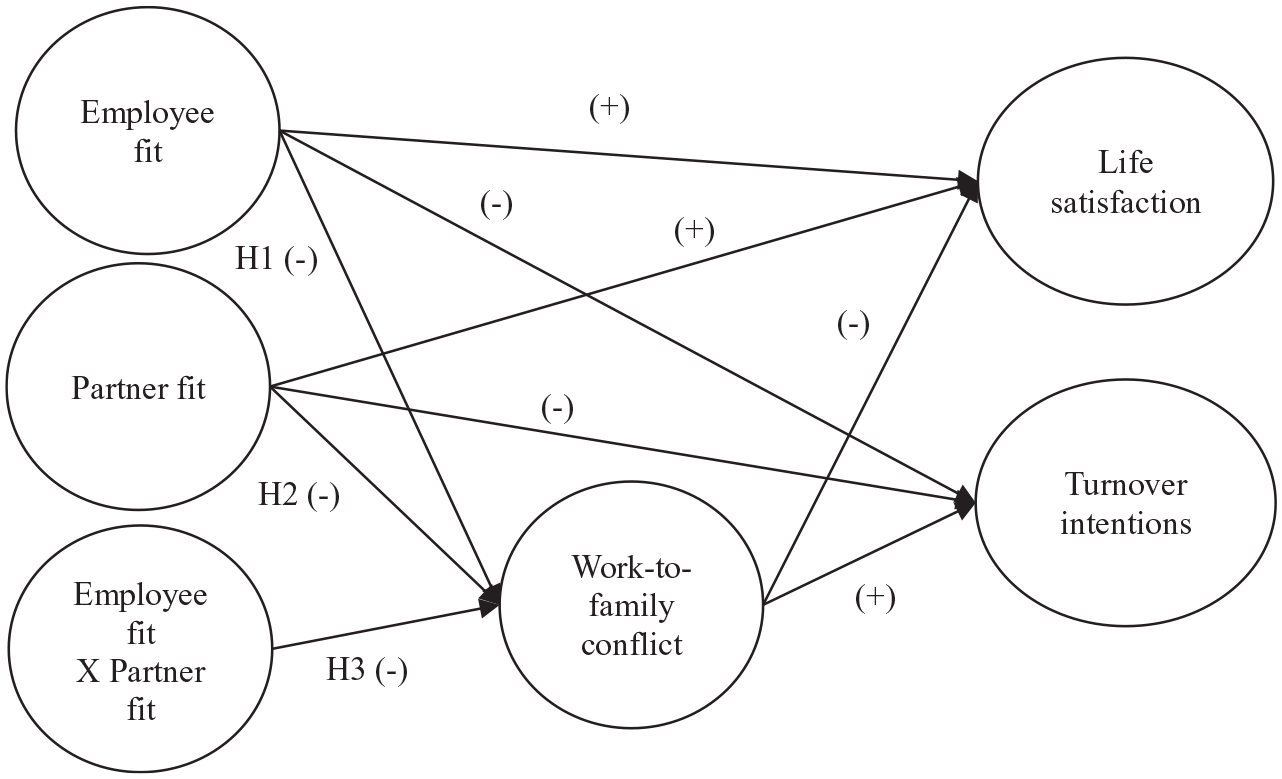
Proposed structural model (Model 3-2).
This study makes a number of contributions, including moving the needle on relational considerations in relation to the work–family interface, answering recent calls to that end (Casper et al., 2018; Wayne et al., 2019). Casper et al. (2018) lamented that even relational aspects of the work–family interface were almost exclusively assessed using single-source self-report measures. However, because relational aspects reflect alignment of expectations between role-related partners, we must account for perceptions of both employees and their partners to address relational aspects of the work–family interface (Casper et al., 2018). We put forth the concept of partner fit and objectively calculate the extent to which the partners’ expectations (values) regarding employees’ role involvement align with employees’ role involvement. For example, when partners expect employees to invest more time and energy at home, yet employees are more heavily involved in work, low partner fit is exemplified, such that the partner’s expectations regarding the employee’s role involvement are not aligned with the employee’s actual role involvement. Alternately, if a partner expects the employee to concentrate predominantly on their career (e.g., to prioritize career success or job security as the breadwinner), and the employee is indeed highly involved in work, this situation exemplifies high partner fit because the partner’s role values are aligned with the employee’s actual role involvement. Accounting for partner fit in this way allows for assessments of how employees’ behavior patterns satisfy partners’ priorities and values regarding the employee’s work and family roles. Moreover, accounting for the relational considerations inherent in the work–family interface offers unique insight into common outcomes of import.
To our knowledge, this is the first explicit examination of relational considerations of the work–family interface as based on empirically derived fit determinations – an important angle that has heretofore been largely underrepresented in the literature, despite being increasingly heralded from a conceptual perspective (e.g., Casper et al., 2018; Wayne et al., 2019). Indeed, such relational considerations offer a more accurate understanding of the work–family interface, including employee fit’s direct and indirect relations with work–family conflict and more distal outcomes, as well as the extent to which partner fit impacts the strength and nature of those relations. In so doing, we offer a thorough consideration of the relational nature of the work–family interface, and how alignment – or lack thereof – of role involvement and role values, both within- and between-persons, impacts key individually and organizationally relevant outcomes. In so doing, our work advances relational work–family research both conceptually and empirically.
Employee fit and partner fit: Conceptual and operational definitions
Drawing from the person–environment fit perspective (Edwards et al., 2006), we define employee fit as an alignment between employee role value (i.e., employee’s role priority between the work and family) and employee role involvement. If employees invest a large amount of time, energy, and attention in their work and correspondingly value the work role, high employee fit results. On the other hand, if employees desire to spend substantial time with their family but instead actually spend much of their time on work, employee fit is low. Partner fit is defined as an alignment between the partner’s role value (i.e., partner’s expectations regarding employee’s role involvement between the work and family) and the employee’s role involvement. Thus, if employees invest most of their time, energy, and attention on their work while their partners expect them to invest most of their time, energy, and attention on their family, partner fit is low. On the other hand, high partner fit is achieved when the partner’s expectation for the employee’s family involvement is aligned with the employee’s actual family role involvement.
Of the types of person–environment fit (i.e., needs–supplies fit, demands–abilities fit; Edwards et al., 2006), employee fit and partner fit both reflect needs–supplies fit such that they address whether the needs and desires of the employee and the partner are met, or “supplied”, by the extent of employee role involvement across the work and family domains. Three primary approaches have been used in operationalizing needs–supplies fit: atomistic, molecular, and molar (Edwards et al., 2006). The atomistic approach assesses respondents’ needs and supplies separately, combining the two values to measure fit. The molecular approach measures respondents’ perception of discrepancies between needs and supplies. The molar approach evaluates respondents’ perceived fit between needs and supplies (Edwards et al., 2006). Evidence suggests that these three approaches are related to only a modest extent, and thus should not be considered interchangeable (Edwards et al., 2006).
We take an atomistic approach to operationalizing employee fit and partner fit. Specifically, we assess employees’ role involvement, their own role values, and their partners’ expectations and values separately. We then calculate whether employees’ role involvement is aligned with their own role value (assessing employee fit), as well as whether employees’ role involvement is aligned with their partners’ expectations and values (assessing partner fit). We took an atomistic approach to employee fit and partner fit because assessing partner fit by measuring partner-reported role value (i.e., needs) and employee-reported role involvement (i.e., supplies) separately enables a more relational consideration between the marital dyad. This approach has a methodological advantage in that it helps researchers avoid biases subject to individuals’ tendency to interpret their environment in such a way so as to secure a positive self-concept and avoid cognitive dissonance (Kristof-Brown et al., 2005). Operationalizing partner fit with the atomistic approach overcomes this by taking a truly relational fit perspective that assesses the person and the environment from different sources.
Distinctiveness of employee fit and partner fit from other fit constructs
To clarify the construct space and avoid a jingle-jangle fallacy (Casper et al., 2018), we next briefly address how our dyadic fit assessment of employee fit and partner fit differs from other fit-related constructs in the work–family literature (e.g., work–family fit, work–hour fit, work and family authenticity, work–family balance). Table 1 provides a list of conceptual definitions for work–family constructs in order to improve understanding of the construct space. Employee fit and partner fit are conceptually different from work–family fit (Voydanoff, 2005), such that the latter captures the degree to which “the resources associated with one role (e.g., family) are sufficient to meet the demands of another role (e.g., work)” (Voydanoff, 2005: 825, parentheses added), aligning with needs–supplies fit (Edwards et al., 2006). Although both employee fit and partner fit also capture the needs–supplies fit, they assess whether employees’ and their partners’ expectations about their role involvement across work and family are aligned with their actual involvement across both roles. Employee fit and partner fit are also distinct from work–hour fit (Sturman and Walsh, 2014) such that the former captures desired and actual resource investment across work and family domains, while the latter captures desired and actual resource investment in the work role alone. Further, number of work hours does not always indicate the actual involvement in work because employees may engage in family or nonwork-related activities at the workplace. Work role involvement goes beyond work hours and reflects the energy and attention that one is devoting to work-related goals.
Conceptual definitions and measurement of work–family constructs.
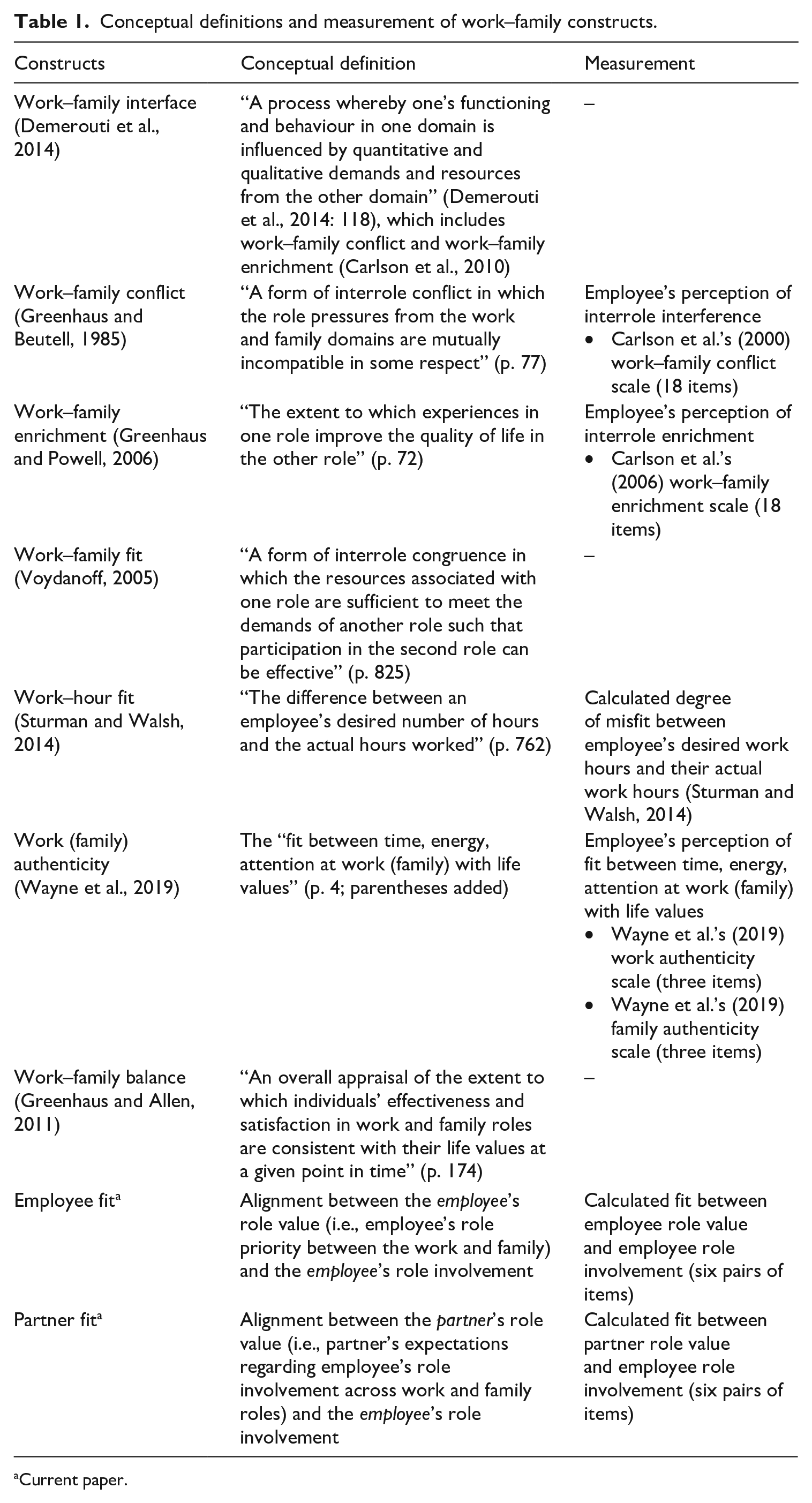
Current paper.
Work [family] authenticity closely aligns with the conceptual definition of employee fit in that it represents the fit between time, energy, and attention at work [family] with life values (Wayne et al., 2019). However, it too is distinct from employee fit and partner fit in two primary ways. First, similar to work–hour fit (Sturman and Walsh, 2014), work authenticity and family authenticity capture employees’ perceived fit between desired and actual resource investment in the work role and the family role respectively. Thus, they are role-specific. On the other hand, employee fit and partner fit capture their and their partners’ desired and actual resource investment across work and family roles. Second, while both work (family) authenticity and employee (partner) fit capture needs–supplies fit (Edwards et al., 2006), work (family) authenticity takes a molar approach by directly asking respondents about their perceived fit between their role involvement and value (Edwards et al., 2006; Wayne et al., 2019). On the other hand, we take an atomistic approach to employee fit and partner fit by separately asking respondents (and partners) about their role values and their role involvement. We then combined these needs and supplies to measure fit. This is notable such that fit scholars have suggested that the atomistic and molar approaches to fit offer distinct value and are therefore uniquely beneficial (Edwards et al., 2006).
Finally, employee fit and partner fit are distinct from work–family balance (Greenhaus and Allen, 2011) such that the latter captures “an overall appraisal of the extent to which individuals’ effectiveness and satisfaction in work and family roles are consistent with their life values at a given point in time” (Greenhaus and Allen, 2011: 174; emphases added). Thus, work–family balance takes the molar approach by capturing individuals’ overall appraisal or perceived fit. Further, while employee fit and partner fit focus on employees’ role involvement across work and family roles, work–family balance focuses on employees’ effectiveness and satisfaction in those roles. Thus, employee and partner fit are conceptually different from work–family balance, though, importantly, may contribute to balance (Greenhaus and Allen, 2011).
Employee fit as a predictor of work–family conflict
From a role scarcity perspective, work–family conflict is understood as “a form of interrole conflict in which the role pressures from the work and family domains are mutually incompatible in some respect” (Greenhaus and Beutell, 1985: 77). As such, work–family conflict represents a proverbial struggle between these two central domains, whereby both are particularly demanding of resource investment (time, energy, effort) on the part of the focal individual. Work–family conflict is bidirectional, such that work can interfere with family (i.e., work-to-family conflict) and family can interfere with work (i.e., family-to-work conflict; Netemeyer et al., 1996). Work–family conflict arises, in part, from nonoptimal resource allocation that does not fit with one’s inner values (Kofodimos, 1993). Thus, a misalignment between one’s values and work role involvement is likely to cause individuals to experience work–family conflict (e.g., Sturman and Walsh, 2014).
Drawing from person–environment fit perspective (Edwards et al., 2006), we propose that employee fit, an objective fit between the employee’s role involvement and role values, functions as an antecedent of work–family conflict. Employee fit takes an atomistic approach by measuring employees’ values and current behavior patterns (i.e., desired states and actual states) separately, then combining them to construct the fit variable. A person–environment fit perspective suggests that fit based on the atomistic approach influences perceived person–environment discrepancy (i.e., molecular approach), which in turn influences perceived person–environment fit (i.e., molar approach) and other outcomes such as satisfaction and well-being (Edwards et al., 2006). Given that work–family conflict is employees’ experience of their work interfering with their family or vice versa, we suggest that work–family conflict reflects employees’ perceived discrepancy between their desired and actual resource allocation. For example, when employees perceive that they invest more than their desired amount of time, energy, and attention toward work, thereby compromising their ability to invest their desired amount of resources in their family, this perception of discrepancy between the desired and actual resource allocation is likely to increase work–family conflict. As the person–environment fit perspective considers fit based on the atomistic approach (i.e., employee fit) as a predictor of the perceived discrepancy on which work–family conflict is based, we suggest that employee fit is likely to precede work–family conflict. Notably, Sturman and Walsh’s (2014) work–hour fit likewise aligns with the atomistic approach by calculating degree of fit between desired and actual work hours, proposing work–hour fit as an antecedent of work–family conflict. On the other hand, Wayne et al.’s (2019) work and family authenticity aligns with the molar approach, measuring employees’ perceptions of fit between their investment of time, energy, and attention at work [family] with their life values and proposing them as outcomes of work–family conflict. Our approach aligns with atomistic fit, considering employee fit as a predictor of work–family conflict.
Importantly, we suggest that work–family conflict is not likely to precede employee fit for two primary reasons. First, although it is reasonable to expect that employees may prioritize their involvement in the role that suffered interference from another role in order to compensate previous behavior patterns (Maertz and Boyar, 2011; Shockley and Allen, 2015), it is unclear whether this change in role involvement increases or decreases the alignment between their role value and the role involvement. Further, employees may not have the discretion to reduce their work role involvement, even after experiencing work-to-family conflict. It is also difficult to predict how employees’ experience of work–family conflict might influence their role value. For example, while employees’ experience of work-to-family conflict may make their family role salient in their mind, they may also justify their current work-focused behavior patterns by compromising their family role values so as to avoid cognitive dissonance (Festinger, 1957).
Thus, we suggest that employee fit is negatively associated with work–family conflict, specifically positioning employee fit as an antecedent of work–family conflict. When employees’ work role involvement is not aligned with their role values (i.e., lack of employee fit), they are likely to perceive that their current allocation of time, attention, and energy toward work does not fit with their desired allocation. Thus, employees will evaluate that their resource investment in work, for example, is incompatible with their expectations and desires for family involvement. On the other hand, when employees’ role involvement is aligned with their role value (i.e., employee fit), they will perceive that they are successfully dividing their time, attention, and energy between work and family domains (e.g., Sturman and Walsh, 2014), resulting in lower work–family conflict.
Hypothesis 1: Employee fit is negatively associated with work–family conflict.
Partner fit as a predictor and moderator of work–family conflict
Based on ecological systems theory (Bronfenbrenner, 1989), a systems perspective of the work–family interface (Voydanoff, 2002: 138) suggests that employees’ “work and family are microsystems consisting of networks of face-to-face relationships”. This microsystem represents “interpersonal relationships and social roles through which individuals interact with their social context” (Greenhaus and Ten Brummelhuis, 2014: 18). Employees function within an interconnected relational system in the work and family domains, and thus, the perspectives of relevant others (e.g., partner) must be considered in a comprehensive understanding of relational processes. This is in line with the crossover mechanisms through which a partner’s work–family interface impacts the employee directly or indirectly (Westman, 2001, 2013). Indeed, partners’ reports of work–family conflict explain significant variance in employees’ own conflict (Hammer et al., 1997), reinforcing the value of a dyadic approach. Similarly, employees’ work–family conflict has been found to reduce their spouses’ family satisfaction and well-being (Lavner and Clark, 2017; Lu et al., 2016).
We take a systems perspective and a person–environment fit perspective in considering the role of partner fit, in addition to employee fit, in work–family conflict (Edwards et al., 2006; Greenhaus and Ten Brummelhuis, 2014). Specifically, we suggest a crossover mechanism (Westman, 2001) by which low partner fit results in elevated work–family conflict (Hypothesis 2) and diminishes the benefits of employee fit in reducing work–family conflict (Hypothesis 3). We expect that lower partner fit leads to higher employee work–family conflict for two reasons. First, if a worker’s role involvement fits their own values but not their partner’s values, this means that the work is incongruent with their spouse’s goals and thus likely to frustrate the partner (Fox and Spector, 1999), leading to negative feedback and emotionality from the partner. Employees’ experience of their partners’ misfit and dissatisfaction should increase their own work–family conflict because, in such a case, their own work involvement is incongruent with their partner’s values and thus interferes with their partner’s goals, rendering work and family incompatible. This would be true even if the level of work involvement is consistent with the employee’s own values. Second, negative interactions with their partners at home are likely to drain the employee’s energy, decreasing the energy available for work. Several resource-based theories of work–family conflict suggest that when energy is depleted in one role, it likely reduces energy for another role, resulting in interrole conflict (e.g., Edwards and Rothbard, 2000; Ten Brummelhuis and Bakker, 2012).
Hypothesis 2: Partner fit is negatively associated with work–family conflict.
We also expect that partner fit strengthens the negative relationship between employee fit and work–family conflict. In other words, we suggest that the negative effect of employee fit on work–family conflict will become stronger when partner fit is high, and weaker when partner fit is low. In cases of low partner fit, the partner is likely to show dissatisfaction and less support for the employee, diminishing the benefits of employee fit for the work–family interface. In contrast, in cases of high partner fit, partners are likely to show satisfaction with the employees’ involvement in the work and family domains, show positive attitudes, and offer more support toward the employee (Green et al., 2011; Wayne et al., 2013). Thus, employees will perceive their partners’ endorsement and support when there is high partner fit. This support and endorsement will (a) give employees a feeling of confidence in their current resource allocation between their work and family domains and (b) provide them with the emotional energy needed for work, thereby further lessening work–family conflict. As such, we expect that high partner fit enhances, and low partner fit diminishes, the benefits of employee fit for the work–family interface.
Hypothesis 3: Partner fit will moderate the negative relationship between employee fit and work–family conflict, such that the relationship will be more negative when partner fit is high.
Work–family conflict as a mediating mechanism between fit and outcomes
Moving beyond the direct (moderated) relation specified in Hypotheses 1–3, we suggest that work–family conflict may partially mediate employee and partner fit’s relationship with distal outcomes of fit, to include life satisfaction and turnover intentions. Regarding the former, we would reasonably expect employees’ work–family conflict stemming from low employee fit to lower their satisfaction with life. Specifically, employees who experience frequent incompatibility between work and family roles struggle to satisfy their role-related demands, often leading to psychological distress (Frone et al., 1992), which impairs quality of life. Likewise, work–family conflict is consistently found to result in negative consequences (e.g., Amstad et al., 2011) at both between-individual (e.g., Zhang et al., 2012) and within-individual levels (e.g., Goh et al., 2015).
Low employee fit is similarly expected to negatively influence employees’ life satisfaction, as domain discrepancies regarding competing resource investment needs are likely to compromise life satisfaction by decreasing the quality of one’s experiences in both domains (Higgins et al., 1992). Indeed, when employees experience difficulties in meeting work or family demands as a result of depleted time, energy, and attention, they are likely to experience increased psychological distress (Huffman et al., 2017; Westrupp et al., 2016) and poorer psychological well-being (Noor, 2003), thereby impairing quality of life. When employees’ role involvement is not aligned with their role values (i.e., lack of employee fit), they are likely to expend too much time, attention, and energy in the work domain, resulting in insufficient resource investment in the family domain. Moreover, scholars have conceptually suggested (Friedman and Lobel, 2003) and empirically found (Wayne et al., 2019) that greater alignment (fit) between values and investments results in positive outcomes, including work–family balance, life and job satisfaction, and organizational commitment. Such direct relations are underpinned by fit theories (Edwards et al., 2006) and intrinsic motivation approaches (e.g., self-determination theory; Ryan and Deci, 2000; broaden-and-build theory; Fredrickson, 2001) as well as early conceptual (Kernis and Goldman, 2006) and recent empirical (Wayne et al., 2019) work on employee authenticity, which suggest that when individuals pursue that which is inherently valuable to them they are more likely to enjoy positive outcomes. Such research further indicates that fit between one’s values and behaviors may also directly predict life satisfaction independent of work–family conflict (Wayne et al., 2019).
As hypothesized above, drawing from a crossover mechanism (Westman, 2001) and systems perspective (Greenhaus and Ten Brummelhuis, 2014), partners’ experiences of negative affectivity (e.g., dissatisfaction, frustration) stemming from misalignment between their expectations about employees’ role involvement and employees’ actual role involvement are expected to crossover into employees’ experiences of work–family conflict. This is because (a) partners’ frustration stemming from the misalignment may lead to negative emotional expression toward employees, and (b) this negative interaction is likely to drain employees’ energy at home, impairing work performance and resulting in work–family conflict, in turn threatening life satisfaction (Goh et al., 2015; Zhang et al., 2012). As with employee fit, we suggest that partner fit may also directly influence employees’ life satisfaction, independent of work–family conflict. As mentioned above, partners who are dissatisfied with employees’ resource allocation across domains may direct the resulting negative emotions toward employees. Employees who experience such negative emotional expressions from their partners are likely to experience similar negative emotions through emotional contagion (Schoenewolf, 1990). Thus, taken together, we suggest that both employee fit and partner fit will indirectly (through work–family conflict) and directly influence employees’ life satisfaction:
Hypothesis 4a: The positive relationship between employee fit and life satisfaction is partially mediated by work–family conflict.
Hypothesis 4b: The positive relationship between partner fit and life satisfaction is partially mediated by work–family conflict.
For similar reasoning, it is also likely that the indirect effects of employee fit and partner fit on turnover intentions are partially mediated by work–family conflict. When work–family conflict increases, employees have trouble dealing with competing demands of work and family domains (Greenhaus and Beutell, 1985). Moreover, employees who spend a lot of time at work may try to reclaim more time with their families by lessening or even discontinuing involvement at work (Dugan et al., 2012). It follows, then, that when employees experience incompatible demands from work and family domains, they may withdraw from their jobs to cope with these demands. For example, employees are likely to move to a more family-friendly company when experiencing high work–family conflict (Nohe and Sonntag, 2014). Indeed, Amstad et al.’s (2011) meta-analysis on consequences of work–family conflict showed consistent, positive relationships between work–family conflict and turnover intentions. Moreover, the spouse’s perception of the employee’s work–family conflict was positively related to the employee’s job searching behavior (Watkins et al., 2012). Consistent with these findings, viewed within the additional context of the likely direct relation with fit justified above, we expect work–family conflict to partially mediate the relationship between employee and partner fit and turnover intentions. When employees experience misalignment between their work role involvement and role priorities, or their partners experience misalignment between the employees’ work role involvement and their partners’ role priorities, employees are likely to experience incompatible role pressures from work and family domains, and subsequently attempt to adjust their behavior to resolve that discrepancy. Such attempts may include extreme measures such as resigning in order to seek or accept an alternative position in a more family-friendly company or role.
Hypothesis 5a: The negative relationship between employee fit and turnover intentions is partially mediated by work–family conflict.
Hypothesis 5b: The negative relationship between partner fit and turnover intentions is partially mediated by work–family conflict.
Partner fit as moderating indirect relations between employee fit and outcomes
Layering a systems (Greenhaus and Ten Brummelhuis, 2014) and crossover (Westman, 2001) perspective onto these proposed relations, we further hypothesize that partner fit will influence the relationship between employee fit and work–family conflict, with implications for life satisfaction and turnover intentions. As proposed in Hypothesis 3, we expect that partner fit will moderate the negative effect of employee fit such that the effect of employee fit on work–family conflict will be stronger when partner fit is high. Subsequently, employees’ experience of work–family conflict should lead employees to be less satisfied with their lives as they perceive their work and family roles to be incompatible. Taken together, we suggest that partner fit will moderate the indirect effect of employee fit on life satisfaction via work–family conflict. Specifically, in cases of high partner fit, higher employee fit will lead to an increase in life satisfaction mediated by decreased work–family conflict. On the other hand, in cases of low partner fit, the negative relationship between employee fit and work–family conflict will be weakened, thus employee fit will have a weaker indirect effect on life satisfaction.
Hypothesis 6: Partner fit will moderate the strength of the mediated relationship between employee fit and life satisfaction via work–family conflict, such that the relation will be stronger and more positive when partner fit is high.
In a similar vein, the aforementioned (mis)alignment between employees’ work role involvement and role priorities, and the subsequent incompatible role pressures from work and family domains, is likely to be particularly problematic when the employee’s partner holds competing values and expectations regarding the employee’s responsibilities in the home domain. As proposed in Hypothesis 3, partner fit is expected to moderate the effect of employee fit on work–family conflict such that the negative effect of employee fit on work–family conflict will be greater when partner fit is high. Here, we further consider that in cases of high partner fit, employee fit will predict lower turnover intentions, as mediated by decreased work–family conflict, whereas in cases of low partner fit, the negative relationship between employee fit and work–family conflict will be weakened, and thus employee fit will have a weaker indirect relationship with turnover intentions.
Hypothesis 7: Partner fit will moderate the strength of the mediated relationship between employee fit and turnover intentions via work–family conflict, such that the relation will be stronger and more negative when partner fit is high.
Method
Participants and procedures
Participants were 199 marital dyads (employees and their domestic partners) in South Korea (378 employees invited; 53% response rate). Of those, 20 dyads were removed owing to incomplete surveys, resulting in a final sample of 179 dyads. Respondents were sourced via personal and professional contacts and from public institutions, including those in Bucheon, one of the largest cities in South Korea. Employee participants were required to be employed full-time and live with their spouses/partners, and were instructed not to consult with their partners while responding. They were 68.7% male and averaged 43.8 years of age (SD = 9.85). In total, 4.5% of participants had been employed in their role for <1 year, 21.2% from 1–5 years, 22.3% from 5–10 years, 10.6% from 10–15 years, and 40.2% >15 years. They were employed in various occupations, including service (59.8%), manufacturing (12.8%), distribution (3.9%), and finance (3.9%). Partner participants averaged 42.6 years of age (SD = 9.25) and 68.9% of partners were employed. Marital duration averaged 15.4 years (SD = 10.5) and the average number of children per couple was 1.50 (SD = 0.90).
Measures
With the exception of two measures that had pre-existing Korean versions (work–family conflict, Yoo et al., 2012; turnover intentions, Lee and Suh, 2014), all measures originated in English and, in line with best practice (e.g., Brislin, 1970), were translated into Korean by the first and third authors independently, and subsequently back-translated by the first author and two additional bilingual scholars who were otherwise unaffiliated with the study and not privy to the original English scales. 1 Unless otherwise noted, all response scales were five-point Likert scales (1 = not at all, 5 = very much). See Table 2 for means, standard deviations, reliability estimates, and correlation and covariance coefficients.
Means, standard deviations, correlations, covariances, and reliability estimates for study variables.
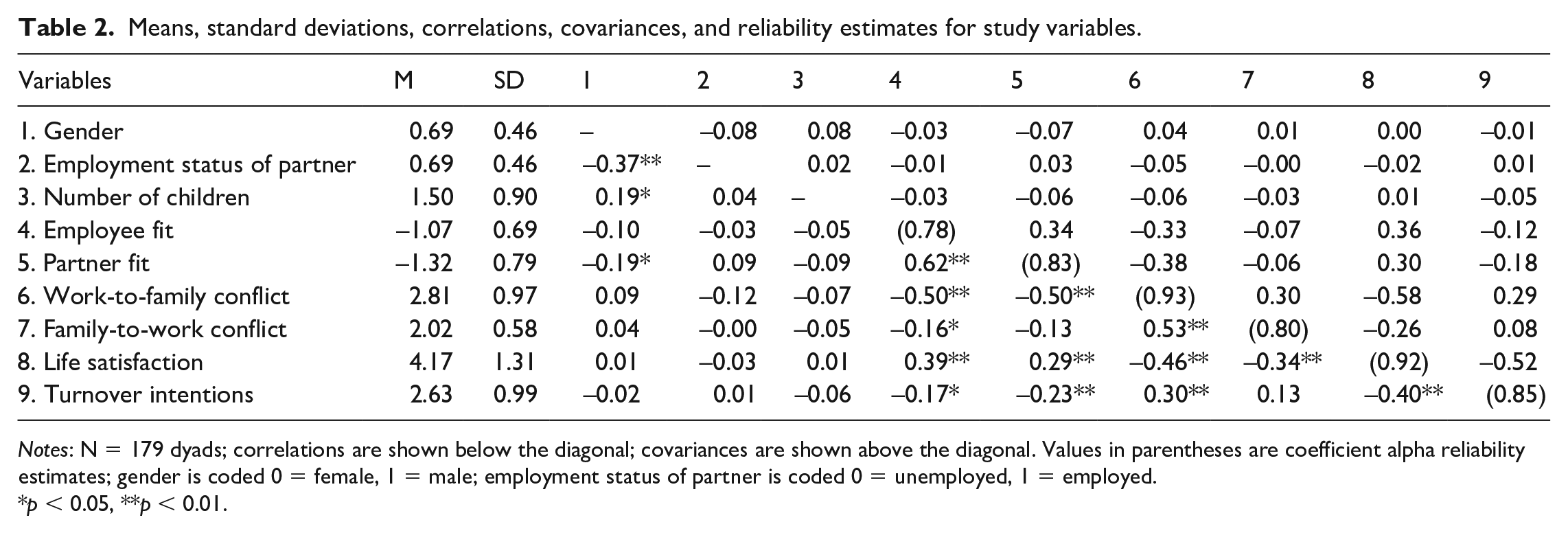
Notes: N = 179 dyads; correlations are shown below the diagonal; covariances are shown above the diagonal. Values in parentheses are coefficient alpha reliability estimates; gender is coded 0 = female, 1 = male; employment status of partner is coded 0 = unemployed, 1 = employed.
p < 0.05, **p < 0.01.
Employee role value was assessed with an adaptation of the work centrality (Kanungo, 1982) and family centrality (Rothbard, 2001) scales, assessing the extent to which respondents assign importance to work orientation or family orientation. We combined the scales to create six bipolar items, so as to allow for a preferentially valued domain to emerge. We asked participants to refer to their own life and values as opposed to general beliefs. A sample item is, “In my view, my personal life goals should be work-oriented rather than family-oriented.” Higher scores indicated a greater value placed on the work role; low scores indicated greater value placed on the family role.
Employee role involvement was measured via an involvement-focused adaptation of the role value measure (Kanungo, 1982; Rothbard, 2001), yielding a six-item scale with items reflecting employees’ role involvement over the past three months. A sample item is, “Considering my behavioral patterns in the last three months, I am currently living a work-oriented life rather than a family-oriented life.” Higher scores indicated greater involvement in the work role; low scores indicated greater involvement in the family role.
Partner role value was measured using an adaptation of the six items in the employee role value scale so as to reflect the partner’s perspective of how they desire the employee to value work roles in comparison to family roles. A sample item is, “In my view, my partner’s personal life goals should be work-oriented rather than family-oriented.” Higher scores indicated the partner’s greater expectation for the employee’s involvement in the work role; low scores indicated the partner’s greater expectation for the employee’s involvement in the family role.
Employee fit was calculated as the absolute value of the discrepancy between an employee’s role value and that employee’s role involvement. Employee fit was scored as a negative value, with a maximum value of zero and with scores closer to zero (i.e., higher scores) indicating a greater degree of fit. This followed procedures established in the literature (e.g., Cao et al., 2009; Jackson and Johnson, 2012; Venugopal et al., 2020). Specifically, the absolute values (with a negative sign assigned) of the discrepancies were calculated for each of six item pairs of employee role value and employee role involvement (e.g., employee fit item 1 = ‒ |employee role value item 1 – employee role involvement item 1|). We assigned the negative sign to the absolute value of the discrepancy because the absolute value itself indicates the degree of misfit (e.g., lower fit); thus adding the negative sign optimizes interpretation such that higher values indicate higher fit. For example, we subtracted each individual’s score (e.g., 5) for the first item of employee role involvement from the score (e.g., 3) for the first item of employee role value. Then, we took the (negative) absolute value of this discrepancy. This resulted in six values of employee fit, one for each item pair. In order to perform descriptive statistics analyses and independent sample t-tests, we averaged these six resultant values. For the structural equation modeling (SEM) analysis, we specified each of the six values as an indicator of employee fit.
Partner fit was calculated as the absolute value of the discrepancy between the partner’s role value and the employee’s role involvement. Partner fit was scored as a negative value, with a maximum value of zero and with scores closer to zero (i.e., higher scores) indicating a greater degree of partner fit. Like employee fit, partner fit value was calculated via the absolute values (with a negative sign assigned) of discrepancies for each of six pairs of partner role value and employee role involvement items, resulting in six scores. As above, we averaged these six resultant values when performing descriptive statistics analyses and independent sample t-tests, and specified each of the six values as an indicator of partner fit in the SEM analysis.
We used the six item-level absolute values of difference scores to measure employee fit and partner fit for three primary reasons. First, although some have raised a caution regarding reliability of difference scores (Edwards and Cooper, 1990), utilizing multi-item and multi-source data reduces this problem (Tisak and Smith, 1994). The current study uses multi-item measures for each component of employee fit and partner fit (i.e., employee’s role value, employee’s role involvement, partner’s role value) and data were collected from multiple sources (i.e., employees and their partners), guarding against this potential problem. Supporting this, coefficient alphas for employee fit and partner fit measures were 0.78 and 0.83, respectively.
Second, a polynomial regression approach may be inappropriate in the current study specifically. This is because a relatively large sample size (N>1000) is generally required to attain enough power to gain stable estimates of each coefficient in polynomial regression (Yang et al., 2008). The polynomial regressions used to assess congruence also suffer from significant multicollinearity because the regression equation includes multiple related terms of independent variables (i.e., X, Y, X 2, Y 2, XY; Kristof, 1996; Yang et al., 2008). In light of the current sample size of 179 dyads, polynomial regression analysis may lead to erroneous conclusions owing to insufficient power to obtain stable estimates for the specific terms. Additionally, polynomial regression is empirically driven in that it includes all possible linear, polynomial, and interaction effects among the variables. Others (e.g., Witt and Ferris, 2003) have likewise argued that polynomial regression may not be appropriate for theory-based hypotheses directly about absolute fit, especially when the sample size is not large enough to obtain stable estimates of each of those terms.
Finally, the current study hypothesizes an interaction effect of employee fit and partner fit in predicting work–family conflict and the extended moderated mediation effects on life satisfaction and turnover intentions. The interaction between employee fit and partner fit cannot to our knowledge be tested with polynomial regression (Jackson and Johnson, 2012), as addressed later. Thus, we used the item-level absolute value of difference scores for measuring employee fit and partner fit in the current study.
However, for interested readers we offer results from response surface analysis (RSA; Edwards and Parry, 1993; Shanock et al., 2010) and polynomial regression as online supplemental material. We used the procedure introduced by Shanock et al. (2010), estimating the polynomial regression model where the outcome variable (Z; e.g., work-to-family conflict) is regressed on two predictors (X, Y; e.g., employee role value, employee role involvement), the square terms of two predictors (X 2, Y 2), and the interaction (XY). Based on the regression coefficients of each term and the resultant coefficients for the linear and curvilinear slope terms along the fit (i.e., X = Y) and misfit (i.e., X = ‒Y) lines, we tested whether the linear and curvilinear slopes along the fit and misfit lines are statistically significant (Shanock et al., 2010). Please see the online supplemental material files for detailed results.
Work–family conflict was assessed using Yoo et al.’s (2012) Korean version of Cinamon and Rich’s (2002) 14-item measure. The scale consists of seven items for work-to-family conflict and seven items for family-to-work conflict, which we analyzed separately. Sample items are “The time I invest in my work makes it hard for me to meet my family’s demand” (work-to-family conflict) and “My family life interferes with my work” (family-to-work conflict).
Life satisfaction was measured using the five-item satisfaction with life scale (Diener et al., 1985). Participants responded using a seven-point Likert-type scale from 1 (not at all) to 7 (very much); sample item, “I am satisfied with my life.”
Turnover intentions were measured with three items used by Lee and Suh (2014), based on items from Becker (1992) and Mobley (1982). We made a minor revision to one item (“I would like to stay in the current organization” to “I would not like to stay in the current organization”) to more closely align it with the original. The final three items were, “I often think of leaving the organization”, “If I could choose again, I would not work for this organization”, and “I would not like to stay in the current organization.”
Control variables
Employee gender, employment status of partner, and number of children were specified as control variables, as these demographics are consistently associated with work–family conflict (e.g., Byron, 2005; Hill et al., 2008).
Analysis
Prior to testing hypotheses, we conducted independent-samples t-tests and a confirmatory factor analysis (CFA) to test for potential group differences and to ensure discriminant validity, respectively. Mean scores were computed for each construct for independent-samples t-tests, while each indicator of study constructs was loaded on the respective latent factors when performing CFA and SEM analyses. Independent-samples t-tests indicated that employee fit, partner fit, work-to-family conflict, family-to-work conflict, life satisfaction, and turnover intentions did not differ by gender, employment status of partner, or whether the marital dyad has child(ren), with one exception: male respondents reported lower partner fit (–1.416) than did female respondents (–1.101), t = ‒2.517, p = 0.013 (Table 3).
Comparison of construct values across gender, employment status of partner, and parenthood status.
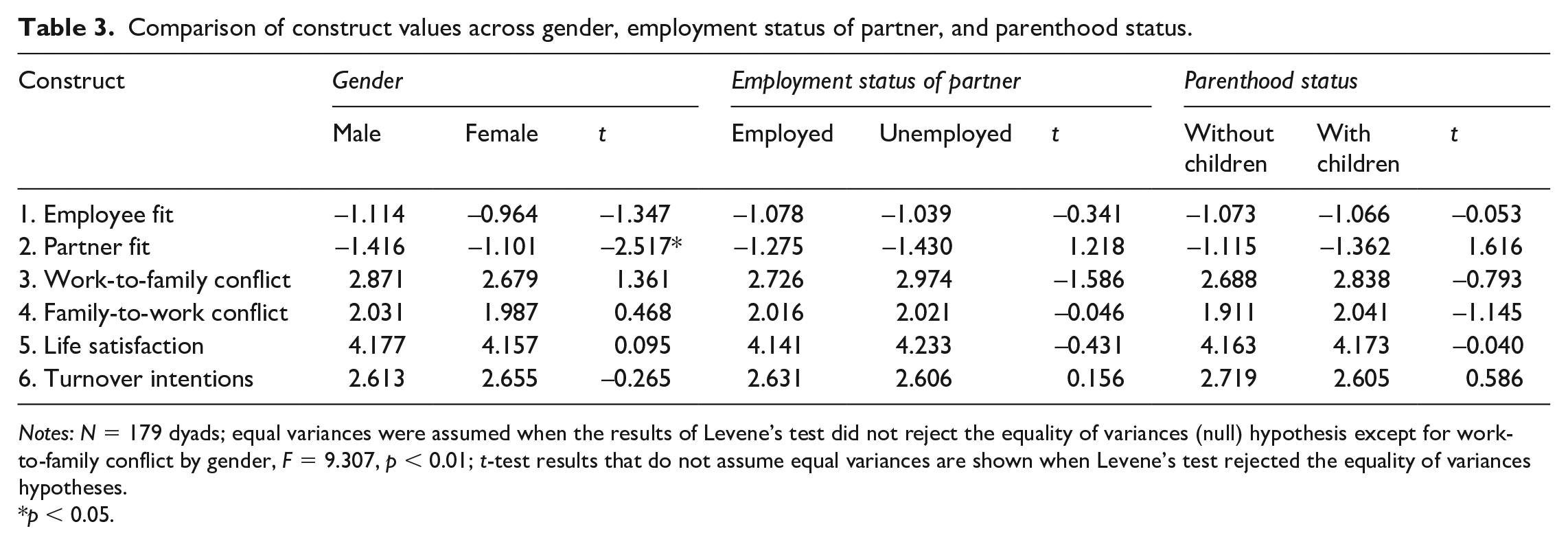
Notes: N = 179 dyads; equal variances were assumed when the results of Levene’s test did not reject the equality of variances (null) hypothesis except for work-to-family conflict by gender, F = 9.307, p < 0.01; t-test results that do not assume equal variances are shown when Levene’s test rejected the equality of variances hypotheses.
p < 0.05.
To ensure discriminant validity, we performed a CFA for the measurement model (Model 1) of our variables (employee fit, partner fit, work-to-family conflict, family-to-work conflict, life satisfaction, turnover intentions) before primary analyses. We then used SEM (AMOS 21) to test hypotheses. As aforementioned, following prior practices (e.g., Venugopal et al., 2020), we calculated indicators for employee fit and partner fit with the absolute value of the discrepancy and the resulting six indicators for employee fit and six indicators for partner fit were loaded on to the respective latent variables. Given that employee role involvement items have been used for both employee fit and partner fit, we allowed correlated uniqueness between indicators of employee fit and those of partner fit. To specify the latent variable for the interaction term of employee fit and partner fit, we took a double-mean centering approach (Crowson, 2020; Lin et al., 2010) with matched-pair choice of product indicators (PI; Foldnes and Hagtvet, 2014), yielding six indicators for the interaction term latent variable.
We initially specified a full structural model where work-to-family conflict and family-to-work conflict are considered as separate latent variables in the same model, with (Model 2-1) and without (Model 2-2) control variables. However, we found limited fit in Model 2-1 and a negative variance problem in Model 2-2, likely owing to the extent to which the two directional conflict variables are interrelated (Φ12 = 0.625 in the measurement model; Model 1) and thus including them in the same model was problematic for that reason. Thus, we specified two separate structural models. First, we specified a structural model that includes only work-to-family conflict with (Model 3-1) and without (Model 3-2) control variables. Second, we specified a structural model including only family-to-work conflict with (Model 4-1) and without (Model 4-2) control variables.
Results
Goodness-of-fit assessments
As seen in Table 4, the results showed appropriate goodness-of-fit for the measurement model (Model 1), χ²(506) = 772.87, p < 0.01, CFI = 0.92, RMSEA = 0.05 (90% CI = 0.05, 0.06), in line with commonly accepted standards (e.g., Hu and Bentler, 1999), confirming the distinctiveness of the constructs. Based on the results of measurement model, we proceeded with analyzing the structural models – one set for work-to-family conflict (Models 3-1 and 3-2), and one set for family-to-work conflict (Models 4-1 and 4-2). As seen in Table 4, the four structural models showed appropriate goodness-of-fit consistent with acceptable standards (Hu and Bentler, 1999). Given the results showed that the two structural models without control variables (Models 3-2 and 4-2) showed lower Akaike Information Criterion (AIC) and Browne-Cudeck Criterion (BCC) scores than the two corresponding structural models with control variables (Models 3-1 and 4-1), we report the path coefficients for the two structural models without control variables. However, excluding the control variables did not influence the results of significance testing. 2 As shown in Table 4, goodness-of-fit indices were appropriate for Model 3-2 [χ²(476) = 804.60, p < 0.01, CFI = 0.91, RMSEA = 0.06 (90% CI = 0.06, 0.07)], and Model 4-2 [χ²(476) = 707.90, p < 0.01, CFI = 0.92, RMSEA = 0.05 (90% CI = 0.04, 0.06)]. See Figure 1 for the final structural model.
Confirmatory factor analyses and structural equation modeling analyses.
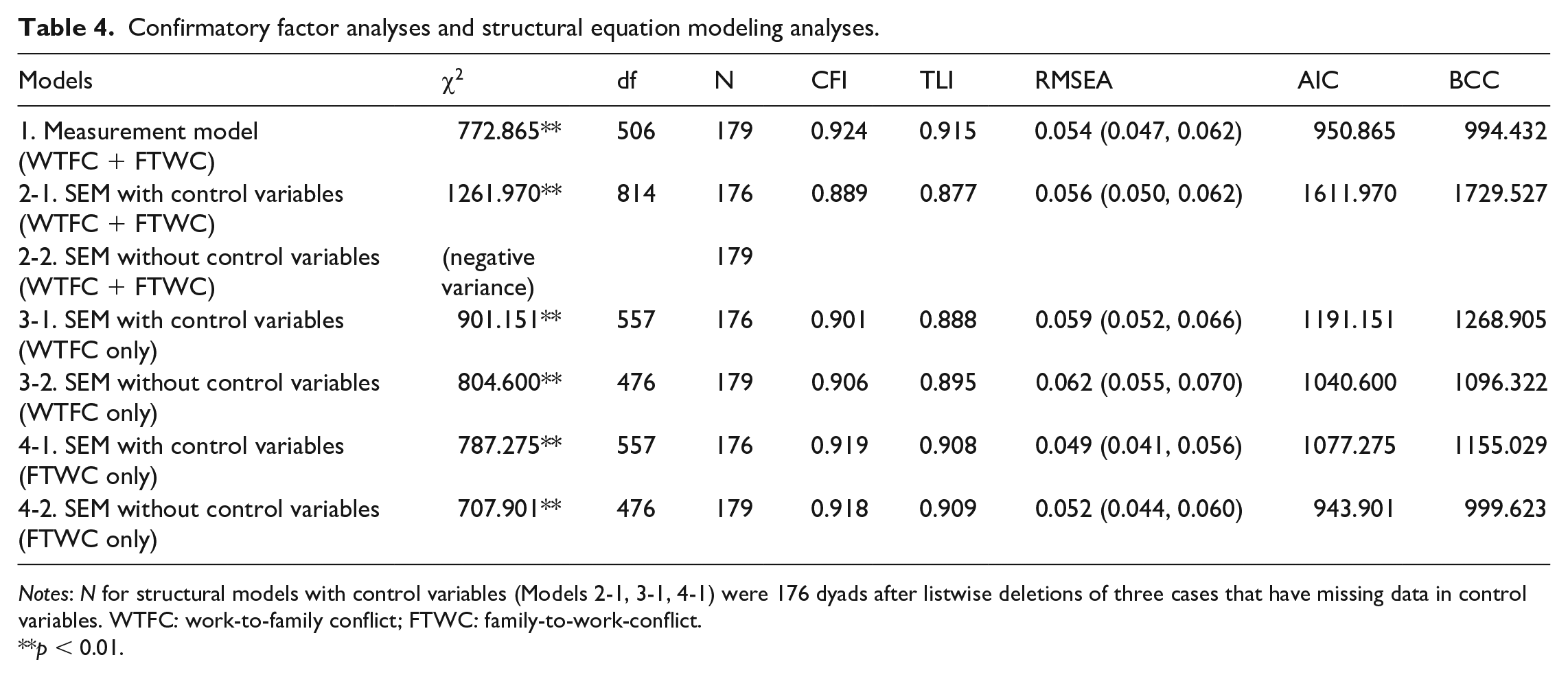
Notes: N for structural models with control variables (Models 2-1, 3-1, 4-1) were 176 dyads after listwise deletions of three cases that have missing data in control variables. WTFC: work-to-family conflict; FTWC: family-to-work-conflict.
p < 0.01.
Hypothesis testing
Path coefficients in two structural models that included the main effect terms of employee fit and partner fit, and either work-to-family conflict or family-to-work conflict, were analyzed to test Hypotheses 1 and 2. Path coefficients of structural models are shown in Table 5. As seen in Table 5, employee fit and partner fit were negatively associated with work-to-family conflict (employee fit: b = ‒0.461, p < 0.01; partner fit: b = ‒0.435, p < 0.01), but not family-to-work conflict (employee fit: b = ‒0.034, p = 0.40; partner fit: b = ‒0.026, p = 0.42). Thus, Hypotheses 1 and 2 were partially supported.
Path coefficients of structural models.
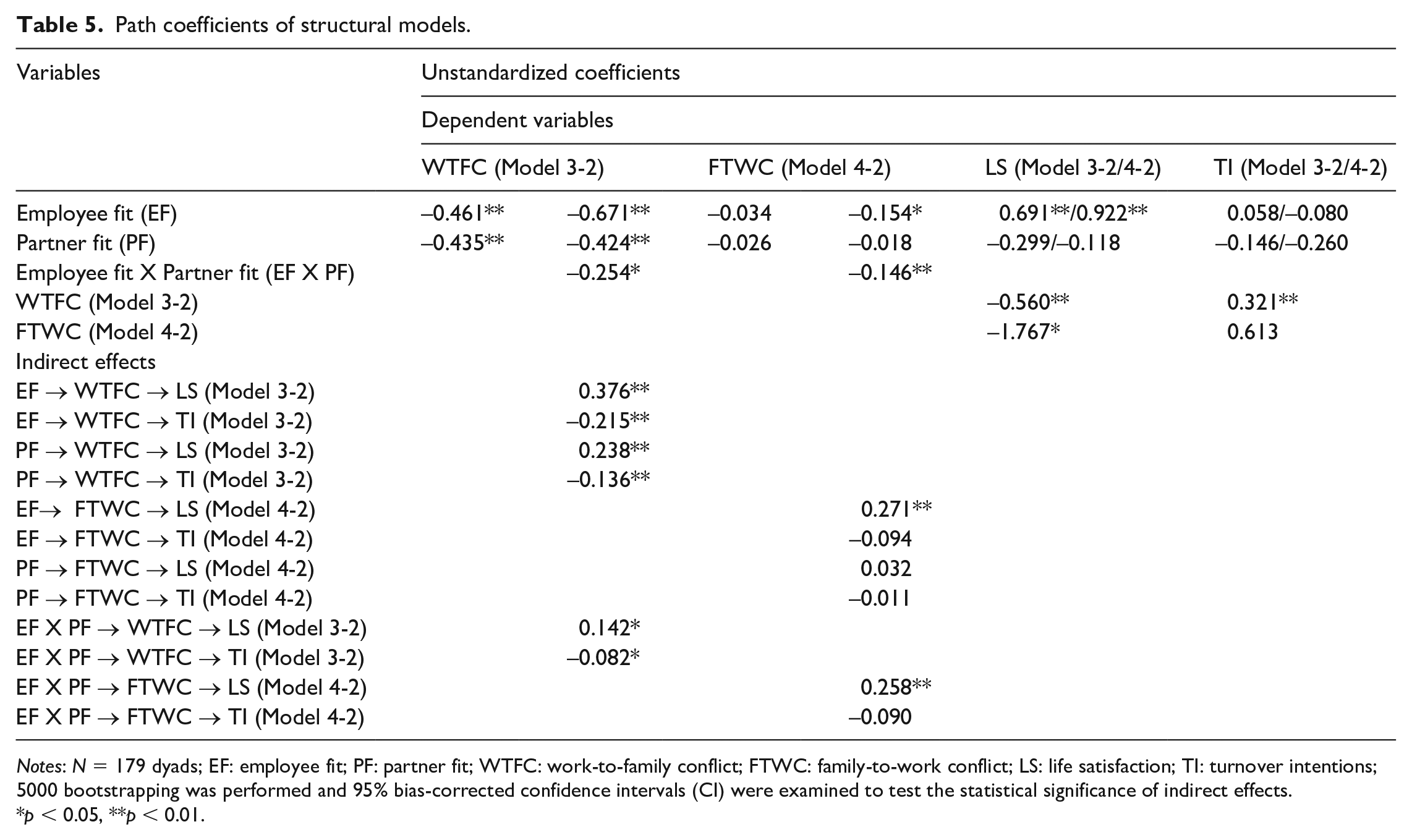
Notes: N = 179 dyads; EF: employee fit; PF: partner fit; WTFC: work-to-family conflict; FTWC: family-to-work conflict; LS: life satisfaction; TI: turnover intentions; 5000 bootstrapping was performed and 95% bias-corrected confidence intervals (CI) were examined to test the statistical significance of indirect effects.
p < 0.05, **p < 0.01.
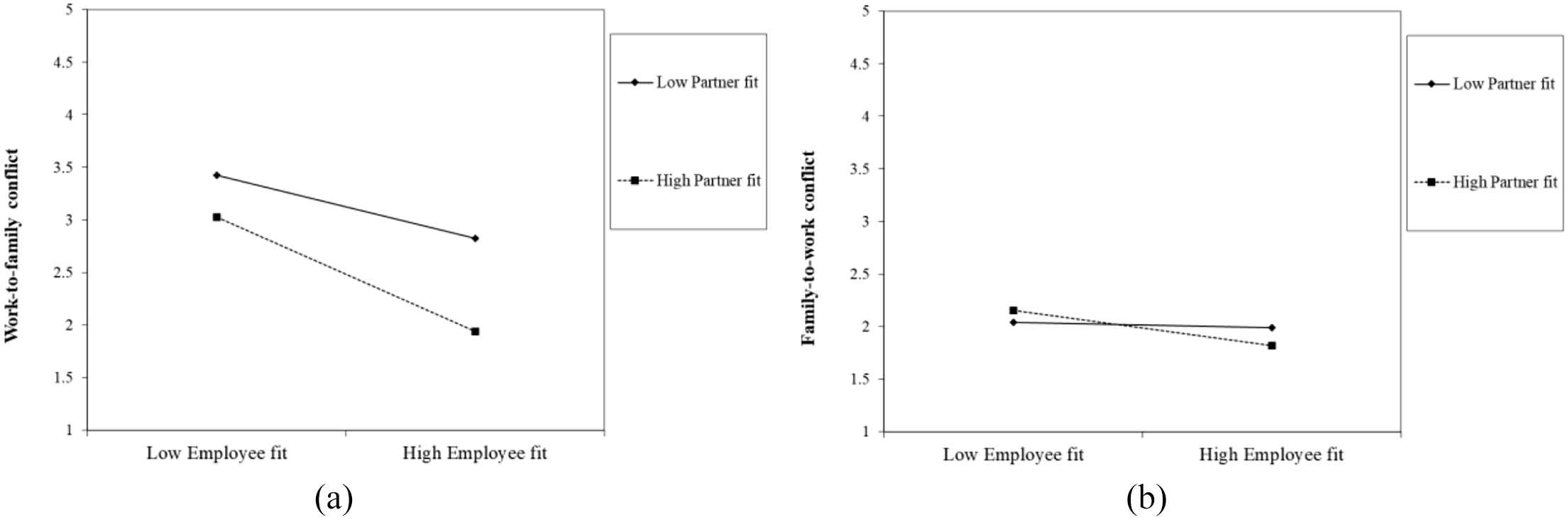
To test Hypothesis 3, path coefficients for the interaction term of employee fit and partner fit on work-to-family conflict (Model 3-2) and family-to-work conflict (Model 4-2) were estimated. The results showed that the interaction term was significantly related to work-to-family conflict, b = ‒0.254, p = 0.04, and family-to-work conflict, b = ‒0.146, p < 0.01. Thus, Hypothesis 3 was supported. Specifically, the negative relationship between employee fit and both directions of work–family conflict was greater when partner fit was high than when it was low (Figures 2a and 2b), suggesting that conflict decreases dramatically when an increase of employee fit is coupled with high partner fit.
To test Hypotheses 4a, 4b, 5a, and 5b, mediation analyses were performed with bootstrapping based on 5000 iterations and 95% bias-corrected confidence intervals (CI) in two structural models (Models 3-2, 4-2). First, we tested the indirect effects of employee fit (Hypothesis 4a) and partner fit (Hypothesis 4b) on life satisfaction via work-to-family conflict and family-to-work conflict. As seen in Table 5, indirect effects of employee fit on life satisfaction via work-to-family conflict, PYMPMX(SE) = 0.376(0.151), 95% CI = [0.14, 0.74], and family-to-work conflict, PYMPMX(SE) = 0.271(0.136), 95% CI = [0.08, 0.61] were significant. The direct effects of employee fit on life satisfaction were significant in Model 3-2, b = 0.691, p < 0.01, and Model 4-2, b = 0.922, p < 0.01. Thus, Hypothesis 4a was fully supported such that both work-to-family conflict and family-to-work conflict partially mediated the indirect effect of employee fit on life satisfaction.
As shown in Table 5, results also indicated that indirect effect of partner fit on life satisfaction via work-to-family conflict, PYMPMX(SE) = 0.238(0.110), 95% CI = [0.07, 0.50] was significant, while the indirect effect via family-to-work conflict was not significant, PYMPMX(SE) = 0.032(0.067), 95% CI = [–0.09, 0.17]. The direct effects of partner fit on life satisfaction were not significant in Model 3-2, b = ‒0.299, p = 0.11, or Model 4-2, b = ‒0.118, p = 0.51. Thus, Hypothesis 4b was partially supported such that work-to-family conflict fully mediated the indirect effect of partner fit on life satisfaction, while family-to-work conflict did not mediate this indirect effect.
Second, we tested the indirect effects of employee fit (Hypothesis 5a) and partner fit (Hypothesis 5b) on turnover intentions via work-to-family conflict and family-to-work conflict. As seen in Table 5, while the indirect effect of employee fit on turnover intentions via work-to-family conflict, PYMPMX(SE) = ‒0.215(0.115), 95% CI = [–0.54, –0.06] was significant, the indirect effect was not significant through family-to-work conflict, PYMPMX(SE) = ‒0.094(0.096), 95% CI = [–0.35, 0.04]. The results further showed that the direct effects of employee fit on turnover intentions were not significant in Model 3-2, b = 0.058, p = 0.77 or Model 4-2, b = ‒0.080, p = 0.68. Thus, Hypothesis 5a was partially supported such that work-to-family conflict fully mediated the indirect effect of employee fit on turnover intentions, while family-to-work conflict did not mediate this indirect effect.
The indirect effect of partner fit on turnover intentions via work-to-family conflict, PYMPMX(SE) = ‒0.136(0.079), 95% CI = [–0.35, –0.03] was significant, whereas the indirect effect via family-to-work conflict was not significant, PYMPMX(SE) = ‒0.011(0.030), 95% CI = [–0.11, 0.02]. The direct effects of partner fit on turnover intentions were not significant in Model 3-2, b = ‒0.146, p = 0.37 or Model 4-2, b = ‒0.260, p = 0.10. Thus, Hypothesis 5b was partially supported such that work-to-family conflict fully mediated the indirect effect of partner fit on turnover intentions, while family-to-work conflict did not mediate this indirect relationship.
Hypotheses 6 and 7 were also tested with bootstrapping based on 5000 iterations and 95% bias-corrected confidence intervals (CI) in the two structural models, estimating the indirect effects of the interaction term of employee fit and partner fit on life satisfaction and turnover intentions via work-to-family conflict and family-to-work conflict. As seen in Table 5, the indirect effects of the interaction term on life satisfaction via work-to-family conflict, PYMPMX(SE) = 0.142(0.128), 95% CI = [0.001, 0.50] and family-to-work conflict, PYMPMX(SE) = 0.258(0.267), 95% CI = [0.10, 0.78] were significant. Thus, Hypothesis 6 was supported. Results also showed that the indirect effect of the interaction term of employee fit and partner fit on turnover intentions via work-to-family conflict, PYMPMX(SE) = ‒0.082(0.080), 95% CI = [–0.34, –0.002] was significant, while the indirect effect via family-to-work conflict, PYMPMX(SE) = ‒0.090(0.120), 95% CI = [–0.37, 0.07] was not significant. Thus, Hypothesis 7 was partially supported.
Discussion
This study answers recent calls (e.g., Casper et al., 2018; Wayne et al., 2019) for a more relational understanding of the work–family interface. In particular, we incorporated the partner’s values alongside the employee’s own in assessing the contribution of partner fit to work–family conflict, life satisfaction, and turnover intentions. Indeed, Wayne et al. (2019: 10) noted that such dyadic considerations are compelling but “notably absent” from the literature. The results suggest that partner fit, or the fit between the employee’s role involvement and the partner’s role values, contributes to work-to-family conflict beyond the effects of employee fit, or the fit between the employee’s role involvement and the employee’s own values. Additionally, the effects of employee fit on work-to-family conflict and family-to-work conflict were contingent on partner fit being high. Finally, there were indirect relationships between partner fit and life satisfaction and turnover intention, with these relationships mediated by work-to-family conflict. These results confirm that a relational consideration of the partner’s values in addition to the employee’s own is critical in fully understanding the work–family interface. Specifically, how employees’ fulfilment of work–family demands through their role involvement (i.e., needs–supplies fit) influences their work–family conflict can be more fully understood when we consider the needs of both employees and their partners. Our approach accomplishes this by taking a person–environment fit perspective and a systems perspective to the work–family interface in a way that previous research has failed to do.
Findings indicated that the negative effects of employee fit on work-to-family conflict and family-to-work conflict became stronger as partner fit rose. This suggests that employees’ experiences of bi-directional interrole conflict between work and family were minimized when both employee fit and partner fit were high – that is, when employees’ domain involvement patterns aligned with both their and their partner’s role values. Moreover, increased partner fit strengthened indirect effects of employee fit on life satisfaction via work-to-family conflict and family-to-work conflict. In other words, employee fit boosted life satisfaction (by reducing work-to-family conflict and family-to-work conflict), particularly when partner fit was high. Thus, the benefits of achieving alignment between employees’ role involvement and their role value were greater when their role involvement also aligned with their partner’s role expectation.
Interestingly, the indirect effects of employee fit and partner fit on turnover intentions were significant via work-to-family conflict, but not via family-to-work conflict. These results suggest that employees are likely to consider another work option mainly when they attribute the misfit of their role involvement and their and their partner’s role values to workplaces, as indicated by work-to-family conflict, as opposed to owing to familial reasons, which are, notably, less malleable. That is, it is easier and more realistic for individuals to leave or change their jobs than it is for them to leave or change the nature or extent of their family demands, which – baring potentially outsourcing some housework demands – are largely fixed, in part because they are uniquely relationally and emotionally laden. Moreover, leaving one’s job is more likely to resolve or mitigate the interdomain conflict when the source of the conflict is the work, as opposed to when the source of the conflict is the family. To that end, we suspect that employees try to address their experience of incompatible demands between work and family roles by prioritizing their involvement away from the role that caused the conflict. This dovetails with findings that employees who previously prioritized work over family involvement subsequently prioritized family over work so as to compensate (Shockley and Allen, 2015). Likewise, we suggest that employees who attribute low employee fit to their workplaces and experience work-to-family conflict may compensate by subsequently prioritizing their family over work – and may consider leaving their job for one that is more family-friendly.
Theoretical and practical implications
This study offers a number of theoretical implications. While considerations as to how the field should best assess the work–family interface from a relational perspective are still developing, we put forth an approach accounting for such relational considerations. Despite the importance of partners’ perspectives and couples’ relational judgments in impacting work–family conflict and well-being (Green et al., 2011; Huffman et al., 2017), extant work–family literature has predominantly addressed person–environment fit constructs via single-sourced data. We build on earlier attempts at relational (e.g., Grzywacz and Carlson, 2007) and fit-based (e.g., Wayne et al., 2019) perspectives by taking an atomistic approach to the alignment, or fit, between employee work role involvement and the partner’s work role values. In so doing, we offer a more nuanced approach to the work–family interface.
Results suggest that partner fit has benefits beyond employee fit, and that benefits of employee fit are maximized when accompanied by a high level of partner fit. That is, employees benefit most when their division of time, attention, and energy across work and family roles is aligned not only with their role priorities but also with their partner’s expectations. In concrete terms, if an employee values their work heavily and is highly involved in their work in congruence with their values, but their partner does not value the employee’s work role, this misfit with the partner’s values is likely to contribute to work–family conflict and diminish the benefits of the employee’s own role value–involvement fit. This highlights the importance of considering the inherently relational considerations surrounding work–family conflict, namely partners’ perspectives.
It is also notable that the main effects of employee fit and partner fit only contributed to work-to-family conflict but not family-to-work conflict, yielding important theoretical implications. Theory and research on work–family conflict suggest that these two directions of conflict have different causes, with work-related stressors and resources influencing work-to-family conflict and family-related stressors and resources influencing family-to-work conflict (Byron, 2005; Frone et al., 1992). However, it is not clear from prior research and theory how employee and partner fit would influence these directions of conflict. Our findings suggest that when employees are more or less involved in work than their partners would prefer, this is more likely to lead to the experience of work interfering with family than family interfering with work. This is an important distinction because employees tend to direct negative attitudes toward the source of their conflict (Amstad et al., 2011; Shockley and Singla, 2011), meaning that work-to-family conflict is more likely to generate negative attitudes toward work than toward family. Because partner fit contributed more to work-to-family conflict than to family-to-work conflict, employees are likely to direct their negative attitudes in response to partner misfit more toward their work than toward their partners. Employees appear to experience partner fit more as the intrusion of work into family life, and thus may blame their work for the negative relational consequences of partner fit. Consistent with this inference, we also found that partner fit and the interaction term of partner fit and employee fit were related to turnover intentions through work-to-family conflict but not through family-to-work conflict.
Practically, the results caution against pushing employees to their limits or encouraging workaholic behaviors (e.g., Friedman and Lobel, 2003), even if employees themselves highly value their work roles. If their partners do not value high work involvement, highly involved employees may experience more work-to-family conflict and in turn lower life satisfaction and an increased desire to leave. Employees’ career-focused role involvement may not align with their partners’ expectations, yielding negative marital interactions and heightened work–family conflict, which can have many negative and far-reaching consequences (e.g., Amstad et al., 2011; Booth-LeDoux et al., 2020). Also, because misalignment between the partner’s expectations and the employee’s work role involvement generally yielded work-to-family conflict, we recommend that employees make their work role demands known to their partners so as to enable more open communication and realistic involvement in home responsibilities, thereby facilitating expectation management and minimizing negative consequences resulting from partner misfit.
Finally, the cultural context of this research is worthy of note (Johns, 2006) and answers calls (e.g., Wayne et al., 2019) for work–family research to give more attention to considering perspectives from a variety of cultures. Importantly, countries in Confucian Asia are known to have a more collectivistic culture and tend to consider family as a central part of their identity (e.g., Shockley et al., 2017). This cultural characteristic is further compounded by the more traditional gendered and domestic roles in some cultures (e.g., gender egalitarianism; Powell et al., 2009), which may further influence not only individuals’ own assessments of role valuation but also their partners’ judgments and expectations of them in both the work and home domain alike. Moreover, South Koreans work some of the longest hours in the world (OECD, 2021), implying a strong normative expectation that employees dedicate an enormous amount of themselves toward work. Yet, our data indicate that employee role involvement (M = 2.988) was greater than employee role values (M = 2.210) (t = 11.95, p < 0.01), suggesting that employees may be spending more time working than they may otherwise desire. Interestingly, a recent governmental regulation was implemented to reduce working hours in an attempt to improve work–life balance (Chang et al., 2018). As such, replications and extensions of this study in the future would be particularly interesting so as to compare these fit and conflict perspectives pre- versus post-regulation.
Limitations and future research directions
Notably, this study was not longitudinal, precluding inferences of causality. Nevertheless, the inclusion of matched multi-source data buffered this methodological limitation, such that although we did not have data points across multiple time points, we did have data across dyads. This multi-source method also helps allay concerns about common method bias. With single-source raters being one of the main sources of such bias (Podsakoff et al., 2003), collecting data from multiple sources is an effective way to proactively limit systematic measurement error. Another limitation is that although the delta calculations (e.g., the absolute value of the discrepancy between the component variables to calculate employee and partner fit) generally supported the hypotheses, they nonetheless impose restrictions on the regression coefficients of the component variables to be equal in magnitude but opposite in sign (Edwards and Cooper, 1990). However, delta calculations offer substantial utility for relational considerations, such that they are recommended as a useful means to quantify differentials (e.g., French et al., 1974; Tisak and Smith, 1994). Congruence analyses based on polynomial regression with response surface analyses (Edwards and Cooper, 1990; Shanock et al., 2010), which are sometimes used to assess fit constructs, suffer from low power and cannot directly examine the interaction between multiple fit constructs such as employee fit and partner fit (Jackson and Johnson, 2012). Thus, while both approaches to analyzing fit suffer from limitations, the delta calculation approach to computing fit directly was the most appropriate for testing our hypotheses about the main and interactive effects of employee and partner fit.
Countering some of these limitations, future research would benefit from a longitudinal approach with an organizationally homogeneous sample, as well as cross-cultural research allowing for the comparison of employees from different countries and cultures. Sampling from one company with offices in both regions would be fruitful, as would examining fit among expatriates and their spouses. Future research would also benefit from measuring both partners’ perceptions of the employee’s role involvement. Although we assessed partner fit via the discrepancy between the partner’s role values and the employee’s role involvement, we did not measure the partner’s perception of the employee’s role involvement. It is possible – even likely – that the partner’s perception of the employee’s role involvement may differ from the employee’s own perception of his/her role involvement (Molouki and Pronin, 2015). As such, future research would do well to also examine the partner’s perception of the employee’s role involvement. Also, while we accounted for whether or not couples had children, given that some recent research (Farivar and Richardson, 2020) has found that other child-related factors – namely the age of children and age spacing between children – may influence individuals’ expectations of one another as well as impacting work–nonwork satisfaction, future research would do well to further examine the effects of these considerations on the nature of the work–family interface experienced by marital dyads.
Finally, future research would do well to build on our work by further extending the operationalization and measurement of relational work–family considerations. Specifically, while we put forth measurement indices and an option for assessing the alignment between employees’ role involvement and partners’ expectations, such an approach could be further advanced by additionally assessing the extent to which those expectations were negotiated and shared (Grzywacz and Carlson, 2007). Such a combination of these complementary approaches to assessing the work–family interface as relational would be particularly beneficial in understanding the nuances inherent in such a perspective. Going a step further, although other role-related relationships (e.g., employee–supervisor, employee–colleague, employee–children) were outside the scope of this marital dyadic study, each nonetheless plays an important role in a thorough understanding of the relational work–family system, and would serve as natural extensions to the current work that recognizes the multiplicitous nature of employees’ work and non-work relationships.
Conclusion
The work–family interface continues to be the focus of burgeoning interest among researchers and practitioners, spurring continued efforts to better understand how workers and organizations can best manage the work–family interface. Although some work–family literature has attended to issues of fit and fit-related constructs (Greenhaus and Allen, 2011; Sturman and Walsh, 2014; Wayne et al., 2019), the role of partners’ perspectives in employees’ work–family interface has remained unclear, with scholars urged to reconsider how partners’ perspectives may best be understood, conceptualized, and assessed. We contribute to knowledge in this area, integrating a person–environment fit perspective with a relational perspective to move beyond the employees themselves to also account for the values and expectations of the workers’ partners. Findings indicated that the fit of employee role involvement with the partner’s values plays a critical role in the work–family interface, highlighting the importance of such fit-based relational considerations and their potential to advance understanding of the work–family interface, including downstream consequences for employees (e.g., life satisfaction) and organizations (e.g., turnover intentions) alike.
Supplemental Material
sj-pdf-1-hum-10.1177_00187267221117800 – Supplemental material for Unpacking work–family conflict in the marital dyad: Interaction of employee fit and partner fit
Supplemental material, sj-pdf-1-hum-10.1177_00187267221117800 for Unpacking work–family conflict in the marital dyad: Interaction of employee fit and partner fit by Yeong-Hyun Hong, Maura J Mills, Yongwon Suh and Michael T Ford in Human Relations
Footnotes
Acknowledgements
The authors are grateful to Russell Matthews for reading an early version of this work.
Funding
The authors disclosed receipt of the following financial support for the research, authorship, and/or publication of this article: Funding for this research was provided by the Brain Korea 21+ project, National Research Foundation of Korea.

Supplemental material
Supplemental material for this article is available online.
Notes
References
Supplementary Material
Please find the following supplemental material available below.
For Open Access articles published under a Creative Commons License, all supplemental material carries the same license as the article it is associated with.
For non-Open Access articles published, all supplemental material carries a non-exclusive license, and permission requests for re-use of supplemental material or any part of supplemental material shall be sent directly to the copyright owner as specified in the copyright notice associated with the article.
