







Abstract
Does endorsement of employees’ constructive voice always result in more voice behavior in the future? Although it is often assumed that endorsement is a critical predictor of future voice behavior, we argue that this effect is contingent on whether managers claim credit for their employees’ voice. Drawing from the group engagement model, we first predict that endorsement will be positively associated with voicing employees’ perceived respect within the group, while managers’ credit-claiming behaviors will be negatively associated with such respect. We then further predict that credit-claiming behaviors serve as a boundary condition to the positive association between endorsement and respect, such that when levels of credit claiming by managers are higher, the positive association between endorsement and respect will be weakened. Higher levels of respect, in turn, are associated with higher levels of work group identification and then higher levels of future voice behavior. Results from a multi-wave survey field study in China and a scenario experiment in the United States offer support for our model. Our findings suggest an important but neglected form of managerial response to voice – credit claiming – and highlight its detrimental effect on motivating future voice behavior despite voice endorsement.
I showed the work to my supervisor, who loved it and agreed entirely that I should carry on with it. She watched me do this for weeks and then when I was finished went to her manager and claimed that she had thought of the idea in its entirety and just had me implement it for her, rather than it being my idea. (25-year-old male working in the construction industry) My idea proposed a reward system for the best sellers. Monthly, we offered a technological article as first prize and money for second and third place. The idea worked wonderfully: sales increased, and everything was going very well until I discovered in a meeting that all the recognition went to my supervisor, who had proclaimed himself as the owner of the idea. (32-year-old male working as a salesperson in the service industry)
Employees often share important ideas on how to improve work group effectiveness (i.e., voice), and managers have the authority to determine whether to implement these ideas (Burris, 2012; Lam et al., 2019). In order for their ideas to be put into practice, employees must gain endorsement, defined as the extent to which managers express agreement with and allocate resources to realize ideas raised by employees (Burris, 2012). Extant work suggests that endorsement brings about a host of positive outcomes for voicing employees, including higher levels of organizational commitment (Lobdell et al., 1993) and work engagement (Li et al., 2022), more positive moods (Wu et al., 2021), greater desire for change implementation (Zhang et al., 2022), and higher likelihood of speaking up in the future (Janssen and Gao, 2015; Lloyd et al., 2015). When managers disregard employee suggestions, employees are more likely to feel psychologically unsafe, which contributes to lower levels of future voice (King et al., 2019).
We propose that the research on the beneficial consequences of endorsement for voicing employees has neglected an important form of managerial response to voice, namely credit-claiming behavior, which refers to managers taking credit for employees’ ideas (Ellis, 2022; Ellis et al., 2002; Rodgers et al., 2013). We focus on credit claiming by managers as opposed to other forms of managerial responses for two reasons. First, managers may be motivated to claim credit because they want to create a positive image of themselves in the eyes of upper management (De Cremer and Van Dijk, 2005; Stouten and Tripp, 2009). Indeed, research suggests that credit claiming is common among managers with high levels of narcissism (Campbell et al., 2000) and exploitative leadership (Schmid et al., 2019), and low levels of moral identity (Taylor et al., 2019). In some companies, credit claiming is even encouraged (Rodgers et al., 2013; Stouten and Tripp, 2009). Some managers may come to believe that by implementing new ideas, they are taking the risk of introducing changes within the work group, which may bring harm to themselves, such as loss of credibility and resource damage (Lam et al., 2018). As a result, they genuinely believe that they are responsible for the constructive change that results from endorsing their employees’ voice (Fuller et al., 2015) and feel entitled to take the credit (Park et al., 2022). Second, credit represents one’s “positively disposed impressions residing in the perceptions of relevant others” (Hollander, 1958: 120), and the accumulation of such positive impressions provides individuals with a level of status that enables them to engage in behaviors that deviate from group norms and expectations, such as implementing their voiced ideas (Satterstrom et al., 2021) or speaking up with change-oriented suggestions that challenge the status quo in the future (Van Dyne and LePine, 1998). Therefore, credit claiming by managers may have a profound effect on voicing employees because it could take away from employees this elevated level of status and restrict their latitude to engage in non-conforming behaviors, thus limiting beneficial changes based on their suggestions as well as their future voice.
To explore the impact of credit claiming by managers on future voice behavior and why it may weaken the positive consequences of endorsement, we draw on the group engagement model (GEM; Tyler and Blader, 2003). The GEM emphasizes the effect of resources and interpersonal justice on individuals’ sense of respect within the group, defined as individuals’ self-perception of their status within the group (Tyler and Blader, 2003). Furthermore, such a sense of respect positively predicts group identification, which in turn positively predicts future discretionary behaviors for the group. Applying the GEM framework to managerial responses to voice, we predict that endorsement will be positively associated with respect within the group, while credit claiming will be negatively associated with it. This is because high levels of endorsement and low levels of credit claiming provide a valued type of resource (in the form of credit) to voicing employees and convey interpersonal fairness. Moreover, we predict that the positive association between endorsement and respect will be attenuated when managers engage in higher levels of credit claiming. This is because when managers engage in credit claiming, voicing employees experiencing higher levels of endorsement do not receive a valuable resource (i.e., credit) that they would have received from endorsement had managers not engaged in credit claiming. In addition, voicing employees would perceive that having their ideas endorsed and managers claiming credit for their ideas is interpersonally unfair, thereby attenuating the positive effect of endorsement on respect. Consequently, we predict that lower levels of respect will be associated with lower levels of work group identification, which in turn will be associated with lower levels of future voice behavior (see Figure 1 for our proposed theoretical model).
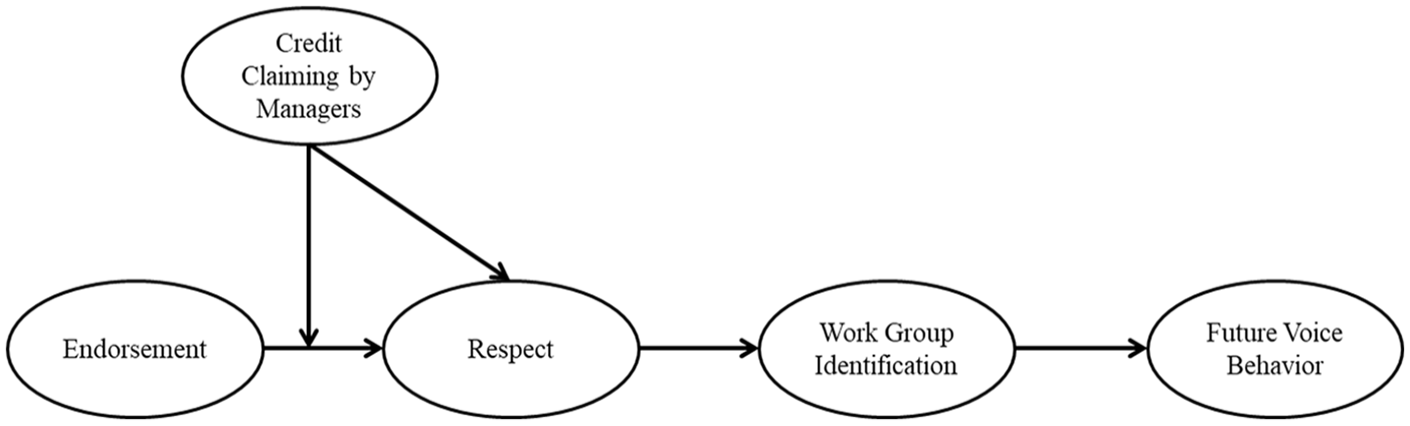
Conceptual model of the effects of endorsement and credit claiming by managers.
Our research contributes to the literature in three ways. First, we introduce credit claiming as a critical yet understudied form of managerial response to voice. We demonstrate how a managerial response to an initial voice behavior, specifically credit claiming, can hurt future voice behavior by diminishing voicing employees’ sense of respect and, consequently, their work group identification. Second, and relatedly, we illuminate the role of credit claiming in attenuating the positive effect of endorsement. In doing so, our work challenges the assumption that endorsement is always beneficial to voicing employees in terms of their attitudes (i.e., work group identification) and behaviors (i.e., future voice). Finally, research on voice has often portrayed voice as a one-time decision whereby individuals decide whether to speak up (Morrison, 2014). In reality, the voice process does not end with the decision to voice or not, but rather continues to include whether the manager endorses and claims credit for the voice and how these responses affect future voice behavior (Kim et al., 2023). Our study responds to calls in the literature to study managerial post-voice reactions, and how their reactions affect employees’ voice behavior over time (Li and Tangirala, 2021; Morrison, 2023).
Theoretical background and hypotheses development
The GEM (Tyler and Blader, 2003) extends previous models of justice to describe the antecedents of discretionary behaviors in groups. The key explanatory factor within GEM is group identification, or the extent to which individuals experience a sense of oneness with the groups to which they belong (Mael and Ashforth, 1992). The GEM contends that group members’ willingness to engage in discretionary group behaviors is influenced by the information they receive regarding their self-worth and identity within the group, which foster group identification. Examples of this type of identity-relevant information include obtaining valuable resources and being treated with interpersonal fairness by authorities, such as managers, within the group (Tyler, 1989; Tyler et al., 1996). When individuals are treated with respect and fairness by the authority members of the group, they perceive that they are in a respected position within the group. In other words, GEM suggests that dyadic treatment of employees by managers within a group influences employees’ perception of respect within the group. For example, Tyler et al. (1996) found that college students’ perceptions of treatment by faculty during a conflict with faculty positively related to their perceptions of respect within the university community (which included faculty, staff, and students). They also found that university employees’ perceptions of treatment by their direct supervisor and Americans’ perceptions of treatment by the United States Supreme Court (a representative of authority for Americans) positively related to their perceptions of respect within their work group and among other Americans, respectively. Another study found that perceiving higher levels of abusive behaviors by supervisors compared with peers negatively related to employees’ perceptions of respect by their peers (Schaubroeck et al., 2016). These authors argued that employees “view their supervisors as embodying the opinions of the group” (Schaubroeck et al., 2016: 268), so supervisors’ abusive behaviors signal to them that their peers do not respect them. In turn, perceived respect within the group indicates that it is a positive group to be associated with, so individuals are likely to identify with it. Finally, individuals who identify with their group are motivated to engage in discretionary behaviors to maintain the group’s positive identity (Tyler and Blader, 2003).
Applying insights from the GEM to the current context, we offer hypotheses that describe the main effect of endorsement and credit claiming and their interactive effect on respect. First, by having their ideas endorsed, employees obtain a valued resource – credit – for coming up with constructive suggestions. Credit can be seen as a type of resource because when employees earn enough credit, they are given leeway to engage in behaviors that deviate from existing norms (Hochwarter et al., 2007; Phillips et al., 2009; Shapiro et al., 2011) such as implementing changes they propose or speaking up to alter the status quo again in the future. Voice is a type of discretionary behavior (Van Dyne and LePine, 1998) that is risky (Morrison, 2014), may lead to an unfavorable performance evaluation (Burris, 2012), and may negatively impact voicing employees’ image within their work groups (Lam et al., 2018). Given these risks, employees should perceive high levels of endorsement as a form of achievement that accumulates to become credit, a valuable resource that signals to voicing employees that they have a respected position within the work group. Second, higher levels of endorsement signal to voicing employees that their managers listened to, paid attention to, and spent effort on evaluating their suggestions. Such positive treatment from an authority figure within the work group enhances employees’ perception of fair interpersonal treatment (Lloyd et al., 2017), as their voicing efforts are positively reciprocated by the manager’s endorsement (Kim et al., 2023), thereby elevating their sense of respect within the work group. In sum, we hypothesize the following:
Hypothesis 1 (H1): Endorsement is positively associated with respect.
Irrespective of whether managers endorse voice, managers may claim credit for employees’ suggestions, and there are multiple ways that this may occur. For example, managers may announce an idea to the work group through emails and publicly implement a change in a process without acknowledging that the idea came from the voicing employee. A voicing employee may also discover through peers that their manager has implemented their suggestions and subsequently shared them with their superior. Alternatively, upper management may praise the manager who introduced the changes when in fact it was the voicing employee who had come up with the idea but expressed it privately to the manager. It is even possible for voicing employees to be removed from their work group so they no longer have the opportunity to be associated with the idea. It is important to acknowledge that managers may claim credit for their employees’ suggestions independent of whether they have endorsed those suggestions. This can occur when managers refute employees’ suggestions when employees originally share them but then later implement the suggestions without acknowledging the voicing employees. By not endorsing employees’ suggestions and later sharing the suggestions as if they are their own, managers claim credit for the suggestions.
Drawing once again from the GEM, we predict that credit-claiming behaviors by managers result in lower levels of respect. First, managers claiming credit for employees’ ideas results in voicing employees perceiving that a valued resource – credit – is taken away. Receiving few resources within a work group signals to employees they do not have high status, which lowers their perceived level of respect. Second, managers taking credit means that the voicing employees are being treated in an interpersonally unfair manner. Voicing employees feel that they deserve credit for coming up with constructive suggestions (regardless of whether their ideas are endorsed) and when an authority figure in the work group takes credit for their ideas, it conveys that the voicing employees are not being treated fairly, resulting in lower levels of perceived respect in the work group. Therefore, we predict the following:
Hypothesis 2 (H2): Credit claiming by managers is negatively associated with respect.
We further hypothesize that high levels of credit claiming attenuate the positive association between endorsement and respect. First, when levels of credit claiming are high, employees are deprived of a resource (i.e., credit) they would otherwise have gained through endorsement from an authority figure within the work group (i.e., the manager), weakening the association between endorsement and perceptions of respect within the group. In contrast, when levels of credit claiming are low, employees maintain a sense of respect in response to endorsement. This is because lower levels of credit claiming mean that employees obtain the valuable resource in the form of credit for their endorsed ideas, and an elevated level of respect within the work group is preserved.
Second, when levels of credit claiming are high, employees are likely to perceive that their manager is behaving without concern for their rights. As a result, rather than viewing endorsement as an indication of interpersonally fair treatment, employees may instead perceive their manager as manipulative, endorsing their constructive suggestions to show support on the one hand, and claiming credit for their suggestions on the other (Schmid et al., 2019). This perception of manipulation would negate the otherwise positive feeling of interpersonal treatment associated with endorsement. Voicing employees no longer feel that they are being treated fairly, thereby weakening the positive association between endorsement and perceived respect. In contrast, when levels of credit claiming are low, voicing employees feel that endorsement is a type of positive interpersonal treatment. This is because managers are listening to and responding to their suggestions, and treating them with fairness by not taking credit for their ideas and suggestions. As a result, the association between endorsement and perception of respect is positive. In sum, we hypothesize the following:
Hypothesis 3 (H3): Credit claiming moderates the positive association between endorsement and respect, such that the positive association between endorsement and respect is attenuated when managers engage in higher levels of credit claiming.
As mentioned previously, the GEM holds that respect contributes to group identification (Tyler and Blader, 2003). Membership of groups is a key source of individuals’ perception of self-worth (Hogg and Terry, 2000). Since groups have a critical influence on individuals’ sense of self-worth, employees are more likely to identify with their group when it has positive implications for their identity (Tyler and Blader, 2003). In a work group context, we predict that employees who perceive respect within the work group have a greater desire to identify with the group to elevate their sense of self-worth. Furthermore, an important tenet of the GEM is that group identification motivates discretionary behaviors in groups (Tyler and Blader, 2003). In a work context, employees who identify strongly with their work group have integrated the group into their self-concept, so they are concerned about the success of the work group and are willing to engage in behaviors that further its interests (Blader and Tyler, 2009). These strongly identified employees are likely to engage in discretionary behaviors that result from their motivation to help the group (Tyler and Blader, 2003). One such discretionary behavior is voice, which represents a type of voluntary behavior employees engage in to improve the processes of the work group (Van Dyne and LePine, 1998), and research suggests that work group identification is positively associated with voice behavior (e.g., Liu et al., 2010; Tangirala and Ramanujam, 2008). In sum, we offer the following hypotheses:
Hypothesis 4 (H4): Respect is positively associated with work group identification.
Hypothesis 5 (H5): Work group identification is positively associated with future voice behavior.
We further expect that credit claiming weakens the positive indirect effect of endorsement on future voice behavior through respect and work group identification. Specifically, when levels of credit claiming are high, endorsement no longer gives voicing employees credit for coming up with constructive suggestions and a sense of interpersonally fair treatment. As a result, the positive association between endorsement and respect is attenuated, which in turn lowers work group identification and then voice behaviors. In contrast, when levels of credit claiming are low, endorsement gives voicing employees the valuable resource of credit for coming up with constructive suggestions and the feeling of being treated interpersonally fairly. As a result, endorsement is positively associated with respect, thus facilitating higher levels of work group identification and then voice:
Hypothesis 6 (H6): Credit claiming moderates the positive indirect relationship between endorsement and work group identification via respect, such that the positive indirect relationship is weakened when managers engage in higher levels of credit claiming.
Hypothesis 7 (H7): Credit claiming moderates the positive indirect relationship between endorsement and future voice behavior serially via respect then work group identification, such that the positive indirect relationship is weakened when managers engage in higher levels of credit claiming.
We conducted two studies to test our theoretical model: a survey field study with 372 employees in China and a scenario experiment with 200 full-time employees from Prolific in the United States to support causality. Data and syntax related to our studies are available at https://tinyurl.com/2tr3th65.
Study 1
Participants and study design
We collected data from a transportation company in northern China whose business focuses on transportation design, highway management, and vehicle parts supply across the country. The research team randomly selected four members from each team to participate in the survey. We assigned each participant a unique survey number to ensure confidentiality, and during the data collection process, we reminded participants by means of a signed official letter from the participating university that participation was voluntary and their responses would be confidential. We administered and collected paper surveys with a prewritten script. Participating employees were invited to a conference room, and after completing the surveys, they sealed their responses in envelopes and submitted them directly to the survey team. We offered ¥20 (approximately ~US$2.80) for completing each wave.
The three-wave data collection featured two-week time lags to limit common method bias and minimize concerns about reverse causality (Podsakoff et al., 2003). Initially, we distributed surveys to 422 employees and received 408 completed surveys. Among the 408 surveys, 11 employees indicated a score of 1 on a voice measure at Time 1 (i.e., did not speak up at all), 19 employees did not pass an attention check item (“Please choose ‘disagree’ for this question”), which was put around three-quarters of the way through the last survey, and six employees had missing data on one or more of our key variables. Therefore, we retained 372 employees from 105 teams (retention rate of 88.2%). Among the 372 employees, 31.2% were women, their average age was 34.34 (SD = 5.33), 87.6% held at least a bachelor’s degree, and their average tenure with the company was 5.88 years (SD = 4.42). We conducted multiple F-tests to check for response bias between those who participated and passed the attention checks and those who were not included in the final data set. We found no significant differences among the studied and demographic variables.
Measures
At the beginning of each survey wave, we stated the definition of voice behavior as the “expression of ideas or suggestions to their manager intended to benefit the work group or the organization” to ensure that the participants understood the meaning of voice behavior. This also ensured that when the employees rated the credit-claiming items, they understood that they were rating their managers’ credit claiming of their suggestions. Unless otherwise noted, for all items, we began with the prompt, “To what extent do you agree with the following statement? In the past two weeks . . .”, followed by a six-point Likert scale ranging from one (strongly disagree) to six (strongly agree). Two independent bilingual researchers translated the items from English to Chinese and then back-translated them into English (Brislin, 1986). Table 1 summarizes the means, standard deviations, intercorrelations, and Cronbach’s alpha values.
Study 1: Means, standard deviations, intercorrelations, and Cronbach’s alpha values.
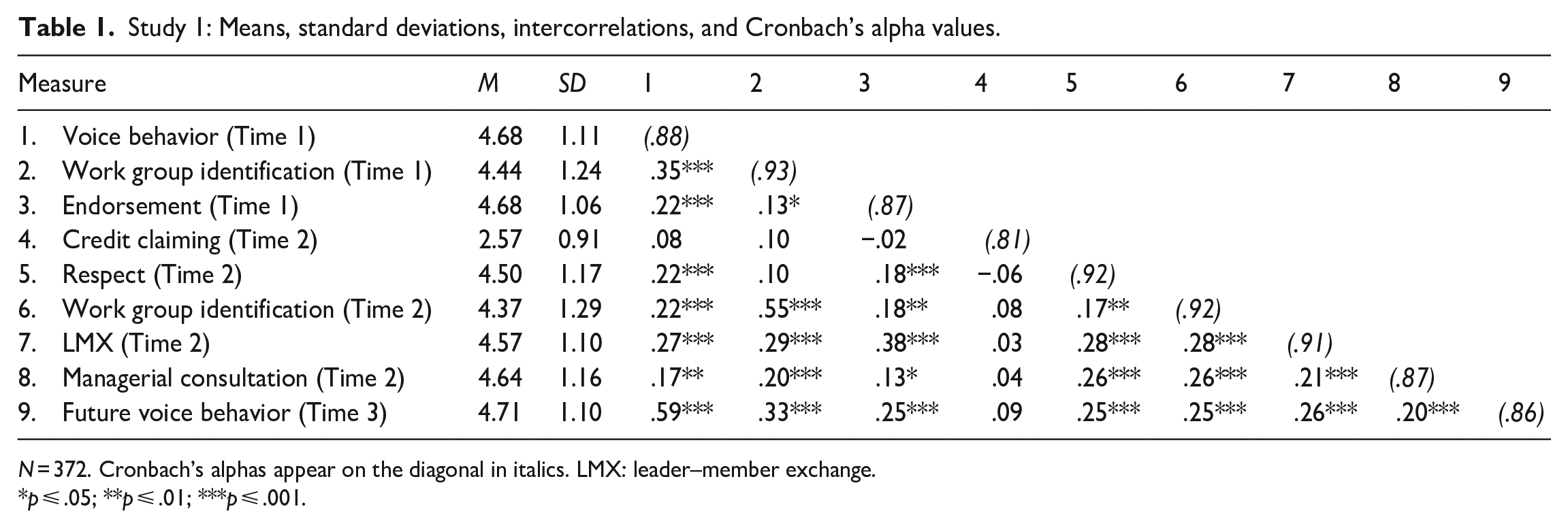
N = 372. Cronbach’s alphas appear on the diagonal in italics. LMX: leader–member exchange.
p ⩽ .05; **p ⩽ .01; ***p ⩽ .001.
Endorsement
At Time 1, employees evaluated the extent to which their managers endorsed their suggestions using Burris’ (2012) five-item scale. A sample item is “My manager agreed with my suggestions”. We used employee-rated endorsement because an employee’s perception of endorsement may differ from that of their manager and may influence their sense of respect more than manager-rated endorsement. We conducted a pilot study to examine the interactive effect of manager-rated endorsement and credit claiming on work group identification via respect, and we found a significant interactive effect of manager-rated endorsement and employee-rated credit claiming on respect, which in turn predicted work group identification. Interested readers may email the first author for more details.
Credit claiming by managers
At Time 2, employees evaluated the extent to which their managers engaged in credit-claiming behaviors using a three-item measure adapted from Proell et al. (2016). The items were “My manager took credit for my ideas”, “My manager claimed my ideas as his/her own”, and “My manager used my ideas without acknowledging that I came up with the ideas”. We measured credit claiming at Time 2 because extant research suggests that it often takes time for a change-oriented suggestion to be enacted, and so it could be that credit claiming might not have occurred at the original time point but might have occurred at a later time point (Satterstrom et al., 2021). To validate our measure of credit claiming, we conducted a recall study to collect qualitative data on the nature of managers’ credit-claiming behaviors and two additional samples to demonstrate the discriminant, convergent, and criterion-related validity of the construct. Results are available upon request from the first author.
Respect
At Time 2, employees evaluated their perceived sense of respect within their work group using Tyler and Blader’s (2002) six-item measure of respect. A sample item is “Your colleagues in your work group respect the work you do”. In the context of this organization, colleagues could denote both peers and managers.
Work group identification
At Time 2, employees evaluated their work group identification using items adapted from Mael and Ashforth’s (1992) six-item measure of organizational identification by changing the referent to “work group”. A sample item is “My work group’s successes are my successes”.
Future voice behavior
Following past research (Tangirala and Ramanujam, 2012), at Time 3 employees evaluated their voice using Van Dyne and LePine’s (1998) four-item measure. A sample item is “I spoke up in this group with ideas for new projects or changes in procedures”.
Control variables
We asked participants to complete a measure of work group identification (Mael and Ashforth, 1992) and voice (Van Dyne and LePine, 1998) at Time 1 to support our time-lagged effects on work group identification at Time 2 and future voice behavior at Time 3. We also controlled for two factors known to predict voice behavior (Kim et al., 2023; Morrison, 2014): leader-member exchange (LMX) at Time 2 (e.g., Van Dyne et al., 2008) with a seven-item measure (Graen and Uhl-Bien, 1995) and managerial consultation at Time 2 (Fast et al., 2014) with a three-item measure (Tangirala and Ramanujam, 2012).
Confirmatory factor analyses (CFAs)
We conducted multilevel CFAs in Mplus 8.7 (Muthén and Muthén, 2004) to test whether the Likert-type multi-item measures are distinct constructs. We used parcels for the variables with more than four items: endorsement (five items), respect (six items), and work group identification (six items). Following Mathieu and Farr (1991), we conducted exploratory factor analyses of the items for each variable and combined the two items with the highest and lowest factor loadings into a parcel. We then combined the two items with the next highest and lowest factor loadings into another parcel, and so on. For scales with an odd number of items, the remaining item was used in the CFAs along with the parcels. The five-factor measurement model (
Analysis and results
We used single-indicator, multilevel path analysis (Preacher et al., 2010) in Mplus version 8.7 (Muthén and Muthén, 2004) to test our model. Since participants were nested within their teams, we utilized multilevel analysis to separate the variance resulting from differences between teams from that resulting from differences between employees (Heck, 2001). To justify using multilevel methods, we calculated the intraclass correlation (ICC; Stapleton, 2006) for our dependent variable (i.e., voice). ICC is calculated by dividing between-group variance by the sum of between-group and within-group variance (Muthén, 1997). To obtain the ICC for voice, a model was run that specified variance and covariance of the between-group and within-group levels with no theoretical relationships for the dependent variable. The ICC for voice was 10%, which indicated sufficient group-level variance for the dependent variable to justify multilevel methods. Our hypothesized model fitted the data well (χ2 [11] = 22.34, p = .02; RMSEA = .05; CFI = .93; SRMR (within) = .04; SRMR (between) = .47). Following the recommendation of Enders and Tofighi (2007), we group-mean-centered the independent variables, moderator, and control variables. A summary of the path analysis results is provided in Figure 2 and Table 2.
Study 1: Mplus path analysis results (coefficients and standard errors).
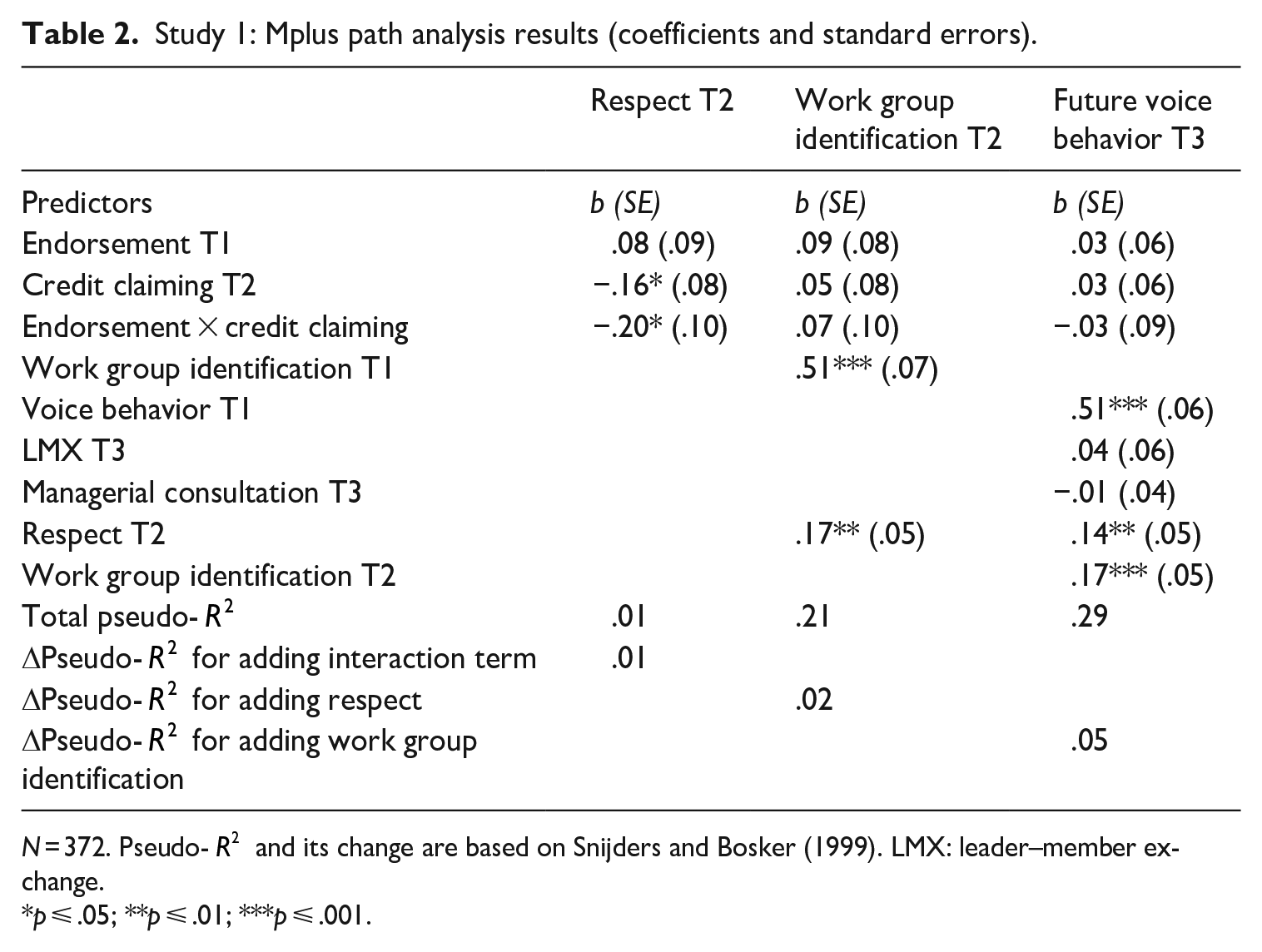
N = 372. Pseudo-
p ⩽ .05; **p ⩽ .01; ***p ⩽ .001.
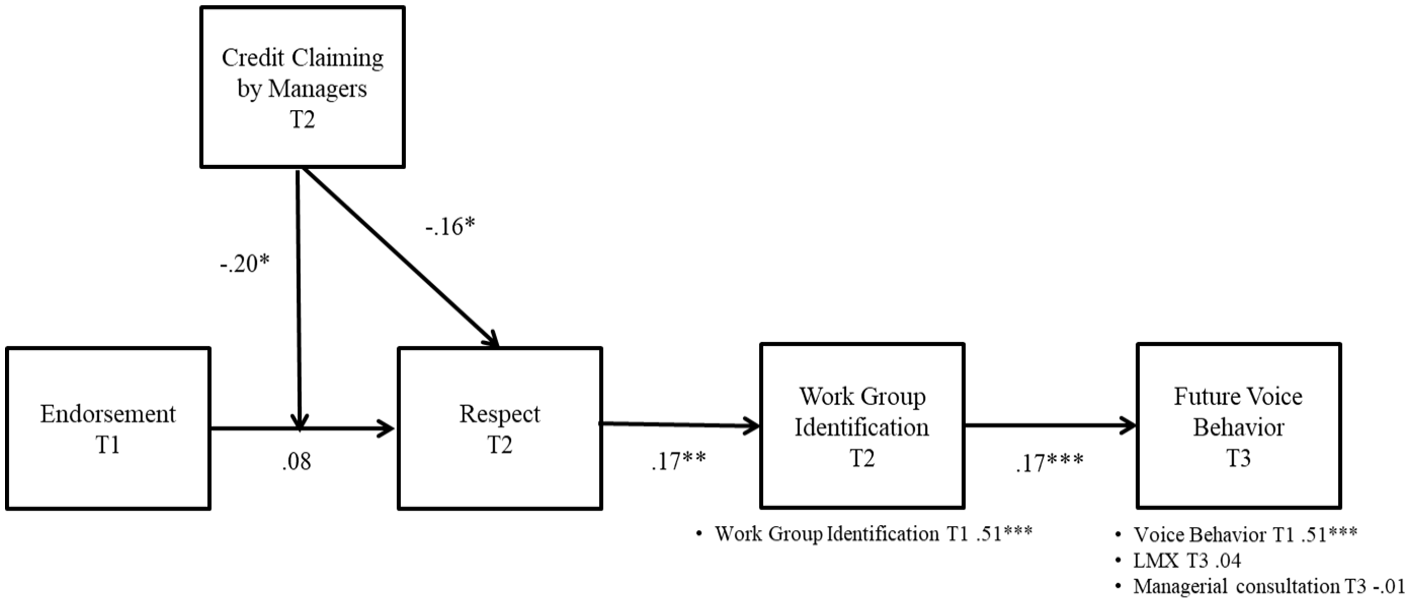
Study 1: Mplus path analysis results.
H1 predicted that endorsement would be positively related to respect, and this was not supported (b = .08, p = .38). We found support for H2, which predicted that credit claiming would be negatively related to respect (b = −.16, p = .046). H3 was supported as the interaction term of endorsement and credit claiming in predicting respect was significant (b = −.20, p = .043; see Figure 3), showing that the positive association between endorsement and respect was weakened when credit claiming was higher. Simple slopes analyses at ±1 SD from the mean for credit claiming indicated a positive effect of endorsement on respect when credit claiming was lower (simple slope = .23, SE = .11, t = 1.98, p = .049) but not when it was higher (simple slope = −.08, SE = .11, t = −.68, p = .50).
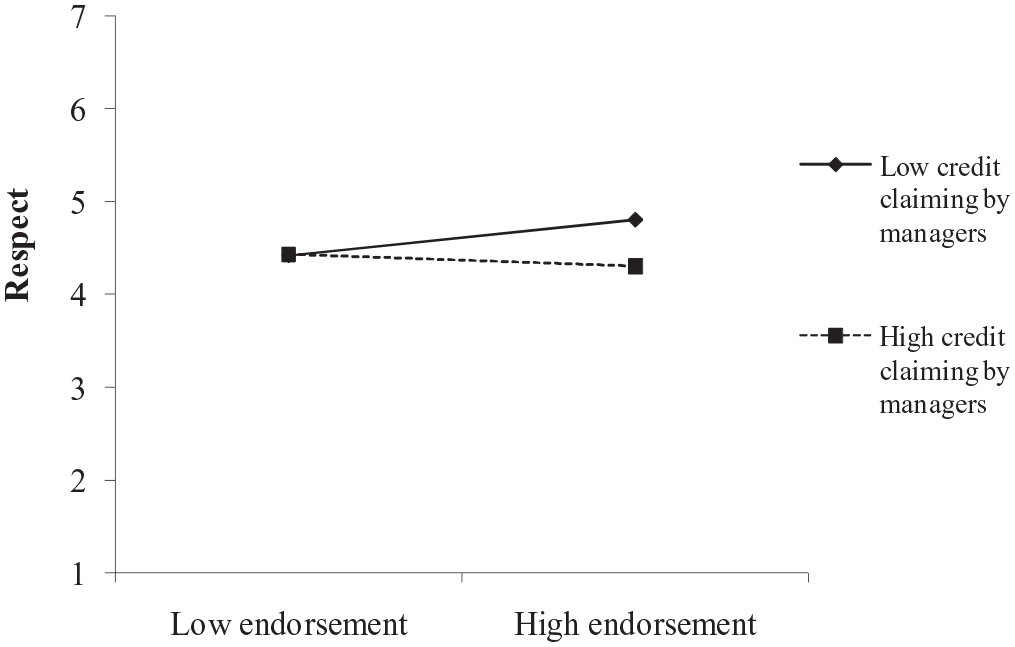
Study 1: Interaction of endorsement and credit claiming by managers on respect.
H4 predicted that respect would be positively related to work group identification, and was supported (b = .17, p = .008). H5 was supported as work group identification was positively related to future voice behavior (b = .17, p < .001).
H6 predicted that credit claiming moderates the positive indirect relationship between endorsement and work group identification through respect. Utilizing R, we found that the positive indirect relationship was significant at lower levels of credit claiming (−1 SD; 95% CI = .0002, .10) but not at higher levels (+1 SD; 95% CI = −.06, .03), and the difference between these conditional indirect effects was significant (95% CI: −.13, −.0005), providing support for H6.
H7 predicted that credit claiming would moderate the positive indirect relationship between endorsement and future voice behavior serially through respect then work group identification. Utilizing R, we found a significant positive indirect relationship between endorsement and future voice behavior serially mediated by respect and work group identification at lower levels of credit claiming (−1 SD; 95% CI = .000003, .02) but not at higher levels (+1 SD; 95% CI = −.01, .005), and the difference between these conditional indirect effects was significant (95% CI: −.02, −.00000008), providing support for H7.
Study 1 discussion
In Study 1, managers’ credit-claiming behaviors were negatively associated with respect. Furthermore, the positive association between endorsement and respect was weakened when levels of credit claiming were higher, and in turn, respect was positively associated with work group identification. We then demonstrated the downstream effect of work group identification on future voice behavior. To strengthen our confidence in our theoretical model, we controlled for work group identification and voice at earlier time periods, to support the changes in work group identification and voice behavior, respectively, over time.
Despite the external validity of Study 1, reverse causality is an important limitation. Although we tried to minimize this concern in Study 1 by separating the measurement of our variables across multiple periods of time and controlling for work group identification and voice behavior at an earlier point in time, one could argue that employees with higher respect are more likely to receive endorsement and less likely to experience credit claiming. Moreover, our field study was conducted in China, where employees tend to accept hierarchical differences (Hofstede, 1980) and thus may be less sensitive to credit-claiming behaviors, which may contribute to an overall weaker effect of credit claiming on outcomes. Finally, our measures were self-reported, which may inflate our findings. Therefore, we next tested the causal mechanism in our model in a controlled environment by manipulating endorsement and credit claiming and examining their main and interactive effects on respect, work group identification, and future voice behavior with a sample of employees from the United States.
Study 2
Participants and study design
We recruited 200 full-time US employees from Prolific to take part in a scenario experiment based on Fast et al.’s (2014) TravelAir scenario. All participants passed the attention check item (“choose ‘disagree’ to confirm you are reading this”), which was put around two-thirds of the way through the survey. Regarding the final sample of full-time employees, 35.7% were female, their average age was 35.98 (SD = 10.19), 62.5% had at least a bachelor’s degree, their average tenure with their work group was 4.50 years (SD = 5.19), and their average tenure with the organization was 5.98 years (SD = 6.10). Participants were paid £0.75 (about ~US$0.80).
Participants first read a description of the fictitious company, TravelAir, and imagined working for their manager, Jamie (see online Supplement A for the full scenario and manipulations). The experiment had a 2 (endorsement versus non-endorsement) × 2 (high versus low credit claiming) between-subjects design, in which participants were randomly assigned to read one of four descriptions (endorsement + high claim credit, endorsement + low claim credit, non-endorsement + high claim credit, or non-endorsement + low claim credit) of how their manager responds when they share their ideas and suggestions. The conditions were counter-balanced such that half of the participants read the endorsement manipulation first, and the other half read the credit-claiming manipulation first. In the endorsement manipulation, participants read the following: “In discussions with you, Jamie often agrees with your suggestions, considers them valuable, and thinks your suggestions should be implemented.” In the non-endorsement condition, participants read the following: “In discussions with you, Jamie does not agree with your suggestions, does not consider them valuable, and does not think your suggestions should be implemented.” In the credit-claiming condition, participants read the following: “When Jamie meets with his superior and talks among your peers, Jamie does not acknowledge that you came up with your ideas. In other words, he claims your ideas as his own and takes credit for your ideas.” In the low credit-claiming condition, participants read the following: “When Jamie meets with his superior and talks among your peers, Jamie acknowledges that you came up with your ideas. In other words, he does not claim your ideas as his own and does not take credit for your ideas.” After being reminded to imagine themselves as working for their manager and with a work group of colleagues who all report to Jamie, they completed the measures for respect, work group identification, and voice. The participants then provided demographic information.
One of the above conditions is non-endorsement and credit claiming such that the manager does not typically endorse his employees’ ideas but typically claims credit for them. To demonstrate that credit claiming can occur without endorsement, we conducted two additional studies (see online Supplements B and C for the full details of both studies). In the first study, we recruited 248 full-time US and UK employees from Prolific.ac to write about a time they had spoken up to a manager. We coded endorsement as low (average endorsement score < 4) or high (average endorsement score > 4) and then ran a one-way ANOVA with credit claiming as the dependent variable and found no significant difference in credit claiming for incidents that were lower (M = 1.96, SD = 1.39) versus higher in endorsement (M = 1.98, SD = 1.18; F[1, 239] = .01, p = .92). In the second study, 317 full-time US and UK employees were randomly assigned to write about a time when they spoke up to a manager and received one of four responses from their manager (endorsement + high credit claiming, endorsement + low credit claiming, non-endorsement + high credit claiming, or non-endorsement + low credit claiming). We were interested in how difficult it was for participants to recall their experiences. If voice endorsement is a prerequisite of credit claiming, then we would expect participants in the low endorsement and high credit-claiming condition to have a higher level of difficulty recalling the experience compared with participants in the other conditions. We conducted a 2 × 2 between-subjects ANOVA with recall ability as the dependent variable and examined the pairwise comparisons. There was no significant difference in recall ability between those in the low endorsement and high credit-claiming condition (M = 5.81, SD = 1.17) and those in either the low endorsement and low credit-claiming condition (M = 5.95, SD = 1.06; F[1, 313] = 0.70, p = .41) or the high endorsement and high credit-claiming condition (M = 5.81, SD = 1.11; F[1, 313] = 0.00, p = .98). Additional qualitative data describing the low endorsement and high credit-claiming conditions are available upon request from the first author. Overall, these two supplemental studies demonstrate that endorsement is not a prerequisite for credit claiming.
Measures
Unless otherwise noted, all items started with the prompt, “To what extent do you agree with the following statements?”, followed by a seven-point scale ranging from one (strongly disagree) to seven (strongly agree). We used the same six-item measure of respect and six-item measure of work group identification that were used in Study 1, with a question stem that read: “Please answer the following questions imagining that Jamie is your manager. To what extent do you agree with the following statements that the colleagues in your work group:?” We used the same four-item measure of voice behavior that was used in Study 1, with a question stem that read: “Please answer the following questions imagining that Jamie is your manager and you work in a work group of colleagues who all report to Jamie. How much would you behave in the following ways in the future?” (1 = Not at all to 5 = A great deal). To ensure that the endorsement and credit-claiming manipulations were successful, we used the items used in Study 1 for endorsement (α = .94) and credit claiming (α = .99), with a question stem that read: “Imagining that you work for TravelAir and Jamie is your manager, evaluate Jamie in the scenario with the following items. Jamie. . .”. Table 3 summarizes the means, standard deviations, intercorrelations, and Cronbach’s alpha values.
Study 2: Means, standard deviations, intercorrelations, and Cronbach’s alpha values.
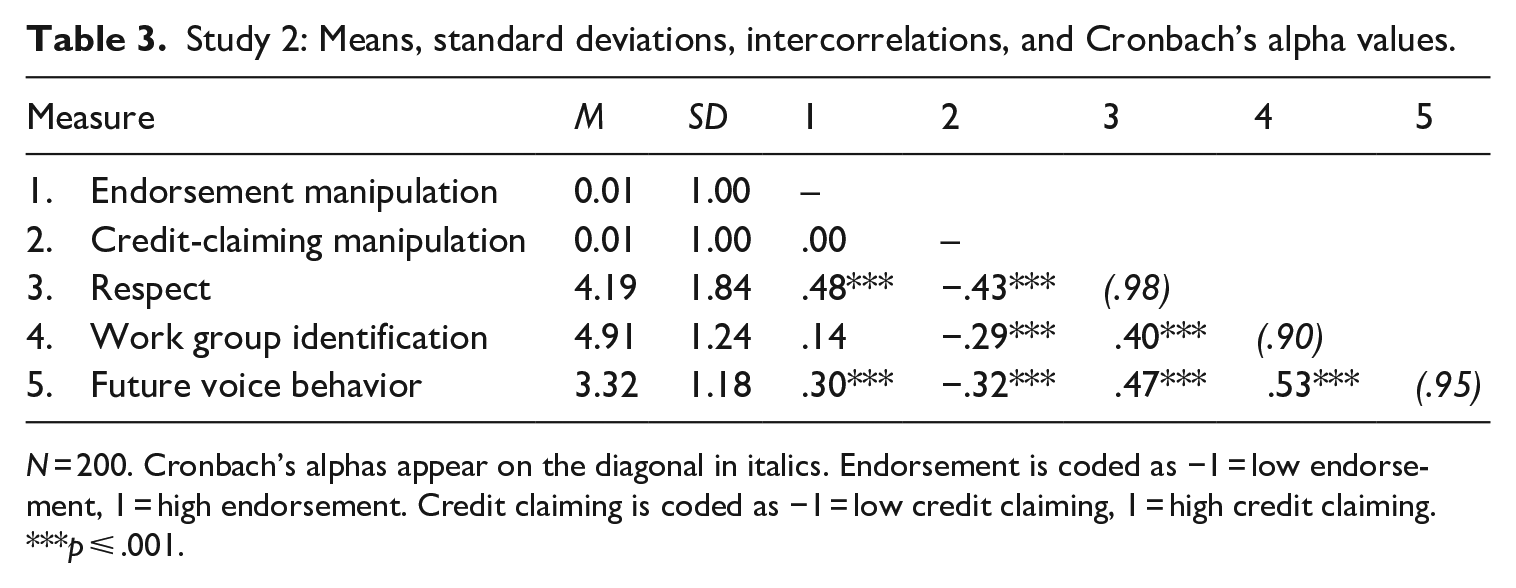
N = 200. Cronbach’s alphas appear on the diagonal in italics. Endorsement is coded as −1 = low endorsement, 1 = high endorsement. Credit claiming is coded as −1 = low credit claiming, 1 = high credit claiming.
***p ⩽ .001.
Results
We checked whether the endorsement manipulation (non-endorsement = 0; endorsement = 1) was effective using a 2 (endorsement versus non-endorsement) × 2 (high versus low credit claiming) between-subjects ANOVA in which endorsement was the dependent variable. Participants in the endorsement condition indicated higher levels of endorsement (M = 5.75, SD = 1.04) than those in the non-endorsement condition (M = 2.81, SD = 1.43; F[1, 196] = 297.64, p < .001, ηp2 = .60). Next, we checked whether the manipulation of credit claiming (low credit claiming = 0; high credit claiming = 1) was effective using another 2 × 2 between-subjects ANOVA with credit claiming as the dependent variable. Participants in the high credit-claiming condition agreed more with the statement that Jamie claimed credit (M = 6.52, SD = 0.80) than did participants in the low credit-claiming condition (M = 1.99, SD = 1.55; F[1, 196] = 676.05, p < .001, ηp2 = .78). Thus, our manipulations were effective.
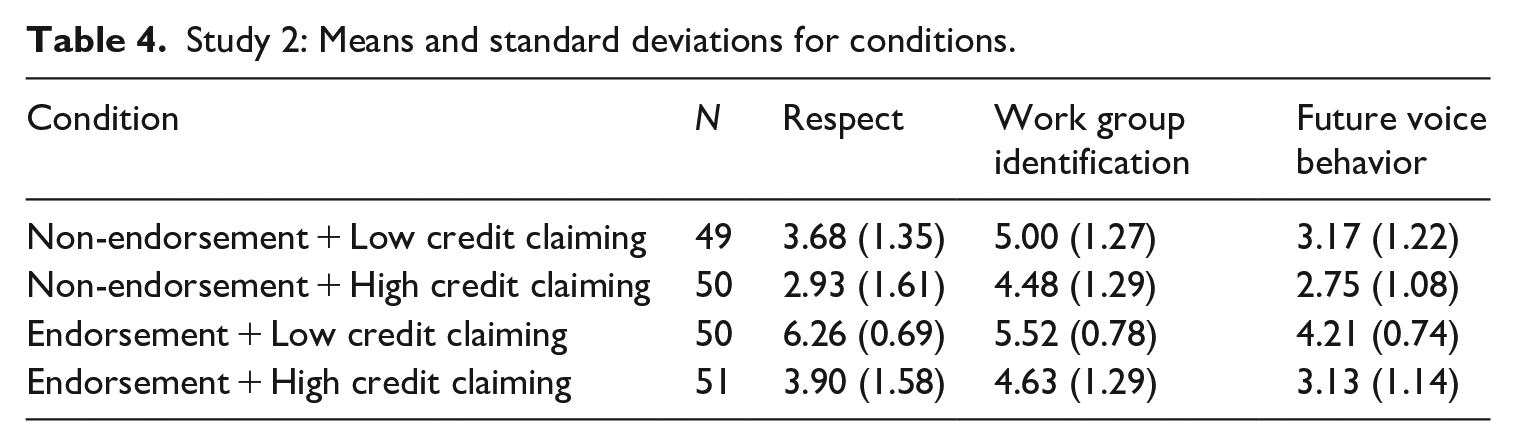
Table 4 summarizes the means and standard deviations of respect, work group identification, and future voice behavior across conditions. We conducted a 2 (endorsement versus non-endorsement) × 2 (high versus low credit claiming) between-subjects ANOVA with respect as the dependent variable. In support of H1, we found a significant main effect of endorsement on respect, such that participants in the low endorsement condition perceived lower levels of respect (M = 3.30, SD = 1.53) than participants in the high endorsement condition (M = 5.07, SD = 1.70; F[1, 196] = 85.15, p < .001, ηp2 = .30). Supporting H2, there was a significant main effect of credit claiming on respect, such that participants in the high credit-claiming condition perceived lower levels of respect (M = 3.42, SD = 1.66) than participants in the low credit-claiming condition (M = 4.98, SD = 1.67; F[1, 196] = 65.20, p < .001, ηp2 = .25). H3, which predicted that the positive association between endorsement and respect would be attenuated when credit claiming was higher, was also supported (F[1, 196] = 17.41 p < .001, ηp2 = .08; see Figure 4). An analysis of the simple effects of credit claiming within the endorsement and non-endorsement conditions revealed that the effect of endorsement on respect was positive and significant in the low credit-claiming condition (
Study 2: Means and standard deviations for conditions.
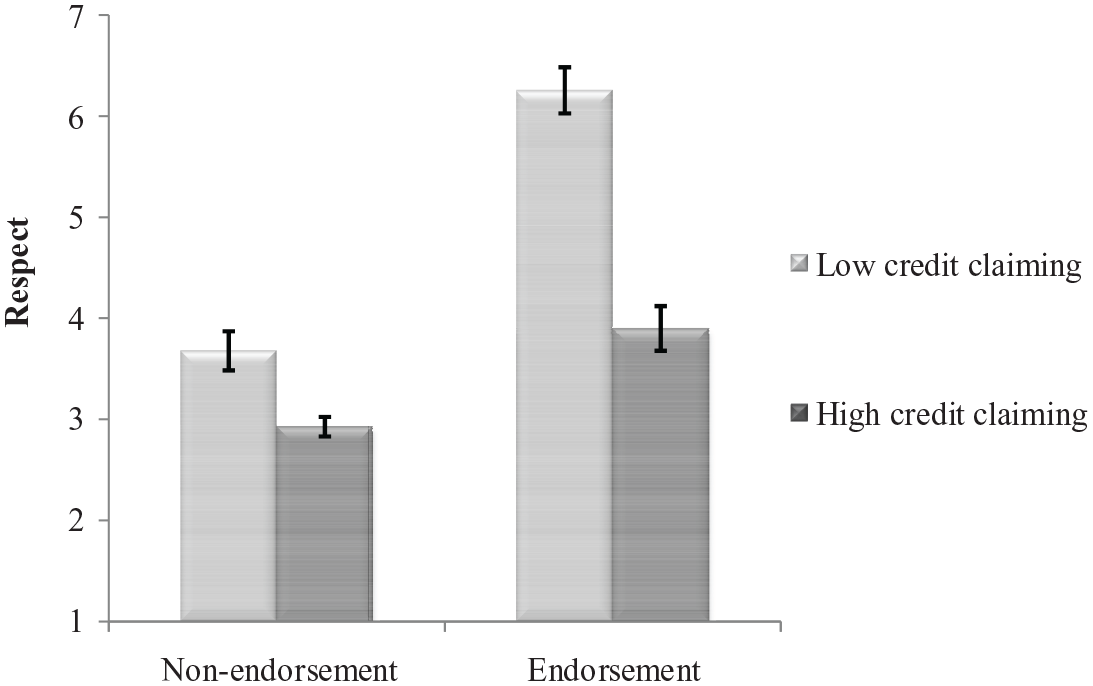
Study 2: Interaction of endorsement and credit claiming by managers on respect.
We tested H4–H7 using the coefficients from a path analysis in Mplus version 8.7 (Muthén and Muthén, 2004) and R (R Core Team, 2013). H4 predicted a positive association between respect and work group identification, and this was supported (b = .25, p < .001). H5 predicted a positive association between work group identification and voice, and this was supported (b = .38, p < .001). H6 predicted that credit claiming would moderate the positive indirect relationship between endorsement and work group identification via respect, such that the positive indirect relationship would be weakened when managers engaged in higher levels of credit claiming. The positive indirect relationship was significant at lower levels of credit claiming (−1 SD; 95% CI = .42, 1.31) and higher levels of credit claiming (+1 SD; 95% CI = .23, .67), but the difference between the conditional indirect effects was significant (95% CI = −.69, −.17), supporting H6.
H7 predicted that credit claiming would moderate the positive indirect relationship between endorsement and future voice behavior serially through respect then work group identification. We found a significant positive indirect relationship between endorsement and future voice behavior serially mediated by respect and work group identification at lower levels of credit claiming (−1 SD; 95% CI = .15, .54) and at higher levels of credit claiming (+1 SD; 95% CI = .08, .28), and the difference between these conditional indirect effects was significant (95% CI: −.28, −.06), providing support for H7.
Study 2 discussion
In a scenario experiment where we manipulated endorsement and credit claiming, we found that endorsement was positively associated with respect. Moreover, we constructively replicated the findings that credit claiming was negatively associated with respect, the positive association between endorsement and respect was attenuated when levels of credit claiming were higher, respect was positively associated with work group identification, and work group identification was positively associated with future voice behavior. Our findings also supported the conditional indirect effect of endorsement on work group identification via respect, such that the indirect effect was weakened when levels of credit claiming were higher. Finally, we supported our serial mediation hypothesis that the indirect effects of endorsement on future voice behavior, mediated by respect and work group identification, would be weakened when levels of credit claiming were higher. This study not only enhances our causality claims but also, because it employed different sources to the first study (i.e., endorsement and credit claiming were manipulated while respect, work group identification, and voice behavior were measured), addresses concerns regarding common method bias.
General discussion
Theoretical implications
Our work has several theoretical implications for the voice literature. First, we introduce credit-claiming behaviors by managers as a critical yet understudied response to employee voice. Whereas the extant work emphasizes a negative response to voice by managers in which they reject employee voice to protect their status and self-esteem (Burris, 2012), our work suggests another form of negative managerial response, namely claiming credit for employees’ suggestions. Our research suggests that credit claiming may occur independent of whether managers actually endorse employee voice. This means that managers may endorse employees’ suggestions and also claim credit for those ideas, or they may reject the employees’ suggestions and then go on to present their employees’ suggestions as if they were their own to claim the credit. Understanding credit claiming irrespective of levels of endorsement is important because it lowers employees’ sense of respect. It also means that once employees express their voice, the allocation of credit becomes a critical issue for the voicing employees irrespective of whether managers endorse the employees’ suggestions.
Of course, there may be more nuances to credit claiming beyond what we have studied. For example, managers may claim credit to protect the voicing employees or to bolster the chance that the suggestions will be received favorably by top management. As a result, voicing employees may feel that since their managers have their best interests or the interests of the work group in mind, their managers deserve to claim some credit. To test this idea, in the field study, we measured the extent to which employees perceived that their managers were claiming credit in order to protect the employees’ image (i.e., protection reasons) or increase the likelihood of the ideas being implemented (i.e., instrumental reasons). We found that neither of these perceptions attenuated the negative effect of credit claiming on respect (protection reasons: b = −.06, p = .52; instrumental reasons: b = .12, p = .19). Alternatively, managers may claim only partial credit by granting voicing employees some credit at the same time as claiming credit themselves. Again, preliminary findings show that credit granting did not attenuate the negative effect of credit claiming on respect (b = .05, p = .56). These findings, overall, suggest that the negative impact of managers’ credit-claiming behaviors can be so profound that neither protection or instrumental reasons nor credit granting can mitigate its negative effect on respect. Given that these findings are preliminary, future research may further expand our understanding of voicing employees’ perceptions of the managerial motivation behind credit claiming and whether such perceptions mitigate the negative effect of credit claiming on respect, work group identification, and future voice behavior.
Second, examining manager’s credit-claiming behaviors during the voice process enhances our understanding of the taken-for-granted positive association between endorsement and future voice behavior (Janssen and Gao, 2015; Ng et al., 2022; Sun et al., 2022). It is often assumed that endorsement of initial voice encourages employees to speak up again in the future because endorsement enhances employees’ status (Janssen and Gao, 2015), commitment (Landau, 2009), and work engagement (Li et al., 2022). Building on this line of work, we introduce credit claiming as a boundary condition by which the positive association between endorsement and future voice behavior is attenuated. In doing so, we illuminate when and why endorsement may not always bring beneficial outcomes for voicing employees.
Finally, our work expands our knowledge about the process through which voice may change over time (Lam et al., 2018; Li and Tangirala, 2021). Previous research has often portrayed voice as a one-time decision-making process whereby employees make decisions on whether to speak up (Morrison, 2014) or managers make decisions on whether to endorse employees’ ideas (Burris, 2012). These two processes, although related, have often been studied in isolation. As a result, the extant research on voice does not present a complete picture of how an employee’s decision to voice might impact their manager’s decision to endorse, which in turn may further influence the employee’s attitudes (i.e., respect and work group identification) and behaviors in the future (i.e., voice behavior). Examining both perspectives (i.e., managers responding to voice and employees speaking up again in the future) in the same model helps paint a more complete picture of the process of voice behavior. As an example, prior research shows that employees with stronger work group identification engage in more voice behavior (Tangirala and Ramanujam, 2008), which increases endorsement (Burris et al., 2017). Our work shows that endorsement, along with the absence of credit claiming, results in higher levels of respect, which in turn strengthen work group identification and encourage voice behavior in the future. Combined with prior research on work group identification and voice, our work suggests that work group identification may be self-reinforcing in nature, such that it positively influences endorsement, and then endorsement positively influences work group identification (via respect, and contingent on managers’ credit-claiming behaviors). In doing so, we respond to calls in the literature to understand voice as a dyadic and dynamic concept over time (Kim et al., 2023).
Limitations and opportunities for future research
This research has some limitations that warrant consideration. First, we could not rule out the possibility of reverse causality in the survey field study. Furthermore, common method variance could have inflated our relationships as voice behavior, credit claiming, respect, and work group identification were self-reported measures. We mitigated this somewhat by separating the measures with time lags, controlling for voice behavior and work group identification at an earlier time period, and conducting a scenario experiment to support the causal relationship in our model. Yet, reverse causation is still possible: work group identification could influence respect, or respect could influence endorsement and credit claiming. We encourage future studies to control for each variable at an earlier time period to examine the changes in respect, work group identification, and voice behavior over time. Future research could also have managers rate endorsement and employees’ voice behavior, and coworkers evaluate credit claiming to further reduce the risk of common method variance.
Second, credit claiming can be a sensitive issue within work groups, and as a result, it is possible that our participants underreported their managers’ credit-claiming behaviors. We note that our mean value for credit claiming was similar to the mean values of other forms of negative managerial behavior, such as abusive supervision (Tepper, 2007), narcissistic behaviors (Ames and Kammrath, 2004), and exploitative leadership (Schmid et al., 2019), reported in the existing literature. This increases our confidence that our credit-claiming score in our field study was not underreported. Moreover, if underreporting did indeed occur, then it should have minimized the variance of credit claiming, making its effect more difficult to detect. To better examine the effects of credit claiming, we encourage future research to include a measure of social desirability and control for its effect (Paulhus, 1991). Finally, there may be two types of credit given to voicing employees: credit for coming up with a useful suggestion that is successfully implemented, and credit for coming up with a suggestion that does not end up being implemented. Future research may explore whether voicing employees value one type of credit more than the other, or whether the negative effect of credit claiming on employees’ perception of respect is weaker when the voiced suggestion is endorsed but not successfully implemented.
Third, future research may explore other mechanisms responsible for the association between credit claiming and future voice behavior as well as individual differences that modify this relationship (Lam et al., 2022). For example, after having credit for their ideas taken, voicing employees may experience anger, which can contribute to negative behaviors such as workplace deviance (Bennett and Robinson, 2000). Individuals may also differ in terms of their sensitivity to unfair treatment (Schmitt et al., 2005), with those lower in sensitivity to unfair treatment more likely to deem credit claiming as acceptable. Moreover, managers may compensate for their credit-claiming behaviors by rewarding voicing employees with more tangible benefits, such as higher performance evaluation scores and salary increases. Additionally, although managers may initially claim credit for coming up with suggestions, they may later grant credit to the voicing employees during the implementation stage (He et al., 2020; Satterstrom et al., 2021). This type of longer-term compensation at a later period of time may mitigate the impact of credit claiming on future voice behavior as voicing employees are still rewarded for their contribution despite having credit for their ideas claimed by their managers. Finally, future research may explore the combined effect of credit claiming with other forms of managerial responses to voice on voicing employees, such as discussing voiced ideas with voicing employees or behaving consistently in public versus in private, to further enrich our knowledge of how the negative impact of credit claiming may be mitigated.
Fourth, we conducted the field study in China and the scenario experiment in the United States to support the generalizability of our findings. Nevertheless, cultural differences may have played a role in our research that we have not considered. For example, in a culture where vertical individualism is high, meaning people are concerned with status, uniqueness, and being different (Triandis, 1998), managers’ credit claiming may be especially detrimental to voicing employees’ sense of respect. In contrast, in a culture where horizontal collectivism is high, meaning people emphasize “oneness” with members of the ingroup, credit claiming may be less of a concern because voicing employees may expect managers to claim credit for the benefit of the work group. China, where our field study was conducted, is characterized by vertical collectivism, a cultural pattern in which people emphasize serving the benefit of the ingroup yet prefer standing out from other members of the ingroup (Bhagat et al., 2002). Employees from this type of culture may, on the one hand, be concerned with credit claiming owing to their desire to stand out from other members of the ingroup but, on the other hand, be more tolerant and accepting of their managers’ credit-claiming behaviors if such behaviors could enhance the chances of creating positive changes for the work group. This may explain why there is a lack of correlation between credit-claiming behaviors and the key variables in the field study. Therefore, we encourage future research to explore the role of cultural differences in employees’ reactions to endorsement and credit claiming and their downstream effect on future voice behavior.
Fifth, our theory focused on the person level rather than the event level because the GEM is primarily a person-level theory, meaning that the personal experience of endorsement and credit claiming by supervisors over the past weeks or month may accumulate to exert a sufficiently strong influence on respect and subsequently on work group identification. However, a different theory may be needed to explain the phenomenon at the event level, meaning that scholars could keep track of specific ideas over time, examine whether an idea is endorsed and/or whether credit is claimed, and then measure the subsequent effects on the employees’ respect and work group identification. This could help scholars understand the time it takes for supervisor reactions to voice to affect respect, for perceptions of respect to impact identification, and/or for identification to affect future voice behavior.
Finally, given that the GEM is concerned with individuals’ perceived respect within the group, it is plausible that other members of the group may also influence voicing employees’ sense of respect through both endorsement and credit claiming. For example, it is possible that a peer may publicly endorse a voicing employee by showing support or agreeing with the voicing employee, which may enhance the voicing employee’s sense of respect. Alternatively, it could be that managers endorse an employee’s suggestion but coworkers do not (perhaps owing to an increase in workload should the suggestion be accepted). Future research should explore whether coworker and manager endorsement may interactively influence respect. Additionally, a peer may also claim credit for the voicing employee’s suggestion. For example, an employee planning to voice a constructive suggestion may share the suggestion with their peer, who may then go on to express the suggestion to their manager without acknowledging that the first employee came up with the suggestion. We expect that this type of peer credit-claiming behavior would decrease the voicing employee’s sense of respect, damage the employee’s identification with the peer who took credit for the idea, and reduce the employee’s desire to help and to share ideas with the peer again in the future. We encourage future research to explore the impact of peer voice endorsement and credit claiming on the voice process.
Practical implications
Our study has implications for organizations, managers, and employees. Most importantly, organizations need to minimize credit-claiming behaviors by managers because organizations need employees to speak up continuously over time to maintain a competitive advantage. To avoid managers taking undue credit, organizations may consider introducing processes that reward managers for endorsing and implementing employees’ ideas. Managers’ performance evaluations could include a section focused on collaboration and employee support where instances of endorsement could be highlighted. Public validation could also be implemented to reward supervisor–employee dyads for employees voicing ideas and managers implementing them. Organizations could set up channels for employees to submit ideas directly to upper management as a way for employees to demonstrate their value and receive credit for doing so. The key is for organizations to recognize that it is not enough simply to endorse voice; they also need to address and give proper credit for employees’ ideas.
For managers, simply endorsing employees’ ideas may not be enough to motivate employees to speak up again. Managers should realize that employees pay close attention to whether they receive credit for their endorsed ideas and should therefore ensure that their employees do not perceive them as claiming credit for their ideas. Even if managers feel that they are responsible for the successful implementation of employees’ ideas and therefore deserve partial credit, it is important that they give employees credit explicitly so that employees do not feel that undue credit is taken by their managers.
For employees, our findings suggest the need to be proactive in securing credit for their suggestions, irrespective of whether their managers endorse their ideas. In order to receive proper credit for their voiced suggestions, employees may consider presenting their ideas to upper management along with their manager, sending emails to the rest of the team to make their contributions visible, asking their manager to mention their name when sharing their ideas, or writing thank you notes to upper management for considering their ideas. Employees may also consider speaking up to upper management directly to secure credit for their ideas, although this strategy should be used with caution as managers may be upset by employees overstepping boundaries. Employees may also need to claim credit with caution so they do not appear to be concerned only with their self-interest, especially in settings where humility is valued.
Conclusion
Although it is often assumed that a positive managerial response to voice results in higher levels of voice behavior in the future, our research suggests that there are more nuances to this relationship. Specifically, our work shows that the positive effect of endorsement on employees’ sense of respect is attenuated when managers claim credit for their suggestions. In turn, employees experience lower levels of respect and identify less strongly with their work group, resulting in lower levels of future voice behavior in spite of endorsement of their initial voice.
Supplemental Material
sj-pdf-1-hum-10.1177_00187267231156791 – Supplemental material for Ideas endorsed, credit claimed: Managerial credit claiming weakens the benefits of voice endorsement on future voice behavior through respect and work group identification
Supplemental material, sj-pdf-1-hum-10.1177_00187267231156791 for Ideas endorsed, credit claimed: Managerial credit claiming weakens the benefits of voice endorsement on future voice behavior through respect and work group identification by Hana Johnson, Wen Wu, Yihua Zhang and Yijing Lyu in Human Relations
Footnotes
Funding
The authors disclosed receipt of the following financial support for the research, authorship, and/or publication of this article: This project is partially supported by Humanities and Social Sciences Research Youth Fund of the Ministry of Education of China, Grant/Award Number: 20YJC630162.

Supplemental material
Supplemental material for this article is available online.
References
Supplementary Material
Please find the following supplemental material available below.
For Open Access articles published under a Creative Commons License, all supplemental material carries the same license as the article it is associated with.
For non-Open Access articles published, all supplemental material carries a non-exclusive license, and permission requests for re-use of supplemental material or any part of supplemental material shall be sent directly to the copyright owner as specified in the copyright notice associated with the article.
