







Abstract
Why do women receive equal or better performance ratings than men in managerial assessment centers even when they are structured in ways that systematically disadvantage them? This study provides the first attempt to understand this managerial assessment center gender paradox using in-depth interviews with managerial assessment center evaluators for a large semi-military governmental organization. The study revealed that the managerial assessment center was a gendered environment in which organizational practices, language used, and the underlying logic establish and reinforce men as assertive or protectors and women as weak and in need of protection. In accordance with the managerial assessment center gender paradox, women were successful at the managerial assessment center despite systemic bias against them. Interpretive analysis revealed that women candidates generate discomfort that evaluators alleviate by increased attention to the extent to which they conform to gender ideology. We coin the term ‘benevolence effect’ to describe evaluators’ tendency to over-valuate and advance women candidates who conform to traditional stereotypes of white femininity. The benevolence effect paradoxically contributes to the preservation and perpetuation of the sexual binary and the idealization of the abstract manager as male-bodied in the organization, even as it contributes to the promotion of women.
Introduction
Managerial assessment centers (MACs) serve as a supporting tool for decision-making in managerial advancement decisions. At these centers, candidates perform tasks that simulate the tasks and working environment of the position for which they are being evaluated. As such, they are meant to serve as a comprehensive and behavioral screening process (e.g., Herd et al., 2016; Howard, 1997; Thornton, 2015; Thornton and Byham, 2013).
Previous studies have established that despite their claim for objectivity and fairness, MACs are in fact gendered environments (Acker, 1990; Baker and Brewis, 2020). A gendered environment is one in which ‘advantage and disadvantage, exploitation and control, action and emotion, meaning and identity, are patterned through and in terms of a distinction between “male” and “female”, “masculine” and “feminine”’ (Acker, 1990: 146). In gendered organizations, women are construed as Other, and the imaginary body occupying the managerial role is a ‘male’ body (Fotaki, 2013). For instance, in organizations that are gendered in favor of men, the organization of work, opportunities for promotion, benefits, and prestige are available to men more than to women. Consequently, in such organizations, women are less likely to be promoted to leadership roles (Acker, 2006). The mechanisms through which MACs are gendered in favor of men include demographic composition, where the participants are mostly men, and criteria for selection, which are based on stereotypical ‘masculine’ traits (dominance, assertiveness, etc.). These mechanisms pose increased challenges for women candidates in MACs, as they perpetuate women’s disadvantages in organizations (Alimo-Metcalfe, 1995). The situation is even worse in organizations that are ‘masculine’ and in cultural contexts characterized by traditional gender roles. Masculine organizations are those in which the proportion of men is high and the industry and the related organizational culture is associated with masculinity (e.g., security, building, engineering, etc.; Greed, 2000; Kark et al., 2016; Miller et al., 2019). In these organizations, hegemonic masculinity emphasizing competition, aggression, and self-mastery serves as a mechanism for excluding women and sustaining their subordinate position (Weller et al., 2021). Non-inclusive cultures, in which traditional gender roles are prevalent and legitimate, add another hurdle to women’s advancement as they pose ideals of femininity as domestic and subordinate to men that run counter to the leadership role and upward mobility in management (e.g., Kark et al., 2022).
The gendered environment would be expected to consistently disadvantage women and lead men to outperform women, thus undermining the validity of MACs for managerial decision-making (Alimo-Metcalfe, 1993). Yet, prior findings demonstrate that women consistently perform as well as men (e.g., Shore, 1992; Silvester and Dykes, 2007) or even outperform men (e.g., Anderson et al., 2006; Becker, 2002; Dean et al., 2008) in MACs. We refer to this phenomenon as the Managerial Assessment Center Gender Paradox. Interestingly, despite the seemingly egalitarian outcome of MACs, they, and the organizations that use them, remain gendered in favor of men. Thus, despite promoting women to the same extent as men, MACs do not serve as agents of change. This study was undertaken to better understand these gaps between women’s chances and performance in MACs, on one hand, and between the equalizing potential of MACS and their conservation of the gendered status quo, on the other hand.
In this study, we help explain these patterns by analyzing the accounts of MAC evaluators. These accounts show that the success of women candidates derived from what we name the ‘benevolence effect,’ wherein stereotypically feminine women (i.e., women who did femininity ‘well’; Mavin and Grandy, 2012) received positive evaluations out of sympathy for their weakened position. In contrast, women who exhibited traditionally masculine traits such as assertiveness (i.e., women who did femininity ‘differently’; Mavin and Grandy, 2012) elicited hostile and critical judgments. These findings suggest that the commitment to and desire to maintain the organization’s gender binary and hierarchical gender ideology in which the ideal manager is male-bodied was more important in the MAC assessor’s decision-making than picking the candidates with the traits more appropriate for the job. Thus, despite advancing individual women, MACs play a role in the gendering process, specifically the creation and maintenance of a sexist gender ideology in which the ideal manager is male-bodied.
This research provides a feminist critique of MACs, as a prevalent selection tool, which were established as an objective and standardized tool for evaluating and identifying managerial potential (Herd et al., 2016; Howard, 1997; Thornton, 2015) and are thought to provide equal opportunity and a gender-neutral process for advancement into management (Woodall, 1996). However, the fairness of MACs cannot be assumed (Thornton and Gibbons, 2009). While many quantitative studies have looked at demographic variables as moderators of sub-group differences, this study uses interviews to explore how the gender logics used by assessors propel some women ahead while maintaining a binary and hierarchical gender ideology at the MAC.
We focus on the exploration of MACs in a context of hyper-masculine security organization in Israel for several reasons. First, MACs are a major component in the process of promotion to senior management positions. Since they are time-consuming and costly, organizations invest in them mostly to assesses candidates’ compatibility with high-ranking and prestigious roles. Second, they can be used as a barrier to promotion if candidates are evaluated poorly. Third, the MACs provide seemingly orderly promotion processes, in which the criteria are transparent and clear. Thus, the importance of the MAC in the promotion process means that they have a major role in enabling or holding back women’s promotion opportunities. As such, MACs allow us to explore the workings of gender logics and biases in this critical organizational context.
We further chose the setting of a semi-military security organization to study the MACs, since this is a large hyper-masculine organization in which women have many challenges getting ahead. The large organization that we studied, as well as other security organizations in Israel, is highly structured, hierarchical and seemingly has a transparent and orderly promotion process. This setting allows us to explore and uncover critically the gender biases and assumptions that come into play in settings that are presented as gender neutral. Also, in Israeli society managerial roles in security organizations are perceived as prestigious, and they also provide an important entry point to management roles in civil society as well as to political roles. These considerations highlight the importance of the research site we chose.
Earlier works have considered a variety of gender paradoxes (e.g., Pesonen et al., 2009; Putnam and Ashcraft, 2017; Valet, 2018; Zheng et al., 2018) and the dynamic underlying the perception of the ‘ideal worker.’ This work has explored the ways in which masculinity is privileged, since it is seen as representing the ‘ideal worker,’ such that women are held to masculine standards (e.g., Baker and Brewis, 2020) and has demonstrated that executive women can contribute to the preservation of a masculine working context by overlooking gender and denying gender inequality (Baker and Kelan, 2019). However, these papers mostly focused on women’s challenges and the negative aspects of being seen as ‘feminine’ or as acting ‘feminine’ in a woman’s body. Our primary contribution to the literature on gender paradoxes is showing how others in the organization (the evaluators) appropriate sociopolitical, cultural, and organizational gender discourse in their attributions of women’s behavior. When women perform their gender in ways that align with these discourses (i.e., ‘feminine’ women), then they are reviewed favorably, despite their apparent misalignment with the ‘masculinity’ of the organization and the management role. In this way, women can advance in the organization without challenging the status quo that excludes them. Thus, the significance of this study lies in revealing the subtle and sophisticated ways in which gendered organizational structure and stereotypes are perpetuated under the guise of ‘good intentions’ towards women.
Theoretical background
Organizations are sites for the construction of gender as a social institution (Fotaki, 2021). Managerial roles have traditionally been constructed as compatible with ‘masculinity’ and men and incompatible with the stereotypic notion of ‘femininity’ and women (e.g., Kark and Eagly, 2010; Lyness and Heilman, 2006). Organizations’ practices that exclude women serve as obstacles to women’s rise to management, such as the expectation of working long hours (‘overwork’) (Cha, 2013), lack of external family obligations (e.g., Gloor et al., 2018), lack of mentors and role models (Kark et al., 2022), and artifacts (tools, dress, etc.) designed to fit a masculine body (Acker, 1990). Moreover, pervasive organizational discourses about gender difference serve to exclude women from management by implying that the abstract manager is ‘male-bodied’ and possesses traditionally masculine characteristics, such as assertiveness and extroversion (Fotaki, 2013; Offermann and Coats, 2018).
Masculine imagery pervades managerial discourses, including language of ‘taking charge’ and images from the military, aggressive sexuality, and heroism (Collinson and Hearn, 1996). As discussed by Collinson and Hearn (1994), several aspects of masculinity contribute to perpetuating men’s power and advancement opportunities relative to women’s: authoritarian masculinity and its association with control, paternalism and protecting ‘weaker’ members of the organization, entrepreneurialism and its association with competitiveness and the willingness to work unlimited hours, informalism and its associated homosocial socializing and solidarity, and careerism and its associated preoccupation with upward mobility in the organization. Each of these masculinities serve to exclude women from the exercise of power (Collinson and Hearn, 1994). Moreover, certain professions and sectors are associated with men and masculinity, including construction (Greed, 2000), research and development (Pecis, 2016), and offshore oil platform work (Ely and Meyerson, 2010). As in management, in these industries, both the structure of the work and the prevalent discourses within the professions serve to maintain their association with masculinity. Women are relegated to support or part-time positions using justifications related to their supposedly ‘weaker’ bodies, presumed childcare commitments, and interpersonal rather than physical skills (Greed, 2000), particularly in safety and security professions and organizations (e.g., police, military, intelligence). According to Acker (2006), all these practices form ‘inequality regimes’ that are defined as the loosely interrelated practices, processes, actions, and meanings in organizations that result in maintaining, frequently invisible, inequalities and reproduction of inequalities in work organizations.
These organizations highlight a prototypical leadership model based on the notion of combat leadership, characterized as heroic, courageous, and combative (Kark et al., 2016). While this leadership model holds an important functional value in the accomplishments of security and military tasks, it limits the acceptable types of bodies who can serve as managers. This is a challenge for women, who are not seen as compatible with this model. Moreover, while the combat mission does not typify all professions and units in military and security organizations, the symbolic and structural repercussions are seen as applying to everyone (Kark et al., 2016). This abstract, ideal body of a ‘male’ combat warrior who puts his life on the line in difficult and dangerous military assignments forms a dominant social discourse that renders women in military, safety, and security organizations as having a lower leadership potential (Boyce and Herd, 2003; Ridgeway and Correll, 2004).
As a result of gendering processes in organizations, women receive lower ratings than their male counterparts on management capabilities and on suitability for management positions (e.g., Ford, 2006; Pesonen et al., 2009). This is especially the case when women are assessed for stereotypically ‘masculine’ sex-typed roles (e.g., Boldry et al., 2001; Heilman and Wallen, 2010; Heilman et al., 2004). Moreover, once women have obtained a management position, they are still systematically evaluated more poorly than men (Eagly et al., 1995; Phelan et al., 2008) and many times also evaluate themselves more negatively (Karazi-Presler et al., 2018; Kark et al., 2022), which suggests that they have internalized the sexist gender ideology of the organization (Mavin and Grandy, 2012).
Scholars have explained that the reason women are evaluated more harshly and held to higher standards of performance is owing to the ways in which gender is constructed and practiced in organizations. Discourses about men and women that align men with technical rationality, organizational performance, and controlling others serve as self-fulfilling prophecies that perpetuate inequalities based on a masculine hegemonic story of organizational reality (Knights and Kerfoot, 2004). Discourses and practices of masculinity maintain male autonomy and male power in organizations by continuously defining women as Other (Knights, 2019). Women in masculine organizations, and even more so in security and military contexts, frequently adopt leadership practices or gestures perceived as ‘soft’ and sociable in order to increase the chances of getting legitimation from their subordinates. In other words, they choose to ‘do gender well’ by acting in accordance with gender stereotypes (Mavin and Grandy, 2012). Concurrently, this enactment of power can be seen as having boomeranged against them. While seeking to increase their ability to influence, they were essentially limiting it, since women in such contexts are seen as socially too soft or too aggressive, a phenomenon characterized by the ‘double- edged sword’ (Kanter, 1977; Kark et al., 2012; Zheng et al., 2018).
As a result, women must contend with the double bind, whereby ‘doing gender well’ or acting feminine in accordance with their gender roles renders them unsuitable for management, but ‘doing gender differently’ (Mavin and Grandy, 2012) or acting masculine in accordance with the requirements of the managerial role renders them unlikeable (e.g., Cuddy et al., 2004; Zheng et al., 2018). The double bind accounts for a dynamic in which any behavioral decision made by a woman manager (i.e., choosing either a tough or a gentle management style) will violate the gender ideology and draw criticism (Eagly and Carli, 2007; Zheng et al., 2018). The double bind can appear in MACs. Women who do not display masculine traits may be deemed a poor fit for management, while women who display masculine traits may experience a backlash. The negative assessment of assertive or opinionated women, who are perceived as a threat to the patriarchal social order (e.g., Rudman and Phelan, 2008; Zheng et al., 2018) supports the prediction that women would fare poorly in MACs (e.g., Eagly and Carli, 2003; Heilman et al., 2004). Our study was undertaken to explore why in fact they do not.
Methods
The present study explored the paradox of women’s unexpected success in MACs through a qualitative analysis of the attitudes, interpretations, and ideology of assessors in a MAC.
Research site
The study was conducted in a MAC for identifying managerial potential for a large public sector semi-military governmental organization in Israel, which will be referred to as Security Inc. Security Inc. can be considered a highly ‘masculine’ organizational environment for several reasons. First, most employees are men (59%) and the overwhelming majority of managerial roles are held by men (82%). Second, the industry of the organization—security—has been associated with masculinity and a masculine culture owing to its affiliation with the military, war making, and war-waging (Karazi-Presler et al., 2018). Moreover, organizations with these characteristics have been described as contexts that exclude women (e.g., Kark et al., 2016). The gender composition of the assessment centers is overwhelmingly male as well (80% men).
It is important to note here that, although in some organizations MACs may hold merely a symbolic role, and do not have a major effect on promotion decisions of candidates, in the organization we study (and more widely in security organizations in Israel) MACs are an important component of the promotion process. The committee in charge of the promotion process at Security Inc. considers all the different numerical ratings of the MACs along with a written comments and evaluation provided by the assessors. These, along with prior performance reviews, managers’ yearly evaluations and other materials in their personal files, are used to make the promotion decisions. People in the organization who participated in such committees noted that the MAC is highly weighted in the promotion decision, as much as 50%. Moreover, low ratings can halt the promotion process altogether. If a manager receives a low rating in the MAC, he or she will not be eligible for promotion and participation in the MAC for a year or at times two years. Therefore, it is a meaningful component in the promotion process and in shaping the organizational perspective of who is a valid candidate for a managerial role in the organization.
The Israeli context is noteworthy. Despite its post-industrial economy and westernized lifestyle, Israeli society is known for its familialism (Fogiel-Bijaoui, 2002; Remennick, 2006). The high value of family and motherhood are important factors shaping individual lives and social institutions. This is evident in the high marriage rates and total fertility rates, which are among the highest in the developed industrialized world and among all OECD states, with an average of 3.1 children per woman in 2015 (in comparison to an average of 1.68; Karazi-Presler and Sasson-Levy, 2022; Weinreb et al., 2018). As a cultural code, familialism takes for granted an unequal gender division of labor. Women are still to some extent constructed as wives and mothers, whose primary responsibility is to bear children and take care of their homes and families. Women’s paid work is seen as secondary to men’s in its contribution to the families’ livelihoods (Fogiel-Bijaoui, 2002).
Israel is below average compared with other OECD countries in terms of pay gaps, women in public positions and parliament, and women’s rights in family and marital law (OECD, 2018). An Index of the Global Gender Gap, published by the World Economic Forum in 2020, indicates that Israel went down 18 places in ranking in comparison to its ranking in the previous year and is currently ranked 64th out of 153 countries, mostly owing to the gender wage gaps and the relatively low political representation for women (World Economic Forum, 2020). Those women who do achieve those high-level positions often face belittlement and harassment. For example, female parliament (Knesset) members are regularly referred to as ‘girls’ by their colleagues, reflecting widespread views about women among the political elites (Jaffe-Hoffman, 2021).
Data collection and procedure
An official request was submitted to Security Inc. management to conduct a study on their MAC. Once we obtained their written permission to conduct the study, we contacted the HR department of Security Inc. requesting data on the demographics and performance ratings of MAC candidates prior to their candidacy in the MAC, in the MAC itself and following promotion to management. HR agreed to provide us with the statistical analyses of the demographics and performance scores of 1031 managerial candidates assessed in the MAC between 1997 and 2007, 360-degree feedback of promoted managers, and employee performance ratings from a random selection of years within the studied period. These served as preliminary data to test if women fare as well as or better than men in the MACs.
In addition, the primary researcher phoned all the active assessors in the MAC and invited those who met the study criterion to participate in the study. Thirty of the 36 active assessors met the participation criterion of having served as an assessor in the MAC at least three times. All 30 eligible assessors agreed to be interviewed. The interview questions were formulated in light of a pilot interview conducted with three assessors that did not have enough experience to be included in the study. The following are some of the interview questions: What was your experience with men and women in the assessment center? What were some of the differences between men’s and women’s behavior and performance in the assessment center? Do you think you behave differently toward men and women at the assessment center? How would you characterize the women who come to the assessment center as compared with the men? Interviews with participants were conducted in person and lasted between 45 minutes to 90 minutes. All interviewees gave consent for the interviews to be taped and were guaranteed confidentiality. The interviews were transcribed soon after they were completed.
It should be noted that one of the researchers on our team had a close affinity to the organization studied, as she was involved in creating the MAC in the study and managed it for 10 years. Her professional acquaintance with the interviewees enabled her to gain their trust. This may have also led them to present themselves as ‘objective’ during the sorting process. However, this was not the case, as most interviewees disclosed lack of objectivity on their part.
Preliminary quantitative analysis of the MAC paradox in the organization
Confidential archival data provided by the organization was analyzed to ascertain whether the MAC under study exhibited the prior patterns found in the review of the MAC gender paradox. To establish whether the gender paradox pattern was present in this specific organization, thus making it a viable context to understand the paradox, we needed to answer the question of whether women perform as well as or outperform men in this MAC. Our analysis of the data provided by Security Inc. indicated that in the 10 years prior to the study, women and men candidates’ overall MAC performance scores did not differ (see Table 1). Thus, women candidates performed as well as men, supporting the possibility of our exploration of a MAC gender paradox in this organization.
Comparison of men and women candidates’ managerial assessment center scores.
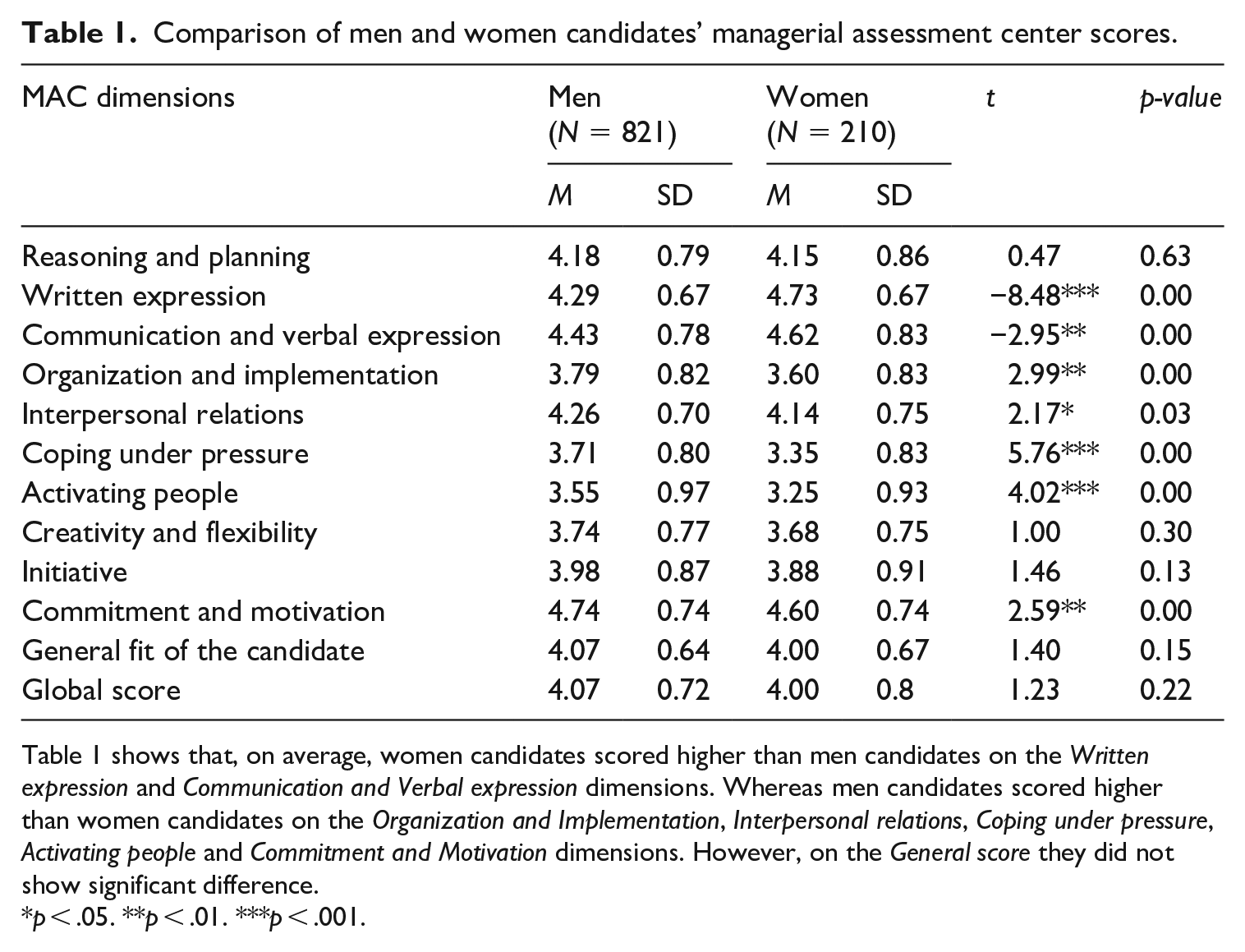
Table 1 shows that, on average, women candidates scored higher than men candidates on the Written expression and Communication and Verbal expression dimensions. Whereas men candidates scored higher than women candidates on the Organization and Implementation, Interpersonal relations, Coping under pressure, Activating people and Commitment and Motivation dimensions. However, on the General score they did not show significant difference.
p < .05. **p < .01. ***p < .001.
To rule out the possibility that women candidates perform better than expected in the MAC because they are exceptionally talented, we compared the performance ratings of women and men managerial candidates prior to their candidacy in the MAC. The results indicated that they did not significantly differ (see Table 2).
Gender differences in pre-assessment center employee evaluation scores (during 3 years of MACs).
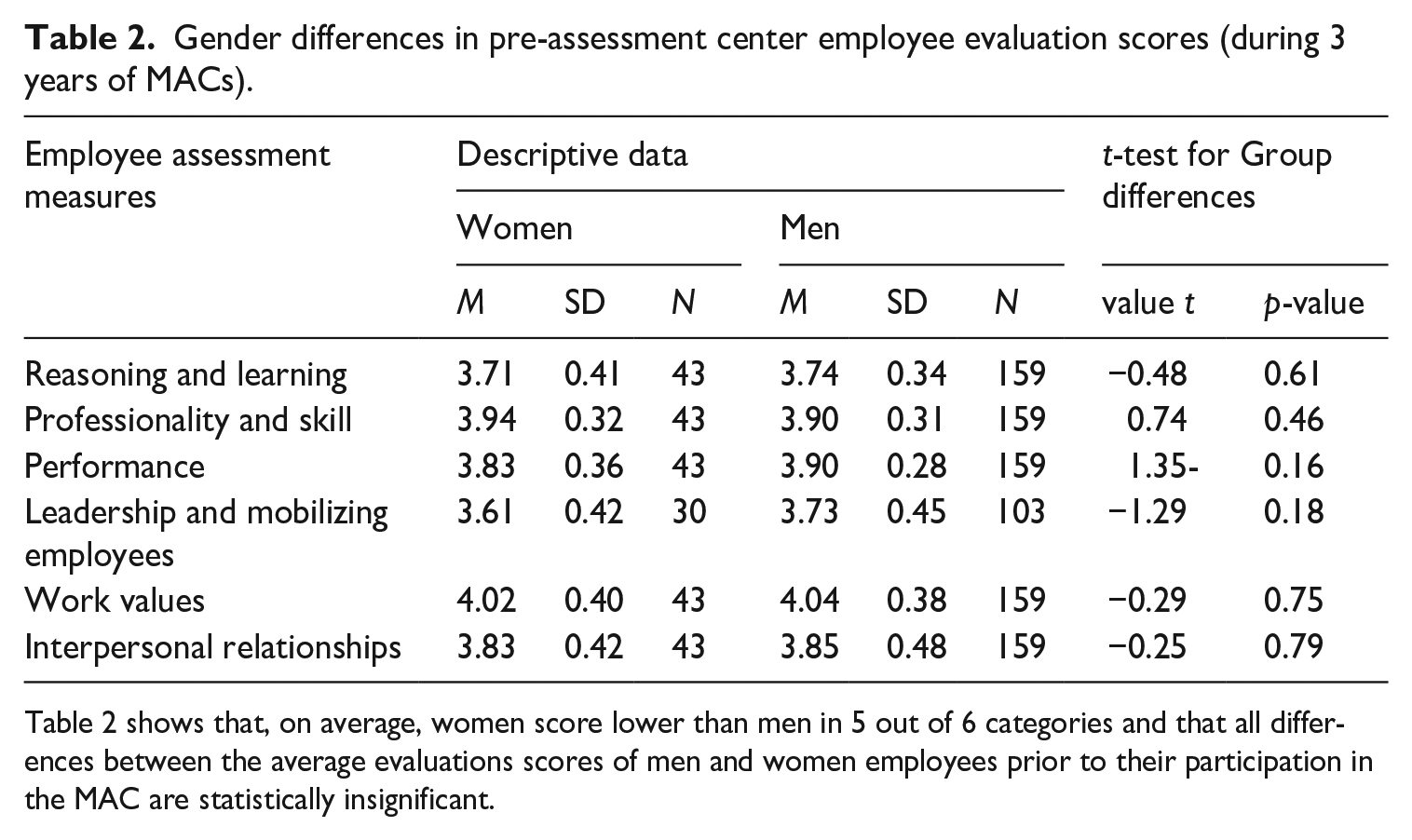
Table 2 shows that, on average, women score lower than men in 5 out of 6 categories and that all differences between the average evaluations scores of men and women employees prior to their participation in the MAC are statistically insignificant.
Personal reflection
The author team was constructed in a manner that helped us view the research field from multiple angles and encouraged us to challenge our initial impressions and analyses. As noted above, one of the authors had been an insider in the security industry and had worked in the past in the MAC. Another author was familiar with the Israeli security culture as she has served as an external consultant to security organizations. The third team member is external both to the Israeli security culture and unfamiliar with the specific organization. These three divergent perspectives contributed different ways of understanding and interpreting the interviews. The discussion among us enabled the author team to hold the tension between the perspectives and understandings of an insider as well as the critical external point of view. We believe that the result was to gain a deeper understating of the role of gender ideology in the MAC.
Participants
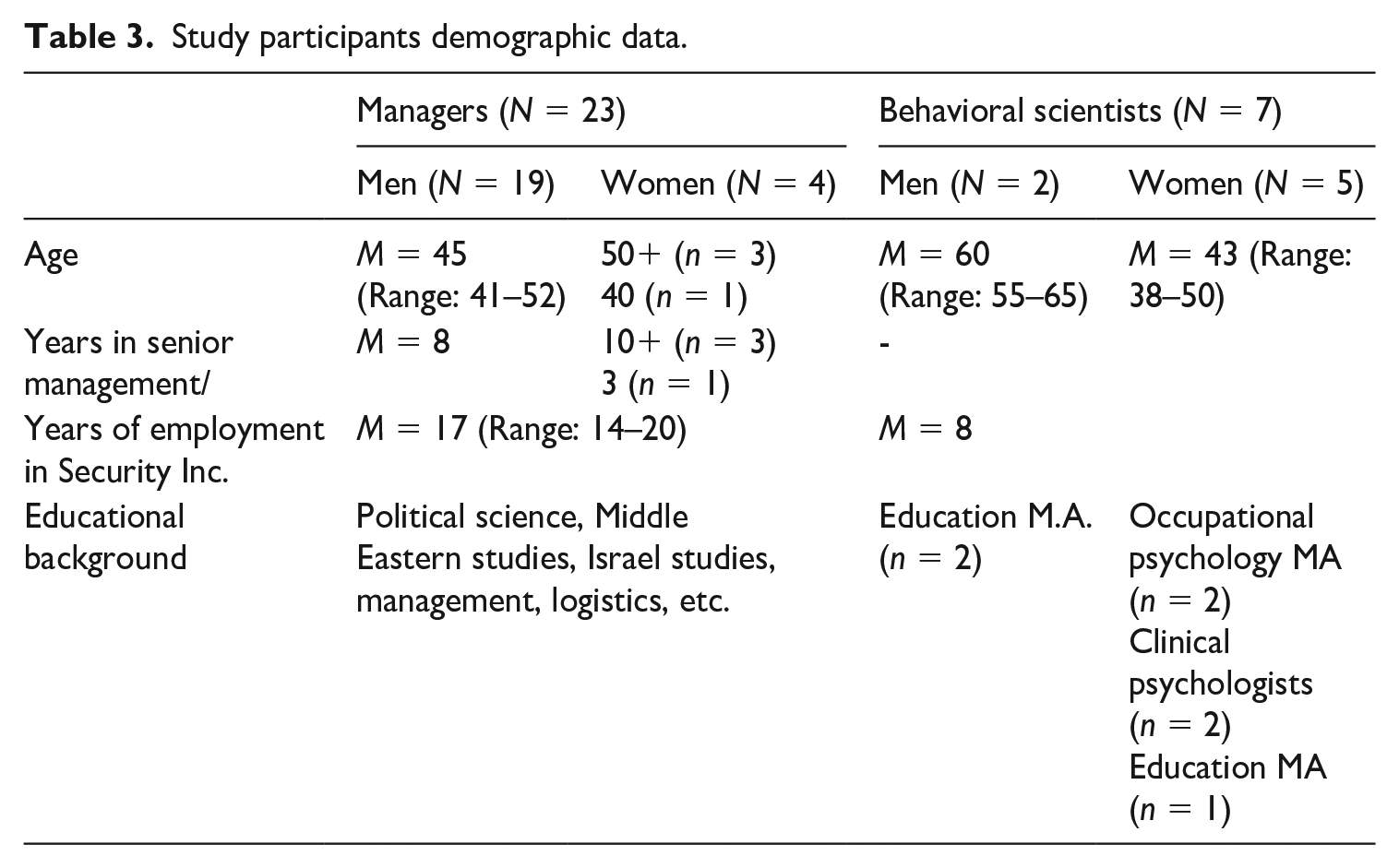
The sample was comprised of all individuals who met the participation criterion of having served as a MAC assessor for Security Inc. on at least three occasions during the period of interest. This led to inclusion of 30 participants in the study, 23 of which were senior managers who were trained by the manager of the MAC and seven external contractors who specialize in recruitment processes (see Table 3 for more details about the sample).
Study participants demographic data.
Data analysis
Interviews were analyzed using discourse analysis, focusing on ‘how ideas, culture, and ideology are used, interpreted, and spliced together with certain situations or empirical phenomena in order to construct particular ideative patterns through which the world is understood’ (Lindekilde, 2014: 196). Discourse analysis is particularly illuminating for studying power inequalities, as it allows a reading of how elite group members enact, legitimate, or otherwise reproduce power through text and talk (Van Dijk, 1993). We applied a critical lens, or a ‘hermeneutics of suspicion’ (Josselson, 2004) toward what evaluators may not be aware of and how they may be blind to the influence of gender ideology on their evaluations of women candidates. Using this method, we analyzed how assessors talked about their encounters with women candidates and what underlying assumptions guided their decision-making regarding women candidates’ suitability for management. We looked at how evaluators used discursive resources such as metaphors, narratives, and categories, and with what effects. This allowed us to identify both underlying ideology and its effects on the organization; that is, what ‘work’ the talk was doing. Underlying logics and ideology were identified through thematic analysis (Lincoln and Guba, 1985; Shakedi, 2003). The interviews were coded using ‘in vivo’ codes and codes derived from the literature. These codes were examined across cases to identify themes and interrelationships between concepts (Strauss and Corbin, 1994). In the final stage of the analysis, we created a theoretical-empirical generalization linked to the research on gender ideologies in organizations. The theoretical model enabled us to conceptualize the organizational meta-narrative underlying the assessment of male and female candidates in the MAC (for examples of Central and Secondary themes and supplementary quotes see Appendix 1).
Findings
The gendered logic and practices of Security Inc
Our findings revealed a gendered environment that creates and maintains an essentialist gender binary and hierarchical gender order in which women are viewed through the lens of racialized and classed norms of traditional white middle-class femininity (Holvino, 2010; hooks, 1984). Organizational practices, language used, and the underlying logic establish and reinforce men as assertive, ambitious, and dedicated, and thus suitable for management (dominant masculinity) or protectors (protective masculinity) and women as vulnerable, sensitive, and maternal and in need of protection. This gendering process was apparent through several mechanisms.
Gender composition
One of the key mechanisms for creating and maintaining a hierarchical gender binary at the MAC was through the gender composition of the simulation groups. The archival data revealed that women were almost always minorities in the simulation groups. Of the 168 assessment groups between 1997 and 2007, 26 (15%) were composed of men only. Of the remaining 142 mixed-gender assessment groups, 71 (50%) had a 5:1 ratio and 59 (41%) had a 4:2 ratio in favor of men. Each assessment group was evaluated by three managers, who were at least two ranks above the candidates, and three professional assessors. Of the evaluating managers, 20 were men and, depending on the year, three to four were women. Thus, the evaluating managers were almost always men.
These demographics put women in a disadvantaged position vis-a-vis their male colleagues. The MAC creates situations that enhances the gender tokenism of women, making them highly visible and susceptible to intense scrutinized by others (Farh et al., 2020; Kanter, 1977). Tokens are more likely to be treated as representatives of their groups rather than as unique individuals (Farh et al., 2020; Yoder et al., 1983). Women’s minority position in these groups are also likely to trigger stereotype threat, where they become concerned about being judged or treated negatively on the basis of a negative stereotype about their group (Spencer et al., 2016; Steele, 1997). This dynamics of tokenism and stereotype threat can lead to overwhelming pressure on women while at the same time creating conditions that make it difficult for them to succeed. As we show later, being in the minority often subjects women managerial candidates to either bullying or pity, solidifying their weaker position.
Simulations that disadvantage women
The assessment center uses several simulations that are supposed to showcase candidates’ behavior in situations similar to those they would face as managers. The simulations used in this MAC were exercises of building a Lego bridge, designing and building airplanes, and designing a factory. The Lego bridge task, for example, is one in which the participants are asked to plan and build a Lego bridge. Engineering, construction, building, and playing with Lego is perceived stereotypically as a masculine task, which is related to the masculine sphere (e.g., Greed, 2000). Supporting this notion, studies show that 76% of parents encourage Lego play for boys compared with just 24% for girls (Brown, 2021; de Castella, 2014) and that until recently Legos were marketed primarily to boys. In the United States, roughly 90% of Lego sets that are being sold are intended for boys and not for girls (LaFrance, 2016). This implies that these simulations are likely to disadvantage women, essentially setting them up to fail.
If the exercise were stereotypically feminine (for example, setting up house) women may have had an a priori advantage over men. As one of the male manager evaluators said, ‘The Lego exercise, building the bridge, there I saw clearly that men are stronger than women.’
The evaluators reported that the Lego task had little to do with the kind of work the candidates would have to do as managers in their future roles in Security Inc., revealing that the outcome of these exercises create and maintain a gender gap in performance. Rather than truly differentiating those with managerial skills from those who lack them, the Lego task create a situation in which women are more likely to perform poorly. Although the choice and effect of the Lego task appeared unintentional, some managers did see its’ implications and the bias it may create. As another manager said, ‘It’s funny, [the Lego task] doesn’t indicate any managerial ability. . . it’s the one exercise where from the very beginning for some reason women take a step back. I don’t know, we need to check.’ His words reveal that even though women are clearly disadvantaged, and even though the task may not be optimal for discerning managerial potential, no systemic organizational action has been undertaken to change the status quo. Thus, although the evaluators to some level recognize the biases inherent in these simulations, they do not advocate to replace these simulations with a more gender-neutral activity or one that advantages women, which suggests an attachment to the existing gender order.
Language
The language at the evaluation center created and maintained an essentialized gender binary that associated women with traditional ideals of white womanhood—middle class respectability, femininity, and passivity (Collins, 2000; Harris, 2000)—and men with masculine ideals of agency, domination, and ambition (authoritarian masculinity, Collinson and Hearn, 1994). As Fairhurst and Grant (2010: 174) suggest in line with other social construction theories, ‘language does not mirror reality; rather it constitutes it.’ This view sees language and communication not as a mere simple transition of meaning, but rather a way in which meaning is negotiated and constructed in social interactions. Evaluators repeatedly refer to the women candidates as ‘girls.’ As noted above, referring to women as ‘girls’ is a common practice in Israel, even in the highest chambers of government (Jaffe-Hoffman, 2021). This practice infantilizes women and reduces their compatibility with the manager role and its authority. This is another example of the paternalistic misogyny in this context. It is important to note, that men, managers and commanders, are not referred to as ‘boys.’ Additionally, evaluators made extensive use of aggressive language and violent military metaphors to describe the assessment situations. They talked about the candidates’ need to ‘fight’ in order to succeed in the simulations and further described the evaluation process as a ‘hostile environment,’ as a ‘battlefield,’ and as a ‘jungle full of predators.’ One evaluator described the male candidates as ‘hunters with knives between their teeth.’ Their language evoked a sense of danger, especially for women, and stressed the combative masculine aspect of the simulation and of Security Inc.
As one of the male manager evaluators said, ‘She’s there with five wolves and even if they want her [as a team member] and desire her, she feels inferior. It’s hard for her to deal with five wolves.’ It is important to note the sexualization of her position as desired and the subordination by the five wolves. This type of dominating masculinist logic pervaded Security Inc., and was further evident in the essentialist discourse, as presented below, of women as primarily mothers. Binary language about the difference between men and women also served to perpetuate hierarchical differences between men and women, where men are seen as aggressive and strong and women as passive and weak (Knights and Kerfoot, 2004).
Valuing masculine life cycles and traits
Respondents openly admitted that Security Inc. values masculine traits over feminine ones and used this as an account for why there are so few women managers. As one manager evaluator said, ‘If you’re a woman in a macho organization, an organization where most of the managers are men, an organization that values operations. . . your starting point, in her view, in my view, is lower.’ In this gender essentialist view, women are ‘by nature’ ill-suited to management, as they cannot be ‘macho’ enough.
Women’s lack of advancement to management was thus attributed to the masculinist organizational culture and the incompatibility between women and management, rather than a bias in the MAC. As one professional male evaluator said: I’ve known this organization for years and there is, there is discrimination. There is discrimination. I heard it one-on-one in casual conversations, conversations in hallways. Not formally in discussions, but many things that were said with a smile, as half a joke like ‘What, women? Births, weddings, stories, problems, single women with problems and stories, who needs all that?’
As this quote makes apparent, women are seen as primarily mothers and wives and as sources of multiple ‘problems’ for the organization. Unsurprisingly given the masculinist logic, evaluators reported that people do not like being managed by women and that women’s life cycle does not fit management (see Acker, 1990).
Hours worked as marker of motivation/dedication/quality
Another aspect of the logic of gendered meanings is that hours worked, and specifically overtime, were cited as indicators of productivity, commitment, and desire to get ahead in Security Inc. As one evaluating manager said: If I had two candidates with the same abilities, a man and a woman. I’ll be honest with you, say theoretically, as a manager, the office will get more from the man than from the woman just from the perspective of hours present.
In accordance with entrepreneurial masculinity (Collinson and Hearn, 1994), managers explicitly revealed sexist assumptions that men are more willing to work overtime than women, and that this makes them better suited for advancement.
Traditional view on gender and heteronormativity
The interviews with the evaluators exposed the logic of gendered meanings and images that reify traditional and essentialist views of men as authoritative, agentic, and dominating and women as lacking these attributes. These views are consistent with the traditional gender ideology and familialism prevalent in Israeli society (Kark, 2007) and is another manifestation of how the broader cultural ideology on gender is appropriated by the evaluators to maintain the gendered status quo. According to one male manager assessor, ‘I think that girls, women, prefer to get what they want in ways that are less about exercising authority and more about charm.’ In contrast to women, men are described as ambitious and career oriented. As one male manager evaluator said, ‘With men, and I am very familiar with this, the moment he gets to Security Inc. he’s already thinking about management.’ Women are also seen as unsuited to management because of their association with motherhood. As this evaluator says: I think it’s basic organizational Darwinism. I mean, the number of women who have families and then the stereotypes in our culture are such that the number of women who are interested in advancement, who are suitable for advancement, is naturally smaller than the number of men.
By appealing to ‘nature’ and Darwin, this evaluator essentializes a traditional division of labor where women are caretakers of families and men are fit to be promoted in organizations. This sexist language, though claiming to reflect a ‘natural’ gender order, in fact creates this order by associating women with motherhood and men with work and management.
Taboo against mentioning gender equity
When asked whether women candidates complain about the difficulties of being women in a mostly male setting, evaluators overwhelmingly reported that they do not. The reason they gave was it would lead to her being labeled as a complainer or a whiner (Ahmed, 2019; Kark and Waismel-Manor, 2005, 2011) rather than successfully draw attention to the gender bias. One of the female professional evaluators stated: I don’t recall anyone mentioning the gender issue in the exit interviews. It’s because in this organization, you can’t “play that card. . .” Women expect themselves to be equals among equals and to fit into the masculine environment. It’s as if the expectation is for women to fit in.
None of the evaluators raised the possibility that the overwhelmingly male gender composition of the evaluation team could affect the candidates’ behaviors. Apparently, the gender imbalance of the evaluators is transparent and considered natural. The underlying gender logic and ideology in the MAC had a taken-for-granted status (Pease, 2010).
Taken together, these findings showcase gendered practices and underlying ideology of masculine assertiveness, dominance and authority and feminine weakness, maternalism, and subordination. This logic both reflects and helps create and maintain an essentialized gender binary and a biased organizational culture (Acker, 2004; Ely and Padavic, 2007; Ford, 2006; Kark and Eagly, 2010; Okin, 1989). Next, we turn to how this ideology manifests in how assessors talk about and treat male and female candidates to understand why this gender bias did not hurt women’s performance in the MAC.
Women candidates as triggers to sensemaking
We found that women who reach the MAC challenge the organizational gender ideology, which creates a binary gender hierarchy in which women are unsuitable to management, and as such trigger sensemaking among the evaluators. Sensemaking occurs when individuals turn a flow of organizational experiences into words and categories that they can comprehend and then use as a springboard for action (e.g., Weick et al., 2005). Sensemaking is triggered by discrepancy; when people face events that disrupt normal expectations, they use their experience to make sense of them and compose a plausible story of what is happening (e.g., Brown, 2000). We found that evaluators drew upon the gendered logic of Security Inc. to help them make sense of women managerial candidates.
Women candidates present three kinds of challenges to the organizational gender ideology. First, they contradict the tacit organizational belief that women are ‘not suited for managerial positions in Security Inc.’ To make sense of women who were referred to the MAC assessors expressed the view that these women were exceptionally high performer. As one male manager evaluator said, ‘I can tell you that most of the women that come here are more intelligent than the men.’ Another said, ‘To become a manager a woman has to stand out much more in her abilities, her managerial abilities. The standards for women are higher. . . the female managers are generally better than the men.’ Exceptionalizing women candidates serves to keep the gendered logic in place. By seeing them as atypical, assessors make sense of their existence without questioning the validity of the organization’s underlying gender ideology.
Evaluators indeed reported wondering, upon encountering female candidates, what is so special about them. They were rare and unusual at the MAC and as such aroused curiosity. One manager admitted that when a woman candidate ‘appears’ he is much more focused on her: First of all, it’s curiosity, I genuinely have more curiosity about how she’ll be, as compared with the five men. In other words, without being aware of it, I’m much more focused on her to see how she’s been in the group and whether she’ll be dominant or not dominant, will she be smart or not smart, can she analyze, can she plan, more so than the men.
Second, women candidates trigger sensemaking because, despite evaluators’ beliefs concerning their exceptional talent and high management suitability, women candidates visibly struggle during the assessment process. Their struggle creates dissonance (discomfort) for two reasons. First, it challenges the assumption that the MAC is a valid (appropriate) tool for identifying managerial potential, as these women, whom are perceived as highly suited for management (or otherwise would not have made it to the MAC), struggle in the MAC. Second, having a certain kind of candidate (women) struggle on a consistent bases challenges the belief that the MAC is unbiased and neutral.
Rather than attributing women’s struggle to the biased tasks or gender composition in the MAC, evaluators resolved their cognitive dissonance by drawing upon the gendered logic that women are not suited for management. One manager said: Girls had a harder time getting into the first exercise and, in general, girls had a harder time getting in. More hesitant, less confident. It’s because she’s in. . . an operations-based organization. Less girls come from this field into management.
Another said: The women I observed had a harder time motivating people as compared with the men. Also, they had a harder time handling pressure. Their strengths were things like written expression, verbal communication. . . they were better at that. . . It always seemed that the women were less confident than the men.
Although being minorities in their groups would help explain why women candidates were less confident than men, this evaluator appealed to an essentialist gender ideology to account for the difference. His repeated use of the infantilizing ‘girls’ in this quote highlights how he appropriates broader cultural discourses on gender roles rather than the particular circumstances of the MAC to explain women’s performance.
Third, evaluators had to make sense of the competing demands of management and gender norms in Security Inc. Managerial advancement required masculine traits such as assertiveness and decisiveness. Yet, when women exhibited these traits, they violated the gender ideology of the organization and, to an extent, broader Israeli society. Thus, the evaluators faced the dilemma over which aspect of organizational culture they should uphold: managerial competence or gender ideology? Our findings suggest that evaluators resolve this conflict through focusing on the extent to which women conform to the gendered logic of men as strong, assertive, dominant, and protective and women as weak, helpless, and in need of protection. The extent of conformity becomes a framework for making sense of the female managerial candidate, in which evaluators favor stereotypically ‘feminine’ women over stereotypically ‘masculine’ women in ways that maintain the organization’s gender ideology. In this manner, evaluators draw on Israeli cultural discourses on gender as a resource to navigate the competing demands of management and gender norms. Ultimately, their choice meant that the demands of maintaining the organization’s gender ideology prevailed over the demands of management.
Resolution of sensemaking challenge: The differentiation among different prototypes of women
Regular women versus women who are managerial candidates
Respondents made a distinction between ‘regular’ women and those who become managerial candidates. Using essentialist binary gender logic prevalent in Israeli society, assessors regarded ‘regular’ women as less motivated to become managers. As one female manager evaluator said, ‘Women have choices. At some points in their lives they can choose not to have a career because of the sacrifices they have to make at home.’ The notion that women can make a free choice overlooks the many structural barriers preventing women from career advancement. It also ignores the effect of the limited number of role models of women in higher positions (Zheng et al., 2018), and that the gender ideology of Security Inc. sends the message that women are not suited for management. Our findings suggest that evaluators reacted to these sensemaking challenges by favoring gender-conforming stereotypical ‘feminine’ women over gender-nonconforming stereotypical ‘masculine’ women.
‘Feminine’ women
Stereotypically ‘feminine’ women, who did not challenge the organizational gendered logic of women as vulnerable, sensitive, and empathic, generated a sympathetic reaction that can be characterized as paternalistic. These women seem to play a role in enhancing the pattern of masculinity that is socially constructed in Security Inc. by contrasting it with model of femininity (e.g., Benschop et al., 2013; Martin, 2003), which is embodied by women who are perceived as holding feminine attributes.
Despite women managerial candidates’ explicit ambitions to advance in Security Inc., they were often spoken about in terms of their traditional feminine roles and Israeli familialism. As one male manager evaluator said, ‘I felt it’s fair that we don’t give the women candidates a hard time. Again, because she’s a mom, because she’s a wife, even if she didn’t say it, maybe it’s in our eyes, we’re a little easier on her.’ His words assume that the abstract woman managerial candidate is the Israeli feminine idea of a mother and a wife, and accordingly he decides to go ‘a little easier on her’ by lowering his standards or not challenging her as much as the male candidates.
Evaluators expressed the sentiment that ‘feminine’ women have it hard and need their help, sympathy, and support. For example, this male manager evaluator said: Especially when there is only one woman in the group, or only two women, I didn’t ever see any more than that, then naturally you treat her differently. I don’t want to say forgiving, it’s more like careful. Naturally we are human and when a woman comes you feel empathy because it’s a woman.
The use of the word ‘naturally’ naturalizes and upholds traditional gender roles. The empathy of this evaluator was conditional on women conforming to Security Inc.’s traditional view of women. In other words, when women performed femininity ‘well’ (Mavin and Grandy, 2012), enhancing the organizational constructed perception of masculinity as related to ‘leadership’ and ‘management’ (Ford, 2006), they were reinforced and treated favorably to compensate for the gender bias in the assessment center.
A female professional evaluator implicitly reinforced women’s managerial perceived inferiority and lack of fit with management: I say, ‘Ok, maybe she’s not very confident but she’s serious and trustworthy and she can express herself,’ and that’s also important in a manager. . . it’s possible that I don’t give the men a break in the same way.
By holding women to a lower standard than men, evaluators both help women advance and reinforce prevalent perceptions of their inferiority.
The common message expressed by evaluators is that the special treatment they grant women gives them an advantage that compensates them for the gender bias of the assessment center. As this male manager evaluator said: I think the fact that assessment centers are hostile toward women in the end plays to their advantage. . . the bottom line is that assessment centers give an advantage, paradoxically, assessment centers give an advantage to women over men.
Thus, he effectively erases the gender bias of the assessment center by virtue of supposedly the sympathetic lower standards by which women are evaluated.
The sympathy is part and parcel of the evaluators’ gender logic of men as aggressors or protectors, and women as weak and needing protection. Paternalistic masculinity supposedly serves women’s interest, but in fact is a mechanism for men to establish themselves as strong and differentiate themselves from women who are weak and are not in a position to exercise paternalism themselves (Collinson and Hearn, 1994). Instead of trying to reform the testing process and the organizational norms of the male-bodied ideal manager, they give feminine women a push that helps resolve the discomfort they experience without changing the bias of Security Inc. Thus, some women get ahead but the organization maintains a binary and hierarchical gender order that is biased against women. As Collinson and Hearn (1994: 14) point out, under a paternalistic logic, ‘so long as women conform to conventional notions of female identity, they will experience little hostility.’ We found that when women do not conform to the expectation that they appear weak, helpless, or hold the feminine roles of mother or wife the response appears to be less sympathetic (see below).
‘Masculine’ women
‘Masculine’ traits in women candidates contradict the organizational discourse constructing women primarily as weak, vulnerable, and as caregivers. Women performing femininity ‘differently’ (Mavin and Grandy, 2012) were not able to underline the organization’s gender ideology. Rather, a mannish women generated hostility. The following quote from a female professional evaluator is illustrative:
When men exercise power in certain roles, when it doesn’t come with visible hostility, it’s seen as going very well with leadership. When a woman exercises power, somehow it doesn’t sound right, it doesn’t work. And it’s wrong, it’s a bias. . . it’s pretty typical that women who exercise power are not accepted. In the most direct terms, right away it goes to the place of evaluating her as a witch or as bad whereas with men you say, ‘he’s a leader, he’s a manger, he got it done.
This evaluator is aware of the bias against masculine women and the negative terminology used to describe them as ‘witch and ‘bad’ and is complicit with it. Likewise, a male manager said, ‘We look for assertive women who can make decisions, who will be dominant, and then when we get one like that we say, “It’s a woman with a mustache. . .”’
Most of the evaluators were uncritical in their devaluation of masculinity in women. They looked unfavorably at strong, opinionated women. This quote from a woman professional evaluator is illustrative: When women come and try to play in the male field with male qualities it annoys people. That’s why maybe they are stricter with them on something that they would let go if it were a man. Like being a little assertive, banging on the table, if a woman does it it’s just terrible.
Presumably banging on the table would be overlooked if done by a man, but is judged negatively when performed by a woman. As Mavin (2006: 269) points out, women managers are often criticized for being ‘more male than men’, which functions as a form of sexism that polices women who do not conform to traditional femininity.
A female manager evaluator reported that the discussions among evaluators called out assertiveness as undesirable in female managerial candidates, ‘with a woman who is assertive, later in the discussion I hear from the men here, from the other evaluators, the managers, that it’s ‘too much’ for them.’ A male manager evaluator agrees: ‘The way evaluators talk about women is, I’d say, gendered, like “She probably keeps her husband on a short leash.”’
Thus, despite the need for managerial candidates to display masculine qualities to indicate their fit for management, when women display these qualities, they are evaluated unfavorably. Importantly, women’s ‘masculine’ behavior appears to reduce the motivation of the evaluator to advance women managerial candidates. The following quote from a female professional evaluator sums up this point best: A woman who tries to manage in a masculine style, it confuses us. . . it seems unnatural to us. I think it affects all of us. It confuses us first of all because we’re supposed to give her points for acting like a manager as a manager is expected to behave, but on the other hand at the interpersonal level or personal level we don’t like to see a woman acting like a man.
Our findings provide evidence that preserving the gender order is more important to the assessors than promoting the person with right skills for the job.
Our findings highlight the challenge faced by MAC evaluators. As agents of the organization, they are tasked with perpetuating its gendered logic, ideology, and culture, not reforming it. As such, they are complicit with a sexist organization that makes it difficult for women to get ahead. At the same time, women candidates defy the sexist assumptions of the culture by presenting themselves as capable, motivated women who are up for a managerial position. Our findings suggest that women candidates generate discomfort, which evaluators alleviate by increased attention to the extent to which women conform to gender stereotypes, or how ‘well’ women perform traditional femininity. The extent of conformity becomes a framework for making sense of the female managerial candidate. As suggested by Fairhurst and Grant (2010: 172), leadership is a co-constructed product of collective meaning making, which is negotiated through a complex interplay among various leadership actors and managers. Thus, by seeing these women as less worthy of progress to higher managerial ranks, the evaluators can sustain the gender logic that links leadership to men and men’s masculinity.
We found that evaluators resolve their discomfort through a benevolence effect, whereby they favor feminine women who do not challenge the gender logic of Security Inc. Thus, although advancing women candidates appears on the surface to undo the gender ideology of the organization, it in fact strengthens it.
Discussion
This study was an attempt to decipher what we call the Managerial Assessment Center Gender Paradox: the gap, identified in previous studies, between the advantage given to men by the structure and design of the managerial assessment process and women’s relatively high performance in it (e.g., Becker, 2002; Dean et al., 2008). We sought to understand why women do as well as or better than men in MACs despite the process being rigged against them.
Participant narratives illuminated the gendering process of the MAC, in which evaluators create and maintain a binary gender hierarchy and a gender logic in which men are aggressors or protectors and women are weak, maternal, and in need of protection. This gender logic reflects the wider Israeli sociopolitical context in which familialism dictates both an ideaology whereby women focus on their roles as wives and mother and a reality of high marriage and fertility rates (Kark, 2007). As in previous studies, we found that the MAC in Security Inc. was gendered in favor of men. One explanation that has been offered for the unlikely success of women in these gender-biased assessment environments is that women who compete for managerial positions, particularly in organizations characterized by male dominance, are atypical women (e.g., Ragins and Sundstrom, 1989). This explanation did not account for women’s success in the MAC we studied. According to data provided by Security Inc., women candidates did not have higher pre-MAC managerial evaluations than men. However, one must take into account that managerial evaluations are also affected by stereotypes and prejudices against women (e.g., Acker, 1990; Harding et al., 2013).
Our findings suggest that the MAC Gender Paradox may be the result of over-evaluation of feminine women candidates out of sympathy for their predicament and commitment to the gender ideology of the organization. Our respondents drew from discourses of both masculinity and femininity to legitimize their decision-making in ways that maintain a gendered logic of men as dominant and women as weak (Weller et al, 2021). They expressed compassion for female managerial candidates who struggled in light of the biased assessment center and reported compensating these candidates through higher evaluations. Though helping individual women, this pattern served to preserve a binary and hierarchical gender order that disadvantages women as a whole. Various scholars have attempted to explain female candidates’ unexpected success in Assessment Centers using exclusively quantitative research tools (e.g., Anderson et al., 2006; Becker, 2002; Walsh et al., 1987). These scholars raised the possibility that the female candidates’ success might be the result of over-evaluation, but they were unable to back this with evidence. The present study makes an attempt to explain the paradox by analyzing the discourse of the assessors.
We found that women candidates who behaved in accordance with the gendered logic of masculinist domination and protection and feminine weakness and caregiving—that is, they did femininity ‘well’—received generous, protective, and paternalistic evaluations. These women did not challenge the organizational or national gender order. In contrast, assertive or opinionated women candidates who contradicted the organization’s gender ideology (i.e., they did femininity differently) elicited hostile and critical judgments. The perception of a woman being ‘too masculine’ became a rhetorical opportunity for sexism and policing the appropriateness of women’s behavior (Mavin, 2006). The logic of masculinist domination and protection are two sides of the same coin: men are assumed to be predatory and dangerous toward women. Men seek to dominate, overpower, and exclude women (MacKinnon, 1987). At the same time, it is men who are tasked with protecting women from threat. As Young (2003) points out, the masculinist logic of protection draws on the image of the benevolent father, chivalrous knight, or kindly priest who protects the safety of weak women and children. Young writes that ‘central to the logic of masculinist protection is the subordinate relation of those in the protected position’ (p. 4). Thus, the logic of protection subordinates the protected; creating a protected Other over whom the protector has the right to exercise control. Threat is assumed rather than observed.
Likewise, our interviews show that assessors often apply a paternalistic logic to women managerial candidates, feeling sorry for them because of how difficult it must be to be a solo woman. According to their masculinist logic, the helplessness of the women is assumed. Because of their pity, assessors report that they inflate the scores of the women to give them a boost. However, if the woman managerial candidate is un-feminine—in other words, if she is assertive, dominant, or aggressive—they report negative reactions to her and do not inflate her scores. We interpret this to mean that masculinist logic both creates and perpetuates gender inequality in the organization by helping promote ‘feminine’ women who fit the organization’s paternalistic masculinist logic toward women, while holding back ‘masculine’ women who violate the expectation that women be weak, passive, and in need of protection.
According to our findings, the success of women candidates derived from a phenomenon we named the ‘benevolence effect,’ wherein women who exhibit gender-conforming behavior or attributes stereotypically associated with women receive an encouragement prize in the form of over-evaluation for their gender conformity or perceived weakness. This term was intended to encompass the totality of compassionate, forgiving, and protective attitudes of assessors toward female candidates who were regarded as weak and gender conforming in the MAC. In line with ambivalent sexism theory (Cikara and Fiske, 2007; Glick and Fiske, 2001, 2006), the benevolence effect reflects both benevolent sexism, as evaluators respond paternalistically toward ‘feminine’ women, as well as hostile sexism, as evaluators respond with hostility toward women with ‘masculine’ traits (e.g., Diekman et al., 2010).
We also found that this phenomenon was the product of assessors’ attempts to make sense of women candidates who challenge the organization’s gender ideology. A woman managerial candidate defies the gendered status quo and thus triggers contradictory reactions. Our findings suggest that evaluators resolve this challenge by favoring stereotypical ‘feminine’ women over stereotypical ‘masculine’ women. The assessors display a paternalistic benevolence toward feminine women candidates and hostile sexist views of ‘masculine’ women candidates. Thus, assessors did not respond to all women with an equal amount of sympathy.
Importantly, the phenomenon we call the benevolence effect was explicitly described by over two-thirds of the assessors. Thus, the overwhelming majority of assessors share the opinion that women are bound to succeed in the MAC via bonuses from the assessors in the form of over-evaluations when they exhibit stereotypical, feminine behavior. Since the MAC is the springboard for promotion in Security Inc., the generous judgment—which is the result of the benevolence effect—can have very practical consequences in terms of women’s promotion.
The implications of the benevolence effect are troubling, as it appears to lead to the promotion of women based on their compliance to gender ideology and stereotypes. In other words, rather than identifying managerial potential among women candidates, the MAC encourages the promotion of women who demonstrate stereotypically ‘feminine’ behavior. Not only is such behavior irrelevant to managerial effectiveness, but it may also overlook candidates that are suitable for management but demonstrate assertiveness, which is associated with ‘masculinity.’ It preserves the ideal manager as male-bodied and penalizes women candidates with traits conducive to effective management because they are female bodied.
Implications for theory
The current study provides four theoretical contributions. First, we identified how national and organizational gendered logic that equates leadership potential and ‘masculinity’ with domination and protection of the weak favors weak women and gives them an organizational advantage. When women perform their gender in ways that align with this logic (i.e., ‘feminine’ women), then they are reviewed favorably, despite their apparent misalignment with the ‘masculinity’ of the security sector and the management role. Doing ‘femininity’ in managerial roles under this gendered logic means participating and perpetuating a logic that subordinates women to men. Women who do not adopt ‘feminine’ gender performance can be excluded from management, thereby maintaining their subordinate position in a different way. Thus, a ‘masculinist’ gender logic and its resultant benevolent effect entail an implicit bargain: women can get ahead by performing traditional ‘femininity,’ thereby reinforcing the organization’s gendered logic. In this way, women can advance in the organization without challenging the masculinist status quo.
A focus on particular women’s paths to managerial advancement reflects a neoliberal logic in which social change occurs at the level of individuals rather than organizational, systemic, or social change (Brown, 2005). Evaluators sympathetic to women’s predicament at the MAC offered solutions and support to particular women (and not others), without challenging the cultural and structural injustices that produced the predicament in the first place. Thus, discourse around personal gain for some women sidesteps the goal of social justice and equality, a goal that was not expressed by the evaluators.
Our analysis contributes to understanding how sociopolitical, cultural, and organizational discourse regarding the ideal managerial body creates, reproduces, and maintains gender inequity, what Acker (2006) termed ‘inequality regimes.’ Our work shows how leadership and management are socially constructed within the assessment centers as representing fixed and hegemonic masculine characteristics. Our analysis shows how hegemonic masculinity is protected by excluding not only feminine traits but also female bodies from masculine and thus managerial ideals (see Connell, 2005; Kimmel, 2001). By putting forward the gendered aspects of the ‘ideal manager,’ the evaluators were able to maintain, through discourse, the socially constructed link between management and masculinity in the security context, reinforcing the ways men are fit for the role even as they promote women by contrasting it with women who are perceived as holding feminine attributes (see also Benschop et al., 2013; Ford, 2006). We find that when women do demonstrate the socially constructed masculine behaviors needed, they are seen as ill-fitting, since they embody these behaviors within the ‘wrong body,’ the female body. Thus, this pattern of aligning management and leadership and management with masculine characteristics, as well as the male body, is maintained by contrasting it with femininity or with masculinity that is performed and enacted in the female body.
Second, our work also contributes to the Ambivalent Sexism Theory (AST) and to leadership and gender theories, by identifying, naming, and better understanding the dynamic of the ‘benevolence effect.’ According to this effect women candidates who exhibit ‘feminine’ behavior or attributes will garner positive attitudes and evaluations, but also need to demonstrate leadership like behaviors (i.e., masculine behaviors) in order not to be perceived as less fit for leadership roles. Our thematic analysis of the MACs assessors’ discourse indicates that the positive evaluation of ‘feminine’ women, who did not demonstrate ‘masculine’ behaviors did not receive backlash and lower ratings for being ‘feminine.’ Rather, the mechanism underlying this finding is the benevolence effect. Evaluators reported coming to the aid of ‘feminine’ women candidates by inflating their scores. Women who behaved in stereotypically ‘feminine’ ways benefited from the evaluators’ paternalistic desire to help. Women who were perceived as more ‘masculine,’ through displaying traits associated with management, generated dislike on the part of evaluators, thereby reducing their likelihood to give them a push. Thus, the assessors display a paternalistic benevolence ideology toward ‘feminine’ women candidates and hostile sexist views of ‘masculine’ women managerial candidates.
We also identified a parallel and complementary process reflecting hostile sexism and a gender ideology in which masculine women candidates were not talked about using benevolent language, but were talked about with hostility, suggesting that assertive, opinionated, and powerful women managers may not receive a bonus for being women. Assessor’s narratives suggest that they are they less likely to bolster gender nonconforming women as they are their gender-conforming peers. Thus, women displaying expected managerial and leadership behaviors may experience a backlash, lowering their ratings and ability to be promoted.
Third, our study contributes to the study of the perpetuation of gendered organizations (Acker, 2006). The MAC, a supposedly objective sorting tool, has the potential to de-gender organizations, minimizing organizational hierarchical gender divisions and stereotypical thinking (Amram-Katz and Sasson-Levy, 2005; Lorber, 2005). Re/de-gendering is a sociological theory regarding the ways in which a social structure is produced and reinforced in organizations (Amram-Katz and Sasson-Levy, 2005). Re-gendering describes ‘the processes which preserve and re-create non-matter-of-fact gender distinctions which place women at a lower status than men’ (Amram-Katz and Sasson-Levy, 2005: 67). In the current research, instead of serving as a tool for de-gendering—that is, for changing the existing patriarchal gender structure—the MAC bolsters the existing social structure and the re-gendering of the power relations and division in the organization (Alimo-Metcalfe, 1993). Women who conform to rather than challenge male-favoring gendered norms are more likely to be promoted to management positions. As such, they are less likely to initiate change in the patriarchal structure of the organization. Thus, the benevolence effect identified in this study contributes to the preservation of organizational gendering and to a process of re-gendering and reproducing the male power structures.
Finally, our findings contribute to the literature on how individual action perpetuates the status quo, in this case the structurally biased organization. Individual assessors thus feel that they are helping individual women, yet their actions do not threaten or dismantle the existing sexist structure. Following these findings, we join others who identify the challenges of implementing diversity initiatives in ways that transform normative organizational structures. As Sara Ahmed (2012: 151) writes, ‘Diversity can thus be used not only to displace attention from material inequalities but also to aestheticize equality, such that only those who have the right kind of body can participate in its appeal (emphasis added)’. Those trying to do diversity work try to increase representation not only of bodies of color and gender, but also their perspectives. Yet, those who are invited to be included are often included only to the extent that they are willing to conform to existing organizational structures and patterns. As Carden and Callahan (2007) found, participating in leadership development and advancing in the organizational hierarchy often comes with an implied adoption of and commitment to the organization’s culture and values.
Implications for MACs and practice
This study makes a practical contribution as well. In light of the study findings, we were able to suggest three concrete ideas on how to improve the common and expensive tool for the identification of managerial potential known as the MAC. The first is to include more women managers in the job analysis and to give inclusive and cooperative management styles more weight in the definition of managerial aspects. In other words, the tasks in the MAC should reflect a more holistic understanding of what the management job entails, and in particular, its relational aspects (e.g., Fletcher, 2004; Uhl-Bien, 2006).
The second implication for MACs is to rethink the necessity, extent, form, and structure of group simulations such that they do not systematically advantage men. Women should not be isolated within a group of men, which places them in a highly visible token status. Rather, the gender composition of the group simulation should be more evenly balanced. The group simulations should assess not only skills related to assertiveness and competitiveness, but also relational skills such as compassion, building high quality relationships and the ability to empower others, all important for managerial performance (Dutton et al., 2014; Kark, 2011). In some cases, group simulation should be replaced with individual and paired exercises that enable candidates to showcase skills independent of interpersonal and group dynamics.
A third implication of our study is that assessors should become aware of different biases in the assessment process, as well as the benevolence effect during their training and receive tools for dealing with the potential tension between the demands of managerial roles and a masculinist gender ideology. Fairness is a practice, not a claim. Specifically, assessors should learn the difference between the individual level practice of ‘helping’ women who appear to struggle in the MAC because they are traditionally ‘feminine’ and the structural level of maintaining gender inequality by ‘punishing’ masculine women who may in fact make excellent managers. The gap between individual and structural levels of action is how well-meaning people may inadvertently strengthen rather than weaken an unjust status quo. If assessors are aware of gender inequity—for example, in the type of task or in the group composition of a simulation—then they should advocate for changing the inequity of the situation, rather than perpetuating the inequity via the benevolence effect.
Limitations
Alongside the anticipated contributions of this study there exist a number of limitations as well. Our study was conducted in a male dominated semi-military organization, which might represent only a certain type of organization that makes use of MACs (such as the army, the police, prison service, defense ministries, etc.). It is possible that MACs in civilian organizations (banks, technology companies, etc.), in which the managerial strata might be more balanced in terms of its gender makeup, might not exhibit the benevolence effect we identified in the case study. Thus, future studies should explore this. Furthermore, our study focused solely on gender. It is possible that minority status or intersectionality between gender and other identity components may lead to a similar or more complex dynamics. Our findings can suggest that acting in a manner consistent with Orientalist portrayals of African Americans, Asians, Hispanics, or other minoritized individuals as servile (Said, 1978/2003) will benefit them in MACs. Studies show implicit pro-White leadership bias, whereby people implicitly connect leadership roles and leadership traits with whiteness (Gündemir et al., 2014). In line with our findings of the gender benevolent effect it is possible that when minoritized individuals exhibit strong leadership and managerial traits, such as decisiveness and assertiveness, rather than being seen as more suitable to management, they will be seen in the MAC as violating an implicit status quo. This may lead to a benevolent effect towards minoritized individuals who enact the normative behavior expected of them, which may lead to their success in the MAC and possibly promotion, but may also simultaneously enhance and reinforce the racial or cultural ideologies, stereotypes, and power relations between the groups, rendering them less fit for management (see also Gündemir, 2010; Gündemir et al., 2014). Thus, it may be valuable to explore this, as well as the intersection of multiple identities in future studies.
Directions for further research
Apart from the suggestions above, further research in this field should examine the perceptions of MAC assessors in civilian organizations and organizations in more ‘feminine’ fields of occupation, with the goal of examining whether assessors in more balanced organizations (both numerically and in terms of perspective) still evaluate participants in the AC through the eyes of ambivalent, benevolent or hostile sexism. Another fruitful avenue of research is to examine the perceptions of assessors toward male and female candidates who exhibit characteristics of hybrid or androgynous management styles that combine ‘feminine’ and ‘masculine’ sex-typed management characteristics.
To conclude, this study attempted to explain the MAC Paradox. We found that in an organization with a masculine culture, women candidates generate discomfort. The evaluators resolve their discomfort through the benevolence effect, whereby they favor ‘feminine’ women who do not challenge the gender norms of the organization. Although advancing women candidates appears on the surface to undo gender in the organization, it in fact redoes gender by strengthening a binary and hierarchical gender order. Thus, despite advancing women candidates, the assessment center does not challenge the hegemonic discourse of the organization, nor does it undo an essentialist gender ideology in which the ideal manager is male-bodied.
Supplemental Material
sj-pdf-1-hum-10.1177_00187267231161426 – Supplemental material for A woman’s got to be what a woman’s got to be? How managerial assessment centers perpetuate gender inequality
Supplemental material, sj-pdf-1-hum-10.1177_00187267231161426 for A woman’s got to be what a woman’s got to be? How managerial assessment centers perpetuate gender inequality by Ronit Kark, Ruth Blatt and Varda Wiesel in Human Relations
Footnotes
Acknowledgements
The authors are grateful to the anonymous reviewers, to the Associate Editor Alessia Contu, and to the Editor-in-Chief Mark Learmonth for their insightful and useful suggestions.
Funding
The author(s) received no financial support for the research, authorship, and/or publication of this article.

Supplemental material
Supplemental material for this article is available online.
References
Supplementary Material
Please find the following supplemental material available below.
For Open Access articles published under a Creative Commons License, all supplemental material carries the same license as the article it is associated with.
For non-Open Access articles published, all supplemental material carries a non-exclusive license, and permission requests for re-use of supplemental material or any part of supplemental material shall be sent directly to the copyright owner as specified in the copyright notice associated with the article.
