







Abstract
Return migration of rural-to-urban migrant (RUM) manufacturing workers incurs major disruption and costs to global supply chains, while threatening export-driven economic growth in emerging economies. To clarify the etiology of this key driver of factory attrition, we integrate theories of expatriate repatriation, multifocal job embeddedness, and the turnover-intention conversion process to derive a framework delineating push-and-pull forces underlying RUM laborers’ return to provincial homes. Specifically, our model specifies how host-city embeddedness comprising pull-to-stay forces discourages home return, whereas hometown embeddedness representing pull-to-leave forces encourages such return. We further posit that critical events prompting thoughts of returning home induce return intentions, while specifying that hometown embeddedness facilitates how such intentions translate into actual return. We validated this model by surveying 1673 Chinese RUM workers and tracking their subsequent return migration. Our findings sustained the push-and-pull forces undergirding intended migration, while revealing that hometown embeddedness increases the likelihood that intended return materializes into actual return.
Keywords
Introduction
Transnational corporations often change manufacturing sites, moving within or across countries for logistical or economic reasons (Goodman, 2023; Yang and He, 2017). Yet they remain steadfastly committed to building and operating factories in emerging economies to capitalize on abundant low-cost labor (Knight et al., 2022; Seeborg et al., 2000; Wang and Zuo, 1999). To do so, manufacturers have lured away millions of rural inhabitants from the countryside in China (Chan, 2010; Jiang et al., 2009), India (Afridi et al., 2020; Bhandari and Heshmati, 2006), Mexico (Miller et al., 2001), and Vietnam (Pham et al., 2019) to populate industrial assembly lines. Although labor-intensive manufacturing boosts their employment and living standards (Kuang and Liu, 2012), rural-to-urban migrants (RUM) often perform “3-D” jobs (“dangerous, dirty, and demanding” jobs, Chan, 2010: 664) for meager wages, scarce benefits, and insecure employment (Keung Wong et al., 2007; Roberts, 2020a; Wang, 2014). In response, migrant assemblers readily quit factories at high rates (Chen et al., 2016; Qin et al., 2014, 2019), such as 30% annually by Guangdong migrants (Roberts, 2020a). Such elevated turnover boosts employer costs for recruiting and training new replacements, disrupts plant production, and hampers delivery of finished goods (Goodman, 2023; Jiang et al. 2009).
To address such worldwide threats to global supply chains, human resources management (HRM) scholars and professionals sought greater understanding and control over developing-world factory turnover. Drawing from March and Simon (1958), a plethora of early studies documented how perceived desirability of movement (PDM) and perceived ease of movement (PEM) underpin RUM turnover. Beginning with Mexico and later China, this research stream established that RUM attrition hinges on PDM forces, such as low pay or abusive supervision (Chen et al., 2016; Tello et al., 2002; Zhou and Sun, 2010), and PEM forces, such as ample factory jobs (Chuang, 2016; Linnehan and Blau, 2003). Moving beyond these classic push-and-pull forces, RUM investigators later scrutinized forces underscored by modern views on leaving (notably, the unfolding model of turnover; Lee and Mitchell, 1994) and staying (job embeddedness—or totality of forces constraining leaving; Mitchell et al., 2001). Attesting to the unfolding model, contemporary scholars chronicle how critical events prompting thoughts of leaving (aka shocks), such as accidents, infraction fines, or child-rearing (Chuang, 2016; Jiang et al., 2009; Roberts, 2020a), initiate factory quits, whereas embeddedness researchers enumerate how pull-to-stay forces, such as at-work friendships and job benefits, deter quits (Yang and Lin, 2013; Zhang and Ma, 2021).
Despite proliferating research on turnover drivers (Allen and Vardaman, 2017; Zhang and Ma, 2021), prevailing tests overlooked a prime reason why RUM assemblers leave urban factories—namely, their return to home provinces or countries (Chen and Wang, 2019; Li et al., 2020; Smyth et al., 2009). Indeed, return migration is common among migrant laborers in the global South (e.g. 36% of migrant women left China’s Special Economic Zones for home; Chuang, 2016) and is more dysfunctional than turnover owing to factory-based causes (e.g. excessive work hours, mind-numbing and repetitive tasks). After all, factory managers may have more difficulty anticipating or counteracting external forces compelling home return, such as family emergencies (Chuang, 2016) or homesickness (i.e. nostalgic provincialism—a Confucian norm that “people ought to stay in their hometown”; Li et al., 2020: 168). Indeed, return migration may represent “unavoidable turnover” that factory owners neither control (Hom et al., 2019) nor anticipate (“unplanned repatriation”; Meuer et al., 2019). Quite likely, extant models (Maertz et al., 2003; West, 2004) suffer from “construct deficiency” (Ramesh and Gelfand, 2010) by overlooking return migration.
We extend burgeoning RUM turnover research by developing and evaluating a model of why Chinese migrants employed in industrial factories return home. Specifically, we integrate perspectives on expatriate repatriation (Tharenou and Caulfield, 2010), multifocal job embeddedness (MFE; Kiazad et al., 2015), and turnover-intention conversion (Wong and Cheng, 2020) to elucidate the etiology of their return migration. Because RUM laborers resemble self-initiated expatriates (SIEs) by emigrating to distant locales for work where they endure “culture shock” adjusting to urban life and factory conditions (Li et al., 2020; Qin et al., 2014, 2019), we adapt Tharenou and Caulfield’s (2010) push-and-pull forces underlying why SIEs remain aboard or repatriate. They conceived how host-country career and community embeddedness induce SIEs to stay, while recognizing how host-country shocks offset embedding forces. Conceivably, career and community forces (e.g. prospects for higher-wage jobs or marriage; Chuang, 2016; Roberts, 2020a) also embed RUM laborers in cities, whereas urban shocks may prompt them to abandon cities (e.g. family separations, urbanite discrimination; An et al., 2018; Chen and Wang, 2019; Jiang et al., 2023; Song et al., 2021). Host-city career advantages offered by other urban vocations (e.g. construction, hotels or restaurants; Chang, 2005; Qin et al., 2019; Roberts, 2001) may embed migrants in cities more than do oft-studied job embeddedness focusing on what keeps them in current factory jobs (Luan and Wan, 2018; MeiRun et al., 2018a, 2018b; Sun and Yang, 2012; Yang and Lin, 2013).
Besides generalizing Tharenou and Caulfield’s (2010) SIE embeddedness for the RUM workforce, we promulgate “hometown embeddedness” to represent forces emanating from provincial homelands impelling return migration. From MFE views that incumbents can be embedded in multiple work foci (e.g. job, occupation; Kiazad et al., 2015; Ng and Feldman, 2009), we contend that RUM factory hands also encounter embedding forces from both urban and rural communities. While provincial embedding forces did not deter migrants from initially leaving villages, they nonetheless persist (e.g. countryside amenities; Tharenou and Caufield, 2010) and may beckon them home (e.g. family reunion; Meuer et al., 2019). Because MFE theory envisions how embeddedness in different work foci differentially affect turnover (Kiazad et al., 2015), we deduce that different forms of community embeddedness differentially influence migrants’ home return.
Finally, we elucidate how hometown embeddedness strengthens Chinese migrants’ resolve to return home. Because SIEs’ reparation intentions imperfectly foreshadow actual reparations (e.g. rs = .16–.33, .69; Ren et al., 2014; Tharenou and Caulfield, 2010), many Chinese RUM assemblers may likewise fail to enact return intentions. After all, turnover researchers have long documented turnover intention–action discrepancy (Griffeth et al., 2000; Wong and Cheng, 2020). Although the single best turnover predictor, meta-analyses conclude that quit intentions rarely explain more than 25% of the turnover variance (.45, Griffeth et al., 2000; .56, Rubenstein et al., 2018; .29, Wong and Cheng, 2020). Because “many individuals who report high turnover intentions do not quit” (Vardaman et al., 2015: 1178) (including RUM workers; Chen et al., 2016; West, 2000), scholars increasingly recognize a two-stage turnover intention conversion process (Ajzen et al., 2004; Gollwitzer, 1999) whereby quit intentions are formed at an early stage but its implementation—or deflection—occurs later and hinges on facilitators (e.g. personality; Allen et al., 2005) or inhibitors (e.g. network centrality; Vardaman et al., 2015; Wong and Cheng, 2020). Because migrants’ return intentions do not necessarily materialize (as “their original intention is more likely to be attenuated by group preferences” owing due to collectivism; Wong and Cheng, 2020: 1182), we establish how hometown embeddedness facilitates translation of return intentions into actual return. In all likelihood, migrants deeply embedded in their village more likely follow through on their return intentions if they feel a strong sense of village fit and maintain close village links (such embedding forces yield durable resources; Kiazad et al., 2015).
Figure 1 summarizes our formulation explaining the etiology of Chinese migrants’ return migration, advancing the scholarly literature in several ways. First, this model closes a conspicuous gap in pervasive research on why RUM workers stay or leave cities by identifying return migration as a key turnover driver (Qin et al., 2019). We thus apply Tharenou and Caulfield’s (2010) SIE embeddedness theory to pinpoint career and community forces embedding migrants in cities. Host-city career embeddedness better explains why they remain in urban centers than does their embeddedness in particular jobs (MeiRun et al., 2018a, 2018b; Yang and Lin, 2013). Second, we extend MFE theory by recognizing how different communities (city vs village) generate different—if not conflicting—embedding forces. Hometown embeddedness, in turn, contributes to repatriation research that has thus far downplayed home-country pull forces (Kraimer et al., 2012; Ren et al., 2014). Finally, our framework introduces a two-stage intention conversion process to more fully explicate how push-and-pull forces undergirding return intentions subsequently influence actual return, specifying how hometown embeddedness boosts the probability that such intentions are enacted. Such inquiry suggests refinements in SIE repatriation views (Ren et al., 2014; Tharenou and Caulfield, 2010) that integrate a two-stage intention conversion process abetted by home-country pull-to-return forces. Investigating whether hometown embeddedness expedites this process advances incipient research on the “dark side” of job embeddedness, disclosing how embedding forces can increase leaving (Allen et al., 2016).
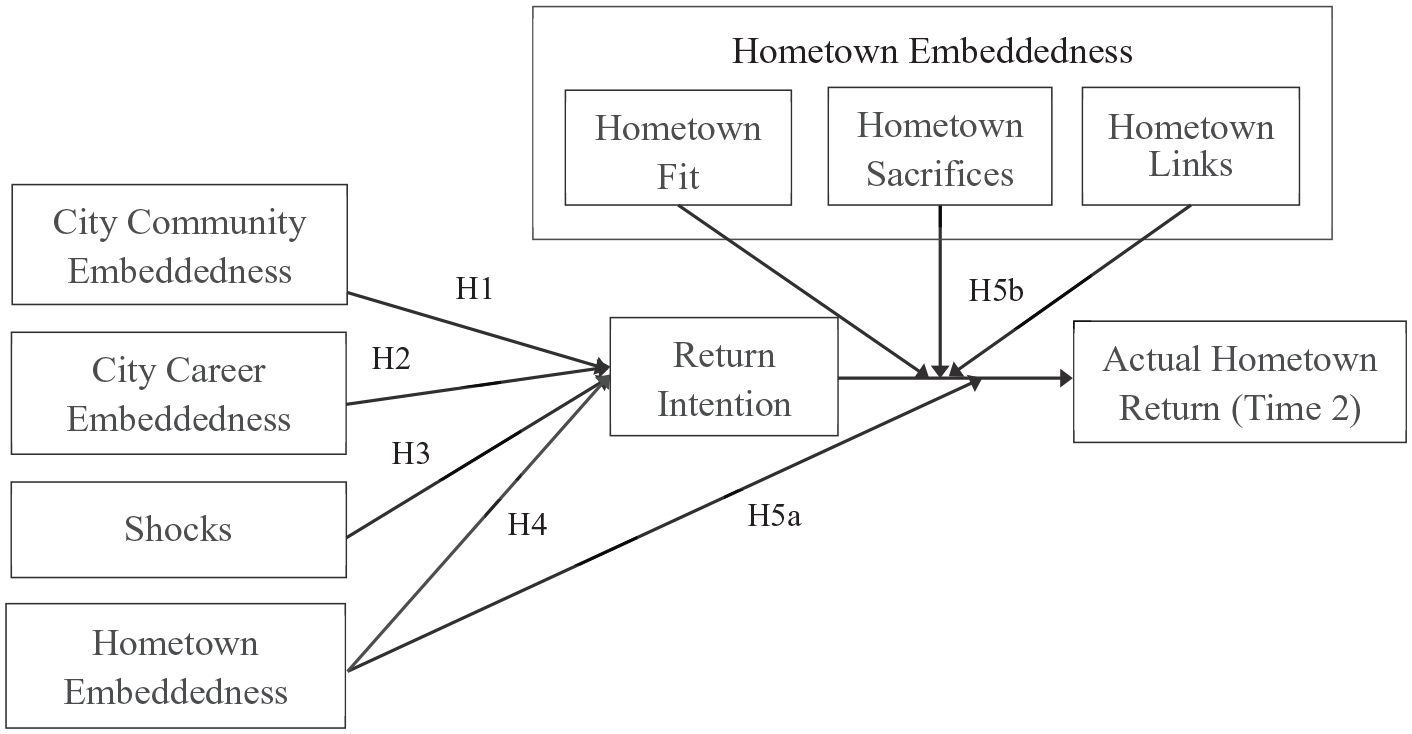
Theoretical model of return migration among RUM workers.
The case of Chinese RUM workers
Our quest for greater insight into RUM return migration draws inspiration from Li et al.’s (2020) observation that Chinese RUM laborers resemble SIEs who independently relocate overseas for work without the sponsorship of multinationals. While expatriates cross international borders, Chinese migrants move internally from impoverished rural areas to faraway urban centers seeking higher-paying jobs and prosperous livelihoods (Chuang, 2016; Li et al., 2020). Like expatriates, these domestic migrants face daunting challenges adjusting to unfamiliar urban environments where they end up as a rural underclass performing low-status jobs under harsh factory regimes and residing in substandard housing (Frenkel and Yu, 2015; Lu et al., 2013; Qin et al., 2019). Specifically, China’s household registration policy (hukou) and migrants’ limited skills, rudimentary education, and regional dialects prevent them from achieving city dwellers’ occupational status and living standards (Démurger and Xu, 2011; Gong et al., 2011; Zhu and Delbridge, 2022). Despite recent reforms easing hukou restrictions in lower-tier cities, Chinese migrants largely remain “second-class” citizens denied social welfare benefits (e.g. public housing, medical care) bestowed on urban citizens (Cheng et al., 2023; Li et al., 2023). Alongside expensive urban living costs, their inability to access residential benefits (including jobs providing income security and good benefits; Lu et al., 2013) hinders full integration into urban society (Sun et al., 2022). Family separations exacerbate urban assimilation as migrants leave behind relatives because they cannot afford to cohabit together or enroll children in public schools in cities (Zhu and Delbridge, 2022). Excepting annual homecomings, they seldom visit homebound family as travel to isolated villages is costly, time-intensive, and constrained by rigid factory work schedules (Chang, 2005; Qin et al., 2014). Such disadvantages frustrate “second-generation” migrants who seek the “China dream” (attaining affluent and rewarding cosmopolitan lives) rather than the first-generation who became urban sojourners to earn money to support families rather than permanently abandon agrarian life (Cheng et al., 2023; Sun et al., 2022). Such inferior working and living conditions engender a “high tendency towards mobility” among younger migrants (Zhu and Delbridge, 2022: 2279).
Theoretical rationale for model linkages
Host-city career embeddedness reducing migration intentions
Given their SIE resemblance (Li et al., 2020), we adapt Tharenou and Caulfield’s (2010) host-country career embeddedness to represent pull-to-stay forces that keep SIEs working overseas. As they explain, career embeddedness comprises (1) fit between SIEs’ career goals and career opportunities in host nations, (2) career links abroad, and (3) overseas career benefits (sacrifices) surrendered by repatriation. Similarly, we propose host-city career embeddedness comprising analogous career forces inducing Chinese migrants to remain in urban centers. By emigrating to cities, these migrants may find career fit between career aspirations and urban career paths, where they can earn higher pay, status, or self-fulfillment (including entrepreneurship; Roberts, 2020a) than in subsistence farming (Zhou and Sun, 2010). Given broader occupational choices, urban labor markets furnish greater prospects for vocational fit. Twenty years ago, Chinese migrants mostly labored in manufacturing or transportation (40%), construction (27%), or commerce (18%) (Roberts, 2001). While continuing to work in those fields (50%), nowadays they perform a wider array of jobs, such as retail (13.2%), transportation (7.1%), catering (6.7%), and various services (12.7%) according to the 2023 Migrant Worker Inspection Survey Report. 1 Attesting to prospective career fit, a qualitative study finds that “most migrant workers see their move from hometown to city as a ‘good’ choice” elevating their status or career mobility (Zhou and Sun, 2010: 61), while large-scale surveys report that a third of migrants (especially younger ones) identify as “working class” rather than as farmers (Frenkel and Yu, 2015).
Moreover, migrants may develop professional (guanxi) links with workmates (especially if they cohabit factory dorms or enclaves), supervisors (Li et al., 2018), or urban kin residents who furnish social capital such as job referrals or material resources (Huang et al., 2018). Although mostly tied to low-status local citizens, the few connected to high-status urbanites may look forward to more career resources or influence (e.g. business licenses for small businesses; Lu et al., 2013). Further, Chinese migrants employed in urban jobs (Huang et al., 2018; Roberts, 2020a; Wang, 2014) can better support families with remittances (Chan, 2010). Although the majority earn lower wages and benefits than urban dwellers (Knight and Gunatilaka, 2022), some migrants attain higher pay or benefits (thus enduring career sacrifices) if they sign formal labor contracts (guaranteeing social insurance, overtime pay, and minimum wage; Frenkel and Yu, 2015; Wang, 2014), perform skilled jobs (Zhu and Delbridge, 2022), or join manufacturers for international brands (and live in their campus-like dorms; Pun et al., 2016; Roberts, 2020a). Should migrants become enmeshed by career-embedding urban forces, they would feel discouraged from coming home, as by doing so, they would give up instrumental and intrinsic resources available in urban workplaces. In support, Tharenou and Caulfield (2010) found that host-country career embeddedness reduces repatriation intentions. Based on the foregoing rationale and evidence, we thus posit:
Hypothesis 1: Chinese migrants encountering city career embeddedness are less likely to intend to return to provincial homes compared with less embedded counterparts.
Host-city community embedding forces reducing migration intentions
Repatriation theorists (Ren et al., 2014; Tharenou and Caulfield, 2010) assert that SIEs also stay abroad owing to host-community embeddedness—notably, host-country fit, local indigenous links, and foreign residential amenities (aka sacrifices). Chinese migrants may encounter similar embedding forces living in cities. There, they may develop city fit (relinquishing provincial identity; Qin et al., 2019) by adopting urbanites’ consumer tastes, habits, and dress (e.g. attend high-end bars, wear designer clothing; Tang et al., 2020). Liberated from parental oversight (Chang, 2005), young migrants are more likely to find romantic partnerships of their choosing (Chuang, 2016; Huang and Brouwer, 2018; Song et al., 2021). Despite city residents’ prejudice toward them (Jiang et al., 2023; Lu et al., 2013), migrants may form some community links (Qin et al., 2019) with emigrated kin or government officials who offer funds, favors, or job leads (Huang et al., 2018; Lu et al., 2013). Further, some migrants join social networks of migrants from their village or live together in the same enclave (Sun et al., 2022; Tang et al., 2020). Finally, Chinese migrants partake of recreational and social activities (e.g. sports, dining, courtship) absent from rural homelands (aka city sacrifices; Liu and Lin, 2023; Roberts, 2020a; Tang et al., 2020). Although denied social welfare benefits in megacities (Chan, 2010; Roberts, 2020a), some migrants can experience “city sacrifices” if they qualify for urban hukou (enabling welfare access) by marriage, business investment, or inhabit smaller, inland cities (Frenkel and Yu, 2015; Zhu and Delbridge, 2022). Accordingly, we theorize that Chinese migrants embedded in cities are less likely to intend to return home. In support, Huang et al. (2018) reported that Chinese migrants having ample and strong ties to urbanites plan to settle permanently in cities, while embeddedness researchers observed that migrants embedded in cities less willingly quit or return home (MeiRun et al., 2018b; Yang and Lin, 2013).
Hypothesis 2: Chinese migrants embedded in city communities are less likely to develop intentions to return to hometowns compared with less embedded migrants.
Following Tharenou and Caulfield (2010), we adapt the classic notion of turnover shocks—critical events spurring thoughts of quitting a job (Lee et al., 1996, 1999)—to represent crucial events prompting thoughts of leaving cities and predict that such “return shocks” boost RUM workers’ return intentions. Indirect support for this proposition comes from qualitative or journalistic accounts attesting to how personal events (akin to path 1 shocks in the unfolding model; Lee and Mitchell, 1994) induce migrants to come home (e.g. child-bearing, caring for aging parents, farming, or retiring from factory labor; Chang, 2009; Chuang, 2016; Jiang and Sánchez-Barricarte, 2012; Knight et al., 2022; Smyth et al., 2009; Sun et al., 2022). Moreover, negative workplace events (aka path 2 shocks; Lee et al., 1996), such as work hazards or unpaid wages, can cause migrants to contemplate quitting (Chan and Pun, 2010; Jiang et al., 2009; Seo and Chung, 2019). Akin to path 3 shocks (aka unsolicited jobs; Lee and Mitchell, 1994), Zhu et al. (2023) also noted that provincial opportunities for rural start-ups may initiate migrants’ return migration. We thus predict the following:
Hypothesis 3: Return shocks increase Chinese migrants’ intended home return.
Hometown embeddedness as a direct influence on return intentions
Extrapolating from MFE theory that incumbents can be embedded in multiple work foci (e.g. occupation, organization; Kiazad et al., 2015), we envision that migrants are embedded not only in urban areas but also their place of origin. That is, they may experience hometown embeddedness based on provincial fit (e.g. farmer or place-of-origin identity; Qin et al., 2019; Zhu et al., 2023), village links (e.g. relatives, neighbors), and rural sacrifices (e.g. home comforts, clean air; Roberts, 2020a). Although hometown embedding forces did not deter Chinese migrants’ original urban migration, they may persist (e.g. village friendships renewed by Spring Festival trips; Zhu et al., 2023) or remain dormant until activated by return shocks or declining city embedding forces (Hom et al., 2012). To illustrate, some migrants retain a strong provincial identity (given ancestral ties to farming and residential rights, a plot of land symbolizing basic security; Qin et al., 2011) despite—or because of—its lack of affirmation in cities where they are negatively stereotyped (e.g. dirty, bumpkin) and denied residential privileges (Huang and Yi, 2015; Qin et al., 2019). Beyond this, Chinese migrants maintain village links to relatives left behind to care for dependents and the family farm (Chuang, 2016). When living in cramped unsanitary housing in cities (Huang and Yi, 2015), Chinese migrants may become mindful of rural home amenities (sacrifices), such as private sleeping quarters and pollution-free countryside (Roberts, 2020a). Acting as pull-to-return forces, hometown embeddedness thus motivates home return. Attesting to conflicting community embedding forces, Kraimer et al. (2012) documented that expatriates’ past host-country embeddedness weakens their loyalty to home-country employers upon repatriation, while Tharenou and Caulfield (2010) reported that home-country allures enhance SIE repatriation cognitions. All told, such findings support:
Hypothesis 4: Hometown embeddedness increases intended return migration.
Hometown embeddedness moderating relationship between intended and actual return
We further contend that hometown embeddedness strengthens the relationship between return intentions and behaviors. Quite likely, RUM workers are more likely to follow through on plans to return if they become mindful of the bountiful resources they can regain by heading home. Applying conservation of resources (COR) tenets, Kiazad et al. (2015) contend that the core embedding forces (aka fit, links, sacrifices) yield different resources. Their MFE perspective asserts that hometown sacrifices offer resources holding intrinsic value (e.g. affordable housing, healthier countryside), whereas hometown fit and links (e.g. provincial identity, village kin) offer instrumental value enabling resource gain (e.g. job autonomy, status; Hobfoll, 2001). Prospective returnees may readily enact return plans if they foresee ample resources awaiting them at home, should they have strong village fit, many village links, and alluring rural amenities. In COR parlance, anticipated resource gain may motivate them to act on return intentions to acquire hometown resources (Halbesleben et al., 2014).
Alternatively, identity strain may underlie this moderating effect (Kraimer et al., 2012). Based on expatriate identity theory (Kraimer et al., 2012), rural migrants may develop a stronger provincial identity if they experience hometown embeddedness. Specifically, they may fit the roles of farmer and/or village leaders (Chen and Liu, 2021), which enhance role satisfaction and identity salience. They may also have more village links and become cognizant of their provincial identity via frequent village interactions (remotely or intermittently during home visits). Further, their village roles may offer autonomy (e.g. self-employed farmer), enjoyment, or influence (e.g. family patriarch), constituting role sacrifices that reinforce provincial identity. In short, village fit, links, and sacrifices promote rural migrants’ provincial identity, which has been sustained by research that embedding forces instill a stronger social identity (Kraimer et al., 2012; Li et al., 2022).
Chinese migrants may nonetheless feel identity strain when their provincial identity lacks urban affirmation—or “receive inputs from their urban environment . . . that conflict with rural identity standards” (Qin et al., 2019: 804). Despite out-earning villagers remaining at home, rural migrants may feel more relative deprivation when comparing their income and living standards with those of local urbanites (Knight and Gunatilaka, 2012). Should they develop pessimistic expectations that they will never achieve the same pay and lifestyle as urban locals (becoming a rural underclass), they may decide to head home (Knight and Gunatilaka, 2012; Roberts, 2020b) or move to a lower-tier city where such deprivation—and identity strain—is less acute. Because “people in many contexts are willing to forgo absolute income in order to avoid lower relative income” (Knight and Gunatilaka, 2022: 1), we deduce that migrants feeling such strain (owing to a strong provincial identity underpinned by hometown embeddedness) are more motivated to exit urban communities. In support, Aime et al. (2020) found that well-paid executives earning lower relative pay than other top management team (TMT) members quit for firms where they can upgrade their relative TMT pay standing.
Hypothesis 5a: Hometown embeddedness strengthens the relationship between Chinese migrants’ intentions to return home and actual return.
Although relinquishing provincial amenities when moving to cities, RUM workers do not necessarily surrender village fit or links. As noted above, these hometown embedding forces remain instrumental for attaining resources. In contrast, village sacrifices have “intrinsic value in a specific context (e.g. safe neighborhood)” (Kiazad et al., 2015: 644). Unlike fit or links, sacrifices are inextricably bound to the place and given up when one physically leaves the village. Such intrinsic resources (e.g. home comforts, pleasant climates, child-rearing) thus cannot be experienced or savored when migrants live outside villages. Indeed, rural community amenities may represent “sunk costs” sacrificed while moving to cities. These sacrifices may even become permanent losses that are not reinstated upon return. For example, leaving home may have resulted in crop failure or undermined the well-being of children left behind. When migrants return, they may not be able to reverse the damage to household food security or children’s mental health and academic progress (Wen et al., 2021).
Although village amenities are anticipated rather than directly experienced, RUM workers can maintain active village links (via cell phones or home visits), and these ongoing links may even obligate them to return home (aka “normative pressures”; Hom et al., 2024; Li et al., 2020) to care for dependents or tend to the family plot (Ding et al., 2019; Song et al., 2021). Similarly, migrants can still perceive person–village fit (e.g. provincial or place-of-origin identity) despite living in cities; Qin et al., 2019). As noted earlier, they retain a provincial identity when interacting with fellow migrants in cities (reinforcing this identity) as well as urbanites (whose negative stereotyping may induce internalization of attributed peasant traits; Steele, 1997). Migrants are readily identified as such for “urban residents typically attach negative stereotypes to migrant workers because of their accent, appearance, and dress . . . in public areas”; Jiang et al., 2023: 2). Based on the above rationale, we propose:
Hypothesis 5b: Hometown fit and links moderate the relationship between return intentions and behavior more so than do hometown sacrifices.
Method
Sample and procedure
In 2015, we surveyed 2008 migrant workers from two factories of a large electronic manufacturing company located in neighboring cities in China’s Yangtze River Delta. Both factories served as primary Apple manufacturing bases. As Apple Original Equipment Manufacturer (OEM) facilities, their working conditions resemble those described by Ngai and Chan (2012) at Foxconn campuses. Despite offering various amenities (e.g. dormitory housing, subsidized meals, and entertainment facilities), assembly work is monotonous, fast paced and subject to close supervision that upholds strict work standards and severely punishes infractions.
We first distributed a letter inviting survey participation and assuring recipients that participation was voluntary and that their responses would remain confidential. In total, 1673 migrant workers (813 from one factory and 860 from another) participated, resulting in an 83.32% response rate. The senior author administered questionnaires to workers in the company’s canteen. This survey collected information about respondents’ demographic attributes (e.g. gender, age, income, hometown, marital status, and plant tenure). Participants were primarily men (70%), averaged 24.07 years of age (SD = 3.51), and averaged 1.54 years of firm tenure (SD = 1.57). They averaged 11.35 years of education (SD = 2.34). The survey also measured components of our model depicted in Figure 1. We also assessed control variables—namely, PDM (i.e. job and city satisfaction; see Tharenou and Caulfield, 2010) and PEM forces (i.e. perceived job alternatives in villages). Given high RUM turnover (Choi and Peng, 2015), we followed a standard research practice of collecting turnover data nine months after predictor assessment (see Begley, 1998; Porter et al., 1974; Waldman et al., 2015). The HR department provided information about participants’ employment status, revealing that 904 had since left the company.
Among the 904 leavers, 624 provided contact information in the questionnaire and agreed to follow-up phone interviews. We contacted 371 leavers and interviewed 313, representing a response rate of 84.37%. We could not reach 253 owing to incorrect or obsolete contact information. Among the 313 interviewed leavers, 117 had returned home, while the rest did not return home upon leaving. As a token of appreciation, we offered interviewees mobile phone credit worth 30 RMB (US$4.23). We checked for sampling bias by comparing survey responses between the 313 interviewed leavers and the 591 leavers whom we did not interview. T-tests detected no significant group differences in city career embeddedness (difference = .08, t = 1.72, p > .05), city community embeddedness (difference = .04, t = .68, p > .05), hometown embeddedness (difference = .001, t = .01, p > .05), return shocks (difference = .02, t = .79, p > .05), or return intentions (difference = .06, t = .94, p > .05).
Measures
Adhering to Brislin’s (1986) methodology, survey measures were initially translated from English to Chinese by a bilingual translator, and subsequently back-translated to English by another bilingual translator. We adapted Tharenou and Caulfield’s (2010) items (which themselves were based on Mitchell et al.’s (2001) embeddedness items) to assess city career, city community, and hometown community embeddedness. Previous studies validated Mitchell et al.’s (2001) original scale for assessing job embeddedness among Chinese RUM workers (Wang and Yang, 2014; Yang and Lin, 2013). Adopting rating formats from Tharenou and Caulfield’s (2010) host-country embeddedness measures, we had respondents evaluate “to what extent the following things would be sacrifices or losses for you if you returned to/left your hometown” from 1 (“not at all”) to 5 (“to a great extent”). For hometown fit and links items, our respondents indicated their agreement on a scale from 1 (“strongly disagree”) to 7 (“strongly agree”). For career links items, they reported numerical scores. A complete list of the measures used in this study is provided in the online Appendix.
City career embeddedness
Four items measured city career fit, assessing migrants’ belief that they can attain career goals in cities (e.g. “My career needs fit with the opportunities available in this city”). Three items measured career sacrifices—or career benefits relinquished leaving cities (e.g. “The career and employment opportunities I have in the host city”). City career links were evaluated with three questions: the first pertained to factory tenure, while the second and third inquired about the number of coworkers RUM workers regularly interact with at work and the number of coworkers they frequently interact with outside of work. We computed a composite score after first standardizing item scores (given different rating formats) and then averaging them.
City community embeddedness
City community fit (e.g. “The community I live in is a good match to me”) and links (e.g. “My close friends live near the community I live in”) were respectively measured with three items. Another item, “My family has stable jobs in the host city” was added to measure community links as accompanying spouses or relatives can influence migrants’ decision to return home (e.g. Li et al., 2020). City community sacrifices were measured with three items (e.g. “The friends and social ties I have in the host city”).
Hometown embeddedness
The measurement of hometown fit and links was adapted from the above scales assessing city community fit and links, by substituting “hometown” for the host-city’s name in each item. Conversely, the measurement of hometown sacrifices was derived from the scale assessing city community sacrifices, replacing “host-city name” with “hometown” in each item.
Return shocks
Following Tharenou and Caulfield (2010), we used the average score of two items to measure shocks. Each item was coded “1” if the participant answered “Yes” and “0” if the participant answered “No”. A sample item was, “There has been a particular identifiable event that started me thinking about returning to my hometown.”
Return-to-hometown intention (return intention)
Following Li et al. (2020), we assessed RUM workers’ return-to-hometown intention through a single item (i.e. “I plan to work in my hometown in the near future”), utilizing a scale ranging from 1 (“strongly disagree”) to 5 (“strongly agree”). Similar one-item measures have been used in expatriate research (e.g. intention to remain on the international assignment, Stahl and Caligiuri, 2005; intention to return to a domestic assignment, Guzzo et al., 1994).
Actual hometown return
Follow-up phone interviews determined whether leavers had returned home. This index was coded “1” for “Yes” and “0” for “No”.
Control variables
Given that age (Mobley et al., 1978), gender (Moynihan and Landuyt, 2008), income (Khatri et al., 2001), local economic environment 2 (Fields, 1976), marital status (Bluedorn, 1982), and factory location (Birdseye and Hill, 1995) have been shown to influence employees’ quit propensity, we controlled their effects on return intention and behavior. We also controlled residency status of migrants’ spouses as their city residency can affect migrants’ home return (regarding expatriates, see Froese, 2012; regarding rural migrants, see Frenkel and Yu, 2015). Additionally, we controlled whether migrants have children, as this can indicate higher hometown embeddedness, given that RUM workers’ children often remain in the home village (Duan et al., 2021; Li et al., 2020).
To estimate incremental predictive validity of our model constructs, we followed a routine practice in embeddedness research by controlling traditional turnover antecedents—namely, job satisfaction, city satisfaction, and hometown job availability (Jiang et al., 2012; Mitchell et al., 2001; Ramesh and Gelfand, 2010). We therefore used Russell et al.’s (2004) eight-item scale to assess job satisfaction (e.g. “My job makes me content”) and Lee and Mowday’s (1987) job alternative scale (e.g. “All in all, what is the likelihood that you could find an acceptable alternative in your hometown?”). As Tharenou and Caulfield (2010) found that host-country satisfaction is inversely related to SIE repatriation decisions, we also adapted their four-item measure to assess RUM workers’ satisfaction living in the host city.
Analytic strategy
We tested our model using Mplus 8.3 (Muthén and Muthén, 1998−2017). Specifically, to predict Time 1 return intention, we estimated two regression models. Model 1 included only control variables (i.e. age, gender, income, hometown GDP, marital status, children, and factory location) to predict Time 1 return intention. We estimated Model 2 by adding all independent variables (i.e. city career embeddedness, city community embeddedness, shocks, and hometown embeddedness) into Model 1 to predict Time 1 return intention. To predict Time 2 hometown-return status (a categorical criterion), we estimated two logistic regression models. Model 3 included control variables, independent and moderator variables (i.e. city career embeddedness, city community embeddedness, and shocks as independent variables; hometown embeddedness as independent variable as well as the second-stage moderator), the mediator (i.e. Time 1 return intention), and interaction terms between hometown embeddedness and Time 1 return intention to predict Time 2 actual return. Finally, we estimated Model 4 by using three dimensions of hometown embeddedness as second-stage moderators of the relationship between return intention and behavior. Following Preacher and Selig (2012), Monte Carlo simulation procedure further tested mediation hypotheses.
Results
Table 1 presents means, standard deviations, reliabilities, and correlations. We conducted confirmatory factor analysis (CFA) to test the construct validity of our measures. CFAs showed that the nine-factor (i.e. city career fit, city community fit, hometown fit, city–career links, city community link, hometown links, city career sacrifices, city community sacrifices, hometown sacrifices) model fit the data well: χ2 (314) = 1623.18, p < .01, CFI = .92, RMSEA (root mean square error of approximation) = .05, and SRMR (standardized root mean square residual) = .05. A second CFA next specified three second-order factors—city career embeddedness, city community embeddedness, and hometown embeddedness—underlying their respective three dimensions. The inclusion of second-order factors, along with another factor composed of two items representing return shocks, yielded a good to adequate fit: CFI = .86, RMSEA = .062, SRMR = .088. These findings affirm discriminant validity among the three embedding foci and return shocks.
Means, standard deviations, correlations, and reliabilities.

N ranges from 1082 to 1673. The Cronbach’s alpha coefficients are in parentheses along the diagonal. The unit of income is 1000 RMB, and the unit of Hometown GDP is 100,000,000,000 RMB. *p < .05; **p < .01.
Hypothesis testing
The coefficients in the hypothesized model are presented in Table 2 and Figure 2. As shown in Model 2 of Table 2, the negative relationship between city community embeddedness and migrant workers’ return intention (b = −.06, p = .07) was marginally significant, partially supporting Hypothesis 1. City career embeddedness (b = −.17, p < .01) was negatively related to migrant workers’ return intention, which supported Hypothesis 2. Workers experiencing higher city career embeddedness and city community embeddedness tended to have lower return intention. In addition, return shocks (b = .26, p < .01) and hometown embeddedness (b = .15, p < .01) were positively related to return intention, supporting Hypotheses 3 and 4.
Unstandardized coefficients and standard errors of estimated models.

N = 1673. We obtained R2 for Model 1 and Model 2, and obtained pseudo R2 for logistic models (i.e. Model 3 and Model 4). *p < .05; **p < .01.
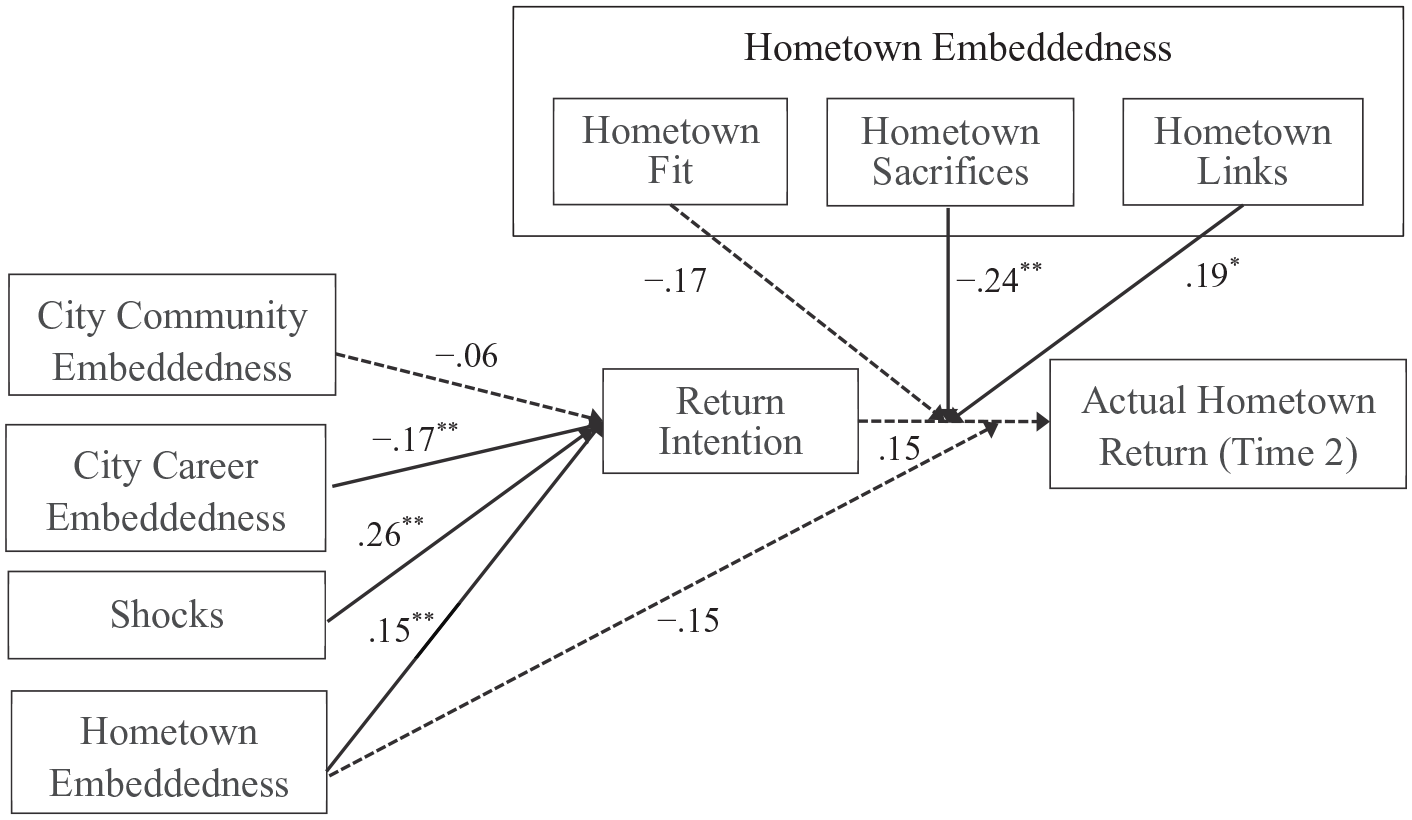
Model result with hometown embeddedness as the second-stage moderator.
According to Model 3 parameter estimates in Table 2, overall hometown embeddedness did not moderate the relationship between Time 1 return intention and Time 2 actual return, thus disconfirming Hypothesis 5a. However, as shown in Model 4 of Table 2, hometown sacrifices (b = −.24, p < .01) and hometown links (b = .19, p < .05) moderated the association between Time 1 return intention and Time 2 actual return, while hometown fit (b = −.17, p > .05) did not moderate this association.
Following Cohen et al. (2003), we plotted the effect of Time 1 return intention on Time 2 hometown return probability at conditional values for hometown sacrifices (i.e. 1 SD above and below the mean) in Figure 3. As seen in Figure 3, when hometown sacrifices were lower, the association between Time 1 return intention and Time 2 actual hometown return was significant and positive (b = .44, p < .01, OR = 1.55). For a one-unit increase in migrant workers’ return intention at Time 1, the odds of them returning home at Time 2 increased by a factor of 1.55. When hometown sacrifices were high, the association between Time 1 return intention and Time 2 actual return was not significant (b = −.15, p > .05, and OR = .86).
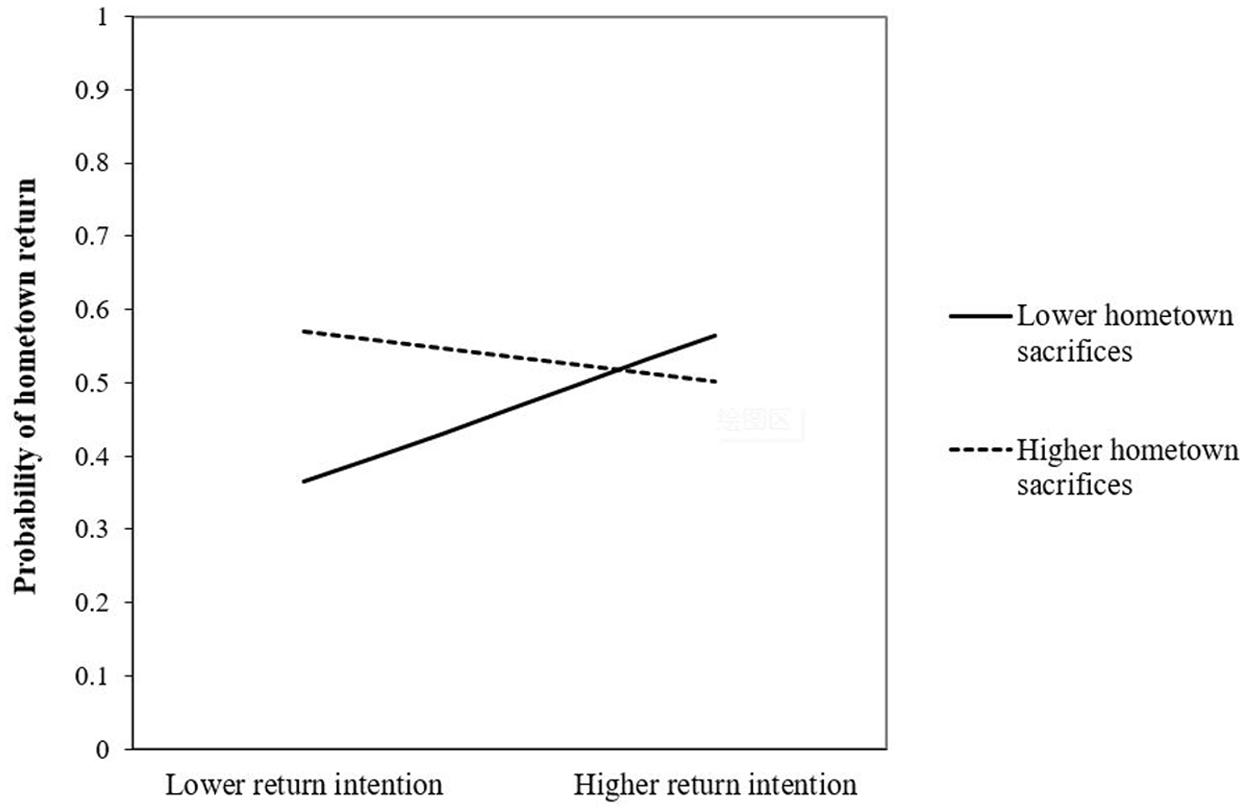
The moderation of hometown sacrifices.
As Figure 4 shows, when hometown links were higher, the association between Time 1 return intention and Time 2 actual hometown return was significant and positive (b = .36, p < .01, OR = 1.43). For migrants with many links, a one-unit increase in their return intentions at Time 1 thus increased the odds of their returning home by a factor of 1.43. However, when hometown links were fewer or weaker, Time 1 return intention and Time 2 actual return was not significantly related (b = −.07, p > .05, and OR = .93). Overall, we found partial support for Hypotheses 5b as hometown links strengthen the return migration intention‒behavior relationship, whereas hometown sacrifices weaken this relationship.
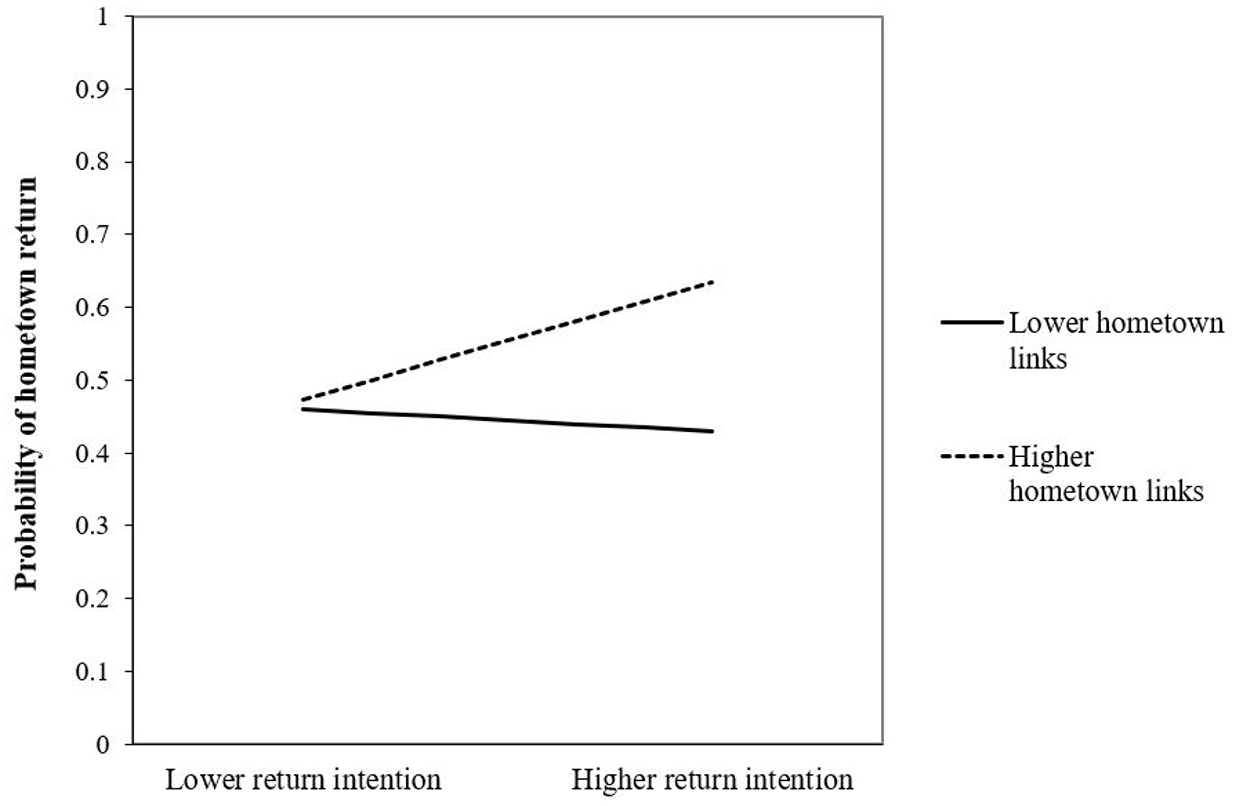
The moderation of hometown links.
We next tested moderated mediation effects implicit in our model using Monte Carlo simulation. We found that hometown sacrifices moderated the indirect effect of city career embeddedness on Time 2 hometown return via Time 1 return intention (index of moderated mediation = .040, 95% Monte Carlo CIs [.012, .071]). Meanwhile, hometown sacrifices moderated shocks’ indirect effect on Time 2 actual hometown return through Time 1 return intentions (index of moderated mediation = −.063, 95% Monte Carlo CIs [−.110, −.019]).
In a similar vein, we found that hometown links moderated three indirect effects. Specifically, hometown links reduced the indirect effect of city career embeddedness on Time 2 hometown return through Time 1 return intention (index of moderated mediation = −.032, 95% Monte Carlo CI [−.063, −.002]). Additionally, we found that hometown links increased the indirect effect of shocks on Time 2 actual homecoming through Time 1 return intention (index of moderated mediation = .050, 95% Monte Carlo CI [.003, .098]).
Supplementary analyses
Because some participants leaving factories stayed in the host city (N = 102) or moved to another city (N = 94), we estimated two logistic regression models to predict migrant workers’ likelihood of (1) leaving the company but staying in the host city against other situations and (2) relocating to a new city against other situations separately. The effects of the mediator, moderators, and interaction terms in predicting (1) leaving the company but staying in the host city against other situations were nonsignificant. Similarly, the effects of the mediator, moderators, and interaction terms were nonsignificant in predicting (2) relocating to a new city against other situations. These insignificant results may be partly attributed to the fact that we only measured hometown-return intention rather than intention to stay in the original city or intention to move to a new city. We also examined the direct effects of our independent variables on these two categorical variables and found that host-city career embeddedness had a significant direct negative effect on (2) relocating to a new city against other situations (b = −.46, p < .05, OR = .63). This result is consistent with its negative effect on migrant workers’ return decisions (see Table 2, b = −.42, p < .05, OR = .66), indicating that host-city career embeddedness reduces the odds of migrants returning to their hometown or relocating to other cities.
Discussion
Our research advances understanding of why Chinese RUM assemblers essential for manufacturing in global supply chains return to home provinces, a prime reason for their high factory attrition. Adapting Tharenou and Caulfield’s (2010) SIE repatriation theory, we enrich predominant RUM attrition models based on March–Simon (1958) and Mitchell–Lee (2001) models (Allen and Vardaman, 2017; Maertz et al., 2003; Qin et al., 2019) by elucidating why Chinese migrants leave or stay in cities. Contributing to the burgeoning literature on developing-world RUM attrition (Allen and Vardaman, 2017; Hom et al., 2019), we showed that Chinese migrants’ embeddedness in urban career prospects and communities decreases intended homeward return, while return shocks boost such intentions. The first-generation of Chinese migrants emigrating to export-processing zones had been confined to assembly-line work and lacked access to urban hukou benefits (e.g. public schools, subsidized housing; Huang and Yi, 2015; Qin et al., 2014, 2019), limiting their host-city career and community embeddedness. By contrast, host-city embedding forces increasingly enmesh subsequent generations (such as our study participants) who can pursue a wider range of vocational pursuits besides factory jobs (e.g. delivery drivers, low-skilled IT labor) and find new ways to obtain residential amenities (e.g. private schooling for children) by inhabiting lower-tier cities, investing in real estate, or transferring their hukou to the household hukou of urban kin residents (Chu et al., 2015; Huang et al., 2018; Roberts, 2020a; Zhu and Delbridge, 2022). In line with Alberti and Sacchetto’s (2024) recent research on migrant workers’ mobility, we emphasize the importance of considering their broader life circumstances and social contexts rather than focusing solely on their job-related concerns.
Our study further generalized Tharenou and Caulfield’s (2010) adaptation of Lee and Mitchell’s (1994) original notion of turnover shocks (aka events prompting mental deliberations about leaving a job; Jiang et al., 2009; West, 2000) to represent return shocks underpinning RUM workers’ homeward migration. Although Mitchell and Lee’s (2001) job embeddedness theory has been widely extended to explain diverse embedding foci such as expatriate assignments (Kraimer et al., 2012), occupations (Ng and Feldman, 2009), and colleges (Wangrow et al., 2022), their unfolding model nonetheless eluded such refinement. By reconceptualizing the prevailing notion of turnover shocks (Laulié and Morgeson, 2021), we demonstrated how return shocks clarify why migrant workers relocate home.
Going beyond MFE theory specifying multiple forms of work embeddedness (Kiazad et al., 2015) we demonstrated how migrants can also be embedded in urban and rural communities. In consonant with the MFE view that different work embedding foci differentially affect turnover, we established that migrants’ embeddedness in their provincial community counteracts host-city embeddedness by bolstering their intentions to head home. Such findings extend emerging inquiries into the “dark side” of embeddedness, revealing that extreme or certain embedding forces can have detrimental effects on incumbents (e.g. psychological distress, stunted human capital development; Allen et al., 2016; Ng and Feldman, 2010), families (e.g. work–family conflict; Ng and Feldman, 2012), or organizations (e.g. worse performance or disloyalty; Holtom et al., 2020; Porter et al., 2019).
Moreover, our investigation revealed that hometown links facilitate translation of return migration intentions into actual return, suggesting that a two-stage withdrawal conversion process enhances the explanatory power of theories about withdrawal decisions by collectivists susceptible to ingroup influences (Hom et al., 2024; Wong and Cheng, 2020). Consistent with earlier research that RUM workers often fail to implement quit intentions (Chen et al., 2016; West, 2000), we found weak relationships between home return intentions and decisions (r = .05). Like turnover decisions (e.g. uncertainty of finding alternatives and their attributes, unpredictable effectiveness in new job; Vardaman et al., 2008), migration decisions carry risks for RUM workers, such as parenting resentful left-behind children, resuming strenuous agricultural labor, or living with parents-in-law (Connelly et al., 2010). RUM workers may overcome risk aversion or perceive less risk when hometown links (i.e. trusted and close referents) exert normative pressure on them to come home. After all, embeddedness researchers have long envisioned that normative pressures (reflecting coercive demands or personal appeals) can originate from embedding links (Hom et al., 2012; Ramesh and Gelfand, 2010). This is especially true for women migrants, who face stronger normative pressure to return home for caregiving responsibilities (Dong, 2023) given conflicts between migrant work and domestic duties (Alberti and Sacchetto, 2024). Likewise, social demands or encouragement from rural family or friends may strengthen RUM workers’ resolve to return home (Tharenou and Caulfield, 2010). Their appeals may entail promised help or resources to facilitate homecomings (Wangrow et al., 2022), such as financial or social capital for village start-ups (Zhu et al., 2023) or help expanding a house to accommodate in-laws (Connelly et al., 2010). Indirect evidence comes from Huang et al. (2018) who noted that migrants relying on social support from fellow villagers in other cities are less likely to settle in host cities.
This moderating effect further sustains recent perspectives that job embeddedness can underlie social identification (Li et al., 2022) and incur identity strain when an individual confronts embedding forces from two distinct communities (Kraimer et al., 2012). Extending this line of inquiry, our test suggests that hometown embeddedness may bolster RUMs’ identity strain—and thus intentions to return home—by strengthening their provincial identity. Yet those intentions culminate in actual return only when hometown links are strong.
Contrary to hypothesis, hometown sacrifices attenuated the relationship between return intention and behavior. That is, migrants reporting that they are forsaking village amenities by living away from home (e.g. provincial lifestyle, village friendships) are less likely to enact their decision to return home. As previously mentioned, hometown sacrifices may not facilitate home return because migrants physically separated from home villages cannot directly experience tangible hometown amenities (e.g. access to cleaner air, open spaces, and nature). Moreover, our study operationalized village sacrifices as “sunk costs” migrants had incurred or are incurring. Yet embeddedness theorists typically construe community sacrifices as prospective costs inhabitants would incur if they leave current communities. Prospective costs thus embed them by eliciting risk aversion, inducing them to stay for fear of potential losses. By comparison, our respondents described what they had already sacrificed or continue to do so by living in cities. Such sunk costs might actually reinforce commitment to their decision to leave home (Becker, 1960) by invoking post-decisional rationalization to justify village sacrifices (Mowday et al., 2013). Further, Chinese migrants may believe that they cannot recoup certain losses by returning, especially if they are permanent (Fernandez and Rodrik, 1991; Garland and Newport, 1991), such as relatives having also migrated to cities, aging parents who since died, or home farm had been sold (Kan and Chen, 2022).
By contrast, correlations reveal that hometown fit and links represent pull-to-leave forces. All the same, they differentially moderated the relationship between return intention and behavior. Hometown links reinforced this relationship but not hometown fit. Conceivably, hometown fit relies on visceral experience of the physical environment of the hometown community (Yao et al., 2004); thus, hometown fit exerts weaker influence given its weaker saliency when RUM workers live in cities. By contrast, hometown links are strengthened by regular phone communications with fellow villagers and relatives and home visits (Li et al., 2020). Indeed, Yue and Wang (2022) report that RUM workers’ hometown links play a more dominant role than city links in fostering urban adaptation and well-being.
Study limitations and future research
First, while predicting return migration, our model did not forecast the longevity or “permanency” of home return (Huang et al., 2018). Many rural migrants engage in “circular migration”, cycling between villages and urban centers (Roberts, 2020a; Sun et al., 2022), often returning to cities after rest, family duties, or seasonal work (Roberts, 2020a; Wang and Wang, 2021). In follow-up interviews with 117 returnees, 70 had secured hometown jobs and 31 expressed a willingness to continue working there. This suggests our criterion mainly captures return migrations rather than temporary stays. Future longitudinal tests could evaluate our model’s ability to predict home resettlement persistence and incorporate influences like urban attractions and village shocks that drive returns to cities.
Second, while our study extends RUM turnover research by exploring turnover destinations, we focus specifically on return migration. Supplementary tests indicate that the interaction between return intention and hometown embeddedness does not predict other turnover outcomes, such as relocating to other cities or job changes within the same city. This highlights our model’s limitations and the need to assess migrants’ intentions to migrate to other destinations and normative pressures from their referent others who shape their chosen destinations (Hom et al., 2024; Wong and Cheng, 2020). Huang et al. (2018) similarly noted that village and urban links differently shape urban settlement decisions.
Third, the unexpected moderating effect of hometown sacrifice suggests that our “sacrifice” proxy assessing village benefits and amenities forsaken by urban emigration represents a feeble pull-to-return force. Rather, we prescribe Tharenou and Caulfield’s (2010) “home-country lifestyle instrumentality” index to capture expectations of career and lifestyle improvements upon home return. Future research should thus assess “hometown attractions” by evaluating rural migrants’ expectations of provincial advantages and opportunities. Conversely, we welcome more inquiry identifying inhibitors that weaken the relationship between return intentions and behaviors, such as dense local networks (where migrants form friendships or marital bonds with other migrants in cities; Chuang, 2016) or city sacrifices (e.g. freedom from parental oversight; Connelly et al., 2010). They serve as salient reminders of the actual costs of return migration (Vardaman et al., 2015).
Fourth, while we noted that return shocks differ from turnover shocks, our measure did not specify their nature (e.g. pregnancy, child-rearing, village start-ups). Child-rearing shocks are particularly significant in China owing to urban hukou restrictions and housing, which impede family cohabitation and schooling (Li et al., 2023; Zhu and Delbridge, 2022). Future inquiries should examine these specific shocks’ effects and intensities. Lastly, evaluating model generalizability in nations like Mexico or Vietnam is essential given that their citizens do not face hukou restrictions nor travel long distances to visit home villages.
Practical implications
Our findings reveal that 54.03% of Chinese RUM assemblers left their jobs, consistent with high turnover rates in electronic manufacturing (e.g. 62% within one year; Qin et al., 2019). Among those interviewed, 37.38% (117/313) returned home. To mitigate return migration, a key component of turnover, our study highlighted the stronger impact of city career embeddedness compared with city community embeddedness in retaining RUM workers. Enhancing city career embeddedness through special training and educational opportunities that broaden workers’ urban vocational prospects can reduce home migration. Although this “managerial paternalism” may lower job loyalty (Zhu and Delbridge, 2022), increasing migrant employability in urban labor markets (Fugate et al., 2004) may nonetheless prolong their tenure (and perhaps performance) and attract new replacements. Hometown embeddedness, however, remains a powerful draw, with hometown links reinforcing the translation of return intention into actual return by reflecting the complexity of their hometown lives (Cao et al., 2015). To counter this, local city authorities should promote urban integration (Yue et al., 2013) and support identity transformation for migrants to facilitate transition into urban life (Fu et al., 2018). Organizations can address second-class citizenship stigma (arising from rural hukou; Jiang et al., 2023; Roberts, 2020a) by improving housing conditions, peer mentorship (Liao et al., 2015), and social networks to include local ties (Huang et al., 2018), thereby encouraging RUM workers to see themselves as urbanites. Greater identification with the urban community may weaken hometown ties (Keung Wong et al., 2007). Additionally, factory managers could motivate RUM workers by acknowledging their sacrifices incurred by leaving home (including their amelioration such as increasing home visits or economical ways to communicate with relatives), strengthening urban commitment through reminders of their “sunk costs” (Vardaman et al., 2015).
Conclusion
City career embeddedness and city community embeddedness act as pull-to-stay forces decreasing Chinese migrants’ return-to-hometown intention, while returning shocks exhibit the opposite effect. Hometown embeddedness also serves as a pull-to-leave force, reinforcing return intentions. Among the three components of hometown embeddedness, hometown links also facilitate the translation of return-to-hometown intention into actual return, while hometown sacrifices act as sunk costs constraining implementation of return cognitions into action.
Supplemental Material
sj-pdf-1-hum-10.1177_00187267251319670 – Supplemental material for Homeward bound or urban aspirations? Unraveling rural–urban migrant workers’ decision to return through hometown embeddedness and city embeddedness
Supplemental material, sj-pdf-1-hum-10.1177_00187267251319670 for Homeward bound or urban aspirations? Unraveling rural–urban migrant workers’ decision to return through hometown embeddedness and city embeddedness by Jingqiu Chen, Peter W Hom, Ningyu Tang and Qingyue Fan in Human Relations
Footnotes
Acknowledgements
We would like to express our gratitude to Associate Editor Mina Beigi and the three anonymous reviewers for their insightful and constructive comments, which greatly contributed to the development of this article. We are especially grateful to Mo Wang and Yifan Song for their valuable insights during the early stages of this research, as well as to Kohyar Kiazad for his helpful feedback. Additionally, we appreciate the assistance of Heng Li in data collection at two factories of a major electronics manufacturing company. Finally, we are grateful for the support of the National Natural Science Foundation of China (Grant Nos. 72071129, 72072116, and 72232005).
Funding
The authors disclosed receipt of the following financial support for the research, authorship, and/or publication of this article: This work was funded by the National Natural Science Foundation of China (No. 72071129, No. 72072116 and No. 72232005).

Supplemental material
Supplemental material for this article is available online.
Notes
References
Supplementary Material
Please find the following supplemental material available below.
For Open Access articles published under a Creative Commons License, all supplemental material carries the same license as the article it is associated with.
For non-Open Access articles published, all supplemental material carries a non-exclusive license, and permission requests for re-use of supplemental material or any part of supplemental material shall be sent directly to the copyright owner as specified in the copyright notice associated with the article.
