







Abstract
Institutional theory has long been concerned with the relationship between agency and structure in explaining how institutions are created, maintained and transformed. While early formulations emphasized the constraining power of institutional structures, subsequent work – most notably the institutional work literature – has sought to recuperate agency by foregrounding the purposive actions of individuals and collective actors. Despite these advances, institutional theory continues to grapple with a persistent paradox: agency is treated as structurally constrained when explaining institutional reproduction, yet as relatively autonomous and intentional when accounting for institutional change. We argue that this paradox stems from an implicit assumption shared across much of institutional theory: the view that agency and structure are analytically and ontologically separable. Drawing on Judith Butler’s philosophical work on the formation of subjectivities, we challenge existing theoretical accounts of institutional reproduction and change by reconceptualizing agency and structures as intersubjective relational accomplishments that co-constitute institutionalization. To this end, we developed a psychosocial approach to institutional work that views embodied performativity and affective relationality as central to the enactment, maintenance and disruption of institutions, offering a novel and provocative intervention into ongoing debates on microfoundations of institutional processes.
Keywords
How can we know the dancer from the dance?
Introduction
Institutional theory remains a dominant lens in management and organization studies (MOS) for explaining how social order is produced, reproduced and transformed (Greenwood et al., 2008; Harmon et al., 2019; Holm, 1995; Lawrence et al., 2011). By engaging the relationship between agency and structure, institutional scholars have shown how norms are established, maintained and occasionally disrupted (Barley and Tolbert, 1997; DiMaggio and Powell, 1991; Seo and Creed, 2002). While early formulations emphasized the constraining power of institutional structures (DiMaggio, 1988), subsequent developments – most notably the institutional work literature – sought to recuperate agency by foregrounding the purposive actions of individuals and collective actors (David et al., 2019; Hwang and Colyvas, 2020), and their role in enacting institutional processes (Abdelnour et al., 2017; Lawrence and Phillips, 2019; Meier and Simsa, 2021; Tuominen, 2025).
Despite these advances, the explanatory power of institutional theory remains hindered by contradictory assumptions in its treatment of agency. On the one hand, agency is depicted as structurally embedded and constrained in its explanation of institutional reproduction; on the other hand, it is framed as reflexive, intentional and capable of effecting institutional change. Such an inconsistency has led to recurring critiques that ‘institutional theorists have long tended to flip-flop between structure and agency in their efforts to include both while failing to strike an analytical balance between them’ (Modell, 2022: 36). As a result, over the last couple of decades, debates continue over: (1) whether agency retains ontological independence given that its embeddedness within institutional structures (Bitektine et al., 2020; Cardinale, 2018, 2019; Tuominen, 2025) and (2) whether and how agency and structure are mutually co-constituted (Aksom and Tymchenko, 2020; Brandtner et al., 2026; Goldenstein and Walgenbach, 2021; Lok and Willmott, 2019; Meyer and Vaara, 2020). However, regardless of whether actors are embedded, autonomous or entrepreneurial, agency is typically conceptualized as a capacity they possess and exercise in relation to pre-existing structures. Across these debates, another shared assumption persists: agency and structure are treated as analytically and ontologically separable.
We argue that this assumption constitutes a fundamental limitation. By maintaining an ontological distinction between agency and structure, institutional theory struggles to account for how institutions are lived, embodied and reproduced through everyday practice. To address this impasse, we draw on Judith Butler’s (1990, 1993a, 1993b, 2004) theory of subjectivity to reconceptualize agency not as a sovereign capacity but as a process through which subjects are constituted by attaching themselves to social norms. We critique institutional theory and argue for an overhaul of its conceptual edifice through a subjectivitist lens, to challenge the premise that agency and structure are separable elements of social life.
Subjectivity refers to the old philosophical problem on the nature of reality where ‘there is no division to subject and objects in the sense of internal and external, but only into that of consciousness and their perceptions of consciousness’ (Jones, 1949: 53). In critical theories that inflect Butler’s writings – such as poststructuralism and psychoanalysis – sensations or pure cognitive reason do not define the ontology of the subject (Rebughini, 2014). Butler’s work offers a relational and non-sovereign account of subject formation, in which individuals are simultaneously subjected to and constituted by normative frameworks. From this perspective, agency is neither external to structure nor fully intentional; it emerges through embodied and affective processes that bind subjects to the very norms they may also contest. This shifts the analytical focus from ‘embeddedness’ to embodiment, foregrounding how actors experience, enact and negotiate possibilities for action. At the same time, Butler’s work directly connects subjects with agency in the sovereign political sense, which is ‘simultaneously “subjective” (say, capable of decision) and “sub-jected” (say, pliable with coercion)’ (Kockelman, 2006: 8), proffering revelatory insights on how and why conformity and resistance to social norms occur.
Although Butler’s ideas have gained traction in MOS (Cabantous et al., 2016; Doshi et al., 2025; Fotaki and Daskalaki, 2021; Gond et al., 2016; Kenny, 2010, 2018; Komporozos-Athanasiou et al., 2018; Riach et al., 2014; Segarra and Prasad, 2020; Tyler, 2020; Varman and Al-Amoudi, 2016), their implications for institutional theory remain underdeveloped. In particular, institutional theory has not fully mobilized them to challenge the field’s underlying assumptions about agency. We address this gap by engaging Butler’s theorization of subjectivity to rethink institutional work as a productive path, casting agents/actors as malleable entities simultaneously implicated in the submission to and production of social norms, who are not fully knowable to themselves and, therefore, not entirely in control of, or always reflexive about their actions. Specifically, Butler’s ideas enable us to reconceptualize agency not as a sovereign or reflexive capacity but as an embodied and affective process through which subjects come into being via their attachment to social norms. From this perspective, institutions are not external structures that actors inhabit or strategically manipulate; instead, they are intersubjective accomplishments sustained through performative and affective relations. To offer analytical specificity, we focus our critique on institutional work – a stream within the broader domain of institutional theory that ‘describes the process of individuals and collective actors aimed at creating, maintaining, and disrupting institutions’ (Lawrence et al., 2011: 52).
We distil Butler’s contribution into two interrelated concepts: embodied performativity, which conceptualizes action as the reiteration of socially constituted norms through the body, and affective relationality, which captures how subjects become attached to norms and others through affective processes. Together, these concepts allow us to reconceptualize agency as a psychosocial and relational process through which institutions are continuously enacted and destabilized.
The article proceeds as follows: We first review the institutional work literature, highlighting its unresolved treatment of agency. We then develop our Butlerian framework of subjectivity, elaborating embodied performativity and affective relationality. Finally, we discuss the implications of this reconceptualization for institutional theory and broader debates on agency, power, and institutional change.
Structuralist and post-structuralist views of agency in institutional theory
Despite its conceptual diversity – often bordering on analytical ambiguity – institutional theory has exerted significant influence in MOS. Rather than rehearsing this expansive literature (for a comprehensive overview, see Greenwood et al., 2008; Haack et al., 2019; and for an outline of new directions, see Aksom and Tymchenko, 2020; Lawrence and Phillips, 2019; Lawrence et al., 2013), we focus on a central and unresolved question within institutional work: what constitutes agency and what role does it play in institutional processes?
Institutional theory has long been divided between structuralist accounts, which privilege institutional constraint (DiMaggio, 1988; DiMaggio and Powell, 1991), and perspectives that foreground agency in institutional transformation (Creed et al., 2014; Lawrence et al., 2011; Meyer and Vaara, 2020; Voronov and Weber, 2020). Structuralist approaches treat actors as embedded within institutional environments, responding to isomorphic pressures through conformity and legitimacy-seeking behaviour (DiMaggio and Powell, 1991; Oliver, 1991). This produces an ‘oversocialized’ conception of agency (Granovetter, 2007), in which action is largely a premediated response to external constraints. While actors are understood to pursue their interests, agency remains subordinate to structures that predate and exceed them.
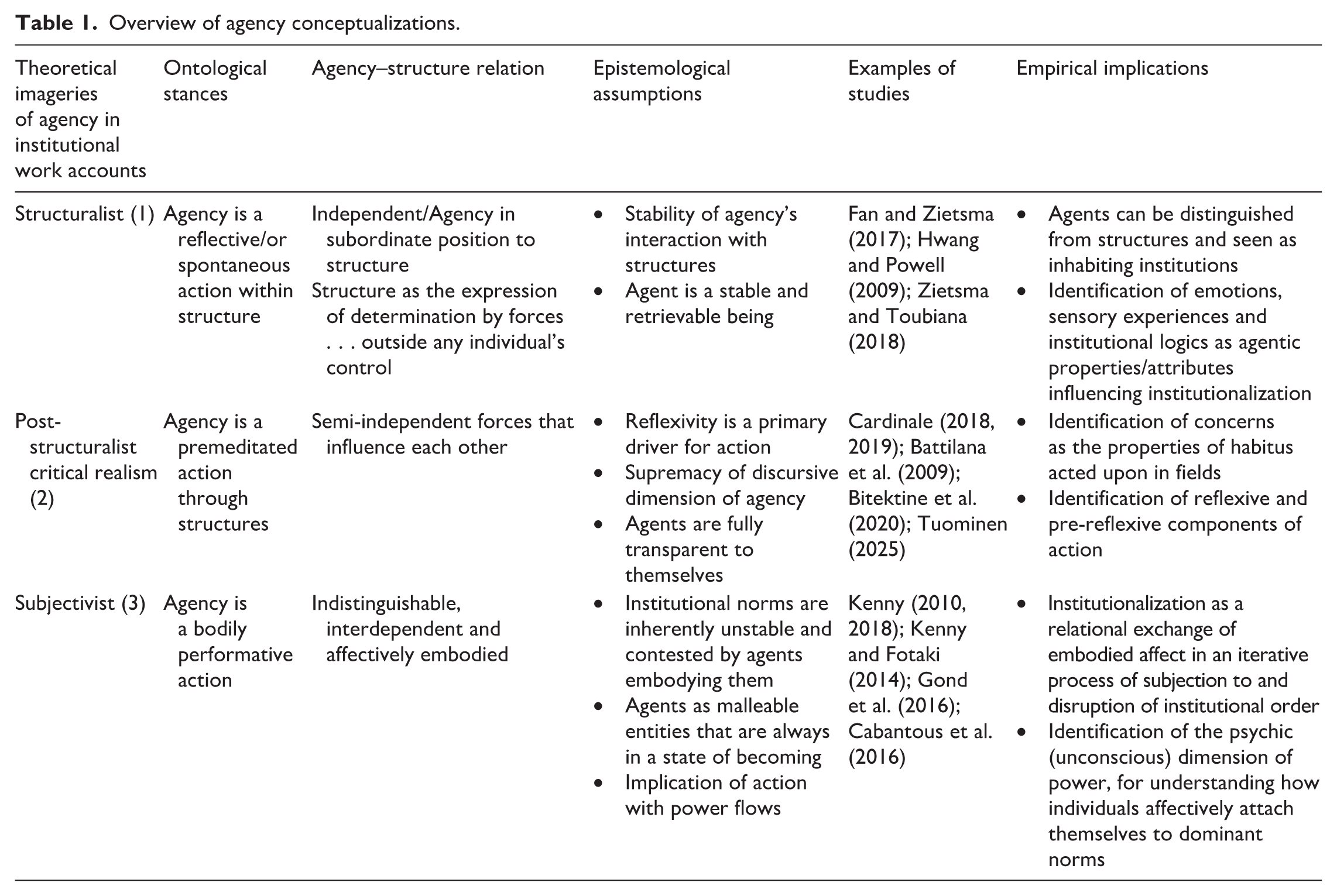
The embeddedness of actors in their respective institutional environments is thus considered the ultimate condition of actorhood underlying its agentic manifestations and dictating its rationales (Lok and Willmott, 2019; Meier and Simsa, 2021). In simple terms, actors engage with their institutional environments in ways that serve their interests and survival; nonetheless, actors and structures remain separately constituted, with the latter constraining the self-determination of the former. Arguing that social survival of actors depends on how they live out their condition of embeddedness, the structuralist view emphasizes rational aspects of action and assumes the sovereignty of agency within structure, thereby providing space for discursive reactivity to legitimacy pressures (Langley et al., 2019; Suddaby and Greenwood, 2005). At the same time, actors remain constrained by structures that predate and exceed them. Overall, this perspective retains a clear separation between actors and structures, positioning agency as a response to external constraints rather than as constitutive of institutional order itself. We summarize the structuralist conceptualization of agency in the first row of Table 1.
Overview of agency conceptualizations.
While the influence of the structuralist view of agency on organizational studies has remained relatively stable, its deployment to explain the implications of agency for institutional processes has evolved. Consequently, agency has been reconceptualized away from being merely a set of responsive strategies to structural pressures (Oliver, 1991) and towards demonstrating its generative and creative capacity to disrupt and change the institutional environment (Lawrence and Suddaby, 2006; Lawrence et al., 2009). This evolution has also manifested in, among other theoretical outcomes, the institutional work perspective (Lawrence et al., 2011, 2013) that sought to move beyond structural determinism by recuperating actors’ capacity to engage with and transform institutions creatively. Since its inception in 2006, institutional work has informed an expansive research programme that aspires to explore (and celebrate) the embedded, yet intentional, actions of individuals in shaping institutions. While other approaches underlying the critical realism tradition (Archer, 2000) make more modest claims about the role of agency in institutional transformation, they all rest on the assumption that agency is needed to explain change in structures (Van den Berg and Amasyali, 2025). Subsequent work, particularly within institutional work and entrepreneurship literatures, has sought to redress this imbalance by emphasizing actors’ creative and transformative capacities (Battilana et al., 2009; Lawrence and Suddaby, 2006). Here, agency is recast as reflexive, intentional and generative – capable of disrupting and reshaping institutional arrangements. In its most pronounced form, this produces the figure of the ‘hyper-muscular’ institutional entrepreneur (Suddaby, 2010), whose intentional actions are treated as the source of institutional transformation.
Furthermore, in seeking to imbue institutional work perspective with critical or emancipatory intent, many researchers have placed significant emphasis on reflexive agency as a vehicle for achieving emancipation or some degree of dis-embeddedness from oppressive structures (Modell, 2022). For instance, Holm (1995) showed that the rise and fall of a specific institutional form in Norwegian fisheries was in part an outcome of a political process initiated by its constituent actors. In a study of Canadian harvesting practices, Zietsma and Lawrence (2010) demonstrated that, under certain conditions, the very actors subjected to institutional pressures could influence and change them. Nilsson (2015) further argued that institutional work is an agential act that maintains or transforms institutions in response to actors’ lived experiences and social interests. Similarly, Granqvist and Gustafsson (2016) examined the establishment of a university to show how actors engaged in temporal work – that is, how they constructed, navigated and capitalized on timing norms in their attempts to change institutions. More recently, in their case study of a public organization in Finland, Tuominen (2025) focuses on reflexivity as a multidimensional human ability to theorize how different reflexive processes of individual employees are implicated in the creation, development and maintenance of institutions. Overall, a theoretical take on agency as the major force in institutional processes is realized by recasting structural constraints on action as opportunities and/or resources to challenge institutional order (for a summary of the post-structural view of agency represented by the critical realism perspective, see row 2 in Table 1). However, a focus on such agency and a simple inversion of the agency–structure dichotomy in which agency is elevated as the primary driver of institutional change and structures recede into the background as malleable contexts, is not sufficient for understanding how emancipatory courses of action can be nurtured, for it requires a more explicit engagement with the notions of power (Willmott, 2011, 2015).
The main problem is that regardless of whether scholars view actors as conforming agents or as actors seeking empowerment, both interpretations are limited by the ontological essentialism that foregrounds them. This essentialism is rooted in the assumption that actors’ intentions when engaging in institutional work (Meier and Simsa, 2021) are immutable. Whether constrained or empowered, agency is conceptualized as a capacity that actors possess and deploy. Furthermore, despite their differences, both positions share a common limitation: an ontological essentialism that treats actors as coherent, knowable and intentional subjects. While the post-structuralist view usefully highlights the generative dimensions of action, it also presumes, as we mentioned earlier, that actors are reflexive and largely self-transparent. These assumptions leave key dimensions of institutional life undertheorized. In particular, this leaves out how actors’ positionality within power relations shapes their possibilities for action (Abdelnour et al., 2017), and how embodiment, affect, and unconscious processes actively contribute to institutionalization. Even when lived experiences are acknowledged, they are typically treated as attributes actors bring to institutional contexts (Voronov and Weber, 2016), rather than as constitutive of institutional processes themselves. As a result, the notion of actorhood remains disembodied and abstract (Hwang and Colyvas, 2020).
Recent attempts to ‘humanize’ agency by distinguishing between actors and persons (Voronov and Weber, 2020) gesture toward these limitations. The authors argue for a clear distinction between the concepts of actor and person, or ‘personhood’, as a necessary means to achieve this. For them, an ‘actor’ is an entity that is a part of a network of actors within an institutional order, constituted by the institution (e.g. managers). In contrast, ‘a person’ refers to a human endowed with a sense of self, dignity and the capacity to reflect upon themselves that no single institutional order can produce. The implication is that an individual’s lived experiences within institutional orders matter in and of themselves – beyond their contribution to institutional work. However, while they build a case for moving beyond the notion of ‘actor’ in conceptualizing agency, the understanding of the roles of ‘person’ and ‘personhood’ in institutional processes remains very limited. This is because these authors see individuals as dwellers rather than co-creators of institutions (Meyer and Vaara, 2020; Nilsson, 2015), although their phenomenological theorization inscribes it in the broader person’s agency (personhood). By emphasizing lived experience and personhood, this perspective usefully complicates instrumental accounts of action. However, it retains a conceptual separation between individuals and institutions, positioning persons as occupants of institutional orders rather than as subjects constituted through them. As a result, the core assumption of embeddedness – as structurally contingent action – remains largely intact (Cardinale, 2018, 2019).
We contend that the problem runs deeper. Both structuralist and post-structuralist accounts assume the knowability of actors as reflexive subjects, while ignoring the body and affect as generative of action, and of any transformations they might undergo as they attach themselves to social norms and institutional structures. These limitations become especially evident when we consider how affective attachments and embodied performances actively sustain institutional norms, suggesting that norms themselves are not fixed and stable but malleable.
In sum, despite considerable theoretical development, institutional work scholarship continues to conceptualize agency and structure as analytically distinct (Modell, 2022; Willmott, 2011). Furthermore, whether agency is constrained or celebrated, it is still treated as something actors do rather than as something that emerges through relational, embodied, affective dynamics. These limitations point to the need for a radically different understanding that moves beyond the simplistic agency–structure dichotomy. By foregrounding how subjects – and their capacities for action – are constituted through performative and affective relations to social norms, Butlerian subjectivity provides a pathway for breaking with such dualities while bringing the ‘unnoticed’ aspects of the body and affect to theorize agency. This perspective allows us to recast agency as a psychosocial process through which institutions are simultaneously reproduced and unsettled (for a summary of the subjectivist view of agency, see row 3 in Table 1).
Institutional work, agency and the problem of subjectivity
Subjectivity encompasses various aspects of human experience that are crucial for making sense of social and organizational life. It provides a relational account of the individual becoming a social being, comprising less conscious psychic mechanisms, affects, and embodiment (Budgeon, 2024). Applying these insights proved to be theoretically constructive for the field of MOS, in studies on professional autonomy (Parker and Jary, 1995), employee management (Hancock and Tyler, 2001), including recruitment (Bergström and Knights, 2006) and flexible work (Whittle, 2005), the process of knowledge creation in firms (Nonaka and Toyama, 2005), discursive strategies elites (Knight and Jarzabkowski, 2022), senior managers (Dick and Collings, 2014) and organizations deploy (Laine and Vaara, 2007), as well as research activity (Driver, 2016), organizational identity (Clarke and Knights, 2015) and resistance (Newton, 1998). Yet, despite this broader engagement, institutional theory has largely neglected the question of subjectivity (Willmott, 2015), except in political theory (Hay, 2017; Larsson, 2018; Peters, 2013).
We can think of several reasons for this lack of engagement with subjectivity in institutional theory. First, it is important to note that ideas of subject, subjectification or subjectivation are more fully developed in anti-positivist philosophies of poststructuralism and Lacanian psychoanalysis, or post-humanism influencing critical approaches (in MOS, e.g. Cozza and Gherardi, 2023; Driver, 2008; Kenny et al., 2020; Prasad, 2012; Vanheule et al., 2003). These perspectives conceptualize the subject not as a stable, fully retrievable and coherent entity that still informs institutional thinking but as a relational and ongoing process of becoming (Rebughini, 2014; Thiem, 2008). The second reason may be attributed to the fact that multiple strands of feminist thought, which consider subjectivity in depth, including affects, intersubjective relations and the body’s materiality (Fotaki et al., 2014; Tyler, 2018; Vachhani and Pullen, 2018), have had a limited influence in mainstream MOS and virtually no impact on institutional theory. Yet the potential of feminist theories lies in incorporating knowledge that is often ignored, silenced and erased (Fotaki, 2021) to better understand organizations and institutions (Prasad, 2016). For instance, as the gender and political theorist Meryl Kenny (2007, 2014) has argued, a theoretical synthesis between feminist gender analysis and new institutional theory could yield a novel understanding of how agency and power operate within institutions.
Judith Butler’s theory of subjectivity offers institutional theory a fundamentally different understanding of agency – one in which action does not originate from a sovereign, reflexive actor but emerges through embodied, affective and intersubjective relations to social norms and power. In Butler’s (1990, 1993a, 1993b) account, becoming a subject requires submission to prevailing discursive regimes of power through which we gain recognition as social beings by others. Individuals subject themselves to normative pressures because their lives within society are unviable without this (symbolic) submission, which leads to social recognition (Kenny, 2010, 2018). This emphasis on normative pressures resonates with structuralist institutional perspectives, which highlight conformity as a condition of organizational survival. However, such perspectives stop short of theorizing the depth of the relationship between actors and institutions, typically treating actors as entities distinct from the norms that shape them. Recognizing this shortcoming, Meyer and Vaara (2020) call for developing a closer, more organic relationship between agents and structures. Institutional theory still lacks the conceptual apparatus to conceive of agency and structure as co-constitutive processes, as Meyer and Vaara (2020) advocate, nor can it explicate the dynamics of their co-creation. As a result, existing approaches remain unable to explain how subjects simultaneously reproduce and transform the norms to which they are attached. In recent years, these criticisms have grown stronger and unveiled as Modell (2022) points out ‘an allegedly innate lack of critical self-reflection among institutional theorists as they strive to bolster their hegemonic position in MOS’ (p. 34).
A Butlerian perspective, as developed in this article, challenges the hegemonic assumptions underpinning institutional work by rendering the problem of embedded agency analytically redundant. Rather than treating agency as either constrained by or enacted within structures, it foregrounds the psychic and embodied processes through which subjects are constituted in relation to social norms and power. In this view, subjects are not pre-given actors but emerge as co-creators of the provisional institutional arrangements to which they are simultaneously subjected. Butler reconceptualizes agency not as intentional action performed by a sovereign actor, but as an effect of embodied and affective processes that bind subjects to the norms they reiterate. Agency is therefore not exercised within structures but is inseparable from the processes through which structures are enacted and sustained. This shifts the analytical focus from what actors do to how subjects come into being as capable of action.
Building on this insight, we develop a psychosocial framework for rethinking institutional work. Our subjectivity-centred approach departs from dominant conceptions of actors and persons (Voronov and Vince, 2012; Voronov and Weber, 2016, 2020) as intentional agents of institutional creation, maintenance and disruption (Lawrence and Suddaby, 2006; Lawrence et al., 2009, 2013). Instead, we conceptualize subject formation as an ongoing embodied process through which individuals appropriate and reiterate discourses, practices and symbolic norms, as discussed next. In doing so, we recast agency as emergent, relational and inseparable from the performative dynamics through which institutions are continuously reproduced and unsettled.
Judith Butler: Becoming a performative subject
Drawing on the work of feminist and queer philosopher Judith Butler, we develop a psychosocial conception of subjectivity in which individuals are inseparable from institutional structures and thus intrinsic to institutional processes. Butler’s early work on gender performativity provides a crucial starting point. As Butler 1 (1990: 24) argue, ‘gender proves to be performative – that is, constituting the identity it is purported to be’. Performativity rejects any pre-social essence of identity, locating subject formation instead in the reiterative enactment of social norms that render bodies and identities intelligible. These enactments do not express an underlying self; they constitute the very conditions under which subjects come to exist as recognizable social beings: ‘gender is performatively constituted by the very “expressions” which are said to be its results’ (Butler, 1990: 25). Such a postulation affords no a priori ontology to social identity categories.
From this perspective, neither identity nor subjectivity precedes social norms. Both emerge through processes of subjection enacted in everyday practice. The body is not a neutral substrate or ‘mute facticity’ (Butler, 1990: 129), but a site where power operates through the reiteration of norms that govern intelligibility. While identity categories lack fixed ontological foundations, their performative enactment has material consequences, producing hierarchies of recognition in which some bodies are rendered viable and others excluded. For instance, certain discourses may produce (un)viable, socially unacceptable bodies when they exclude specific categories of people from recognition as equivalent beings (based on their race, ethnicity, religion and other characteristics).
Building on Foucault, Hegel and psychoanalysis, Butler (1997a, 1997b) theorize subjection as both external and internal to the subject. Subjects become attached to social norms because recognition – and thus social existence – depends on them. This attachment is not purely cognitive but affective: subjects are bound to norms through desire, dependency and the need for recognition. Butler also use the psychoanalytic conception of the unconscious to explain how power operates on subjects’ psyches, stressing the importance of affective attachment to others and, by extension, to the social norms they enact and embody: ‘no subject emerges without a passionate attachment to those on whom he or she is fundamentally dependent’ (Butler, 1997a: 10). This explains why subjects are never fully transparent to themselves nor fully in control of the norms they reproduce, as their attachments operate both consciously and unconsciously.
This comprehensive account of subject formation enlivens the embodied and affective dynamics through which norms are sustained. It also provides the foundation for our reconceptualization of agency. In what follows, we develop two interrelated concepts – embodied performativity and affective relationality – to show how agency emerges through these psychosocial processes.
Performativity of (gender) norms and the body
Butler’s (1990, 1993a) notion of performativity provides a powerful account of how norms and subjectivities are co-constituted, first developed in the context of gender politics, discussed above. Performativity refers to the reiterative enactment of norms through bodily and discursive practices that produce intelligible identities while simultaneously constituting the boundaries of what counts as viable life. These performances do not merely express norms; they sustain them. Performativity also focuses on the repetitive actions and identity performances necessary to sustain social norms. Yet precisely because norms depend on repetition, they remain inherently unstable and open to contestation.
Butler (1990, 1993a) illustrate this dynamic through gender and sexuality. Heterosexuality, for instance, must be continuously reproduced through everyday practices to appear natural, while alternative identities are rendered deviant (Hird, 2004). Sex and gender are reproduced through constant re-citation of norms, if they are not to be undone. While the re-citation of heterosexuality is an expression of gender performativity, it is not immune to subversive forces: ‘heterosexuality is always in the act of elaborating itself is evidence that it is perpetually at risk, that is, that it “knows” its own possibility of becoming undone’ (Butler, 1993b: 313). Indeed, social norms are always unstable because of the constant threat from subversive desires, which are excluded and suppressed. In other words, performative norms compel repetition, yet this very repetition creates openings for their reworking. Bodily performances thus reproduce norms while simultaneously exposing their contingency.
To sum up, the body is a culturally produced site of normativity: ‘the body is not (just or at all) a natural, material entity but a discursively regulated, cultural construction’ (Butler, 1990: 2). Norms compel subjects to act, to repeat and to conform, but they also create the conditions under which norms may be reworked or undermined. Identity, from this perspective, is always provisional – an effect of ongoing performative labour rather than a fixed attribute. Simultaneously, the body becomes a site of agency not because it exists outside power, but because it is where power is enacted, negotiated and potentially subverted.
These insights are critical for organization studies, implying that we cannot understand subjects as external to the performative processes through which norms are sustained. While critical MOS scholarship has drawn on Butler’s ideas to examine aspects of critical performativity in various organizational contexts (Cabantous et al., 2016; Gond et al., 2016; Prasad and Shadnam, 2023; Tyler, 2020), the embodied and affective dimensions of performativity remain underdeveloped in institutional work research, despite their emancipatory potential (see Fotaki and Daskalaki, 2021 and Komporozos-Athanasiou et al., 2018 for exceptions). In particular, there is limited attention paid to how subjects internalize norms in their psychic lives (Driver, 2008, 2016) and how bodily enactments contribute to institutional reproduction. The concept of embodied performativity addresses these gaps.
Embodied performativity
We develop the concept of embodied performativity to foreground the bodily dimensions of agency in institutional work and to move beyond treating social structures as external constraints. Instead, we show how norms animate and are enacted through bodily practices.
Building on Butler, embodied performativity conceptualizes agency as emerging from the corporeal reiteration of norms rather than through detached reflection or strategic calculation. Bodies do not simply enact institutional scripts; they actively produce the meanings and affects that sustain institutions. Subjects seek recognition through conformity, yet their bodily performances also register tensions, exclusions and desires that exceed normative expectations. Subjection to norms is therefore never complete. As Butler (1993a: 95) notes, ‘the constraint is not necessarily that which sets a limit to performativity; the constraint is, rather, that which impels and sustains performativity’. Constraint, in this sense, is productive rather than merely restrictive. Norms are thus both regulatory and generative.
Transposed to organizational contexts, this perspective reveals how subjects reproduce institutions by internalizing and embodying norms while simultaneously transforming them through everyday practice. Butlerian insights on agency as bodily performative re-enactments and subversions of structures unpack, in ways that dominant theories cannot, how subjects function within institutions as they enact social norms individually and collectively (Meier and Simsa, 2021). Moreover, the concept of embodied performativity helps elucidate how variability in action (degrees of freedom afforded to agency) stems from variability in the condition of embeddedness: different bodies experience different constraints and respond to them in different ways.
Because subjection to norms is never complete, embodied performances always contain the possibility of variation, explaining why institutional reproduction is never perfectly stable and why change can emerge from within routine practices rather than from deliberate acts of resistance alone. Embodied performativity challenges dominant accounts that privilege reflexivity as the primary source of institutional change (e.g. through personhood, as per Voronov and Weber, 2020, or embedded agency, as in Cardinale, 2018). Subjects cannot fully distance themselves from the norms that constitute them; nor are they fully transparent to themselves. Embodied performativity therefore directs attention to the pre-reflexive, affective and unconscious dimensions of institutional work – processes that shape both attachment to norms and the capacity to act otherwise (Zietsma and Toubiana, 2018).
In the following section, we extend this argument by examining how Butler’s notion of the instability and iterability of norms, alongside subjects’ partial opacity to themselves, create openings for contestation from within through affect and desire.
Affective relationality
Affective relationality explains how institutions are maintained through passionate attachments while remaining vulnerable to disruption and subversion when those attachments shift or falter. This possibility emerges from the instability of discourses and the subjects’ desire for recognition, which coexists with their need for self-expression as ‘the desire for the good life’ (Thiem, 2008: 22) – aspirations that exceed dominant norms. Still, when ‘subversion is possible, it will be a subversion from within the terms of the law, through the possibilities that emerge when the law turns against itself and spawns unexpected permutations of itself’ (Butler, 1990: 119). Accordingly, subversion does not originate outside of the institutional order. Still, it emerges from within the affective bonds that tie subjects to norms, which generate the very conditions for their own rearticulation.
Affective relationality, therefore, foregrounds how power operates not only through external constraint but also through the interiorized attachments that bind subjects to norms. It shows how the subject’s engagements with social norms create spaces for their contestation. Subjects, knowingly or not, reproduce and reify the practices that ultimately constitute institutions through relational engagements in which they attach themselves to those who embody normative authority. While these attachments sustain institutional practices, they also create openings for their contestation, as subjects express desires and affects that exceed normative expectations. Institutional stability thus depends on affective investments that are never fully secure.
Transposed to institutional theory, this view challenges accounts that treat actors either as constrained by or as acting upon structures (Hwang and Colyvas, 2011; Meier and Simsa, 2021). Instead, subjects are co-implicated in institutional reproduction: they enact norms through their attachments while simultaneously reworking them through embodied and affective variation. The proposed Butlerian framing posits that they may simultaneously disrupt or otherwise undermine these norms through expressing their own excluded desires. This helps explain how institutional stability and change emerge from the same processes, rather than from a dichotomy between conformity and resistance. It also departs from perspectives that position individuals as ‘inhabitants’ endowed with ‘evaluative capacity’ external to institutional norms (Voronov and Weber, 2020).
While some studies incorporated emotions, embodiment and lived experience into institutional analysis – including the role of shame (Creed et al., 2014), vulnerability (Creed et al., 2022), politics and power (Gray and Kish-Gephart, 2013; Sadeh and Zilber, 2019) – they have not theorized these dimensions as constitutive of subject formation. Butler’s account of subjectivity addresses this gap by showing how power operates through affective attachment and embodied reiteration. Institutions are thus inherently unstable, sustained through processes that simultaneously enable their transformation.
Taken together, embodied performativity and affective relationality form the basis of a psychosocial understanding of agency. Agency emerges not as an intentional, reflexive action, but as a relational and affective process through which subjects are constituted and institutions enacted. Our approach offers new insights into institutional work by critically engaging with power and politics in institutionalization (Clegg, 2010; Munir, 2015) and by showing that both the desire for subjection to dominant discourses and their subversion arise from the interiorized operation of power in subjects’ psyches. Such an understanding is currently missing from extant theorizations of the agency–structure relationship.
Psychosocial critique of institutional work
Thus far, we have drawn on Butler to show that subject formation entails a dynamic interplay of subjection to, and subversion of, social norms – processes that exceed conscious, rational deliberation. We conceptualize this as a psychosocial process through which subjects are constituted in ways they cannot fully know or control. By foregrounding embodied performativity and affective relationality, we shift the analytical focus from discrete actors to intersubjective processes, positioning the body as a central site of meaning-making and institutional enactment.
As we have argued, these concepts are essential for answering the questions about the nature of agency and its role in institutionalization vis-à-vis structures posed at the beginning of this article. This perspective enables a thorough reconsideration of agency in institutional work. Specifically, this psychosocial interrogation critiques the prevailing assumptions and limitations of agency in the extant institutional work literature by (1) challenging the view that action is inherently intentional and that actors can reflexively extricate themselves from structures instead of subverting them from within and (2) by accounting for the embodied materiality and affective relationality of actors suggesting intersubjective engagements between them and social norms as a key aspect of institutional change. Agency, in this view, operates within – rather than outside – structures.
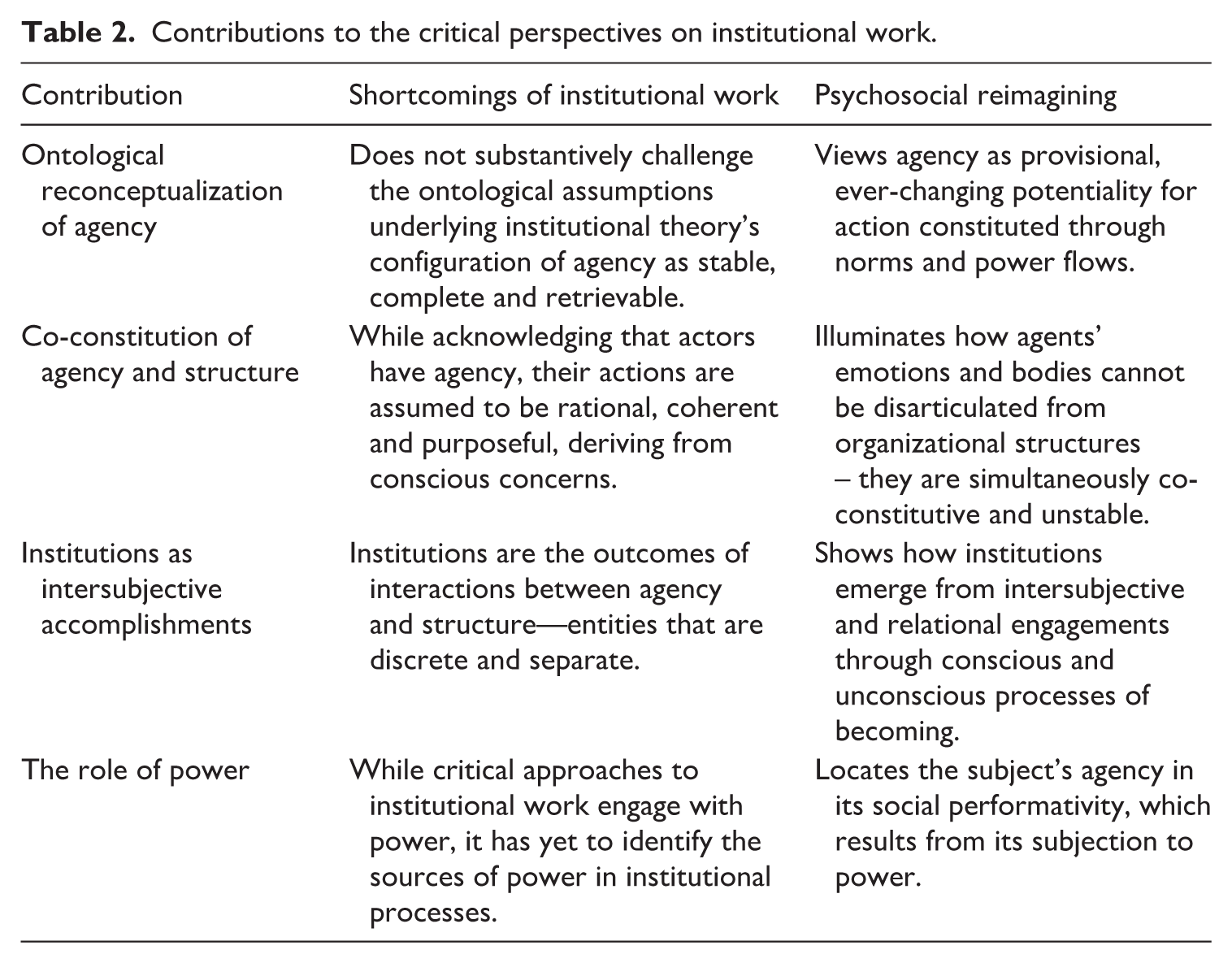
We build on this argument to advance four contributions to the institutional work literature (summarized in Table 2). First, we offer an ontological reconceptualization of agency as an embodied process of becoming. Second, we illuminate the psychosocial dynamics through which agency and structure are co-constituted. Third, we conceptualize institutions as intersubjective accomplishments sustained through performative and affective relations. Fourth, we re-centre power and politics by showing how both subjection and subversion arise from the interiorized operation of norms.
Contributions to the critical perspectives on institutional work.
In the following section, we elaborate these contributions in detail.
Reconceptualization of agency as an embodied process of becoming
Revisiting Butler’s account of subject formation, we challenge the view of agency as stable, coherent and retrievable. Instead, we conceptualize it as a contingent and shifting potential for action, constituted by norms and power relations. Subjects are not unified actors but are marked by internal tensions arising from disavowed and repressed desires. These tensions stem from the disjunction between psychic life and social order, positioning subjects as simultaneously subjected to and capable of reworking dominant norms. This reconceptualization shifts the analytical focus from how actors resolve institutional contradictions to why they act at all. Therefore, rather than asking how subjects navigate institutional contradictions (Voronov and Yorks, 2015) and reconcile competing institutional logics (Toubiana and Zietsma, 2017; Zilber, 2024), we focus on a deeper understanding of how and why subjects act (or not) in various situations. By foregrounding affect and desire, we expose dimensions of action that exceed rational explanation.
Despite the incorporation of emotions into institutional analysis (e.g. Fan and Zietsma, 2017; Zietsma and Toubiana, 2018), the role of unconscious motivations – central to Butler’s account – remains underdeveloped. Though valuable, these accounts rarely consider the role of unconscious motivations beyond pre-reflexive acts (for exceptions, see Petriglieri and Petriglieri, 2022; Voronov and Vince, 2012). Crucially, the burgeoning research on emotions in institutional contexts (Creed et al., 2014, 2022; Friedland et al., 2014; Toubiana and Zietsma, 2017; Voronov and Weber, 2016; Zilber, 2024) continue to treat agency as separable from structures and as ultimately knowable. We argue that without acknowledging the subject’s opacity – its partial unknowability – we cannot adequately theorize institutions as co-constituted by agents and structures (Meyer and Vaara, 2020). Similarly, existing approaches to socio-symbolic processes (Lawrence and Phillips, 2019) or embodiment in organizations (Lawrence et al., 2023) enrich the institutional work literature but stop short of challenging its underlying ontological assumptions. They remain incomplete because they overlook the bodily (unconscious) desire for self-expression and its constitution through power relations. In short, these streams of research add nuance to the existing theoretical edifice, without questioning the institutional theory’s configuration of agency.
In contrast, a Butlerian perspective foregrounds the subject’s partial unknowability and the affective attachments through which norms are embodied and reproduced. Accounting for how disavowed desires and unconscious investments shape action offers a deeper understanding of what drives institutional processes. In doing so, it advances debates on the relationship between actors, institutions and society (Meyer, 2010) beyond cognitive and behavioural models of actorhood (Bitektine et al., 2020), while addressing calls to reduce abstraction in actor-centred institutional research (Hwang and Colyvas, 2020; Tuominen, 2025).
Psychosocial co-constitution of agency and structure
Institutional work scholarship has shown how actors align with institutional fields to generate meaning and attach value to their activities (Lawrence and Phillips, 2019). However, it struggles to explain why actors sustain norms that reproduce institutions, and under what conditions they withdraw their support (Lok and Willmott, 2019; Modell, 2022). We argue that this limitation stems from an overreliance on rationality, intentionality and purposefulness (Lawrence and Phillips, 2019), which sidelines the psychosocial and power-laden processes underlying institutional attachments.
Moreover, in dominant perspectives – such as those influenced by Margaret Archer (2000) – reflexive agents can navigate and reshape structures, even when embedded within them (Meier and Simsa, 2021). Such an understanding implies a degree of separation between actors and institutions, though actors are both constrained and enabled by social norms that predate them (Tuominen, 2025). Even when considered as only semi-autonomous beings, subjects possess reflexivity or pre-reflexive ability, allowing them to change institutions despite their structural embeddedness (Cardinale, 2018, 2019). This presumes a residual separation between actors and institutions: actors are shaped by structures, yet remain, to some extent, external to them.
A Butlerian perspective disrupts this assumption. Agency is ‘no longer the discrete action of a subject’ (Butler, 2010: 150) but emerges through processes of subjection to norms. Actors are not external to institutions; they are entirely constituted through them. Subjectivity, understood as constituted through submission to and reiteration of norms, is thus fundamentally anti-essentialist, as subjects are often indistinguishable from the norms or structures they co-create. Our concept of subjectivity therefore rejects the separation of cognition, emotion and embodiment from institutional structures, instead showing how they are relationally co-constitutive and inherently unstable (Meyer and Vaara, 2020), rendering traditional debates on embedded agency increasingly untenable. We thus reject institutional work frameworks focusing on how actors inhabit institutions (Hallett and Ventresca, 2006; Voronov and Weber, 2020). This move extends beyond calls to examine how institutions ‘inhabit’ actors (Bitektine et al., 2020) by dissolving the distinction altogether: actors are not merely shaped by institutions – they are of them.
In this sense, our retheorization extends beyond the problems/paradoxes of embedded agency (Cardinale, 2019) and renders the very binary of agency–structure redundant. Rather than resolving this long-standing and tired debate (Modell, 2022; Willmott, 2011), we displace it by recasting agency as a relational and psychosocial process continuously enacted in institutions.
Institutions as intersubjective accomplishments
We reconsider institutions not as external structures but as ongoing intersubjective accomplishments. Central to this reconceptualization is a relational ontology that challenges reified views of social structure and foregrounds the affective and material dimensions of institutional life.
Rather than treating actors as independent from structures, we focus on performative action. Actors do not simply operate within institutions; through reiterative enactment, they reproduce and transform them. Butler’s account of the co-constitution of agency and structure is particularly generative here, as it reframes this process through intersubjectivity: subjects come to embody norms through their relations with others. These processes infuse institutions with meaning (Zucker, 1977) and allow us to consider how institutions acquire continuity (Douglas, 1986) beyond the functional goals described by Suddaby (2010). Thus, a relational perspective captures both the mutual dependence and the tensions between self and other, highlighting how institutions emerge through ongoing processes of exchange and contestation. In doing so, it departs from reified accounts of structures as either pre-given or externally manipulated (Van den Berg and Amasyali, 2025): they do not materialize ex nihilo, nor are they moulded or disrupted by separate, disembodied agents.
Understanding institutionalization through intersubjectivity also highlights the role of affect, embodiment and materiality. Emotions, bodily practices and non-discursive forms of action are not peripheral but constitutive of institutional processes (Creed et al., 2014, 2022; Riach et al., 2014; Sadeh and Zilber, 2019). Butler’s (2015) work on assembly further underscores how embodied performances – through presence, visibility and vulnerability – produce the very conditions under which collective life becomes recognizable. Institutional change, therefore, does not arise solely from deliberate intervention but also from embodied enactments that subtly reproduce or destabilize norms. By stressing the essential role of various forms of materiality in effecting institutional change through non-discursive bodily work in public spaces, Butler (2015) help us understand that all modes and practices of embodiment can be institutionally consequential because they might produce: The conditions of possibility of [the community’s] appearance, and so within the visual field, and by their actions, and so as part of embodied performance . . . which include the conditions of staging . . . as well as the means of conveying a gathering, a coming together, in the visual and acoustic fields. (p. 4)
As a result, change is continuous and often unintended, arising from variations within routine practices rather than from overt resistance. Such an ontologically elastic view of the relationship between agency and the environment, which blurs distinctions among actors, structures and norms, offers fresh accounts of action and institutionalization (Lawrence and Suddaby, 2006). This stands in contrast to micro-foundational accounts that privilege reflexivity and strategic intent (Lawrence and Phillips, 2019; Schilke, 2018).
Moreover, attending to the instability of norms reveals how marginal or disavowed desires may unsettle institutional arrangements. Institutional debates that oppose rational and oversocialized actors overlook these dynamics. A psychosocial perspective instead shows how institutional reproduction and disruption are co-implicated processes, driven by the same affective attachments that sustain norms (Kenny and Fotaki, 2014). Such theorization helps explain when, why and how subjects affectively embody institutional norms: their desires lead actors to perform identities with their bodies and within relationships that shape processes of institutional formation, maintenance and undoing. Overall, the inherent instability of social norms prompts us to reconsider institutional processes that account for the (ever-present) generative power of psychosocial dynamics through internalization and enactment.
Finally, this approach highlights the political significance of embodiment. As Laing (2021) suggests, the institutional impact of action may be directly indexed to bodily vulnerability – the more dangerous and precarious a position an actor takes, the more powerful its effect. From a conventional institutional work perspective, such vulnerability signals a lack of agency. Yet a psychosocial analysis suggests the opposite: it is precisely the exposure of fragility that can destabilize institutional orders. From an institutional perspective, a fragile body without discourse and reflexivity would have no power to effect change, as any arising emotions would have to be privately regulated (Voronov and Weber, 2016). Yet the psychosocial analysis reveals the opposite: it is the very inadvertent exposure of the body’s fragility that can make the structures shake and crack, offering new possibilities for transformation (see debates on vulnerability in equality and diversity policies or in care in organizations, Fotaki, 2023; Johansson and Wickström, 2022). By foregrounding embodied performativity and affective relationality, we show how institutions are continuously enacted – and unsettled – through the relational processes of becoming that bind subjects to, and enable them to rework, the norms that constitute them.
The power of the unconscious in institutionalization
While some strands of institutional theory acknowledge unconscious motivation – drawing, for example, on Giddens’ (1984) structuration theory – these insights are rarely fully integrated into analyses of agency and power (Lok and Willmott, 2019; Willmott, 2015). Psychodynamic traditions, including Menzies (1960) and Jaques (1953), demonstrate how unconscious anxieties shape organizational practices, yet remain marginal in institutional work. More recent contributions have begun to address unconscious dynamics (Petriglieri and Petriglieri, 2020; Vince, 2018), but their implications for theorizing agency remain underdeveloped.
Butler’s work extends these insights by situating subjectivity within broader socio-political relations of power. It offers a more anthropologically sensitive conception of subjectivity that connects psychic life to organizational and societal contexts (Kenny and Fotaki, 2014), considering power as both productive and constitutive. Power does not merely constrain action; it shapes bodies, identities and desires, operating through both conscious and unconscious processes. As previously mentioned, the notion of affective relationality locates the subject’s agency in its social performativity when individuals subject themselves to power. From this perspective, agency emerges through subjection to norms rather than existing prior to them.
Our proposal challenges dominant approaches in institutional work, which tends to privilege reflexivity and treats power as a resource unevenly distributed across actors (Willmott, 2011, 2015). Unfortunately, the current scholarship on institutional work ignores the political dimensions of subjectivity and their co-implications in power flows (Bitektine et al., 2020; Voronov and Weber, 2020; Voronov and Yorks, 2015). The pre-occupation with actors’ reflexivity has reinforced a static view of power that presents agents as more or less powerful depending on their capacity for reflexivity (Willmott, 2011, 2015). Such accounts risk reifying power and overlooking its relational and performative effects on subjects’ bodies and psyches. Without attending to these dynamics, the role of subjectivity in institutionalization remains only partially understood.
Following Butler, we conceptualize institutional processes as unfolding through iterative cycles of subjection and disruption, mediated by affective attachments to norms. This psychosocial perspective illuminates how institutions are sustained through subjects’ attachments to power, while simultaneously remaining open to transformation. More broadly, it explains how psychic processes of subjection and attachment to power sustain the social order. Emphasizing the psychosocial dimension not only deepens our appreciation of how actors depart from rational motivations (Bowring, 2000; Suddaby, 2010), it also enables us to consider how socio-emotional resources, positionalities and relational dependencies shape subjects’ capacities to act that arise from socioemotional resources, rights and obligations tied to the roles and social positions that actors occupy (Abdelnour et al., 2017). Specifically, it explicates how subjectivities are conditioned relationally ‘through the interaction with actors in situated role-sets in their institutional environments’ (p. 1778).
Overall, Butler’s framework enables a reconceptualization of institutional continuity and change that integrates symbolic, embodied and affective dimensions. By foregrounding subjectivity as relationally constituted and psychically mediated, it offers a more comprehensive account of how institutions are sustained and contested.
Concluding remarks
Inspired by Butler, this article interrogates key limitations in dominant approaches to institutional work through a subjectivity lens. Specifically, it addresses: (1) the indeterminacy of agency arising from the unconscious dimensions of subjectivity; (2) the inseparability of subjects and norms through processes of subjection and attachment; and (3) the centrality of politically situated subjectivity in institutional maintenance and change. Through a reading of Butler’s writings, we discern a relational connection between individual performativity and institutions that urges us to reconsider the specific processes by which institutional work is performed. We develop embodied performativity and affective relationality as foundations for a psychosocial conception of subjectivity.
Reimagining subjectivity in these terms compels a shift from viewing institutions as external structures to understanding them as continuously constituted through embodied and affective interactions (Berger and Luckmann, 1966). While Butler’s work has been mobilized in MOS, it has not been fully applied to theorize institutionalization processes. We extend her insights to show how performativity and affective subjection illuminate the instability, reproduction and transformation of institutions.
Our approach contributes to further research in institutional theory in several ways. First, it reorients microfoundational analyses by foregrounding the embodied and affective constitution of institutional environments (Meyer, 2010; Occasio, 2023). This enables a reconceptualization of how macro-level discourses and institutional norms are lived and reproduced in practice. For instance, their idea of subjectivity as being bodily and affectively constituted re-envisions the interplay between macro-level instantiations (including policy and broader political discourses), institutional norms and agentic responses (Occasio, 2023), offering a novel understanding of institutional reproduction and instability (Bouilloud et al., 2020).
Second, it advances a politically situated understanding of subjectivity, linking power and recognition to institutional processes. Emerging work on whistleblowing (Kenny, 2018), precarity (Fotaki, 2022; Varman and Al-Amoudi, 2016) and resistance (Cutcher et al., 2022; Scheibmayr, 2024) points to the value of this perspective for analyzing organizational life. While engaging directly and inspiring empirical investigations of work and organization (Borgerson, 2005; Tyler et al., 2024) through a politically situated conception of subjectivity, it endows institutional theory with the power of critical illumination (Willmott, 2015) by accounting for broader socio-political implications of agentic acts.
Finally, our framework has implications for policy and practice. By foregrounding unconscious and affective dynamics, it helps explain persistent policy failures and organizational ‘blind spots’ that rationalist models struggle to capture (Fotaki and Hyde, 2015; Gunder, 2016). For instance, by integrating this perspective, we might explain the elusive causes of significant policy failures by highlighting the psychic mechanisms actors deploy to defend themselves against unworkable policies and their detrimental consequences during administrative, political and symbolic policy implementation (Matland, 1995). A post-agentic conception of action enables a more nuanced understanding of how actors appropriate, resist and reproduce policy discourses, revealing both their emancipatory and harmful effects (Fotaki, 2006, 2010; Hoggett, 2006) within an institutional environment and myriad forms of institutional work (Meyer et al., 2014).
In conclusion, a Butlerian conception of subjectivity offers a critical rethinking of agency, power and institutionalization. By integrating embodied and affective dimensions into institutional analysis, this approach opens new avenues for theorizing organizations as sites of ongoing, contested processes of becoming. This novel and original framework redefines normative paradigms and has the potential to refurbish the conceptual edifice of institutional theory through the lens of subjectivity, with significant implications for work organizations and beyond.
Footnotes
Acknowledgements
We are grateful for the unwavering support of Associate Editor Professor Rafael Alcadipani and for his advice on clarifying our arguments. We also acknowledge the suggestions of three anonymous Reviewers, which helped us improve the manuscript. We bear the sole responsibility for any remaining errors.
Funding
The authors received no financial support for the research, authorship, and/or publication of this article.
AI usage declaration
The authors acknowledge that they have followed Human Relations’ AI policy. Accordingly, AI was used only for copy editing or proofing the manuscript.
