







Abstract
The Rushikulya valley in southern coastal Odisha witnessed the rise of brāhmaṇa settlements from the sixth century onwards. In the four centuries that followed, this compact region evolved into a major cluster of brāhmaṇa settlements, so much so that we have discovered 43 copperplate grants made to brāhmaṇas here in this period thus far. An examination of these copperplate grants will enable us to produce a nuanced micro-history of the rise of brāhmaṇa settlements in early medieval India. This article is an attempt at producing such a micro-history. It suggests that the Rushikulya valley brāhmaṇas were mostly autochthonous in origins, claiming affiliation with Vedic culture even when they deviated from it in some respects. At the same time, their adherence to the Vedic identity seems to have been persistent enough to keep them away from Buddhist, Āgamic and other ‘sectarian’ influences. Whether or not for this reason, the Rushikulya valley did not develop shared sacred spaces and multiple religious affiliations in the early medieval period. It became an area of Vedic brāhmaṇa religious monopoly, involving the dominance of the Vājasaneya brāhmaṇas of the Kāṇva recension.
The Rushikulya river valley of what is today Ganjam district in southern coastal Odisha saw the appearance of brāhmaṇa settlements in sizeable numbers from the sixth century
The article focuses on the Vedic nature of these brāhmaṇa settlements and studies different categories of representation of the brāhmaṇa recipients. The employment of categories that suggest strong Vedic affiliation of the brāhmaṇa recipient, and the meagre references to the other religious traditions, suggest that these brāhmaṇa recipients dominated the Rushikulya valley region. On the basis of the study of Vedic brāhmaṇas in the Rushikulya valley, it becomes possible to arrive at a tentative picture of the emergence of settlements in the region in the early medieval times in relation to questions of religious identities and sacred spaces. Existing studies of religious settlements centre on sacred geography, patronage, coexistence, poly-religiosity, religious violence, persecution, etc. Several of these studies, especially in the context of South India, challenge what Richard H. Davis has called the ‘standard narrative’ of persecution and religious violence between the Jains and Śaivas. 2 This school presents the history of religion in South India in terms of non-violence and the coexistence of various religious groups at a given site. 3 Susan Varma Mishra and Himanshu Prabha Ray extended this line of thinking to the religious landscapes and settlements in early historical and early medieval Gujarat, arguing that diverse religious groups shared sacred spaces and practised harmonious coexistence. 4 Umakant Mishra made a case for this theory in the context of early medieval Odisha. 5 The present study underlines the need for caution while extending the theory to Odisha for the said period.
Historical data points to the sharing of sacred spaces by different religions in several instances across South Asia, but the data are not extensive or persuasive enough for us to generalise for all early medieval religious centres. We have cases of many religious sites from early medieval India where a single religious group held a monopoly. For instance, Śravaṇabeḷagoḷa in southern Karnataka was an exclusively Jaina centre where none of the other religious groups were reported in the early medieval and medieval times. 6 In early medieval Kerala, multiple religious groups coexisted only at a few places, such as Mahōdayapuraṃ, 7 Kollaṃ 8 and Tirumiṟṟakkōḍu. 9 While it is not known if this coexistence was essentially peaceful, all other settlements in the region are known to have had temples of a single religious group in the early medieval period. Evidence also exists for conflict between two religious groups at many places. The violence between Śaivas and Jainas in Abbalūru and Puligeṟe in Karnataka, 10 and between a temple and a monastery in Sanjan, are instances. 11 Yet, the discussions in the rest of the article suggest that the theory of shared sacred spaces is not widely prevalent or generalisable for most early medieval religious centres. The religious landscape of early medieval Rushikulya valley, the present study argues, does not point to the coexistence of religions or a multi-religious landscape. On the contrary, the region had a strong presence of Vedic brāhmaṇa settlements to the near total exclusion of Āgamic temples and centres of the Buddhists and the Jainas.
The Rushikulya Valley
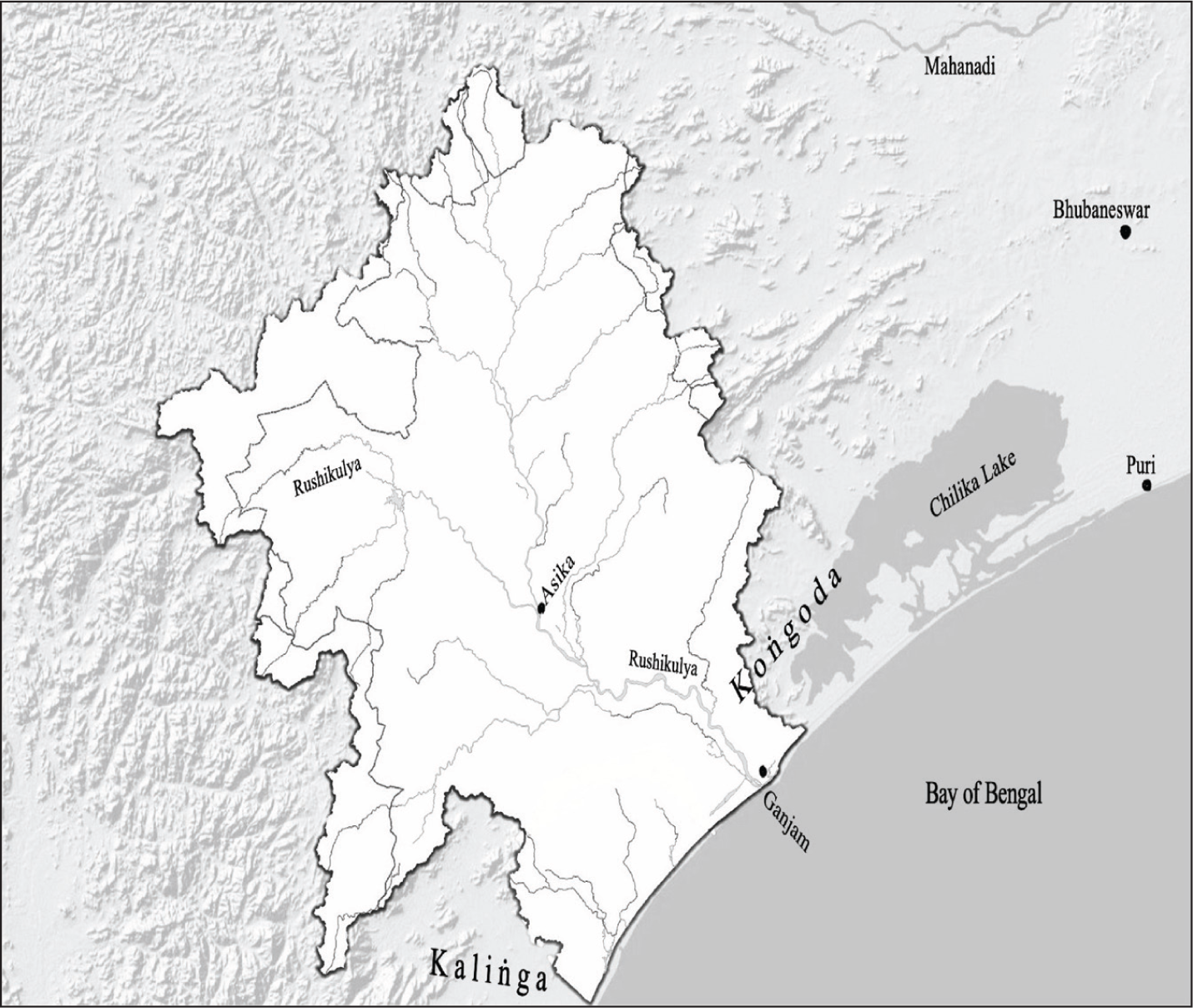
The Rushikulya is an important river on India’s east coast, but a minor one vis-à-vis the larger ones such as the Krishna, the Godavari, the Mahanadi, the Brahmani, the Vaitarani and the Subarnarekha. It originates at an altitude of 1,000 metres above mean sea level in the Rushimal hills in the Daringbadi area of the present-day Baligurha sub-division in the Kandhamal district. 12 The river traverses a distance of 175 kilometres in the south-easterly direction before discharging into the Bay of Bengal at Purnabandha between Chhatrapur and Ganjam, without forming a delta. It has a drainage area of 82,100 cubic millimetres, spread across the modern-day districts of Ganjam, Phulbani and Puri between 19°07’N to 20°19’N latitudes and 84°01’E to 85°06’E longitudes. 13 The catchment area of the river is pear-shaped and has a flourishing dendritic tributary system. 14 After it descends from the Eastern Ghats, two major tributaries, the Jarao and the Ghodahada, join the river on the right and three others, the Dhanei, the Baghua and the Badanadi, on the left. The Rushikulya meets the Jarao at Surada, followed by the Badanadi—which is in its turn formed by the confluence upstream of the Bodanadi and the Loharakhandi at Madhabarida—at Narasinghapalli, the Dhanei and the Baghua at Jhadabandha, and the Ghodahada at Kalidaspur. In the monsoon, the river is navigable to the south of its confluence with Badanadi, some 50 kilometres upstream from its mouth. 15 The channel of the river is dry during the summer season. 16 It is prone to flooding during monsoons, which leaves behind great volumes of alluvium, making this otherwise saline soil vastly fertile (Figure 1).
The average acreage for a few crops in the Ganjam district for the year 1931–32, when mechanised agriculture, chemical fertilisers and high-yielding varieties of seeds were still unknown, suggests that the yield was rich enough to throw up a considerable surplus. An acre produced 871 pounds of paddy, 1,020 pounds of jowar, 960 pounds of bajra and 990 pounds of ragi when irrigated, the corresponding yields from non-irrigated fields being 536, 595, 520 and 630 pounds, respectively. 17 There were huge variations in the annual yield due to factors such as poor rainfall or floods, which at times led to an output of less than half the full crop. In 1895, unfavourable monsoons affected paddy fields badly, producing only 44 per cent of a full crop. 18 In recent centuries, Ganjam district has been known for sugarcane cultivation, and the areas near Humma and Surala were important for salt production, although the existing evidence does not enable us to confirm if this was true of the early medieval period as well. 19 The forests in the vicinity of the Rushikulya were home to some of the finest elephants in India.
The Rushikulya valley has hosted human settlements from very early times. The river is mentioned in the Purāṇas, although these accounts are confusing.
20
In the third century
The Rushikulya valley in Odisha.
The Geopolitical Context
Little is known of human settlements in the valley for a few centuries after the decline of Jaugada. By the sixth century
A chief called Dharmarāja, a subordinate of the Kaliṅga ruler Pṛthvīvigraha, exercised his political control over the valley in the latter half of the sixth century. In his Sumaṇḍala copperplates of the year 250 Gupta Era (569–70
When Dharmarāja made his Sumaṇḍala grant, the Rushikulya valley had not evolved into a state society yet, although the Mauryans had controlled it for some time in the third century
Dharmarāja made his grant from Padmakholi, thought to be in the vicinity of Narayanakhol or Khallikote,
34
while Caramparāja made his grant from Vijaya Koṅgoda, identified as Bankada near Banpur.
35
Koṅgoda would soon emerge as a major political centre and the headquarters of the region of the same name. In the early seventh century, Śaśāṅka of Gauḍa brought the Koṅgoda region under his sway, apparently making a line of local chiefs his subordinates. With the demise of Śaśāṅka, these chiefs assumed sovereign titles and established the Śailodbhava state. By this time, a line of rulers claiming Gaṅga descent seems to have established themselves at Śvetaka, identified with Chikiti in the Ganjam district.
36
Inscriptions of the Śvetaka Gaṅgas are known only from the end of the seventh century, but the Gaṅga Era is believed to have commenced in 498
This was also the period when regions began to evolve into self-consciousness in different parts of India, including Odisha. 37 The rise of the region in India has been interpreted variously: as the result of an interface between autochthonous traditions and brāhmaṇical ideology, 38 and as an outcome of the spread of landed property with resultant growth of locality polities. 39 In the context of other regions, for example Kashmir valley, the process has also been perceived as a product of distinct geographies that are culturally shaped by long-distance economic, political and cultural networks that produced a connected history. 40 The Rushikulya valley formed something of a northern and southern periphery of the shifting frontiers of two adjoining regions, Kaliṅga and Koṅgoda, respectively. It is in the context of state formation and the emergence of the region that we begin to get a wealth of information on the brāhmaṇa settlements through the copperplate charters.
The Copperplate Charters
The Rushikulya valley has yielded 46 copperplate inscriptions dated to the period between the sixth and the tenth centuries
The recipients of the grant have names that generally carry suffixes such as svāmi, śarman, mitra, deva and candra. In a majority of the cases, they also carry an appellation that points to their vocational or ritual status. Three such appellations occur in the inscriptions, namely bhaṭṭa, dīkṣita and agnihotrin. In a handful of instances, the brāhmaṇas are also identified as mahattaras, a word that was used in contemporary inscriptions in eastern India to refer to a rural landed magnate.
The brāhmaṇas are generally identified with the Vedic branch to which they belong. The specific recensions are also mentioned in many cases. These are indicated by words such as śākhā and caraṇa, but there is no uniformity in the manner of the use of these words. What is identified as a śākhā in some inscriptions is presented as a caraṇa in a few others. In addition to the Vedic affiliation, the brāhmaṇas are also identified by their gotras in most cases and by the pravaras in several instances. An additional classification called anupravara is also known from some of the copperplates. 43
The Śvetaka Gaṅgas made 17 of the 43 extant grants and the Bhan˜ja ruler of Van˜julavāka made 12. The Śailodbhavas made five grants, the Bhaumakaras three and the Kaliṅganagara Gaṅgas and Nalas, two each. The remaining two were made by Dharmarāja and Caramparāja, mentioned earlier. The inscriptions contain a few distinct traits that tended to change from state to state, and at times from ruler to ruler. These might have been determined by state policy; it is also not unlikely that these variations were the result of scribal preferences.
Teachers and Ritual Functionaries
The recipients of the grants were perhaps expected to perform a set of ritual and sociopolitical services for the state. Some facts about these services are known from the inscriptions of the Eastern Gaṅgas from other parts of Odisha after the eleventh century, but the Rushikulya valley copperplates for the period examined here yield no such information. Some of the beneficiaries of land grants were learned in the Vedas. One of the four recipients in the tenth-century Doora plate of Udayakheḍi is Ādityaśārman, son of Yogeśvara, said to be an expert in the Vedas (vedavid).
44
Such information is not copious, but recorded in a few inscriptions from areas to the south of the valley as well. The Dharmaliṅgeśvara plates of Anantavarman (Gaṅga Era 204/702
The copperplates mention 40 bhaṭṭas. Half of them are recipients of the grants, the remaining ones are their fathers or grandfathers. They are by far the most popular among the brāhmaṇa functionaries in the Rushikulya valley, figuring in the inscriptions of all states that made grants here. The bhaṭṭas were primarily teachers, and the grants made to them were identified as bhaṭṭavṛtti in a few inscriptions from other parts of India. 47 It has been argued that the portfolio of the bhaṭṭas included military training, 48 but it is not known if this was true of the Rushikulya valley.
There are ten agnihotrins mentioned in the inscriptions, eight of them recipients of grants and two others the recipients’ fathers. One of the eight recipients appears in a Śailodbhava inscription, the remaining seven in a Bhan˜ja inscription. The Śailodbhava grant recipient was Bhaṭṭa Goṇadevasvāmi, who received the village of Koṇḍeḍḍe in the Khiḍiṅgāhāra Viṣaya. 49 The seven beneficiaries of the Bhan˜ja grant are said in Neṭṭabhan˜ja’s Ganjam plates (tenth century) to have received the village of Rātaṅga situated in the Vāsudevakhaṇḍa. 50 The agnihotra (fire-god oblation) is mentioned in the sūtra texts as a necessary sacrifice in the daily rituals of the śrotriya brāhmaṇas. It was to be performed by the householder brāhmaṇas every morning and evening. 51 As part of it, the agnihotrin was expected to maintain three fires in his house: gārhapatya, āhavanīya and dakṣiṇāgni. The agnihotra used the cow’s milk as a sacrificial substance (havis) for the libation. The sacrificer, his wife, the advaryu (the priest who recites the mantras from the Yajurveda) and the man who fetched the milk from the cow participated in the sacrifice. 52 The information in the copperplates is not sufficient for us to ascertain if brāhmaṇas in early medieval Rushikulya valley performed the agnihotra as prescribed in the sūtra literature.
There are two references to dīkṣitas in the inscription, one in Khandipada–Nuapalli plates of Caramparāja, 53 the other in the Nivina plates of Śailodbhava Dharmarāja. 54 According to the Dharmaśāstras, a brāhmaṇa is eligible for this title after the performance of the dīkṣāṇīya iṣṭi, which is part of the agniṣṭoma sacrifice. This iṣṭi invests the saṁskāra related to the sacrifice in the man who is going to perform the agniṣṭoma, and after the iṣṭi, the sacrificer (yajamāna) becomes eligible to be called a dīkṣita. 55 Whether this prescription was honoured in the observance or breached during this period is anyone’s guess.
Śailodbhava inscriptions make frequent references to sacrifices performed by the rulers. The genealogy (praśasti) recorded in the copperplates issued by Mādhavavarman II (seventh century) 56 and his successors 57 speak of sacrifices such as the aśvamedha that he performed. The genealogy in the Koṇḍeḍḍe plates also mentions the performance of great or principal sacrifices (mahāmakha) such as the aśvamedha and the vājapeya by Dharmarāja Mānabhīta. The inscription states that Dharmarāja’s body was purified by the ablution (avabhṛtha) after performing these sacrifices. 58 The sacrifices called for the presence of ritual functionaries in considerable numbers. It is likely that some of the recipients of land grants officiated during these sacrifices, although positive evidence to this effect is not found in the copperplates.
Vedic Affiliations
The copperplate inscriptions generally associate the recipients with one or other of the three Vedas: Ṛgveda, Yajurveda and Sāmaveda. 59 This is noticed in most inscriptions, although there are several exceptions too. The name of a Veda per se is not found in inscriptions until the end of the ninth century. Instead, the branch of the Vedas and the recensions with which the branch were associated are named. These are identified as śākhā and caraṇa, but as mentioned earlier, there is no uniformity in this respect.
The earliest of the grants, the Sumaṇḍala plates, only speaks of brāhmaṇas of various caraṇas, without naming any. The śākhā is not mentioned in the grant. In Caramparāja’s inscription, only one of the eight recipients is identified by a Vedic affiliation. He seems to have been the leader of the group of recipients and is identified with the Bāhvṛca, which, we know from other sources, was an appellation for the Ṛgveda. This is the only grant from the Rushikulya valley made to a Ṛgvedic brāhmaṇa. No grants were made in the valley to an Atharvaveda recipient at any time during the period under examination or later. With an occasional exception here or there, the Atharvavedis are generally not among the recipients of land grants in the early medieval period in any part of South Asia. 60 Two grants are known to have been made to Atharvavedis of the Paippallāda recensions in early medieval Bengal, 61 while four cases of Atharvavedi recipients are noticed in the Maitraka copperplates of western India. 62 Within Odisha, the Neulpur plates of Śubhākaradeva 63 and the Orissa state museum plates of Śilābhan˜jadeva 64 record grants made to Atharvavedi brāhmaṇas. Copperplates from the Rushikulya valley do not give us any such example.
The records suggest that brāhmaṇas belonging to the Vājasaneya caraṇa and Kāṇva śākhā of the Śukla Yajurveda received a large number of grants. The Vājasaneya was a major recension of the Śukla Yajurveda, and the only one known to have survived in early medieval India. The mention of Vājasaneya caraṇa occurs 25 times, and Kāṇva śākhā 15 in the inscriptions of the valley. Kāṇva śākhā generally occurs with the Vājasaneya caraṇa. In the Gautami plate of Indravarman (eighth century), it is found without the use of ‘śākhā’ as a suffix. 65 In the Doora plate of Udayakheḍi, one of the recipients, Āditya Bhaṭṭaputra, is said to belong to the Kāṇva śākhā of the Yajurveda. 66 It is the only record until the end of the tenth century in which Kāṇva śākhā is mentioned with the Yajurveda as such and not with a recension. However, we have two records from the eleventh century in which the Kāṇva śākhā is associated with the Yajurveda. 67 It is also noticed that there is no reference to the Mādhyandina śākhā of the Śukla Yajurveda in the valley.
Inscriptions from the Rushikulya valley also refer to the recensions of the Kṛṣṇa Yajurveda, but only the Taittirīya and Kaṭha recensions are noticed. Taittirīya occurs with ‘caraṇa’ as a suffix two times. It also occurs once without this suffix. In the Ganjam plate of Śatrubhan˜ja Tribhuvanakalaśa, year 198 (tenth century), it is mentioned as a śākhā instead of caraṇa, and is associated with the Yajurveda, which is recorded as a caraṇa.
68
The reference to the Kaṭha recension comes from the Badakhimedi or Indian Museum plate of Devendravarman (Gaṅga Era 308/806
Inscriptions also refer to the śākhās and caraṇas of the Sāmaveda. The word Sāmaveda is not mentioned in the inscriptions, but there is a reference to the Chandoga (from Chāndogya), which appears four times. All of them carry the suffix ‘caraṇa’. The Nivina plates of Dharmarāja, year 9 (eighth century), mention the Kauthuma śākhā, 70 and the Badakhemundi plates of Indravarman (ninth century), the Rāṇāyaṇiya 71 śākhā. 72 These are the only instances where the śākhās of the Sāmaveda are mentioned.
Distribution of Vedic S´ākhās.
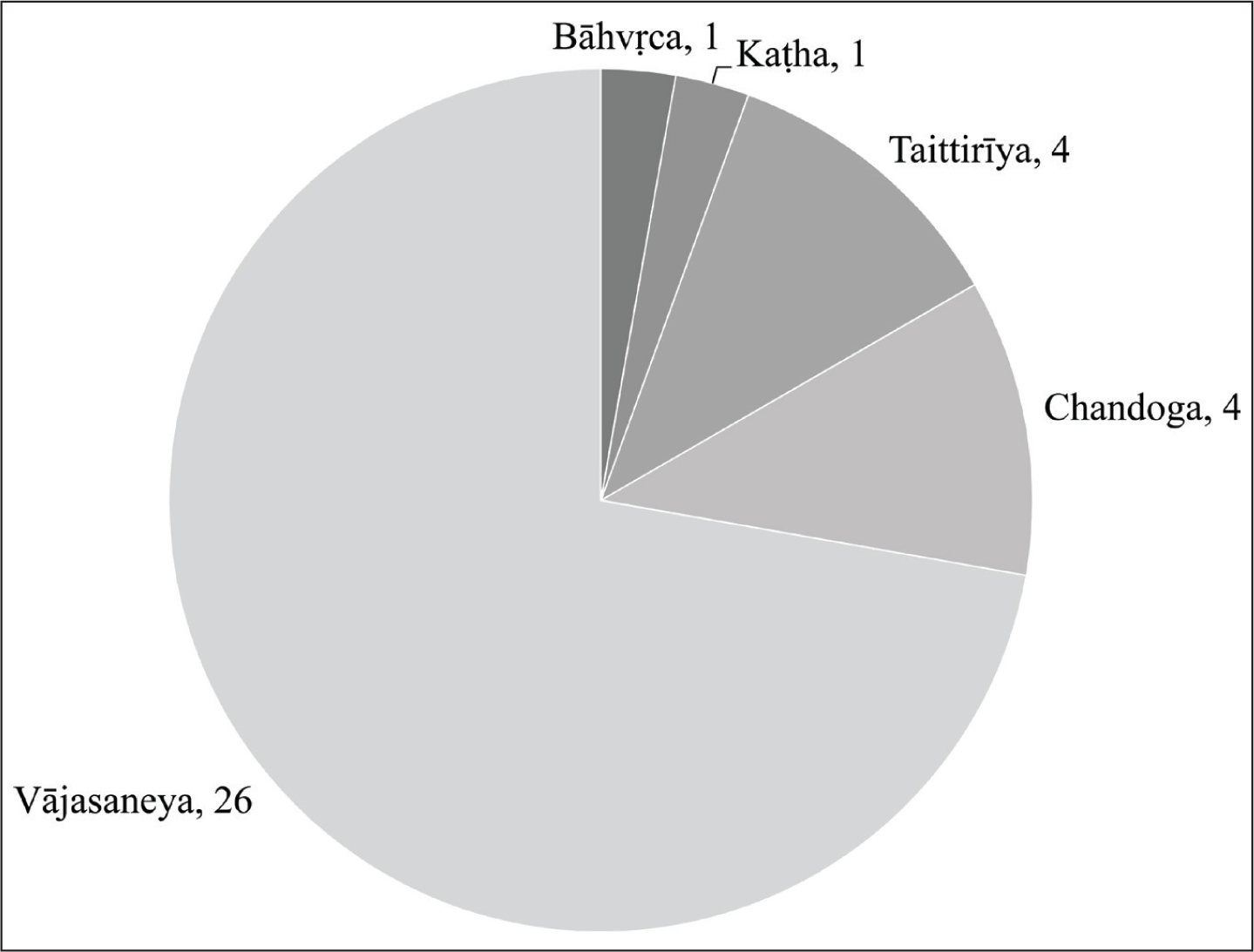
Reference to the caraṇa of the brāhmaṇa recipient is missing in 19 cases and śākhā in 32. In 17 cases, neither the caraṇa nor the śākhā is found in the description of the recipients, while both figure together in as many as 20 instances. On the whole, there are only four Sāmaveda grantees in Rushikulya valley. As opposed to this, the Yajurveda recipients figure in 31 copperplates of which one is a Kaṭha, four are Taittirīyas and 26 are Vājasaneyas. Thus, Vājasaneya brāhmaṇas were the recipients in a little over 60% of the 43 copperplate grants made to brāhmaṇas in the valley between the sixth and tenth centuries (see Figure 2). The grants facilitated the brāhmaṇas—who were already landed—to become powerful landholders, dominating the agrarian economy of the valley.
It has been suggested that royal endowments of land to the brāhmaṇas led to the recipients ‘emerging as a land-owning class’, and that the landed estates were sometimes large. 73 In most cases, the land was tax-free, which left considerable resources at the disposal of the recipients. Interestingly, the inscriptions do not mention reclamation of untilled land for agriculture. The term cirakhilaśūnya, which is used for a freshly reclaimed land, is seen in a few other parts of eastern India, but not in the Rushikulya valley. 74 All available indications, including the declaration of boundaries of the land granted, suggest that the land was already settled and brought under cultivation. Instructions to the existing landowners show that the villages had also arrived at revenue settlements with the state. Grants are generally addressed to the existing landlords (kuṭumbis) of the village, who are asked to follow the established practice (pūrvvocita maryādā) in relation to the land being endowed. The existing landlords are not evicted from the land, but are asked to pay the regular dues to the recipients of the grant. The grants have been interpreted ‘as the creation of a system of revenue distribution, involving superior rights over existing occupants who were apparently transformed into revenue-paying landowners’. 75
Gotras
As in many other parts of India, the gotra was an important part of the brāhmaṇa social and ritual identity in the valley. The gotra is defined in our times as an ‘exogamous patrilineal sibship’, 76 which might have been true of the brāhmaṇa society in early medieval Odisha as well, although nothing in the inscriptions enables us to confirm this. In the Āśvalāyana Śrautasūtra, seven ṛṣis after whom gotras were named have been listed, namely Viśvāmitra, Jāmadagnya, Bhāradvāja, Gautama, Atri, Vasiṣṭha and Kaśyapa. We may call them the sapta-ṛṣi gotras. Together with them, the Agastya is also named. 77 This seems to have been a widely accepted list of gotra progenitors in the Śrautasūtras. The same list of eight appears in the Baudhāyana Śrautasūtra. 78 ‘From the traditional point of view, therefore’, writes Brough, ‘only eight of the exogamous units are gotras properly so-called. These are the Jamadagnis, Gautamas, Bharadvajas, Atris, Viśvāmitras, Kaśyapas, Vasiṣṭhas, and Agastyas’. 79 Agastya is not met with in any inscription from the early medieval Rushikulya valley. Six of the sapta-ṛṣi gotras are also found in the region, but Jāmadagnya is missing. In addition to these, there are ten other gotras figuring in the copperplates from the valley, namely Vatsa, Kauśika, Parāśara, Hārita, Maudgalya, Māṅgalya, Jātūkarṇa, Śāṅkhya, Kauṇḍinya and Rohita (see Figure 3). All 10 figure in the Śrautasūtras as gaṇas of one of the major gotras.
Distribution of Gotras.
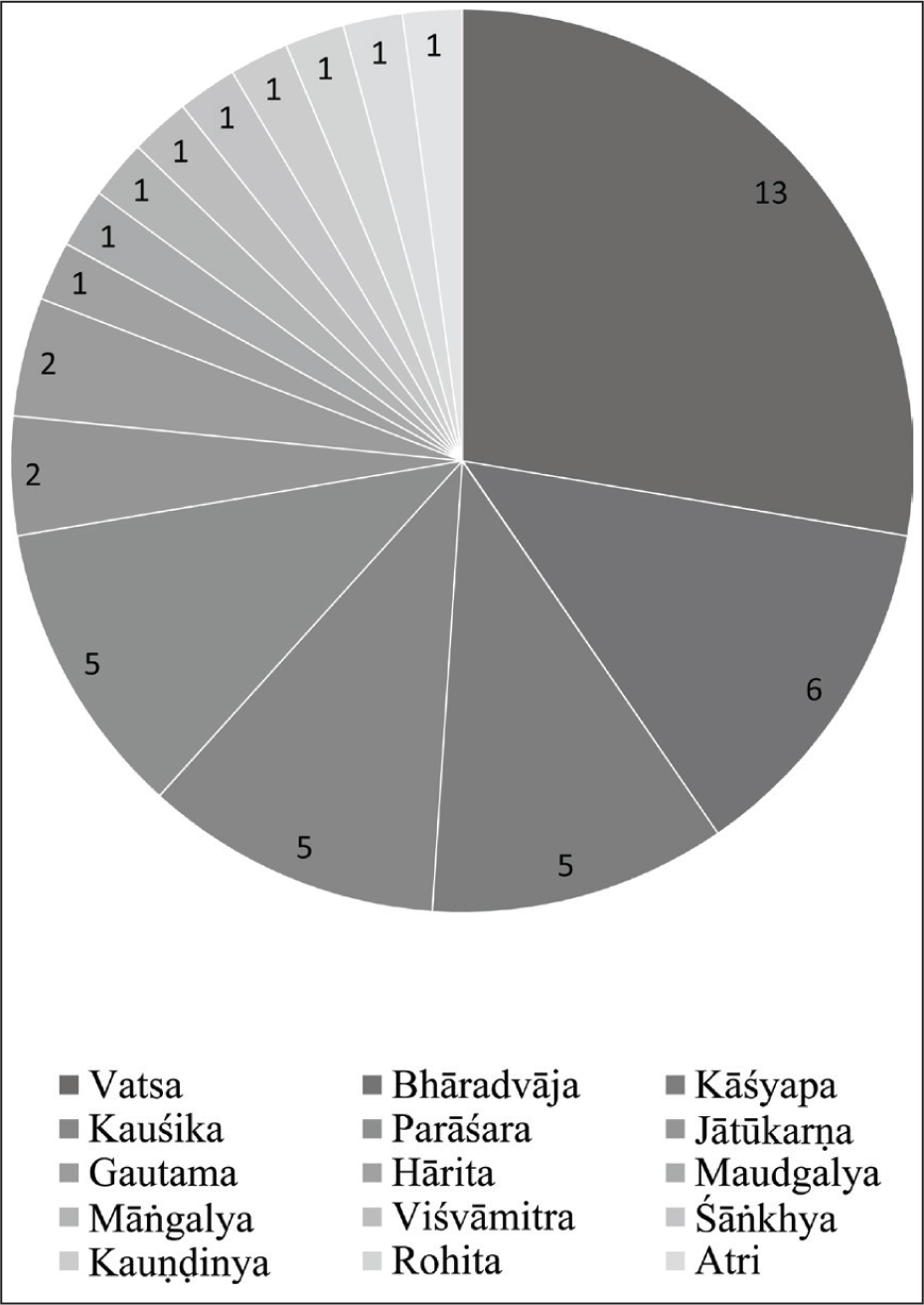
The gotras are found in the copperplates from very early times. No mention of the gotra is found in the Sumaṇḍala plates, but the Khandipada–Nuapalli plates identify one of the recipients as belonging to the Gautama gotra. By far, the Vatsa gotra appears with the greatest frequency in the inscriptions and figures in 13 instances. Its earliest occurrence is in the early eighth-century Nivina copperplate grant of Dharmarāja, year nine. 80 Of the other twelve instances, two are from the latter half of the eighth century, and five each from the ninth and tenth centuries. It is interesting that Vatsa, which does not appear as a gotra but only as a gaṇa in the Śrautasūtras, occurs with the greatest frequency here. It does not figure with this remarkable frequency anywhere in India before the tenth century. For instance, the Maitrakas of Valabhi are known to have issued more than a hundred copperplate charters, but there are only two instances of Vatsa gotra brāhmaṇas, both figuring in the same grant, namely the Ḍaccāṇaka grant of Śilāditya III. 81 In the whole of eastern India to the north of Odisha, comprising of present-day West Bengal, Bangladesh, Assam and Tripura, only four instances of Vatsa gotra are known until the end of the tenth century, three of them figuring in a single copperplate. 82
The fact that the Vatsa gotra appears with such great frequency must be juxtaposed with the fact that three from the list of seven major gotras of the Śrautasūtras together appear only thirteen times in the copperplates of the valley, six Bhāradvāja, five Kaśyapa and two Gautama. The other three from the Śrautasūtra list of seven known from the valley, Vasiṣṭha, Viśvāmitra and Atri, are found only once each. Two more instances of Viśvāmitra gotra are known from the valley, but they are both from the eleventh century and do not belong to the period examined here. 83 The Parāśara and the Kauśika gotras occur five times each, the Jātūkarṇa twice. All other gotras, six in number, appear only once each.
These figures throw interesting light on the gotra preferences in the Rushikulya valley in the latter half of the first millennium
Pravaras and Anupravaras
Associated with the gotras are the pravaras and anupravaras, which generally were a list of three or five ṛṣis thought to have been the earliest figures in the gotra line. In some cases, only a single name is identified, but in a few examples, a pravara of four ṛṣis is also found. The pravara is described as ‘stereotype [sic] list of names of ancient ṛṣis and seers’, considered to be the founders of the family in the past. 84 The system of pravaras is described in the Pravarasūtra sections of the Śrautasūtras. On the other hand, the anupravara system, noticed in the inscriptions, seems to be unique to Odisha. Brough observes that the term anupravara was alien to the Sūtra literature and occurred only in the epigraphic sources. 85 Ghurye claims that the term anupravara is found only in the Odishan inscriptions. 86 According to Brough, this term is used to signify either of the two following things. In the first, the anupravara ‘means the pravara in the advaryu’s form’. 87 But Brough does not explain this in detail. In the second, anupravara signifies the third member of a three-ṛṣi pravara, while the second and the first names denote the pravara and the gotra, respectively. 88 It is claimed that the anupravara is nothing but the pravara list presented in the reverse order. 89 But the analysis of the inscriptions suggests that these are not standard patterns in recording the anupravaras. Inscriptional data present large variations in this respect. They also point to a distinct cultural practice which the Rushikulya valley brāhmaṇas had created.
The Ganjam plates of the Śailodbhava king, Mādhavarāja, dated Gupta Era 300/619
There are at least two instances from eastern India that might precede Mādhavarāja’s Ganjam plates by a few decades, alluding to the pravara. The Ragolu plates of Śaktivarman, regnal year 13, discovered from the Srikakulam District of Andhra Pradesh, record the donation of the village of Rākaluva in Kaliṅga Viṣaya to the brāhmaṇa Kumāraśarman and his eight sons, who are said to be of the Sāvarṇasa gotra 93 having a five-ṛṣi pravara. The word pravara is not mentioned in the inscription. 94 The plate does not seem to be older than the latter half of the sixth century and might as well be from the early years of the seventh. 95 The other more-or-less contemporary reference to pravara comes from the Kalahandi district. The Baradipada plates of Nandarājadeva, 96 regnal year 3, record the grant to three brāhmaṇas belonging to the various gotras, caraṇas and pravaras. 97 Both inscriptions do not give the list of pravaras, although, unlike the former, the word pravara is found in the latter.
Of the six among the sapta-ṛṣi gotras of the Śrautasūtras that we find in the inscriptions, the pravara and anupravara are not mentioned in the case of Gautama, Vasiṣṭha and Atri gotras. The solitary Viśvāmitra 98 gotra known from the period examined here mentions Daivarāta as pravara and Audala as anupravara. Five of the six Bhāradvāja gotras refer to the pravara, but the order of pravara matches with the Śrautasūtra list—Āṅgirasa, Bārhaspatya, Bhāradvāja 99 —only at two places, of which one replaces Bhāradvāja with Bhārgava in what appears to be a scribal error. In two cases, only Āṅgirasa and Bārhaspatya are mentioned, and in the last case, only Āṅgirasa. One of the five records identifies Bārhaspatya as an anupravara, a category not associated with other Bhāradvājas.
The pravaras of the Kaśyapa gotra are mentioned only in two of the five recorded instances. The Āśvalāyana Śrautasūtra mentions three different pravara lists for Kaśyapa. viz., Kāśyapa, Āvatsāra and Asita; Kāśyapa, Āvatsāra and Naidhruva; and Kāśyapa, Āvatsāra and Raibhya, 100 the second and third of which are also found in the Baudhāyana Śrautasūtra. 101 One of the grants identifies the second of the three as its pravara, while the other mentions Āvatsāra as pravara and Āvatsāra and Naidhruva as anupravara.
The above discussion points to the fact that the sapta-ṛṣi gotra in the Rushikulya valley were less prone to identify pravaras and anupravaras. This is at variance with the non-sapta-ṛṣi gotras, which show a greater tendency to record the pravaras and, in several instances, the anupravaras too.
Eleven of the 13 Vatsa gotra references mention the pravara. In the Śrauta texts, Vatsa is a gaṇa under the Bṛgus and has a five-ṛṣi pravara, namely Bhārgava, Cyavana, Āpnuvāna, Aurva and Jāmadagnya. 102 The five pravaras are mentioned only at three places, of which we find the list in the order given in the Baudhāyana Śrautasūtra only once. In two other instances, Bhārgava and Cyavana are replaced by Dairda and Bṛgu, in one other case, Bhārgava by Bṛgu. Five instances allude only to the five-ṛṣi pravara without listing any. In one other example, we find a four-ṛṣi pravara instead of five, with the names recorded as Bṛgu, Dairda, Āpnuvāna and Jāmadagnya. The replacement of Bhārgava and Cyavana with Bṛgu and Dairda seems to suggest that some brāhmaṇas of the valley followed a different pravara ancestry, which was not recorded in the Śrauta texts. One possible reason for the inclusion of Bṛgus is that the Vatsas denote a gaṇa under the Bṛgus. In one of the Vatsa gotra instances, Kāśyapa and Āvatsāra are mentioned as pravara, and in the same example, Naidhruva appears as anupravara. These were traditionally associated with the Kaśyapa gotra. Finally, Āṅgirasa is mentioned as a pravara in one instance, which is not noticed in any of the Śrauta texts. The anupravaras of the Vatsas are also found in eight instances, including the Naidhruva mentioned above. In two cases, it is identified as the same as pravara without repeating the names, and in two others, five anupravara are alluded to, without being named. In one instance, the names of five anupravaras are seen, but Bhārgava is replaced by Bṛgu. In one record, five names are found, Bhārgava, Cyavana, 103 Āpnuvāna, Aurva and Jāmadagnya, while another inscription only records Bhārgava.
Four of the five Parāśara gotra references mention the pravara, but none of them speak of the anupravara. It is identified as a gaṇa under the Vasiṣṭha gotra in the Baudhāyana Śrautasūtra with its pravaras named as Vasiṣṭha, Śāktya and Parāśara. 104 This list is found in two instances but not in the Śrautasūtra order. Of the two other instances, one mentions two pravaras with Parāśara missing. The other mentions five pravaras without furnishing the list thereof. This might either be a scribal error or an attempt by the brāhmaṇa recipient to affiliate himself with a remote ancestry.
Four of the five Kauśika gotra instances mention the pravara, two of them the anupravara as well. Identified as a gaṇa of Viśvāmitra gotra in the Śrautasūtras, it is assigned a three-ṛṣi pravara: Viśvāmitra, Daivarāta and Audala. 105 Only two inscriptions mention the three, although not in the said order. Of the two other instances, one identifies Viśvāmitra and the other Adhamariṣarṇa 106 as pravara. This may point to the presence of two groups of Kauśikas in the valley, that is, Viśvāmitra Kauśikas and Aghamarṣaṇa Kauśikas, both of which are known from the Baudhāyana Śrautasūtra. 107 The Baudhāyana also mention the Indra Kauśikas, 108 who do not figure in any of the inscriptions. Among the two copperplates that mention anupravaras of the Kauśikas, one names Daivarāta and Audala, the other, Viśvāmitra.
The pravara is seen in both known instances of Jātūkarṇa, the anupravara in one of them. The pravaras in the first case are Vasiṣṭha and others (vaśiṣthāddavat) and Jātūkarṇa. In the same case, Jātūkarṇa and others (jātukarṇṇa vvadda) and Vasiṣṭha are mentioned as anupravara. 109 The second case only mentions Vasiṣṭha as pravara.
Among the non-sapta-ṛṣi gotras mentioned only once, the Śāṅkhya is not associated with either a pravara or anupravara, while the Hārita has only a pravara. The rest of them, namely Maudgalya, Māṅgalya, Kauṇḍinya and Rohita have both. The Hārita, a gaṇa under Kevala Āṅgirasa gotra, has a three-ṛṣi pravara: Āṅgirasa, Ambarīśa and Yuvanāśva. 110 The inscription follows the same order. Maudgalya, also a gaṇa under Kevala Āṅgirasa, has Āṅgirasa, Bhārmyaśva and Maudgalya as pravara. 111 The inscription only records Āṅgirasa as pravara and Bhārmyaśva as anupravara. The Māṅgalya has Āṅgirasa recorded as pravara and Aurva and Sāvarṇa as anupravara in the inscription. 112 In this case, we find a notable deviation from the Śrautasūtras in which Māṅgalya is associated with the Ātreya gaṇa and follows the three-ṛṣi pravara, Ātreya, Ārcanānasa and Śyāvāśva. 113 Kauṇḍinya, a gaṇa under Vasiṣṭha gotra in the Śrautasūtras with Vasiṣṭha, Maitrāvaruṇa and Kauṇḍinya as pravara, 114 has been assigned Maitrāvaruṇa as pravara and Vasiṣṭha as anupravara in the inscription. Rohita, which might be the same as Lohita of the Baudhāyana, a gaṇa of the Viśvāmitra gotra, has Viśvāmitra, Āṣṭaka and Lohita as pravaras. 115 In the inscription, it has the same pravara mentioned in the Śrautasūtra, which also duplicates as the anupravara; only that Lohita is rendered as Rohita.
Immigration of Brāhmaṇas
The analysis of the inscriptions from the Rushikulya valley sheds some light on the development of the brāhmaṇa society in the valley, although this is fairly limited and cannot be held as conclusive. The inscriptional data show a significantly few number of arrivals of brāhmaṇa immigrants into the valley. 116 We have only five references to migration into the valley, none of them from the Śailodbhava and Śvetaka Gaṅga records. Immigrant brāhmaṇas are noticed in the inscriptions of Kaliṅganagara Gaṅgas, Bhan˜jas and Nalas. Unlike the Śailodbhavas and Śvetaka Gaṅgas, headquartered close to the valley, these other polities were either based elsewhere or established bases in this region by moving in.
The earliest instance of immigration comes from an inscription of the Kaliṅganagara Gaṅgas, the Badakhimedi or Indian Museum plates of Devendravarman of Gaṅga Era 308 (806
After the tenth century, only two instances of brāhmaṇa immigration are recorded in the early medieval inscriptions. Both are from the eleventh century and identify the recipients as Gaṅgavāḍi brāhmaṇas belonging to the Viśvāmitra gotra. 123
These records of migration present interesting facts about the region’s gotra, pravara and anupravara institutions. The migrant brāhmaṇas belong to the Vatsa, Viśvāmitra, Rohita, Bhāradvāja and Parāśara gotras. The Vatsa gotra migrant is mentioned without the pravara and anupravara. Before his arrival, there are three references to the Vatsas. Pravaras and anupravars are already known to them. The Bhāradvājas are also not new to the region. They are also not new to pravaras and anupravaras, as were the Parāśaras. In the case of the migrant Parāśara, a five-ṛṣi pravara is mentioned, although the Śrautasūtras only have the three-ṛṣi pravara.
The Bhāradvājas were known from at least the seventh century, the Vatsas from the late seventh to early eighth centuries, and the Parāśaras from the middle of the eighth century. The Viśvāmitras and Rohitas appear only in the tenth and eleventh centuries with the immigrants. The brāhmaṇas with these later gotras are altogether new to the region. This evidence suggests that the Kaliṅganagara Gaṅgas, Bhaumakaras and Nalas depended on brāhmaṇas from outside the valley, as did the Bhan˜jas on at least some occasions. In doing so, they preferred brāhmaṇas either of a gotra or a śākhā not hitherto recorded in the valley, or of a pravara ancestry as yet unheard of in this area.
Dominance of the Vājasaneya Brāhmaṇas
The examination of copperplate grants in the Rushikulya valley points to the dominance of brāhmaṇas belonging to the Kāṇva recension of the Vājasaneya saṁhitā in the religious and socio-economic affairs between the sixth and tenth centuries
The picture is further complicated by another fact. Odisha is known to have hosted scores of Buddhist settlements in the early medieval period. Most of them are from the area to the north of the Mahanadi. A few sites have also been discovered to the south of the Mahanadi in addition to a number of locations that have yielded stray finds of Buddhist sculptures. 124 However, the Rushikulya valley has not yielded any settlement or remains associated with the Buddhists until now.
Similar to Buddhism, the near total absence of Āgamic temples is recorded in the valley from the early medieval times. 125 There is only a solitary epigraphic reference to a temple built in the valley during this period. This is the grant made to Lokamādhava (Viṣṇu) and Bhaṭṭāraka Śvayaṃbhūkeśvara (Śiva) in the Indian Museum plates of the tenth-century king, Indravarman. 126 The grant was made by Queen Elā, wife of Gaṅgasvayaṃbhū. The donation includes the village of Beṭhiśṛṇga in the Paduṇikhaṇḍa Viṣaya. The land was divided into three shares, one each assigned to the two deities and the third to eleven brāhmaṇas who are named in the deed. As it turns out, there is no mention of the gotra, caraṇa and sākhā of any of these brāhmaṇas, which suggests that they practised Āgamic worship and were not into Vedic learning. A few names of the recipients recorded in the inscription, such as Dāūpa, Śomapā, Virṭhu, Vāstavya Gaṇapati, Bhāgudeveśa and Savarapa, are uncommon for a brāhmaṇa in early medieval Odisha, which is perhaps an indicator of their non-brāhmaṇa and non-Vedic origins. Such names do not appear in other copperplate deeds recovered from the valley. This leads us to posit that they were locals who secured a brāhmaṇa identity for purposes of service in an Āgamic temple. The Vedic brāhmaṇas were perhaps unwilling to take up the position of a priest in a temple. 127
The temples mentioned in Indravarman’s inscription have not survived, but three modest temples of this period have come to light from some parts of the valley. One of them is the Nṛsiṃhanātha Svāmi (19°53’51” N 84°41’01” E) at Bargaon in the Bhanjanagar taluk. Also known as the Dakṣiṇeśvara Śiva temple, 128 it has Śiva Liṅgas such as Bālukeśvara, 129 Lādukeśvara 130 and Svapneśvara 131 in its corners. Vidya Dehejia dates this temple to the eighth century, 132 while Thomas Donaldson places it in the ninth on the basis of stylistic analysis. 133 The second shrine is the Bāteśvara Mahādeva (19°25’18” N 85°06’27” E), situated on the coast near Humma in the Chatrapur Taluk. It has been assigned to the tenth–eleventh centuries on considerations of architectural style. 134 An example of an early structural shrine also comes from Nayakpara near Bargaon in Bhanjanagar Taluk. The temple and a good number of Āgamic images, which can be assigned to the tenth century, were unearthed from this place. 135
All temples were in poor states of preservation when they were discovered in the twentieth century. None of these locations yielded any copperplate charter made to the brāhmaṇas. Nor did they show signs of being an agrahāra of antiquity. This must be placed alongside the fact that the Rushikulya valley did not develop any centres of pilgrimage until the appearance of the Tārā Tāriṇī temple near Purushottampur in the early modern period.
Grants made to the brāhmaṇas make references to agrarian villages and landowners, but little is known of the non-brāhmaṇa community in these villages. It is likely that the Rushikulya valley was home to various ethnic descent groups, identified in modern ethnography as tribes. Their presence and importance in the early medieval period have been speculated upon. 136 It appears that the marginalisation of these descent groups was already under way in the early medieval centuries when the hegemony of brāhmaṇas over the affairs of the agrarian villages began to develop. To say more on this aspect is to enter the realm of conjectures.
Was the absence of Buddhist settlements and Āgamic temples the result of the firm control that the Vājasaneya brāhmaṇas exercised over religious affairs of the valley? It is too early to say. What can be said with certainty is that the Vājasaneya brāhmaṇas dominated the religious, cultural and socio-economic affairs of the valley. They became influential landlords through the agrahāras they established and the grants they received from the state. Whether or not as a consequence thereof, the valley did not witness sectarian plurality and coexistence in the early medieval period. No site in the valley—including the ones where grants were made—was known for multiple religious associations. In socio-religious terms, the Rushikulya valley was an area of unencumbered Vedic brāhmaṇa monopoly, involving a dominance of the Vājasaneya brāhmaṇas of the Kāṇva recension. This encourages us to reconsider the claims made in recent years about shared sacred spaces and the coexistence of multiple religious groups in the first millennium
Footnotes
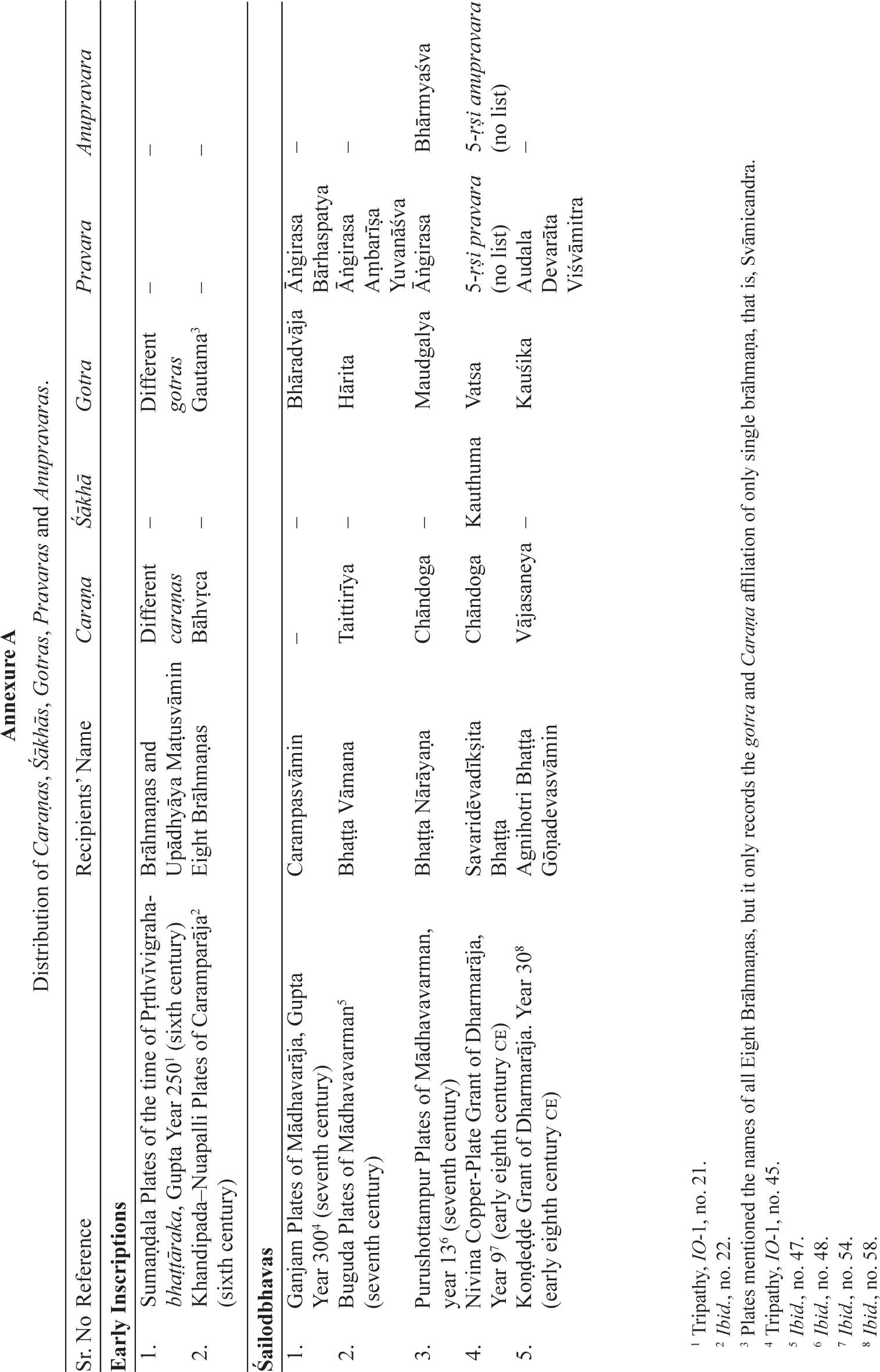
Annexure A
Distribution of Caraṇas, Śākhās, Gotras, Pravaras and Anupravaras.
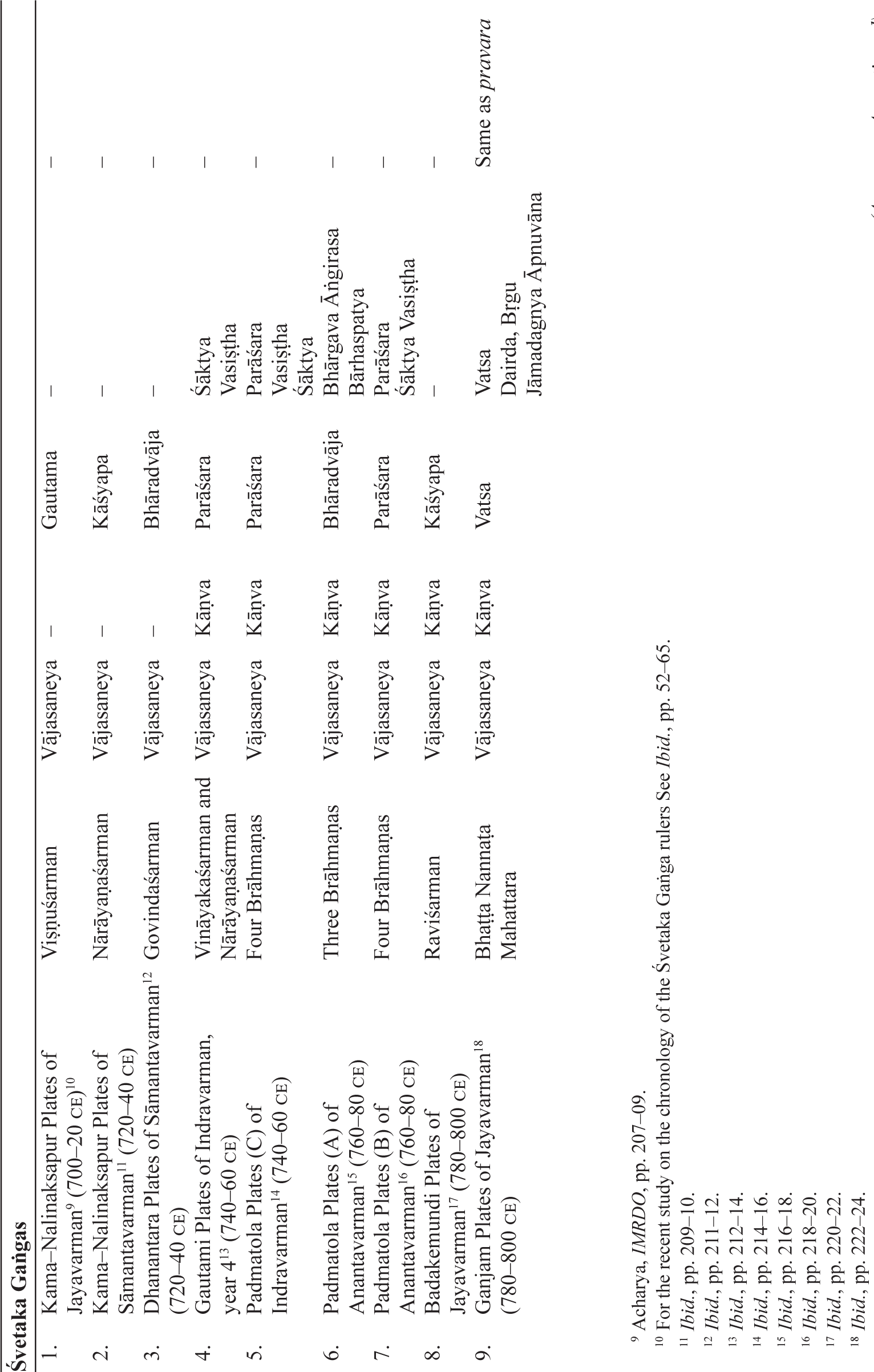
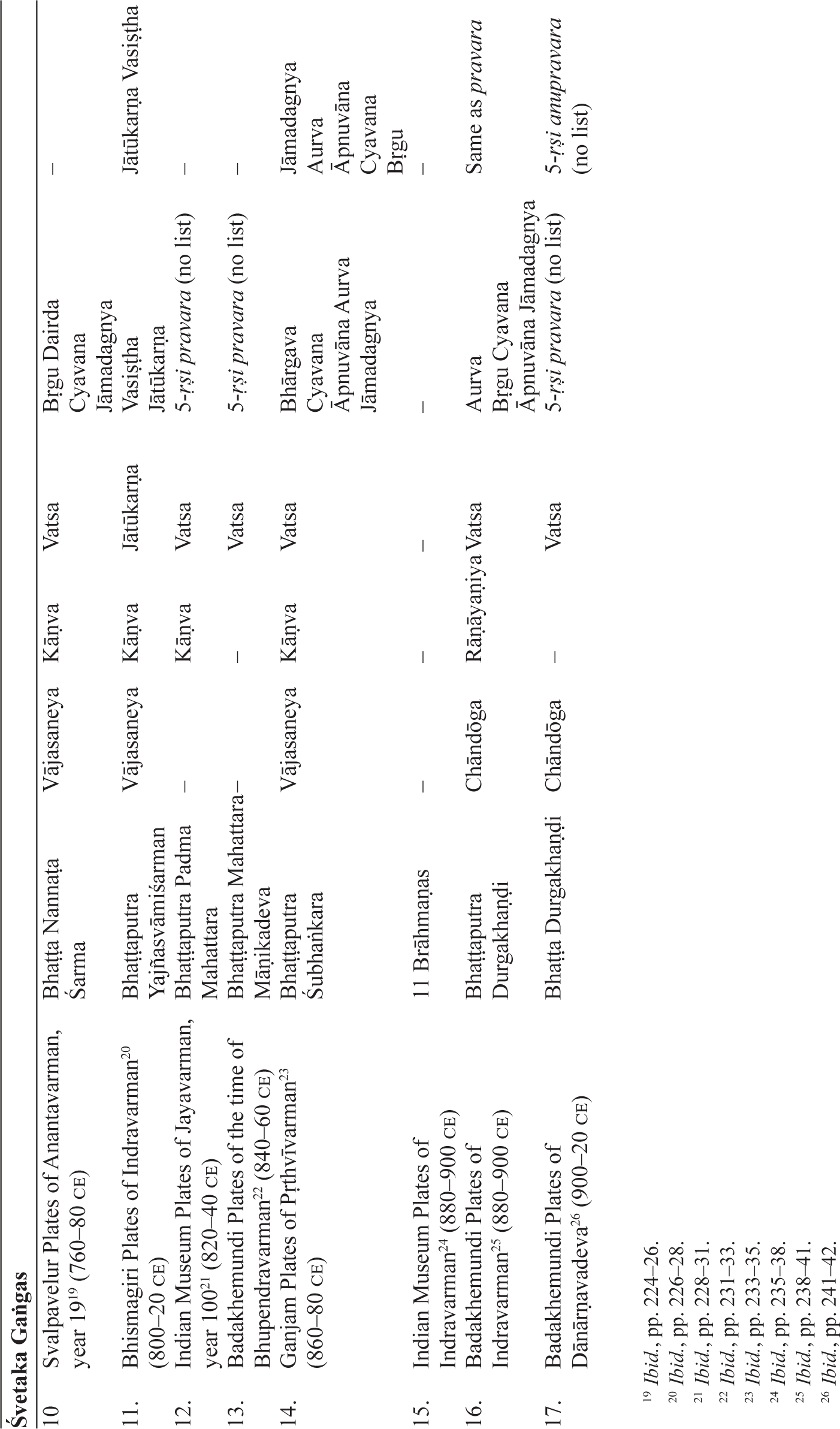
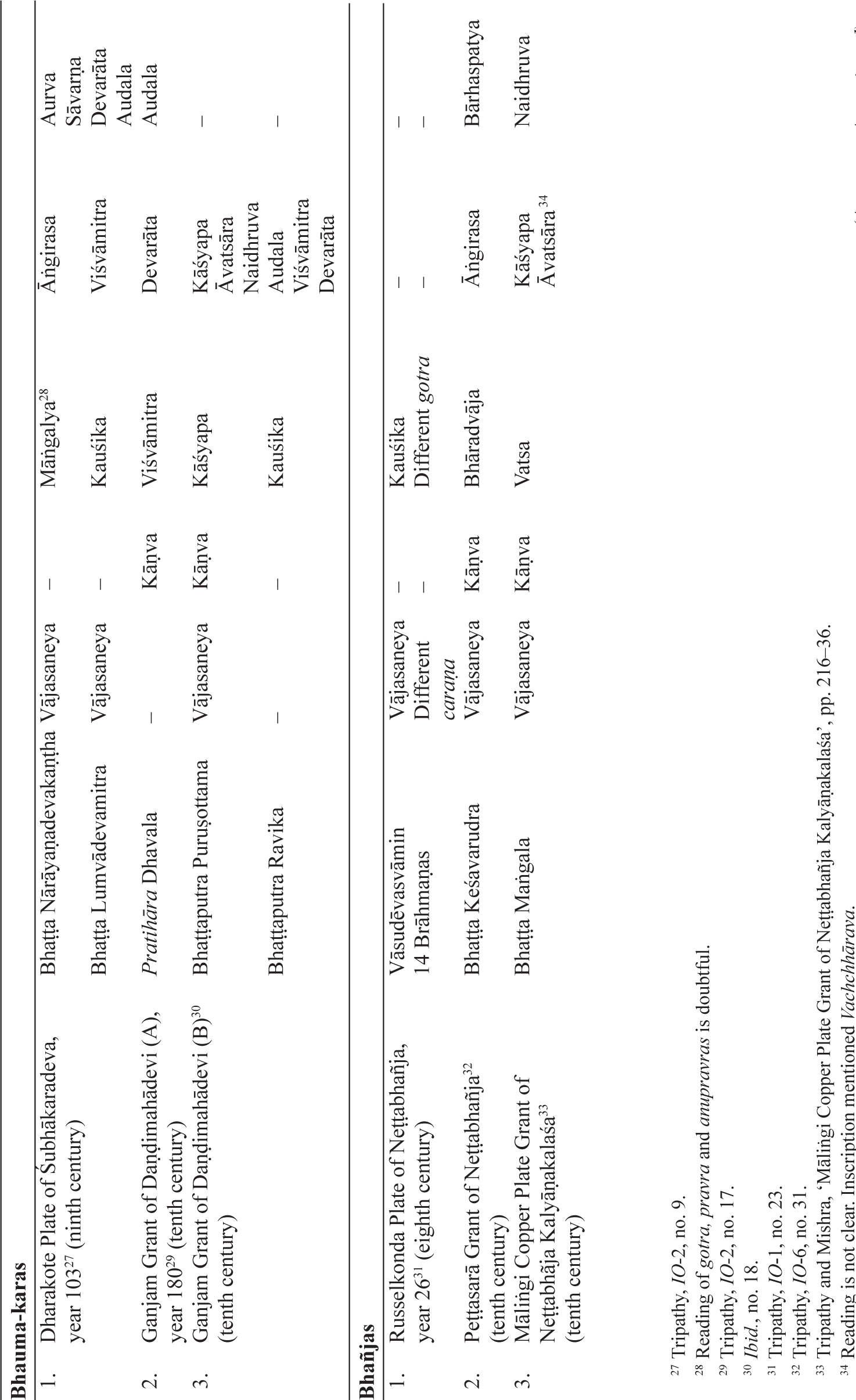
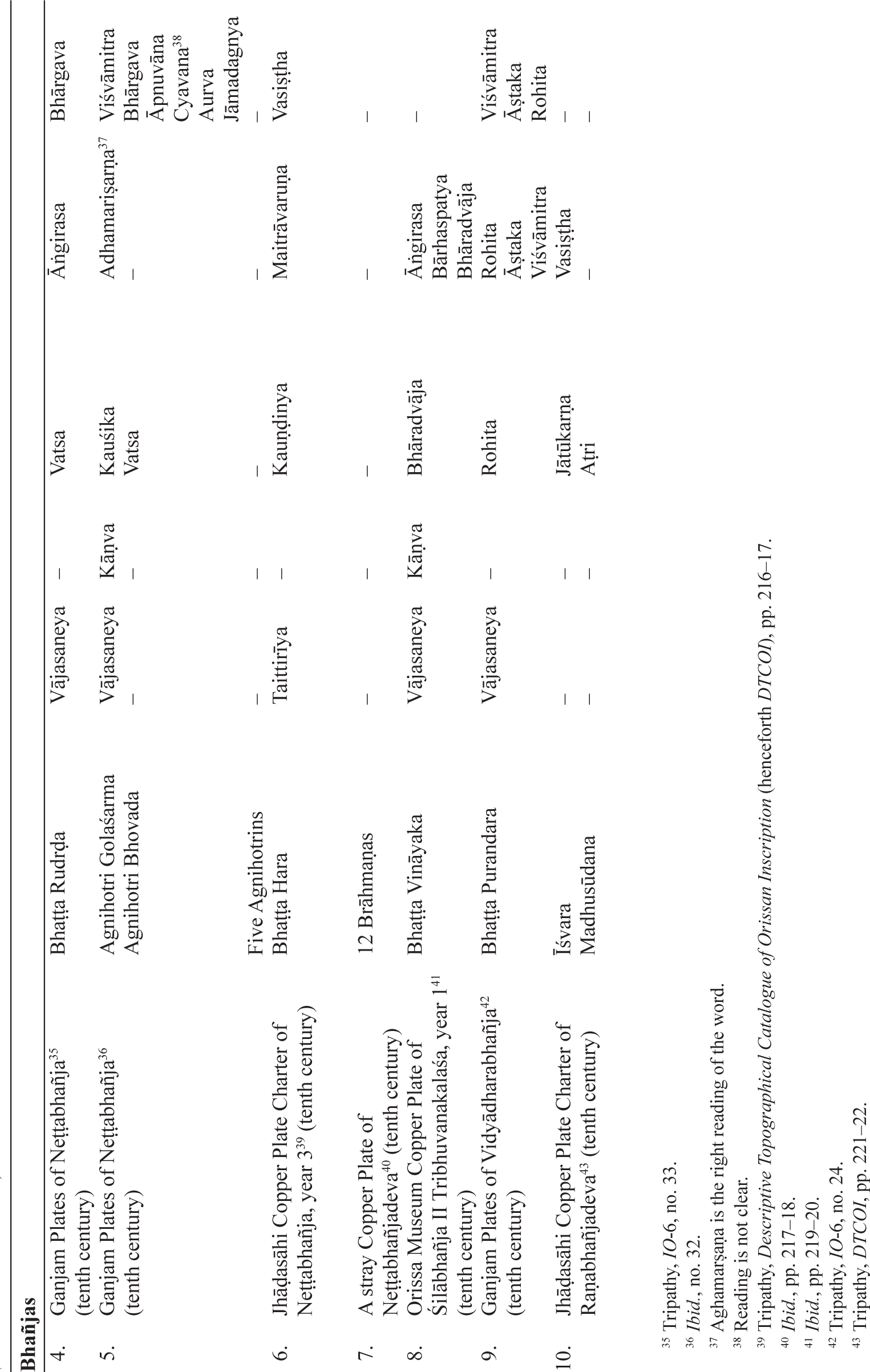
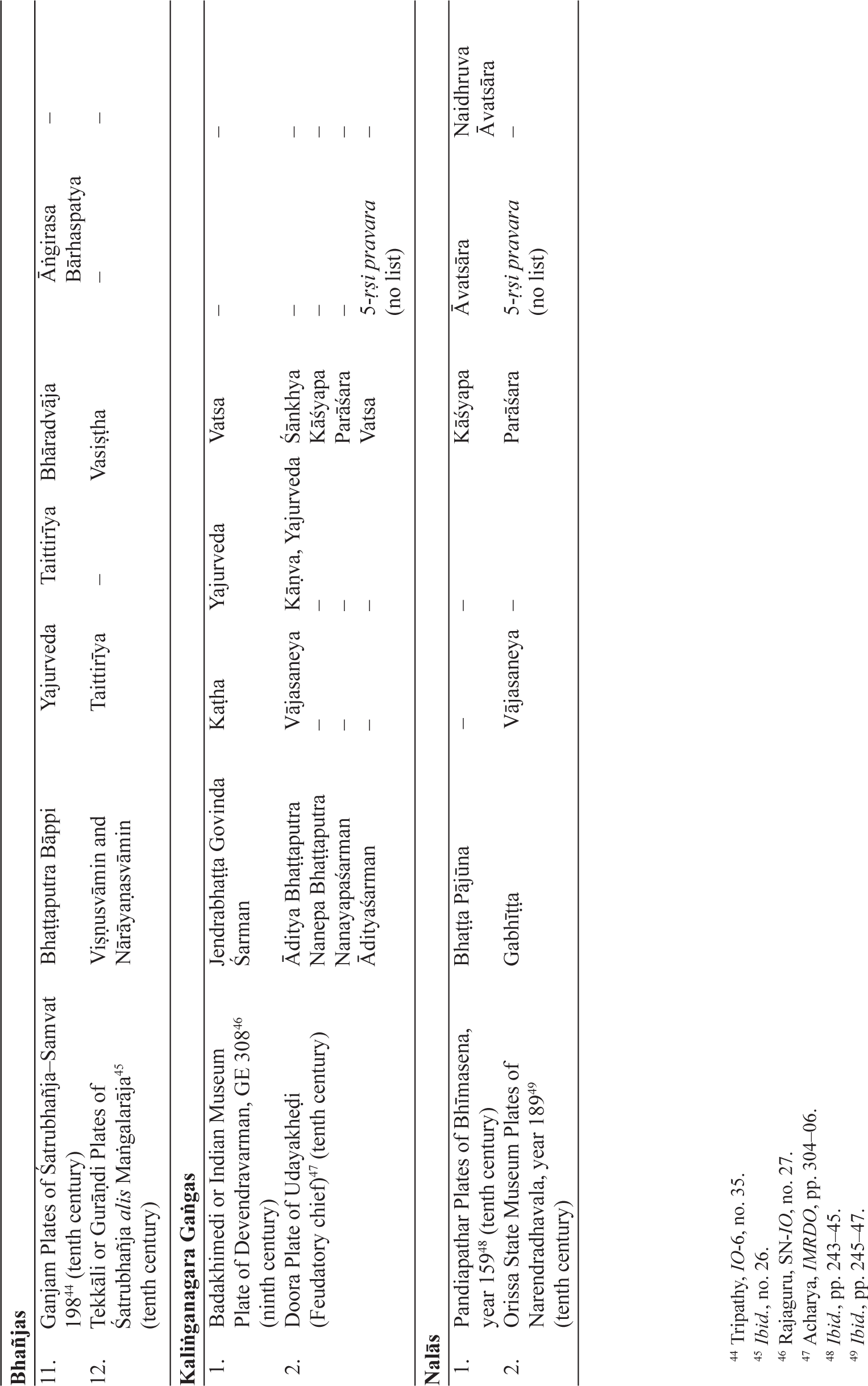
| Sr. No | Reference | Recipients’ Name | Caraṇa | Śākhā | Gotra | Pravara | Anupravara |
|
|
|||||||
| 1. | Sumaṇḍala Plates of the time of Pṛthvīvigraha-bhaṭṭāraka, Gupta Year 250 1 (sixth century) | Brāhmaṇas and Upādhyāya Maṭusvāmin | Different caraṇas | – | Different gotras | – | – |
| 2. | Khandipada–Nuapalli Plates of Caramparāja 2 (sixth century) | Eight Brāhmaṇas | Bāhvṛca | – | Gautama 3 | – | – |
|
|
|||||||
| 1. | Ganjam Plates of Mādhavarāja, Gupta Year 300 4 (seventh century) | Carampasvāmin | – | – | Bhāradvāja | Āṅgirasa Bārhaspatya |
– |
| 2. | Buguda Plates of Mādhavavarman 5 (seventh century) | Bhaṭṭa Vāmana | Taittirīya | – | Hārita | Āṅgirasa Aṃbarīṣa Yuvanāśva |
– |
| 3. | Purushottampur Plates of Mādhavavarman, year 13 6 (seventh century) | Bhaṭṭa Nārāyaṇa | Chāndoga | – | Maudgalya | Āṅgirasa | Bhārmyaśva |
| 4. | Nivina Copper-Plate Grant of Dharmarāja, Year 9
7
(early eighth century |
Savaridēvadīkṣita Bhaṭṭa | Chāndoga | Kauthuma | Vatsa | 5-ṛṣi pravara (no list) | 5-ṛṣi anupravara (no list) |
| 5. | Koṇḍeḍḍe Grant of Dharmarāja. Year 30
8
(early eighth century |
Agnihotri Bhaṭṭa Gōṇadevasvāmin | Vājasaneya | – | Kauśika | Audala Devarāta Viśvāmitra |
– |
|
|
|||||||
| 1. | Kama–Nalinaksapur Plates of Jayavarman
9
(700–20 |
Viṣṇuśarman | Vājasaneya | – | Gautama | – | – |
| 2. | Kama–Nalinaksapur Plates of Sāmantavarman
11
(720–40 |
Nārāyaṇaśarman | Vājasaneya | – | Kāśyapa | – | – |
| 3. | Dhanantara Plates of Sāmantavarman
12
(720–40 |
Govindaśarman | Vājasaneya | – | Bhāradvāja | – | – |
| 4. | Gautami Plates of Indravarman, year 4
13
(740–60 |
Vināyakaśarman and Nārāyaṇaśarman | Vājasaneya | Kāṇva | Parāśara | Śāktya Vasiṣṭha |
– |
| 5. | Padmatola Plates (C) of Indravarman
14
(740–60 |
Four Brāhmaṇas | Vājasaneya | Kāṇva | Parāśara | Parāśara Vasiṣṭha Śāktya |
– |
| 6. | Padmatola Plates (A) of Anantavarman
15
(760–80 |
Three Brāhmaṇas | Vājasaneya | Kāṇva | Bhāradvāja | Bhārgava Āṅgirasa Bārhaspatya |
– |
| 7. | Padmatola Plates (B) of Anantavarman
16
(760–80 |
Four Brāhmaṇas | Vājasaneya | Kāṇva | Parāśara | Parāśara Śāktya Vasiṣṭha |
– |
| 8. | Badakemundi Plates of Jayavarman
17
(780–800 |
Raviśarman | Vājasaneya | Kāṇva | Kāśyapa | – | – |
| 9. | Ganjam Plates of Jayavarman
18
(780–800 |
Bhaṭṭa Nannaṭa Mahattara | Vājasaneya | Kāṇva | Vatsa | Vatsa Dairda, Bṛgu Jāmadagnya Āpnuvāna |
Same as pravara |
| 10 | Svalpavelur Plates of Anantavarman, year 19
19
(760–80 |
Bhaṭṭa Nannaṭa Śarma | Vājasaneya | Kāṇva | Vatsa | Bṛgu Dairda Cyavana Jāmadagnya |
– |
| 11. | Bhismagiri Plates of Indravarman
20
(800–20 |
Bhaṭṭaputra Yajñasvāmiśarman | Vājasaneya | Kāṇva | Jātūkarṇa | Vasiṣṭha Jātūkarṇa |
Jātūkarṇa Vasiṣṭha |
| 12. | Indian Museum Plates of Jayavarman, year 100
21
(820–40 |
Bhaṭṭaputra Padma Mahattara | – | Kāṇva | Vatsa | 5-ṛṣi pravara (no list) | – |
| 13. | Badakhemundi Plates of the time of Bhupendravarman
22
(840–60 |
Bhaṭṭaputra Mahattara Māṇikadeva | – | – | Vatsa | 5-ṛṣi pravara (no list) | – |
| 14. | Ganjam Plates of Pṛthvīvarman
23
(860–80 |
Bhaṭṭaputra Śubhaṅkara | Vājasaneya | Kāṇva | Vatsa | Bhārgava Cyavana Āpnuvāna Aurva Jāmadagnya |
Jāmadagnya Aurva Āpnuvāna Cyavana Bṛgu |
| 15. | Indian Museum Plates of Indravarman
24
(880–900 |
11 Brāhmaṇas | – | – | – | – | – |
| 16. | Badakhemundi Plates of Indravarman
25
(880–900 |
Bhaṭṭaputra Durgakhaṇḍi | Chāndōga | Rāṇāyaṇiya | Vatsa | Aurva Bṛgu Cyavana Āpnuvāna Jāmadagnya |
Same as pravara |
| 17. | Badakhemundi Plates of Dānārṇavadeva
26
(900–20 |
Bhaṭṭa Durgakhaṇḍi | Chāndōga | – | Vatsa | 5-ṛṣi pravara (no list) | 5-ṛṣi anupravara (no list) |
|
|
|||||||
| 1. | Dharakote Plate of Śubhākaradeva, year 103 27 (ninth century) | Bhaṭṭa Nārāyaṇadevakaṇṭha | Vājasaneya | – | Māṅgalya 28 | Āṅgirasa | Aurva Sāvarṇa |
| Bhaṭṭa Lumvādevamitra | Vājasaneya | – | Kauśika | Viśvāmitra | Devarāta Audala |
||
| 2. | Ganjam Grant of Daṇḍimahādevi (A), year 180 29 (tenth century) | Pratihāra Dhavala | – | Kāṇva | Viśvāmitra | Devarāta | Audala |
| 3. | Ganjam Grant of Daṇḍimahādevi (B) 30 (tenth century) | Bhaṭṭaputra Puruṣottama | Vājasaneya | Kāṇva | Kāśyapa | Kāśyapa Āvatsāra Naidhruva |
– |
| Bhaṭṭaputra Ravika | – | – | Kauśika | Audala Viśvāmitra Devarāta |
– | ||
|
|
|||||||
| 1. | Russelkonda Plate of Neṭṭabhañja, year 26 31 (eighth century) | Vāsudēvasvāmin | Vājasaneya | – | Kauśika | – | – |
| 14 Brāhmaṇas | Different caraṇa | – | Different gotra | – | – | ||
| 2. | Peṭṭasarā Grant of Neṭṭabhañja 32 (tenth century) | Bhaṭṭa Keśavarudra | Vājasaneya | Kāṇva | Bhāradvāja | Āṅgirasa | Bārhaspatya |
| 3. | Māliṅgi Copper Plate Grant of Neṭṭabhãja Kalyāṇakalaśa 33 (tenth century) | Bhaṭṭa Maṅgala | Vājasaneya | Kāṇva | Vatsa | Kāśyapa Āvatsāra 34 |
Naidhruva |
| 4. | Ganjam Plates of Neṭṭabhañja 35 (tenth century) | Bhaṭṭa Rudrḍa | Vājasaneya | – | Vatsa | Āṅgirasa | Bhārgava |
| 5. | Ganjam Plates of Neṭṭabhañja 36 (tenth century) | Agnihotri Golaśarma | Vājasaneya | Kāṇva | Kauśika | Adhamariṣarṇa 37 | Viśvāmitra |
| Agnihotri Bhovada | – | – | Vatsa | – | Bhārgava Āpnuvāna Cyavana 38 Aurva Jāmadagnya |
||
| Five Agnihotrins | – | – | – | – | – | ||
| 6. | Jhāḍasāhi Copper Plate Charter of Neṭṭabhañja, year 3 39 (tenth century) | Bhaṭṭa Hara | Taittirīya | – | Kauṇḍinya | Maitrāvaruṇa | Vasiṣṭha |
| 7. | A stray Copper Plate of Neṭṭabhañjadeva 40 (tenth century) | 12 Brāhmaṇas | – | – | – | – | – |
| 8. | Orissa Museum Copper Plate of Śilābhañja II Tribhuvanakalaśa, year 1 41 (tenth century) | Bhaṭṭa Vināyaka | Vājasaneya | Kāṇva | Bhāradvāja | Āṅgirasa Bārhaspatya Bhāradvāja |
– |
| 9. | Ganjam Plates of Vidyādharabhañja 42 (tenth century) | Bhaṭṭa Purandara | Vājasaneya | – | Rohita | Rohita Āṣtaka Viśvāmitra |
Viśvāmitra Āṣtaka Rohita |
| 10. | Jhāḍasāhi Copper Plate Charter of Raṇabhañjadeva 43 (tenth century) | Īśvara | – | – | Jātūkarṇa | Vasiṣṭha | – |
| Madhusūdana | – | – | Aṭri | – | – | ||
| 11. | Ganjam Plates of Śatrubhañja–Samvat 198 44 (tenth century) | Bhaṭṭaputra Bāppi | Yajurveda | Taittirīya | Bhāradvāja | Āṅgirasa Bārhaspatya |
– |
| 12. | Tekkāli or Gurāṇdi Plates of Śatrubhañja alis Maṅgalarāja 45 (tenth century) | Viṣṇusvāmin and Nārāyaṇasvāmin | Taittirīya | – | Vasiṣṭha | – | – |
|
|
|||||||
| 1. | Badakhimedi or Indian Museum Plate of Devendravarman, GE 308 46 (ninth century) | Jendrabhaṭṭa Govinda Śarman | Kaṭha | Yajurveda | Vatsa | – | – |
| 2. | Doora Plate of Udayakheḍi (Feudatory chief) 47 (tenth century) | Āditya Bhaṭṭaputra | Vājasaneya | Kāṇva, Yajurveda | Śānkhya | – | – |
| Nanepa Bhaṭṭaputra | – | – | Kāśyapa | – | – | ||
| Nanayapaśarman | – | – | Parāśara | – | – | ||
| Ādityaśarman | – | – | Vatsa | 5-ṛṣi pravara (no list) | – | ||
|
|
|||||||
| 1. | Pandiapathar Plates of Bhīmasena, year 159 48 (tenth century) | Bhaṭṭa Pājūna | – | – | Kāśyapa | Āvatsāra | Naidhruva Āvatsāra |
| 2. | Orissa State Museum Plates of Narendradhavala, year 189 49 (tenth century) | Gabhīṭṭa | Vājasaneya | – | Parāśara | 5-ṛṣi pravara (no list) | – |
Tripathy, IO-1, no. 21.
Ibid., no. 22.
Plates mentioned the names of all Eight Brāhmaṇas, but it only records the gotra and Caraṇa affiliation of only single brāhmaṇa, that is, Svāmicandra.
Tripathy, IO-1, no. 45.
Ibid., no. 47.
Ibid., no. 48.
Ibid., no. 54.
Ibid., no. 58.
Acharya, IMRDO, pp. 207–09.
For the recent study on the chronology of the Śvetaka Gaṅga rulers See Ibid., pp. 52–65.
Ibid., pp. 209–10.
Ibid., pp. 211–12.
Ibid., pp. 212–14.
Ibid., pp. 214–16.
Ibid., pp. 216–18.
Ibid., pp. 218–20.
Ibid., pp. 220–22.
Ibid., pp. 222–24.
Ibid., pp. 224–26.
Ibid., pp. 226–28.
Ibid., pp. 228–31.
Ibid., pp. 231–33.
Ibid., pp. 233–35.
Ibid., pp. 235–38.
Ibid., pp. 238–41.
Ibid., pp. 241–42.
Tripathy, IO-2, no. 9.
Reading of gotra, pravra and anupravras is doubtful.
Tripathy, IO-2, no. 17.
Ibid., no. 18.
Tripathy, IO-1, no. 23.
Tripathy, IO-6, no. 31.
Tripathy and Mishra, ‘Māliṅgi Copper Plate Grant of Neṭṭabhañja Kalyāṇakalaśa’, pp. 216–36.
Reading is not clear. Inscription mentioned Vachchhārava.
Tripathy, IO-6, no. 33.
Ibid., no. 32.
Aghamarṣaṇa is the right reading of the word.
Reading is not clear.
Tripathy, Descriptive Topographical Catalogue of Orissan Inscription (henceforth DTCOI), pp. 216–17.
Ibid., pp. 217–18.
Ibid., pp. 219–20.
Tripathy, IO-6, no. 24.
Tripathy, DTCOI, pp. 221–22.
Tripathy, IO-6, no. 35.
Ibid., no. 26.
Rajaguru, SN-IO, no. 27.
Acharya, IMRDO, pp. 304–06.
Ibid., pp. 243–45.
Ibid., pp. 245–47.