







Abstract
In the late nineteenth century, British officials characterised tribal populations in Northeast India as rural, primitive and place-bound. State-sanctioned forms of migration into the region—of tea-plantation labourers, missionaries, scientists, ethnographers, mapmakers and armed forces—generated paper trails that underscored the separateness of two worlds: an urban and mobile imperial world that entered other lands, and a rural and immobile tribal world that was entered. Decentring the concerns of empire, this article focuses on Mizo travellers from the Lushai Hills District (modern-day Mizoram) who not only travelled in the opposite direction but also changed the imperial world as they worked, learned, wrote, loved and conducted diplomacy in scales that spanned it. Tribal presence in distant urban centres—as choir members, students, labourers, diplomats, chiefs, nurses and preachers—challenged imperial fictions, often flying under the radar of colonial recordkeeping. This article argues that illuminating their stories requires an alternative archive: vernacular newspaper travelogues, Mizo-language diaries and historical materials today held in family collections across Mizoram unveil an overlooked era of outbound mobility, predating by over a century the current swell of travelling tribal youth, but also offering a way to reconceptualise it as part of a tradition rather than as a rupture. The histories of highlanders at lower elevations and in bustling urban centres—far away from rural frontiers and imperial borderlands—do not simply add to, but in fact constitute, the history of Northeast India.
Introduction
On a November day in 1933, the songs of a remote Northeast Frontier tribe blanketed one of the imperial world’s great cities. 1 Far from their mountain homelands of the eastern Himalayan foothills, a choir of Lushai singers gathered around a microphone at the Calcutta Radio Club. Hailing from a rural borderland, where British officials characterised local populations as both place-bound and primitive, they transformed upland harmonies into electromagnetic radio waves. Tribal voices beamed at the speed of light across the urban heart of a global empire.
If a ‘frontier tribe’ communicating wirelessly at the centre of an imperial metropole in the 1930s strikes us as unexpected, it is because the choir’s presence cuts against deeply engrained ideas that shaped their world—and ours as students of Northeast India. In the popular imagination, the stories of hill peoples unfold passively at political fringes, not in the cores of world cities. As Coll Thrush points out for another imperial space:
The city, as the ultimate expression of colonial modernity, seems to offer little space for Indigenous presence. This has been replicated in both popular culture and most academic studies, in which urban Indigenous people…are often portrayed as little more than the collateral damage…[or as an] inauthentic manifestation of some lost past.
2
What were they doing there?
In fact, historical wayfarers from the Lushai Hills (the modern-day state of Mizoram) travelled to colonial India’s imperial lowlands not only as choir members but also as students, labourers, diplomats, chiefs, tourists, nurses, teachers, adopted daughters, prisoners and preachers. Their mobility and the variety of their roles worked against the grain of the imperial archive and colonial-era assumptions, which have long pigeonholed Northeast India as ‘remote’, ‘backward’ and cut off beyond various dividing lines, whether of legal exclusion (such as the Inner Line) or of difference (as with lines of lactose, fermentation, dried fish or facial phenotypes). 3
But longstanding tribal traditions of urban travel and geographical mobility are rediscoverable. To reveal this world requires venturing beyond the official archive, turning instead to sources held by local families in private collections across Mizoram. In collaboration with Mizo scholars, elders and the everyday curators of personal and family archives, I co-directed a British Library Endangered Archives Programme (EAP) project that located, digitally preserved and catalogued some 11,000 images of historical material drawn from the village level across the state. 4 From the capital of Aizawl to distant rural villages such as Saikao and Tlabung, EAP researchers followed the lead of document custodians, digitising materials on site, recording stories and presenting custodians with digital copies of their own records. The project ‘revealed a significant body of hitherto unknown and endangered items that were the product of interactions between individuals and the colonial state and which predate the emergence of a literate public sphere’. 5 These alternative historical collections, upon which this article draws heavily, are time capsules of a mobile world in which tribal peoples were more than just guests.
How were colonial-era hill populations not only travelled to, but travellers themselves? Decentring state agents and concerns of empire, this article asks how diverse upland travellers from the Lushai Hills viewed the imperial world as they variously moved, lived, worked, learned, wrote, loved and conducted diplomacy in scales that spanned it. Centring spatial mobility, it attends to recent calls to recast the ‘territorialised narratives’ of Northeast India by ‘starting in the highlands and examining how they connect to larger regions’. 6 In surveying tribal movement, I narrow the lens to willing travellers—who, despite often brutal constraints and circumstances, moved for their own reasons, outside of the forced and state-engineered carceral and military regimes that are being explored elsewhere. 7 This focus tightens the scope while decentring the priorities and agency of empire. Who were these historical tribal individuals ‘in unexpected places’? 8 How did a Lushai boy see much of the Indian subcontinent in 1896? What was a Mizo man doing in central London in 1908 with an audience of 4,000 listeners? How did the name of a young Mizo scholar appear in the Depression-era newspapers of Pennsylvania?
Yet what follows is more than a catalogue of Mizo sojourners. Building on recent scholarship on Indigenous travel in other world regions, the article makes a case for how upland presences in lowland places—such as the electricity-powered recording studio in 1930s Calcutta, the exact sort of urban environment currently absent from writings on the colonial Lushai experience—were meaningful. 9 Mizo travellers were more than just there. For brief but significant moments, the metropolitan presence of the frontier-colonised impacted the coloniser. These presences catalysed knowledge, materials, experiences and ideas that mattered not only to Mizo people but also to the self-fashioning of the imperial metropole and to colonial modernity itself.
Scholars of Northeast India have already revealed a dazzlingly mobile upland world for precolonial eras, following traders, herds and cowry shells or bonds of marriage, debt and devotion up and down mountainsides in rhythms that slowed only in moments of monsoon, scarcity or conflict. 10 Through a long and convoluted process from the mid- to late 1700s, imperial presences in the region increasingly pursued new sorts of territorial fixity. For a time, designated trading outposts could be negotiated in zones beyond formal state control, an outsourcing of lowland state security to hill leaders. 11 But the advance of formal colonial control had a gradual freezing effect on many customary avenues of circulation. Scholars of this era have thus tended to focus primarily on mobility’s inbound manifestations in areas of concern to the state. Travellers and migrants arrived as tea-plantation owners and labourers, explorers, missionaries, scientists, mapmakers and military men, all forms of inward movement that made big splashes in the colonial archive. 12 By the early twentieth century, inbound travellers defined local populations by their supposed immobility, as ‘untravelled hillmen’ 13 or as people who ‘die if they get away from their hills’. 14
In fact, a host of historical sojourners, willing and unwilling, ventured out of India’s northeast—and not just in the comparatively mobile precolonial period. Tribal individuals on the move played significant roles that must command our attention in the colonial eras 15 too, even when they are viewed from the limited angle of a single district like the Lushai Hills, the understudied frontier region centred in this article precisely for its geographic compactness (see Figure 1). Family sources can illuminate a third era of Mizo sojourning, neither precolonial nor postcolonial. It is an era that predates the current swell of tribal travel by over a century, but that also offers a way to reconceptualise it: as part of a tradition rather than a rupture. 16
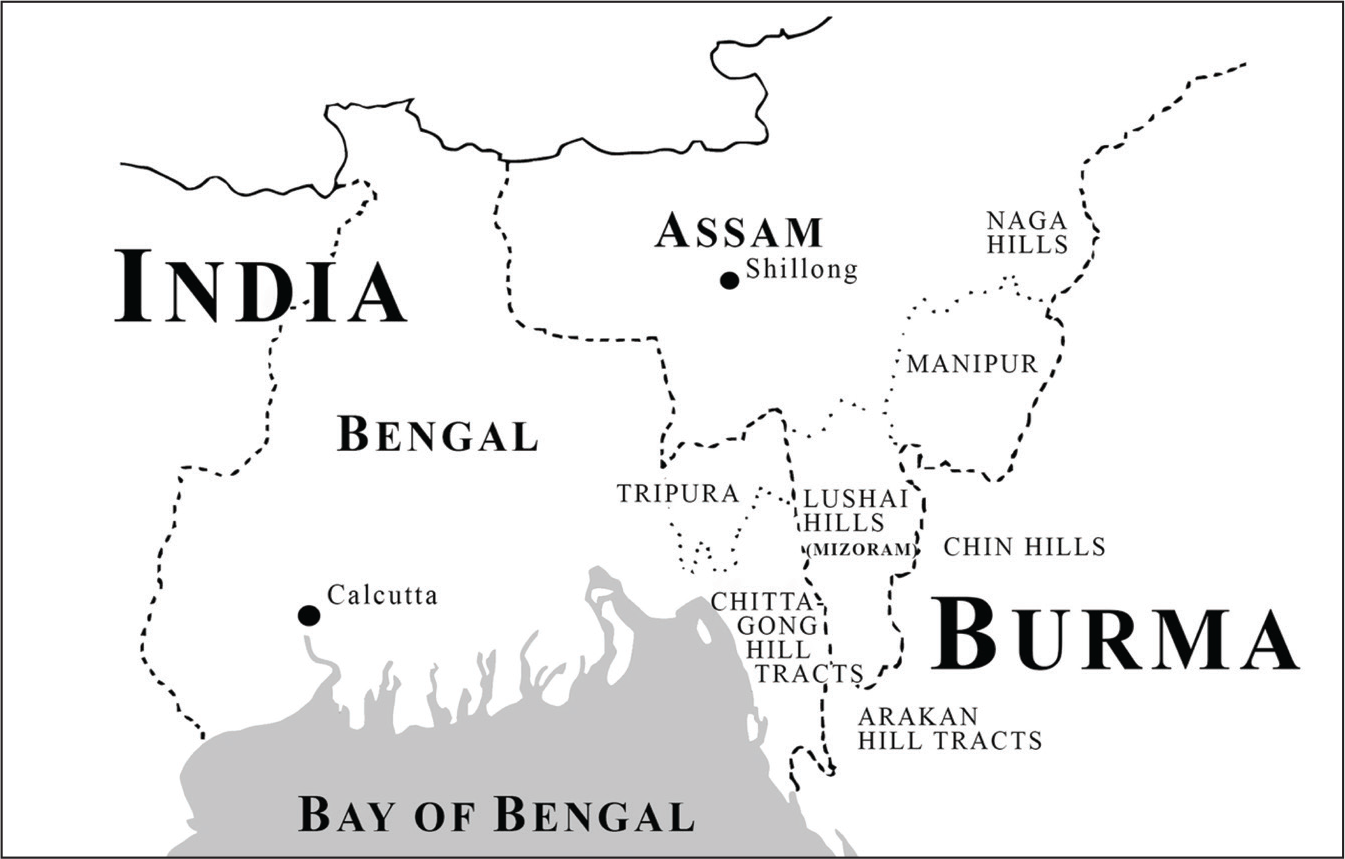
This article has two parts. The first section follows a delegation of Lushai chiefs to the distant imperial capital of Calcutta in the 1870s. The article reinterprets the chiefs’ actions and inaction by centring not the supposed strangeness of their presence in the city, but the strangeness of the city itself. 17 Next, the article turns to a Mizo boy called Khuma, a child who found hierarchy-flipping moments during his travels across northern India in 1896, and who provided opportunities for the agents of empire to think imperially about new technologies—like ice machines—even as he extended tribal ways of sensing deep into urban spaces. The following section investigates the case of Challiana, a Mizo man who in 1906 used Indigenous units of measurement to remeasure scientific specimens in London, gauged contemporary British society against Mizo systems of ethics and captured attention across Great Britain as a singer and speaker. The second part of the article offers an overview of a range of historical Mizo individuals who sought knowledge, status, health and souls in distant places. Emphasising sources from family archives, this part unveils the variety and scope of historical Mizo travel, under the conviction that, ‘[o]nly by accumulating many tiny slivers of these lives…can we start to build a picture of the past that sees these travellers as they were—sometimes remarkable, and at other times mundane, but above all there’. 18 This discussion ends with a caution against triumphalism, for histories of tribal mobility are also bound up tightly with brutal power disparities and abuse. The article concludes by pulling together these diverse stories in light of the movement of present-day travellers, who are part of a long tradition that entangles tribal with urban stories.
Part I: Mizo Mobility Up Close
Savunga Travels to Calcutta, 1871
Savunga sparked up his pipe. The stars were out above the Maidan, the grassy boulevard at the centre of the city, another day closing for the Lushai 19 traveller in Calcutta. At the lieutenant governor’s grand palace that day, Savunga and six other Lushai chiefs had been aloof of most everything they had been taken to see, save for a silver sofa set atop silver lions that had drawn a brief remark. 20 The chiefs were part of a delegation of some 27 people visiting from distant mountains to stand in awe of ‘the glories of the metropolis’ 21 —at least, that was the intention of colonial officer T. H. Lewin, planner of their two-week itinerary. But Savunga and the chiefs were failing to play their expected roles. They had met the steamship from Chittagong—its belly of coal and fire, chugging out plumes of petrochemicals—not with wonder but ‘impassivity’, Lewin sighed: ‘their astonishment, if they felt any, being expressed by an apparent increase in the stolidity of their demeanour’. 22 The chiefs raised their eyebrows at a sofa, but not at the grand palace in which it sat. And the set piece most anticipated to amaze, the city itself, they had met with jaded indifference: ‘[T]he magnificence of the City of Palaces did not apparently impress them’, Lewin recorded. ‘On the whole, the balance of their minds inclined in favour of their own hill-tops, where there were no mosquitoes (the plague of Calcutta), and where the ceaseless jostling of strange men troubled them not’. 23
Whether Mizo sightseers in Calcutta, Inuit visitors in London or Kanaka Maoli seafarers in Macao, non-state, ‘frontier’ and Indigenous populations were expected by imperial agents around the world to express awe in the face of the big city and the godlike know-how of empire. 24 But in Calcutta, ‘[o]nce, and once only’, Lewin records, ‘were [the Lushai chiefs] roused to enthusiasm’. 25 Cashing in a favour with someone at the new East India Railway, Lewin had the chiefs rocketed for ‘a mile at full speed on a fiery, snorting locomotive’ which ‘fairly frightened the dignity out of them’. 26 At long last, Calcutta drew from tribal lips the expression of wonder that Lewin craved.
But to focus on Lewin’s glee, on how the chiefs’ astonishment confirmed for him the existence of two worlds—one primitive, one civilised; one that brought modernity, one that received it—misses the point. 27 In the 1870s, cosmopolitan urbanites the world over were still struggling to come to terms with the alarming speed and sheer sensory overload of travel by rail: the ‘fear of derailment, of catastrophe, of “not being able to influence the motion of the carriages in any way”’. 28 The same year Lushai chiefs rode the rails in Calcutta, a local newspaper reported on multiple crashes in a single day along those very junctions. 29 The self-styled image of the railway as a model of order and civility was equally at odds with local newspaper reports of murder aboard Calcutta’s railcars 30 or of mass injuries from train crashes in the city. 31 Lewin had seen tribal difference because he was so ready to see tribal difference.
And yet there were two separate worlds on display that day in Calcutta, albeit not the two that Lewin imagined. There was, on the one hand, the age-old, solar-powered world. Here, the movement of animals, including the mobility of humans, variously categorised as ‘British’ or ‘Lushai’, depended fundamentally upon the sun and its gifts used in the present. What was new was the fossil-fuelled world. Here, urban humans had begun distinguishing themselves from their forebears, and other species, by exploiting solar energy buried in the deep past. 32 This was the real novelty on display that Calcutta day in 1872, when the Lushai chiefs were in fact united with—not differentiated from—other elites the globe over as the astonished early adopters of high-speed, fossil-fuelled urban movement. They were there, entering a new world of human mobility powered by the burning of the ancient ‘necrosphere’. 33
Back on solid ground, the chiefs camped out on the Maidan, in Lewin’s company (which they insisted upon), sleeping little and ‘smoking far into the night’. 34 The chiefs declined Lewin’s offer to meet the viceroy, apparently anxious at rumours of his violence and unpredictability. Instead, they chose to present their gifts of elephant tusks and homemade cloths to the lieutenant governor of Bengal, a ceremony they conducted with confidence, in Lewin’s estimation, ‘as to an equal’. 35 The gifts were selected, carried and hand-delivered in line with the standard protocols of hill diplomacy. Today, a photograph of their journey (see Figure 2) can be found in Mizoram, preserved in the private collection of Dr Pu Laltluangliana Khiangte. 36 The chiefs pose confidently with guns, spears and their followers, dressed in traditional clothes rather than attempting to fit in. Distant from the ecosystems of ancestral lands, they have, however, cast off one piece characteristic of upland attire: the kelmei necklace—a bio-repellent device made of goats’ hair that shielded humans from the disease-causing spirit-pests, ramhuai, endemic in the upland region. 37 The chiefs had no use for kelmei in the ecology of this distant city. Given their selective leveraging of gifts to those gauged as political equals and their choices about attire, choices that asserted custom and referenced the upland healthcare system, their journey to Calcutta—usually characterised as imperial theatre arranged for an ostensibly passive and dumbstruck Lushai audience—can be interpreted anew. Tribal mobility was also about the careful extension of upland political power, diplomatic protocols, material culture and the performance of military prowess into the lowlands. Hill representatives here carried tusks and cloth, guns and spears, pride and expectations of mutuality into the unfamiliar capital of the Indian empire. 38 They communicated hill sovereignty selectively, on high alert and paying close attention to their own safety. And they did so also in ways less subtle, with openly carried weapons. Like their more-studied counterparts, the imperial officers who travelled in the opposite direction, tribal elites also moved great distances, ‘seeking information, testing out their opponents’. 39 At the end of the tour, the Lushai chiefs returned home with ‘presents and purchases’, Lewin records, ‘well pleased with their visit, and more than well pleased that it was safely over’. 40
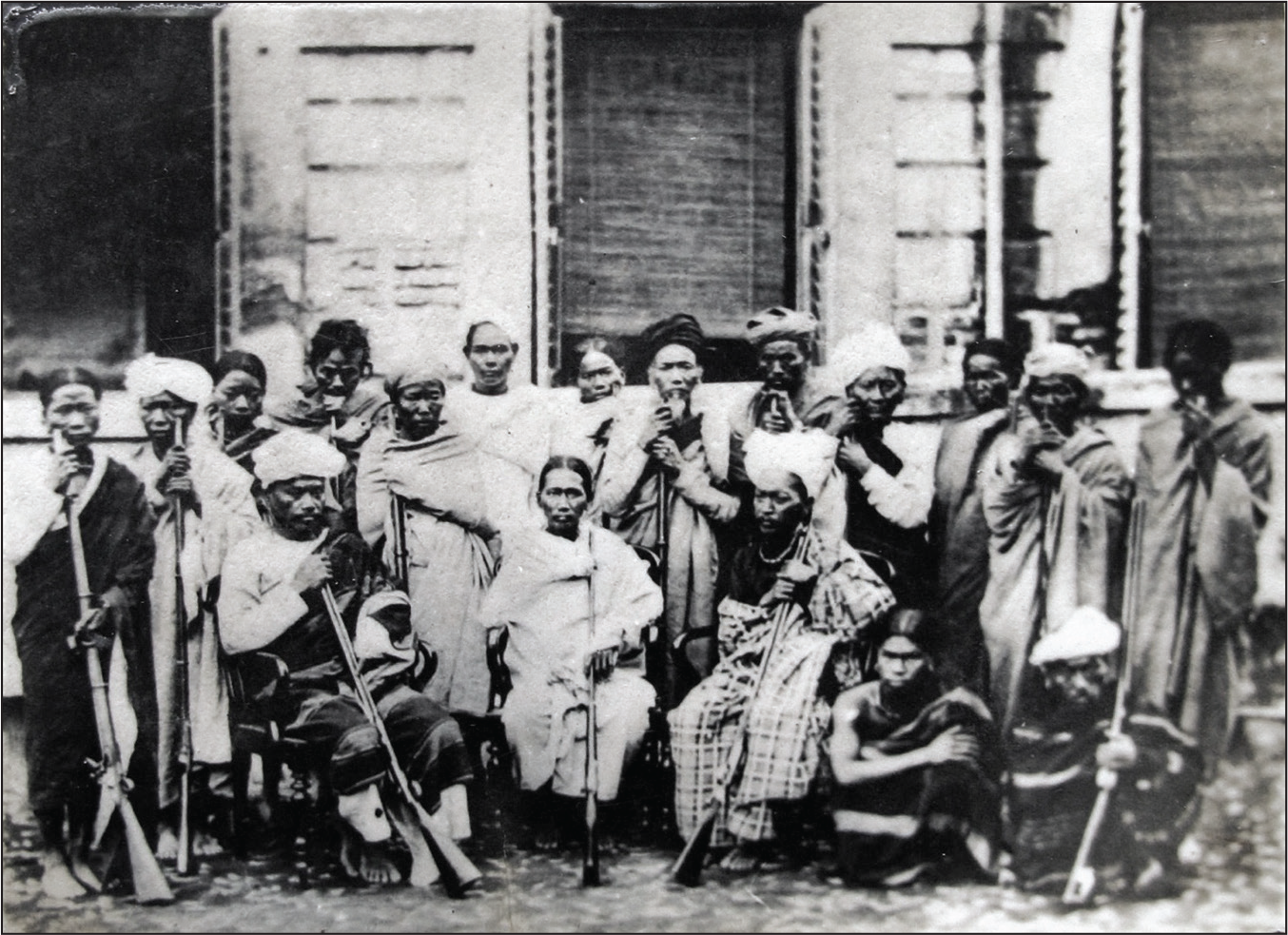
This ‘Calcutta Expedition’ was the latest tribal delegation whose frostiness to the imperial city challenged the empire’s expected plotlines. A decade earlier, an Andamanese deputation was transported across the Bay of Bengal by administrator Henry Corbyn to see the sights in Calcutta. The eight tribal travellers ‘never evinced astonishment or admiration at anything which they beheld, however wonderful from its novelty we might suppose it would appear to them’. 41 As historian Satadru Sen writes, perhaps the silence was calculated, a snub that refused to give people like Corbyn or Lewin what they craved. 42 The ability of machines at the Calcutta Mint to imprint with roaring efficiency images onto small discs of metal was not—contrary to Corbyn’s expectations—impressive to everyone. 43 The whoosh of the steam engines, the ka-chaack of the cutting-out presses, the ground-shaking vibration of furnaces—each ‘displayed before them in active operation’ 44 —drew no comment at all. The modern ‘age of noise’ 45 could be met with tribal studied silence.
Initially caught off-guard, Corbyn landed on his own explanation: the travellers were ‘absorbed in thought’. 46 Today, names like Marx, Engels, Dickens and Blake are familiar in the critique of early industry. But the names of tribal individuals—Savunga, Lalngura and Vanhnuaia, chiefs aboard the rumbling Calcutta train, or Topsy, Jumbo and Jacko, the Andamanese woman and men at the Calcutta Mint—await credit in the intellectual critique of industrialisation. Corbyn was correct that these were tribal thinkers, sceptical and steady in the face of the most modern and explosive of Calcutta’s sights. But where Corbyn and Lewin had intended to educate these travellers, tribal equanimity in the face of the lesson—composed, stolid, aloof—can be read in turn as an attempt to instruct them. The urban actions of these tribal travellers left a mark not just on the minds of their hosts but also on subsequent publications broadcast to an imperial reading public. Andamanese and Lushai people, present in the empire’s urban core, injected the reports of author-mediums like Corbyn and Lewin with tiny doses of doubt. These were quiet visions that sometimes made the author-medium ‘stop and reflect on [their] own certainties about the world’—and then report this certainty-slicing moment widely. 47 Because of urban tribal presence, the just-so story of industrial progress was suddenly not so self-evident. Because of urban tribal presence, British ‘hosts’ in the big city—guides like Corbyn and Lewin—could be remade into another sort of host: as harbouring messengers communicating alternative ways of being. 48
In this way, imperial authors could unwittingly transmit what scholars today would identify as decolonial perspectives. When the British engineer G. H. Loch took another Lushai man, Liana, to Darjeeling to feast his eyes upon the mountain Kanchenjunga, ‘grand panorama of the Eternal snows’, all that Liana said was, ‘Oh, I have seen that sort of thing before in my own country’. 49 Liana dismissed the great Himalayan glaciers—the vertical landscapes that contemporary Victorian mountaineers hailed as the definitive proving-ground of both masculinity and imperial science 50 —as just a scaled-up version of the wintertime hoarfrost he occasionally spotted back home. Reporting the story, missionary J. H. Lorrain grumbled to his logbook: ‘Lushais are most disappointing to take to see things. They often exhibit no interest whatever in what we think they would be struck by’. 51 In such moments, the intended messages of Corbyn, Lewin, Loch and Lorrain were briefly but foundationally coopted. Here, decolonial perspectives are not read back into the past, but rather bubbled to the surface contemporaneously, from within historical moments of tribal travel. In colonial authors’ reports, the actions and inactions of mobile tribal people undercut imperial assumptions about how masculinity related to mountains and how modernity related to mints.
Yet the point here cuts deeper than the ‘non-universality’ of the idea of progress. The Lushai chiefs brought to Calcutta by Lewin critiqued the great city’s mosquitoes precisely in a moment of surging endemic malarial fever and urban mass death. 52 Ignoring the city’s architectural and technological wonders, its drainage systems, white-marble palaces and the carbon arc-lighting that pushed back the night at Eden Gardens, they chose instead to comment on urban crush in a moment when the city’s human population had exploded to some 430,000 people—a near-doubling across a half-century, despite simultaneously soaring rates of death. 53 Lushai explorers of the urban world—reverse mountaineers—surveyed the grand imperial capital and identified precisely that which most ailed the civilisation they had been transported to appreciate. 54 Drawing upon tropes of imperial travel and discovery, as well as stereotypes of tribal head-hunting and savagery, Rudyard Kipling imagined a ‘German orchid-hunter, fresh from nearly losing his head in the Lushai hills’. 55 But the on-the-ground reality in Calcutta in 1872 flipped each of the empire’s scripts. Lewin arranged a stop on the tour in which Savunga and his fellow Lushai chiefs were to present their heads for measurement to the skull-obsessed Dr James Wood-Mason. 56 The travelled-to had become the traveller, and the head-hunter the head-hunted. The presence of tribal travellers could turn the most overdetermined fictions of empire inside out.
Khuma Travels Across Northern India, 1896
This was his chance. ‘Get up! Get up!’ Khuma, a young Lushai boy, was barking commands from a boat anchored on the banks of the Tlawng river, somewhere north of the small trading community of Sairang in the Lushai Hills. 57 It was early—what Khuma would have known as the ‘last rooster crow’, not yet six o’clock. 58 The first morning into a journey that would span Assam and East Bengal, the boy was letting the sleeping Bengali boatmen have it.
Khuma (see Figure 3)—a jovial boy who is said to have narrated his mission-station workdays with singsongs composed on the spot 59 —was the live-in mission-station cook at Aijal with missionaries F. W. Savidge and J. H. Lorrain, who recorded Liana’s disappointing take on the glaciers of Kanchenjunga. That day on the river, the voice of a government engineer from Aijal had been the first to scream at the Bengali navigators. Khuma’s verbal onslaught had thus been opportunistic: the commands of a young, tiny servant to the powerful—‘our boy’, in Lorrain’s possessive phrasing—doubled the powerful, official voice. A moment later, two other emboldened servants, the colonial officer’s Muslim cook and ‘table servant’, joined Khuma, about whose audacity Lorrain would later chuckle: ‘[He] likes to feel that he has someone to order about’. 60
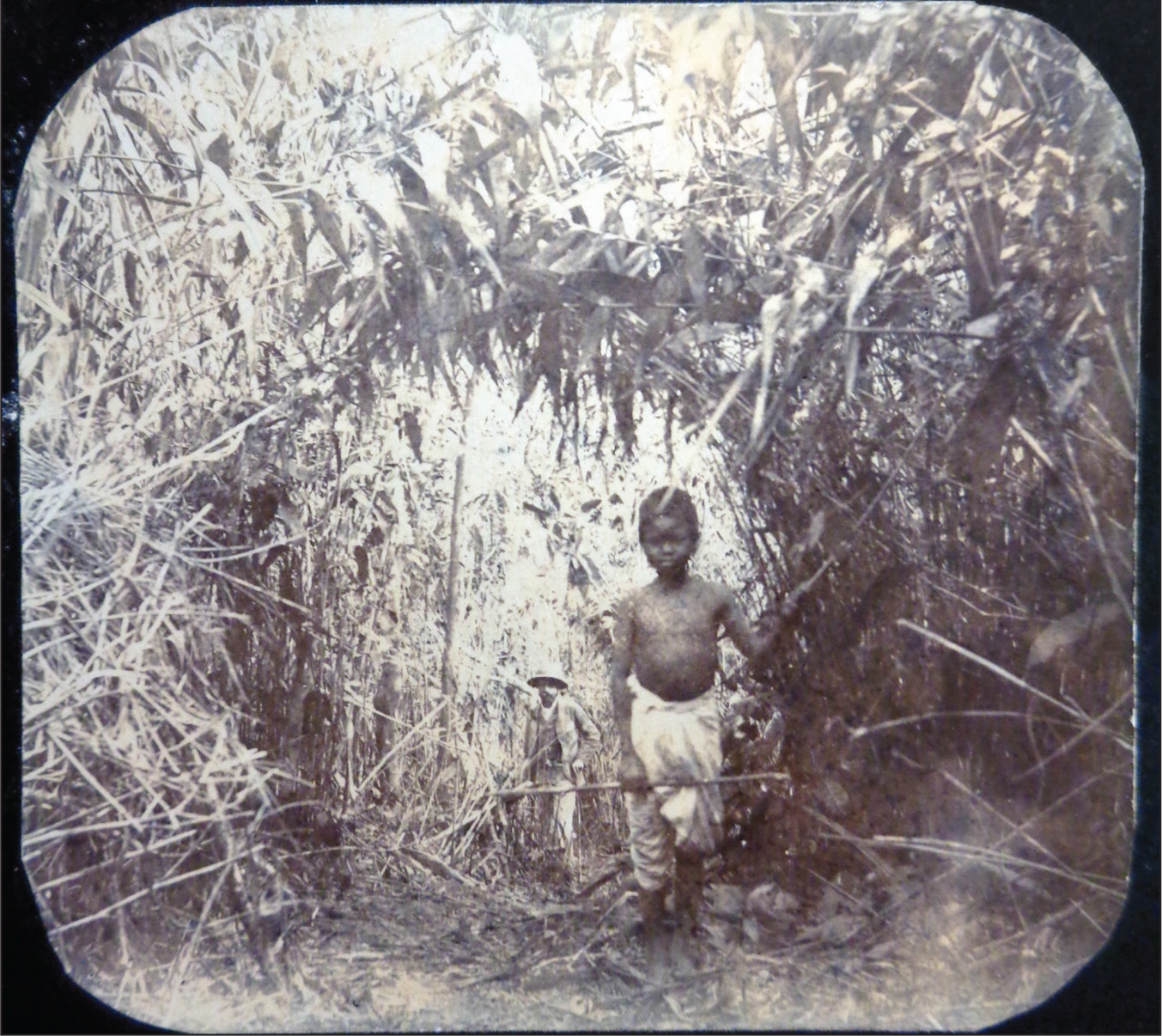
In that moment, a Lushai boy and two other servants travelling in boats on a river unknowingly joined the likes of far-flung, contemporary Indigenous and Black whalemen in distant corners of the globe: mobile individuals who fashioned for themselves, on the high seas and other watery spaces, temporary, hierarchy-flipping moments of respect and authority. 61 These were moments of relative respect unlocked by buoyant mobility: the unique hierarchies born of travel by ship and the distance they had put between themselves and the usual state of things. Months later, on the return journey by the same river from Silchar, two hired boats were put fully in Khuma’s charge. As the White missionaries travelled by a circuitous overland route, Captain Khuma steered his flotilla up to Kalacherra. 62
The records of Khuma’s journey—in which he accompanied the missionaries for much of a 4,000-mile return journey linking Fort Aijal, Ledo and Goalundo—are few, and recorded in Lorrain’s voice. The available records show, first, that travel provided an opportunity for Khuma (who long declined to align himself with Christianity) to witness elasticity in the European missionaries’ typical way of doing things. River highways had a way of watering down long-established hierarchies; they could also dilute some fundamentals of religious time. At the mission station, Lorrain and Savidge’s strict definition of ‘Christian’ included a Lushai convert’s avoidance of rice beer, attendance of church and acceptance not only of Christ but also of something called ‘Sunday’, a hard pause in the workweek that the missionaries guarded for converts even in the face of the government’s forced-roadwork regime. 63 For some, this ‘Sunday’ was an incentive to ‘conversion’: exhausted locals sometimes noticed and seized upon the opportunity to get out of backbreaking labour. But with Khuma outbound at Kalacherra, the currents of the Dhaleswari river were strong enough to even erode the Sabbath Day. Lorrain’s early journal entries about the voyage are full of hand-wringing about Khuma and the company’s liquid mobility on Sundays, at pains to justify how Khuma and the Bengali boatmen were not technically ‘working’ under his care if they were merely floating downriver. 64 Christian time, so rigid for Khuma and everyone else on the mission compound, was slipperier on the river.
In the most revealing experience, Lorrain and Khuma had time to explore a warehouse at Silchar. ‘We inspect the store [and] are shown the new ice machine which has lately been set up at no small expense’. 65 Here, a Mizo boy encountered the latest technology of what scholars have termed ‘thermal colonialism’. 66 For most of the nineteenth century, tens of thousands of tonnes of frozen water were sawn by hand annually out of Massachusetts ponds, packed in an organic bubble-wrap—sawdust—and shipped onwards to urban customers from New Orleans to India. 67 One arm of this frozen network reached down into the tropics, to colonial capitals like Kingston and Calcutta, where great blocks of ice were shattered into smaller shards saleable in elite markets. There, the artificial temperatures enabled new pleasures, such as chilled cocktails sold to customers concerned about the effects of tropical climates on their privileged bodies. 68 A Lushai boy-traveller’s chance encounter in 1896 with an ice machine in Assam thus reflects not only the recent decline of global ice barons like Frederic Tudor but also another shift in the character of thermal colonialism in the region. In a history of ice machines, Willis Woolrich shows how British interest in frozen water mirrored British interest in cartography, railways and firearms: all were tools, however imperfect, of colonial expansion. 69 Frozen water molecules could enlarge the geographic radius of imperial trade by compressing the atoms of saleable products, accelerating trade on larger scales by decelerating atoms on infinitesimal scales. A Lushai boy was there at the dawning moment of the local, machine-assisted, imperial ‘cold chain’. 70
Back at the Silchar storehouse, Lorrain was ready to spring a trap.
Knowing that our boy has never seen such a thing before we get a piece of ice from the storing vats & hand it to him, and it is highly amusing to see how quickly he drops it & looks to see if his finger is burnt. 71
The missionary continues: ‘He can scarcely believe that it is not hot & it is sometime before he can make out whether it is hot or cold’. 72 Lorrain knew what he was doing. He recorded Khuma’s reaction—in Lorrain’s view wrong, even ignorant—as a shorthand for tribal lack, in this case of cosmopolitanism. Physically far from his homeland, Khuma is metaphorically even further away. Outside of the British officer in Darjeeling turning over a cube of cocktail ice on his tongue, outside of the shipping networks of British India, where ice slowed the decay of perishable goods, Lorrain showed that thermal colonialism had a third and discursive dimension. A piece of ice could be used to articulate tribal difference. 73 Yes, Khuma was there, a Mizo boy experiencing the very latest shift in technologies of artificial cooling. 74 Yes, he was even a fossil-fuelled traveller. But where each of these elements for Lorrain might have jarred with Khuma’s true identity, ice put Khuma back in his place. The misrecognition of a modern product was confirmation of a tribal identity set not in place but in time. People like Khuma were the living ancestors of people like Lorrain.
Lorrain, and others like him, had to learn to think in these terms. 75 In Silchar, it was Khuma’s physical presence as a traveller that made it possible for Lorrain to draw connections between ice, race and the senses in the first place. Back in the Lushai Hills, contemporary colonial stereotypes construed Mizo skin as too soft, and Mizo senses as too blunted and easily mistaken. 76 Officials hailed the government’s brutal forced-roadwork regime as beneficial to lazy Mizo bodies, a method for thickening tribal skin. These were hierarchies of sensing that were fundamentally built upon notions of civility. Whose nose was qualified to declare which smell was pleasant? Whose skin was worthy of feeling which quality of clothing? 77 Building on the insights of historian Mark M. Smith, the correct sensing of ice, too, could suggest something embodied and racialised about the skin of the person doing the feeling and of the person judging the accuracy of that feeling—and therefore about both individuals’ comparative ‘worth and social standing’. 78 Khuma’s being there offered Lorrain the chance to think imperially about ice, extending the geographic range and character of a contemporary colonial trope.
What was happening when a mobile Lushai boy encountered the ice of empire speaks not ‘just’ to a moment of ‘straightforward racism’, 79 however. Khuma’s experience of ice finds distant echoes in nineteenth-century ice-sensing all over the world. In Cape Town, articles advised South Africans unacquainted with ice cream that it might burn ‘as bad as a fireball, or a hot potatoe [sic], or as a raspberry tart just fresh from the oven’. 80 Arctic travellers described the sensation of tasting frozen-slushy alcohol: like ‘“coals of fire,” their “tongues, lips, and palate so burned and excoriated”’. 81 Indigenous labourers on Hawaiian sugar plantations experienced ice cream as piping hot, and raised questions about expected states of matter: ‘“Wela loa,” they said, “ho-o iloko o ka wai”—too hot—place it in water…[They] would not understand how anything became so hot that it would solidify’. 82 Indeed, the Kanaka Maoli author of an 1877 Hawaiian newspaper article entitled ‘Ka Hau’ (‘Ice’) recognises the sensory subjectivity at play, yet ends by asserting that ice and snow did feel hot and not cold. 83 In an imagined scene, a Hawaiian narrator is handed ‘a piece of ice for examination’ by two White children: ‘the heat of it burned him’. 84 Should one of his Native Hawaiian readers ever find themselves in a similar situation, the author has a warning: it is best to self-censor one’s reaction to the heat of the ice. ‘If perhaps it is heard [by the White children] your naming this as heat, they will laugh at you’. 85 But the Indigenous narrator concludes by seizing for himself the final word: ‘“Owau kai ike” (I’m the one that knows)’. 86 Scientifically, temperature is measurable. But hot and cold are more personal affairs. Physiologically, what Khuma was feeling that day was the transfer of energy from his finger to the ice, not the coldness of frozen water. Despite Lorrain’s assumption of superior thermal knowledge, cold was subjective, definable in multiple ways.
Khuma’s presence as a tribal traveller might have offered Lorrain the chance to act like a colonial actor: the missionary joined global nineteenth-century representatives of the British Empire in scoffing at the supposed naivety of Indigenous and other colonised and ‘frontier’ populations about their reactions to ice. 87 However, as with the highly embodied and contemporary Mizo sense of spirit possession, harhna, Western conventions of interpreting sensory stimuli were not the only way of sensing the world—or even of authentically encountering ice. 88 Mizo travel involved not only the movement of tribal bodies but also the mobility of upland ways of sensing. Tribal travel could have unexpected results. Ice could be hot.
Challiana Travels to London, 1907
Challiana was sizing up a massive dead animal. The specimen—perhaps the skeleton of a whale—had already had its measurements carefully taken and recorded by staff at London’s Natural History Museum, where the young Mizo traveller now stood in 1907. Challiana had seen a whale in the flesh once before, or at least one spouting near the Suez Canal, while en route to London. 89 Standing now in that centre of the imperial world, amid the planet’s foremost collection of natural history specimens, in an age of empire powered by the standardised quantifications of urban science, Challiana started taking his own measurements. ‘It has quite a long body but relatively narrow body, lengthwise’, 90 he would later report in the Mizo language to upland readers in the Lushai Hills: fourteen hlam plus one ngun tang in length. Embodied figures, these were numbers that required, and flowed through, Challiana’s Mizo fingers, skin and bones, the hlam representing the distance between the tips of his outstretched hands, and the ngun tang adding the distance from the tip of his middle finger to the middle of his forearm. Here in the scientific heart of the empire, a prized specimen of natural science was being measured—literally articulated—through the body of a tribal man from Northeast India.
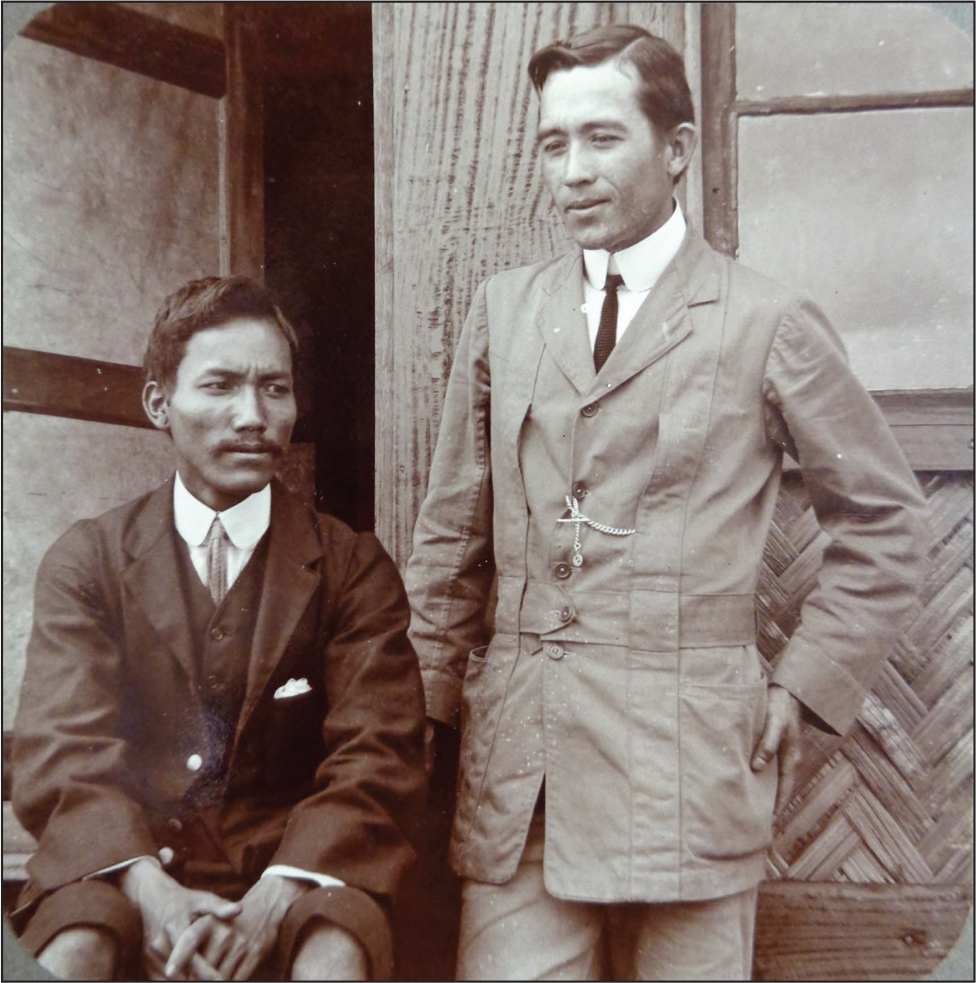
In 1907, Challiana and co-traveller Chuautera were the first Mizo people to visit London, accompanying Baptist missionary F. W. Savidge, who thanked God for bankrolling the voyage. 91 An original photograph (see Figure 4) from the family collection of Pi Thanzingi in Serkawn, Mizoram, depicts Challiana and Savidge in London, England, the country of Challiana’s estranged father. His mother, a Mizo woman named Thangtei, was among the upland women in the Lushai Hills sexually assaulted in the 1890s by British officer C. S. Murray, a frontier predator who left in his wake a trail of burned villages (from his role as an invader) and individual and community trauma (from his abuse of local women). When Murray’s sexual violence was finally resisted with Mizo military violence, his superiors quietly demoted him from ‘service’ in the Lushai Hills—and then had the resisting village burned. Murray’s punishment was to take up the more easily supervised post of assistant commissioner in the Chittagong Hill Tracts. 92
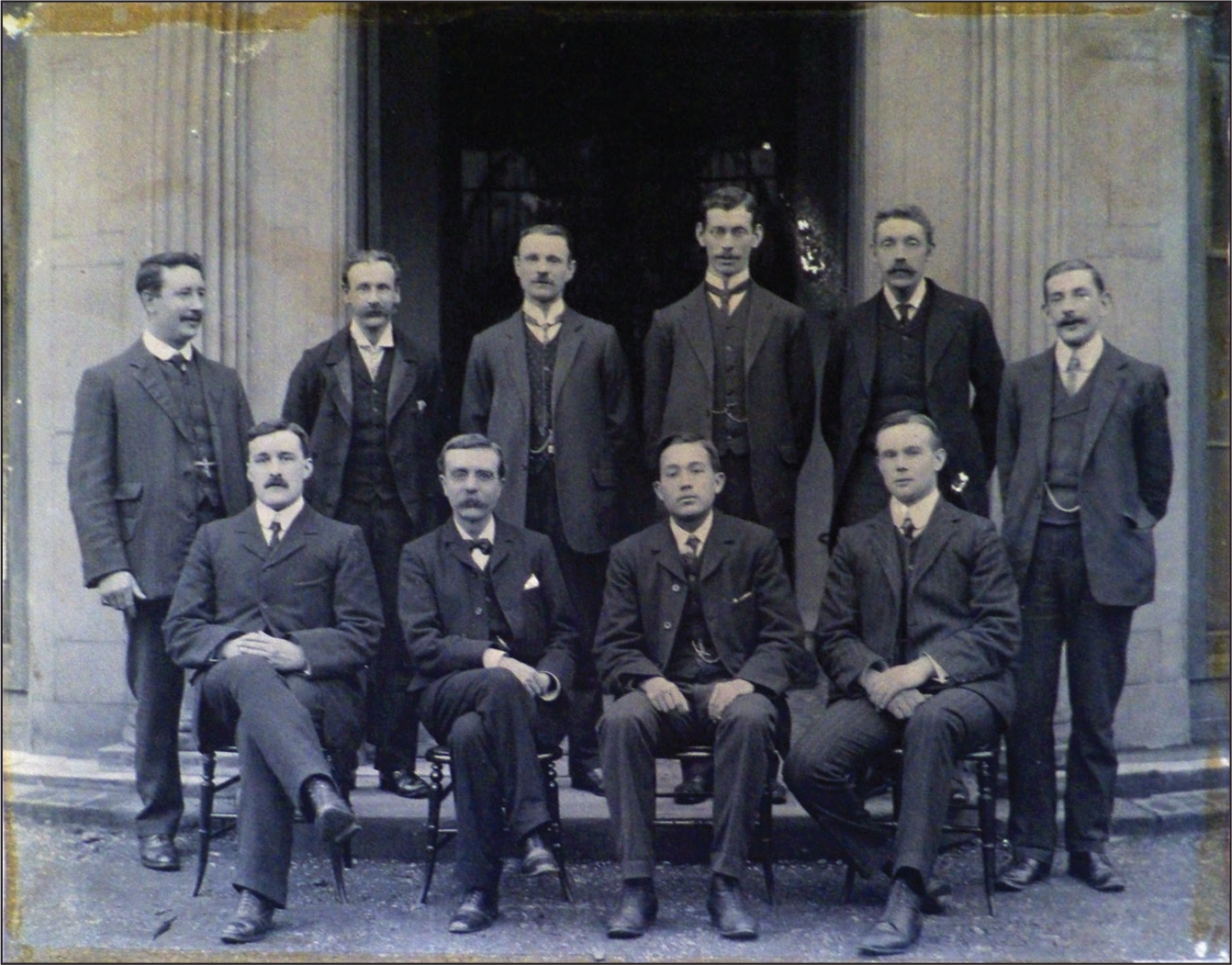
Years later, rumours reached the ears of Lushai Hills missionaries F. W. Savidge and J. H. Lorrain about an 11-year-old boy whose lighter skin tones resembled theirs. Thangtei had hidden her son as long as she could. The care of the boy called Challiana—the Great Bison—was assumed by the missionaries, his mission-school education funded in part by his father in distant Britain. Challiana was to be groomed into a translator, church pastor, medical assistant and schoolmaster—trained, and even explicitly labelled, to pass as White. Surviving mission registers recording the contemporary ‘clan’ names of individual Mizo converts erase Challiana’s Eurasian in-betweenness, listing the boy exclusively as ‘Sâp’ (sahib, White) and disregarding his mother once again. 93
Challiana and Chuautera’s mission-station education took a European turn in 1907, when they travelled to London via Calcutta and Bombay, Milan and Venice. In London, they attended church services and mission fundraisers and took in the sights. Although Challiana’s mobility was greased by his colonial education and a version of his personal history that downplayed his Mizo-ness, he turned to the Mizo language and upland concepts for measure-sticks when observing, recording and reporting his experiences among the natives of England. Less famous today than J. H. Hutton and other European anthropological writers, who travelled between roughly the same regions as Challiana, at roughly the same time but in opposite directions, Challiana observed English-speaking informants, publishing his findings in 24 Mizo-language articles. These appeared between 1908 and 1910 in the first Mizo monthly magazine, Mizo leh Vai, copies of which can still be found in private collections in Mizoram (see Figure 5).
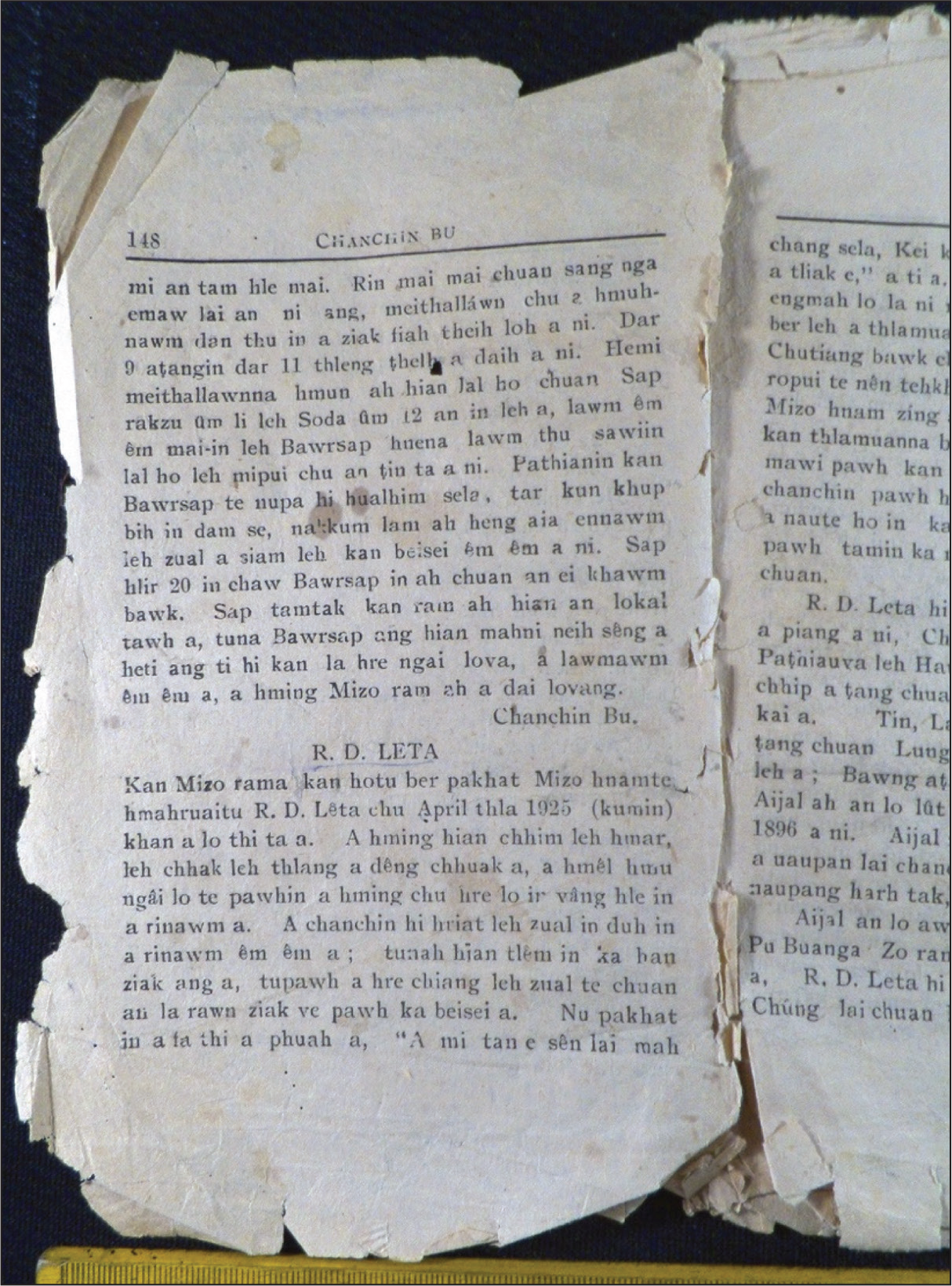
In the articles, Challiana touches on the categories of imperial ethnographic writing: the natives’ religious traditions, services and institutions; dress; musical instruments; gender roles; transportation; socio-economic hierarchies; entertainment; architecture; politics (including an explanation of democratic law-making); technology; and the weather. Reporting on two days en route in Bombay, Challiana shares priorities with other contemporary anthropologists, seeking out and making observations on the local Parsi community, commenting on their ‘fire-worship’, dress, skin colour, wealth, women and death practices—observations destined not for the Journal of the Anthropological Society of Bombay but for Mizo leh Vai. 94 As Isaiah Lorado Wilner notes in another context, if anthropological ‘participant observation stands as method and maxim for the impact of human science on modernity’, and if tribal and Indigenous individuals like Challiana played parts in creating that ‘modality, then the so-called subjects of scientific study are in fact agents in the creation of modern knowledge’. 95 The scope and volume of Challiana’s writings are sufficient to reposition him from the rural anthropologised-by-empire to the urban anthropologist-of-empire.
What were Challiana’s ethnographic findings in Great Britain? His reports are packed first with careful sensory observations. He comments on the acoustic reverberation of stone walls in London’s churches, amplifying the voices of piano and congregation, 96 as well as the external soundscape of ‘singing’ church bells—a sonic method of gathering attendees and marking time also in use in his homeland, if on a smaller scale. 97 An underground restaurant with ‘lanterns in every corner’ illuminates for Challiana how gendered and comparatively rushed English hospitality seemed: all the servers were ‘sap [sahib] ladies; they quickly serve our demands, and they have no time to stand still’. 98 In a later article, he comments on the 300 male attendees at a YMCA church service and mess hall (guests nonetheless served by ‘sap women’). 99 In such spaces, concepts foreign to Challiana—the monetisation of food, the closed-fistedness of hospitality—draw his criticism. ‘In order to enter those places [restaurants], we have to pay money’. 100 ‘Nothing can be done here without money…Forget being able, as in Zo Ram, to go and eat in anyone’s house when you are hungry or thirsty. Over here they do not even talk to each other if they do not know each other!’ 101 Although the ‘streets are always full of people’ 102 and horses, Challiana sometimes worries about being ‘stampeded in the crowd’. 103 He hears the soundscape of public conversation in the city as paradoxically isolated and private: ‘Nobody asks other people: “Where are you going?” or “What are you going to do?”’ 104 He sniffs at the great imperial city’s anomie, the individualism of everyday life and the commercialisation of basic friendliness.
Relative poverty—and not that of the Mizo traveller—is the second focus. Challiana points to the lack of communal social safety nets in a society void of the Mizo ethic of tlawmngaihna, a striving for individual selflessness and communally minded generosity. In the Lushai Hills, the wealthiest person was not the one who had the most, but who could give the most away, particularly through feasts of merit, an upland system for radically redistributing wealth, calories and nutrition.
105
As the old Mizo saying puts it, sem sem dam dam, ei bil thi thi: ‘share, share, live, live; hoard, hoard, die, die’.
106
His later descriptions of Buckingham Palace perceive, but immediately flatten, the most extreme of British hierarchies: ‘I have no idea what was it like in the inside as we did not enter, but I realized the house must almost be the same as other houses, despite the fact it was the home of a monarch’.
107
Meanwhile, Challiana reserves some of his greatest praise for the Crystal Palace, the epic cast-iron and plate-glass edifice at Hyde Park, which he hails as seemingly ‘built by the community, not individuals’.
108
And to Mizo readers accustomed to the relative power and material affluence of British men stationed in the Lushai Hills, he offers a blanket revelation earned through travel in the wider world:
It is not true all saps are rich; there are many beggars, blind and homeless people, without proper clothing, among the sap. I presume the impoverished sap are more unfortunate compared to the impoverished people in Zo Ram, as it is too hard for sap to make ends meet.
109
Had English Christians been able to read Challiana’s Mizo-language reportage, they might have appreciated moments of approval: ‘Witnessing their beautiful dress and the way they joyfully praise God in the church, I wish the Mizo people could have that kind of church service. I hope we will be like them someday’. 110 At the same time, more subtle forms of norm-enforcement were not lost on the Great Bison, whose Mizo language was nimble in spotlighting and articulating individual shame perceived against a communal standard: ‘I believe no one would prefer to remain in the street other than being in the church; it looks…shameful to be outside church during the service’. 111
For all F. W. Savidge’s intentions as to who would be observing and teaching whom on Challiana’s trip, Challiana stepped into the spotlight. At a ‘big church’ 112 in London, 8,000 ears pricked to hear his vocal cords cast solo Mizo melodies over a massive congregation. Taking in a show at the Queen’s Hall, he rubbed shoulders with British royalty: the king’s daughter was in attendance. 113 Challiana’s tribal body joined hers, fundamentally part of the same sort of cosmopolitan audience that packed into urban spaces, bestowing them with cultural importance. Challiana commanded headlines. At churches and public halls in Scotland, he sang Mizo hymns and expressed his perspectives on missionisation. Ensuing newspapers reports christened him a ‘youth of marked abilities’ (a sentiment echoed today by privately held materials in Mizoram, crediting Challiana with skills ranging from the harmonium to tooth extraction). 114 This kind of press was possible not just because of Challiana’s presence but also his exceptional skill, which cut hard against then-popular imperial tropes of tribal barbarity. In Buckie, Scotland, Challiana headlined a mission fundraiser, advertised as the reason to attend: ‘The meeting should be all the more interesting as the speakers are accompanied by a native youth, Challiana, who is assisting in the translation of the Scriptures’. 115 Such articles erased Challiana’s biracial heritage in a way he was less used to, this time to exclusively emphasise his nativeness. 116 So successful a native conversion story could bring out the big shots—and the big donations. In Scotland’s Grantown, MP George White listened to Challiana’s songs alongside the organising secretary of the Baptist Missionary Society. 117 In moments like these, Challiana was not simply a passive student of empire or a peripheral receiver of the British and Scottish missionary movement. This tribal man was an animating force of the movement, his skill a dynamo magnet spinning at the centre of it, pulling in powerful people and cash.
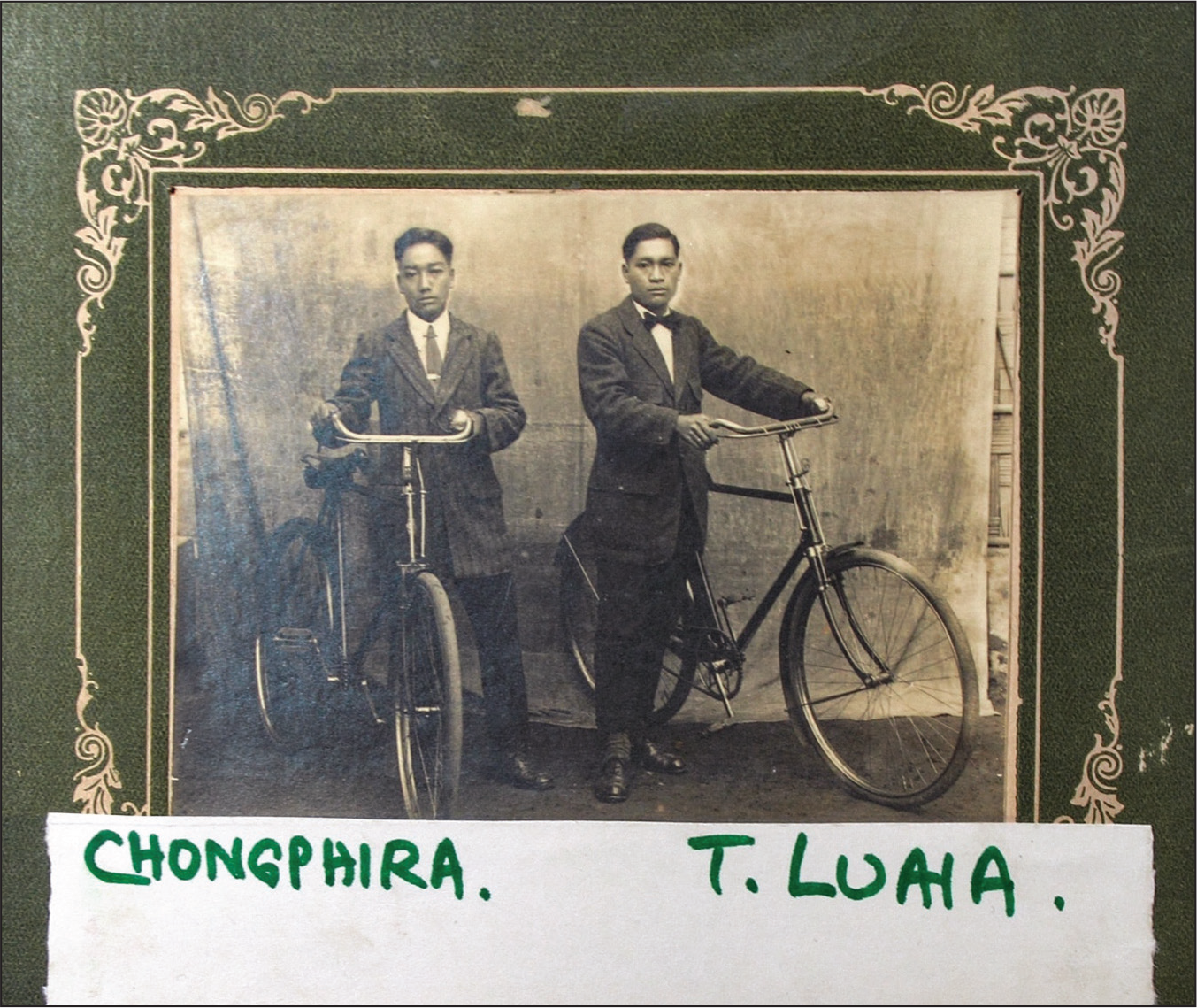
Back home, Challiana’s Mizo-language newspaper reports boosted not only his status as a church leader but also the means through which upland readers—armchair travellers, whether readers or the read-to—could encounter contemporary ideas about civilisational hierarchies and racial difference. Challiana took his reporting role seriously and used his global experiences to generate new ideas of collective belonging and to communicate and refine racial ideas then emerging back home. Contrary to what Mizo people experienced in the Lushai Hills, Challiana reported from his global experiences in Italy that not everyone in the racial category of ‘sap’ spoke English. 118 Travelling authors like Dala, Challiana and Chuautera (who appears with Challiana in Figure 6) ensured that Mizo-speaking people did not have to physically travel anywhere to be part of the modern ‘Age of Comparison’. 119 Mizo authors of the day did not merely acquiesce to, but in fact urged such comparison: ‘Let us…turn our attention to the practices of other lands, such as their hardworking nature, their intelligence, and their riches’. 120 Under Challiana’s comparative eye, cosmopolitan sights in the wider world were recast in Mizo publications in terms of Mizo precedents. Gazing at the seaside Italian city of Trieste, Challiana saw rural Zo Ram, his imagination entangling urban and rural through two distant peoples’ architectural solutions for building homes on mountainsides. The Suez Canal resembled in width the big rivers of the Lushai Hills. 121 Though few in number, tribal travellers had an outsized significance in bringing the modern, comparative age home.
In the end, Challiana’s series of articles is urban not just in its content but also in form. This was the definitive era of the imperial travelogue. But, as with the Lushai and Andamanese critiques of industrialism, tribal and Indigenous contributions have so far formed a type of ‘literary dark matter’ 122 in the study of this empire-enabled genre. Like the Kanaka Maoli traveller William Hoapili Ka‘auwai, who penned a travelogue serialised in the Hawaiian vernacular about a London visit in the 1860s, Challiana was no subordinate copyist but a full-fledged contributor to a global, metropolitan genre. 123 The evidence for Mizo contributions to urban modernity can be found not in official state archives, but in the pages of Mizo leh Vai, a 1908 copy of which—used here to reconstruct Challiana’s travels—survived because of the custodianship of Pu Lalthantluanga, grandson of Luangpawl (Mamit) chief Lalchhinga Sailo. 124 Today, the writings and photographs of highly mobile Mizos like Challiana and Chuautera (see Figure 7) can be found in family collections across the state. 125
Part II: Mizo Mobility in the Big Picture
Mobile Students
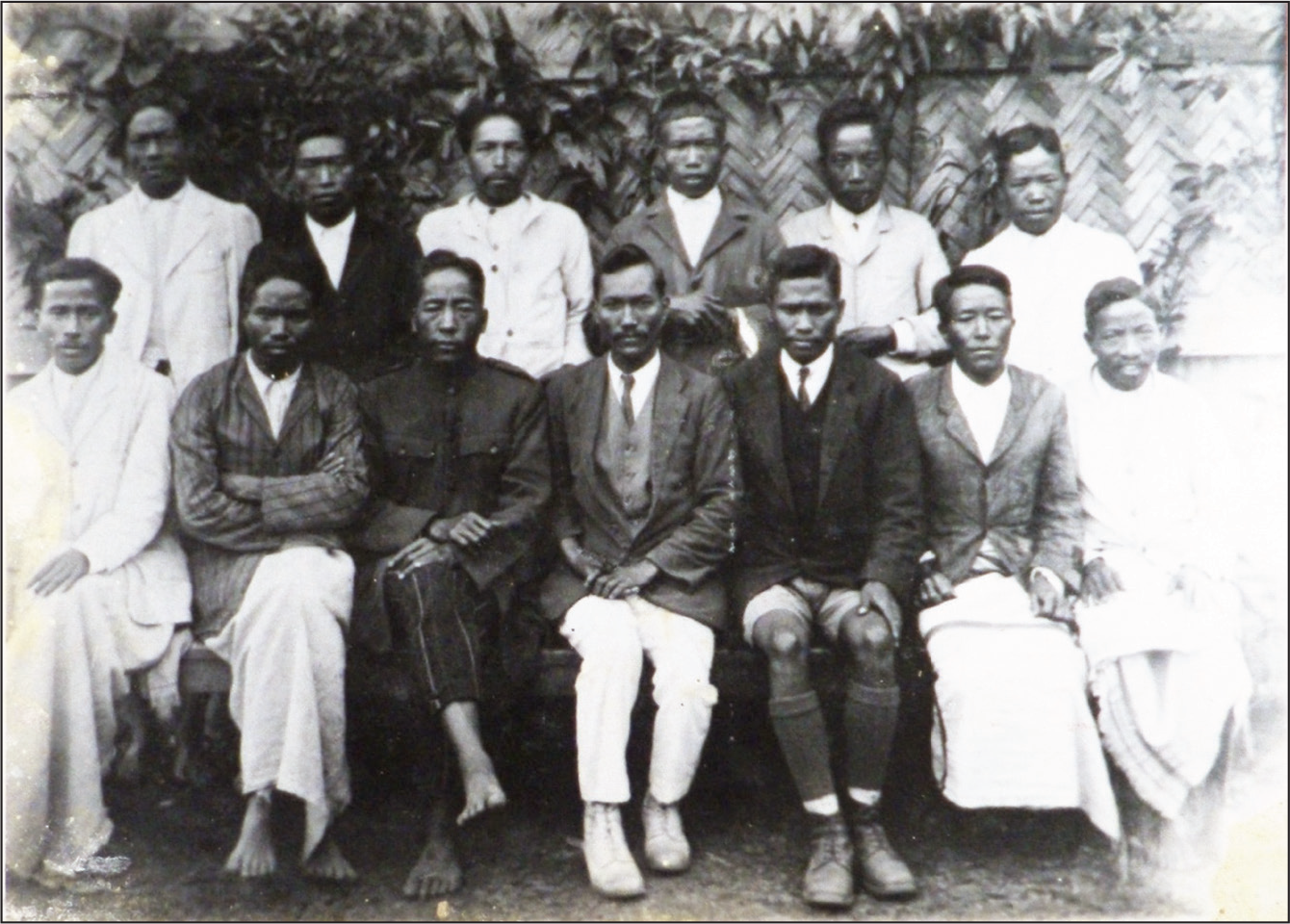
This section broadens its scope to appreciate some of the wider practices of Mizo travel by quantifying tens of Mizo travellers through privately held historical materials, all of whom could be investigated in more detail. Mizo students like Challiana were the first major category of tribal travellers who rapidly fanned out across the subcontinent and beyond. In 1906, government scholarships supported R. D. Leta, Thanga, Lalhuta, Laltawnga, Dohleia and Thangnghillova to study at the Shillong Government High School. 126 Four others arrived in 1910 to study English. 127 Through the 1910s, more Mizo students arrived at the Berry White Medical School in Assam, while a woman called Saii pioneered Mizo women’s teacher-training at the Girls’ School in Shillong. 128 The educational decade was heralded by the sounds of drums and bagpipes across the natural amphitheatre of hilly Aijal in sonic commemoration of the high-school graduation in Shillong of R. D. Leta, the first Mizo to do so. The moment echoed a 50-round salute fired from Calcutta’s Fort William generations earlier, in honour of the first human dissection performed by caste Indians—surgeons whom, like Leta, colonial officials celebrated with ostentatious soundwaves for having overcome the ‘prejudices’ of their upbringing. 129
Like today, the factors motivating tribal students were long-term economic possibilities and the inaccessibility of quality opportunities at home. Students were often away from home in long stretches, with those funded by the government permitted to return home only once every two years. 130 Thanga passed matriculation at Calcutta University in 1911. 131 A prolific translator, he drew upon a global repertoire of Christian hymns to import into the idiom and churches of the Lushai Hills. 132 Three years later, 17-year-old T. Luaia’s academic achievement in Shillong saw him admitted to the Scottish Church College in Calcutta (Luaia’s cosmopolitan photograph appears in Figure 8, courtesy of Pi Thanbuangi’s family collection in Chawnpui). A wider range of Mizo agricultural students travelled to learn agricultural techniques in distant centres like Tezpur, Dacca and Pusa at government expense. 133 Such opportunities, government officials promised, could translate into lucrative employment for graduates back in the Lushai Hills as ‘Clerks, Hospital Assistants, and Public Works Department Sub-Overseers’. 134
Students sometimes felt that their travels imparted the authority to moralise about, and assist in the definition of, the Mizo ‘nation’ (hnam). In 1925, Mizo student R. Buchhawna wrote to the editor of Mizo leh Vai from his rhetorical perch at Cotton College, Guwahati, criticising traditional demands on Mizo women: they were expected to work not only alongside the men in the fields, but also to manage all household affairs. He advocated the formal education of Mizo women and urged open-mindedness about traditional Mizo gender roles, pointing to the famous chief and entrepreneur Khamliana, who was not above weaving textiles ‘like a woman’ (and whose photograph appears in Figure 9, from Pi Lalengliani’s family archive). 135 Khamliana’s financial success—his literal wheelbarrows full of money—testified to the success of these innovations. 136 ‘[W]ho could attack [Khamliana] as not man enough?’ 137 When the Mizo man Chala was taken to see Delhi, his long, masculine hair saw him shamefully (in his view) mistaken for a woman, a case paralleled in part by the experiences of modern Mizo youth in the same city, whose faces are today mistaken and othered as East Asian. 138
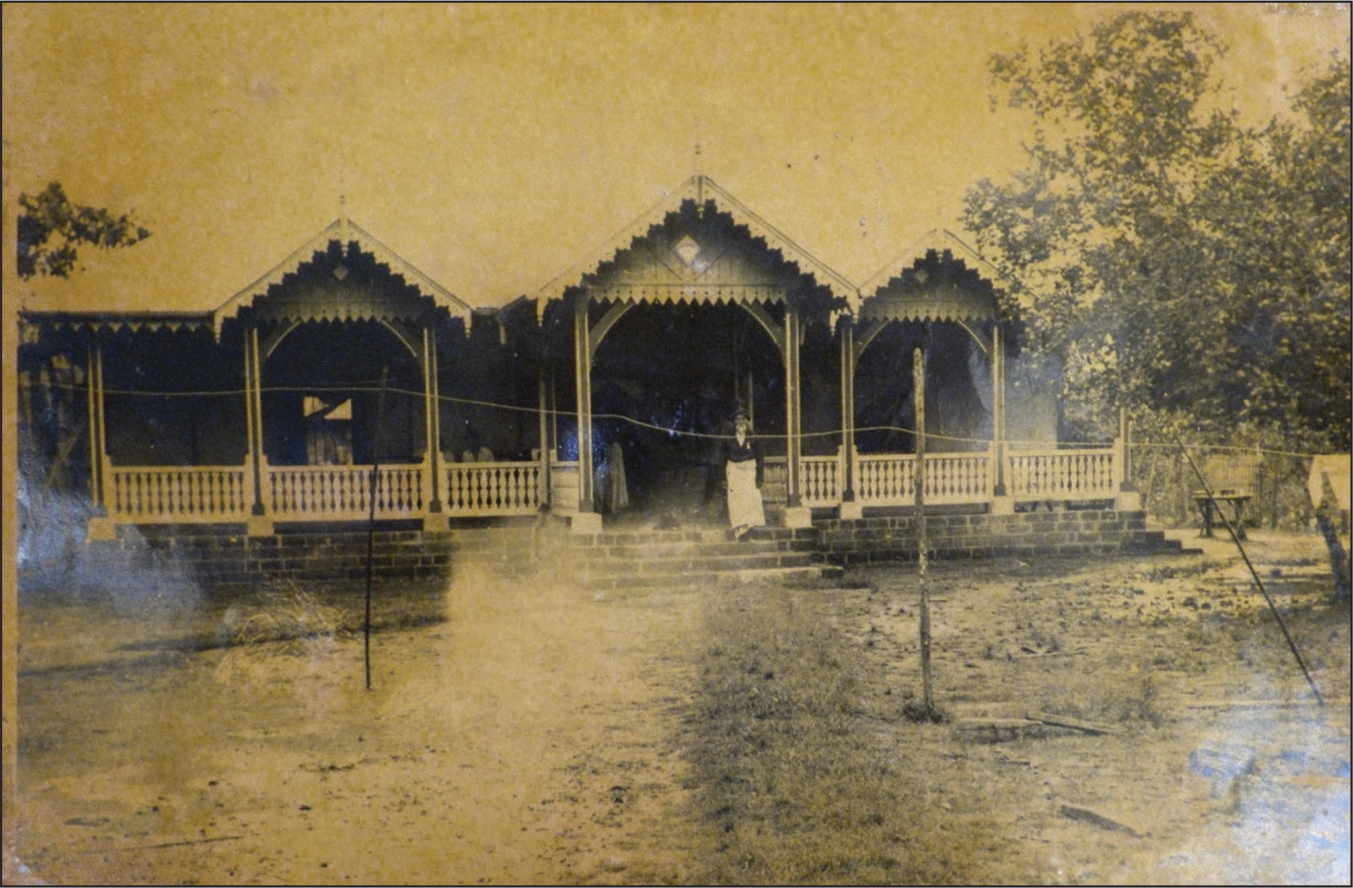
Others used their experiences while studying ‘abroad’ to more sharply define their nation at home. At Madras’s Overseas Training School in 1910, Lianbuka penned a letter proclaiming pride in his people: ‘The Mizos may be backward and small in number, but I remember that we are always frontrunners among people of colour of the same numbers; therefore, let us not relinquish our Mizo tlawmngaihna’, 139 referring to the same ethic of self-sacrifice and communal care that Challiana had so missed in London. For Buchhawna and Lianbuka, travel was a prism through which they learned to see and define not only others but also their own ‘people’. It is not a coincidence that the first consciously Mizo ‘national song’ (hnam hla) was composed by a Mizo student studying in Shillong or that the ‘Lushai Students’ Association’ first sparked to life not in the Lushai Hills, but in Calcutta, Guwahati and Shillong. 140 In such ways, Mizos learned to be a nation in part from outside their ancestral geographies, self-defining from afar what it meant to be inside that nation at home. 141
Travellers carried the wider world back home. Returning to Aijal from London’s Goldsmiths College in the 1920s, Pasena—a gifted Mizo polyglot and ‘mixer with all sorts of people’—drew upon his European education to launch a distinctively Mizo kind of theatre, a hard turn from the ‘Puja variety show[s]’ of the local Bengali officers or the live performances occasionally offered by off-duty paramilitary forces. 142 A first play combined ‘secular drama’ with Christian themes important to Pasena: Heroda Chawimawina (King Herod’s Glory), which Mizo literary scholar Laltluangliana Khiangte credits with kickstarting a soon-flourishing branch in the Mizo arts. 143 Meanwhile, in 1926, Mizo student and musician Vankhama carried a ukulele back into the hills from Calcutta, globalising Mizo music with an Hawaiian-Portuguese instrument and introducing a form of the guitar decades before American soldiers exponentially popularised the instrument during the Second World War. 144
For school graduates, the certificates of distant institutions were cared for and prized as the credentials of colonial modernity, of what Mizos called changkanna (self-improvement). 145 They were material pieces of urban places, fragments of distant worlds that embodied connection with those worlds. In modern-day Mizoram, the record of these mobile students remains carefully preserved in the hands of family custodians (see Figure 10). In Chaltlang, Pi Lalengliani preserves the inky red seal of the University of Calcutta, pressed and soaked into paper in 1910. In Mission Veng, Upa Hualkunga’s family safeguards an ‘All India Sunday School Examination’ medallion from 1908. In Chawnpui, Pi Thanbuangi is custodian of school certificates from Shillong—documents that also underscore the intimate, familial nature of their preservation, with a child’s doodles and spelling practice visible on the reverse. Each is representative of material items that situated the Lushai Hills within physical and urban geographies of higher learning, while also providing hard evidence of Mizo mobility, geographic and social. As ‘touchstone[s] for demonstrating competence’, 146 they tell a story not only about Mizo academic accomplishment in a colonial world but also about the physical transference of somethings that materially linked imperial and urban space with tribal and rural space.
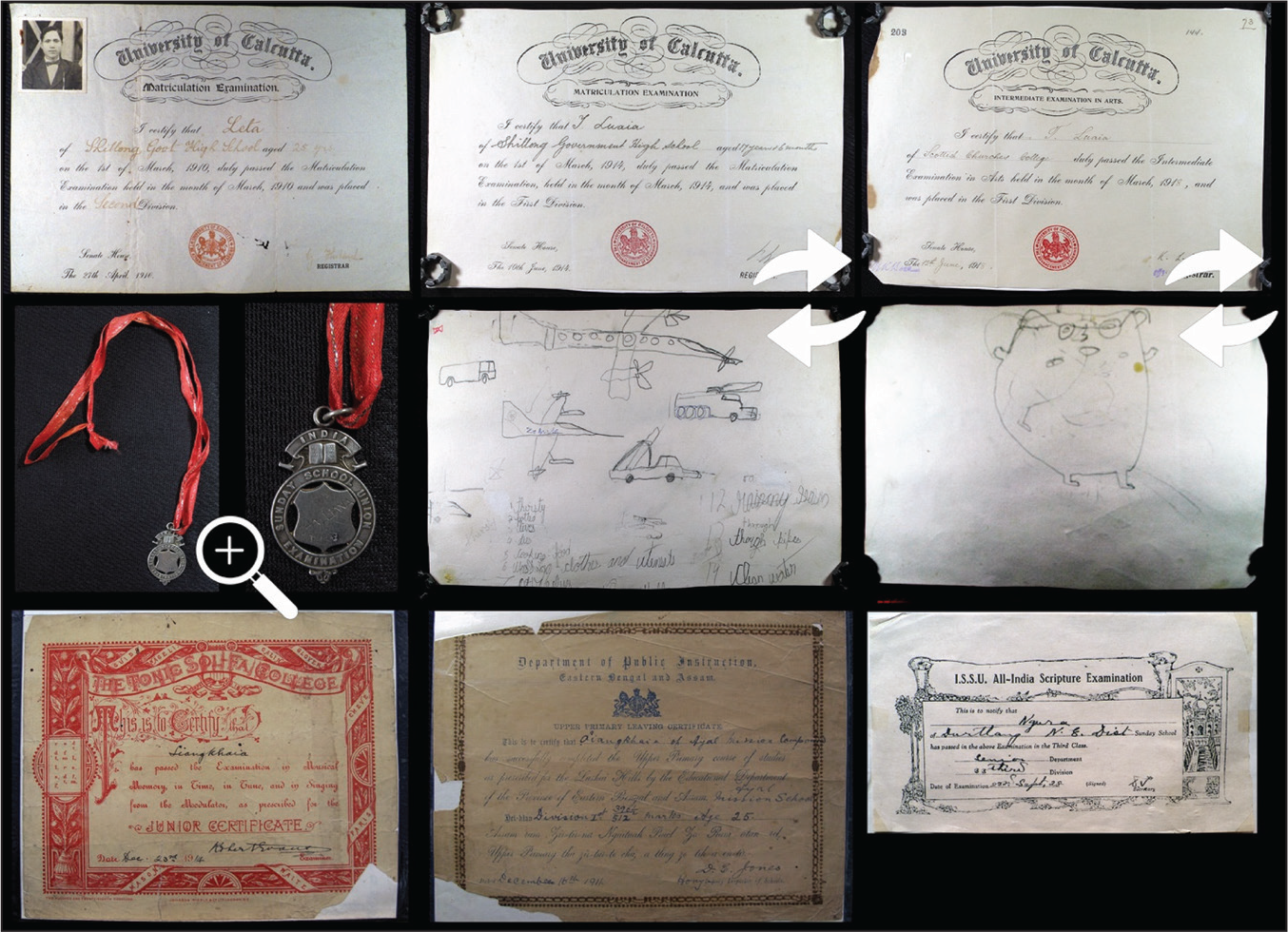
The meticulous family archiving of such materials shows the rapidity with which mobile Mizos came to understand how important, and even necessary, it was to leverage the colonial paper trail. In a time when alphabetic literacy was not much more than a decade old, Mizo travellers learned to create and tend to their own personal archives, many of which have been handed down intact within families. The chief Khamliana carefully preserved usable correspondence with powerful government officials, futureproofing his aspirations in a region that saw rapid rotation of government officials in and out of the hills. 147 Pieces of paper—not the officials—offered Khamliana a usable ‘institutional memory’. The graduate Leta likewise saved a reference letter in which a Shillong headmaster praised his conduct as ‘steady’ and ‘diligent’. 148 Leta’s son, Lalsikula—like Khamliana’s son, Vanhnuaithanga—kept close watch over personal finances in bank passbooks. 149 Each is an example of the kinds of personal papers that mobile students preserved, and that were subsequently safeguarded within family archives.
Family records could prove powerful tools for leveraging tribal power. When Vanlira Sailo wrote a letter to the British superintendent in 1919—a mode of communication that did not yet exist when his late grandfather, Vanhnuaia, chief of Pukzing, visited Calcutta with Lewin in 1872 (see Figure 2)—he highlighted two official documents received by his grandfather in the imperial capital: a photograph and a note assuring Vanhnuaia’s descendants of hereditary chieftainship and land ownership in the Lushai Hills. 150 The lore of these records, but not the documentation itself, had trickled down intact across generations. Vanlira’s rhetorical move, backed by an appeal to search ‘the Viceroy[’]s record’ 151 for duplicates of the original papers, fundamentally mixes urban Mizo histories with rural Mizo histories, and tribal geographical mobility with tribal social mobility. Like his grandfather, Vanlira had an agenda: since his family history was stitched into the lofty political fabric of that distant urban centre of the 1870s, could he therefore be made a chief in the local, rural Lushai Hills in 1919? Leaning on his grandfather’s movement, Vanlira’s request unveils an oral record of tribal ‘wayfinding’ 152 archived and useful across generations.
Mobile Missionaries
Christianity was a second engine that propelled colonial-era Mizo travellers into the wider world by road and sea. Converts Vanzika, Savawma and Taitea departed the Lushai Hills in 1910 to preach the gospel in Manipur, where Mizo Christian R. Dala would also arrive on Christ’s business three years later. Hrangvunga’s preaching carried him to what is today Tripura, while other converts journeyed to Haflong in Assam, and Bihar. 153 Lushai Christianity moved with travellers in 1918 deep into Burma’s Myittha Valley, 154 to Wales again with Pasena 155 in 1925 and to the Mru village of Trupu (Yimpung) in the Chittagong Hill Tracts, where British official J. P. Mills encountered a Mizo Christian woman living and teaching. 156 One Mizo evangelist named her baby girl Zokalkhumi (‘crossed over Zo Ram’) because her mission tours had zigzagged from neighbouring Arakan to Tripura. 157 The first generations of Mizos to encounter Christianity thus quickly formed part of its regional and global engines. By 1937, Pennsylvania newspaper Pottstown Mercury could advertise a multimedia lecture by Lalthanliana, a graduate of the Philadelphia Bible Institute, son of Mizo traveller R. D. Leta and the first Mizo to attain a doctoral degree. 158 Here, a tribal settler spoke about the history of Christianity in his own ancestral homeland while living on the urbanised and ancestral lands of the Lenape peoples.
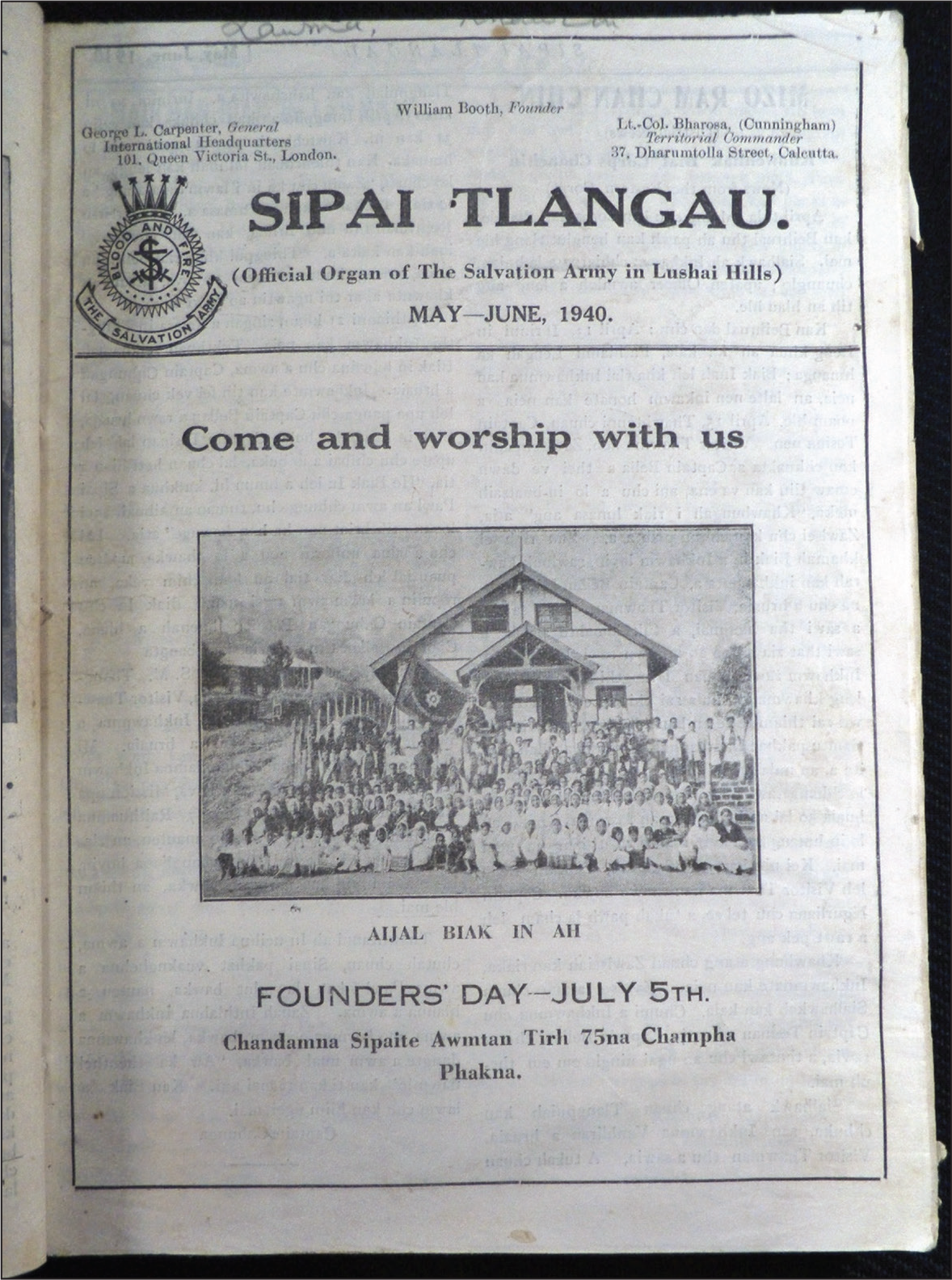
Spiritual ideas were weightless but mirrored other resources that tribal people harvested from far-flung places. Mobile Mara people from the Lushai Hills dismantled government bridges and snipped telegraph wires across the border in Burma, pounding the pilfered metal into more useful bullets, 159 while Mizo traders bought back ponies from Kalemyo (present-day Kalay) in Burma. 160 In the same way, Mizo travellers to Chittagong in 1925 brought back another usable resource, Catholicism, initiating a new phase in the religious history of the region and alarming the more established missions. 161 The arrival into the Lushai Hills of the Salvation Army was spurred by another Mizo traveller: Kawlkhuma’s visit for a training course in Bombay sparked plans for a European Salvation Army officer to be stationed in Aijal. Both events were accompanied by an explosion of physical documentation subsequently archived in the collections of Mizo families (see Figure 11). 162 They show how measuring the significance of tribal travellers by number alone misses a key point: the actions of individual, long-distance travellers could have massive social impacts. 163 At the same time, the number of Mizo students studying ‘abroad’ can be reframed in still-wider scales, for instance, as part of the first major, global wave of Asian international students at the turn of the century. This wave was composed primarily of Japanese students moving outwards from Tokyo and Osaka. But it also included Mizo students moving outwards from Aijal and Lungleh.
Within the context of increasing and travel-initiated denominational options, Mizo converts to Christianity learned to pray for their bodily healing. They simultaneously learned to travel long distances for biomedical treatments in distant urban hospitals, kickstarting a process that continues today. In 1928, for example, one Mizo father travelled alone ‘by road, river and rail for about 500 miles’ 164 to reach a hospital in Shillong, where he underwent a successful operation on a gastric ulcer. A neurodivergent Mizo girl named Lalhluti travelled to London for ear surgery performed by ‘one of the best…specialists of the day’. 165 Lalhluti pioneered art therapy in London years before the term and practice became popular. During her travels, she was more regulated ‘when interested in a good piece of creative art’ or confidently knitting Mizo textiles on a loom. 166
Other creative practices—like Christian hymns—powered still other Mizos onwards to faraway centres, further entangling lowland urban with upland rural histories. In 1929, the first touring Mizo choir performed at a church assembly in nearby Sylhet. 167 Plans crystallised for a follow-up tour in 1933: 50 individuals, 40 concerts, 16 cities. Mizo singers would travel to Patna, Benares, Dehra Dun, Ludhiana, Allahabad, Calcutta (including the Mizo-language radio broadcast) and beyond, under the direction of choir master Pi Zaii (‘The Woman Who Sings’, Welsh missionary Katie Hughes). 168 In Calcutta, ‘posters in many places’ promoted the choir, an example of how metropolitan print media engaged the ‘frontier’. 169 In Delhi, Mizo drumming reverberated inside the newly constructed Viceroy Church within the Raj’s new government complex, the rhythmic pulses transforming the building itself into a massive Mizo khuang beating in the heart of the imperial district. 170
Painful Mobilities
When locating the historical presences and urban impacts of tribal travellers, it is critical not to neglect the ‘darker side of mobility’: the precarity, anxiety and vulnerability that often characterise these journeys, whether at places of departure, arrival or in between. 171 Circuitous travel in the contemporary period has been driven as much by financial precarity, conflict and concerns around local corruption as by perceived opportunities. Dolly Kikon and Bengt Karlsson remind us how ‘opportunities’ for outward mobility are themselves often entangled with forms of brutal structural, physical and sexual violence, the exploitative and racist structures of affective labour regimes and other, often gendered, experiences of essentialism and humiliation. 172
Tribal travel has hurt. It has often been, and remains, bound up in violently unequal relationships of power. In the early 1900s, a Mizo teenage girl testified about her experiences of tribal mobility. A Welsh missionary, Edwin Rowlands, had, in her words,
insisted on treating me after I had grown up as if I was a little girl or his wife. I resented it, but he kept on doing it, put his hands on my breasts &c., and I turned on him and told him he was acting in a way unworthy of a missionary.
173
Although the vast bulk of correspondence and official publications out of Aijal’s Welsh mission was conducted in English, this case, involving several girls, was secreted away in the Welsh language. The mission’s official reports (in English) and upland newspaper articles (in Mizo) celebrate the testifier’s journey to Calcutta for nursing training in late 1905, but are silent on the unfolding controversy. 174 As historians Aled Jones and Bill Jones point out, Welsh could act as a convenient cipher that ‘effectively excluded’ Welsh missionary societies’ internal correspondence ‘from outside scrutiny’. 175 The most brutal sides of Mizo mobility could be cast into the shadow of code-talk by the comparatively powerful and distant.
In the National Archives of Wales, a 27-page file written almost exclusively in Welsh preserves Mizo testimony against Rowlands. Accusers testify that he ‘would often be alone in his house’ with a second teenage girl, ‘lights off with a boy watching to make sure no one came in. She would also go to his house alone and stay there for hours. They were seen embracing each other and lying on his bed’, where Rowlands ‘touched this young woman’s bosom’. 176 Bawnga, a Mizo boy, testified that he ‘had seen the girl without clothes on Mr. Rowlands’ knee’. 177 The local community had had enough. One night, a group of 40 Mizos—their number underscoring the breadth of community outrage and possibly a felt need for safety, both in numbers (in confronting a person of power) and in timing (in marching under cover of darkness)—rallied together in demonstration, reporting Rowlands to his missionary colleague D. E. Jones. 178
Strict conditions were imposed on Rowlands in August of 1906. And yet at some point these loosened, for his contact with adolescent girls seems to have continued in subsequent years, judging from subsequent complaints. 179 Rowlands finally admitted to being ‘indiscreet to say the least, and worse’, openly confessing in another letter that, ‘I’m to blame’. 180 As the investigation committee in Liverpool waffled, mission officials in Northeast India explained away his behaviour: where Rowlands had had the best intentions to civilise the Mizo people, here was evidence that the Mizo people had de-civilised Rowlands. The missionary—recast as a victim—had been known for his openness to eating upland food and embracing upland ways. This explained things. ‘He has tried to put himself on a level with the people which is certainly wrong’, one official sighed, ‘for it is not we that raise them, but they that drag us down’. 181
Mizo mobility entered the picture when the investigation zeroed in on a cryptic note from one teenager’s correspondence with Rowlands. Around 1906, Rowlands ‘sent’ Thangkungi from the Lushai Hills to the distant Assamese town of Srimongol, removing her ‘out of sight because of the rumours’ of his conduct in Aijal.
182
Some six months into the trip, Thangkungi wrote to Rowlands:
I had been here [Srimongol] for a long time (Oct.–Mch.) and my ‘periods’ did not come. I was in great sorrow. And although you gave medicine to me I did not have it [her period]. They put it down to the fact that we had trouble last year. Now it has come again and I am very glad.
183
What medicine had Rowlands given to bring back her periods? Had the stress of it all triggered amenorrhoea, the interruption of regular periods due to hormone disruption? Had Thangkungi been pregnant? In the end, the committee did not have to decide. Flouting formal mission approval, Rowlands travelled back to Aijal, where he subsequently resigned and fled eastwards to Burma as a freelance missionary, eventually marrying Thangkungi. 184 But while the mission now considered the matter closed, things would not have been so simple for any of the teenage girls involved. 185 As for Rowlands, the departure of Mizo girls from the Lushai Hills to Calcutta or to Srimongol—the actual act of tribal mobility—had provided what he saw as his best opportunity for locking down inconvenient truths, even as his own privileged access to movement eventually saw him slip away from Aijal and accountability. There is no room for triumphalism in the story of tribal movement when it could be so entangled with power disparities, abuse and civilisational hierarchies—when it involved the international and inaccessible deliberations of committees of distant White men about the mobile bodies of Mizo girls.
Conclusion
In a posed photograph (see Figure 12), a Mizo woman gazes longingly at the cover image of a 1930s Modern Woman magazine, in which two White women fawn over a puppy in a cosmopolitan living room. A British author captions the set piece: ‘Aspiration’. 186
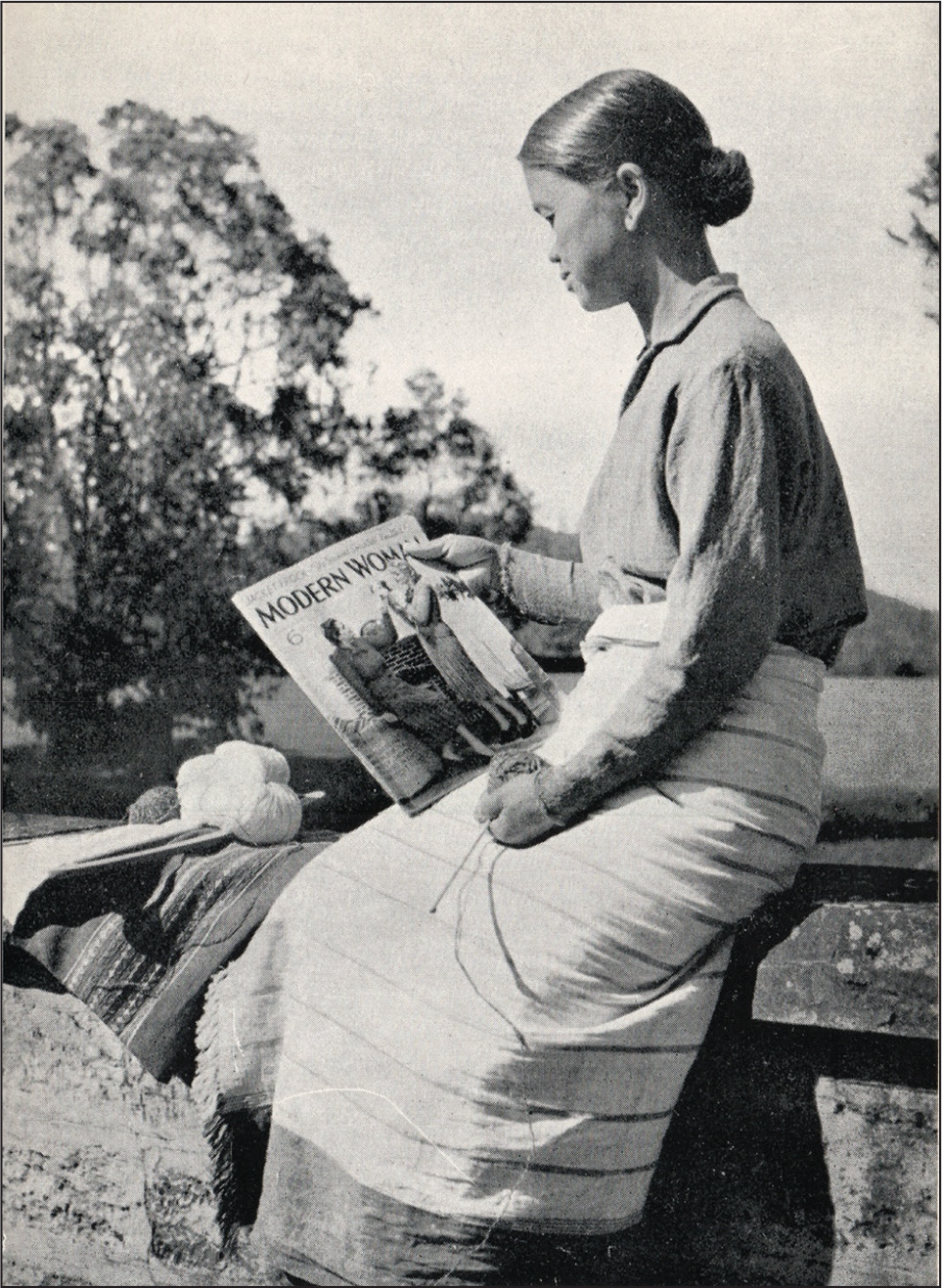
This article has mustered historical evidence to challenge the idea that the tribal, rural world and the cosmopolitan, urban world have been separate rather than co-created. Defying the colonial ‘overstory’ represented in Figure 12 would not be possible if relying solely on the colonial archive. It would also not be possible if we were to accept the common refrain about the paucity of sources of Mizo history. The EAP materials centred across this article—sources shared and preserved by families at ground level across Mizoram—represent one way to ‘expand the archive’. 187 They form a localised response to Ann Stoler’s broader call to ‘reconfigure what makes up the archival terrain’. 188 The availability and significance of such materials are confirmed by other recent efforts in the wider region to uncover privately held sources. 189
Family archives reveal historical Mizos acting and moving in surprisingly global ways. Today, Lalzidinga Sailo and family preserve records about their ancestor, the wealthy Mizo chief Khamliana Sailo. 190 In 1915, the chief donated nearly ₹1,300 to the Imperial Indian Relief Fund and a further ₹200, in 1918, to the Red Cross’s ‘Our Day’ Fund. 191 Tribal people were global philanthropists, moving their money around international financial markets. When Wales faced a sudden economic downturn in its mining sector in the mid-1920s, its people received an injection of emergency international aid, not from neighbouring developed countries, but from the so-called backwards tribals of India’s eastern Himalayas. In Assam, Cacharis, Khasis and Mizo people donated for the ‘aid of the [Welsh] sufferers in the distressed areas’. 192
This article has also demonstrated how colonial officials and imperial ethnographers were not the only ones on the move. Wayfinding and globetrotting individuals from the northeast may have been scant in number by comparison, but they had an outsized impact as ‘reverse anthropologists’. They turned the tables, observing, commenting upon and judging the imperial metropole. Recasting tribal travellers as intelligence-gatherers mirrors recent work in Indigenous Studies more broadly, which has reframed Indigenous and tribal peoples not as ‘static recipients’ of encounter but as populations ‘reaching out’. 193 At once participants in the modern age of comparison and yet authentically tribal, some of these groups increasingly came to promote visions of their own diverse lands and peoples as forming a singular, emergent, definable territory and nation (hnam): Mizoram, ‘land of the Mizos’. Such categorisations have proven durable. Ironically, they also serve as territorial containers of history-writing—making the history of Nagas outside Nagaland or Mizos outside Mizoram, for example, more difficult to appreciate—despite the categorisations themselves being, in part, originally conjured by tribal travellers making comparisons from far away. 194 Back in ancestral hills, large audiences read or had read to them, the narratives written by these travellers, stories increasingly broadcast throughout the region by new technologies. Print media, alphabetic literacy and emerging traditions of public reading all meant that travelling authors could mould the shape of the globe for the ‘immobile’, whether local readers or listeners. 195
Mizo travellers did not always play the roles expected of them. Some panned the sights of modernity and industry that were supposed to impress. Others rejected their assumed place in imperial civilisational hierarchies, sometimes from remarkable podiums. In 1936, an orphaned Mizo teenager named Lalziki Sailo broadcast her own language across the greatest of all imperial cities, her song commanding nothing short of London’s BBC airwaves. The singer—whose later photograph is preserved in an Aizawl family’s archive
196
—elected to close her broadcast with a speech in English that flatly rejected imperial expectations:
People say to me that I shall miss England when I return to India…but I say to them: ‘England is very interesting and beautiful, but my country is also very beautiful, with its mountains and rivers and forests. I would rather live in my own country than in England’.
197
An example of ‘colonized people exert[ing] an influence upon the colonizers’, 198 such Mizo influence could reach the loftiest of imperial heights. Parliamentary debates in Westminster about slavery were shaped by controversies that unfolded in the Lushai Hills, with tribal names immortalised in Hansard. 199 Military commander Lord Roberts’ famous horse, Vonolel—who accompanied Roberts from Bombay to Khandahar to London and was decorated with war medals by special permission of Queen Victoria herself—took his name from a plucky Lushai chief. 200
Today, migration from India’s northeast—primarily outbound but also cyclical—is undeniably distinguishable from an earlier era in both scale and character. This article applauds recent work on the current movements of tribal youth, but simultaneously urges for this moment to be seen as an extension of much older explorations that have long characterised tribal societies like the Mizo. The predominant Mizo origin story itself is one of wayfaring, a journey from a distant cavern to present-day territories. 201 For today’s travellers, the rediscovery—or rather, because families have always known about their mobile pasts, the wider appreciation—of historical tribal-people-on-the-move could represent empowering pasts, what historian Coll Thrush calls ‘useable history’. 202 The current flows of travellers out of the northeast, a region long ‘islanded’ 203 by colonial and postcolonial policies and discourse, do not indicate a very recent thawing of an otherwise frozen or isolated past. Today’s Mizo youth travel in an unbroken ‘culture of mobility’. 204
Future scholarship might turn to explore more fully the many individual, colonial-era travellers glossed in Part II of this article, studying family archives or illuminating the ‘internal journeys’ experienced by the mobile or those they left behind. 205 Outside of the formal colonial period, but prior to the present day, Mizo families in the 1970s and 1980s recorded and posted cassette tapes to distant loved ones living outside the region, conveying news and songs in their ancestral tongue. 206 Tribal families pioneered literal ‘voice mail’. Mizo political nationalism, too, operated on globe-hopping scales in the 1960s and beyond. 207 And in 2018, 18 Mizo students travelled to Delhi as part of an Assam Rifles National Integration Tour, the latest example of a state policy dating to the nineteenth century, where Northeast Indian bodies are conveyed to distant Indian capitals in an attempt to ‘win them over’. 208 The study of human mobility in the region could likewise stretch beyond the living (as with the Lushai skulls shipped to distant imperial craniological collections) 209 or beyond the human (as with the gibbon ape shipped from the Lushai Hills to the London Zoo in the 1920s, ‘so its cheerful call could be heard in Greater London’). 210
By foregrounding village-level, privately held sources, this article has revealed a preliminary glimpse into an unexpectedly mobile historical world. It has integrated a wider range of transregional, technological, metropolitan and wider-world spaces into the analytical frame of ‘Northeast India’. The evidence challenges perceptions of the region as geographically bounded and isolated, or its populations as culturally authentic only when living within fixed and rural ancestral ‘homelands’. 211 Writing about Indigenous travellers in another world region, Cecelia Morgan advocates recognising ‘their stubborn refusal to stay in the places created for them by…nation-states’ 212 —something that can apply even when the people themselves fought at great cost to win those formal zones of influence, as with the state of Mizoram. The histories of tribal highlanders at lower elevations and in urban centres—far away from upland frontiers and imperial borderlands—do not simply add to, but in fact constitute, the history of Northeast India.
Footnotes
Acknowledgements
I wish to thank Dr H. Vanlalhruaia, Joseph Lalzarliana, Mike Hmingthanpuia Tlau, Dr Mary Vanlalthanpuii, Ffion Mair Thomas, Dan Shutt and two anonymous reviewers at The Indian Economic and Social History Review. I would also like to acknowledge the countless individuals and families across Mizoram who care for historical materials and records in their own homes, in particular Rev. Dr C. L. Hminga, Pi Thanzingi, Pi Lalengliani, Pi Thanbuangi, Upa Hualkunga, Pu Chawnghmingliana, Pu Lalhruaitluanga Ralte, Prof. J. V. Hluna, Prof. Laltluangliana Khiangte and Pu Lalzidinga Sailo. I am grateful to the Chancellor’s Chair research programme at Kwantlen Polytechnic University for supporting this research.