







Abstract
In order to revive the agricultural sector under the neoliberal regime, contract farming has been emerging as a new agricultural technology in India and in the state of West Bengal, in particular. The present paper is a micro-level comparative study of West Bengal, dominated mainly by small and marginal farmers, which serves as an interesting case for highlighting on the pattern of cropping changes over time. The study highlights on the contract farming models prevailing in the study area, the specific implications of the nature of contracts followed by a detailed discussion on the characteristics of the crop under contract and the structure of contract farming in the study area. The article also attempts to investigate the factors inducing contract farming by different size classes of farmers as well as contract farming through individual agents vis-a-vis cooperatives using a logistic regression model. The study reflects that the success of contract farming as an emerging alternative institution that may alter the existing farm practices as suggested by the recent Farm Bill, 2020, depends much on the nature of the product as well as the contract.
Introduction
Trade liberalisation and globalisation of agriculture have undoubtedly opened up new challenges and opportunities to the agrarian sector of India in a situation when the economy was experiencing a declining size of its agricultural holdings, slowing down of technological advances in staple crops, falling investment in agriculture and increasing degradation of natural resources. In order to sustain in the globally competitive environment, World Bank (2005) has specifically suggested crop diversification, replacement of traditional fertiliser-based economy with a bio-fertiliser-based economy and promotion of contract farming as a solution to the problems of marketing and credit in developing countries like India.
Contract farming is an agreement between farmers and the contracting processing firm whereby various inputs in the form of seed, fertiliser, insecticide and pesticides of specific qualities and prices (as dictated by the firm) are supplied to the farmers as advance, the prices of which are to be adjusted with the prices of the crops after the harvest. It provides an assured, remunerative price of contracted crops to the producer, thereby minimising the risks associated with the marketing of crops and supply of inputs as well as product prices in the open market. Contract farming encourages the small and marginal farmers to take advantage of the market economy and at the same time helps the firms involved in contracts to earn profit from agricultural produce of specified quality. However, the farmers are always at a risk as the crops produced by them may fail to meet the specific quality requirements of the contracting firms and hence be rejected on quality grounds. In such cases, the farmers are liable to bear the entire burden of loss.
Contract farming was adopted by the states as a tool to promote diversification for improving farm incomes and employment (Singh, 2000). Production of raw materials and processed food expanded significantly with companies supplying seeds to farmers coming under contracts, processing the vegetables (tomato) and supplying it to the market (Singh, 2004). Singh (2012) examines the potentialities of contract farming in ensuring the betterment of all parties concerned, especially the small and marginal farmers in the presence of adequate tools to monitor and use the contract for development purposes. Hill and Insurgent (1982), identify factors like the method of determining producers’ price, adjustments for quality differentials, allowance for climatic variations, farm practices, terms of credit, provisions for renewal and termination of contracts and for arbitration in negotiating the terms of contract from the producers’ point of view.
Goldsmith (1985) suggests that contracting is suitable for crops that are perishable, non-bulky and perennial in nature, requiring heavy processing and strict quality adherence. Contract farming is often associated with export crops and high-value crops, which are likely to be riskier than traditional crops (Simmons, 2002) as they involve higher costs of production and are more volatile and perishable in nature in turn leading to uncertain yields. Most of the contracting firms however prefer to work with large and medium farmers with exceptions in Andhra Pradesh and Karnataka, which involved small and marginal farmers due to the very nature of the crop itself (Dev & Rao, 2004). Smallholders who have access to better physical infrastructure and credit, however, managed to integrate successfully with agribusinesses (Braun & Diaz-Bonilla, 2008). The superiority of contract farming over corporate farming is evident in its more widespread and sustained practice as compared with corporate farming experiences and in its positive impacts like producer link up with profitable markets, better farm incomes, skill upgradation due to transfer of technology and sharing of market risk even in India (Dev & Rao, 2005; Glover & Kusterer, 1990).
Bijman (2008), however, observed that the existing contract farming arrangements are complex and their potential benefits depend on the specific features of the product, firm, communities and contractual specifications involved. Singh (2008) strongly recommends the bargaining cooperatives and other agricultural producer organisations to ensure equitable contracts. A study by Little and Watts (1994) in Sub-Saharan Africa focuses on the conflicts between farmers and the contracting firms. Grosh (1994) viewed that the contracts should be regulated and monitored. There is a need to build partnership in contract farming (Eaton & Shepherd, 2001) where companies not only offer contractual terms for working with farmers but also share their business risk and profits with producers as equity shareholders. Birthal (2008) identifies the role of Central and State government in creating a conducive climate for private investment in agribusiness, improve farmer’s access to credit, technology and other extension services and encourage smallholders to organise themselves into cooperatives so that they can effectively deal with the big business firms. Singh (2004) found that while companies could profitably continue with their business, big farmers did not find it profitable to meet the conditions of the contract. Besides, the success of the contract farming system becomes doubtful when production is organised in a large number of very small units with low level of fixed capital, inadequate infrastructure and private irrigation system (Chakrabarti & Kundu, 2009). Ghosh (2003) identifies the problems relating to contract farming in India and argues that contract farming has emerged primarily on account of the failure of public institutions to provide farmers with essential protection and support for viability on a sustained basis. In most cases, there was a total lack of commitment on the part of the service-providing companies (Kumar, 2006).
Thus, there is a debate among scholars regarding the benefits and adverse impacts of contract farming. The earlier studies have mostly emphasised on the impact of contract farming but there is indeed a lack of in-depth study on the driving factors behind the adoption of contract farming. In India, the eastern states are still lagging behind the majority of northern and southern Indian states in adopting contract farming perhaps due to the farmers’ poor socioeconomic conditions, and lack of institutional efficiency and effectiveness (Behera et al., 2018). This article focuses on West Bengal, one of the states in eastern India that has already experienced successful implementation of land reform along with growing marginalisation of landholdings to understand the nature of contract farming and to identify the socioeconomic factors that motivate farmers’ participation in contract farming in an overwhelmingly smallholder-dominated economy.
Recently, in order to transform Indian Agriculture and ensure enhanced incomes for the farmers, three Bills, namely The Farmers’ Produce Trade and Commerce (Promotion and Facilitation) Bill, 2020, The Farmers (Empowerment and Protection) Agreement of Price Assurance and Farm Services Bill, 2020 and The Essential Commodities Act were passed by the Parliament on 20 September 2020. The former Bill intends to provide freedom of purchase and sale of crops by the farmers and traders directly to the consumers without bearing any additional transport and other associated marketing costs. The second Bill will authorise the farmers to enter into contractual agreements with the processing and/or marketing firms for production support at predetermined prices. This is not only supposed to provide access to various inputs in the form of seed, fertiliser, insecticide and pesticides of specific qualities but also protects the farmers against undue price fluctuations. The third Bill seeks to remove commodities like cereals, pulses, oilseeds, edible oils, onion and potatoes from the list of essential commodities. The Bills are expected to enable the farmers to sell their produce outside APMC mandis to whomsoever they want.
Soon after the Acts, often called the Farm Bills were introduced, unions began holding local protests, mostly in Punjab and Haryana, claiming them as anti-farm laws. In this context, it is worth mentioning that Punjab was the first Indian state to embrace contract farming in the production of tomato and chilli in 1998. Farmers believe that the laws will ‘gradually lead to the deterioration and ultimately end the mandi system’ thus ‘leaving farmers at the mercy of corporates’. The farmers have also demanded the creation of a Minimum Support Price (MSP) Bill to ensure that corporates cannot control the prices. Farmers have been constantly demanding the repealing of the farm laws and are not ready to go for any compromise with the government. Against this background, West Bengal being the second largest producer of potatoes in India after Uttar Pradesh, accounting for 30% of the country’s total output (Punjabi, 2015), the present article attempts to highlight the extent of participation of small and marginal farmers in potato contract farming in the state and in doing so, it contributes to the ongoing debate on contract farming in India. This study also intends to identify the factors that motivate farmers’ participation in contract farming in an overwhelmingly smallholder-dominated economy. This is particularly significant in the context of the new model law adopted by the Government of India to promote contract farming domestically.
Research Methodology
This study examines the performance of different size groups of farmers with regard to contract farming under alternative conditions on the basis of primary data. Potato is the popular cash crop in West Bengal with Hooghly, Midnapore (West) and Burdwan districts together contributing almost 56.38% to the total potato production in West Bengal (Government of West Bengal, 2015). Contract farming is mostly prevalent in those districts of West Bengal which has traditional expertise in potato cultivation. Hence, the only processing firm in the state engaged in large-scale potato contract farming, PepsiCo Limited currently is found to operate in six districts, viz. Burdwan, Hooghly, Bankura, Birbhum, Howrah and West Mednipore (Acharya, 2012). So, the districts of Burdwan and Hooghly are selected to assess the operation of the contract farming practice of PepsiCo Company in potato cultivation. A micro empirical field survey of 200 households was conducted in two villages, Shaktigarh and Panpara of Burdwan and Hooghly districts, respectively, directly through field surveys.
Shaktigarh is dominated entirely by privately controlled firms while in Panpara, contract farming is under a cooperative system of cultivation where farmers have a formal contract with the contracting company not individually but as a collective group. Thus, contracting in Shaktigarh is between private individuals and the company (which is the Pepisco International in both the villages), while contracts in Panpara are between a collective group of individuals and the company. While Shaktigarh is in relatively closer proximity to urban exposure, village Panpara is located far away from the nearest main town and does not have the kind of urban demonstration effect that could be observed at the outset. Contract farming in both villages is a new phenomenon and is being practised since 2010 and thus is still under experimentation. Contract farming was adopted by the small and marginal farmers mainly to take advantage of the market economy, to minimise the risks of marketing of crops and to insure against fluctuations in product prices in the open market. The entire sample was divided into two broad groups, one who takes up contract farming designated as contract farmers and the other who do not, namely the non-contract farmers. To conduct the household survey, the interview method was followed. Each household was visited separately for canvassing the structured questionnaires to collect the required information relating to a large number of socio-demographic and -economic variables that are relevant to the present study.
In order to capture the nature of qualitative response involving contract farming decisions and practices, a logistic regression model has been used. This helps in focusing on the factors and variables which are instrumental to raise the probability of a farmer being a contract farmer. The estimation of logit models involves a logistic distribution function and the odds ratio, which is the ratio of the probability (in this case) that a farmer will go into contracts to the probability that he will not go into such contracts. The basic form of the logit model is available through the equation:

where L is the log of the odds ratio and remains linear in both X and the parameters β0 and β i . More precisely, L is what is known as the ‘logit’. When L is positive, then an increase in the value of regressor(s) also increases with odds and vice versa.
To be precise, the logistic regression model adopted by us is given as follows:

where Zi = probability of undertaking contract farming by the farmer is a dummy variable taking value of 1 if the farmer participates in contract and 0 otherwise,
X1 = Crop diversification index
X2 = Average net sown area under potato
X3 = Education of the farmer
X4 = Age of the farmer
X5 = Dependence on agriculture
X6 = Access to bank facilities
X7 = Degree of urbanisation
X8 = Number of dependents in the household
In the present study, the researcher has calculated an index of diversification of commodities for each farmer using the Simpson Index of diversity. The index provides a clear dispersion of commodities and its value lies between 0 and 1. A zero value of the index indicates complete specialisation while unity implies complete diversification. The index is calculated as follows:

where SID is the Simpson Index of diversity and Pi is the proportionate area of the ith crop in the gross cropped area of output.
The a priori expectation is that as diversification in cropping pattern in an area increase, the scope of contract farming also rises as diversification in favour of high-value crops essentially is market-oriented and the system of contract farming is expected to play a positive role in encouraging the phenomenon of crop diversification. Similarly, with increase in net sown area under cultivation of potato, the output of potato will also increase, which will induce the farmers to go for more contract farming. Education of the farmer is expected to influence contract farming ventures positively, as in general, it widens the scope for crop experimentation, which is likely to induce the farmers to enter into a contract. Again, a negative association is expected between age and the probability of being a contract farmer as people in the younger age group are normally found to be more enterprising, dynamic and willing to accept a new organisation of production.
Contract farming requires improved farm practices, modern inputs as well as higher amounts of land on which it can be undertaken as an additional means to supplement the mainstream income activities. This requires sufficient quantities of additional resources in the form of credit, and hence, access to rural credit facilities is likely to promote the willingness towards undertaking contract farming. Further, contract farming seems to be dependent on the availability of marketing infrastructure including cold storage and warehousing facilities, generally located near urban areas. Thus, the degree of urbanisation in and around a farming area is likely to raise the probability of undertaking contract farming. The variable urbanisation is defined in a manner that it takes the value of one if the village is located in Shaktigarh, having urban proximity and zero if located in Panpara, a remote area. For a similar reason, it is expected that the higher the dependence on the agricultural sector, the higher the probability of being a contract farmer and vice versa. Dependence on the agricultural sector is a binary variable assuming a value of one if there is only one earner in the household, having no alternative source of income apart from agriculture and zero otherwise. The number of dependents in the household can be a decisive factor on which the commitment to contract farming might depend. Particularly, as the dependency burden at the household level increases, the households are expected to look for a variety of alternative farming practices to enhance their income. As a result, a rise in the number of dependents might contribute positively to the probability of being a contract farmer.
Contract Farming Model in the Study Area
In case of contract farming, there are generally five different models, viz. The Centralised Model, The Nucleus Estate Model, The Multipartite Model, The Informal Model and The Intermediary Model. In the village Panpara of the Hooghly district, there is a partial variant of the Multipartite model where the farmers organise themselves into a cooperative and go into contracting with the company. 1 Owing to the inherently underdeveloped marketing relations, however, contract farming seems to have failed to assume the other defining characteristics of a multipartite system. For example, the company does not have any agreement with other private firms, which is mainly probably due to the fear of losing its bargaining grip on the farmer cooperative in a general environment of scepticism towards contract farming arrangements. Again, the nature of contract farming in the study area has a close resemblance with the intermediary model. 2 This can be identified as the vendor-agent form of contract farming. In this form, vendor is the intermediary who serves as the ‘go between’ in the whole arrangement. The flow diagram (Figure 1) has been prepared in order to explain the fundamental structure of the type of contract farming model as prevalent in the study area.
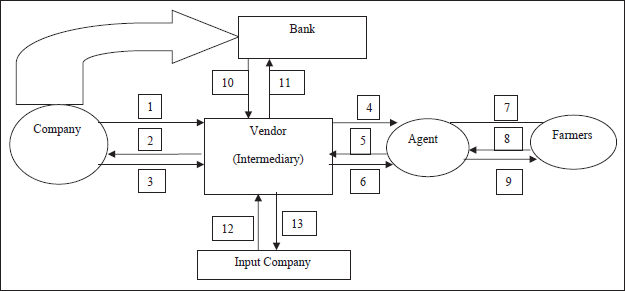
The diagram indicates a process of exchange based on business, convenience and mutual understanding. Everything depends on proper coordination among the parties involved in transactions. There is a bilateral flow of produce from the farmers to agents of the company via the intermediary and a flow of inputs from the company to the farmers. Thus, the agent assumes an important role in both transactions. The direct exchange of services between the agent and the company however could not be made possible and the interlinking mechanism is available in the form of intermediary participation. Interestingly, it is the vendor who is responsible mainly for supplying inputs such as pesticides and fertilisers to the farmers, but the seed is supplied mainly by the company where the vendor once again occupies the major role of the primary connector. While the transactions between the company and the bank are strictly formal and are not affected by what is happening at the village level, there may be occasional problems of repayment failure in case of any random damage to the crop. However, the company–vendor relationship is also formal.
The informal arrangements implied in this model, figure in the transaction processes between the vendor, agent and farmers. This is because these transactions are mostly carried out in terms of the localised social contacts between the villagers and those working on behalf of the company. The method of coordination with the farmers in order to bring them in the purview of contractual agreement varies from place to place depending on the nature and type of contracting agency, technology, nature of crop and the local and national context (Singh, 2008). In the context of West Bengal, in general and in the study area (Shaktigarh and Panpara) in particular, the agrarian sector is dominated by a large number of small and marginal farmers. Thus, establishing proper coordination with the farmers in order to disseminate information and negotiate contractual terms and conditions turns out to be a cumbersome task for the company. Also, the post-contractual delivery of inputs and extension services to the farmers, monitoring and collection of the produce is equally daunting and leads to a high transaction cost. It seems that under such conditions, the company in the study area has favoured the adoption of the intermediary model of contract farming. This requires involvement of a local middleman who facilitates transactions between the company and the farmers.
The rationale for employing such a middleman lies in the inability of the company to coordinate with a large number of farmers in order to communicate its needs and negotiate the contractual terms and conditions with the farmers. In the case of the present study, the intermediary involved known as a ‘vendor’ facilitates contract farming in more than one village depending upon his managerial capabilities and influence. Additionally, the company appoints a local person from each village who is selected on the vendor’s reference and is known as an ‘agent’. The company imparts him training and pays him a fixed monthly salary and a performance-based bonus. Thus, in the context of the present study, the model of contract farming may be identified as ‘vendor–agent model’.
Implications of the Nature of Contracts in the Study Area
There are two particularities of the nature and extent of implementation of the contract farming system in West Bengal:
The farmers and the company involved in the contracts preferred to behave much conservatively. Both the farmers and the company find the resulting gains out of contract farming as more or less acceptable as the crops rejected by the company are usually taken away by the vendor though at a price lower than that agreed upon by the contract processing firm in advance.
The contracts agreed upon in the study area were found to be verbal in all cases covered in the sample in both Shaktigarh and Panpara village, independent of the prevailing technological conditions and size class characteristics. This indicates that the agribusiness companies are distant away from making strictly formal agreements and are content to go with loosely designed relationships with the farmers. Possibly the contracting company prefers to behave as a monopsonist and intends to ensure a better wielding of bargaining power over the farmers, which otherwise in the case of a formal written contract would have been more or less equally twisted between the parties. This certainly involves the elements of bias against the farmers in the contract.
In the study area, most probably due to a strong network of monitoring based on the local agents, the rate of default by the company in procuring the contracted output was quite low, in the case of contracts relating to Gherkin and rice seed. While this applies largely to the Burdwan district, in the case of Hooghly district, the company being organised in the form of a cooperative, the monitoring was done by and within the cooperative in its own interest. Further, while the case of quality rejection, in general, is low in the study area, its incidence in Hooghly is relatively lower than in the Burdwan district. This difference arises from the fact that the cooperative commitment and effort are observed at a much higher level than what is achieved under individual supervision as in the case of the Burdwan district. However, even in the study area, the contracts seem to have a pro-company characteristic. The ultimate bargaining power seems to be vested in the company management as there is no clause for the farmers to take legal action in an event when the company fails to buy the product.
Crop Characteristics under the Contract and the Details of the Contract
Potato is the contracted crop that is taken into consideration. The farmers are induced to shift their resources away from the traditional Jyoti variety to the non-traditional variety of potatoes known as Atlanta, which is appropriate for processing. Thus, contract farming in the study area has promoted crop diversification in favour of a new variety of potato, the Atlanta variety that takes about three months to mature and has low sugar content and a higher solidity compared to the traditional varieties, which makes it ideal for producing chips. It is widely grown for chipping right off the field or with short-term storage. Marketable yields of this variety of potatoes are fairly high. However, the farmers cultivating the contract variety must adhere to certain guidelines set by the company in relation to planting of seedlings, weeding, application of pesticides, monitoring, harvesting, etc.
In the study area, the farmers seem to confront a much higher level of risk because it involves the cultivation of contract potato, which is non-edible and hence lacks alternative markets. Though the company provides selected inputs like seeds, pesticides, fertilisers and extension services, the farmers need to bear all the remaining cultivation costs, which is a substantial part of the total cost. Thus, in this case, the farmers get locked into a considerable degree of asset-specific investment in the sense that the contract crop has no alternative buyer in case the company defaults on the contract. Also, the contract variety involves a high degree of uncertainty regarding the suitability of crop to local climate, quality of yield and the yield rate per unit of the plant. Further, in the case of the contract variety, a portion of the crop that fails to meet the quality standards as prescribed by the company is rejected. Because of this, the cultivation of contract variety always carries a risk that a part of the output might be rejected on quality grounds.
Operation of the Contract
Contract farming in the study area is promoted by a well-organised and well-respected local person, the vendor who functions as a bridge between the farmers and the company and who could encourage his fellow farmers to try an experiment with the Atlanta variety of potato by undertaking contract farming. Further, such a person is also well suited to address the fears and inhibitions of the farmers regarding the nature of the contractual agreement. In fact, most of the farmers tend to cultivate the contract variety only on the assurance of the vendor as they know that the vendor is a permanent resident of the area and would never run away by cheating them. This seems to be reverse instances of transaction based on informal inter-linkages. In the study area, the vendor was found to be an influential person. In Burdwan, the vendor wielded sufficient political power and control at the Gram Panchayat level and many villagers knew him as well as respected him. In Hooghly, the vendor exercises a more or less similar status but as the farmers organise themselves into a cooperative, they also appeared to have some bargaining power vis-a-vis the vendor. The vendor himself was found to be a big farmer in both the areas though they themselves did not enter into a contract with the company. Again, the prevailing form of the institution is instrumental in reducing different types of transaction costs related to such a screening of potential clients, negotiation of contracts, delivery of inputs and extension services, enforcement of terms of contract and monitoring, etc.
What follows is that the rationale for employing the vendor is to exploit his influence and goodwill to propagate contract farming in the region. The vendor is also helpful in disseminating information relating to the terms and conditions of the contract to a large number of farmers in a convenient and informal language. The vendor assures the farmers that they will not incur losses and if they somehow happen to incur a loss on account of defective seeds or other factors which fall under the company’s responsibility then they will be adequately compensated. Once a contract materialises through such assurance, there may be a number of empirical instances visible to the farmers. In the study area, the farmers are more or less satisfied with the yield rate of the contract variety. Further, the prefixed nature of price is instrumental in eliminating the marketing risk of crop and guaranteeing a fixed return. Some of the crops are rejected which might be taken away by the vendor at a low price. This reduces the risk related to the production and marketing of contracted crops to some extent. It is found that the vendor carries out contract farming in a few more adjoining villages and includes farmers from all size classes. In spite of some negative outcomes relating to the viability and efficiency of contract farming, both the vendor and the agent continue to persuade and encourage new farmers to undertake contract farming.
In order to identify the specific factors that might influence the farmers to take up contract farming of a farmer in the surveyed area, a logistic regression analysis of 200 farmers has been conducted using crop diversification index, area under cultivation, education of farmer, age of farmer, dependence on agriculture, access to bank facilities, urbanisation and the number of dependents as predictors (Table 1). Many factors were considered and a few were found to affect the viability of contract farming. The regression analysis demonstrated that crop diversification index, area under cultivation, education of the farmer, age of the farmer, dependence on agriculture, access to bank facilities, urbanisation facilities and the number of dependents in the farmer household made a significant contribution to predict the take-up of contract farming offer. Also, while doing so, a test has been conducted for heteroscedasticity and multicollinearity among the variables considered for regression analysis. Since the variables considered for all the farmers taken together as well as for farmers in Panpara were suffering from the problem of heteroscedasticity, the GLS technique has been used and the corrected results have been reported in Tables 1 and 3.
Logistic Regression Analysis of Probability of All Farmers Entering into Contract Farming.
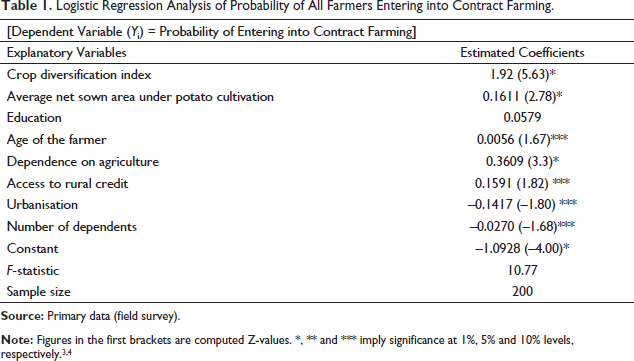
Logistic Regression Analysis of Probability of All Farmers Entering into Contract Farming.
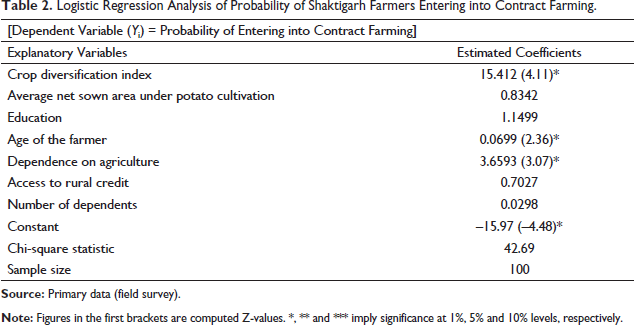
Logistic Regression Analysis of Probability of Shaktigarh Farmers Entering into Contract Farming.
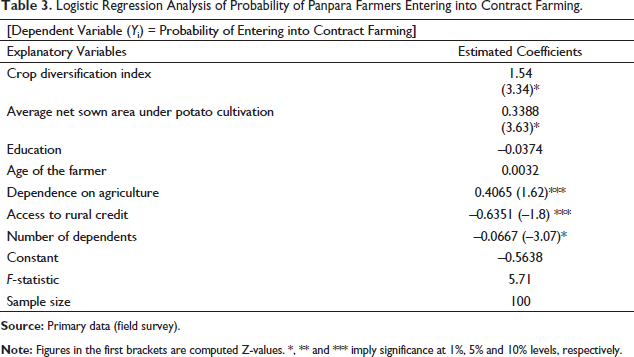
Logistic Regression Analysis of Probability of Panpara Farmers Entering into Contract Farming.
The highly significant positive coefficient of the crop diversification index indicates that crop diversification and contract farming both move in the same direction. This result appears to be broadly corroborating the study by Singh (2000). The rise in crop diversification promotes contract farming and hence crop diversification is found to be an important factor that induces farmers to participate in contract farming. This is possibly because diversifying agriculture in favour of high-value crops involve adoption of new technology based on the use of bio fertiliser and hence farmers rely on contract farming as a solution to the problems of marketing of such high-value commodities and credit. Similarly, area under cultivation is another factor which increases the viability of contract farming. Land is the most limiting resource to the farmers. The positive coefficient value for area under cultivation indicates that when area operated is increased, the households are more likely to take the offer. Farmers having larger landholdings have more cultivable space to experiment with new crops. Thus, when operational area increases, it appears that there is a general tendency among the farmers to go into contract farming in order to insure against the fluctuations in incomes from other sources. This corroborates the idea of Kumar (2006) that mostly large farmers participate in contract farming. Besides, larger growers are likely to be preferred by the contractors as it assures lower cost per unit of output and quality products.
Besides, education of the farmer household positively affects the contract participation though the coefficient is not very significant. Education opens the mind of the farmer to knowledge, makes them fully aware of the specific product quality requirements, contractual agreements and encourages them to undertake contract farming on a large scale as the firms by supplying a good part of inputs eases out the resource constraints of the farmers and the small landholders in rural areas can enhance their income entitlements. This observation is also supported by the earlier empirical findings of Prowse (2012) that better education has positive impact on contract farming participation. Age is another important factor affecting contract participation positively and significantly. The positive influence of age on the probability of being a contract farmer is somehow unexpected and this shows that as the farmer ages and gains more experience, he becomes willing to undertake new farming venture and experiment with new crops in comparison to the younger age groups. Thus, contract farmers are older in age than the non-contract farmers.
The positive value for dependence on agriculture suggests that at the household level, dependence on agriculture itself is a major contributor to decide the take up of contract farming. In fact, when agriculture is the only source of income, it is more likely that contract farming will emerge as an alternative remunerative and compensating development for the farmers. This study confirms the idea of Behera et al. (2018) that the non-availability of alternative sources of employment may encourage the farmers to participate in contract farming to ensure increased income. Possibly, the contract provides the farmers a steady source of income by insuring against production and marketing risks. The firm under contract farming offers many benefits for farmers including access to technology, financial resource, a ready market for the output and assured returns. Thus, to access these facilities farmers are interested to participate in the contract mode of production.
Entering a contract farming arrangement gives the farmers access to credit, inputs and technical assistance. Access to rural credit seems to have a very strong impact on the likelihood of being a contract farmer. Banks require collateral as security against loans and hence it is difficult to lend small and marginal farmers. However, if they are involved in contract farming, they have a better chance. Banks willing to lend to farmers increases viability if the farmer is under contract farming. The positive value of access to rural credit facilities indicates that when access to rural credit facilities is increased, the households are more likely to take the offer. This lends support to the observations made by Braun and Diaz-Bonilla (2008). This is once again due to the very nature of contract farming in the study area where contract farming arrangements require a large amount of investment in resources like high-value seeds, chemical fertilisers and pesticides as well as hired labour, which could be obtained by the farmers directly from the banks, cooperatives and other financial and non-financial institutions. In fact, access to credit becomes important as the participating farmers have limited household-level resources to access the input markets.
However, the negative impact of the number of dependents on contract farming decisions is possibly due to the need for greater area allocation under traditional food crops in order to support the dependence. In fact, both urbanisation and the number of dependents in the farmer household appear to be significant predictors, the b coefficients for both the explanatory variables being negative, indicating that increase in the value of each of the predictors is associated with decreased probability of taking up contract farming. The negative influence of urbanisation is quite unexpected as farming areas in closer proximity of urban centres are likely to have higher access to various infrastructures including marketing and communications, which in turn is expected to be highly supportive to a market-friendly development like contract farming. In order to understand whether contract farming through individual agents vis-a-vis cooperatives makes any difference; an alternative logistic regression analysis was performed to ascertain the effects of the same set of variables separately on the likelihood that farmers in villages Shaktigarh (Table 2) and Panpara (Table 3) adopt contract farming.
The tables reveal that in village Shaktigarh, factors like crop diversification index, age of the farmer and dependence on agriculture as the only source of livelihood significantly and positively affect the farmers’ decision to take up contract farming while the influence of factors like area under cultivation of the contracted crop, level of education of the farmer, access to rural credit and the number of dependents in the farmer household is positive but insignificant (Table 2). On the other hand, for the village Panpara (Table 3), the factors like crop diversification index, area under cultivation and dependence on agriculture as the only means of subsistence significantly and positively influences the farmers and hence are more decisive factors in adopting contract farming by the farmers.
The access to bank facilities and the number of dependents in the farmer’s household however have a significant negative impact on the farmers’ decision to take up contract farming. The willingness of banks to lend to farmers is an economic factor that makes contract farming feasible but in Panpara village, the farmers mostly approach the cooperatives and not the banks for fulfilling their credit requirements and probably due to this reason, the access to bank facilities has a significant negative influence in contract participation. It seems that the presence of a cooperative organisation even in a relatively less enterprising farm economy has led to the success of contract farming arrangements. This observation supports the study by Birthal (2008). However, the factors like level of education and age of the farmer do not have any significant influence on the farmers’ decision to adopt contract farming in Panpara village. On the whole, on the basis of logit analysis, it can be concluded that factors positively influencing the viability of contract farming include crop diversification index, average net sown area under potato cultivation and dependence on agriculture. In fact, the absence of alternative sources of income for the farmer may encourage them to participate in contract farming to maximise their income opportunity.
Though the farm unions strongly believe that the new Farm Bill, 2020 will leave the farmers at the mercy of the corporates, it is true that the mechanism of contract farming definitely can provide easier access to credit, input, information and technology and product market and given the right contracting systems, even small farmers in India and West Bengal in particular, can participate successfully in these emerging value chains. Contract farming helps to uplift the farmers by providing better services while linking with the market. However, contract farming alone cannot solve all the problems related to agricultural production and marketing. In order to promote contract farming, the government has to take several measures.
Contract farming should be regulated by the state and the contracts must be made more transparent with farmers having a stronger bargaining power. Government should give tax concessions to the companies engaged in contract farming and should encourage adequate scientific research to provide region-specific crop solutions to the farmers. The government should also boost the import of new improved high-yielding varieties of seeds and technology for the contract farmers. Besides, even in the absence of any strict legislation, the company must be able to maintain a proper database on farmers, publicise the names of defaulters if any and also introduce a system of incentives and rewards as the case may be to make the system effective. The farmers must be encouraged to set their own targets and also be permitted to sell their surplus output in the open market after meeting their contractual obligation to the company. Moreover, both farmers and contractors need to understand the factors that influence the viability of contract farming as both have a big role to play in the success of these factors in contract farming through effective planning. Commitment and participation of all stakeholders is an essential prerequisite for the successful implementation of contract farming.
Conclusion
The study highlights the viability of contract farming in the cultivation of potato as a market development strategy of West Bengal, mostly dominated by small and marginal landholders who rely on agriculture as the primary source of income. Potato being a highly labour-intensive cash crop involves huge investment in production. Contract farming provides the necessary support to the farmers by mitigating the price and output risks and improving their income opportunity. The level of education and limited non-farm employment opportunities prompt the farmers to opt for contract farming at a relatively greater scale. The organisation of the cooperative appears to be beneficial for enhancing contract farming opportunities particularly in a relatively less enterprising area rather than undertaking contract farming entirely on their own indicating the farmer’s willingness to be within the collective guard against any possible risk involved in contract farming, which they are not much exposed to.
This study suggests that contract farming is undertaken with an aspiration of raising future incomes through improved bargaining strength and resolving their uncertainties regarding their farm incomes in a relatively less developed agrarian society. Pre-existing literature and the field level data suggest that contract farming has both positive and negative aspects but the benefits overweigh the negative effects which need to be addressed properly. Modern contract farming appears to be mutually advantageous. Both farmers and contractors need to realise the factors that affect the viability of contract farming. Since the company is financially stronger than individual farmers, the terms of the contract may go against the farmers. The government will have to play an active role in convincing the farmers in favour of contract farming.
West Bengal, given the diverse agro-climatic zones, can be a competitive producer of a large number of crops. Contract farming is only one possible solution. The benefits of contract farming, however, depend on the nature of the product and the contract. Hence, there is a need to design appropriate policies to promote contract farming in several agricultural commodities, especially in high-value crops, without considering it to be a one-size-fits-all solution for agricultural production. With the growing middle-class population becoming increasingly conscious about food safety and quality and with the rising demand for quality products in the export market in the developed countries, the future of contract farming in West Bengal seems to be quite promising.
Footnotes
Declaration of Conflicting Interests
The author declared no potential conflicts of interest with respect to the research, authorship and/or publication of this article.
Funding
The author received no financial support for the research, authorship and/or publication of this article.
