







Abstract
Insufficient availability of family labour is a major hurdle in farm operations in India, which compels farmers to use hired agricultural labour. Given the importance of manpower in farm operation, the use of hired labour in agriculture is expected to play a vital role in agricultural development. Hence, the present article aims to examine the role of hired agricultural labour in crop production in the Brahmaputra Valley of Assam in North East India. The study is based mainly on farm-level data collected using a multi-stage sampling technique from 237 field crop-cultivating households. Analysis using simple statistical tools depicts that a large majority of farmers of all size classes depend on hired labour for different farming activities. The extent of use of hired agricultural labour is more for larger farmers relative to smaller farmers. Further, larger farmers hire agricultural labour more or less equally for all types of activities, while small and marginal farmers hire such labour mostly for activities requiring group efforts. Tobit regression analysis depicts a significant role of hired agricultural labour in improving cropping intensity and crop diversification, but the fragmented nature of the market for agricultural labour calls for government intervention.
Introduction
The labour scarcity is a major impediment in agriculture (Prabakar et al., 2011), which causes operational difficulties (Indian Journal of Agricultural Economics, 2019) and affects agricultural production and productivity. Prabakar et al. (2011) found that diminishing proportion of agricultural workers in total workers reduces crop yield and cropping intensity. The important source of labour scarcity is the unequal distribution of factors of production. Ray (2011, pp. 409–410) stated that the distribution of labour is very unequal and, usually, in relation to the cultivable land, the availability of labour is abundant with smaller farmers, while it is scarce for larger farmers. In India, the distribution of cultivable land is highly unequal and major part of it is concentrated in the hands of a few, 1 resulting in disproportionate possessions of factors of production. As a result, many farmers faced the problem of manpower scarcity. Under such circumstances, mechanised cultivation is a way out. However, although farm mechanisation is taking place, owing to various factors it is not up to the mark. Further, machines are not the perfect substitute to human labour and they are even complementary in certain cases. Hence, it has become imperative to use hired labour in farm operation. Given the role of manpower in farm operation and as the manpower requirement for farm operation is fulfilled by using hired agricultural labour, it is felt relevant to examine the impact of extent of use of such labour on production and productivity of the sector.
The different dimensions of agricultural labour and agricultural labour market have been already studied. The issues such as the extent of use of agricultural labour (Asiwal, 2014; Hayami & Godo, 2014, pp. 328–338; Nair, 1997; Ninan, 1984; Salam, 1986; Som, 1961), nature of contract in agricultural labour market (Haque, 2000; Rajni, 2007; Sharma & Kumar, 2003; Unni, 1989), characteristics of agricultural labour (Asiwal, 2014; Rahman, 2017), determinants of participation in agricultural labour market (Bedemo et al., 2013; Salam, 1986), inter-linkage of agricultural labour market with other factor markets (Rajni, 2007; Sharma & Kumar, 2003), impact of such markets on resource allocation (Swamy, 1998) and so on are covered by researchers in India and abroad. Balasubramanian et al. (2002) discussed the agricultural labour market in Tamil Nadu from the gender perspective covering the issues such as its use pattern, determinants, impact of employment, and wage on intra-household power relation and gender issue in labour absorption pattern. However, there is a dearth of micro-level studies on the impact of hired agricultural labour on the adoption of production and productivity-enhancing practices in agriculture, which motivated the present researcher to carry out the study in the proposed area.
Assam, an agriculture-based 2 state located in the northeastern part of India, is characterised with great extent of inequality in agricultural landholdings, 3 which makes use of hired labour in farm operation reasonably obligatory. In Assam, a significant portion of the total workers is agricultural workers, which accounts for 49.35 per cent of total workers of the state as per Census 2011, although there was a marginal decline from 52.50 per cent as per Census 2001 (Table 1). Noticeably, there is a compositional change in agricultural workers in the state such that share of agricultural labours in total workers increased from 13.28 per cent in 2001 to 15.42 per cent in 2011, whereas the share of cultivators in total workers declined from 39.22 per cent in 2001 to 33.93 per cent in 2011. Thus, it is evident that the farmers in Assam are using hired agricultural labour and the extent is even rising. Yet, the present researcher has not found any comprehensive study on the role of hired agricultural labour on production and productivity of the sector. In this background, the present study aims to examine the role of hired agricultural labour in crop production in the Brahmaputra Valley of Assam. The study is confined to the crop production sector only, as it is an important component of agriculture sector in India, which contributes nearly half of the farm income (Srivastava et al., 2017). In the study area too, it is a major component of the agriculture sector.
Share of Agricultural Workers in Total Workers in Assam as per Census 2001 and 2011.
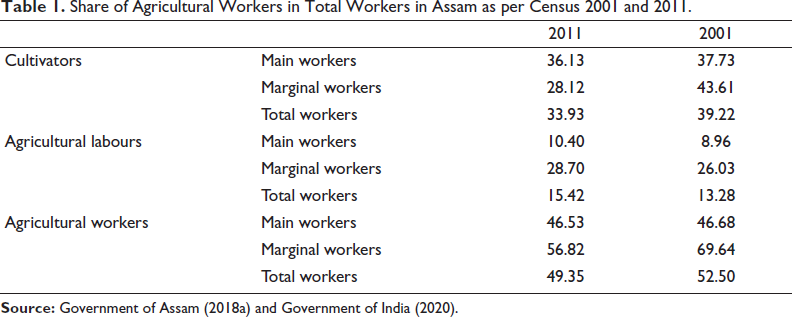
Share of Agricultural Workers in Total Workers in Assam as per Census 2001 and 2011.
The rest of the article is organised in four sections. Section II includes a brief description of the study area, followed by a discussion on the data source, sampling procedure and empirical model in Section III. The results and discussion are presented in Section IV. The final section concludes the major findings of the study with policy implication.
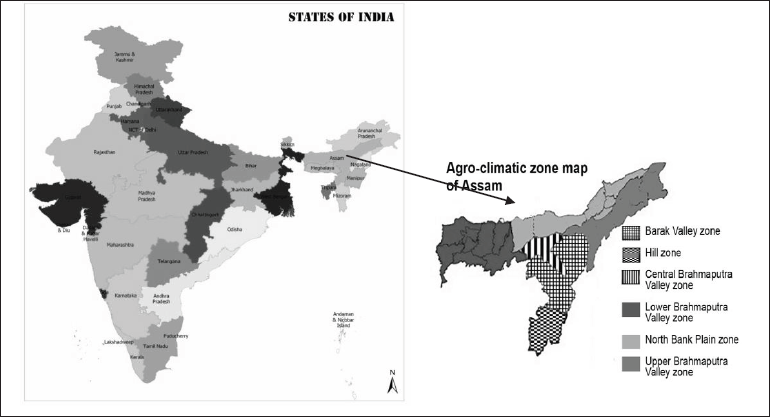
Assam is located at the centre of northeastern part of India between the latitudes of 24°08′ N and 27°09′ N and the longitudes of 89°42′ E and 96°10′ E covering 2.4 per cent of total geographical area of the country. As per Census 2011, the share of Assam in India’s total population was 2.58 per cent and 85.90 per cent of the state population are rural (Government of Assam, 2019). The Brahmaputra Valley is the biggest natural division among the three broad natural divisions. The valley, which constitutes around 72 per cent of the geographical area of Assam (Dutta, 2011), is a long strip of plain land extending from the western part of the state to its north-eastern part, and the mighty river Brahmaputra passes through it. Assam is divided into six agro-climatic zones on the basis of geographic terrain, soil characteristics and pattern of rainfall and four of them belong to the Brahmaputra Valley. The four agro-climatic zones of the valley are lower Brahmaputra Valley zone, central Brahmaputra Valley zone, north bank plain zone, and upper Brahmaputra Valley zone as presented in Figure 1.
Data Source and Sampling Procedure
The study is based primarily on data collected from field by adopting a multi-stage sampling method during November 2017–February 2018. As field crop cultivation is done in all the districts of the Brahmaputra Valley, four districts were selected from different parts of it to make the sample representative. The selected districts are Baksa, Darrang, Morigaon and Lakhimpur. Baksa and Lakhimpur districts are located respectively in lower and upper parts of the valley. Darrang and Morigaon belong to central part of the valley. Darrang is located in the north side and Morigaon is located in the south side of the central part of the valley. In the second stage, two villages from each sample district were selected by considering the fact that field crop cultivation is extensive in such villages. The sample villages are Barama, Dakhinchupa, Morisuti Pam, Manaha, Upahupara, Bhuktabari, Deolia Gobindapur and Dulia Gaon. Finally, a total of 237 households engaged in field crop cultivation were selected as the ultimate sampling unit. The sample households constitute around 10 per cent of households engaged in field crop cultivation in sample villages.
Empirical Model
The role of hired agricultural labour in crop production sector has been examined by looking into the contribution of availability of such labour in farm operation and adoption of production and productivity-enhancing practices. Accordingly, the extent and magnitude of use of agricultural labour by hiring are compared across size groups and activities to understand the role of use of agricultural labour in farm operation. The extent of hiring is measured in terms of the percentage of sample farmers who use hired agricultural labour, and the magnitude of hiring of such labour is obtained in terms of the use of hired agricultural labour per hectare of gross cropped area (GCA).
Econometric models have been used to examine the impact of availability of agricultural labour for hiring in adoption of production and productivity-improving practices. Cropping intensity and crop diversification are considered as the two indices of adoption of production and productivity-enhancing practices.
Cropping intensity is calculated using the formula given as:

Where, NSA is the net sown area.
For measurement of crop diversification, Herfindahl Index (H), one of the commonly used indexes, is considered. Using the Herfindahl Index, crop diversification index is formulated as:

Where, H =
The value of CD is bounded between 0 and 1 such that the higher value indicates greater extent of diversification and vice versa.
The independent variable in the regression analysis is the availability of agricultural labour for hiring. Since the availability of agricultural labour for hiring is not possible to measure directly, wage of such labour is used as a proxy, which bears a negative relation with labour supply and positive relation with its demand. Higher wage depicts lesser availability of agricultural labour for hiring and vice versa. It is found that there are different forms of hiring of agricultural labour in sample villages. As clubbing of wages under different forms is not possible, wage under daily-based form which happens to be the dominant one in the study area is taken for the analysis here. It is well accepted that there is a wage gap between male and female labours. Comparison of daily average agricultural wage of field labour in Assam as well as India for the period 2010–2011 to 2016–2017 depicts that male wage exceeds female wage both in nominal and real value (Das & Kalita, 2021). Similarly, wage of agricultural labour is varying activity-wise. Hence, first the average wage paid by sample households in a village for each type of activity is calculated separately for each sex category. Thus, average wage of agricultural labour of sex g used for activity j in village k is calculated as:

Where, g is gender of hired labour, i is sample household-hired agricultural labour of gender g in village k for j activity under daily-based form, j is activity for which agricultural labour is hired, k is village, and m is number of households in village k hired agricultural labour of gender g for activity j under daily-based form.
Next, the final wage under daily-based form for agricultural labour of sex g paid by sample households in village k for different activities is calculated as:

Where, n is number of activities for which agricultural labour of gender g is hired in village k on daily basis.
Finally, wage variable for regression analysis is derived by substituting the calculated final wage for villages against the sample households that belong to concerned village. For the robustness of the results, two regressions considering male wage and female wage separately have been used for both the dependent variables. However, as hiring of male agricultural labour under daily-based form in Dulia Gaon was not reported by any sample household during the field study, the wage rate stated by Gaonburah (village headman) has been used in the analysis.
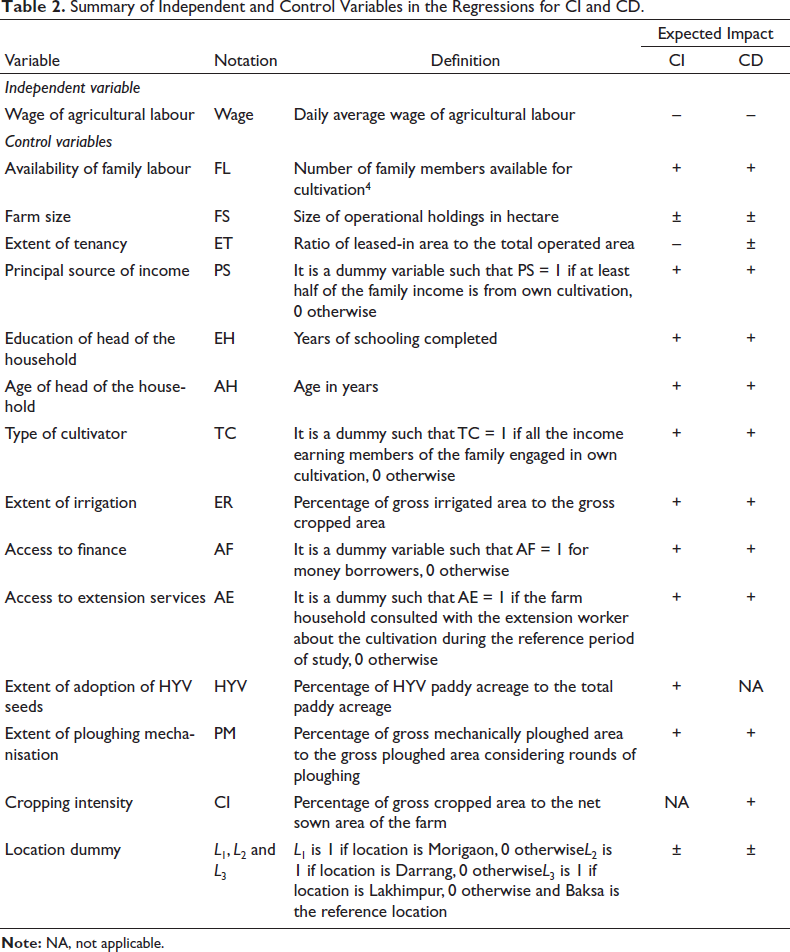
Apart from the availability of agricultural labour for hiring, there are many other factors affecting cropping intensity and crop diversification. The literature reveals that tenancy affects cropping intensity (Goswami, 2012) and crop diversification (Dutta, 2011; Goswami, 2012). It was found that the impact of tenancy on crop diversification can be both positive and negative. Irrigation has also some impact on cropping intensity (Agarwal, 1984; Dhawan & Datta, 1992; Karunakaran & Palanisami, 1998) and crop diversification (Goswami, 2012; Mandal & Bezbaruah, 2013). Farm size is found to be another determinant of cropping intensity (Agarwal, 1984) and crop diversification (Mandal, 2014; Mandal & Bezbaruah, 2013). However, although a positive impact of farm size on crop diversification is depicted by Mandal and Bezbaruah (2013), considering the impact of cropping intensity on crop diversification as found by Saud (2017), reverse can also be anticipated if smaller farmers cultivate more intensively. Moreover, while negative impact of farm size on cropping intensity is evident (Agarwal, 1984), it is also possible that poor economic condition of smaller farmer may limit their intensive cultivation by restricting the accessibility to farm inputs especially the non-labour inputs. Similar to the availability of hired agricultural labour, availability of family labour is likely to raise cropping intensity and crop diversification. Interference of access to credit and access to extension services needs to be controlled in the analysis of the impact of availability of agricultural labour for hiring on cropping intensity and crop diversification as while the former can contribute helping in procurement of farm inputs, the latter can play the role through raising awareness about the new and improved farming technique, better varieties of seeds and so on. Education of farmer can play the same role as extension services in intensive and diversified cultivation. Cropping intensity and crop diversification may depend on age of farmers since they become more experienced as the time passes. Compared to traditional varieties of seeds, high-yielding variety (HYV) seeds get matured in shorter period of time and hence, the area under HYV seeds can augment cropping intensity. We can also expect higher cropping intensity and crop diversification if cultivation is the only or principal source of income of a farm family. Moreover, by making ploughing easier and reducing the time involved in it, ploughing mechanisation can contribute to cropping intensity (Agarwal, 1984) and thereby to crop diversification too.
There are some location-specific characteristics which can affect cropping intensity and crop diversification. Accordingly, three location dummies are used to control the interference of such factors in regression analysis. Table 2 presents the details of all explanatory variables.
Summary of Independent and Control Variables in the Regressions for CI and CD.
The baseline models corresponding to dependent variables CI and CD are formulated as:


The Model Specification
Usually, in case of corner point solutions, we use the specification such as Tobit, Heckman Selection model or Cragg’s Double Hurdle model (Cragg, 1971). Heckman Selection model is suitable if we are examining determinants of adoption decision and quantity decision separately assuming disturbance terms are correlated. On the other hand, if disturbance terms are assumed to be independent, use of Craig’s Independent Double Hurdle model is suitable. However, in the present case, both adoption and quantity decision of intensive and diversified cultivation are assumed to be affected by same set of factors and hence Tobit specification is found appropriate.
The dependent variable CI has a lower limit at value 100 and we also have a cluster of observations at that value. Hence, a TOBIT regression with left censoring is formulated corresponding to Equation (5) as:

Where,
The dependent variable CD ranges from 0 to 1 and there are some observations having value 0 in our data set. Therefore, corresponding to Equation (6), left-censored TOBIT regression is formulated as:

where,
Hired Agricultural Labour and Farm Operation
Table 3 depicts that a total of 69.62 per cent of sample farmers are dependent on agricultural labour irrespective of their farm size which shows the scarcity of manpower for farming even among the small and marginal farmers. Across size classes of operational holdings, the extent of farm household dependent on agricultural labour ranges from 56.41 per cent to 100 per cent. On an average, the extent of hiring of agricultural labour is found to be more among larger size group farmers. However, in terms of man-days, it is found that hired agricultural labour has a share of 16.90 per cent in total farm labour used in the reference period. Thus, the magnitude of hiring of agricultural labour is lower than its extent. Here, it is to be noted that the working hour for hired labour is fixed while it is not so in case of family labour. Given that there is a limit up to which an individual can work normally in a day, the number of family labour works more than hired labour in a day is expected to be less than the number of former type works less than the latter type. As working hour of own labour is not counted in the present study due to difficulties in collection of such data, it is felt that the magnitude of hiring could be more than calculated one if man-days are counted considering the working hour of family labour. The magnitude of hiring is found to be varied from 11.88 per cent to 60.43 per cent across size groups and it also bears more or less a positive relation with farm size like the extent of hiring.
Extent of Dependency on Hired Agricultural Labour.
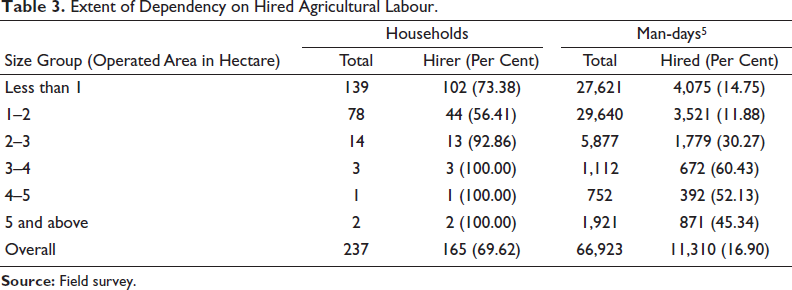
Extent of Dependency on Hired Agricultural Labour.
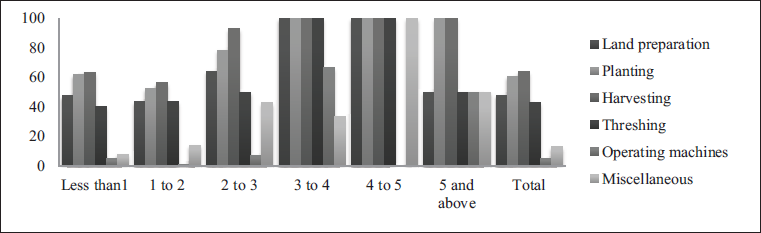
It is found that agricultural labours are hired for performing different types of activities. Figure 2 presents that hiring of agricultural labour is highest for harvesting (63.71 per cent) followed by planting (60.76 per cent). The extent of hiring of agricultural labours for activities such as land preparation, threshing, operating machines and miscellaneous are 48.10 per cent, 43.04 per cent, 5.06 per cent and 13.08 per cent, respectively. It is seen that while larger farmers hire agricultural labour more or less equally for all types of activities, small and marginal farmers hire such labour mostly for activities requiring group efforts.
The use of hired agricultural labour per hectare of GCA is 44.68 man-days in the reference period (Table 4). Across size groups, the use of hired agricultural labour per hectare of GCA ranges from 29.75 man-days to 174.13 man-days. By activities, like the extent of hiring, highest intensity of use of hired agricultural labour is for harvesting (17.92 man-days) followed by planting (14.29 man-days). In case of land preparation, threshing, operating machines and miscellaneous activities, the intensity of use of hired agricultural labour are 6.47 man-days, 2.19 man-days, 1.55 man-days and 2.25 man-days, respectively.
Use of Hired Agricultural Labour (in Man-Days) per Hectare of Gross Cropped Area (GCA).
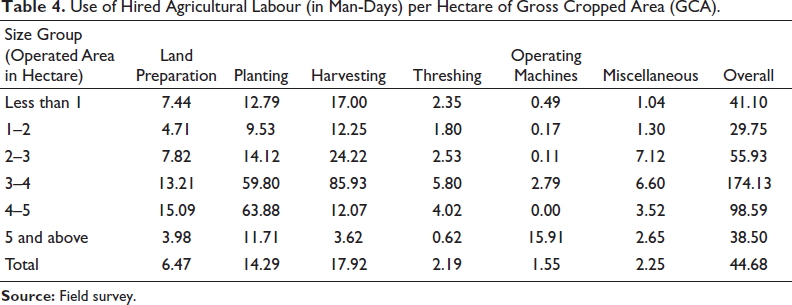
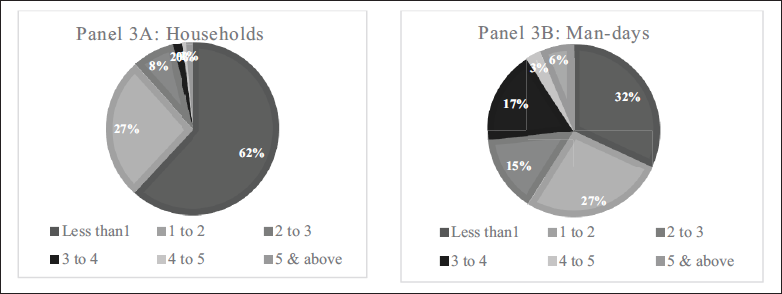
Figure 3 depicts that around 89 per cent of agricultural labour hiring farmers are small and marginal and their share in total man-days of hiring of such labours is 59 per cent. Thus, even though the extent of hiring of agricultural labour is more among larger farmers, it is the small and marginal farmers who benefited more from the availability of such labour for hiring.
Impact of Hired Agricultural Labour on Cropping Intensity and Crop Diversification
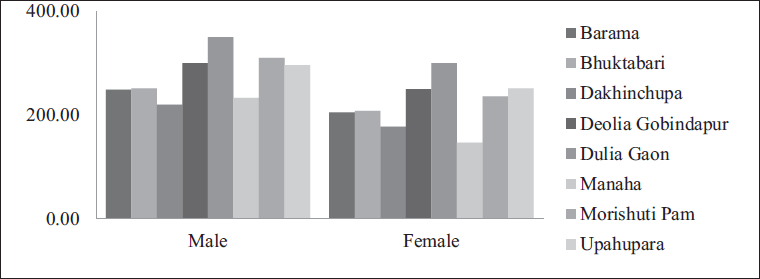
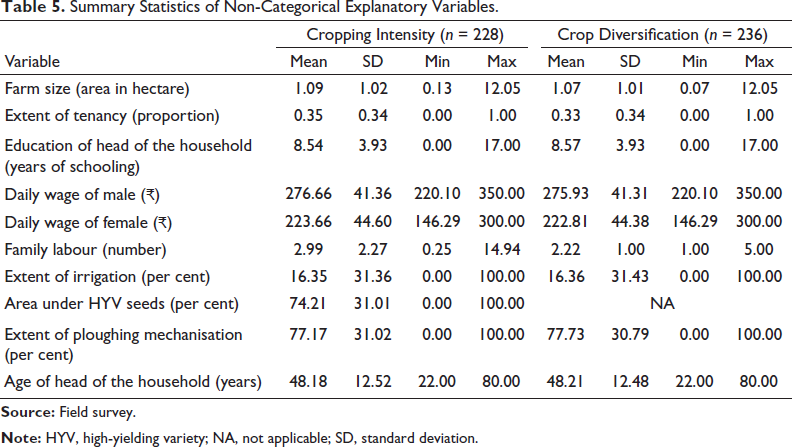
There is a large variation in daily average wage of agricultural labour across sample villages for both male and female (Figure 4). The daily average wage for male agricultural labour ranges from ₹220.10 (Dakhinchupa) to ₹350.00 (Dulia Gaon) and in case of female agricultural labour, it varies from ₹146.29 (Manaha) to ₹300.00 (Dulia Gaon). Thus, like for the country as whole as evident from agricultural wage data for the period 2019–20 (Government of India, 2021b), market for hired agricultural labour in the study area is also fragmented. It implies that agricultural labour is not equally available in sample villages, which may have serious implications in adoption of land productivity-enhancing practices, and hence, regression analysis has been carried out for examination of presence of such implications. Table 5 presents the summary statistics of non-categorical explanatory variables included in the models.
Summary Statistics of Non-Categorical Explanatory Variables.
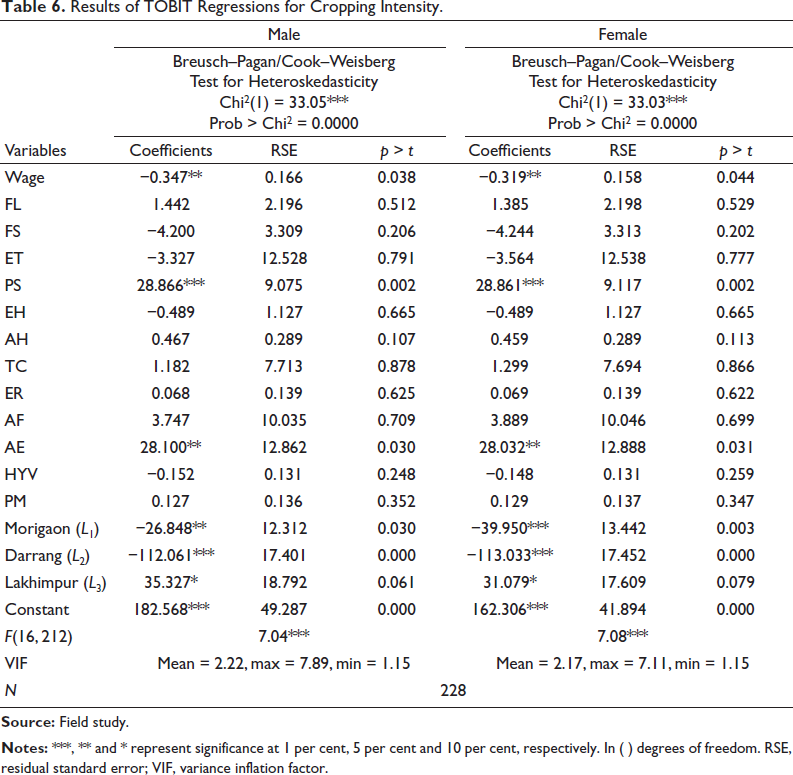
The results of regressions for impact of availability of agricultural labour for hiring on cropping intensity and crop diversification are presented in Tables 6 and 7, respectively. Wage of agricultural labour, used as proxy for availability of agricultural labour for hiring, is the focus variable in the regression analysis and its coefficient is turned out to be significant with negative sign in case of both cropping intensity and crop diversification. Thus, a positive impact of the availability of agricultural labour for hiring on cropping intensity and crop diversification is evident from the present study.
Results of TOBIT Regressions for Cropping Intensity.
Results of TOBIT Regressions for Crop Diversification.
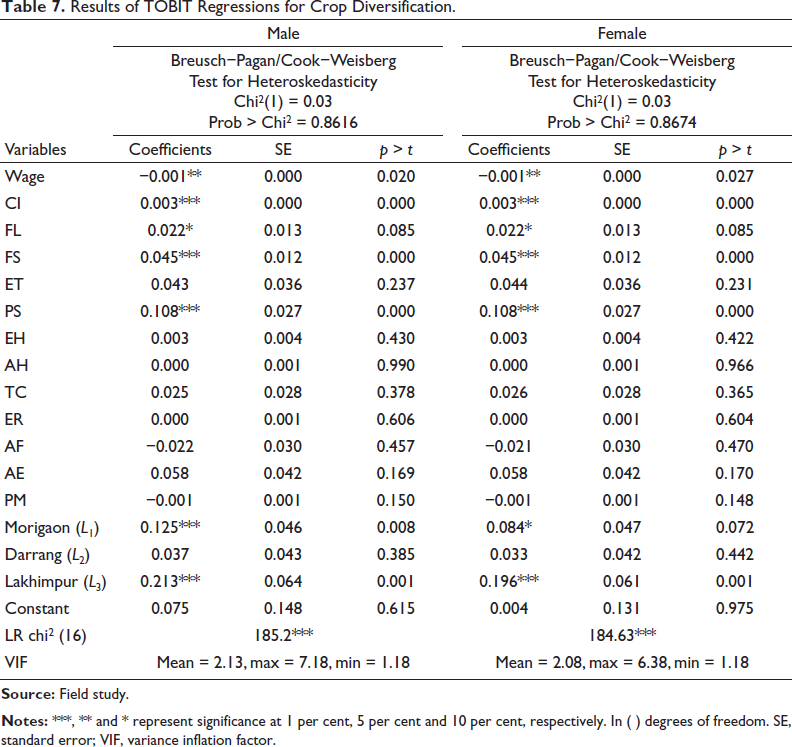
Among the control variables, the coefficient of FS is positive and significant in case of CD. It shows greater extent of crop diversification among larger size group farmers. The coefficient of AE is significant with positive sign with respect to CI which indicates a positive impact of access to extension services on cropping intensity. The significant and positive coefficient of PS with respect to CI and CD depicts the more intensive and diversified cultivation by farmers for whom agriculture is the principal source of income. It is also found that the coefficients of CI and FL are positive and significant for crop diversification. Thus, improvement in cropping intensity and availability of more family labour facilitate cultivation with diversified crop profile. The location dummies L1 and L2 are negatively significant and L3 is positively significant in case of cropping intensity. Regarding crop diversification, L1 and L3 are significant with positive coefficients. Thus, location-specific characteristics have some impact on both cropping intensity and crop diversification which makes such practices varied across locations.
By examining the role of hired agricultural labour in crop production, our analysis found an extensive dependency on such labour for farm operation irrespective of size groups. As a whole, more than two-third of sample farmers is found to be dependent on hired labour for farming and as expected, the extent of dependency on hired agricultural labour is more among the larger size group farmers. Activity-wise, small and marginal farmers are dependent on hired agricultural labour mainly for activities such as planting, harvesting, land preparation and threshing whereas larger farmers are dependent on such labour somewhat equally for each type of activity.
Apart from the farm operation, hired agricultural labour is found to have great role in augmenting agricultural production and productivity. Econometric analysis reveals that greater availability of agricultural labour for hiring significantly contributes in improvement of cropping intensity and crop diversification.
It is found that hired agricultural labour has a major role in crop production in the Brahmaputra Valley of northeastern part of India. However, the serious concern is the fragmented nature of the markets for such labour in the study area, which is in fact true for the county too, as it reduces the market efficiency. Therefore, adequate government intervention is desirable for the better outcome of the market.
The impact of availability of agricultural labour for hiring is captured using wage as the proxy variable which is an important limitation of the study. Further, it is basically a demand side analysis of hired agricultural labour ignoring the supply side. Thus, there is scope for further study on the role of agricultural labour in crop production adopting better method of measuring availability of agricultural labour for hiring and covering both demand and supply sides.
Footnotes
Declaration of Conflicting Interests
The authors declared no potential conflicts of interest with respect to the research, authorship and/or publication of this article.
Funding
This article is an outcome of the project entitled ‘Agricultural Labour Market and Farm Operation: A Study in Assam of North East India’ sponsored by Centre for Development Studies, Department of Economics, Rajiv Gandhi University, Arunachal Pradesh, India.
