







Abstract
The existing literature has studied the impact of remittance inflow on climate change for several developing countries. However, the existing literature has not adequately addressed how different levels of remittances asymmetrically affect climate change. In this study, we address this research gap using the multiple threshold non-linear autoregressive distributed lag approach. Our study demonstrates how minor, moderate and major changes in remittances influence climate change differently. Our analysis, based on time-series data for Nepal, reveals that minor, moderate and major changes in remittances have an asymmetric impact on climate change. In the long run, a minor rise in the inflow of remittances has a significant negative effect on climate change, a moderate rise has a large positive effect and a major rise has a positive effect, although smaller than that of a moderate rise. Thus, we observe an inverted ‘U’-shaped relationship between remittances and climate change. Additionally, we present a new conceptual framework to discuss this phenomenon. Prior studies have employed the non-linear autoregressive distributed lag (NARDL) model to examine this topic, but such analysis is absent in the Nepalese context. Therefore, we also apply the NARDL model to assess how positive and negative shocks in remittances influence climate change. Our findings confirm the asymmetric effect of remittances on climate change under the NARDL framework as well.
Introduction
In an increasingly globalised world, remittances (REM) play a significant role in the economies of developing countries. Previous studies have explored the role of REM in these economies (Siddique et al., 2012; Sutradhar, 2020). REM are pivotal for economic growth (Ratha, 2013), poverty reduction (Chimhowu et al., 2005), financial development (Azizi, 2020) and overall improvements in living standards (Koc & Onan, 2001). Recently, attention has turned to how REM influence climate change. However, studies exploring how REM influence climate change predominantly rely on linear relationships. Nonetheless, a few studies consider non-linearity in this relationship (Ahmad et al., 2019; Neog & Yadava, 2020). These studies demonstrate how a rise or fall in REM affects climate change asymmetrically. Thus, it is beyond the scope of existing research to examine how minor to major changes in REM affect climate change. Our study aims to fill this research gap by developing a new conceptual framework and providing empirical evidence.
Previous studies at the country level have discussed the relationship between REM and climate change; however, these studies are limited to either linear relationships or asymmetric non-linear relationships based on rises and falls in REM values (Ahmad et al., 2019; Karasoy, 2021). Moreover, such studies are rare in the context of the Nepalese economy. Hence, this study aims to demonstrate how REM influence greenhouse gas (GHG) emissions in Nepal. Moreover, we have chosen Nepal as our sample country because the conceptual framework discussed in Section III requires a country with heavy dependence on REM. In such economies, REM play a critical role and are likely to have a significant impact on climate change as well.
Nepal has a long history of labour migration (Seddon et al., 2002), and REM are one of the central pillars of its economy. REM serve as the country’s primary source of foreign currency (Kaphle, 2018). REM contribute more than 30% to Nepal’s GDP, making it one of the most REM-dependent economies globally (Chhetri et al., 2020). The impact of REM on the Nepalese economy has been extensively studied. Devkota (2014) found that REM reduce poverty in Nepal but exacerbate inequality. Furthermore, REM are a significant determinant of Nepal’s economic growth (Srivastava & Chaudhary, 2007). However, REM make the Nepalese economy consumption-driven, reducing incentives for investment in capital goods. Moreover, REM exacerbate brain drain, distorting Nepal’s labour market.
Although the relationship between REM and climate change may seem unrelated, REM can contribute to climate change in various ways. By raising living standards, REM increase energy demand. Additionally, REM drive aggregate demand and economic growth, which in turn trigger GHG emissions. REM also foster financial development within the economy. The link between financial development and climate change is well-documented (Nasir et al., 2019; Qamruzzaman, 2023). Further, REM provide financial support that enables vulnerable households to adapt to climate change and adopt more sustainable livelihoods. They also empower recipient governments financially, potentially facilitating increased green investments. Figure 1 illustrates the theoretical pathways through which REM impact climate change.
Graphical Representation of the Nexus Between Remittance Inflow and Climate Change.
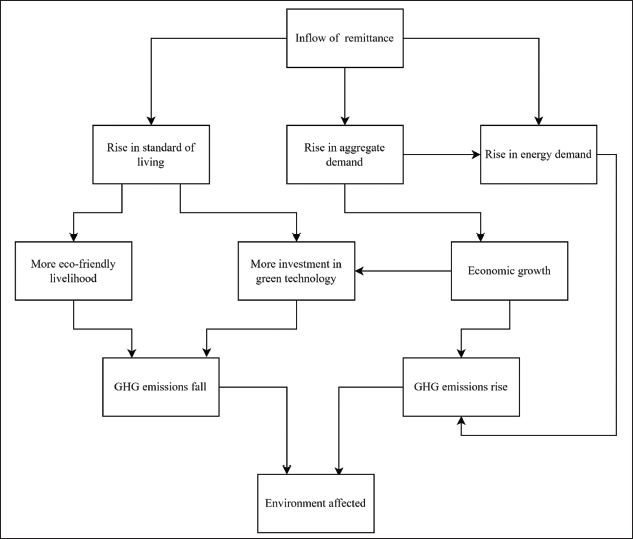
Graphical Representation of the Nexus Between Remittance Inflow and Climate Change.
Given that REM play a pivotal role in GHG emissions, this study examines how REM affect GHG emissions in Nepal. Further, our study makes a methodological contribution. We address how REM affect climate change non-linearly, moving beyond the simple linear framework employed in previous studies. Earlier research on this topic, particularly in the context of Nepal, used linear methods to examine the relationship between REM and climate change (Sharma et al., 2019). While studies at the country level have explored this relationship using non-linear frameworks, these primarily focused on the asymmetric effects of REM on GHG emissions. Such studies, using the non-linear autoregressive distributed lag (NARDL) model, have shown how increases and decreases in REM asymmetrically or heterogeneously affect GHG emissions (Karasoy, 2021; Neog & Yadava, 2020). However, our study goes a step further by employing an extension of the NARDL model—the multiple threshold non-linear autoregressive distributed lag (MTNARDL). This approach allows us to demonstrate how minor to major changes in REM affect GHG emissions heterogeneously. Here, we decompose the independent variable (REM) based on its quantiles and analyse how different levels of REM impact GHG emissions differently. This represents a novel contribution to the existing body of research. Additionally, while NARDL has been applied to study the effects of REM on climate change in other countries, no prior research has examined this relationship in the context of the Nepalese economy. Consequently, the literature lacks insights into how rises and falls in REM asymmetrically affect climate change in Nepal. To fill this gap, we also apply the NARDL model to illustrate how increases and decreases in REM influence climate change asymmetrically in Nepal.
Most research on climate change focuses on carbon dioxide (CO2) emissions. However, nitrous oxide (N2O) is also a significant gas of concern. Although the concentration of N2O in the atmosphere is much lower than that of CO2, its global warming potential is approximately 300 times greater (Sinha & Sengupta, 2019). The rising concentration of N2O in the atmosphere is one of the leading contributors to climate change and stratospheric ozone depletion (Tian et al., 2020). While some prior research has used N2O as a proxy variable for climate change (Bui et al., 2023; Kwakwa et al., 2023; Och, 2017), most studies analysing the relationship between the economy and climate change primarily focus on CO2 and largely overlook N2O (Sinha & Sengupta, 2019). In the context of the Nepalese economy, a few prior studies have used CO2 emissions as an indicator of climate change, but these studies have largely ignored the significance of N2O (Bastola & Saptoka, 2015; Mehmood et al., 2022; Raihan & Tuspekova, 2022). Hence, in this article, we take N2O as an indicator of climate change. By doing so, we not only address our research objective of understanding how REM affect climate change but also highlight the importance of N2O emissions, adding a new dimension to the analysis.
Importance of REM for Developing Countries with Particular Reference to Nepal
For developing countries, the importance of REM is well-documented in the existing literature (Amuedo-Dorantes & Pozo, 2014; Buch & Kuckulenz, 2010; Milanovic, 1987). REM have contributed to foreign exchange earnings, trade balance, macroeconomic stability and other important economic and social indicators (Akeerebari, 2022; Anyanwu & Erhijakpor, 2010; Chimhowu et al., 2005; Pradhan et al., 2012; Solimano, 2004). Le (2011) developed a model exploring the nexus between REM and economic development, a relationship that has also been empirically verified (Dang, 2015; Deonanan & Ramkissoon, 2018; Goschin, 2014). Narayan et al. (2011) found that in developing countries, REM not only drive economic growth but also generate inflation. The impact of REM on unemployment and labour migration has also been examined in previous studies (Asad et al., 2016; Okeke, 2021). Additionally, REM are shown to reduce poverty in recipient countries (Adenutsi, 2011). In the Nepalese context, Acharya and León-González (2013) empirically demonstrated that REM reduce poverty but exacerbate income inequality.
REM also enhance the economic well-being of Nepalese citizens (Wagle & Devkota, 2018). Furthermore, REM positively contribute to human capital formation in Nepal, although they adversely affect the country’s trade competitiveness (Banjara et al., 2020). Bhatta (2013) found that REM contribute to a rise in Nepal’s trade deficit. Through causality analysis, Ranamagar and Upadhyaya (2022) identified REM as a significant determinant of economic growth in Nepal. Several other studies have also highlighted the role of REM in accelerating Nepal’s economic growth (Lamsal, 2023).
Climate Change in Nepal
Nepal is highly vulnerable to climate change due to its ecological hotspots and mountainous terrain (Bhattacharjee et al., 2017). Climate change has resulted in frequent extreme weather events, rising temperatures and alterations in precipitation patterns in the country (Anup, 2017). Rijal (2014) found that climate change adversely affects Nepal’s tourism-based local economy. Since tourism is the second largest industry in Nepal after agriculture, the repercussions of climate change on this sector are critical. Similarly, climate change has a profound effect on Nepalese agriculture, which serves as the backbone of the economy (Malla, 2009). Furthermore, climate change threatens Nepal’s biodiversity. Karki and Gurung (2012) identified its detrimental impact on the country’s rich ecological diversity, while Bhatt (2021) emphasised the broader risks to Nepal’s fragile ecosystems. In addition to its environmental and economic effects, climate change also affects public health outcomes in Nepal. Dhimal and Bhusal (2010) highlighted the increasing health risks associated with changing climate conditions, and Tomé et al. (2021) noted that Nepal’s population is among the most vulnerable to the adverse health consequences of climate change.
REM Inflows and Climate Change
In recent times, the relationship between REM and the environment has garnered significant attention. Karasoy (2021) found that REM negatively impact environmental quality in the Philippines. Khan et al. (2022) identified a positive association between REM and carbon emissions in countries such as Australia, Germany and India. Ahmad et al. (2019) developed a five-stage conceptual framework to explore the relationship between REM and GHG emissions in China. According to their framework, REM increase household income, leading to higher consumption and aggregate demand. Conversely, a rise in savings due to REM contributes to financial development, and together, these effects drive GHG emissions. Neog and Yadava (2020) explored how REM and financial development jointly contribute to climate change in India. Sharma et al. (2019) provided the only study focusing on the nexus between REM and GHG emissions in Nepal. They found a negative relationship between the two variables, but their analysis was based on a simple autoregressive distributed lag (ARDL) model. Several other studies have examined the relationship between REM and environmental degradation in different countries (Kibria, 2022; Rahman et al., 2023; Yang et al., 2021). However, most of these studies use ARDL, NARDL, fully modified ordinary least squares (FMOLS) and GMM models, which are less efficient compared to the MTNARDL model employed in this study. Additionally, while most studies focus on CO2 emissions, we explicitly focus on N2O in our analysis.
N2O as a Proxy of Climate Change
N2O emissions are closely related to economic development (Sadeghi Shahdani et al., 2021). It is the third most significant contributor to climate change and the leading ozone-depleting agent today (Daniel et al., 2013). Despite this, N2O has not received the attention it deserves in the climate change debate (Naser & Alaali, 2021). Nevertheless, N2O must be targeted in emission control policies (Bouwman et al., 2013). Kwakwa et al. (2023) used N2O to analyse the Environmental Kuznets Curve (EKC) and found an inverted U-shaped relationship between N2O emissions and economic growth. Wang et al. (2017) used N2O as a proxy for climate change in the context of the USA, while Zambrano-Monserrate and Fernandez (2017) did the same in the case of Germany. In developing countries, using N2O as a proxy for environmental degradation is particularly relevant, as these economies often rely heavily on fossil fuel consumption (Bui et al., 2023). Therefore, using N2O as a proxy for climate change is logical in the context of our analysis.
Conceptual Framework
Here, we develop a conceptual framework on the nexus between REM and climate change. In the subsequent sections, we empirically test the model using time-series data. Our framework is based on several assumptions, which are outlined below: Country A has a heavily REM-dependent economy, with a significant share of its national income reliant on REM. REM affect climate change both positively and negatively. On the one hand, REM lead to an increase in aggregate demand, energy demand and economic growth. Thus, through various channels, the rise in REM accelerate GHG emissions and climate change. Let this negative effect of REM on the environment be denoted as κ. On the other hand, REM increase income and empower people to adopt sustainable livelihoods and green alternatives. In our model, a substantial portion of government revenue comes from REM, which motivates the government to invest in green technology. Thus, REM promote the adoption of greener technologies. Let this positive effect of REM be denoted as λ.
Let µ1 and µ2 be two threshold values of REM.
Case I: REM ≤ µ1: In this case, REM inflows are low. REM are so minor that they cannot boost the economy or consumption demand. As a result, REM do not influence climate change. At this stage, however, households receiving REM may abandon their traditional livelihoods, such as dependence on natural resources like forests and wood. In this stage, with a smaller population, due to labour migration abroad, emissions decrease. In this phase, λ dominates κ (i.e., λ > κ).
Case II: µ1 < REM ≤ µ2: This phase represents a moderate REM inflow. Here, κ is stronger. In this phase, REM cause a rise in energy demand and aggregate demand, which drives economic expansion. However, both the government and the population are not yet sufficiently empowered to adopt green technologies, so λ is weaker (λ < κ). As a result, REM negatively impact the environment, causing climate change.
Case III: REM > µ2: When REM inflows are high, the economy experiences significant growth and rising energy demand, contributing to increased GHG emissions. However, at this stage, living standards are high enough for people to adopt sustainable, eco-friendly livelihoods, and the government is better equipped to invest in green technologies. In this phase, λ < κ, similar to the second stage, but the difference between these two effects is less pronounced.
Thus, according to our model, there should be an inverted U-shaped relationship between REM inflow and climate change. In the subsequent sections of the article, we aim to empirically test the validity of this theory.
Data and Methodology
Data
Secondary-level time-series data collected from the World Development Indicator (WDI) Database are used for this analysis. Our independent variable is personal REM received (as a percentage of GDP) (REM), while the dependent variable is N2O emissions (measured in thousand metric tons of CO2 equivalent) (N2O). The data span from Q1 2007 to Q4 2019, resulting in 52 quarterly observations used for this study. This sample size is sufficiently large to yield valid results within the ARDL framework. We collected annual data from the WDI database and then interpolated it into quarterly data sets, effectively transforming the low-frequency data into a high-frequency format. This technique is widely used in time-series analysis and has been employed in several influential studies (Emir & Bekun, 2019; Jyoti, 2021; Meo et al., 2020).
Methodology
In this study, we employ non-linear extensions of the ARDL model. These extensions capture non-linear dynamics while retaining the key advantages of the ARDL framework. Notably, they can address mixed stationarity issues and produce reliable results even with smaller sample sizes. The functional form of our study is as follows:

The specification form of Equation (1) is inspired by the work of Ahmad et al. (2019), who employed a similar structure in their NARDL analysis. In their study, Ahmad et al. (2019) considered REM as the determinant of GHG emissions, demonstrating a functional relationship between the two variables. A common question may arise regarding the potential for omitted variable bias in the presence of a single independent variable in Equation (1). However, the models we use to study our concerned relationship are free from such issues. Our models are based on cointegration, meaning there is a stable long-run relationship between the variables. In the presence of cointegration, any non-stationary variables that are excluded become part of the residual term, which makes the residual term non-stationary and thus violates the condition of cointegration (Everaert, 2011). In the presence of cointegration, the coefficients estimated in the model are super-consistent, and such consistency holds in models with extended independent variables (Herzer, 2020). This contrasts with ordinary least squares (OLS), where the exclusion or inclusion of any independent variable can completely change the nature of the coefficients (Herzer, 2019). Moreover, in ARDL models, the regressors do not need to be cointegrated among themselves. Adding further independent variables may lead to the existence of more cointegrating relationships, which can affect the consistency of the model (Herzer, 2019). Further, our main model is a specific non-linear extension of ARDL known as MTNARDL. In MTNARDL, the common practice is to work with a single independent variable. For instance, the founder of MTNARDL, Verheyen (2013), demonstrated how exports react differently to various changes in exchange rates by using a function with a single independent variable, the exchange rate. Pal and Mitra (2019) employed the MTNARDL framework to analyse how oil price shocks affect the purchasing power of the US dollar. Their study, like ours, used a single independent variable framework, showcasing the model’s ability to capture complex non-linear dynamics. In these MTNARDL works, the supplementary NARDL model uses the same specification. Therefore, in MTNARDL analysis, the common practice in the existing literature is to employ a single independent variable. Consequently, we use the specific specification in Equation (1), where N2O is a function of REM, inspired by existing literature on MTNARDL, the philosophy of cointegrating relationships, and the study by Ahmad et al. (2019).
Our first model is the NARDL model, developed by Shin et al. (2014). Previous research has used the NARDL model to examine how REM affects climate change; however, no such analysis has been conducted in the context of Nepal. In NARDL, a single threshold is taken, and the variable of interest, in this case, REM, is decomposed into two parts through partial sum decomposition. This allows us to determine the asymmetric effect of REM on N2O. The model captures how a rise and fall in REM affect N2O differently, with a Wald test used to further verify the assumption of asymmetry. Both REM and N2O are expressed in natural logarithms in our model.

We use a partial sum decomposition method to attain Equation (2), where:


Thus, the NARDL model can be written as:

In Equation (4),

In Equation (5), ECT is the error correction term, which shows the adjustment rate towards the long-run equilibrium.
Existing studies exploring the relationship between REM and climate change predominantly rely on the NARDL approach. While NARDL effectively captures the asymmetric effects of REM during periods of increase and decrease, it has limitations. NARDL considers only a single threshold value and cannot address scenarios where minor to major changes in REM have different effects on climate change. To address this, we employ the multiple threshold MTNARDL approach, developed by Verheyen (2013). This method decomposes the independent variable into segments based on its distribution quantiles, using thresholds at the 30% and 70% quantiles, which we also adopt for REM in our analysis. Thus, we can write lnREM
t
as:

In Equation (6),



In Equations (7a), (7b) and (7c), the

In MTNARDL, as with ARDL, cointegration is identified using the bounds testing approach. Upon confirming cointegration, the ECM is utilised to capture short-run dynamics while maintaining consistency with the long-run equilibrium. The ECM representation of Equation (8) is expressed as:

The symbols in Equations (8) and (9) remain consistent with those discussed earlier in the NARDL model. Once the model is estimated, we perform diagnostic tests to ensure its robustness. These include checks for heteroscedasticity, autocorrelation, normality of residuals, specification error, model stability and the verification of asymmetric effects.
Table 1 presents the descriptive statistics for lnN2O and lnREM, summarising the nature of the data set used in our study.
Descriptive Statistics.

Descriptive Statistics.
Unit Root Test
The precondition in ARDL and its extensions is that none of the variables should be stationary at the second difference. To ensure this, we test for unit roots using two conventional tests: the Phillips–Perron (PP) test and the Kwiatkowski–Phillips–Schmidt–Shin (KPSS) test. For the PP test, the null hypothesis (H0) is the presence of a unit root, whereas for the KPSS test, H0 is that the time series is stationary. However, these conventional tests do not account for structural breaks, so their results should be interpreted carefully. Hence, we employ a more robust unit root test that considers structural breaks: the Zivot–Andrews (ZA) test. As shown in Table 2, none of the variables in our model are stationary at the second difference, indicating that the extensions of ARDL can be applied without concern.
Unit Root Test.
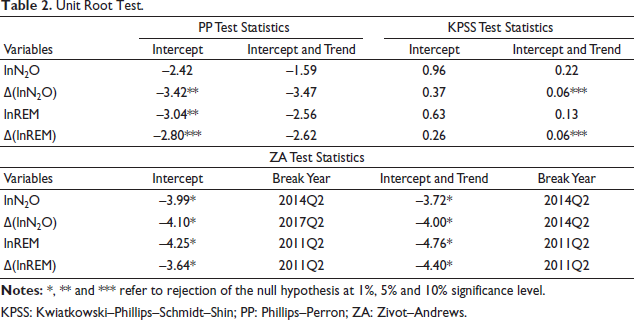
KPSS: Kwiatkowski–Phillips–Schmidt–Shin; PP: Phillips–Perron; ZA: Zivot–Andrews.
Bounds Test
The bounds test is used within the ARDL framework to detect evidence of long-run cointegration. In this test, H0 is that there is no long-run cointegration. Rejecting H0 indicates the presence of long-run cointegration. As shown in Table 3, there is evidence of cointegration in the NARDL and MTNARDL models. However, no evidence of cointegration is observed in the ARDL model. The ARDL model is a simple linear framework, which may fail to capture hidden cointegration. Conversely, when employing more complex non-linear models, evidence of cointegration emerges. In the subsequent section, we do not proceed with the ARDL model as existing research has already been conducted using linear models, and our focus is on exploring non-linear relationships. Moreover, the application of ARDL will not provide results for the long-run relationship between REM and climate change, as we fail to detect cointegration in this model. Therefore, given the evidence of cointegration in the NARDL and MTNARDL models, we estimate these two models exclusively.
Bounds Test.
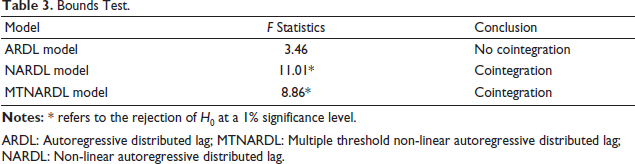
ARDL: Autoregressive distributed lag; MTNARDL: Multiple threshold non-linear autoregressive distributed lag; NARDL: Non-linear autoregressive distributed lag.
Model Estimation
Table 4 presents the results of the NARDL model. The findings indicate that positive shocks to REM have a positive impact on N2O emissions. Specifically, a 1% rise in REM leads to a 0.26% increase in N2O emissions. This occurs because an increase in REM drives economic growth, leading to higher aggregate demand and greater energy consumption, which in turn raises emissions. Conversely, when REM decrease, N2O emissions in Nepal also increase. Notably, the impact of falling REM on N2O is greater than that of rising REM, demonstrating the asymmetric effect of REM on N2O. A 1% fall in REM results in a 0.47% increase in N2O emissions, compared to the 0.26% increase caused by a 1% rise in REM. When REM declines, the economy contracts, limiting resources available for investment in clean technologies and sustainable livelihoods. Furthermore, as REM fall, individuals may turn to more carbon-intensive occupations due to the lack of eco-friendly livelihood alternatives in Nepal. Previously, Sharma et al. (2019) found that when REM increase, carbon emissions decrease in Nepal. Our findings regarding N2O emissions differ from theirs. This highlights that, through a non-linear model, we uncover insights distinct from those obtained using previous linear models. However, the coefficients obtained in our NARDL analysis align with the findings of Neog and Yadava (2020), who demonstrated the asymmetric impact of REM on climate change and concluded that REM affect climate change asymmetrically. Our study also shares similarities with Ahmad et al. (2019), who found that REM impact climate change asymmetrically in China, with rising and falling REM having heterogeneous effects. However, a key contrast with Ahmad et al. (2019) is that we found falling REM have a more intense effect on climate change than rising REM, whereas their study concluded that rising REM exert a dominant effect compared to falling REM.
Results of Non-linear Autoregressive Distributed Lag (NARDL) (2,1,1) Model.
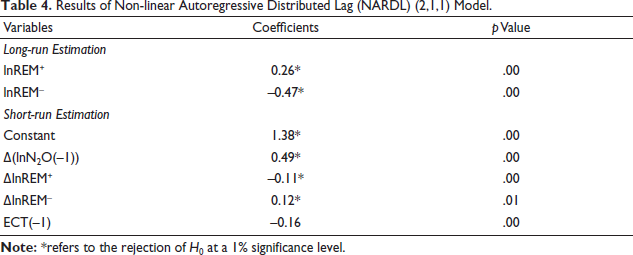
In the short run, the findings differ from the long-run estimation of the NARDL model. An increase in REM leads to a decrease in emissions, with a 1% rise in REM causing a 0.11% reduction in N2O emissions. Conversely, a 1% negative shock in REM results in a 0.12% decrease in N2O emissions. This finding confirms the presence of an asymmetric relationship in the short run, consistent with previous studies such as Ahmad et al. (2019) and Dash et al. (2024).
The effect of REM on N2O differs between the short run and the long run. However, such divergence between short-run and long-run results is common in ARDL and its extension models. This difference is explained by the ECT. The ECT indicates that any divergence from long-run equilibrium arising in the short run is corrected by the model, which converges towards the long-run equilibrium. In Table 4, the coefficient of the ECT confirms that the model adjusts itself and progresses towards long-run equilibrium.
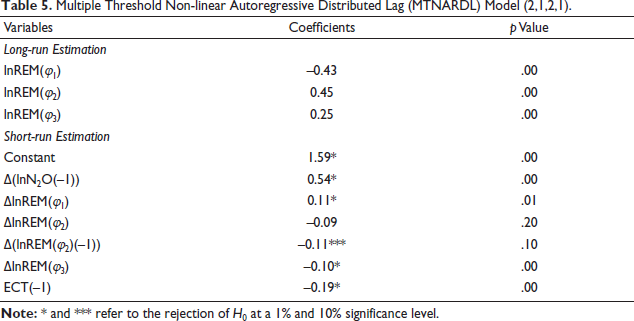
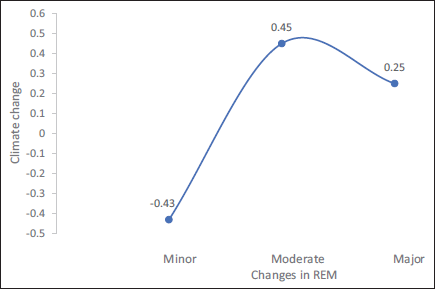
Table 5 presents the results of the MTNARDL model. In the long run, a minor change in REM inversely affects N2O emissions. Specifically, a 1% minor rise in REM leads to a 0.43% reduction in N2O. According to our framework, minor increases in REM are insufficient to significantly raise energy demand or boost aggregate demand in the economy to a level that would adversely impact the environment. However, a moderate rise in REM has a concerning effect on climate change. A 1% moderate increase in REM results in a 0.45% rise in N2O. This is because moderate changes in REM are substantial enough to stimulate economic growth and energy demand, thereby causing higher emissions. Major changes in REM also contribute to climate change, but their impact is less pronounced than that of moderate changes. This is likely because significant REM inflows enable the government to invest in green technologies and encourage people to adopt sustainable livelihoods and eco-friendly practices. At the same time, however, energy demand and aggregate demand remain high. Consequently, while emissions occur, their intensity is lower than with a moderate rise in REM.
Multiple Threshold Non-linear Autoregressive Distributed Lag (MTNARDL) Model (2,1,2,1).
By decomposing REM into minor, moderate and major inflows, we find evidence of an inverted ‘U’-shaped relationship between REM and climate change (see Figure 2). This finding supports our conceptual framework, demonstrating that different levels of REM inflows asymmetrically affect the climate.
Inverted ‘U’-shaped Effect of Remittances (REM) on Climate Change.
In the short run, the effect of REM on N2O differs significantly. A 1% minor rise in REM leads to a 0.11% increase in N2O emissions. A moderate increase in REM, with a one-period lag, has a significant impact on N2O emissions. Specifically, a 1% moderate rise in REM causes a 0.11% decrease in N2O emissions in the subsequent period. Similarly, a 1% rise in major REM results in a 0.10% reduction in N2O emissions. These findings do not align with the long-run results. The inverted ‘U’-shaped hypothesis proposed in our analysis applies only to the long run and has limited relevance in the short run. As such, we do not claim its theoretical applicability in the short run. Nevertheless, the coefficient of the ECT indicates convergence towards the long-run equilibrium, reinforcing the validity of the long-run results.
Interestingly, prior studies have limited the examination of the impact of REM on climate change to the application of the NARDL model. As MTNARDL is a relatively new methodology, with its application gaining attraction only in recent years, no prior studies have utilised the MTNARDL model to address our specific research question. However, as discussed earlier, studies such as Ahmad et al. (2019), Neog and Yadava (2020) and Dash et al. (2024) used NARDL to investigate this topic. These studies demonstrate the asymmetric impact of rising and falling REM at the country or group-of-countries level. Nonetheless, previous research has not considered quantile-based asymmetry, which is a key feature of the MTNARDL approach.
Research examining how REM affect climate change has predominantly relied on linear techniques. For instance, studies such as Karasoy (2021) and Khan et al. (2022) used linear models to establish that REM influence climate change. However, linear models provide a generalised relationship, merely indicating whether REM affect climate change positively or negatively, without delving into potential non-linear dynamics. In contrast, our study employs the MTNARDL model to demonstrate how REM affect climate change non-linearly, using quantile-based decomposition. Our findings reveal an inverted ‘U’-shaped relationship between REM and climate change. While the notion that REM impact climate change in an inverted ‘U’-shaped manner has been explored in prior literature, it has primarily been investigated through linear models with non-linear specifications. For example, Dilanchiev et al. (2024) demonstrated an inverted ‘U’-shaped relationship between REM and climate change for 10 REM-receiving countries. However, their model was linear, incorporating non-linear terms such as REM and its square as independent variables. In contrast, our study utilises the quantile-based MTNARDL approach to highlight this non-linear inverted ‘U’-shaped relationship. Although prior studies have employed linear models with non-linear specifications to explore the inverted ‘U’ hypothesis in other contexts, recent developments in MTNARDL have enabled researchers to test this relationship more effectively. For instance, Uche and Effiom (2021) recently applied MTNARDL to investigate inverted ‘U’-shaped relationships in similar research areas.
Diagnostics
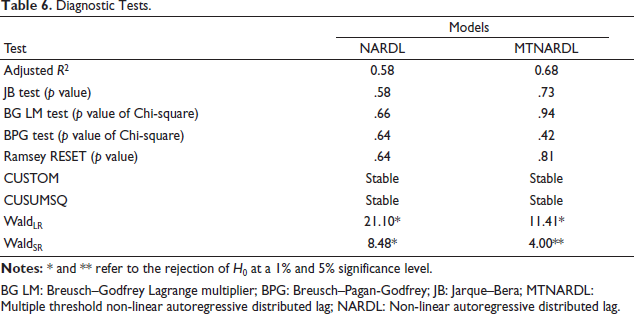
For a robust model, it is essential to satisfy all necessary diagnostic criteria. Both of our models meet these requirements (see Table 6). The models exhibit a highly acceptable goodness of fit, with the adjusted R2 of the MTNARDL model outperforming that of the NARDL model.
The Jarque–Bera test confirms the normality of residuals, as the residuals of both models are normally distributed. Furthermore, neither heteroscedasticity nor autocorrelation is detected in the models. The RESET test verifies that the models are correctly specified. Additionally, both models are stable, as evidenced by appropriate stability diagnostics (see Figures 3 and 4).
Diagnostic Tests.
BG LM: Breusch–Godfrey Lagrange multiplier; BPG: Breusch–Pagan-Godfrey; JB: Jarque–Bera; MTNARDL: Multiple threshold non-linear autoregressive distributed lag; NARDL: Non-linear autoregressive distributed lag.
CUSUM and CUSUMSQ Plot for Non-linear Autoregressive Distributed Lag (NARDL).
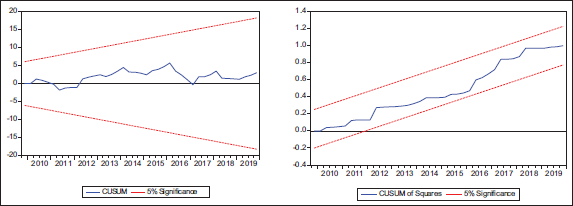
CUSUM and CUSUMSQ Plot for Multiple Threshold Non-linear Autoregressive Distributed Lag (MTNARDL).
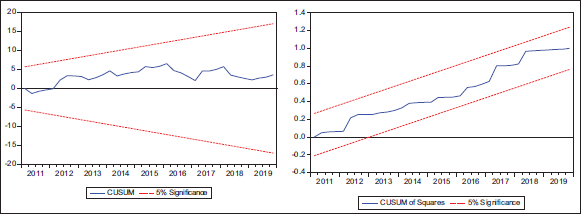
Finally, our analysis provides evidence of both long-run and short-run asymmetries in both models, strengthening the reliability and validity of our findings.
As discussed in Section V, it is evident that REM have a non-linear effect on climate change in Nepal. Although REM contribute to GHG emissions, they also play a crucial role in Nepal’s economy, supporting livelihoods and driving economic growth. Thus, their significance cannot be disregarded. However, as a Himalayan country, Nepal is highly vulnerable to the impacts of climate change. Studies have shown that mountain communities are particularly at risk, facing heightened threats from environmental changes. Given that REM constitute a significant portion of Nepal’s national income and simultaneously exacerbate climate change, policymakers must address these dual challenges with urgency. Major steps should be taken to channel REM income into green investments and renewable energy generation. Households should be encouraged to adopt micro-hydropower systems and solar panels, as Nepal’s geography makes these renewable energy sources highly feasible. To facilitate this transition, the government should provide financial subsidies for the adoption of clean technologies. Additionally, tax incentives should be introduced to encourage the allocation of REM income towards green investments.
Attention must also be given to the nature of consumption funded by REM. A comprehensive micro-level database should be developed to monitor and regulate the allocation of REM income, ensuring it is directed towards environmentally sustainable technologies. Fiscal incentives could further support the consumption and investment shift from carbon-intensive sectors to greener alternatives.
At the community level, initiatives should promote green entrepreneurship through REM-supported microfinance schemes. Such efforts would not only stimulate sustainable economic growth but also mitigate environmental impacts. Raising public awareness about the severity of climate change and its potential impacts on Nepal’s Himalayan economy is essential. Education campaigns should focus on promoting sustainable practices and emphasising the importance of both individual and collective actions in addressing climate risks.
Engaging diaspora communities worldwide is another critical strategy. Their contributions can be mobilised towards sustainability-focused funds, leveraging REM to support green investments and climate resilience projects.
Furthermore, Nepal’s susceptibility to natural disasters is expected to increase due to the adverse effects of climate change. To address this challenge, disaster preparedness funds should be strengthened through REM-supported community initiatives or government programmes.
Conclusion
This study demonstrated the relationship between REM and climate change through a novel framework and explanation. Our empirical approach is also new, as no previous study has addressed this research question using the MTNARDL model. Our model presents several novel findings, with the most significant being the demonstration of how minor to extreme changes in REM cause an inverted ‘U’-shaped effect on GHG emissions. We believe our study advances the literature and adds substantial value to the existing body of research.
However, we must highlight the limitations of our study and provide directions for future research. First, our study is based solely on Nepal, a small economy with a high dependency on REM inflows. While Nepal is an ideal case for examining how REM affect GHG emissions, future research could expand the analysis to other REM-dependent economies to validate our findings. Second, due to data limitations, our study uses a relatively short time frame. Although the sample size of 52 time periods is sufficient to provide robust estimations within the non-linear extensions of the ARDL framework, future studies could consider a longer time span to explore the relationship across a broader temporal context. Third, in the MTNARDL framework, we explored how different levels of REM affect N2O in Nepal by decomposing REM according to its quantiles. Specifically, we examined the effect of different quantiles of REM on N2O within the ARDL framework. However, we only considered quantile heterogeneity for the independent variable. It is also possible that different quantiles of REM might influence different quantiles of N2O. In other words, a model could be developed that accounts for quantile heterogeneity in both the dependent and independent variables. With the growing application of quantile-on-quantile regression, as developed by Sim and Zhou (2015), our study could be expanded further to provide a more comprehensive non-linear analysis by incorporating quantile-based heterogeneity for both the dependent and independent variables.
Data Availability Statement
Data are available on request.
