







Abstract
This study seeks to elicit trends and patterns of employment and labour productivity following the reforms of 1991, along with the association between the two using Capital, Labour, Energy, Materials and Service (KLEMS) data. The findings indicate that since 1991, both employment and labour productivity have been on the rise in India’s manufacturing and service sectors. Additionally, a beneficial relationship between the two is established. However, this research also uncovers other significant insights. First, employment generation has not met expectations, as evidenced by employment elasticity in both sectors. Second, there is a critical need to enhance the long-term performance of employment and labour productivity in manufacturing as well as services. To meet these challenges, it is crucial for industry stakeholders to focus on upskilling and reskilling the existing workforce to elevate productivity and minimise job losses. Efforts must also be made to adopt cutting-edge production technologies so as to improve labour productivity in future, while also emphasising the importance of training.
Introduction
After the reforms of 1991, India’s economy experienced significant changes, with agriculture’s share in employment and GDP declining. On the other hand, those for manufacturing and services sectors rose, but at an uneven pace (Gordon & Gupta, 2005; Joshi & Omkarnath, 2020).
A notable aspect of India’s economic growth over the post-reforms phase has been the robust performance of the services sector. The growth rate of services began to increase in the 1980s and saw a further acceleration in the 1990s, averaging 7.5% annually (Gordon & Gupta, 2005). This is paradoxical, as India, a labour-abundant nation, should have a greater contribution to the manufacturing sector than services. However, surplus labour of the agricultural sector struggles to be absorbed into high-end services, creating a reserve army of labour. These surplus or unwanted workers often find employment in the informal services sector. Despite being a significant part of India’s economy, quality and productivity concerns associated with the services sector cannot take a back seat (Kochhar et al., 2006).
This article analyses employment and labour productivity trends post-reforms and explores their inter-relationship, a unique addition to existing literature that usually examines them separately, using the RBI’s Capital, Labour, Energy, Materials and Service (KLEMS) database. The same provides a comprehensive assessment of employment and productivity patterns in various sectors of India’s economy, making it a valuable resource for research in domestic labour economics (Aggarwal & Goldar, 2019; Joshi & Omkarnath, 2020).
The study is divided into the following sections. In Section I, the theme is introduced. In Section II, a brief review of existing literature on the topic is undertaken. In Section III, the methodology for this study is elicited. In Section IV, the key results of this study and its consequent discussion are undertaken. In Section V, the article is concluded, and its future policy implications are listed.
The next section reviews existing literature on the topic.
Review of Literature
This section examines existing literature to clarify employment and productivity trends in India’s manufacturing and service sectors, laying the groundwork for subsequent data analysis.
Employment and Productivity Patterns in India’s Manufacturing Sector
India’s manufacturing sector saw a boost in employment post-1991, thanks to opportunities brought by liberalisation, privatisation and globalisation. However, growth in manufacturing employment slowed after the 1980s. Despite a slight increase in sectoral shares in employment (from 10.4% to 11.8% between 1980–1981 and 2015–2016), most employment shifts have been from agriculture to services rather than manufacturing (Aggarwal & Goldar, 2019; Papola, 2012). Notably, while agriculture contributes 15% to India’s gross value added (GVA), it employs 42% of the workforce, whereas services, employing 31% of workers, contribute over 53% to the country’s GVA (Aggarwal & Goldar, 2019; Ghose, 2016; Krishna et al., 2017). This indicates lower labour productivity in manufacturing, consistent with global trends, as also falling employment elasticity in the sector (Aggarwal & Goldar, 2019; Joshi & Omkarnath, 2020; OECD, 2016). Reasons for low job creation in manufacturing include reduced labour intensity in exports, increased capital intensity, production relocation and rising trade protectionism (Aggarwal & Goldar, 2019).
Employment and Productivity Patterns in India’s Services Sector
The services sector in India has seen significant growth in both employment and labour productivity since the 1980s (Aggarwal & Goldar, 2019; Mehrotra et al., 2014; Papola, 2012). In 2015–2016, it accounted for 31% of total employment and 53% of India’s GVA (Aggarwal & Goldar, 2019; Papola, 2012). Despite the sector’s high labour productivity and growth, there is a disparity between output and employment due to its increasingly capital-intensive nature (Papola, 2012). While modern services have seen better labour productivity, traditional services have not kept pace, leading to a lack of quality employment opportunities (Prakash, 2023; Prakash & Manyam, 2018). This discrepancy highlights the challenge of balancing the twin objectives of labour productivity and job creation in India’s services sector in the post-reforms period (Prakash, 2023).
Clearly, while existing literature seeks to build bridges between employment and productivity growth in the post-reforms period, it fails to visibly explain the nature of the relationship between employment and productivity growth across the two sectors. This article seeks to fill this research gap.
The next section explains the methodology employed for this study.
Methodology
This study employs India’s KLEMS data for drawing parallels between India’s manufacturing and services sectors and for explaining the nature of the relationship between employment and productivity growth in the same. Data are extracted from the KLEMS data set for the post-reforms period (1991–1992 and afterwards) until 2022–2023 (as per the latest data availability pertinent for this analysis). Techniques of simple tabular and correlation analyses are used. Productivity, for the purpose of this analysis, is coterminous with labour productivity, measured using output (or GVA at current prices) to labour ratios for both manufacturing and services sectors for the period under study. To lend further credence to the central argument, compound annual growth rates (CAGRs) of employment and future employment prospects in the manufacturing and services sectors are calculated using employment elasticities for the period under study (Aggarwal & Goldar, 2019; Balakrishnan, 2004; Joshi & Omkarnath, 2020; Papola, 2012).
The research hypotheses, based on the analysis thus far, are stated as follows:
H0: There is no relationship between employment and labour productivity in India’s manufacturing and services sectors in the post-reforms period.
H1: There exists a relationship between employment and labour productivity in India’s manufacturing and service sectors in the post-reforms period.
The following section presents the results of this study and briefly discusses the same.
Results and Discussion
This section explains the results of the study.
Table 1 explicates the trends and patterns of employment and labour productivity in India’s manufacturing sector from 1991–1992 to 2022–2023.
Employment and Productivity in India’s Manufacturing Sector.
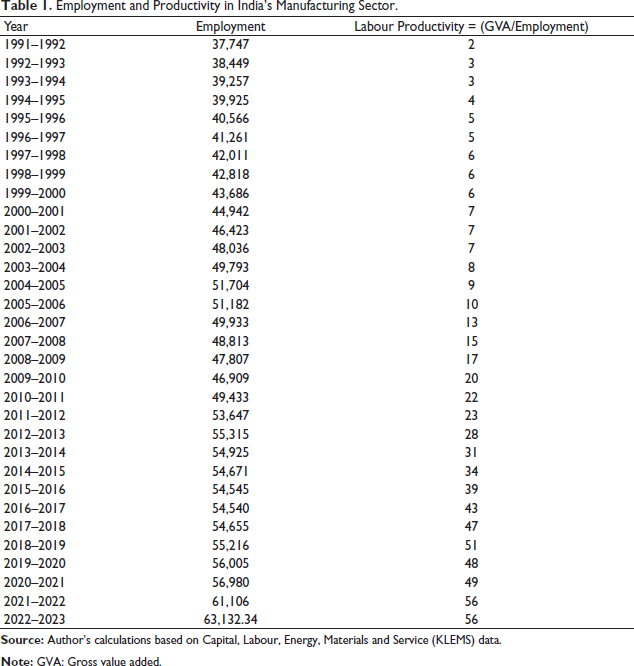
Employment and Productivity in India’s Manufacturing Sector.
As Table 1 shows, both employment and labour productivity have increased in India’s manufacturing sector, implying a positive impact of economic reforms on the same.
Table 2 depicts the CAGR for both employment and labour productivity in India’s manufacturing sector.
Compound Annual Growth Rate (CAGR) for Employment and Productivity in India’s Manufacturing Sector.

As evident from Table 2, CAGR for both employment and labour productivity is low, indicating the need to improve long-term performance for both employment and labour productivity in India’s manufacturing sector.
Table 3 explains the trends and patterns of employment and labour productivity in India’s services sector from 1991–1992 to 2022–2023.
Employment and Productivity in India’s Services Sector.
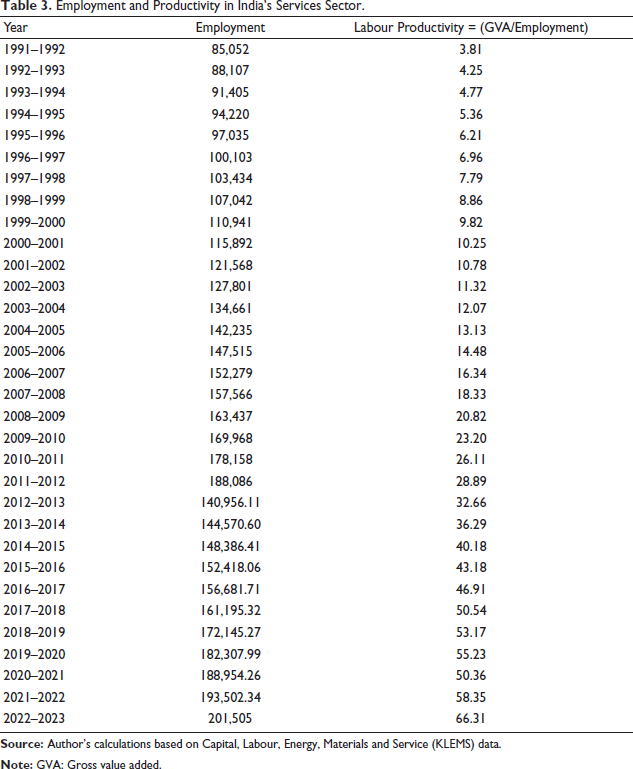
As Table 3 shows, both employment and labour productivity have increased in India’s services sector, implying a positive impact of economic reforms on the same.
Table 4 depicts the CAGR for both employment and labour productivity in India’s services sector.
Compound Annual Growth Rate (CAGR) for Employment and Productivity in India’s Services Sector.

As evident from Table 4, the CAGR for both employment and labour productivity is low, indicating the need to improve long-term performance in both employment and labour productivity in India’s services sector.
Table 5 shows the correlation between employment and labour productivity in India’s manufacturing and services sectors.
Correlation Between Employment and Productivity in India’s Manufacturing and Services Sectors.

As depicted in Table 5, there is a high correlation between employment and labour productivity in India’s manufacturing and service sectors, indicating that high labour productivity may translate into better employment generation. This may come as the sectoral output expands, thanks to increased labour productivity, generating a virtuous cycle of growth, increased consumption and incomes (purchasing power) (Calligaris et al., 2023).
Table 6 depicts employment elasticities for India’s manufacturing and service sectors.
Employment Elasticities for India’s Manufacturing and Services Sectors.

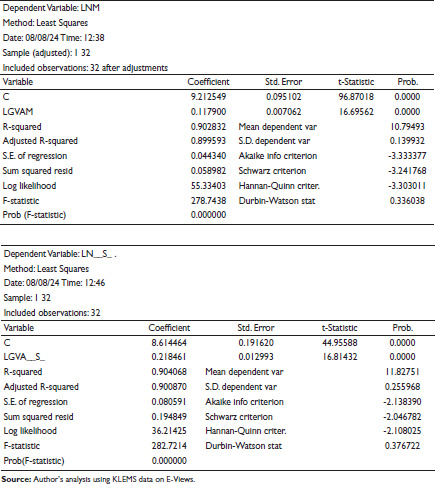
As evident from Table 6, employment elasticities for the country’s manufacturing and services sectors are relatively low, implying lower employment generation for every unit increase in sectoral output.
Based on this study, the null hypothesis of no relationship existing between employment and labour productivity in India’s manufacturing and services sectors is rejected for the post-reforms period.
The last section concludes this study and lists its future policy implications.
This study explores the post-reforms trends and patterns in employment and labour productivity, as well as the relationship between them, in India’s manufacturing and service sectors. Both employment and productivity have increased across the two sectors since 1991, with a favourable relationship between them. However, the study also reveals challenges such as below-par employment generation and the need for long-term performance improvement. To address these issues, industry stakeholders must focus on upskilling/reskilling the workforce to boost productivity, adopting new production technologies and providing adequate training to their workers. This will help enhance labour productivity and reduce job losses in the imminent future. Apart from this, labour-intensive firms with greater employment generation potential must be vertically integrated with global production networks and global value chains (GVCs) to raise employment within Indian industries (Aggarwal & Goldar, 2019; Athukorala & Yamashita, 2006; Calligaris et al., 2023; Hummels et al., 2001; Joshi & Omkarnath, 2020).
Footnotes
Declaration of Conflicting Interests
The author declared no potential conflicts of interest with respect to the research, authorship and/or publication of this article.
Funding
The author received no financial support for the research, authorship and/or publication of this article.

Appendix
| Dependent Variable: LNM | ||||
| Method: Least Squares | ||||
| Date: 08/08/24 Time: 12:38 | ||||
| Sample (adjusted): 1 32 | ||||
| Included observations: 32 after adjustments | ||||
| Variable | Coefficient | Std. Error | t-Statistic | Prob. |
| C | 9.212549 | 0.095102 | 96.87018 | 0.0000 |
| LGVAM | 0.117900 | 0.007062 | 16.69562 | 0.0000 |
| R-squared | 0.902832 | Mean dependent var | 10.79493 | |
| Adjusted R-squared | 0.899593 | S.D. dependent var | 0.139932 | |
| S.E. of regression | 0.044340 | Akaike info criterion | -3.333377 | |
| Sum squared resid | 0.058982 | Schwarz criterion | -3.241768 | |
| Log likelihood | 55.33403 | Hannan-Quinn criter. | -3.303011 | |
| F-statistic | 278.7438 | Durbin-Watson stat | 0.336038 | |
| Prob (F-statistic) | 0.000000 | |||
| Dependent Variable: LN__S_. | ||||
| Method: Least Squares | ||||
| Date: 08/08/24 Time: 12:46 | ||||
| Sample: 1 32 | ||||
| Included observations: 32 | ||||
| Variable | Coefficient | Std. Error | t-Statistic | Prob. |
| C | 8.614464 | 0.191620 | 44.95588 | 0.0000 |
| LGVA__S_ | 0.218461 | 0.012993 | 16.81432 | 0.0000 |
| R-squared | 0.904068 | Mean dependent var | 11.82751 | |
| Adjusted R-squared | 0.900870 | S.D. dependent var | 0.255968 | |
| S.E. of regression | 0.080591 | Akaike info criterion | -2.138390 | |
| Sum squared resid | 0.194849 | Schwarz criterion | -2.046782 | |
| Log likelihood | 36.21425 | Hannan-Quinn criter. | -2.108025 | |
| F-statistic | 282.7214 | Durbin-Watson stat | 0.376722 | |
| Prob(F-statistic) | 0.000000 | |||