






Abstract
Environmental degradation remains a major global issue, with significant implications for the environment and ecological sustainability. This study investigates the relationship between employment and environmental degradation in selected G20 countries, particularly focusing on the impacts of economic growth, renewable energy consumption and trade openness. The study examines long-term relationships using panel data from 1991 to 2021. This employs fully modified ordinary least squares, dynamic ordinary least squares and augmented mean group. The findings show that employment and GDP growth have a considerable impact on carbon footprints, confirming the environmental Kuznets curve hypothesis, which holds that economic growth increases environmental degradation before reducing it at higher income levels. Conversely, renewable energy has a significant adverse relationship with carbon emissions, emphasising its potential for decoupling economic expansion from environmental impact. However, trade openness has an association with higher carbon footprints, which supports the ‘pollution haven’ argument. The study emphasises the importance of integrated policies that balance economic development and environmental sustainability, providing actionable insights for achieving the UN Sustainable Development Goals and the Paris Agreement targets.
Keywords
Introduction
Environmental degradation is considered one of the pressing global issues and generally contributes to climate change (Aladejare, 2022). The lack of coherent regulations to address environmental impact is a significant driver of environmental degradation. As degradation levels increase in one country, it has impacts beyond its borders, affecting global ecosystems and communities (Muhammad et al., 2021). The environmental harm in one region can trigger cascading effects, such as biodiversity loss, climate change and resource scarcity, impacting communities worldwide. This transforms the issue from a localised dilemma into a global challenge. However, addressing this problem is complicated by the need to balance environmental protection with economic growth and income stability. Employment and environmental degradation are global issues illustrating the conflict between growth and preservation (Ali et al., 2024). Economic growth puts more pressure on natural resources, resulting in higher emissions, habitat destruction and depletion (Xu & Zhao, 2023). This is surprising because higher economic activity (measured by employment) is usually linked to job growth in anti-environmental sectors like heavy industry, resource extraction and environmental degradation (Schor, 2015). However, this correlation is complex and varies with economic development and sectoral characteristics. The environmental Kuznets curve (EKC) and the emerging environmental employment curve (EEC) help explain this dynamic (Ajmi et al., 2023). According to the EKC, environmental degradation increases as an economy grows and income rises, but after a certain threshold, degradation declines as societies become wealthier and adopt cleaner technologies and stricter environmental regulations (Ajmi et al., 2023). This means that early economic growth often causes more environmental damage, but as societies become more affluent, they prioritise sustainability and invest in greener solutions, reducing degradation. However, the EEC believes that employment dynamics can affect environmental impacts both positively and negatively (Wang, 2012). In the initial phases of industrialisation, employment growth might lead to more pollution and resource exploitation. Although the relationship between economic growth and environmental degradation still applies to underdeveloped countries relying heavily on primary industries, a shift occurs in developing nations. The relationship between economic growth and environmental impact evolves as economies transition to service-oriented or technologically advanced structures. In such economies, employment and productivity can increase with relatively lower environmental harm compared to industrial or resource-intensive economies, as they rely more on knowledge-based industries, energy-efficient technologies and sustainable practices (Ajmi et al., 2023). This shift demonstrates that economic development and environmental preservation can coexist, provided there is a focus on innovation, cleaner technologies and policies that decouple growth from resource exploitation. In this article, we investigate the prospective empiricism of a broader EEC hypothesis within selected G20 countries by focusing on employment-induced environmental effects or vice versa, presenting specific footprints like carbon and ecological in forming a validating framework against the urgency of the demographic responses. This relationship is explored to offer a more detailed insight into the employment–environment nexus, particularly within G20 countries, representing an essential share of world economic and environmental activity.
Such challenges are associated with significant risks to both human and ecological systems, further complicating the imperative for economic growth and job creation over time, specifically, in developing and emerging economies. It may, however, be suggested that the discussion on EKC has overshadowed the potential role of employment in this equation. In addition, all studies focus on CO2 emissions only and disregard wider environmental effects like the ecological footprint. This is critical for policymakers who must balance economic growth and environmental damage. More so, this research forms part of the few studies dealing with EEC and can provide an interesting perspective on how labour market processes affect environmental sustainability. The study contributes to global policy debates on ongoing efforts like the UN Sustainable Development Goals and the Paris Agreement on climate change.
The remainder of this article is organised as follows. The next Section II discusses literature review. Section III discusses econometric models. Section IV looks at the results and discussions. Finally, the conclusions and policy implications of the study are discussed in Section V.
Literature Review
Existing literature related to carbon footprint and its economic determinants, such as employment, economic growth, renewable energy consumption and trade, can be segregated into four subsections.
Employment and Environmental Degradation
Employment is considered an essential contributor to the development of skills across various life domains and a significant source of personal meaning for many individuals (Saunders & Nedelea, 2014). The relationship between pollution, economic growth and income is extensively discussed in environmental literature, as highlighted by Grossman and Krueger (1995) in their seminal work on the EKC hypothesis. Dinda (2004) showed a positive relationship between environmental pollution and economic growth, with labour market employment linked to environmental sustainability. Okun’s law (1962) states that a country’s unemployment rate is inversely correlated to its total output or income. As a result, the gap between a country’s potential and actual GDP increases in proportion to its unemployment rate. Employment and environmental pollution are, therefore, linked to economic growth. Kashem and Rahman (2020) conducted empirical research on the relationship between environmental degradation and unemployment and discovered a negative relationship. Previous research suggests that environmental pollution and employment may be positively related under certain conditions, particularly when environmental regulations stimulate job creation in pollution control and green technology sectors. This section aims to review existing research on carbon and ecological footprint, including factors such as employment, GDP, renewable energy use and trade openness, which can be divided into separate parts.
Economic Growth and Environmental Degradation
Economic growth contributes to environmental issues due to increased energy consumption, industrialisation and consumer spending. This comprehensive study of the influence of economic expansion on carbon footprints shows the complex relationship between economic growth and environmental degradation. Jaforullah and King (2017) examine CO2 emissions and economic growth in 29 high-income nations from 1991 to 2008, finding support for the EKC hypothesis, which suggests emissions rise with growth and then decline past a certain income level. Knight and Schor (2014) focus on the impact of GDP growth on consumption-based versus territorial emissions, noting a stronger relationship with consumption emissions. Usman et al. (2020) investigate how advancements in the financial sector affect carbon emissions in Belt and Road Initiative countries from 1990 to 2017, utilising regression techniques for robust results. Factors like urban expansion, foreign direct investment and economic growth contribute to increased carbon footprints, as noted by Hafeez et al. (2019), while Usman and Makhdum (2021) emphasise that rising energy demands in growing economies escalate carbon emissions. Salahuddin et al. (2016) investigated long-term relationships among carbon emissions, inflation, GDP growth and trade openness. Their analysis revealed that uncertain GDP and emission trends in Organisation for Economic Co-operation and Development (OECD) countries underline a focus on economic growth that may compromise environmental sustainability.
Renewable Energy Consumption and Environmental Degradation
The relationship between renewable energy consumption and environmental degradation has been extensively studied in recent years, as the global community seeks sustainable solutions to mitigate climate change and reduce ecological harm. Renewable energy from sources like solar, wind, hydro and biomass is promoted as a vital approach to mitigate greenhouse gas emissions and address environmental degradation. The literature frequently discusses both the advantages and challenges of adopting renewable energy systems, highlighting their significant potential to decrease carbon emissions, a major contributor to environmental degradation. Al-Mulali et al. (2015) found a significant reduction in CO2 emissions with increased renewable energy consumption, indicating a beneficial shift towards renewables. Bilgili et al. (2016) emphasised the critical role of renewable energy in reducing environmental degradation in developed economies. However, renewable technology production can lead to habitat destruction and pollution (Hertwich et al., 2015). Hydropower can disrupt ecosystems, resulting in biodiversity loss (Fearnside, 2016). Managing the life cycle of these technologies is essential. The environmental impact of renewable energy varies regionally, being more pronounced in high-income countries due to superior technology (Destek & Aslan, 2017). In developing nations, limited access to advanced renewable technologies and reliance on traditional biomass can hinder environmental benefits (Owusu & Asumadu-Sarkodie, 2016).
Trade and Environmental Degradation
The relationship between trade and environmental degradation has been a subject of extensive research, with scholars exploring how economic activities, particularly international trade, impact environmental quality. One prominent perspective is that trade can exacerbate environmental degradation through increased production and resource extraction. Trade liberalisation can lead to environmental degradation, as indicated by the pollution haven hypothesis, where countries lower standards to attract investment, resulting in increased pollution, particularly in developing nations (Copeland & Taylor, 2004). Conversely, trade can promote positive environmental outcomes through the transfer of cleaner technologies and improved efficiency, aligned with the EKC (Frankel & Rose, 2005). This framework suggests that environmental quality improves at higher income levels. Developed countries can aid in reducing the environmental footprint of developing nations by exporting cleaner production methods (Mani & Wheeler, 1998). Regulatory frameworks and international agreements, such as those by the WTO and GATT, are crucial in mitigating trade’s negative externalities, although challenges persist in harmonising trade and environmental objectives (Esty, 2001).
Research Methodology
Variables and Data Sources
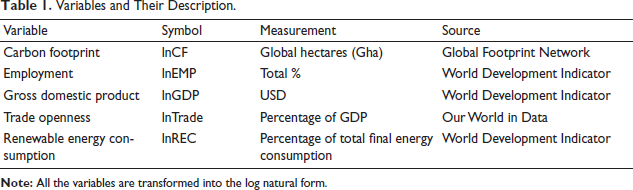
Our study incorporates carbon footprint as an indicator of environmental degradation in selected G20 countries. The study utilises annual panel data for selected G20 countries from 1991 to 2021. These selected G20 countries are Argentina, Australia, Brazil, China, India, Indonesia, Italy, Japan, Mexico, South Africa, Turkey, the UK and the USA. By this approach, the current study contributes to the growing body of literature on environmental degradation and employment. A detailed description of the variables and their data sources is given in Table 1.
Variables and Their Description.
Variables and Their Description.
Cross-sectional Dependence Test
Panel data can exhibit cross-sectional dependence, where all units in a cross-section relate due to common shocks or unobserved factors (Pesaran, 2007). This issue has been central to research in panel data, as first-generation unit root tests that overlook cross-sectional dependence yield inaccurate results. To address this, the current study evaluates cross-sectional dependence using the Breusch–Pagan Lagrange Multiplier, Pesaran scaled LM and Pesaran CD tests (Pesaran, 2004).
Panel Unit Root Test
A time series is stationary if its mean, variance and autocorrelation remain constant over time. This property is crucial for econometric analysis to identify long-run relationships among variables. To assess stationarity, a unit root test is used, with this study utilising Pesaran’s cross-sectionally augmented Dickey–Fuller and cross-sectionally augmented IPS tests.
Panel Cointegration Test
The panel cointegration test reveals long-term relationships between multiple datasets, providing a reliable way to estimate long-run coefficients and assess equilibrium connections. This study utilises Pedroni’s (2004) panel cointegration technique and Westerlund’s (2007) methodological framework to investigate enduring linkages among integrated variables in panel data structures, based on stationarity test results.
Pedroni Cointegration Tests
Pedroni panel cointegration tests assess long-run relationships among integrated variables of first difference in panel data, relying on residuals from a regression of the hypothesised cointegrating relationship. These residuals, if cointegration exists, should be stationary at level. The framework consists of seven test statistics split into within-dimension (panel) and between-dimension (group) categories, allowing for flexibility across heterogeneous cointegrating vectors. However, reliability is contingent on correctly specifying the regression and ensuring no cross-sectional dependence.
Westerlund Panel Cointegration Test
Panel cointegration tests enhance power in analysing panel data, yet the Pedroni test may fail to reject the null hypothesis of no cointegration due to issues like small sample sizes. This limitation is termed a common factor limit, affecting the utility of residual-based cointegration tests (Kremers et al., 1992). The Westerlund test is considered superior as it addresses these limitations, testing the null hypothesis of no cointegration against an alternative where some panels may be cointegrated. It also corrects errors and performs better amid cross-sectional dependence, aiming to determine long-term relationships among factors.
Panel Fully Modified Ordinary Least Squares
Panel fully modified ordinary least squares (FMOLS) is a non-parametric method for estimating long-term cointegrating relationships in panel data. It addresses endogeneity and serial correlation by changing the OLS estimator. FMOLS is particularly useful when the regressors show endogeneity and the residuals display serial correlation. The method gives asymptotically efficient estimates and shows robustness to heterogeneous cointegrating vectors. Phillips and Hansen (1990) introduced FMOLS for time-series data, whereas Pedroni developed its application to panel data, enhancing its accuracy in estimating long-run parameters in panel cointegration models.
Panel Dynamic Ordinary Least Squares
Panel dynamic ordinary least squares (DOLS), developed by Kao and Chiang (2000), is an alternative method for evaluating cointegrating relationships in panel data. It expands the time-series DOLS methodology of Stock and Watson (1993) with panel data. DOLS addresses endogeneity by incorporating leads and lags of the differenced regressors into the model. This method yields impartial and effective estimates of long-term parameters and is resilient to serial correlation and endogeneity. Panel DOLS is particularly useful for small sample sizes, showing effective performance in such cases.
Econometric Approaches
Model Specification
In current study, we have employed FMOLS and DOLS models to investigate the impacts of employment on environmental degradation across selected G20 countries.

Equation (1) represents Model I, which investigates the relationship between carbon footprint and the independent variables. For panel estimation, we re-write Equation (1) as follows:
where αi is the intercept of the dependent variable, βi is the coefficient of the variables, ε is error term and ln is the natural logarithm.
The FMOLS framework for Equation (2) can be written as follows:
where
The mean-differenced transformation
The between-dimension FMOLS estimator for the panel is:
which takes the average of country-specific FMOLS estimates.
The DOLS estimator can be constructed as:
where

The between-dimension FMOLS estimator for the panel is:
which averages individual country estimates.
Results for Diagnostic Checks
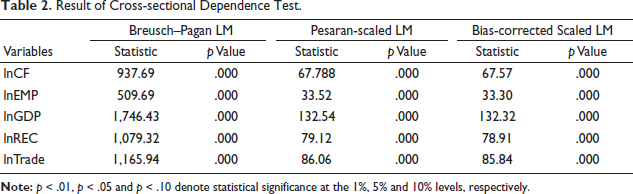
Before conducting the core analysis, it is essential to assess the dataset to identify the most appropriate and efficient estimation method. Table 2 shows the results of the cross-sectional dependence (CSD) tests. The presence of CSD is confirmed, as the null hypothesis is rejected at the 1% significance level.
Result of Cross-sectional Dependence Test.
Result of Cross-sectional Dependence Test.
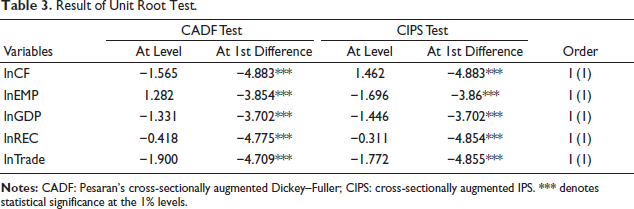
Based on CSD, we have employed the second-generation panel unit root tests. Table 3 reports the results of unit root tests. The results indicate that all variables are non-stationary at the level but become stationary after first differencing. For each variable, test results at levels and first differences, and CIPS test results at levels and first differences.
Result of Unit Root Test.
Results for Panel Cointegration Test
Considering the stationarity characteristics and cross-sectional dependence, Table 4 applies Pedroni’s and Westerlund’s cointegration methodologies to assess the existence of long-term associations among variables across the selected G20 nations. The findings show that the carbon footprint and the independent variables have a long-term cointegrating relationship. Table 4 shows that both models reject the null hypothesis of no cointegration. The Pedroni cointegration analysis reports that six out of eleven test indicators are significant, confirming the existence of a long-term equilibrium relationship among the variables included in the model.
Results for Pedroni and Westerlund Cointegration Tests.
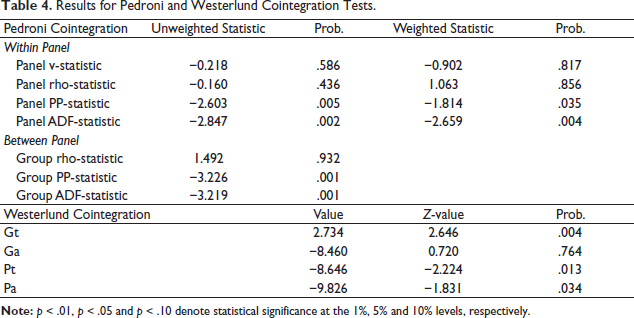
Similarly, the Westerlund cointegration results show that the Group Gt statistic is significant at the 1% level, while both Panel Pt and Panel Pa statistics demonstrate significance at the 5% level across the models.
Results for Fully Modified Ordinary Least Squares and Dynamic Ordinary Least Squares
Table 5 shows the findings for FMOLS. The FMOLS findings indicate strong long-term relationships between carbon footprint and its determinants. A 1% rise in employment increases lnCF by 0.365 units, significant at the 1% level, indicating the dual function of employment growth in fostering industrial development and energy-intensive production (Bowen & Kuralbayeva, 2015). This positive relationship between employment and carbon footprints indicates the importance of carbon-intensive industries such as energy production, transportation and heavy manufacturing in creating employment. However, these energy-intensive production industries are major contributors to environmental degradation, raising concerns about the long-term sustainability of such employment growth.
Result of Fully Modified Ordinary Least Squares (FMOLS).
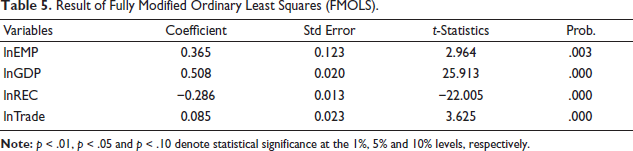
Likewise, GDP demonstrates a positive elasticity (0.508), validating the EKC hypothesis, which posits that economic growth in developing nations favours industrialisation at the expense of environmental sustainability (Dinda, 2004). The consumption of renewable energy significantly decreases carbon footprint by 0.286, validating its effectiveness in reducing fossil fuel dependence and alleviating emissions (Apergis & Payne, 2010). This negative relationship between renewable energy consumption and environmental degradation is further supported by an existing study (Rahman & Alam, 2021). Trade openness has a positive relationship with CF, 1% rise in employment (lnEMP) increases lnCF by 0.085 units, significant at the 1% level, consistent with the ‘pollution haven’ hypothesis, which posits that trade liberalisation encourages polluting industries to move to areas with lenient environmental regulations (Copeland & Taylor, 2004). The FMOLS methodology, which addresses endogeneity and serial correlation in cointegrated systems (Phillips & Hansen, 1990), highlights the structural persistence of these relationships.
Table 6 shows the findings of DOLS. The DOLS estimates substantiate the findings of FMOLS by integrating dynamic adjustments via lead-lag structures (Stock & Watson, 1993). Employment maintains a positive yet diminished influence (0.631), significant at the 5% level, indicating short-term labour market adjustments, including transitions to service sectors or green jobs, which partially mediate its environmental impacts (Chen et al., 2022).
Result of Dynamic Ordinary Least Squares (DOLS).
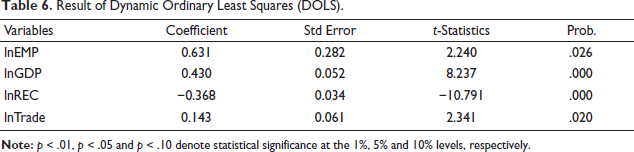
In contrast to FMOLS, GDP has a slightly lower elasticity (0.430) but remains significant, supporting the EKC framework and highlighting the moderating role of technological advancements in dissociating growth from emissions (Dong et al., 2018). Renewable energy has a stronger negative coefficient, highlighting its long-term benefits in decarbonising energy systems, especially when supported by policy (IRENA, 2022). Like FMOLS, DOLS found that trade openness increases carbon footprint by 5%, highlighting transportation and export-driven production emissions (Cherniwchan, 2019). DOLS results, which consider temporal dynamics, show subtle coefficient magnitude differences between immediate economic activities and delayed environmental effects. The alignment of FMOLS and DOLS findings highlights the strength of the established relationships. Both methodologies affirm that employment and GDP growth intensify carbon footprint, whereas renewable energy consumption alleviates it and trade openness presents environmental trade-offs. The methodological advantages of FMOLS in addressing cointegration and DOLS in modelling dynamic adjustments collectively bolster the reliability of these findings.
Results for Augmented Mean Group
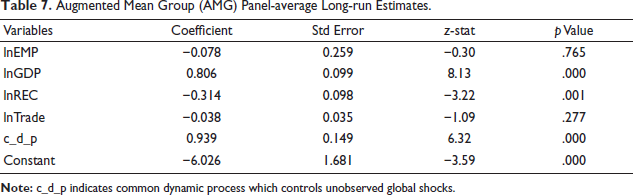
This study employs the augmented mean group (AMG) estimator to obtain country-specific long-run effects while controlling for unobserved common factors through a common dynamic process. Table 7 shows the AMG panel-average estimates. Economic growth exerts a positive and statistically significant impact on carbon footprint, reflecting the scale effect of expanding economic activity. In contrast, renewable energy consumption has a negative and significant effect, indicating that greater reliance on clean energy helps mitigate environmental degradation. Employment and trade openness are statistically insignificant at the panel level, suggesting that their environmental impacts are not uniform across countries and are driven by country-specific conditions.
Augmented Mean Group (AMG) Panel-average Long-run Estimates.
To address heterogeneity across countries, Table 8 shows the country-specific AMG coefficients, which constitute the focus of the analysis.
Augmented Mean Group (AMG) Country-specific Long-run Estimates.
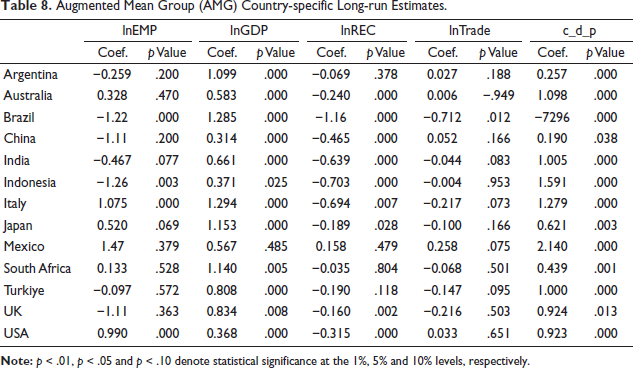
The country-specific AMG estimates highlight that employment impacts carbon footprints differently across countries. Labour-intensive sectors in Brazil, India and Indonesia have lower carbon footprints with higher employment. Italy, Japan and the USA have a positive relationship between employment growth and carbon emissions, suggesting that energy-intensive industrial and service activities like advanced manufacturing, transportation and high-energy service sectors increase carbon footprint. All countries except Mexico have a positive and statistically significant association between GDP and carbon footprint. This shows that economic growth continues to increase energy consumption and emissions, reflecting the scale effect. Research indicates that economic growth leads to higher CO2 emissions due to increased energy use, particularly from fossil fuels (Sharif et al., 2020). Renewable energy consumption in Italy significantly reduces carbon footprint, as shown in Australia, Brazil, China, India, Indonesia, Japan, the UK and the USA. This finding is consistent with recent empirical evidence showing that greater renewable energy adoption significantly mitigates carbon emissions through fossil fuel displacement and enhanced environmental sustainability (Sohaib et al., 2025).
Trade openness has a significant negative impact on Brazil, India, Italy and Türkiye’s carbon footprint, highlighting the technique effect where global value chains encourage cleaner technologies and stricter environmental standards. In Mexico, trade openness is positively significant, supporting the pollution haven hypothesis, as carbon-intensive manufacturing drives trade expansion (González & Martínez, 2012). Trade openness is statistically insignificant in Argentina, Australia, China, Indonesia, Japan, South Africa, the UK and the USA, suggesting context-specific and nonlinear trade–environment links. In these countries, regulatory stringency, structural transformation and clean energy investments offset pollution-increasing scale effects, neutralising carbon footprint. Recent research emphasises heterogeneous trade–environment relationships (Mahajan & Kulshrestha, 2025). The country-specific results show that while economic growth increases carbon footprint, renewable energy adoption consistently reduces environmental degradation. Trade openness and employment have country-specific environmental effects due to industrial composition, energy structure and regulatory frameworks.
The common dynamic process (c_d_p) is positive and statistically significant across countries, indicating the presence of strong global shocks influencing carbon footprint dynamics. This confirms cross-sectional dependence among countries and validates the use of the AMG estimator.
This study provides a comprehensive analysis of the relationship between employment and environmental degradation in selected G20 countries, offering critical insights into the dynamics of economic growth, renewable energy consumption and trade openness. The findings underscore the complex interplay between employment and environmental outcomes, revealing that while employment growth drives economic development, it also exacerbates carbon footprints due to its association with energy-intensive industries. The positive relationship between GDP and carbon emissions aligns with the EKC hypothesis, suggesting that developing economies prioritise industrialisation over environmental sustainability in their early growth stages. However, the study also highlights the transformative potential of renewable energy consumption, which significantly reduces carbon footprints by displacing fossil fuel dependency. This finding underscores the importance of transitioning to cleaner energy systems to mitigate environmental degradation. Trade openness, while beneficial for economic growth, is associated with increased carbon emissions, supporting the ‘pollution haven’ hypothesis. This suggests that trade liberalisation often leads to the relocation of polluting industries to regions with weaker environmental regulations, exacerbating global environmental challenges. The robustness of the FMOLS, DOLS and AMG methodologies, which account for endogeneity, dynamic adjustments and heterogeneity, strengthens the validity of these findings. Overall, the study underscores the need for integrated policies that balance economic growth with environmental sustainability, particularly in the context of global efforts to achieve the SDGs.
Limitations
This study acknowledges limitations, including its focus on selected G20 countries, which may restrict the applicability of findings to low-income or developing nations. Additionally, the emphasis on carbon footprints may overlook other significant environmental issues like water pollution, deforestation and biodiversity loss. Future research should address these limitations for a more holistic understanding of the employment–environment relationship.
Footnotes
Declaration of Conflicting Interests
The authors declared no potential conflicts of interest with respect to the research, authorship and/or publication of this article.
Funding
The authors received no financial support for the research, authorship and/or publication of this article.
