







Abstract
Print media plays a significant role during disasters as it is one of the most widely used modes of communicating important information to the masses. Every media has different agenda to highlight in such a scenario. While some media may portray the devastation, others may expose the failures of the system. The article pursues four of the most read English newspapers in India out of which three are also local favourites of Uttarakhand, which are selected on the basis of their readership, to examine how print media disseminated the news of Uttarakhand floods 2013—whether it was playing an important role in awareness generation and mitigation or it was concerned with only reporting situational information. The authors use qualitative content analysis to map print media’s interventions during Uttarakhand disaster in 2013.
Media framed most of the Uttarakhand flood stories by stressing widely on the response and less often focusing on the level of preparedness of the community. Most of the stories covered information related to rescue operation, while very few stories concentrated upon awareness generation, mitigation and redevelopment. Often the messages conveyed by the media pertain to ‘during-disaster’ and ‘post-disaster’ phases. It is evident from this study that efforts of media are least in educating people and disseminating information on disaster before it strikes. In the concluding note, authors specify the road to better disaster management and provide an input for policymakers and media agencies for a coordinated approach.
Introduction
Uttarakhand is one of the most disaster-vulnerable states of Indian Union. Its active geomorphic changes that occur frequently make it a hazard-prone region—landslides and earthquakes being most frequent (Satendra, 2003). The increase in global warming, which is leading to climate change, seems to be adding to geological condition of Uttarakhand. On 16 June 2013, Uttarakhand was hit by another natural hazard—flash floods that have been noted down in the history books of Indian disaster. Changing the scenario overnight, the Chorabari Glacial Lake Overflow (GLOF) led to massive destruction in the state (NIDM, 2015). Within no time this news was covered by various media in the country. While some called it a ‘Himalayan Tsunami’, others reported it as a ‘multi-day cloudburst’. In such circumstances, media is expected to play a key role in disseminating necessary information that can help in reducing chaos and propagating issues related to such massive catastrophe that can lead to immediate action upon the situation by the government (Rautela, 2013). According to the report of the High Powered Committee (National Centre for Disaster Management, IIPA, 2002) media have an emerging important role to play in disaster mitigation and its management. Back in 2002, this committee suggested that for better disaster mitigation, an appropriate publicity management plan accompanied with timely and correct information dissemination by local and national media would be very beneficial.
Disaster preparedness has been the prime focus of all the countries in the world today (Coppola, 2015). The role of communications in dissemination of knowledge regarding preparedness measures with reference to natural and man-made disasters is gaining importance. The goal of such awareness campaigns should be to sensitise local communities enabling them to deal with disasters like floods, which are very common in India. It is important to ensure that these local communities have a first-aid kit, food and safe water supply readily available in case of a disaster. They need to be sensitised to have a plan that in case of a disaster they are able to find and communicate with their loved ones (Barnes et al., 2008). These messages are expected to be conveyed by the media during and post-disasters, but a study shows that media do not play a proactive role in disseminating such information and educating people before the disaster strikes (Detrani, 2011).
Media agenda setting refers to the deliberate coverage of topics or events with the goal of influencing public opinion and public policy. We conducted a quantitative content analysis of four prominent newspapers to examine how the media gathered and distributed news to shape public policy priorities during Hurricane Katrina in the USA.
The media framed most Hurricane Katrina stories by emphasising government response and less often addressing individuals’ and communities’ level of preparedness or responsibility. Hence, more articles covered response and recovery than mitigation and preparation. The newspapers studied, focused significantly more on government response than on key public health roles in disaster management.
We discuss specific implications for public health professionals, policymakers and mass media so that, in the future, coordination can be enhanced among these entities before, during and after disasters occur.
Additionally, the absence of a clear-cut policy for media on disasters allows media to set their own priorities according to their convenience and type of calamity (Barnes et al., 2008; The International Research Institute for Climate and Society (IRI), 2007). In other words, this is a media-driven disaster coverage, which is confined to highlighting the extent of devastation due to disaster (Robinson, 2001). Sometimes, the article covering aftermath of the disaster hardly contributes to drawing attention towards preparedness at local levels.
Thus, media’s effort, except for increasing its academic value, does not reflect the reality; rather it filters and shapes the news on issues in such a manner that public perceives it to be of more importance, consequently influencing public opinion (McCombs, 1977).
During the Uttarakhand floods, the media, especially selected (four) newspapers, namely, The Times of India, Hindustan Times, The Hindu and The Telegraph, played a role in the agenda setting which created public interest and also focused on convergence of priorities.
Despite general criticism that is often observed regarding the media’s role in disasters, especially in the Indian context, it played a crucial role in addressing and highlighting the loopholes in the Uttarakhand disaster 2013. It focused on human angle thus prompting the government to take action. Media also created awareness among the citizens of India on the issues arising out of illegal constructions around their habitat. However, the media’s coverage of disasters should equally emphasise on disaster mitigation and preparation. Ideally, the media should focus throughout on all phases of a disaster to aid lawmakers and the public in developing and supporting policies designed on area-wise basis that can lead to a better management during disasters. In addition, reporting on analyses of current and proposed disaster policies can help increase understanding of their potential impact (McCombs, Shaw, & Weaver, 1997; Tierney, Bevc, & Kuligowski, 2006).
Mainstreaming print media plays an important role in educating and preparing local communities for disasters like floods (Kapucu & Liou, 2014). This needs a dedicated group of officials that are capable of handling the press which also have a deeper understanding of how media works, which will in turn, ease the process of information dissemination (National Centre for Disaster Management, IIPA, 2002). The study examined the role of print media by reviewing local and national newspaper articles on Uttarakhand floods of June 2013, especially with an objective to find how media theories corroborate practices (mitigation, preparation, response and recovery) and assessed whether the media are proactive enough to educate the local community. Research further explored the need for strong policy guidelines so that media’s social responsibility (MSR; Baran & Dennis 2000) is defined.
Methods
Newspaper Selection
Researchers selected four English newspapers on the following considerations: (a) these were the most circulated English dailies of India and Uttarakhand (except The Hindu) and (b) these newspapers represented the intellectually elite group of population, which includes policymakers, civil engineers, ministers and other government and non-governmental officials, who play predominant role in designing and shaping disaster management policies. The major four newspapers chosen were—The Times of India, which ranks highest in the list of most read English dailies; Hindustan Times, which holds number two position in the same list; while the third position is held by The Hindu, and last but not the least The Telegraph being number four in rank in the list of newspapers. Researchers studied each newspaper for the period of one week beginning 17 June 2013 when the heavy rainfall was first reported until 23 June 2013 when the news value of the story had begun to fade. The articles with indirect reference to the Uttarakhand disaster and articles which were printed on other than selected pages, were not taken into account. Therefore, it can be noticed that the researchers carried out textual analysis and did not cover semiotic details of photo essays related to the Uttarakhand disaster.
Coding Categories
Various categories were decided for the purpose of coding the articles, such as date, prominence, space provided, frame type and tone of the article. Date was considered for the study to understand when the news of disaster gained importance and when it began to fade away. Prominence means that each article was coded according to its placement vis-à-vis either on the front page or on the Nation/National page. This was done to understand the importance of news for each media house. It is understood that front page news carries more significance than the news printed on other pages (Riff, Lacy, & Fico, 2014). Each item was also coded by the space that was allotted to the story in the newspaper and this was measured in square centimetres. With reference to Riff, Lacy and Fico (2014, p. 76), the space is one of the parameters for carrying out a content analysis of the newspaper and this should be measured in units like ‘square inches’ and ‘square centimetres’, depending upon the type of information that is being sought by the researcher from the study. In terms of framing, the articles were coded as episodic or thematic. ‘A frame is a central organising idea for news content that supplies a context and suggests (to audiences) what the issue is through the use of selection emphasis, exclusion and elaboration’, as quoted in Welch-Ross and Fasig (2007). From a disaster management perspective, thematic frames (frame type) are generally preferred because they focus on community response and emphasise programme needs (Barnes et al., 2008). An article was coded as having a negative tone if it was critical of those to whom responsibility was attributed. While, if the articles were appreciating the efforts made in respect of the disaster, these were considered to be having a positive tone. Articles that were difficult to identify on the basis of their tone were coded as neutral.
Results
News Value
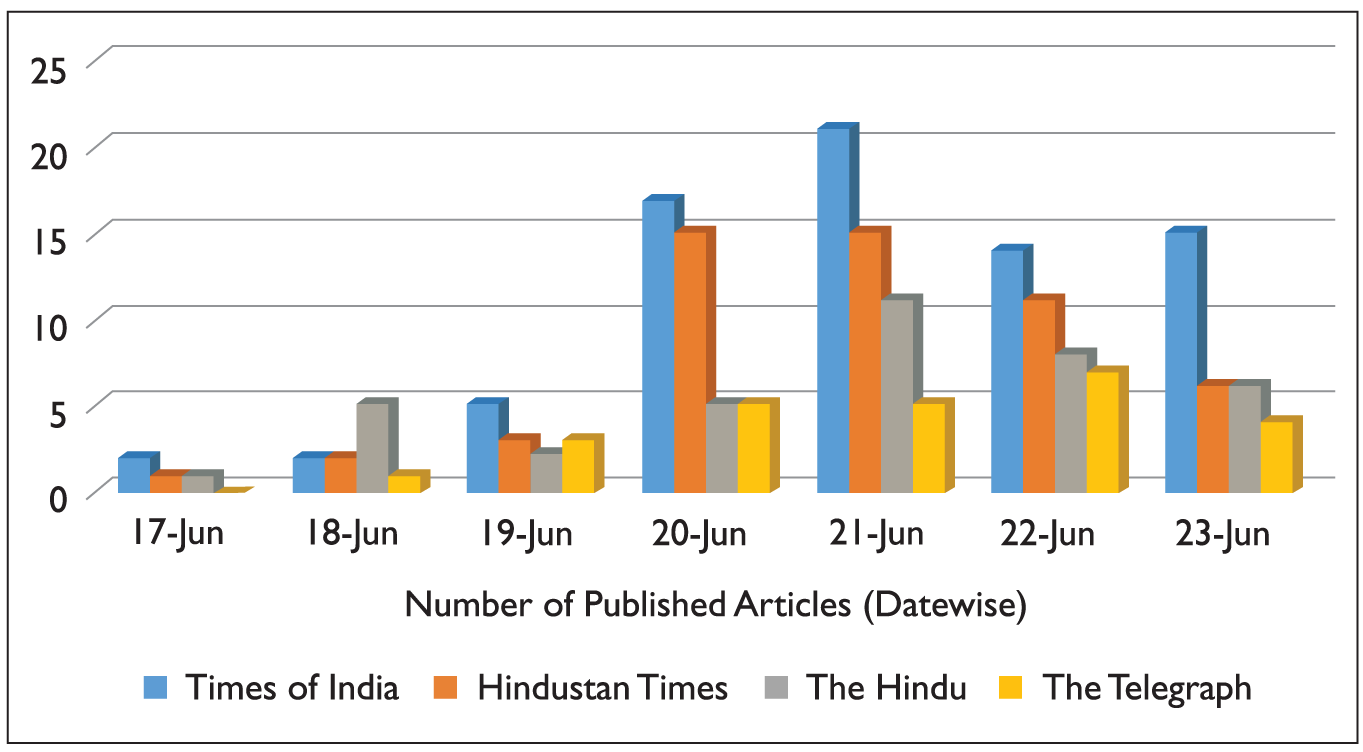
It can be seen in Figure 1 that out of 192 stories most of the articles were published on 20, 21 and 22 June 2013. The Times of India published twenty-one items on 21 June, which was highest as compared to all other newspapers. While on the same date, Hindustan Times printed fifteen items, The Hindu and The Telegraph published eleven and five items, respectively. It is worth noticing that on 17 June, all the four dailies did not publish news of floods or heavy rain in Uttarakhand; these rather reported early arrival of monsoon. While The Times of India published two items, Hindustan Times and The Hindu published one each, The Telegraph did not cover this news. Even when the major focus of the world was on the Uttarakhand disaster, for The Hindu and The Telegraph political news were of more importance than the other two. Having said that, it is worth noticing that while 17 to 20 June were most crucial days in the history of the Uttarakhand disaster, the peak of the news coverage in print media only began after the mid-week and lasted until the weekend of the said period. 22 June, Saturday, saw increase in the number of stories in The Telegraph.
Prominence
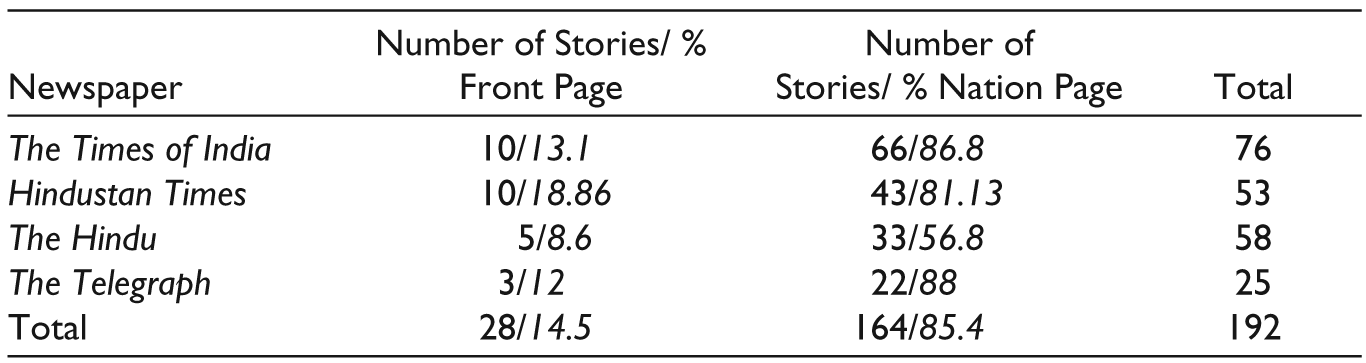
Of the 192 stories examined, approximately 85 per cent items were published in the Nation page of all the newspapers (Table 1). With The Times of India printing the highest number (seventy-six) of stories, out of 192, 13 per cent of which were printed on the front page while approximately 87 per cent stories were published on the Nation page. Hindustan Times, being the second on the list, published 81 per cent of fifty-three stories on the Nation page, while only approximately 19 per cent was published on the front page. The Hindu and The Telegraph stood on 3 and 4 ranks with thirty-three and twenty-two stories, respectively, printed on Nation page. Here, it is worth noticing that stories related to floods on other states, such as Delhi and parts of Uttar Pradesh, were not taken into consideration and stories on the Editorial pages of each newspaper were not taken into account. This is because most of these stories were either not related to Uttarakhand floods directly or were not informative enough. These stories rather were testimonials of the victims and survivors.
Tone of Stories
Media is a strong medium to deliver and penetrate any message that is important in nature. While having said that, the tone of stories published plays a crucial role in conveying the message that could change the ideology and shift the focus on important propaganda. Researchers measured these 192 articles on the basis of ‘Positive tone’, ‘Neutral Tone’ and ‘Negative Tone’.
It is evident from Table 2 that a few newspapers like The Telegraph and, most importantly, The Times of India did not focus upon the positive aspect like rescue operations. Out of 192 stories printed, 164 (85%) were having a neutral tone, that is, these items only focused on happenings at ground zero such as death toll, devastation, stranded pilgrims and tourists, airlifts done, evacuation and relief work carried out in the meantime. While, Hindustan Times balanced its positive and negative stories, its focus seemed to be more on neutral stories, especially those with human angle to it. On an average, The Hindu promoted more negative stories, which played as a promoter of questioning government responsibility.
Total Number of Stories Published in Each Newspaper and Its Prominence
Focus on Tone of Articles Published in the Newspapers
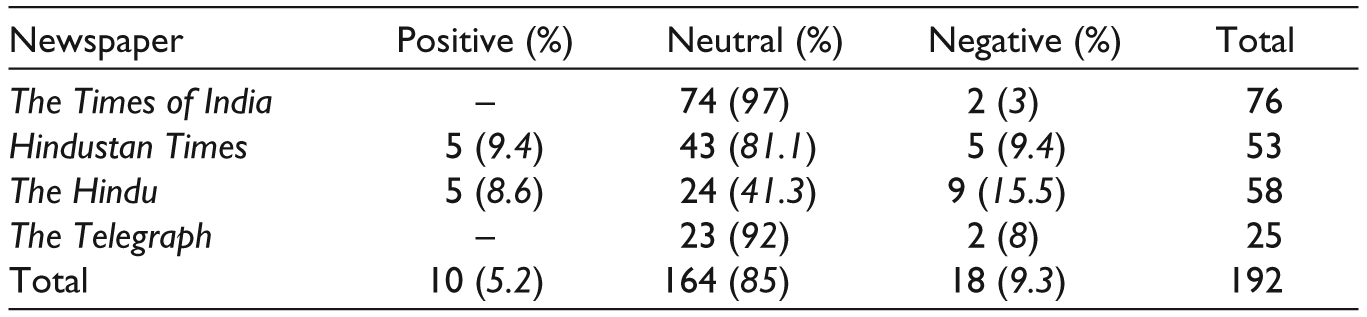
While 5.2 per cent of 192 stories focused on positive side of the rescue operations and portrayed human angle to its stories, 9.3 per cent stories had a negative tone—these articles were focusing on failure of implementation of disaster management policies and highlighted the need of improvement in framing and implementing policies on ground level. The focus of the print media houses was seen to be most on the affected or devastated region. Talking about focus, it was also noticed that newspapers did not talk about estimated property and livelihood loss; redevelopment was another aspect which was not given much importance.
Frame Type
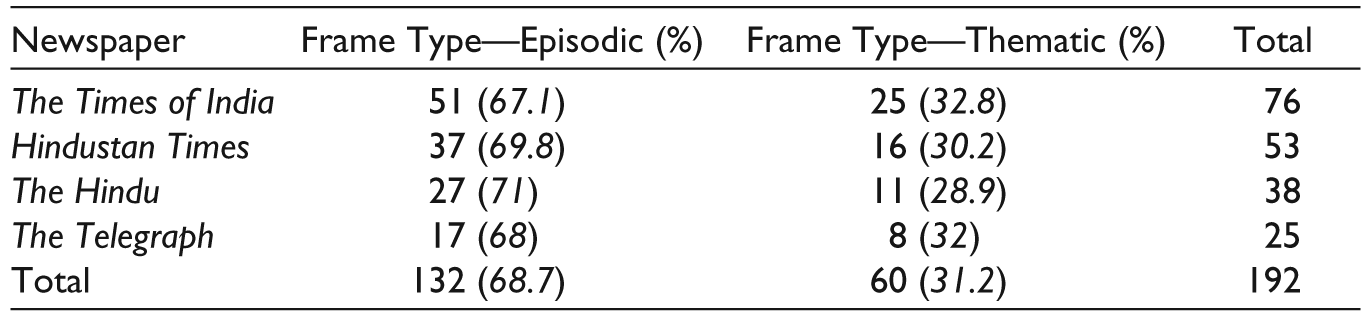
In Table 3, it is evident that print media have played it safe by keeping their focus on the news that were based mainly on ‘during disaster’ aspect of the calamity. Researchers selected to analyse stories on the basis of their episodic or thematic representation. Thematic presentation classified the stories on the basis of information regarding preparedness and mitigation angle in case of disaster in future or articles which had human angle to the coverage of disaster. While Episodic stories were those which were straightforward into sensationalising the news and only reporting those stories which had information on death toll, damage, stranded pilgrims, evacuated victims, exercises carried out by the Army and Indo-Tibetan Border Police (ITBP) personnel.
From Table 3, it is observable that The Times of India had the most thematic stories and overall there were only 60 items of 192, which were thematic in nature. It is worth noticing that some of the stories published had both thematic and episodic frame types. These kinds of articles were added in either category depending upon the main focus of the coverage. For example, if the news article predominantly talked about damage and death toll and in the same story it highlighted human angle, then such a story was considered having an episodic approach. Likewise, if the story covered more of human angle and educative angle than that of factual information, it was considered to have thematic approach to the content. From the aforementioned inferences, it is evident that Indian print media is mostly interested in sensational news content than an educative one. As it can be observed from Table 3, out of seventy-six stories published in The Times of India, fifty-one were episodic type. Similar was the case in Hindustan Times, The Hindu and The Telegraph, where more than 50 per cent stories were episodic in nature. While studying these newspapers, it was also noticed that most of these had similar headlines, with typically the same type of content. It seemed that maximum publications were dependent on the news agencies such as Reuters and INS for the information and were not really reporting from ground zero.
Focus on Frame Type of the Four English Dailies
Space Alotted for News
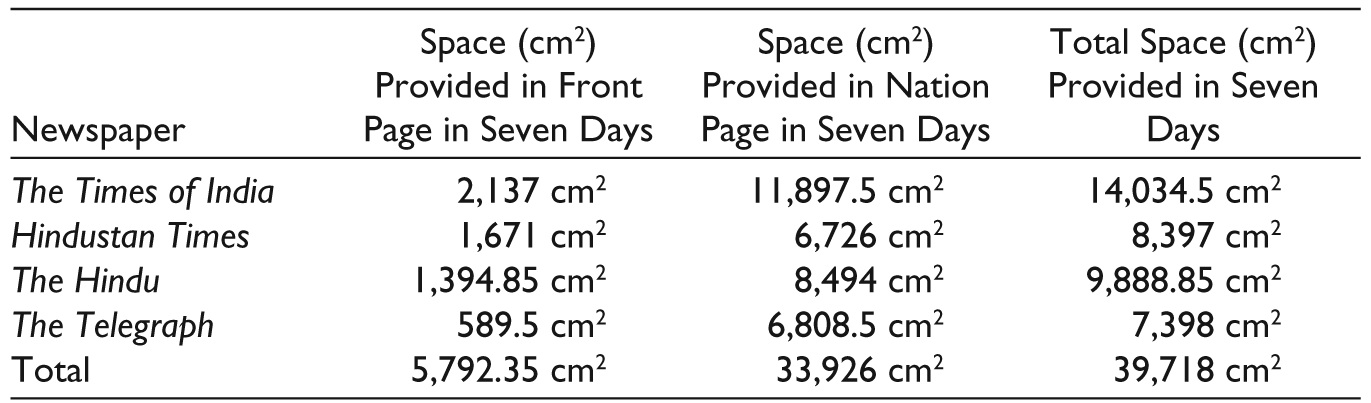
Table 4 depicts that The Times of India provided maximum space in its edition from 17 June to 23 June 2013. It provided 2,137 cm2 of space on the front page while 11,897.5 cm2 on the ‘Nation’ page. It is worth noticing that even though Hindustan Times covered more overall stories, it gave less space to each article as compared to The Hindu. This means that even though The Hindu published less number of items, it provided more information on the ‘Nation’ page as compared to Hindustan Times. Having said that, Hindustan Times still remained on the second spot in its overall coverage and The Times of India was noticed to be covering maximum news about the Uttarakhand disaster. The Telegraph covered the least in terms of first-page space given to disaster-related news.
Total Space Allotted for News on the Uttarakhand Disaster 2013 in cm2
Discussion and Suggestions
‘Media can play an important role to highlight the vulnerable community that is acutely affected at the time of disaster and can become an active medium for community awareness’ (National Centre for Disaster Management, IIPA, 2002). It is obvious that despite known vulnerabilities, the predesigned response systems failed to apply the already existing disaster plans in timely and efficient manner, which steered its ill effects to the exposed community of the region (Barnes et al., 2008). Although it is expected that media should be inclined to emphasise a greater need for government responsibility during disaster, unfortunately, it is not considered as a priority. Looking at the aforementioned results, conditionally, it can be said that different newspapers have diversified agendas and disaster news may not be of the same importance to every media house. It is worthy to note that the print media’s restricted role in reporting disaster event is heart-wrenching because, even when the impact of flash floods was known and was not limited to the state of Uttarakhand (it was also affecting other low-lying areas), the print media could have published more items on ‘dos’ and ‘don’ts’ during floods for other states. But this initiative was somewhat missing in these dailies. Moreover, stories that emphasised government accountability were placed mostly on the ‘Nation’ page. Even though the front page serves as the prime reading sources for policymakers, placing news majorly on ‘Nation’ page affected the weightage the news could have received. Not only is the front page deliberated to be a significant source of information but also serves as a means through which the print media advances its organisational focus to the audience it most desires to reach. Most of the articles which appeared on ‘Nation’ page were in The Times of India and Hindustan Times. It is worth noting that The Hindu and The Telegraph began to cover major part of news related to the Uttarakhand disaster after three days of the coverage by the other two. This shows that not every newspaper follows a similar agenda. Some of these may start reporting later and may not provide the same amount of space and time for such news. It, thus, becomes important that newspapers develop strategy allotting certain portions of the newspapers’ space for the news of disasters—focusing primarily on preparedness and mitigation in case of a disaster. Further, this should be encouraged possibly at the local level as the penetration of local media in disaster preparedness can be an effective way of communicating knowledge and enhancing skills of the population of the particular region (Pratt, 1989). Results depict that in India, print media are more focused on sensationalism, which can attract their readers. Social responsibility, in this case, seems missing, while it is expected from the print media that they produce more stories based on disaster preparedness and redevelopment.
Typically, during pre-monsoon season, the government along with their non-governmental counterparts, must promote emergency preparedness, through different media, in an attempt to ensure a more coordinated response. However, existing guidelines that are present on NDMA (2008) are rarely heeded. This study also affirms that regardless of being a strong medium of setting agenda and changing concepts, print media has not been as effective in pressing the government for accountability by not emphasising much on articles related to disaster preparedness and mitigation over rescue and redevelopment efforts (Comfort, Boin, & Demchak, 2010). In this regard, learning from media across the world could be considered of greater importance as there have been disasters in recent past like East Japan earthquake, in which it was evident that the media played a greater role in timely dissemination of information. As a key role player in risk mitigation and management, media have considerable responsibility during disaster times. Information dissemination through various mass media outlets, such as newspapers and television, definitely plays a vital role in providing emergency information to those who do not have access to social media and other sources (Uchida et al., 2015).
Tone is one of the most important aspects of the agenda-setting process. A negative tone can strongly highlight the gaps that exist in the required and actual levels of preparedness that must be taken care of (Barnes et al., 2008). In this case, print media’s attention was mostly focused on the current situation rather than on advising or disseminating information on safeguarding people from disasters. Most stories covered in the newspapers were of neutral tone, which only depicted the items that create sensationalism. It was noted that all newspapers published few stories that had negative tone, highlighting poor planning and illegal construction on such a fragile topography of Uttarakhand. Media also focused on calling it a ‘man-made’ disaster, which definitely was able to challenge the state and central governments to take appropriate action. Most negative tone of the stories was found in stories stressing on greater response by the individuals, governments and local communities.
Print media, especially in disasters, are expected to have more focus on items based on mitigation measures and educating the masses. Lack of qualitatively informative articles diminishes the urge to read the similar type of news each day and hence loses its importance. And this was evidently seen during the coverage of the Uttarakhand floods 2013. Though media’s significant attention to the government’s response had huge coverage on issues cropping up during rescue and relief, it was noted that from day 3 of the disaster, more stories focused on death toll, stranded public, food and medical supply, stories based on human angle and the like. Some of the best stories, which gave timeline review of floods were mainly seen in The Times of India and Hindustan Times. Discussing when rainfall began and how flash floods led to such massive devastation, these articles highlighted and censured the undesirable settlements near the river banks and ill-effects of construction of various hydropower projects in the delicate geology of Uttarakhand. Nonetheless, the lack of preparedness-oriented articles leads to the assumption that either the media do not fully understand the need of articles concerned with disaster management or it considers establishing ‘devastation’ stories as a main focus for agenda-setting as having greater significance than disaster prevention and mitigation practices. Journalists and disaster managers differ in their perspectives on news relevance (Anzur, 2000; Shoaf & Rottman, 2000). Journalists focus more on conflict, loss of life, property damage, and identifying the accountable party, whereas a disaster management expert is more concerned with appropriate information dissemination. According to views of disaster managers, important news regarding drills and safe practices is missing from the newspapers. It is important that journalists and disaster managers work in collaboration to achieve promotion of health and safety-oriented articles that are informative in preventing loss and injuries as well as preparing for disasters like floods in India (Anzur, 2000). Hence, it can be said that during disaster, diverging agendas clash, which drive a journalist to reporting drama in catastrophe, while disaster managers emphasise on prevention, relief and recovery (ibid., p. 197). Likewise, disaster management agencies have been criticised by the media because often media professionals are unable to accumulate authentic data that could be due to various governmental protocols. This, in turn, makes media professionals depend on unscrupulous and opportunist sources of information which at times results in ambiguous news coverage (Tinker, Zook, & Chapel, 2001, p. 67).
Disaster Managers and Media
An understanding of the relationship between disaster managers and the media, as well as the unique contributions they make in all phases of a large-scale emergency, can help both parties achieve their disaster-related goals. To assume that only the media are able to exert an agenda-setting influence is a mistake. Agenda-setters tend to be directly or indirectly involved in mass media organisations with the primary intention of influencing policymakers on key issues. As a vision to integrate media into disaster management, disaster managers can tap into the media and their resources to advance broad social views and promote policies and changes—preventive or reactive—that will ultimately enhance the expected outcomes from disaster managers and media (Barnes et al., 2008). Media are often blamed to be snobbish to publish any article related to public welfare, but it is often forgotten that disaster managers also need to become knowledgeable about how the media work—gather and distribute the news. This exercise can assist disaster managers in the long-term and goal-oriented partnership with media. In fact, disaster managers, at all levels, could yield timely and accurate information to media in the form of appropriately formulated press releases and opinions for publication as news, views and editorials which play a significant role in shaping and defining the frame of news stories. A fruitful disaster management demands that policymakers must make it a point to collaborate with media before, after and during emergency (Ball-Rokeach & Loges, 2000). Disaster managers must develop a plan that is accessible and can be implemented in the event of a crisis, well before any catastrophe. To do so, they must develop clear, attention-getting stories regarding preparedness, precautions, predictions and policy issues. The plan must include prevention and preparedness as key messages and connect the media to experts who may be available for analysis and comment in the wake of a crisis. The key is to identify and develop relationships beforehand as well as sustain relationships made during disaster coverage that may benefit future prevention-oriented media coverage. At the time of disaster, the media may view public health professionals as allies who can provide timely and reliable information. When fact-based messages include interesting story characteristics (who, what, where, when, why and how?), the media will be more likely to stress upon the message hence generated. Adding human element to such messages through stories to which the public can relate will automatically increase its readership leading to sensitisation process. Then, after a calamity, disaster managers should communicate their evaluations and recommendations through the media. As reflected in the findings of this study, the media can be stubborn in seeking to influence policymakers. Conversely, policymakers rely on the media to be seen as effective managers of a crisis. A mutually coordinated relationship between media and disaster managers can influence the policymakers in allocating more resources to disaster preparedness, drills and various other activities before and after a disaster and better mobilisation of funds (Ball-Rokeach & Loges, 2000).
It is important to understand that when we talk about disaster management, the government, disaster managers and media professionals are three spokes of the same wheel that are incomplete without each other’s coordinated and extended support. Each one has a different but crucial role to play in effective crisis management. Therefore, a well-synchronised approach must be developed to tackle future calamities. ‘A triangular risk communication effort between the media, the disaster managers and the government will help present clear message to protect vulnerable populations and emphasise prevention, preparedness, and immediate-response efforts’ (Barnes et al., 2008). Moreover, disaster managers must have core messages ready to disseminate at any given time. Thus, generated messages must be consistent and must not have the use of such language that can lead into a controversy. Here, it is important that each party understands that they do not know everything. Such efforts will avoid confusing the public or causing an overreaction (Tinker, et al., 2001).
Limitations
The findings are limited in a way that we reviewed newspapers for only one-week period during the Uttarakhand disaster and included only four newspapers. Articles that made minimal reference such as news briefs, indexes or image and their captions were excluded from the sample. In addition, previous studies on agenda-setting have coded for the presence of an accompanying photograph or for headline placement above or below the fold. We did not cover information regarding such details. Hence, we were unable to analyse these characteristics.
Conclusion
The findings re-establish the agenda-setting ability of the media. They also conclusively establish the contributions of print media in disaster management though primarily focusing only at the problems concerning disaster response and recovery. However, results also portray that the media could have been more involved in the Uttarakhand floods tragedy. Media did not adequately represent vital messages that should have focused on preparedness and redevelopment. The emphasis during the Uttarakhand flood disaster should not have been only on reporting the news but also on ensuring that the news influenced the key audience—that is, policymakers. ‘Agenda setting tends to promote disaster relief policies by reflecting on social problems retrospectively while rarely, if ever, dealing prospectively with future disasters’ (Barnes et al., 2008). The study clearly shows that for media, disaster response is still the primary focus and it considers the preparedness for and mitigation of a social issue requiring broad governmental involvement. Media help in advancing the needs of vulnerable people through policy-based messages. Complementing this action of media, it is desired that the disaster managers also attempt to promote policy-oriented actions by involving media (Leiva, 2008; Sudduth, 2012). Promoting media in to carrying out regular co-curricular activities such as games, poster-making competitions, skits and street plays (nukkad nataks) for awareness generation among the youth can be helpful in mainstreaming media’s role in the governance of disaster. At the same time, enhancing capacity building by training teachers, older generation, women and the like by conducting orientations and sensitisation programmes for achieving awareness generation for resilience is the need of the hour (National Centre for Disaster Management, IIPA, 2002). With media’s positive attitude towards disasters and likewise, disaster managers’ appreciation towards media’s efforts can help in development of a progressive disaster management approach that can lead to a paradigm shift in the way disasters are handled in India—from rescue and redevelopment to preparedness and mitigation.