







Abstract
This article examines the challenges faced by independent regulatory agencies (IRAs) in India today. It scrutinises the working of some trust-based self-regulating institutions, which the Government of India (GoI) is in the process of converting into a non-trust-based IRA framework. The article then reviews the functioning of the non-trust-based regulatory institutions through the lens of the electricity sector. It does this by examining the performance of these institutions against a ‘4CA’ framework: Capture, Capacity, Commitment, Communication and Accountability. It then attempts to draw generic lessons for regulators across all sectors. The article further examines additional challenges sectoral regulators will face arising from three areas: first, data privacy concerns and the requirements the proposed data regulator may impose; second, the interface with cross-sectoral regulators like the Competition Commission of India (CCI) which have jurisdiction across sectors; and third, interaction between sectoral regulators themselves.
Keywords
Introduction
This article analyses the challenges faced by independent regulatory agencies (IRAs) in India today. It consists of six sections. The first section briefly outlines the rationale for regulation and profiles an IRA. The second section reviews the challenges presently being faced by the self-regulated trust-based institutions in the Indian polity. The third section looks at the performance of the electricity sector and highlights some of its failings. 1 The fourth section analyses the reasons for such failure and attempts to draw generic lessons from them by examining the performance of some sector regulators against a framework defined in this article as the 4CA structure: Capture, Capacity, Commitment, Communication and Accountability. The fifth section describes additional challenges sectoral regulators will face arising from interface with cross-sectoral regulators like the Competition Commission of India (CCI) and among themselves. The sixth section concludes the article.
The theology on the need for regulation is well established. The conditions required for free markets to emerge and perfect competition to arise do not always hold. Market failures may occur under five circumstances: first, in the presence of externalities; second, in the exploitation of common pool resources; third, in the provision of public goods; fourth, in the presence of monopoly power; and fifth, when the market participants have asymmetric information. Regulation is aimed at protecting public interest by internalising the externalities, clarifying property rights, regulating monopolists and providing symmetric information to all market players. Effective regulation ensures fairness and predictability in market behaviour and is, therefore, seen as conducive to investment and growth. It can be argued (Roth, 2007) that IRAs must strive to achieve three objectives: first, ensure thick markets by attracting wherever appropriate a sufficient number of competitors; second, overcome congestion and delays arising out of a large number of players in the market, so that market participants can effectively leverage the diversity of choice available to them; and third, render markets safe and simple for buyers and sellers, so that they can operate in an ecosystem of fairness and predictability, without giving any player an opportunity to indulge in strategic behaviour that reduces overall welfare.
Regulators come in all shapes, stripes and sizes. Government itself may directly regulate in some cases. In other cases, constitutional authorities have been empowered to do so. In yet other cases, specialised agencies which report to government departments do so. In others, IRAs have mostly been established under parliamentary statutes. This article restricts itself to a study of the functioning of IRAs and attempts to draw some generic lessons from such an analysis.
An IRA is generally a creature of a statute. It is empowered simultaneously with law making, enforcement and adjudication powers in its dominion. As pointed out (Thatcher, 2002):
The creation of such agencies is a classic example of delegation to non-majoritarian institutions. They are created by legislation; hence elected officials are their principals. They are organizationally separate from governments and headed by unelected officials. They are given powers over regulation but are also subject to controls by elected politicians
2
and judges.
To some, regulators are as powerful as Fury 3 in Alice in Wonderland, and therefore, should have the capacity and the ability to meet the variegated expectations of the law from them.
Trust Model and Regulatory Weakness
We draw from extant theory on the provision of public services to examine the nature of regulation. The Legrand model defines two non-market approaches to providing public services by the government. These are termed the trust model and the distrust model (Legrand, 2003). Under the trust or network model, public service providers are seen as knights, who are seen to always have the public weal in mind and need not be constantly supervised. They have the freedom to deploy resources as per their felt priorities which is seen to be ultimately in the public interest. The gram panchayats in Ralegaon Siddhi and Hiware Bazar reflect successful implementation of such a trust model. 4 Under the distrust model, both the resources allocation and the provisions of the services are undertaken under close supervision. Public service providers are seen as knaves, who are motivated purely by self-interest, and need constant and continuous supervision to ensure they strive to reach predetermined goals. The working of a state hospital, where the government owns/controls all the resources (premises, equipment, staff, drugs and consumables), is seen as an example. The service providers (doctors, nurses, technicians) would be required to provide medical service across geographies and across disease burdens only in accordance with the government’s mandate. These service providers are allowed little discretion in fixing either the objectives, the inter se priority allocation or the geographical location of their services.
Extending such a taxonomy to IRAs, we can classify them into two categories: the trust model IRAs and the distrust model IRAs. Regulatory agencies in India who operate under the trust model are typically those which are self-regulated. They are only technically independent, since these professions are regulated by their own kind and these regulators face an inherent conflict of interest in the performance of their duties. These IRAs include
5
the Institute of Chartered Accountants of India (ICAI) for chartered accountants, the Medical Council of India (MCI) for doctors and the Bar Council of India for lawyers. These trust-based regulators derive their authority from statutes like the Chartered Accountants Act 1949, the Indian Medical Council Act 1956 and the Advocates Act 1961, respectively. These regulators wield significant power in matters relating to setting up and enforcing education standards, licencing members of their respective professions based on norms and laying down and enforcing standards of professional conduct. More than fifty years have elapsed since these self-regulating RAs were set up. Their performance over this period has come under increasingly critical scrutiny. The prime minister while addressing the Annual Day of the Institute of Chartered Accountants on 1 July 2017 stated (Prime Minister, 2017):
Apart from this, the government has already identified more than thirty- seven thousand shell companies who are engaged in hiding black money and hawala transactions. Stern actions shall be taken against them. Now the question arises that the temple of democracy, i.e. the Parliament of India, which is the voice of 125 crore countrymen, has given you so much authority, then why is it that in the last 11 years, only 25 Chartered Accountants have been prosecuted. Did only 25 people make a mess? And I have heard that more than 1400 cases are still pending for many years now. A single case takes years to settle. Tell me my friends, is it a matter of concern or not, for such highly qualified professionals?
The government has recently approved 6 the proposal for establishing the National Financial Reporting Authority (NFRA) as an IRA for the accounting and auditing profession effectively displacing the ICAI for regulating listed and large unlisted companies. This agency was originally envisaged in the Companies Act 2013 and has found expression only five years later, after questions have been raised on the role of auditors in recent bank swindles.
The MCI is now sought to be replaced by the National Medical Commission. This Commission will comprise autonomous boards mandated to set up standards and testing for undergraduate and postgraduate education, assessment and accreditation of medical institutions and registration of practitioners. The Bill was introduced in Parliament in December 2017. This was done after repeated complaints were received about the irregular function of the MCI especially in the matter of assessment and accreditation of teaching colleges.
The Supreme Court in 2016 had noted the need to review the provisions of the Advocates Act to deal more effectively with breaches of discipline and misconduct by lawyers. The Law Commission in its 266th report proposed significant changes in the Advocates Act 1961, including a definition of misconduct and providing pre-enrolment training for lawyers. The Commission prepared a draft Advocates Act (Amendment) Bill 2017 which is presently under consideration of the union government.
In all the three professions cited earlier, the trust model IRAs have not proved successful in proactively regulating their membership to ensure that all stakeholders as well as the economy as a whole benefited through the effective enforcement of appropriate standards in service delivery. Despite stiff opposition from the service providers themselves, the government has confirmed its lack of faith in the trust model by proposing to put in place distrust model IRAs in these three presently self-regulated professions. The challenge for the remaining IRAs working on the basis of the trust model in India is therefore this—they need to effectively implement their mandate failing which they will increasingly face the demand for the dissolution of the self-regulated trust model and the setting up of IRAs in their respective professions under the distrust model.
Distrust Model and Regulatory Weakness
We now turn to the distrust model of regulation. We will focus our attention on the electricity sector, where the Electricity Regulatory Commissions (ERCs) set up under the Electricity Act (EA) 2003 are an example of the distrust model at work.
The Central Electricity Regulatory Commission (CERC) as well as the State Electricity Regulatory Commissions (SERCs) were constituted under the EA 2003. 7 As with other IRAs, they have been empowered concurrently with legislative, executive and judicial functions. They can make wide-ranging regulations from imposing entry conditions through reduction of cross-subsidies to determining modalities for deciding tariff. They have executive powers to determine and regulate tariff, issue licences for transmission, distribution and trade, promote cogeneration and renewable energy and specify and enforce standards with respect to quality, continuity and reliability of service by the licensees. They have judicial powers, having been empowered to adjudicate upon disputes between licensees and generating companies and to refer any dispute for arbitration.
In its functioning, the SERCs are required to be guided by the National Electricity Policy, the National Electricity Plan and the Tariff Policy. Section 4 of the Tariff Policy states that, among others, the objective of the policy is to:
ensure availability of electricity to consumers at reasonable and competitive rates, ensure financial viability of the sector and attract investments and promote competition, efficiency in operations and improvement in quality of supply.
Thus, electricity regulators are charged with maintaining the balance between consumer welfare and financial sustainability of the sector. The former requires determining competitive and reasonable rates. The latter requires determining financially remunerative rates. The IRAs must simultaneously ensure expansion of coverage while demanding improvements in the quality of supply.
The electricity sector in India is performing poorly in all these three dimensions: coverage, outcomes as well as financial sustainability.
The Parliamentary Standing Committee on Energy (PSC) in their 30th report
8
submitted in August 2017 summarised the problems in this sector as the following:
The power sector in the country has developed in a manner wherein the balanced and coordinated approach to all segments is missing. Generation has been de-licensed leading to sudden spurt in its growth. Availability of electricity at affordable rates is still elusive. Demands of electricity by the Discoms has not registered a growth, there is no solution to regulatory assets of the Discoms, element of balancing power to maintain stability in grid in view of the huge upcoming renewable energy is also not being attended to in a desired way. Around 4 crore households are yet to be electrified and the issue of NPA in the electricity sector are the problems which require urgent attention for resolution.
The PSC also reported that as on 2014–2015, the distribution companies (DISCOMS) had accumulated losses of ₹360,736 crore and had an aggregated outstanding debt of ₹4,068.25 crore. Further, this precarious financial position was continually deteriorating as the average cost of supply of power was ₹5.20 per unit against the average revenue of ₹4.60. Despite their already fragile position, DISCOMS continue to make a loss of ₹0.60 for every unit of power sold. State governments implicitly underwrite this disastrous financial performance.
Ministry of Power annually rates distribution utilities based on their performance in various parameters including aggregate technical and commercial [AT&C] losses, power purchase costs and profitability. The fifth integrated ratings of these utilities
9
covering the fiscal year 2015–2016 were published in May 2017. Forty-one DISCOMS in twenty-two states were rated. The report found:
The cost coverage for twenty-five out of the forty-one utilities was below 90 per cent; Fifteen utilities showed a worsening of their AT&C losses; Tariff orders were not issued for eight states for 2016–2017 and Eleven utilities could not file audited accounts for 2015–2016.
The implementation of Ujwal DISCOM Assurance Yojana (UDAY) in December 2015 financially re-engineered the DISCOMS by having state governments take over 75 per cent of their debt by issuing bonds. The DISCOMS in turn are required to commit to meeting two performance parameters: first, bringing AT&C losses down to 15 per cent by 2018–2019 and second, bringing the difference between average revenue received per unit and the average cost of supply per unit to zero by 2018–2019. Twenty-seven states have joined UDAY. Sixteen states have already issued bonds 10 under this scheme to the tune of ₹232,163 crore. As of now, twenty-four states are reporting AT&C losses of 23.92 per cent. It does not appear that all states will meet their UDAY performance targets by 2018–2019. In December 2017, the Minister for Power noted that sixteen states reported 11 an increase (the opposite of the expected decrease) in transmission and distribution losses from 20 per cent to 56 per cent.
The per capita annual average consumption of power in India today is around 1,075 kwh against the world average of about 2,950 kwh. Triggering demand and increasing per capita consumption is an essential requirement for accelerated economic growth. This cannot happen till the electricity sector becomes financially sustainable.
The foregoing discussion shows that the electricity service providers in many states have not fulfilled their universal service obligations, supply poor quality power, do not provide adequate quantity of power and are reporting significant losses. Evidently, in these states, regulators have not fully complied with their obligations under the EA which requires them to fix remunerative tariffs, while enforcing quality and coverage standards. Issues like ensuring open access in distribution and implementing renewable energy purchase obligations have also fallen short of expectations. This reflects in some sense the failure of IRAs in the electricity sector to meet their fiduciary obligations. The causes for such regulatory failure are examined in generic terms in the next section.
The 4CA Structure of Evaluation of Regulation
The causes of regulatory feebleness in the electricity sector are examined against a framework termed 4CA: Capture, Commitment, Communication, Capacity and Accountability.
Capture
Regulatory capture is defined by Moss (2014) as the result or process by which regulation, in law or application, is consistently or repeatedly directed away from the public interest and towards the interests of the regulated industry, by the intent and action of the industry itself.
Such a definition may not be completely relevant in the Indian context. For the power sector in India today, the public interest could be defined as the supply of continuous high-quality power in increasing volumes 12 to all consumers in a financially sustainable manner. The regulated industry (at least the generation and distribution components) is in financial doldrums, while providing poor-quality power. It certainly cannot be said that regulation is being directed towards their interests. What can be said, however, is that regulation is being repeatedly and consistently diverted away from both public interest as well as interests of the regulated industry towards what is perceived to be political interests and other stakeholder interests. In this process, the industry operates suboptimally. For example, it has been argued that residential tariff subsidies have been captured by the elites in India (Kristy Mayer, 2015).
87 per cent of the subsidy payments go to above poverty line (APL) households instead of the poor, and over half the subsidy payments are directed to the richest two-fifths of the households. In 2010, the poorest two-fifths of the households accounted for just 14 per cent of the subsidy payments.
Such a finding is equally extendable to the agricultural sector where several state governments extend free supply of electricity to all farmers irrespective of whether they are Above Poverty Line (APL) or Below Poverty Line (BPL). APL famers possess more land and sink more tube wells/borewells per capita than BPL farmers. They, thus, consume more electricity and concomitantly more subsidy. Moss (2014) distinguishes between strong and weak capture. He posits that what is more important is the degree of capture rather than the fact of capture. Strong capture totally negates the objectives of regulation while weak capture merely dilutes it. It can be argued that this distinction can be made in the context of the Indian regulated sector also. How regulatory capture occurs is examined further under three categories:
Capture by Absence of Law
This merely means that the government chooses not to appoint a regulator even though there is a need for one to be in place. An example is the road sector in India today. The road sector has been showing signs of performance stress over the past five years. Road construction targets are not being met, and Built, Operate and Transfer (BOT) projects are under risk of non-completion due to delays arising from land acquisition, utility shifting and construction of under- and over- bridges by the railways. The project concessionaires blame the National Highway Authority of India (NHAI) for poor project preparation and cost underestimation conjoined with overoptimistic traffic projections. However, according to the then secretary of the Ministry of Road Transport and Highways:
The banks have killed the road sector. There was a bubble because the banks would give developers money even before the land was made available. Certainly the banks have a lot of explaining to do. Because it wasn’t just that they allowed funding to happen to these projects which were not yet ready for construction, but they agreed to TPCs [total project cost] much higher than what NHAI had assessed.
13
A significant amount of money is locked up in disputes, resulting in banks holding non-performing assets (NPAs). A conflict of interest arises as NHAI/Ministry of Road Transport and Highways (MORTH) are rule-making as well as executing bodies with no accountability for their performance to stakeholders. This leads to the perception of unfair contract conditions imposed by the government seeking to transfer major project risks to the contractor and thus imposing disproportionate operational risks on them. 14
The finance minister in his budget speech in March 2013 while addressing the problems in the road sector recognised:
[T]he sector faces challenges not envisaged earlier, including financial stress, enhanced construction risk and contract management issues, which are best addressed by an independent authority.
MoRTH accordingly prepared a draft Road Authority for Highways Bill 2013 which provided for jurisdiction over national highways and other specified roads. All contracts whether in the public–private partnership (PPP) mode or engineering, procurement and contract (EPC) mode would have to be registered with the regulator who would stipulate service standards, advise on tariff structuring and tolling mechanisms, enforce contractual provisions and facilitate renegotiation of future contracts. Although the draft provided a minimal regulatory role for the proposed agency, it was at least a good start.
The sector is ripe for a road regulator, and yet the government has not yet constituted one. Instead, it is has sought recourse to enhancing NHAI’s sanctioning powers and promoting the Hybrid Annuity Model even though this model is restricting competition due to the cautious approach adopted by bankers to fund bidders.
This sector is an example of strong capture—capture by the absence of law.
Capture by Emasculation of Law
The Petroleum and Natural Gas Regulatory Board Act 2006 was enacted to provide for the establishment of the Petroleum and Natural Gas Regulatory Board (PNGRB). The law provides for the PNGRB to regulate the refining, processing, storage, transportation, distribution, marketing and sale of downstream petroleum products and natural gas while protecting the interests of both consumers and entities engaged in specified activities.
In a significant order in 2013, PNRGB issued a direction to Indraprastha Gas Ltd (IGL) to reduce its network tariff and compression charges. This order was challenged by IGL on the ground that PNGRB had no authority to regulate tariffs and compression charge. The Ministry of Petroleum and Natural Gas in its affidavit supported the stand of IGL, that PNGRB is not empowered to fix or regulate the maximum retail price (MRP) at which gas is to be sold by such entities. It further argued that the PNGRB is not empowered to fix any component of network tariff or compression charges for any city gas distribution (CGD) entity. This argument was upheld by the Delhi High Court. When carried on appeal, the Supreme Court stated:
We are of the opinion that none of the aforesaid clauses can be construed as prescribing price control/regulation as a function of the Board. The Board cannot frame a Regulation which will cover the area pertaining to determination of network tariff for city or local gas distribution network and compression charge for CNG. The said Regulation deserves to be declared ultra vires, and we do so.
The PNGRB is unable to perform a basic regulatory function—regulate the price of compressed natural gas. Due to non-notification of the relevant provisions of the Act, the PNRGB does not regulate petrol and diesel prices in the market. This appears to be a case of strong capture by emasculation of the law.
Capture by Exploitation of Law
There can be four categories of capture under this category: appointment, financial independence, operational independence and capture by direction.
Appointment
Although ostensibly the EA provides for the setting up of independent selection committees headed by retired members of the senior judiciary and other eminent persons, instances are not rare where the appointment of chairmen and members of these Commissions are seen as the result of patronage of the government in power. Commissioners which worked in the government or in the power utilities are often unable or unwilling to take on a role independent of the government which they served till recently. This situation exemplifies strong capture to the demands of politics/the government in power as contrasted to the requirements of the sector. The proposal to have sitting judges of the superior judiciary rather than retired judges as chairpersons of selection committees to provide a greater degree of objectivity to the selection process has not been received enthusiastically.
Financial Independence
Sections 99 and 103 of the EA 2003 provide for the creation of the CERC Fund and the State Electricity Regulation Commission Fund. These funds are to be credited with grants and loans received from the respective governments and all fees received by the respective commissions in the performance of their functions. These funds are to be applied to meeting salary, allowances and remuneration of chairman and members and the staff of the commission and all its expenses in the discharge of its functions under the Act.
The purpose of the creation of these two funds is to provide financial independence to the commissions and eliminate dependency on the government for pecuniary support. This is a necessary condition for an IRA to become truly independent.
For the CERC, though, a CERC fund has been created, it is maintained under the Public Account of India by the Ministry of Power. Professional fees and interest earned by the CERC are being remitted to the Ministry of Power for crediting to the CERC fund (Central Electricity Regulatory Commission, 2015–2016). As per the expenditure budget for the Ministry of Power for 2018–2019, an amount of ₹55.5 crore has been earmarked as establishment expenditure 15 of the CERC, which is then set off from the amount met from the CERC fund. Thus, CERC’s expenses pass through the Government of India (GoI) budget and the CERC has to seek financial releases from the GoI for its expenditure. It cannot be said that this is the best system for ensuring the independence of the CERC.
The situation in the state governments is no better. The Andhra Pradesh Electricity Regulatory Commission (APERC) was constituted on 31 March 1999. For fifteen years, it was completely dependent on government grants and had to approach the government, cap in hand for financial releases every year. It was only in 2014, under strenuous pressure from the author who was then chairman, the APERC Fund was created. There are some state ERCs like those in Maharashtra and Gujarat which have created such funds which show healthy surpluses. They have little dependence on government grants. However, there are other states where this fund has not been created and dependence on state government continues. The Haryana SERC remitted ₹82,194,497 back to the Government of Haryana during 2014–2015. This reverse remittance was twice the grant of ₹420,000 it received from the government that year and appears to infringe the parameters around which the fund was to be created. The Punjab Electricity Regulatory Commission appears to be significantly dependent on the state government for its operational expenditure.
Lack of financial independence indubitably compromises the independence of IRA.
Operational Independence
Another important issue is operational independence—the ability of the IRAs to plan its work, recruit staff independently as per its work plan and pay them market-related wages. A number of SERCs require government permission to recruit staff and are constrained to pay them only government scale-linked remuneration. Regulatory economics is a specialised field with talent being scarce. Such constraints hamper the efficient working of the ERCs.
A related issue is the availability to the ERC of accurate and timely data on operational, financial and service quality parameters relating to the performance of the licensees. These include data relating to generation, distribution, costs and revenue of these licensees. In a significant judgement, 16 Appellate Tribunal for Electricity (APTEL) in 2011 ordered that SERCs should ensure that the annual performance review, true up of past expenses, annual revenue requirement and tariff determination be conducted regularly and annually. If the licensees did not come forward for determination of tariff as required under the EA, APTEL ordered that the respective SERC should suo motu initiate proceedings for the determination of tariff. Fulfilling this mandate requires that the SERCs have independent access to operational and financial performance data of the licensees for the relevant period. The APTEL found that Sections 94, 128, 129, 130, 142 and 146 of the EA adequately empower ERCs to demand the production of such information from the licensees. In practice, only in a few cases have some SERCs issued suo motu tariff orders. Thus, the availability of timely and relevant data and their disinclination to enforce submission of this information by licensees affects the ability of ERCs to independently implement its regulations and suo motu issue tariff orders.
Capture by Direction
Section 108 of the EA empowers the state government to provide directions to ERCs in matters of public policy which they may deem to be in public interest, and provided such directions are given in writing, the SERC shall be guided by such directions.
A number of state governments have used this provision to issue specific directions on tariff setting including in one case blocking the ERC from issuing its tariff order. Others have used it to hamper the use of open access by withdrawing State Load Dispatch Centre (SLDC) permission to generators for the sale of electricity outside the state in an effort to bolster the finances of utilities.
Commitment
All ERCs need to be committed to enforce the provisions of the EA and the regulations issued by them under the law. This statement appears to be a truism but unfortunately is not always true. The APTEL
17
has lamented that some ERCs are not meeting expectations under the EA and the Tariff Policy. APTEL noted:
Several State Commissions are leaving regulatory gaps in tariff fixation, that is, the tariff fixed for a particular year is not sufficient to cover the ARR for that year; Such regulatory gaps are left as a matter of course and the gap is left to be filled up in the truing up or in subsequent years and There are delays in the tariff determination exercise.
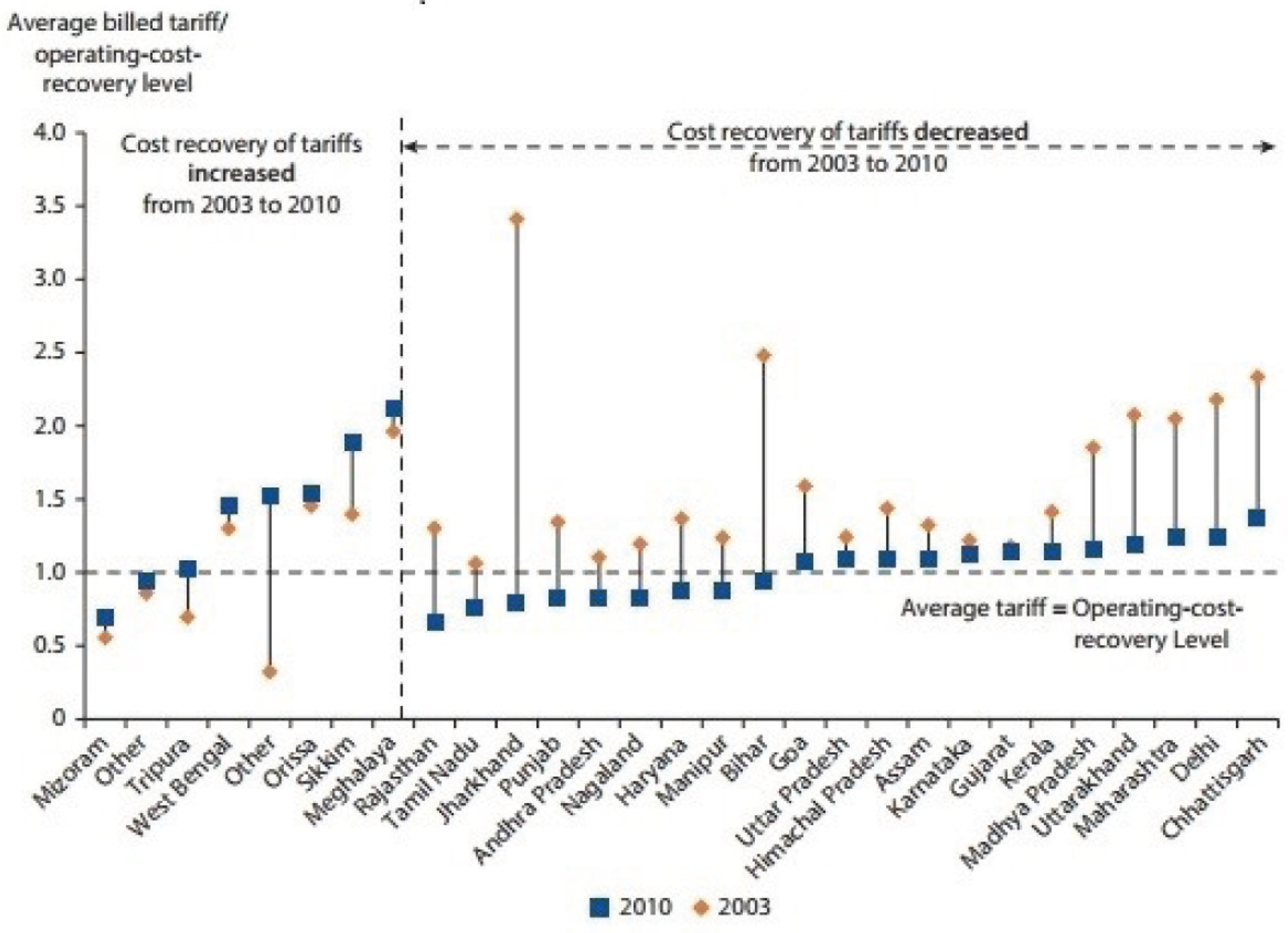
The first point—SERCs—adopting a flexible attitude to tariff fixation is demonstrated in Figure 1.
As per the EA, SERCs are required to fix a tariff structure to fully meet the Annual Revenue Requirements of the DISCOMS. However, as seen from Figure 1, in the case of twenty-one utilities, the cost recovery through tariffs decreased between 2003 and 2010. During this period, the tariff points should have moved upwards—as they did for eight SERCS pictures on the left side of the graph. However, for the majority of twenty-one utilities, the tariff points have moved downwards, that is, the ratio of billed tariff to operating cost recovery level has worsened over the seven-year period between 2003 and 2010.
The Tariff Policy 2016 has debarred regulators from consenting to the issue of regulatory assets. However, this mechanism has now transformed to a new avatar as ‘revenue gaps’—the difference between projected revenue and expenditure. This revenue gap which is not met by tariff increases is now being carried forward to the next year in some states for recovery—in exactly the same manner as the provision for regulatory assets was inappropriately used. Despite the prohibition in the National Tariff Policy to use the regulatory assets mechanism, some states are doing so under the guise of ‘revenue gaps’, presumably with the tacit consent of the regulator.
The relatively relaxed commitment to implementation of the EA’s provisions is also reflected in the way open access is implemented by ERCs. Section 2(47) of the EA defines open access as:
[T]he non-discriminatory provision for the use of transmission lines or distribution system or associated facilities with such lines or system by any licensee or consumer or a person engaged in generation in accordance with the regulations specified by the Appropriate Commission.
Open access was introduced in EA to expose distribution licensees to competition by institutionalising alternate sources of power for subsidising consumers. In the power sector tariff regime, subsidising consumers are charged higher tariffs to compensate for the lower tariffs paid by the subsidised consumer. Open access is sought by subsidising consumers who seek to reduce their power consumption cost. The DISCOMS are not keen to loose these subsidising consumers as this will reduce the amount of subsidy available to provide for subsidised consumers and therefore deleteriously affect their finances. The ERC is required under Section 42(2) of the EA to introduce open access after framing suitable regulations including those relating to the levy of cross-subsidy charges, additional surcharges and stand-by charges to compensate DISCOMS for the loss of these subsidised consumers. These levies should be so fixed by the ERC that it is still competitive for consumers to avail open access. The key words in Section 2(47) are ‘non-discriminatory provision’. While this is true for some cases, in other cases after levy of cross-subsidy surcharge, additional surcharge and standby charges, the cost to the consumer is greater than the cost of the DISCOM tariff—effectively shutting out the consumer from open access by this levy of prohibitively high charges.
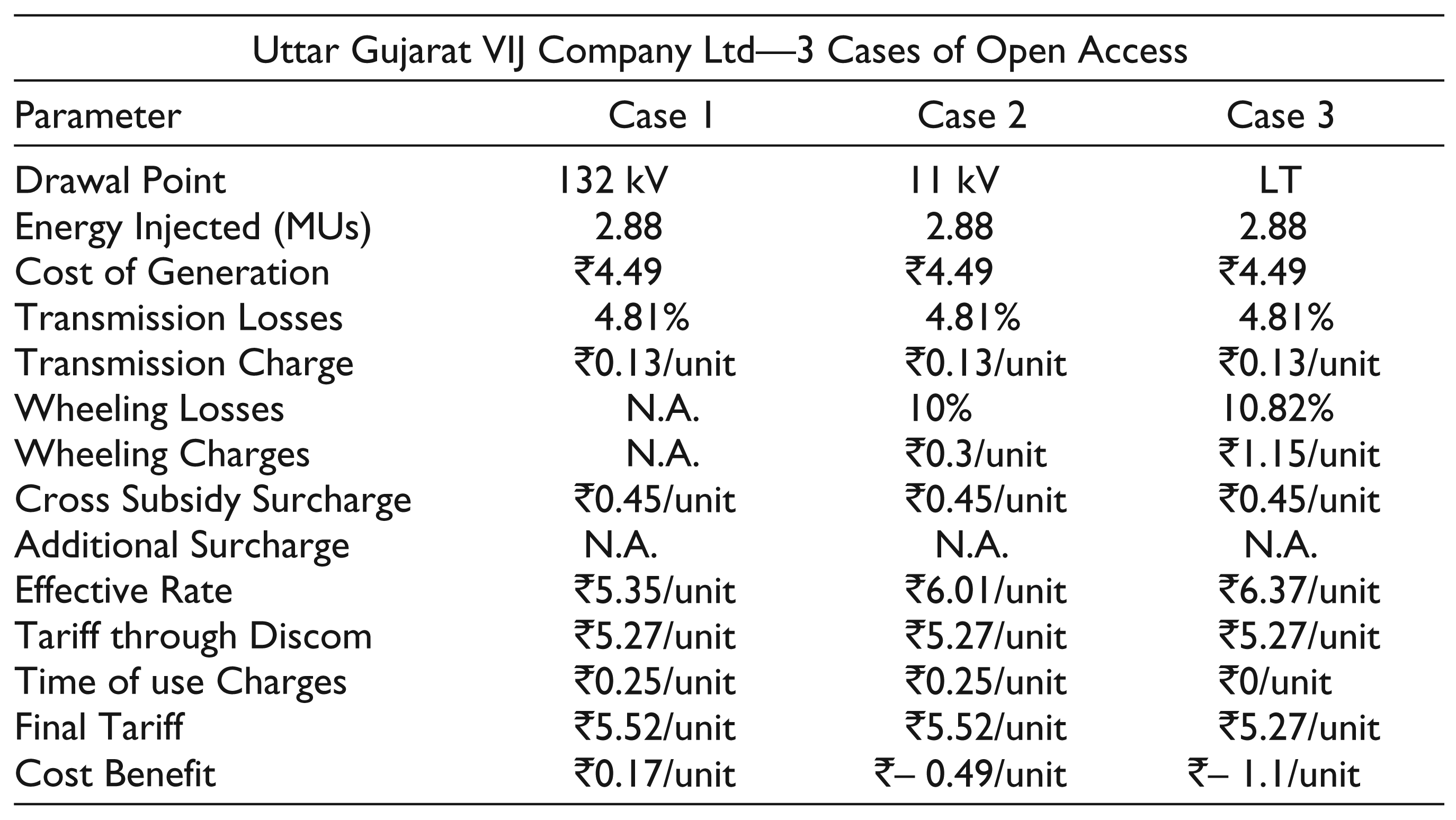
Table 1 compares the effective rates of open access for three different voltage levels in Uttar Gujarat Vij Company Ltd (UGVL) in 2013. The row titled effective rate shows the cost to the consumer of open access power after paying for all the prescribed losses and charges. The row titled final tariff is the rate offered to the same consumer by the UGVL. As will be seen, for 11 KV and LT consumers, the effective rate is above the UGVL rate. Only for 132 KV consumers there is a marginal surplus of ₹0.17 per unit. Although the study is somewhat dated, it proves an important point—in an effort to retain subsidising consumers with the DISCOMs, ERCs may be approving the levy of a slew of additional charges which render open access uneconomic for a consumer.
Study of Open Access and Cost Benefit Analysis of Open Access over Grid Power’ Report 18
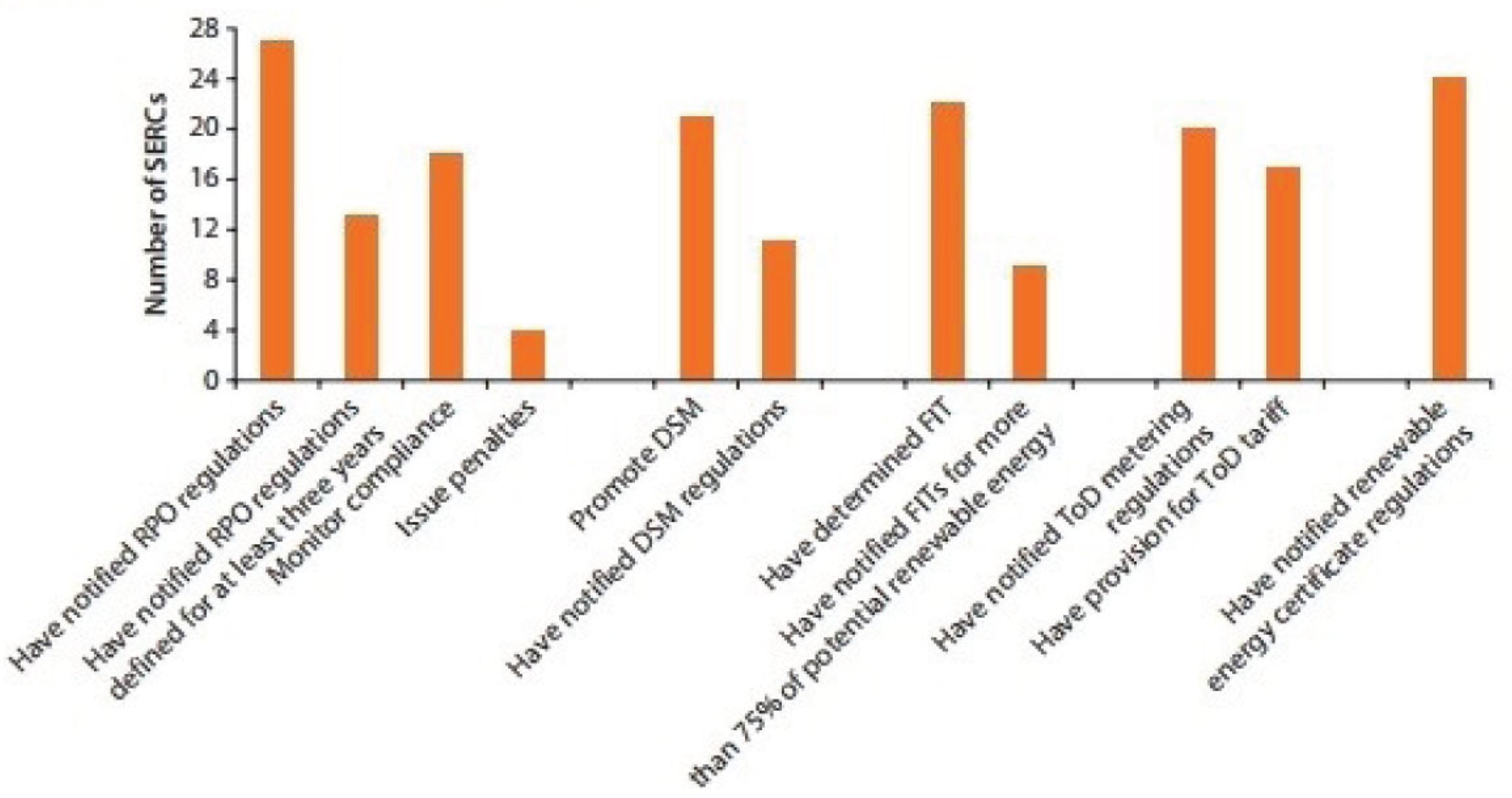
Section 86(e) of the EA requires ERCs to promote the generation of electricity from renewable sources and also specify the percentage of electricity from such sources as a percentage of the total consumption of electricity in the area of the distribution licensee. The ERCs are also required by the Tariff Policy to promote demand-side management by introducing time of the day pricing as well as promoting energy consumption efficiency. Figure 2 shows the progress made in this regard by the twenty-nine ERCs. As will be seen, while most ERCs have introduced Renewable Purchase Obligation (RPO) regulations, only a few monitor compliance with these obligations and fewer still enforce penalties for non-compliance with these obligations. Here again is evidence of the ambivalent attitude of the ERCs for the implementation of the law and their own regulations.
Communication
As pointed out earlier, the regulator needs to seek a balance between two competing needs. In one, direction is the pull of consumer welfare which demands not only universal availability but also competitive rates and high-quality service. In the other, direction is the pull of service providers who need to be nurtured by providing them with an economically sustainable ecosystem. In between are the demands of other stakeholders including politicians, financial markets, institutions and sectional elites who may seek to hijack the regulators’ agenda. To balance all these variegated interests, regulators need to firm up their mission and vision statements and effectively communicate the steps they are taking to reach their short-term and long-term goals.
In a survey of regulators in sixteen developing countries conducted by a private firm, 19 it was found that five most significant communication challenges arose from the following groups of stakeholders: (a) politicians, (b) legislators, (c) government ministries, (d) consumers and (e) government agency managers. The top five communication challenges were as follows: (a) lack of political will, (b) lack of transparency, (c) corruption, (d) political opposition and (e) ministerial opposition. Regulators need to keep these challenges in mind while designing their communication policy to buttress the implementation of their mission and vision statements. Unfortunately, there seems little awareness of these issues in ERCs and few, if any, have in place a formal communication policy.
However, there are some redeeming features in the electricity sector. One major step followed by almost all ERCs is the institution of preannouncement and public consultations with all stakeholders on all major issues including the formulation of regulations, fixation of tariffs and adjudication of demands from licensees. Collateral steps include publishing all relevant information on a website including discussion and preliminary position papers calling for comments, listing matters scheduled for adjudication and orders issued on them and listing contact information of all the staff and members of the Commission.
The EA Act requires CERC/ERCs to prepare an annual report providing a summary of its activities. This report is required to be sent to the central/state government for placing before the respective legislature. The EA Act also requires the ERCs to set up Central Advisory Committees and State Advisory Committees to advise the ERCs on matters of major policy initiatives, quantity and quality of power supplied by licensees and protection of consumer interests. These committees are required to meet regularly and their proceedings published regularly on the website.
While public hearings are the norm among ERCs today, a number of ERCs do not publish annual reports. Some publish it in English and do not publish it in the local language. The placing of the report on the table of the House is seen as a formality. To this author’s knowledge, there are few instances where consequent to the reports of the ERC being placed on the table of the House, they have been either reviewed or questions raised as to its contents. The discussions in Advisory Committees and the follow-up action are rarely made public by the respective ERCs.
Mounting an effective communication initiative to propagate its vision and mission for the sector is increasingly a challenge for the SERCs in today’s environment and must be effectively addressed by them.
Capacity
Problems of capacity are correlated with problems of capture. The ERC must be financially independent to hire the best talent and set up the best information management system for it to effectively address its mandate. Only a few ERCs have set up regulatory information management system (RIMS) for compilation and analysis of both operational and financial parameters. Lack of such systems dilutes both the quality and the effectiveness of the ERC’s orders.
Limitations to staff hiring imposed on ERCs by some state governments are sought to be overcome by hiring of the short-term consultants hired to work on specified terms of reference. While these short-term assignments enable the ERCs to fulfil their immediate obligations, this practice is not conducive to the creation and fostering of domestic capacity within the ERC itself. It also does not help in the creation of historical memory within the ERC, and in the long run it may not be advantageous to the organisation.
A related issue is the computation of tariff based upon category-wise/voltage-wise cost of supply rather than average cost of supply. Determination of category-wise/voltage-wise cost of supply requires a higher degree of sophistication in both measurement and computation. Although the Tariff Policy requires that the tariff as well as the cross-subsidy surcharge be based upon the voltage-wise/sector-wise cost of supply, most ERCs use the simpler average cost of supply as the expenditure benchmark.
An additional reflection of the capacity of an ERC is the use of advisories by it to further its mission and vision. Section 86(2) of the EA requires 20 the ERCs to advise the state governments on matters which include promotion of competition, efficiency and economy in the activities of the industry, promotion of investment in the electricity industry and reorganisation and restructuring of the electricity industry in that state . The EA also provides that when the state government refers any matter concerning generation, transmission distribution and trading of electricity in the state to the ERC, it shall advise the state government suitably. The corresponding reference for the CERC and the central government is found in Section 79(2) of the EA.
As per the annual report of the CERC for 2015–2016 (p. 70), 21 since its inception, the central commission has tendered advice to the central government on twenty-three different issues of importance relating to the electricity sector. During FY 2015–2016, CERC tendered advice to the government on road map for states to achieve reliable grid management and large-scale integration of variable renewable energy sources.
These are examples of reactive advice given to the central government by the CERC. What is remarkable is that over the last fifteen years, as reflected from its annual report, the CERC has not sought fit to proactively advise the central government even once on the electricity sector under Article 79(2).
The position for state ERCs is worse. A cursory examination of the websites of the ERCs of leading states discloses that in no case 22 has an ERC issued an advisory to a state government nor did it receive a request for advice on the electricity sector from a state government and respond to it.
Clearly, ERCs have not grown fully into the roles envisaged for them in the EA and to that extent the viable and sustainable growth of the sector is not fully exploited.
Accountability
Quis custodiet ipsos custodes is a Latin phrase. It is often literally translated as ‘Who will guard the guards themselves?’. The corresponding question in the regulatory field is ‘Who will regulate the regulators?’. In other words, who are the regulators accountable to?
As pointed out at the beginning of this article, the ERCs are a classic example of delegation to non-majoritarian institutions. They are created by legislation. They are organisationally separate from governments and headed by unelected officials who are not accountable for their actions. The submission of their reports in the assembly appears to be only a proforma accountability since the legislature does not undertake a detailed review of its activities.
It can be argued that the appellate authority (APTEL in the case of the electricity sector) has the power of oversight over the ERCs and can prevent regulatory overreach. While this is true for things done by the regulator, it is not true for things not done by the regulator 23 —for example, non-issuance of advisories to the governments consistent with its mission and vision statements.
One way to address this problem would be to rate the regulators based on some agreed upon parameters like prompt issue of tariff orders, reducing cross- subsidies consistent with the Tariff Policy, enforcing regulations on demand- side management and renewable energy purchase on an all-India basis by an independent group and publication of the results of such a ratings exercise.
Another option, as envisaged in the forthcoming Regulators Bill, is putting in place a formal accountability mechanism to the concerned select committee of the legislature which would review the performance of the ERC in public sittings. Will this happen? One can earnestly hope this will be so in the future.
New Challenges Arising from Innovation
Regulating the Privacy of Personal Data
The volume of data flowing through the Internet is increasing exponentially. One estimate (The Economist, 2018) puts it at one zettabyte per month. This is one trillion gigabytes—the disc storage capacity of more than a trillion personal computers. A large chunk of this comprises personal data—data which the owner/generator regard as private and privileged. Significantly, more volumes of such data reside in the servers of companies who are service providers.
This personal set has commercial significance for a host of agencies—ranging from the service providers themselves, advertisers, data miners and analytic companies to even polling consultants. Such data can be misused by commercial agencies without permission. Cambridge Analytica stands charged with mining data of 50 million users of Facebook to enable them to undertake ‘behaviour change programmes’ by targeting specific groups of voters during the US Presidential Election in 2016.
The Ministry of Electronics and Information Technology (MeitY) has issued two notices, one on 23 March 2018 to Cambridge Analytica (Press Information Bureau, 2018a) and a follow-up notice on 28 March 2018 to Facebook (Press Information Bureau, 2018b). MeitY is asking these agencies
24
five questions:
Whether the personal data of Indian voters and users have been compromised by Cambridge Analytica or any other downstream entity in any manner, and if so, how was it compromised? Whether Facebook or its related or downstream agencies utilising Facebook’s data have previously been engaged by any entities to manipulate the Indian electoral process? If any such downstream entity misused data from Facebook, what is the protection available to the data subject? What are the specific steps proposed to be taken by Facebook to prevent any misuse of personal data for potential interference in, or manipulation of the Indian electoral process? Facebook today has its largest footprint in India in terms of its user base and therefore what proactive measures are being taken to ensure the safety, security and privacy of such large user data and to prevent its misuse by any third party?
MeitY constituted a Committee of Experts chaired by Justice Srikrishna on 31 July 2018 to study and identify key data protection issues and recommend methods for addressing them. The Committee will also suggest a draft ‘Data Protection Bill’ (MeitY, 2017). The Committee has held consultations with stakeholders and is expected to submit its report shortly. In the meanwhile, the European Unions’ General Data Protection Regulation has been brought into force with effect from 25 May 2018. This regulation applies to all companies processing data relating to persons residing in the EU, irrespective of that company’s location. The regulation may have a spin-off impact in India both in terms of companies regulated under Indian law which work with data of residents of the EU and in terms of the shape and form of the future Indian data regulation bill.
There are two challenges here for effective regulation: first, how to regulate data effectively without impeding the growth of the digital economy in India today. The GoI has taken a number of steps to improve the efficacy of its anti-poverty programmes as well as its revenue collection and subsidy provision mechanisms. These include the JAM initiative—Jan Dhan, Aadhar and Mobile. Sharing of these data with anti-poverty programme service providers effectively addresses inclusion and exclusion errors and makes the functioning of these programmes more efficient and effective. It will indeed be a challenge to regulate personal data without emasculating the efficiency and effectiveness of the administrators of both anti-poverty programmes and tax collection institutions. Should the proposed Indian data regulator, following the GDPR, distinguish between personal data (name, address, photo, IP address) and sensitive personal data (race, religion, caste, political and trade union affiliation, sexual orientation, health information, biometric information, genetic data)? Should it allow personal data to be made available on justifiable grounds and totally restrict the storage and use of sensitive personal data? These would be some of the challenges facing the proposed data regulator in India.
Smoothening the Interface between Sectoral and Cross-sectoral Regulators
The second challenge is—who should be the regulator? The proposed data protection Bill will presumably be sponsored by MeitY. Since data protection is a cross-sectoral issue spanning across a range of sectors from social media, to credit to service provision, presumably the Bill will propose that a cross-sectoral regulator be put in place. Let us assume this will be MeitY itself. It must be recognised that sectoral regulators are already in place in a number of areas. For example, a prime concern of data privacy as reflected in MeitY’s questions listed previously is the apprehension of the manipulation of the electoral process through social media as Cambridge Analytica is accused of doing. Under Article 324 of the Constitution, the Election Commission of India (ECI) is vested with the superintendence, direction and control of all parliamentary and legislative elections. Should data regulation in respect of elections vest with ECI or MeitY?
Such a blurring of regulatory authority is not unique. The Competition Act 2002 set up the CCI to:
Prevent practices having adverse effect on competition, to promote and sustain competition in markets, to protect interests of consumers and to ensure freedom of trade carried on by other participants in markets in India.
The CCI is specifically empowered under Sections 3, 4 and 6 of the Act to prohibit anti-competitive agreements, prohibit abuse of dominant position and regulate combinations elections. Section 21 of the Act enables any sectoral regulator to make a reference to the CCI on any issue before it which would have an impact contrary to the Competition Act and seek its opinion which shall be considered by such sectoral regulator while giving its findings. The corresponding section for references to be made by the CCI to sectoral regulators is Section 21A of the Act. Despite these reciprocal consultative channels being available, the CCI has in the past come into conflict with sectoral regulators. Instances include differences with TRAI over allegations of predatory pricing by Jio and differences with SEBI over the NSE issue. There are also differences among sectoral regulators themselves. These include the clash between IRDA and SEBI on the regulation of ULIPs, and the differences between Forward Markets Commission and the Central Electricity Commission on the future trading in electricity. In respect of the latter, the Bombay High Court ruled (Forward Markets Commission versus Central Electricity Regulatory Commission, 2011):
[I]t is not only question of resolving conflict between two entities and /or mandates of the respective specialised Acts, but actual and physical workable solution to permit and /or allow either authorities/commissions/exchanges to deal with electricity in the futures/forward market. Both authorities /commissions under the respective Acts may not be in a position to control and regulate the futures contract in electricity exclusively unless those Acts and regulations are reframed /amended. Both cannot have exclusive jurisdiction as claimed in the present scenario in India.
Such disputes are further complicated by the functioning of appellate authorities in these sectors, under the respective Acts. How should these challenges in the interface between sectoral regulation and cross-sectoral regulation be addressed? There are a number of models worldwide. New Zealand believes in light-handed competition, regulation and no sectoral regulation. Accordingly, the competition regulator handles both competition law and sectoral regulation and is given primacy. He is empowered to administer sectoral regulatory rules. The East European countries model allows temporary powers to the competition regulator until sector-specific regulators are established. A third model could give primacy to sectoral regulators who would be specifically empowered to implement sector- specific anti-competitive, anti-dominance and anti-combination rules and be exempt from the ambit of the competition regulator. Under this model, the sector regulator is dominant. A fourth model emphasises cooperation and collaboration between sectoral and cross-sectoral 25 regulators. Their mandates are interlocked forcing a joint approach to their work. In Mexico, the competition agency is entrusted with the responsibility of determining whether or not the conditions for effective competition exist, or are sufficiently absent, to justify the continued imposition of price regulation. Administration of price control rules is then entrusted to the sectoral regulator, if such conditions are justified. A Regulators’ Forum has been launched by the South Africa Competition Commission which aims at promoting transparent, consistent and coherent regulation between sectoral regulators and the competition regulator.
The lack of a cogent and consistent approach to regulation in India across sectors has been a subject of concern. The Planning Commission in 2013 formulated a draft Regulatory Reform Bill which sought to converge the incentives of all regulators into a uniform philosophy and approach to regulation.
The finance minister in his 2015 budget speech stated: ‘Our Government, proposes to introduce a regulatory reform law that will bring about a cogency of approach across various sectors of infrastructure’.
The draft Regulatory Reform Bill was released for public consultation by NITI Aayog in July 2015. The objective of the proposed Bill is:
[T]o ensure orderly development of infrastructure services, enable competition and protect consumer interest in securing access to affordable and quality infrastructure. It is guided by the three general principles of separation of powers, democratic accountability, and the federal principle. To secure democratic accountability, the regulator has been made responsible to the legislature and to the people at large. The federal principle has also been followed through distribution of subjects of economic regulation between Union and State competencies. Accordingly, the rule-making and enforcement functions have been separated from judicial functions, which have been vested in appellate tribunals. The paper also states that the government may, from time to time, constitute regulatory commissions and appellate tribunals besides the tariff regulatory commissions.
26
The draft Regulatory Reform Bill does not appear to address the interface challenges between sectoral and cross-sectoral regulators and inter se sectoral regulators described earlier. This issue will indeed be a challenge to independent regulators in India in the future.
Conclusion
This article has examined the challenges faced by IRAs in India today. Self-regulating institutions face the challenge of poor performance threatening their conversion to IRAs. IRAs fall short when measured against the 4CA framework: Capture, Capacity, Commitment, Communication and Accountability. There are additional challenges sectoral regulators will face from data privacy concerns, the interface with cross-sectoral regulators and interaction between sectoral regulators themselves. The solution to these challenges is implicit in the analysis itself. The IRAs should strive to operate independently, enhance their capacity, reinforce their commitment to their legal foundation, improve communication with all stakeholders and strive to improve their accountability.
It can be argued that taking the aforementioned steps is easier said than done, given the presence of powerful vested interests, which include the government of the day itself, which has an interest in stymying the changes suggested earlier. The road to improved and effective regulation will be long and arduous. In this journey, the best should not be allowed to become the enemy of the good. As aptly pointed out (Kahn, 1988):
The central institutional issue of public utility regulation remains finding the best possible mix of inevitably imperfect regulation and inevitably imperfect competition. All competition is imperfect. The preferred remedy is to try to diminish the imperfection. Even when highly imperfect, it can often be a valuable supplement to regulation. But to the extent that it is intolerably imperfect, the only acceptable alternative is regulation. And for the inescapable imperfections of regulation, the only available remedy is to try to make it work better.
It is to be hoped that sustained and progressive efforts towards addressing the issues highlighted earlier will substantially enhance the beneficial impact of regulation in India.
Declaration of Conflicting Interests
The authors declared no potential conflicts of interest with respect to the research, authorship and/or publication of this article.
Funding
The authors received no financial support for the research, authorship and/or publication of this article.