







Abstract
Studies related to governance and leadership contributing to quality are rare in education. Sikkim has been chosen for this study to fill the gap. The article argues that good governance is a means or a process through which network governance can be effectively applied in the education system that is operationalised through leadership for achieving higher quality. The study indicates that the influence of ministerial leadership in public administration flows from the state level to schools. The lead-organised governance network at the state level characterises educational functions ranging from identifying needs to build a vision for an education system and exploiting ICT for the ease of administration. A network administrative organisation at the district level characterises establishing networks, aligning the focus between the state and school levels, creating a network of leaders at the school level and spreading innovations and good practices to all schools in the district. Participant governance at the school level mainly translates the state’s vision into action, engages in professional development of teachers, creates a climate for experimentation, distributes time equally between academic and administrative activities and builds networks with district- and state-level officials for improving schools. Through these processes at all levels, good governance acts as a means for apt application of network governance. Relevant leadership practices ensure good governance for higher quality education.
Understanding Governance and Leadership in the Education System
Network Governance
In the changing circumstances of neo-liberal economic policies, many private players invest their money in programmatic interventions to provide in-service training to teachers. It is also fast replacing the role of traditional NGOs. It has even changed the government’s top-down approach to consultative, cooperative and collaborative processes in small ways. As a consequence, the notion of leadership in the government is also changing from being directive to empowering, collaborating and participatory, compelling both private actors and government officials to adopt a broader approach to educational governance and leadership. More specifically, the shift is in the approach to adopt network governance by government officials to work with diverse stakeholders for delivering results.
Network governance creates relatively stable horizontal interdependence having operationally autonomous actors within a normative framework (Soren & Torfing, 2008) for the formulation and implementation of collectively binding decisions (Borzel & Panke, 2008). Leadership is shared among different members of the organisation at different levels more informally than formally in traditional hierarchical organisations (Crosby & Bryson, 2005). Pal (2012) enumerated several characteristics of the network. It is essentially non-hierarchical so that orders and commands do not constitute its basic vocabulary, and rules tend to be quite loose as its members come from diverse backgrounds and hence prefer norms to rules. It consists of interconnected nodes and exchanges which need not be equal, despite the flatness and the lack of hierarchy. The network in which primary exchanges are informative are characterised by openness, focus on quality and often in a condition of flux, change, growth and decline. Therefore, network leaders are engaged in constant search as old information gets stale. Networks have no single, final arbiters; decisions are made through complex interactions of interconnections and exchanges (ibid., pp. 19–20).
There are three main approaches to network governance, namely lead-organised governed network, network administrative organisation and participant governance (Provan & Kenis, 2008). The lead-organised governed network takes a lead role in the network. The network administrative organisation is set up to govern the network. In participant governance, the network is governed by participants themselves without an overarching governance structure. In the context of education system, the lead-organised governance network in education influences the entire system from the state level. At the district level, network administrative governance caters to governing the networks across all schools at cluster and block levels within the district. Participant governance is at the school level which moves from individual to individual rather more informally linking higher and lower structures like block resource centres and cluster resource centres (CRCs) to a viable collaboration in a comparatively more flexible and horizontal manner. So, members, groups and organisations stimulate others to recognise latent needs, desires and potentials to work together towards their fulfilment (Denhardt & Denhardt, 2011).
Improving governance is a process of integrating three vital components: knowledge with rigorous data and empirical analysis including in-country diagnostics and dissemination using the latest ICT tools; leadership in the political, civil society and international arenas and collective action via systematic participatory and consensus building approaches with key stakeholders in society (Jain, 2004). It facilitates responsiveness, openness and transparency in leading educational governance. So, it is not only about governance characterised by intangible goals with intrinsic values for the welfare of citizens but also about good governance characterised by tangible goals with instrumental value. Good governance emphasises on a reworking relationship between the state, civil society and the market for attaining goals that are people-centric for development (Bagai, 2016) that shapes the future of children and the welfare of overall society.
Good Governance
Good governance refers to accountability, effectiveness, participation, promoting the rule of law, respect for institutions, efficiency, resource management, inter- action among players, transparency, fairness, adopting information technology, citizen-oriented paradigm, responsiveness, balancing interests and cutting across communities for inclusiveness and flexibility (Hyden, Julius, & Kenneth, 2004; The World Bank, 1998; United Nations Development Programme [UNDP], 1997). What is not bad governance is good governance. Bad governance is reflected in many forms: sacrificed political accountability, lost freedom, missing law-abiding behaviour, eroded bureaucratic accountability, missing transparency, rare availability of information, never-bothered effectiveness, efficiency found only in dictionary and cooperation between the government and society remains ideal (Tiwari, 2002). Thus, good governance, treated as an instrumental value, is a means to achieve the desired ends (Punyarathabandhu, 2004).
Good governance has three basic characteristics: first, it invokes popular participation of the common man for meaningful involvement and without being marginalised in the decision-making process at all levels of governance; second, it stands for the welfare of all people, especially the deprived sections of the population and third, it stands for social and economic changes in society (Bareth, 2004, p. 109). The dream of good governance can be realised if there is an adequate departmental governance at the national, state, district and local levels as they have a central role in working closely with the ministers who are handling internal operations, external relationships, communicating, directing and coordinating within the ethos of public service and stewardship (Edwards, Halligan, Horrigan, & Nicoll, 2012). Three principle empirical dimensions enable a greater understanding of good governance: citizen’s influence and oversight, responsive and responsible leadership and social reciprocities (Hyden, 1992). These principles aptly characterise public accountability, transparency, openness to public policy and adherence to the rule of law for good governance. They are also applicable to the education sector. In other words, good governance in education is directly influenced by good governance in the larger social, economic, political and cultural contexts at the state, district and school levels (Lewis & Pettersson, 2009).
Leadership
From the perspective of network governance, leadership relates to fostering collaboration, building resilience and adaptive capacity, resolving ethical concerns through dialogue and engaging citizens (Denhardt & Denhardt, 2011). Respon- siveness provides a realistic understanding of the efficacy in governing processes and collaborative leadership rather than accountability. The strength of responsiveness is the utility in provisions, service provided to stakeholders with due care in reasonable time and without discrimination (Sastry, 2004). Responsiveness is culturally relevant for the Indian context than the stringent accountability mainly because of the lack of robust systems and structures for adopting people-centred processes for achieving goals. Hence, adaptation, inclusiveness and associational leadership with others in the education system are more relevant for creating a meaningful work culture and outcomes. Similarly, public accountability is another form of responsiveness and openness that is suitable for the education system as it involves stakeholder participation, parents and lay foundation for achieving the larger societal goals. Therefore, good governance and leadership are more concerned with positive results without witnessing negative impacts, requiring reinvention of the government, repositioning bureaucracy and reinvigorating the non-governmental sector for human development (Chitlangi, 2004, p. 50).
Relationship Between Network Governance, Good Governance and Leadership in Education System
The article argues that good governance and network governance by themselves do not constitute sufficient condition for achieving higher quality education. Rather, good governance is a means or a process through which network governance can be effectively applied in the education system that is operationalised through leadership. Further, good governance and able leadership in public administration are a necessary condition having an overarching influence on both leadership and good governance in education for achieving higher quality education.
Governance, Leadership and Quality Education in India
Grindle (2011) observed that India has a well-institutionalised competitive political system characterised by rule through stable legitimate organisations with procedures and open competition for power through programmatic parties. It has not only provided a well-defined framework and robust processes for strengthening education system but also facilitated the analysis of the content and context of reforms to promote changes and identify key areas of challenges (ibid.).
Excessive emphasis on teachers’ training continues while neglecting other key players in the system has affected the efficacy of leadership at the block, district and state levels. Leaders at these levels lack necessary skills and knowledge to implement programmes, monitor and supervise schools and guide the overall block and district education system effectively. They are also disconnected with school-level realities. All these have resulted in higher rigidity in reform programmes, adversely affecting the school quality. Provincial, regional and district education bureaucracies tend to duplicate the structure of the Central Ministry with unclear lines of authority and responsibility in the Asian region (Chapman, 2000). Main responsibilities of the intermediate levels of the Central Ministry are to convey policy and programme information to schools, convey data and other information from schools to the ministry and ensure that schools are abiding by government policies. The intermediate level lacks authority for decision-making and acts on the information available (ibid.). Moreover, inspections continue to be manned by personnel with questionable qualifications, and generalists are selected through public examinations with little or no professional training in education or administration, block education officers continue to function in the old inspectorate style due to the lack of professional knowledge or training (Sharma, 2000). As such, the domain of educational administration, planning and management did not develop sufficiently in India (ibid.). Education departments and their functionaries have isolated schools from the very nucleus of power and authority. Govinda (2002) and National University of Educational Planning and Administration (NUEPA, 2010) discussed the bottlenecks of school heads. These include the centralised system of teacher appointment without involving school heads that has adversely affected the posting of suitable teachers to schools; the lack of adequately designated school heads, the shifting of core academic roles of school heads such as teacher development, academic monitoring, supervision and management of block, district- and state-level structures and the absence of rewards and recognition linked to performance as school heads. The political characteristic of teacher unions in many states has also significantly influenced the educational administration and management at all levels in the school education system (Ramachandran, Beteille, Goyal, & Chatterjee, 2018). These challenges reflect poor governance in education especially in terms of establishing causal linkages between different levels in the bureaucracy and leadership for achieving higher education quality.
The learning levels of students continue to be lower at the elementary and secondary levels in India (NCERT, 2018 1 ; The World Bank, 2017). Trying to defy the daunting issues of coverage of 1.5 million schools, India is aspiring for bigger goals like achieving at least minimum expected levels for all children, developing 21st-century skills among children through its new scheme called Samagra Shiksha Abhiyan. USAID (2003) emphasised a constitutional and legal framework to support education for all, prohibit child labour practices, address issues of educational equity, deliver basic education, provide opportunity for the participation of citizens in the design and oversight of school services and encourage civil society partnerships to strengthen basic education.
Amidst all these challenges, some states are able to engage in institutional development and administrative reforms and reorganise systems and processes for achieving higher quality. A deeper understanding of what works well and how good governance and leadership contribute to higher quality in school education is rather crucial to investigate. It is even more important to know what works well for education in small states with limited resources. These states are often neglected when compared to large and medium states in India for the purpose of study and policy implications.
Conceptual Framework for the Study
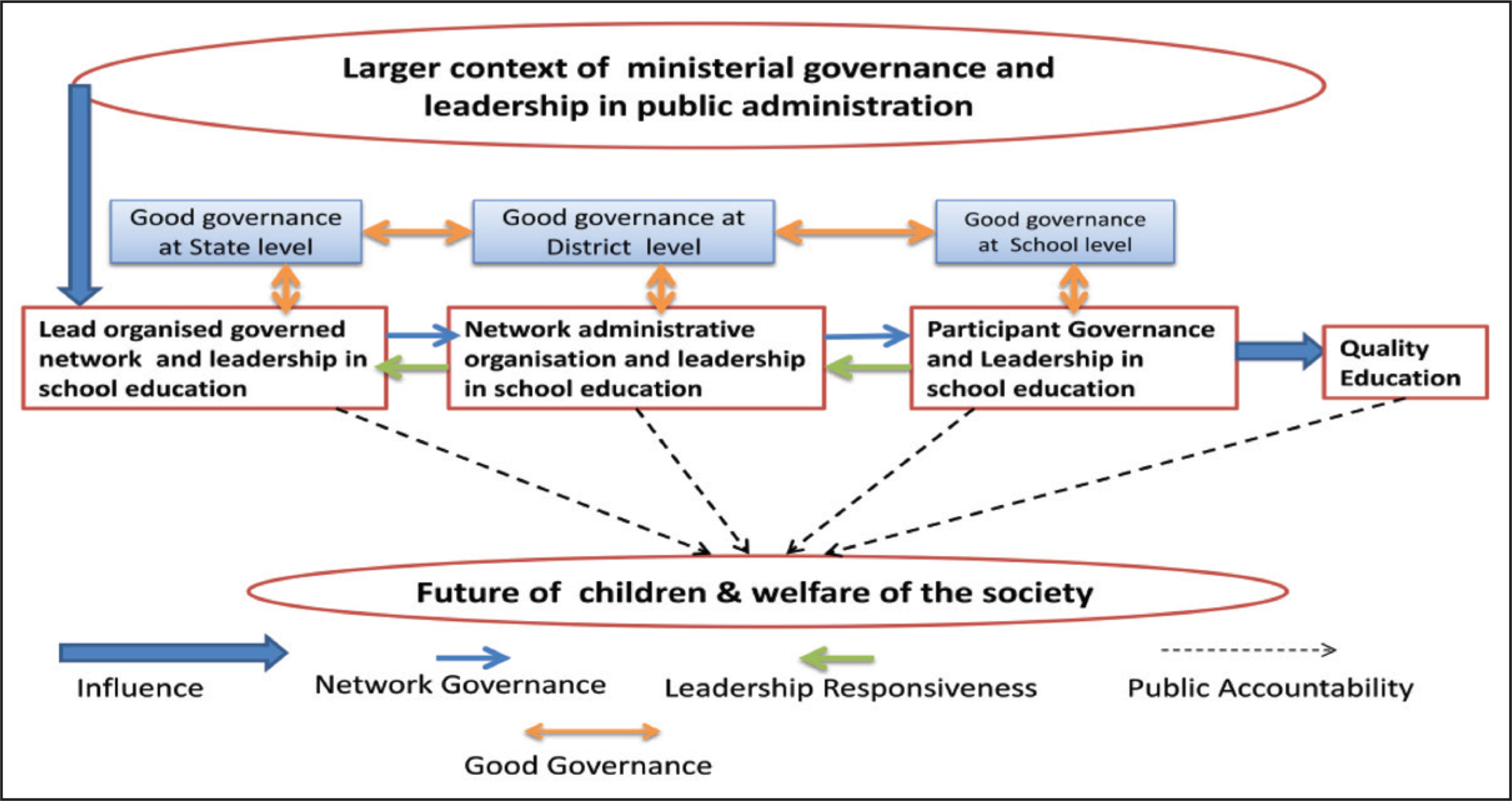
Educational leadership at the state level is influenced by ministerial governance in the larger public administration. It influences the leadership of the lead organised governance network at the state level and network administrative organisation at the district level. These two governance approaches impact participant governance at the school level. In an environment of responsiveness and public accountability for leadership, good governance can be achieved by coordinating between the ministerial, network and participant governance at the state, district and school levels. Good governance in education refers to all those academic, administrative and managerial processes to design and implement good practices and innovations wherein people participate, collaborate and guide one another. All these are mediated not only through educational leadership but also through good practices and innovations, influencing people, operationalising ideas, directing actions and coordinating among the state, district and school levels. While governance flows from the state level to the school, leadership responsiveness for governance flows from the school to the state level.
Studies in education also show that leadership at the district and state levels significantly influences school leadership (Fullan, 2010; Louis, Leithwood, Wahlstrom, & Anderson, 2010), and that school leadership is the second most significant factor for student learning and school quality (Leithwood & Jantzi, 1999; Leithwood, Day, Sammons, Harris, & Hopkins, 2006; Leithwood, Louis, Anderson, & Wahlstrom, 2004). Leithwood and Jantzi (2012) also claimed that principals and district leaders have the most influence on decisions in all schools, and they do not lose influence as others gain influence (p. 11). Hence, leaders are responsible for initiating dialogues across a wide range of functions and levels to operationalise values within political policies (Jain, 2004). They are like magnets attracting the best persons to build teams for organisations and give inspiring leadership even during failures of missions as they are not afraid of risks (Kalam, 2004). It is apparent that good governance without capable leadership remains a dream, and quality education without good governance is impossible to achieve. Good governance with good leadership shapes the future of children and welfare of the overall society (see Figure 1).
Methodology
Sikkim was the site for this study because of its higher performance when compared to other states in the northeastern region of India. It is also untouched by research in the field of school education. The data on governance and leadership were collected using a multipronged and iterative approach consisting of semi-structured and open interviews and formal and informal discussions. These were conducted in natural settings of everyday working environment without disturbing the routines of education officers. The sample consisted of policymakers, planners, decision-makers, administrators and implementers working in different leadership positions at the state and district levels. In all, seven directors and joint directors from all the four districts, four senior education officials working in the Sarva Shiksha Abhiyan (SSA) and the Rashtriya Madhyamika Shiksha Abhiyan (RMSA) programmes and two top-level decision-makers in the state, namely, the Secretary for Education and Director of School Education-cum-State Project Director (SPD) for Sikkim, were interviewed. Access to the high-profile officials and the richness of the data were possible to obtain as the author was also implementing the school leadership development programme (SLDP) in that state during the time when research was also conducted. The total duration for collecting the data lasted for 25 days from the two visits between August 2015 and July 2016.
The sample also consisted of twenty school heads from elementary, secondary and senior secondary schools who participated in the SLDP workshop as members of the state resource group (SRG). They were interviewed on various aspects of leadership, governance and education quality. They came from four districts of Sikkim. Based on the information obtained from the focused group discussions with school heads and discussions with district education officers, ten schools were visited for in-depth observation. These schools were known for good practices and innovations.
The researchers adopted the outsider–insider approach as there was a higher level of acceptance which can be attributed to the implementation of the SLDP that created a sort of records in the state. 2 They engaged in deeper self-reflective exercises regarding their own work in the school. Several education officers took keen interest in the workshop. Some of them even took part in the sessions, and a few others observed the processes and discussed larger issues pertaining to Sikkim’s educational scenario.
Several iterative steps were used to analyse the data on good governance and leadership. First, Sikkim was studied within the larger context of ministerial governance in public administration using the Human Development Report of Sikkim (2014). Outcomes were studied in terms of achievements, and innovation was made in public administration. Next, educational governance at the district level that is situated within this larger context of public administration was examined by studying good practices and achievements in education at the state level. Annual reports published by the state, interviews and discussions were used for the purpose. Various facets of good governance related to departmental governance, public accountability and openness to public policy, transparency, the rule of law and effectiveness were examined using qualitative data. Later, school-level governance and leadership were assessed in terms of time managed between academic and administrative functions by the school heads. The data were collected by distributing a schedule. Innovations and good practices carried out in schools were collected through individual presentations made by school heads, and focused group discussions were held on the presentations by their peers. Out of the twenty schools, ten schools were visited for in-depth observation.
Studying leadership practices for good governance at various levels included leadership in the larger context of public administration and leadership in educational administration at the state, district and school levels. These practices were captured from direct interactions and discussions, observing their style of functioning, inferred from discussions with other officials and from secondary sources. Leadership of school heads was captured through interactions, discussions and presentations made by school heads in the SLDP workshop. School heads were able to freely express their views as they participated in the SLDP workshop engaging intensely in self-reflective exercises. The data were later verified with district- and state-level leadership.
Education quality was inferred through secondary sources like students’ pass percentage in the 10th standard examination conducted by the Central Board of Secondary Education (CBSE), ranking of the state in the National Achievement Study (NAS) conducted by National Council of Educational Research and Training (NCERT) for children at the 5th, 8th and 10th standards in 2015, 2017 and 2018, respectively. The status of educational backwardness and the overall scenario of school education system in the state were also considered.
Governance for School Education
Public Administration in the Larger Context of Sikkim: Achievements, Innovations and Outcomes
The Sixth Schedule of the Indian Constitution confers local autonomy to some states of the northeast region (NER) in administration, protection of tribal areas and their interests by allowing self-governance through constitutional institutions at the district and regional levels. The North Eastern Council was set up in 1971 for the development of northeastern states. The Council provides financial support to the extent of 90 per cent from the non-lapsable Central Pool of Resources (NLCPR). A separate ministry has been set up at the centre with an intention to develop the NER. There is also a shift in the centre’s approach from the ‘Look East Policy’ to the ‘Act East Policy’. It projects the region as the gateway for Southeast Asia for economic development.
Despite several forms of support and initiatives, issues in governance persist in the NER. Ethnic assertions providing advantages to some tribal communities by declaring them special forever over the descendants of immigrants and minority tribes who are forced to remain as perpetual outsiders have resulted in internal conflicts (Kholi, 1990; Srikanth, 2011). The region continues to experience social alienation and the outsider syndrome and remains politically restive and economically dependent (Dhar, 2016). Insurgency and existence of informal parallel polity and administrative structures have also distorted the governance, even though there is some progress (Bagai, 2016). Thus, good governance for the people of NER states is about the feeling of equal and integrated citizens of India, partaking in speedy and inclusive growth (Haldipur, 1969).
Sikkim is the second smallest state with the lowest population of 6.2 lakhs located in the inner ranges of Eastern Himalayas in India. It is characterised by geographically difficult terrains with hills, forests, snowfalls and big rivers. It has four districts and twelve major regional languages, each with a well-developed script and literature of its own. Though landlocked with international borders on its three sides—Nepal, Bhutan and China—Sikkim is comparatively more peaceful than other states in the region.
It is characterised by higher political stability with the ruling party in power for the last 23 years. The chief minister undertakes direct civic engagement. He visits villages accompanied by other legislators and bureaucrats to understand and resolve the problems of people (Human Development Report of Sikkim, 2014). In 2016, his visit lasted for 42 days. It is perceived as an effective method to engage with people and actively participate for the development of Sikkim. When the researcher revisited the state in 2016, there was the Doklam crisis on the international borders. Despite this, the normal life of Sikkim was undisturbed, and the chief minister undertook his direct civic engagement for that year during this time. His leadership enjoys credibility of the people. Public credibility is a basic prerequisite for any development wherein an environment of peace and security with minimum problems of law and order prevails (Aggarwal, 2004).
Achievements and innovations in the larger public administration indicate the outcomes of good governance in Sikkim. The state has received several awards and recognitions in the last 15 years for its excellence in performance. Key achievements in the provision of infrastructure facility are: a near-universal electrification, health and sanitation as well as no open defecation; Sikkim declared itself as a fully organic state and imposed ban on using plastic and on begging, and managed a near complete restoration of infrastructure facilities after the earthquake in 2011 (Human Development Report of Sikkim, 2014). Utilising the work opportunities provided under National Rural Employment Guarantee scheme to ensure employment for all, most of the works in PWD, constructions, roads, and so on have been completed.
Similarly, Sikkim has also made considerable progress in the social and economic welfare of the people. As per the Human Development Report of Sikkim (2014), only 8 per cent of the population is poor. The annual rate of reduction in poverty is 17.4 per cent. There is high safety for women and near-absence of abuse and discrimination against women. Forty-two per cent of women are employed in Sikkim which is the highest in India. Only 11 per cent of the children are mal-nutritional, which is the lowest in India. Social audits are institutionalised in all gram panchayats. A seven-fold increase in investment in health and education was made in 2012. Sikkim ranks third in India for performance in accountability in Panchayati Raj Institutions (PRIs) and has received awards in 2009 and 2010. Sikkim has also won awards for the effective use of ICT in all areas. Tourism, eco-tourism and home stays are highly popular, which contribute 8 per cent to the state’s gross domestic product. These and several other achievements indicate the commitment of political leadership in the state for development. The state government aims at promoting the general well-being of people through the provision of health care, education facilities, access to basic human needs such as food, water, electricity, roads and employment (Aggarwal, 2004).
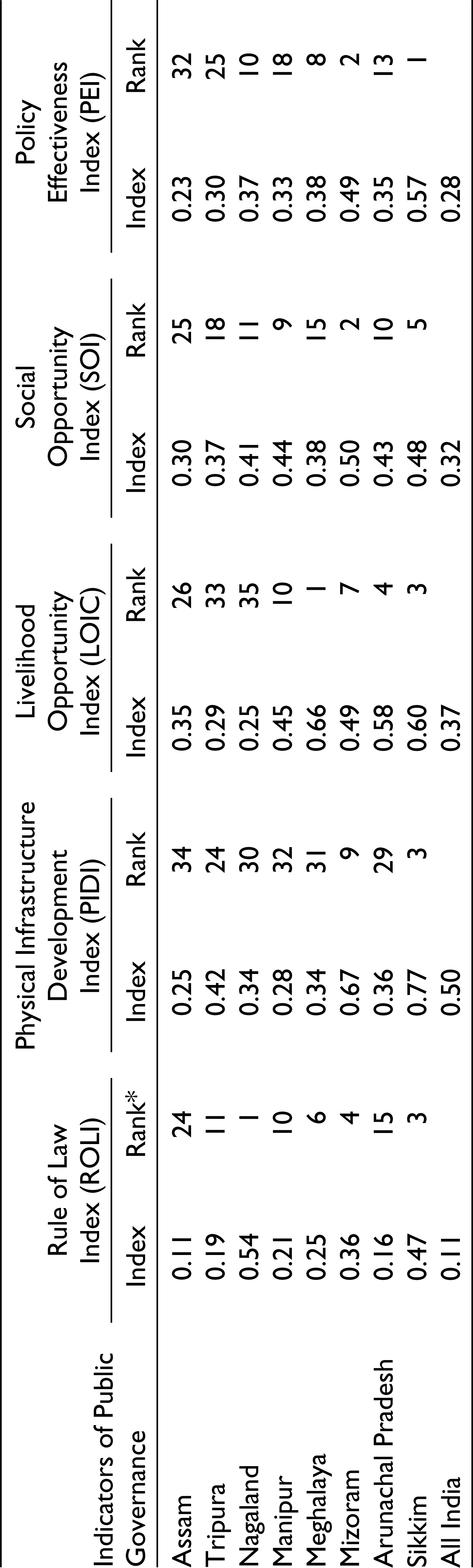
Sikkim ranked first among all Indian states on the policy effectiveness index (PEI) in 2011 with 0.57 mark as against 0.28 at the All India level. It is way ahead in the physical infrastructure development index (PIDI) and rule of law index (ROLI) when compared to other northeastern states. It ranked third for the livelihood opportunity index (LOIC) and fifth for the social opportunity index (SOI) at the All India level (refer to Table 1).
Performance in Public Policy Effectiveness Among the Northeastern States of India (2011)
Innovations in public systems include Dhara Vikas (springshed) to rejuvenate dried water springs and restore groundwater through rain harvesting. It is recognised by the UNDP. Tourism has received six awards in the last 15 years. Achievements and innovations in the larger context of Sikkim indicate an assurance approach for good governance characterised by maturity in processes that enhance institutional responses (Deshmukh, 2004) and provide higher quality life to people that is amply reflected through the Human Development Index, 0.665 for the state.
Network Governance for School Education in Sikkim
Lead Organised Governed Network at State Level
The education system is hierarchically structured at the state, district, block and cluster levels. The schooling pattern comprises 8 years of elementary, 2 years of secondary and 2 years of senior secondary education. The syllabus prescribed by the Central Board of Secondary Education (CBSE) is followed. There is no separate syllabus prescribed by the state government. The Human Resource Development Department (HRDD) is responsible for school education in Sikkim. The department is headed by the Principal Secretary (now promoted Additional Chief Secretary—ACS) who looks after the entire education system in the state—school, higher, technical and professional education. He is assisted by a secretary (now promoted Special Secretary—school education) holding the posts of State Project Director in the RMSA and Head of the Department of School Education. The secretary is assisted by directors, deputy directors and joint directors in the SSA and the RMSA, the director of the State Council of Educational Research and Training (SCERT), the district education office (DEO) and the block education office (BEO) in the department. Principals of senior secondary schools, who are below the rank of joint director, have dual responsibilities of managing schools and CRCs.
The ACS for education in Sikkim said:
Even though there are no special increments for high performance or excellent work in the government, I mention them with a positive remark in the Annual Confidential Report (ACR) of individuals so that anyone who sees these reports later on will know about that person.
The Special Secretary, School Education, remarked, ‘In Sikkim you normally don’t find anyone arguing beyond a point, which is why work goes on smoothly’. These remarks from decision-makers reflect the kind of work culture that is built for good governance in the education system in the state. Various forms of good practices and innovations at the state level throw light on the nature of good governance and leadership in educational administration.
Decision-makers and other officials at the HRDD in Sikkim recognised the positive presence of higher political will and stability in public administration as having contributed to improve the education system. They comprehensively examined the state’s education system using strengths, weaknesses, opportunities and threats (SWOT) analysis to understand the future course of action (Rashtriya Madhyamika Shiksha Abhiyan [RMSA] & Human Resource Development Department [HRDD], 2015). An in-depth discussion with officials revealed more details of the processes. Accordingly, there are adequate physical facilities and teachers in most of the schools. Administrative support by district- and state-level officials is also satisfactory. The education system is equipped with ICT services and electronic gadgets to reach out to all schools, including those in remote areas. Mobile applications and Internet services have made administration simpler, easier and quicker for communication, decision-making, sending official orders and circulars, interacting with teachers and school heads—all of which have enhanced the efficiency of educational administration. Active support and meaningful involvement of district officers in schooling processes is apparent in all these aspects. Further, higher officials have also observed that there are well-defined and designated positions for school heads at the elementary, secondary and senior secondary levels of schooling that are filled through regular appointments. Candidates are selected through a rigorous process of performance assessment over the years, written tests and interviews for these posts. More than 80 per cent of the students pass the public examination held by the CBSE every year. Hence, officials at the helm of affairs concluded that the state has reached a threshold level to take off for achieving higher school quality. Subsequent to SWOT Analysis, a vision-building exercise was initiated by the HRDD for the state as part of quality accreditation by the Quality Council of India, initially for ten high-performing schools. This initiative was taken much before the introduction of the Ministry of Human Resource Development’s (MHRD) Shaala Siddhi Programme in 2015.
An important component identified in SWOT Analysis was leadership development. It coincided with the introduction of MHRD initiatives to develop school leadership in the country. This significance might also translate into active participation of policymakers and decision-makers such as the principal secretary and special secretary, programme officers, district education officers, joint directors and school heads. It also included the participation of the Education Minister who took active interest and actively engaged in getting updates about the progress of the programme. The thrust for leadership development continued even after the first round of creation of the state resource group and its capacity building in 2015. A school leadership academy was set up to sustain leadership development in the state for education. It conducted the one-month certificate programme for the school heads which was also widely acknowledged and appreciated. The Education Minister spent about 2 hours interacting with the participants to know the usefulness of the programme. He also said that the state government will finance the one-month programme in case there are no central funds coming next year. Thus, the priorities of the government and the propensities of ministers to intervene are crucial for good departmental leadership and governance (Edwards et al., 2012). A responsible leadership at the highest level geared towards the concern for others, and having a vision in relation to departmental leaders at different hierarchical positions is essential for good governance (Pless & Maak, 2011). It should also be characterised by stakeholder orientation that creates a sense of belonging and loyalty to the organisation as a departmental culture.
The ease of educational administration was another important feature of good governance in Sikkim. Officials discuss issues with school heads and mostly decide administrative matters on the spot when they visit schools. It has considerably reduced the stress of school heads and their time to travel to the district or state head office. Simplifying bureaucratic procedures using ICT and electronic gadgets for information dissemination has proved effective for state-level officials to be in touch with teachers and district officers. Direct access to system-level officials through ICT and mobile communication has considerably reduced the psychological distance between district and state officials and teachers and HMs. These methods have boosted the morale of teachers and school heads, providing them with an opportunity to express themselves freely and fearlessly. In fact, any teacher in the system can directly contact the ACS and special secretary as well as other officials on WhatsApp, seeking clarification or making request for resolving issues or professional guidance. These measures using ICT have increased trust among members of the teacher community, school heads and other officers. It has enhanced the efficiency in educational administration and inter- and intra-level connectivity among officials in the department. This has also created transparency in educational administration, flexibility, alternate approaches, cost-effective policies, greater accountability, efficiency in delivery mechanisms and stress-free working atmosphere. As a consequence, higher quality consciousness for educational and result-oriented work processes is apparent at the state level.
Education officers at the district and state levels strive to encourage innovations and good practices and also replicate them in other schools in the entire state or its districts. As part of professional development, HRDD-sponsored high-performing teachers and school heads visit schools in Singapore, the UK, Japan and China to learn good practices in these countries. It also encouraged individual’s initiatives by some principals to bid for collaborative projects with schools in the UK which included knowledge exchange programmes between the two countries, experimentation of new methods of teaching and educational visits to the UK. According to a few school heads, they also enjoy a greater degree of autonomy, if they demonstrate excellence in school improvement. Openness to discuss matters with school heads and teachers is observed among system-level leaders. At least some HMs have been able to discuss issues with HRDD officials, suggest changes and give their opinions on the educational policy in the state.
Network Administrative Organisation at District Level
Complementing the good practices adopted at the state level, the district leadership also engaged in a number of activities. It regularly coordinated with state-level officers on matters related to educational administration. Officials also visited most of the schools at least once in a year and ensured timely completion of work. They facilitated the networking between different schools which are working on similar ideas or innovations; identified innovations implemented in different schools and examined the efficacy of their application to other schools or even in the entire district. Officials in south Sikkim personally involved themselves in experimentation and also arranged inter-school visits for teachers. They started pre-primary classes on an experimental basis in some secondary and senior secondary schools to ensure the continuity of schooling for children and their siblings. It soon spread to the entire state. Now, all schools in Sikkim have started pre-primary classes that are attached to primary schools. A separate cadre of designated HM posts was also created, and posts were filled in 2017. District officials also gave autonomy to well-performing schools to experiment and design their own school development plans. They tried to give individual attention to schools, an indication of good governance practised by district-level leadership. In this way, district leaders articulated the vision created at the state level, empowered schools and encouraged creativity and innovations. One of the district officers made great efforts to streamline the land records of all schools in north Sikkim. The ownership of the land in most schools remained in the names of donors. This officer negotiated with families to get the land registered in the name of schools. He also won an innovation award at the national level for these efforts. Such networking by district leadership will unfold when good practices and innovations are discussed at the school level, which are discussed in the next section in detail. Thus, governance involves creating and implementing activities based on shared goals with those who lack formal authority or policing power (Agranoff, 2003).
Participant Governance at School Level
Two factors are examined to understand the participant governance at school level, namely, time management and innovations and good practices in schools.
Time management: The most challenging task of the school head is managing the time between academic and administrative activities. Any good governance process characterises duty orientation towards core activities giving requisite time. The extent of attention paid to academic activities balancing them with that of administrative roles enabled school heads to undertake innovations who adopted good practices for achieving higher quality. Some of the crucial academic and administrative duties for which the school heads spent time have been examined (in Table 2).
Time Spent on Academic and Administrative Activities by School Heads in Sikkim

School heads in Sikkim devoted almost equal time to academic and administrative activities. They personally spent 3 hours 30 minutes per week working on administrative matters apart from supervising the work carried out by staff and representing the school in various meetings held by the education department. Meetings at the departmental level are a crucial space to project the work of the school, negotiate with officials for financial grants, resolve administrative and academic issues and so on. Another important administrative function is the maintenance of records, which is the key evidence for establishing accountability and transparency in school administration. They focused more on this activity than any other administrative duties.
The nature of academic activities reflected several characteristics of instructional leadership. It included 1 hour of teaching students directly every day apart from academic supervision and monitoring. School heads devoted 3 hours 20 minutes per week on mentoring teachers and nearly as much time on supervision. Therefore, distribution of time equally between academic and administrative activities of the school especially focusing on core schooling functions, accountability and transparency implied school leadership’s efficacy for achieving higher quality. Innovations and good practices led by school heads added further impetus to these results.
Innovations and good practices in schools: Some of the innovations and good practices are narrated briefly here. The ‘mother–teachers’ or ‘teacher–guardian’ programme introduced in some schools by school heads has spread to other schools in south Sikkim. It was actively facilitated by district officials, especially by the joint director of the district. Now, it has spread to entire state as a state-level intervention to give care and attention and ensure student participation, especially at the pre-primary and primary levels.
As Sikkim is amidst forests and mountains, some of the practical learning in biology is conducted in the ‘Forest School’ with intent to develop independence, self-confidence and technical and social skills. Children learn directly about flora and fauna in the forest. This is a popular method of teaching in the entire Sikkim. Students also learn processing of tea leaves, which is an important regional commercial crop and vocational education having potential for earnings.
‘Star of the week’ is another initiative by some schools in south Sikkim. Weekly award is given to a child as recognition of high performance in learning for the entire week. The child wears the star for the entire week in the school. It acts as recognition for the child to continue learning. This is an initiative learnt from the international collaborative project. Another principal convinced the District Education Officer in East Sikkim to permit her to declare holiday on all Saturdays for children studying in the lower classes so that she can mentor teachers. She guided the teachers to develop weekly worksheets on all subjects for effective teaching. In a junior high school, headmistress convinced the teachers to take responsibility for students’ learning if they have not learned in their present class, but are promoted to the next level under the no-detention policy. Teachers in her school ensured that children learnt as revealed through their test scores within a period of 4 months.
In one of the schools in East Sikkim, supply of drinking water facility was frequently disrupted. Children had to carry water bottles to the school. Principal with the help of a parent working in BWSSB department found that water supply to the school was illegally hacked by houses situated in the vicinity of the school. Negotiating with HRDD to sanction the money, collecting donations from the community, the water tank was set up and illegal hacking of water was checked by having a separate line for connection. Children and teachers enthusiastically lend their support for the tank and set up water pipe connections in several places in the school. After the completion of the entire exercise, children expressed ‘we can do it ourselves’. It indicated the participation of children for restoring water facilities in the school.
In Gangyap, an interior tribal village in west Sikkim, the school head introduced basketball in the Eklavya Model Residential School for girls in 2009. The initiative was mainly to arrest dropout of girls after completing 8th standard. Consistent efforts of head master resulted in girls taking interest to play. They even constructed the concrete court for playing the game and created walking path to reach the court. They won the regional basketball tournament held in Sikkim and Kolkata, the junior national championship continuously from 2012 to 2015 and again in 2017. These girls also scored above 9.0 CGPS points in the CBSE board examinations. 3
The school visits revealed a number of good practices besides innovations. The physical environment is good in most of the schools in Sikkim. A number of modern, colourful and play items such as slide, toys, television, audio player, paint brush, colours, garden, courts for playing games, bio-diversity parks, biology garden, normal school garden, neat and clean classroom corridors, which make schools more attractive, are more than adequate. The natural environment of forests, hills and clean surroundings add special significance to it. Therefore, there is a readiness for learning in terms of school climate for learning in most of the schools in Sikkim. Classroom walls in elementary and primary sections were full with learning aids and charts. Paintings of animals, birds, nature and children’s assignments also filled the walls. In many schools, walls besides the staircase were utilised as spaces to display children’s assignments, science models, general knowledge, and so on to promote learning among students. Setting up of English learning corner in each classroom is commonly found in all schools in Sikkim. Print-rich classroom is another initiative which is popular among teachers and school heads in all districts. In this way, classroom and school building served as learning enablers for children. Few other good practices observed in Sikkim schools included creating a weekly calendar of activities for efficient allocation and management of resources equally for all classes, weekly field trips, maintaining a score board on quiz competition held during assembly sessions, active participation of teachers and students in the morning assembly, inculcating reading habits other than text books and so on. A school principal also started a blog for the school to announce new initiatives taken up, which also facilitated transparency, ease of school administration, maintenance of records and so on. Several other schools also attempted it subsequently.
Good Governance in School Education
Three indicators of good governance were further examined from the aforementioned analysis to understand the extent of the good governance practised in Sikkim. They refer to public accountability, openness to public policy, adoption of technology and adherence to rule of law.
Public Accountability
Achievements, innovations and accomplishments in larger public administration are indicated by near universal provision of basic facilities such as electricity, education, health and food. Direct political engagement with people and encouraging their participation has resulted in greater political stability, higher degree of peace in the region and excellence in performance. It is evident from awards and recognitions received for innovations in public services by the state. All these have influenced higher human development index and quality life as well as created a favourable environment for good governance in education system. Human development report also mentions that the methodology adopted was a participatory approach wherein stakeholders actively participated in giving their inputs for human development report. An online forum was also created, and suggestions and comments were also received online for the same.
Openness to Public Policy and Adoption of Technology
In the area of school education, co-ordination and mutual support between state, district and school level administration to improve quality through direct interaction is mainly facilitated by ICT. WhatsApp is a common and easy-to-manage application through which school heads shared good practices, disseminated information and interacted with each other extensively with colleagues and leaders at all levels from ACS to school teachers. ACS immediately used to reply wherever found relevant, consoled and boosted the confidence of teachers. Important circulars and information were also being posted on WhatsApp regularly. Doubts were clarified, and new updates were given for the schools. It shows transparency in governance processes as well as effectiveness in leadership practices. Hence, while core administrative aspects are mediated through district-level leadership to reach every school with regular feedback mechanisms, every teacher also had the access to ACS and special secretary at HRDD. These processes also indicated the alignment of focus and direction of responsiveness by the leadership at all levels. This has particularly resulted in responsible leadership and openness for public policy in education and good governance. In other words, good governance in the larger public administration has provided necessary stability in the education system building a culture of innovation, excellence and responsiveness.
Adherence to Rule of Law
School being the primary unit for translating state’s aspiration into actions, it must be duly supported by state- and district-level leaderships. The data show that leaders in Sikkim examined their own experiences, identified the needs and implemented suitable changes through good practices and innovations for accomplishing higher quality education. There is also a spillover effect of learning from a few schools to the entire district and state through initiatives such as ‘star of the week’, teacher–guardian for young children who are below the age of 10 years, child-friendly classrooms and so on. All these practices occur when there is a mutual interaction among different players. Any interaction between different players succeeds where there is fairness in the treatment of professionals besides providing spaces for free thinking and experimentation for innovations. Fairness of treatment results from adherence to rules and regulations.
Leadership and Governance for School Education
Responsiveness and Responsible Leadership
Improving governance is a process of integrating knowledge with rigorous data and empirical analysis, diagnostics and dissemination, use of the latest available ICT, leadership in political, civil society and international arena and collective action through systematic participatory and consensus building approaches for good governance and development (Jain, 2004, p. 52). Achievements and innovations discussed earlier including high connectivity through ICT clearly indicate that development is systematically planned using data and situational analysis in Sikkim. Popularity and stability of political leadership, peaceful co-existence despite sharing international borders with three countries and direct civic engagement indicate the quality of collective action and consensus building for good governance in Sikkim. In other words, there are strong indications of the presence of good governance in the larger context of Sikkim characterised by higher levels of policy effectiveness and public accountability. Good governance was possible due to the higher political stability with able political leadership that translates into stronger political will for development. Thus, there is a responsive and responsible leadership for public administration in Sikkim led by the Chief Minister. It provided a favourable environment for good governance in school education too in the state.
Greater political stability provided stronger political leadership, higher political will and the push required for good governance. It is evident from achievements and innovations in public administration for good governance, influencing leadership and quality in school education. HRDD, the formal structure at state level for educational governance, supported and actively participated in bringing about educational change in the state. State leadership directly connected with school heads and district officers through ICT, mobile and other technology besides visiting district offices and schools.
A distinct preparation in the form of need analysis, vision building and admin- istration indicated the aspiration for good governance by the state leadership for achieving higher education quality. Educational leadership, therefore, is responsive to good governance in public administration driven by stable political leadership which took responsibility for good governance in educational administration. A proactive educational leadership at the state level has significantly influenced the succession of events starting from recognising the need to aspiring for higher quality accompanied with readiness for its accomplishment.
Three aspects link responsible leadership with good governance in Sikkim for achieving higher quality. They refer to building a vision for education in the state; appropriate academic and administrative leadership and processes and encouraging innovations and implement good practices. These have firmly established the direction of responsiveness not only from state to school level but also from school to state level, witnessing transparency, trust building and stability for good governance at district and school levels.
Inclusiveness and Associational Leadership
There is a coordination of educational processes between state, district and school level. While the school head focuses on the overall school improvement and changes in the teaching–learning process, district administration lends support and participates in the school change processes. The state-level administration facilitates district and school administrations by introducing easier and quicker means of administrative procedures extensively using ICT to connect with district officials and school heads. Good practices and innovations in the school are positively reciprocated by district- and state-level leaderships. District admin- istration through its networking has also facilitated in building a culture of change in schools. Innovations in teaching–learning processes like teacher–guardian, forest schools have spread to the entire state due to networking by district leaders connecting schools with HRDD at the state level. This type of tri-level coordination for good governance practising inclusiveness of leaders is popularly known as shared and/or distributed leadership in education. Aspiration for higher quality has resulted in readiness for achieving the same through good governance initiated aptly by the top-level leadership at HRDD. Thus, governance is about exercising legal power and authority vested in institutions and agencies of the government to carry out avowed goals (Aggarwal, 2004).
In sum, public accountability in public administration influences transparency, adherence to rule of law and responsible and responsive leadership in the education system at state level. District- and school-level leaderships are responsive to state-level leadership on good governance. District-level inclusive and associational leadership aligns leadership focus between schools, link schools with state-level leadership necessary for establishing stability in good governance and for consolidating the direction of responsiveness from school-to-state and state-to-school levels. It facilitates building a culture of innovation and excellence in education system. Thus, good governance can be said to be initiated and led by state-level leadership into which adherence to rule of law and tri-level coordination are built-in.
Education Quality
The school system in Sikkim is characterised by several strengths. According to RMSA and HRDD (2015), there are no single teacher schools, nor is there educationally backward block (EBB) in the state. There are only four school categories in Sikkim, out of which 406 primary (1–5 standards), 184 junior high schools (1–8 standards) and 113 secondary schools (1–10 standards) and 64 senior secondary schools (1–12 standards). Altogether, there are 767 schools. All of them have designated school head’s positions such as Primary Head Master/Mistress (P-HM), Junior Head Master/Mistress for elementary level (J-HM), Head Master/Mistress (S-HM) for Secondary level and principal for senior secondary level (RMSA & HRDD, 2015). There are also eight Sanskrit patashalas (or schools), one Gumpa school (local traditional school) and one Buddhist school in Sikkim. Out of the 767 school head’s vacancies, 700 posts were filled in 2015. Now, most of the schools also have pre-primary (recently introduced) attached as per the policy of the government, which is a significant development in the state to ensure enrolment and participation of children in schooling. Posts of designated Head teacher for primary sections (from pre-primary to 5th standard) have also been sanctioned and filled in 2017.
Educational scenario in Sikkim contrasts with the national scenario which has ten school categories, out of which six of them are stand-alone schools with no designated school head’s position or a sanctioned post for a school head. Pre-primary sections in most of these schools are absent, and single teacher schools are as high as 57 per cent (Unified District Information Schedule [UDISE], 2015–2016). It is approximated that more than 50 per cent of the designated school heads’ posts are not filled in the country, whereas Sikkim has designated school heads in more than 95 per cent of schools. There is at least one EBB in other states, whereas Sikkim does not have any one. Sikkim stands third in the National Achievement Survey on student learning conducted by NCERT in its IV round in 2015. Eighty-two per cent of students passed 10th standard examination conducted by Central Board of Secondary Education in 2015. However, in the NAS survey conducted in 2017 and 2018 for elementary and secondary stage, Sikkim does not score as high as it did in 2015. This calls for examining pedagogical processes, which is beyond the scope of this article.
Educational Leadership as the Operational Leg of Governance for Higher Quality of Education
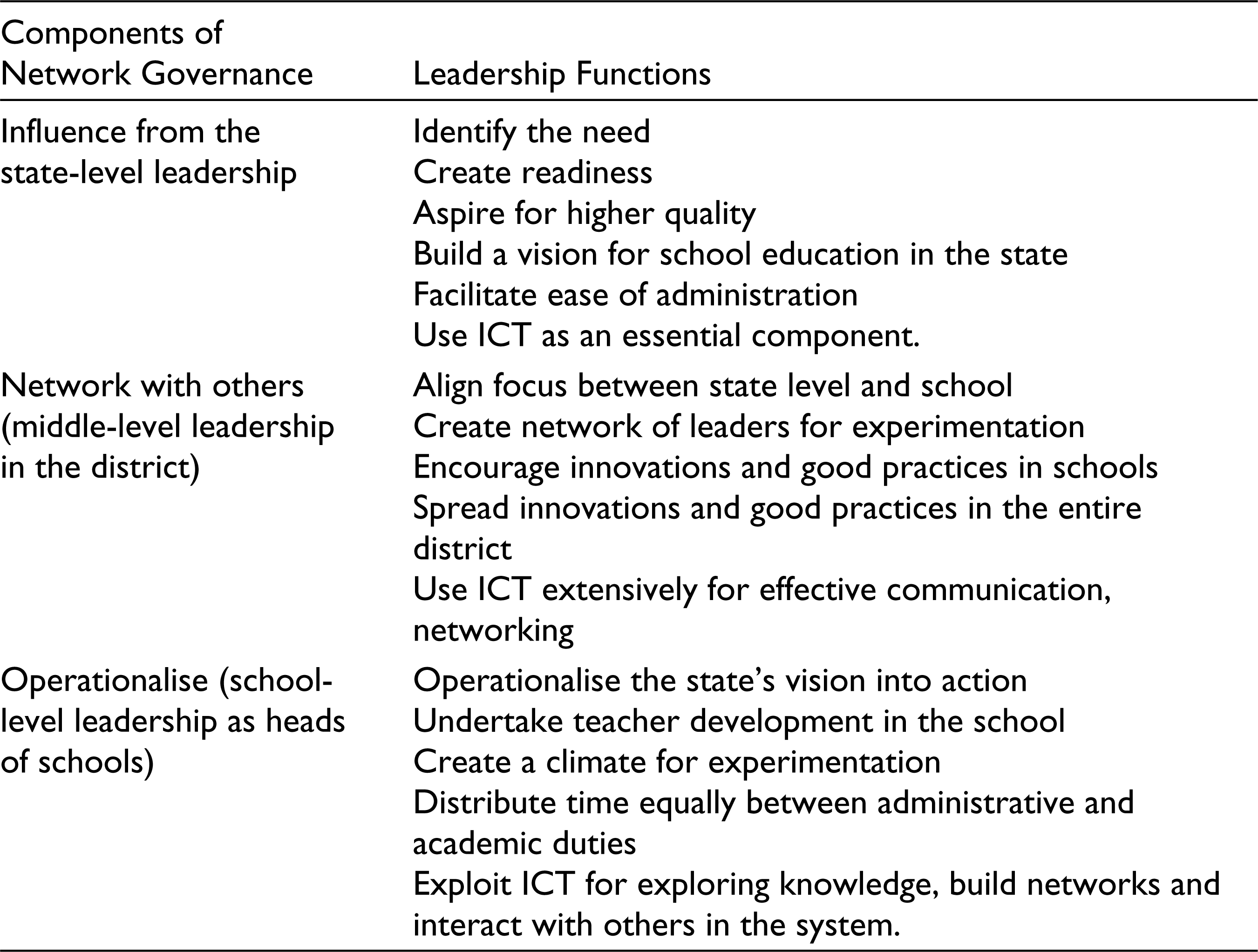
The present study shows that three aspects of good governance and related leadership functions contribute for higher education quality in Sikkim. These functions are: influencing the system-wide changes, networking with others and operationalising ideas into practices at state, district and school levels in the education system. Influencing systemic change from the state level involves three specific leadership actions such as identifying the need, creating readiness and aspiring for higher quality. Decision-makers and policy implementers at the state level felt the need for change to achieve higher quality. District leaders provided the required support and acted as network leaders to scoop talents, innovations and good practices for translating the need felt at the state level leadership into action through a network leadership. They served as a link between state and schools aligning the focus to form tri-level coordination for good governance in education. District leaders created a network of schools for encouraging experimentation, innovations and good practices in schools and spread them in the entire district.
The school leaders operationalised ideas conceived at the state level as well as applied their own ideas to translate the state’s vision into actions, undertook teacher development and created a favourable climate for experimentation. The principal distributed her/his time equally between academic and administrative functions for these goals to be realised: utilise ICT for exploring knowledge, build networks, interact with others in the system, monitor and supervise school activities, innovate different methods and adopt good practices for operationalising state’s vision into actions.
In and through these educational processes from state-to-school level, there is a high degree of inclusiveness in leadership practices, adherence to the rule of law, mutual support and reciprocation for building associational leadership that characterise good governance. Leaders established appropriate administrative procedures, aligned leadership practices from state-to-school level, reinforced good practices and encouraged innovations for sustaining good governance (see Table 3).
Governance and Leadership for Higher Quality Education
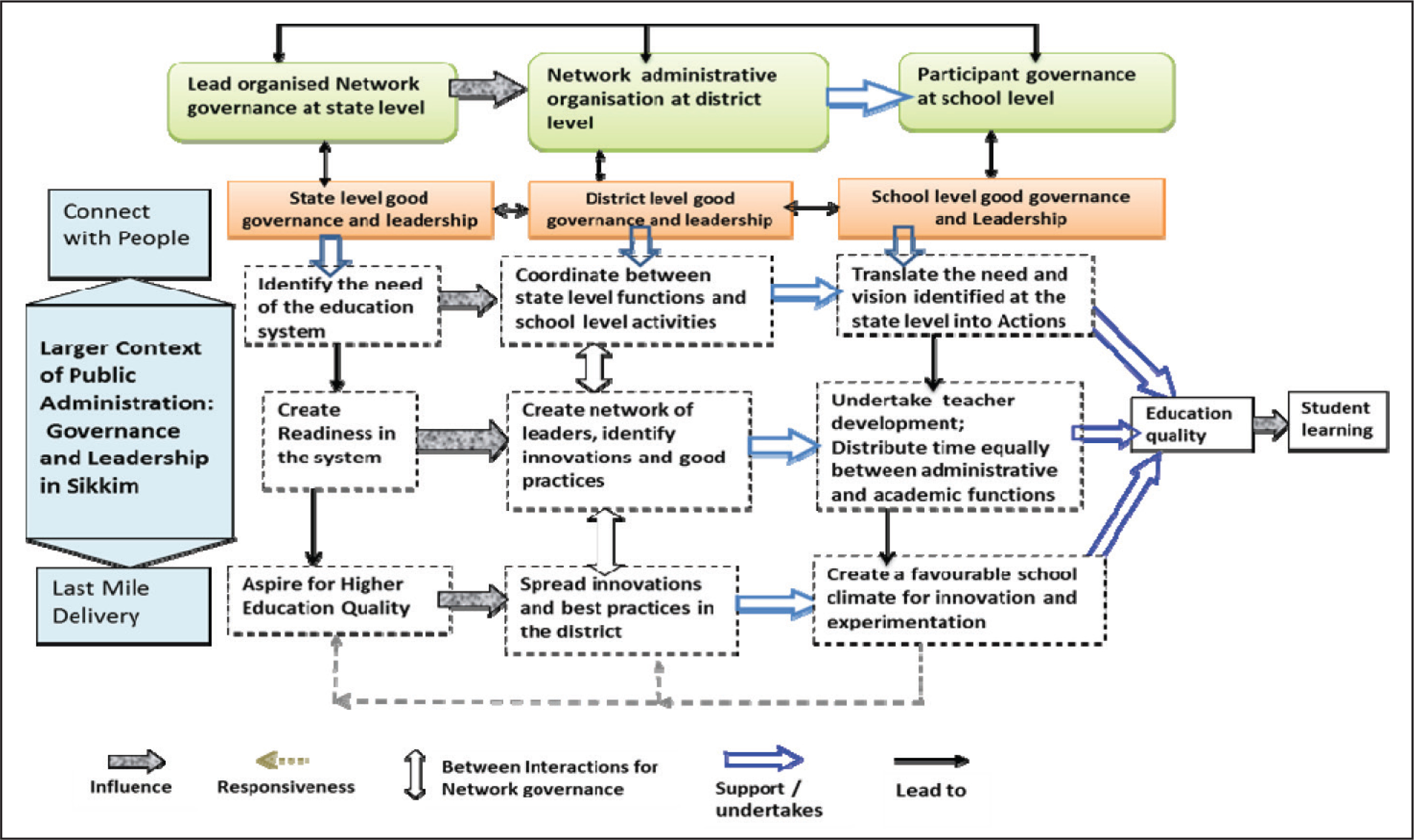
The larger context of the good governance carrying the motto ‘connect with people’ and ‘last-mile delivery’ (Human Development Report of Sikkim, 2014) influenced good governance and leadership practices in education system for achieving higher educational quality. The leadership practices in various positions of the hierarchy were responsive to the levels above while coordinating and aligning with levels below. A higher efficiency in public administration was imminent as leaders were responsive and responsible who practised inclusive and associational leadership to provide public accountability, extensive use of ICT, openness to public policy and adherence to rule of law in the larger public administration. This increased the efficiency in educational administration and good governance that guaranteed well-functioning government schools.
Leadership connected institutional factors, organisation and individuals for ensuring good governance depending on the context and situational demands exercised in a relational framework of values, motives and a shared sense of vision across multiple levels to achieve higher quality education. It is a direct way of attributing higher legitimacy to public institutions in the state including government schools by the political leadership. It was duly translated by the bureaucratic leadership through HRDD from state to school level. Thus, the study shows that strategic actions alter the content and process of education system manoeuvred through network governance and leadership that is positioned within the context of larger public administration wherein different components of good governance influence one another for achieving higher quality (see Figure 2).
As a function, leadership develops the ability to question the prevailing attitudes, notions and beliefs in the schooling processes to co-craft the meaning, characteristics and approaches to practise collective consciousness, creating indi- genous processes and practices for good governance. It is a leadership continuum in the education system for those working from various hierarchical leadership positions to dovetail into the school to support and share responsibilities with the school head for leading change with a shared vision. In network gover- nance through the means of good governance from system level, leaders create more leaders who are equidistant from the school, networking with each other, replacing the notion of leader–follower with a collective of leaders and creating an ownership for all, participating actively to create a climate and culture where experimentation, innovations and good practices for higher quality of achievements are the necessary prerequisites. For this, state-level leadership, operationalised needs and aspirations emphasising on responsiveness rather than accountability for good governance aligning vision and leadership practices at all levels. In this way, leadership became as the operational leg of good governance. In education system, network governance mainly aims to strengthen experiential learning, leading educational change and providing platform for exchanging perceptions and practices among education functionaries at all levels for achieving higher quality education. Good governance supplements and complements as a means by which process of network governance connecting public administration and its leadership are effectively implemented, and goals of educational administration are realised.
Conclusion
The present study argues that good governance is a means for network governance through which higher education quality can be achieved. Good governance and leadership in the larger context of public administration at the state level influences good governance and leadership in education at the school level for achieving higher school quality.
The study shows that leadership influences from the state level characterising lead-organised governance network is in the form of identifying the needs, creating readiness, aspiring for higher quality, building a vision for education system, ease of administration and use ICT for efficiency. District-level leadership practices characterising network administrative organisation include establishing networks by aligning the focus between state and school levels, creating a network of leaders in the school for experimentation, encouraging innovations and good practices, spreading innovations and good practices happening in a school to other schools in the district and effective communication using ICT. School heads practise participant governance mainly by translating the state’s vision into action, engaging in developing teachers professionally, creating a climate for experimentation, distributing their time equally between academic and administrative activities, using ICT, building networks with district- and state-level officials and interacting meaningfully with officials. In and through these processes at all levels in public administration and education system, good governance practices in the form of public accountability, openness to public policy, adopting ICT and adherence to rule of law provided the necessary means to realise higher quality education. Responsive, responsible, associational and inclusive leadership practices strengthened good governance and network governance to result in higher quality education. Network governance loses its significance without practising good governance. Good governance yields little result without network governance in the hierarchical education system. Higher quality of education is achieved on account of the triangulation of good governance, network governance and leadership. Hence, it is of significance to develop leadership at all levels in the education system to operationalise good governance by building network governance for achieving higher education quality.
Footnotes
Declaration of Conflicting Interests
The author declared no potential conflicts of interest with respect to the research, authorship and/or publication of this article.
Funding
The author received no financial support for the research, authorship and/or publication of this article.