







Abstract
At present, Upazila land offices are designated to provide digital land services for reducing the complexity of land-related services and increasing the satisfaction of citizens in Bangladesh. The government has planned to extend the digital land management framework to all Upazila’s land offices for improving the state of land service delivery. The study has tried to explore the extent of satisfaction, trust and knowledge of citizens about the digital land services delivered by the Upazila land offices. The study has applied qualitative methodology approach. The data have been collected through in-depth interviews and key-informant interviews, both from service-receivers and service providers. Content analysis has also been used to analyse secondary data. The findings of the study suggest that lack of responsiveness, insincerity and non-cooperation of the staff in service delivery as well as lack of knowledge and awareness of citizens about digital land services are major constraints to achieve satisfaction in digital land administration.
Keywords
Introduction
Bangladesh is an over-populated country, and it has a limited land boundary. So, the management of this scarce land is a very important and sensitive issue in governing the state. Land is a valuable resource, and proper land management can reduce land-related complexities in Bangladesh (Hoque, 2016). Land-related complexities mainly arise due to the delay in updating information about land ownership transfer and land recording in the traditional system. Public organisations and governments across the globe are adopting digital technologies to support the interaction between citizens and the state (Goodsell, 1981 cited in Lindgren et al., 2019), with the aim to improve efficiency and service quality through reduction of service time, increase transparency and integration across organisations (Layne & Lee, 2001). Bangladesh has not been far behind in developing the public service delivery in order to satisfy the needs of the people through using ICT in public sectors (Goetz & Gaventa, 2000; Osman, 2016). Effective digitalisation requires negotiation, coordination, networking and regulation of ICT (Gessi, 2006). Most importantly, the effective application of ICT can minimise the number of inefficiencies in processes by allowing file and data sharing across government departments, contributing to the elimination of mistakes from manual procedures as well as reducing the required time for transactions (Rahman & Talukder, 2016). Moreover, data can be submitted online, greatly increasing the quality of service for customers (Lin et al., 2001, cited in Asad, 2013). So, digitalisation has a positive influence on achieving efficiency in service delivery and citizens’ satisfaction.
Land is closely connected with our livelihood, social norms and economic activities, and it is emphasised by Article 42(1) of the Constitution of Bangladesh, which gives rights to all citizens to acquire, possess and transfer properties. With its importance in our daily lives and economic activities, land that is currently administered remains firmly rooted in practices established during the colonial era. The colonial British government gave high priority to the organisation of a Centrally controlled management system that was designed to maintain political control and secure a steady source of state finance. Relatively little has changed in the post-Independence era (Billah, 2017). The complex and disaggregated process of land administration creates various problems in land management, including lack of coordination and efficiency in the system, and this system is very often responsible for errors in ownership records. The ownership rights are recorded in three different offices, each of which is run completely by a different executive process (A2I, 2016). The uncoordinated executive processes are the source of most of the problems with land administration in Bangladesh, which leads to everlasting land conflicts. Hence, the importance of efficient and appropriate land administration and management in a country like Bangladesh cannot be ignored. It is essential to establish a compatible and efficient land administration and management system for establishing a systematic approach for planned land development (Islam et al., 2015). The Government of Bangladesh has already undertaken efforts to provide quality land-related services to people through improved land administration and digital management system (Islam, 2013). But people experience harassment, maltreatment and non-cooperative attitude from the service providers in the Upazila Land Offices (ULOs).
The service delivery system in land offices is conventional and time intensive. Existing problems of land offices like poor quality of land record and land management are principal obstacles in improving public service delivery. Complicated and ambiguous land records create tenure-related disputes and incite malpractice (Hossain, 2015). The government is also deprived of land revenue, and the land grabbers manipulate ownership through forged documents using their muscle power (Barkat, 2001). Citizens find land-related laws, rules, regulations and official procedures complex and confusing, and the minute formalities act as a repulsive force to keep them away from the land office (Masum, 2017). Hence, access to land-related services has become complicated, middlemen-dependent and bribery-oriented. Different studies detected various impediments to promote quality land-related services to citizens in Bangladesh. The argument of the study is that there are various limitations in providing land-service delivery, especially in digital land service in land offices in Bangladesh. The specific objective of the study is to find out what factors explain the citizens’ satisfaction with digital land services provided by the Upazila Land Office of Barishal Sadar Upazila.
Methodology
The study has applied qualitative method approach. The qualitative approach helps to find out more accurate and in-depth analysis of service providers about the factors of satisfaction or dissatisfaction of digital land services (Creswell, 2003). For collecting primary data, in-depth interviews with service-receivers and key informant interviews (KII) with service providers have been applied in the study. The secondary data have been collected by content analysis. Through open-ended questionnaire, interviews have also been conducted with respondents. Some close-ended questions were included on service receiver’s questionnaire for numerical findings on citizens’ satisfactions with land service. The respondents of the study have been selected by purposive sampling technique. The desired sample size is fifty. From the fifty respondents, forty are service receivers, six are staff and four are high-level officials of the district such as Deputy Commissioner of that district, ADC (Revenue), Revenue Deputy Collector (RDC) and Assistant Commissioner of Land (AC Land) as service providers. As study area, Barishal Sadar Upazila has been selected as it is one of the prominent Upazila of Barishal district. These are categorised in Table 1:
Primary Data Collection Technique.
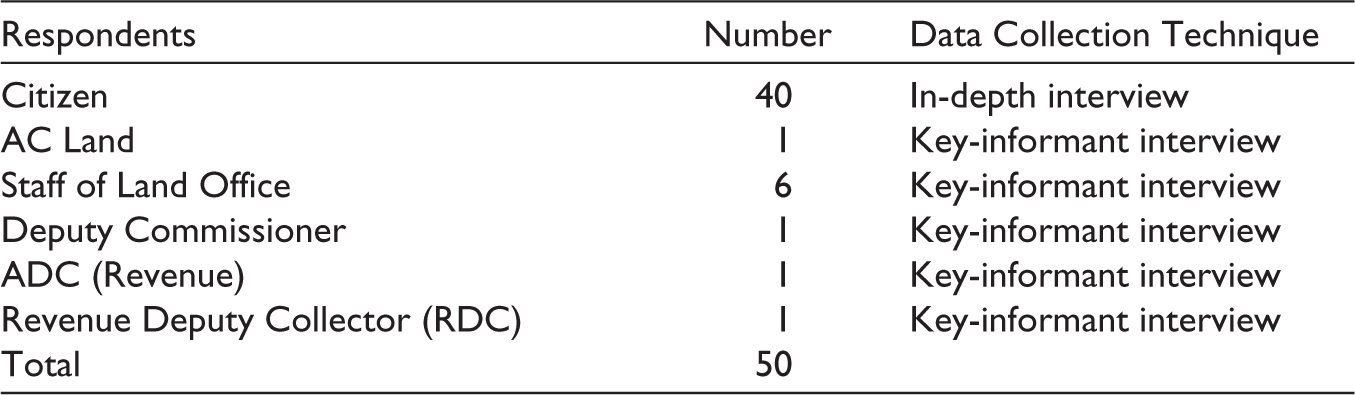
Because of time and cost limitations, the researcher could not reach all the Upazila land offices in Bangladesh and apply the survey method in study. Having some limitations, the study has assumed that the services provided by the Barishal Sadar Upazila Land Office can help to represent all Upazila Land Offices of Bangladesh in a tentative way.
Conceptual Framework
Citizens’ satisfaction can be explained in a variety of fields. In public service delivery, citizen’s satisfaction has been considered on the basis of citizens’ expectations, citizens’ trust, and perceived quality of the delivered services. The governance factors like accountability, transparency and responsiveness in e-service delivery of government can ensure proper satisfaction of citizens. The satisfaction of e-services can also ensure citizens’ trust in government agencies and in general (Mishra & Geleta, 2019). There are many studies about the existing problems of land administration and management, but no studies have been found about the citizens’ satisfaction with the delivered digital services of Upazila land offices in Bangladesh. The study has tried to fill the research gap on the satisfaction of citizens with digital land service provided by Upazila land offices in Bangladesh. Hasan (2017) in his study, explained land management, land survey and land transfer registration as the core functions of land administration system in Bangladesh. The author has explained that the manual process of service delivery in land administration became lengthy and time-consuming. In this study, various problems of land administration system are explained, such as record-keeping and information management in the entire land sector are done manually, and all land surveys (CS, SA and RS) for more than 100 years were done manually. Furthermore, manual information management systems unwittingly prevent proper monitoring of field operations and are a major hindrance to ensure accountability. In this regard, digitalisation is considered essential to bring efficiency to the land sector (Hasan, 2017).
Hossain (2015) emphasised the digital management system of land services through inputting the khatian records in the e-Service Centre and DLRS and printing the information. Without having an integrated digital record system with a Central server, lack of coordination and inefficiencies in managing and maintaining land record keeping will sustain. Besides, some officials and employees suffer from enthusiasm and are reluctant to provide digitalised services as it would reduce their scope to indulge in corruption and anomalies (Hossain, 2015). At the local level, the Upazila land offices play a vital role in delivering digital land services to citizens. The Ministry has introduced regular reporting flows to monitor and regulate the service delivery of Upazila land office. However, all those reports are produced and processed in a manual manner. Moreover, it has been very difficult for the Ministry to scrutinise those reports in an effective manner due to the shortage of human resources. So, there is inefficiency and mismanagement in the digital service delivery by Upazila land offices according to the circulars of the Ministry. Hence, it is believed that proper digitalisation and utilisation of ICT on land sector would reduce sufferings of citizens and help to bring efficiency, control corruption and anomalies of Upazila land offices (Asad, 2013).
The Upazila land office is led by Assistant Commissioners (ACs)–(Land) who are directly accountable to the respective Upazila Nirbahi Officer (UNO). The Upazila land offices are responsible to Additional District Commissioners (ADC) (Revenue) stationed at the district level. However, District Commissioner (DC) in each district is solely responsible for managing land issues and implementation of government policies on land at the district level. In each district, the DC office also runs a record room, from where all certified copies of RoR are distributed to service recipients and tenants (Hossain, 2017). Beyond this level, the implementation of land policies is managed and coordinated by the respective Divisional Commissioner’s Office. The Upazila land (AC Land) offices give many services to the citizens regarding land. Mutation is one of the important services of the Upazila land office that are now served digitally. Before digitalisation, people faced many problems getting this service and needed to spend more time and cost in getting the mutation service done. Sometimes it took 3–4 months more, and money had to be paid to the middleman for land mutation. It is a need to introduce automaton in land mutation system and make the service more citizen-responsive. The quick and accurate digital land service delivery can increase satisfaction of service-receivers (Saif & Hawlader, 2018). So, responsiveness of service providers in service delivery is one of the main criteria to ensure citizens’ satisfaction in digital land service delivery.
In Bangladesh, the land-management system still follows the traditional methods of providing many land-related services, which creates many problems in providing and getting effective land services (Subedi, 2016). And, the government is continuously being deprived of getting khas land as land grabbers manipulate ownership through forged documents (Barkat, 2001). The manual process, lack of transparency in documents, absence of a transparent system, bribery and other irregularities are common in land offices, which play a key role in decreasing the trust and satisfaction of citizens. People in the administration who are responsible for creating and maintaining land records often prepare incorrect records intentionally, and land owners are forced to pay bribes to officials to get the records approved (Talukder et al., 2014). In this aspect, digitalisation can play a fundamental role in improving the operation of land administration and making information services more readily available in support of land markets and urban and rural economic development (Goyal, 2011). The government or public servants can serve the public interest with fairness and manage public resources efficiently through digital service delivery (Mahmood, 2016). The digital service can gain citizens’ trust and enhance their satisfaction by providing the expected services on time (Mahmood et al., 2019). So, citizens’ trust in digital land services can foster satisfaction at Upazila land offices.
People have become so accustomed to corruption in land sector that they find it inevitable. Corruption in land sector is believed to have increased land disputes in the country. As a result, ordinary people have endured enormous losses in terms of money, time and mental agony, and land owners and the state are losing their land to influential land grabbers (Hasan, 2017). The corruption exists in the land sector because of the dependency of service receivers on officials and some middlemen. The general people have little knowledge about the provided digital services, which can undermine their satisfaction level. The awareness of citizens in receiving proper and efficient digital services can increase the trust and satisfaction with the Upazila land office (Khan et al., 2009). There is little effort of service providers to be aware and make service providers knowledgeable. So, it can be assumed that proper knowledge about digital land service can reduce corruption and ensure citizens’ satisfaction with land administration.
The literature review conducted in the study has helped to highlight the key factors related to citizens’ satisfaction with the digital land service of Upazila land office. From the existing literature and conceptual framework used, three perspectives can be identified to find out the factors related to citizens’ satisfaction such as responsiveness in mutation service, trust on digital service delivery, awareness and knowledge about digital services.
Findings of the Study
At present, the Barishal Sadar Upazila provides mutation and record of rights services digitally. The office has started to collect land development tax through mobile services. Besides, other services are provided manually. The findings of the study have been explained on the basis of data gathered from both service receivers’ and service providers’ perspectives.
Service Receivers’ Perspectives of Their Satisfaction on Digital Land Service
Citizen’s satisfaction depends on the responsiveness and trustworthiness of the delivered services by the service-providers and also proper knowledge and awareness of digital land services of the Upazila land office. These factors have been explained below to analyse the satisfaction level of citizens with the digital land service delivery of the Upazila land office.
Responsiveness in Mutation Service
Citizens have to apply online for the mutation of their land. It is expected that the time and cost of getting mutation will be lessened with the e-mutation service of Upazila land office. But the citizens faced problems with the online mutation service of Barishal Sadar Upazila land office. The citizens cannot get their mutation service on time. The citizens depend on photocopies and computer shops for applying the mutation of their land. Besides, there also exists some corruption in the Upazila land office. Sometimes, the lower-ranked office staff demands more money than the application fees for the mutation process. The citizens’ perceptions of the e-mutation service is given below (Table 2).
Time Required for E-mutation.

Time Required for E-mutation
Table 2 shows that 37.5% of respondents said that it took less than 3 months to get mutation service from the Barishal Sadar Upazila land office. It happened when the service providers responded quickly to the mutation application. But the majority of respondents (57.5%) expressed that they got the mutation service within three to six months. Because, the service providers were not helpful and cooperative to the service receivers for mutation application process. So, they have to depend on the local computer shop for processing their application. And the computer shopkeepers were not fully aware of the whole application process of mutation. The other 5% respondents spend more time (7 months–1 year) for mutation because they provided wrong information in their application procedure. The service providers responded slowly to the improper application of mutation of service receivers. So, it took more time to correct the improper mutation application and get the services.
Cost Required for E-mutation
Table 3 depicts that most of the respondents (75%) paid 1,100–1,500 takas for the mutation application process. According to the government circular, a service recipients cost that amount of money for the mutation process. But 20% respondents paid 1,600–2,000 takas and 5% respondents paid more than 2,000 takas for getting mutation of their land, because the office staff do not respond to the accurate fees and process of mutation.
Cost Required for E-mutation.

Satisfaction Level with the Provided E-mutation Services
The digital mutation service is provided with a view to satisfy service recipients more than the manual mutation process. But some complication is seen in receiving digital mutation services that are delivered from the Upazila land office. So, service recipients are not highly satisfied with the provided services. Table 4 explains the satisfaction of service recipients:
Table 4 demonstrates that most of the respondents (70%) are dissatisfied with the services provided by the Barishal Sadar Upazila land office. The citizens did not get quick and accurate responsiveness from the service-providers. The citizens opined that there was no specific room or staff in the land office for guiding the whole procedure of the mutation application process. However, the office staff demanded more money for delivering the citizens’ expected services, which caused dissatisfaction among the citizens. Other 30% respondents expressed that they were moderately satisfied with the provided land services. Because they got service in less time and did not face any corruption from the service providers. Surprisingly, no respondent was highly satisfied with the land service.
Satisfaction Level with the Provided E-mutation Services.

Trust on Digital Land Service Delivery
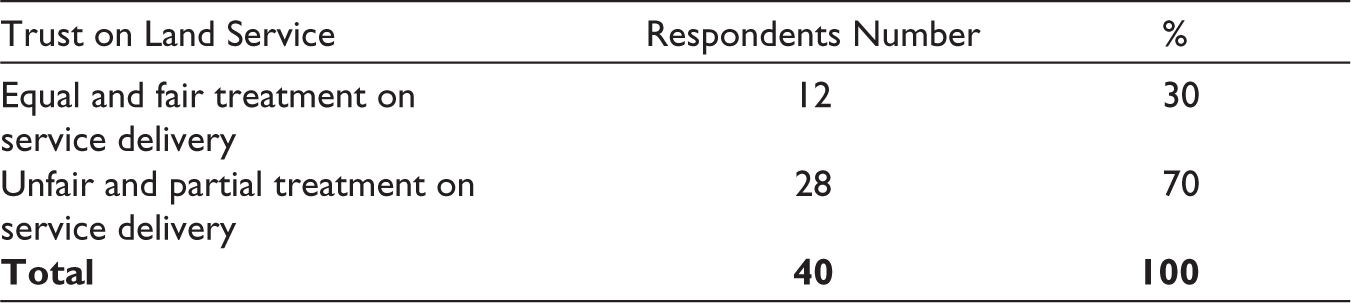
For mapping the trust of citizens, perception of service recipients about behaviour and sincerity of the service-providers were considered. It is believed that equal, fair and just treatment and credible service delivery on time and cost-friendly treatment promote citizens’ confidence and trust in service-providers. Patient hearing to the service-recipients is an important ingredient in this regard. Table 5 explains that 30% of the service receiving respondents experienced adequate allotment of time from the officer for resolving their issues, and they had trust in the land office, whereas 70% of the respondents opined negatively. Most of the citizens believed that the service providers did not deliver fair and impartial service to them.
Trust on Land Office.
Transparency in the Digital Services
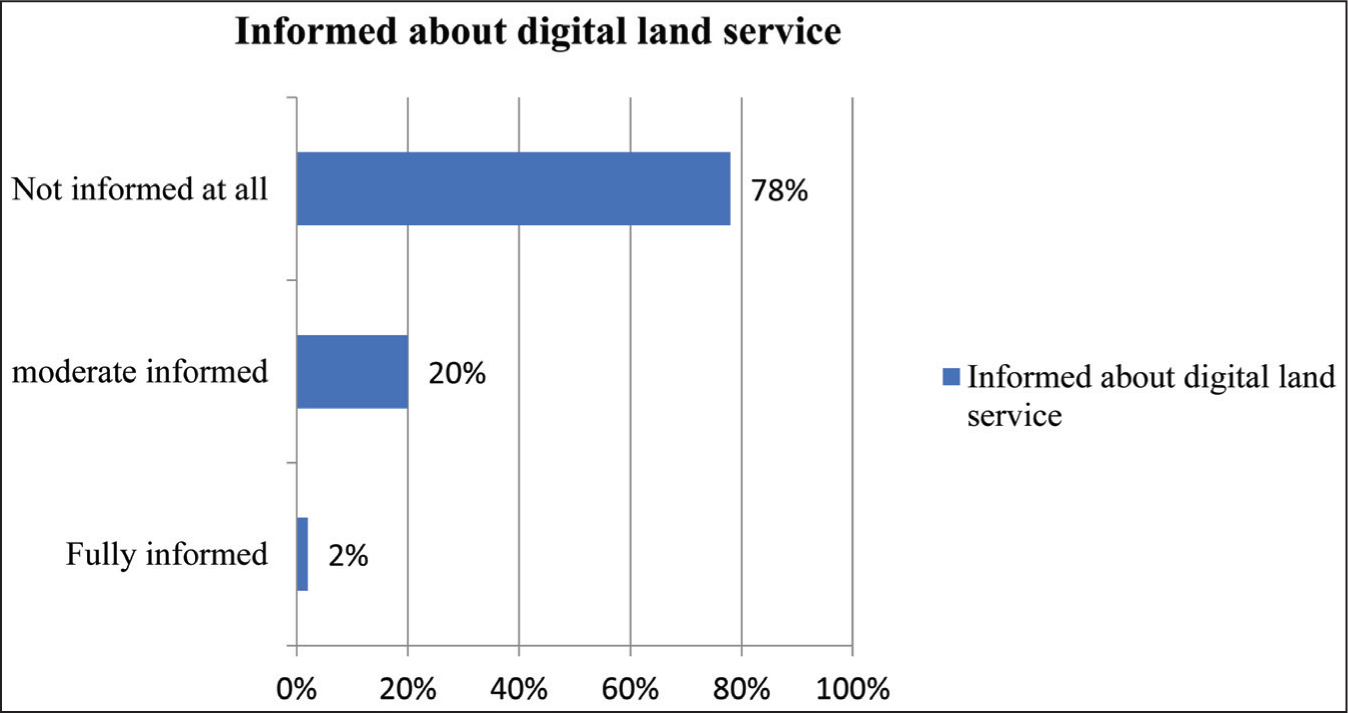
The service-providers informed the citizens about the digital service of land offices through DC offices meetings and village meetings, with local representatives and the civil society. But most of the service recipients were not well informed about the digital land services of the Upazila land office. Many of them had no idea about the fees and procedures of various digital land services.
Figure 1 presents that 78% of the respondents were not informed about the digital land service from the land office or other sources. The citizens got to know about the whole process of digital service when they went to get that service at the land office. The 20% respondents were moderately informed about the service by the service-providers. Many service-receivers were informed about the digital services from their relatives, friends and community leaders. Only 2% of sincere and educated respondents were fully informed about digital land services of the Upazila land office. They tried to know about the full process of a digital land service that is provided to them before applying for or getting the service.
Awareness and Knowledge About Digital Service
The Upazila land office provides many services to citizens related to land. But the service recipients have little knowledge about land services, as it is assumed that land services are complex and incomprehensible. Besides, most of the citizens are not aware of the provided digital land services. Due to lack of knowledge and awareness, the service receivers went to middlemen (dalals) to get their services. So, they faced various problems that undermined their satisfaction level at the land office. Figure 2 shows the ignorance of respondents about various digital land services:
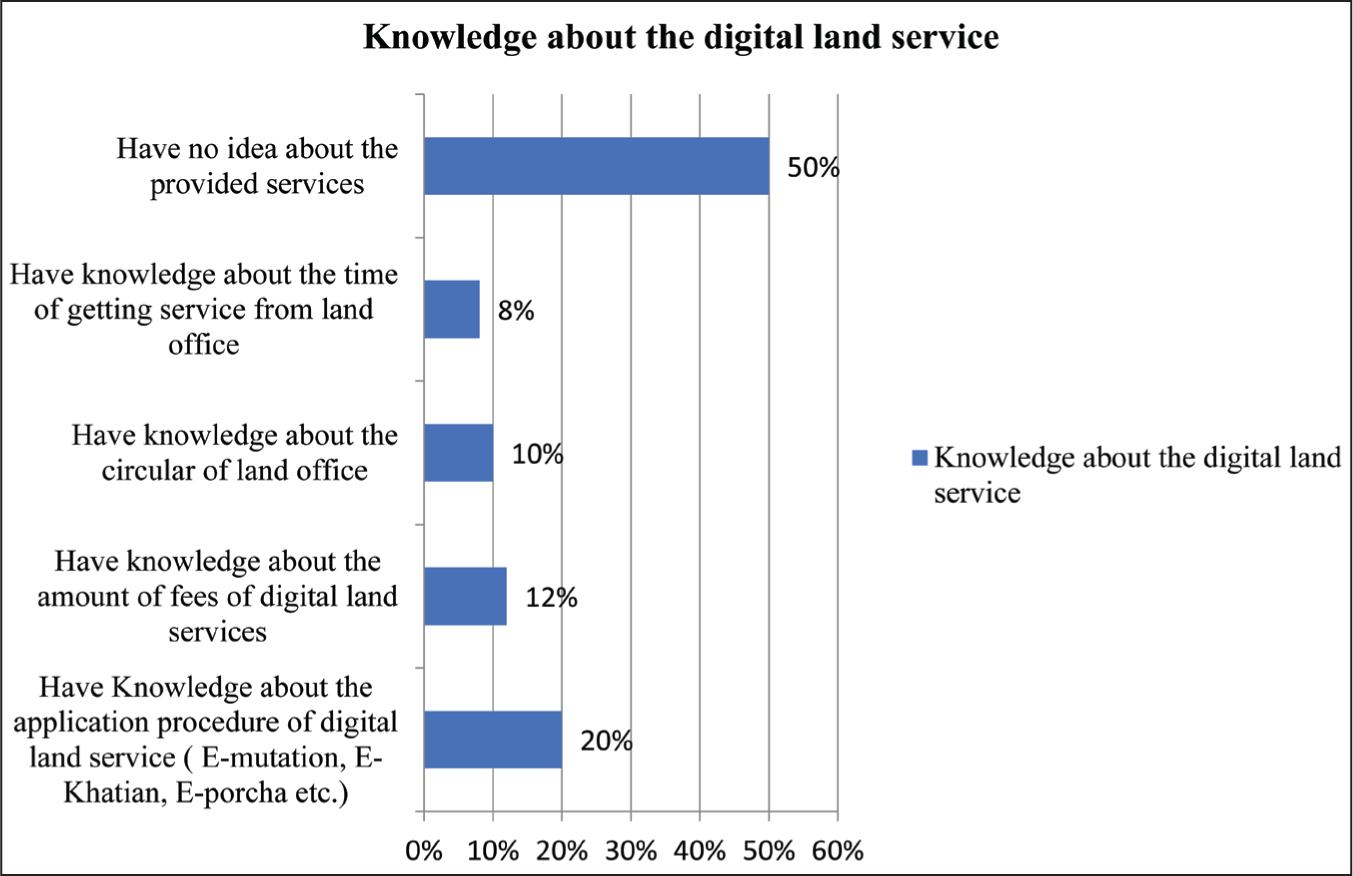
The graph (Figure 1) delineates that half of the respondents (50%) had no knowledge about the application procedure, required time for getting service, fees for the required service and circular of the land ministry for digital land service. The 8% of respondents had knowledge about the time, 10% had knowledge about the circular of land office and 12% had knowledge about the amount of fees for getting digital land services. And 20% of the respondents had knowledge about the application procedure of digital land service.
Service Providers’ Perspectives on Citizens’ Satisfaction of Their Provided Services
It is very important to know the insights of service-providers about their citizen-oriented service delivery. Most of the service-providers had expressed that the manual process was a time-consuming and cost-oriented mutation service that (Figure 1) been replaced by the e-mutation process of Upazila land office. They thought that this had enhanced citizens’ satisfaction with and trust in the digital land service of the land office. The AC land expressed that:
We have applied digitalization process fully in land office through e-mutation service and also on other services as well. Now all the applications of mutation has been taken on online. Though there has been inaccurate information on application provided by applicants, but we tried to mitigate these problems by informing the applicant/service recipients. He also added that the service recipients could not get proper digital service because of their shortage of knowledge about the digital land service of land office. The service receivers who were educated and knowledgeable about their digital land service were fully satisfied with their provided services.
The staff of the land office also tried to help the service-recipients to get proper digital service. But they complained that:
The service seekers go to dalal or touts to get land service instead of coming to them. The dalal/frauds always try to convince uneducated service receivers to provide their desired services with less time. In reality, the service receivers face more problems because of their misunderstanding and ignorance about digital land service. If the service receivers directly come to them instead of going to dalal or frauds, they (staffs) try to deliver the desired service effectively and gain their (service receivers).
The DC, ADC and RDC also expressed that:
The DC office arranges various meetings and seminars to inform the digital land service engaging the civil society and citizens. So, the citizen can get proper digital new services from upazila land office. The DC office also provides leaflets to the general people to make them aware about their desired digital land service. To ensure citizens satisfaction, the DC office always monitors the functions and activities of the staff and the AC land officer of upazila land office.
Discussion
Though the service-providers tried to provide land services according to the circular of the Ministry, there were seen some inconveniences in the service delivery to citizens. The service providers at the local level did delay in forwarding applications to higher authority. The tehsildar of the Union Land Office had to forward applications of mutation to AC land within 7 days. But they could not forward to the Upazila land office within proper time because of shortage of logistic support, such as lack of high-speed internet connectivity, skilled manpower, electricity interruption and so on. These problems not only hampered the time of delivering service but also distressed service providers (M. Hasan, personal communication [M. Akter, Interviewer], October 13, 2020). Besides, there was seen a lack of coordination between other land offices and Upazila land office. The land transfer registration office (sub-registrar office) did not send the copy of registration and notice of mutation to Upazila land office in due time. So, the AC (land) had to check out all the documents and necessary papers for new mutation. This complication hampered proper digitalisation in the service delivery of the service providers. In addition, the senior officials were habituated to the manual service process, and they felt disinterested in digital service delivery. Besides, the senior officials felt bored in learning about digital technologies and services. They also avoided the training for learning ICT in the land service. There also existed corruption in land office even after digitalising services. Many staff wanted bribes from the service-receivers in the digital land service delivery. As service recipients are not aware and know about the services procedures, so the staff took benefit of it and demanded some money for delivering services. These challenges of service providers of Upazila land office decreased satisfaction of service receivers. But the service-receivers also accepted their limitations about the knowledge and awareness of digital land service, which lessened the satisfaction level. They sought help from middlemen instead of administrators or staff of Upazila land office and spent a lot of money for getting a simple service. The service-receivers paid more fees for the provided services than the due fees in the circular. These existing challenges have decreased the satisfaction level of service recipients. To upgrade the satisfaction level of the service-providers, it is needed to give more focus on service-oriented governance system. Most importantly, the government is needed to take effective initiatives to ensure proper digitalisation of Upazila land office for making it a trust-oriented and satisfying institution.
Conclusion
The digitalisation of land services is very much needed for delivering services more quickly and accurately (Widyanarko, 2020). Although the service providers face problems with the new technologies and service receivers are not so much conscious about the land services, the digital system has made a remarkable change in the service delivery of Upazila Land Offices. The Barishal Sadar Upazila Land Office can overcome the existing challenges and ensure citizens’ satisfaction in the digital land service delivery by implementing an integrated system among the related departments of land mutation process and others digital services. For delivering efficient digital land service, there strong logistic supports are needed, such as high-speed internet connectivity, strong web portal and webpage, uninterrupted electricity and enough ICT tools (computer, laptop, scanner, etc.) in Upazila Land Office. Enough skilled manpower is needed not only in Upazila Land Office but also in Union land office for delivering quick and accurate digital land service at local level. If there is shortage of enough skilled officials in Union land office, then the Upazila Land Office alone cannot ensure effective digital land service and achieve citizens’ satisfaction. The service-receivers were not conscious of and knowledgeable about the land services of Upazila Land Office. So, it is necessary to launch an awareness-raising campaign about the land services of land office so that the influence of middlemen can be reduced. The office can engage civil society to make the general people aware of the procedures and fees, as well as the circulars of digital land service. The service-providers could give more focus on maintaining serial of application in delivery of land services for gaining service receivers’ trust on them. The service recipients can use a central web portal for complaining against officials. It can increase the sincerity of service-providers about service-delivery. The land office needs to be more interactive with the service receivers, and the attitude of the service-providers need to be changed through rigorous training. Thus, the government’s effective response about providing strong logistics support to Upazila Land Offices, efficiency of the service-providers and proper digitisation affects the satisfaction level of citizens as well as promotes good governance positively and significantly.
Footnotes
Declaration of Conflicting Interests
The author declared no potential conflicts of interest with respect to the research, authorship and/or publication of this article.
Funding
The author received no financial support for the research, authorship and/or publication of this article.