







Abstract
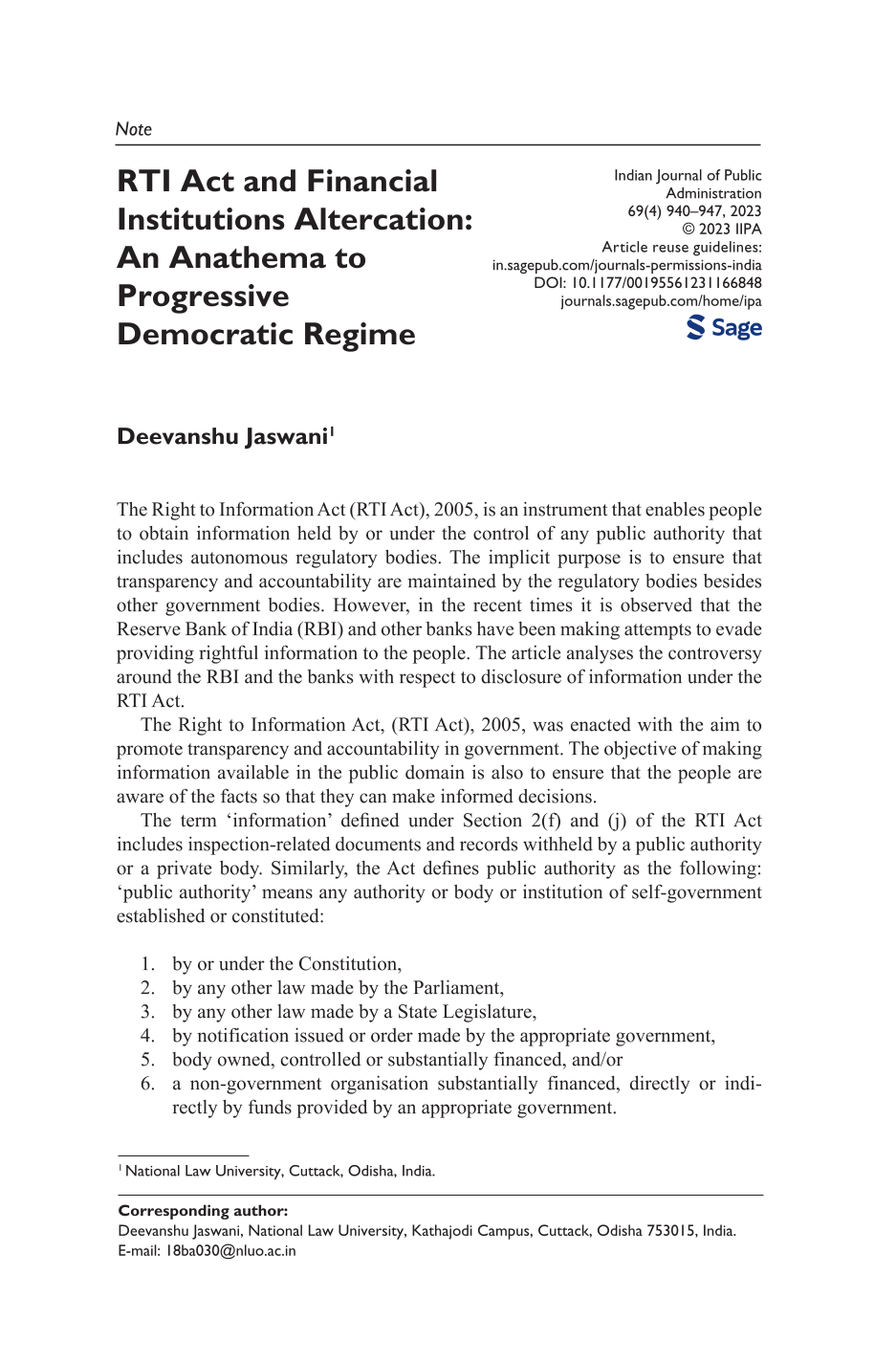
The Right to Information Act (RTI Act), 2005, is an instrument that enables people to obtain information held by or under the control of any public authority that includes autonomous regulatory bodies. The implicit purpose is to ensure that transparency and accountability are maintained by the regulatory bodies besides other government bodies. However, in the recent times it is observed that the Reserve Bank of India (RBI) and other banks have been making attempts to evade providing rightful information to the people. The article analyses the controversy around the RBI and the banks with respect to disclosure of information under the RTI Act.
The Right to Information Act, (RTI Act), 2005, was enacted with the aim to promote transparency and accountability in government. The objective of making information available in the public domain is also to ensure that the people are aware of the facts so that they can make informed decisions.
The term ‘information’ defined under Section 2(f) and (j) of the RTI Act includes inspection-related documents and records withheld by a public authority or a private body. Similarly, the Act defines public authority as the following: ‘public authority’ means any authority or body or institution of self-government established or constituted:
by or under the Constitution, by any other law made by the Parliament, by any other law made by a State Legislature, by notification issued or order made by the appropriate government, body owned, controlled or substantially financed, and/or a non-government organisation substantially financed, directly or indirectly by funds provided by an appropriate government.
It is to be noted here that under Section 35 of the Banking Regulation Act, 1949, the RBI has the power to conduct inspection of the banks in the country; furthermore, under Section 27 of the Act the RBI has a right to direct the banks to furnish an information. Section 28 of the Act provides that the RBI may publish such inspection-related information in public interest. The term ‘may’ has, however, provided some discretion to the RBI wherein, it may release the information if it deems fit.
In addition, provision of Section 8 of the RTI Act envisaging exemptions wherein disclosure of information can be refused, was being used by the regulatory bodies to escape from the duty of disclosure on the grounds of ‘fiduciary capacity’.
However, in Reserve Bank of India v Jayantilal N. Mistry and Ors. (2016) (Jayantilal case), the court made it clear that the regulatory bodies, the RBI for instance, cannot do so except when the information sought has a bearing on the security of the state.
Now, one might think that the conundrum ends here, but there is a sting in the tail. It was created when the RBI agreed and was ready to release the information, but the banks when they received notices from the RBI, started approaching the courts for ordering a stay on the notices.
I
The following decisions cover the long steller controversy involving the RBI and the banks for disclosure of certain information. These cases have repeatedly answered the disputed question whether the RBI and the financial institutions in the country are ‘bound’ to disclose the information sought under the RTI Act.
Jayantilal Case
Various transfer petitions filed across different High Courts in the country were merged in this case. For context, a transfer petition is a petition filed to transfer a case from one court to another. The court after hearing decides whether it can be transferred. The procedure for transfer and withdrawal of cases is provided under Sections 24 and 25 of the Civil Procedure Code 1908. Under Section 25 of the same code, the Supreme Court has the power to transfer a case on an application by a party and after notice to all parties involved. In this case, several transfer petitions were filed by different parties. The Supreme Court decided to merge the petitions in order to hear the matter in one go, as all the petitions shared a common issue.
The issue that arose in the case was whether the information sought under the RTI Act can be denied by the RBI and the banks on grounds of ‘fiduciary relationship’ with other banks.
The contention of the RBI while emphasising on its role as the regulator vested with powers to determine ‘Banking Policy’ was that the information sought was exempted under Section 8 of the RTI Act. Furthermore, it was argued that the RBI being the supervisor and the regulatory authority of the banking sector has the discretion in disclosing information obtained by it in a consolidated form, but not otherwise as per Section 28 of Banking Regulation Act. Thus, the RBI was using Section 28 of the Banking Regulation Act as well as Section 8 of the RTI Act to escape from the disclosure of the information sought.
The RBI, furthermore, contended that the information if released would not only affect public confidence in the banking sector but also trigger the potential market reaction which may not be desirable. Referring to Section 45E under the RBI Act, 1934, and Sections 17(4), 20 and 22 of Credit Information Companies (Regulation) Act, 2005, it emphasised on the privacy of information in respect to banks.
On the issue of—‘fiduciary relationship’ as a ground for exemption from disclosure of information under section 8 of the RTI Act, the Supreme Court citing from the book Advanced Law (Lexicon, 3rd Edition, 2005) envisaged four conditions to highlight the scope of such relationship:
when one person places trust in the faithful integrity of another, who as a result gains superiority or influence over the first, when one person assumes control and responsibility over another, when one person has a duty to act or give advice to another on matters falling within the scope of the relationship, or when there is specific relationship that has traditionally been recognised as involving fiduciary duties, as with a lawyer and a client, or a stockbroker and a customer.
In addition, to avoid any further confusion, the court also laid down the extent of the scope of such relationship through the following rules:
No conflict rule: A fiduciary must not place himself in a position where his own interests conflict with that of his customer or the beneficiary. There must be real sensible possibility of conflict. No profit rule: A fiduciary must not profit from his position at the expense of his customer, the beneficiary; Undivided loyalty rule: A fiduciary owes undivided loyalty to the beneficiary, not to place himself in a position where his duty towards one person conflicts with a duty that he owes to another customer. A consequence of this duty is that a fiduciary must make available to a customer all the information that is relevant to the customer’s affairs; Duty of confidentiality: A fiduciary must only use information obtained in confidence and must not use it for his own advantage, or for the benefit of another person.
According to the Court, the RBI cannot escape the statutory duty to disclose the information by labelling it as ‘fiduciary’.
Emphasising the role of the RBI in upholding public interests, the Court held that there exists no relationship of trust between banks and the RBI since it is under no legal duty to maximise the benefit of any banks.
The dictum of Jayantilal case made it is clear that the information sought cannot be denied by the RBI on the grounds of fiduciary relationship with the banks. Fiduciary Relationship as provided under Section 8 (1) (e) of the RTI Act, is a ground for exemption from disclosure of information. The term is not defined in detail. However, as mentioned above, in the Jayantilal case, the court envisaged four conditions under which the scope of such relationship would fall. The case has, furthermore, elaborately discussed when the exceptions envisaged under the RTI Act could be used.
It also reiterated that the RTI Act is in line with Article 19 of the Constitution. It not only empowers people to be informed using this tool but also ensures the ideal form of ‘government by the people’.
It is pertinent to mention that the Court, keeping in mind the interests of RBI as well, has limited the extent of information to be published. It held, that if the information affects the public at large then the financial institutions are accountable for such disclosure.
Information with respect to ongoing matters could, however, be exempted if such a disclosure might cause a huge loss to the bank or the company. Therefore, only the information regarding the decided matters could be released. In this way, a balanced approach was adopted by the Court.
Sandeep Singh Jadoun v. Pio, Dgeat (2018)
The information sought in this case related to (a) wilful defaulters of bank loans of ₹50 crore and above, (b) details of loan sanctions, and (c) details of defaults and non- performing assets (NPAs). The RBI contended that the sensitive personal data of customers of a body corporate is protected under Section 43A of the IT Act, 2000. However, the Commission believed that as a statutory regulatory authority, the RBI must prioritise public interests over individual bank interests. The Commission emphasised the need for transparency and accountability from the RBI to spread awareness among the masses regarding defaulters. In addition, public scrutiny of documents can ensure transparency and compel wilful defaulters to pay back their debts Furthermore, relying on the Jayantilal case, the Commission held that financial institutions are obligated to provide the RBI with all information, and such information cannot be protected from disclosure under the guise of a fiduciary relationship .
Subsequently, the Commission, rejecting the contention of confidentiality, put forth by the RBI, provided an extent to which disclosure can be done by the RBI, It held that:
None is asking for information about every customer who took loan but was paying back sincerely. The most important question which the RBI ignored is when hundreds of crores of rupees of public money is not repaid by a loanee, how that became confidential customer’s information? The RBI or other banks need not give personal details of the wilful defaulters like their addresses, but why not they disclose the names of wilful defaulters and amount that fell due, besides measures, if any, being taken to recover the money that belonged to people? Every evasion of loan is misappropriation of public money, which public have a right to know.
As a result, the Central Information Commission (CIC) sent a ‘show cause’ notice to the RBI Governor asking for clarification why the maximum penalty of ₹25,000/- should not be imposed for disobedience of RTI provisions.
As such the Commission directed the RBI to comply with all the orders of CIC and reveal details of defaulters’ worth > ₹1,000 crore at the beginning, ₹500 crore or less at a later stage and collect such information from banks to update their voluntary disclosures.
Girish Mittal v. Parvati v. Sundaram & Anr. (2019) (‘Girish Mittal Case’)
This case entertained three contempt petitions which were filed against the RBI for wilful and deliberate disobedience of the directions issued in the Jayantilal case.
The first petition stated that the information provided by the RBI in response to the RTI filed relating to market losses due to currency derivatives was unsatisfactory and therefore the RBI was indulging in suppression of information.
The second petition mentioned that the disclosure policy of 2016 as uploaded by the RBI was to reverse the effects of Jayantilal’s judgement as instructed the Public Information Officers (PIOs) to not disclose virtually all kinds of information. The disclosure policy of the RBI also included various exemptions that were added based on the RBI’s wisdom to be exempted from disclosure the third petition sought information related to inspection reports of several banks and the Sahara Group of Companies, which was denied by the CIO on the grounds that disclosure would affect the state’s economic interests and the competitive position of the third party. In response to it, it was submitted that this was contrary to the directions issued in the Jayantilal case.
With regard to the new disclosure policy of the RBI that instructed numerous departments not to divulge information, the court held ‘the Respondents, in our opinion, have committed contempt of this Court by exempting disclosure of material that was directed to be given by this Court’.
As a result, the RBI agreed to withdraw the disclosure policy, on the grounds of being contrary to the directions of the Jayantilal case.
For the issue of furnishing the information stated in first and third petition, the Court referring to the Jayantilal case held:
…it is in the interest of the general public that the information sought for by the Respondents therein has to be furnished. There is a specific reference to the inspection reports and the other materials, which were directed to be given to the Respondents therein.
In addition, the extent of disclosure was highlighted when the court observed that the only exception available is when the disclosure has a bearing on the security of the state.
Lastly, the court made it clear that the directions issued in Jayantilal case were general in nature and any violation of such directions can be a ground for an aggrieved party to file a contempt petition.
RBI v. Jayantilal N. Mistry & Anr. (2021)
The case dealt with the miscellaneous applications (‘MA’) filed for impleadment in the transfer case and recall of the Jayantilal case. These applications were earlier listed with the writ petitions filed by SBI and HDFC bank challenging the notices issued by the RBI seeking the information. However, the court was of the view that the MA should not be dealt with petitions since the issue in writ petitions was different. It was, therefore, left open to decide later and the order passed on these applications would not have any bearing on the merits of the petitions.
It is imperative to note here that
Therefore, the banks were adamant on proving that the Jayantilal dictum should not be on the grounds that no opportunity of hearing was given to the affected party.
The banks further argued that the information sought to be released to the public was protected by Right to Privacy which was held by Justice K. S. Puttaswamy v. UOI (2017) (Justice K. S. Puttaswamy case) being an intrinsic part of Article 21 of the Constitution.
On the issue of ‘not given an opportunity to be heard’, it was highlighted that the lack of efforts by the banks to get themselves impleaded when the transferred cases were being heard in the Jayantilal case. Furthermore, it was correctly stated by the bench that since the contempt petitions in Jayantilal case were against the RBI, the banks could not have been made parties to it.
On the issue of maintainability, it was clear that the ultimate validity of the contentions raised by the banks had to be tested on the touchstone of merits of the case. Furthermore, as pointed out by the Court, no provision existed for filing recall of a judgement, rather Order XLVII of the Supreme Court rules provides a remedy for filing application for review. Therefore, the court referring to M. C. Mehta v UOI (2019) observed that: ‘The applications styled as recall are essentially applications for review. The nomenclature given to an application is of absolutely no consequence—what is more important is the substance of the application’.
The petitions were therefore dismissed; however, the court provided the banks with the liberty to pursue other legal remedies available.
Prayer for Interim Stay
Yet again an attempt was made by the Punjab National Bank and the Union Bank of India to escape from the duty to furnish information wherein prayers were made for stay on the RTI notices issued to them by the RBI for the disclosure of information. The Supreme Court, refusing to grant interim stay, directed to tag it with similar petitions filed by the SBI and other private banks including HDFC, ICICI, Axis Bank and Yes Bank. While hearing the pleas put forth by the banks, the Supreme Court adjourned the matter and directed to list it on 17 August 2021. On 17 August 2021, the division bench referred the matter to the bench of Justice L.N. Rao as that the bench had dealt with the previous litigations in the matter.
Thus, the matter is yet to be settled (no particular date decided as of yet) before the court of law. Even though, the Jayantilal case has already dealt with the issues, the banks are still looking for loopholes to stretch the controversy even further with the intention that ultimately the pressure on them to disclose the information would ease.
II
It is evident from the above-mentioned judicial decisions as to how the financial institutions have been using every means possible to escape the disclosure requirements. The delay in furnishing the information by the banks has been creating doubts in minds of the people, which has resulted in losing confidence in the banks. After the Jayantilal case, it was made clear that the RTI Act matters and the financial institutions and other regulatory bodies are accountable to the public.
It is well settled that the right to information is inherent under Article 19 of the Constitution and the same being denied by the financial institutions is against the fundamental democratic rights of the citizens. Under the guise of availing legal remedies, these institutions are evading the people from getting their claim on the rightful information that they are entitled to.
The contention that such disclosure would generate misunderstanding in the minds of the people and would lead to a loss of confidence in the banks is fallacious, as it is the endless delays by misusing the legal system which are a cause of disappointment for the people, leading to a loss of confidence in the system.
Furthermore, the manner in which ‘the disclosure policy’ was withdrawn by the RBI during the proceedings of Girish Mittal case was seen as a contempt by the court and the same raised doubts in the minds of people as to whether this could be some sort of coverup for any actions which would again become the reason as to why people might lose confidence in the central bank of the country.
In addition, raising the contention of right to privacy for protecting such information by placing reliance on Justice K. S. Puttaswamy case is again based on a misconceived notion, because in that case the Court made it abundantly clear that the Right to Privacy is not an absolute right and is subject to reasonable restrictions which includes public interests. Furthermore, the conflict between ‘right to privacy’ and ‘right to information’ has been already dealt with under the RTI Act. Under Section 8(1)(j) of the RTI Act which exempts information pertaining to ‘personal information the disclosure of which has no relationship to any public activity or interest, or which would cause unwarranted invasion of the privacy of the individual’. Thus, the information sought in these cases, if they affected the public at large, could not be protected under the garb of ‘right to privacy’.
In S. P. Gupta v. President of India and Ors. (1982) also, the court emphasised on the need of disclosing information to the public because hiding under the veil of secrecy would tend to create chaos and oppression as there would be no accountability on their part.
Lastly, it is pertinent to mention the Court’s observation in Sandeep Singh’s case, aptly describing the consequences that might occur if the financial institutions in the country continued to maintain the secrecy, namely:
If RBI does not respect the orders of SC and denies the citizens Right to Information, it will result in perpetuation of financial regime of secrecy that is potential enough to facilitate financial frauds and allow fraudulent rich & influential business persons to flee the country, as witnessed in recent times. Most of the unhealthy financial trends could be attributed directly to the practice of secrecy founded in pre-Independence British legislations, ignoring the recent reforms for good governance.
III
To sum up, the pro-active role of the Indian judiciary in ensuring transparency and accountability for the regulatory bodies needs to be appreciated. While, on one hand, the reluctance of banks in disclosing the information relating to inspection reports, NPAs, extent of loans written off, and details of money stashed away by big Indian corporates despite the 2015 ruling, have been a cause for frustration among all concerned.
The judiciary on the other hand, by maintaining its stance regarding mandatory disclosure requirements for the regulatory bodies, including the financial institutions in the country, can restore the faith of the common people in the justice system.
In this backdrop, it is imperative to mention that timely furnishing of information could have enabled the people to make informed decisions earlier on their investments and other finance related services. The same would have been helpful for the economic interests of the nation as well. As the court rightly described in the Jayantilal case:
economic interests include in its ambit a wide range of economic transactions or economic activities necessary and beneficial to attain the goals of a nation, which definitely include as an objective economic empowerment of its citizens. … One of the tools to attain this goal is to make information available to the people.
Footnotes
Declaration of Conflicting Interests
The author declared no potential conflicts of interest with respect to the research, authorship and/or publication of this article.
Funding
The author received no financial support for the research, authorship and/or publication of this article.