







Abstract
Working conditions in an organisation have a direct bearing on its performance. Better working conditions are a source of constant motivation for its employees, which further help in extracting their best towards realisation of organisational goals in terms of customer satisfaction. Police organisation is no exception and to generate people-friendly policing, amelioration in their working conditions is a necessity. The present study is an endeavour to make a detailed examination of the working conditions of the Haryana police personnel and their resultant satisfaction from them. To this end, a sample of 710 police personnel was drawn from various police establishments across the state for this study.
Keywords
Introduction
Conducive environment is inevitable for an employee to carry out his duties in an effective way. Such an organisational environment has a direct relationship with the overall performance of its employees. On the contrary, a stressful environment in an organisation mars the organisational efficiency. Central to the conducive environment in an organisation is the extension of better working conditions to its employees. Availability of better working conditions to the employees plays a significant role not only in raising the potential of the functionaries but also in their outputs. Sound working environment acts as the driving force to motivate the organisational manpower to work more for the progress and development of the organisation. In fact, the effectiveness of an organisation has a direct bearing on the satisfaction of the organisational employees from their working conditions. This satisfaction further contributes towards the maximum goal realisation which ultimately results in customer satisfaction on which the stability of the organisation depends. Very few research studies have been conducted about the working conditions of the police organisations in India.
In common parlance, ‘…working conditions cover a broad range of topics and issues, from working time (hours of work, rest periods, and work schedules) to remuneration, as well as the physical conditions and mental demands that exist in the workplace’ (International Labour Organization, n.d.). They can be defined as those actions ‘… in which an individual or staff works, including but not limited to such things as amenities, physical environment, stress and noise levels, degree of safety or danger, and the like’ (Business Dictionary, n.d.). They include organisational harmony, cordial junior–senior relationship, adequacy of staff, adequate infrastructure, that is, availability of buildings, necessary equipment, availability of necessary amenities like water supply, sewerage, toilets facilities and so on. Working conditions are those conditions under which an employee is obliged to discharge his/her administrative obligations. They act as a prime source of employee’s motivation. In the present paper, an attempt has been made to examine the working conditions in which the police personnel in Haryana discharge their duties and their resultant satisfaction from them.
Objectives of the Study
The objective of the paper is to examine the working conditions in different police establishments and the resultant satisfaction of the sampled police persons with respect to availability of housekeeping services (cook, sweeper and washerman), availability of drinking water, toilets and recreation facilities, supply of food and other essentials, while on long duty hours, availability of electricity and power-backup arrangement, availability of retiring rooms and separate rooms for investigating officers (IOs), availability of accommodation facilities, office amenities and satisfaction from grievance-redressal machinery.
Sample Selection
A sample of 710 police personnel was drawn across the state (Haryana) to examine whether they were satisfied with their working conditions or not. It included all the traffic police stations/aid centres, fifty randomly selected police stations situated in both rural and urban areas (twenty-five from each area) and fifty randomly selected police posts situated in both rural and urban areas (twenty-five from each area). In that also eight respondents from each police station, four respondents from each police post and five respondents from each traffic police station/aid centres were randomly selected as per the detailed scheme given below (Table 1).
Sample Selection.
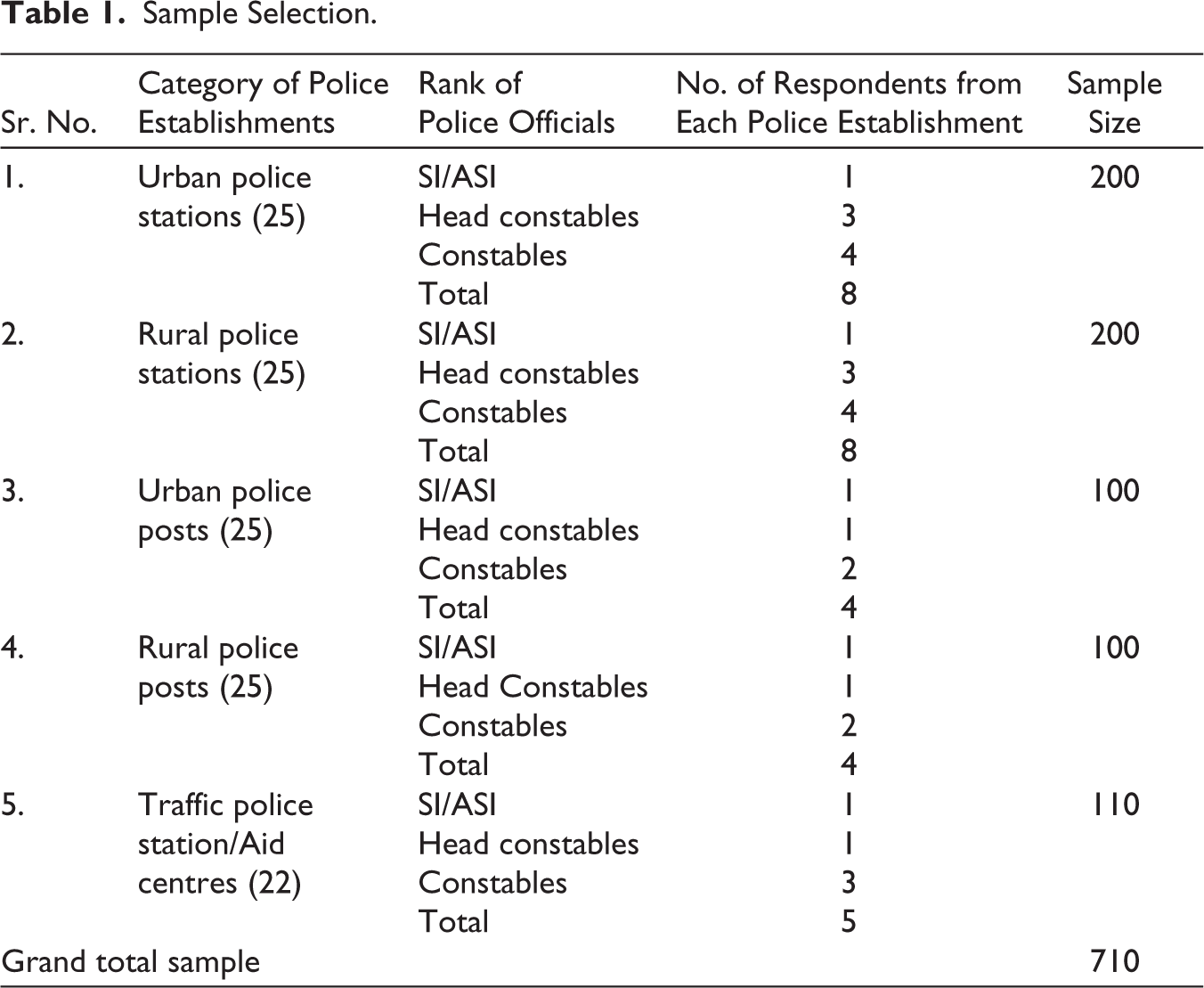
Data were collected from the above categories of respondents with the help of a detailed schedule. Along with this, the opinion and views of some senior police functionaries were also taken into account. All possible observations drawn in the process of data collection were incorporated in the study.
Analysis of Data
Availability of Housekeeping Services
To discharge the obligations effectively by the police persons, it is necessary that they have been provided with the housekeeping services including a cook, a washerman and a sweeper. It is because the nature of duties of police personnel is such that they have to spend most of their time at the workplace as per Section 51 of the Haryana Police Act, 2007. It provides that every police officer shall be considered to be always on duty and may at any time be deployed in any part of the state or outside the state. So, these basic amenities are required to be ensured at each and every police establishment, particularly at those where inadequate housing arrangements render police persons deprived of their family support. The sampled police persons were probed whether they had been provided with adequate housekeeping services or not. The responses so gathered are recorded in Table 2.
Availability of House Keeping Services (N = 710).
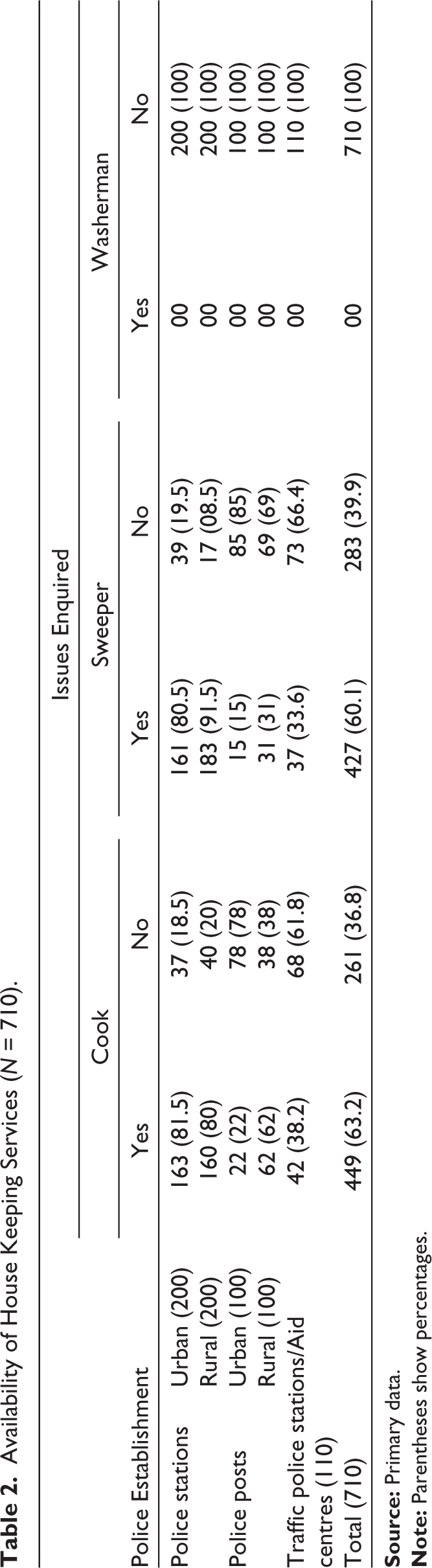
Table 2 reveals that slightly less than two-thirds (63.2%) of the respondents pointed out that a cook is made available by the government in their kitchen. However, more than one-third (36.8%) of the total respondents stated that they had managed their private cook from their own pocket. However, more than three-fourths (78%) respondents of urban police posts and more than three-fifths (61.8%) respondents of traffic police stations/aid centres claimed that they were facing the problem with regard to the availability of a cook. Some of the respondents even complained that the police department usually appointed these cooks at the Deputy Commissioner rate but after the expiry of their term, it was rarely renewed. That is why they had to pay the salary of the cook from their own pockets to maintain and ensure his continuity.
So far as the availability of the sweepers in the police establishments is concerned, about three-fifths (60.1%) of the respondents answered in affirmative, while the rest (39.9%) of the respondents answered in negative. In this regard, 85% respondents of urban police posts, 69% respondents of the rural police posts and about two-thirds (66.4%) respondents belonging to the traffic police stations/aid centres complained about the non-availability of sweepers in their police establishments. It was observed that the problem of non-availability of sweepers was significantly found in the police posts belonging to both rural and urban areas and that of traffic police stations/aid centres, respectively. As far as the availability of washerman was concerned, all the respondents of the respective police establishment claimed that this facility was not available to them.
Availability of Drinking Water, Toilets and Recreation Facilities
The Directive Principles of the State Policy enumerated under Part IV of Indian Constitution provides for just and humane conditions of work to every worker at the workplace (Article 42). Therefore, human conditions, including access to safe drinking water, toilet and recreational facilities, need to be ensured at the workplace as they are the basic requirements for every human being to sustain organic existence, and police persons are no exception to this. Thus, all police establishments must ensure the availability of the above-said facilities like any of the other public institutions. The sampled police persons were enquired about the availability of the above-mentioned facilities at their workplace and the responses are classified in Table 3.
Availability of Drinking Water, Toilet and Recreation Facilities (N = 710).
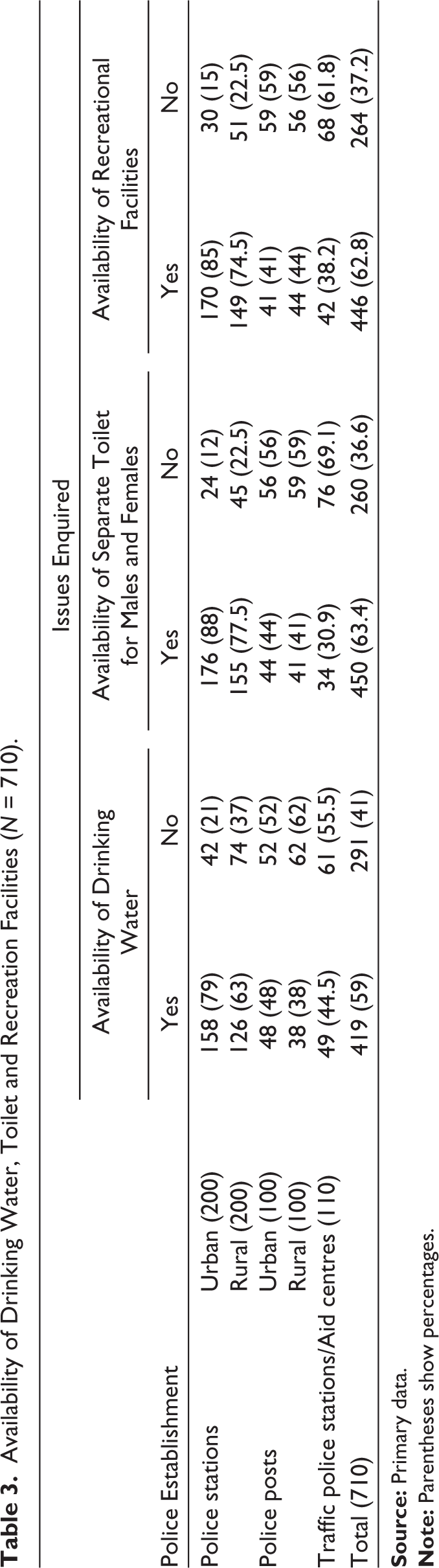
Table 3 clearly reveals that slightly more than two-fifths (41%) respondents belonging to different police establishments stated that they were facing the problem of non-availability of drinking water. This problem was more acute in police posts and traffic-aid centres. More than 50% respondents of urban police posts as well as traffic police stations/aid centres and more than 60% respondents of rural police posts were facing the problem of drinking water. It is mainly because of two reasons—either the groundwater is hard or the provision of water supply is found lacking in that area. Some of the respondents stated that they utilised the services of private water-supply agencies distributing water tankers in the city/nearby areas.
So far as the availability of separate toilets for males and females were concerned, less than two-thirds (63.4%) of the total respondents confirmed their availability in their respective police establishments. However, more than one-third (36.6%) of the total respondents complained about the problem of their non-availability. This problem was more acute in the police posts and traffic police stations/aid centres. Fifty-six per cent respondents of urban police posts, 59% respondents of rural police posts and 69.1% respondents belonging to traffic police stations/aid centres expressed that they were not having separate toilets for males and females in their respective police establishments.
With regard to the availability of recreational facilities, more than three-fifths (62.8%) of the total respondents answered in affirmative, whereas the rest, who constituted almost two-fifths (37.2%) of total respondents, answered in negative. This problem was more common in the urban and rural police posts as well as in traffic-aid centres. It is because 59% respondents of urban police posts, 56% respondents of rural police posts and 61.8% respondents of traffic police stations/aid centres claimed the lack of such facilities in their respective police establishments. In addition to this, more than one-fifth (22.5%) of the rural police stations were also found suffering from this problem.
Supply of Food and Other Essentials While on Long Duty Hours
Like the defence services in India, timely supply of food and other essentials is not extended from the side of the police department. But under extraordinary circumstances, if a police person is deputed at a place where he could not move for long hours or to a place having least possibility of food arrangements, the police department is required to make the possible arrangements for timely supply of food and other essentials. The sampled police persons were enquired whether any such type of arrangement was available at police establishment level when they had been put on long duty hours. The data so collected from the respondents are presented in Table 4.
Availability of Food While on Long Duty Hours (N = 710).
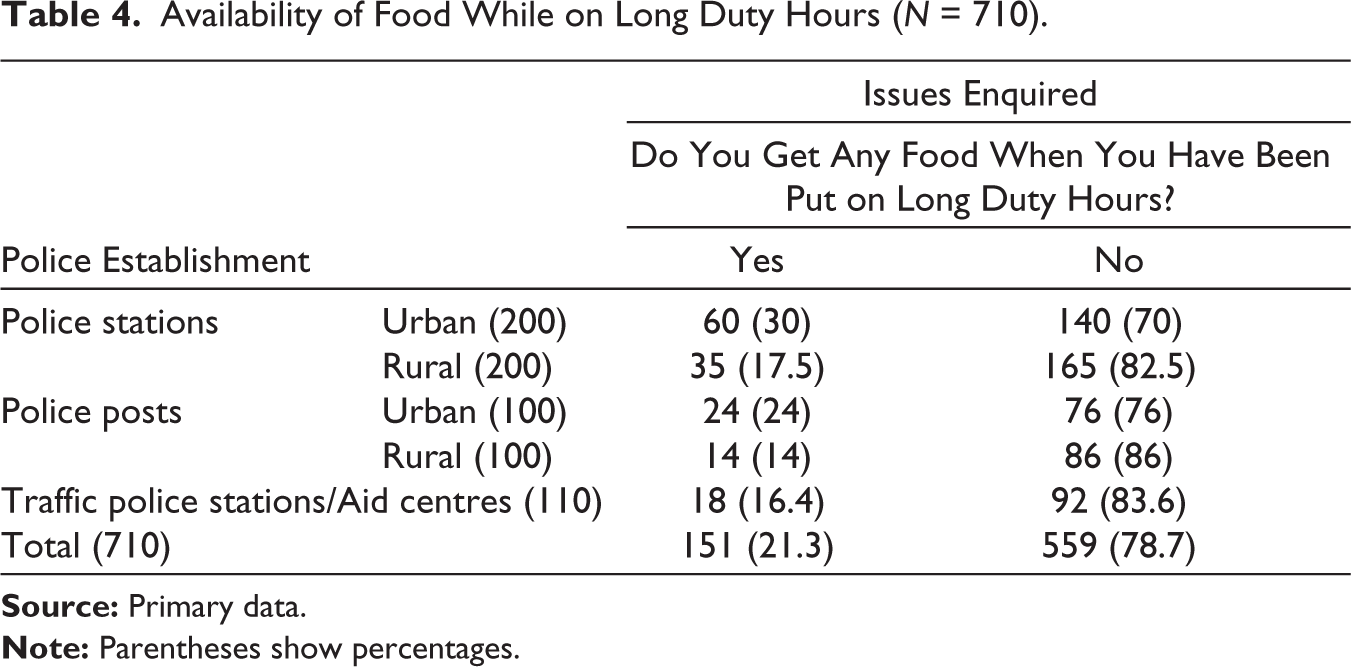
Table 4 reveals that more than three-fourths (78.7%) of the total respondents claimed that they were provided food and other essentials when they were put on long duty hours. This was true in the case of employees of police stations, police posts and traffic police stations/aid centres. It was because 70% respondents of urban police stations, 82.5% respondents of rural police stations, 76% respondents of urban police posts, 86% respondents of rural police posts and 83.6% respondents belonging to traffic police stations/aid centres expressly stated that no food and other essentials were served to them even when they were put on long duty hours. So, it became obvious that police personnel were not served food and other essentials while put on long duty hours.
Availability of Electricity and Power Backup Arrangements
Police function is not only a round-the-clock affair but also a critical and emergency-driven function which requires immediate, cautious and careful responses from those engaged in policing function. A very short delay may cause considerable damage to both individual and public safety and security causing a serious threat to law and order situation in the area concerned. Therefore, alternative arrangement in the form of generator/inverter is essential to discharge official obligations by the police personnel at the workplace, particularly during odd duty hours. This arrangement becomes more important in the light of erratic power supply, specifically in rural areas. Moreover, every police establishment must be equipped with requisite electrical appliances like coolers, fans, water coolers and so on. Thus, the respondents were enquired about the availability of power-backup arrangements and other electrical equipments. The responses so gathered from the respondents are classified and presented in Table 5.
Availability of Electricity and Power Backup Arrangements (N = 710).
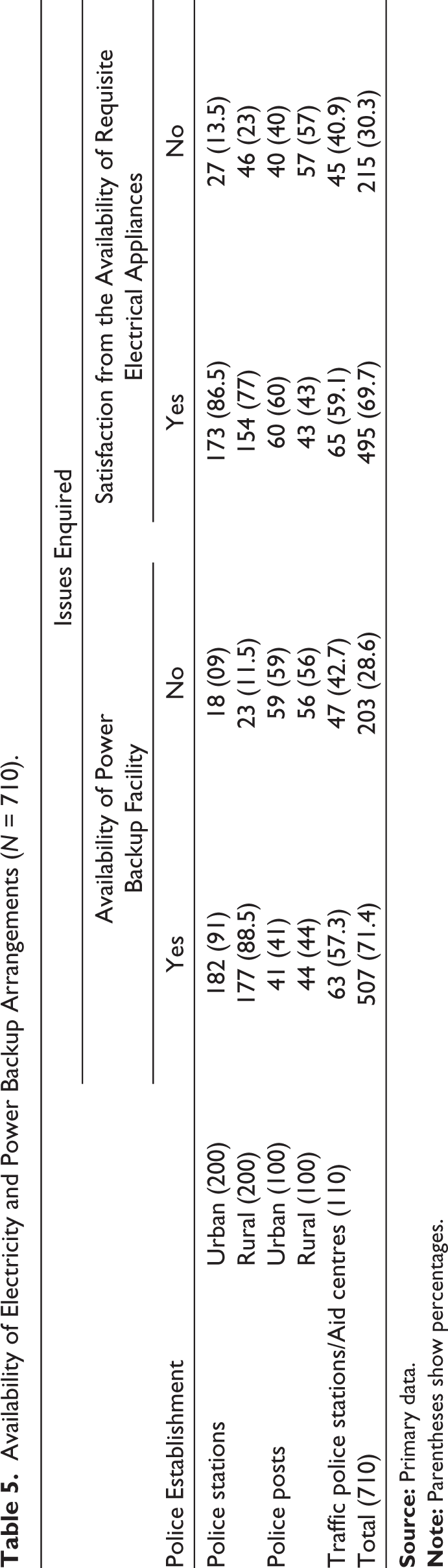
Table 5 shows that 71.4% of the total respondents expressed the availability of power backup arrangements in different police establishments as an alternative to power failure. Only 28.6% of the total respondents stated that there was a lack of power backup facility in the form of generator/inverter in their respective police establishment. A vast majority of respondents belonging to police stations and traffic police stations/aid centres stated that they were having no problem with regard to the availability of inverter/generator facilities in case of power failure. However, this problem was more acute in case of police posts. Fifty-nine per cent respondents of urban police posts and 56% respondents of rural police posts expressed that the power backup facility in the form of an inverter is either not available, or if available, then the inverters were not functional and the police department paid least attention to this.
As far as the satisfaction of the respondents from the availability of requisite electrical appliances in their respective police establishments was concerned, 69.7% of the total respondents answered in affirmative, while the rest, almost 30.3%, answered in negative. It is obvious from Table 5 that the majority of the respondents belonging to the rural police posts registered their complaints regarding the non-availability of requisite electrical appliances at their police establishments. Fifty-seven per cent respondents of rural police posts, 40% respondents of urban police posts and 40.9% respondents of traffic police stations/aid centres were found dissatisfied from the non-availability of requisite electrical appliances in their respective police establishments.
Availability of Retiring Rooms and Separate Rooms for Investigating Officers (IOs)
Discharging of duties as a police person, both physically and psychologically, is a challenging job. This becomes even more difficult when one has to work for long hours in a rough and non-conducive environment and exposing oneself to the criminal and anti-social elements. Under such working conditions, it becomes imperative to ensure the availability of adequate numbers of retiring rooms in all police establishments to protect them from any excessive physical and psychological strain, which could otherwise pose serious health hazards to these police personnel. Moreover, the provision of separate retiring rooms’ facility not only helps in increasing the efficiency and effectiveness of the IOs but also works as an antidote to any health hazards which might have resulted to the police personnel while discharging their duties under extremely difficult conditions. In addition to this, every IO is required to have a separate room facility in the police establishment so that he can handle the task of investigation properly. Lack of these facilities may add to the psychological irritation of police personnel in general and IOs in particular. This ultimately affects the attitude and behaviour of an IO while interrogating or discharging any other function related with the investigation. The sampled police persons were asked whether the facility of retiring rooms and separate rooms for IOs were available in their concerned police establishments. The responses so gathered from the sampled respondents are given in Table 6.
Availability of Retiring Rooms and Separate Rooms for Investigating Officers (N = 710).
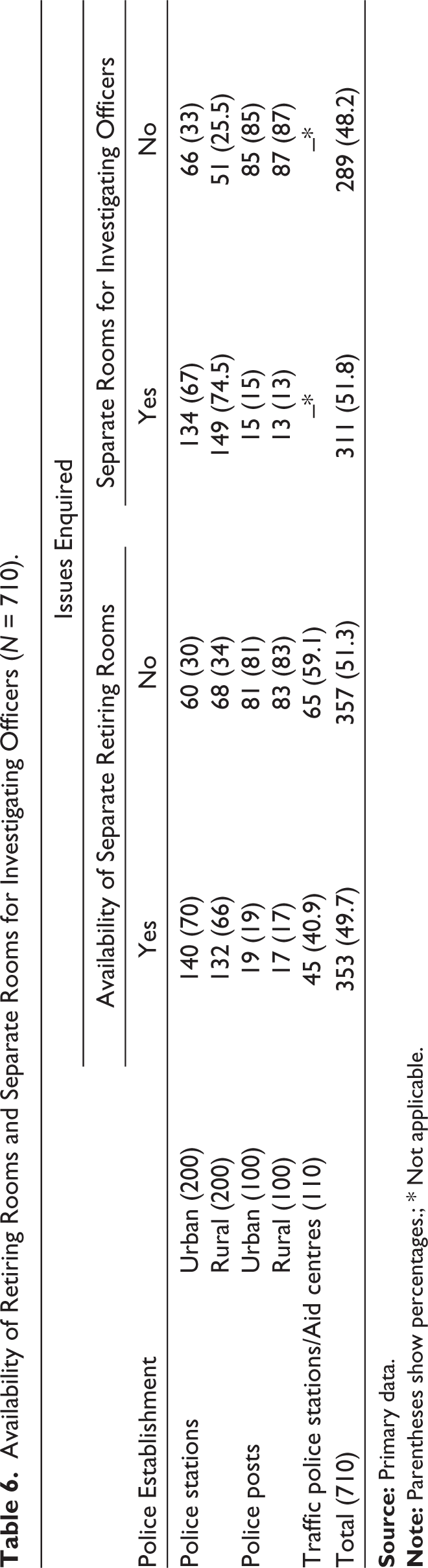
Table 6 clearly reveals that on the issue of existence of separate retiring rooms for the police persons in different police establishments to take rest when they were free from their duties, the respondents were squarely divided. From the table, it is obvious that an overwhelming majority of the respondents, that is, 81% from urban and 83% from rural police posts were denied the availability of separate retiring rooms for the police staff in their respective police establishment. On the other hand, this was further denied by about 60% of respondents belonging to traffic police stations/aid centres.
On the issue of availability of separate rooms for the IOs, almost 52% of the total (600) respondents answered in affirmative, whereas about 48% of them answered in negative. The problem was found more acute in case of rural police posts. About 85% respondents belonging to urban police posts and 87% respondents belonging to rural police posts denied that there were no separate rooms for the IOs. It needs to be mentioned here that one-third (33%) respondents of urban police stations and about one-fourth (25.5%) respondents of rural police stations also denied this facility. However, the respondents belonging to traffic police stations/aid centres opined that they did not deal with the work of investigation.
Availability of Accommodation Facilities
Given the nature of the job, police personnel discharge critical functions of diverse nature in order to maintain public safety, security and order. They have to work at odd hours and with anti-social and criminal elements. In such a situation, they should be given safe, secure and comfortable accommodation facilities in the vicinity or within the police establishment. In order to know the state of accommodation facilities, the investigator strived to ascertain whether police personnel had been provided with adequate accommodation facilities and their resultant satisfaction from these facilities. The responses so gathered have been tabulated in Table 7.
Availability of Accommodation Facilities (N = 710).
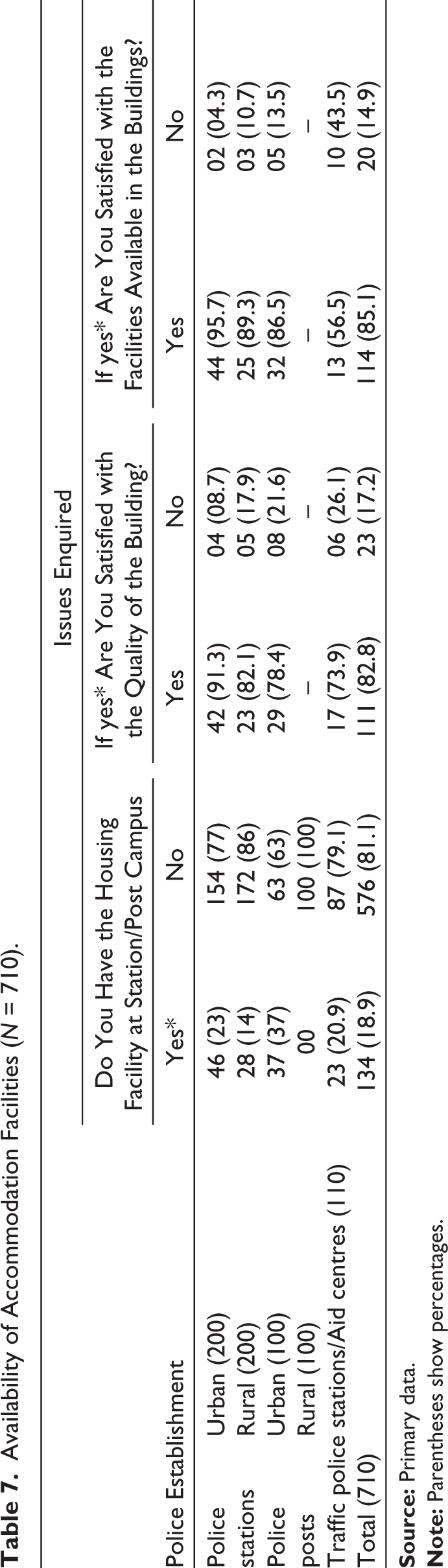
It is obvious from Table 7 that about four-fifths of the total respondents (i.e. 81.1%) belonging to different police establishments claimed that they had not been given housing facilities at the campus of their police establishment. Only 18.9% of the total respondents were found utilising accommodation facilities. It is interesting to note that all the respondents belonging to rural police posts denied the availability of this facility.
Those 134 respondents utilising the accommodation facility were further probed on the ground of their satisfaction from the accommodation facilities. Out of these enjoying the housing facility, a high majority (82.8%) were found satisfied with the quality of buildings, whereas more that 85% of these respondents were found satisfied with the facilities made available in these buildings.
Availability of Office Amenities
The efficiency of the police personnel has a direct bearing on the availability of adequate office amenities including office furniture, stationary items and communication and transportation facilities. Non-availability of these amenities create hurdles in the smooth functioning of the office work. Moreover, it is difficult for the police personnel to purchase these items from their own pockets. The only alternative is to put this onus on the common people who visit the police stations/posts for the redressal of their grievances. But this hampered the reputation of the police department. So, in the public interest, it is necessary that every police station/post must be equipped with adequate office amenities. The sampled police personnel were probed whether the police establishments were equipped with adequate office amenities. The data so collected are presented in Table 8.
Availability of Office Amenities (N = 710).
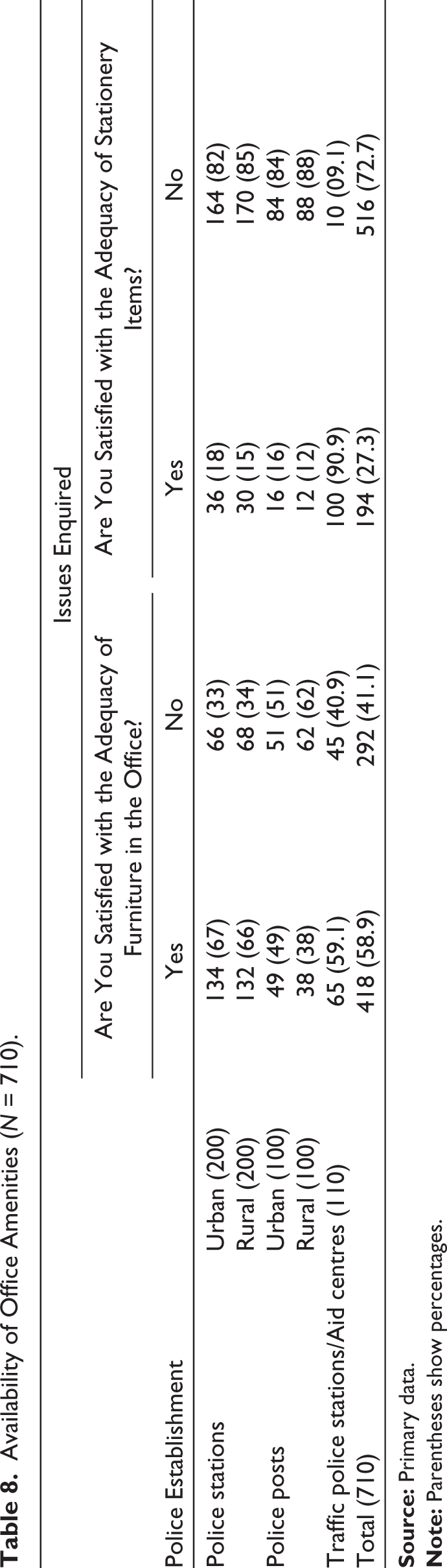
Table 8 clearly reveals that 58.9% respondents which constitute almost three-fifths of the total respondents expressed that they were satisfied with the adequacy of furniture in the offices, whereas almost two-fifths, that is, 41.1% of the total respondents, expressed their dissatisfaction on this front. It is obvious from the table that the satisfaction of the respondents belonging to police posts, both urban and rural, with regard to the adequacy of office furniture is found gloomier. Almost one-third respondents of police stations, both rural and urban, half of the respondents of urban police posts, more than 60% respondents of rural police posts, and more than 40% of the respondents belonging to traffic police stations/aid centres, stated that they were not satisfied with the adequacy of office furniture. Most of the dissatisfied respondents further claimed that plastic chairs had been purchased in their respective police establishments by the in-charge with the help of public money.
On being probed whether they were satisfied with the adequacy of stationery items, a majority (72.7%) of total respondents answered in the negative. It is interesting to note that a vast majority of respondents belonging to police stations (82% from urban and 85% from rural) and police posts (84% from urban and 88% from rural) opined that they were not satisfied with the quality and quantity of the stationary items. Most of these respondents stated that they usually faced scarcity of stationery items, and thus they either had to ask the complainants to bring it from the market or they themselves had to purchase it from the market with their own money.
Satisfaction from Grievance-redressal Machinery
Cordial senior–subordinate relationship in an organisation reflects its democratic working. Any bitterness in these relations not only mars the efficiency of the organisation but also leads to frustration of the employees. To overcome this frustration, the existence of effective grievance-redressal machinery is necessary. In case of non-availability of this kind of machinery, the personnel working in the organisation feel frustrated as they find no outlet to ventilate their grievances. Police organisations, being sufficiently large in size, are also required to have cordial senior–subordinate relationships which could be ensured through efficient grievance-redressal machinery. The researcher enquired from the sampled respondents whether the senior–subordinate relations in their police establishment were cordial. They were further probed whether adequate arrangements existed in the police department for redressal of their grievances. The data so collected are presented in Table 9.
Satisfaction from Grievance-redressal Machinery (N = 710).
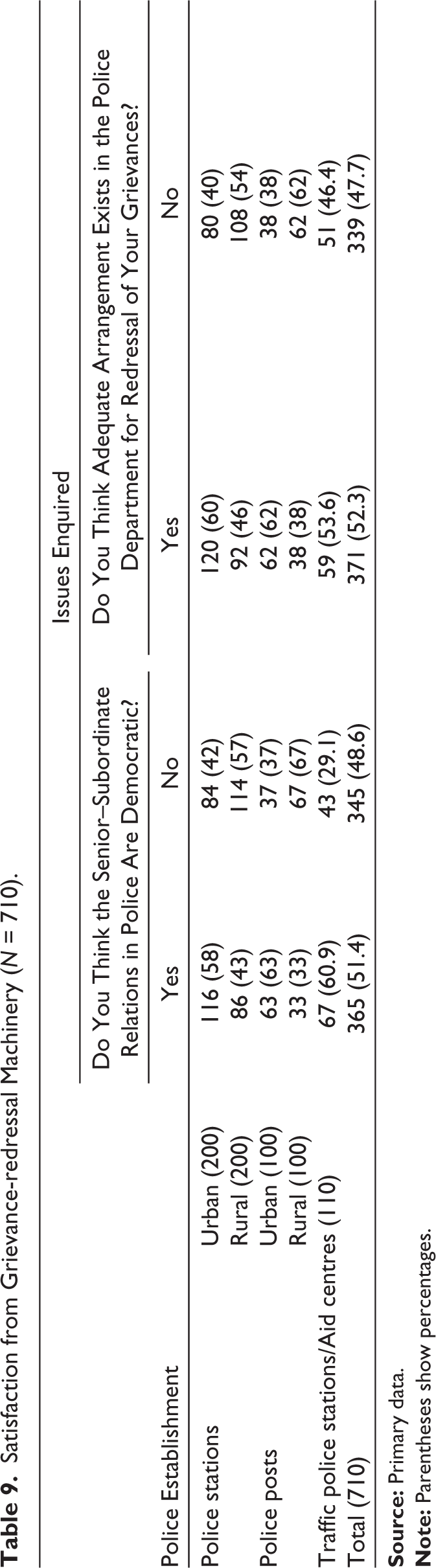
Table 9 clearly reveals that on the issue of senior–subordinate relationships in the police organisation, the respondents were squarely divided. About 48.6% of the total respondents expressed without hesitation that the senior–subordinate relationship in the police organisation was not democratic. The picture was gloomier specifically in the rural police stations and police posts. This view was confirmed by 57% of the respondents belonging to rural police stations and 67% respondents belonging to rural police posts.
On being probed whether adequate arrangements exist with regard to redressal of grievances of the police persons, all the respondents were again almost squarely divided. About 52.3% of the total respondents answered in affirmative, while 47.7% of the respondents answered in negative. Sixty-two per cent respondents from rural police posts and 54% from rural police stations claimed that the grievance redressal machinery in the police force was inadequate.
Usually, the grievance-redressal machinery in the police department is made up of top officers, and junior officials rarely dare to express their real concerns. They expressed the necessity to include persons from all strata in the grievance-redressal machinery to make it more viable and representative.
Findings and Observations
Following are the main observations of the study:
More than three-fifths of the respondents (63.2%) pointed out that a cook was made available by the government in their kitchen. However, the rest 36.8% of the total respondents opined that they managed their own private cook from their own pockets (Table 2). About three-fifths (60.1%) of the respondents confirmed the availability of a sweeper. It is interesting to note that the availability of a washerman was confirmed by the respondents of none of the police establishments (Table 2). Slightly more than two-fifths (41%) respondents belonging to different police establishments claimed that they were facing the problems of non-availability of drinking water. Three-fifth respondents of rural police posts and traffic police stations/aid centres and majority of the urban police posts were found suffering from this problem (Table 3). More than one-third (36.6%) of the total respondents confirmed the non-availability of separate toilets for males and females in their respective police establishments. More than two-thirds (69.1%) respondents of traffic police stations/aid centres claimed the non-availability of separate toilets for males and females. Likewise, a majority of the respondents belonging to rural and urban police posts also held this opinion (Table 3). More than one-third (37.2%) of the total respondents claimed the non-availability of recreational facilities in their respective police establishments. This problem was more common in the urban and rural police posts as well as in traffic police stations/aid centres (Table 3). More than three-fourths (78.7%) of the total respondents claimed that no food and other essentials were served to them even when they had been put on long duty hours (Table 4). A vast majority (71.4%) of the total respondents expressed the availability of power backup arrangements in their respective police establishments as an alternative to power failure. However, a majority of the respondents of both urban and rural police posts claimed the non-availability of this facility in their respective police establishment (Table 5). About one-third (30.3%) of the total respondents were not found satisfied with the availability of requisite electrical appliances in their respective police establishments. It is interesting to note that the respondents of rural police posts were found most dissatisfied with regard to this issue (Table 5). So far as the provision of separate retiring rooms in their respective police establishments is concerned, all the respondents were squarely divided. More than four-fifths of the respondents of both rural and urban police posts claimed that their respective police establishment was deficient with regard to this facility of separate retiring rooms (Table 6). Again, all the respondents were found almost squarely divided on the issue of non-availability of separate rooms for the IOs in their respective police establishments. More than four-fifths of the respondents of both rural and urban police posts and majority of the respondents of rural police stations outrightly denied the availability of separate rooms for IOs in their respective police establishment (Table 6). An overwhelming majority (81.1%) of the total respondents belonging to different police establishments stated that they were not having the housing facility at the campus of their police establishments. All the respondents belonging to rural police posts denied the availability of accommodation facilities to them (Table 7). Out of those enjoying the housing facility, an overwhelming majority (82.8%) were found satisfied with the quality of buildings, whereas about 85% of these respondents were found satisfied with the facilities made available in these buildings (Table 7). More than two-fifths of the total respondents (i.e. 41.1%) were found dissatisfied with the availability of office furniture in their respective police establishments. However, this facility was found deficient in a majority of the rural and urban police posts (Table 8). A majority (72.7%) of the respondents relating to different police establishments were found dissatisfied with the adequate availability of stationery items (Table 8). Half of the total respondents expressed that the senior–subordinate relationships in the police organisation were democratic. This problem was more acute in rural police stations and police posts (Table 9). With regard to the existence of adequate machinery for the redressal of grievances of the police personnel, all the respondents were almost squarely divided. A majority of the respondents belonging to rural police posts (62%) and rural police stations (54%) outrightly denied this contention (Table 9).
Conclusion
In the light of the above findings, the government is required to take initiative to ameliorate the plight of all police establishments across the nation so that the police personnel may discharge their official obligations in an effective and efficient manner. During the study, it was observed that most of the police stations across the study area were going to be constructed on modern lines equipped with various sorts of facilities which were nature-friendly. But it is unfortunate that these facilities have not yet been extended to the police posts operating in rural and urban areas as well as the traffic police stations/aid centres stationed on the highways. The police persons serving in these police posts as well as the traffic police stations/aid centres were facing the problem related to basic infrastructural facilities like non-availability of housekeeping services, drinking water, separate toilets for males and females, recreational facilities, electricity and power backup facilities, retiring rooms and separate room for IOs, accommodation facilities and office amenities.
In addition to this, the senior–subordinate relations further added to the frustration of the police persons serving at the operating level. This kind of relationship led to generating gaps between the senior and subordinate police officers. In fact, in the name of discipline, even their genuine demands were usually turned down. The subordinates were seldom encouraged to express their views freely. To ventilate the grievances of the constabulary, no satisfactory mechanism is yet to be devised by the police department in Haryana. Usually, the grievance-redressal machinery in the police department was made up of top officers, and junior officials rarely dared to express their real concerns. The need of the hour is to democratise the grievance-redressal machinery by including persons from all strata to make it more inclusive and democratic.
Time has come when the government has to initiate efforts to generate a people-friendly interface between the police and the public by bringing structural and behavioural changes on their parts. It is only possible through a drastic restructuring of each police establishment by equipping them with all sorts of modern facilities. In addition to this, there is an urgent need to promote better senior–subordinate relationships by providing due attention towards their genuine demands. The need of the hour is to democratise their existing grievance-redressal machinery by involving persons from different streams apart from the police department. It may help to bring behavioural changes among all the police persons. It is hoped that the present study would help in drawing the attention of the government towards the promotion of structural and functional working of the police in India.
Footnotes
Declaration of Conflicting Interests
The authors declare that there is no conflict of interest with respect to the research, authorship and/or publication of this article.
Funding
This work was approved by UGC vide reference no. F. No. 5-579/2009 (HRP).