







Abstract
There cannot be a more appropriate time for infusing the education system of India with flexibility, innovativeness and quality. National Education Policy (NEP), 2020, is a step in this direction which emphasises on inclusiveness, equity and quality with a clear focus on the attainment of learning outcomes. NEP 2020 promotes the adoption of learner-centric education which develops critical thinking, creativity and problem-solving skills and discourages rote learning methods. An effective education policy relies on strong curricular foundations for optimum results. An enriched curriculum should be rooted in India’s diverse culture, knowledge systems and traditions embracing local knowledge and cultural practices, on the one hand, and at the same time, should incorporate the modern-day learning perspectives developed by the curriculum theorists over the last century. This article analyses the idea of curriculum as conceived by different learning perspectives and how NEP 2020 draws inferences from them.
Introduction
Mahatma Gandhi (1937) said ‘By Education, I mean an all-round drawing out of the best in child and man—body, mind and spirit’. It envisions an education system where all children are able to achieve their fullest potential and harness their abilities and capacities in the best possible manner. This utopian vision is entwined with the successful resolution of the question, ‘what is to be taught’ within the precincts of socio-cultural milieu, thereby, paving a roadmap for the future. The question ‘what is to be taught’ in our classrooms, that is, designing and transaction of curriculum has intrigued policymakers and educational thinkers for a long time because it carries philosophical, political, social, economic, cultural underpinnings and requires a careful and deliberate effort.
National Education Policy (NEP) 2020 envisages ‘Education to be fundamental for achieving full human potential, developing an equitable and just society, and promoting national development’ (NEP, 2020, p. 3, Para. 1). Therefore, the education system in India needs to accommodate the varied socio-cultural diversity, resolve the dilemmas arising out of dichotomies of rural–urban, haves/have-nots and rich-poor divides and forge its own trajectory with an underlying aim of eliminating the deep fissures of inequality and perceived injustices prevalent in the society, and thereby redefining the value systems along with reconfiguring the existing social and power structures. India being a diverse country, there are differentiated and layered loads of aspirations of different groups in the society, and which, in turn, put asymmetric strains on the educational milieu. It needs deep probing through the lens of national aspirations to accommodate the views of various interest groups and align them in the curricula. It also requires a nuanced approach to incorporate contemporary global perspectives such as sensitivity towards human rights, gender issues and sustainable development along with inculcating the idea of global citizenship and the value of equity (NEP, 2020, p. 6, Para. 2).
In the last century, the conception of curriculum, its meaning, the role and purpose it serves, have evolved significantly with the seminal works of numerous curriculum theorists. Bobbitt in his book The Curriculum (1918) has highlighted the need for scientific planning in curriculum designing, keeping goals and objectives in sight. He perceived schools as an agent of social reproduction matching individuals with existing social and economic order (Lagemann, 2000, p. 107). On the other hand, schools were also perceived as a platform for social progress and reform with a focus on nurturing child’s innate potential through education (Dewey, 1897). In later years, the idea of social reconstructionism and critical pedagogy gained ground bringing the need to challenge the oppressive social and economic order at the centre stage of the education system and influenced the curriculum designing and pedagogical processes. The objective approach emerged as a predominant perspective and found favours with educational planners. Bloom (1968) contributed to this approach with his idea of mastery of learning, and last few decades have witnessed the mainstreaming of outcome-based education perspective as the principal approach of education and training across the globe (Halász, 2017).
In India also, since Independence, concerted efforts have been undertaken by various commissions and committees to streamline the curricular structures and the National Council of Educational Research and Training (NCERT) came up with a consolidated document in the form of the National Curriculum Framework (NCF) in the year 2005. NCF proposed systemic changes in the curricula with specific emphasis upon replacing the rote method of learning with the construction of knowledge, making students learn to apply knowledge in real-life situations outside schools, making examinations more flexible and thus ensuring holistic development of the child imbibing them with democratic ethos and constitutional values (NCF, 2005).
Building upon this further, NEP 2020 released by the Union Ministry of Education is a transformational policy document which suggests a paradigm shift in our educational system with a clear focus on attainment of learning outcomes along with overhauling the pedagogical and assessment strategies (Ministry of Education, 2020). NEP 2020 presents a synthesis of myriad of learning perspectives and incorporates all aspects of curricular dimensions comprehensively.
The Idea of Curriculum
The purpose of curriculum is to ensure the transmission of knowledge to the learners and building a set of skills, values and attitudes among them. In recent times, it is well established that knowledge is not absolute and static, rather it continuously develops and evolves (Mugisha & Mugimu, 2012). Knowing or meaning construction is a dynamic process which is a mix of experienced reality, value systems and context. This epistemic process is entwined with curricular dimensions and is considered a central pillar of the curriculum development and designing exercise (Ornstein & Levine, 1993). The curriculum developers should have a suitable understanding of various forms of knowledge which can help them in the selection of the content and transaction of the curricula.
Ornstein (1987) defines curriculum as ‘a plan for action, or a written document, which includes strategies for achieving desired goals or ends’. Dewey (1902) suggested curriculum as a composition of planned experiences. He stressed on the centrality of the child while deciding the experiences and tasked the teacher to establish a link between the child and the curriculum. Bobbitt (1918) included unplanned experiences along with planned experiences. He stressed upon including adult life skills as a part of the curriculum so that child ends up as an adult who leads a well-adjusted life. Kliebard (1977) further added a new dimension in the form of a hidden curriculum which is the unintended and implicit curriculum in the forms of values, norms, expectations of the society conveyed to students through the organisational and operational set-up of the schools. Another perspective in the form of null curriculum was highlighted by Eisner (1994) which deals with the knowledge and experiences not taught explicitly in the school. Hidden and null curriculums are identified as important components of unplanned experiences (Kliebard, 1977; Kridel, 2010). The curriculum is considered as the whole of experiences at school (Taba, 1932; Tyler, 1975).
Considering the essence of different definitions, it can be summarised that curriculum serves as a guide for all the stakeholders in the education of the child so as to ensure that the child gets a wholesome experience in life (Bonser, 1927). It is not just the experiences a child gets in the school but it includes the experiences a child gets in the society in general. The concept of curriculum is not static, rather it is dynamic because it reflects the needs and aspirations of the society. The facets of the curricular framework transform in sync with the socio-economic and cultural flux that the society undergoes. Curriculum carries the daunting task of fulfilling national aspirations, societal demands and individuals’ expectations. Also, the curriculum needs to be grounded in the philosophical, psychological and sociological frameworks with the overall aim of education (Golen, 1982). Therefore, designing of curriculum is an exercise of translating the aims of education into concrete phrases which have to be deliberately acted upon by the teacher in the classroom so that the objectives are achieved and a child is moulded into a fully functioning individual well-adjusted into the societal framework (Walker & Soltis, 2004). The curriculum scholarship, in an organised form, has undergone a gradual evolution with Bobbitt (1918) and Kliebard (1975) championing the idea of scientific curriculum-making, which was further curated by Tyler (1975) and Popham (1987) with their objectives model. The consciousness of prevalent inequalities and injustices in the social order introduced a new dimension to the curriculum development exercise in the form of reconstructionist and critical pedagogical perspectives. Humanistic and instrumentalist viewpoint gave a fresh impetus in the form of advocacy of an autonomous and fulfilled life. In essence, curricula should serve as bedrock for laying strong foundations of a vibrant democracy wherein individual advancement is completely interlaced and embedded with the community good (White, 1995). Therefore, Scott (2007) also argued for a new model of curriculum that supports the vision of education as the public good which benefits the whole society.
Philosophical Foundations of Curriculum
While framing the curriculum, the policymakers need to build upon the philosophical positions which have influenced the idea of learning and education per se over centuries. Curricular decisions are contingent upon the moral, social, cultural beliefs and value systems to be inculcated in the child and also upon the instrumental value of the education in his life and to the society. Four major philosophies of education which have a role to play in curriculum development exercise are perennialism, progressivism, essentialism and reconstructionism (Ornstein, 1990).
Perennialism considers education to be absolute and universal, and it is rooted in the idealism philosophy of education. Robert Hutchins (1899–1977) and Mortimer Adler (1902–2001) are the chief proponents of Perennialism. Adler (1998) in his book Paideia Proposal seeks to establish a course of study that is general, not specialised; liberal, not vocational; humanistic, not technical. According to perennialists, curriculum has to be subject centred and study of science, literature and arts is considered more appropriate and these subjects have an organised structure of content and transmit values that have moral and spiritual basis. The authority of a teacher is considered paramount and students have very little say in the designing and transaction of the curriculum (Tan, 2006).
Progressivism, on the other hand, promotes the idea of developing problem-solving skills of the children and promoting the scientific inquiry approach among them. The chief proponent of progressivism philosophy is John Dewey (1869–1952). John Dewey considered education to include socially engaging learning experiences and representative of real-life situations where children can engage in learning activities in a flexible and interchangeable manner in consonance with the social settings (Dewey, 1938). Progressivism professes that education should not be isolated from the social reality and emphasises that individual experiences have a very important role to play in the learning behaviour of a child. It conceives curricula to be inter-disciplinary and highlights the importance of cooperative behaviour among students (Pérez-Ibáñez, 2018).
Essentialism advocates that the aim of education is to prepare the child to adjust to the changing society, and it assigns a highly directive role to the teacher. William Bagley, a renowned essentialist, in his book An Essentialist’s Platform for the Advancement of American Education (1938) highlighted three tenets of essentialism: well-educated and culturally knowledgeable teacher, teaching the ideals of community to students with efforts on the part of students to learn. Essentialism emphasises upon the need to impart knowledge so as to develop the cognitive faculties and competencies of the child by giving due focus on academic subjects and grade-level achievement standards (Sahin, 2018).
Reconstructionism emphasises upon developing and shaping the attitude and value system of the individuals in a way that they, in turn, shape and reconstruct the society itself. Theodore Brameld (1904–1987) and George Counts (1889–1974) spearheaded the social reconstructionism movement to make society more cohesive and compassionate. According to re-constructionist philosophy, the idea of curriculum is to focus on the prevailing social problems and committing the individual to find a solution to these problems, and thus bring in a desirable social change. Curriculum should include more social science subjects instead of the pure sciences and the aim of education is to commit the individual to the path of self-realisation, wherein he is not bound by narrow, parochial and restrictive tendencies (Mosier, 1951).
Sociological Foundations of Curriculum
In a democratic country, curriculum needs to be designed keeping in sight the goal of inculcating democratic values among the students. Fundamental rights and Directive Principles of the State Policy enshrined in the Constitution of India spell out a social order which is based on principles of equality, equity, justice, brotherhood, freedom and respect for all (Singh, 2007). Dr Sarvepalli Radhakrishnan (1888–1975), a renowned educationist, has observed:
the educational system must find its guiding principles in the aim of the social order for which it prepares, and in the nature of the civilisation, it hopes to build. The social philosophy must be pellucid with a clear purpose, without which it is difficult to decide what should be done and how it should be done. The Commission declares that our educational system should be governed by social philosophy outlined in the Constitution. (University Education Commission, 1948)
There are numerous facets of society which guide the choices of curriculum designing. The changes occurring in the societal structures, the prevailing social problems, the interrelationships among different groups in society and existing economic conditions are important determinants of the curriculum designing exercise. J. Krishnamurti (1895–1986) elaborated that the primary aim of education is to establish a right kind of relationship between the individual and the society.
Schools may be considered as a microcosm of the society and epitomise the larger society outside their walls. They have a significant role to play in production and reproduction of the culture of the society in general (Naguib, 2006). The purpose of education is to transmit the cultural and social heritage to future generations, improvement of social wellbeing of persons, inculcation of constructive and creative outlook and development of a socially efficient individual by improving his social efficiency, emotional integration and a feeling of intra-group cohesion (Nakpodia, 2010). Curriculum is a medium of realising these socially determined objectives and prepares the child for the future. Techniques to develop right attitude of social behaviour and a sense of rights and duties is necessary for the social adjustment of the individual, and thereby it is a primary aim of the curriculum.
Psychological Foundations of Curriculum
Learning is a psychological process which is an outcome of complex interplay of psychological attributes, namely, personality traits, motivation, aptitude, attitude, learning style, locus of control and so on of learner as well as teachers (Mathis et al., 2013). Besides these intrinsic attributes, there are extrinsic factors as well, namely social and cultural environment, economic conditions and value system of the society which affect the learning process. Depending upon the weights assigned to the parameters on intrinsic extrinsic/objective–subjective axis, the curricular parameters can be ascertained and broadly classified into three major approaches delineating the psychological foundations of curriculum, namely behaviouristic, cognitive and psychosocial approaches.
Behaviourist approach to curriculum designing is founded on the idea of clear specifications of behavioural objectives. These objectives help in deciding the curriculum transaction in the classroom, and finally in measuring the outcomes in an objective manner. It helps the teacher to decide what they should teach and what students should learn along with the pedagogic interventions to be made and assessment strategies to be followed. This approach has been instrumental in the success of programmed instructional design strategies for learning and helps the learner to learn at his own pace. It has its theoretical bases in the B.F. Skinner operant conditioning learning theory based on reinforcement schedules (Cooper, 1993).
Cognitive approach to curriculum designing takes into account how the cognitive development of a child takes place during his formative years. Piaget (1936) has highlighted how a child acquires knowledge, constructs and then uses it. He suggested that as children’s thinking develops, their behaviour changes, reflecting these cognitive developments. Cognitivism gives a perspective of recognising individual differences, their previous knowledge-bases and optimising the teaching strategies to facilitate students’ learning in an effective and context-specific manner (Yilmaz, 2011).
Psycho-social approach to curriculum designing takes into account how psychological factors and social environment affect the cognitive development of a child. Vygotsky (1978) suggested that social interaction, deep learning, zone of proximal development, internalisation and scaffolding help the children in building their concepts and learning. Bruner (1960) gave the concept of discovery learning, spiral curriculum and highlighted that curriculum should be based on narrative construction of reality which a child can construct by using strategies like contrast, confrontation and metacognition (Johnston, 2019). Psycho-social approach to curriculum designing caters to addressing intrapersonal and interpersonal belief systems and fosters positive interactions with other students and enhances the self-concept and self-efficacy of the students (Cross et al., 2021).
Rooted in the philosophical, sociological, and psychological foundations, major curricular perspectives have emerged in the 20th century and have influenced the idea of curriculum in their own ways. The discussion in the next sections maps the curriculum perspectives based on philosophical, sociological and psychological foundations and their influence in the NEP 2020.
Behavioural Objectives Perspective
It takes an atomistic view of the goals to be achieved and follows a reductionist approach to disaggregate the intended objectives. Behavioural objectives should be clearly defined, explicitly and unambiguously so that there are no misinterpretations of what the objective is meant for and also whether it can be accomplished or not. It stresses upon practical verificationism and intends to include only those items in curricula which can be measured.
Process Perspective
It is close to humanistic school of thought. It suggests learner-centric curricula wherein we should not be worried about the end product; rather we should be concerned about the process of learning. The teaching should be learner-centric with an additional focus on the autonomy of the individual-teacher in effecting learner development; curricula should therefore be not overly prescriptive. Teaching process should ensure that it does not determine the outcome, opinion, and perspective of the students, rather it allows the students to reach their own conclusions with proper inquiry and discussion. Teacher acts as a chairman of the discussion, should facilitate it, ensure quality and standards in learning and should never promote his own view. Teacher acts as an extended professional who should have a commitment to systematic probing of their own teaching methods and with a concern to question and to test theory in practice. Teacher should allow other teachers to observe their work and to discuss it in an open and honest manner.
Foundationalist Perspective
It suggests that development of mind is important, and curriculum should be designed to ensure that. It asserts that there are different knowledge forms, and each knowledge form has its own concepts, logical structures, skills and techniques and particular ways of testing its knowledge.
Society-centred Curriculum Perspective
It covers socio-cultural, psycho-cultural and socio-linguistic perspectives. It emphasises upon the role of social interactions in learning wherein learning takes place with continuous reconstruction and renegotiation with the perceived social reality. The learner plays an active role in meaning-making and developing categories, schema, theories and facts about the world. The learning is a social practice, socially embedded, contextualised with contexts being knowledge resources, power dimensions, teaching and learning strategies and the structures of learning environment.
Social Reconstruction Perspective
It affirms that the aim of education is to further the social change and reconstruction. Students need to gain emancipatory experiences and should be able to critically evaluate the prevalent social ills, prejudices, inequalities and deprivations and then try to ameliorate by challenging the status quo.
Instrumentalism Perspective
It suggests that education should serve a practical purpose and curriculum should be so designed that it helps the learner to lead a good life. Good and fulfilling life is possible when the person is able to make right choices.
Vision of NEP 2020
The 21st century world offers new challenges and also brings in myriad of opportunities. Knowledge and employment landscape has got a complete transformation. This is an era of Big Data, machine learning and artificial intelligence wherein it is important that the students are in a position to learn the nuances of the use of technology in their lives and continuously adapt and innovate as per the demands of the present times. Their capacities and capabilities should be honed in the subjects of mathematics, computer science and data science along with the humanities subjects so as to transform them into a competent and skilled workforce. They should be in a position to analyse any problem critically and should be creative enough to solve it using their skill sets. Multidisciplinary and holistic education across the humanities and science subjects with an enquiry-driven and discovery-oriented pedagogical approach is an important criterion to build a sound knowledge base. Along with this new dimension of educational requirement, it is also important that inspiration should be drawn from the rich heritage of the ancient Indian knowledge systems to ensure the realisation of true self of an individual along with character building.
To realise the vision for the 21st century India, NEP 2020 suggests a move away from a content-heavy education towards inculcating conceptual understanding, critical thinking, problem-solving, creativity and adaptability among students. Pedagogy is expected to become more experiential, learner-centred and flexible, covering arts, humanities, sports and values alongside science and mathematics. Key principles include recognising and fostering unique student capabilities, prioritising Foundational Literacy and Numeracy, flexibility in learning trajectories, eliminating rigid subject separations and promoting multidisciplinary education. Multilingualism, life skills, technology integration, respect for diversity, equity and inclusion are also highlighted. The policy envisions education as a public service, emphasising access to quality education as a basic right for every child. It underscores the importance of investment in public education, involving private and community participation. The document calls for a ‘light but tight’ regulatory framework, encouraging innovation and research as essential components. The policy aims to instil a deep sense of pride in being Indian, fostering a commitment to human rights, sustainable development and global well-being. Holistic development is a key focus, aiming to move away from rote learning and promoting character-building. Curriculum content has been suggested to be reduced to essentials with an increased flexibility to students in subject choices including vocational skills, fostering critical thinking. The policy also emphasises standardised Indian Sign Language and the inclusion of diverse knowledge systems, including tribal and indigenous wisdom.
Special attention is given to Early Childhood Care and Education (ECCE), with a phased approach ensuring universal access, especially in socio-economically disadvantaged areas. ECCE is a very significant component to develop the cognitive and social abilities of the child because foundation of learning is laid in the formative years of child which decides to a great extent his future trajectory in the attainment of learning outcomes. Ethical education is integrated from a young age, covering a range of values and themes. The curriculum is designed to be rooted in Indian and local context, ensuring relatability and effectiveness. Efforts are directed at reducing the weight of school bags and textbooks, with a focus on timely availability and eco-friendly options. The policy also addresses the recognition and development of gifted students, emphasising the need for specialised education and teacher training. It stresses the urgency of special educators, particularly for children with disabilities, and proposes certificate courses to address these needs. Adult education is addressed through the development of a curriculum framework, covering foundational literacy, life skills, vocational skills, basic education and continuing education. The involvement of trained instructors and volunteers, including community members and NGOs, are encouraged to support adult education initiatives.
A transformational vision has been put forward for assessment pattern. Formative assessment has been highlighted upon. NEP 2020 has recommended that all students will take school examinations in different grades which will be conducted by the appropriate authority. The examinations would test achievement of basic learning outcomes, through assessment of core concepts and knowledge from the national and local curricula, along with relevant higher order skills and application of knowledge in real-life situations, rather than rote memorisation.
Teachers are mandated to be given more autonomy in choosing aspects of pedagogy, so that they may teach in the manner they find most effective for the students in their classrooms. A common guiding set of National Professional Standards for Teachers (NPST) to be developed by National Council of Teacher Education (NCTE) in consultation with National Council of Educational Research and Training (NCERT), State Council of Educational Research and Training (SCERT), teachers and expert organisations in teacher preparation and development. The SCERT will develop a school quality assessment and accreditation framework (SQAAF) through wide consultations with all stakeholders.
In higher education, the policy envisions a transformation, advocating for large, multidisciplinary universities, increased faculty and institutional autonomy, and a shift towards more holistic, multidisciplinary undergraduate education. It outlines changes in curriculum, pedagogy and assessment, with a strong emphasis on research and teachers’ autonomy. Equity and inclusion in higher education are highlighted, with specific steps for governments and higher education institutions to address issues like financial constraints, admission processes and geographical barriers. The document stresses the importance of making education accessible to socio-economically disadvantaged groups. It envisions a comprehensive approach to research, starting from school education and continuing through higher education, emphasising a shift towards a research mind-set in the country. Overall, the NEP seeks a comprehensive transformation in the education system, from school to higher education, with a focus on flexibility, inclusivity and research-oriented learning.
Nature of Curriculum as Envisioned in NEP 2020
Integration and synergy in curriculum across all levels of education with flexibility for the students to decide their learning trajectories and programmes is the hallmark of NEP 2020. It envisages no hard separation between the different segments of streams of subjects and focus should be on multi-disciplinarity and holistic education across the sciences, social sciences, arts, humanities and sports to ensure integrity and unity of knowledge. A child should be able to develop a conceptual understanding of the subject and topics and should be in a position to deploy creative and critical thinking so as to learn logical decision-making and innovation. NEP 2020 has proposed a restructuring of curricula according to the developmental needs of the learner along with specific emphasis on rooting the curricula in Indian ethos with 21st century outlook.
Introducing the Restructured Curricular Framework
Keeping in view the developmental stages of the learner and to align the educational priorities according to them, a new curricular and pedagogical structure has been proposed in the form of 5 + 3 + 3 + 4 covering age three to eighteen years instead of the existing 10 + 2 structure in the school education system. The proposed new structure corresponds to the age ranges of three to eight years, three to eleven years, eleven to fourteen years and fourteen to eighteen years (Table 1).
Proposed Curricular Restructuring.
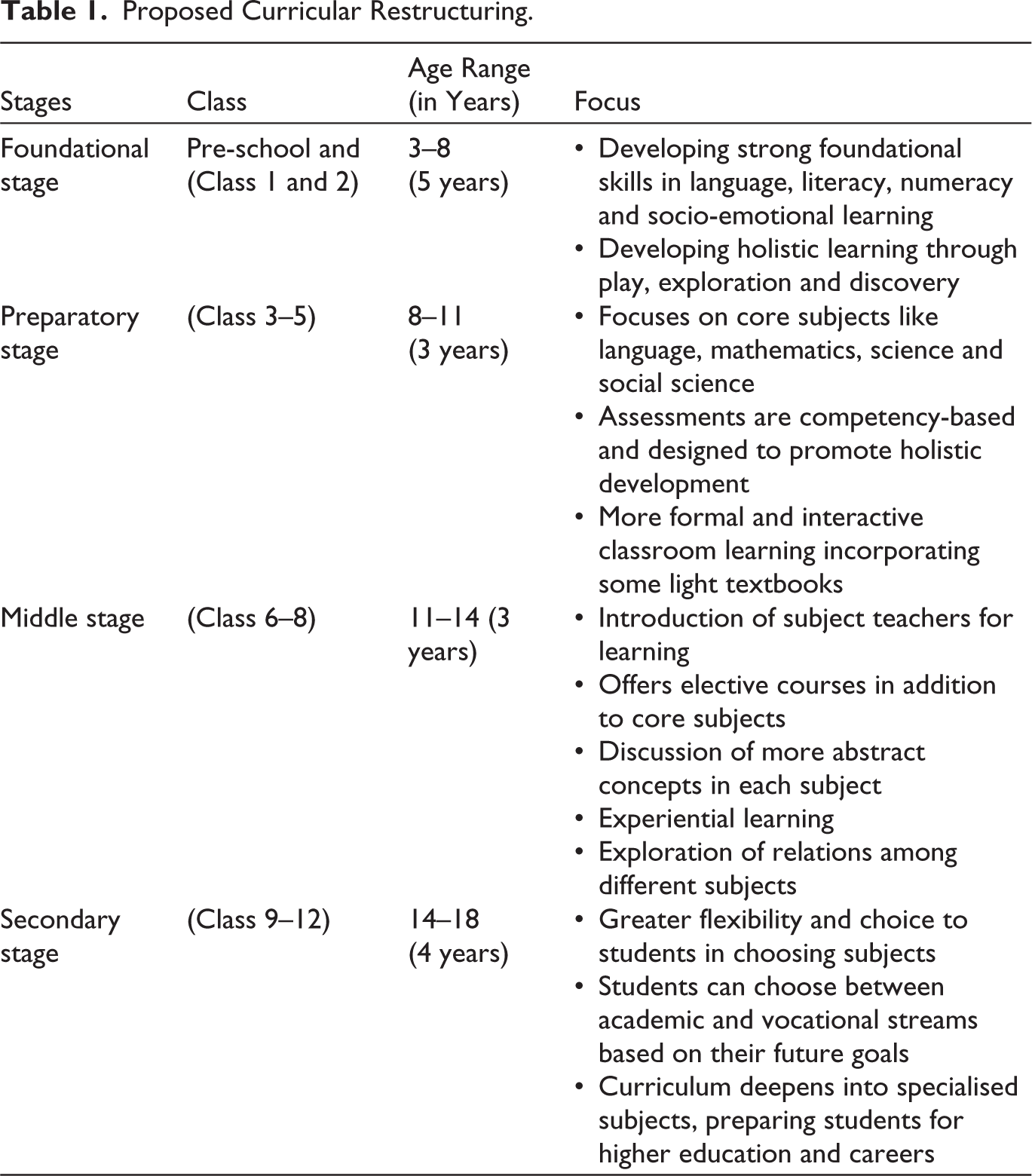
NCERT has been mandated to develop a National Curriculum and Pedagogical Framework for Early Childhood Care and Education (NCPFECE) for children up to the age of eight years. NEP 2020 has proposed that foundational literacy and numeracy for all children should be accorded the highest priority wherein reading, writing, speaking, counting, arithmetic and mathematical skills of the child should be improved.
The curriculum content has been suggested to be reduced to the core essentials with a focus on key concepts and ideas so as to give an opportunity to the learner to employ critical thinking and deepen his learning with inquiry-based, discovery-based, discussion-based and analysis-based approaches. A shift towards competency-based learning is expected by focusing on achievement of learning outcomes which is the measurable and observable behaviour of the learner and assessment tools will also be aligned according to the learning outcomes.
Cross-curricular pedagogical approach with art integration and sports integ-ration have been conceptualised to build a linkage between education and culture and developing a collaborative, responsible, self-initiative behaviour among the learners.
Removing the rigid boundaries between vocational and academic streams or curricular, extra-curricular and co-curricular or among arts, humanities and sciences has been envisioned.
Teaching the young children in their mother tongue till Grade 5 or preferably till Grade 8 along with exposing them to different languages early on, right from the foundational stage has also been conceived to underline the power of language and the importance of multilingualism in national integration.
To ensure the development of the learner into an innovative and productive human being, it is important that he should have a scientific temper, sense of aesthetics, communication skills, problem-solving strategies and a strong value system encompassing citizenship skills, ethical and moral reasoning, gender sensitivity and a keen sense of responsibility towards environment. Therefore, all individuals should learn certain subjects, adopt specific skills and develop all required capacities.
Curricula Embedded in Values
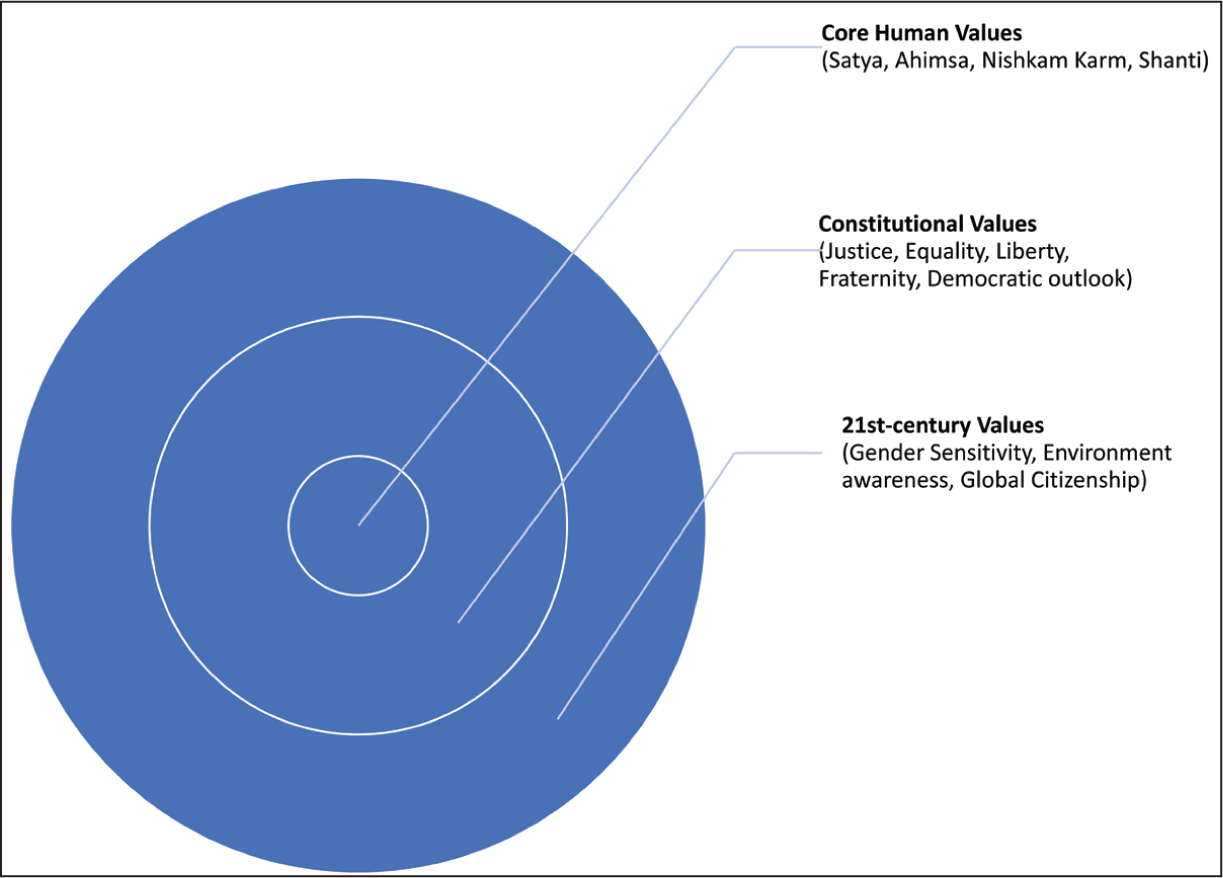
For transforming India into a global and vibrant knowledge society, it is important that the learner carries a confident and positive attitude towards life which stems from the strong value system, he holds. Education system should strive for inculcating the right kind of values in the citizens which, on the one hand, are rooted in the rich philosophical, cultural and social traditions of the Indian society and, on the other hand, are in alignment with the modern global values of 21st century. From a very young age, the learner should be able to appreciate and take pride in the rich heritage and traditional ancient knowledge system of India. He should respect the cultural and geographical diversity of the country and inculcate a feeling of brotherhood for all. He should develop logical framework of moral and ethical value system wherein he understands the importance of doing ‘what is right’. Character building should be the foremost aim of the educational process. Core human values propounded in Indian philosophical systems such as Ahimsa, Shuchita, Satya, Nishkam Karm and Shanti need to be instilled deep in the psyche of the learner. Constitutional values, namely justice, liberty, equality, fraternity, equity, inclusion, sense of responsibility should be incorporated in the behavioural pattern of the individuals. It is also important that learners adopt 21st century values, namely the right kind of health and hygiene practices to lead a healthy and wholesome life, have an acute sense of environmental awareness, have gender sensitivity, and a concern for global issues (Figure 1).
Values for Holistic and Fulfilling Life.
21st Century Skills
To build a future-ready India, there is a need to equip the workforce with the requisite skills of the modern world. Technology is very pervasive and the use of artificial intelligence and machine learning is dominant in almost all spheres of life. So, it is important that the new generation has a fair understanding of the use of computers and technology and should be able to leverage its advantages while staying careful of the potential risks and dangers. NEP 2020 has suggested the introduction of coding languages right from the class sixth. Specific emphasis has been laid on introducing the subjects of environmental education, holistic health, organic living, design thinking and global citizenship education at relevant stages. To compete at the global level, multi-disciplinarity is an important theme suggested for the higher education system. For creating new possibilities, it is important to remove the rigid boundaries and introduce flexible curriculum structures. Opportunity should be provided to the learners to choose creative combination of disciplines for study. Multiple entry and exit points should be offered by adjusting the structure and length of the degree programs.
In essence, NEP 2020 emphasises a paradigm shift towards holistic, integrated, enjoyable and engaging learning experiences. The hallmark of the new policy is to ensure the attainment of the learning levels in clear, specific, realistic and measurable ‘learning outcomes’ by overhauling the three important facets of educational process, namely curricula, pedagogical practices and the assessment aspect.
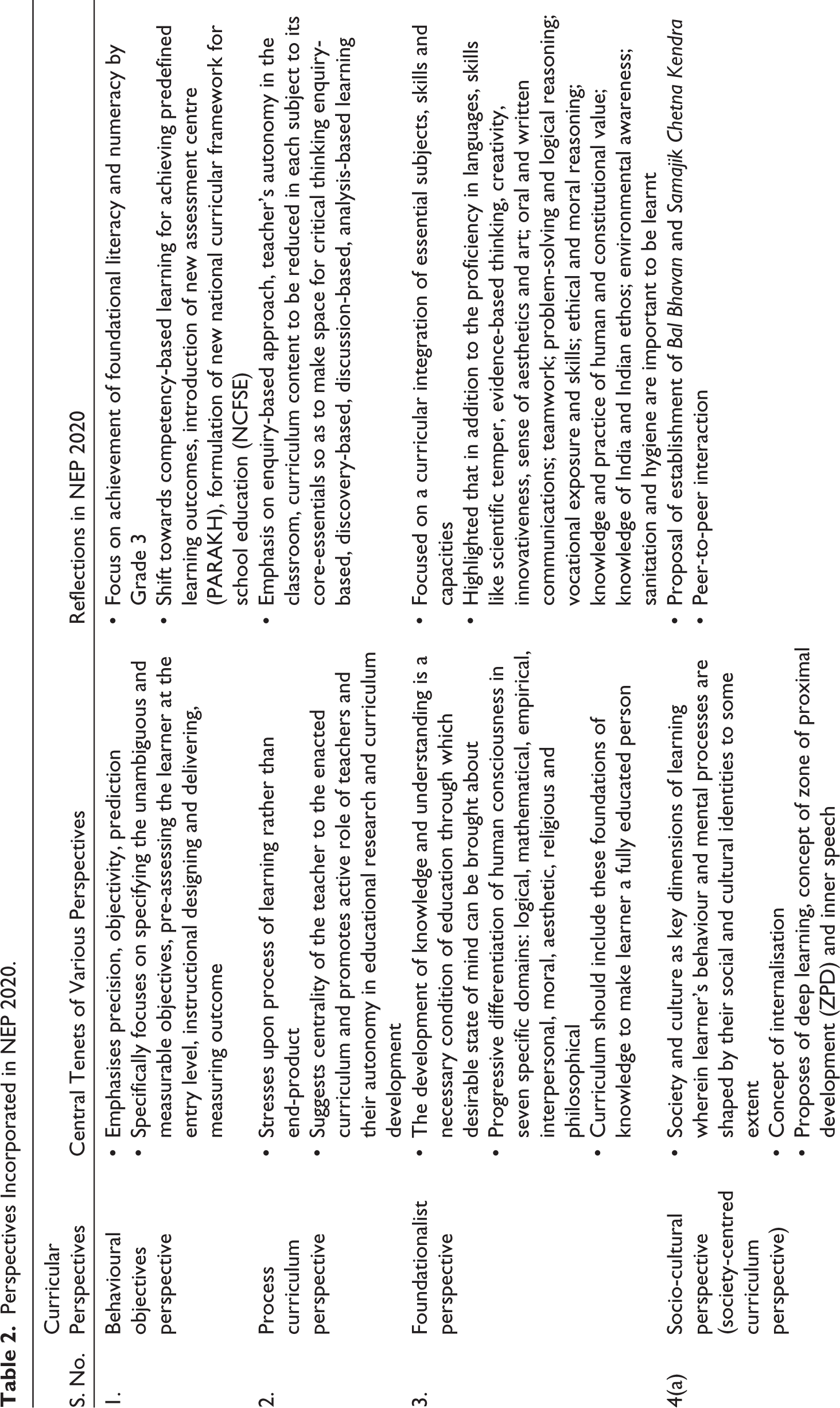
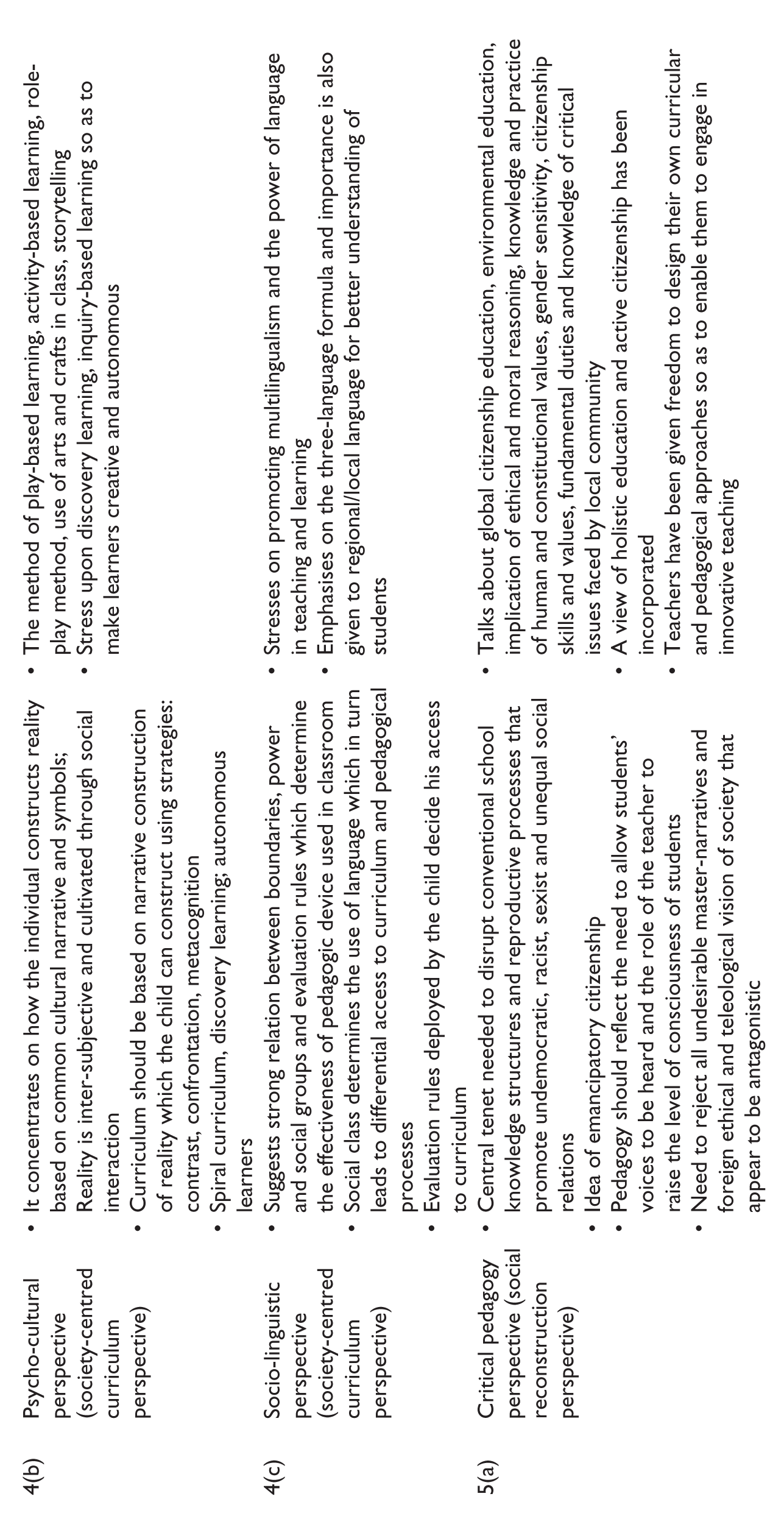
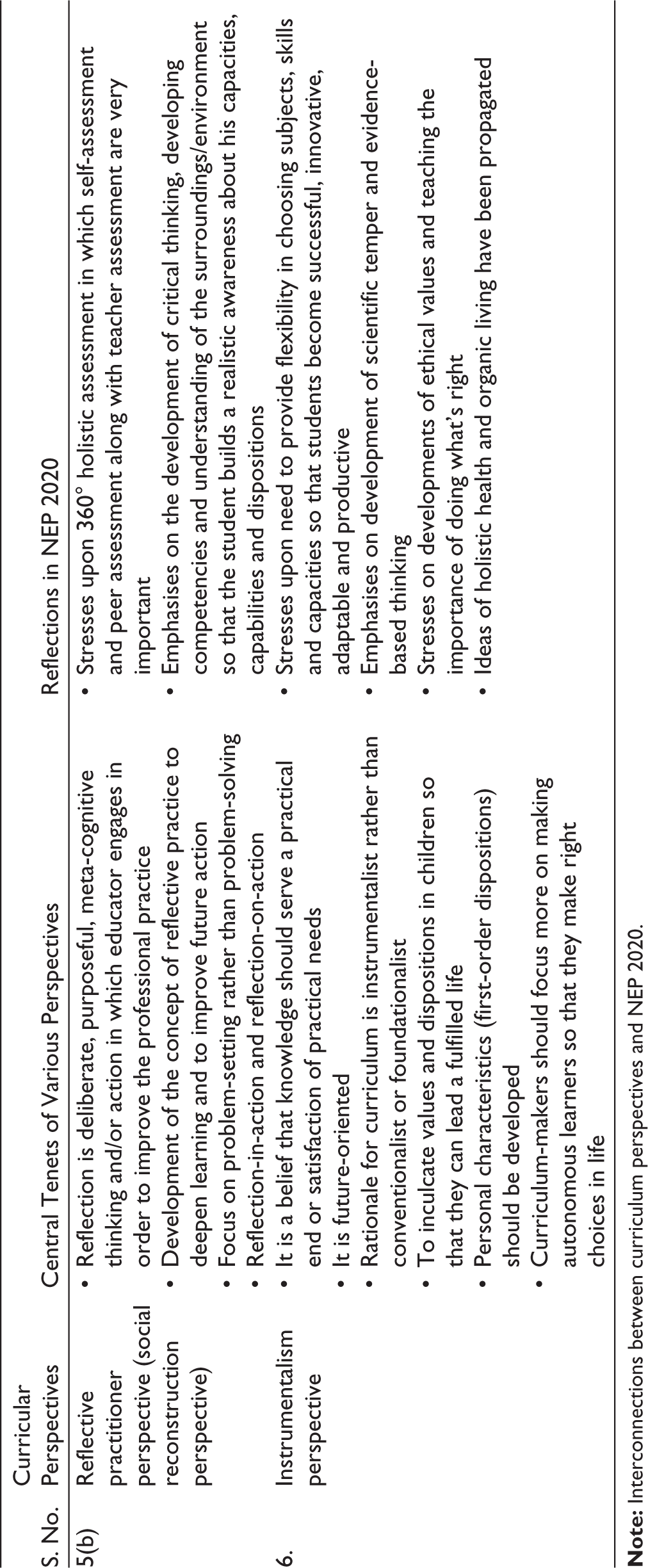
NEP 2020 draws significantly from the different curricular perspectives discussed above incorporating their major postulations and structuring the curricular and pedagogical approaches within those premises. The curricular propositions in NEP 2020 are a reflection of developmental discourse of curriculum evolved over the last century.
Table 2 is provided to give a comprehensive picture about how the different curricular perspectives are incorporated in NEP 2020.
Perspectives Incorporated in NEP 2020.
Conclusion
From Table 2, we can see that NEP 2020 is the synthesis of all the major curriculum perspectives and has beautifully interwoven the ideas advocated therein. The focus has been laid on the attainment of learning outcomes by restructuring the curricula according to the developmental needs of the learner and emphasising competency-based learning using innovative pedagogical approaches. The transformative vision of quality and outcome-oriented education has moved the educational aim beyond the traditional goal on access and retention. Emphasis has been laid on conceptual understanding, developing creative potential of the child and inculcating an ethical, human and constitutional value system. Unique capabilities of every child have been mandated to be identified and fostered by providing a nurturing and supportive ecosystem. Suggested curricular and pedagogical interventions promote inclusivity so that all groups of students are catered to and are provided with opportunities for becoming a successful learner. The curricular modifications aim at an all-round development of students instead of only preparing them for jobs. The new curricular framework is in sync with the idea of India as a modern nation along with being firmly rooted in our cultural ethos and traditional knowledge and value system.
NEP 2020 has been released after a gap of around thirty-four years since the release of NEP in 1986. It envisions India ascending the path of growth and development by building upon the capacities and capabilities of its human resources through appropriate curricular, pedagogical and systemic changes. Equal emphasis has been laid on promoting life skills and citizenship values along with cognitive and social development. The policy proposes to revamp all aspects of the educational system so as to align it with the aspirations of 21st century India.
Footnotes
Declaration of Conflicting Interests
The authors declared no potential conflicts of interest with respect to the research, authorship and/or publication of this article.
Funding
The authors received no financial support for the research, authorship and/or publication of this article.