







Abstract
Agristart-ups in India have ushered in an era of revolution in agriculture to make India both annadata and urjadata, which is concomitant and quintessential for the vision of Viksit Bharat by 2047. They have leveraged and bolstered technology and innovation to provide sustainable solutions to agricultural systems. However, systemic challenges such as financial limitations, regulatory constraints, technological barriers, market and supply chain constraints and human resource and entrepreneurial challenges are stifling their growth and scalability. This study employs a mixed-methods approach, consisting of both qualitative and quantitative tools to assess constraints faced by agristart-ups. Primary data are collected through a Likert scale-based questionnaire survey and analysed using arithmetic mean and standard deviation to measure the severity and variability of these constraints. The results highlight the need for greater financial access, evidence-based targeted policy interventions and a strong support ecosystem. Addressing these challenges is of paramount salience to foster agri-entrepreneurship and thereby enhance agricultural resilience both in letter and spirit in India.
Introduction
Employing about 46% of the workforce and contributing around 16% to the GDP for the financial year 2024, the agricultural sector remains a vital part of the Indian economy (MOSPI, 2024). However, the industry faces persistent challenges such as constraints in production, fragmentation in the supply chain and vulnerability to climate change (Bhooshan & Kumar, 2020). As a result, the productivity of agriculture is hindered, and the livelihoods of millions of smallholder farmers are at risk. In this scenario, agristart-ups have emerged as game changers, providing solutions through products and services, as well as applications for a range of agricultural functions from upstream to downstream.
It is estimated that one out of every nine agritech start-ups hails from India. Besides, the Economic Survey 2019–2020 highlighted that 3.80% of start-ups in India are agristart-ups. The Department for Promotion of Industry and Internal Trade (DPIIT) under the Ministry of Commerce and Industry, Government of India, has outlined criteria for an entity to be called a start-up: the enterprise should not have been in operation for more than 10 years since its incorporation; the annual turnover should not exceed ₹100 crore; and the business model should be scalable, with huge potential for wealth and employment creation (Government of India, 2025).
India’s start-up ecosystem has witnessed exponential growth over the past decade, contributing to India’s reputation as a global hub for innovation. This has been made possible due to the emergence of aspiring youth pioneering innovation and technology to find practical solutions, increasing digital penetration, favourable policy frameworks, availability of venture capital and, all told, a supportive entrepreneurial environment. As a result, India has emerged as the world’s third-largest start-up hub, with over 1.59 lakh start-ups recognised by DPIIT as of 15 January 2025 (Government of India, 2025). The number of start-ups in agriculture and allied sectors has also seen tremendous growth from just 50 to nearly 7,000 over the past nine years (The Federation of All India Farmer Associations (FAIFA), 2024).
Despite this rapid expansion, agristart-ups continue to face substantial constraints. Securing finance remains a major hurdle, with investment in Indian agritech start-ups declining by 45% between financial years 2022 and 2023, and over 66% of start-ups struggling to obtain adequate funding (FSG, 2024; RBI, 2024). Lack of funding restricts the scaling of these start-ups, thereby demotivating newcomers. Additionally, they find it difficult to navigate complex policies as well as regulatory frameworks, which remain a challenge. Market scalability is another major constraint, as many start-ups face issues in reaching a wide customer base; the problem multiplies due to sociocultural barriers in adopting new solutions.
This study seeks to comprehensively examine the multifaceted constraints faced by agricultural start-ups in India. It also conducts a detailed analysis of the nuances and niceties of prevailing constraints and offers actionable insights for policymakers, entrepreneurs and investors.
Background and Literature Survey
Eric Ries, in his seminal book The Lean Start-up (2011), describes a start-up as a human institution designed to create new products or services under extremely uncertain circumstances. Start-ups play a pivotal role in contributing to structural change in economies by introducing products and services that are knowledge-intensive (OECD, 2013). Ali et al. (2025) define agripreneurship as the application of entrepreneurship in the agricultural sector, which means that the individual is engaged in agri-production and the agri-value chain while putting business skills into practice. For Indian agristart-ups to expand and survive, they must have access to capital, technology infrastructure and market networks as they traverse the challenging landscape of the agriculture industry.
Agristart-ups in India are at an embryonic stage of development. New budding agripreneurs strive to solve current problems in the Indian agribusiness ecosystem. The compounded revenue of all agritech start-ups in India is estimated to be about $100 million, which is a drop in the ocean in a market value of more than $350 billion. Thus, the window of opportunity to scale and disrupt is enormous. India has made a strong impact on itself in the global start-up hamlet (Nagaraju, 2020).
The three stages of India’s start-up ecosystem’s evolution are micro, small, and medium enterprises (MSMEs), including small-scale industries, livelihood, and traditional enterprises (OAEs), and more contemporary technology-driven start-ups. Despite difficulties with formal integration, cottage industries and OAEs have historically supported subsistence lives in rural areas by creating jobs. After Independence, the small-scale industry burgeoned and made substantial contributions to exports and manufacturing, but it was also encumbered by challenges such as limited growth progression and obsolescence. The third wave of start-ups, hailed as the ‘new generation start-ups’, is fuelled by ICT, globalisation and creative knowledge-based entrepreneurs. In contrast to traditional MSME practices, successful start-ups rely significantly on regional ecosystems, venture capital, technology infrastructure and an enabling governmental environment. Current Indian regulations frequently resemble MSME support frameworks; therefore, it is crucial to adopt a customised strategy that considers local niche, nuances and niceties, the distinct traits and stages of development of high-tech start-ups. To materialise the equitable and widespread economic transformation of agristart-ups, Tier II and III cities’ start-up ecosystems must be strengthened on par with Tier I cities. The goal is to learn from previous policy failures and capitalise on start-ups’ ability to create jobs, innovate technologies and boost economic competitiveness (Subrahmanya, 2015).
Enhancing farmers’ incomes and increasing agriculture’s share of the national GDP require the metamorphosis of agriculture into agribusiness (Singh et al., 2022). Agribusinesses furnish solutions to farmers through disparate agribusiness models, namely (a) supply chain: e-distributor, marketplace, logistics and warehousing; (b) growing systems: aquaponics, hydroponics, vertical farming and drip irrigation; (c) financial services: payments, revenue sharing, lending and insurance; (d) farm data and analytics: integrated platform, remote sensing and GIS platforms, farm mapping and farm management and advisory and (e) field operations: farm mechanisation and bulk handling.
Understanding the constraints and policy imperatives is essential to enhancing resilience in agricultural start-ups (Condor, 2020). These start-ups leverage advanced technologies, data analytics and precision farming techniques to enhance agricultural performance (Kumar et al., 2024). For reference, institutional theory sheds light on how laws and rules from the government influence the start-up environment (Su et al., 2017). Another lens to examine Indian agristart-ups is the resource-based view, which highlights the significance of resources, capabilities and competencies in generating competitive advantage (Kraaijenbrink et al., 2010). The innovation diffusion theory clarifies how Indian agristart-ups embrace and spread cutting-edge methods and technology in the agricultural industry (Bocken, 2015; Miller, 2018; Wani & Ali, 2015). The sustainable entrepreneurship theory provides a framework for comprehending how agristart-ups incorporate social impact, environmental sustainability and economic viability into their company plans (Binder & Belz, 2015; Hoogendoorn et al., 2019). It builds on the premise that a sustainable environment is poised to develop business with a multiplier effect and simultaneously focuses on reducing environmentally inimical behaviours as part of environmental economics theory (Dean & McMullen, 2007). Sustainable entrepreneurship theory can be studied in connection with the leadership role, the organisational CSR strategy and the sustainable development of the region with micro-focused, multilevel and multi-theoretical approaches. The results demonstrate how crucial the leader is in establishing the company’s CSR strategy and how societal and cultural factors influence how leaders respond to sustainability issues (Silvestri & Veltri, 2020). It equally and plausibly applies to the country’s agristart-up ecosystem.
In India, several bodies, such as the Department of Science and Technology (DST), Direct Benefit Transfer, the National Institute of Agricultural Extension Management, the Biotechnology Industry Research Assistance Council, the Indian Council of Agricultural Research (ICAR), the Rashtriya Krishi Vikas Yojana (RKVY), the National Bank for Agriculture and Rural Development (NABARD), the All India Council for Technical Education, the All India Council for Technical Education (MSME), the Agriculture Insurance Company of India Limited (AIC) and the State Industrial Security Force (SISF), have played a monumental role in supporting agristart-ups in distinct phases by incentivising innovation, providing incubation support and offering grants and incentives. The Innovation and Agri-Entrepreneurship Development programme under the RKVY from 2018–2019 aimed for further innovation and agri-entrepreneurship by dint of a financial and technical push for a start-up ecosystem in India. An Agri Accelerator Fund of ₹300 crore was earmarked for 2023–2026 to incubate and modernise the agricultural start-up ecosystem in India. AgriSURE (Agri Fund for Start-Ups and Rural Enterprises; Budget 2022–2023, NABARD) aims to finance start-ups for agriculture and rural enterprises, germane to farm value chain development. Other Indian programmes for agristart-ups ecosystem cultivation include the Agriculture Infrastructure Fund, Ministry of Agriculture, 2020; Agri-Grand Challenge, Start-up India, 2016; Credit Guarantee Scheme for companies, Fund of Funds for Start-ups; Atal Incubation Mission; Start-up India Seed Fund Scheme; Start-up Agri-business Incubation Programme, MANAGE; Agri Seed Funding Scheme; NIDHI Seed Support Programme by the DST; Digital Agriculture Mission; Agri-Start-ups Based Micro Funding Programme, Ninjacart Start-up Programme; State-based start-up policies like the Bihar Start-up Policy 2022 and 2024 and the Karnataka Start-up Policy 2015–2020. Agristart-up conclaves are also organised. Moreover, the government has ushered in a flurry of reforms since 2016 to promote the ease of doing business by simplifying capital raising and reducing compliance requirements (Rao et al., 2024).
India is predominantly an agricultural country with one of the lowest per capita emissions. Yet, the current situation entails the application of a combination of sustainable entrepreneurship theories with robust institution theories to cater to both the demand and supply sides’ needs of agristart-up development in the country, which is currently in a niche and fragile phase of agriculture development, an alternative paradigm in the space–time continuum.
Materials and Methods
This study employs a mixed-methods approach, integrating quantitative and qualitative data to analyse the constraints faced by agristart-ups in India. The quantitative aspect consists of a questionnaire survey of 160 start-ups, while the qualitative aspect consists of semi-structured interviews with agristart-up founders. After performing an in-depth literature survey, a questionnaire covering financial, policy, technological, market, entrepreneurial and sociocultural constraints was designed. Respondents were asked to rate different constraints on a Likert scale ranging from 1, indicating that a specific factor is not a constraint, to 5, indicating that the factor is a severe constraint. After data collection, descriptive statistical methods such as mean and standard deviation were used for the analysis. The mean values for each constraint were calculated to determine the overall severity of each issue and find the most pressing constraints. The standard deviation, in contrast, was computed to study the variability in responses. Low standard deviation indicated homogeneity and consistency among the responses, while high standard deviation indicates the opposite. The qualitative insights from the interviews were used to aid and contextualise the quantitative study’s findings. They were instrumental in providing an in-depth understanding of the challenges faced by agristart-up founders and increasing the validity and reliability of the research.
Results and Discussion
Agristart-ups in India are paramount and quintessential drivers of innovation and entrepreneurship. They address key challenges concerning food security, rural livelihoods and environmental sustainability. These start-ups range from agritech, agri-research and product development, agri-marketing and branding, allied activities, agri-fintech, agro-based manufacturing and others, which may include multi-sector agristart-ups.
The start-ups, indeed, have benefited from these de novo initiatives. However, some issues are still prevalent, as gleaned from the primary survey, and vary across disparate categories of start-ups as represented in Table 1. Respondents have also revealed the kind of support ecosystem they requisition.
Major Constraints by Nature of Start-ups.
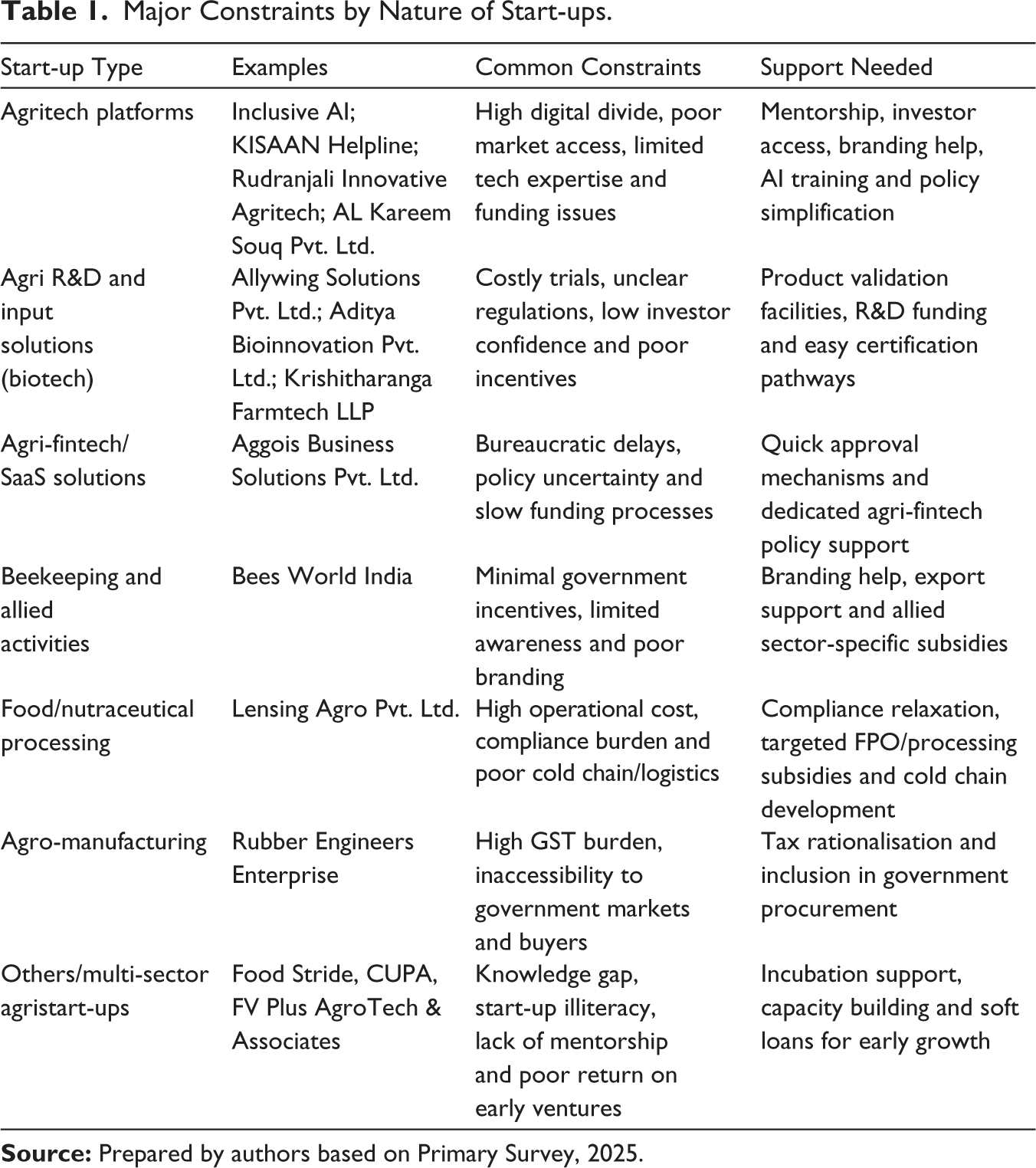
The nature of the start-up predominantly influences the type of challenges encountered. Agritech grapples financially and technologically, manufacturing is in a clutch of regulatory battles and fintech is entrenched in bureaucratic red-tapism and expediency.
Agritech start-ups such as Inclusive AI, Rudranjali Innovative Agritech, AL Kareem Souq Pvt Ltd and FV Plus Agrotech gave a score of 4–5 to financial bottlenecks (access to loans, operational costs). The sector faces maximal issues and bottlenecks in tech (lack of scalable solutions, shortage of technical expertise). It is financially precarious and technologically underserved, requisitioning seamless credit and tech incentives for its proliferation and growth.
Research and product development start-ups such as Allywing face enormous challenges due to technological expenses and burns. Such start-ups give very high ratings due to the high cost involved in the adoption of technologies and the scarcity of viable agritech solutions. R&D-focused start-ups require subsidised access to testing facilities, equipment and research labs as they perceive tech adoption to be unaffordable and unviable.
Beekeeping industry start-ups, such as Bees World India, have fewer financial constraints, but glaring problems in the face of poor market integration and connection. Bees World India has low ratings (mainly one star) for financial restraints and a score of three for difficulties with logistics and revenue swings. Despite their financial stability (government assistance, specialised venture capital funding), beekeeping start-ups face price volatility and limited and sporadic market access.
Manufacturing start-ups, such as Rubber Engineers Enterprise, experience problems with regulation and taxation. High GST rates and limited institutional market access are major challenges for these start-ups. Start-ups in the manufacturing sector have greater challenges with tax compliance and unfavourable regulatory environments than with funding.
Agri-fintech start-ups such as Aggois Business Solutions requisition expedient and agile bureaucratic procedures. Cooperative bureaucracy and agile decisions were highlighted by these agristart-ups as their top priorities. Agile, expedient and more stable regulatory oversight is crucial for fintech businesses in agriculture to innovate and grow swiftly.
Start-ups in the nutraceutical and related industries, such as Lensing Agro Pvt Ltd, face stringent compliance burdens. When it comes to financial and compliance responsibilities, nutraceutical start-ups must be assisted in complying with regulations to overcome significant regulatory obstacles.
Financial Constraints
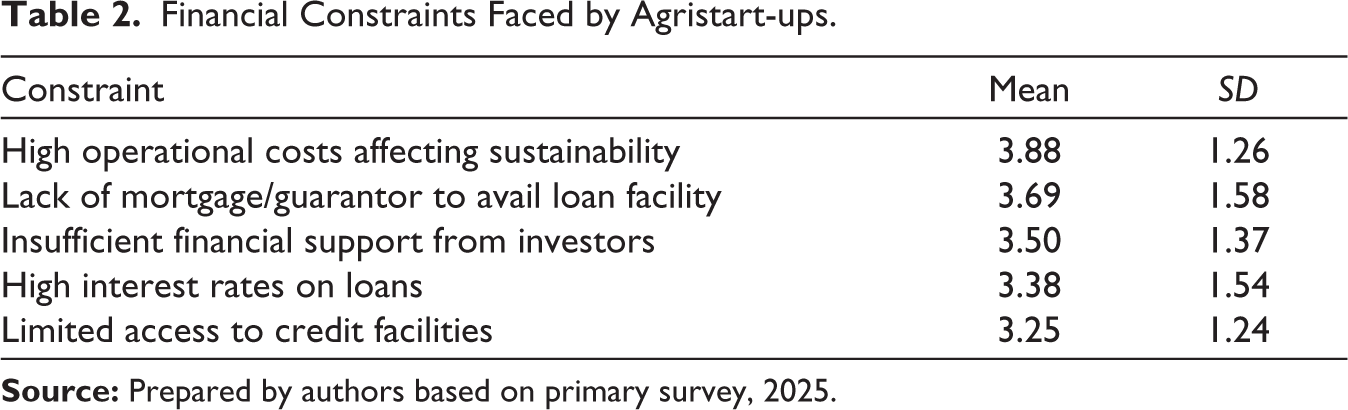
As evident from Table 2, high operational costs remain the biggest deterrent for the growth and sustainability of start-ups. Low standard deviation on the issue reinforces this fact, as start-ups have a strong consensus regarding their impact. High costs associated with fixed and working capital limit start-ups’ ability to scale their operations effectively. Especially with bootstrapped and nascent start-ups, high costs become a major constraint. The role of the mortgage/guarantor cannot be understated, as it shares the second-highest mean score. However, a relatively high standard deviation suggests variability in the responses and, therefore, experience. Absence of collateral or guarantors restricts access to formal credit, thereby stifling access to the capital required for expansion (Asia, 2021; David et al., 2021). Next in rank is insufficient financial support from venture capital firms, private equity firms and angel investors. Perceived risks and unique challenges associated with agriculture instil reluctance among investors to fund agristart-ups. Finally, high interest rates on loans and limited access to credit facilities emerge as another key challenge. Although ranked lower than other constraints, these remain a notable issue. Further, as evident from the ranking, the problem lies more in the affordability of loans than in accessibility.
Financial Constraints Faced by Agristart-ups.
Policy and Regulatory Constraints
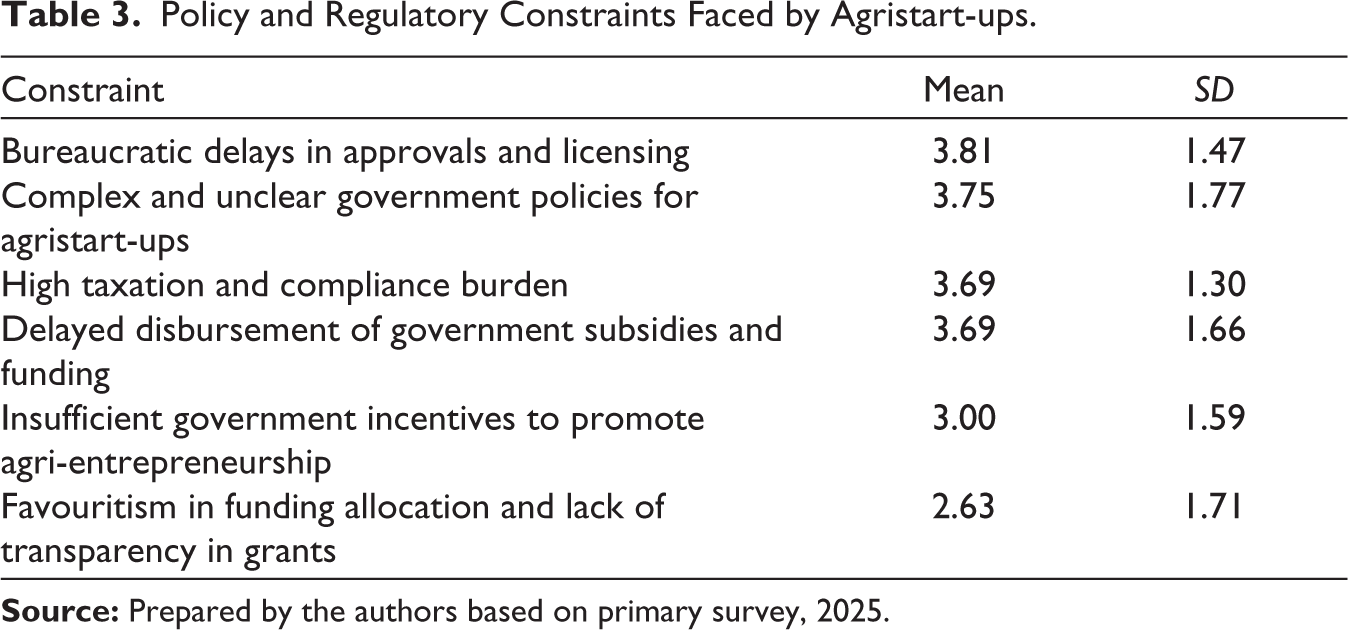
Table 3 states bureaucratic delays in approvals and licensing as the most critical constraint. Complex and ambiguous government policies for agristart-ups closely follow the first constraint. The high standard deviation suggests high variability among experiences, which could be attributed to regional and sectoral differences in policies and their implementation. Both high taxation and compliance burdens, as well as delayed disbursement of government subsidies and funding, are ranked equally. These requirements increase operational costs and discourage new entrants in the sector.
Policy and Regulatory Constraints Faced by Agristart-ups.
Government grants reduce financial stress but not policy challenges. Start-ups with government grants show less financial stress (mean 3.5), but bear the regulatory and compliance burdens (mean scores above 3.5 for ‘complex policies’ and ‘favouritism in funding’). The crux of grant governance is that government grants allay the initial funding enigma, but complex policy and compliance systems burden the start-ups.
Insufficient government incentives to promote agri-entrepreneurship rank lower than other constraints but remain a notable issue. The high standard deviation suggests a difference in perception, which could be due to differences in awareness about the incentives. Another reason could be the inadequacy of these incentives or of accessibility to existing ones. The lowest-rated constraint is favouritism in funding allocation and a lack of transparency in grants. However, a high standard deviation suggests varied perceptions, likely based on differences in experience.
Technological Constraints
Start-ups that bridge the gap between agriculture and technology are becoming increasingly important in promoting agricultural sustainability and production, especially in the countries of the Global South (Bethi & Deshmukh, 2023). The most critical technological constraint, as outlined in Table 4, is the high cost of adopting advanced technologies. A low to moderate standard deviation indicates that some start-ups with better access to funding or subsidies do not feel the impact of this constraint as much as those with a lack of funds. Limited access to scalable and commercially viable agritech solutions is the second most critical constraint underlining a gap between technology and its practical application. Many agritech products remain limited to research and pilot projects rather than being widely adopted by start-ups due to inaccessibility, inadequate distribution networks and the high cost of scaling these innovations.
Technological Constraints Faced by Agristart-ups.
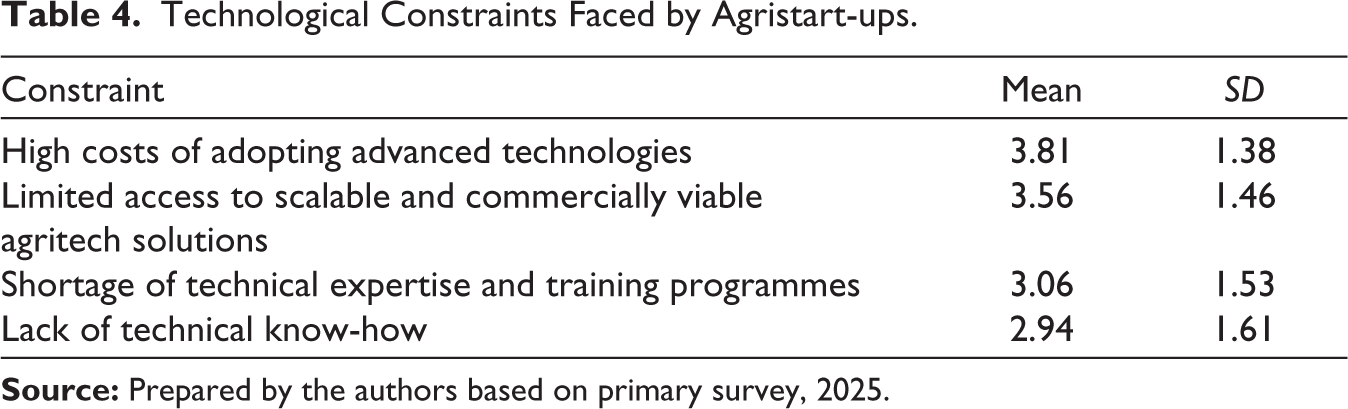
Next in rank, the shortage of technical expertise and training programmes, is also a considerable issue, as it restricts the effective implementation of innovative solutions. The relatively high standard deviation indicates that while some start-ups may have access to training programmes, others struggle due to the lack of institutional support. The lowest-rated constraint is a lack of technical know-how. The high standard deviation may be attributed to differences in the background of founders, exposure and access to technological advancements and knowledge.
Market and Supply Chain Constraints
As outlined in Table 5, the most critical challenge is the lack of real-time market intelligence and data-driven insights. Limited access to up-to-date market trends and insights inhibits the ability of start-ups to optimise production. There is also a relatively low standard deviation, which indicates a consensus among respondents, underscoring the need for more and better tools and platforms that provide real-time market insights.
Market and Supply Chain Constraints Faced by Agristart-ups.
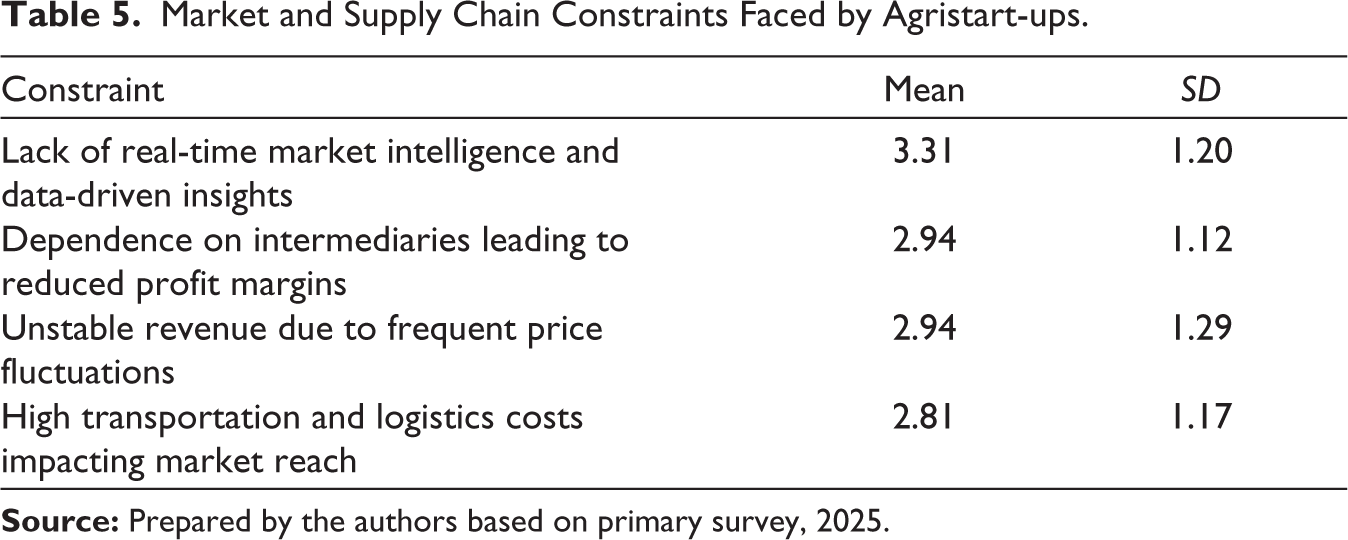
Two constraints—dependence on intermediaries leading to reduced profit margins and unstable revenue due to frequent price fluctuation—rank equally and highlight major financial risk. High transportation and logistics costs are rated lowest, indicating it is not a primary constraint for start-ups.
Human Resource and Entrepreneurial Constraints
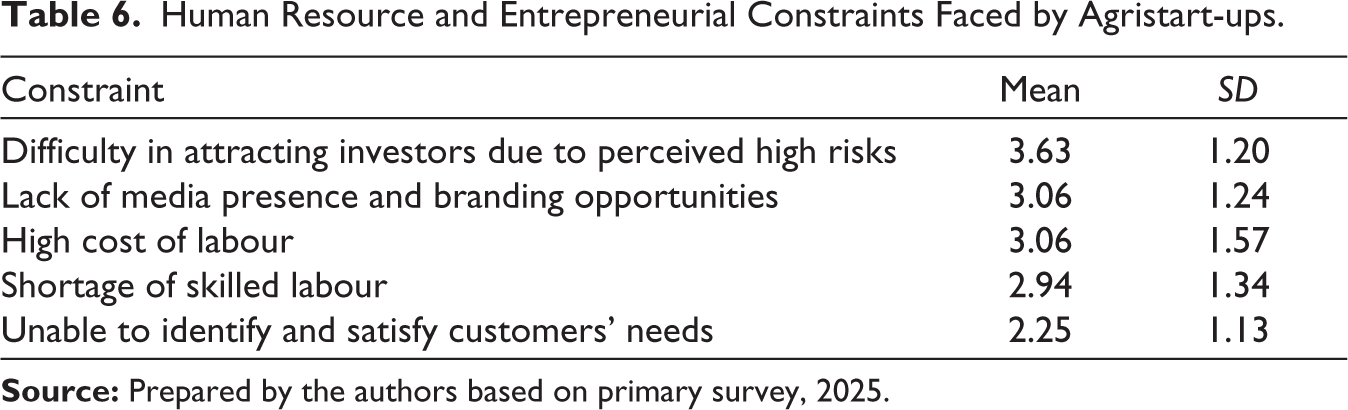
Table 6 highlights the difficulty in attracting investors due to perceived high risks as the most pressing constraint faced by agristart-ups. The relatively low standard deviation indicates that this challenge is widely experienced across the sector. Two constraints—lack of media presence and branding opportunities, and high cost of labour—rank equally. Lack of marketing limits start-ups’ visibility and ability to reach potential customers and investors, while high labour costs increase financial pressure, especially for small and bootstrapped start-ups. Next in rank is a shortage of skilled labour, which highlights difficulties in hiring experts in agriculture and technology-related fields. The least significant constraint is the inability to identify and satisfy customers’ needs. While this issue ranks lower, it still indicates that some start-ups grapple with market research and product-market fit.
Human Resource and Entrepreneurial Constraints Faced by Agristart-ups.
Sociocultural Constraints
The most pressing socio-economic constraint is low awareness of start-up–led agricultural innovations, as evident in Table 7. This limits the adoption of technological solutions. The moderate standard deviation indicates that awareness levels vary, possibly due to education and accessibility (Shah & Sharoff, 2017; Singh et al., 2016).
Sociocultural Constraints Faced by Agristart-ups.
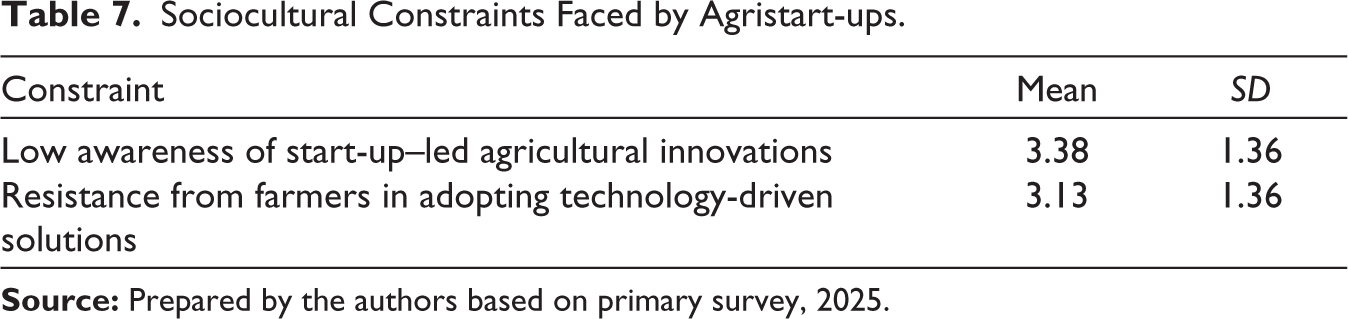
The second constraint is resistance from farmers in adopting technology-driven solutions, mainly to avoid risk and financial losses. The moderate standard deviation indicates that while some are open to new technologies, a significant portion remains reluctant. Though farmers are becoming more receptive to innovation, adoption is still slow (Fiocco et al., 2023).
Agristart-ups in India are at the cusp of revolution and are plagued by multifaceted constraints:
Agribusiness model: Most agristart-ups are mainly oriented towards the production and marketing of agriculture and are encumbered by a large number of stakeholders and the inability to connect to and converge with real-world problems that thwart their scaling. Lack of seed fund: Founders of agristart-ups are mostly from humble backgrounds and need initial support to prove their ideas and carve a minimum viable product; small and sporadic grants are not of much use to them. Paucity of mentorship: Agribusiness incubators, often from agricultural universities and other research organisations, are in the embryonic stage of learning. The overall professional adeptness of agribusiness incubators needs to be ameliorated. Limited knowledge of emerging technologies: Some early entrepreneurs are not accustomed to these technologies, and others are not able to apply these technologies to real-world issues.
India has copious land, labour and capital. The factors of production are abundant in the country, but how it combines these factors of production (total factor productivity) is poor. At this juncture, agristart-ups play a significant role in bridging the gaps and inefficiencies in demand and supply to improve total factor productivity in agriculture, diversify the agri-value chain and promote India’s agri-export strategy. The surplus labour generated by agriculture has to be absorbed by the industrial sector with a view to becoming the Lewis exemplar; however, Indian industries cannot develop to such an extent. Niti Aayog propounded a factory-in-farm model where agri-value chains would be developed and traded. Whether the Lewis or Niti Aayog model plausibly and cogently defines India’s sectoral development paradigm is debatable. Nonetheless, it is undeniable that agristart-ups complement the praxis and theory of both and have served as the engine of a robust alternative growth paradigm. Agristart-ups have been augmenting and reinforcing India to gain a vantage point and traction to become the sixth industry and usher in the sixth industrialisation with synergistic backward–forward linkages and economies of scale in agricultural systems and their value chain development. They need to be supported to operate with ease and treated as real innovators and serious social enterprises.
Recommendations
There is a need for evidence-based and data-driven policy making to furnish an enabling environment for the burgeoning agristart-up ecosystem in the country. The bottom line is that early-stage start-ups urgently need technological know-how, affordable tech solutions and trained personnel. Older start-ups veer away from survival instincts to scaling, profitability and increasing market outreach. The sustainability of start-ups is hamstrung due to high operational and initial costs, entailing quick cost optimisation and actionable plans. Agristart-ups’ unprecedented requisition puts robust integration above finance. It entails erudite mentorship and robust B2B–B2G stakeholder linkages.
It is necessary to focus on actionable research on agristart-ups centred around the issue of sustainability. There is an urgent need to strengthen incubation centres and their collaboration ecosystem. There is a need for a better policy environment of nudge and mandate with better incentivised and transparent market reforms for a level-playing field for agristart-ups. There is a need to promote agristart-ups offering nature-based solutions to agriculture, such as those involved in natural farming, green mitigation planning and so on. Along with increasing awareness regarding existing programmes, agristart-ups should be given the benefits of government policy imperatives such as PM Fasal Bima Yojana, Priority Sector Lending, Interest Subvention, Mudra Loans and the Production Linked Incentive scheme. In line with the Digital Agriculture Mission (Digital Public Infrastructure, Agri Stack), Aspirational Block programme and PM Dhan-Dhanya Krishi Yojana, a block based on agristart-ups should be conceived with robust agri-infrastructure, abundant agri-extension facilities and an incubation-cum-bridge-training centre to train the burgeoning demographic dividend of India to make more scalable and replicable agristart-ups based on niche potential, owing to local nuances, subtleties and niceties. The agristart-up block should also be touted as an agri-tourism hub in the district, and it shall be incentivised to augment One District One Product, Vocal for Local and the region’s GI tag. It shall also be encouraged to conduct agricultural research and development, as it is mostly owned by the burgeoning demographic dividend, who are keen on innovation, hackathons, creativity, intellectual property rights, breakthroughs and path-breaking research. Investment in agricultural research and development is paltry at 0.2% of the GVA. So, it needs to be upended and increased. Moreover, collaboration between agristart-ups and universities is the need of the hour to bridge agri-extension gaps.
The Empowered Action Group (EAG) states-based start-ups need to be robust in incubation, training and fund transfers, and their start-up policy should be framed as per the niche requirement of the specific state. Due to poor enforcement of the start-up policy in an EAG of states such as Bihar, the Start-up Policy 2022 failed to recognise certain categories of agristart-ups like pearl farming. It also faced issues such as a large rejection rate, poor training, corruption and prolonged delays in fund transfer, crippling the cause and intent of agristart-up development. The Start-up Policy 2016 should be amended to create more subcategories within agristart-ups so that they can benefit under the scheme. Moreover, agristart-ups should be included as the most significant category across all start-ups, and special incentives need to be bestowed accordingly, as it is imperative to build the country’s food, nutritional and energy security to usher in the alternative development paradigm of Viksit Bharat by 2047.
Conclusion
The agricultural landscape in India is at a critical juncture, as it is riddled with uncertainties and has languished with low growth rates for several decades. In this scenario, agricultural start-ups have emerged as saviours, unlocking their potential to make way for a more efficient and sustainable future of agricultural systems. However, the overall conjecture in India is that initial capital significantly helps start-ups in survival, but market accessibility, technical expertise and policy and compliance requirements need to be navigated to help the start-ups scale and achieve long-term success. There is an overt need to ramp up incentive-based ecosystems, ensuring sustainability with public–private–people partnership in policy design formulation and implementation, with a blended element of nudge and mandate as a tool of public policy and governance. Moreover, areas such as funding, regulatory frameworks and adoption of frontier technologies have emerged as most critical and should be dealt with as a priority to facilitate the nation’s entrepreneurial momentum. Agristart-ups are bolstering cutting-edge technology, data analytics and sustainability in the face of the disparate challenges faced by traditional farming systems.
India’s agriculture systems seem to have metamorphosed into a de novo digital agriculture revolution by shouldering the wheels of the agristart-up ecosystem. Agriculture 4.0 would foresee ‘the Internet of Farming’, the intelligence of data analytics to the whole value chain, ensuing lesser costs, added income and better quality with end-to-end traceability. Comprehensive support and a vibrant ecosystem should be provided to nurture, catalyse and galvanise the growth of agristart-ups. Collaborative efforts, eclectic research and development, concerted push and evidence-based and data-driven, smart and sustainable policies and governance with nudge and mandate policy tools should be made to ensure the development of a vibrant and inclusive start-up ecosystem across all the nooks and crannies of the country to realise the vision of Viksit Bharat by 2047.
Footnotes
Declaration of Conflicting Interests
The authors declared no potential conflicts of interest with respect to the research, authorship and/or publication of this article.
Funding
The authors received no financial support for the research, authorship and/or publication of this article.