







Abstract
This Note examines why preventive security proceedings under Chapter VIII of the Code of Criminal Procedure (CrPC)/Chapter IX of Bharatiya Nagarik Suraksha Sanhita (BNSS) have lost operational efficacy despite doctrinal endorsement and argues that institutional misalignment between police and executive magistracy is the principal cause. Security proceedings have been an integral component of the CrPC and now of BNSS since its inception. Over time, the challenges confronting local administration have evolved, resulting in significant discrepancies between the intended purpose of the law and its practical application. Despite widespread consensus on the continued necessity of such proceedings given the diverse law and order challenges facing the country, a thorough examination is required to ensure their continued relevance and effectiveness. This Note critically examines the issues surrounding security proceedings from a practical standpoint, drawing insights from real-world experiences to highlight challenges and propose potential solutions. It adopts a qualitative doctrinal-practice analysis informed by administrative experience, supplemented by case law, commission reports and National Crime Records Bureau (NCRB) data.
Introduction
A notorious bad character! The magistrate decides what is good security; and in a district where the police are efficient no respectable person will offer security for someone the magistrate considers a notorious bad character (Mason, 1992).
The CrPC 1973 reforms sought to strengthen the separation between executive and judicial functions in criminal justice. However, a complete separation was neither intended nor implemented. Executive authorities, particularly Executive Magistrates (EM) and Sub-divisional Magistrates (SDM), continue to exercise quasi-judicial powers in specific domains. One such domain is Chapter VIII of the CrPC, retained as Chapter IX in the BNSS, titled ‘Security for Keeping the Peace and for Good Behaviour.’
Briefly, the provisions of this chapter are preventive in their scope and objective. They are aimed at people who may pose a threat to public peace and public order and may commit certain offences. Preventive magisterial jurisdiction under this chapter is a powerful executive instrument. When exercised judiciously and proportionately, it can preserve public order effectively. However, excessive or indiscriminate use risks undermining civil liberties and administrative legitimacy (Ratanlal, 2017).
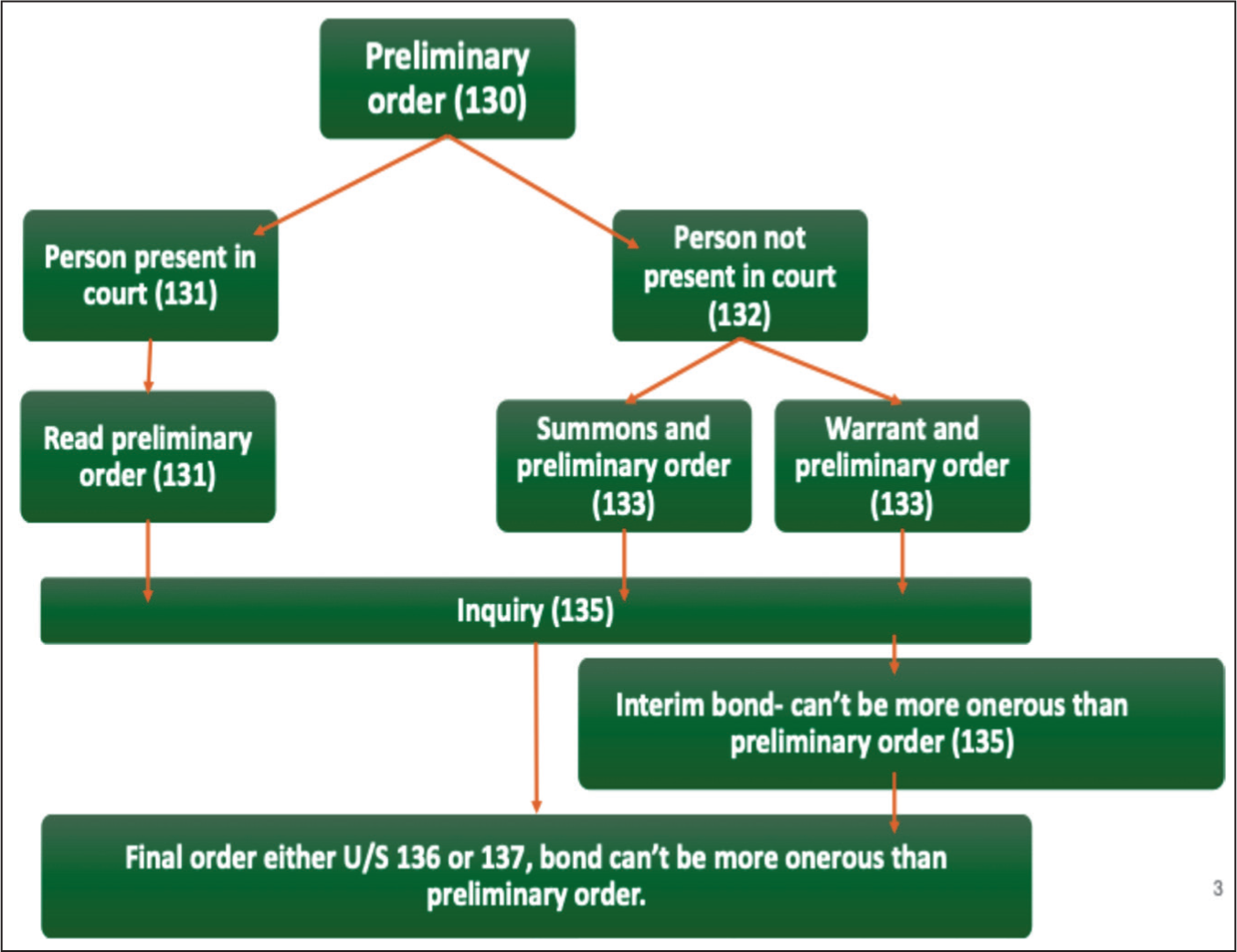
The entire process can be summarised in Figure 1.
Schematic Process Flow of Security Proceedings.
Continuing Relevance
These provisions originated in the colonial context in response to the rebellion of 1857 and subsequent political unrest. The continued importance of these provisions is reflected in repeated endorsements by reform bodies. The Second Administrative Reforms Commission (2007), in its fifth report on public order, emphasised the need for systematic and effective use of preventive measures, recommending revised training and operational manuals for both the police and magistracy. Similarly, the Law Commission of India (1969) rejected calls for the repeal of provisions such as Sections 107 and 109 CrPC, observing that such measures are essential for maintaining peace and order. Judicial scrutiny has also upheld their constitutional validity. The Supreme Court held that these provisions fall within reasonable restrictions under Article 19, being in the interest of public order (Madhu Limaye v. Sub-Divisional Magistrate, Monghyr, 1970).
Alongside Section 144 (now Section 163 BNSS), these provisions are the most frequently invoked provisions to preserve peace at the slightest apprehension of disturbance. During the May–June 2024 general elections, the Election Commission of India closely monitored key indicators under Chapter VIII, such as persons bound down, summons issued and served, and pending proceedings through structured formats and continuous review mechanisms. These provisions are also central to training new administrators. Whether managing sensitive festivals, rallies, demonstrations or land disputes, these proceedings are a preferred executive tool.
Institutional Practice and Police–Magistracy Interface
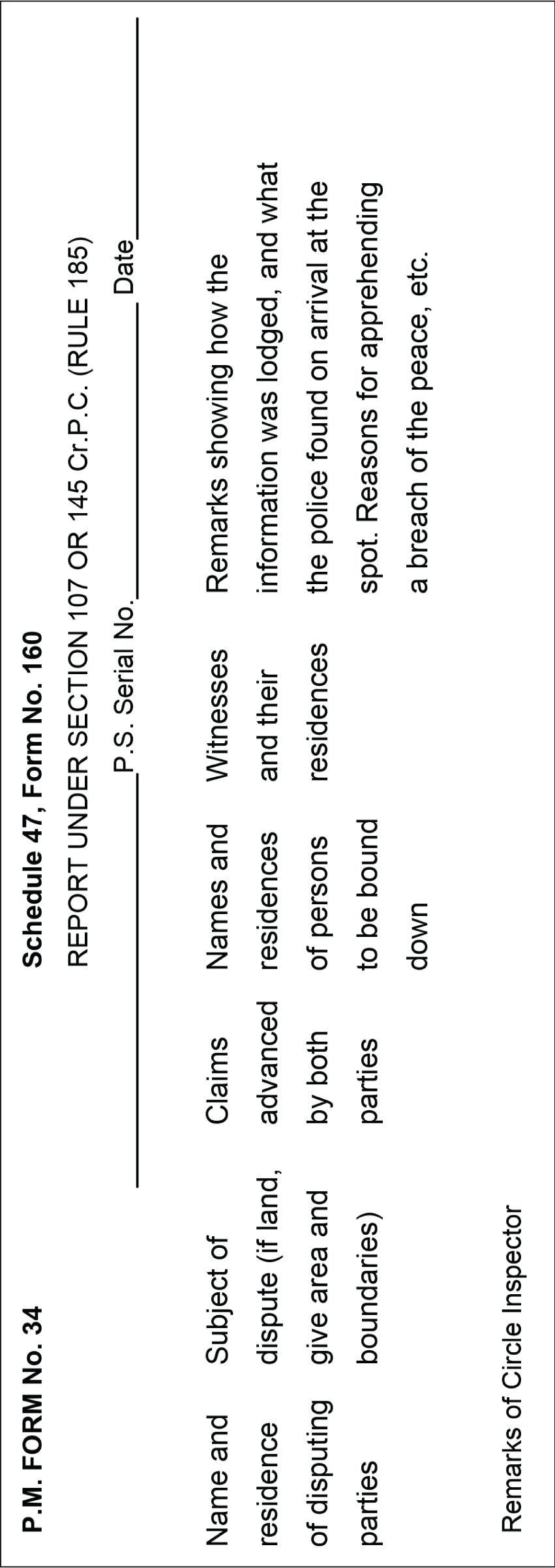
Unlike criminal litigation, which originates when a first information report (FIR) is registered, or civil litigation, which originates when a plaint is filed, security proceedings can originate from multiple sources. The statutory language requires that the EM should receive information that any person is likely to commit a breach of the peace without specifying how or from whom that information is received. It is not uncommon for magistrates to start proceedings on the basis of a plain paper complaint, social media posts or a newspaper report. While the magistrate is at liberty to start proceedings from any information whatsoever, most of these proceedings are initiated on the basis of police reports. Police manuals in various states provide formats to report such occurrences, which might warrant such a proceeding (Figure 2). 1
Format for reporting incidents under Sections 107, 109 and 110 as per Jharkhand Police Manual (Jharkhand Police, 1978).
A recurring problem in security proceedings is that the police often shift their prosecutorial responsibility onto the EM. For instance, two parties approach a police station saying that the other is forcibly trying to possess a property of which they are the rightful owner and is threatening the other with life. If nothing is done immediately, it may lead to violence and bloodshed. The incident has just about reached the threshold of a cognisable offence but might not lead to an FIR; in other words, it lies in a grey area. The police, unable to reach a determination, recommend action under Section 126 for breach of peace. Moreover, an FIR would not only burden their already strained resources with an investigation but also reflect in subsequent crime review meetings.
Another illustrative instance involved a police recommendation under Section 126 BNSS in a case where a woman had been beaten, disrobed and dragged through a field. Such recommendations reveal a systemic incentive structure wherein the police prefer preventive proceedings over FIRs to minimise investigative burdens and statistical accountability. The very core of the nature of these proceedings is that they are of a preventive nature. This practice directly contradicts the preventive character of security proceedings, as clarified by the Karnataka High Court, which held that preventive jurisdiction cannot substitute regular prosecution once a substantive offence has been committed (C.V. Krishnappa Shetty v. Karnataka, 1979). The result is a dual distortion; first, the police avoid responsibility for investigation, and second, magistrates bear the burden of preventive failure.
Vagueness and Evidentiary Uncertainty
Another structural issue lies in vague statutory thresholds embedded in terms such as ‘likely’, ‘habitual’, ‘public tranquillity’ and ‘public peace’. These terms are inherently open-ended and require careful judicial interpretation. There should be material before the EM to come to a conclusion that the person who is to be asked to furnish the bond is engaging in such activities which are reasonably dangerous to public peace and public tranquillity, and that too directly. The material should show that he has an associate and is exercising muscle power, or engaging himself in anti-social activities, which would result in an incident which would disturb the public tranquillity and would cause the breach of public peace (Mulla, 2021).
Judicial precedents have also clarified distinctions between law and order, public order and security of the state. As articulated by Justice Hidayatullah, these form concentric circles of increasing gravity. Law and order represents the largest circle, within which is the next circle representing public order, and the smallest circle represents the security of the state. It is then easy to see that an act may affect law and order but not public order, just as an act may affect public order but not the security of the state (Dr Ram Manohar Lohia v. The State of Bihar and Others, 1965). In other words, public order is an expression of wide connotation and signifies that state of tranquility which prevails among the members of a political society as a result of the internal regulations enforced by the government which they have established (Romesh Thappar v. The State of Madras, 1950). Despite many such clarifications and observations, many of the provisions in these sections remain vaguely worded for the purposes of effective implementation.
In practice, however, a wide range of private disputes, such as family conflicts, property disagreements or neighbourhood quarrels over parking or grazing areas, are frequently brought under preventive proceedings even when they lack broader public implications. These disputes warrant preventive action only when they escalate into collective tensions, such as by mobilisation along caste or religious lines, thereby posing a genuine risk. The failure to maintain this distinction leads to an overreach of preventive law.
Accountability and Governance Constraints
Security proceedings directly impact personal liberty. Failure to comply with bond requirements can lead to imprisonment for up to three years at most. Given these consequences, strict adherence to procedural safeguards is essential. Courts have consistently taken a strict view of lapses. Even minor procedural defects, such as improper summons, can result in proceedings being quashed. This creates a governance dilemma for magistrates—if they accept weak police reports, they risk judicial censure; and if they reject them, they risk the blame if unrest occurs later.
Compounding this is the institutional asymmetry between magistracy and police. Executive magistrates lack independent investigative machinery. Their primary field functionaries are revenue staff who are not equipped for intelligence gathering on law and order issues. They also have limited supervisory control over police forces, whose accountability lies within their own hierarchy. Most of their authority over police is derived from state-specific police manuals, wherein they might be empowered with mundane provisions such as conducting regular inspections of thanas (police stations). This creates a structural paradox—EMs must act on police inputs without having effective means to verify or supplement them. Police officers also fail to see that they have to act as the prosecution and provide ample evidence to the EM, who acts in a quasi-judicial capacity. Even when the EM starts his proceedings suo moto, based on perhaps a media report, he will rely on the police for the enquiry. Inculcating responsibility in the police to gather evidence and ensure that the person is bound down in a legitimate manner is vital.
Another challenge is the time limit for such enquiries and proceedings. Section 135 of the BNSS requires completion within six months, assuming no imminent threat to public peace would last longer. However, for police forces already stretched across their jurisdictions, this period is often inadequate for a thorough enquiry. As a result, many proceedings fail to reach their logical conclusion.
Consequences
The cumulative effect of these systemic issues is a loss of credibility of security proceedings. Lawyers and litigants often treat them as inconsequential, knowing that procedural lapses or weak evidence will likely lead to dismissal. Even summons are frequently quashed by higher courts. These proceedings are increasingly seen as mere formalities without real consequences. In some cases, being subjected to such proceedings is even perceived as politically advantageous, undermining their intended purpose.
During preparatory consultations held before a major festival, officials met community representatives to ensure communal harmony. One representative said he did not want to cooperate with the administration. He felt that issuing a summons showed a preconceived intention to penalise people from his community. Another participant, from a different group, saw the same action differently. He believed it could be politically beneficial, especially with elections approaching. He further added that no leader of importance has ever grown in stature without a 126 summons. Even Jayaprakash Narayan was tried under 126. 2 Therefore, this was a badge of honour to be worn with pride.
The NCRB Crime in India Report (2022) states that a total of 57,082 cases of offences against public tranquility were registered under various sections of the IPC during 2022, out of which rioting (37,816 cases) accounted for 66.2 per cent of total such cases. In 2021, the figure for rioting was 41,954, and in 2020 it was 51,606 (National Crime Records Bureau, 2022). Many such incidents could potentially have been prevented through effective and targeted use of preventive provisions. After all, if any part of BNSS can be thought of as being the legal basis for all the numerous preventive theories of crime in criminology, then it is these sections which take the cake.
Reform Pathways: The Way Ahead
At the heart of this issue is a very delicate balance between the police and the EM. With time, the gulf between them has widened, and addressing these divergences requires systemic reforms rather than incremental adjustments. The police and EMs must be trained jointly to develop a shared understanding of preventive law, evidentiary standards and operational constraints. Focus should be on clear guidelines for initiating proceedings, particularly clarifying terms, such as ‘likely’, ‘habitual’, and so on, through various case studies. EMs also require training in evidence appreciation, digital documentation and order-writing to strengthen procedural robustness.
There should also be a de-emphasising of quantitative targets, such as the number of persons bound down, and it should be replaced with a qualitative assessment of outcomes, along with fixing accountability for preventive failure. Every incident of rioting or breakdown of public order should be followed by a post facto assessment of the failure of preventive mechanisms, with findings systematically disseminated to enable cross-learning among all relevant stakeholders. Police should be accountable for the quality of reports and evidence, not merely for forwarding cases. Very rarely, though not unheard of, situations arise where poor training meets a passion for targets and numbers. Recently, a high court questioned the SDM on the basis of initiating proceedings under Section 107 CrPC. The SDM admitted he relied solely on a police report that contained only vague apprehensions and no supporting material or antecedents of the individuals. Irked by this, the court commented that the SDM had not read Section 107 CrPC till date (Santosh Singh v. The State of Bihar, 2022).
Lastly, police manuals and administrative rules have not received the necessary updates across states following the enactment of new criminal laws. They must be updated to reflect contemporary realities, especially in light of modern challenges posed by social media, artificial intelligence, cyber crime and fake news.
Conclusion
The courts of the SDM and EM are powerful tools. Working closely with the police, they have the means and the wherewithal to not only pass orders, provide speedy justice, but also execute their orders. While the enforcement of decrees or conduct of sessions trials under the BNSS is often prolonged and cumbersome, summary proceedings before EMs offer timely relief and practical remedies. Drafting new criminal laws is a welcome step, but it must be complemented by substantive reforms in policing and administration to achieve meaningful impact. The present moment presents a critical opportunity that must not be undermined by institutional frictions, and past missed opportunities should be treated as instructive lessons to enable more decisive, coordinated and forward-looking action across the system. In the end, laws gain real meaning only when supported by efficient enforcement, coordinated institutions and a proactive administrative approach.
Footnotes
Declaration of Conflicting Interests
The author declared no potential conflicts of interest with respect to the research, authorship and/or publication of this article.
Funding
The author received no financial support for the research, authorship and/or publication of this article.